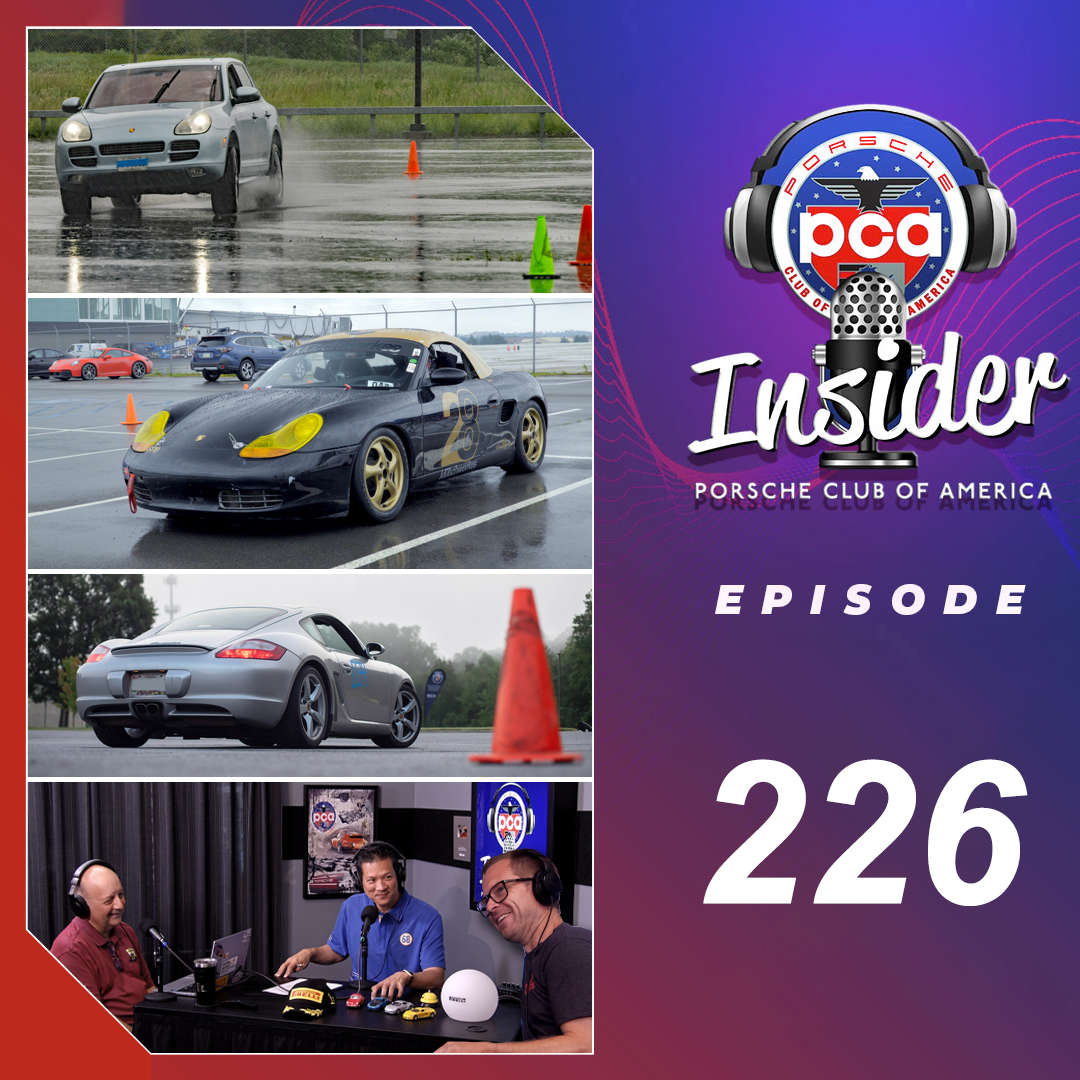
Porsche Autocross Adventures: Cayenne, Spec Boxster, and Cayman Review
About this episode
Porsche Club Insider dives into PCA Parade chatter, including online debates about Porsche’s lineup and why the Cayenne EV seminar drew record interest. The hosts defend the event’s car choices, noting Porsche’s US heritage resources are limited and that budgets and availability shape what shows up. The conversation then shifts to autocross prep and lessons learned, especially around a 356 project and the risks of breaking in a fresh engine. They also discuss autocrossing a Cayenne as a practical, fun fallback when other cars aren’t ready.
On this episode, we recap our recent autocross adventures at the Porsche Parade and with the Chesapeake Region. We share our driving impressions from a rainy-day racing Vu's Cayenne, Damon's first time behind the wheel of a Spec Boxster, and Manny's experience driving Damon's Cayman. Plus, we cover the latest Porsche news, preview upcoming PCA events, and share an exclusive update on our next video releases.

Porsche Macan EV
"that Porsche brought their Macan EV, and I don't know if they mentioned the Cayenne EV,"
The Porsche Macan EV is Porsche’s electric SUV. It’s basically the Macan, but powered by electricity instead of a traditional engine.
The Porsche Macan EV is the electric version of Porsche’s Macan SUV line. It’s notable because Porsche is using the Macan nameplate to bring EV packaging and power delivery into a familiar performance-SUV shape.
Cayenne EV seminar at Tech Tactics at Parade
"for those who were wondering, like I said, I think last week, the Cayenne EV seminar at Tech Tactics at Parade was the most popular one we had,"
They’re talking about a special event talk about the Cayenne EV. The hosts say it attracted more people than expected.
This segment highlights a specific event format: an EV-focused seminar tied to a Porsche club gathering. It’s used to explain why the Cayenne EV talk drew unusually high interest.

Porsche Carrera GT
"We had the 19. We had the Carrera GT. We had all three Club Coops."
The Carrera GT is a rare, high-performance Porsche supercar. People like it because it’s special and fun to drive, not just a normal road car.
The Porsche Carrera GT is a supercar that’s known for its V10-era Porsche identity and track-focused character. In Porsche enthusiast circles, “Carrera GT” is often used to refer to the Carrera GT supercar that’s prized for its rarity and driving feel.
record breaking parade with 2,600 people
"as you said, it was a record breaking parade with 2,600 people. I mean, it was, we've said this before, like the town was 2,100 people."
They’re talking about how big the event was—about 2,600 people. That crowd size is part of why the EV seminar got so much interest.
The hosts frame the event’s popularity with crowd-size comparisons, emphasizing how many people showed up. This helps explain why certain EV discussions drew attention.
autocross
"Autocrossing. So I got to say this year, I've been lagging... I think some of you might know the car that I typically Autocross is my 996..."
Autocross is a timed driving event on a closed course with cones. You drive through a layout that tests how well the car handles and how smoothly you can steer.
Autocross is a motorsport where drivers run a car through a marked course with tight turns and cones, usually on a closed lot or airfield. It emphasizes steering response, grip, and driver technique more than outright top speed.
battery tender
"At least I have a battery tender on the car. I have a"
A battery tender is a smart battery charger/maintainer that keeps a car’s battery at the right voltage while the vehicle sits. It’s commonly used to prevent battery drain and sulfation when a car isn’t driven regularly.

Porsche 356
"Heck, you got your 356. Yes, but the 356... You post your whole life on Facebook. ...the 356 project was so that I could Autocross it at Parade..."
The Porsche 356 is a classic early Porsche sports car. Here, the speaker is working on a 356 project so it’s ready for autocross events.
The Porsche 356 is an early, lightweight Porsche sports car that’s famous for its classic shape and for being a popular platform for vintage racing and autocross. In this segment, the host is talking about a Porsche 356 project build and how they’re preparing it to autocross at Parade.
pits and seals
"Just send it at Autocross and they all kind of debated it at dinner. Because usually that's just for the pits and seals to set, right?"
“Pits and seals” is shorthand for the sealing surfaces and components inside an engine that need time to seat properly after rebuild—often discussed in the context of piston rings and cylinder sealing. The host contrasts that traditional approach with the idea of using autocross to help the engine settle.
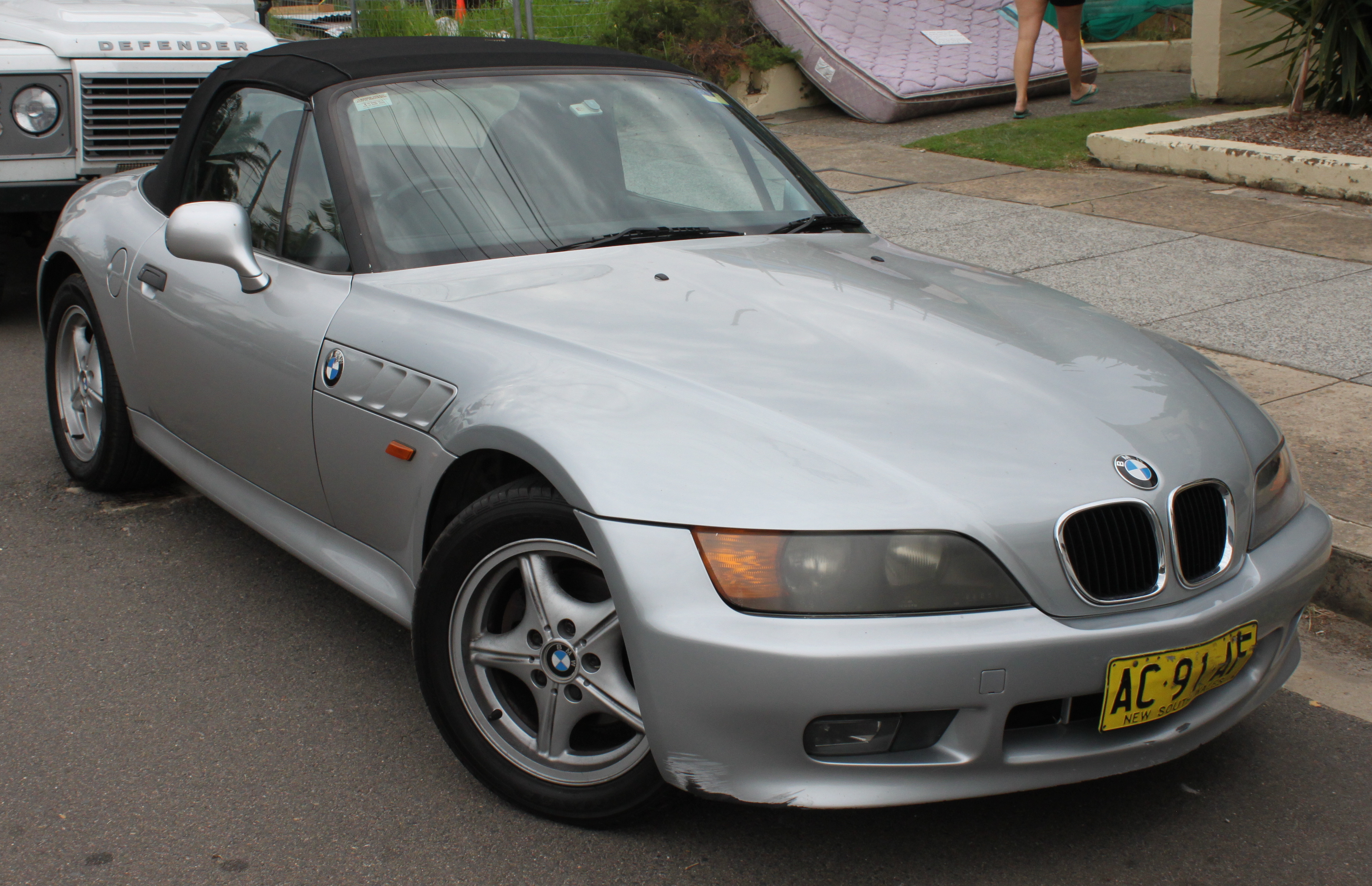
BMW Z3
"Remember the time I had Autocross my Z3 at BWI parking lot? Yeah. And even though I daily drive that car, when you are ragging a car out, that's when you're pushing it to the limit"
The BMW Z3 is a small two-seat roadster. The speaker mentions it because when they pushed it hard at autocross, they learned where the car’s cooling system maxed out.
The BMW Z3 is a compact roadster known for its classic, fun-to-drive character and for being a common enthusiast platform. Here, the host uses their BMW Z3 autocross experience to explain how hard driving can reveal limits in the car’s cooling system.
BMW cooling system
"when you are ragging a car out, that's when you're pushing it to the limit of the BMW cooling system."
The cooling system keeps the engine from overheating by circulating coolant and dumping heat. The speaker is saying autocross can stress it more than everyday driving.
A car’s cooling system manages engine temperature by moving coolant through the engine and radiator, then rejecting heat to the air. The host is pointing out that autocross-style driving can push the cooling system harder than normal daily driving.

Porsche 928
"Nathan and I were going to meet for that, that video that'll be coming out. And with Frank Young driving the 928 and he said, meet me by booze 356."
The Porsche 928 is a Porsche grand tourer that uses a V8 engine. In this segment it’s just the other Porsche being referenced while they’re trying to locate the 356.
The Porsche 928 is a grand-touring Porsche from the late 1970s through the 1980s, built around a front V8 layout rather than the brand’s more famous rear-engine cars. Here it’s mentioned as the car Frank Young is driving, contrasting with the classic Porsche 356 coupe they’re meeting up to find.
starter relay
"And it's really, it's the trigger wire for the relay for the starter. For whatever reason, the connector either wasn't, you know how sometimes when you use a spade connector, you kind of have to press the ends of the connector a little bit to make it tighter."
A starter relay is like a heavy-duty electrical switch that helps the car’s starter engage. If the relay trigger wire connection is loose or damaged, the starter may not get the signal to crank the engine.
A starter relay is an electrically controlled switch that sends high current to the starter motor when you turn the key. In this segment, the speaker says a specific wire is the trigger for the relay, which explains why the car sometimes won’t crank after the connection rubs or comes loose.
spade connector
"For whatever reason, the connector either wasn't, you know how sometimes when you use a spade connector, you kind of have to press the ends of the connector a little bit to make it tighter."
A spade connector is a plug-style electrical connection that can feel seated but still be slightly loose. If it isn’t tight, the car may start sometimes and fail to start other times.
A spade connector is a flat, fork-like electrical terminal that slides onto a mating post or blade. The speaker suggests that spade connectors sometimes need extra pressure to sit tightly, and that a loose fit can cause intermittent starting problems.
relay kit
"I think because I used a relay kit so I can bypass the ignition for running all the power to the starter. So anyways, I think that was not crimped very well."
A relay kit is an aftermarket wiring solution that uses relays to route power more safely and efficiently, often reducing load on the ignition switch or improving starting reliability. Here, the speaker says they used a relay kit to bypass the ignition for running power to the starter, which changes how the starter circuit is triggered.
crimped
"And so before I put it on the trailer, I even got a little scope. I crimped it, I put it on there, I took the scope to look at it to make sure it was on there nice and tight."
Crimping is how you permanently attach an electrical connector to a wire. If the crimp isn’t tight enough, the connection can fail when the car vibrates or heats up.
Crimping is the process of mechanically compressing a metal terminal onto a wire so it makes a reliable electrical connection. The speaker’s issue appears to be a poor crimp on the starter trigger wire, so they re-crimp it and then verify it’s secure.
zip tied
"I also zip tied it so that even if it wanted to come loose, the zip tie would kind of hold it into position."
A zip tie is a plastic fastener you can use to hold wires in place. Here it’s used to help keep the electrical connection from vibrating loose.
Zip tying is using a plastic cable tie to physically secure a wire or connector so it can’t move or pull apart. The speaker uses zip ties as a backup to keep the starter trigger connection from coming loose while driving.
production
"So stock then production? Does that work? So stock is Wednesday and then production. You should get prepared, but now it's production."
In autocross, “production” is a class meant for cars that are basically stock. The idea is to keep the competition fair by limiting how much you can modify the car.
In autocross, “production” refers to a class where cars are expected to be close to stock (production) configuration, with only limited allowed changes. The speaker is discussing which class they can run based on how closely their Cayenne matches the rules.
stock
"Technically, my car is stock. Yeah, I think technically it is stock, the Cayenne. I don't think I've heard that one before."
“Stock” means the car is basically as it came from the factory. In racing classes, being “stock” usually means you can’t do big performance modifications.
“Stock” means the car is in its factory configuration (or as close as the rules allow). The speaker emphasizes that, technically, their Cayenne is stock even if they’ve made changes like removing items and choosing tire types to fit the class.
S, P, and I
"Well, I mean, I think of it as S, P, and I. Exactly. So whatever the P means, production or prepared."
Those letters are shorthand for different autocross categories. They determine what kind of car setup is allowed, so it matters which one you’re entered in.
“S, P, and I” appears to be shorthand for autocross class categories used by the event’s rule set. The host is trying to recall what each letter stands for (they mention “production or prepared”), which affects what modifications are allowed.
summers
"You got all seasons on there, right? Or you got summers. I've got summers."
“Summers” are tires made for warm weather. They usually grip better in dry, warm conditions, but they’re not ideal in cold or snowy weather.
“Summers” refers to summer tires—rubber compounds designed for warm weather that generally provide better grip than all-seasons in dry conditions. The host contrasts this with all-seasons used in winter, which can feel slippery when temperatures drop.
all seasons
"I thought I ordered all seasons and I took it out in the snow and it was sliding all over the place."
All-season tires are meant to be a compromise for different weather. They can be okay year-round, but in deep winter or snow/ice they may not grip as well as winter tires.
“All seasons” are tires designed to work across a range of temperatures and conditions, but they’re a compromise compared with dedicated summer or winter tires. The speaker’s winter story illustrates how all-seasons can still be hard to manage when the roads are cold and slick.
Pirelli P Zeroes
"Yeah, they're P zeroes. Oh, wow. So I got to say. It's Soto zero for the winter."
Pirelli “P Zero” tires are made for strong grip, mostly in warm or normal weather. They’re not the same as winter tires, which are designed to bite in snow and cold.
“P Zero” is Pirelli’s performance tire line, typically aimed at dry-to-wet grip rather than deep snow traction. In this segment, the host is contrasting it with winter tires and explaining why the tire choice matters in snow and cold conditions.

Ford F150
"the all seasons are. So where does Scorpion play into this? I think that's like the off-road, like you bought a Raptor, F-150 Raptor, and you want to take it off-road. Yeah. So that mistake actually worked in my favor or as I thought would work in my favor in the autocross. And so"
The Ford F-150 is a large pickup truck. People use it for hauling, towing, and general driving, and some versions are set up for off-road use. It comes up a lot because it’s a common choice for both work and weekend driving.
The Ford F-150 is a full-size pickup truck known for being widely used for work and everyday driving. It’s frequently discussed in the context of off-road and all-season capability because different trims and packages can be aimed at tougher terrain. In the podcast context, it sounds like the conversation is tying the F-150 line to off-road-focused variants like the Raptor.
torrential rain
"Thursday was terrible rains. But if I can get like to 50, 51... Thursday was torrential rain. I don't know if, um, Damon has some of the video here..."
“Torrential rain” describes extremely heavy rainfall, which dramatically changes tire grip and braking/acceleration behavior. In autocross, it can turn a normal traction problem into a near-hydroplaning or sideways-control challenge.
hydroplaning
"it was raining sideways. There was rivers going across. There's a video that there, uh, I don't know if we have it or not."
Hydroplaning happens when water builds up between the tire and the road surface, reducing traction and making the car harder to steer. The host’s description of “raining sideways” and “rivers going across” is consistent with conditions that can trigger hydroplaning during high-speed sections.

Ford F-150 Lightning
"...o the events. Um, Paul Kudrow and team, it wasn't lightning. It was just lots of rain. And so we, we soldiere..."
The Ford F-150 Lightning is a pickup truck that runs on electricity instead of gasoline. It’s built to do the same kind of truck tasks, but with an electric motor. The podcast mention sounds like it was connected to an event where rainy weather was part of the story.
The Ford F-150 Lightning is an electric version of the Ford F-150 pickup, combining the practicality of a truck with an all-electric powertrain. It’s often discussed in contexts like weather and real-world driving because electric trucks can behave differently than gas trucks in traction and power delivery. In the podcast, the “it wasn’t lightning… lots of rain” line suggests the conversation is about an event where conditions mattered.
all-wheel drive
"here's where 5,000 pounds all wheel drive and summer Pirelli's. I'm like, I'm going to send it."
All-wheel drive means the car powers both the front and rear wheels. That can help it stay in control when the road is wet or slippery.
All-wheel drive (AWD) sends power to more than just the front or rear axle, helping the car maintain traction when conditions are slippery. In autocross rain, AWD can help reduce wheelspin and keep the car moving forward more consistently.
summer Pirelli's
"here's where 5,000 pounds all wheel drive and summer Pirelli's. I'm like, I'm going to send it."
Summer tires are built for warm weather. In cold or snowy conditions, they don’t grip as well as winter tires.
“Summer tires” are designed to work best in warm temperatures, using rubber compounds and tread patterns optimized for dry and wet grip. They generally lose effectiveness in cold weather and can struggle in snow compared with dedicated winter tires.
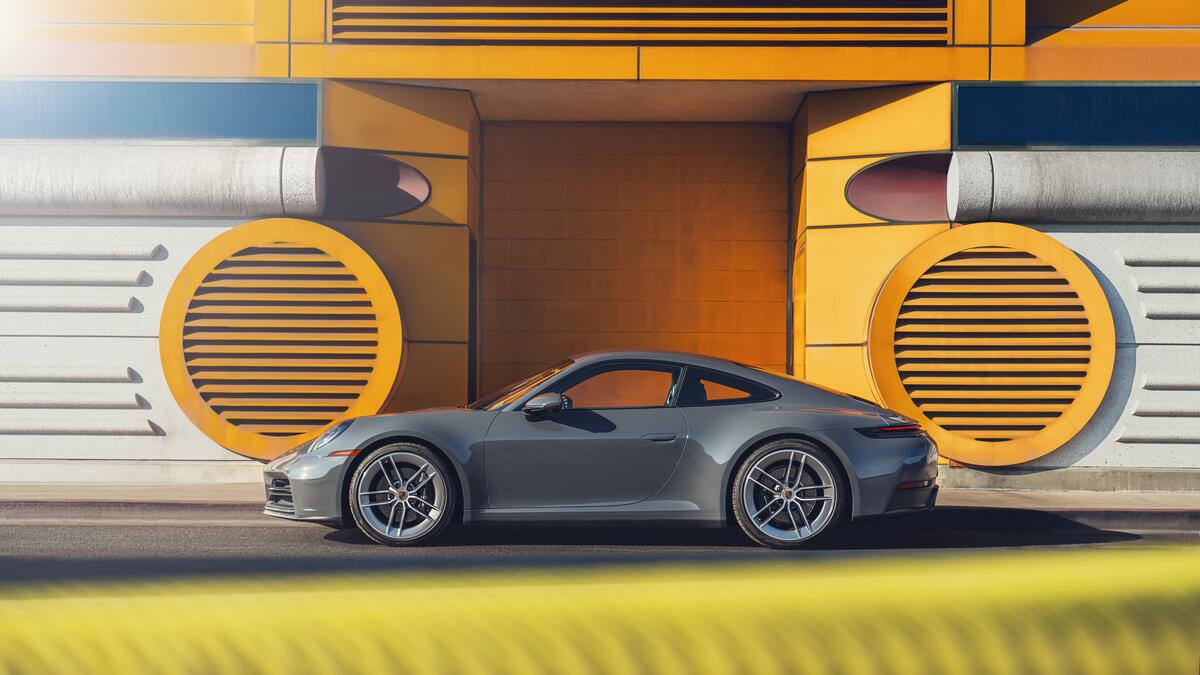
Porsche 911 GT3 RS
"In fact, there was a GT3 RS in front of me that I think I only look so it's slower than him in three runs, three out of four"
The Porsche 911 GT3 RS is a track-focused 911 variant built for maximum grip and lap-time performance, with a strong emphasis on aerodynamics and chassis balance. Here it’s referenced as a benchmark car in the autocross flow, with the host noting relative pace in multiple runs.

Porsche Cayenne
"runs. And if you've never ought to cross your Cayenne, do it just for the fun of it, because you'll be surprised at how capable, how very capable a Cayenne is. Here's the run. If you're watching YouTube, if you're watching on YouTube, this is up there."
The Porsche Cayenne is Porsche’s SUV. Even though it’s not a sports car, it can still do really well on autocross tracks where you have to turn quickly and stay on the right path.
The Porsche Cayenne is Porsche’s performance-oriented SUV, known for being surprisingly capable on tight, twisty courses despite its size. In this segment, the host is using it in autocross to show how well it can keep speed and follow the course compared with expectations for an SUV.
line
"Oh, six. I don't learn anything from an in-car video. Well, you can, what you can learn is the line. You can't learn the line. Yes, you can."
In driving, the “line” is the specific path you choose through a corner or sequence of corners. Learning the line helps you place the car where it can maintain traction and speed, especially in autocross where the course is tight and repeatable.
slicks
"including the car that Damon got to drive that were on slicks or on very aggressive stickies. Once you got up to speed on some of these crossings, these water crossings, like you could see like the car standing water."
Slicks are race tires with no tread pattern, designed to maximize contact patch and grip on dry pavement. They generally perform poorly in wet conditions because there’s no tread to evacuate water.
stickies
"including the car that Damon got to drive that were on slicks or on very aggressive stickies. Once you got up to speed on some of these crossings, these water crossings, like you could see like the car standing water."
“Stickies” is enthusiast slang for very grippy tires, typically with a sticky compound and/or tread designed for high traction. In autocross, tire grip can be the difference between maintaining speed through corners and losing time to wheelspin or sliding.
water crossings
"Once you got up to speed on some of these crossings, these water crossings, like you could see like the car standing water. You're done."
“Water crossings” are sections of an autocross course where the surface is wet or flooded, creating a sudden traction and visibility challenge. The host notes that standing water can quickly overwhelm grip and lead to loss of control.
fiberglass hardtop
"For those not familiar with spec Boxster, most of them use a fiberglass hardtop that it's almost just a covering of the cage and no windows."
A fiberglass hardtop is a rigid roof panel made from fiberglass composite. In spec Boxster setups described here, it’s used as a lightweight, rules-compliant alternative to full factory-style windows/roofing.
cage
"most of them use a fiberglass hardtop that it's almost just a covering of the cage and no windows. Yeah. And that's it. It's just the cage is what protects you, not the little"
A “cage” is short for a roll cage—an internal metal framework installed to protect occupants during crashes. In autocross-spec cars, the cage is often the primary safety structure, with body panels or hardtops covering it.
fiberglass top
"fiberglass top, but they all have to run this fiberglass top. Yep. Yep. And the cars are"
Fiberglass is a lightweight material. A fiberglass top means the roof/upper panel is made to be lighter than normal, which helps the race car stay light and handle better.
A fiberglass top is a lightweight body panel/roof made from fiberglass composite instead of heavier materials. In spec racing, mandated lightweight parts help keep vehicle weight down and make the cars more consistent across competitors.
coilovers
"I forget what's on the car. I think it might be motion control. Coilovers. It's stripped."
Coilovers are suspension parts that control how the car rides and grips the road. They can often be adjusted so the car sits right and handles better for racing.
Coilovers are adjustable suspension units that combine a coil spring with a shock absorber. They’re commonly used in track and autocross setups because they let teams fine-tune ride height and damping for grip and balance.
race seat
"Coilovers. It's stripped. It's got the race seat. It's got no exhaust."
A race seat is a special seat for motorsport that keeps you held in place during aggressive driving. It usually has stronger side support and works with a racing harness.
A race seat is a purpose-built bucket seat designed to hold the driver firmly during hard cornering. Compared with a street seat, it typically has deeper side bolsters and a harness-friendly shape to improve control and safety.
DOT legal
"So they're technically DOT legal in the sense that, you know, technically they are legal."
“DOT legal” means the tire is approved under U.S. rules to be used on public roads. But that doesn’t necessarily mean it’s good in rain or for every driving situation.
“DOT legal” means the tire meets U.S. Department of Transportation requirements for road use, even if it’s still a track-oriented tire. It’s a regulatory label, not a guarantee of wet-weather performance or everyday drivability.
rain tire
"Or at least what the, I'm sure the club racers use a. Rain tire. A rain tire, a Toyo rain tire."
A rain tire is made to grip when the road is wet. It has tread that helps push water out so the tire can keep traction.
A rain tire is designed with tread patterns and rubber compounds that evacuate water and maintain grip on wet surfaces. In autocross, the “right” tire matters because wet or cooling conditions can quickly change traction and lap-to-lap consistency.
tire cool down
"You aren't doing this for award standard. The reason they do that for the autocross is there's no five minutes for the tires to cool down to make things even."
Tires get hot during a run, and then they cool off afterward. If they cool too much before the next run, they can grip worse—so event timing rules try to keep things fair.
Tire cool down is the drop in tire temperature between runs, which can reduce grip because tire compounds and tread behavior are temperature-dependent. Autocross rules often manage timing so conditions are as fair as possible between drivers.
weight period
"So it's a five minute minimum weight period. But in the rain, I think the tires weren't even done."
A “weight period” here sounds like a minimum waiting window required by the event rules. The idea is to give the tires time to come up to the right temperature and grip level before the run matters.
A weight period is a rules-based minimum time window during which a driver’s tires are expected to be in a certain state (often after warming or setup) before the timed portion begins. In this context, it’s tied to how long tires need to be warmed and ready, especially in rain where grip changes quickly.
shagging cones
"So I was shagging cones at the far side, a pretty quick section of the autocross."
In autocross events, volunteers “shag” cones—meaning they pick them up and set them back in place between runs. It helps keep the event moving so drivers can get their next timed attempt.
Shagging cones is the volunteer job of quickly retrieving and repositioning cones between runs. It’s common in autocross because the course needs to be reset or adjusted so the next driver can go without delays.
stabbing the brakes
"when they were told go, like they just dropped the hammer, came up to the first corner, stabbed the brakes, and then hammered it, and then lost control"
“Stabbing the brakes” means hitting the brake pedal suddenly and hard. On a slippery autocross course, that can make the car slide or lose control because the tires can’t grip evenly.
“Stabbing the brakes” describes a very abrupt, hard brake application—often too sudden for the available traction. In autocross, that can unsettle the car, making it easier to lose control on wet or low-grip surfaces.
dropping the hammer
"when they were told go, like they just dropped the hammer, came up to the first corner, stabbed the brakes, and then hammered it"
“Dropping the hammer” just means pressing the gas pedal all the way down. It’s a quick, aggressive acceleration move that can be risky on wet courses.
“Dropping the hammer” is slang for flooring the throttle to accelerate aggressively. In autocross driving, it often refers to an immediate, high-power input right after a corner entry or brake phase.
best run that counts
"I always tell my students, it's your best run that counts, so don't go rocket out on the first run."
Autocross scoring often rewards your fastest attempt. So the goal is to avoid blowing the first run and instead make sure your best run is clean and fast.
In many autocross formats, only a driver’s fastest run (or best score) is used for results. That changes strategy: drivers may hold back slightly early to avoid mistakes and then push harder once they’re confident in the course.
rocket out
"I always tell my students, it's your best run that counts, so don't go rocket out on the first run."
“Rocket out” means you accelerate or launch too aggressively right away. The warning is that it can cause you to make mistakes before you’ve figured out the course.
“Rocket out” is slang for launching too aggressively—typically meaning an overly fast start that can lead to mistakes before the driver has fully learned the course. In autocross, it’s often a caution against overdriving early runs.
rolling into it
"The difference was you were smoother, more composed when you were applying the throttle... You were pushing it, but you rolled into it as opposed to Connor and Van."
“Rolling into it” means you add gas smoothly instead of flooring it instantly. That helps the tires stay hooked up, which is especially important when the track is wet.
“Rolling into it” means gradually increasing throttle rather than snapping it on. On an autocross course—especially in rain—smooth throttle application helps keep traction and vehicle balance, reducing the chance of oversteer or loss of control.
track driving
"Yeah, the difference between track driving is you have a 20-30 minute session, so if you mess up a corner, yeah, it may affect the next two or three corners, but you can get back on track."
Track driving is driving on a real race circuit for multiple laps or a longer session. If you mess up one corner, you often have more chances to improve on the next lap.
Track driving typically refers to circuit racing or lapping on a closed track with longer sessions. Compared to autocross, a mistake can affect only a few corners because you have more time and repeated opportunities to correct your line.
shifting
"So when it comes to shifting in autocross, I tend to try and get into second gear... And then I'm in second gear the whole time."
Shifting is choosing when to change gears. In autocross, the timing matters because it changes how the car pulls out of turns and how smoothly it behaves.
In autocross, shifting strategy (when to upshift and whether to stay in a gear) directly affects acceleration and how smoothly the car transitions through corners. The transcript discusses choosing between first and second gear based on where the turns and traction demands occur.
PSM
"And when it's wet, you want to avoid all that torque because you're going to lose the rear end or your PSM will come on and automatically start breaking the car."
PSM is Porsche’s electronic stability system. When the car starts to lose traction, it can automatically brake individual wheels to help you stay in control.
PSM (Porsche Stability Management) is Porsche’s electronic stability control system. In low-traction situations it can intervene by applying brakes and adjusting engine/traction behavior to help prevent loss of control.

Spec Boxster
"So you can see here, so one of the things I'll talk about with the Spec Boxer, it's a two and a half liter engine, it has less torque and the torque happens higher up in the rev range"
A Spec Boxster is a Boxster that’s set up for a more controlled, rules-based racing format. Here they’re saying its engine makes less low-end pull, so you often need to shift differently, especially when the track is wet.
The Spec Boxster is a race-prepped Boxster used in spec-style autocross/club racing, where cars are tuned to be closer in performance. In this segment, the host highlights its 2.5-liter engine character—less torque and torque arriving higher in the rev range—so shifting strategy matters more on wet runs.

2.7 liter Cayman
"and in my 2.7 liter Cayman. I'm going to put this up again and if you're on YouTube, you'll see that I shift pretty soon because I'm starting to get a little bit of wheel slip because it is so wet"
They’re comparing a 2.7-liter Cayman to the Spec Boxster. The point is that the Cayman’s engine delivers torque differently, so on a wet course you may need to shift sooner to keep the tires from slipping.
This refers to a Porsche Cayman with a 2.7-liter engine, which typically provides a different torque curve than the Spec Boxster. The host uses that difference to explain why they shift earlier in the wet—because the Cayman is starting to show wheel slip and wheel hop as torque hits the rear wheels.
wheel slip
"if you're on YouTube, you'll see that I shift pretty soon because I'm starting to get a little bit of wheel slip because it is so wet"
Wheel slip is when the tires spin but the car doesn’t move forward as intended. On wet courses, it’s a sign you’re asking for more grip than the tires can provide.
Wheel slip is when the tires lose traction and rotate faster than the car is actually moving. In wet autocross, slip often shows up as loss of acceleration control and can trigger stability systems or cause the car to rotate unexpectedly.
wheel hop
"you'll see that I shift pretty soon after the car starts to shake and that's because I'm getting a little bit of wheel hop right there."
Wheel hop is when the tires start bouncing because they keep losing and regaining traction. It usually means the car is getting too much torque for the surface.
Wheel hop is a bouncing or chattering of the driven wheels caused by traction breaking and re-gripping rapidly. It’s common when torque is applied too aggressively for the available grip, especially on wet or uneven surfaces.
torque
"But I grabbed it and went from second to first again and it gave me all the torque to kind of launch up the hill."
Torque is the engine’s pulling force. Higher torque at the right moment helps you launch harder out of a corner.
Torque is the twisting force an engine produces, and it largely determines how strongly the car can accelerate at a given RPM. The host mentions getting “all the torque” when shifting back into first to launch up the hill.
PDK
"And that's why I would love to have a PDK car to autocross at some point because you can do things like that to maybe get an advantage."
PDK is Porsche’s automatic-style gearbox with two clutches. It can change gears quickly, which helps you stay in the right power band during fast cornering.
PDK is Porsche’s dual-clutch transmission. It uses two clutches to pre-select the next gear, so upshifts and downshifts can be very fast—useful in autocross where keeping momentum matters.
heel toe
"My success with that, I can heel toe into first perfectly 95% of the time and my upshifts are quick, just as quick."
Heel-toe is a technique for downshifting smoothly. You brake and give a quick throttle blip at the same time so the engine speed matches the lower gear.
Heel-toe is a driving technique used during downshifts where the driver uses the right foot to brake while “blipping” the throttle with the toe. It helps match engine RPM to the lower gear so the car shifts smoothly without upsetting traction.
carry more momentum
"But it also teaches you to carry more momentum. It does. So you don't let it drop."
Carrying momentum means you don’t lose speed in the corner. The host is saying the right gear choice helps the car stay fast and smooth instead of bogging down.
In autocross and road racing, “carrying momentum” means keeping the car’s speed and energy through a corner rather than slowing down too much. The host argues that staying in the right gear helps prevent RPM from dropping, which keeps acceleration available when you exit.
lap times
"But I started looking at my lap times and they were getting worse. Because you weren't carrying as much speed?"
Lap times are the measured durations for completing a circuit or a defined course segment. Here, the host uses lap-time changes as feedback that downshifting strategy affected smoothness and speed through the corner.
shift costs
"they say the least amount of shifting, I forgot how many seconds or half second, [1893.5s] whatever a shift costs you. So yeah, it's kind of smart sometimes to shift into second"
When you shift gears, it can slow you down a little because the car’s power delivery changes. In autocross, those small slowdowns add up, so drivers try to shift as efficiently as possible.
In autocross driving, “shift costs” refers to the time lost and momentum disrupted when you change gears. Since autocross courses are short and turns are frequent, minimizing gear changes can improve lap time.
understeer
"there's enough [1942.2s] to play around with, have some fun, feel out the slip from the rear, the oversteer and the understeer."
Understeer is when the car doesn’t turn in enough. Instead of following the corner, it tends to push wide, and the driver may need to adjust speed or inputs.
Understeer is when the front tires lose grip first, so the car doesn’t turn as much as the driver wants. It’s commonly felt as “pushing” toward the outside of a corner and is influenced by tires, suspension setup, and driving inputs.
oversteer
"there's enough [1942.2s] to play around with, have some fun, feel out the slip from the rear, the oversteer and the understeer."
Oversteer is when the back of the car wants to swing outward more than you planned. Drivers often try to control it so the car stays pointed where they want.
Oversteer is when the rear of the car rotates more than the driver expects, often because the rear tires have less grip than the front. It can be managed with throttle and steering, and it’s a key part of how drivers “read” a car’s balance.
slip from the rear
"there's enough [1942.2s] to play around with, have some fun, feel out the slip from the rear, the oversteer and the understeer."
This is about the back tires losing some grip. When that happens, the car may rotate a bit, and the driver can feel it and adjust to keep control.
“Slip from the rear” describes how the rear tires lose traction and rotate slightly relative to the car’s direction. Drivers use that feedback to judge balance and to manage oversteer/understeer during cornering.
roll bars
"It's got basically coilovers and a roll bars [1974.0s] and the mounts for all that stuff. And that's it for suspension and square setup."
Roll bars help keep the car from leaning too much in turns. Changing them can make the car feel more stable or more willing to rotate.
Roll bars (sway bars) connect the left and right sides of the suspension to reduce body roll during cornering. Stiffer roll bars can make a car feel more responsive, while softer settings can improve ride compliance and traction.
differential
"Yeah, but lightweight flywheel and differential. Different differential. [1984.7s] And the lightweight flywheel doesn't really do probably anything."
The differential is what lets the left and right drive wheels spin at different speeds when you turn. Changing it can change how the car grips and handles in corners.
The differential is the gearbox component that allows the driven wheels to rotate at different speeds while turning. In performance cars, differential choice (and tuning) strongly affects traction and how the car behaves when you’re loading the rear in corners.
lightweight flywheel
"Yeah, but lightweight flywheel and differential. Different differential. [1984.7s] And the lightweight flywheel doesn't really do probably anything."
A lightweight flywheel helps the engine spin up and down faster. That can make the car feel more responsive, especially when you’re changing throttle often.
A lightweight flywheel reduces rotational mass, which can make the engine respond more quickly to throttle changes. In practice, it can improve how fast the car revs and how responsive it feels, though it may also change drivability.
Toyo proxy Rs
"It just felt sharper, you know, in those Toyo proxy Rs. Those are racing tires, stiff sidewall. It was just a very connected experience."
This is a specific kind of tire (from Toyo) that’s popular for autocross. It’s designed to respond quickly to steering inputs, so the car feels more precise and predictable.
“Toyo proxy Rs” refers to a specific autocross-oriented tire model from Toyo. These tires are known for a stiff sidewall and responsive grip, which helps the car feel more immediate and “connected” during steering and cornering.
stiff sidewall
"Those are racing tires, stiff sidewall. It was just a very connected experience. You could feel what the car was doing through the steering wheel..."
The sidewall is the tire’s “wall.” If it’s stiff, the tire doesn’t squirm as much, so the car feels sharper and easier to steer.
A stiff sidewall means the tire’s side portion resists flexing under load. That reduces delay between steering input and tire response, which is why the driver can feel the car’s behavior more clearly through the wheel and seat.
countersteer
"my third run in the Boxer, I didn't have a single point of countersteer at all. Period. I went through that."
Countersteer is when you quickly steer the opposite way to correct a slide. If you don’t need it, it usually means the car is behaving predictably.
Countersteer is the steering correction you make when the car starts to rotate more than you intended. In autocross terms, avoiding countersteer usually means the car is staying balanced and not surprising you at the limit.
spec Boxer
"So that's a little spec Boxer trip. So are you tempted to gut your car to get that, get that sort of direct feel?"
“Spec Boxer” is an autocross class where cars are kept closer to stock (or limited by rules). That helps make the competition more about driving rather than who spent the most money.
“Spec Boxer” is an autocross class concept where a Subaru “Boxer” engine car is prepared to a rules-limited, near-spec setup. The point is to reduce differences between cars so driver skill and setup within the rules matter more than expensive custom builds.
spec Cayman
"They have a 987, right? There is spec Cayman, spec SPC. And that is 987.1 Caymans, I believe."
This is an autocross category for the Porsche Cayman where the rules limit how much you can modify the car. The goal is to keep cars more comparable so driving matters more.
“Spec Cayman” refers to an autocross class (or ruleset) built around the Porsche Cayman, with preparation limited to keep competition fair. The speaker contrasts it with “spec Boxer,” implying different levels of participation and cost barriers.
gut your car
"So are you tempted to gut your car to get that, get that sort of direct feel? They have a 987, right? There is spec Cayman, spec SPC."
“Gut your car” means removing interior parts to save weight. It can make the car less comfortable, so it’s a bigger decision if you still want to use it day-to-day.
“Gut your car” means stripping out interior components (like door panels and carpet) to reduce weight and improve feel for autocross. The tradeoff is comfort and practicality—especially if you still want to drive the car on the street.
spec SPC
"There is spec Cayman, spec SPC. And that is 987.1 Caymans, I believe."
“Spec SPC” sounds like a rules-based autocross class. It’s meant to limit modifications so cars compete on a more even footing.
“Spec SPC” appears to be a specific autocross preparation class/ruleset mentioned alongside “spec Cayman.” In this context, it likely defines what modifications are allowed and what tire/weight/setup constraints apply.

Porsche 944 S2
"It was my old 944 S2. I regret gutting that thing. And I never finished it, you know, because I was young, dumb, didn't have the time or the space."
The Porsche 944 S2 is a classic Porsche from the 944 family. Here it’s used as a cautionary example: removing interior parts to save weight can make the car less enjoyable and harder to finish.
The Porsche 944 S2 is a front-engine, rear-transaxle 2.5-liter-era 944 variant known for its balanced feel and classic 1980s/early-1990s Porsche packaging. The speaker brings it up as an example of regretting a “gutting” weight-loss approach because it can hurt usability and completion.
sock class
"when I built my race car, I knew exactly what sock class I was going to go for, what I could, what I couldn't do on it."
They’re talking about the race “class” rules—what kind of car you’re allowed to run. If you know the class rules first, you can build your car to fit them instead of wasting money on changes that won’t be allowed.
The speaker appears to mean a “spec class” (transcribed as “sock class”), which is a defined racing category with specific rules about what the car must be and what modifications are allowed. Knowing the class ahead of time determines what you can build (and what you must leave alone) so the car remains eligible for competition.
Spec 996
"people that have ran in Spec Boxster or Spec Kame or Spec 996 that they're kind of ready to move on to the next level."
“Spec 996” means a Porsche 911 (the 996 generation) prepared for a specific rules-based racing class. The rules limit what you can change so different cars stay more evenly matched.
“Spec 996” refers to a spec-class preparation for the Porsche 911 generation known as the 996. In a spec class, the rules typically constrain modifications so cars remain comparable, which is why drivers often move from one spec class to another as they progress.
Spec Kame
"people that have ran in Spec Boxster or Spec Kame or Spec 996 that they're kind of ready to move on to the next level."
“Spec Kame” sounds like another rules-based racing class, similar in spirit to Spec Boxster. The goal is that cars are prepared to the same rules, so the competition is more about driving than random build differences.
“Spec Kame” is another spec-class name the speaker references alongside Spec Boxster, implying a rules-based Porsche autocross/club racing category. The key idea is that these “Spec” classes standardize preparation so drivers can compete with less variation between cars.
tires
"I'm sure if it were drier on those tires, that would have been, you know, potentially a top time of day contender."
Tires are the part of the car that actually touches the ground, so they control grip. If the weather changes (like getting drier), tires can work better and help you go faster.
In autocross, tire condition and grip level can be the difference between a competitive run and a slower time. The speaker notes that if it were drier, the tires would likely provide more consistent traction, potentially improving lap performance.
time of day contender
"potentially a top time of day contender, you know, with at least the car's capabilities."
“Time of day” is basically the best lap time people set during that part of the event. A “contender” is someone who has a real chance to be near the top.
“Time of day” refers to the fastest overall run among the cars in a given session window, often used in autocross/club events to rank drivers. Being a “contender” means the car and driver combination has a realistic shot at the top times under the day’s conditions.

Porsche 911 GT3
"And was it improved or? I don't remember. But he beat, he got a 44 or 45 and beat David Critcher in his GT3 on cup two."
The Porsche 911 GT3 is a performance-focused 911 meant for track driving. In this segment, they’re talking about how a GT3 did well in autocross, especially because of the tires it was running.
The Porsche 911 GT3 is a track-focused 911 variant built around high grip and lap-time performance, typically using race-bred tires and aggressive setup. Here it’s specifically referenced in the context of autocross competition on “cup two” tires, tying the car’s performance to tire choice and wet-weather traction.
cup two
"But he beat, he got a 44 or 45 and beat David Critcher in his GT3 on cup two. He's not cup two ours anymore."
“Cup Two” is a type of performance tire. The host is saying the car was running that tire model, which matters a lot for grip and lap times, particularly when the course is wet.
“Cup Two” refers to Michelin Pilot Sport Cup 2 tires, a motorsport-oriented street tire designed for high grip and strong performance under heat. In autocross, tire choice is often the biggest lever for traction—especially in rain—so calling out Cup 2 ties directly to why a car could post faster times.
Porsche 356 Coupe
"There are a lot of cars driving in the rain, especially Tom Tate drove his 356 Coupe, Ed Mayo and his 911 S."
The Porsche 356 Coupe is a classic early Porsche from the 1950s/60s era. The host is pointing out that even this older model was out autocrossing in the rain.
The Porsche 356 Coupe is one of Porsche’s earliest production models, celebrated for its classic shape and lightweight, nimble driving character. Mentioning it in an autocross context emphasizes how older air-cooled-era Porsches can still be competitive in tight, low-speed events—especially when conditions are wet.
trophy
"So you ended up, uh, you ran for trophy. So the funny part is, uh, I was running as though I was competing against others, but, uh, there was a, you bumped up to a higher class."
A “trophy” means an award for doing best in the event. The speaker is saying they earned one because of their results in their group.
In autocross, “trophy” refers to winning awards based on class results or overall timing. Here, the speaker says they “trophyed,” meaning they earned a top finish even though the competition in their class didn’t fully show up.
higher class
"but, uh, there was a, you bumped up to a higher class. Yeah. There's a Panamera."
Autocross cars are sorted into groups (classes) so the competition is fair. If you get moved to a higher class, you’re usually racing against stronger cars.
In autocross, cars are grouped into classes based on rules like vehicle type and modifications, so competitors race against similar setups. Getting “bumped up” to a higher class means you’re competing against faster or more modified cars under that class’s rules.

Porsche Panamera
"There's a Panamera. There was a Panamera in my class and they didn't even show up."
The Porsche Panamera is Porsche’s four-door car. In this story, it’s brought up because it was in the same autocross group/class, even though it didn’t show up.
The Porsche Panamera is Porsche’s four-door sedan, designed to combine comfort with performance. Mentioned here as a competitor in the same autocross class, it highlights how different Porsche body styles can end up racing together under class rules.
demo runs
"And they moved just doing a demonstration. Yeah. Demo runs."
Demo runs are practice/show drives, not the main timed competition. They’re there to demonstrate the car, not to race for trophies.
“Demo runs” are non-competitive passes where a car is driven to show what it can do, rather than to score points or set official results. In this segment, it explains why some cars didn’t fully compete.
timed laps
"If you haven't tried autocrossing, it's a lot of fun. You'll learn the capabilities of your car in a very controlled environment... You got to run the drive. He ran, he ran a 49 and a half and I ran a 52."
In autocross, you’re timed while you drive the course. Your best time is what decides who wins.
Timed laps are the core scoring method in autocross: each run is measured, and the fastest run (or best run per rules) determines results. The speaker’s focus on run times like “49 and a half” and “52” fits this timing-based format.

Toyota Corolla
"...not for me. I don't care if you do it in a Toyota Corolla, if you do it in your Cayenne, your 911, your box..."
The Toyota Corolla is a small, everyday car. It’s made to be practical and easy to live with, especially for commuting. In the podcast, it’s mentioned as an example of a normal car you could use for everyday driving.
The Toyota Corolla is a compact, high-volume car designed for efficient everyday transportation. It’s often brought up in conversations as a baseline example of a practical, dependable choice. In the podcast quote, it’s mentioned in a “I don’t care if you do it in…” style comparison, highlighting that the speaker isn’t focused on brand or model when making a point.
Porsche 911
"if you do it in your Cayenne, your 911, your boxer, it's so much fun. Like don't be intimidated."
The Porsche 911 is Porsche’s famous sports car. Autocross is a great way to learn how it turns and handles, because you’re driving on a controlled course.
The Porsche 911 is the brand’s iconic sports car, known for its rear-engine layout and balance. In autocross, that layout often makes the car feel responsive and predictable as you learn how it rotates through corners.
tornado watch
"It was tornado watch. We canceled the runoff."
A tornado watch means the weather could turn into tornadoes. For driving events, that kind of weather can be dangerous because the roads get slick and visibility drops.
A tornado watch is a weather alert indicating conditions are favorable for tornadoes to form. In motorsport, severe weather like this can drastically reduce tire grip and visibility, which is why events may be canceled or rerouted for safety.
runoffs
"Yeah. And again, shout out to Megan and the team for the runoffs so that we don't burn up Porsche's tires on the cars that they brought. They brought brand new sets of Pirelli's for the runoff and we didn't even get to use them."
Runoffs are extra space next to the course for safety. If a car goes off-line, the runoff area helps reduce the chance of a crash.
Runoffs are the safety areas next to a course where cars can slow down or stop if they leave the main driving surface. In autocross/track events, they’re part of the safety design—especially important when weather reduces tire grip.
limits of the car
"Yes. Uh, but it's really hard to tell the limits of the car. You have to, if Porsche puts us on a track, then it's a, you can do some fun stuff."
“Limits of the car” means how far you can push it before it stops handling the way you want. A track or autocross lets you test that safely.
“Limits of the car” refers to the maximum grip and control the vehicle can provide before traction, braking, or steering performance falls off. On track or autocross, you can probe those limits repeatedly and safely, which is why it’s harder to judge from everyday street driving.
course
"I walked the course twice... it was a pretty straightforward course... if you look, you can see a straight line and what, and then you got to turn around"
In autocross, the “course” is the cone-marked driving layout that determines where you turn, brake, and accelerate. Course design strongly affects strategy—fast sections reward momentum, while tight sections punish poor line choice.
Greg Hartke
"I think that was back, but Greg, uh, uh, Greg Hartke, the autocross chair, uh, he had done a great job with the event"
Greg Hartke is named as the person in charge of the autocross event. That usually means he helps organize the course and how the event runs.
Greg Hartke is mentioned as the event organizer for the autocross, specifically the “autocross chair.” That role typically involves coordinating the course layout, event flow, and logistics for the competition.
PCA regions
"I think, um, PCA regions have been taking some feedback... PCA in years past... has been accused of maybe having too much tightness"
PCA regions are local Porsche club groups that put on events. They can change how the autocross is set up based on what drivers say they want.
PCA regions refers to local Porsche Club of America (PCA) chapters that organize events like autocross. Different regions can adjust course design and rules emphasis based on feedback from drivers.
pylons
"I'm going to be shooting straight up this hill. I even do it as pylons and everything... quite a few sections that were like that"
Pylons are the cones that mark the autocross track. You use them to judge where to turn and how to drive through the course.
Pylons are the cone-like markers used to define the autocross course boundaries and turning points. Drivers use them as reference points for braking, turn-in, and exit lines.
second gear
"quite a few sections that were like that, that still stayed in second gear, uh, but it was very... was not a slow autocross"
Second gear is one of the transmission settings that controls engine speed. In autocross, choosing the right gear helps you stay in the power band while you change direction quickly.
“Second gear” is a specific gear selection in the transmission that affects engine speed, torque delivery, and how much acceleration you can maintain through corners. In autocross, staying in a lower gear can help keep the car responsive for quick direction changes.
pointer cones
"And I told him, I said, [2888.8s] look at the pointer cones because they had pointer cones for every cone. I'll tell you [2893.1s] which way to go."
Pointer cones are extra cones that help you understand which way the course wants you to go. They’re like visual arrows on the track so you don’t accidentally take the wrong line.
Pointer cones are additional cones used to visually “point” you toward the correct path through a gate or around a turn. In autocross, they reduce ambiguity by indicating the intended direction and line when the course is otherwise easy to misread.
Request an Explanation
Heard something you'd like explained? We'll add it to this episode.
Sign in to request explanations for terms you heard.
Want to learn more?
Browse our glossary for plain-English explanations of automotive terms, jargon, and concepts.
Help improve this episode
See something that's not quite right? Our annotations are AI-generated and can sometimes miss the mark. Click the flag icon on any annotation to suggest a correction.
1 community members have helped improve this episode.