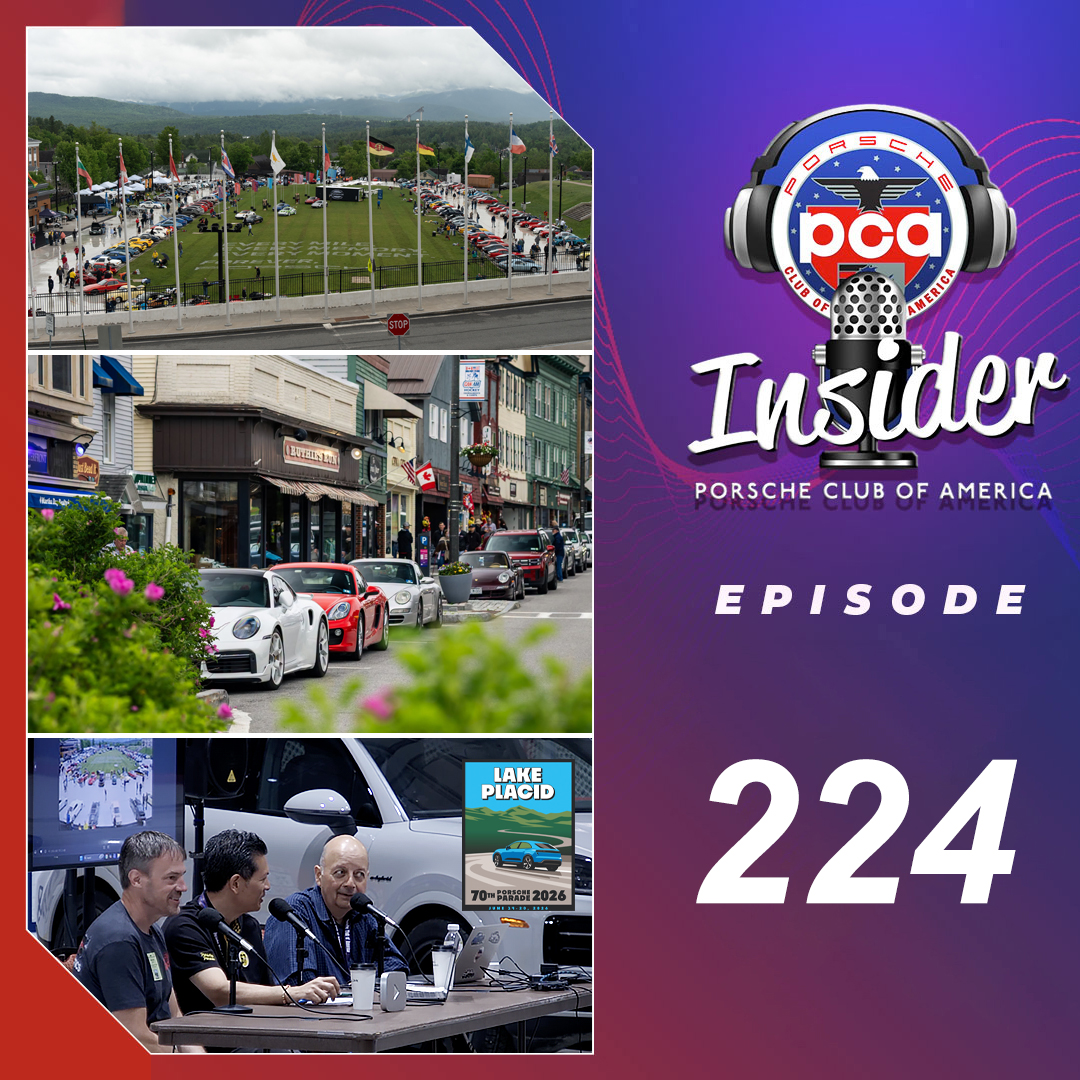
Porsche Parade Breakdown with Nathan Merz: Pixar, Classics, and the Cayenne EV
About this episode
Lake Placid sets the stage for the Porsche Parade, with Pirelli sponsorship and a huge turnout that’s compared to the town’s population. Between parade logistics, Pixar-themed display cars, and tire-compound pin trading, the conversation turns into classic-car reality: engine swaps, oil-leak scares, and break-in advice before autocross. Nathan Merz also shares a quick ride in a Cayenne Turbo EV, plus stories about concours judging details and restoring a 356 Continental from a rusted barn find.
This episode was recorded live at the 2026 Porsche Parade in Lake Placid, New York. Special guest Nathan Merz joins the show to review Lake Placid as a host city and break down the massive preparation behind the event. We dive into Vu's frantic, down-to-the-wire 356 engine installation and discuss how organizers navigated a localized marathon on day one. Plus, we share our favorite highlights from the Concours day including the Pixar Porsches—and recap Manny's first ride in the brand-new Cayenne Turbo EV.
2026 Porsche Parade
"We are in Lake Placid, New York, home of the 2026 Porsche Parade. Also, it was the home of the 1994 Parade."
The Porsche Parade is a PCA event where Porsche owners get together. It includes activities and events focused on Porsche cars and the club community.
The Porsche Parade is a Porsche Club of America (PCA) event where members gather for driving, judging, and community activities centered on Porsche ownership. This episode ties the event to Lake Placid as the host location for 2026.
Lake Placid, New York
"We are in Lake Placid, New York, home of the 2026 Porsche Parade. Also, it was the home of the 1994 Parade."
Lake Placid is a town in New York where this Porsche Parade is happening. The hosts are also referencing famous winter sports history from the same area.
Lake Placid, New York is the host location for the Porsche Parade mentioned in this episode. It’s also historically tied to major winter sports events, which helps explain why the hosts are talking about the arena and Olympics while they’re recording.
Pirelli
"Well, I will make sure that I want to thank our presenting sponsor, Pirelli. I think Pirelli tires are on that new cayenne over there to the right of us."
Pirelli is a well-known tire company. Here, they’re the sponsor, and the hosts say Pirelli tires are on a new Porsche Cayenne.
Pirelli is a major tire brand that sponsors motorsport and performance-focused road cars. In this segment, the hosts mention Pirelli tires as being on a “new Cayenne,” linking the brand to Porsche’s current lineup and tire performance/safety messaging.

Saturn Vue
"...eople don't know is it's like a 10 by 10 room and Vue must have installed a hundred thousand watts of l..."
The Saturn Vue is a compact SUV, meaning it’s a taller, more practical car for everyday driving. In the podcast, it’s mentioned because someone claims it had a very powerful sound system installed. That’s the main point of the reference—how it was used and modified.
The Saturn Vue is a compact SUV that was designed to be practical and easy to live with, with a focus on comfort and everyday usability. In the podcast context, it’s mentioned in a humorous way related to audio power—suggesting someone installed a very high-output sound system. That kind of story is typical of how the Vue can show up in real-world, owner-driven modifications rather than just performance talk.

Porsche 944
"And I'd want to know, oh, that sounds transaxle like sounds kind of. [310.6s] Oh, that's a normally aspirated 944 [313.3s] And I actually got that one wrong."
The Porsche 944 is a classic Porsche from the 1980s/early 1990s. It’s a sports car with the engine in the front and the drivetrain set up in a way that helps it handle well, and people often recognize it by how it sounds.
The Porsche 944 is a front-engine, rear-transaxle sports coupe known for its near-50/50 balance and classic 1980s/early-1990s styling. It’s also famous in enthusiast circles because its sound and layout make it a common “spot the model by noise” car at shows.
normally aspirated
"[310.6s] Oh, that's a normally aspirated 944 [313.3s] And I actually got that one wrong. [314.5s] It was a 968"
Normally aspirated means the engine doesn’t use a turbo or supercharger to push air in. It relies on normal airflow, which can make the throttle response and engine sound feel different from turbo cars.
Normally aspirated (NA) means the engine draws air in naturally without a turbocharger or supercharger. That usually changes the sound and how the engine responds—often making NA cars feel more linear and “rev-happy” compared with forced-induction setups.

Porsche 968
"[313.3s] And I actually got that one wrong. [314.5s] It was a 968 [315.4s] I was like, damn it's but it's kind of fun to play that game."
The Porsche 968 is a classic Porsche from the late 1990s. It’s part of the same family as the 944, but it’s the newer, more developed version—so it feels and sounds a bit different.
The Porsche 968 is a late-1990s-era evolution of the 944/968 family, built as a front-engine, rear-transaxle coupe. It’s notable for being a more refined, higher-performance take on the same basic concept, which is why enthusiasts can often identify it by sound and character at events.
PCA
"Speaking of records and history, the population of Lake Placid is about 21, 2200. And PCA is setting a record this week with Porsche Parade,"
PCA stands for Porsche Club of America. It’s the group that organizes Porsche events, and they’re saying PCA is running a record-breaking Parade.
PCA is the Porsche Club of America, the main U.S. organization that runs Porsche-owner events and activities. In this segment, PCA is credited with setting a record attendance for Porsche Parade.

Porsche 928
"You know what's sad to admit, I drove my 928 from Charleston. So 1400 miles."
The Porsche 928 is a classic Porsche grand tourer with a V8 engine. It’s the kind of car people pick when they want to drive far comfortably, not just for short trips.
The Porsche 928 is a front-engine grand tourer known for its V8 power and long-distance comfort. It’s a classic Porsche that stands out from the more common 911 formula, so it’s a notable choice for a road trip like driving from Charleston.
Porsche 944 Turbo
"So I saw a 944 turbo, New York plates. Great, super excited."
The Porsche 944 Turbo is a classic Porsche with a turbocharged engine. Turbo means it uses exhaust gases to force more air into the engine for extra power.
The Porsche 944 Turbo is a front-engine, rear-transaxle-era Porsche that uses turbocharging to boost performance. It’s a popular 1980s-era classic because it combines everyday drivability with a turbocharged punch.
New York State Police
"And then the very next Porsche we saw. Oh, pulled over by New York State Police. Oh, ouch."
New York State Police are the main police force that patrols roads in New York. If you’re driving and get pulled over, it’s often by them on highways.
New York State Police are the statewide law-enforcement agency that patrols highways and enforces traffic laws across New York. In the context of a parade drive, they’re relevant because they can stop drivers for speeding or other violations.
state troopers
"And I noticed there was like 88 police officer like icons. Oh, no, there was eight state troopers."
State troopers are police officers who focus on enforcing rules on highways. The speaker is saying there were several officers, not just a random number of symbols.
State troopers are highway-focused police officers who enforce traffic laws and respond to incidents on state roads. The speaker uses it to clarify that there were multiple officers present, not just a single “icon” count.
pallets
"…a lot of work once we got there on Wednesday after we unloaded [656.8s] the pallets, it was a 12 hour days…"
Pallets are flat platforms that packages sit on so they can be moved easily with equipment like a forklift. They unloaded those before setting up the store.
Pallets are standardized platforms used to move goods in bulk, typically with forklifts or pallet jacks. In this context, they unloaded pallets before spending days setting up a temporary store.
swap engines
"…where you decide to swap engines in your 56 [685.1s] OK, so in fairness, the idea was to get the 356 my A ready…"
“Swap engines” means removing one engine and installing another (or reinstalling the same one) in the same car. For classic cars like the Porsche 356, the time and difficulty depend heavily on access, fasteners, and whether wiring and mounts come apart cleanly.
autocross
"…the idea was to get the 356 my A ready so I could [692.5s] autocross that parade and we've been traveling…"
Autocross is a timed driving event on a closed course made with cones. You drive through a lot of tight turns to see who can be fastest while staying in control.
Autocross is a motorsport format where drivers run timed laps on a closed course marked out with cones, usually in parking lots or similar venues. It emphasizes quick steering response and traction management rather than top speed.
valve cover
"I now know that one of the valve covers was leaking badly. But the panic that set in as I started the car and the guys go, stop, stop."
The valve cover is a cover on top of the engine that keeps oil inside where the engine’s valve parts live. If it’s leaking, oil can drip out and you may need to fix it before driving.
A valve cover is the protective housing on top of an engine that covers the valvetrain area. When a valve cover leaks, oil can drip down and can become a serious concern because it may indicate a failed gasket or a loose/worn mounting component.
putting it on a trailer
"And obviously now I don't have I'm like two days away from putting it on a trailer. I couldn't get a new spring."
A trailer is how you move a car without driving it. Here, they’re trying to avoid risking the car because of the leaking valve cover.
Trailer transport is a way to move a car when it’s not safe or practical to drive it. In this case, the speaker is trying to avoid driving with an oil leak close to the Porsche parade.
fire extinguisher
"Now, we have that element fire extinguisher that we've never used before. Not only did we have the element fire extinguisher, but we took the office fire extinguisher and put it behind my seat."
A fire extinguisher is a safety tool you can use if something catches fire. It only helps if it’s charged, and they found theirs was empty.
A fire extinguisher is an onboard safety device used to suppress small fires before they spread. The speaker also mentions checking the gauge and discovering the extinguisher was completely empty, which is a critical readiness issue.
six volt car
"[945.1s] And I'm like, I didn't do anything [946.4s] electrical and it's a six volt car. [948.3s] What could possibly be catching on fire electrically?"
Some older cars used a 6-volt electrical system instead of today’s 12 volts. That means the battery and wiring are designed for 6 volts, and electrical problems can show up differently than on newer cars.
A “six volt car” refers to an older electrical system that uses a 6-volt battery and wiring instead of the more common 12-volt setup. Lower voltage systems were common on early classic cars, and electrical issues (like shorts or poor connections) can behave differently than on 12V cars.
heater boxers
"[956.5s] And he kind of nonchalantly walks out and he sticks his head in. [959.9s] He's like, oh, yeah, that's the oil from that dripped onto your heater boxers [965.3s] and heat exchangers and just blowing that off."
This sounds like the car’s cabin heater parts. If oil drips onto them and they’re hot, it can smoke or catch fire.
“Heater boxers” appears to be a transcription error for “heater boxes,” which are parts of the cabin heating system. Oil dripping onto those components can smoke or even ignite if it contacts hot surfaces.
heat exchangers
"[959.9s] He's like, oh, yeah, that's the oil from that dripped onto your heater boxers [965.3s] and heat exchangers and just blowing that off. [968.2s] But here's the thing, I didn't know that."
A “heat exchanger” is a component that transfers heat between two fluids (or between a fluid and air) without mixing them. In cars, heat exchangers can include oil coolers or other cooling-related units, and oil on hot heat-exchanger surfaces can create smoke and fire risk during startup.
broken in properly
"[997.0s] I knew it wasn't a good idea to drive nine [998.9s] hours at 90 degree heat on a motor that has zero miles. [1001.7s] I knew enough that it needs to be broken in properly."
“Break-in” is the first period of driving a new (or rebuilt) engine. You don’t want to stress it right away—you ease into it so parts can wear in smoothly.
“Broken in properly” refers to the early running-in process for a new or freshly rebuilt engine, where you gradually build heat cycles and load. Proper break-in helps components seat correctly and can reduce the risk of premature wear compared with immediately driving hard.
break it in
"You need to break it in. So I still want to autocross."
“Break it in” means you run a newly rebuilt or freshly serviced engine gently at first. It helps the moving parts settle in so the engine lasts longer.
“Break it in” refers to the early running period after an engine rebuild or major work, where you avoid harsh loads to let internal components seat properly. The idea is to reduce premature wear and help the engine reach stable performance.

Cayenne
"I'll be autocrossing my tow vehicle and I'll be flogging the Cayenne."
The Porsche Cayenne is Porsche’s SUV. It’s the kind of vehicle people don’t just drive to work—it can also be driven hard because it handles more like a sports car.
The Porsche Cayenne is Porsche’s SUV, known for blending everyday usability with sports-car handling and strong performance. In this segment, it’s specifically being discussed as the vehicle the host plans to drive hard in autocross conditions.
tow vehicle
"I'll be autocrossing my tow vehicle and I'll be flogging the Cayenne."
A tow vehicle is the car used to pull a trailer or another vehicle. In motorsports contexts, people often tow their race car to events, then use the tow vehicle for transport or even limited driving.
high G corner
"I mentally had this image of like a high G corner that spring popping out the valve cover, all the oil dropping out and creating a hazard for all the other members."
A “high G corner” is a hard corner where the car is pulling sideways a lot. That kind of force can make loose parts move or cause leaks.
A “high G corner” means a corner where the car experiences large lateral acceleration, measured in “G” forces. Higher G loads increase the chance of things shifting, leaking, or coming loose—like a valve cover spring in this example.
pulling the motor
"Yes, so there's just a little tweaks, but I have to tell you the experience of pulling the motor, putting in the motor, working with Mr."
“Pulling the motor” means taking the engine out of the car. It’s a big job that usually takes a lot of time and work.
“Pulling the motor” means removing the engine from the vehicle to access internal components or perform major repairs. It’s a labor-intensive job that usually requires significant disassembly and careful reinstallation.
flat bladed screwdriver
"I will say three things that from my toolbox that I have never really used as often as I have working on a 356 is a flat bladed screwdriver."
A flat-bladed screwdriver is the common tool with a straight tip used for screws with a single slot. The host is saying their 356 work needed this kind of screwdriver more often.
A flat-bladed screwdriver is a basic hand tool with a single straight blade used for slotted screws. The host is highlighting that older Porsche designs (like the 356) may rely on hardware that’s easier to service with traditional tools.
torque curve
"The motor is smooth. [1124.8s] The torque curve is nice. [1126.5s] I've only gone up to like maybe 3500 RPM."
A torque curve is a chart of how strong the engine feels at different engine speeds. If it’s “nice,” the car tends to pull smoothly when you drive it, not just at one specific RPM.
The torque curve describes how much twisting force (torque) the engine produces across different RPMs. A “nice” torque curve usually means the car feels responsive and pulls smoothly rather than only making power at a narrow band.
RPM
"The torque curve is nice. [1126.5s] I've only gone up to like maybe 3500 RPM. [1129.7s] It's shifting great."
RPM means how fast the engine is spinning. Keeping it under a certain RPM during break-in helps the engine parts settle in more smoothly.
RPM stands for revolutions per minute, which is how fast the engine’s crankshaft spins. Limiting driving to around 3500 RPM is a common way to gently “break in” a fresh engine or drivetrain so components wear in properly.
Houserman clutch
"I've only gone up to like maybe 3500 RPM. [1129.7s] It's shifting great. [1130.9s] I have a Houserman clutch over a three spring clutch and on and on."
A clutch is what lets you smoothly connect and disconnect the engine from the transmission. A “Houserman clutch” is a particular upgraded clutch that can make shifting feel better and last longer.
A Houserman clutch refers to a specific aftermarket clutch brand/model used to improve how the clutch engages and handles torque. In a classic Porsche context, enthusiasts often choose these for a more precise pedal feel and durability compared with stock setups.
three spring clutch
"It's shifting great. [1130.9s] I have a Houserman clutch over a three spring clutch and on and on. [1135.1s] So when we have more time, let's get back to parade."
A three-spring clutch uses three diaphragm springs (or spring elements) to apply clamping force to the clutch disc. The spring arrangement affects engagement feel and how the clutch responds under load, which is why enthusiasts compare spring setups.
Concord field
"And I think some of these cars have never even seen moisture, but they were out on the Concord field."
This is the event area in Concord where people parked and got ready before driving their cars in the parade. The host is saying the weather was bad, but the cars still showed up.
The “Concord field” is the parade’s staging/parking area where Porsche owners brought their cars. In this segment, it’s described as the spot where cars were positioned before heading out, and where weather conditions (especially moisture) affected how people felt about driving.
Concord prep area
"This was the Concord prep area. And you could see people looking out, looking at their weather app and thinking,"
This is a designated spot where cars were set up before the parade. The host is using it to explain how people were worried about getting their cars wet.
The “Concord prep area” is the specific staging zone for the parade. The host contrasts it with the route outside the door, emphasizing how weather and puddles influenced owners’ decisions about driving their cars.
weather app
"And you could see people looking out, looking at their weather app and thinking, oh, dear God, I've spent hundreds of hours in my car to ride there, drive it."
A weather app is the phone app that tells you if it’s going to rain. Here, people were checking it to decide how risky it was to drive through wet conditions.
A “weather app” is a smartphone tool that forecasts conditions like rain and mist. In this segment it’s relevant because owners are deciding whether to drive their cars based on how wet the route is.
chassis
"and it was funny watching people like, weigh the risk of rubbing your car against the concrete wall versus keeping your chassis 50 percent cleaner."
The “chassis” is basically the car’s main frame/structure that everything is attached to. The host is saying people were trying to avoid getting the car’s underside too dirty or damaged while driving through a puddle.
In automotive terms, the “chassis” is the vehicle’s structural foundation that supports the engine, suspension, and body. Here it’s used to describe keeping the car cleaner—owners weigh the risk of rubbing the car against a wall versus protecting the car’s underside/structure from road grime and water.
classic Porsche
"We will usually bring a classic Porsche of some ilk to parade. [1586.8s] We brought our 79928"
They’re talking about older Porsche cars they bring to club events. “Classic” usually means the car is kept and enjoyed for its history and style.
“Classic Porsche” here refers to older Porsche models that the Porsche Club of America (PCA) members bring to events like parades. In enthusiast circles, “classic” often implies a car that’s valued for heritage, design, and preservation rather than daily practicality.
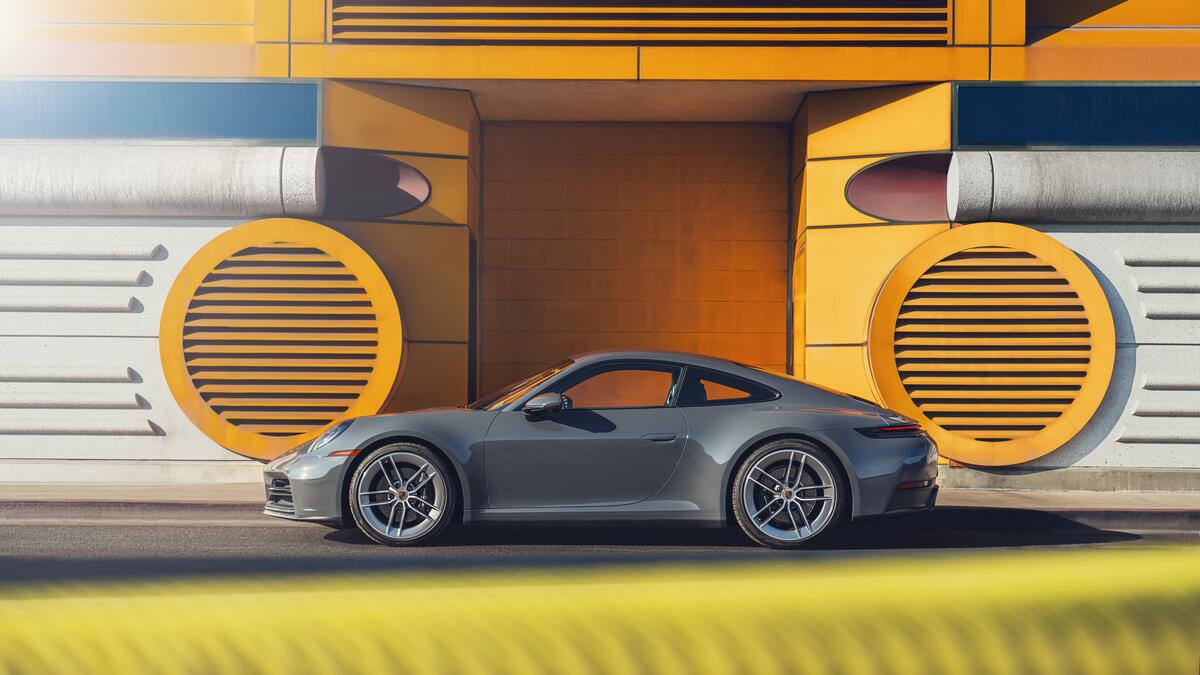
997 turbo
"So you're telling me you don't have a 997 [1611.1s] I have a 997 turbo. [1612.5s] But remember, it's got the white interior."
This is a Porsche 911 from the 997 generation with a turbocharged engine. The turbo helps the car make strong power, especially when you accelerate.
A Porsche 997 Turbo is the boosted, all-weather-capable performance version of the 911 generation 997. “Turbo” indicates a turbocharged engine, which is a major part of why these cars feel so quick and responsive compared with naturally aspirated 911s.
rain tires
"pro league had different different types of tires, like qualifying tires, rain tires. ...as soon as people realized that there was different types of tires"
Rain tires are designed to grip better on wet roads. They help push water out of the way so the tire can stay in contact with the road instead of skimming on top of water.
“Rain tires” are tires engineered for wet-weather traction, typically with tread patterns that channel water away to reduce hydroplaning. They often use different rubber compounds than dry or intermediate tires to maintain grip when conditions are slippery.
qualifying tires
"pro league had different different types of tires, like qualifying tires, rain tires."
Qualifying tires are made for getting the most grip for a short time, like when you’re trying to set your best lap. They usually don’t last as long as tires meant for everyday driving or longer stints.
“Qualifying tires” are tire compounds designed to deliver maximum grip for a short period—typically for the fastest laps. They’re usually optimized for warm-up and peak traction rather than long tread life.
compound
"people feeling the tires to see the compound on the little ring was different"
The tire “compound” is basically the rubber recipe inside the tire. Changing it changes how grippy the tire feels and how it behaves in different weather, like rain versus dry track.
In tires, the “compound” is the rubber formulation that strongly affects grip, heat behavior, and wear. Different compounds are chosen for dry, wet, and qualifying use because they perform differently as the tire warms up and as water is present.
Targa logo
"They replaced the Targa logo on the bar with this time they put Jesse."
“Targa” is Porsche’s name for a roof style that lets you enjoy an open-air feel while still keeping the car’s structure safe. In this build, they swapped out the normal Targa badge/logo for the Jesse theme.
“Targa” is Porsche’s body style designation for a roof design that typically uses a removable roof panel/section, leaving an open-air feel while retaining a structural roll-bar frame. Here, the segment says they replaced the Targa branding with the Jesse character name.
Easter eggs
"It was just so many different little Easter eggs that were on the car. And we got a tour from Porsche on these right before we did the video."
“Easter eggs” are little hidden details you only notice when you look closely. The host is saying these cars have lots of small, character-themed references built into the design.
In car customization, “Easter eggs” are hidden visual references—small details placed on the car that reward close inspection. The host describes multiple themed touches on the Jesse/Buzz builds that reference the characters’ outfits and iconography.
Porsche GT3 RS
"You can see the Buzz Lightyear had a they chose a GT3 RS because obviously if you've seen Buzz Lightyear, he has the wings that pop out, which is very reminiscent of the tail."
The Porsche 911 GT3 RS is a special, performance-focused 911 meant for track driving. Here, Porsche chose it for the Buzz Lightyear theme because the car’s big rear wing looks like the character’s pop-out wings.
The Porsche 911 GT3 RS is a track-focused 911 variant known for its aggressive aero and motorsport-derived setup. In this segment, it’s used as the base for the Buzz Lightyear-themed car because the “wings that pop out” visually echo the tail design.
paint and it takes over 400 man hours by hand to paint this
"[2034.1s] It's not it's not a wrap. [2036.6s] It's actually paint and it takes over 400 man hours by hand to paint this. [2042.8s] Same thing with the the Jesse car."
They’re talking about how much manual work goes into painting this car. More hand work usually means the color and finish are more carefully done.
The hosts are describing a highly labor-intensive, hand-applied paint process. That matters because custom colors and multi-step finishes (like layered blues) can require careful application and curing to look right.
PPF
"So. [2062.3s] This one definitely needs PPF. [2064.1s] Can you imagine if you have some damage on this?"
PPF is a clear protective film you put on a car’s paint. It helps prevent small damage like rock chips and scuffs from everyday driving.
PPF (paint protection film) is a clear protective layer applied to a car’s painted surfaces. It helps guard against rock chips, light scratches, and road debris without changing the paint’s appearance much.
concor field
"Well, maybe you run over a nail on your way to the concor field or the cars and coffee."
This is the display area at a fancy car show (a concours). People drive in and park there, so it’s the kind of place where you might worry about damaging your tires.
“Concor field” refers to the lawn/field area at a concours d’elegance-style event where cars are displayed. It’s the kind of venue where you might worry about road hazards like nails before the cars are parked for judging or viewing.
cars and coffee
"Well, maybe you run over a nail on your way to the concor field or the cars and coffee."
“Cars and coffee” is a casual car meet where people show up with their cars and hang out, usually in the morning. It’s more about meeting other enthusiasts than judging cars.
“Cars and coffee” is an informal car meet where enthusiasts gather in the morning to show cars, talk, and sometimes take short drives afterward. It’s not a specific brand or model—more a recurring community event format.
Porsche Exclusive
"Porsche had Shelby from a Porsche car in North America who worked closely with Pixar and Porsche Exclusive creating this car."
Porsche Exclusive is Porsche’s personalization program—its division for bespoke options and special builds. In this segment, it’s described as helping create a Pixar-themed Porsche car, meaning the project likely involved custom styling and presentation details beyond standard options.
Pixar
"Porsche had Shelby from a Porsche car in North America who worked closely with Pixar and Porsche Exclusive creating this car."
Pixar is the animation studio behind the “Pixar” brand that collaborated here with Porsche. The segment frames the collaboration as producing a special, themed Porsche car with design details inspired by Pixar’s world.
Shelby
"Porsche had Shelby from a Porsche car in North America who worked closely with Pixar and Porsche Exclusive creating this car."
“Shelby” here appears to be a person associated with Porsche in North America (the transcript says “Porsche had Shelby from a Porsche car in North America”). Because the name is ambiguous without a last name, it’s best understood as a Porsche staff contact involved in the Pixar/Porsche Exclusive project.
private collector
"Hopefully the room that the rumor they're not being auctioned off. They're already spoken for to a private collector."
A “private collector” is an individual who buys and keeps rare cars rather than selling them through public auctions or dealerships. The segment suggests these Pixar-themed Porsche cars are already allocated to collectors, which affects how often they’re seen at public events.

Porsche 959
"So we had everything at this parade from a 1955 Continental Cabriolet [2275.5s] to the Holy Trinity of supercars and 959, the Courgette and the 1918 Spyder."
The Porsche 959 is a very famous, rare Porsche supercar from the 1980s. People talk about it because it was ahead of its time in how it handled grip and stability at high speeds.
The Porsche 959 is a landmark 1980s supercar known for advanced engineering like all-wheel drive and a very sophisticated approach to traction and high-speed stability. In a parade context, it’s notable because it represents the “Holy Trinity” tier of rare, historically important performance Porsches.

Porsche 1918 Spyder
"...inity of supercars and 959, the Courgette and the 1918 Spyder. And kudos to these folks."
The Porsche 918 Spyder is a supercar that uses a mix of electric power and a regular performance engine. It’s known for being a very advanced, special Porsche. The podcast mentions it because it’s considered one of the standout supercars.
The Porsche 918 Spyder is a high-performance hybrid supercar known for combining electric power with a traditional performance engine. It’s often brought up in “greatest supercars” discussions because it represents a major engineering milestone for Porsche. In your podcast context, it’s mentioned alongside other legendary cars, reinforcing its reputation and significance to enthusiasts.
9-18 Spyder
"but we were missing a Courgette, a 9-18 Spyder. So I thought I'd help out Alex and I made a call to a dear friend."
This refers to a very rare Porsche concept/one-off roadster called the 9-18 Spyder. It’s famous with collectors because it’s an early, lightweight open-top design from Porsche’s history.
The Porsche 9-18 Spyder is a one-off concept car from Porsche’s early history, built around the idea of a lightweight, open-top roadster. It’s especially notable to collectors because it’s tied to Porsche’s formative design and engineering direction rather than a mass-produced model.
converted
"The race series was canceled after I think 17 of the cars were converted and dial. And so we had a converted car here as well as we had a non converted a port car,"
“Converted” here means the race cars were modified to be used differently than they were originally built for. The speaker is saying some were changed after the racing series stopped.
In this context, “converted” means the race cars were modified after their original racing purpose—e.g., turned into a different configuration for use outside the original series. The host ties it to the Carrera Cup USA cars being changed after the series was canceled.
originality
"And I said, no, no, that is the mark of originality. Because believe it or not, Porsche knew these cars were going to be converted to race cars..."
“Originality” here means the car still looks the way it did when it was built. The host is saying the carpet looks slightly imperfect because it hasn’t been changed to look “new.”
In classic-car judging, “originality” means the car’s details match how it left the factory (or how it was correctly assembled for its era). The host argues that the carpet’s visible gaps and loose fit are not a defect, but a sign the interior is still original rather than modified.
race cars
"Because believe it or not, Porsche knew these cars were going to be converted to race cars, and so they simply place the carpet in the car. They didn't glue it down."
“Race cars” are cars set up for track competition. The host is saying Porsche expected some of these classic cars to be turned into race cars, so they installed the carpet in a way that made later changes easier.
“Race cars” refers to vehicles prepared for competition, often with interior and component choices that prioritize serviceability and weight/fitment over showroom appearance. The host claims Porsche anticipated conversions to race use, which influenced how the carpet was installed (laid in rather than glued).
turbo look
"And beforehand, the previous owner wanted to make it look like a turbo look"
“Turbo look” means making a car look like a turbo version, even if it may not be the same turbo model underneath. Here, the host is describing the owner’s goal for the car’s appearance.
“Turbo look” is a shorthand for modifying a non-turbo car to visually resemble a turbo model—typically via bodywork, trim, and styling cues. The host says the previous owner wanted the car to look like a turbo, which connects to how restorers chase period-correct appearance versus strict mechanical originality.
rust
"And when people during the auction asked about rust, I answered very honestly, [2681.7s] because I'm a good seller, I said, yes. [2684.5s] And then like, well, how about like, where's the rust? [2687.2s] Yes, everywhere."
Rust is corrosion on metal. In an auction, it matters a lot because it can mean serious damage that costs a lot to fix.
In classic-car auctions, “rust” is a major condition issue because it can indicate structural corrosion and expensive repairs. The host is describing how they answered questions about rust very directly—“everywhere”—to set accurate expectations for buyers.
automotive apprentice school
"And they used map, the automotive apprentice school, Madison automotive [2696.1s] apprentices. And so there was a whole team of young men and women all day around [2700.1s] that car, prepping it and showing it."
The host is talking about a school that trains automotive apprentices. Students helped prep and present the car for the event.
The host mentions “map,” described as an automotive apprentice school, where students assist with car prep and presentation. This highlights a structured training pipeline that supports detailing and auction readiness.
flat black
"And we're shocked when I told them, no, it's a one on one special [2725.5s] paint, paint the sample back then of flat black. [2729.6s] Now, if you all never dealt with anything flat paint wise, [2733.1s] it will show every imperfection. [2736.3s] If you brush up against it, it's like a scratch."
Flat black is a paint finish that doesn’t shine like normal paint. The downside is it makes scratches and imperfections stand out, so it’s harder to keep looking clean.
“Flat black” refers to a matte or non-gloss paint finish that doesn’t reflect light smoothly. Because it shows surface texture and minor damage more clearly, it can look “perfect” only when it’s kept pristine—any touch or scuff can become visible.
Bob Gutierrez
"Bob Gutierrez 924. [2764.9s] Yes, he was very proud of it because it won at the Greenwich Car Show and [2769.9s] Greenwich must have much more relaxed standards than the Porsche Parade."
Bob Gutierrez is the person in the story who owns the Porsche 924 they’re talking about. They mention him because he cleaned and showed off his car at the event.
Bob Gutierrez is the named owner of the Porsche 924 Sebring edition discussed in this segment. The conversation uses his car’s show results and how he prepared it to illustrate the social side of the Porsche Parade.
Porsche Parade standards and judging
"Greenwich must have much more relaxed standards than the Porsche Parade. [2774.1s] Because he finished six out of sevenths. [2777.8s] Don't be shaming."
They’re joking about how strict the Porsche Parade is compared to another car show in Greenwich. The discussion is basically about how the judging and results are viewed.
The hosts compare the judging strictness of the Greenwich Car Show versus the Porsche Parade. The key point is how finishing positions are interpreted as “standards” for the event.

Chevrolet Corvette
"...y resignation for the Porsche Club and joined the Corvette Club. That's it."
The Chevrolet Corvette is a sports car made by Chevrolet. It’s designed for performance and is popular with car enthusiasts. In the podcast, it’s mentioned because someone moved from the Porsche club to the Corvette club.
The Chevrolet Corvette is a long-running American sports car known for delivering high performance with a strong focus on driving feel. It’s often referenced in automotive communities because it has a large enthusiast following and a deep history of performance models. In your podcast context, it comes up as a club affiliation point, highlighting how Corvette owners and fans fit into the broader sports-car world.
shock tower
"I just reached down and like touched this shock tower kind of semi-deep. And I pulled a handful of just like schmutz."
A shock tower is a reinforced spot on the car’s body where the suspension shock/strut bolts in. It’s important because it helps the car stay rigid when you hit bumps.
A shock tower is a structural mounting point where the suspension strut/shock attaches to the car’s body. On many cars it’s also a key part of the chassis stiffness, so dirt and grime there can hide issues and make inspection harder.
Porsche 911
"Honorary judges are usually our guests from Germany, from Porsche. And they always pick a 356 or 911."
The Porsche 911 is Porsche’s most famous model line. It’s a classic that judges and fans recognize right away, so it often gets picked in car shows.
The Porsche 911 is the long-running rear-engine sports car that became the brand’s most iconic model. It’s also a frequent choice in classic judging because it’s instantly recognizable and has many historically significant variants.

Porsche 356
"Honorary judges are usually our guests from Germany, from Porsche. And they always pick a 356 or 911."
The Porsche 356 is one of Porsche’s earliest classic sports cars. It’s a big deal to enthusiasts and often shows up in classic-car judging because it represents Porsche history.
The Porsche 356 is the brand’s early classic, known for being the foundation of Porsche’s air-cooled sports-car identity. In concours judging, it’s a common “honorary judge” pick because it represents the marque’s heritage.

Porsche 924
"But this year was the Transaxle anniversary, plus it was motor sports. So they hit gold when they saw Bob's 924, because it was a tribute to their"
The Porsche 924 is a classic Porsche from the late 20th century. It’s notable for its transaxle setup, and in this story it was chosen because the event was celebrating that theme.
The Porsche 924 is a front-engine, rear-transaxle sports car that’s known for its distinctive transaxle layout and for being a key part of Porsche’s 1970s–80s lineup. Here, it’s specifically mentioned as the car that won the honorary judges’ attention due to the Transaxle anniversary.
transaxle
"[2897.4s] Sebring win and it was a transaxle. [2900.3s] The only transaxle."
A transaxle is a single unit that combines the transmission and the differential. It helps the car send power to the wheels in a more compact, well-balanced way.
A transaxle is a combined gearbox-and-differential unit used on some cars, especially when the engine and drive wheels are packaged together. In a Porsche context, it’s often associated with mid- or rear-engine layouts where moving the transmission/differential into one assembly helps balance weight and improve drivetrain efficiency.
gimmick rally
"[2921.5s] Now, his wife, Ellen, does the gimmick rally. [2924.5s] So she was busy at registration, answering questions."
A “gimmick rally” is likely a rally event with a special theme or extra rules. In this story, it’s just used to explain why she couldn’t help with car prep right away.
The host mentions a “gimmick rally,” which sounds like a themed or rules-driven rally event. It’s relevant here because it explains why Ellen was busy at registration while the car-prep and judging discussion was happening.
outdoor judging
"Yeah, I think this is where outdoor judging is beneficial, because indoor these lights, it showed the paint. Oh, yeah. And it needed a lot of help. But when he went outside, it looked beautiful."
Outdoor judging means they look at the car in daylight instead of showroom lights. Daylight makes it easier to tell what the paint really looks like.
Outdoor judging is when cars are evaluated in natural light rather than under indoor show lighting. The goal is to see how the paint color and clearcoat look in real-world conditions, since indoor lights can hide flaws or exaggerate them.
deep sixes
"I go, well, it's got deep sixes. And I go, it's a 72. I said, the last cars that should have deep sixes are like, you know, maybe early build 71 and he's like, what are you talking about?"
“Deep sixes” is a wheel/fitment nickname for a specific style of Porsche wheel with a deeper rim profile (often associated with classic 911-era aesthetics). The speaker is arguing that the car’s wheels don’t match what would be expected for its year/build, which matters for correctness in judging.
date stamp
"I show him where the date stamp and I was like, there you go. [3045.3s] It's a 1969 date stamp."
A date stamp is a printed/marked date on a part that tells you when it was made. For older cars, people look for the right date to help prove the car is original.
A date stamp is a factory-marked code (often on parts like tires, spare components, or other service items) that indicates when that part was produced. In classic Porsche circles, matching or plausibly correct date stamps are used as evidence of originality.
concours
"You do you do realize that is a very mean thing to do in the middle of a concourse. [3062.2s] He already won."
A concours is a fancy car show where cars are judged by rules. People are careful about what they do and say because the judging is formal.
A concours (short for concours d’elegance) is a formal car show where cars are judged against rules for correctness, condition, and presentation. The host mentions doing something “in the middle of a concourse,” implying strict etiquette and scoring.
valuation
"So we're going to have a new valuation and there's no protest committee. [3067.7s] Nice knowing you, my friend."
Here, “valuation” basically means the car’s score/points from the judging. If there’s no protest committee, you can’t appeal the decision.
In concours-style judging, “valuation” refers to the scoring outcome or assessed points for how the car measures up to the event’s standards. The host also mentions “no protest committee,” suggesting there’s a formal process for disputes that won’t apply here.
valve stem supports
"Her valve stems did not have the valve stem supports. And she was debating whether or not the car came from the factory with valve stem supports..."
On an engine, the valves open and close to let air and fuel in and exhaust out. A valve stem support is a small part that helps hold and guide the valve stem correctly, and it can matter for whether the engine looks like it came that way from the factory.
Valve stem supports are hardware used at the top of an engine’s valve stem to help locate and support the valve stem assembly. In air-cooled and performance-focused engines, small differences in valve-train hardware can be part of what judges look for when determining whether a car matches factory-correct details.
factory-correct
"And she was debating whether or not the car came from the factory with valve stem supports and she's like, that can't be."
“Factory-correct” means the car looks and is set up the way it would have been when it left the factory. At judging events, they look for details that match the original build, not modified or swapped parts.
“Factory-correct” means the car’s visible details (and often mechanical details) match how the manufacturer delivered it from the factory. At concours-style events, judges use this idea to decide whether deviations—like missing or different components—suggest non-original parts or incorrect restoration choices.
preservation cars
"because we did the seventy four to 98 preservation cars, which I have to say we had a class of six cars..."
“Preservation cars” are cars that are kept as original as possible, instead of being restored to look brand-new. Judges often care a lot about whether the details still match what the car originally had.
“Preservation cars” are typically vehicles judged on how well they’ve been kept in an original or near-original state, rather than being fully restored to a like-new condition. In Porsche club judging, this can affect how strict the judges are about originality of details and whether deviations from original equipment are penalized.
class of six cars
"we had a class of six cars that were unbelievable. I mean, I actually felt so bad because the car that I actually gave six place to..."
At these events, cars are split into groups (classes). If there are only a few cars in your class, it can be easier to place well than if the class is packed.
In club parade judging, cars are grouped into classes, and the number of cars in a class can strongly influence outcomes. A smaller class can make it easier to place higher, even if the overall field quality varies from year to year.
barn
"In a barn, it is covered in rust. You there's no continental badging on it."
A “barn find” is when someone discovers an old car that’s been sitting for a long time. Those cars often need a lot of work because they’ve been exposed to moisture and time.
Finding a car “in a barn” is a common enthusiast origin story: the vehicle may have been stored for years, often with unknown condition. It usually implies potential corrosion, missing parts, and a restoration project rather than a straightforward refresh.
badging
"You there's no continental badging on it. It looks like a total basket case and he decides to buy it and restore it."
Badging means the badges/emblems that tell you what model a car is. If a car has missing or wrong badges, it can suggest it’s been modified or is not what it appears to be.
Badging refers to the manufacturer’s model/trim identification marks (like badges or emblems on the car). The host notes there was “no continental badging,” implying the car’s exterior identification didn’t match what it was supposed to be, which is a big clue for restorations and authenticity.
grime
"[3283.8s] But he bought it. [3285.3s] You know, he started rubbing off some of the rust and all the grime."
Grime is just a layer of dirt and buildup. Cleaning it helps you see what’s really going on with the paint and body underneath.
Grime is built-up dirt and contaminants that can hide surface damage and make paint look dull. Enthusiasts often clean and decontaminate before judging a car’s true condition or doing restoration work.
continental badge
"[3289.9s] And he sees the two holes for the where the continental badge would go. [3295.0s] And sure enough, he found a continental badge in one of the boxes that came with [3299.5s] the car and the paint you saw on that car."
A badge is the little emblem on the outside of a car. The “continental badge” is a specific emblem that’s meant to go in the matching holes on the body.
A badge is an exterior emblem that identifies a car’s brand, model, or trim. The “continental badge” refers to the specific emblem that would mount in the body’s pre-existing holes, helping confirm the car’s original specification.
Paterac brothers
"[3307.8s] Yeah, that was all done back in the early to mid [3310.0s] nineties, and it still looks by studying today. [3313.5s] Paterac brothers."
This refers to the Paterac brothers as the people credited with doing the paint/body work. In classic-car circles, naming the specific shop or craftsmen is common because restoration quality can vary a lot by who did the work.
restored
"[3324.2s] But the body work and all that stuff was done, you know, quite a long time ago now. [3328.9s] 25 years ago was restored, John saying."
“Restored” means the car was repaired and brought back to a better condition, sometimes to look like it did when it was new. The age of the restoration can affect how well it’s held up.
A “restored” car has had its condition improved back toward original or show-quality standards—often including bodywork, paint, and interior refurbishment. Restoration timing matters because it affects how long the work has had to age and whether it still looks fresh.
Col Spragum
"But you know, it's going to handle really well and be able to take abuse on track because Col Spragum, who I think many are saying runs the JDC Miller Ninetext three program."
The host mentions Col Spragum as a racing-team figure. He’s presented as someone with experience building and preparing cars for competition.
Col Spragum is mentioned as the person associated with the JDC Miller Ninetext three program. The host frames him as a key figure behind a racing team’s progress and experience across different Porsche eras.
JDC Miller Ninetext three program
"because Col Spragum, who I think many are saying runs the JDC Miller Ninetext three program."
This is a racing program connected to a team. The host is using it to explain where the track-prep experience comes from.
The JDC Miller Ninetext three program is referenced as a racing program run by Col Spragum. The host uses it to connect track setup and team experience to how well a car can handle and endure abuse on track.
Tech Tactics East
"I think we haven't committed to come to Tech Tactics East next year and do a presentation of how he went from basically zero to a team that the customer car,"
Tech Tactics East sounds like a motorsport or car-tech event. The host is saying someone will present how their racing program grew over time.
Tech Tactics East is mentioned as an event where the host expects a presentation next year. In this context, it’s tied to explaining how a team progressed from “zero” to a customer-car program.
Laguna Seca
"And if you have Palo Emsa, they recently won a Laguna Seca. They beat everyone, all these other huge teams, the end of winning overall."
Laguna Seca is a famous race track. The host is using it as evidence that the team recently did very well in a real race.
Laguna Seca is a well-known road racing circuit in the U.S., used for major motorsport events. The host mentions it to support the credibility of the racing team’s recent win and “winning overall.”
air cooled cars
"he has tons of experience, not just with newer race cars like that, but also air cooled cars."
Air-cooled engines don’t use coolant like many modern cars. Instead, they rely on airflow to keep the engine from overheating.
“Air cooled” refers to an engine cooling approach that relies on airflow over the engine rather than liquid coolant. The host brings it up to emphasize that Col Spragum’s experience spans both newer race cars and classic air-cooled Porsche platforms.
Cayenne Ev
"So I'm like, sure. And he gives me a ride in this Cayenne EV Turbo. You look at this thing and it's pretty chu..."
Request an Explanation
Heard something you'd like explained? We'll add it to this episode.
Sign in to request explanations for terms you heard.
Want to learn more?
Browse our glossary for plain-English explanations of automotive terms, jargon, and concepts.
Help improve this episode
See something that's not quite right? Our annotations are AI-generated and can sometimes miss the mark. Click the flag icon on any annotation to suggest a correction.