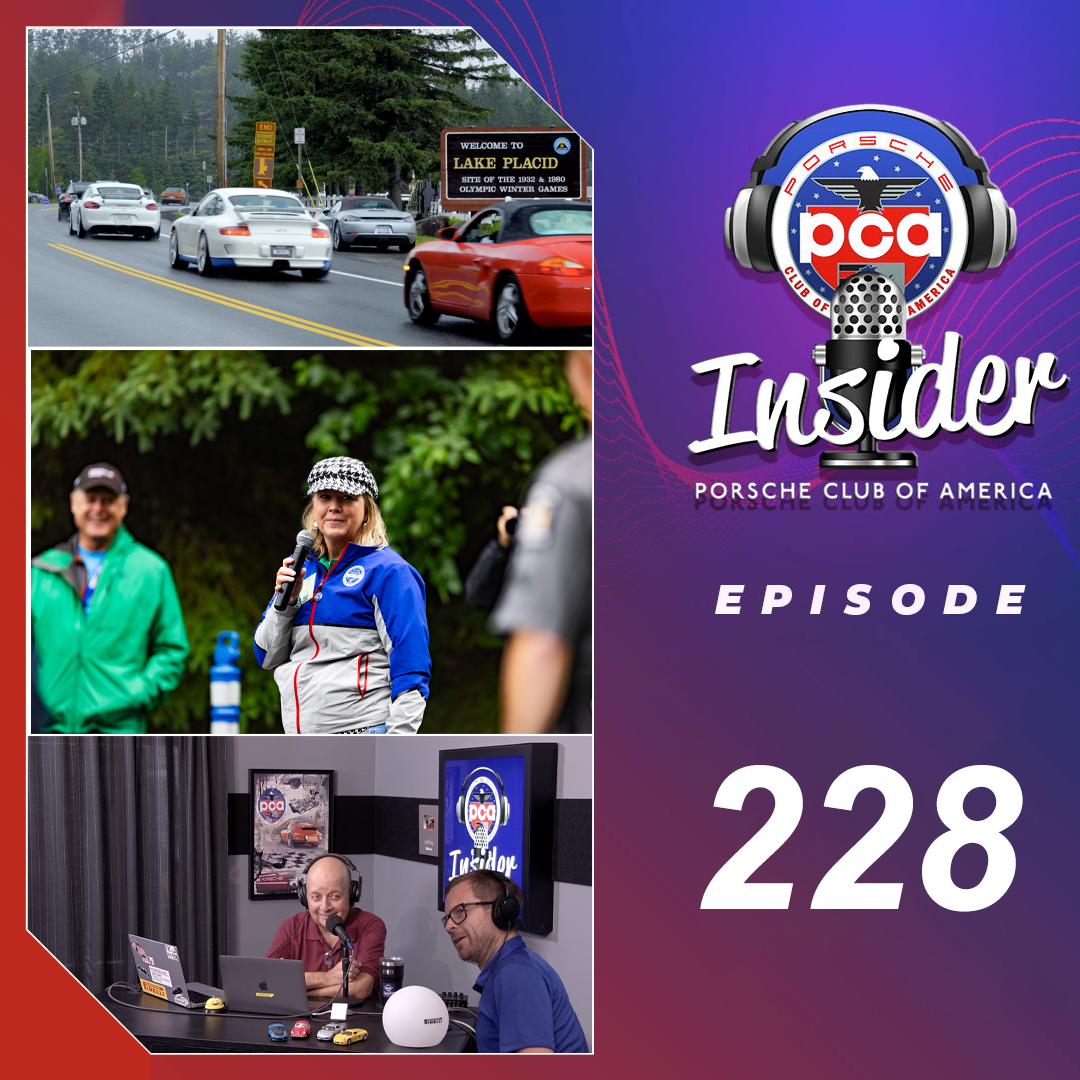
Inside Porsche Club of America Driving Tours: Why They are So Popular With Members
About this episode
Porsche Club Insider breaks down why Porsche Club of America driving tours have become so popular with members. The show highlights the national driving tour chair’s logistics, the push for “standards, not guidelines,” and the safety-first philosophy that keeps speed on the track. Tours feel social and welcoming—members arrive early, meet across regions, and even get curated destinations. Behind the scenes, organizers coordinate run groups, volunteers, insurance, routes, and contingencies like breakdowns, rain, and limited cell service.
In this episode, PCA National Tours Chair Holly Jackson joins the podcast to take us behind the scenes! Discover how PCA keeps its driving tours safe, fun, and highly engaging for members. Tours are one of PCA’s most popular events, and their massive appeal takes center stage every single year at the annual Porsche Parade. Holly shares exactly how the Driving Tour Committee maintains these elite event standards across both the United States and Canada.

1980 Porsche 911 SC Targa
"So nothing can outdo it, but it's an air cooled. It's a 1980 SC Targa in light in light blue metallic with a black bar."
This is a specific older Porsche 911 called the 911 SC, and it’s air-cooled. “Targa” is a body style that lets you enjoy open-air driving while still having safety structure around the cabin.
The Porsche 911 SC is an air-cooled 911 variant, and the “SC” refers to the 3.0-liter Super Carrera model used in the late 1970s and 1980. A Targa is a specific 911 body style with an open-air feel—typically a removable roof section—while still retaining a roll-over protection structure.
air cooled
"So nothing can outdo it, but it's an air cooled. It's a 1980 SC Targa in light in light blue metallic with a black bar."
“Air cooled” means the engine is cooled mainly by air flowing around it, not by coolant running through a radiator. Older Porsches like this one are known for that design.
“Air cooled” describes an engine cooling design where heat is removed by airflow over the engine rather than using a liquid coolant system. Classic Porsche 911s (like the 1980 911 SC mentioned here) are famous for this layout, which shaped their character and maintenance habits.
Pirelli
"So I'll take a little break here to thank our presenting sponsor, Pirelli. [212.5s] Pirelli tires have to achieve the highest levels of performance, [216.7s] safety, noiselessness and grip on the road surface."
Pirelli makes tires. The point here is that their tires are designed to help cars stick to the road and feel safe, especially when driving hard.
Pirelli is a tire brand known for developing performance tires for sports cars and motorsport-derived applications. In this segment, the host highlights tire goals like grip and safety, which are core to how Pirelli positions its products for driving events.
grip
"[212.5s] Pirelli tires have to achieve the highest levels of performance, [216.7s] safety, noiselessness and grip on the road surface. [220.0s] Innovative tires that can satisfy even the most specific mobility needs of the end consumer."
Grip is how well the tire can “hold” the road. More grip usually means the car stops, turns, and accelerates more confidently.
In tire talk, grip is how well a tire can generate traction between the rubber and the road surface. Higher grip improves acceleration, braking, and cornering confidence—especially important on Porsche driving tours where drivers encounter varied pavement and conditions.
noiselessness
"[212.5s] Pirelli tires have to achieve the highest levels of performance, [216.7s] safety, noiselessness and grip on the road surface. [220.0s] Innovative tires that can satisfy even the most specific mobility needs of the end consumer."
Noiselessness means the tire is designed to be quieter while you drive. That can make long trips more pleasant.
Noiselessness refers to how quiet a tire is during driving, usually tied to tread pattern design and internal construction that reduce road noise. For long driving tours, quieter tires can make the cabin feel less fatiguing and more comfortable.
test drive program
"[226.9s] If you're a current PCA member and own a Porsche, what are you waiting for? [230.3s] Be sure to have your van handy. [232.1s] And for those of you don't currently own a Porsche, check out the test drive program. [235.7s] Just go to www.pca.org."
The test drive program is a structured way for non-owners to experience Porsche driving without committing to ownership first. In the context of PCA, it functions as a member-engagement funnel that helps people learn what Porsche ownership feels like.
Porsche Parade
"[293.2s] We'll talk through a few things and just kind of help people out, mentor people. [300.9s] You know, the other thing is doing Porsche Parade."
Porsche Parade is a PCA club event where members get together and do organized driving and activities. It’s one of the bigger things the club runs.
Porsche Parade is a PCA event where club members gather for organized driving and activities. It’s referenced here as part of the broader ecosystem of PCA driving tours and regional participation.
driving skill grouping
"ed, where people would be grouped according to their driving skill. [419.0s] They had instructors or club racing that you had to pass a certain amount of [423.3s] requirements here."
On these tours, people aren’t all thrown together at the same speed. They’re sorted by skill level so the ride stays fun and safer for everyone.
The Porsche Club of America driving tours organize members by driving-skill level so instructors and experienced drivers can manage pace and risk. This kind of grouping helps newer drivers learn line choice and car control without being overwhelmed by faster traffic in the group.
club racing requirements
"[419.0s] They had instructors or club racing that you had to pass a certain amount of [423.3s] requirements here. [425.0s] You had people that were driving their first Porsche at a performance level"
They mention that you may need to meet certain requirements before you can do the more serious racing-style parts of club events. The goal is to make sure drivers are ready for the higher demands.
The speaker describes a structured qualification path—passing certain requirements—before participating in more competitive club activities. In club contexts, these requirements often ensure drivers can handle higher speeds and tighter spacing safely.
rally-style qualifying
"[431.0s] for the first time and other ones who simply wanted to go out for a nice [435.3s] leisurely drive and wasn't interested in qualifying for a rally type thing. [441.6s] So yes, doing tours."
They’re saying some people just want a relaxed drive, not the more competitive rally-style part. Rally qualifying is about racing against the clock or earning a position, not cruising.
The speaker distinguishes casual touring from rally-style qualifying, where drivers compete for starting positions or attempt timed performance. That difference matters because qualifying-focused driving usually involves more aggressive pace and stricter performance goals than a relaxed club tour.
group formation planning
"[453.8s] It sounds simple when you're by yourself in your own car, but when you're [457.8s] leading 15 cars behind you, then you've got to kind of plan it out and [462.9s] never have everyone has to be on the same understanding."
Driving by yourself is simple, but leading a bunch of cars requires planning. You have to coordinate timing and spacing so everyone knows what to do next.
The speaker contrasts driving alone versus leading a group of cars, highlighting the need to plan maneuvers and maintain consistent understanding across the pack. In practice, this is about coordinating spacing, timing, and communication so everyone can follow the same plan.
lead car pacing
"[474.0s] because whatever the lead car does, all 15 or so cars, depending on how big [480.0s] the group is, are going to want to do the exact same thing. [482.5s] And so as the lead car, it is a little bit more of a, you know, puts a"
When you’re leading a group of cars, your driving sets the pace for everyone behind you. If you brake or turn suddenly, the whole line has to react, so the leader has to be extra smooth and careful.
In a multi-car tour, the lead car sets the pace and the “execution” of maneuvers, and the rest of the group tends to mirror it. That’s why the speaker emphasizes safe, predictable actions—because 15+ cars following will amplify any mistake or sudden change in speed.
auto cross
"[624.3s] I'm 38 now and I love the autocross and that's sort of what I've been doing."
Autocross is a driving competition on a course made with cones. You drive your car through the course while other people wait their turn, and it’s a fun way to learn how to control the car.
Autocross is a motorsport where drivers compete one car at a time on a temporary course marked with cones, usually in a parking lot or similar flat area. Because cars run in short bursts, it’s a low-cost way to practice car control and handling without needing a full race track.
driving tours
"[658.8s] ...such as at Parade or at the region level? [658.8s] Yeah, so driving tours really, the focus is about sticking together..."
In Porsche Club of America (PCA) context, driving tours are group road trips where members drive together to scenic destinations. The emphasis is on staying together, following traffic laws, and prioritizing safety over pace.
rules of the road
"[668.4s] and have fun roads, but to do it as reasonable as possible, you know, [673.5s] following the rules of the road."
“Rules of the road” means the normal laws and safety guidelines you’re expected to follow when driving on public streets. The speaker is saying tours are about doing that, not racing.
“Rules of the road” refers to the everyday legal and safety requirements for driving—things like speed limits, right-of-way, lane discipline, and obeying traffic signals. In the tour context, it’s used to contrast normal public-road driving with track-style driving.
track
"[684.9s] It's not, driving tours are not about the speed. [687.7s] If you want the speed, go to the track..."
Here, “track” means a closed race course where cars can drive faster more safely. The point is that public roads aren’t set up for that kind of driving.
In this context, “track” means a closed racing circuit designed for higher-speed driving and track events. The speaker contrasts it with public roads, arguing that higher-speed driving is safer when the environment is controlled.
deer crossing
"[697.1s] You never know when that deer might cross in front of you or something"
A “deer crossing” means an animal suddenly runs onto the road. The speaker is using it to explain that you can’t reliably predict hazards on public roads.
A “deer crossing” is an unpredictable hazard on roads where wildlife may enter the roadway without warning. It’s used here as an example of why high-speed driving on public roads is risky compared with controlled track conditions.
blind corner
"And you know, you're coming over a blind corner and you know, they're not prepared to see that. So you got to just enjoy the drive."
A blind corner is a turn where you can’t see what’s around the bend until you’re already committed to entering it. The host uses it to explain why driving fast on side roads is risky—other road users (like kids) may not be visible in time to react safely.
speed limit
"I've heard some people call into that they were on a driving tour and it was going above the speed limit and that they just decided to pull over and just drive normal"
The speed limit is the maximum speed the road allows by law. The host is saying some people have gone faster than allowed during a tour, then decided to slow down and just follow the rules.
The speed limit is the legally posted maximum speed for a road segment, and it’s a key reference point for safe driving and enforcement. The host references people going above the speed limit on tours, then choosing to pull over and drive normally afterward.
PCA way
"because there's always people, it's the Porsche way. I call it the PCA way that everybody wants to show up early and get stage really early."
“PCA way” refers to the culture and norms of the Porsche Club of America, including how members show up early and follow the event flow. In this context, it’s about members arriving ahead of schedule so the organizers can still finish setup.
get stage
"I call it the PCA way that everybody wants to show up early and get stage really early. So, so they're showing up way too early and we're still trying to set up."
“Get stage” here means getting lined up at the start area before the cars go out. People want to be ready early so the tour can leave on time.
“Get stage” in a driving-tour context means positioning cars and drivers at the starting area before the group departs. It’s an event-operations term—members want to be staged early so the schedule and lineup can run smoothly.
driving run groups
"But sometimes the destination wants to have the people broken out over the day ... some regions are like ... normally about 15 to 30 people. And I'm like, yeah, we're going to have 75 in this group and 75 in this group. ... in multiple driving run groups, right?"
Instead of everyone driving together at once, the tour is divided into smaller groups of cars. That makes it safer and easier to keep traffic under control.
PCA driving tours often split attendees into smaller “run groups” so cars leave and travel together in manageable clusters. This reduces congestion, helps keep drivers from bunching up, and makes it easier to manage pace and safety during the day.
leader and a sweeper
"So, but there was one. That means you need a leader and a sweeper for each group? Yeah. So here's here's some numbers that are just crazy."
The leader is the car up front that guides the group, and the sweeper is the last car that checks everyone is still together. It helps prevent anyone from getting lost or stuck behind.
In organized club drives, a “leader” sets the pace and route for the group, while a “sweeper” rides at the back to ensure no car is left behind. This is a common safety practice for multi-car events, especially when groups are large or routes are complex.

Ford Taurus
"... a place where they build boats. It's not a yeah. Taurus destination, let's say. No, it's not."
The Ford Taurus is a regular passenger car, usually a family sedan. It’s designed for everyday driving like commuting and errands. In a podcast, it might be mentioned simply because the name “Taurus” is being used in a conversation about places or brands.
The Ford Taurus is a mid-size sedan built by Ford, known for being a mainstream family car rather than a performance-focused model. It may come up in a podcast when discussing everyday vehicles, production locations, or how certain car names get used as shorthand for destinations or brands. Even when the context is a bit unclear, the Taurus is essentially a common, practical sedan line from Ford.
cell service
"There wasn't very good cell service. And so it's it's kind of what we do here in our region..."
Cell service is whether your phone can get signal. If there’s no signal, it can be harder to call for help when a car breaks down.
Cell service is the ability to connect to a cellular network for calls and data. Driving tours rely on it for breakdown coordination—if coverage is poor, it can delay contacting help and arranging a tow.
radios
"...I mean, how many radios would we have? And then trying to make sure that I got them all back..."
Radios are walkie-talkies that let the tour leaders talk to each other quickly. They’re useful when phone signal is bad.
In organized driving tours, radios are two-way communication devices used to coordinate between vehicles and support staff. They’re especially important when cell service is weak, because they allow immediate coordination for issues like breakdowns.
engine trouble
"...if if you have engine trouble, you know, pull over, find the safest spot you can..."
“Engine trouble” means something is wrong with the car’s engine and it may not run or drive properly. On a trip, it’s handled quickly so the car can be made safe and towed if needed.
“Engine trouble” is a catch-all for problems that prevent the engine from running normally, such as overheating, misfires, or a no-start condition. For driving tours, it’s treated as an immediate safety issue because the car may not be able to continue under its own power.
hazards
"...find the safest spot you can, put your hazards on, the sweeper will come up."
Hazards are the blinking lights that tell other drivers, “This car is stopped or in trouble.” They make it easier for people to see you safely.
Hazard lights (the “four-way flashers”) are used to warn other drivers that a vehicle is stopped or disabled. In a breakdown scenario, they help alert traffic and improve safety while the tow plan is arranged.
flatbed tow truck
"...and get you one of those flatbed tow trucks to come and get you in rescue."
A flatbed tow truck is a truck that carries your car on a platform. It’s safer for your car than having it dragged on the road.
A flatbed tow truck lifts the whole vehicle onto a flat platform instead of dragging it on the ground. That’s especially helpful for cars with low ground clearance or drivetrain components that could be damaged by towing.
Parade of Portions
"“...four days of tours and then the Parade of Portions. So, you know, this year we did it for 200 cars.”"
“Parade of Portions” sounds like the club’s name for a parade-style part of the event. It’s where members and their cars are grouped together as part of the overall tour.
“Parade of Portions” appears to be the club’s named segment of the event schedule—essentially a parade-style gathering or procession. In this context, it’s tied to moving and displaying a large number of cars as part of the tour experience.
Concord
"And I said, the closest is the Concord. And then after that, you know, they all break up to do different events."
“Concord” is the stop where the group gets together so you can see lots of Porsches in one place. After that, the cars go off to do different activities.
“Concord” here refers to a specific location where the Porsche Club of America driving tours gather so members can see multiple cars together. It’s being contrasted with the later split into smaller events after that initial gathering.
Boise
"So I tell people, I went to the last Boise Parade... But what I do remember about Boise the last time was if I'm correct, they resurrected the parade of Porsches..."
Boise is the capital city of Idaho, and it’s referenced here as a Porsche club event location. The speaker describes how the Boise parade and related activities made members feel like they discovered a great town.
parade of Porsches
"if I'm correct, they resurrected the parade of Porsches because before then we weren't doing, at least certainly not regularly... a ton of revolved around the parade of Porsches because it was such a sight to see all these cars lined up."
This is basically a group show-and-drive: lots of Porsches together, moving through town in an organized line. The point is the big, impressive sight of many cars at once.
A “parade of Porsches” refers to a club-style procession where multiple Porsche cars are lined up and driven through a town as a coordinated event. The speaker highlights it as a memorable visual spectacle—cars lined up and moving through town for a long stretch.
Hershey
"I like to think Hershey is the one who really accelerated the the tours, the idea of the tours..."
The speaker credits “Hershey” with helping make the club’s driving tours grow. It’s the name the host uses for the person behind that change.
Hershey is referenced as the person credited with accelerating the Porsche club’s driving tours concept. In this segment it functions more like a named individual than a location, but it’s still a key identifier for who influenced the club’s event format.
EV
"But unfortunately, Porsche is getting rid of the gas McCann. That was a little a strategic planning that didn't work out too well. But they thought at this point, everyone be driving EVs didn't work out that way."
EVs are cars that run on electricity from a battery, not gasoline. The host is saying Porsche expected everyone would switch to EVs, but that didn’t happen as quickly as planned.
EVs are electric vehicles that use one or more electric motors powered by a battery pack instead of a gasoline engine. In the context of this episode, the speaker is referencing Porsche’s (and the industry’s) expectation that members would transition to electric driving.
production ramp-up
"they have more production space sort of ramping up production on 9 11 and 9 11 is very desirable... they're selling a ton of not trying to fulfill all the requests for 9 11."
A production ramp-up means the factory is making more cars. The host is saying Porsche is increasing 911 production because demand is higher.
A production ramp-up is when a manufacturer increases output over time to meet demand. Here, Porsche is described as using “more production space” to ramp up 911 production, which is why the 911 is outselling the other model.
model cut rumor
"The interesting to see there was that rumor earlier that BW is cutting all these models... one of the things they may be looking at cutting also is a Ticon."
A “model cut” rumor refers to the possibility that a manufacturer will discontinue or reduce production of certain models. The host says there was earlier a rumor that Porsche (referred to as “BW”) is cutting models, and that the Ticon might be among them.

Volkswagen Bus
"...one of the car show held there, and that's the VW bus show. I got to tell you, the VW bus people are th..."
The Volkswagen Bus is a van made by Volkswagen that’s known for carrying people and gear comfortably. It has a very recognizable shape, and there are car shows where people gather to celebrate and restore them. If the podcast mentions a “VW bus show,” it’s probably talking about an event for fans of this van.
The Volkswagen Bus (often called a VW Bus or Type 2) is a classic van known for its roomy interior and distinctive styling. It’s significant in car culture and shows because many enthusiasts focus on preserving and restoring these vehicles, which is why a “VW bus show” would be a natural topic. In a podcast, it’s likely discussed as part of a community or event centered on that specific model.
Frank Young
"I think we have the Frank Young. Yeah, we do. I completely forgot about the videos for a second there. But yes, Frank Young, Porsche AG's head of their archives, an historian, did an excellent presentation with rare photos..."
Frank Young is the person in charge of Porsche’s archives. Here, he’s the historian/presenter sharing rare old Porsche photos with the club.
Frank Young is described as Porsche AG’s head of archives and an historian. In this episode segment, he’s the presenter who shares rare Porsche-related historical photos from the company’s archive.

Porsche 356 SL
"It's a Le Mans running start with the number 46, 356 SL, their first race car that I believe won its class at that race."
The Porsche 356 SL is an early Porsche built for racing. In this segment, they mention it because it’s tied to Le Mans and is considered Porsche’s first race car to win its class there.
The Porsche 356 SL is an early Porsche race car variant of the 356 line, and it’s specifically referenced here in connection with Le Mans. The host says it was their first race car that won its class, which is why it’s a notable piece of Porsche racing history.
Le Mans
"It's a Le Mans running start with the number 46, 356 SL, their first race car that I believe won its class at that race."
Le Mans is a legendary long-distance race in France. It’s known for endurance racing and for cars racing in different categories (classes), not just one winner.
Le Mans refers to the famous 24-hour endurance race held in France, where cars compete in classes rather than just overall placement. In this segment, it’s used to frame the historical significance of the Porsche 356 SL and the “running start” photo.
running start
"It's a Le Mans running start with the number 46, 356 SL, their first race car that I believe won its class at that race."
A “running start” means the cars are already moving when the race start happens, instead of sitting still and then launching.
A “running start” describes a race start where the car is already moving as it accelerates into the first phase, rather than starting from a complete standstill. The host uses it to describe the specific look of the Le Mans photo.

Porsche 914 guide
"We have I keep talking about this 914 guide"
The Porsche 914 is an older Porsche sports car with an unusual mid-engine design. The hosts are saying they’re working on a guide video about it for Porsche Club members.
The Porsche 914 is a classic mid-engine sports car from Porsche’s early-1970s era, known for its distinctive layout and enthusiast following. In this segment, the hosts mention a “914 guide,” which suggests they’re covering what makes the 914 special and how to evaluate or enjoy one.

Porsche Boxster
"We have a video with a spec Boxster that club racing business manager, Connor and I filmed at the rainy autocross"
The Porsche Boxster (spelled “Boxster” here) is Porsche’s mid-engine roadster line, and it’s a common platform for club racing and autocross. Here, the hosts specifically describe a “spec Boxster” running in a rainy autocross on slick tires, which highlights how the car is being used in motorsport-style conditions.
slicks
"...filmed at the rainy autocross in a spec Boxer on Slicks."
Slicks are special race tires that don’t have tread grooves. They can grip extremely well on dry roads, but they’re usually not ideal when it’s raining.
Slicks are race tires with no tread pattern, designed to maximize grip on dry pavement. In this segment, the hosts mention “slicks” for a rainy autocross, which is notable because slicks generally lose effectiveness in wet conditions compared with treaded tires.
Porsche 997.2 Carrera S PDK
"...give a walk around of a 997 dot two Carrera S PDK Basalt Black Metallic."
The Porsche 997.2 Carrera S is part of the 911’s 997-generation facelift (often called the “.2” update), and it’s known for refined drivability and performance compared with earlier 997s. “PDK” refers to Porsche’s dual-clutch automatic transmission, and the segment frames this as a specific, well-equipped club test car (including its color).
tape measure
"What is the tape measure? He pulled out the tape measure measures everything. Exactly. So we give, you know, the specs that Porsche provides,"
They’re talking about using a tape measure to check real-world dimensions. The idea is that published numbers don’t always match what people assume by sight or feel.
A “tape measure” is used here as a literal tool to verify physical dimensions beyond published specs. The hosts use it to explain why two 911 generations can feel different in size even if the measured differences are smaller than expected.
Gunther Works
"Also, go check out the Gunther Works video that Bogdan filmed. He doesn't get a lot of chances to film longer form videos that are more than just a social media clip."
Gunther Works is a Porsche specialty shop that does custom work on 911s. The hosts are pointing you to one of their videos for more behind-the-scenes detail.
Gunther Works is a Porsche-focused shop known for building and modifying 911s, including custom and restomod-style projects. The hosts reference a Gunther Works video filmed by Bogdan as part of their tour-related content.
Peter Nam
"But he filmed this one in California with Voo. It's a shop tour with unprecedented access to what the founder, Peter Nam, giving the tour."
Peter Nam is the founder of the shop featured in the tour. The hosts say he personally gave the tour, which is why the video feels unusually detailed.
Peter Nam is identified as the founder of the shop being toured in California. The segment emphasizes that he personally provided access during the shop tour, which is why the video has “unprecedented access.”
carbon fiber
"And I think we got it most everything except how they lay out their carbon fiber. He just said you didn't want to put that on film because that's still proprietary."
Carbon fiber is a strong, lightweight material used in some high-performance car parts. Here, the shop wouldn’t show their exact process because it’s their private know-how.
Carbon fiber is a lightweight composite material made from carbon strands woven into a strong structure, often used in performance cars to reduce weight while maintaining stiffness. In this segment, the hosts mention the shop tour included access to how carbon fiber is laid out, but that the exact method is proprietary.
zone six
"[4084.1s] Wow. So yeah. [4086.9s] And the biggest region, the zone, the zone that does the most [4091.5s] driving tours is zone six."
PCA organizes members into geographic zones, and “zone six” is one of those regions. When the hosts say zone six does the most driving tours, they’re pointing to where PCA’s driving-tour activity is concentrated.
zone two
"[4091.5s] driving tours is zone six. Wow. [4094.6s] As of last year, it tells zone two to get their button gear."
“Zone two” is another geographic area within PCA. The hosts bring it up to compare how active different zones are with driving tours.
“Zone two” is another PCA geographic zone referenced in the discussion of which areas run the most driving tours. The mention is used to compare activity levels between zones.
button gear
"[4094.6s] As of last year, it tells zone two to get their button gear. [4098.5s] I thought my region did a lot, but I didn't realize those six was that."
“Button gear” appears to refer to PCA’s member “buttons” (pins/badges) and the gear or items associated with collecting or displaying them. In the context, it’s a playful nudge for another zone to step up their participation.
Request an Explanation
Heard something you'd like explained? We'll add it to this episode.
Sign in to request explanations for terms you heard.
Want to learn more?
Browse our glossary for plain-English explanations of automotive terms, jargon, and concepts.
Help improve this episode
See something that's not quite right? Our annotations are AI-generated and can sometimes miss the mark. Click the flag icon on any annotation to suggest a correction.