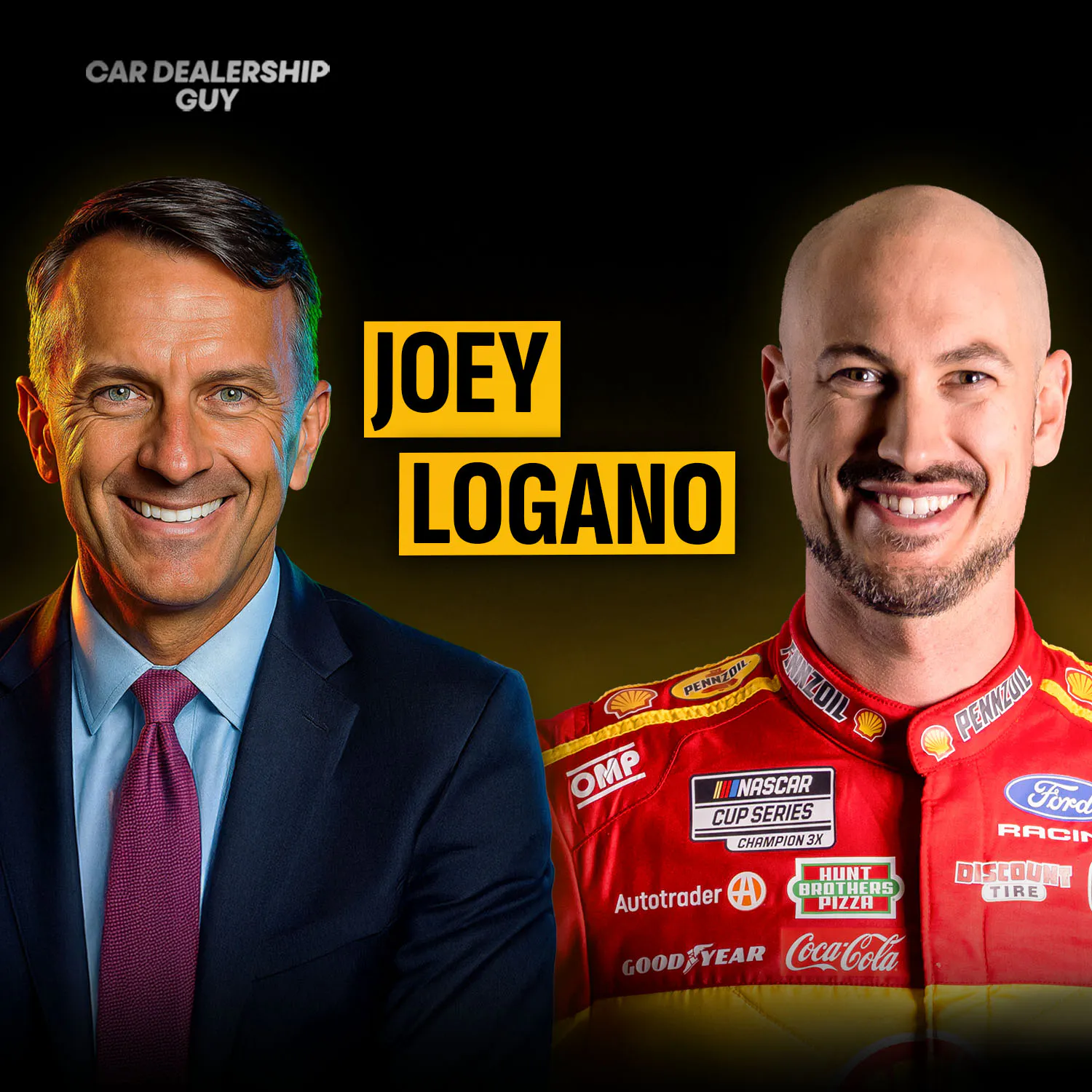
"Pour Gas On It!" How Joey Logano is Scaling Huntersville Ford (+ his NASCAR playbook for dealers) | Joey Logano, NASCAR Driver and Co-Owner of Huntersville Ford
Joey Logano talks about going from NASCAR champion to co-owner of Huntersville Ford, framing the move as “pouring gas on” an already strong dealership rather than taking over operations. He explains how elite motorsports habits—professionalism, process, and treating the service team like a pit crew—translate into customer experience and loyalty. Mentored by Roger Penske and supported by the Krause Automotive Group, Logano shares what surprised him about dealership complexity, his hands-on relationship role, and how he handles conflict and respect on track and in business.
Today, Sam D'Arc is joined by Joey Logano, NASCAR Driver and Co-Owner of Huntersville Ford.
Joey breaks down his transition from the NASCAR track to the dealership floor, revealing how he applies a "Sunday report card" mentality to retail operations.
We explore the complexity of managing inventory, the "brutal" nature of automotive competition, and why Joey is focused on building a generational legacy beyond racing.
This episode is brought to you by:
1. Openlane - The world’s best online dealer marketplace for used cars, bringing you exclusive inventory, simple transactions, and better outcomes. If you’ve never used OPENLANE before, or it’s been a while since you have, you’re eligible to earn up to $2,500 in buy or sale fee credits. Learn more @ here.
2. Lotlinx - Meet LotGPT, your AI Inventory Strategist built exclusively for car dealers. It reveals competitive insights, shopper behavior, and pricing dynamics, and even identifies underperforming VDPs with merchandising recommendations to boost conversion without cutting prices. Put LotGPT to work for your dealership today, totally free, @ here.
3. Nomad Content Studio - Most dealers still fumble social—posting dry inventory pics or handing it off without a plan. That’s where Nomad Content Studio comes in. We train your own videographer, direct what to shoot, and handle strategy, from posting to feedback. Book a call @ here.
Check out Car Dealership Guy’s stuff:
For dealers:
CDG Circles ➤ https://cdgcircles.com/
Industry job board ➤ http://jobs.dealershipguy.com
Dealership recruiting ➤ http://www.cdgrecruiting.com
Fix your dealership’s social media ➤ http://www.trynomad.co
Request to be a podcast guest ➤ http://www.cdgguest.com
For industry vendors:
Advertise with Car Dealership Guy ➤ http://www.cdgpartner.com
Industry job board ➤ http://jobs.dealershipguy.com
Request to be a podcast guest ➤ http://www.cdgguest.com
Topics:
05:20 Why Joey Logano Is Pouring Gasoline On A Flame.
08:55 The Billionaire Mentor Joey Logano Calls For Advice.
09:45 What Joey Logano Learned Drinking From A Fire Hose.
16:15 The NASCAR Rule Joey Logano Applies To Dealership Drama.
18:30 Why Winning A Race Isn't Winning Championships.
22:20 The One Feeling Business Can't Give Joey Logano.
23:45 How Joey Logano Compares Pit Crews To Dealership Teams.
29:00 The Brutal Truth About Saying No To Opportunity.
Car Dealership Guy Socials:
X ➤ x.com/GuyDealership
Instagram ➤ instagram.com/cardealershipguy/
TikTok ➤ tiktok.com/@guydealership
LinkedIn ➤ linkedin.com/company/cardealershipguy
Threads ➤ threads.net/@cardealershipguy
Facebook ➤ facebook.com/profile.php?id=100077402857683
Everything else ➤ dealershipguy.com
"Today, I'm joined by Joey Legano, NASCAR driver and co owner of Huntersville Ford."
NASCAR is a major U.S. auto racing league. Joey’s racing experience is the reason he’s talking about performance and teamwork in the dealership.
NASCAR is the premier stock-car racing series in the U.S. Mentioning it signals that Joey Logano’s background is in high-pressure competition and performance execution—skills he’s applying to dealership operations.
"The automotive retail business is cutthroat and it's exactly the environment that Joey performs best in."
This just means the dealership side of the car business—selling cars and making money from service and customers. It’s competitive, so how you run the store matters a lot.
This refers to selling cars and related services through dealerships. In dealership terms, it’s a competitive market where pricing, inventory, and customer experience directly affect sales and profit.
"...how to treat your service department like a world class pit crew to drive customer loyalty."
The service department is where the dealership fixes and maintains cars. If it’s handled well, customers come back and trust the dealership more.
A dealership’s service department is where customers bring cars for maintenance and repairs, and it’s a major driver of repeat business. How it’s run affects customer loyalty, retention, and long-term profitability.
"I race a Ford. I've been racing fords for the last 14, 15 years."
Ford is a major car company. Joey is saying he races Ford cars, which ties his racing life to the dealership he’s involved with.
Ford is the automaker Joey Logano says he races. In this context, it highlights brand loyalty and how his racing background connects to the dealership business.
"Ford's seen a great opportunity with tying me together with an already successful dealership in Huntersville Ford and the Krause Automotive Group."
Krause Automotive Group is the larger company that owns/operates dealerships. Groups like this can help individual stores by sharing experience and resources.
Krause Automotive Group is referenced as the broader dealership group behind Huntersville Ford. Dealership groups matter because they share processes, purchasing power, staffing, and marketing resources across multiple stores.
"So walk us through the ownership structure at Huntersville Ford. Are you hands on or is this more of a financial stake?"
Ownership structure means who really controls the business. It can be hands-on day-to-day management or more of an investment where someone doesn’t run daily operations.
“Ownership structure” refers to how a business is owned and controlled—whether someone has day-to-day involvement or just a financial stake. In dealership terms, this affects decision-making, staffing, and how aggressively the owner pushes sales and operations.
"I had some great people mentoring me. Roger Pensky being one of them. That's my my boss and I drive for it on the race team."
Roger Penske is a famous motorsports team owner and business leader. Here, he’s mentioned as someone who helped guide the speaker as they worked through the dealership ownership process.
Roger Penske is a major figure in motorsports and business, best known for Penske Racing and the broader Penske organization. In this context, he’s referenced as a mentor/leader connected to the speaker’s racing team, implying business guidance and credibility.
"Like, we have to hit certain benchmarks, we're up, we're competing every single day..."
Benchmarks are measurable targets used to evaluate performance and progress. Here, they’re framed as part of racing discipline—teams must hit specific standards to be competitive and to satisfy sponsors and partners.
"This is your first store. Do you have bigger plans for multiple stores? Is this kind of enough for your goal?"
“Multiple stores” refers to dealership expansion—opening additional locations or growing a dealership group. This is a business concept tied to scaling processes like customer experience, service quality, and warranty/maintenance workflows.
"So in NASCAR is with automotive, folks have mentors, people that they look to for advice. I'd be curious, who on track early in your career was a mentor in NASCAR and who today is your mentor in automotive to learn this new world?"
A mentor is someone who’s been there before and helps you learn faster. Joey is asking who helped him early in racing and who helps him now in the car business.
A mentor is an experienced person who guides someone less experienced—often sharing strategy, contacts, and lessons learned. Here, Joey contrasts mentorship in NASCAR versus mentorship in the automotive/dealership world.
"Because it's probably not going to happen. Because it's a dog eat dog world out there and you're wearing milk It is a dog eat dog. Like what's going on out here? It is brutal."
It’s an expression for a very cutthroat, competitive situation. Joey is saying that in some parts of racing and car business, people may not be eager to help competitors.
“Dog eat dog” is a phrase meaning a highly competitive environment where people are focused on their own advantage. Joey uses it to describe how hard it can be to find help or mentorship when everyone is trying to win in racing and automotive.
"This episode is brought to you by Open Lane once again voted the most preferred digital wholesale marketplace by dealers. And they've been busy using the power of people and AI to build a transparent wholesale experience."
Open Lane is a website/dealer service that helps car dealers buy cars from auctions or other sellers. They use tools (including AI) to make the car info and pricing easier to understand.
Open Lane is a digital wholesale marketplace aimed at helping dealers buy and sell vehicles more efficiently. In this segment, it’s described as using AI to improve how vehicles are inspected, priced, and communicated to buyers.
"Intelligence guides their condition reports feature AI powered and inspector confirmed exterior damage detection, high quality engine audio recordings and OBD two codes decoded into plain English."
A condition report is like an inspection checklist for the car. It tells you what’s good and what might need fixing, so you’re not guessing.
A condition report is a structured summary of a vehicle’s condition, often including visual damage notes and other inspection findings. For wholesale buyers, it helps compare cars consistently and reduces reliance on subjective descriptions.
"Intelligence guides their condition reports feature AI powered and inspector confirmed exterior damage detection, high quality engine audio recordings and OBD two codes decoded into plain English."
They use AI to spot possible body damage from photos or scans, but a person confirms it too. That helps dealers judge damage without seeing the car in person right away.
This describes AI-assisted detection of exterior damage (like dents, scratches, or other body issues) that’s then confirmed by an inspector. The combination is meant to improve accuracy versus AI alone and make damage easier to evaluate remotely.
"OBD two codes decoded into plain English. Open Lane predictive pricing provides historical and future pricing guidance allowing you to buy confidently."
Instead of showing a complicated code description, they explain it in simpler language. That makes it easier to decide whether the issue is serious or just needs a quick check.
“Plain English” here refers to translating technical diagnostic information (like OBD-II codes) into a more understandable explanation. This matters in wholesale because it helps non-specialists interpret what the code likely means and what to inspect next.
"I said a minute ago, how complex the businesses how many little businesses there is within the one, right? And you start zooming out and you see how people own 1020 50 hundreds of them like, Oh, my"
A dealership is more than just selling cars—it’s a bundle of departments (sales, finance, service, parts, body shop, etc.) with different roles and incentives. Scaling and improving performance often requires coordinating all those “mini-businesses.”
"...You get bumped around, you're gonna have to get it."
That means cars are hitting or pushing each other during the race. In racing, that kind of contact can happen more than it would on normal roads.
“Bumped around” refers to contact between cars during racing, which can be intentional or at least expected as part of close-quarters competition. It’s a reminder that NASCAR-style racing often involves physical interaction more than street driving does.
"Well, I got to tell you, sitting on top of the box of the Daytona 500 this past just a few weeks ago to see Carson come in first place, final lap white flag gets pushed from behind into the wall spins out."
The Daytona 500 is NASCAR’s biggest race. It’s known for being intense, and a late mistake or crash can completely flip who wins.
The Daytona 500 is NASCAR’s most famous race, held at Daytona International Speedway. It’s a high-stakes, high-visibility event where late-race incidents can dramatically change results.
"Well, I got to tell you, sitting on top of the box of the Daytona 500 this past just a few weeks ago to see Carson come in first place, final lap white flag gets pushed from behind into the wall spins out."
The white flag means the race is on the last lap. If you get hit or pushed at that point, it’s very hard to save the car.
In NASCAR, the white flag indicates the final lap is underway. Being “pushed” or contacted on that lap can cause a spin or crash because there’s no time to recover.
"...like when you hit that buzzer beater, right? When you make the last lap pass to win the race, and it hits you just so hard."
It’s a last-second win moment. The speaker is saying racing can feel like that—like you do something at the very end that decides everything.
A “buzzer beater” is a last-second, high-pressure moment where the outcome flips right at the end. In racing terms, the speaker is comparing that feeling to making the final-lap pass to win.
"When you hit that buzzer beater, right? When you make the last lap pass to win the race, and it hits you just so hard."
A “last lap pass” is an overtake made on the final lap, usually when the pressure is highest and there’s little time to recover. It’s used here as a metaphor for the emotional rush of closing a deal or achieving a decisive win.
"This episode is brought to you by Lotlings. What if you had a strategist that could actually look at your inventory..."
Lotlings is the company behind the AI tool mentioned in the ad. The tool is meant to help car dealers make better decisions about what cars to price and how to market them.
Lotlings is the company sponsoring the segment and is presented as the creator of Lot GPT. The product is aimed specifically at dealership inventory and pricing strategy.
"What if you had a strategist that could actually look at your inventory, your pricing, your market and real shopper behavior... That's Lot GPT."
Lot GPT is an AI tool for car dealers. It looks at a dealer’s inventory and pricing and helps suggest what to do next to sell cars.
Lot GPT is described as an AI-powered inventory strategist built for car dealers. It’s positioned as analyzing inventory and pricing at a granular level to recommend what actions dealers should take next.
"And the car wash stuff, yeah, we I like cars, right? And a friend of mine was starting up a new franchise called Hang 10 and, you know, they got seven or eight of them open already."
A franchise is a business model where an operator buys the rights to run a branded business using the franchisor’s systems, products, and support. Joey mentions being involved with a car-wash franchise, highlighting how dealership-adjacent business opportunities can scale using established brands.
"This episode is brought to you by Nomad Content Studio. Many dealerships are still getting social media completely wrong..."
Nomad Content Studio is a company that helps car dealerships make and post social media videos. The idea is to create content consistently and in a way that actually helps sell cars, not just get random likes.
Nomad Content Studio is presented as a marketing/content production partner for dealerships. The pitch emphasizes training videographers, creating storyboards and clips, and posting content daily across social platforms to drive views into sales.
"Many dealerships are still getting social media completely wrong. They either ignore it, post inventory photos, or hand it off to someone on staff with no strategy."
They’re saying some dealerships post on social media randomly, or just throw up car photos. A strategy means planning what to post and how it should lead to actual customers.
The segment contrasts dealerships that “ignore it,” post inventory photos, or hand social media to staff without a strategy. A strategy typically includes consistent posting, content planning, and a conversion path from social engagement to leads.
"...some of the cars have good margins. Some of them don't."
“Good margins” refers to the profit difference between what the dealer pays for a vehicle and what it sells for. The speaker is highlighting that not every car is chosen for the same financial reason—some are profitable, others are strategic for traffic or branding.
"where they sell a lot of these you know, souped up vehicles, right? Whether it's doing it in house, in the garage"
“Souped up” refers to cars that have been modified or selected for higher performance than stock. In dealership terms, it can mean factory performance models, dealer-installed upgrades, or specialty builds.
"about how that model T was revolutionary, right? Like it was changed the industry. It sold millions of these cars, right?"
The Model T was Ford’s early car that helped kick off mass production of automobiles. It made cars more common and helped Ford become a major company.
The Ford Model T is the car being referenced as a revolutionary, mass-produced vehicle that helped shape the modern auto industry. It’s closely tied to Ford’s rise and the idea of making cars affordable and widely available.
"Even the engineering, right? That was a car that was, you know, much better than a horse and buggy. That's what it was competing against, right?"
A horse and buggy is the old way people traveled before cars. The speaker is saying the early car was a big upgrade over that.
“Horse and buggy” is used as a historical baseline for what early cars replaced—horse-drawn transportation. The comparison highlights how early automotive engineering was a major leap in mobility and practicality.
"...invited to come to a live stream there from the show as you do your grand opening."
A grand opening is a dealership’s official launch event, often used to generate local awareness and drive early sales. Dealers may coordinate media, live streams, promotions, and community outreach around the opening.
Why Joey Logano Is Pouring Gasoline On A Flame.
The Billionaire Mentor Joey Logano Calls For Advice.
What Joey Logano Learned Drinking From A Fire Hose.
The NASCAR Rule Joey Logano Applies To Dealership Drama.
Why Winning A Race Isn't Winning Championships.
The One Feeling Business Can't Give Joey Logano.
How Joey Logano Compares Pit Crews To Dealership Teams.
The Brutal Truth About Saying No To Opportunity.
Select text to request an explanation
I say, listen, treat me as special teams would on a football
team, right? I can't be there right now through the day to
day operational stuff because I have a day job, right? But treat
me as someone that can go out there and be the relationship
guy, thinking of things that are a little bit outside of the
box. Where can I, you know, do some things that they haven't
been able to do in the past?
Everybody, I'm Sam Darkin. Today, I'm joined by Joey
Legano, NASCAR driver and co owner of Huntersville Ford. The
automotive retail business is cutthroat and it's exactly the
environment that Joey performs best in. He explains how he uses
his background as a two time NASCAR champion to quote poor
gasoline on an already successful dealership. Joey
breaks down the transition from athlete to operator, the value
of elite mentorship from Roger Penske and how to treat your
service department like a world class pit crew to drive
customer loyalty. A big thanks to our sponsors for making
today's episode possible. Open Lane, Plotlinks and Nomad
Content Studio. And now let's get into the show.
So Joey Legano, welcome to the car dealership guy podcast.
Exciting to have you here. So Joey, everyone knows you from
NASCAR. What they may not know is you just became a co owner at
Huntersville Ford. Joey, what was the moment you knew you wanted
to own a dealership and why Ford specifically?
Well, I think it's been a long time coming. I've always
enjoyed cars. I'm a car guy, right? That's I think the first
box you need to check is do you love cars? Because if you don't
love what you're doing, it's never going to work. And as a
race car driver as my day job, that obviously kind of goes
hand in hand. I race a Ford. I've been racing fords for the
last 14, 15 years. Also a very natural relationship there.
Live pretty close to Huntersville, North Carolina. So
Huntersville Ford is kind of our local Ford dealership worked a
lot with them through various projects that we've done through
our studio business that's right up the road from there. And so
built some good relationships along the way. And then this
opportunity kind of came to my door and like, Hey, if you're
going to do it, this is like the natural time for all things to
come together. So it's actually been a very fun partnership, but
a very natural thing. It just kind of came along. It really
wasn't forced. And I think Ford's seen a great opportunity with
tying me together with an already successful dealership in
Huntersville Ford and the Krause Automotive Group. So it's
been it's been very educational eye opening and a lot of fun.
So walk us through the ownership structure at Huntersville
Ford. Are you hands on or is this more of a financial stake?
No, I want to be hands on. I want to I want this to be the
first step into my my career, if you will, into you know, the
automotive world. And like I said, I've been enjoying it a lot.
The way I tell our operating partner, Stacy, I say, Listen,
treat me as special teams would on a football team, right? I
can't be there right now through the day to day operational
stuff because I have a day job, right? But treat me as someone
that can go out there and you'll be the relationship guy, think
of things that are a little bit outside of the box, where can I
you know, do some things that they haven't been able to do in
the in the past. That's where my true value comes into play. As
a race car driver, you have relationships, like any athlete,
they can kind of call any CEO and they're going to answer. And
that's a great business. So if I can leverage that in certain
ways to help the dealership, that's what I want to do.
When did the deal become official? When did you officially
take over in your ownership role?
It's right before Christmas. It's a Christmas miracle.
Right before then took a while to kind of get to that point.
Obviously, we wanted to make sure all of it was right. I had
some great people helping me along the way to make sure that
you know, because I'm sure a lot of people on this podcast can
understand it. You know, the first time you walk into the
dealership world, especially if you haven't worked in it before.
Gosh, it can be really confusing. And like, what the heck is
going on? I had some great people mentoring me. Roger Pensky
being one of them. That's my my boss and I drive for it on the
race team. So he was a big piece of help in this getting done.
So I think of Pensky's, you know, a legend and an automotive
head of an automotive group, I think of Hendrick legend big in
NASCAR racing. I work for Aaron Ziegler. We're in NASCAR racing.
We show up on Sundays at the track. You have a view that those
three don't have, which is you're able to walk into a
dealership and you see things with a fresh set of eyes. When you
took over that first month or two, what surprised you most as an
outsider looking in coming from NASCAR as a driver about the
automotive world that most people may not see who are already
in it?
Yeah, first off, I don't like the takeover comment. That's that's
not what I was there to do. I'm there to try to add a little
bit to what they already got going on, right? They got it. In
other words, they got a great flame burning. I'm looking to
pour a little bit of gasoline on it and make it even bigger. And
as a, you know, someone in motorsports, what you learn
really quickly is that within motorsports, that is kind of
top of the top when it comes to mechanics and engineering and
processes, right? Like, we have to hit certain benchmarks, we're
up, we're competing every single day, right? And our report card
happens every Sunday. So right, so we have to be the most
professional, right? Because we're representing huge partners
that are spending millions of dollars on our race car. So we
have to act a certain way, we need to look a certain way, we
need to perform, right? Every Sunday, we need to not just get a
car to the track, we have to bring the best car to the track.
So I think when you can apply that mentality to the dealership
world, I think that's kind of the next step that we can make.
Huntersville forward is where, you know, we can take some of
those those lessons, those that attitude, that culture that you
see in motorsports. And I think anyone that watches motorsports
probably sees this stuff very easily and say, man, how can we
apply that to our business? And there's many, many ways that we
can do that. So it's going to take some time, right? None of
this happens overnight. When those things happen kind of
slowly. But I think that's something I can apply over
time is that culture that that that look that feel when the
customer comes into the store. But also, when they when they get
their cars worked on, right? When it's, when it's warranty work,
fix whatever it may mean, maintenance stuff, we want to do
it at the highest level, the very, very top, which is possible,
we can do that. And it's not far from that. Actually, it's
actually closer than I thought. But it's just trying to get that
image and all that right.
So,
Penske, Hendrik Ziegler, they started an automotive and went
into NASCAR, you're starting in NASCAR, you're coming into
automotive. This is your first store. Do you have bigger plans
for multiple stores? Is this kind of enough for your goal?
Knowing me, no. But at the moment, yes. Right. I'm 35.
years old. I'm young in the car world, I guess I'm middle aged
in the race car driving world. So, you know, you kind of got to
look, you know, into the future. Okay, what's what's your next
steps, right? Every, for athletes, it's kind of odd. You
think about it, right? Like, I'm on the upper end of my career,
middle to upper end of my career. That means you're done around
40 years, 45 somewhere in that window. That's the peak of most,
you know, executives role type people is that's when they
start to come into their prime. And so it's backwards. And for
an athlete, you can either be done at that point in your life
and do nothing. You could do that. That doesn't sound like
fun, right? Like, it sounds like something like I have a
competitive nature inside of me. I need something I can compete
in, right? And this is a great avenue for that. So in NASCAR is
with automotive, folks have mentors, people that they look
to for advice. I'd be curious, who on track early in your
career was a mentor in NASCAR and who today is your mentor in
automotive to learn this new world? And is there a parallel?
Yes and no. I will say coming in as a race car driver, if you're
looking for someone that's currently in the business that's
going to help you, it's probably not going to happen. Because
it's a dog eat dog world out there and you're wearing milk
It is a dog eat dog.
Like what's going on out here? It is brutal. But that's that's
okay. That's that's what you come to expect. It's just cut
throat. In the automotive world, you know, for me, my my mentor
is Roger Penske. And I don't know if I could find a better one.
Roger Waltzarnakie, you know, his whole group, your guys that
I've, you know, trust I've worked for for 15 plus years. And he
wants to see me succeed here. So I'm able to just, you know,
call with any questions. Hey, hey, take a look at this. Tell me
if I'm way off on this one. How can we work together? Right? I
mean, there's so many different ways to work with him. He's
been great. I will say Zach Krause has been great to work
with as well. He's been a great mentor of mine, as in a
partner, in this case, but you know, just trying to to, you
know, it's kind of like you're drinking out of a fire hose at
the moment because it's so much and it's, it's much more of a
complex business than I thought coming into it a couple years
ago. Yeah. But there's so much opportunity. Gosh, there's so
much if you can do it correctly.
This episode is brought to you by Open Lane once again voted the
most preferred digital wholesale marketplace by dealers.
And they've been busy using the power of people and AI to build
a transparent wholesale experience. Open Lane
Intelligence guides their condition reports feature AI powered
and inspector confirmed exterior damage detection, high
quality engine audio recordings and OBD two codes decoded into
plain English. Open Lane predictive pricing provides
historical and future pricing guidance allowing you to buy
confidently. If you've never used Open Lane before or it's been
a while since you have, you're eligible to earn up to $2,500
in buy or sale fee credits. Learn more at openlane.com
slash CDG or click the link in the show notes below.
I want to go back to a question I asked a little bit earlier and
I want to ask it in a little bit different way. So we have a
large auto dealer audience. You see listening to this
podcaster auto dealers people that own dealerships all across
the country. And many of them have an interest in racing NASCAR
my boss included myself include I'm a track many weekends. And I
think many of us are curious from a race car drivers viewpoint
going into automotive. What did you see that surprised you most
when you first went in? Was it how cars were sold? Is it how
they're merchandise? Is it is there something in the service
department the way technicians service vehicles? The speed or
the slow with which they process customers? Was it something to
do with the interaction between customers and the dealership
with your fresh set eyes? Was there something that kind of
surprised you or you said, Hey, that's kind of cool how that
works. What what about automotive kind of gave you an aha and
those first few months? You're giving me a hard one because
there's so many. I know, like, oh, yeah, yeah. Right. I said a
minute ago, how complex the businesses how many little
businesses there is within the one, right? And just one
hard dealership, right? And you start zooming out and you see
how people own 1020 50 hundreds of them like, Oh, my
goodness, right? How do you how do you do it? You got to scale
that right? Yeah, because they are complicated, but they're
simple. They're simple, but they're complicated. It's a
complicated bit. It definitely is. It's I've been involved with
some much simpler ones. But anything hard doing is, you know,
you usually worth it if you can accomplish it. And I'd say,
gosh, I was always interested in the you know, because I've been
a customer at car dealerships long enough. And I was like, how
do you make the deal really work? Right? What's it look like on
the back end? Because you talk to the sales guy and you're like,
okay, like what's what's actually happening here? And you
don't really get to see, you know, until they pull the
curtains back, right? And now I can see Oh, this is what I do
it this way. This is what's happening here. Even the service
work, how that is operating, the amount of inventory, gosh,
that's a tough, that's a tough part of the business for sure.
And something you have to be, you know, very efficient at and,
and agile, for sure, right? You got to be quick, but you can't
be, you can't get too lazy with that department. That's for
sure. But you know, I think for me, what what I care about
right now, and what I want is I want the image of the business
to look a certain way. And for our employees to act a certain
way. And that to me is what's going to drive the most
business, right? If I'm going to put my name on something, I want
it to I want people to walk into there and say, man, I got a
great experience. I feel like I was treated fairly. It was
professional. There was, there was, you know, an open door
policy, right? There's an explanation for everything that
was going on. As a customer, those are the things I wanted,
right? And I walk into a car dealership to buy a car or to
get service done. I want, I want to know I'm not getting BSed.
You know, I'm talking about, like, I want to make sure that
everything is up to that level.
transparent. That's kind of the first. Yeah. The first thing I
want to tackle, right? Is that side, the image of marketing
side of it? Like that's where I can bring the most expertise. I
want to hit those marks first, and they kind of keep diving in
deeper from there. So do customers walk through the
front door of the dealership asking for Joey Logano? Do they
come in wanting to meet you to see you to talk to you to buy a
car from you? We're planning on doing kind of a re grand opening
if you will. But we want to make sure again, everything is put
together correctly. Everything is right. So we've kind of made a
soft announcement. We're doing some things like we're doing
right now, right? Talking about it. But we really want to put
together a big splash and show that there's some differences and
what's going on and kind of a rebranding if you will. So we
kind of got to get to that point, right? It takes us a walk
before you run, but we're kind of easing into that. So we wanted
to make it public because we don't want to waste that
opportunity of being involved. But we also want to make a big
splash when we're ready for that. But obviously, there's a lot
of you know, logistics and collateral that needs to be
produced before we can do that.
When you get to that point, let us know because we'd love to
have the car dealership guy stream live our daily Monday,
Wednesday, Friday, one PM Eastern. We'd love to come do it
live and maybe do a test drive. I would love a test drive with
Joey Logano. I think there's a couple of great viral. Yeah,
you know what? It's got to be what a Mustang. It's got to be
something something fast GTD something like that, right? Or
hey, it's it's the desk. Actually, I'll show you what you
should be driving for the race. Let's see if you have a
reaction to this. Oh, that's our car.
I'll get to you. Do you know this car? Do you know this car,
Joey Logano? I've seen that one wreck a lot of people lately.
So I'll get you a ready that looks good.
Yes. So speaking of speaking of young drivers and mentors, you
meet Carson host of our on track famously, you guys have had
words back and forth. You've had some advice for him had had
some frustrations of being wrecked. And then I think even
last year late in the season, he may have felt like you bumped
him. It's all racing, right? Is that all part of racing? And is
that translated into the business world as well? How does
how does some of the some of the drama and the excitement of
NASCAR racetrack transit transition into the business
world? I would say it's being a race car driver is a pretty
unique place to be. Because you can honestly, you can do
things that you would typically go to jail for right on the
racetrack in the business world, right? But listen, like you
driving like you put your helmet on the rules of the road
are not there, right? The rules on the racetrack are
different than the rules on the road. And it's an eye for an
eye type of sport, right? You get bumped around, you're gonna
have to get it. And so it's a self policing situation. And it
becomes very challenging. And just like, you know, in other
sports, you know, you might have some rivalries that that
naturally happen, right? And it's great for sports, it's great
for, you know, for certain teams to have those type of
things, right? Because it just brings eyeballs to it. But
usually you have three months before you meet another team
again, right? This is like, hey, yeah, you just got wrecked
every weekend. Guess who you're lining up next to next week,
the guy that just wrecked you. Yeah. So you get into having
some interesting conversations. Because I mean, that's the
best way to do it. Because you don't want to be tearing up
cars back and forth. That's not a fun thing to do. No one
wants to be a part of that. But you also have to stand up
yourself and stick up for it, you know, stand your ground
because the whole industry is watching, right? And when you
start getting pushed around, you're not doing anything
about it. Guess what happens? You get pushed around more.
I see a weak link. So how do you deal with drama? So in
auto dealerships and in the business, it's sort of the
same. You deal with that every single day. So salespeople
disagree, managers will disagree, stores will compete
against each other, they'll disagree, they'll find ways to
talk it out. The tension between yourself, Carson,
and even some of the younger drivers, it's well known. How
do you deal with that on a weekly basis? What advice would
you give to Carson as a newer driver about maturing and
eventually looking to win a race? And remembering, we
sponsor him. I've all been there. Listen, I came into the
sport when I was 18 years old. Same thing, right? I kind of
came in, I ruffled some feathers, I did some things,
kind of driving over my head. Perfect, right? Yeah, I did.
Yeah, yep. And now we're friends. So go figure. But I
think what happens is when you first come into the sport,
you're trying to make a name for yourself. You're racing
like your life depends on it. And so you and you haven't
won a race yet. So you're thinking, gosh, if I can just
win one, I'd do anything to do that, right? And it's
something that a lot of drivers say, I'd wreck my
mother to win a race, right? People say that. That all
sounds well and good until your mom's back behind you
again. And it's going to come back to you, right? So what's
the goal? Is the goal to win a race or is the goal to win
championships, right? Is it the long game or is it the
short game? And once and like I said, I've been through this
once a driver understands that, hey, I'm going to be here
for a while. I have speed and Carson's this guy for sure.
He's got a ton of speed. He's going to be around for a
time. But once he understands that he's going to have many
opportunities to win and they're going to championship
opportunities will be taken away if you don't earn respect on
the racetrack. So you have to earn respect out there. And
sometimes that's by given respect. Sometimes that's
through fear, right? But you got to understand which way that
is and play that mental game. It's a big part of the sport.
So how much of earning respect is going through those steps of
having that conflict on track and how much of it is playing
nice? Because as you said, you went through that process,
right? Harvick was not a huge fan back in the day, right?
Yeah, I mean, it's now they're notoriously there are some
drivers that get frustrated with Carson. Yeah, I mean, it's
common sense really is what it is, right? I mean, how do you
handle conflict in life, right? The first thing you need to do
is be open and honest. If you screwed up, hey, I screwed up,
right? If you meant to do it, hey, I meant to do it. And you're
going to live with the consequences, right? Like,
it's it's that simple. It's really not that hard of a thing
to do. But communication is really the biggest thing, right?
And the truth is the truth is in the in the pudding all the
time, right? When when you see things happen over and over
again, or you see kind of a trend of things, you kind of know
what you're dealing with. But it's a complex thing, right? And
it is just like that. Any business in life with your
spouse, right? Like, you have to just be honest with each
other and understand that we kind of live together, right?
Like, no matter what, it's got to like tomorrow will happen.
Well, I got to tell you, sitting on top of the box of the
Daytona 500 this past just a few weeks ago to see Carson come
in first place, final lap white flag gets pushed from behind
into the wall spins out. That was a heartbreak, Joey, what it
was almost his first first place. What was your first place
finish? What did it feel like to win? And will you be able to
get that same feeling automotive as you have success as a
dealer? Joey, what was your first win in NASCAR? How did it
feel? My first win was, gosh, 2009, years and years ago. And
you know, I honestly, I feel like winning a championship is
like, gosh, the pinnacle, right? It's the best of the best.
And it feels absolutely incredible. And I don't think
you can replicate that in any way. And I don't think in the
automotive world, dealership world, like that is possible,
because in sports, you don't know you got it until it happens,
right? And it happens really, really fast. In the business
world, it's a slow process, right? And it's like, oh, we're
starting to win. We're starting to win. And like, what is that
big win moment? Maybe it's when you sell your business and cash
in, right? Maybe that's what it is. But even that is like a
slow, it's a slow transaction, right? It all kind of, and then
it happens, right? But that like rush you get as a race car
driver, or anyone really an athlete, like when you hit that
buzzer beater, right? When you make the last lap pass to win
the race, and it hits you just so hard. That is those moments,
I don't think you can replicate. So you try to try to enjoy
them while you can, right? Because they are great. But I
think that's just one of the things that sports is able to
give you. This episode is brought to you by Lotlings. What
if you had a strategist that could actually look at your
inventory, your pricing, your market and real shopper
behavior, and then tell you exactly what to do next? That's
Lot GPT. It's the industry's first AI powered inventory
strategist built specifically for car dealers. It analyzes your
Vin level data and surfaces which vehicles are at risk where
the opportunity is in your market and what actions you
should take. Vin by Vin, no digging through reports, no
guesswork. And the best part, it's free for dealers. Just head
to lotlings.com slash Lot GPT and request access or click the
link in the show notes below. So I think the parallel between
owning an automotive dealership and then being a race car
driver is the adrenaline infused high of winning. And the only
thing I would say, Joey, is I think you may be surprised as
you start to win in the business world. Automotive in some
cases works on a 30 day cycle and it is possible to get that
high at the end of the 30 day and even at the end of 12 months
as you develop a team that is so good at executing, it's
almost like training your pit crew. Nothing can be more
frustrating if somebody makes a mistake at the tire because
you know it's preventable, right? And in automotive, it's
kind of the same way. You can see that happen and if you
train your team right, if they're well trained and they
execute right, that high is possible. But I'll never know
what it feels like to get a first place finish. Where was
your first place finish and what do you recollect of that day
and the feeling as you cross that finish line that very
first time, Joey Logano? Yes. So, I mean, my first win was it
was a range shortened race. It was kind of an odd feeling,
right? Because you're sitting there like, oh, it's raining.
Oh, it kept raining. We won. Oh, that's good. But it was like a
Oh, okay. But then winning and poking out after that, that was
maybe one of the first times like you cross the line and you
get that feeling. You know, but those those ones like yeah,
hopefully it's the same way in other other ways because in
life at some point, I'm going to miss that feeling. So, hopefully
it can figure out when and some other things. But I mean, it
needs a lot because it's hard to do, right? And I think that's
what, yes. And everyone's trying so hard and you're
competing against the best of the best, right? Whether it's a
NASCAR or in any industry, right? When you get to the top,
these guys are good, right? Like people know what they're
doing and when you can see success in that, yeah, you know
what? You should take some pride in that. You should enjoy it
because it's freaking hard. Yeah. So, this isn't your first
foray in the in the business. You've got a car wash. You've
got a production facility. You've got the mixed use
development in Huntersville. What's your goal with all of
this with all these different business ventures, Joey? It's
just to see success in other ways. It's very it's a new
challenge. I obviously racing is priority one and it has to be.
But this is kind of like the things that challenges my mind in
different ways, which is important to do. It's very eye
opening to understand how other industries work. It makes me a
better race car driver, if I'm being honest, because I can
understand the business side of not just our sport, but our
partner's businesses as well and what key metrics they're
looking at that makes sense for them and what we need to
produce for them as a race team. So, it's really helped a lot
with that side of it, but it's also a little bit like
selfishly. I want to prove that I'm not a one-trick pony, like
to myself, not really to anyone else, whatever. I don't care
what anyone else thinks about me, but it's really just to
myself is that I want to prove that I can do more than just
drive a race car. So, yeah, you kind of go through this this
thing and opportunities have come my way and gosh, I hate
wasting an opportunity, right? Whether it's, you know, you
brought up the the the multi-family development that
we're, you know, mixed-use development that we're we're
building in Huntersville as well. That's a huge project. I
learned a ton doing that. You know, the studio facility, that
was a natural one just because we do so many shoots as race
car drivers and I had a building. So, just naturally, that
built that business naturally built really fast from the
ground up. So, that one was that one's really special to me.
And the car wash stuff, yeah, we I like cars, right? And a
friend of mine was starting up a new franchise called Hang 10
and, you know, they got seven or eight of them open already.
It's been a short time. It's only been a couple of years. So,
they've been popping those things up left and right. So, I'm a
little bit further away from that one but still involved is a
little bit on that. So, as you get down the road on all these
ventures, including this new Ford store that you've bought,
what's the answer? You say, hey, I want to prove I'm not a one
trick pony. I want to prove I can have success in other areas.
Are you starting to feel that success? Yeah, I mean, I don't
know if it's ever a destination, right? I mean, yeah, I have the
never enough. What will be success? Yeah, what will be
success? I don't know, right? I mean, I think success is defined
differently for everybody. You know, I want to be a person
that is taking advantage of every opportunity that's come my
way. I want to be somebody that's made other people stronger
and better for being around them and happier, right? That's
success to me. You know, and that's hard to do. A lot of
times it is hard to do as many things as I'm doing and still
being a father and a husband. That's very, you know, it's a
hard balance. But, you know, I want my children to see that
dad works hard, dad takes advantage of opportunities as
well. And I want my kids to be the same way. And so, I
involve them a lot and even from our foundation stuff, right?
My whole family is involved in what we're doing charitable
wise and helping foster kids. That's like where our heart is.
So, it's a mix of a lot of things. There's a million things
going on in my life, but it's been enjoyable. It's something
that I find a lot of fun in, right? Some people like to go
golfing and spend half a day doing golf. I hate golf. I'm not
going to go golfing. It's a waste of my time. I don't want to
do it. I want to go to work. I want to go build something.
I want exactly, I want to compete something that to me
matters a lot and it can be generational. That's the stuff
I want to do. Well, let's talk about advice you might give to
other NASCAR drivers. Actually, let's take it to Carson. Let's
say Carson Hosvar comes to you and says, hey, you know what?
Aaron Ziegler is offering to sell me a Chevy store in the
Chicagoland. What advice would you give to a Carson
Hosvar or another NASCAR driver seeking to do the same what
you've done? What advice would you give? What would you tell
me? My thing would be, do you really want it? Like, do you
want that? Like, a lot of people aren't wired like I am. I
realized that. There are people who are a little different
than me. I'm a little weird. It's got to be something you
have to really want to do. It's an opportunity. Like, if
something like that was to happen, it's an opportunity
that doesn't come along every day. So, know that if you say no,
it's a good chance it never happens again, right? Like, you
don't want to, like, once it's gone, it's usually gone. Like,
the window will close. So, you need to think hard about it,
but also, can you do it, right? Like, that's the only thing I
always think about is, it's a good opportunity, but can I do
this in a way that's actually productive for the for the
business and not take away from other things that I feel like
are more important at that moment? And so, sometimes the
timing's off, right? I mean, there's things that come to my
plate. I don't think I just say yes to everything. There's
things that come across my table and I'm like, I would love
to. And I think it's an amazing opportunity. I just can't. I
just can't. I just don't have time. Yeah, and actually, that's
a good book by Matthew McConaughey, Green Lights. He
talks about how a lot of times the nos are more important
than the yeses, deciding what to Green Light, what to say yes
to, where to spend your time and energy. So, thinking about
that, you know, 10, 9, 10 months out of the year, you're
spending spend at the track, weekends, every Saturday, every
Sunday, you're driving that car, that Ford NASCAR for
team Penske. What does your average cadence look like? How
much time are you able to be in the store at this point? And
then, do you hope at some point to be there even more as
your NASCAR career matures out? Yeah, I do. I do want to be
there more than I'm able to. And honestly, I do the majority
of work on the phone because I'm just not home a lot, right?
I'm always just kind of traveling down and you're
on the road. Yeah. You can go much just like we're talking
right now, right? You can do so much with the V. So, I think,
you know, when I look at that, would I like to be boots on
the ground more? Absolutely. I'd like to be there. I'm there
once a week, spend a couple hours, you know, three, four
hours usually weekly. And then I'm on the phone, you know,
daily with things. So, that's just what I'm able to do
right now. Like I said, I don't, I'm not the operations guy.
I'm not going to be over there running the day-to-day stuff.
I can't. But I want to be. But you're learning. And I want to
learn. Exactly. So, someday, maybe I want to do that. Maybe
it's just right now, it's just kind of learning the
business. That's the biggest thing and then putting
together some, you know, unique deals, which honestly, that's
my next thing I'm going to after this. This episode is
brought to you by Nomad Content Studio. Many dealerships are
still getting social media completely wrong. They either
ignore it, post inventory photos, or hand it off to someone
on staff with no strategy. Meanwhile, the dealership down
the street is racking up millions of views and turning
those views into real car sales. That's where Nomad Content
Studio comes in. They're the team behind the dealers you
actually see online. Their system trains a videographer, tells
you exactly what, who, and how to film, then storyboards,
clips, their all footage, and post the content daily across
all your social platforms. They literally do it all for you.
They're the same team behind some of the top dealerships and
biggest automotive influencers today. I believe in them so
much that I even personally invested in them. If you want
your dealership to be next, head to trynomad.co. That's
Talking to the CEOs of companies that are willing to do
things to help enhance the business, right? So there are
multiple departments in a car dealership, right? There's
sales, there's service, there's the office, there's a
body shop potentially. When you're in the store, where do
you feel most at home? Which department do you feel most at
home at at your store? The shop is where I feel like the
garage, right? That area to be is like, okay, I can speak the
language. I understand what's going on. That to me feels the
most natural place to be. Yeah. And probably the sale side is
the most, not natural, if you will, right? That it feels to
me. Okay. You know, that's different. Why? Well, because I
haven't really, I mean, I buy and sell my antique cars, but
like not from the same way they do it, right? And
understanding floor planning, all the stuff that they're
doing, it's like, whoa, this is and I love it though. I like, I
feel at home in the garage, but I really love the sale side
because I love diving into something that's just new to
me and understanding how that whole process works. You know,
and it's inventory of vehicles, right? Like, which ones and
how you do it and all that, like that's that's cool. Shoot, the
other day, we we sell a lot of Shelby vehicles and it was
kind of fun as I was meeting with the Shelby guy there and
yeah, we're picking out colors of cars we want to order. Like,
that was kind of fun. I was like, going shopping like kid in
candy store. That was a blast. That was a fun perk that I
did not realize was coming my way. And I was like, wait a
minute. How did you decide what vehicles to purchase? Just the
ones I thought were cool. It's really hard not to buy one
yourself. But no, I think that I mean, I looked a lot at, you
know, what we did before, right? What are the popular ones
itself? Yeah. There is some things that I think is cool
that other people don't. So we were just looking at what has
sold and what hasn't. But you know, it's definitely a unique
thing to do a lot of things like that. And it's it's hard not
to buy one yourself. If I'm being honest, you know, when you
get to start to talk to the Hennesseys or Shelby's or
RTR's of the world, you know, you're kind of like, hey, I
kind of want one too. Said every dealer who owns a car
dealership anywhere across the United States. So it's it's
always a competition in store between what do you personally
want to own and have sitting on the showroom and then what's
going to sell the best, right? And that's always one of the
conflicts. So do you have someone nearby that says, hey,
wait, this is a great idea because this will look good in
your personal collection. But it's not as great an idea sitting
on the floor for general inventory. Do you have anybody
that says but kind of keeps you in that lane, Joey?
See something that's not quite right? Our annotations are AI-generated and can sometimes miss the mark.
Click the flag icon on any annotation to suggest a correction.