“FSD supervised” means the car can do more of the driving, but you’re still responsible for watching the road. It’s not meant to be fully hands-off or fully driverless.
The Tesla Cybercab is an EV that Tesla is promoting as very efficient. That means it’s designed to use less energy to travel the same distance. The episode brings it up because efficiency affects range and charging needs.
This is a way to measure how much electricity an EV uses to drive one mile. A lower number usually means the car goes farther on the same amount of energy.
The Lucid Air Pure rear-wheel-drive is another electric car they compare against. They’re using it to show whether Tesla’s claimed efficiency is better or worse than other EVs.
They mention the Tesla Model 3 rear-wheel-drive as a comparison EV. The point is to show how much electricity it uses per mile versus the CyberCab claim.
The Tesla Cybertruck is the truck in question. Early versions had a charging hardware problem, so AC charging may not work as expected, but DC fast charging still does—and Tesla is offering free Supercharging while parts are on back order.
A power conversion system in an EV manages electrical conversion between what the charger provides and what the battery system needs. In this segment, it’s described as converting AC power to DC power so the battery can charge.
AC power is the electricity that comes from the power grid. The EV can’t always feed it directly into the battery, so it’s converted to DC for charging.
A DC fast charger is a high-power charger that can charge an EV faster. In this case, even with the hardware issue, the car can still charge when using a DC fast charger.
The 2027 Chevy Equinox EV is being updated with a NACS charging port. That lets it charge at Tesla Superchargers more easily, without needing a special adapter.
The Chevy Blazer EV is getting a NACS charging plug. That’s meant to make charging at Tesla stations easier compared with older versions that used a different plug type.
NACS is the charging plug standard Tesla uses. If your EV has a NACS port, you can charge at Tesla Superchargers directly instead of needing an adapter.
CCS is another common EV charging plug type. The episode is saying older GM EVs used CCS, but newer ones are switching to NACS for easier charging at Tesla stations.
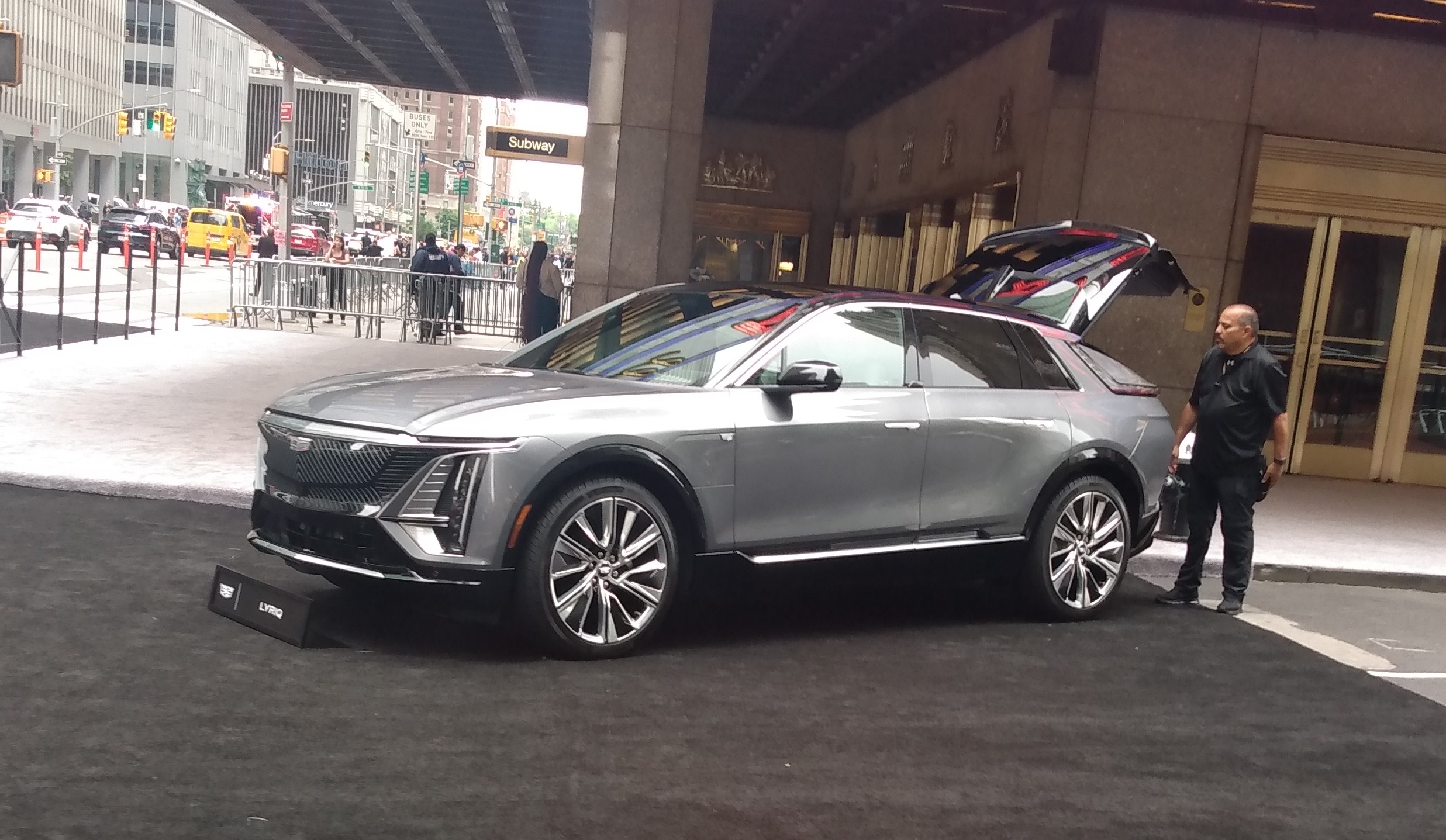
The Cadillac Lyriq is an electric SUV. It’s a car that runs on electricity instead of gasoline. The podcast mentions it when talking about what EV models are coming next.
Super Cruise is GM’s advanced driver-assist feature that can help with steering and driving on supported roads. Here, they’re talking about how much it costs to use in these EVs.
Waymo is a company that runs self-driving vehicles. They paused service in some cities because flooded roads created a safety problem, and they planned to fix it with a software update.
Stellantis is a big car company. Here, they’re teaming up with another company to build cars in France, and they’ll own more of the partnership than their partner.
A joint venture is when two companies team up to build something together. They split ownership and responsibilities instead of one company doing everything alone.
The Ford F-150 is a large pickup truck. It’s usually powered by gasoline, so it can use a lot of fuel compared with smaller cars. The podcast mentions it to explain why some people might not choose it if they’re trying to avoid gas-only vehicles.
LIVE
Hello everyone and welcome to Kilowatt, a podcast about electric vehicles, renewable
energy, autonomous driving, and much much more. My name is Bode and I am your host and on today's
episode we are going to cover some news. We're gonna start off with Tesla news and then I'll work
our way through to the actual EV news. Let me pull up my document here because I just closed it on
accident. Oh, you know what? Okay, so I was able to get through a large backlog of emails. So if
you haven't received an email from me yet responding to an email that you sent even a while ago,
it's coming. I'm working through the backlog and I know some people sent some emails about the
Rivian and Lucid earnings calls recently and I'm definitely working on those as well. So just so
everybody knows getting through that. Oh, oh, you know what? I have a question for everybody.
Recently, we've had a number of new folks in the Kilowatt community based on download numbers and
you know, it's not an insignificant bump recently and trust me, I'm very happy about the bump.
But I was curious, if you're new to the show, are you listening because you're interested in EVs?
Because of the way that the world is right now? Did you recently just purchase an EV? This isn't
something that I put two and two together recently on a recent Patreon subscriber actually said that
they heard me on DTNS, they got a used EV, I believe, and they wanted to learn a little bit
more about EVs. And then they came over here, which I love, I love. But if you're new to the show,
are EVs a recent interest to you because of kind of what's going on in the world with gas prices
and that stuff? I'm just curious. So send me an email, it's bodeyeat918digital.com. And speaking
of DTNS, I was on Daily Tech News show Weekend Edition, and I was talking about an AI development
tool that I used called Lovable to basically make a virtual news desk, like where all of my
articles come in and I can sort them and get them prepped for the show, I built a tool like that
through Lovable. And if you want to listen to it, I'll put a link in the show notes. But basically,
it was not about EVs, it was about something completely different. But Tom and I had a good
chat. So if you want to listen to that, like I said, I'll have a link in the show notes for that as
well. Okay, let's start off with our Tesla news here because I got a lot of EV news. So really
filled the show up with the EV news. And then I got to Tesla and I was like, I'm running out of
energy. So let's start with our Tesla news. First up, Tesla released FSD supervised in the Netherlands
about five weeks ago. We now have a second European country to, to approve FSD supervised,
and that is Lithuania. So great work at Tesla. They're on a roll. I don't know how many countries
are in the EU, but you're, you can scratch two off your list. So congratulations.
Next up, Tesla said that the CyberCab is the most efficient EV ever. Again, that's according to Tesla.
So they said the CyberCab, its efficiency is 165 watt hours per mile. So it
expends 165 watt hours every mile that it drives. That's pretty good because when you look at the
other vehicles like the Lucid Air Pure rear wheel drive with 19 inch wheels, it's 230 watt hours per
mile. The Model 3 rear wheel drive with 18 inch wheels, 240 watt hours per mile. And that's same
with the Model Y rear wheel drive. The Ioniq 6 is 241 watt hours. It's the rear wheel drive. All
of these are not all of them. A lot of them are the rear wheel drive versions that they're comparing
to. The Toyota's BZ3XXLE front wheel drive is 260 watt hours per mile. So, you know,
165. The lower the number, the better here. 165 is pretty good, but
Abterra says that their EV will be 100 watt hours per mile. So around that. And so that's better.
That's better than what Tesla is touting here. Now, I can hear a lot of you saying,
but Abterra isn't producing a car yet and it hasn't been certified. You're right.
Next story. Tesla is addressing a known hardware issue that affects the charging systems for
early built cyber trucks. The issue is with the power conversion system. So this converts,
the way I understand this, it converts AC power to DC power. So when you're charging from an AC
source like a level two charger or even level one, it's converting it to DC so it can charge the
battery. The problem is, is it's unable to use this AC side of the system, but you can still charge
using a DC fast charger. And that's good news because Tesla is offering free supercharging
because the parts that are needed to fix this are currently on back order. So until the
back order is cleared, you can supercharge for free if you own one of those early Tesla cyber
trucks. Alright, that was pretty fast. That was our Tesla news. Let's go ahead and jump into our EV
news. The 2027 Chevy Equinox and Chevy Blazer EV got some interesting updates. The first one and
probably the best one is that the cars now come equipped with a NACS port. So you can charge on
Tesla supercharger network without having to have an adapter. Previously, the Blazer and Equinox EVs
had a CCS port. Eventually all new GM EVs will have the next port. But it's not quite, you know,
I think the next ones are the Cadillac Lyric and the Chevy Bolt will come with that. And then,
you know, as they release new models or updated models, then we'll get that next port.
They did announce some stereo upgrades in these new models. I don't really care about that so much,
but I guess people were complaining because the stereos were awful. So they have,
I guess an upgraded stereo system and then an option to purchase a more upgraded stereo system
if you want to. So good for them. And then Super Cruise is available in all of the models and it
will cost you $4,650. So cheaper than $8,000 for sure, which Tesla is no longer charging $8,000.
Oh, that's another news story. And I forgot to put this down. Tesla is no longer offering a
one-time payment for FSD supervised in Europe. Now you actually have to subscribe or you just
don't get it. So that's another update. But anyway, the Equinox is going to, or no,
the Super Cruise is going to cost $4,650. And it's up to you to decide if that's worth it to you
or not. The Equinox EV starts at $35,000, a very reasonable price. And the Blazer EV
starts at $45,000, which isn't too shabby either. Waymo is pausing operations in Atlanta and San
Antonio because the roads are flooded. So this comes after a Waymo in Texas was caught blasting
through a little area of a flooded roadway. And, you know, there was quite a bit of water,
quite a bit of standing water on the roadway. And that's not safe for those cars to be in that
situation. So somebody snapped a picture of it. And Waymo just decided to pause operations and
they are going to issue a software update to correct the issue. Now that's relevant here
in Phoenix too, because we do have roads, especially in the East Valley around, you know,
the rural is a silly way to mention it. But the more unpopulated areas around Scottsdale and stuff,
and even further East, the one Queen Creek and Apache Junction and things like that,
we have roads that kind of dip down. And when it floods, those roads will completely get washed
out sometimes. There's actually a couple of roads near where I work, when it floods, those roads
will be washed out because they kind of go down into that ravine, the channel, they go down into
that channel and eventually there's enough water that it will wash them out. I've had to drive
through these in during flood times in the fire truck. And, you know, the fire truck is not
we were doing it, but I could definitely see where a car would have that could get washed away.
So, you know, good on you. I'm expecting if they don't have it fixed, they'll pause that in
Phoenix too, just because Phoenix this year is supposed to get a ton of rain with the
weather patterns during the summer. So we'll see if they have it fixed by then.
Oh, and if I didn't say it, they're going to fix the issue with a software update.
Okay, next up, Stellantis. Stellantis is investing nearly 70 billion US dollars or 60
billion euros on updating 50 existing vehicles and launching 60 new vehicles between now and 2030.
So right now, the mix looks like this. 29 battery electric vehicles, 15 plug-in hybrid,
or extended range vehicles, 24 hybrids and 39 ice vehicles or mild hybrids is what they put here.
Yeah, so 29 EVs, that's pretty impressive. We'll see how many make it here to the US.
Their focus will be on the following brands Chrysler, good news because Chrysler only has
one car that they're currently selling, Dodge, Citroen and Opel. Now, there was some more
announcements about specific EVs that Stellantis is planning on putting out. One of them was a Jeep,
but honestly, I'm going to wait before putting too much effort into what Stellantis is doing with
EV efforts. But having said that, and speaking of Stellantis's EV efforts,
Stellantis is going to build EVs in France for Chinese car automaker, Chinese automaker Dongfeng.
If that name sounds familiar to you, because it's because we talked about them a couple weeks ago,
and they were selling a luxury car for more money than they were selling the same car in
Australia and China. And that created some sort of hubbub. Anyway, Dongfeng has a luxury brand
called Voya. And one of the cars that Stellantis will be building is the Voya Free. They are going
to be building this car in, like I said, France. The companies are going to be creating a joint
company or a joint venture. Stellantis will own 51% and Dongfeng will own 49%. And this is very
similar to the joint venture that Western companies have to do with Chinese companies when they build
an EV or any car in China. So there's got to be a partnership. And I believe that's for most every
production, not just cars. Anyway, yeah. So Stellantis is working very hard with Leap Motors,
and now they've got a joint venture with Dongfeng. So interesting. We're going to have somebody on
talking about their experience with their Leap Motors in a couple of weeks. So stay tuned for that.
Before we get to our main story, I just want to thank everybody who supports the show on Patreon
and Supercast. Whenever the economy gets bad, and it's bad in a lot of different places,
not just here in the US, I always expect to lose Patreon supporters. I mean, and I totally get why,
right? It is 100%. This is not a necessity in your life. You can get every single episode and
just listen to a couple of ads rather than just giving me flat-out money. But we have very little
churn on the show. And really, that makes me super appreciative. Like, there are people who decide to
stop supporting for whatever reason, and that's okay. But by and large, we have, I mean, folks who
have been still with the podcast since the very beginning. So I appreciate each and every one
of you for supporting the show. If you want to be one of those people, you can go to support
kilowatt.com. But if you don't, and you just want to keep listening on the free feed, that's totally
fine too. But yeah, honestly, and I don't know how to put this into words without sound and sappy,
I do appreciate everybody who supports the show. I also appreciate everybody who sits through the ads
because I get it, you know, it's not fun to sit through the ads either, but the show costs money
to produce. It's not free. And it doesn't really make money so much as it gets close to breaking
even. So any help that you can give, whether that's listening to all the ads or supporting the show
on Patreon or Supercast, it's always appreciated. So thank you everybody for basically just sticking
with me. I really appreciate that. And thank you to all the new folks as well. And if I didn't
mention you specifically, thank you. It just comes down to how I appreciate all you. Thank you very
much. You make doing this podcast a lot of fun. All right, let's move on to our final and main
story. This is America centric. So if you don't live here, you can tune out now. The Build America
250 Act is more than 1000 pages. And inside that act is a new federal registration for EVs
and some plug-in hybrids that would basically require people to pay an annual fee
to help offset the fact that they're not paying for road tax. So if you remember, you know,
Congress floated this about a year ago and they wanted to charge EV owners $250 and hybrid owners
$100 a year for the road tax. And that was just too much, right? So the new proposed fee is $130
for battery electric vehicles and $35 for plug-in hybrids. And it will go up by $5 each year until
it hits a maximum of $150 for EVs and $50 for plug-in hybrids. When I read this, I was like,
that seems almost reasonable. Like I can't think of it when I read it. I was like,
I can't really think of a way or a reason to be upset about that until some advocacy groups
pointed out that gas-only vehicles, so if you just had your regular Ford, I don't know, would
probably wouldn't want to do an F-150. But if you just were driving around in a regular gas sedan
or small SUV, you pay around $73 to $89 a year in federal gas taxes, which seems really low to me,
but I did the math. So dieselers are going to pay a little bit more, but I did the math and it's
that's pretty close to being accurate, depending on, you know, how fuel efficient your car is.
So the federal gas tax hasn't been adjusted since 1993. So the federal gas tax, not federal and state,
just federal, is 18.4 cents a gallon. Diesel, the federal tax is 24.4 cents a gallon. Those numbers
haven't changed, or at least the gas tax hasn't changed since 1993. If the federal gas tax kept
up with inflation, it would be 42 cents a gallon. Now, I am not advocating that we raise our gas
tax to 42 cents a gallon, but I am advocating for fairness between EVs and gas-powered cars. So
this makes it a little weird, because more than 40 states charge their own annual registration
to EVs to make up for lost road taxes. For instance, I'm going to use North Carolina as
an example, because it's one of the higher ones. In North Carolina, EV owners pay $214
for state road tax. And then if we were to add another $130 on top of that, now we're creeping
up to $344 a year to own an EV total. And I was like, well, that's interesting, because
based on how fuel efficient your car is, you're going to pay, you know, a different amount for
everybody. So if you had a car that had, that got like 20 miles to the gallon, and in one year,
you drove 11,000 miles, which is, you know, not crazy. It's not a lot, and it's not a little.
You would put 550 gallons of gas in your car, and your annual gas tax would be around $225.
So a $214 road tax wouldn't be ridiculous if you lived in North Carolina and you played
41 cents a gallon. But let's kind of break that down as our cars get more efficient.
So if you had a car that got 25 miles per gallon, you would use about 440 gallons of gas,
and this is all based off of 11,000 miles. You'd use about 440 gallons of gas per year.
That would be $180 in North Carolina state road taxes or gas taxes, I guess, and $101 federal.
So that's a total of 291. So we're already lower than the 344 that we were talking about earlier.
So 291, that's if you had a car that was 25 miles per gallon.
But we live in an age of fuel-efficient cars. So if we had a car that got 30 miles per gallon,
what happens then? Well, we're going to burn about 367 gallons of gas per year.
We're going to pay $150 in annual gas tax just for the state of North Carolina,
$81 in federal tax, and that's going to get us down to $231.
Now, there's a lot of hybrids out there. They get more than 40 miles per gallon.
So if we are just using 40 miles per gallon as the example here, that would be 275 gallons of gas,
$113 in annual gas taxes, and we're not talking plug-in hybrids, we're just talking about hybrid
hybrids. That'd be $113 in annual state gas taxes, $50 in federal tax for $163. I think we can all
argue that an EV that burns no fuel whatsoever is more efficient than a car that gets 20 miles per
gallon. So as far as it goes when it comes to these EV specific taxes for road tax to pay for
highways and things like that, I am going to rebuke any road tax that's higher than what
the average driver pays in gas tax. I think it needs to be fair. I don't think it should be lower.
I don't think it should be nothing, but it should be what the average driver pays.
So what I'm proposing is we use 30 miles per gallon as where we're at in terms of fuel efficiency,
again, we can all agree that EVs are way more fuel efficient than gas-powered cars.
30 miles per gallon, you can calculate 11,000, 12,000 miles, whatever floats your boat in this
regard. And then whatever that number is, that's the gas tax, or that's the tax that we pay. So it
if we had a 30 miles per gallon car, a mile per gallon car, it'd be right around $81 for federal
tax. And then whatever the state gas tax is, calculate that same thing. In North Carolina,
that would be $150. So I think that's the fair way to do it. We need to have a, this is what the
standard gas car is going to pay. And this is, you know, this is, this is a middle of the road
efficiency in terms of EVs and really inefficient gas cars, 30 miles per gallon, that's how we're
going to calculate it. I think that's easy. And if you wanted to have a tiered system where
if you're between zero and 8,000 miles, you pay X amount and 8,000 and 15,000 miles, you pay Y
amount, sure, but it still should be all calculated off of that number. If you don't want to track
everybody's mileage for the year, which I think is difficult to do. Anyway, that is, that is my
show. It's all they got for you today. I don't know, $130 doesn't seem too bad to me, but in
reality, if somebody is paying more than their fair share, I have an issue with that. By the way,
I would have this same issue if EV owners were paying $20 a year in road tax and gas
owners were paying an average of $80 a year in gas tax. I wouldn't be okay with that either.
So I do think it's important to keep our infrastructure maintained and up to date.
And I'm more than willing to pay for that. However, I'm not willing to pay more than
somebody else just because I bought a fuel efficient car. And I don't think that's fair.
All right, everybody, that is it for me. I hope you enjoyed this episode. And yeah, I don't.
Go listen to the Daily Tech News show. I'll put a link in the show notes.
And let me know what you think. And I will talk to you all soon.
About this episode
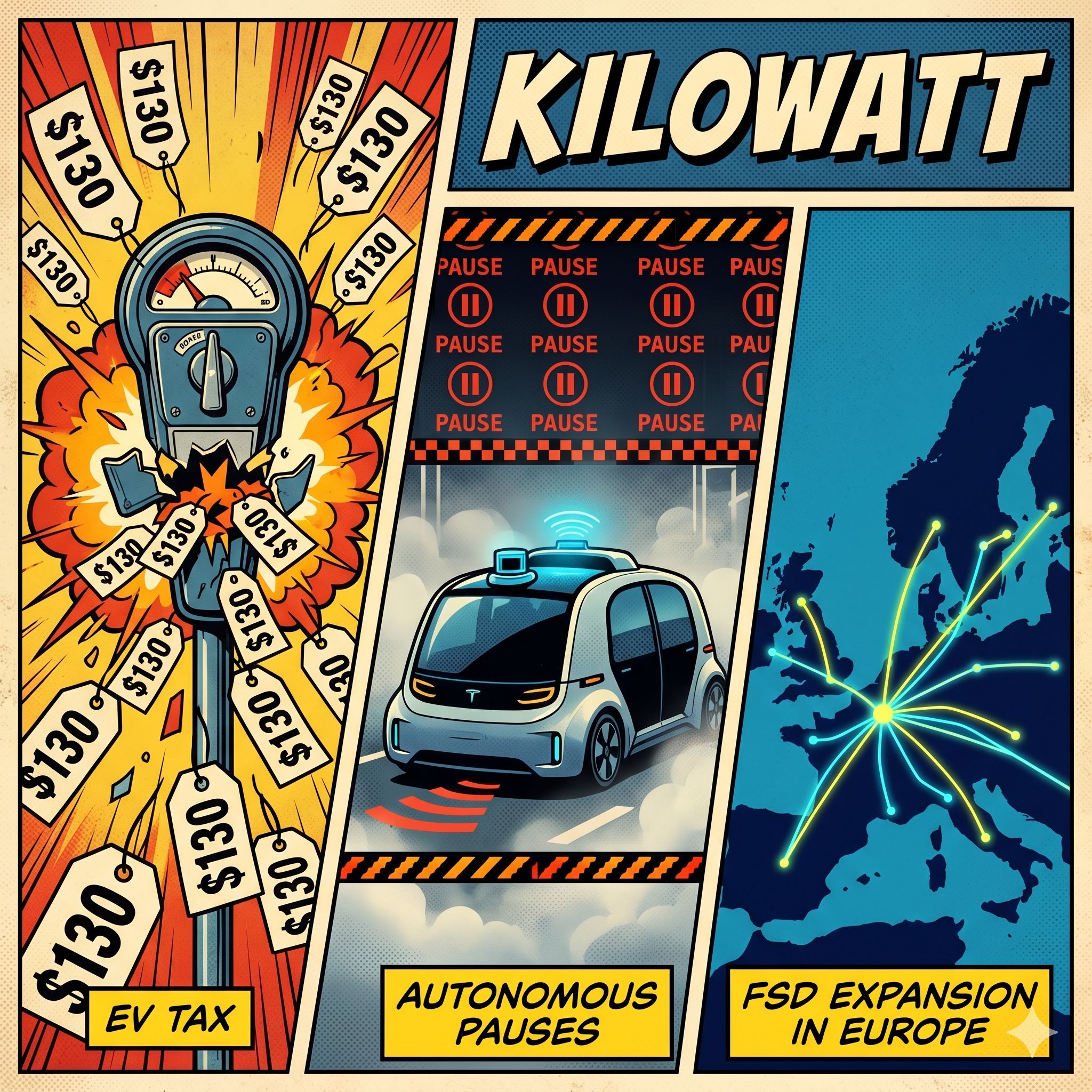
Tesla expands FSD supervised approvals in Europe, while the hosts compare efficiency claims and dig into a Cybertruck charging hardware snag tied to the power conversion system—plus Tesla’s free Supercharging while parts are back ordered. Elsewhere, GM moves to NACS for easier Tesla-network charging, and Tesla shifts FSD supervised Europe payments to subscriptions. Waymo pauses robotaxi operations in flooded Atlanta and San Antonio. The show also breaks down a proposed U.S. EV road-fee framework and Stellantis’ big EV investment and China partnerships.
This week, we dive into the news as Tesla's Full Self-Driving (Supervised) platform expands its European footprint into a second country, moving closer to widespread adoption while transitioning away from one-time purchase options in the region. On the hardware front, we look at Tesla’s ambitious efficiency assertions regarding the futuristic CyberCab, alongside a new monitoring program addressing charging failures to support early Cybertruck buyers with free Supercharging. Looking at legacy automakers, Chevrolet is stepping up its game for 2027 by introducing key updates for the Equinox EV and Blazer EV lineups. Meanwhile, safety concerns have prompted Waymo to temporarily suspend its freeway driving operations in certain conditions. Stellantis is also charting a massive $70 billion comeback strategy heavily featuring affordable LFP batteries, a dedicated Tesla FSD challenger, and production partnerships to manufacture EVs for Dongfeng in France. Finally, we break down the high-stakes debate surrounding a newly proposed annual $130 federal EV registration road tax fee in the United States and weigh its implications for modern clean vehicle owners.