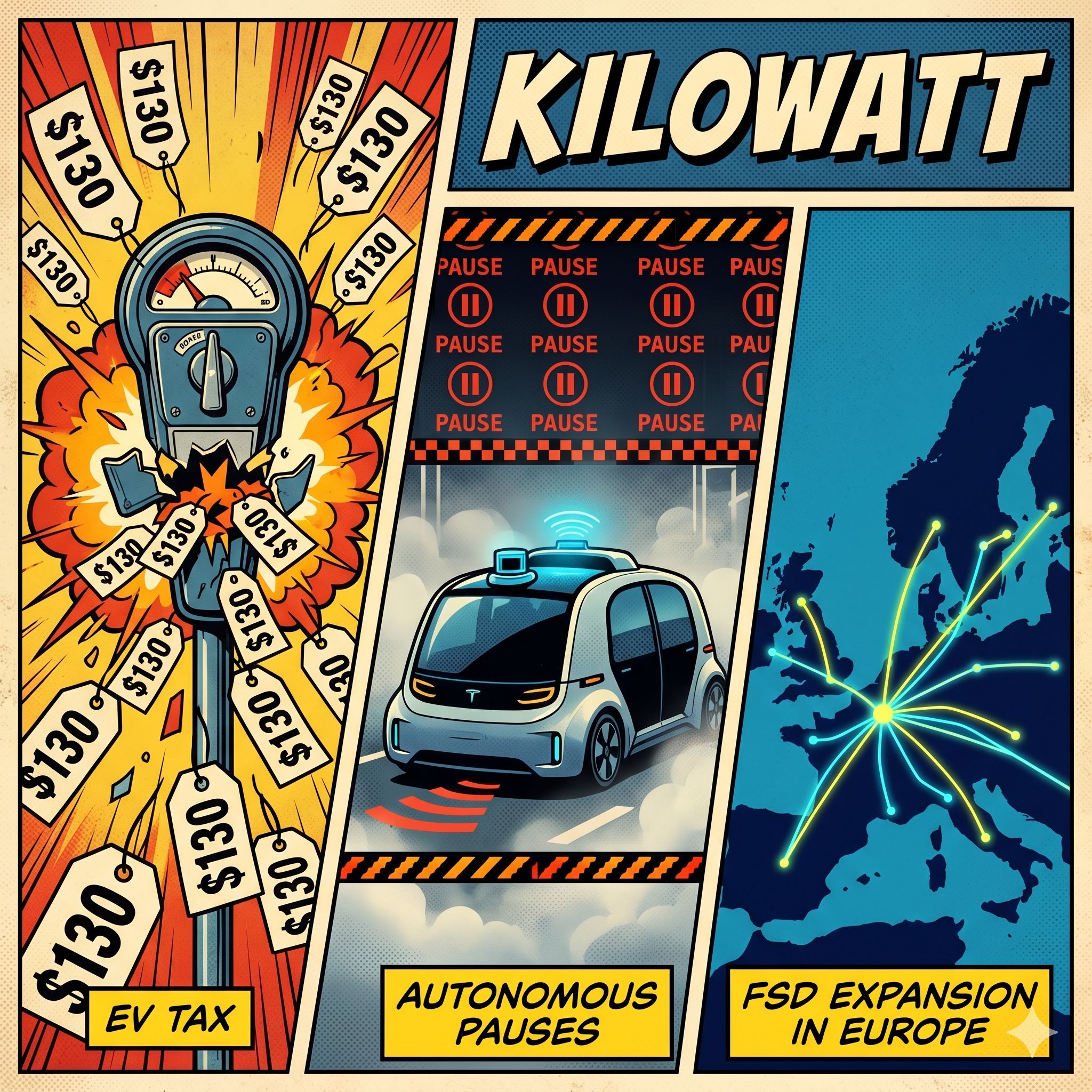
Proposed $130 EV Tax, Waymo Pulls Back, and Tesla Expands European FSD
About this episode
Tesla expands FSD supervised approvals in Europe, while the hosts compare efficiency claims and dig into a Cybertruck charging hardware snag tied to the power conversion system—plus Tesla’s free Supercharging while parts are back ordered. Elsewhere, GM moves to NACS for easier Tesla-network charging, and Tesla shifts FSD supervised Europe payments to subscriptions. Waymo pauses robotaxi operations in flooded Atlanta and San Antonio. The show also breaks down a proposed U.S. EV road-fee framework and Stellantis’ big EV investment and China partnerships.
This week, we dive into the news as Tesla's Full Self-Driving (Supervised) platform expands its European footprint into a second country, moving closer to widespread adoption while transitioning away from one-time purchase options in the region. On the hardware front, we look at Tesla’s ambitious efficiency assertions regarding the futuristic CyberCab, alongside a new monitoring program addressing charging failures to support early Cybertruck buyers with free Supercharging. Looking at legacy automakers, Chevrolet is stepping up its game for 2027 by introducing key updates for the Equinox EV and Blazer EV lineups. Meanwhile, safety concerns have prompted Waymo to temporarily suspend its freeway driving operations in certain conditions. Stellantis is also charting a massive $70 billion comeback strategy heavily featuring affordable LFP batteries, a dedicated Tesla FSD challenger, and production partnerships to manufacture EVs for Dongfeng in France. Finally, we break down the high-stakes debate surrounding a newly proposed annual $130 federal EV registration road tax fee in the United States and weigh its implications for modern clean vehicle owners.
DTNS Episode:
Support the Show https://www.supportkilowatt.com/
Other Podcasts:
- Beyond the Post YouTube (https://www.youtube.com/@beyondthepostfm)
- Beyond the Post Podcast (https://www.beyondthepost.fm/)
- Shuffle Playlist (https://shows.acast.com/shuffle-playlist)
- 918Digital Website (https://www.918digital.com/)
News Links:
- InsideEVs: Is A $130 Fee For EV Drivers Really Fair? Plus, We Review The Volvo EX60
- Not a Tesla App: U.S. Proposes Annual $130 Federal Road Tax for EV Owners
- Ars Technica Cars: EV drivers will pay $130 a year under Congress' 2026 transportation bill
- InsideEVs: Congress Wants You To Pay $130 A Year Just To Drive An Electric Car
- Electrek: Chevy Equinox and Blazer EVs gain a few key updates for 2027: Here’s what to expect
- Not a Tesla App: Tesla Says Cybercab is the Most Efficient EV Ever Built
- The Verge: Waymo suspends freeway driving amid safety concerns
- InsideEVs: Tesla Drops One-Time Purchase For Full Self-Driving In Europe
- Teslarati: Tesla Full Self-Driving expands in Europe, entering its second country
- Electrek: Tesla launches FSD in second European country
- Not a Tesla App: Tesla in Talks for FSD Approval in Ireland
- Teslarati: Tesla Full Self-Driving gains momentum in Europe with new country mulling approval
- Electrek: Jeep and Ram vehicles are about to get more affordable with prices under $40,000
- Electrek: Jeep maker reveals plans for a new ‘groundbreaking’ EV that will start at under $18,000
- InsideEVs: Stellantis Plans $70 Billion Comeback With LFP Batteries And A Tesla FSD Challenger
- CleanTechnica: Stellantis to Build EVs for Dongfeng in France
- Not a Tesla App: Tesla Is Now Monitoring Cybertrucks for Charging Failures and Offering Free Supercharging
*Show Art Created By Gemini
Hosted by Simplecast, an AdsWizz company. See pcm.adswizz.com for information about our collection and use of personal data for advertising.
FSD supervised
"First up, Tesla released FSD supervised in the Netherlands about five weeks ago. We now have a second European country to, to approve FSD supervised, and that is Lithuania."
“FSD supervised” means the car can do more of the driving, but you’re still responsible for watching the road. It’s not meant to be fully hands-off or fully driverless.
FSD supervised is Tesla’s driver-assistance/automation mode where the car can handle more driving tasks, but a human driver is still expected to monitor and be ready to take over. “Supervised” implies the system is not fully driverless; it’s designed to operate with ongoing driver oversight.

Tesla Cybercab
"... So congratulations. Next up, Tesla said that the CyberCab is the most efficient EV ever. Again, that's acco..."
The Tesla Cybercab is an EV that Tesla is promoting as very efficient. That means it’s designed to use less energy to travel the same distance. The episode brings it up because efficiency affects range and charging needs.
The Tesla Cybercab is an upcoming Tesla EV concept aimed at maximizing efficiency and reducing energy use. The podcast highlights Tesla’s claim that it’s the most efficient EV ever, which is the kind of metric that matters for range and operating costs. It’s discussed because efficiency improvements can change how EVs are used and how far they can go between charges.
watt hours per mile
"So they said the CyberCab, its efficiency is 165 watt hours per mile. So it expends 165 watt hours every mile that it drives."
This is a way to measure how much electricity an EV uses to drive one mile. A lower number usually means the car goes farther on the same amount of energy.
“Watt hours per mile” is an energy-consumption metric for EVs: how much electrical energy the car uses to travel one mile. Lower numbers generally mean the vehicle is more efficient in real-world driving conditions (though exact results depend on test cycle and configuration).

Lucid Air Pure rear wheel drive
"And that's pretty good because when you look at the other vehicles like the Lucid Air Pure rear wheel drive with 19 inch wheels, it's 230 watt hours per mile."
The Lucid Air Pure rear-wheel-drive is another electric car they compare against. They’re using it to show whether Tesla’s claimed efficiency is better or worse than other EVs.
Lucid Air Pure rear wheel drive is used here as a benchmark EV in Tesla’s efficiency comparison. The host specifically cites its watt-hours-per-mile figure to show how the CyberCab’s claimed efficiency stacks up against other EVs.

Tesla Model 3
"The Model 3 rear wheel drive with 18 inch wheels, 240 watt hours per mile. And that's same with the Model Y rear wheel drive."
They mention the Tesla Model 3 rear-wheel-drive as a comparison EV. The point is to show how much electricity it uses per mile versus the CyberCab claim.
The Tesla Model 3 rear wheel drive is referenced as another comparison point for EV efficiency. The segment uses its cited watt-hours-per-mile number to argue that the CyberCab’s claimed efficiency is lower (better) than existing Tesla variants.

Tesla Model Y
"And that's same with the Model Y rear wheel drive. The Ioniq 6 is 241 watt hours."
They also compare the Tesla Model Y rear-wheel-drive. It’s another example of an EV’s electricity use per mile in the same efficiency discussion.
The Tesla Model Y rear wheel drive is included in the efficiency comparison using watt-hours-per-mile. It’s part of the host’s argument that the CyberCab’s claimed energy use is significantly lower than current Tesla models (at least in the cited configurations).

Ioniq 6
"The Ioniq 6 is 241 watt hours. It's the rear wheel drive."
The Hyundai Ioniq 6 is another electric car they’re comparing. They’re using its electricity-per-mile number to see how it compares to Tesla’s claim.
The Hyundai Ioniq 6 is used as a non-Tesla benchmark in the watt-hours-per-mile efficiency comparison. The host cites its rear-wheel-drive configuration’s energy use to contextualize Tesla’s claimed CyberCab efficiency.

Tesla Cybertruck
"Tesla is addressing a known hardware issue that affects the charging systems for early built cyber trucks. The issue is with the power conversion system... And that's good news because Tesla is offering free supercharging because the parts that are needed to fix this are currently on back order."
The Tesla Cybertruck is the truck in question. Early versions had a charging hardware problem, so AC charging may not work as expected, but DC fast charging still does—and Tesla is offering free Supercharging while parts are on back order.
The Tesla Cybertruck is discussed here in the context of a charging-related hardware issue affecting early-built vehicles. The host explains that the power conversion system can’t properly use the AC charging path, but DC fast charging still works, and Tesla offers free supercharging until replacement parts arrive.
power conversion system
"Tesla is addressing a known hardware issue that affects the charging systems for early built cyber trucks. The issue is with the power conversion system. So this converts, the way I understand this, it converts AC power to DC power."
A power conversion system in an EV manages electrical conversion between what the charger provides and what the battery system needs. In this segment, it’s described as converting AC power to DC power so the battery can charge.
AC power
"So when you're charging from an AC source like a level two charger or even level one, it's converting it to DC so it can charge the battery."
AC power is the electricity that comes from the power grid. The EV can’t always feed it directly into the battery, so it’s converted to DC for charging.
AC power (alternating current) is the type of electricity commonly delivered by the grid and used by many chargers. The host contrasts it with DC power, explaining that the EV needs conversion to charge the battery.
DC fast charger
"The problem is, is it's unable to use this AC side of the system, but you can still charge using a DC fast charger."
A DC fast charger is a high-power charger that can charge an EV faster. In this case, even with the hardware issue, the car can still charge when using a DC fast charger.
A DC fast charger delivers direct current at high power, allowing quicker charging than typical AC charging. The segment says early Cybertrucks can’t use the AC side of the system, but they can still charge using DC fast charging.

Chevrolet Equinox
"The 2027 Chevy Equinox and Chevy Blazer EV got some interesting updates. The first one and probably the best one is that the cars now come equipped with a NACS port. So you can charge on Tesla supercharger network without having to have an adapter."
The 2027 Chevy Equinox EV is being updated with a NACS charging port. That lets it charge at Tesla Superchargers more easily, without needing a special adapter.
The 2027 Chevy Equinox EV is getting a new charging connector standard: a NACS port. That means it can plug into Tesla Supercharger stations without using an adapter, which is a big day-to-day convenience change for EV owners.

Chevrolet Blazer EV
"The 2027 Chevy Equinox and Chevy Blazer EV got some interesting updates. The first one and probably the best one is that the cars now come equipped with a NACS port. So you can charge on Tesla supercharger network without having to have an adapter. Previously, the Blazer and Equinox EVs had a CCS port."
The Chevy Blazer EV is getting a NACS charging plug. That’s meant to make charging at Tesla stations easier compared with older versions that used a different plug type.
The Chevy Blazer EV is also being updated with a NACS port for charging. The episode contrasts it with earlier Blazer EVs that used a CCS port, highlighting how connector standards affect charging convenience.
NACS port
"The first one and probably the best one is that the cars now come equipped with a NACS port. So you can charge on Tesla supercharger network without having to have an adapter."
NACS is the charging plug standard Tesla uses. If your EV has a NACS port, you can charge at Tesla Superchargers directly instead of needing an adapter.
NACS (North American Charging Standard) is a charging-connector standard used by Tesla. When a vehicle has a NACS port, it can use Tesla Superchargers directly, reducing the need for adapters and making charging simpler.
CCS port
"Previously, the Blazer and Equinox EVs had a CCS port. Eventually all new GM EVs will have the next port."
CCS is another common EV charging plug type. The episode is saying older GM EVs used CCS, but newer ones are switching to NACS for easier charging at Tesla stations.
CCS (Combined Charging System) is a different EV charging-connector standard than Tesla’s NACS. The episode notes that earlier GM EVs used CCS, and the move to NACS is part of GM’s transition to the “next port” standard.
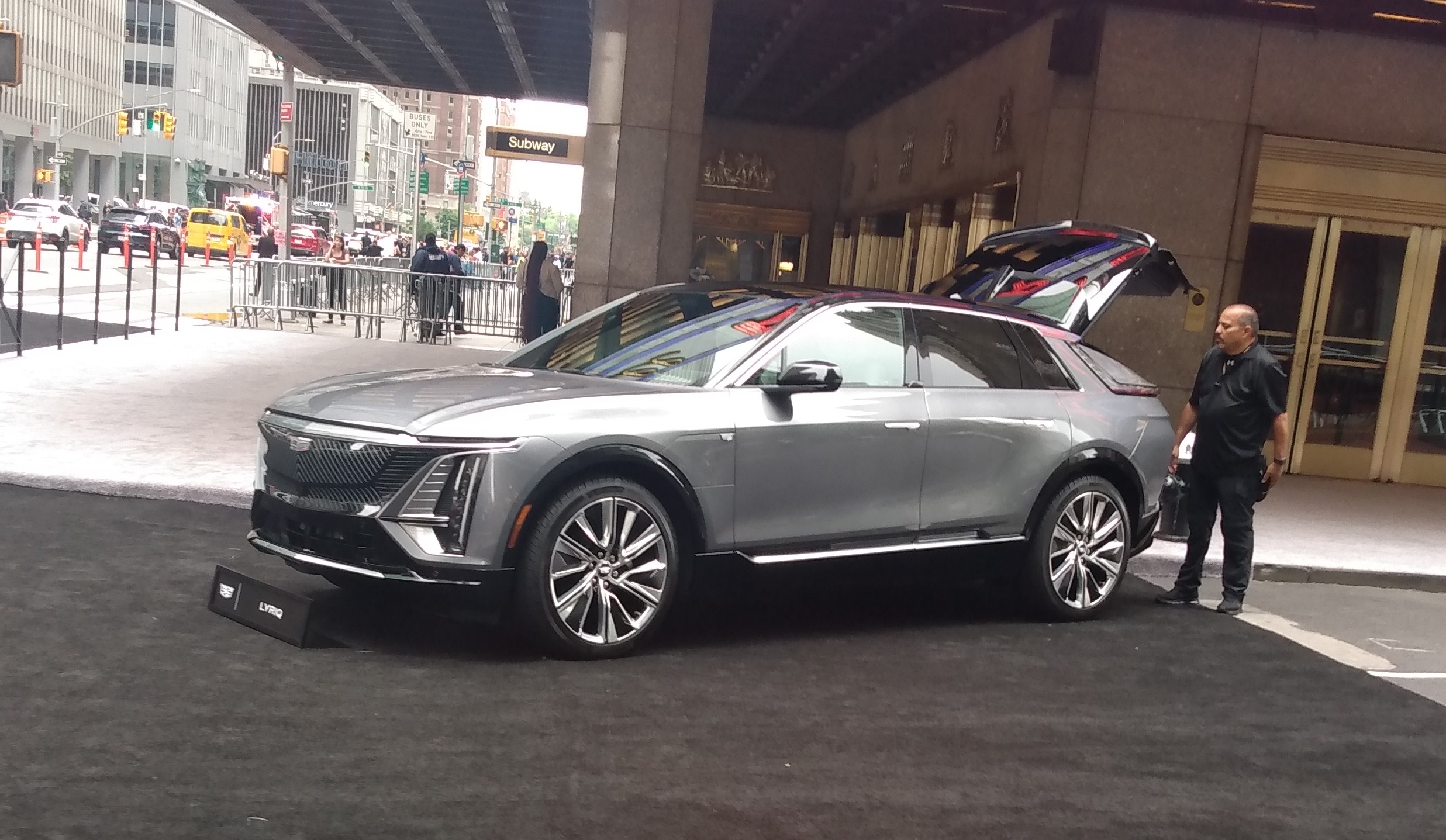
Cadillac Lyric
"... you know, I think the next ones are the Cadillac Lyric and the Chevy Bolt will come with that. And then,..."
The Cadillac Lyriq is an electric SUV. It’s a car that runs on electricity instead of gasoline. The podcast mentions it when talking about what EV models are coming next.
The Cadillac Lyriq is an electric SUV from Cadillac, discussed as part of the broader shift toward EVs. The podcast groups it with other upcoming EV plans, suggesting it’s part of Cadillac’s next generation of electric offerings. It’s relevant because it represents how traditional automakers are expanding their EV lineup.
Super Cruise
"And then Super Cruise is available in all of the models and it will cost you $4,650. So cheaper than $8,000 for sure, which Tesla is no longer charging $8,000."
Super Cruise is GM’s advanced driver-assist feature that can help with steering and driving on supported roads. Here, they’re talking about how much it costs to use in these EVs.
Super Cruise is General Motors’ hands-free driver-assistance system for certain roads. In this segment, the hosts mention it’s available across the models and discuss the subscription/price to enable it.
Waymo
"Waymo is pausing operations in Atlanta and San Antonio because the roads are flooded. So this comes after a Waymo in Texas was caught blasting through a little area of a flooded roadway."
Waymo is a company that runs self-driving vehicles. They paused service in some cities because flooded roads created a safety problem, and they planned to fix it with a software update.
Waymo is an autonomous-driving company that operates robotaxi services in select cities. In this segment, the hosts say Waymo paused operations in Atlanta and San Antonio due to flooded roads and planned a software update to address the issue.
Stellantis
"The companies are going to be creating a joint [770.2s] company or a joint venture. Stellantis will own 51% and Dongfeng will own 49%."
Stellantis is a big car company. Here, they’re teaming up with another company to build cars in France, and they’ll own more of the partnership than their partner.
Stellantis is a major automaker formed from the merger of Fiat Chrysler Automobiles and PSA Group. In this segment, it’s described as partnering with Dongfeng via a joint venture to build EVs/cars in France, with Stellantis holding a majority stake.
joint venture
"The companies are going to be creating a joint [770.2s] company or a joint venture. Stellantis will own 51% and Dongfeng will own 49%."
A joint venture is when two companies team up to build something together. They split ownership and responsibilities instead of one company doing everything alone.
A joint venture is a partnership where two companies create a new business entity to share investment, manufacturing, and risk. The host compares this to how Western automakers often partner with Chinese companies to produce EVs and other cars in China.
Dongfeng
"company or a joint venture. Stellantis will own 51% and Dongfeng will own 49%."
Dongfeng is a car company from China. In this story, it’s teaming up with Stellantis, with each side owning a different share of the project.
Dongfeng is a Chinese automaker that, in this segment, is partnering with Stellantis through a joint venture. The host says Stellantis would own 51% and Dongfeng 49%, which is a common structure for shared manufacturing and technology risk.
Leap Motors
"Anyway, yeah. So Stellantis is working very hard with Leap Motors, [800.1s] and now they've got a joint venture with Dongfeng."
Leapmotor is an EV company. The host says Stellantis has been working with them, and they plan to share more about that experience later.
Leapmotor (Leap Motors) is an EV-focused automaker mentioned here as another partner Stellantis is working with. The segment frames it as part of Stellantis’ broader strategy of partnering with EV brands and manufacturers.

Ford F150
"pointed out that gas-only vehicles, so if you just had your regular Ford, I don't know, would probably wouldn't want to do an F-150. But if you just were driving around in a regular gas sedan or small SUV, you pay around $73 to $89 a year in federal gas taxes, which seems really low to me,"
The Ford F-150 is a large pickup truck. It’s usually powered by gasoline, so it can use a lot of fuel compared with smaller cars. The podcast mentions it to explain why some people might not choose it if they’re trying to avoid gas-only vehicles.
The Ford F-150 is a full-size pickup truck built for hauling, towing, and everyday driving. In an EV-focused discussion, it often comes up because it’s commonly sold as a gas-only truck, so the episode may be contrasting it with smaller or more efficient vehicles. That makes it relevant when talking about what kinds of vehicles people might want to switch to for lower energy use.
Request an Explanation
Heard something you'd like explained? We'll add it to this episode.
Sign in to request explanations for terms you heard.
Want to learn more?
Browse our glossary for plain-English explanations of automotive terms, jargon, and concepts.
Help improve this episode
See something that's not quite right? Our annotations are AI-generated and can sometimes miss the mark. Click the flag icon on any annotation to suggest a correction.