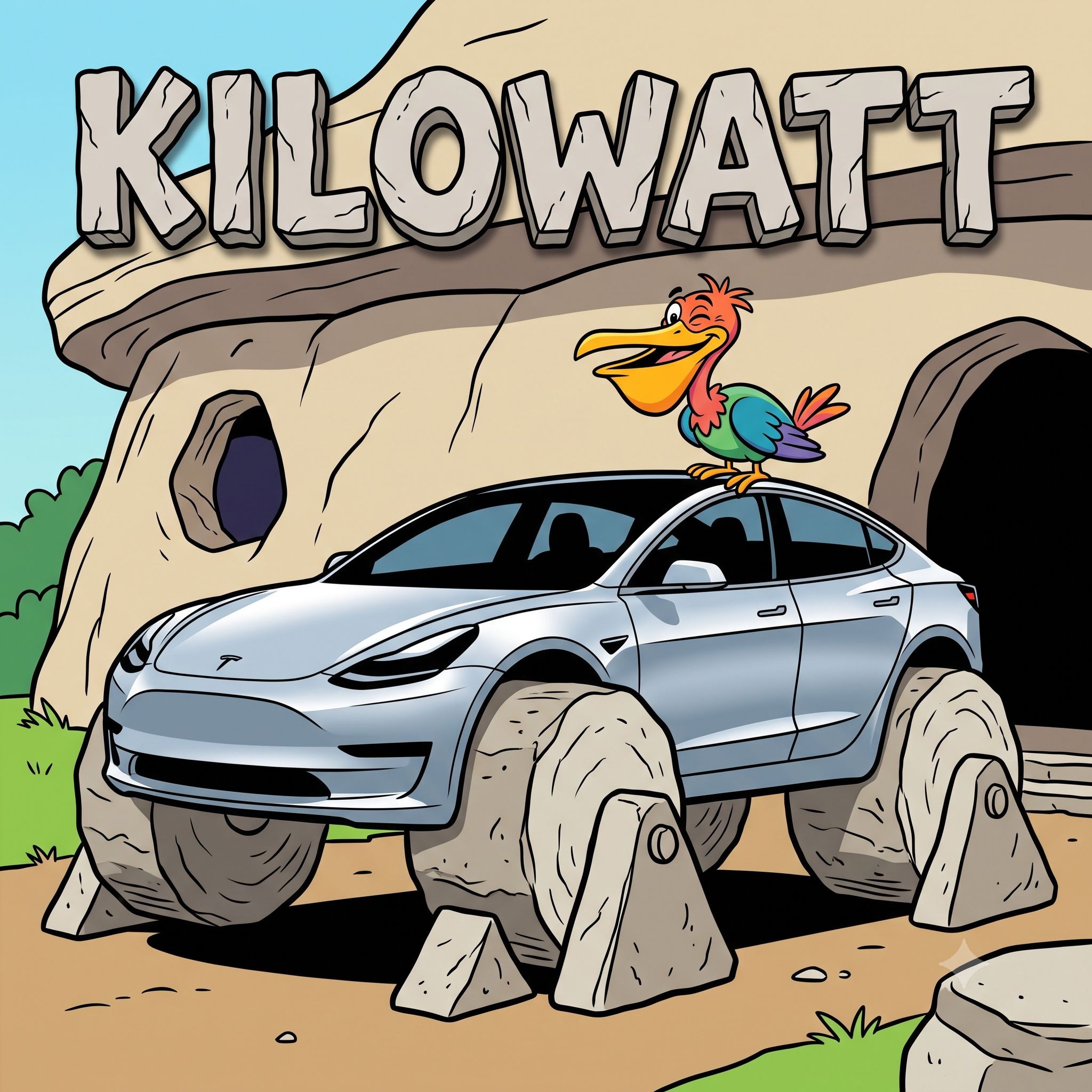
The Flintstone's Guide to FSD, Robotaxis and Cybercab
About this episode
The episode kicks off with a new release cadence and a focus on Tesla news. It connects California EV incentives to how eligibility caps could disadvantage Tesla, then pivots into robotaxis and Cybercab expectations—geofenced unsupervised operations, app-based passenger experience, and what Level 4 would mean. The hosts also walk through first-responder guidance for autonomous-mode shutdown, wheel chocks, and emergency interaction standards, before debating whether FSD will get an “iPhone moment,” alongside Grok voice/AI ideas and $99/month pricing.
In this weekend edition of Kilowatt, I chat about a new production philosophy to balance his full-time commitments, shifting to flexible weekly and weekend editions. This Tesla-focused episode dives deep into the hardware blueprint of the highly anticipated CyberCab, highlighting its ultra-efficient powertrain, 48-volt architecture, 4680 battery cells, and an exclusive upgraded AI4+ FSD computer with expanded RAM capacity. Bodie provides critical context for emergency personnel by breaking down the newly released CyberCab First Responder Guide, mapping out the specific protocols, chocking requirements, and sensor modalities needed to safely disable Level 4 autonomous mode on active scenes. The episode also tracks the expansion of Tesla's autonomous footprint with new unsupervised deployments in Miami and supervised networks in New Orleans. Finally, the show analyzes California's controversial new $135 million EV incentive structure, discusses a teased Grok assistant integration for precise driveway navigation, and breaks down an industry analyst's prediction that full self-driving is rapidly approaching its historic "iPhone moment."
Support the Show
- https://www.supportkilowatt.com/
Other Podcasts:
News Links:
- Not a Tesla App: Tesla Cybercab Will Let You Change Air Vent Direction From the App
- Electrek: Tesla claims Cybercab driving employees at Giga Texas — in a parking lot
- Not a Tesla App: New Jersey Bill Wants Tesla to Add More Sensors to Robotaxis
- InsideEVs: New Jersey Law Would Outlaw Tesla's Camera-Based Robotaxi Tech
- Teslarati: Tesla analyst says Full Self-Driving is about to have its iPhone moment
- CleanTechnica: How Many Tesla Robotaxis Are In Miami?
- Not a Tesla App: Tesla Cybercab Has New Ultra-Efficient Powertrain, 4680 Batteries, 48V & More
- Not a Tesla App: Tesla VP Confirms Grok FSD Integration is Coming Soon
- Not a Tesla App: Exclusive: Tesla Cybercab Includes More Powerful FSD Hardware
- Not a Tesla App: Tesla Robotaxi App Now Tells You If Your Ride Has a Safety Driver
- Not a Tesla App: Inside Tesla Cybercab's Level 4 'Autonomous Mode'
- Teslarati: Tesla reveals huge Cybercab detail in new guide for First Responders
- *Show Art Created By Gemini
Hosted by Simplecast, an AdsWizz company. See pcm.adswizz.com for information about our collection and use of personal data for advertising.
EV incentives
"let's go ahead and dive into our first story California put aside 135 million dollars in in EV incentives and the purpose of these incentives is to help first time EV buyers"
EV incentives are discounts or money offered by the government to make electric cars cheaper to buy. Here, California is offering them to help first-time EV buyers.
EV incentives are government or program subsidies meant to reduce the cost of buying an electric vehicle. In this segment, California sets aside money specifically to help first-time EV buyers qualify under certain rules.
first time EV buyer
"the purpose of these incentives is to help first time EV buyers no application is required you just got to be a first time EV buyer and you qualify"
First-time EV buyers are people buying an electric car for the first time. The host says the program is aimed at them and has specific eligibility rules.
First-time EV buyers are people who have not previously owned an electric vehicle and therefore qualify for a targeted incentive. The host emphasizes that no application is required, but eligibility depends on meeting that first-time criterion.

Lucid Sapphire
"but there does need to there are caps on the vehicles you can't just go out and buy a lucid sapphire for instance keep that in the back of your head because that's not exactly true what I just said"
Lucid Sapphire is a pricey electric car from Lucid. The host is using it to explain that California’s EV money has price limits, so expensive EVs won’t qualify even if they’re electric.
Lucid Sapphire is a high-end model from Lucid, used here as an example of an EV that would exceed California’s incentive purchase-price caps. The point is that incentives apply only if the vehicle price is under the program’s limits, so very expensive trims may not qualify.
purchase-price caps
"but there does need to there are caps on the vehicles you can't just go out and buy a lucid sapphire for instance ... so the caps on new vehicles will be $50,000 and $25,000"
Purchase-price caps are maximum car prices allowed to get the incentive. If the EV costs more than the cap, you don’t qualify for the discount.
Purchase-price caps are limits on the vehicle price that can qualify for an incentive. The host says the caps are $50,000 for new vehicles and $25,000 for used vehicles, meaning expensive trims won’t be eligible even if they’re electric.

Rivian R1S
"if you go out and buy a Rivian I don't know let's say but R1S for $120,000 there's no cap because Rivians and Lucid are based in California"
Rivian R1S is an electric SUV. The host brings it up to show how the incentive rules might treat different EV brands differently, depending on where the company is based.
Rivian R1S is an electric SUV from Rivian, mentioned as an example of a vehicle that could qualify differently under California’s EV incentive rules. The host contrasts it with Tesla by arguing that Rivian’s corporate base (and Lucid’s) affects whether the incentive has a purchase-price cap.
cyber cab
"most of the rest of this [461.6s] episode is going to be about robotaxis and cyber cab so let's start off with robotaxis and then [469.2s] we'll get into cyber cab"
Cybercab is the name for the small self-driving car. Robotaxis is the ride service/network that uses those cars.
The host distinguishes “Cybercab” from robotaxis: Cybercab is described as the small two-seater car, while robotaxis refers to the network/service operating it. This framing matters because people online often mix up the vehicle and the service.
robotaxis
"most of the rest of this [461.6s] episode is going to be about robotaxis and cyber cab so let's start off with robotaxis"
Robotaxis are self-driving rides you can summon like a taxi. The host is explaining how they work and where Tesla is starting to run them.
The host uses this segment to explain what robotaxis are and how they differ from the specific “Cybercab” concept. They also discuss real-world rollout details like operating regions and early service expansion.
FSD
"we end up let me see here I think we end up with talking about [477.0s] fsd and a little bit extra robotaxi stuff"
FSD means Full Self-Driving. It’s Tesla’s software aimed at making the car drive more on its own, and the host plans to talk about it in the context of robotaxis.
FSD stands for Full Self-Driving, Tesla’s driver-assistance and autonomy software stack marketed for increasingly automated driving. In this segment, the host says they’ll discuss FSD alongside robotaxi topics, implying it’s part of the technology behind the broader autonomy push.
miami florida
"tesla has launched a few unsupervised robotaxis in miami florida [512.1s] they're operating in a geofenced area"
Miami, Florida is where the host says Tesla started running some self-driving taxi rides. They’re limited to a defined area, at least at the start.
Miami, Florida is the location where the host says Tesla launched a few unsupervised robotaxis. The mention is tied to the rollout details like operating in a geofenced area and the expected number of vehicles.
geofenced area
"they're operating in a geofenced area so as far as we can tell that the geofenced area is about 10 [519.3s] to 14 square miles"
A geofenced area is a restricted zone where an automated service is allowed to drive. If it goes outside that boundary, it may have to stop or switch to a different, more controlled mode.
A geofenced area is a mapped boundary where an autonomous service is allowed to operate. Outside that defined region, the system typically won’t run in the same “unsupervised” mode, because it can’t guarantee safe behavior beyond the tested limits.
new orland in louisiana
"tesla started operating their robotaxi service in new orland in louisiana so that's cool so we got [542.4s] we know we just recently added florida and louisiana to the robotaxi network"
New Orleans, Louisiana is where the host says Tesla began running its robotaxi service. It’s part of the rollout expanding the service to more states.
New Orleans, Louisiana is referenced as the next place where Tesla started operating a robotaxi service. The host frames it as an expansion beyond Florida, adding Louisiana to the robotaxi network.

Cybercab
"let's get to our cyber cab news we have a little bit more information on the cyber cab specifically uh and some of this is not surprising like for instance it's gonna have a 48 volt architecture"
The Tesla Cybercab is Tesla’s planned robotaxi-focused vehicle. The host is saying it’s built with certain EV systems and navigation hardware that are meant to support self-driving in limited conditions.
Tesla Cybercab is presented as an upcoming Tesla vehicle designed around robotaxi-style operation. The host ties it to specific EV and autonomy hardware choices like a 48-volt architecture, 4680 battery cells, and dual GPS positioning.
48 volt architecture
"it's gonna have a 48 volt architecture tesla's doing this on as far as i know all of their new vehicles so that's not new"
Instead of using a typical 12-volt electrical system, the car uses a 48-volt system. That lets it power certain electronics more efficiently, which is useful for modern EVs and advanced features.
A 48-volt architecture is an electrical system design where the car’s main power distribution runs at about 48 volts instead of the traditional 12 volts. It helps support higher-power accessories and can make electric systems more efficient and responsive.

Chevrolet Volt
"...surprising like for instance it's gonna have a 48 volt architecture tesla's doing this on as far as i kn..."
The Chevrolet Volt is a plug-in hybrid, which means it can drive using electricity and also uses gas when needed. The podcast mentions it has a “48 volt” electrical setup. That’s part of how the car’s electrical system is designed to manage power.
The Chevrolet Volt is a plug-in hybrid electric vehicle that uses both an electric drive system and a gasoline engine. It’s mentioned in the podcast alongside battery and electrical-architecture topics, specifically noting a “48 volt architecture.” That matters because the vehicle’s electrical design affects how power is managed and how the car transitions between electric and gas operation.
4680 battery cells
"it's gonna have 4680 battery cells that's not a huge surprise"
4680 refers to a specific size/type of Tesla battery cell. Using a larger cell can help the battery store more energy and may make the battery pack cheaper or easier to build.
4680 battery cells are Tesla’s large-format cylindrical cells (46 mm diameter, 80 mm length). The bigger cell format is intended to improve energy density and reduce manufacturing complexity compared with smaller cylindrical cells.
steer by wire
"it'll have steer by wire which the cyber truck has"
Steer-by-wire means the steering wheel isn’t directly connected to the wheels with rods or cables. Instead, it uses sensors and motors to steer electronically.
Steer-by-wire replaces the traditional mechanical linkage between the steering wheel and the wheels with electronic controls. Sensors and actuators handle steering input, which can enable easier integration with advanced driver-assistance and autonomous systems.

Cybertruck
"it'll have steer by wire which the cyber truck has"
Tesla’s Cybertruck is a unique EV from Tesla, and it’s known for using electronic steering (steer-by-wire). The host is bringing it up as a reference point for what the Cybercab might share.
Tesla Cybertruck is notable for being one of Tesla’s most distinctive EVs, including its use of steer-by-wire. That matters here because the host is saying the Cybercab will use similar steering tech.
400 volt battery pack
"let's see 400 volt battery pack um also not a huge surprise"
A 400-volt battery pack means the car’s high-voltage electrical system is set up around 400 volts. That can help the EV move power more efficiently and often supports faster charging.
A 400-volt battery pack refers to the nominal high-voltage system used to power the electric drive and to support faster charging. Higher-voltage EV architectures can reduce current for the same power, which can improve efficiency and reduce cable thickness.
dual gps positioning
"and then dual gps for better positioning this makes a lot of sense if you're gonna be selling a vehicle that's exclusively level four"
Dual GPS positioning means the car uses two GPS inputs to figure out its location more accurately. That can help it navigate better, especially when driving itself.
Dual GPS positioning means using two GPS receivers (or two GPS sources) to improve location accuracy and robustness. For autonomous or robotaxi operation, better positioning helps the vehicle understand where it is relative to lanes, curbs, and mapped routes.
full self-driving
"let's talk a little bit more about fsd uh full self-driving and the cyber cab because again if you are running a vehicle"
Full self-driving is Tesla’s name for its advanced driver-assistance software. The idea is that the car can do more of the driving tasks on its own, though the exact capability depends on the system and conditions.
Full self-driving (FSD) is Tesla’s branding for its software stack aimed at enabling more automated driving features. In this context, the host is connecting FSD to how the Cybercab will operate and what capabilities it may have.
level four
"that is supposed to be level four not have any sort of human inputs in terms of you know being able to you know hit an accelerator or tap a brake or whatever steer if you don't have any of those"
“Level four” means the car can do the driving on its own in certain situations. You don’t have to constantly watch or be ready to take over like you do with lower automation levels.
“Level four” refers to SAE autonomy levels, where the vehicle can drive itself in specific conditions without expecting a human to take over. In practice, it’s about the car handling driving tasks (like steering, speed control, and lane keeping) within a defined operational design domain.
level two autonomy
"so currently whether it's hardware three ai three ai four we're we're still sitting at level two autonomy we have not reached level three in the consumer version of fsd now tesla will be in the cyber cab"
“Level two” means the car can help with steering and speed, but you’re still the driver. You have to stay alert and be ready to take over at any moment.
“Level two autonomy” is also from the SAE automation scale: the car can assist with both steering and speed, but a human driver must remain engaged and ready to intervene. It’s not full self-driving; the driver is still responsible for the driving task.
Level Three
"we're still sitting at level two autonomy we have not reached level three in the consumer version of fsd now tesla will be in the cyber cab"
“Level three” is closer to self-driving: the car can do more of the driving itself. But if it asks you to take over, you still have to respond.
“Level three” is the SAE threshold where the vehicle can handle driving in certain conditions and may request human takeover when needed. Unlike level two, the system can take more responsibility, but it still expects the driver to respond to a takeover request.

Dodge Ram
"... to their source is it's going to have a lot more ram than what comes in the standard uh fsd package ri..."
The Dodge Ram is a pickup truck. The podcast is talking about the truck’s onboard computer having more memory than usual. More memory can help the truck’s software run better, especially for driver-assistance features.
The Dodge Ram is a pickup truck, and it’s brought up here in the context of computing resources for driver-assistance or software features. The podcast mentions “a lot more ram than what comes in the standard” package, which suggests the truck’s onboard systems may be upgraded to handle more advanced functions. That’s significant because more memory can help software run more smoothly and support additional features.
hardware four plus chip
"it's almost certainly going to be running ai four plus chip the ai four plus chip or hardware four plus chip and that's supposed to give a lot more compute headroom"
“Hardware four plus chip” is basically Tesla’s next-generation computer chip for self-driving. More compute means the car can run more complex driving algorithms.
“Hardware four plus chip” refers to a specific Tesla compute hardware generation (often discussed as “HW4+”) paired with a dedicated AI compute chip. The idea is that newer compute hardware provides more processing capacity for running advanced autonomy models.
ai four plus chip
"it's almost certainly going to be running ai four plus chip the ai four plus chip or hardware four plus chip"
“AI four plus chip” is the next-generation AI computer chip for the self-driving system. The point is that it should make the autonomy software run with more capability.
“AI four plus chip” is the speaker’s shorthand for Tesla’s next-generation AI compute chip associated with the autonomy stack. It’s presented as part of the hardware upgrade path needed to support higher autonomy levels.
compute headroom
"and that's supposed to give a lot more compute headroom this is you know something that tesla or elon talked about"
“Compute headroom” is spare computer power. For self-driving, having extra power helps the system handle tougher driving situations more reliably.
“Compute headroom” means extra processing capacity beyond the minimum needed to run the current autonomy stack. In self-driving terms, more headroom helps the system handle harder situations, larger models, or higher update rates without hitting performance limits.
private property
"again still on a tesla property property because these vehicles cannot be driven outside of private property"
Private property refers to areas not open to public traffic, where vehicle operations can be restricted by law and safety rules. The host claims these vehicles can’t be driven outside private property, which frames the robotaxi’s current deployment limits.
driver seat
"one of the people uh in the in the seat they're actually sitting in what would be the driver seat of the right side of the car"
The driver seat is the seat where a human would normally sit to drive. In this segment, they’re pointing out where the passenger sits compared to where a driver would normally be.
The driver seat is the front seating position normally associated with controlling the vehicle. Here, the host uses it to describe where the passenger is seated relative to the car’s layout, even though the Cybercab concept removes traditional driving controls.
climate controls
"you can see the animation that uh is shown when you're adjusting the vents for the for like the ac or the heat and that caused quite a stir"
Climate controls are the car’s heating and air-conditioning settings. The interesting part here is that the app can adjust them without you having to reach for physical buttons while you’re waiting or watching something.
Climate controls are the vehicle’s heating and air-conditioning settings, including temperature and airflow. The host’s point is that the Tesla app lets passengers adjust these settings remotely while seated, which becomes a usability talking point.

Tesla Model Y
"of the ac in the backseat of my model y i don't have my model y is older so they don't have that little screen back there giving them the ability to connect to my tesla and change the climate for"
The Tesla Model Y is an all-electric SUV from Tesla. Here, the host is talking about how the car’s app/connectivity can control things like climate settings for people in the back seat.
The Tesla Model Y is an all-electric crossover SUV from Tesla, known for its compact size, strong efficiency, and app-connected features. In this segment, the host talks about using Tesla’s in-car connectivity to control climate settings for passengers.
AC
"of the ac in the backseat of my model y i don't have my model y is older so they don't have that little screen back there giving them the ability to connect to my tesla and change the climate for"
AC means the car’s air conditioning. The host is talking about cooling the back seat and how it can be annoying if you have to ask the driver to change it.
AC is shorthand for air conditioning, the system that cools the cabin. The host specifically discusses adjusting AC settings for rear passengers and how that matters in hot summer conditions.
robotex app
"um i'm sure that there would be other things that you could change via the robotex app as well i don't know why what the reason for tesla deleting the video was"
The “robotex app” sounds like the phone app used to control parts of the vehicle remotely. The host is saying it might let you change more than just the temperature.
The “robotex app” is referenced as the app used to control vehicle functions remotely, such as changing settings. In this segment, the host suggests there may be additional controllable features beyond climate.
first responder guide
"they have these first responder guides so that tells us as first responders how to interact with the vehicle well the cyber cab has some cool features and i have not read the first responder guide that is something that i will be doing over the next couple weeks"
A first responder guide is a set of instructions that car makers provide to emergency crews. It helps them know what to do and what dangers to watch for when they arrive at an accident.
A first responder guide is an emergency-services document automakers provide so firefighters and paramedics know how to handle a specific vehicle safely after a crash. For EVs and autonomous vehicles, these guides often cover hazards like high-voltage systems and how to disable or access key components.
self-driving display indicator
"it'll actually display self-driving at the top left corner of the screen this is important because it's in when it's operating under autonomy"
This is the car’s visual message that tells you it’s in self-driving mode. The point is safety: responders need to know the car might move on its own, even if it looks like it’s stopped.
A “self-driving display indicator” refers to the vehicle’s on-screen status messaging that tells people outside the car whether it’s actively in autonomous operation. The speaker highlights this as critical information for firefighters so they don’t step into the vehicle’s path while it may be ready to move.
wheel chocks
"then we're going to put like these big old wheel chocks that we use for the fire truck underneath the tires"
Wheel chocks are blocks you put in front of (or behind) a tire to stop a vehicle from rolling. Here, they’re used as a safety measure so the car can’t move unexpectedly while responders are working around it.
Wheel chocks are wedge-shaped blocks placed against a tire to prevent a vehicle from rolling. The speaker describes using them under the tires before interacting with a vehicle in autonomous operation, to reduce the risk of unexpected movement.
car in park
"first thing we're going to do is we're going to put the car in park how do you do that with an autonomous vehicle"
“In Park” is a gear setting that helps keep the car from rolling. For a self-driving car, it’s one of the first safety steps before anyone gets close to the vehicle.
“Car in Park” means the transmission is set to a gear position that mechanically locks the drivetrain, preventing the vehicle from rolling. For self-driving or robotaxi scenarios, responders use this as part of a safety checklist before approaching the vehicle.
autonomous vehicle
"first thing we're going to do is we're going to put the car in park how do you do that with an autonomous vehicle other than chalk in the wheels"
An autonomous vehicle is a car that can drive on its own using cameras and sensors. Even when it’s “self-driving,” people still have to follow safety steps if something goes wrong.
An autonomous vehicle is a car that can drive itself using sensors and software rather than a human continuously controlling steering and speed. In practice, it still depends on specific operating modes and safety procedures, especially for emergencies.
B pillar
"according to the guide when the vehicles operating in this mode the cameras and microphones there are cameras and microphones in the B pillar that will recognize emergency lights and sirens"
The B pillar is the metal support post between the doors. Here, the speaker is saying the car’s emergency-related cameras and microphones are mounted there.
The B pillar is the vertical structural support between the front and rear doors (or between the windshield and rear side window on some designs). In this context, the speaker says cameras and microphones are located there for emergency recognition and communication.
emergency lights and sirens
"in the B pillar that will recognize emergency lights and sirens and the vehicle will actually pull over in that situation"
Emergency lights and sirens are the flashing lights and loud sounds that first responders use. The car is described as detecting those signals so it can pull over safely.
“Emergency lights and sirens” refers to the distinctive visual and audible signals used by police, ambulances, and fire trucks. The speaker describes the robotaxi’s system recognizing these cues and responding by pulling over.
speaker system
"support folks can communicate back to the first responders via a speaker system that's underneath the chassis of the vehicle"
A speaker system is the car’s built-in loudspeaker. The segment says it’s positioned under the car so support can talk to first responders.
A speaker system here refers to the vehicle’s built-in audio output used to communicate with people outside the cabin. The speaker says it’s mounted underneath the chassis so first responders can hear robotaxi support instructions.
autonomous mode
"that vehicle is disabled to disable according to the guide to disable autonomous mode there's only four ways to do it"
“Autonomous mode” means the car is in self-driving mode. The speaker is explaining how responders should shut that mode off before getting close for safety.
“Autonomous mode” is a defined operating state where the vehicle is actively driving itself under the control of its automation system. The segment focuses on how first responders should disable that mode before approaching the vehicle.
vehicle senses
"maybe on the phone to the car senses that it is plugged into a charger and then that will disable it"
“Vehicle senses” means the car can detect what’s happening around it using sensors. Here, the speaker says it can detect when it’s plugged in to a charger and use that as part of disabling self-driving.
“Vehicle senses” refers to the car’s ability to detect conditions using its sensors and control systems. In the segment, it’s specifically tied to detecting that the car is plugged into a charger, which is described as one way to disable autonomous mode.

Dodge Charger
"...phone to the car senses that it is plugged into a charger and then that will disable it and there's actuall..."
The Dodge Charger is a car model that’s known for performance. In the podcast, it’s described as having a feature where your phone can detect that the car is plugged into a charger. When it knows it’s charging, it can turn off certain functions.
The Dodge Charger is a performance-focused sedan that can be discussed in EV-related contexts when it’s equipped with charging-related features or connected-car functions. In the podcast excerpt, the key point is that a phone-to-car connection can detect when the car is plugged in and then disable certain functions. That kind of behavior matters for convenience and safety during charging.
plugged into a charger
"maybe on the phone to the car senses that it is plugged into a charger and then that will disable it"
“Plugged into a charger” means the car is connected to a charging station. The segment says the car can detect this and use it to shut off self-driving for safety.
“Plugged into a charger” means the vehicle is connected to external power via a charging plug. The speaker claims this detection is used as a condition to disable autonomous mode, likely for safety during charging operations.
chalk the wheels
"we're still going to chalk the wheels"
“Chalk the wheels” means marking the tires with chalk so you can tell if the car moves. It’s a simple way to double-check the vehicle isn’t rolling while responders are working.
“Chalk the wheels” is a field safety technique where chalk marks are placed on tires to detect any unintended wheel movement. In emergency response for self-driving cars, it’s used as a low-tech verification that the vehicle isn’t rolling or moving unexpectedly.
air bags
"and we're going to exercise caution around that vehicle the other is when the airbags goes off [1570.9s] or detects a crash that's the last way it will detect and in that situation I would probably feel"
Airbags are safety cushions that pop out in a crash to help protect your head and chest. They’re triggered automatically when the car senses a serious impact.
Airbags are inflatable safety cushions that deploy extremely fast during a crash. They’re triggered by crash sensors that detect a collision and then release stored energy to inflate the bag.
first responders
"we might even [1583.1s] cut the first responder loop anyway just to make sure that everything is good [1588.9s] or operate around the vehicle but this this device that I was talking about it's like a"
First responders are the people who show up to emergencies, like firefighters and paramedics. With EVs and self-driving cars, they need clear, safe steps to handle the car after a crash.
First responders are the emergency personnel (like firefighters and EMS) who arrive at crashes or hazards. For EVs and robotaxis, the key issue is having a consistent, safe procedure to manage high-voltage systems and potentially moving/active vehicles.
CCS connector
"it's like a little handheld device and on one end is a next connector and on the other end is a ccs connector [1603.0s] and when you plug that into the um we plug that into the charging port it it actually"
CCS is a type of fast-charging plug used on many EVs. When you plug it in, it lets the charger deliver a lot of power to the battery.
CCS (Combined Charging System) is a common DC fast-charging standard used on many electric vehicles. The CCS connector is how the car and charger communicate for high-power charging.
high voltage battery
"the battery is already activated no matter what if the car detects it there's a [1656.2s] pyrotechnic inside that that separates the high voltage battery from the rest of the components [1662.8s] and you can always cut the cut loop as as first responders so I don't think it's that big of a"
The high voltage battery is the big battery pack that powers the EV. After a crash, the car may isolate it from the rest of the system for safety.
The high voltage battery is the EV’s main traction battery that powers the electric motor(s). In crash scenarios, safety systems can isolate it from the rest of the car to reduce shock and fire risk.
pyrotechnic
"the battery is already activated no matter what if the car detects it there's a [1656.2s] pyrotechnic inside that that separates the high voltage battery from the rest of the components [1662.8s] and you can always cut the cut loop as as first responders"
A pyrotechnic device is a safety mechanism that uses a rapid, controlled charge. In an EV crash, it helps quickly disconnect the high-voltage parts to make the car safer for responders.
In EV crash safety systems, a pyrotechnic device is a small explosive charge used to rapidly disconnect or isolate high-voltage components. It’s designed to act within milliseconds after a crash signal.
autonomous driving
"hopefully you thought it was [1682.8s] interesting and incredibly boring um but yeah it is going to be like all of this no matter if it's [1689.2s] zooks or moa uh not moa what's the other one the uh the Volkswagen one uh brunt link and I but anyway [1697.6s] all of these moa anyway all of these uh robotexy services that are out there [1704.6s] Waymo and such interacting with them when there's autonomous driving it's just gonna [1709.8s] there's just going to have to be like one a standard way for first responders to interact with them"
Autonomous driving means the car can drive itself using sensors and computers. For emergencies, that raises questions about how responders should interact with or stop the vehicle safely.
Autonomous driving refers to a vehicle’s ability to perceive its environment and control itself without a human driving the car. In the context of robotaxis, it creates new safety and operational questions for emergency access and vehicle shutdown.
robotexy services
"all of these moa anyway all of these uh robotexy services that are out there [1704.6s] Waymo and such interacting with them when there's autonomous driving it's just gonna"
Robotaxi services are ride services where a self-driving car carries passengers. The point being made is that emergency teams need a consistent way to deal with them.
Robotaxi services are companies that operate self-driving vehicles for passenger rides. The discussion here is about how emergency personnel should interact with different robotaxi fleets and their differing vehicle designs.
Waymo
"all of these uh robotexy services that are out there [1704.6s] Waymo and such interacting with them when there's autonomous driving it's just gonna [1709.8s] there's just going to have to be like one a standard way for first responders to interact with them"
Waymo is a company that works on self-driving cars and robotaxi rides. Here it’s mentioned as one of the real-world players emergency teams might encounter.
Waymo is a company known for developing and operating autonomous driving technology and robotaxi services. In this segment, it’s used as an example of a robotaxi operator that first responders may need to interact with.
voice-to-car driving commands
"fsd would be twice as useful in neighborhoods if i could actually talk to my car and tell it which driveway to pull into ..."
It’s the concept of telling the car what to do by speaking to it. Instead of typing an address or micromanaging, you’d just say what you want—like which driveway to pull into.
This refers to using natural language (like voice) to directly control or guide an automated driving system. In the segment, the idea is that you could tell the car which driveway to use, rather than manually entering navigation details or supervising every step.
Grok
"that would mean a tighter integration with grok because basically you were saying to your car hey uh pull in here on the right ..."
Grok is an AI the hosts are talking about that could understand what you say and help control the car. The question is whether people would trust the AI to handle driving instructions.
Grok is an AI system referenced here as the “brain” that could interpret voice commands and coordinate driving actions. The speaker is discussing whether tighter integration between Tesla’s driving stack and Grok would let a user directly instruct the car (like choosing a driveway).
level 4 autonomy
"carry people over to vehicles that offer level four level five autonomy but in the the situation that we're in right now i just don't"
“Level 5” is the top self-driving level. It means the car can handle driving by itself in essentially any situation, without you needing to take over.
Level 5 autonomy is the highest SAE autonomy level, where the vehicle can drive itself in all conditions without human intervention. Unlike Level 4, it’s not limited to a geofenced area or specific scenarios.
automatic lane keeping
"like my wife's car but we didn't pay any extra for the features that my wife's car has and it has automatic lane keep it has you know basically cruise control"
Automatic lane keep helps your car stay in its lane. It uses sensors to see the lane lines and can gently steer to keep you centered, but it may not work as well when the road markings are hard to see.
Automatic lane keep is a driver-assistance feature that uses cameras and/or sensors to detect lane markings and help keep the car centered in its lane. It typically works best on well-marked roads and may disengage or reduce assistance when markings are unclear.
cruise control
"automatic lane keep it has you know basically cruise control and then you can tell it i want to stay this far away from the car in front of me"
Cruise control holds a steady speed for you. Instead of keeping your foot on the gas, you set the speed and the car maintains it.
Cruise control maintains a set speed without you pressing the accelerator. Many modern systems combine it with additional functions like distance control, so the car can manage speed relative to traffic.
stay this far away from the car in front of me
"cruise control and then you can tell it i want to stay this far away from the car in front of me or whatever and it's basically autopilot maybe a little bit more advanced than what i have in my "
That’s adaptive cruise control. You pick how far you want to stay behind the car ahead, and the system speeds up or slows down to keep that gap.
This describes adaptive cruise control behavior: the car automatically adjusts its speed to maintain a chosen following distance from the vehicle ahead. It’s more than simple speed-holding because it responds to traffic changes.
autopilot
"whatever and it's basically autopilot maybe a little bit more advanced than what i have in my tesla for autopilot because tesla stopped developing autopilot but it maybe it works pretty good you"
“Autopilot” is Tesla’s name for a set of driving helpers. It can steer and manage speed in certain situations, but it usually doesn’t mean the car is fully self-driving without you paying attention.
“Autopilot” is a brand name for Tesla’s driver-assistance suite, typically combining lane-keeping and adaptive cruise control into a semi-automated driving mode. It’s not the same as full autonomy; the driver is generally expected to remain responsible and ready to take over.
robotexy app
"anyway all right i'm going to stop bullying that uh let's see oh and this is a another neat robotexy app feature and you know when i wrote this i did not anticipate having 40 minutes worth of content so you'll have to forgive me if i'm going back and forth a little bit but with the robotexy app when you hail a robotexy you will now get a message whether or not your"
The “robotexy app” is the app you use to request a robotaxi ride. Here, the host says it can tell you whether someone is watching or sitting in the car for safety.
The “robotexy app” is being discussed as the user interface for hailing a robotaxi service. The key point in this segment is that the app communicates whether a safety driver/monitor is present.
safety driver
"but with the robotexy app when you hail a robotexy you will now get a message whether or not your car has a safety driver or not i like this i like to be able to one know that the car or will have somebody else in it or not"
A “safety driver” is a person in the car who watches the automated system and can step in if something goes wrong. The host likes knowing in advance whether someone will be there.
A “safety driver” is a human who sits in the vehicle to monitor the autonomous system and take over if needed. In this segment, the host emphasizes that the app should clearly indicate whether that person is present.
safety monitor
"it doesn't look like it notifies you if there's a safety monitor in the car so in san francisco for instance there has to be a safety driver in austin there's a safety monitor monitor some of the cars and that safety monitor sits in a passenger seat"
A “safety monitor” is a person watching over the robotaxi’s driving. They may not be in the driver’s seat, but they’re there to help if the system needs intervention.
A “safety monitor” refers to a human oversight role that may be seated in the passenger area rather than actively driving. The host contrasts this with a “safety driver” and argues the app should indicate whether that person is present.
three-year pilot program
"basically if you if you're not familiar the bill was written in a way that doesn't match up with how teslas is doing autonomous driving it's a three-year pilot program teslas like they're they're um purposely targeting us in this bill"
A “three-year pilot program” is a trial period where a government allows a new technology to operate under special conditions. After the trial, regulators can decide whether to expand or change the rules.
A “three-year pilot program” is a limited-duration regulatory trial where autonomous/robotaxi operations are allowed under specific rules. The host uses it to explain that New Jersey’s robotaxi bill is structured differently than Tesla’s approach.
LiDAR
"could be like a radar and lidar for instance now tesla doesn't use radar or lidar and hasn't for a number [2608.0s] of years they're a camera only system"
Lidar is a sensor that shoots laser beams around the car to build a 3D picture of what’s nearby. It helps the system understand distances and shapes more precisely than cameras alone.
Lidar (light detection and ranging) uses laser pulses to map the environment in 3D by measuring how long the light takes to bounce back. It’s often used for high-precision perception in advanced driver-assistance and autonomous driving research.
radar
"could be like a radar and lidar for instance now tesla doesn't use radar or lidar and hasn't for a number [2608.0s] of years they're a camera only system"
Radar is a sensor that uses radio waves to detect things around the car. It can help the car figure out how far away objects are and whether they’re moving toward or away.
Radar is a sensing method that uses radio waves to detect objects and estimate their distance and relative speed. In driver-assistance and robotaxi systems, radar helps the car “see” vehicles and obstacles even in poor visibility.
camera only system
"now tesla doesn't use radar or lidar and hasn't for a number [2608.0s] of years they're a camera only system but teslan does you know where they do use like lidar and [2615.1s] stuff like that"
A “camera only” setup means the car mainly uses cameras to understand the road. Instead of lasers or radio sensors, it has to figure everything out from pictures.
A “camera only system” means the vehicle’s primary perception relies on cameras rather than radar or lidar. This shifts the burden to computer vision—detecting lanes, vehicles, pedestrians, and traffic signals from images.
Request an Explanation
Heard something you'd like explained? We'll add it to this episode.
Sign in to request explanations for terms you heard.
Want to learn more?
Browse our glossary for plain-English explanations of automotive terms, jargon, and concepts.
Help improve this episode
See something that's not quite right? Our annotations are AI-generated and can sometimes miss the mark. Click the flag icon on any annotation to suggest a correction.