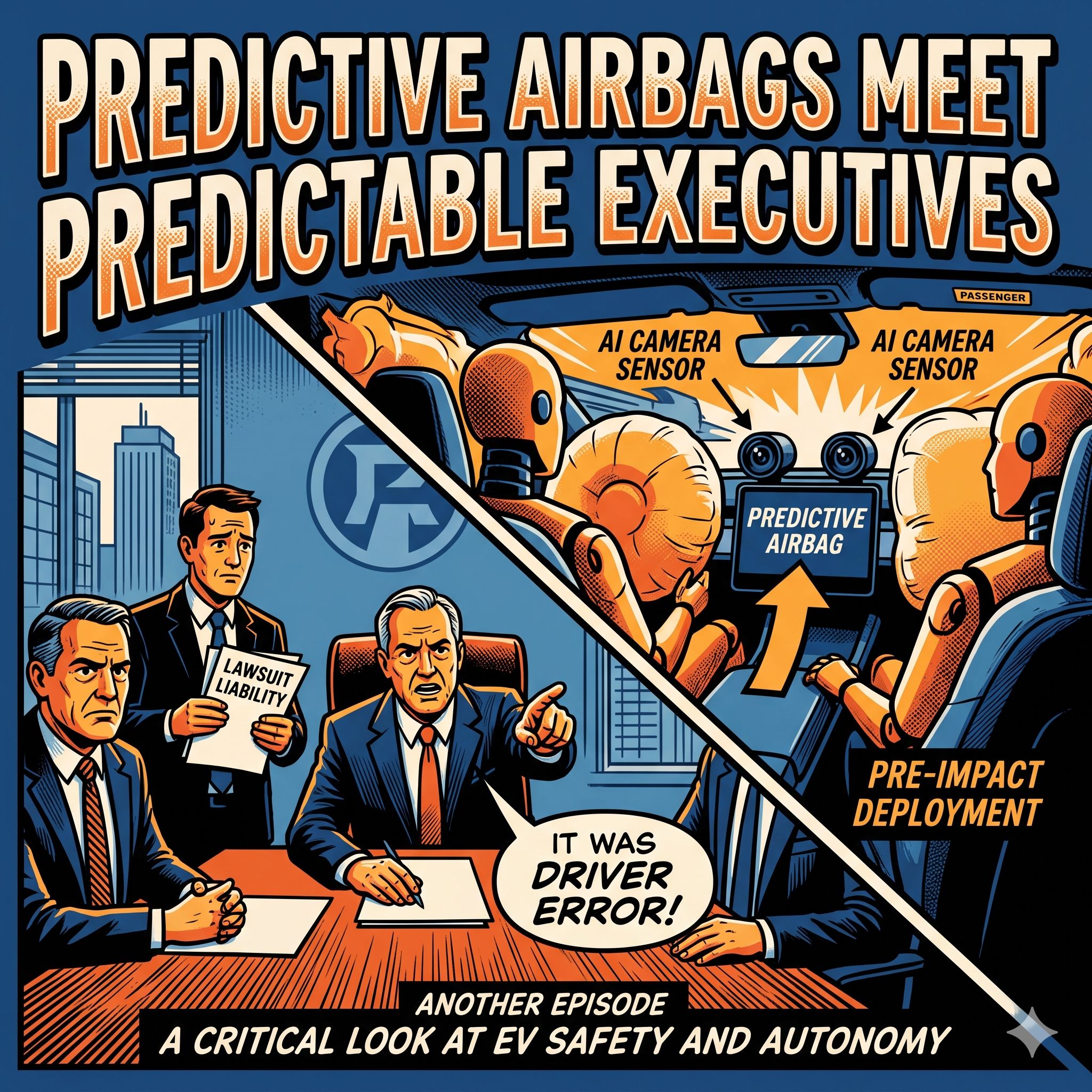
Predictive Airbags Meet Predictable Executives
About this episode
Predictive airbags are getting smarter: Tesla’s cameras are said to spot an oncoming crash and trigger restraint systems “right before a crash happens,” with pre-tensioning and faster airbag deployment. The discussion then widens to Tesla’s autonomy and safety controversies, including NHTSA scrutiny of crashes tied to camera visibility, driver-assist disputes, and allegations of sudden unintended acceleration. Along the way, the hosts cover Cybercab specs, Tesla lineup changes, and limited “signature edition” Model S/X allocations.
In this episode of Kilowatt, we dive into the latest developments shaking up the electric vehicle market, starting with Tesla's surprising decision to open Model S Signature Edition orders in Europe. We also examine the regulatory landscape as the NHTSA updates rules allowing the upcoming Tesla Cybercab to ditch brake pedals entirely, alongside new details on its strict weight limits and recent sightings in New Zealand. Safety and legal battles take center stage as we break down Tesla's recent settlement over a fatal Full Self-Driving crash in Texas and look at a groundbreaking feature that uses vehicle cameras to deploy airbags before an impact even occurs.
Support the Show:
- https://www.supportkilowatt.com/
Other Podcasts:
- Beyond the Post YouTube (https://www.youtube.com/@beyondthepostfm)
- Beyond the Post Podcast (https://www.beyondthepost.fm/)
- Shuffle Playlist (https://shows.acast.com/shuffle-playlist)
- 918Digital Website (https://www.918digital.com/)
News Links:
- Not a Tesla App: Tesla Opens Surprise Model S Signature Edition Orders in Europe
- Electrek: Tesla settles lawsuit over fatal ‘Full Self-Driving’ pedestrian crash
- Ars Technica Cars: Elon Musk denies Tesla’s Autopilot caused crash that killed grandmother
- Teslarati: Tesla and driver sued by family of woman killed in Texas crash: what we know
- Electrek: Tesla sued over fatal crash in Texas home that killed 76-year-old woman
- Teslarati: Tesla pushes back against unfair reporting of accidents
- The Verge: Tesla claims driver ‘manually overrode self-driving’ in deadly Texas crash
- Electrek: Tesla admits FSD was on in fatal Texas crash, blames driver for ‘overriding’ it
- Teslarati: Tesla finally clarifies fatal Texas crash, confirms driver manually overrode acceleration
- Electrek: NHTSA probes fatal Tesla crash into Texas home that killed woman
- CleanTechnica: Tesla On Autopilot Crashes Into Texas House, Killing One
- Not a Tesla App: Tesla Crashes Into Texas Home, Driver Blames Autopilot
- Ars Technica Cars: NHTSA investigating alleged Tesla Autopilot crash that killed woman in her home
- Not a Tesla App: Tesla Cybercab Won't Need Brake Pedals Under New NHTSA Rules
- Not a Tesla App: Tesla Cybercab Has a Max Weight Limit of 617 Lbs
- InsideEVs: Teslas Will Now Deploy Their Airbags Before Crashes Happen Thanks To Cameras
- Not a Tesla App: Tesla Cybercab Spotted in New Zealand for First Time
Hosted by Simplecast, an AdsWizz company. See pcm.adswizz.com for information about our collection and use of personal data for advertising.

Rolls-Royce Phantom
"... happens. So just if you've ever experienced like phantom braking or the windshield wipers turning on and o..."
The Rolls-Royce Phantom is a very expensive luxury car. It can have systems that automatically help with braking and with turning on the windshield wipers. The podcast mentions it because those automatic actions can sometimes happen when they shouldn’t.
The Rolls-Royce Phantom is a flagship luxury sedan built for comfort, refinement, and high-end features. In the episode, it’s referenced in connection with “phantom braking” and windshield wipers activating unexpectedly—both are examples of driver-assistance or sensor-controlled behaviors. That’s why it comes up: these issues can affect even top-tier vehicles when sensors interpret the environment incorrectly.
airbag
"And then it will allow the airbag [208.3s] to be deployed 70 milliseconds faster, so that they're inflated and ready to receive impact as [217.5s] soon as your body moves forward."
An airbag is a safety cushion that inflates very quickly in a crash. The goal is to inflate at the right moment so it can catch you before you hit something.
An airbag is a supplemental restraint that inflates extremely fast during a crash to cushion the occupant. In this segment, the key idea is predictive deployment—using sensors/cameras to time inflation so it’s ready when the body moves forward.
pre tighten or pre tension the seatbelt
"it will pre tighten or pre tension the seatbelt. And then it will allow the airbag [208.3s] to be deployed 70 milliseconds faster, so that they're inflated and ready to receive impact as"
Before a crash, the car can pull your seatbelt tighter automatically. That way you’re held in place right when the impact happens, which helps keep you safer.
Pre-tensioning tightens the seatbelt milliseconds before a crash so the occupant is held in place as the body starts to move. It reduces slack and helps the restraint system work more effectively when the airbag deploys.
impact sensors
"until the actual physical [252.2s] impact sensors that are on the car, they, those still make the final decision whether or not [259.0s] to inflate the airbags or not."
Impact sensors are the car’s crash detectors. They help decide whether the airbags should actually deploy, so the system doesn’t trigger just because it thinks something might happen.
Impact sensors are crash-detection devices (typically accelerometers and related hardware) that determine whether a collision is severe enough to trigger airbags. This segment emphasizes that cameras can’t make the final call—airbags wait for the physical impact sensors to confirm the crash.

cyber cab
"I've got a couple of things for cyber cab just in terms of updates. So I just kind of [294.7s] Ben, who lives in and around Kansas city saw one on the freeway as well. ... [357.7s] We all know that the cyber cab has two seats. We now know that the maximum weight limit of the [363.2s] cyber cab is 617 pounds or 288 or 280 kilograms"
The Tesla Cybercab is a future self-driving vehicle concept. The hosts talk about how it’s designed to be simpler for passengers (like having two seats) and they mention a maximum weight limit.
Tesla’s Cybercab is an autonomous, ride-hailing-style vehicle concept aimed at operating without the traditional driver controls. In this segment, the hosts discuss its two-seat layout and a stated maximum weight limit, tying the concept to real-world sightings and autonomy plans.
autonomy
"once they've figured out autonomy, Tesla, which will probably [322.8s] be by the end of this year if you listen to Elon. But once they figure out autonomy, and the cyber [328.3s] cabs don't need to have steering wheels or pedals anymore"
Autonomy means the car can drive itself. The idea is that if the car can handle driving, you might not need the usual controls like a steering wheel or pedals.
In automotive context, autonomy refers to how much driving is handled by the vehicle itself rather than a human. Here, the discussion is about Tesla’s plan to reach a level where the Cybercab doesn’t need steering wheels or pedals.
curb weight
"they figured this out by subtracting the vehicle curb weight, which is, you know, the battery, the motor, the frame, the skin on the car, all that stuff, when compared to the gross vehicle weight rating"
Curb weight is how much the car weighs when it’s ready to drive, but with nobody inside and no extra stuff in it. It helps you figure out how much weight you can add safely.
Curb weight is the weight of a vehicle as it sits ready to drive, without passengers or cargo. It’s often used in calculations to estimate how much additional load (people and belongings) the vehicle can carry within its rated limits.
gross vehicle weight rating
"when compared to the gross vehicle weight rating, which is the maximum weight that the vehicle can weigh with passengers and cargo, and they got a max weight limit of 617 pounds."
GVWR is the maximum total weight the vehicle is designed to handle. It includes the car plus people and luggage, and it’s the number you shouldn’t exceed.
Gross vehicle weight rating (GVWR) is the maximum total weight a vehicle is designed to carry. That total includes the vehicle itself plus passengers and cargo, and it’s used to determine limits like the “max weight” the vehicle can safely operate at.
maximum weight limit of 617 pounds
"and they got a max weight limit of 617 pounds. Again, that two people, 617 pounds, probably not going to go over that, but two people and some cargo could potentially go over that."
This refers to a calculated payload-style limit derived from GVWR minus curb weight. In practice, it’s a regulatory/engineering constraint that affects how many people and how much cargo the vehicle can carry while staying within its certified maximum weight.
automated driving systems
"The National Highway Traffic Safety Administration, or NITSA, has updated safety standards to remove the requirement for manual brake pedals in vehicles driven by automated driving systems."
Automated driving systems are the car’s tech that can drive for you—like controlling steering and braking. The rules can change depending on how much the car is expected to handle by itself.
Automated driving systems are the hardware and software that perform driving tasks (like steering, braking, and speed control) without a human doing everything manually. In regulation, they’re used to define what kinds of vehicles can be built without traditional driver controls.
towing
"the only way to get it back to someplace is by by towing it or putting it on a flatbed and moving it to the place that you need to."
Towing means pulling the car to where it needs to go when it can’t drive itself. With self-driving cars, that backup plan matters if the system has a problem.
Towing is moving a disabled vehicle using another vehicle or equipment, typically when it can’t drive itself. For autonomous or robo-taxi fleets, towing/flatbed transport becomes an operational fallback if the vehicle can’t reach a service location under its own power.
full self driving system
"But apparently people were using like heads of dolls as a way to fool Tesla's full self driving system to drive on its own without somebody in the passenger seat or in the driver seat."
“Full self driving” is Tesla’s software that tries to drive the car with less help from the human. The host is saying some people found ways to trick it, which shows the system can be vulnerable.
“Full self driving” refers to Tesla’s driver-assistance software stack that aims to handle driving tasks without continuous human intervention. The host is discussing how people can “fool” the system using tricks that exploit weaknesses in how the car interprets the world.

Tesla Model X
"...case. Moving on to our next story. So Model S and Model X are no longer in production. Right before they st..."
The Tesla Model X is an all-electric SUV. It’s designed for families and people who want more space than a sedan. In the podcast, it’s brought up because Tesla is no longer producing it, along with the Model S.
The Tesla Model X is a premium electric SUV known for its distinctive design and features like advanced seating and convenience tech. It’s mentioned alongside the Model S in the context of production changes, indicating the episode is covering how Tesla’s lineup has shifted. That makes it relevant for listeners tracking which EVs are still being made versus those that are becoming older-generation options.

Tesla Model S
"... of an edge case. Moving on to our next story. So Model S and Model X are no longer in production. Right be..."
The Tesla Model S is an all-electric car made by Tesla. It’s a larger, higher-end sedan designed to go a long distance on electricity. It comes up in discussions about Tesla’s lineup and how the company’s models are changing.
The Tesla Model S is a premium electric sedan known for long-range capability and high-performance variants. It’s often discussed because it helped define the modern EV experience, and it appears in news when the conversation shifts to safety, software behavior, or production changes. In this episode, it’s mentioned in the context of production status and the broader Model lineup.
signature edition
"Right before they stopped production, Tesla offered the final few Model S and Model Xs as a signature edition... And you got one of these emails... you have an opportunity to own a Model S signature edition."
A “signature edition” is a special limited version of a car. It usually means fewer were made and they include unique styling and option upgrades.
A “signature edition” is a limited-production trim/packaging strategy where the automaker sets aside a small number of cars with distinctive options and numbering. Here, the host describes how only the last Model S and Model X units were allocated and how they were marketed as sold out (or not).
carbon ceramic brakes
"They are plaid versions, they come with the garnet red paint, carbon ceramic brakes with gold calipers, gold seat badging, gold piping, they're numbered..."
Carbon ceramic brakes are a premium type of brake system that uses special ceramic material. They’re designed to handle repeated hard braking better and can be lighter than regular brake setups.
Carbon ceramic brakes use ceramic brake discs reinforced with carbon fiber, aiming to reduce weight and resist brake fade under hard use. The host pairs them with “gold calipers,” emphasizing this signature edition’s high-end brake hardware.
plaid versions
"They are plaid versions, they come with the garnet red paint, carbon ceramic brakes with gold calipers, gold seat badging, gold piping, they're numbered, you know, between one and 100 or one and 250 depending on where you're at."
“Plaid” is Tesla’s name for its top, high-performance version of the Model S and Model X. In this episode, it’s used to say these signature editions are the fastest/most powerful versions.
“Plaid” is Tesla’s performance trim for the Model S and Model X, associated with the highest-output powertrain and track-focused acceleration. In this segment, the host uses “plaid versions” to distinguish these signature-edition cars from lower trims.
gold calipers
"They are plaid versions, they come with the garnet red paint, carbon ceramic brakes with gold calipers, gold seat badging, gold piping, they're numbered..."
Brake calipers are the clamping mechanism that squeezes the brake pads against the rotor to slow the car. “Gold calipers” here is an appearance/trim detail used to visually mark the signature edition’s upgraded brake package.
FSD
"So what had happened was while she was directing traffic, she was hit by a Model Y that had FSD activated and was driving at highway speeds."
FSD stands for Full Self-Driving. It’s Tesla’s software that can help drive the car in certain situations, but it still needs the driver to be ready to take over.
FSD (Full Self-Driving) is Tesla’s driver-assistance software package that can automate parts of driving, depending on conditions and what features are enabled. In this segment, the point is that FSD was active at highway speeds when the crash happened.

Tesla Model Y
"...while she was directing traffic, she was hit by a Model Y that had FSD activated and was driving at highway..."
The Tesla Model Y is an all-electric SUV. Some versions can use driver-assistance features that help with steering and driving tasks, depending on conditions. The episode mentions it because a crash happened while those features were turned on.
The Tesla Model Y is a compact electric SUV that’s widely used and frequently appears in real-world safety and driver-assistance discussions. In the episode, it’s referenced because a crash involved a Model Y with Full Self-Driving (FSD) activated at highway speeds. That kind of story typically focuses on how driver-assistance systems behave in complex driving situations.
National Highway Transportation Safety Administration
"And in that section, it's not uncommon to be driving about 75 miles an hour. So the National Highway Transportation Safety Administration opened up a preliminary investigation into not only this accident, but similar accidents."
The National Highway Traffic Safety Administration (NHTSA) is the U.S. agency that regulates vehicle safety and investigates crashes and vehicle issues. Here, it opened a preliminary investigation into the accident and similar incidents.
preliminary investigation
"So the National Highway Transportation Safety Administration opened up a preliminary investigation into not only this accident, but similar accidents. And the preliminary investigation, or the probe, was then upgraded to an engineering analysis, which is typically a step before there's a forced recall."
A preliminary investigation is an initial look by safety regulators. They check what happened and whether it looks serious enough to study in more detail.
A preliminary investigation is an early stage of a safety probe where regulators gather information to decide whether a deeper technical review is warranted. In this segment, it’s described as the first step before an engineering analysis and potentially a forced recall.
engineering analysis
"And the preliminary investigation, or the probe, was then upgraded to an engineering analysis, which is typically a step before there's a forced recall."
An engineering analysis is a more technical investigation. Regulators dig into how the car’s systems worked and whether there’s a safety defect that could require a recall.
An engineering analysis is a deeper technical review by regulators that examines vehicle systems, data, and failure modes. The segment frames it as a step that often comes before regulators require a forced recall.
forced recall
"And the preliminary investigation, or the probe, was then upgraded to an engineering analysis, which is typically a step before there's a forced recall."
A forced recall means the government requires the car maker to fix a safety problem. It usually happens after regulators conclude there’s a real risk.
A forced recall is when regulators require a manufacturer to recall vehicles due to a safety issue. The segment uses it to describe the possible outcome if an engineering analysis finds a problem.
camera visibility
"According to the National Highway Traffic Safety Administration, the Tesla system did not detect common roadway conditions that impaired camera visibility until immediately before impact, giving drivers little time to react."
Camera visibility is how clearly the car’s cameras can see what’s in front of it. If visibility is poor, the car may not understand the situation in time.
Camera visibility refers to how well a vehicle’s cameras can see the road and surroundings. In this case, the claim is that the Tesla system didn’t detect certain roadway conditions that impaired camera visibility until immediately before impact.
camera systems
"it does stand a reason that the camera, if this is the way that Tesla is in fact designing their camera systems, that the camera is going to cause a problem with the, the sun's going to cause a problem with the camera."
Tesla uses cameras to “see” the road and traffic. The point being made here is that bright sun could interfere with what the cameras can reliably detect.
Tesla’s camera systems are part of its vision-based approach to sensing the road and detecting objects and lane information. The host argues that if sunlight blinds or overwhelms the cameras, it could lead to perception problems that affect driving behavior.

Tesla Model 3
"...an undisclosed amount of money. Now, last week, a Model 3 crashed into a Texas home at very high speeds. It..."
The Tesla Model 3 is an all-electric sedan. It’s built for everyday driving and is one of Tesla’s most common models. The podcast brings it up because there was a serious crash involving a Model 3 at high speed.
The Tesla Model 3 is a mainstream electric sedan designed to deliver strong range and performance at a more accessible price point than Tesla’s higher-end models. It’s commonly discussed in the context of safety incidents and how driver-assistance features are used. In this episode, it’s mentioned due to a reported high-speed crash into a home in Texas.
autopilot
"The driver of the vehicle said that the automated driver assist feature didn't specifically call out autopilot or full self-driving."
Autopilot is Tesla’s set of driver-assist features that can help steer and control speed in some situations. The discussion here is about which automation mode was running during the crash.
Autopilot is Tesla’s driver-assistance suite, designed to help with tasks like steering and speed control under certain conditions. In this segment, the host notes the crash report didn’t clearly specify whether Autopilot or another Tesla automation feature was active.
manually overrode self-driving
"Ola Swamis... he had this to say, in this case, the driver manually overrode self-driving by pressing the accelerator all the way to 100% of the accelerator pedal in this residential area."
Manually overriding means the driver stepped in and forced the car to do something different than the automated system wanted. The claim here is that the driver’s pedal input was what drove the car’s actions during the crash.
Manually overriding self-driving means the driver takes direct control inputs that conflict with the automated system’s intended actions. In this segment, Tesla’s representative claims the driver pressed the accelerator to 100%, implying the automation was not the sole cause of the car’s behavior.
accelerator pedal
"Ola Swamis, who's the head of I think autonomous driving or full self-driving at Tesla, he had this to say, in this case, the driver manually overrode self-driving by pressing the accelerator all the way to 100% of the accelerator pedal in this residential area."
The accelerator pedal is the driver control that commands engine/motor torque demand, which in an EV translates directly into how much power the car applies. In this segment, Tesla’s executive claims the driver manually overrode the automation by pressing the accelerator fully.
sudden unintended acceleration
"The family has two theories as to why this occurred. One of the theories is sudden unintended acceleration, which is something we heard about quite a bit in the, late 2000s to early 2020s kind of thing."
Sudden unintended acceleration means the car speeds up by itself when you didn’t ask it to. In this story, the lawsuit claims an electrical glitch makes the car think the gas pedal is being pressed.
Sudden unintended acceleration is when a vehicle accelerates on its own even though the driver isn’t commanding it. In this Tesla-related theory, the claim is that electrical issues create a false signal that the accelerator pedal is pressed, so the car rapidly speeds up.
voltage surges
"These voltage surges from the battery can be dangerous, causing the inverter to incorrectly interpret that accelerator pedal has been pressed."
Voltage surges are brief, abnormal spikes in electrical voltage. Here, the lawsuit alleges that battery-related power draw can create these spikes, which then interfere with how the car interprets driver inputs.
inverter
"These voltage surges from the battery can be dangerous, causing the inverter to incorrectly interpret that accelerator pedal has been pressed."
An inverter is an electronic box that changes battery power into the right kind of electricity for the motor. The claim here is that it gets confused and thinks you pressed the gas.
An inverter is the power electronics that converts the battery’s DC electricity into AC power for the electric motor. In the transcript’s lawsuit theory, the inverter is said to misread signals and treat it like the accelerator pedal was pressed.
chip shortage
"when Tesla was building this particular model three, [1366.4s] there was a global chip, chip shortage, and they did not include the necessary chips or the,"
A chip shortage means the factories couldn’t get enough computer chips. Since modern cars rely on chips for sensors and safety features, shortages can sometimes force changes that affect how well systems work.
A chip shortage is a supply-chain disruption where manufacturers can’t get the semiconductor parts needed for production. For vehicles, missing or substituted chips can affect electronics performance, including safety-critical functions that rely on specific sensor-processing hardware.
critical obstacle detection hardware
"there was a global chip, chip shortage, and they did not include the necessary chips or the, [1375.6s] the critical obstacle detection hardware that Tesla, that the car would needed to be [1382.5s] operate on full self driving correctly, or safely."
For self-driving features, the car needs special sensors to “see” what’s around it. This phrase means the key parts that help the car detect things like people, cars, and other obstacles.
This refers to the sensors and computing hardware a self-driving system uses to detect obstacles in the vehicle’s path. In Tesla’s case, that’s part of the perception stack that feeds the driving software so it can decide what’s safe to do.
National Highway Traffic Safety Administration
"operate on full self driving correctly, or safely. The National Highway Traffic Safety [1387.9s] Administration has opened up an investigation when it comes to this incident. And, you know,"
This is the U.S. government agency that looks into car safety problems. If it investigates a crash, it’s trying to figure out what went wrong and whether safety fixes are needed.
The National Highway Traffic Safety Administration (NHTSA) is the U.S. federal agency that oversees vehicle safety. When it opens an investigation, it can examine crashes, hardware/software issues, and whether recalls or safety actions are warranted.
Request an Explanation
Heard something you'd like explained? We'll add it to this episode.
Sign in to request explanations for terms you heard.
Want to learn more?
Browse our glossary for plain-English explanations of automotive terms, jargon, and concepts.
Help improve this episode
See something that's not quite right? Our annotations are AI-generated and can sometimes miss the mark. Click the flag icon on any annotation to suggest a correction.