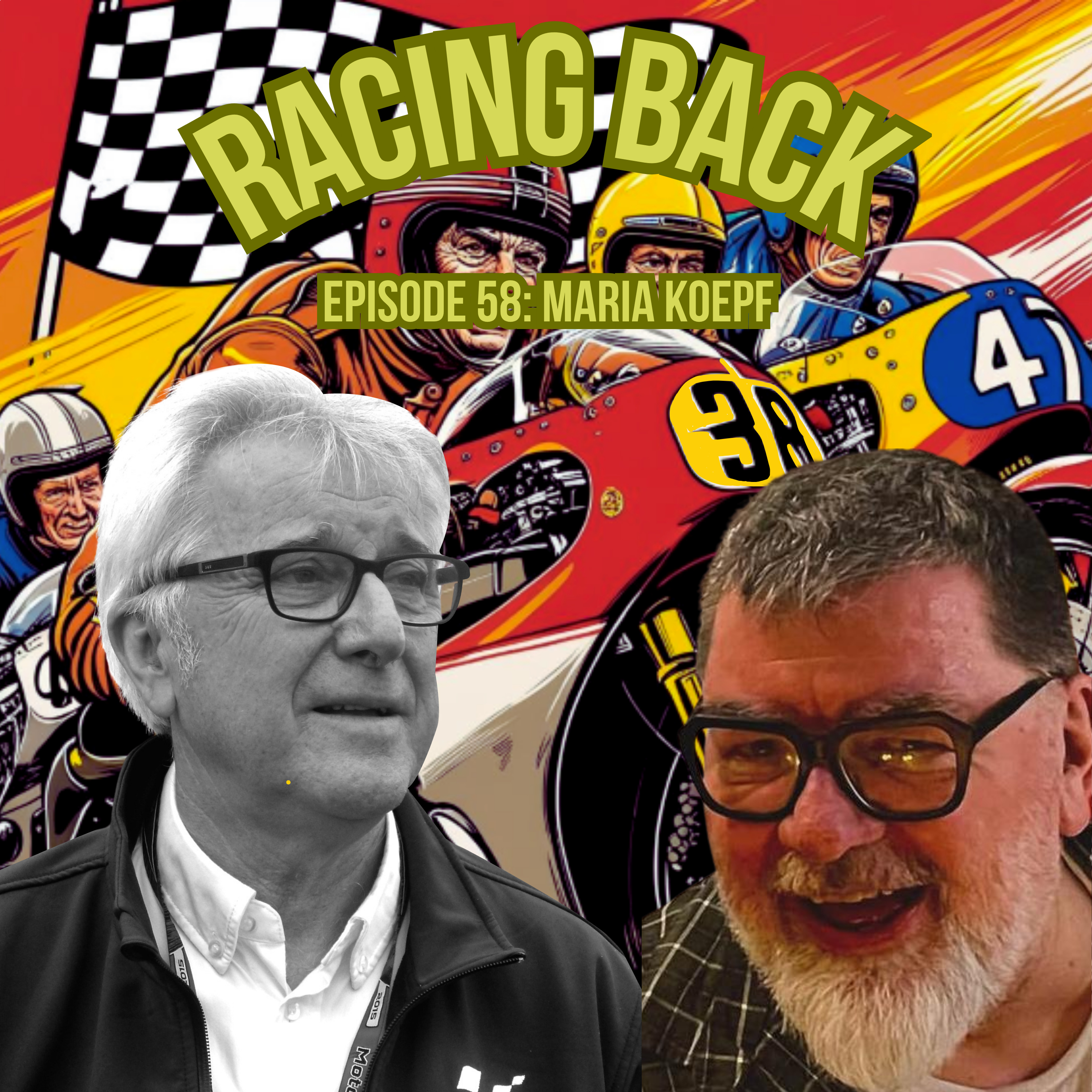
Racing Back Episode 58 – Maria Köpf
About this episode
Maria Köpf’s story anchors a wide-ranging look at women’s motorcycle racing—starting with Beryl Swain’s 1962 TT breakthrough and the way FIM licensing rules could be granted and then revoked. The hosts connect that history to Köpf’s Grand Prix moments, including a Hockenheim incident and a disqualification tied to non-allowed substances. They also zoom out to the broader barriers of weight limits, the two-stroke era, and why visibility through platforms like WCR matters.
This weeks episode is dedicated to Maria Costello and all women in racing.
In this episode of Racing Back, Nick Harris and Julian Ryder are joined by filmmaker and documentary producer Maria Köpf for a thought-provoking conversation about the role of women in MotoGP and Grand Prix motorcycle racing.
Maria discusses her forthcoming documentary and the fascinating stories that inspired it, highlighting the women whose passion, determination and contributions have helped shape the sport throughout its history. Together, Nick, Jules and Maria explore a side of MotoGP that is often overlooked but is every bit as important to the championship's remarkable story.
From pioneering figures to the continuing evolution of the sport, this episode is packed with insight, history and fascinating conversation, offering a fresh perspective on the people who have helped make MotoGP what it is today.
A must-listen for anyone interested in the rich history and future of motorcycle racing.
grom pre-motorcycle racing
"we're going to really concentrate on women in grom pre-motorcycle racing and I can tell you there are plenty of them."
“Grom” is slang for small, beginner-style motorcycles. The episode is talking about early racing steps—how riders get started before moving up to bigger, more serious motorcycle races.
“Grom” is commonly used in motorcycle culture to mean small, beginner-friendly bikes (often associated with youth or entry-level riding). “Pre-motorcycle racing” in this context suggests a feeder or early-stage pathway before riders move into full motorcycle racing categories.
Maria Costello
"we're going to dedicate this program to Maria Costello, obviously, who was so badly injured in the TT sidecar practice in the Isle of Man"
Maria Costello is a racer mentioned because she was seriously hurt during sidecar practice at the Isle of Man TT. The hosts are sending her support and hoping for her recovery.
Maria Costello is referenced as being badly injured in TT sidecar practice at the Isle of Man. The episode dedicates the program to her, emphasizing the real-world risks involved in sidecar racing and practice sessions.
TT
"obviously, who was so badly injured in the TT sidecar practice in the Isle of Man"
“TT” is short for the Isle of Man TT, a world-famous motorcycle race. It’s known for different classes of bikes and for being held on challenging roads.
“TT” here refers to the Isle of Man TT (Tourist Trophy), a long-running motorcycle road-racing event. It’s a major part of the sport’s history and culture, including categories like 50cc and sidecar racing.
TT sidecar practice
"I think before we start we're going to dedicate this program to Maria Costello, obviously, who was so badly injured in the TT sidecar practice in the Isle of Man"
The Isle of Man TT is a famous motorcycle race. “Sidecar practice” means the teams that race with a sidecar (a passenger seat attached to the bike) go out to practice and get the bike working right before the main event.
The Isle of Man TT is a motorcycle road-racing event, and “sidecar practice” refers to the on-track practice sessions for sidecar teams. Sidecars are motorcycles with a passenger compartment attached, and practice is where teams dial in setup and handling before the race.
Isle of Man
"obviously, who was so badly injured in the TT sidecar practice in the Isle of Man"
The Isle of Man is an island where one of the most famous motorcycle races happens. The TT uses roads that are closed for the event, which is part of why it’s so intense.
The Isle of Man is a self-governing island in the Irish Sea, and it hosts the Isle of Man TT—one of the most iconic motorcycle races in the world. The event is known for using public roads closed for racing, which makes it uniquely challenging and dangerous.
Herne Hill
"watching a lady in black leathers go round the cycle track at Herne Hill on a 50cc item on television"
Herne Hill is a place in London. In this story, it’s where the host says they watched a rider on TV before learning she would go on to race in the TT.
Herne Hill is a location in London associated with cycling track racing, referenced here as a place where the host watched a rider on television. It’s part of the story’s “where it all started” context for women in motorcycle/track racing.
Beryl Swain
"Her name, Beryl Swain. Well, thanks for giving the keyword. It's so interesting and so much fun to start with Beryl Swain"
Beryl Swain was an early motorcycle racer who broke barriers in the Isle of Man TT. The episode says she was the first woman allowed to race in the TT, and later her ability to race depended on getting the right license.
Beryl Swain is a pioneering TT-era motorcycle racer highlighted in the episode as the first woman allowed to compete in a TT race in 1962. The discussion frames her as a trailblazer who also faced licensing barriers that limited her ability to keep racing.
50cc class
"because she was literally, she was the first woman to be allowed in a TT race right in 1962, which was also the year the 50cc class was introduced."
“50cc” is a way to classify small motorcycles by engine size. The “50cc class” means races for bikes with engines around that 50cc size.
The “50cc class” is a motorcycle racing category defined by engine displacement—50 cubic centimeters. In the early TT era, it helped create a structured entry point for smaller, lighter bikes and riders.
FIM license
"But the year after, and it was also the first year she got an official FIM license, which is a big issue all over, you know, the decades."
An “FIM license” is the official permission from the motorcycle sport’s governing organization to race. Without it, riders can’t enter certain events.
The “FIM license” refers to a racing license issued by the Fédération Internationale de Motocyclisme (FIM), the sport’s global governing body. It’s the official permission for riders to compete in sanctioned events, and the transcript highlights how licensing decisions affected who could race.
weight limitations
"It's the weight limitations, which is always an issue. Also with the extra weight women have to put on."
Weight limitations are rules that restrict minimum or maximum rider/body weight in certain racing contexts. The discussion here is about how such rules were applied to women riders, including the idea that women had to compensate for perceived disadvantages via additional weight.
Grand Prix
"There was plenty of good women psychopathic just riding in Grand Prix. Definitely."
Grand Prix refers to top-level motorcycle road racing events run under standardized rules, historically including the premier classes that lead to world championships. In this context, it’s used to describe the highest tier of competition where women riders were (and often weren’t) allowed to race.
hill climbs
"we had one of those hill climbs because there were plenty of them in the in the 70s and 80s."
Hill climbs are motorsport events where cars or motorcycles race up a steep course against the clock, usually on a road or track that climbs a hill. They’re popular in many regions because they’re accessible locally and emphasize traction, power delivery, and rider control.
Hockenheim
"We were at Hockenheim, was it 1989 when Tarrenay led the race, the 125cc Grand Prix. You started? Oh my god."
Hockenheim is a famous race track in Germany. It’s hosted big motorcycle and car races, and its layout has included stadium-style sections and tight turns.
Hockenheimring is a German circuit known for long straights and historically distinctive layouts, including stadium sections and chicanes. It’s been used for major motorsport events, including motorcycle Grand Prix racing.
chicane
"Then it was like a mile out to the Oscurb and a mile back again, via a chicane. And it was a tight right hander into the stadium."
A chicane is a section of the track where you have to weave through a couple of turns. It makes the cars slow down and handle more precisely instead of going flat out.
A chicane is a deliberate sequence of alternating turns that forces cars or motorcycles to slow down and change direction. Track designers use chicanes to reduce speed before a corner or to add technical challenge.
stadium
"And it was a tight right hander into the stadium. And apparently she shoved Fausta Grissini out of the way at the last chicane and led into the stadium."
The “stadium” part of a track is the section near the grandstands. It usually has tighter corners, so racing feels more intense and close to the crowd.
In circuit descriptions, the “stadium” section refers to a track area built around spectator stands, typically with tighter corners and shorter sightlines than the main straights. It often creates a more dramatic, close-quarters racing environment.
Fausta Grissini
"And apparently she shoved Fausta Grissini out of the way at the last chicane and led into the stadium. And I have never, ever heard a noise like it on a race track."
Fausta Grissini is a motorcycle racer. In this story, she was involved in an on-track moment where another rider pushed her aside near the end of the race.
Fausta Grissini is a former motorcycle racer mentioned here in the context of a specific on-track incident at Hockenheim. The hosts describe her being pushed aside at a late chicane during a 125cc Grand Prix race.
Mika Hekin
"I mean, she started out in kart racing. She raced against Mika Hekin and we probably know that she beat twice as a kid."
The hosts mention Mika Hekin as someone she raced against when they were kids. The name sounds like it may be a misspelling of Mika Häkkinen, a famous Finnish racer.
Mika Hekin is referenced as a competitor in the rider’s early karting years, with the hosts claiming she beat him multiple times as a child. The name appears to be a transcription error for “Mika Häkkinen,” who is a well-known Finnish racing driver.
disqualified
"But then she raced with some with some substances that were not allowed. So she was disqualified. As is usually in this level, it's dodgy fuel."
Disqualified means the rider is removed from the race results. It usually happens when officials find a rules problem, like using something that isn’t allowed.
Disqualification is an official penalty where a rider or team is removed from the results because of a rules violation. In motorsport, this can happen for technical non-compliance (like fuel) or other sporting infractions.
dodgy fuel
"But then she raced with some with some substances that were not allowed. So she was disqualified. As is usually in this level, it's dodgy fuel."
“Dodgy fuel” means the fuel wasn’t allowed under the race rules. If a team uses fuel that gives an unfair advantage, officials can disqualify the rider.
“Dodgy fuel” here refers to fuel that doesn’t comply with the rules for the class, which can lead to disqualification. In racing, fuel compliance is checked because fuel properties can affect engine performance and fairness.
license revocation mystery
"because her career ended in 1992. And her license, she said she got a letter directly from Bernie Ecclestone, revoking or taking back her license so she couldn't race anymore."
They talk about a confusing story about why a rider’s license was taken away. One person says it came from a big F1 figure, but the motorcycle governing body couldn’t find the paperwork.
The hosts discuss a disputed claim that Taru’s racing career ended in 1992 due to a license being revoked. They contrast Taru’s account (a letter from Bernie Ecclestone) with FIM’s inability to locate proof in their archives.
Bernie Ecclestone
"And her license, she said she got a letter directly from Bernie Ecclestone, revoking or taking back her license so she couldn't race anymore."
Bernie Ecclestone was a powerful person behind Formula 1. Here, the guest says Taru believed she got a letter from him that took away her racing license.
Bernie Ecclestone was a major figure in Formula 1’s business side, closely associated with the sport’s licensing and commercial control. In this segment, his name comes up because Taru claims she received a letter from him that revoked her racing license.
125cc class
"And if you got your newspaper on a Wednesday and read that she won a 125 race, you would not have been shocked."
“125cc” refers to the engine size of the race bikes, measured in cubic centimeters. The 125cc class is a category where riders race motorcycles with that smaller engine size.
The 125cc class is a motorcycle racing category defined by engine displacement—125 cubic centimeters. It’s a common stepping-stone class in Grand Prix-style motorcycle racing, where riders compete on smaller, lighter bikes than higher-displacement categories.
125 race
"There was a lot of Japanese 125 race and the Japanese team for her to ride in as well."
“125” is the engine size class for motorcycles—125cc. It’s a common category in motorcycle racing where riders compete on smaller bikes.
In motorcycle racing, “125” refers to the engine displacement class—125cc. These classes are typically for smaller, lighter bikes and are often used as a stepping stone to larger-displacement racing.
500cc two-stroke motorcycle
"Now the 500 class, nobody would expect a woman and please, I don't take me wrong here to ride a 500cc two-stroke motorcycle."
This describes a motorcycle with a 500cc engine that uses a two-stroke design. Two-stroke engines were common in older racing and can feel very punchy.
A “500cc two-stroke motorcycle” is a bike with a 500cc engine that uses a two-stroke combustion cycle. Two-stroke engines were historically common in Grand Prix racing because they can produce strong power for their size, especially at higher RPM.
World Championship
"But she came to ride in the 500cc World Championship on a Yamaha."
The “500cc World Championship” refers to the top-level Grand Prix motorcycle racing series for 500cc bikes. In that era, it was the premier class, and riders’ results there were the biggest measure of success.
Yamaha
"But she came to ride in the 500cc World Championship on a Yamaha."
Yamaha is a major motorcycle brand. They also make racing bikes that compete at the highest levels.
Yamaha is the Japanese motorcycle manufacturer that built the bikes used in Grand Prix racing. In the 500cc era, Yamaha was one of the major factory teams and bike suppliers.
Daytona
"She started in the 70s and in the U.S. with 125 and 250 mostly Daytona set records, you know, the fastest rookie when she arrived."
Daytona is a famous racing track in the U.S. Motorcycle racers often go there to set records and prove themselves.
Daytona refers to Daytona International Speedway in the U.S., a major venue for motorcycle racing events. The transcript mentions Daytona records in the 125/250 era, highlighting how riders built reputations there before moving to 500cc Grand Prix competition.
250
"She started in the 70s and in the U.S. with 125 and 250 mostly Daytona set records, you know, the fastest rookie when she arrived."
“250” means the bike’s engine class is about 250cc. It’s a step up from smaller classes like 125cc.
“250” refers to the 250cc motorcycle racing class. Riders often compete in 125/250 before moving up to the premier classes like 500cc.
Brands Hut
"And she was invited by a British promoter to come to England in 1990. To Brands Hut, was it? It was Brands, wasn't it?"
This is likely “Brands Hatch,” a well-known race track in England. The speaker is saying her appearance there got a lot of attention.
“Brands Hut” appears to be a mis-transcription of “Brands Hatch,” a well-known circuit in England. The hosts are discussing a 1990 visit that caused a stir in British motorcycle racing.
Nagaro
"Yeah. I tell you when I was there was 1982, Nagaro in France, because she'd had terrible trouble qualifying."
The speaker is talking about a French race track where she struggled to qualify and then later qualified for the 500cc race. The exact track name is unclear in the transcript.
“Nagaro” is almost certainly a mis-transcription of “Le Mans” or another French circuit name, but the context says “Nagaro in France” and then “Nagaro 1992.” Because the exact track name isn’t fully clear from the transcript, this annotation is low-confidence.
privateer
"But what I learned, she was she was touring as a privateer in 1991 and 1992 all over Europe, trying to qualify as she just described."
A “privateer” is a racer who isn’t part of a big factory team. They often have less support and money, so doing well is harder.
A “privateer” is an independent rider/team that competes without full factory backing. In Grand Prix racing, privateers often had fewer resources, so qualifying and results were especially impressive when they broke through.
500cc race
"[881.9s] but mostly when she was in Europe, she tried to qualify in the 500cc race. That's true. [887.5s] Incredibly brave thing to do, wasn't it, to come here at the height of the two-stroke, [894.3s] these fire machines."
“500cc” is a racing class based on engine size. It was considered the top category, so trying to qualify there was a big deal.
“500cc” is another engine-displacement class, historically the premier category in Grand Prix motorcycle racing. Competing in the 500cc class—especially during the two-stroke era—meant riding very powerful, high-strung machines.
Aprilia team
"[948.2s] Kacha Ponson. She rode 250cc. She was in the Aprilia team, wasn't she, with Jeremy Williams, [954.2s] I remember. And I remember she came to the motorcycle show in England."
Aprilia is a motorcycle brand that also competes in racing with official teams. The hosts are saying she was part of an Aprilia-backed team.
Aprilia is an Italian motorcycle manufacturer that fields factory teams in racing. Mentioning the “Aprilia team” indicates Katya Ponson rode for a professional team associated with Aprilia’s racing program.
World Superbike Paddock
"[977.2s] Superbike Paddock. Oh, really? I think her dad was Suzuki Germany or something, but she [983.8s] had a very interesting and she was quick. She was extremely competitive."
A “paddock” is the backstage area at a race where teams work and riders hang out. “World Superbike” is a top-level motorcycle racing series, and they’re saying they first noticed her there.
The “World Superbike Paddock” refers to the team and rider area associated with World Superbike (WSBK) events. In this segment, it’s where the hosts first saw Katya, framing her as an established competitor in that environment.
racing in the wet
"fellow racers once told me, because Katya was always very good in the wet. Yeah. You said, oh, we just told her that the wet, the wet tires are like slicks in the wet... I remember there was a wet race, wasn't there?"
They’re talking about how rain changes motorcycle racing. Grip and passing are harder, and the right tires matter a lot.
The hosts discuss how wet conditions change motorcycle racing—especially tire grip and overtaking. The conversation ties wet-track performance to Katya’s reputation and a specific wet race where she scored points.
slicks in the wet
"Yeah. You said, oh, we just told her that the wet, the wet tires are like slicks in the wet. Katya carry on, you know, okay. And she scored."
They’re saying that in the rain, the tires can lose grip so much that it feels like you’re on slicks (tires with no tread). That means the car can slide more than you’d expect.
This phrase is describing how, in rain, the tire’s grip can behave in a way that feels “slick-like” if the tires aren’t appropriate or if conditions overwhelm the tread’s ability to clear water. It’s a shorthand for the idea that wet-weather traction can drop dramatically, even if the car is otherwise set up for racing.
wet tires
"Yeah. You said, oh, we just told her that the wet, the wet tires are like slicks in the wet. Katya carry on, you know, okay. And she scored."
Wet tires are special tires made for rainy weather. They have tread and rubber that help them grip the road when it’s wet, instead of slipping like normal tires might.
“Wet tires” are tires designed to work in rain, using tread patterns and rubber compounds that can channel water and maintain grip. In wet conditions, tire behavior changes a lot compared with dry driving, so grip limits and braking/turn-in feel can be very different.
Mugello
"So we've got, and she scored. She scored points in Mugello in 2001. Yes. Yeah."
Mugello is a well-known race track in Italy. It’s the kind of track where rain can really change how fast and how safely bikes can corner and brake.
Mugello is a famous racing circuit in Italy, known for long straights and heavy braking zones that test both engine power and tire grip. In MotoGP-era racing, weather at Mugello can strongly affect lap times and race strategy.
ignition
"it was not always nice to race with the boys, you know, sometimes those were the days where you still had keys in your ignitions or sometimes they were trying to fetch the key, the ignition from the key from the ignition just to remember, you know."
The ignition is the system that starts the engine by creating the spark it needs. The joke here is about people messing with the key/start setup.
An ignition system is what provides the spark (and related control) needed to start and run an engine. In racing contexts, “ignition” can also refer to the key/lock mechanism that controls engine start, which the speaker jokes about as being tampered with.
Spanish dominance in WCR
"“...it's turning a little bit into a Spanish league, the WCR, because... there's a much stronger support system in Spain...”"
They talk about why so many of the best riders seem to be Spanish. The hosts suggest it’s not just luck—Spain has stronger support for racing.
This segment discusses how the championship is becoming heavily Spanish, with top racers coming from Spain. It also points to structural reasons—like stronger national support—behind that trend.
imbalance between the nations
"“...there's a really an imbalance between the nations because there's a much stronger support system in Spain than in a lot of other European countries...”"
Some countries have more resources for racing than others—like better training and more support. That can affect which riders end up being the fastest and most successful.
The phrase refers to how different countries can have unequal support systems for developing racers—funding, training infrastructure, and team depth. In motorsport, that kind of imbalance can strongly influence who reaches the top levels and how many competitive riders a country produces.
SuperSport 300
"“...she's the first and so far only world champion in a SuperSport 300 and in general, in a world championship...”"
SuperSport 300 is a motorcycle racing category for smaller bikes, often used to develop younger talent. The rules are strict so the competition is more about riding skill than just having the biggest engine.
SuperSport 300 is a motorcycle racing class built around smaller-displacement bikes, designed to be a stepping stone for younger riders. Because it’s a spec-like category, rules like weight limits and performance balancing matter a lot for competitive parity.
Moto3
"“And she was, I remember her in Moto3.”"
Moto3 is the lower-tier class in Grand Prix motorcycle racing for younger riders and smaller bikes. Many riders use it as a starting point before moving up to bigger categories.
Moto3 is the entry-level class in Grand Prix motorcycle racing, typically featuring smaller, single-cylinder engines and younger riders. It’s known as a key ladder to higher classes like Moto2 and MotoGP.
weight regulation
"“...why would they change in the middle of the season the weight regulation? I mean, all of a sudden she took off...”"
Racing rules sometimes force riders to run with extra weight. If they add weight, the bike feels heavier, so it’s harder to accelerate and the speed usually drops.
In motorcycle racing, a weight regulation is a rule that sets a minimum weight (often including the rider) for the bike. If officials add ballast or require extra weight mid-season, it increases inertia and reduces acceleration and top-end pace, so lap times can drop more slowly.
Moto E
"competitor. So then bang, another enormous crash. And she also really enjoyed riding the Moto E, [1643.4s] which I think, unfortunately, what is no longer, no longer in place."
Moto E is a motorcycle racing series where the bikes are electric. Because the bikes feel and brake differently than gas bikes, riders have to learn the new technique.
Moto E is an electric motorcycle racing series. It uses standardized electric bikes, so riders focus heavily on learning how throttle response, weight, and braking behavior differ from conventional motorcycles.

Yamaha R7
"Of course, these bikes are over 240 kilos, you know, a completely different technique to [1654.9s] riding the Yamaha R7. It's all about learning the technique for the different weight and the different brakes."
The Yamaha R7 is a popular motorcycle model that many riders use for sport riding. Here, it’s mentioned to highlight that riding technique changes when you switch to a heavier electric bike.
The Yamaha R7 is a sport-touring/track-focused motorcycle known for its agile handling and twin-cylinder engine character. In this discussion, it’s used as a reference point to explain how riding technique changes when moving between heavier electric bikes and a conventional R7.
mixed class
"Maria was also saying, you know, it's more important to race with the, you know, in the real, in the mixed class, because [1722.5s] that's where you get the experience."
A mixed class means men and women racing together in the same event. The point being made is that it can teach riders a lot because they’re competing against a wider range of opponents.
A mixed class means riders of different genders competing together in the same race category. The speaker argues that racing in a mixed class can provide experience and help riders learn how to become a racer.
copyright
"Perhaps actually filming it and interviews is the easiest part. It's all the, other stuff, copyrights and everything else that's difficult, isn't it?"
Copyrights are legal rules that control who can use someone else’s creative material. For documentaries, you often have to get permission to use old clips or recordings before you can edit them in.
Copyrights are legal protections for creative works (like footage, photos, and recordings) that restrict how they can be reused in a documentary. In film production, acquiring the rights can be as time-consuming as the technical editing work.
archival material
"we're doing a lot of research because especially like with Gina Bovell and Tago Vinde, you know, there's fabulous archival material, which, which has been researched."
Archival material is previously recorded or preserved content—like old footage, photographs, documents, or recordings—used as sources in a documentary. It often requires research and rights clearance before it can be incorporated into the final edit.
gendered motorcycle
"I found a scholar who is in University of Glasgow, Esperanza Miyake, and she's wrote a book about the gendered motorcycle."
A “gendered motorcycle” means motorcycles have been treated in society as belonging to one gender more than another. The episode is talking about how images and culture can make motorcycles seem “for men” even though anyone can ride them.
A “gendered motorcycle” is the idea that motorcycles are culturally associated with a particular gender—here, framed as being more “male-branded” than other vehicles. The discussion points to how marketing, media imagery, and social history shape who people think motorcycles are “for.”
Cold War
"And you know, it gives you a perspective to look back on things like the history of women in racing as you start with Maria and the week before the proper Cold War."
The Cold War was a long period when the US and its allies were basically competing with the Soviet Union and its allies without direct full-scale war. It affected everyday life and even sports, including racing stories and rivalries between East and West.
The Cold War was the long political and military standoff between the Western bloc (led by the United States) and the Eastern bloc (led by the Soviet Union) after World War II. In motorsport history, it shaped how countries competed, including defections and technology development across East and West.
defected to the West
"Two strokes in Grand Prix racing and it all down to a small, I won't say shed, but very nearly nearly shed in East Germany and a rider who defected to the West."
A defection is when someone leaves their side or country and goes to the other side. In this story, it matters because it can transfer skills and knowledge that affect how racing develops.
A defection is when someone leaves their country or side—often secretly or under political pressure—to join the opposing side. In the context of motorsport history, defections could move people, ideas, and technical know-how between East and West, influencing racing development.
MotoGP riders
"We've got plenty more coming up. Summer break for the MotoGP riders. I suspect by the time we come back, more changes will be made to the rider."
MotoGP is the top level of motorcycle racing. The “riders” are the professional racers competing in that series, and the “summer break” is the pause in the season where changes can happen before the next races.
MotoGP is the premier class of motorcycle road racing, featuring factory-backed teams and the top riders. When the hosts mention “MotoGP riders” and “summer break,” they’re referring to the sport’s seasonal calendar and how rule/technical changes can arrive between rounds.
entry list
"I can have a look at the entry. I can have a look at the entry list soon and try to work out who's who, what's what."
An entry list is the official list of who’s going to race in an event. It helps you see the lineup before the race starts.
An entry list is the official roster of riders/teams scheduled to compete in an event. It’s used to identify who is participating and to compare lineups across races or seasons.
Request an Explanation
Heard something you'd like explained? We'll add it to this episode.
Sign in to request explanations for terms you heard.
Want to learn more?
Browse our glossary for plain-English explanations of automotive terms, jargon, and concepts.
Help improve this episode
See something that's not quite right? Our annotations are AI-generated and can sometimes miss the mark. Click the flag icon on any annotation to suggest a correction.