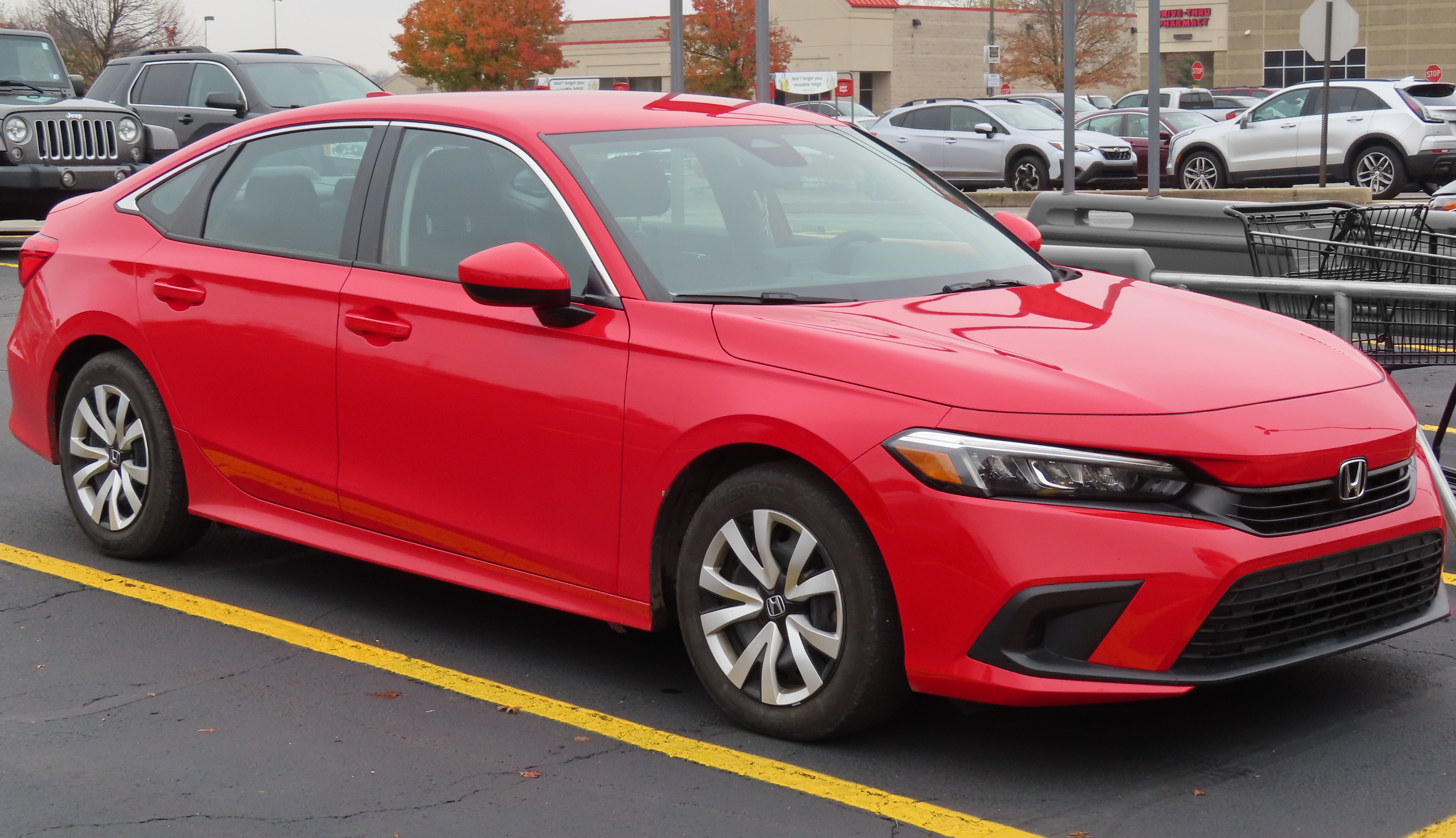
Honda’s Civic Sport Touring is a higher-trim Civic aimed at balancing everyday comfort with a more premium feel. Trim names like “Sport Touring” usually indicate added features (often including better infotainment, comfort items, and sometimes more performance-oriented tuning depending on generation).
A “sports wagon” is a performance-oriented station wagon—typically with a sportier suspension setup and sometimes more powerful engines—while still offering the practicality of a wagon. The hosts are pointing out that Europe may get these variants, but North America often doesn’t, which affects what enthusiasts can buy locally.
The Hyundai Ioniq V is a new electric car Hyundai is planning for China. The big takeaway here is that Hyundai is changing how the cabin looks and feels, not just the powertrain.
“800 volt” is an electrical system design in the EV. Higher voltage can help the car charge faster and manage power more efficiently, especially on the right fast chargers.
They’re talking about the “experience” side of EVs—how the car feels inside and how easy it is to use. With EVs, the cabin design and screens often matter as much as the battery range.
Tesla is being used as the comparison point for how EVs can be designed inside. They’re saying this Hyundai’s interior layout feels similar to Tesla’s big-screen style.
This is the “big screen” dashboard style where most controls and info are shown on one display. It can look clean and modern, but you may need to interact with menus more than with physical buttons.
Concept
letterbox screen effect
They’re describing the screen shape and how it looks—kind of like the black bars you see on some movies. That look can change how easy it is to read and how the dashboard feels.
They’re saying the driver doesn’t get a separate screen directly ahead. Instead, the main information is probably shown on the big central display, so the driver has to look more toward the middle.
They’re talking about minimalist car interiors, where the cabin looks clean and simple. Some people call that “luxury,” but the host thinks it’s often just cheaper for the manufacturer to make. The idea is that fewer physical pieces can reduce cost.
The hosts are criticizing the trend toward putting most of the driver information and controls on large screens. In practice, this can change how quickly drivers can find key functions, and it can also make the cabin feel more “tech product” than traditional vehicle. The segment frames this as a shift in the interior experience that may not translate well to real production cars.
They mention Kia’s design leadership team. The point is that Kia has a global group that decides what the brand’s future look and feel should be. That matters because the hosts are judging whether the “future” design actually looks good in practice.
They’re using a phrase that basically means “the cabin feels like a digital experience.” The host is saying they don’t see much of that in the photos and is worried it might not actually be better once it’s in real cars. It’s a commentary on how marketing language meets real design.
They’re comparing the new Hyundai’s shape to the Toyota Prius. That’s basically saying it has a similar “efficient, aerodynamic” look. It doesn’t mean it’s the same car—just that the styling reminds them of the Prius.
Experience modes are different settings you can choose in a car. They change how the car feels and responds, like switching between different “personalities” for the drive.
“Immersive” here means the car tries to pull you in with more engaging screens and controls. The idea is to make the cabin feel like part of the driving experience, not just transportation.
A joystick is a handheld-style control that can move in different directions. In this concept, it’s used to control the car’s functions in a more interactive, futuristic way.
Simulating gear shifts means the car can mimic the feel or cues of changing gears without a traditional manual gearbox action. This is often done in EVs or automated drivetrains to give drivers familiar feedback, even when the powertrain doesn’t operate like a conventional transmission.
Self-driving means the car does most of the driving for you. The hosts are saying that if the car drives itself, it might be less fun or less engaging for the person inside.
The Hyundai Ioniq 5 is an electric car. The hosts mention it as part of a comparison video, likely contrasting a normal, tech-forward EV with a more traditional performance car.
They mean cars using computers to copy the sensations you’d normally get from a gas engine. The question is whether that makes driving more fun—or just makes it feel fake.
The hosts are describing “simulated” gear changes—common on some EVs—where the car changes sound and/or control behavior to imitate shifting, even though the drivetrain may not actually be changing gears. This can create a familiar sensation without the mechanical event of a traditional transmission shift.
They’re basically saying the car is changing the “baseline” behavior to make it feel like something is happening. On an electric car, that usually means changing sound and power delivery rather than a real engine idling.
They’re comparing the car to VR—something that can pull your attention away from the real world. Their point is that they don’t want driving to feel like a game that disconnects you from what’s around you.
“Enthusiast drivers” are people who care about how a car drives and often seek engagement—handling, feedback, sound, and performance characteristics. In car debates, this group is contrasted with mainstream buyers who prioritize practicality, comfort, or value.
“Driving experience” just means how the car feels to drive. It’s not only about power or speed—it’s about whether the steering, acceleration, and ride are fun and satisfying.
Simulated driving is when a game or setup tries to copy what it feels like to drive a real car. It can be fun and educational, but it still isn’t the same as driving for real because real cars have real road feel and physics.
Hyundai and Kia are big car brands from South Korea. Here, they’re being mentioned in the context of making cars that feel more fun to drive, not just tech-filled.
“No screens” means fewer digital displays and more normal buttons and controls. Some people prefer that because it’s quicker and less distracting while driving.
The GR 86 is a small sports car meant to be fun to drive. It’s usually chosen by people who want performance without spending a lot. The discussion is about whether another car could offer a similar experience for less money.
Concept
volume vs niche sports cars
They’re saying car companies usually make money by selling a lot of cars, not by making only small numbers of niche sports cars. So the features you get are often designed to appeal to more than just hardcore drivers.
“Gamer mode” is basically a nickname for the car’s sportiest settings. It’s meant to make the car feel more responsive, like you’re controlling it more directly.
Concept
reversible jacket, reversible belt
They’re comparing the idea of car settings to clothes that can be worn different ways. The point is that different people want different feels, so the car should let you switch it up.
The Ioniq 5 N is the “sporty” version of Hyundai’s electric Ioniq 5. It’s meant to feel more fun to drive, with settings you can change—though some owners might just use it like a normal EV.
Driver modes are like different “personalities” the car can switch between. They change how the car feels when you press the pedal and how the car manages grip and power.
Concept
virtual thing where you're not actually enjoying driving
They’re talking about how driving in real life feels different from driving in a simulator. The host is basically saying real driving has real feedback that simulations may not capture.
A brake kit is a set of brake parts sold together, usually including rotors and pads. It’s meant to improve stopping and is chosen to fit your specific car.
Powerstop Brakes makes aftermarket brake parts. The hosts are saying their kits can help your car stop better and can also reduce how messy the brakes get.
Carbon fiber ceramic pads are a type of aftermarket brake pad material designed to improve braking performance while producing less brake dust than many conventional pads. They’re often marketed for better pedal feel and cleaner wheels, especially for daily driving.
Drilled and slotted rotors have holes and grooves on the rotor surface. They help the brakes run cooler and can help the pad clean itself during hard stops.
Brake dust is the gritty powder that builds up on your wheels as you brake. Some brake pads make more of it than others, so choosing the right pads can keep wheels cleaner.
“Beaver teeth” is a joking nickname for a grille that has lots of sharp-looking vertical bars. They’re saying the grille looks ugly, even if it’s a little less offensive than before.
Electric range is how many miles an EV can drive before it needs charging. Here, they’re saying the newer electric versions can go farther on one charge.
Term
M70X drive
This sounds like a top, high-power BMW electric version. They’re quoting its power and torque to show it’s meant to be quick.
Horsepower is a way to describe how strong the motor is. More horsepower usually means the car can accelerate harder, especially when paired with good torque.
“Neue Klasse” is BMW’s way of saying they’re moving to a new design direction. Here, it’s basically shorthand for the newer BMW interior and tech look they’re showing off.
A “four spoke steering wheel” just means the steering wheel has four main sections (spokes) coming out from the center. It’s mostly a styling detail, but it can also change where buttons and controls are placed.
“Trapezoidal screens” means the screens on the dashboard aren’t just rectangles—they have a slanted, wider/ narrower shape. The hosts are pointing out that the screen design helps make the cabin feel more high-tech and engaging.
“Immersion” here means the car’s interior feels like a complete experience, not just a place to sit. They’re talking about how screens and luxury features are arranged to make you feel more connected to what the car is doing.
This is a big screen mounted for rear passengers. It’s usually for entertainment or controlling features, and it’s meant to make the back seat feel more like a premium lounge.
This segment highlights a common modern design trick: the visible “light-looking” elements on the bumper may not be the actual headlamp units. The hosts point out that the real headlights are positioned lower than the grille/vent shapes suggest, which affects how you interpret the car’s front-end design.
“Neue Klasse” is BMW’s design theme for a new generation of cars. It’s basically the brand’s way of making the front of the car look different and more modern, even if some details (like lights) don’t match where you think they should be.
They mention the BMW i3 because it’s a distinctive-looking BMW electric car. They’re saying they expected the new car to look like a bigger version of that, but it doesn’t.
A character line is a crease in the car’s body that helps it look more sculpted. They’re saying the new design uses simpler shapes so that line stands out more.
The hosts pivot to “rear lights,” comparing “the old” versus “the new.” Tail light design is a major part of how a facelift or new generation reads visually, often changing the light signature even if the body shape is similar.
A mid-cycle refresh is an update automakers do partway through a model’s life—usually to keep the car competitive without redesigning it completely. Hosts describe this as a “big” refresh that includes interior changes, but not a full new generation.
This is an electric Mercedes-Benz C-Class. They’re talking about how the dashboard is dominated by a big screen and how the outside shape could look like lots of other brands.
“Pixelation” here refers to how the grille and lighting details can look in photos or video due to resolution, compression, or camera processing. It’s not a car feature by itself, but it affects how accurately you can identify styling cues from images.
LED puddle lights are small light sources mounted near the door that project illumination onto the ground when you open the door. They’re often used for visibility and a premium “welcome” effect.
“Light carpet” just means the glowing pattern on the ground when you open the door. It’s usually made by the door lights and can look like a logo or design.
Mercedes-Benz is talking about teaming up with a tech company to upgrade the car’s built-in computer. The idea is that the car’s voice/AI features will work better and feel more “smart” while you’re driving.
Liquid AI is a tech company that’s helping Mercedes-Benz make the car’s built-in AI smarter. That usually means the car can understand and respond faster using its own systems.
M-Bucks sounds like Mercedes-Benz’s name for the car’s “assistant” software platform. They’re saying newer generations make it better at understanding you and controlling car features.
“In-car intelligence” means the car’s system is trying to do more than play media or show maps. It’s meant to understand what’s going on and help you while you drive.
Concept
marketing speak
The host is saying the company’s language sounds vague and salesy. They’re implying that the new screen setup might be used to show ads.
An edge-to-edge screen means the display takes up almost the whole dashboard area. Instead of lots of buttons and gauges, you mostly interact with the screen.
That camera is pointed inside the car to watch what’s happening with the people in it. It can help the car know where you are and what you’re doing, which can power safety or convenience features.
“Serve up ads” means the car could show advertisements or promotions based on where you are. In this case, it’s tied to the car knowing your context while you’re on the road.
EV charge stations are places where you plug in an electric car to recharge. The idea here is that the car (or its connected system) can find nearby charging options and suggest them while you’re driving.
They’re suggesting the car could pick up what people are saying inside it. That could let the car suggest things like food or charging, but it also raises privacy concerns.
This means your car could potentially pay for things automatically using your saved payment info. Instead of you entering details each time, the car could handle it for you.
Some cars are moving toward dashboards that are basically big screens instead of normal dials and buttons. That can be convenient, but it can also pull your eyes away from the road more often.
If you spend too much time looking at screens, it can make it harder to watch the road and other cars. That’s why people worry about distraction from big displays.
“Virtual driving” is when the car feels more like a video game or tablet than a traditional machine. The worry is that the big screens and apps can pull your attention away from the road.
It’s basically a huge screen that stretches across the dashboard. Instead of having separate gauges and a separate infotainment screen, the car uses one big display to show everything.
“Interactive” means the screen isn’t just showing information—it can be used like a device. You can tap, swipe, and run apps, which can make it feel more like a tablet than a car display.
They’re talking about dashboards that are basically all screens. In the extreme version, cameras replace the normal windows so you “see out” using a display instead of glass.
Instead of looking through windows, the car can use cameras outside and show the view on a screen inside. That can let designers remove some glass and still show you what’s behind or ahead.
Polestar is an electric-car brand. They’re being referenced as an example of a company that’s experimenting with replacing traditional windows with camera views.
Instead of a normal window, the car could use a projector to show you what the cameras see. It’s like turning the inside of the car into a display that looks like the outside.
They’re contrasting screens with traditional physical dials. Some people prefer real gauges because they’re easier to read quickly and don’t depend on menus or screen settings.
This is a safety system that tries to “see trouble” before it happens in a corner. If you’re going in too fast, it tightens your seatbelt and gives you a warning to help you slow down.
The description points to an integrated warning strategy: the car tightens the seatbelt and also issues an audible alert through the cabin speakers. This combines haptic (seatbelt tension) and audio cues to get the driver’s attention quickly.
LIVE
Star Wars is back on the big screen with The Mandalorian and Grogu.
Gangsters, war criminals. I'll take out every bad guy in your deck of cards.
On May 22nd, feel the force.
On the biggest screen possible.
The old protect the young, and the young protect the old.
This is the way.
Buckle up.
Always wear your seatbelt.
The Mandalorian and Grogu, rated PG-13.
Maybe inappropriate for children under 13 in theaters May 22nd.
Get tickets now.
We're already laughing.
Happy Tuesday. Welcome back to the podcast.
It's been absurd, but we are prepping for so many crazy things coming up later this year.
We have a road trip going to Monterey that's going to be a cool film,
and that's not even the big film we're doing.
Which we'll tell you soon, I promise, but we have all of the things on this podcast.
Actually, mostly it's news and lots of car debates and a bunch of questions.
So we got to dive in because it's going to be huge.
Hopefully you've seen our K-4, almost hatch versus the Civic Sport Touring.
But this is a piece when the K-4 almost hatch came out,
because we're not getting the actual sports wagon that is available in Europe.
We're not getting that in North America.
Because apparently wagons keep dying and then they don't.
And they just don't get offered here.
I hope it proves something.
I like it actually quite a lot, and I use that as an intro.
So please watch that.
It's a great comparison, and they're both pretty much the same price,
and they're commute, they're a little bit of fun.
Very interesting, I thought, comparison.
They're right on top together for price and specs.
It was really cool to have them together, yeah.
So I use that as a segue into what Kia and Hyundai are doing stylistically.
The recently introduced Ioniq V.
We've got the Ioniq V, so we've got the Ioniq V for the Chinese market only.
We had talked about this a couple episodes ago when the concept came out.
But this is actually what is going forward in China with very little information.
The only thing we know it's got 600 kilometers or about 372 miles of range,
apparently, an 800 volt platform.
So EV, but it's all about the experience, the future experience.
Companies like Hyundai and Kia have never really focused on the interior
and experience for the Chinese market.
They certainly do. Legroom is a very big deal, and having a lot of legroom in the rear,
I want you to notice the screen layout, just the overall feeling of it.
This is a variation on what Tesla does.
Let me be honest, this is a very stark interior with one massive screen that is hugely letterbox
that starts, for those of you who can't see it, it starts over the center console
and it sweeps all the way in front of the passengers.
The driver does not have a screen in front of them.
It's this big, long, super wide screen, which will probably be broken into two or three panels
when you actually use it.
But the rest of the interior is pretty stark.
It's that minimalist thing, which we've all been supposed to be convinced that it means luxurious,
and it really means cheaper to make.
I'm continuing to dread what the future of car interior is like,
because everything is focused on screens, the interior experience,
that has not led up for production cars, and apparently this is where things are going.
So very little information on the Ioniq V, but stylistically,
you can't really describe what category it's in.
So I move to the new concept from Kia,
the executive vice president and head of Kia Global Design, Karim Habib.
He's also a fellow Arts Center graduate.
Kia's opposites united design philosophy shapes our future vision of mobility,
harmonizing the spirit of 1960s long distance touring
with the limitless possibilities of an immersive digital experience.
I see very little of that in this photo, but okay.
The interior, we don't get a picture of the IP,
but here is Kia is finding its voice,
and this is very similar to the Ioniq V from Hyundai that is now just released in China.
Which looks like a Prius. I have to keep saying it.
Very similar kind of thing with a single line for the greenhouse,
paired with facets for the body panels.
So very clean, but bold, faceted panels.
All the doors are angular. Yeah.
A lot of angles. It almost looks origami.
It does. That's a great description.
Smooth greenhouse.
And then here is the interior, giving you three distinct experience modes.
Speedster, Dreamer, and Gamer. These are modes.
What are we going to call these modes? What about Gamer mode?
Gamer, that's what this is based.
It's modes that enhance the highly immersive user experience
according to the driving environment and scenario.
And you'll notice in this photo, there is a joystick
that is part of the driver's seat.
And Kia is claiming this is all concept,
but you're able to switch modes and simulate gear shifts.
So everything about the future experience is what we all like about the old school stuff.
The most immersive experience is when you operate the car.
There's little verbiage about self-driving,
and you're just going to sit there and look at your phone
while the outside world is whatever it's doing.
And it just takes you to your destination.
No, we're trying to engage your senses, engage you in the driving here.
The interior environment, the immersive experience.
That is a shift in thinking.
I mean, I hope that they actually make some decent cars to drive.
Watch our Ioniq 5-In versus Ferrari piece,
which was on purpose a weird dichotomy of two things.
Opposites United.
Seriously, because we wanted to talk about the fact that the Ferrari is all visceral,
and the Ioniq 5-In is faking it, but it's faking it well.
I hope the wrong lesson wasn't learned at Hyundai, okay?
Because what Hyundai taught us, taught us all,
is that they can simulate some of the things about driving and it can work, okay?
To follow that is the prelude that's now trying to do it,
and that works to some degree as well,
which is also all fakery in their gear shifts that aren't gear shifts.
They're just changing the idle level of the engine, essentially.
It's true.
But now we're talking about a similar immersive experience theoretically on these concepts,
and I hope this is where I'm concerned about the wrong lesson being learned.
I hope the lesson being learned wasn't,
well, we'll just fake everything and the car will be boring.
I hope somewhere in there somebody realizes,
let's still make vehicles that are fun to operate.
The gamer thing concerns me, and I say this as a person with a 16-year-old.
When we have our moments when the house is somewhat quiet,
the dogs are asleep, my wife's watching something in the other room that's not on a high volume,
the sun is setting, it's a nice, idyllic kind of evening, right?
And my son is over there in silence, except he's got the VR headset on and headphones on,
and he's having a whole experience that has nothing to do with the world around him.
I don't want that in the car.
Agreed.
And I'm worried about that.
Agreed.
Cars need to continue to be pushed on.
What are the categories?
Who are we selling to?
What is the reason for you to choose one brand over another,
and what is the reason to choose this particular model?
What does it do for us?
It's almost like car companies continue to explore the theme of,
well, just being a car isn't good enough.
Fair point.
You're right.
Well, we know it's a car.
What else could it do?
Really?
Because if you were to ask us, we're enthusiast drivers.
Hopefully all of you watching are enthusiast drivers as well,
and you want something out of your car.
But in the driving experience category,
you want to have fun driving your car.
If it's a minivan, an SUV, a car, a sports car,
and if we're up to all of us, right,
we would just ask our car manufacturers to build cool sports cars for the rest of time.
Yes.
That's not how car companies think.
Gaming is not a new theme.
Not at all.
Not at all.
For the experience of cars.
But now that you're simulating the driving experience,
we've gone all the way to full self-driving.
We just need pods.
And now here's Hyundai and Kia going back to,
hmm, the driving experience.
And we're harking back to the 1960s, the GT cars, the long road trips.
And by the way, you get to drive yourself and it's simulated.
However you're doing it, simulated driving is really cool in my living room.
So does that mean we're going to go, the circle is large.
It's going to take decades.
But do we come back around to, we just built a car.
There's no screens.
It's got a steering wheel seats, a shifter and an engine.
And it's just, it's kind of interesting to drive.
I mean, I would love Kia to just build some sort of GR86 rival.
That's slightly cheaper.
They could do it.
They would be the one of the rare brands to pull it off.
It would look awesome.
Pick an engine.
It would drive great.
Yes, to all the above.
Yeah.
Well, but they're also thinking about volume.
Because all of these car companies, let's be honest, they survive on volume.
They don't survive on niche sports cars.
So if you create something like this, then the person that doesn't care about driving
can have whatever mode they want.
And the person that does care about driving can have gamer mode or whatever.
I mean, that's the concept is to create, it's back to the skateboard concepts
that were proliferating when you were going through art center.
Where it's, you make something that the owner can make it whatever they want.
It's a reversible jacket, a reversible belt.
But in this case, this desk grows with your child.
Anyway, but I know you're huge.
This is something that's like a short trip for you to be really annoyed.
But what it creates is, and that's the Ioniq 5N, let's be honest.
You can drive that as just an EV and it works fine as just an EV.
Yes.
And I wonder how many people, and I don't know if there will be stats for this,
but I want to have people, how many people have bought the Ioniq 5N
and then don't use the driver modes.
Just use it like an EV that's a performance EV with good suspension.
And you should have just bought the Ioniq 5.
Probably, yes.
But that's the thing is they've got to try to figure out how to make,
I hate to say it this way, one pod that will take the person that doesn't care about driving,
but maybe interest the person that does.
But I'm just worried about this whole virtual thing where you're not actually enjoying driving,
but it's been simulated for you.
Here's a last photo of the immersive experience.
That photo is two people staring at something on a turntable.
I don't know how immersive that is.
You know that the music in there is just sort of this humming.
Oh, you're right.
Kind of enjoy the spatial atmosphere and your distance and you're immersed in that.
Okay.
Does it drive well?
I just want to know if it drives well.
I hope so.
I hope so.
Yeah.
For all our adventures this year, we've upgraded our cars with brake kits from Powerstop Brakes.
Powerstop offers reliable, durable upgrade kits for nearly every vehicle on the road.
From trucks and towing to family road trip car to the commuters and canyon carvers,
go to Powerstop.com and fill out their brake finder.
You'll be matched to complete kits and components to fit your car and your driving needs.
Their drilled and slotted rotors keep brake temperatures low and carbon fiber ceramic pads
give improved stopping power with less brake dust.
And Powerstop is a long-term supporter of our show, encouraging our adventures and yours too.
So join us and thousands of other drivers who've upgraded their stopping power with Powerstop.
Visit Powerstop.com and use their brake finder today, right now.
Stop the podcast.
Speaking of car companies that give their customers what they think they want,
BMW has redesigned completely the new 7 Series.
They've refreshed it to the Neue Class design language.
Wait, no they didn't.
Is that really their commentary on this photo?
That is.
Because it still has the beaver teeth and looks every bit as ugly.
Okay.
No, no, no.
It's only 90% as ugly as the 7 Series was prior.
Did it get uglier?
Did it get better?
I think it got less offensive, but it didn't get more attractive.
And I don't see the Neue Class, New Class, I don't see that on here at all.
I don't either.
This represents the most extensive model update ever carried out by the BMW Group for the 7 Series.
What?
The fully electric models have a significantly longer electric range that now extends to
447 miles.
By the way, Lucid Air has already done that.
The M70X drive has 608 horsepower, 748 pound-feet of torque.
Lucid Airs are also quite powerful and pretty fast.
The Lucids actually look good.
That's the problem here.
And they've redesigned.
So the Neue Class style.
The interior, I see it.
The interior is different.
They've got the four spoke steering wheel here.
They've got the trapezoidal screens, adding screens, adding the immersive experience.
BMW and Mercedes are the kings of immersion.
You see it here.
This is the interior that they bragged with that new design.
I'll see that.
The exterior, no.
But the interior, I'll give it to them.
Yeah, for sure.
Here is the rear seats.
And remember, BMW was obsessed with that giant screen in the rear, but immersion into all
of the features and the luxury.
I'll give them this.
The interior looks amazing.
The interior looks like a fantastic place to be and is an absolute update along the lines
of their new styling.
The exterior is still heinously ugly.
Here's the old one.
Yeah.
Which is actually worse.
Here's the new one.
I stand by my worst, but that one's 90% as bad as the other car.
Did it get better?
Here's the old.
It got 10% better.
And this is 2023.
That's heinous.
For those of you who can't see it, chromed beaver teeth.
And keep in mind, the headlights are not where you think they are.
Of course they are.
They're down here.
And same thing on the new car.
They're down here.
These are the actual headlights.
The headlights are down here.
What looks like the side vents of the front bumper.
Yes.
Let me just remind everyone what the Neue Class styling is.
I think it's absolutely brilliant.
Looks great.
Imagine this new i3 as a bloated seven series.
A big seven series version of this.
Sure.
Yes.
Absolutely.
Put that front end.
I'm just not seeing it.
Because it's not there, Paul.
There's a reason you're not seeing it.
It's because it's fully not there.
It's not the Neue Class styling.
It's the same.
It's only if they argue the interior.
Because this as a giant seven series would be great.
All about.
Would look great.
Two PHEV variants and three M performance models.
Here's the versions that I counted.
By the way, here's the rear.
Better.
Old.
New.
Like 10% better.
New.
Yeah.
There is the i750 X-Drive.
The i760 X-Drive.
The i7M70 X-Drive.
You're only getting warmed up.
I could tell.
Yes.
The 750E rear wheel drive.
The M760E X-Drive and the 740 X-Drive.
Not to mention the 740D X-Drive.
I thought it was just going to be a large i3.
And we were going to call it done.
We all hoped that the beaver teeth had gone away.
But alas, not true with the seven.
The BMW kidney iconic glow and minimalist crystal headlights.
Give the car a visually impactful presence.
That's true.
There is visual impact here.
I feel like I got punched in the gut.
When I first saw this, I turned into a dog eating peanut butter.
I was like...
No.
I see that.
It has impact.
It impacted me.
Just not the impact they hoped for.
The side view impresses with reduced surfaces character line and classy details while the
rear ends shaped by newly designed lights in clear forms.
Let's talk about the rear lights.
Here's the old.
Here's the new.
And no, no.
What you've done is you've made a 2011 Lincoln MKZ rear lights that were not successful here.
It does look a little like that.
You're not wrong.
Well, but same.
But same.
Those lights are off the Neue class and they don't look great on that car either.
I agree.
It looks cross-eyed on the rear.
Yeah, you're not wrong.
And I didn't think the MKZ was successful.
The vertical Lincoln logo right in the middle and I thought this looked bug-eyed.
I thought it looked like the Mr. Potato Head or the squeezed all that.
And here BMW has ignored that, thrown caution to the wind and applied some elements of the
Neue class styling, but not all of them that I had hoped.
I mean, that would have made it successful and good looking.
They'll wait for the next full version.
This is this is like a big mid-cycle refresh is what this really is.
It is the most refresh of all the refreshes.
Yes.
Without being a new generation and they did a lot of interior stuff.
Yes.
It can't come quickly enough.
I understand.
The seven is haintlessly ugly right now.
I don't care how many versions of it they sell.
They're all ugly.
As soon as I saw that 760.
That's interesting.
This is all I saw.
All you saw was the Lincoln.
Old MKZ Lincoln.
All right.
Okay.
Mercedes has introduced the new C-Class EV unveiled with a ginormous instrument panel.
It's a single screen.
I hoped you'd bring this up.
This is even more screens than I thought possible.
Here's the new C-Class.
Here's the new EV.
There it is.
That profile could be four other car companies.
You're right.
It's there is nothing Mercedes about the profile of this car.
And as you start to see the front and rear lights, the lights start to have some signature
that you start to go, oh, that's a Mercedes.
But in profile, this could be a Tesla.
It could be a BMW.
It could be, honestly, it could be a Kia or a Hyundai product.
There's nothing about this side profile that says this is a Mercedes.
Nothing at all.
It could be Audi.
Yes.
Yes.
Here's the rear and you start to see that signature.
You start to see the badge.
You start to see the proportions.
The lights look Mercedes.
I see it in the rear.
Yes.
Here's the front grille with all of the pixelation.
Very clear to me.
That's a Mercedes because the grille is all about the Mercedes logos.
I couldn't find a good picture of the light carpet that the doors cast onto the ground
when you get out from the LED lights underneath the doors.
The light carpet.
I couldn't find any good photos.
We're going to have to drive this and take photos of the light carpet.
That's all the reviews could be.
Step out onto.
Light carpet.
Yeah, for sure.
This is the screen.
It spans the entire instrument panel.
For those of you who can't see it, there is a vent, a circular vent on the right by the
passenger.
There's a circular vent on the left by the driver.
Everything between those vents at the extreme is one huge screen.
Mercedes announced a multi-year partnership with Liquid AI to scale embedded on-device
intelligent from Mercedes-Benz models with third and fourth generation M-Bucks in North
America.
This partnership is designed to advance the performance of real-time private and local
AI experiences for onboard services at scale enabling the next generation of in-car intelligence.
They keep saying, gives customers value and it's intelligence.
You know what I hear when you read that?
Ads are coming.
When I hear you read that, it just says to me in marketing speak, ads are coming.
There's a lot of real estate to put an ad up with a little X in the corner.
There's tons of real estate on that.
This evolves the M-Bucks virtual assistant by seamlessly integrating voice control, vehicle
functionality and contextual understanding into a more capable in-vehicle experience.
There is nothing on the dashboard but screen.
If you haven't seen this yet, you have to look it up because it is edge-to-edge screen.
Got a few more images here.
With vents on the edges and it is, I cannot believe it.
There is no dashboard.
It is just a screen.
See what's front and center is a camera looking into the passenger compartment.
Yes.
Right above the screen.
It's going to be looking how many people are in the car.
It's going to be reading reactions.
Who's talking to me?
What are you saying?
What are your gestures?
All of the above.
Are you having a discussion about food and you're on a road trip?
It's going to search the surrounding area and serve up ads.
Of course it will.
100% correct.
That verbiage is ads are coming folks.
It's almost like the Liquid AI partnership is going to turn the car into a sentient being
and be listening to your conversations and almost involved in them when you talk to the
car and you want to know EV charge stations, you want to know food, you want to know anything.
I'm hungry, I'm thirsty, I'm tired and it will serve up locations and ads and discounts
and it might be connected to a credit card already in your wallet.
It might be.
I'll go dove his advocate on this.
We've all done this on a road trip.
You're driving along on a road trip.
Everybody got hungry.
Where are we going to eat?
And somebody invariably pulls up their phone and tells the map show me restaurants and
starts calling out restaurants and menus and star ratings and that kind of stuff.
And that person holding the phone is the keeper of all the info.
In a car like this, in that moment, this is brilliant because you can pull up, I guarantee
you, five or six tabs of the restaurants that are in play and they're all on the screen
in front of everybody and you can see the stars and I want to do that one, not that one.
What kind of food do you feel like?
Exactly.
Then when you touch the one you want to go to, it automatically goes to the nav.
In that moment, this will be brilliant.
Okay.
It will be.
It'll be awesome.
It'll be fantastic.
You traveling with the family, you need to find a gas station or whatever.
Awesome.
We need a Walmart done.
Yeah.
Okay.
But do we want to have an entire dashboard that is a screen?
And I say, no, I say, why are we, we're now driving down the road in our living room.
We're sitting on the couch looking at a TV screen.
By the way, there's windows there that somebody needs to be paying attention to.
I particularly like this image of didn't work hard enough.
Didn't make Diamond Club this year where all of your counterparts or coworkers or
vacationing in Hawaii will just give you a wave.
Simulated on the screen.
If you'll only worked harder.
I have less issue honestly with the potential intelligence and interactivity of this than
I do with the wall to wall screen.
Here's the wall to wall screen.
It's the seamless M bucks hyper screen, a thousand LEDs surround navigation, 39.1 inches.
There's not just one.
There's three.
It depends on which variant did want.
How much money are you paying?
What did you spec your car with?
Because the standard equipment on the left, I think this screen just exists with a clock
on it.
I don't think there's any.
You might be right.
I don't think anything goes on here for the standard version because the super screen
now that's interactive.
You're right.
That is.
That's where the ads are going to serve up.
That's where maybe your passenger watches movies and plays with apps.
Then the hyper screen is the big one that you know everybody really wants because there's
no break in the screen.
For those who can't see this, it's essentially one glass panel and in the lower two settings,
they've put essentially three smaller screens in the same big panel and the screens get
better and nicer from the base to the middle.
Then the upper one is this wall to wall screen, no break, super interactivity that we're all
anticipating.
I must ask from an interior design perspective, if we're now here, if the entire IP is a screen,
I don't care which one of these you choose.
Yeah.
We can't go back.
Future car design, future interior design, we can't go back.
If we go back to anything less than a glass panel with screens, I mean the only way forward
is you can't even see out the front windshield.
It's just one giant screen and it's cameras and pole stars got rid of the rear window.
How long do we get rid of the front window?
I could do a projection.
It's coming.
I mean, well, but this is every sci-fi film ever.
Every sci-fi film ever is the view screen is not actually glass with the exception of
Star Wars, like all the Star Trek and the deep space stuff and all that kind of stuff.
The screen is just that.
You're looking out the window, but it's just a screen.
It's just a projection.
Are we headed there with cars?
That's a terrifying thought.
You can't go back because other interior design is just, it'll look boring.
It'll look, it's not entertaining me, but I think it'll flip around.
There'll be those like the folks that want the analog.
I mean, this is, this is the Apple watch.
So the folks like yourself that want an analog watch with actual gauges, I think that will
continue to exist.
It'll be very niche and it'll be on very high end products while the rest of us stare at screens.
Last on my list here is a new feature, apparently a feature for this car where the seatbelt
strangles you.
If you come too fast to a corner, the seatbelt strangles you.
It's not what it says, Paul.
It's not what it says.
That's what I read into it.
That's what I read.
That is what you could read in.
It's a pre-safe curve function and it tightens the seatbelt.
If you come in just a little bit too hot in a corner, the seatbelt goes some sort of sound
place over the speakers.
I'm reading the actual description here that this is the best sentence ever.
This provides a warning to the driver and allows them to adjust their speed accordingly.
The seatbelt goes, are you paying attention?
Didn't you come in there a little hot?
I mean, look, I also, I hope and I do believe that Mercedes will have all of these features
as things you can turn off.
Okay.
When we've talked to the Mercedes car, we've always made a joke about whenever we say the
word Mercedes in a Mercedes review, we get interrupted.
I am aware you can turn these things off, but they exist.
Pre-save curve function.
It allows the driver to adjust their speed accordingly.
Hey, Moron, wasn't that a little fast?
Actually, you know what?
This has existed forever.
This has been moms throughout all of history.
When you're riding behind your child and you get freaked out, what do you do?
You grab their seat and you pull on their seatbelt.
I mean, moms have done this for all time and you go, mom, you're strangling me.
I'm not going too fast.
It's the new Mercedes mom.
It's the Mercedes mom.
Yes, exactly.
Mercedes mom.
Done.
We've talked about the Ferrari Luce, the EV coming.
It is supposed to be unveiled in Rome on Monday, May 25th, 2026.
That's Memorial Day in the US.
We are just as eager as you to find out what it looks like and exactly why it's expected
to start at 550,000 euro or $647,000 for an EV.
I've said already they're going to have trouble moving these and they're going to drop like stones.
If you'd never have to plug it in or something and it turns it, it's like the Ferrari perpetual
motion machine or something.
There you go.
There you go.
There you go.
That would be it.
Instead of like change your spark plugs every 100,000 miles, it's now plug it in every 100,000
miles and you otherwise never need to.
It just goes and goes and goes.
They figured out how to do enough solar that it just perpetuates itself.
The Lucid Air Sapphire is almost a quarter million dollar car.
Yeah.
I don't know what else you need from speed or range or comfort or tech that the Lucid Air
Sapphire can't give you that actually came out in 2024.
Well and also what's crazy is 650,000 dollars for an EV.
But then also going back to Lucid, you can get those Lucids for a song now.
That's where the used bargain is for sure.
So you'll get this interior.
This is all we know.
You've seen the interior.
This is all we know right now.
So it'll be a cool Johnny I've designed interior, Mark Newsen designed interior for 650,000.
I'm very curious.
Look, I am in this job constantly looking to be surprised.
Honestly, it is my favorite thing about driving cars for living and talking about cars for
living is when we get in something and I don't care what the price is and I just get
surprised by it.
It drives better than I thought.
It looks better than I thought.
It's more comfortable than I thought.
Whatever it is.
I just like being surprised by, oh my gosh, they really thought that through and that's
really cool.
It's way more expensive than I thought.
I hope this is surprising.
But I am concerned.
And to your point, quarter million dollar Lucid does everything you'll ever need an EV
to do and more.
I think the Lucid will still have longer range than whatever this is.
Probably.
Probably.
And so then what are we buying?
What are we doing?
You can go out with $70,000 and get yourself an awfully nice Lucid that's used by a couple
years.
Yeah.
It's amazing how fast they drop.
I'm so curious.
No matter how amazing this is, what is its actual used value in a year?
Somebody buys one and there are people that buy them.
Somebody buys one, sells it in six months and a year after they originally bought it,
what is this worth?
Because Ferraris in general, they trickle down in cost.
True.
They trickle down.
And if they're desirable, they go up for a while when you sell them used.
What will this do?
Because if EVs have shown us anything, it's a race to the bottom.
In a completely unrelated note, tune in next year at this time.
We're going to be doing a series.
We will both own Lucid EVs because we will have bought them for $10,000 and we'll be
doing a full series on Ferraris Lucid EVs and why they weren't worth $650,000 and what
great they are to drive or something.
I don't know.
Hey, surprise me is all I have to say.
As we're talking about EVs and how EVs are changing in the market, literally the news
that they were recording this is that Porsche is getting out of Bugatti.
They have a 45% stake in the Bugatti Remock Combination Company, run by Mate Remock.
And Porsche, as they are resetting, because they're resetting all kinds of things, because
they buy regulations, they moved way into EV and now they are retracting, it's costing
them billions.
And so Porsche is taking the time to rethink what's valuable here and they have sold their
45% stake in that company to a, of course, a venture capital company, they have sold
it out so they are no longer a part of the Bugatti Remock Combination and they're pulling
stuff home to figure out their own stuff.
And I think that is fascinating.
We're just watching how EV attempts and resets are affecting all of these companies.
I was thinking about the 9-11 GTS Hybrid we drove that had the battery built by Remock.
Yes, it did.
Yes, for sure.
Remember that?
Yes, absolutely.
We were just curious and it has the traction battery where the normal battery is under
the cowl, so you lift up the panel and it said Remock, right on the battery, I'll find
that photo and publish it here, Porsche could continue to license that technology.
But I got the idea that was a Remock brainchild.
Maybe it was Porsche, but they had to use them to develop the system or something.
Yeah, I think there's a generator in the turbo.
Maintenance and battery tech that's coming from Remock, but I think the idea is a Porsche
idea.
Okay, maybe so.
But who knows?
It's not going to stop.
It's not going to stop, but in the new turbo, we've got two of them, the electric turbocharger
and the entire battery technology, they'll maybe find a different builder for that battery,
but that is going away, so what does it do to that model?
Maybe nothing, but I don't know.
I think all of that tech will stay around in the Porsche lineup, it's just they're not
going to worry about what's happening over in the Bugatti world, so it'll be fascinating.
Tomorrow morning is knocking, stock your fridge now, how about a creamy mocha Frappuccino
drink or a sweet vanilla, smooth caramel maybe, or a white chocolate mocha, whichever you
choose, delicious coffee awaits, find Starbucks Frappuccino drinks wherever you buy your groceries.
Hopefully you're not surprised to hear we have a lot of really cool Hooked on Driving
events coming up all over the nation.
May 1st and Saturday, May 2nd is Ridge Motorsports Park, that's the Pacific Northwest region,
but the same weekend in the Northeast, Pocono Raceway is happening over there.
That is Saturday, May 2nd and Sunday, May 3rd, so which coast are you on for that weekend?
You can go to an H&D track day.
A couple of weeks later, the Laguna Seca Summer Adventure is happening.
That is Saturday, May 16th and May 17th at Laguna Seca, but the trick there is, for those
of you joining us on our really cool Monterey Driving Adventure, we will have been driving
for a couple of days prior to that, and then winding up, that's the 16th and 17th, at Laguna
Seca for the track day, so all of the above is happening there.
We will be in attendance, and then Oregon Raceway Park ORP, that is two hours east of Portland,
and the cool thing about this track that we keep being told is you run it one direction
Saturday and the other direction Sunday.
That is really cool.
That's right.
That is a Pacific Northwest region again, May 23rd and Sunday, May 24th.
That is happening then, and then that is Memorial Day weekend.
The weekend after Memorial Day, I think there might be three spots left.
CODA, Circuit of the Americas.
We keep talking about it, but it's amazing.
We're working down to the very last few spots.
We're not having people fighting over the last few days.
It's going to be very cool.
A couple of really cool days, May 30th and 31st, in Austin, Texas, Circuit of the Americas,
we are having possibly the biggest event in the history of hooked on driving is happening
that weekend.
If you aren't driving, come anyway.
There are actually going to be a lot of people that are going to be there just as spectators.
That's right.
And I believe it's Saturday afternoon.
We are going to rent out and open the tower.
If you haven't seen CODA from the tower, you'll be able to Saturday afternoon.
We are renting that out to give people that opportunity.
So if you want to come and play spectator, it'll be an amazing couple of days for that
as well.
Plus we're going to do a podcast that night.
That is going to be a huge event.
So yes, as you said, y'all come now.
It's a Texas thing to do that.
You better believe it.
Yes.
Three car debates incoming.
The first one from John L.
In Canton, Georgia, he's an Air Force veteran and here he is.
He's got a 2013 base model 370 Z that he has owned from the dealership.
He's modded everything pretty much still in long tube headers, FI cat back, poured
Is there a reason to keep it versus just nostalgia?
It could be nostalgia.
Well, I just have it, so I might as well just keep it.
I'm going to leave it there for now, but anyway,
you're talking about a daily that's fun with two kids.
Should it be the CT5 Blackwing?
I think where you should go is starting right where Paul is.
Look, I like the Evora period, but starting at the 400,
Lotus started to refine it properly
and it started to really dial it in,
but the 400s are cheaper
and they aren't as hardcore as the GT.
The GTs are more expensive.
The Evora 400 I have showing right now
is still the same cool green color,
but it has 17,000 miles on it.
It's like we both gravitated towards that green.
And is $70,000.
That's great, actually.
I think you would love this 400.
The 400 is the perfect middle place
between where the Evora started
and the hardcore version it finished at.
This is the more refined version than the early cars,
but not as fully, hey, you must take me tracking
hardcore as the GT.
I think you would love this as a daily,
small but usable backseat.
Here's the trick with the Evora 400.
You have all the space you need in the driver's seat
and the kids get to fight over.
Somebody's in the front, somebody's in the back
and ouch, I need more leg room.
But they're still small enough that can work for a bit.
So 400 actually works here because the Amira does not.
I understand, look, I chose the Amira.
I love the Amira, but it's two seats
and that's not really gonna work for your life.
But other ideas, you said CT5 black wing,
but you're worried about it being too big.
I've got other options for you.
2020 BMW M2 CS happens to be white,
but it's $75,000 with 13,600 miles.
Those have dropped a bit.
You would love this car, BMW M2 CS.
This is the prior generation to the current M2.
This was the best way they looked.
It drove wonderfully.
These rose gold motorsports wheels.
Yeah.
This is such a cool car.
This is a manual CS.
You would love driving this daily.
And if you have a back road weekend for you, awesome.
And this has really genuinely usable back seats.
I just happened to find the CS,
but M2's in general of the prior generation
with your budget, take your pick.
I wonder about the competition.
Kind of a step down from this in terms of-
It would be great.
Hardcore, raw performance.
You might like it a little bit.
I mean, the CS, yes.
But when you drive this thing, Andy,
it's very hardcore.
It's very raw, very stiff.
This feels like it needs to be on track.
We put the CS next to the Avoir GT.
That was the comparison we did for the TV show,
was those two together.
This is a great, great car.
They were $100,000 new.
They clearly are coming down.
I'm showing it because this feels to me
like the pinnacle of M2, that M2 generation,
but may not be right for Andy.
Maybe it is the step down to competition,
which you would still love, by the way.
So I'm showing this as the upper level.
So that is a really good consideration
with real back seats.
We joke in that piece about the difference
of the usability of the back seats of the Avorra
versus the M2 CS.
I, six foot three long torso weird guy,
got in the back of both.
And in the Avorra, it was a comedy routine.
And the BMW just worked.
It was normal, yeah.
Legitimate seats, yeah.
M2 CS for you right there.
I think that's a good option.
But then you also said the CT5 is just
the other big consideration and it's too big.
So let's solve that with the CT4.
Look, this is not as powerful as the CT5.
The CT5 has the better, more interesting engine
and the larger, more aggressive feel.
But this is smaller.
And as a result of being smaller.
It's a 25 for 70 grand.
I know.
That's a brand new car for 70 grand.
7,000 miles, $70,000 for a 2025 CT4 V Blackwing.
So this has the turbo V6 and it,
look, it's not as powerful.
The engine is part of the fun of the CT5.
It's a good, big chunk of the fun.
But this, I would argue to you,
if you're wanting a agile daily, this is better.
And this is not gonna feel as big as the CT5 would.
But come on now.
That's a heck of a car.
Andy, you've got choices.
Thank you for writing.
EverydayDriverTV at gmail.com.
Top of Tuesdays.
What CEOs say?
Thanks, CEOs say.
Crazy. We got all kinds of stuff.
We have a good, did you see this coming up
after this episode actually?
We have a really good, did you see this?
You're not ready for this.
You are not ready to see this, yeah.
Top of Tuesdays, car conclusions,
all the stuff right to us.
This episode is brought to you by Ferrero.
Soccer's biggest stage is approaching
and Ferrero is making it easy to go all in.
Pick any two Ferrero brands from Kinder Bueno
to Ferrero Rocher and you could win
the $1 million grand prize,
plus an exciting range of daily and weekly prizes.
Don't miss your shot.
Official rules apply.
Learn more at goallinandwin.com.
We don't always have, did you see this?
And they don't always have to be movies
even though that is my bent.
But our friend Jordan sent us a photo
and we just thought we absolutely have got
to share this photo.
You're not ready for this.
You probably didn't see it because it's Jordan's photo
but it is worth sharing, I think.
I kinda wanna make a new section called Wrapped Cybertrucks.
What do you think, everyone?
Jordan spotted this, instantly sent it to us.
Jordan, thank you for sending over.
What you can't see is that this has been wrapped
to look kind of like a school bus.
It has the pop out stop sign on the school bus
that pops out when the school bus stops and says stop.
This one has it as part of the wrap and it says chill
because I'm sure they've gotten a lot of anger
about driving a Cybertruck.
The key point here is what it says on the side.
Small S, big C, school bus, it's so S cool.
If their kids are under 10, this is the coolest thing ever.
If their kids are over 10,
they're walking from three blocks away.
They're going, this is close enough, mom, dad.
I will walk from here, okay?
The S school bus, wrapped Cybertruck, it hurts my eyes.
If this is you, if you are the owner of this,
please write to us and we would love to see
even more high detail photos.
If you know this person, we'd love to know.
Does this person listen to the podcast?
We would certainly love to know.
And how old are your kids?
I wanna know, how old are your kids?
Like I said, I toyed with the idea
of doing a wrap Cybertruck section,
but then I thought better of it
and I just thought, we'll leave it here.
Maybe I don't need to see all the wrap Cybertrucks
that have ever driven past
because I've seen quite a few and they're not good.
There are so many.
There's a lot of creative ones like, oh, okay.
There's a guy that made one look like a Woody
that used to go around Park City a lot.
There's the bright orange one locally,
that's Bitcoin orange.
Yes, yes.
There's the Vitruvius man,
one that is local for Vitruvius construction.
Saw that.
And that's just the stuff in our backyard.
They have two of those by the way.
Of course they do.
Yeah, they have a fleet.
Okay, so all the write off cars,
the wrapped write off, maybe not.
They are billboards, they are rolling billboards.
That's exactly right.
Jumping to questions, thank you guys,
as always for responding to questions.
We post on Instagram and Facebook for questions
and we try to put some photos up there
to get you guys talking and we really appreciate
when you dive in.
Barbara Peterson hasn't written in a while,
but she's got a great question.
Do you see this?
If the new GT3SC, by the way,
a lot of people are coming down on me
and saying that the reason for this,
I'm gonna argue this real quick,
the reason for this is because it's the really cool,
naturally aspirated engine and you wanna hear it,
therefore convertible.
Yes, I agree with that.
I stand by everything else I said.
Anyway, she said if that GT3SC is for peacocking,
what is the 911 antithesis?
What would be the one that you would just be like,
people are giving you the head nod,
like yeah, that's a cool 911 that you got
because you are a dedicated enthusiast.
And Barbara, I'm gonna go off book
because I think all the 911s have been soured
by a level of peacocking at this point
because if you get into the air-cooled ones,
and please don't misunderstand me,
some of the guys that own air-cooled,
the guys that had the air-cooled
and we did our 50 years of 9-11 film 13 years ago,
many of the guys that have the air-cooled,
they are died-in-the-wool Porsche guys.
They may have had them since they were new,
they are enthusiasts, they drive them, they love them,
they can maintain them on the side of the road.
There are plenty of air-cooled folks,
but a lot of people are buying them
like the rest of the world buys vinyl records.
It's that classic thing that I must own
to show I'm a connoisseur.
I know nothing about it, but I'm gonna get it
because it shows I'm a connoisseur.
The air-cooled 9-11 market is stupid.
It's so expensive and it has a lot of people buying
just to show off they have an air-cooled 9-11
and they don't even really know what that means.
To actually get the anti-peacocking,
I am a Porsche enthusiast Porsche, I have a choice here.
You do, okay.
When somebody pulls into a car's in coffee
with a pristine, well-running 928.
Okay, I like this.
Everybody respects that, that knows cars.
Okay, I like this.
And you are in this, Camp Paul.
You do not buy a 928 without expecting pain.
There is pain coming, okay?
You have to love the car, you have to know the car,
you have to really want to have one.
You don't buy one just to be like,
look what I bought, I bought a 928.
Yeah.
Because trouble is coming.
Trouble is coming, yes.
So this, I think that is the perfect non-peacocking Porsche
because the other thing about it is,
it's not super flashy.
It's very timeless.
It's very timeless.
But it's not bewinged, it's not,
there's nothing crazy about the 928 design,
it's just classic.
And timeless, and they look the same
from the 70s to the 90s.
It's just this nice ubiquitous shape.
Beautiful shape.
It has movie history and risky business
and other places.
It's just a cool car.
But nobody's buying it for look at my cool car.
They're buying it because they want that car.
It's gonna say, why did I buy one?
Because you like the look.
It wasn't Peacock, it was clearly the look
and I just love driving them and I, yeah, I love the shape.
Then you bought another one
and really questioned your choices.
But anyway, yeah.
What am I doing?
I was gonna say 912.
Yeah, but 912 is,
I can't afford an air-cooled 911, so I bought a 912.
You're still Peacocking.
You think so?
I think you are.
Because I'm thinking, well, I couldn't afford it
or I'm, I just liked the 912 and it was the lower end
and I'm not trying to spill off of the spotlight.
The 928 is, I love this thing.
Yeah.
True.
It's not looking me how awesome am I.
It's like, I like this car.
Okay, all right, I'll give that to you.
I mean, that's an easy one for me.
Richard D on Instagram asks,
what is the most bougie thing that you take
or have taken on one of your road trips?
He and his wife just recently went to the Bay Area
and they took their pour over setup with fresh beans.
Oh, stop.
It was a luxury item.
They couldn't live without.
That sounds like a great idea.
I would like, I just need the single press espresso.
I would need that.
I mean, I don't have it,
so maybe I need to ask for that for Christmas.
There you go.
I guess just snacks and tools and I don't,
think I take anything that's really.
Yeah, I don't think you and I really do something odd.
It's very pragmatic.
As far as taking it from home.
It's having our tire inflators, our torque wrench tools,
basic tool set, Griot's car care, the clothes,
a lot of snacks.
Yeah.
Not much else.
I don't think you and I really typically carry weird stuff
other than lots of camera gear.
Camera gear, yeah.
But that's for reasons, yeah.
I guess so.
Beneray32 on Instagram says,
what is one dead brand that never really reached
its full potential?
How about Pontiac?
With the Solstice?
It's like they killed the brand.
The Solstice was like.
The G8.
And the Solstice at the same time.
And the G8, yeah, yeah, yeah, yes.
They weren't going into a renaissance
and they were like, oh, no, just kidding, pull the plug.
I mean, they had their, you know,
GTO days of.
Sure, certainly.
Late 60s and then.
And the Firebirds and the, you know.
Sure, sure, sure.
The Knight Rider kit car was a big thing for Pontiac.
Cause that was the Firebird era.
They had some good stuff in there.
Yeah, for sure.
And they were clearly being established
for a long time as the GM alt brand
that was a little more performance based.
But I don't feel like they really started to be like,
what is this now until Solstice G8 and now they're dead.
Until the C8 Corvette came along.
It was the Pontiac Fiero that was the only mid-engine
to my knowledge out of GM.
Production one, I'm pretty sure you're right.
Yeah, you're right.
The Fiero, yeah.
So the Fiero was cool.
I mean, whatever you think of Fieros,
I thought they were cool.
I totally, I was 10 or eight or something
and I totally lost it after him.
But yeah, I mean, it just felt like they were becoming
the small sports car instead of big heavy muscle car.
And they were being repositioned only to die.
Yeah, interesting.
Interesting, I see that.
IMAX 062 asked a question that I pondered for a while
and then I came up with an answer
that's probably going to be controversial.
So I'm diving right in.
He said, people talk so much about
how the last generation of a car
was so much better than the current generation.
We're talking, and I see where you're going.
You're saying that's happening a lot right now.
He said, people are going, well,
I remember when this car was that
and it's not as good now in the current version.
We're guilty, a lot of us are guilty
because we're looking back fondly at older cars.
He's saying, all right, so what current car
do we think is better than the prior generation
even if no one else agrees?
And I have an answer.
Current car being sold right now
that is better than the iconic one sold prior, the Supra.
Yeah, the Supra that you're thinking of
is the Mark IV with the 2JZ, man,
and the fast and furious connections
and everybody loses their mind
when that Supra generation pulls into the cars and coffee.
And I will admit, those engines are amazing
and they can do 1,000 horsepower
and they became drag monsters.
And yes, it was the crazy thing in fast and furious.
I get, I know and get all the history,
but I've driven them and they're GT cars.
It's a GT car.
It's a very nice GT cars.
Well engineered, it looks good, it drives well.
It's a big GT car.
It is closer to the LC 500 than the current Supra.
Oh, Toyota told a room full of journalists,
including us, that the reason they stopped making
it was because you all stopped buying it.
Well, and then fast and furious happened.
And they were surprised by the fast and furious response.
They showed, they charted interest.
And they were like, you stop buying the car.
Of course we're gonna stop making it.
The new Supra is a better sports and back road car
than the prior Supra.
That's really good.
And I know, look, I know you can tell me
a thousand ways to tune it,
but I'm just talking about buy them both off the lot.
Old Supra, new Supra, both manuals,
I will take the new one.
That's really good.
The Bruce B has another one here.
Look, I'm just gonna go straight into things
that annoy me, pet peeve things.
But Bruce asked a good question.
He said, he really liked our recent 911 T review.
That's actually over on the Test Drive channel,
if you haven't seen it.
And he said, on many YouTube reviews are included,
the speedometer gets pixeled out at certain speeds.
Blurred, I can't imagine why we do that.
Yeah, anyway.
He understands it, but on track,
he liked that there was a track element of this piece.
But we never really showed the speeds.
He's wondering about an on-screen graphic of the speeds
or calling out the speeds.
That's 120, it feels like whatever.
Bruce, two thoughts.
First off, there are plenty of track videos,
and we didn't do it on this,
but plenty of track videos, and maybe we should,
where people will post all the overlays
of all the track info that's happening.
That's certainly helpful.
And I have no problem with that.
I have a personal aversion to the person hosting the show,
calling out a list of speeds.
Oh, that's 90.
Oh, that's 100.
Oh, that's 110.
Oh, that's 120.
Really?
Really?
We've always hated that.
Because here's the thing.
I could sit still and do that.
I could sit still, I just did it.
I just, this second that you listening,
as far as you know, I'm doing 120.
Oh, 130, little bit of buffeting.
You all know what I'm referencing.
Seriously, that annoys me when hosts do it.
Now, we are not immune.
We have had certain situations
when we were calling out speeds.
I know when we did the salt flats,
we wanted you to know how fast we were going.
We've certainly done it.
Well, that's because there was no reference out there.
The mounds just did that in the background.
But look, I understand in some situations
you have to call speed out,
but it's the roll call of speed that drives me nuts.
Like, I'm gonna call out every five miles an hour
for the next two minutes.
It's like, oh, seriously?
Anyway, so that's the same pet peeve.
But I take your point, if we do more track stuff,
it'd be nice to have the overlays.
That's really good information.
And I take that under advisement.
Thank you, Bruce.
Guys, thank you for all your questions.
Really appreciate it.
Write to us every day at DriverTV at gmail.com.
All those topic Tuesdays.
Invent new categories for us.
I love it.
We really appreciate it.
And yeah, keep it coming.
Looking forward to next time.
As always, cheers, everyone.
About this episode
Hyundai and Kia’s latest concepts spark a big debate about where car interiors are headed, with huge screens, minimalist cabins, and “immersive” modes that simulate shifting and driving sensations. The hosts worry manufacturers are drifting toward virtual experiences instead of making cars genuinely fun to operate. The discussion also touches on Kia’s evolving design language, the Ioniq 5 N’s fake-but-effective performance tricks, and whether brands can satisfy both enthusiasts and mainstream buyers without turning cars into pods.
Will the future bring actual driving, or will every cool driving experience just be simulated? The guys cover news from car manufacturers, both concepts and new releases. The first debate is for John L. In GA, an Air Force veteran who needs to replace the car and keep the fun. Car Debate #2 represents the battle between parents and kids: Matthew and his family are in the midst of a Texas standoff. Then, Car Debate #3 is for Andy K., who drives an EV and wants a smaller, more lightweight and balanced driving experience. But he’s got two kids - what’s the right car?
Audio-only MP3 is available on Spotify, Apple Podcasts and 10 other platforms.
Look for us on Tuesdays if you’d like to watch us debate, disagree and then go drive again!
00:00 - Intro
1:10 - Hyundai Confirms IONIQ V For Chinese Market
2:44 - KIA Vision Meta Turismo Concept
10:33 - BMW 7-Series Neue Klasse Refresh - Not Far Enough?
15:35 - Mercedes-Benz C Class (EV) And Its Enormous Screen!
24:20 - Ferrari Luce EV Pricetag Is What Now?
27:28 - Porsche Sells Stake In Rimac And Bugatti
29:27 - Car Debate #1: Replace The Car, Keep The Fun
49:49 - Car Debate #2: The $13,000 Houston, TX Standoff
1:11:14 - Car Debate #3: Small, Lightweight And Balanced..But With Kids?
1:19:45 - Did You See This? The sCool Bus.
1:21:53 - Audience Questions On Social Media
Rate and review us on Apple Podcasts, and subscribe to our two YouTube channels. Write to us your Topic Tuesdays, Car Conclusions and those great Car Debates at [email protected] or everydaydriver.com
Learn more about your ad choices. Visit megaphone.fm/adchoices