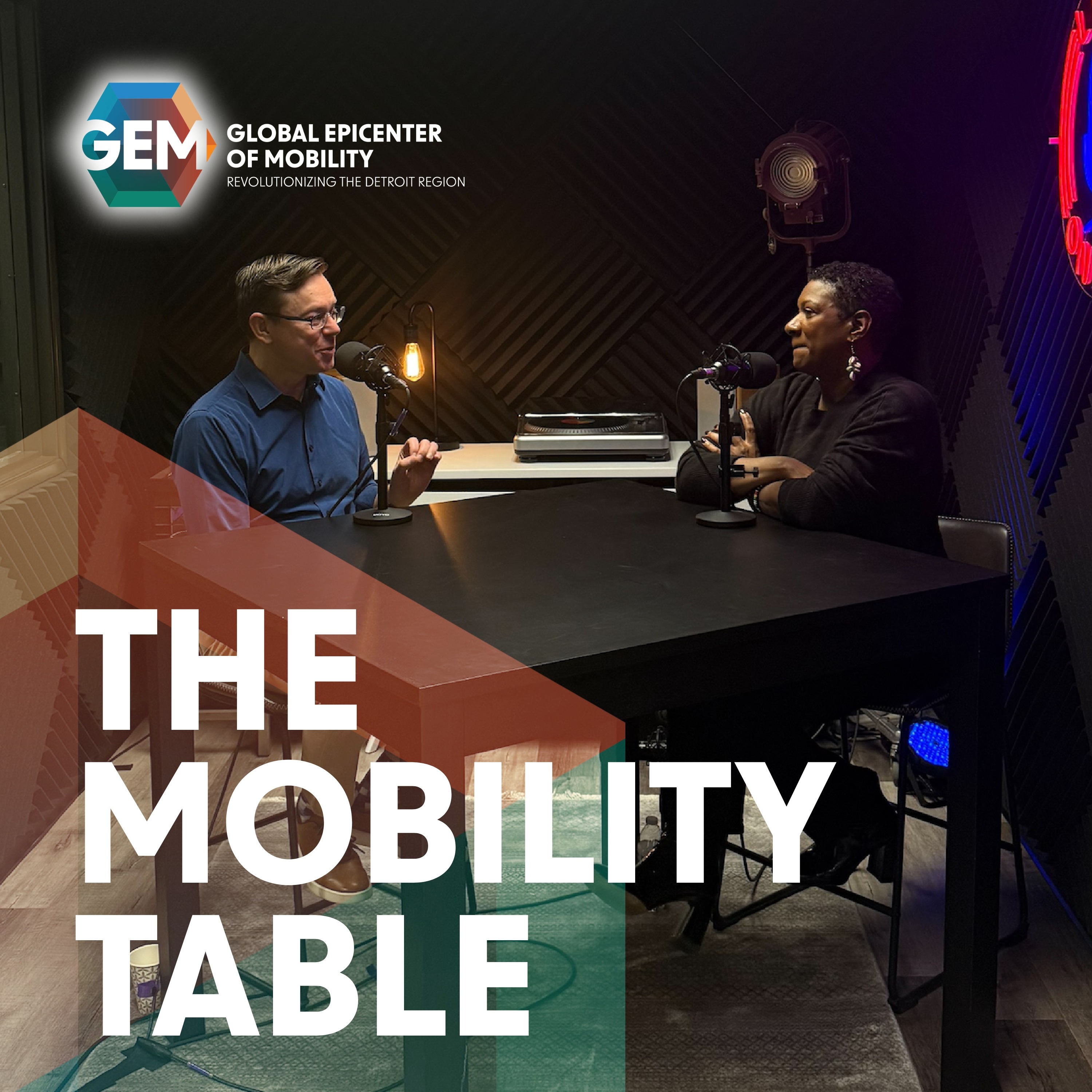
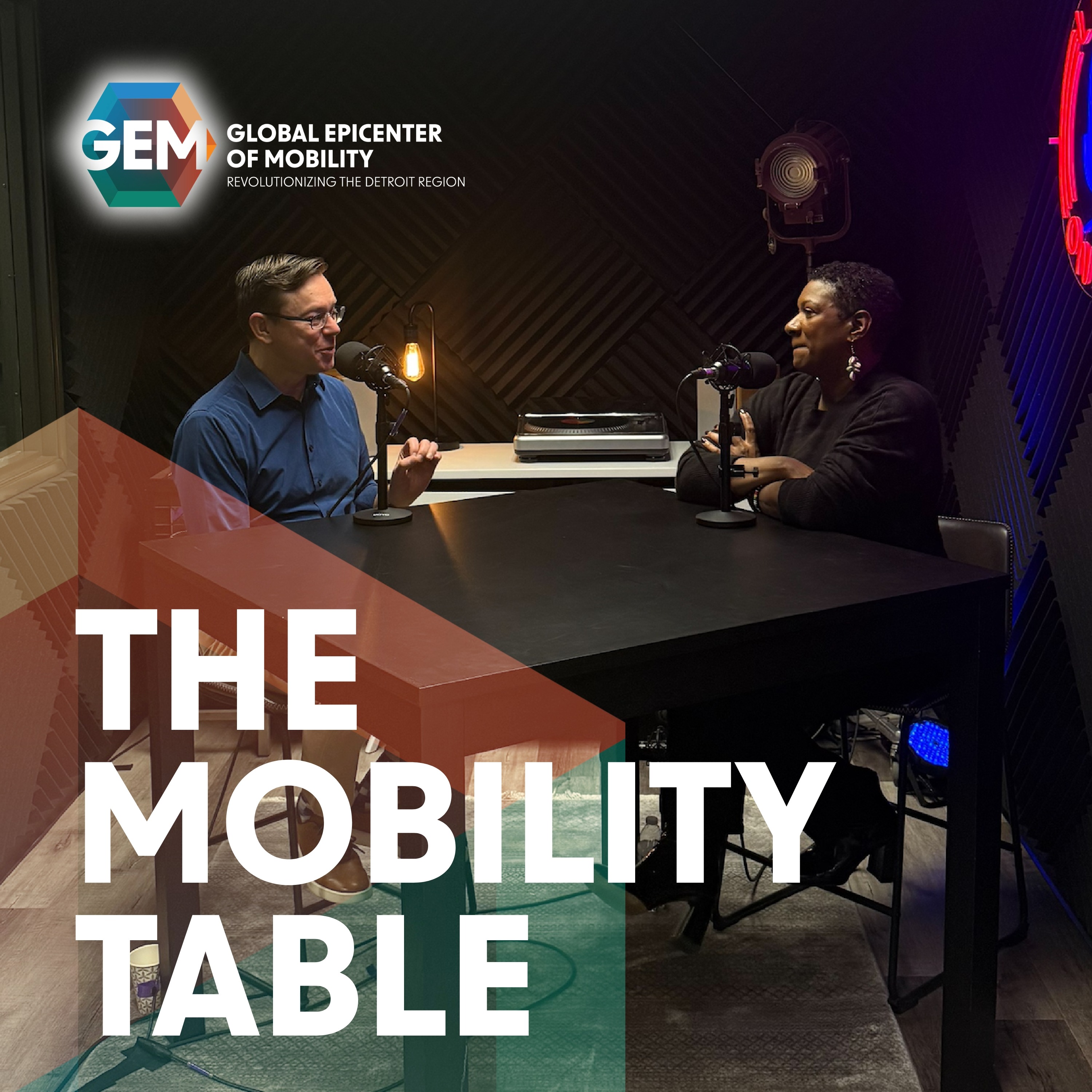
Retraining the Mobility Workforce with Vice President of Strategic Partnerships and Talent at the Detroit Regional Partnership Sarah Gregory
The Mobility Table
Retraining the Mobility Workforce with Vice President of Strategic Partnerships and Talent at the Detroit Regional Partnership Sarah GregoryThe Mobility Table · Mar 24, 2026
A “parts run” is when someone drives around to pick up or deliver car parts for a repair shop. It’s usually part of the day-to-day work that helps the mechanics get what they need.
Code 313 is a Detroit program that helps young people get interested in science and technology. The host is using it to show how early hands-on experiences can lead people toward careers like designing or working on cars.
STEAM is like STEM, but it also includes art. The idea is that creative design skills can go along with technical skills, which matters for fields like automotive design.
Drones are unmanned aircraft controlled by a person or software, often used for learning about robotics, navigation, sensors, and control systems. In the transcript, drone training is an example of hands-on tech exposure that could spark interest in automotive or design careers.
A workforce study is basically a research project to figure out what kinds of jobs people need and what skills are missing. It helps organizations plan how to hire and train people.
In the auto world, automakers build the cars, and suppliers make many of the parts and systems that go into them. When technology changes, both groups need different kinds of workers.
Electric cars run on electricity stored in a battery, not gasoline. Because of that, the jobs around making and maintaining them can be different from traditional gas cars.
Self-driving cars use cameras, sensors, and computer software to help the car drive with less human input. That means the jobs involved often require more tech and software skills.
Screens in cars are the displays for things like navigation, media, and vehicle settings. As cars rely more on software, jobs can start to look more like tech work than traditional auto work.
Self-driving vehicles are cars that can drive themselves using sensors and computers. They need lots of specialized work behind the scenes, not just the car on the road.
A livable wage is enough money to cover everyday costs like housing, food, and bills. The point here is that they want jobs that actually help families, not just any job.
Upskilling means people keep learning new skills as technology changes. In this case, it’s about staying current with newer car and mobility technologies.
A grant is money someone gives you to help pay for a project, and you usually don’t have to pay it back. Here, it’s being used to help organize training and partnerships for jobs.
Certifications are formal credentials that validate a person’s skills for a particular job or industry standard. Here, training providers help employees earn certifications so they can qualify for roles at companies in the mobility ecosystem.
An ecosystem is a network of organizations that work together—such as employers, schools, universities, and training providers—to support talent development. The speaker emphasizes building ecosystems that can adapt as new mobility-related roles and industries emerge.
McDonald’s is mentioned as a simple, well-known job example. The speaker is contrasting it with newer, less familiar career paths in the mobility space.
They’re talking about retraining workers who already have jobs. As cars and technology change, those workers need new skills so they can keep doing their work.
A career pathway is a planned way for someone to grow into better jobs over time. Instead of training only for one future role, it builds skills that can transfer.
Last-mile training is the final step of training that a specific company provides. It’s what makes sure workers can do the exact tasks needed at that workplace.
A baseline of skills means the basic abilities people should have before they get more specialized training. It helps schools and companies align what they teach with what jobs will need.
“Teachable” means someone can learn new things and pick up new instructions quickly. In auto work, that’s important because the factory and tools can change over time.
This means schools need to update what they teach so students are ready for the jobs that new technology creates. It’s about making sure training keeps up with what employers will need.
It means you can take smaller training programs that add up over time. You keep working while you earn the next “step,” and each step can help you qualify for better jobs.
An articulation agreement is a deal between schools/programs that says how one type of training can count toward a later degree. It helps students avoid repeating the same work.
EV means electric vehicle—cars that run on electricity instead of gasoline. The episode is talking about training people to fix EVs and also fix the charging equipment.
These are jobs that are similar enough that what you learned in one can help you in another. The conversation is about finding those connections so people can switch careers more easily.
Fractional workers are people who work for more than one company, usually part-time. Startups use them when they need help with specific skills but don’t want to hire someone full-time yet.
LIVE
Hey, hey, and welcome back to the Mobility Table, powered by the Global Epicenter of
Mobility. I am Janine Gantt, the Mobility Engagement Officer at GEM, and I have my amazing,
wonderful, fabulous, super smart co-host.
Bernard Swicky, VP of Mobility and Research at GEM and Janine, thank you very much for
that very gracious introduction.
Well, you know, they told us we needed to be a little bit more hyped, so I'm hyping
us up because I'm just saying, you know, our Mobility Table is a great place to come
to. This is about really ensuring that everyone has a seat at the table and letting people
know about the opportunities that are available in this new, emerging ecosystem, so it's exciting.
The topics themselves are exciting.
Yeah, and you know what? I've been thinking about, because I serve on this workforce for
the state of Michigan, this work group for the state of Michigan around workforce, and
I tell you the conversation around talent and what this industry needs in order to really
move forward has been a really big top of conversation, but it's about the people, right?
It is, it is. And you know, when we talk about GEM, I feel one thing that just says a lot
is the fact that we have six pillars, but the largest pillar with the most funding is
workforce.
Absolutely.
And I feel like nothing else we talk about happens without the people to make it happen.
That's exactly right.
And it's the one universal glue in any of the topics we cover.
Yeah. So what was your first job, Bernard?
I worked at mom and dad's repair shop in Detroit.
Oh, did you?
Yes. When I got old enough, I drove the tow truck and pulled people in.
I did a lot of parts runs, that kind of thing.
But I think number one big responsibility that comes to mind is on Saturdays when the place
was closed, washing the floors.
Oh, wow.
That that was that was a big thing.
Automotive, like some piece of automotive your whole career since childhood.
Yeah. Yeah.
But, you know, I feel like that's the case for so many kids growing up in the Detroit
region.
Yeah. Right. And then there's this question of, OK, you've got some kind of exposure,
some depth, maybe you think cars are really cool.
And then you see these really beautiful cars, you see nice skyscrapers and so on.
You know, and how do you make that journey from being a kid who likes cars to actually
getting to design them or be part of a company that brings them actually out into the world.
You know, there seems to be, I think in some cases, a bit of an insurmountable gap in between.
And it's we know it's surmountable.
We know the programs are there.
There's all kinds of assistance.
But I feel the work doesn't reach a lot of people who need to hear it.
And we're working on some solutions.
Well, and I think that's the big thing.
So my first job was McDonald's.
Like I was that typical first job, you know, wiping down counters and, you know,
dropping fries, like that was my my my first job.
And it's funny, I never ever really thought about automotive as a particular career path
for me. You know, I think my at least my career took a lot of different, you know,
steps and so forth.
But, you know, I was a follow this group in Detroit called Code 313.
They're very cool.
They are really about getting young people interested and excited about steam.
So science, technology, engineering, art and math.
So the art piece may be around some of the design.
And they're doing some cool stuff like, you know, hands on opportunities
to learn about how do you use a drone, right?
I mean, if I had had some of that exposure, maybe I would have gone more directly
into something like, you know, automotive or design or, you know,
any of those other kind of ideas and industries.
And it's funny because, you know, Detroit is has historically been the the motor city is.
And you would think most people would work in, you know, the space.
But as you said, sometimes folks just don't really know about the opportunities
and what's available to them.
And I think as we look at this kind of emerging ecosystem,
you're really starting to see some of those opportunities start to pop up a little bit
more boldly than I think they have in the past.
Yeah, you know, and I think it's also a bit of a different time in terms
of the product itself, right?
Because there was a time when cars were very exciting and sexy
and they kind of got an emotional reaction and everybody wanted to be a part
of that sort of experience of vehicle ownership and operation.
And then a few decades went by when that really wasn't the case, right?
They became more of a household appliance.
And I feel that made it that much less attractive to work in the industry that produced.
The way you say that, though, like an appliance, like it doesn't really sound super exciting.
No, but I've done many a workforce study where we would interview executives
from automakers and suppliers and they would use that word.
It was something that was kind of almost a tragic development in automotive
that, you know, certainly not those of us in the industry, but, you know,
the idea that the general public sees it that way.
But times have changed, right?
When we talk about electric cars, self-driving cars, you know, I like that.
In your example, you went to drones, so, you know, you can now branch out
into these really cool, exciting domains that are very techie, right?
And I feel like we thought, OK, the car cannot compete with the phone for attention.
But, you know, and certainly I think that's not a battle we're ever going to win.
But, you know, we can now lay claim to the cars are different.
They could drive themselves.
They have electrical power.
They have all kinds of cool things.
They have screens. Yeah, it's such wonderful.
Yeah, it's much cooler.
In fact, I hear people talk about it more as a lifestyle conversation, right?
I mean, not just in the sense of driving and the lifestyle
that's associated with driving, you know, these cool new vehicles,
but even the lifestyle of working in some of these spaces, right?
Because it is a little bit different than some of the older, traditional
kind of spaces that you might find yourself working in.
You know, as you said, it's the it's it's techie, it's hip.
It's, you know, all those kind of things.
I heard someone recently say I'm Gen X. I'll just I'm just saying I'm Gen X.
And someone said something about, you know, Gen X folks aren't hip on tech.
And I was like, what are you talking about?
Like, like I get that many kids come out the I kind of jokingly say the womb,
like with the cell phone in their hand, right?
Like technology is not is something that is so normal for them.
But Gen X, us folks that are a little bit older, we've been on the cutting edge of technology.
I mean, we've seen all these kind of the ways in which things are progressing.
And I think for us, I think there's a great deal of curiosity, right?
So I think if we think about talent needs and job opportunities,
I think that we have to make sure that we are thinking about everyone
and the potential that they can bring to this new industry.
I mean, you need those folks that have all the great experience
that they can pull out of their toolbox to be able to come and help create solutions.
You also need the folks that are a little bit more agile and they've got new ideas.
So again, I think this industry creates an opportunity for everyone.
Yeah. And there's, you know, kind of one more way in which this is a different time,
I think, which is that early on, you know, if you back up maybe a decade
or a dozen years or so when we really started getting serious about self driving vehicles
and a lot of this automated assistance technology,
the feeling was the hot companies are in California, right?
Or, you know, maybe Austin, Texas, right?
And so you had automakers opening studios there and doing that work
to a degree far away from Michigan.
And the times have really, really changed.
They have. We now, you know, you now can,
if you're a Michigan or a Detroit kid who would like to do that kind of work,
you don't have to move.
You know, we now have so much of that cool activity happening here.
And it's both in the entrepreneurial sense of new companies, startups, you name it.
But the legacy automakers and suppliers, they're doing it too.
And this is where it's happening.
And it's not, I think, you know, I believe it's probably a misconception for folks
about what it looks like to work in this kind of industry,
because there are so many different places and ways that you can find yourself
in this new advanced mobility ecosystem.
Yeah, you could be working in a manufacturing plant.
Yes, you could be in research and design, right?
Yes, you could be the innovator.
I actually heard a major supplier in the area say that perhaps our economy
and our workforce needs to be focused on founders,
like creating founders, right?
Because then those founders are going to create jobs.
So I think, again, I think there are lots of opportunity for folks.
And I know we're talking about this whole idea of workforce,
but that's going to be our conversation today with our guests, right?
But and so just just trying to kind of lay the groundwork,
you know, for that conversation and where we're going to go.
And this is not new to Michigan, frankly.
I mean, we have through our work with the with Jim
and the Build Back Better Regional Challenge Grant,
there are coalitions around the country that are trying to solve for workforce.
Yes. And we have fantastic assets in the Detroit region
that have already been here for a long time and they understand the people
and the population. So, you know, we're not starting from scratch.
As you mentioned, the idea now is just can we align it?
Can we inform it?
Can we get it pointing in the same direction?
And that's frankly kind of the gem approach is to provide that insight,
but not at the actual capacity to do it, because we know these entities have got that.
And exactly. And I think we are as a as a as a region, as a Detroit region,
as a state are definitely aware of barriers that folks have, right?
So we understand that people need the support around transportation.
They need support around child care, right?
We want to make sure that people are receiving livable wages, right?
I mean, I know as our group is really thinking about not just a job,
but a good paying job, you know, a good paying job
that is going to help to support families of four, right?
Right. We talked about this before, this idea
that the automotive industry created the middle class in Detroit.
So how do we get back to that for this region, right?
To make sure that we are creating prosperity for everyone.
And you can't do that without talent and create opportunities and education
and, you know, all that kind of stuff. So.
No, no. In fact, when we think about the increased competition,
you know, a lot of investment happening in the southern states,
you know, one of the ways in which Michigan competes
and in which the Detroit region competes is the fact that we have people
that have got a generational instinct,
knowledge and a culture of getting this done.
And I feel like that's going to be more and more of a differentiator
that we can claim that just about nowhere else on Earth can.
I agree. I agree.
So I am excited about our guests.
Do you want to do the introductions?
Yes, of course, we're pleased to bring on Sarah Gregory,
Vice President of Strategic Partnerships and Talent Solutions
at the Detroit Regional Partnership. Excellent.
Welcome back to the Mobility Table.
We're joined by Sarah Gregory of the Detroit Regional Partnership.
Sarah, welcome today.
Hey, Sarah. OK, I have to say about Sarah.
So, you know, I just started doing this work a few years ago
and Sarah, not to hype you up too much, right?
But you are just so brilliant and you were such a great resource for me
when I first was coming into this Global Epicenter Mobility work.
And I mean, you were actually one of the original authors on the grant.
So kudos to you for helping bring all this money into the Detroit region
so that we could look at how we transition from traditional automotive
to this new advanced mobility space.
So you're in talent. I am.
All things talent.
Tell us a little bit about like your role in this in this space
and how you got here. Sure. Yeah.
So my role is the Vice President of Strategic Partnerships
and Talent Solutions for the Detroit Regional Partnership.
And in that role, I'm really responsible for helping companies
who are brand new to the region to navigate our complex workforce ecosystem here.
You mentioned earlier, Bernard, we have a lot of great assets,
but navigating those assets, especially as an international firm,
can be challenging and interesting.
And there's just lots of great programs available,
but knowing how to access them all and when and why within, you know,
your timeline as a new company opening here is challenging.
And so that's what I help companies to do to navigate to the right partners
and resources for them.
So part of my role is to try and understand the broad swath
of great programs that we have and help companies get to the right ones.
So you've been doing this.
I'm sorry, Bernard, I heard you when you wanted to say something.
I'm sorry.
But, you know, you've been in this industry for a while.
So, yeah, what kind of changes have you seen
in terms of like the kind of talent that's needed
for these new advanced mobility type jobs compared to a traditional automotive?
Yeah, I mean, I think it's a lot more technical than it used to be.
You know, we're looking at, you know, it was just previously like,
we're putting things together, we're assembling things, we're producing things.
And then now there's such a more, much more technical aspect to the work.
And robots are doing some of that, you know.
So now we need to figure out how do we support the robots
in doing in doing and putting these things together.
And then also there's, as you mentioned earlier, Bernard,
there's big screens in the cars, big apps that control.
I can turn my vehicle on with an app and all of that needs to be developed.
And I think some of those things are a little bit newer.
So we're looking for more technical talent that has a little bit of a different
skill set than just, you know, putting pieces together as we did previously.
Although there is still a lot of that, too.
But we're really kind of advancing in those technical fields
and looking for really kind of specific skill sets as new technologies emerge.
And companies are bringing new and innovative solutions online
that maybe we don't, you know, there isn't a proprietary training provider for
because the company is the only one who does it that way or just invented
the way to do this. And that's happening all the time.
So we're really seeing talent that needs a new and different set of skills
and constant kind of upskilling and career pathway development.
And so you talked about helping companies navigate
that complex ecosystem of these fabulous partner organizations.
But I agree when when I came over to start my work at Gem,
it can be intimidating in terms of whom do I talk to
for what purpose and what's available from different entities.
And I'm curious, are we similarly challenged to other regions?
Or is it kind of an embarrassment of riches that we have such
a broad ecosystem that one of the outcomes of that is more complexity?
Or does it look that way this way everywhere?
I mean, it looks this way in a lot of places, I'll put it that way.
And I think that it's our responsibility in some ways as an ecosystem
to figure out how to best package these things for employers to make it easy
for them to access all of these great resources that we have.
Because the last thing that we want to do is have a bunch of great resources
that never get used or have a bunch of talent that's getting trained
that doesn't get employed.
And so we really need to make sure that we're working to create easy
on ramps for our employers and our companies to get into these
into these partnerships that are going to be impactful for them.
And so that's one thing that we're always seeking to do.
I think some regions around the country are, you know,
they're figuring it out maybe a little bit quicker than we are,
but we're right there and we have become such a more collaborative ecosystem.
So when you're talking about, you know, what's changed over time,
I think the level of partnership in our region has just come such a long way.
We're really trying to figure out how do we work together
to solve the needs for these companies so that they come here,
stay here, hire our talent, you know, help us grow as a region and as a state
so that we can all, you know, have that great economic future that we're looking for.
Well, and I think a part of when you wrote help to write this grant
for the global epicenter mobility that you all kept that in mind.
So there was a lot of intentionality about making sure that we are bringing
all the different players and partners to the table, right?
So whether you are an employer, whether you are a school system,
a university of which we have many amazing universities, your service provider,
right, providing training and things like that for for employees
to be able to get certifications and so forth.
So I think we're seeing a lot of that kind of collaboration that's been happening.
And I hope it's something that will sustain as you think about emerging
and developing ecosystems.
The idea is, I think, to do it collectively together.
So and everyone has a role to play, right?
So I think that's what's the important thing is a lot of our talent partners,
they have a specialty and they're really good at that thing.
And we need to make sure that we support them in that mission
and then provide on ramps for those people to get into these companies
that are innovating and doing really cool stuff and offering really cool
career opportunities that I had never even heard of before.
It's it's amazing, you know, like if I had it to do over, I'm like,
when I've done something different in this way, it may have been McDonald's.
Yeah, right.
Right. I mean, right.
Because there's just their cool things that are going on right now.
And the idea of breaking it down so that people understand,
I can see where there are opportunities for them to get into this.
And we're seeing high school kids, right?
We're seeing a much younger level of engagement when kids enter that ecosystem.
But of course, we've also got a retraining solution that we need as well.
Because one of the things that happens with being a community
where we've been doing this for over 100 years is you do need to modernize
people who are in the workforce currently.
Yeah. And I'm curious, Sarah, how are we handling that?
What does it look like when you're trying to hit a moving target?
Because the industry is transforming and you're training people now for a job
that may be there, you know, a period from now, right?
Depending on what that technology is.
How do you how do you accomplish that with the moving target problem?
Yeah, I mean, I will say, I think that we are the best region in the country
at helping our talent to reinvent themselves over and over.
When you think about cars, generally, like not just cars, but mobility overall.
You know, that's a that's a field that's constantly been evolving.
And so our workforce is super agile and super able to retrain upskill.
Like think about how you get a car and then three years later,
you get in your car if you have the same model and it's it's not a totally different vehicle.
But there's a lot of new features.
Well, someone had to build all that.
And so every single time our auto companies are helping their workers
to learn a new skill to apply that to whatever their next feature is.
And so I think that we are one of the best regions in the country
and having a workforce that understands that they need to constantly be, you know,
we're going to be retraining them, we're going to be upskilling.
And then I think to your point around, you know, how do we get that timing right?
That's the challenge, right?
Like how do we create this balance of of making sure that we're getting people
into the right skill sets, but not training them so specifically for a job
that maybe isn't quite there yet or is coming in five years or three years or two years.
But giving them a career pathway and a skill set that allows them to transition
and then allowing our companies to do that last kind of mile of training delivery
for their specific needs, right?
So there I think there is like a baseline of skills.
We need to understand what those skills are, help to make sure that our education partners
from all the way up from K-12 to universities are training in those skill sets
and then allow our companies to do, you know, the last cap on that and the last piece
of that final mile training so that they get those very specific skills that that company needs
because what that company needs may not be what the company down the road needs.
Yeah. And so speaking of that last cap, Sarah, you know, having done a bunch of workforce studies
for my previous employment, one thing that we heard over and over again from the companies
was basically give me people who are teach taught to be good learners, right?
Give me someone who is teachable and can adapt and absorb this new material
and then put it into practice, right?
So can we teach people to be a better learner or are you born that way?
And, you know, how do we give that company the right individual for that cap
that you mentioned of training?
Yeah, I mean, I think we can.
I think, like I said, we have that culture.
We have that retraining culture and we have this mindset of continuing to reinvent ourselves,
you know, Detroit, we're reinventing ourselves right now.
called Detroit Great Girl, right?
Like this is who we are.
Yes. And so I think that culture and that mindset and that work ethic, I mean,
that's something that our companies talk about all the time is that their workforce
has that work ethic, has that learning ability, has that agility.
And I think that, you know, that's one of our strengths.
And we talk about that with international firms that are potentially looking to Detroit.
We say, hey, our workforce is different and we can support you because we know how to do it.
So, yeah, absolutely.
You know, one of the things, so many things you said, but I'm thinking about some research
that we've done through the Global Opinion and Mobility, which is around the road to 2030
and really looking at some of these new emerging technologies.
So, so how does something go from here's this new technology?
Here's this new thing that we're going to have to build, manufacture, create,
and then get it to the built into the curriculum, right, of schools.
And so do we get to the point that it's along that continuum?
Then we get to the employer.
So how does that work?
Yeah, I mean, our our institutions are great at customizing training for employers.
I mean, they know how to do it.
We have great apprenticeship programs that are specific to the employer.
The employer says, I want this class and this class and these skills.
And we package it together and now it's an apprenticeship, right?
So you're earning and you're learning those things, you know, are great.
And there is state level support from a funding perspective
to do some of those things, which is great and unique
and something that we're really, really good at.
And I mean, I think it's a challenge, though, right?
Like the speed at which company moves isn't always an industry,
isn't always the speed at which education moves.
Because again, and to this point earlier, we also want to make sure
that we're not creating education programs that are so specific
that then they can't do anything else.
Like, right, we need to make sure that we're creating this learning culture
with a baseline of skill sets that allows them to kind of navigate
to different opportunities.
And it is a challenge to get that timing right, to get that speed right
and to help our educational institutions to do that well.
But I think our companies in this region are really working well
and sitting at advisory boards and sitting at workforce tables
and trying to share, this is the human that I'm looking for.
These are the skill sets that I need.
This is what we're going to need long term.
And we're trying to work with those companies to project that out
and then work backwards with the education institutions
to kind of fill how they're going to do that with their curriculum.
And it's a challenge we'll continue to be,
but it's something I feel like we've been doing for a while.
And I think we'll only get better at it.
So there's this term I've been hearing lately
and it's like stackable credentials.
You know, like I have in my mind what stackable credentials mean,
but in your kind of space, what does that mean?
Yeah, so short term training that allows you to move maybe one step up
in a career into a new role or maybe a higher wage, hopefully.
And then, you know, you work in that for a little while,
you can continue to put credentials on top of that and continue to level up
in your career, creating a career pathway and a career ladder for yourself
without having to necessarily completely stop working and go back to school full time,
which can be a challenge for a lot of families.
You know, not everyone can just totally stop working and go to school
to get these new skills.
And so these stackable credentials allow people to remain in the workforce
usually, but get some additional training to continue to move up that ladder
and, you know, create better economic prosperity for themselves in the meantime.
So and then, you know, just putting it on that pathway of over time,
if I keep adding in the same industry,
then I'm going to keep leveling up within my company.
So I'm curious, is this approach one of the ways
that the region can deal with the fact that many forecasts for electrification
are not happening as quickly as we thought?
And frankly, that was the case even before some of the current moves
out of Washington with executive orders and policy changes.
So I'm curious, does that give us an amount of future proofing
that that can help us navigate because, you know, we can't stop training people.
But yet you're training them for jobs that don't necessarily exist today.
Yeah. How much is that a coping strategy?
I think it is exactly that.
It's a coping strategy because it allows you to like stop at any time as well
and say, OK, well, it's not time yet to get this new skill
because that job doesn't exist yet.
So I'm going to wait and I'm going to work in this field.
And hopefully I just got a credential.
So I'm going to go a little higher wage and kind of stay here.
And then, you know, when that next role looks like it's about to come down,
then my companies and my educational institutions will start training me
in those skills and be able to continue to level up.
And so I think it is a coping strategy allows people to kind of like stop
where they're at, work for a little while,
and then we can make the next move when the timing is right.
And, you know, frankly, sorry, as you were talking, I thought about COVID, right?
And the dent that it put in sort of the desirability of a four year degree
and that it's too much money, too much debt, too much effort,
too big of a pause from your life to get that degree.
And so, frankly, you know, maybe if we can break it up into the stacked approach
that you just talked about, maybe that's one way to also reach some of those people
that are not getting that training for that reason as well.
Yeah, absolutely, absolutely.
And still putting people on a pathway to degrees, you know,
if that's the goal, that's the end goal.
How do we get them credit for prior learning?
How do we get them credit throughout all of these trackable credentials
that you could stack all the way to a bachelor's degree or something?
You know, like, like getting those articulation agreements, right?
Getting all of that together to make sure that that that flows for people
and works with their lifestyle and allows them to continue to earn
while they're while they're doing this education piece.
I think it would be, you know, like the pie in the sky.
Awesome goal of achievement.
You know, one of my favorite stories from from this work we've been doing
over the last couple years is a woman who had moved to Detroit from Chicago.
You know, we compete sometimes with Chicago, of course, you know,
we're much cooler. But anyway, and she was in hospitality
and she was working at one of the local hotels downtown
and saw some information about the EV becoming an EV repair technician
charging station repair technician, and she was able to get her certification
and we were able to then get her a job.
I guess my point is, you know, again, you don't have to have been driving
your parents truck when you were young to see your way into this industry
that you can be someone that has this these skills that can be
that you can use over in this particular area.
I don't think people realize the whole customer service, right?
Accountability, you know, those kind of basic skills that people have
that can be that can translate nicely into this new industry.
Yeah. And we've been doing some research through Gem where we're looking at adjacent
occupations. So how do I move from something like hospitality
and what stackable credentials would I need to do it?
Well, to get into this industry.
And I think the other thing that's really important, too, is when we think
about this industry as a whole, there is HR, there is legal, there is,
you know, design.
And so if you're a creative person, there's a place in mobility for you.
If you're on HR person, there's definitely a place in mobility for you.
So like whatever it is that you want to do, I think in this ecosystem here,
we have it all and there's pathways for everyone.
There's opportunities for all, no matter what your interest is
in this field somewhere.
And it may not be, you know, that you're on the line or you're in the manufacturing plant.
Like maybe that's not it, but there, but you're still part of the industry,
regardless. And of course, like the software piece of all of that as well.
Well, and not only the software piece, but, you know, I think you just hit on
something really cool because the Detroit region automotive economy has always had,
you know, that requirement for everything from legal to HR to you name it.
But the product was just one product, which was automotive.
Now we have that plus the product can be a drone.
It can be an electric boat.
It could be things that fly, float, you name it.
And so it's also more appealing because you get to work on something that, you know,
maybe was not happening in Detroit or maybe even frankly, nowhere on earth
just a decade ago.
Yeah, it's really cool stuff.
I mean, sometimes I see what our companies are working on.
I'm just like, you know, it's wild, the things that you can get into
and how interesting it is and innovative.
And I just love to see that culture of innovation really starting here.
And it definitely needs to continue.
We need to figure out how to grow it to your point earlier around founders
and entrepreneurial support and helping to create that ability within our young
people to give them, you know, you can, you can do it.
You can invent something really cool, you know, and you can do that here.
I keep telling people that, like you have an idea in your mind about how
to make something better or I wish I had, you know, you're in your vehicle or
you're wherever you're like, I wish I had X, Y, Z created.
Yeah.
Like the resources and the opportunity are here right now for you to create it.
And I know we have to wrap up, but, you know, one of the other things
I'm hearing a lot about kind of in this emerging space and especially
working with founders are fractional workers.
So people that might have a particular skill that a founder might need,
you need, they need marketing, they need sales, they need finance.
They just need these things.
They don't have full time positions available yet.
They're going to get there, but they need someone now.
So I'm seeing a lot of folks moving into that fractional working space,
which is interesting.
Or being, you know, like people who are sort of exiting the industry,
maybe at the end of their career coming back and helping to support these
founders at this startup phase to help them, you know, along that pathway,
which is one of my, like the entrepreneurs and residents and that type
of or executives and residents type of program is like those programs are so
cool to give this coaching support to, to young people and to startups and to
help them along that path.
Yeah.
And it seems like that used to happen kind of more ad hoc, more kind of on a
random basis.
And I love the fact that we now have a structure for it.
We have a way to match people up where we didn't before.
That's one of the ways we're maturing in our way to support people.
Absolutely.
So Sarah, we're wrapping up.
Yeah.
So 2030, 2030, what does Detroit look like?
Like, what does this industry look like?
What does the workforce look like?
Yeah, you know, I mean, I think our workforce continues to grow and we've
maybe figured out a little bit of this balance of how do we get people, you
know, on the pathway while those jobs are still emerging.
And I think by 2030, maybe some of them have emerged and you know, what
we're ready for it, we have, you know, we have the right pathways.
We've made it easy for companies to access that talent, to access the
training programs that they need to do their last mile of training and to
continue to hire, you know, Detroit regional residents, which is what we
really want.
That's it.
Totally.
Yeah.
Sarah, thank you so much.
Yeah, thanks for having me guys.
Yeah.
Thank you for joining us at the mobility table.
Our guest has been Sarah Gregory from the Detroit regional partnership.
We'll see you next time.
About this episode
Workforce retraining in Detroit’s advanced mobility ecosystem takes center stage with Sarah Gregory of the Detroit Regional Partnership. The discussion connects the region’s automotive heritage to today’s tech-heavy jobs in EVs, automation, software, and connected vehicles—plus the need to help employers navigate a complex web of training partners. Gregory explains how skill needs are shifting, why “last-mile” company-specific training matters, and how stackable credentials and apprenticeships can future-proof workers when timelines for electrification change. They also highlight pathways from nontraditional backgrounds and the rise of fractional talent for startups.
Sarah Gregory took a seat at The Mobility Table next to Jeannine and Bernard to discuss the Detroit region’s mobility workforce. Together they covered: adapting the region’s talent to emerging technologies and needs, the benefits of being a strong learner, stackable credentials and how the ecosystem approaches connecting employers with the talent in the Detroit region.
Sarah Gregory is the Vice President of Strategic Partnerships and Talent at the Detroit Regional Partnership. She previously served as Director of Talent Development at Workforce Intelligence Network.