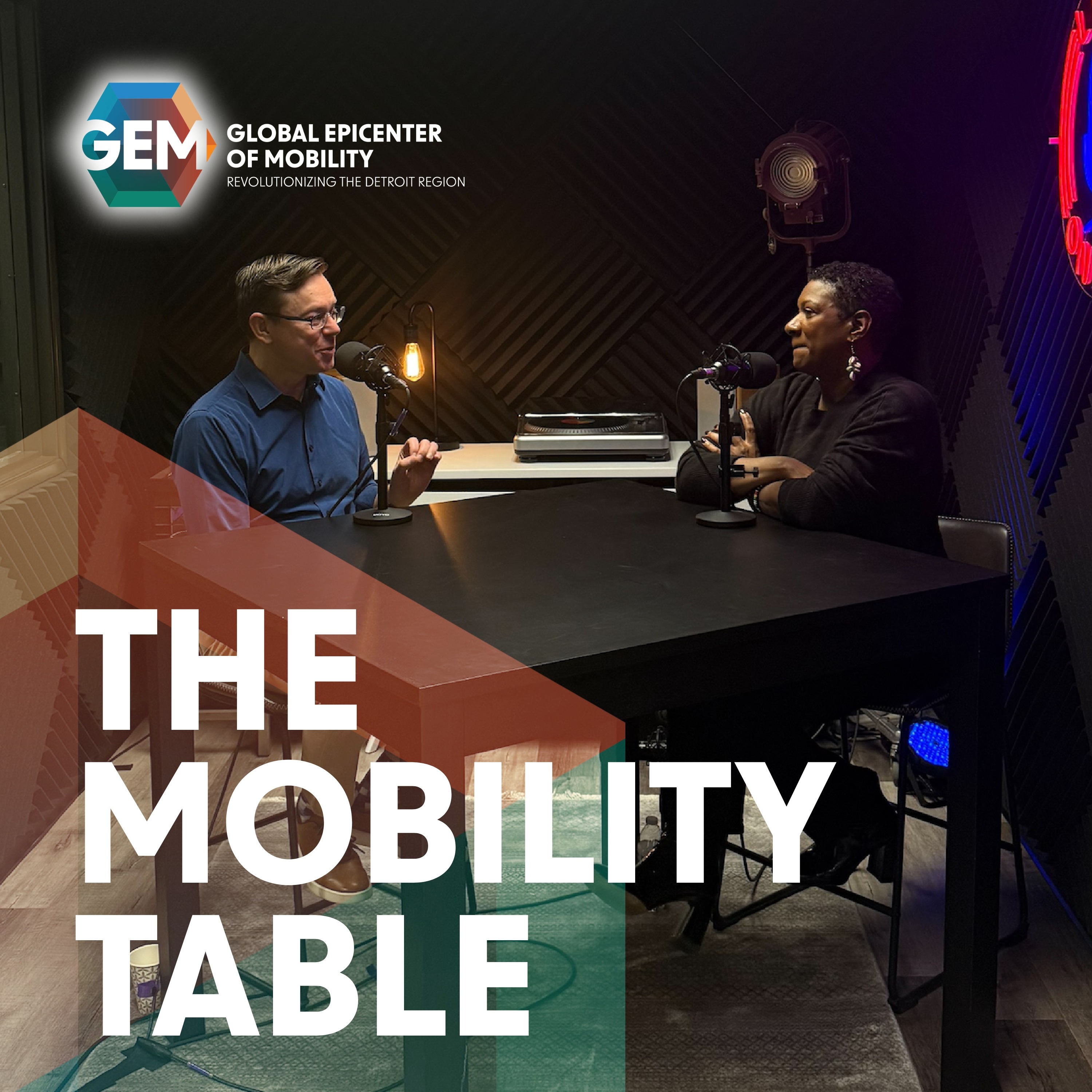
Retraining the Mobility Workforce with Vice President of Strategic Partnerships and Talent at the Detroit Regional Partnership Sarah Gregory
About this episode
Workforce retraining in Detroit’s advanced mobility ecosystem takes center stage with Sarah Gregory of the Detroit Regional Partnership. The discussion connects the region’s automotive heritage to today’s tech-heavy jobs in EVs, automation, software, and connected vehicles—plus the need to help employers navigate a complex web of training partners. Gregory explains how skill needs are shifting, why “last-mile” company-specific training matters, and how stackable credentials and apprenticeships can future-proof workers when timelines for electrification change. They also highlight pathways from nontraditional backgrounds and the rise of fractional talent for startups.
Sarah Gregory took a seat at The Mobility Table next to Jeannine and Bernard to discuss the Detroit region’s mobility workforce. Together they covered: adapting the region’s talent to emerging technologies and needs, the benefits of being a strong learner, stackable credentials and how the ecosystem approaches connecting employers with the talent in the Detroit region.
Sarah Gregory is the Vice President of Strategic Partnerships and Talent at the Detroit Regional Partnership. She previously served as Director of Talent Development at Workforce Intelligence Network.
tow truck
"I worked at mom and dad's repair shop in Detroit. ...When I got old enough, I drove the tow truck and pulled people in."
A tow truck is the vehicle that comes to pick up cars that can’t drive. It’s often used when a car breaks down or needs to be moved safely.
A tow truck is a specialized vehicle used to move disabled or improperly parked cars. In the transcript, it’s used to describe a hands-on early job in an auto repair setting, which is directly tied to vehicle recovery and roadside assistance.
parts runs
"I did a lot of parts runs, that kind of thing. But I think number one big responsibility that comes to mind is on Saturdays when the place"
A “parts run” is when someone drives around to pick up or deliver car parts for a repair shop. It’s usually part of the day-to-day work that helps the mechanics get what they need.
“Parts runs” refers to the job of transporting automotive parts between a shop, warehouse, dealerships, or customers. In many service and repair roles, this is a common entry-level task that supports the technicians doing the actual work.
Code 313
"But, you know, I was a follow this group in Detroit called Code 313. [221.6s] They're very cool."
Code 313 is a Detroit program that helps young people get interested in science and technology. The host is using it to show how early hands-on experiences can lead people toward careers like designing or working on cars.
Code 313 is a Detroit-based program focused on getting young people interested in STEM-related learning. In this segment, it’s used as an example of how early exposure can steer people toward technical careers like automotive design or engineering.
STEAM
"They are really about getting young people interested and excited about steam. [227.5s] So science, technology, engineering, art and math."
STEAM is like STEM, but it also includes art. The idea is that creative design skills can go along with technical skills, which matters for fields like automotive design.
STEAM expands STEM by adding “Art” to the mix, emphasizing that creativity and design are part of technical fields. Here it’s mentioned to connect design-oriented learning (like vehicle design) with engineering and technology pathways.
drone
"they're doing some cool stuff like, you know, hands on opportunities [238.0s] to learn about how do you use a drone, right?"
Drones are unmanned aircraft controlled by a person or software, often used for learning about robotics, navigation, sensors, and control systems. In the transcript, drone training is an example of hands-on tech exposure that could spark interest in automotive or design careers.
workforce study
"“No, but I've done many a workforce study where we would interview executives from automakers and suppliers…”"
A workforce study is basically a research project to figure out what kinds of jobs people need and what skills are missing. It helps organizations plan how to hire and train people.
A “workforce study” is research that interviews stakeholders and analyzes labor needs, often to understand what skills are required and how attractive an industry is to potential workers. In automotive, these studies can shape training programs and talent pipelines for electrification and autonomy.
automakers and suppliers
"“...we would interview executives from automakers and suppliers and they would use that word.”"
In the auto world, automakers build the cars, and suppliers make many of the parts and systems that go into them. When technology changes, both groups need different kinds of workers.
“Automakers and suppliers” refers to the two major groups in the auto industry: the companies that build vehicles and the companies that provide parts, systems, and manufacturing capabilities. Talent needs differ across them, especially as EV and self-driving technologies require new engineering and production skills.
electric cars
"“But times have changed, right? When we talk about electric cars, self-driving cars, you know, I like that.”"
Electric cars run on electricity stored in a battery, not gasoline. Because of that, the jobs around making and maintaining them can be different from traditional gas cars.
The term “electric cars” refers to vehicles powered primarily by electricity, typically using a battery and an electric motor instead of a conventional gasoline engine. In workforce and talent discussions, electrification changes what skills are needed across engineering, manufacturing, and service.
self-driving cars
"“But times have changed, right? When we talk about electric cars, self-driving cars, you know, I like that.”"
Self-driving cars use cameras, sensors, and computer software to help the car drive with less human input. That means the jobs involved often require more tech and software skills.
“Self-driving cars” describes vehicles that use sensors, software, and computing to automate driving tasks. For the mobility workforce, it shifts hiring and training toward software, AI, perception systems, and safety validation rather than only traditional vehicle mechanical skills.
screens
"“They have all kinds of cool things. They have screens. Yeah, it's such wonderful.”"
Screens in cars are the displays for things like navigation, media, and vehicle settings. As cars rely more on software, jobs can start to look more like tech work than traditional auto work.
“Screens” highlights the growing role of infotainment and driver interfaces in modern vehicles. As cars become more software-driven, the workforce increasingly needs skills in UI/UX, embedded systems, and software integration.
self driving vehicles
"Yeah. And there's, you know, kind of one more way in which this is a different time, I think, which is that early on, you know, if you back up maybe a decade or a dozen years or so when we really started getting serious about self driving vehicles and a lot of this automated assistance technology,"
Self-driving vehicles are cars that can drive themselves using sensors and computers. They need lots of specialized work behind the scenes, not just the car on the road.
“Self-driving vehicles” refers to autonomous driving systems that can perceive the environment and control the car with little or no human input. In the mobility workforce context, it drives demand for roles in software, sensors, testing, safety validation, and operations.
livable wages
"We want to make sure that people are receiving livable wages, right? I mean, I know as our group is really thinking about not just a job, but a good paying job"
A livable wage is enough money to cover everyday costs like housing, food, and bills. The point here is that they want jobs that actually help families, not just any job.
Livable wages are pay levels sufficient to cover basic living expenses, reducing financial instability for workers. The speaker ties this to workforce development goals—emphasizing not just employment, but employment that supports families.
robots
"And robots are doing some of that, you know. So now we need to figure out how do we support the robots in doing in doing and putting these things together."
They’re saying robots are doing more of the work now. People still need to support them—like keeping them running and fixing problems.
Robots in manufacturing and logistics are increasingly used for tasks like assembly, handling, and precision operations. Supporting robots typically requires skills in automation, controls, maintenance, and troubleshooting.
upskilling
"So we're really seeing talent that needs a new and different set of skills and constant kind of upskilling and career pathway development."
Upskilling means people keep learning new skills as technology changes. In this case, it’s about staying current with newer car and mobility technologies.
Upskilling is the ongoing process of training workers to handle new tools, technologies, and workflows. In mobility/automotive contexts, it often means learning software, automation support, and connected-vehicle systems alongside traditional mechanical skills.
grant
"Well, and I think a part of when you wrote help to write this grant for the global epicenter mobility that you all kept that in mind. So there was a lot of intentionality about making sure that we are bringing all the different players and partners to the table, right?"
A grant is money someone gives you to help pay for a project, and you usually don’t have to pay it back. Here, it’s being used to help organize training and partnerships for jobs.
A grant is non-repayable funding provided by a government or foundation to support a specific project or initiative. In this context, the grant is being used to coordinate mobility and workforce efforts across multiple organizations.
certifications
"a university of which we have many amazing universities, your service provider, right, providing training and things like that for for employees to be able to get certifications and so forth. So I think we're seeing a lot of that kind of collaboration that's been happening."
Certifications are formal credentials that validate a person’s skills for a particular job or industry standard. Here, training providers help employees earn certifications so they can qualify for roles at companies in the mobility ecosystem.
ecosystems
"And I hope it's something that will sustain as you think about emerging and developing ecosystems. The idea is, I think, to do it collectively together."
An ecosystem is a network of organizations that work together—such as employers, schools, universities, and training providers—to support talent development. The speaker emphasizes building ecosystems that can adapt as new mobility-related roles and industries emerge.
McDonald's
"It's it's amazing, you know, like if I had it to do over, I'm like, when I've done something different in this way, it may have been McDonald's."
McDonald’s is mentioned as a simple, well-known job example. The speaker is contrasting it with newer, less familiar career paths in the mobility space.
McDonald’s is used as a familiar example of a job the speaker might have chosen if they “had it to do over.” While not an automotive brand in this segment, it’s a recognizable reference point for how the speaker’s career awareness has expanded.
retraining solution
"But of course, we've also got a retraining solution that we need as well. Because one of the things that happens with being a community..."
They’re talking about retraining workers who already have jobs. As cars and technology change, those workers need new skills so they can keep doing their work.
The discussion is about workforce retraining—helping people already in the industry update their skills as technology and job requirements change. In automotive, this often means learning new vehicle systems, software, and tools rather than only traditional mechanical work.
moving target problem
"Yeah. And I'm curious, Sarah, how are we handling that? What does it look like when you're trying to hit a moving target?"
It means you’re trying to train people for something that keeps changing. By the time they’re ready, the job requirements might be different.
A “moving target” describes training for jobs that may change before someone finishes learning. In automotive, this is common because vehicle technology evolves quickly—so training programs must be flexible and continuously updated.
technology is constantly been evolving
"You know, that's a that's a field that's constantly been evolving. And so our workforce is super agile and super able to retrain upskill."
They’re saying vehicle technology keeps changing. That means workers have to keep learning so they can handle newer features.
This highlights the rapid pace of change in vehicle technology. For automotive workers, that evolution drives the need for continuous learning because new features can affect everything from maintenance procedures to diagnostic workflows.
career pathway
"...But giving them a career pathway and a skill set that allows them to transition..."
A career pathway is a planned way for someone to grow into better jobs over time. Instead of training only for one future role, it builds skills that can transfer.
A career pathway is a structured route that helps workers move from one role to another over time. The speaker contrasts this with training people too specifically for a job that may arrive later, emphasizing transferable skills.
last-mile training
"...allowing our companies to do that last kind of mile of training delivery for their specific needs... the last cap on that... the last piece of that final mile training..."
Last-mile training is the final step of training that a specific company provides. It’s what makes sure workers can do the exact tasks needed at that workplace.
“Last-mile training” is the final, company-specific training step that happens after broader education and baseline skills are established. In automotive workforce development, it helps ensure workers can perform the exact tasks required by a particular plant or program.
baseline of skills
"So there I think there is like a baseline of skills. We need to understand what those skills are..."
A baseline of skills means the basic abilities people should have before they get more specialized training. It helps schools and companies align what they teach with what jobs will need.
A baseline of skills is the core set of competencies that most workers need before moving into more specialized training. The speaker describes using this baseline to coordinate education partners (from K-12 through universities) with what auto companies will require.
teachability (adapt and absorb new material)
"...give me people who are teach taught to be good learners... Give me someone who is teachable and can adapt and absorb this new material and then put it into practice..."
“Teachable” means someone can learn new things and pick up new instructions quickly. In auto work, that’s important because the factory and tools can change over time.
“Teachable” and “good learners” describe a workforce competency: the ability to learn new processes quickly and apply them on the job. In automotive manufacturing, this matters because technologies and workflows change with each new vehicle feature or platform.
built into the curriculum
"So, so how does something go from here's this new technology? Here's this new thing that we're going to have to build, manufacture, create, and then get it to the built into the curriculum, right, of schools."
This means schools need to update what they teach so students are ready for the jobs that new technology creates. It’s about making sure training keeps up with what employers will need.
“Built into the curriculum” describes the process of updating school and training programs so students learn the skills needed for current and upcoming mobility technologies. It’s central to the episode’s theme: bridging technology development with education and workforce readiness.
stackable credentials
"So there's this term I've been hearing lately and it's like stackable credentials... short term training that allows you to move maybe one step up in a career into a new role or maybe a higher wage... you can continue to put credentials on top of that and continue to level up in your career"
It means you can take smaller training programs that add up over time. You keep working while you earn the next “step,” and each step can help you qualify for better jobs.
“Stackable credentials” are short-term training certifications that can be earned one after another. Each credential builds on the last, helping someone move up into a new role or higher pay without needing to pause work for full-time school.
articulation agreements
"[1651.7s] You know, like, like getting those articulation agreements, right? [1654.8s] Getting all of that together to make sure that that that flows for people [1658.6s] and works with their lifestyle and allows them to continue to earn"
An articulation agreement is a deal between schools/programs that says how one type of training can count toward a later degree. It helps students avoid repeating the same work.
Articulation agreements are formal partnerships between schools or training programs that define how one credential transfers toward another (for example, how a certificate counts toward degree requirements). They’re important for making “stacked” education pathways actually work.
EV
"and she was working at one of the local hotels downtown [1693.1s] and saw some information about the EV becoming an EV repair technician [1699.2s] charging station repair technician, and she was able to get her certification [1704.6s] and we were able to then get her a job."
EV means electric vehicle—cars that run on electricity instead of gasoline. The episode is talking about training people to fix EVs and also fix the charging equipment.
EV usually stands for “electric vehicle.” In this context, the discussion is about training people to become repair technicians for EVs and related charging infrastructure.
charging station repair technician
"and she was working at one of the local hotels downtown [1693.1s] and saw some information about the EV becoming an EV repair technician [1699.2s] charging station repair technician, and she was able to get her certification [1704.6s] and we were able to then get her a job."
This is the person who fixes and maintains the EV charging machines. They make sure the chargers work safely and reliably.
A charging station repair technician maintains and repairs EV charging equipment, which can include troubleshooting electrical faults, replacing components, and ensuring safe operation. This is a distinct job from EV vehicle repair, though the skills overlap.
adjacent occupations
"Yeah. And we've been doing some research through Gem where we're looking at adjacent occupations. So how do I move from something like hospitality and what stackable credentials would I need to do it?"
These are jobs that are similar enough that what you learned in one can help you in another. The conversation is about finding those connections so people can switch careers more easily.
“Adjacent occupations” are jobs that are related enough that skills can transfer between them. The segment uses this to explain career pathways—how experience from one sector can map to roles in mobility.
fractional workers
"...one of the other things I'm hearing a lot about kind of in this emerging space and especially working with founders are fractional workers."
Fractional workers are people who work for more than one company, usually part-time. Startups use them when they need help with specific skills but don’t want to hire someone full-time yet.
“Fractional workers” are professionals who work part-time for multiple organizations instead of being full-time employees at one company. In emerging tech and startup ecosystems, they’re often used to fill specialized roles quickly without long-term hiring commitments.
Request an Explanation
Heard something you'd like explained? We'll add it to this episode.
Sign in to request explanations for terms you heard.
Want to learn more?
Browse our glossary for plain-English explanations of automotive terms, jargon, and concepts.
Help improve this episode
See something that's not quite right? Our annotations are AI-generated and can sometimes miss the mark. Click the flag icon on any annotation to suggest a correction.