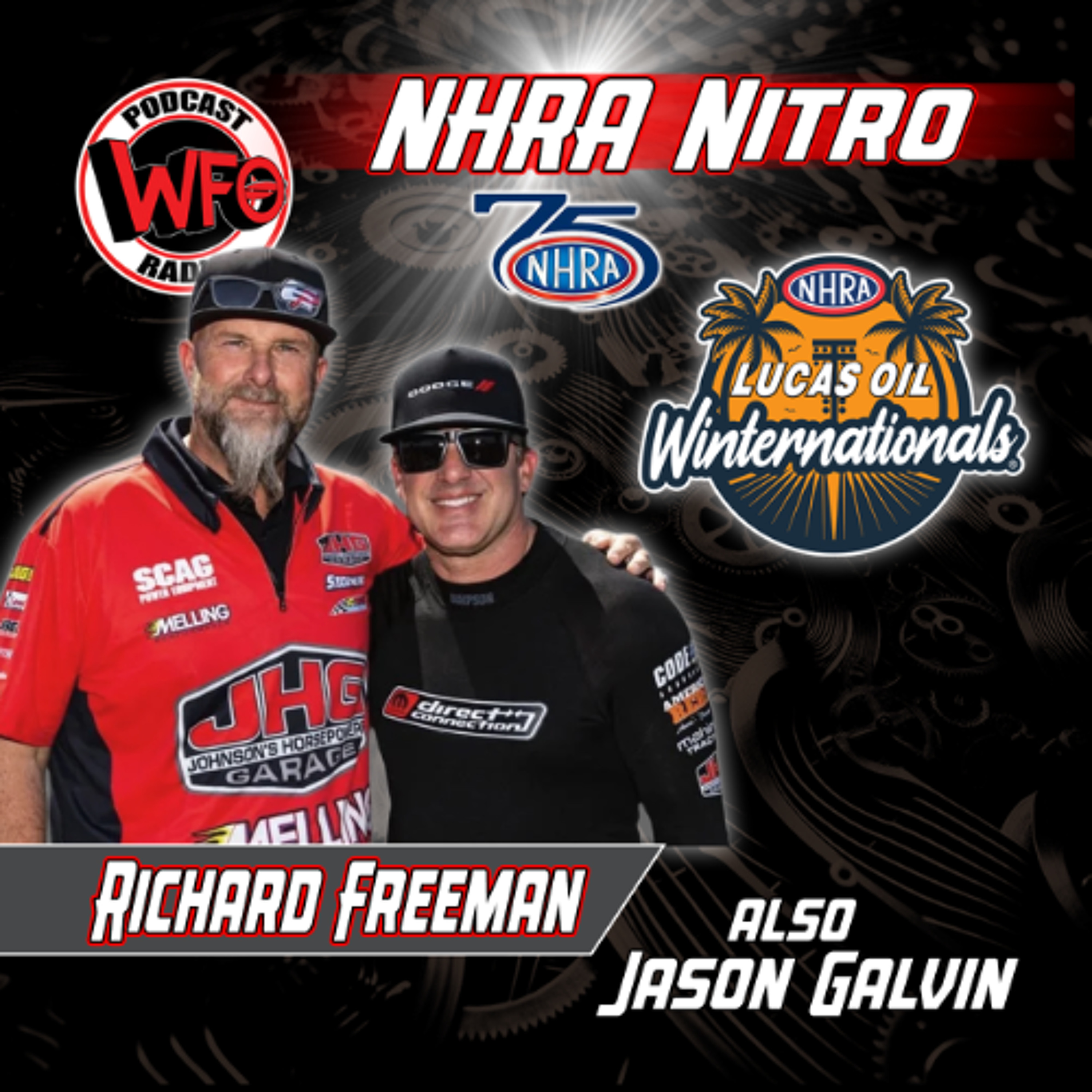
Richard Freeman joins WFO Radio after first Elite Motorsports Top Fuel win, plus Jason Galvin
About this episode
WFO Radio recaps the Lucas Oil Winter Nationals with a big focus on Elite Motorsports’ first Top Fuel win. Richard Freeman celebrates the surreal milestone, crediting the right people, key partners, and Tony Stewart’s final-round performance, while also touching on pro stock struggles and what’s coming next—especially the 2027 rule changes (hood scoops/throttle-body setup) and how they could broaden body styles. Jason Galvin adds race-call perspective, highlights Justin Ashley’s consistency, Matt Hagen’s funny car milestone, and pro stock’s Greg Anderson vs Dallas Glenn storyline, plus standout Super Gas and nostalgia/grassroots winners.
diesel particulate filter
"Looking to replace your OEM diesel particulate filter or diesel oxidation catalyst?"
A diesel particulate filter catches the smoky soot from a diesel’s exhaust. If it gets clogged, the truck can run worse and may trigger emissions problems.
A diesel particulate filter (DPF) traps soot (particulate matter) from a diesel engine’s exhaust. Over time it can clog, and many owners replace it or have it serviced to restore exhaust flow and emissions compliance.
diesel oxidation catalyst
"Looking to replace your OEM diesel particulate filter or diesel oxidation catalyst?"
A diesel oxidation catalyst is an emissions device that helps clean up exhaust gases. It works alongside other parts like the DPF to reduce pollution.
A diesel oxidation catalyst (DOC) helps convert certain exhaust gases into less harmful compounds and supports soot control systems. It’s often paired with a DPF in modern diesel emissions setups.
DPFXfit
"Look no further than DPFXfit, a complete line of aftermarket diesel particulate filters and diesel oxidation catalysts designed as an exact fit OEM replacement..."
DPFXfit sells replacement emissions parts for diesel trucks. They make parts that are meant to fit like the original equipment (OEM) parts, so you can swap them without guessing.
DPFXfit is an aftermarket supplier focused on diesel particulate filters (DPFs) and diesel oxidation catalysts (DOCs). They position their products as exact-fit replacements for OEM parts and emphasize fast shipping and an OEM reverse-lookup tool.
OEM replacement
"...designed as an exact fit OEM replacement with all makes coverage for light, medium and heavy duty trucks."
OEM replacement means the aftermarket part is made to work like the original factory part. That’s important for emissions parts so everything fits correctly and does its job.
“OEM replacement” means the aftermarket part is designed to match the original equipment part’s fitment and function. For emissions components like DPFs and DOCs, exact-fit design matters because incorrect fitment can cause leaks, poor performance, or check-engine/emissions issues.
FTI
"For more than a decade, FTI has strived to become the leader in the aftermarket, performance, transmission and converter industry."
FTI is a company that makes aftermarket performance drivetrain parts, especially related to transmissions and torque converters. They’re partnering with another driveline company to grow their reach.
FTI is described as a long-running aftermarket performance company in the transmission and converter space. In this segment, it’s also presented as joining forces with McLeod driveline components to expand distribution and resources.
McLeod driveline components
"We've joined forces with McLeod driveline components under the leadership of top fuel funny car pilot Paul Lee..."
McLeod driveline components is a performance-parts company. The hosts mention it because it’s partnering with FTI, which helps them support racers with drivetrain parts.
McLeod driveline components is referenced as a partner to FTI, implying collaboration on performance drivetrain technology and supply chain. In drag racing contexts, “driveline components” often includes parts like clutches, transmissions, and related hardware.
top fuel funny car pilot
"...under the leadership of top fuel funny car pilot Paul Lee and now have a larger distribution network..."
In Top Fuel Funny Car racing, the pilot is the driver. They’re responsible for how the car is launched and tuned for each run, which is a huge part of winning.
A “top fuel funny car pilot” refers to the driver competing in Top Fuel Funny Car, a class of drag racing with highly specialized engines and fuel systems. The pilot’s role is central because setup, tuning, and launch strategy directly affect performance and safety.
Lucas Oil Winter Nationals
"WFO Radio is back following the 66th Lucas Oil Winter Nationals."
The Lucas Oil Winter Nationals is a drag racing event. The hosts are talking about what happened there and what it means for the season.
The Lucas Oil Winter Nationals is the event the hosts reference as the backdrop for the episode’s recap. It’s a NHRA stop where teams compete across multiple drag racing classes.
super gas final
"What an amazing weekend. Perfect run in the super gas final."
Super Gas is one of the drag racing categories. The final is the last round where the winner is determined.
“Super Gas” is a drag racing class, and the “final” is the last race of the bracket where the winner is decided. The hosts highlight a “perfect run” in the Super Gas final, which implies top performance across the run.
trip zero, dead zero
"Guys, Mike Wibbler-Schauzer, trip zero, dead zero. Perfect run in super gas."
These terms are about how perfectly the car performed on the timing system. The hosts are saying the run was extremely consistent—basically “spot on.”
“Trip zero” and “dead zero” are drag-racing timing/consistency references, commonly used to indicate the car was extremely consistent and matched the expected timing markers. The phrase suggests the run was so dialed-in that there were effectively no timing deviations.
Elite Motorsports top fuel win
"...Richard Freeman going to talk about elite motorsports first top fuel win. Jason Galvin going to join us to recap the event."
This segment centers on Richard Freeman joining WFO Radio after an Elite Motorsports Top Fuel win. It’s a key narrative hook for the episode, setting up a recap of the competitive weekend.
R&L carriers
"These are my sponsors, just like Richard's got R&L carriers on board. Larisse Motorsports Insurance,"
R&L Carriers is a shipping company. They sponsor racing teams to help pay for the expensive stuff like hauling cars and supporting the team.
R&L Carriers is a logistics and shipping company that sponsors motorsports teams. In drag racing, sponsors like this help fund travel, parts, and team operations.
Total seal piston rings
"You might as well cover it, right? Total seal piston rings, the leader in ring seal technology,"
Total Seal is known for performance piston rings designed to improve ring seal and reduce blow-by. In drag racing, better sealing can help cylinder pressure and consistency under hard acceleration.
ring seal technology
"Total seal piston rings, the leader in ring seal technology, FTI performance."
Piston rings need to seal tightly so the engine doesn’t “leak” power. Ring seal technology is about making that seal better so the engine stays efficient and consistent.
Ring seal technology refers to how piston rings maintain a tight seal between the piston and cylinder wall. Strong ring seal reduces combustion gases leaking past the rings (blow-by), which can improve power and durability in high-stress engines like Top Fuel.
Jesse converters
"FTI performance. You heard about them and Jesse converters, the folks at Redline Oil were on with us."
A converter helps an automatic transmission launch the car by multiplying torque. In drag racing, the right converter can make the car leave the line harder and more consistently.
“Converters” in drag racing usually refers to torque converters used in automatic transmissions to multiply torque and manage launch characteristics. The specific brand “Jesse converters” suggests a specialty converter supplier used to optimize acceleration and consistency.
Redline Oil
"Jesse converters, the folks at Redline Oil were on with us. HusseyPerformance.net,"
Redline Oil is a performance-focused lubricant brand. In racing, oil choice matters for heat control, friction reduction, and protecting components during repeated high-load runs.
Quality Copper Gaskets
"HusseyPerformance.net, Quality Copper Gaskets, Composite Gaskets, Frank Holley's Drag Racing School,"
Copper gaskets are commonly used in high-heat, high-pressure engines because copper can handle thermal stress and maintain sealing. In drag racing, gasket choice is critical for preventing leaks that can ruin cylinder pressure and reliability.
HusseyPerformance.net
"the folks at Redline Oil were on with us. HusseyPerformance.net, Quality Copper Gaskets, Composite Gaskets,"
HusseyPerformance.net is a racing-related business that supports teams. They likely provide parts or services used to keep race cars competitive.
HusseyPerformance.net appears to be a performance parts or services website supporting motorsports teams. Mentions like this typically indicate sponsorship or supply of specialized racing components.
Composite Gaskets
"Quality Copper Gaskets, Composite Gaskets, Frank Holley's Drag Racing School,"
Composite gaskets are made from layered materials that help seal the engine. They’re used to stop leaks, especially when the engine is under heavy racing stress.
Composite gaskets are made from layered materials designed to seal across engine surfaces while managing heat and pressure. Compared with metal-only gaskets, composites can offer good sealing behavior and compliance for certain applications.
Frank Holley's Drag Racing School
"Composite Gaskets, Frank Holley's Drag Racing School, Josh Hart and Bernie's Speed Shop,"
Frank Holley’s Drag Racing School is an educational program focused on teaching drag racing skills and technical understanding. In motorsports, training can cover setup, driving technique, and safety fundamentals.
Foggett
"Josh Hart and Bernie's Speed Shop, Gary Stinnett and Foggett. I know I know Richard knows about Foggett."
Foggett is someone in the racing world the host knows. They’re mentioned as part of the people supporting the sport.
Foggett is referenced as a person or brand associated with drag racing support. Without more context in the excerpt, it’s best understood as part of the motorsports community the hosts recognize.
final round
"I had such a great time just being in that atmosphere and to see you guys go get your first win. Smoke and Justin in the final round."
In drag racing, the “final round” is the last head-to-head race of an event’s elimination bracket. Winning the final round is what earns the event win, making it a key milestone for teams and drivers.
John Force Racing
"she said, you know, she's been at NHRA and she's been at John Force Racing and she said, you know, there's something going on here"
John Force Racing is a major drag racing team. It’s associated with some of the most famous names in NHRA history.
John Force Racing is a well-known NHRA drag racing team founded and led by John Force. The team has historically competed at the highest levels, especially in Funny Car.
Pro Stock
"we got one side that wins a race, three races in, and we got another side that for the last year and a half, since the end of 24, our pro stock program has faltered."
Pro Stock is a drag racing class where cars are based on production models, but they’re heavily modified for racing. Teams tune them to be consistent and fast.
Pro Stock is an NHRA class for highly prepared, factory-based cars that compete in drag racing using strict rules about engines, weight, and body configuration. Teams often talk about “program” performance because results depend on car setup, tuning, and consistency.
fuel car
"My wants and hopes are to be able to have that fuel car and a pro stock car, our program in the finals, like we did with Matt and Tony."
“Fuel car” here means the nitro-fueled Top Fuel drag racing car. The speaker is talking about wanting that team to reach the finals like their other cars.
In this context, “fuel car” refers to a Top Fuel dragster (nitro-fueled) program. Teams often compare their Top Fuel and Pro Stock efforts because each class has different car designs, tuning priorities, and development timelines.
rules for 27
"I want to hear your thoughts on the rules for 27. And I heard Greg talking about him in the in the winner circle. And Greg sounds like he's on board."
They’re talking about the rule changes coming for the 2027 season. Those rules can change what cars can run and how teams have to build and tune them.
“Rules for 27” refers to the NHRA rule changes planned for the 2027 season. In drag racing, rule updates can affect car eligibility, setup strategies, and how teams develop their programs.
winner circle
"I want to hear your thoughts on the rules for 27. And I heard Greg talking about him in the in the winner circle."
The winner circle is where race winners go right after the run to celebrate and talk to people. It’s a common part of drag racing coverage.
The “winner circle” is the ceremonial area where winners are interviewed and celebrated after a race. In drag racing broadcasts, it’s also where drivers often discuss performance and strategy.
pro mod
"Brendan Patina says, is is Erica going to continue to continue to run pro mod and pro stock at similar events? Is that ever going to happen?"
Pro Mod is another drag racing class, usually with more freedom to modify the cars than some other classes. It’s still very rule-based, but teams can build cars in more extreme ways.
Pro Mod (short for Pro Modified) is a drag racing class known for cars that are more heavily altered than Pro Stock, with different rules governing engine placement, body style, and allowed modifications. It’s common for drivers to run Pro Mod at events that also feature other categories.
Phoenix
"Oh, yeah, I think I think there's plenty of opportunity for that. We've got a car. You know, we run Phoenix. The problem"
They’re saying their team races at Phoenix. Different tracks can behave differently, so teams often adjust their setup for each event.
“We run Phoenix” indicates the team competes at a drag racing event in Phoenix, typically referring to an NHRA stop at the Phoenix-area track. Location matters because track surface and conditions can change how cars are tuned.
winner nationals
"We run it up a year ago and he wins the winner nationals his premier NHRA win. Now the winners is a big deal."
“Winner Nationals” refers to the NHRA event being discussed, where the winner takes a major class title/round of eliminations. In Top Fuel, winning the event is a big milestone because it reflects performance across multiple rounds, not just one run.
Top Fuel final
"Let's check out Brian Lone's Tony Pedragon on the ball. They leave the top fuel final of the winner nationals. Header flames up."
The Top Fuel final is the last race of the weekend for that class. It’s the winner-take-all run after everyone has advanced through earlier rounds.
The Top Fuel final is the last head-to-head race of the event in that class. Winning the final is what earns the event win, and it typically comes after multiple elimination rounds where reaction time and consistency matter.
header flames
"They leave the top fuel final of the winner nationals. Header flames up. It's going to be Tony Stewart."
“Header flames” is the big flame you see coming out during a nitro dragster run. It’s a sign the engine is burning hard, especially under full power.
“Header flames” refers to the visible flame/exhaust effect from the nitro engine during a Top Fuel pass. It’s a dramatic indicator of combustion and how the engine is performing under load, though it’s not a direct measurement of speed by itself.
reaction time
"But you did a heck of a job driving this car for the first one to elite another 40 reaction time."
Reaction time is how fast the driver reacts when the starting light comes on. In drag racing, being quicker by a fraction of a second can be the difference between winning and losing.
Reaction time is how quickly a driver responds to the start light after it turns on. In drag racing, even tiny differences can decide a race because both cars are accelerating at the same time once they launch.
consistency
"Justin Ashley is, as we all know, the best lever in the class, his consistency. It's almost unbelievable."
Consistency means the car and driver can repeat good runs again and again. In drag racing, that reliability often beats a one-time great run.
In Top Fuel, consistency refers to how reliably the car performs—especially launch, acceleration, and staying on track through the run. The speaker highlights Justin Ashley’s consistency as a key competitive advantage, even when opponents also run well.
scag
"you know, great team over there on the on the scag side, you know, we we've had involvement with Randy and the guy and Maria and all the group over there at scag."
Scag is mentioned as part of the team’s sponsor group. In racing, sponsors help support the team and show up in the way the team is organized and branded.
Scag is referenced here as a sponsor/partner on the team side (“on the scag side”). In drag racing, sponsor involvement often ties into team resources, branding, and sometimes the support network around the car and crew.
Colletta Motorsports
"It's kind of interesting. Colletta Motorsports one and two last year, Sean Langdon, Brian Hughes and won the most recent race. They I was kind of, you know, wondering like, all right, this is a brand new team."
Colletta Motorsports is another Top Fuel team being compared in terms of past performance. The host is basically asking whether they’ll keep winning now that the situation has changed.
Colletta Motorsports is discussed as a team that previously placed one-two and has strong recent results. The speaker is analyzing whether it will translate into continued dominance, especially given roster/talent movement.
semifinals
"We're going to see a lot of these things in the in the finals. And hopefully we have have Justin in there as well and, you know, and give them their time as well. But Sunday was was all Tony Stewart... And you guys both stepped up in the semifinals took out"
Semifinals are the race right before the final. If you win the semis, you’re one step away from taking the event.
Semifinals are the round before the final, where only a few teams/drivers remain. Winning the semis is crucial because it sets up lane choice, momentum, and the ability to carry forward effective tuning into the final run.
pilot that car
"...trying to do something that he loves to do. And it's, I'm glad to get to see that Randy and then give him an opportunity to pilot that car."
“Pilot that car” just means the driver is the one controlling it during the race. How they launch and manage the car can affect how well it runs.
“Pilot that car” refers to the driver controlling the dragster through the run, including launch technique and how the car is managed under power. In Top Fuel, driver inputs and timing can strongly influence consistency and performance.
spun the tire
"I was kind of shocked that they didn't, that car wasn't, didn't get out against us. I was, I don't know exactly what happened if it spun the tire..."
“Spun the tire” means the tires didn’t grip the track and started slipping. When that happens, the car can’t accelerate as well and the run usually suffers.
“Spun the tire” describes wheelspin during launch, where the tires lose traction instead of gripping and transferring power effectively. In Top Fuel, this can dramatically hurt elapsed time and may also indicate a setup mismatch for track conditions.
dropped a hole
"...if it spun the tire, dropped a hole or whatever."
“Dropped a hole” means the car fell behind right at the start. If you lose ground early in a drag race, it’s tough to catch up later.
“Dropped a hole” is drag-racing slang for falling behind early in the run, often due to a poor launch, traction issues, or a momentary loss of momentum. In elimination rounds, even a small early deficit can be hard to overcome.
tunes that car
"And usually on a, on a tight racetrack, the guy that tunes that car is really hard to beat. So whatever happened there..."
“Tuning” means the crew makes adjustments so the car performs best for that track and day. It can change how hard it launches and how smoothly it runs.
In Top Fuel, “tuning” refers to adjusting the car’s setup and engine calibration to match track conditions and maximize performance. Small changes can affect traction (how well the tires grip), acceleration, and how consistently the car runs from pass to pass.
tight racetrack
"And usually on a, on a tight racetrack, the guy that tunes that car is really hard to beat. So whatever happened there..."
A “tight” track generally means conditions that make it harder for the car to hook up and run its best. The team may have to adjust the setup to keep the car from slipping or behaving unpredictably.
A “tight” racetrack in drag racing context usually means the facility has less favorable geometry or constraints that can make traction and setup more challenging. Teams may need different tuning choices to manage wheel speed, tire growth, and stability under acceleration.
fielded this year
"...If R and L carrier carriers doesn't come on board, that car doesn't, doesn't get fielded this year..."
“Fielded” in motorsports means entering and running a car/team in a specific season or event. When a sponsor or partner doesn’t come on board, teams may not have the budget or resources to compete that year.
R and L carrier carriers
"...If R and L carrier carriers doesn't come on board, that car doesn't, doesn't get fielded this year..."
R and L Carriers is a shipping company mentioned as a partner. In racing, partners like this often provide money or support that helps a team compete.
R and L Carriers is a logistics and shipping company that appears here as a potential sponsor/partner. In drag racing, sponsorship can directly determine whether a team can afford to build, transport, and run a car for a season.
partnership between our two programs
"...that brings up a really good point to do what we're doing with, with the partnership between our two programs..."
They’re talking about two racing teams working together. When teams share resources and coordinate, it can make the car development and race operations smoother.
The hosts describe a collaboration between two racing programs, with shared personnel and a coordinated transition. In motorsports, program partnerships can improve development by combining resources, data, and operational know-how across classes.
starting line
"...as you can see on the starting line, seven, there were seven teams on the starting line when Tony won that race."
In drag racing, the starting line is where the cars line up and get ready to launch. How many teams are there shows how many competitors are in the event.
The starting line in drag racing is where cars stage and begin the run, and it’s where matchups are determined. The number of teams on the starting line reflects field size and competitiveness for that event.
valetrain
"You know, there's, there's it's, it's valetrain stuff. You know, I don't want to get into it a lot."
The valvetrain is the part of the engine that opens and closes the valves. In racing, it has to work perfectly at very high engine speeds, so teams tune it for both power and reliability.
The valvetrain is the engine’s valve system—components like valves, springs, lifters, and camshafts that control airflow. In drag racing classes like Pro Stock, teams spend a lot of time optimizing valvetrain durability and timing because small changes can affect power and consistency.
hood scoops
"...but I really want to talk about next year hood scoops. Heard you with Brian loans a couple of weeks ago talking about 20, 27 rules."
Hood scoops are openings on the hood that help bring air into the engine area. In racing, the rules can require or limit them, which changes how teams set up the car.
Hood scoops are intake-related openings on the hood that help manage airflow into the engine bay and, depending on the rules, can influence how air reaches the intake system. In Pro Stock, rule changes around hood scoops can effectively change how teams design their intake and engine breathing.
rules reset (like Formula 1)
"If you follow formula one, they change the rules every five years. They shake it up every five years or so to reset things."
Racing rules get changed on purpose. When they do, teams have to redesign parts and strategies, so the competition doesn’t get stuck with the same winning approach forever.
The idea is that racing series periodically change regulations to “reset” competitive advantages and force teams to adapt. The comparison to Formula 1 highlights how rule cycles can shift engineering priorities and make older solutions less effective.
throttle bodies
"And what I can tell you as far as tune ability, putting two throttle bodies on top, instead of that front air albatross ship we have now, it just cleans it up."
A throttle body is basically the engine’s “air gate.” It controls how much air can get in, and in racing you can change how it’s set up to make the car run better.
A throttle body is the air-control component that meters how much air the engine can ingest. In drag racing, using multiple throttle bodies (or relocating them) can improve airflow packaging and tuning flexibility for different engine setups.
tune ability
"And what I can tell you as far as tune ability, putting two throttle bodies on top, instead of that front air albatross ship we have now, it just cleans it up."
“Tune ability” means how easy it is to adjust the car so it runs its best. If the setup is easier to tune, teams can get more performance without as much trial-and-error.
“Tune ability” refers to how easily a setup can be adjusted to optimize performance. In racing, better tune ability often means more effective calibration of airflow and engine response as conditions or rules change.
manifold bottoms
"Again, I'm not sure that NHRA has done this in the past, but I want you to think about, we don't have to use one person's throttle body. You can run a Holley, you can run a Wilson manifold, you can run a whatever. There's several people that build throttle bodies... So if you got throttle bodies on top, all you got to work on now is the bottom."
The manifold is part of the engine that routes air to the cylinders. “Bottoms” means the lower part of that system, and changing just that section can be cheaper and easier than replacing everything.
“Manifold bottoms” refers to the lower sections of an intake/manifold assembly used to distribute air to the engine. Splitting the manifold into sections can make it easier to develop, tune, and swap components without replacing the entire assembly.
modular rules (one-piece vs multi-piece development)
"So if you got throttle bodies on top, all you got to work on now is the bottom. So it doesn't take a rocket science to figure out that that overtime is way cheaper than, one piece is way cheaper than three pieces."
They’re saying the rules and design are set up so teams can change or improve only part of the system. That’s cheaper than having to replace or redesign the whole thing at once.
The speaker argues that splitting the system into multiple components (e.g., working on “the bottom” separately from the top throttle body setup) reduces development and replacement cost. Modular approaches let teams iterate on specific sections instead of redesigning or buying a complete one-piece assembly.
Wilson manifold
"You can run a Holley, you can run a Wilson manifold... I like that you Keith Wilson is a friend. He's made a great throttle body for a lot of time."
Wilson is a racing parts maker that builds intake/manifold-related hardware. The discussion is about giving teams more choices for the parts they run.
Wilson (Keith Wilson) is referenced as a throttle body/manifold builder in drag racing. The speaker highlights that teams can use Wilson hardware, and that allowing multiple builders supports innovation and competition.
aftermarket sport (rules allowing multiple suppliers)
"I think that kind of sets the tone for us as a sport. You know, I think NHRA and everybody's kind of, this is aftermarket sport. And so maybe embracing that a little bit."
The speaker frames NHRA as an “aftermarket sport,” meaning the rules allow teams to use parts from different manufacturers. This can lower costs and encourage development because teams aren’t limited to one supplier’s design.

Chevrolet Camaro
"So we're not trying to sell a Camaro on Monday because they don't make a Camaro, right? ... you can take an engine right out of one of our cars manifold and all and just go from a Camaro to another Camaro. Okay, just move it over. And it's not the same. It doesn't tune the same."
They’re talking about the Chevrolet Camaro as a race car shape used in pro stock. Even if you move the same engine parts to another car, the airflow and fitment can be different, so it won’t behave exactly the same.
The Chevrolet Camaro is being discussed as a body style used in pro stock drag racing. The host explains that even if you swap the same engine components between cars, the car’s specific packaging and airflow path can change how the engine performs.
tuning
"Okay, just move it over. And it's not the same. It doesn't tune the same. ... and you'll spend all day trying to get it right and never get it just right."
Tuning is adjusting the engine settings so it runs the way you want for that exact car and setup. If the airflow or intake layout changes, the engine may need different settings to make the same power.
In drag racing, “tuning” means calibrating the engine and fuel/air delivery so it performs correctly under the specific airflow and load conditions of a given car setup. The speaker emphasizes that even with the same engine parts, different body styles change how air enters the front end and how the intake system sits, which forces new tuning.
throttle body
"But you take that same motor and same manifold and same throttle body and put it in the Mustang and you'll spend all day trying to get it right and never get it just right."
The throttle body is the air-control valve at the front of the intake. In racing, the exact way air flows into it matters, so when you change cars (like Camaro to Mustang), you often can’t just bolt everything on and expect the same results.
The throttle body controls how much air enters the intake system by regulating the throttle plate opening. In pro stock, throttle body setup and how it mates to the rest of the intake/airflow path can affect response and tuning requirements when moving between different car bodies.

Mustang
"Now, you can get way closer going from a Camaro to a Camaro, right? But you take that same motor and same manifold and same throttle body and put it in the Mustang and you'll spend all day trying to get it right and never get it just right."
They’re comparing the Ford Mustang to the Camaro in pro stock racing. Even with the same engine parts, the Mustang’s different shape and airflow path means the engine needs different tuning to make the same power.
The Ford Mustang is mentioned as another pro stock body style. The speaker notes that swapping the same engine hardware (manifold, throttle body) from a Camaro to a Mustang requires extensive tuning because the air enters differently at the front end and the engine bay layout changes airflow.
airflow path differences between body styles
"Well, the way the air enters the front end and the way it's laid back or stood up or whatever, it makes a difference. Now, it doesn't make it wrong or right."
They’re saying that the car’s shape changes how air gets to the engine. So even if the engine parts are the same, the airflow can be different, and that changes how the engine behaves.
The speaker attributes performance differences to how air enters the front end and how the intake/engine bay is positioned (“laid back or stood up”). In pro stock, body shape and packaging can alter intake airflow characteristics, which affects combustion and makes setups harder to transfer between different manufacturers.
National Hot Rod Association
"But recently you did lose a big one to the National Hot Rod Association, A1 Courtney Enders."
NHRA is the main organization that runs drag races in the U.S. They set up the events and rules for different racing categories.
The National Hot Rod Association (NHRA) is the major U.S. sanctioning body for drag racing. It organizes events and championships where teams compete in classes like Pro Stock and Top Fuel.
broadcast team
"Yeah, you served into the broadcast team and we certainly love her. What do you think of that?"
The broadcast team is the group that explains the race to viewers—like the commentators and analysts. If the team changes, the show can feel different to watch.
In motorsports, the broadcast team handles live commentary and coverage, translating what’s happening on track into something viewers can follow. Changes in the broadcast’s energy can affect how fans perceive strategy, runs, and results.
blow smoke
"When the guy told me, people can't blow smoke. I'm smiling, but I'm also thinking, hmm, is this going to happen?"
“Blow smoke” means someone is talking big but it might not be true. Here, they’re saying the earlier doubts about winning might have been just talk.
“Blow smoke” is an idiom meaning to make claims that aren’t real or to exaggerate. In racing talk, it often refers to predictions or hype that may not match what actually happens on race day.
rear end explosion
"Remember, we had a couple of a rear end explosion. We were down for rain. It was late."
A “rear end explosion” means something in the back of the race car broke badly. Drag cars put huge stress on the drivetrain, so failures can happen and the team has to fix the car before continuing.
In drag racing, a “rear end explosion” usually refers to a catastrophic failure in the drivetrain or rear assembly—something can rupture under extreme torque and heat. These events can force a team to stop, repair, and sometimes change strategy for the remainder of the event.

Top Fuel
"Tony Stewart first win for elite motor sports and R&L carriers. Just a great job. Thanks to Richard Freeman for joining us on the show."
Top Fuel is the top class in NHRA drag racing. These are specialized race cars that use nitro fuel and are built to go as fast as possible in a straight line.
Top Fuel is the premier class in NHRA drag racing, featuring purpose-built, single-purpose dragsters powered by extremely powerful nitromethane-fueled engines. Wins are major milestones because the cars are highly specialized and the competition is intense.
Larisse Motorsports insurance
"I want to tell you about Larisse Motorsports insurance guys holding Larisse was on with us a couple of weeks ago... I am a customer of Larisse Motorsports insurance because now with Project Pontiac, I got something to lose..."
Larisse Motorsports insurance is an insurance company that specializes in covering race teams. Regular insurance often doesn’t fit racing needs, so they tailor coverage for race cars and equipment.
Larisse Motorsports insurance is an insurance provider that focuses on coverage for race teams and racing equipment. The segment emphasizes that racing has unique risks and exclusions compared to standard auto insurance, so specialized policies matter.
Project Pontiac
"I am a customer of Larisse Motorsports insurance because now with Project Pontiac, I got something to lose that I could never possibly replace out of my pocket."
“Project Pontiac” sounds like a personal build or racing project based on a Pontiac. The point here is that it’s valuable enough that the owner wants insurance to protect it if something goes wrong.
“Project Pontiac” refers to a specific build or racing project based on a Pontiac platform, and the speaker frames it as something valuable that needs proper insurance. In motorsports, projects often involve expensive parts and deferred maintenance risk, so coverage is part of protecting the investment.
race fuel
"What makes them different for racers by racers? They understand that not having race fuel in your trailer is not a reasonable expectation."
Race fuel is the special fuel used in racing cars instead of regular gas. It’s chosen to help the car make more power and it has to be handled carefully.
Race fuel is a specialized fuel used for racing applications, often with different energy content and combustion characteristics than pump gasoline. In drag racing, fuel choice and handling are tightly controlled because it directly affects performance and safety.
staging lanes
"They cover you from when you pull out of the staging lanes and then onto the return road."
In drag racing, staging lanes are where the cars line up and get ready to launch. It’s an important part of the event, so insurance and safety rules often treat it as “on-event” time.
Staging lanes are the designated area where drag cars line up and prepare to start a run. Coverage discussions often reference staging because it’s part of the event flow—before the car leaves for the return road.
return road
"They cover you from when you pull out of the staging lanes and then onto the return road."
After a drag race run, cars don’t just park—they drive back to the next round. That drive-back route is the return road.
The return road is the route drag cars take after completing a run to get back toward staging. It’s mentioned here because insurance coverage is being described as extending beyond the actual launch/run.
insurance exclusions
"But there are so many exclusions and exemptions. If your car is on the lift... it's not covered. You got to read your policy, guys."
Exclusions are the “not covered” parts of an insurance policy. In racing, that can mean something happens during a normal track-related moment and the insurer denies it.
Insurance exclusions are specific situations or conditions that a policy does not cover, even if the policy sounds broad. In motorsports, exclusions can matter a lot because common activities—like working on the car, lifting it, or being between races—may be treated differently by general insurers.
friction
"The number one source of friction in your engine is not what you think... More friction and temperature means more wear and less horsepower."
Friction in an engine refers to energy lost to moving parts rubbing against each other, which can increase operating temperatures. The segment connects higher friction and temperature to more wear and less horsepower, framing friction as a performance limiter.
Drag Race Bracket Bonanza
"Drag racing fans, check out Drag Race Bracket Bonanza. It's the free, family-friendly fantasy bracket gauge... after your final qualifying... you can fill out your bracket for all the pro classes."
They’re promoting a drag-racing fantasy bracket game. After qualifying, you pick winners in pro classes like you would in a bracket tournament.
“Drag Race Bracket Bonanza” is described as a fantasy bracket game tied to drag racing events, where fans fill out brackets after final qualifying. It’s a fan engagement concept rather than a vehicle/tech topic, but it’s central to the segment’s call-to-action.
hussyperformance.net
"Hey, real quick, before we get to Jason Galvin, I want to tell you about hussyperformance.net ... Their turnaround times are lightning fast."
This is a website the host is recommending for racing parts. They’re saying it’s a good place to get things like gaskets quickly, especially if you race.
The host promotes hussyperformance.net as a performance parts source for racers. They specifically mention gasket products and emphasize that the parts are sourced and made in America, with fast turnaround times.
copper head gaskets
"Like I don't know that our fans are going to buy copper head gaskets or composite gasket."
A head gasket seals the connection between the engine block and cylinder head. Copper head gaskets are designed to handle tougher racing conditions where normal gaskets might fail.
“Copper head gaskets” are high-performance gaskets made from copper, commonly used in racing engines. Copper’s heat tolerance and ability to conform can help maintain sealing under extreme cylinder pressure and heat.
top alcohol racer
"...sportsman racer, a Lucas Oil racer, a top alcohol racer, pro-mod racer, nitro racer..."
Top Alcohol is a type of drag racing where the cars use alcohol fuel. The cars are set up for big power and quick acceleration, but the fuel and tuning are different from nitro.
Top Alcohol is a drag racing category that runs on alcohol fuel and uses specialized fuel systems and engine tuning. It’s typically associated with high-performance supercharged engines and a different setup philosophy than nitro classes.
nitro racer
"...pro-mod racer, nitro racer, if you haven't tried these guys..."
A “nitro racer” is someone racing with nitromethane fuel. Nitro cars need special tuning and parts because the fuel and power levels are very demanding.
“Nitro racer” is a general reference to drag racing competitors running nitromethane fuel. Nitro engines typically require specialized fuel delivery, tuning, and engine durability strategies due to the fuel’s high energy content and combustion characteristics.
Tony Seward style of things
"So, just, we heard from Richard, and we really dived into the Tony Seward style of things. I want to talk about the 1,000 funny car race, but if you have a point to make about Tony Seward and Elite Motorsports, now would be a good time."
They’re talking about a particular drag-racing mindset associated with Tony Seward. It usually means being super prepared and making smart choices so the car runs well when it matters most.
The hosts reference “Tony Seward style,” which points to a specific approach Tony Seward is known for in drag racing—preparation, strategy, and execution around race-day details. In Top Fuel/funny car circles, that “style” often means how teams manage the car’s setup and the run plan to maximize consistency.
1,000 funny car race
"So, just, we heard from Richard, and we really dived into the Tony Seward style of things. I want to talk about the 1,000 funny car race, but if you have a point to make about Tony Seward and Elite Motorsports, now would be a good time."
“1,000 funny car race” refers to a major funny car event where the stakes and attention are high because it’s a marquee race. In drag racing, these big-money, high-pressure events often influence how teams plan qualifying and the final-round strategy.
whole shot
"[2186.2s] That, you know, I did a bad job of, you know, even remembering back the last time those two cars ran in a final, Joe was the U.S. Nationals where Tony Stewart lost on the whole shot, you know? [2196.4s] So just his ability to, you know, and he wasn't like late in Indy."
A “whole shot” means you got the best start and were first off the line. In drag racing, that early advantage can be the difference between winning and losing.
“Whole shot” in drag racing means getting the jump at the start and being first to the finish line at the tree/launch—essentially winning the launch. Because traction and reaction time are so critical, a whole shot can put a car in control for the entire run.
U.S. Nationals
"[2186.2s] That, you know, I did a bad job of, you know, even remembering back the last time those two cars ran in a final, Joe was the U.S. Nationals where Tony Stewart lost on the whole shot, you know? [2196.4s] So just his ability to, you know, and he wasn't like late in Indy."
The U.S. Nationals is one of the most prestigious drag racing events in the U.S., often drawing top teams and huge crowds. Because it’s a major championship-style weekend, teams emphasize consistency in qualifying and execution in the final rounds.
27 light
"Justin just ripped off a 27 light, you know? Justin, it sounds wild. Justin missed it a little bit."
On a drag race start, the timing system flashes a light and the driver reacts to it. A “27 light” means the driver’s reaction was extremely quick—around a quarter of a second. In drag racing, that kind of timing can help you win.
A “light” refers to the starting-line timing on the drag racing Christmas-tree. A “27 light” typically means the driver reacted very quickly—about 0.27 seconds after the signal—though exact interpretation depends on the series’ timing conventions. In elimination racing, reaction time and launch consistency can be the difference between winning and losing.
missed it a little bit
"Justin missed it a little bit. He was in the 30s and that was the difference. And Tony and Tony was in the 40s..."
“Missed it a little bit” usually means the car didn’t launch the way it should have at the start. In drag racing, the start is everything, so a small mistake can cost you the race. Even a great driver can have a slightly off launch.
“Missed it a little bit” is a common drag-racing way to describe a suboptimal launch or timing—often meaning the car didn’t respond as intended at the start. In Top Fuel, small launch errors can show up as slower elapsed time or a worse reaction/acceleration profile, even if the driver is otherwise strong. The hosts connect it to the difference between their opponent’s performance numbers.
head-to-head win
"Those two raced head-to-head in Chicago last year as well, ironically. Tony Stewart's only other head-to-head win in Top Fuel came against Justin in Chicago last year..."
“Head-to-head” just means two racers line up and race each other directly, and whoever wins moves on. In drag racing, even tiny differences can decide who wins that matchup. That’s why they’re comparing those direct races.
In drag racing, a “head-to-head” result means two cars race directly against each other in the same elimination round, with the winner advancing. The hosts reference specific matchups (Chicago last year) to highlight how close the competition was and how small performance differences can swing outcomes. This framing is common in elimination-style racing where bracket matchups matter.
World Finals
"...then there's no reason to believe that we won't get to the World Finals and Tony Stewart will be one of the Top Fuel cars that's in contention to win the World Championship."
World Finals is the season-ending championship event for NHRA drag racing, where top point earners compete for class titles. When the hosts say a driver will “get to the World Finals,” they mean they’re on track through the season to qualify for the final championship rounds. It’s a major milestone because it determines who can win the World Championship in that class.
World Championship
"...then there's no reason to believe that we won't get to the World Finals and Tony Stewart will be one of the Top Fuel cars that's in contention to win the World Championship."
The “World Championship” in Top Fuel refers to the season-long points title for the class, culminating at the World Finals. The hosts are arguing that with the right car/crew support, Tony Stewart can remain in contention for that points-based championship. It’s not just about winning one race; it’s about consistent performance across the season.
injected nitro car
"I vividly remember Will ripping off like teen lights in an injected nitro car as well. So I mean, he's Uber talented."
“Nitro” means the car is using nitromethane fuel, which helps it make huge power. “Injected” means the fuel is delivered by a fuel system that precisely meters it, which helps the car run strong and repeatably.
“Injected nitro” refers to nitromethane fuel delivery using fuel injection rather than older carburetion-style systems. In Top Fuel, the fuel system and injection timing are critical because they directly affect how much power the engine makes at launch and under full-throttle conditions.
teen lights
"I vividly remember Will ripping off like teen lights in an injected nitro car as well. So I mean, he's Uber talented."
In drag racing, “lights” refers to the timing results from the track. “Teen lights” means the car ran in the teens of seconds, which is extremely quick.
“Teen lights” is drag-racing slang for very fast elapsed times in the “teens” (seconds) on the quarter-mile. It’s a shorthand for how quickly the car accelerates and completes the run, and it’s often used to describe elite performance.
thousand funny car race
"[2422.8s] Thousand funny car race, Jason. [2424.5s] Couldn't have been two better contenders."
That phrase is talking about a big drag-racing event for “Funny Cars.” Funny Cars are special race cars built to go as fast as possible in a straight line for a short distance.
The “thousand funny car race” refers to a major drag racing event where Funny Cars compete. In drag racing, Funny Cars are purpose-built, high-power vehicles designed for short, explosive runs down a straight track.
final four cars
"[2458.4s] And like, if you looked at what we had to deal with going into Sunday, [2461.2s] the way the 16 cars shook out, you down those final four cars,"
In drag racing, the field gets cut down through head-to-head rounds. “Final four” means only four cars are left, and they race to decide who wins the event.
“Final four” refers to the last four competitors remaining in a drag racing elimination bracket. Those teams then race in semifinal and final rounds to determine the event winner.
Wally
"Like before we get to the U.S. nationals, I suspect Jordan Vander at least a Wally."
A “Wally” is the trophy you get for winning an NHRA drag race. When someone says they’re hoping for a Wally, they mean they want to win the event.
In NHRA drag racing, a “Wally” is the trophy awarded to event winners. Listeners may hear it as shorthand for winning the race at a major meet like the U.S. Nationals.
active drivers in class
"you ended up with the two most successful active drivers in class, two of the greatest drivers in funny car history."
The phrase “active drivers in class” is about which competitors are still racing in that NHRA category and how successful they’ve been. It’s a way of framing current dominance versus historical records.

funny car
"two of the greatest drivers in funny car history. Matt Hagen beats Ron Capps in the final."
“Funny car” is a type of drag race car in NHRA. They’re built specifically to go extremely fast in a straight line, and they look like modified race versions of production cars.
“Funny car” is an NHRA drag racing class with purpose-built cars that use a short, wide body over a tube-frame chassis. They’re known for high power, quick acceleration, and a distinctive front-end design compared with Top Fuel dragsters.
one thousandth race
"So, you know, the right two people, we just talked about the thousandth race of all time, right? ... forever be known as the person who won the one thousandth race in funny car history."
They’re talking about a huge milestone—this was the 1,000th race in funny car history. It’s a big deal because it marks a long run of the sport and becomes part of the record books.
They’re referring to a milestone event in funny car history: the 1,000th race. In motorsports, these “numbered” milestones are often tied to major series records and are treated as historic moments for teams and drivers.
safety system shut down
"Any other notes coming out of funny car, Austin Prok out first round? You said the safety system shut down. I think everybody agreed that. All right, that team, as much as they did also"
That phrase means the car’s safety electronics noticed something wrong and took action to protect the driver. In drag racing, this can happen fast, so the safety system is designed to prevent a bad situation from getting worse.
A “safety system shut down” indicates the car’s onboard safety controls detected an unsafe condition and automatically cut power or otherwise forced the vehicle into a safer state. In drag racing, these systems are critical because failures can happen quickly at very high speeds.
incrementally, we're on their way to their best run of the year
"And incrementally, we're on their way to their best run of the year on Sunday. And you can watch the video all year."
This describes the typical drag-racing development process: improving the car’s setup and tuning step-by-step across events. Teams often chase small gains in traction, stability, and control-system behavior until they reach their best performance.
shuts off
"There's no shake. It doesn't spin. It just shuts off, you know, and unless we all think that Austin decided 500 feet was a good time to lift..."
If the car “shuts off,” it means the engine stops running during the pass. In drag racing that’s usually bad because the car can’t keep accelerating down the track.
When a Top Fuel car “shuts off,” it typically means the engine or fuel/ignition control system cut out during the run. That can be caused by safety interlocks, sensor faults, or other control-system triggers, and it usually ruins elapsed time and top speed.
eliminations
"unless we all think that Austin decided 500 feet was a good time to lift in round one of eliminations, right, like then there's no reason to, you know, just believe..."
Eliminations are the bracket-style races where you race another car directly. If you lose, you’re done—so teams have to be careful and consistent.
In drag racing, “eliminations” refers to the head-to-head bracket rounds where winners advance and losers are knocked out. That format makes consistency and reliability as important as raw speed, because one bad run ends your day.
lift
"unless we all think that Austin decided 500 feet was a good time to lift in round one of eliminations, right, like then there's no reason to..."
“Lift” means backing off the gas pedal while you’re still on the track. It can be done to prevent something from getting worse, but it also makes the car slower.
In drag racing, “lift” means easing off the throttle during a run. Lifting early—like the speaker suggests at “500 feet”—can be a deliberate move to avoid a problem, but it also costs performance and can indicate a safety or drivability issue.
Request an Explanation
Heard something you'd like explained? We'll add it to this episode.
Sign in to request explanations for terms you heard.
Want to learn more?
Browse our glossary for plain-English explanations of automotive terms, jargon, and concepts.
Help improve this episode
See something that's not quite right? Our annotations are AI-generated and can sometimes miss the mark. Click the flag icon on any annotation to suggest a correction.