Trucar is a company that helps dealers with pricing and staying compliant. The show is bringing its founder on to talk about how pricing transparency affects dealers.
KPI means “key performance indicator.” It’s a number a company watches to see if they’re doing well. In this case, Nissan is focusing on how profitable its dealers are.
Ford’s F-Series is their main line of pickup trucks. Because pickups are so popular, changes in F-Series sales can show how the whole truck market is doing.
Retail share is how much of the car-buying market a brand takes from customers buying directly. Higher retail share usually means dealers are selling more of that brand’s cars.
The Bronco Sport is Ford’s smaller SUV. If it’s doing well, it means buyers are still spending money on SUVs, especially ones that are priced more affordably.
The Ford Maverick is Ford’s smaller, more affordable pickup. If it’s doing well, it suggests buyers are looking for trucks that cost less to buy and run.
Hybrid demand means people are buying hybrid cars more than expected. Hybrids can be a “middle step” for buyers who want better efficiency without fully going electric.
Entry-level EVs are the cheaper electric cars that many people start with. If tariffs or production plans change, their prices can move quickly because they’re competing on cost.
Free trade is about letting countries buy and sell with fewer taxes and restrictions. For car dealers, it can change how much cars and parts cost and how easy they are to get.
Lobbying is when people or groups try to influence what laws get made. Here, it’s about pushing for policies that affect how cars and parts are traded and brought into the U.S.
A “regulatory environment” is the set of rules a government requires businesses to follow. If it’s “heavy,” it usually means more paperwork, more compliance, and potentially higher costs for dealers.
When a customer hesitates, they usually have a reason. “Overcoming objections” is the process of answering those concerns so they feel confident buying.
A lemon law is consumer protection legislation for vehicles that repeatedly fail to meet quality/performance standards. The speaker notes that lemon law obligations are not considered a dealer obligation in the same way as fee rules, which affects whether they vote or abstain.
FTC stands for the Federal Trade Commission. It’s a U.S. agency that watches for unfair or misleading advertising, including how car dealers show prices online.
Transparency means being clear and honest about what you’re paying for. In car sales, it usually means the price and any add-ons are explained so you can understand them.
The idea is that what needs to be disclosed depends on where the customer is buying from, because fees and rules differ by location. They’re saying their dealership’s disclosures only matter for the local region they serve.
Car
Volkswagen
Volkswagen is mentioned as an example of a big car brand that’s trying a more direct way of selling cars. The discussion is about whether that should be allowed under state laws.
OEM just means the company that actually makes the cars. In this conversation, it’s the automaker trying to sell differently than the traditional dealership system.
They’re saying that even if something is “green,” the electricity used to make or power it might come from coal. If the power grid is coal-heavy, emissions can still be high.
A tariff is a tax on things brought into the country. If the U.S. puts tariffs on imported cars or parts, they can cost more, which changes what dealers pay and what shoppers see on price tags.
A seven-day return policy means if you buy a car, you can bring it back within a week if it doesn’t work out. It’s basically a safety net for the buyer.
Disclosure means being upfront with customers about what’s included and what they’re paying for. The speaker believes being extra clear helps build trust.
Overfuel helps car dealerships build and run their websites. The claim is that their sites load fast and are designed to help shoppers find the dealership and actually take action.
TrueCar is a website/app that helps people shop for cars by showing pricing information. In this segment, they’re talking about how rules from the government affect how car prices should be shown to buyers.
A VIN is like a car’s fingerprint—unique to that exact vehicle. Putting the VIN in an ad helps make sure the listing matches the actual car being sold.
An affinity group is a group you belong to, like a club or credit union. This segment says some car discounts are only for people who are verified members of those groups.
Price discovery is how you figure out what a car is really worth based on what people are actually offering. If the offers aren’t clear, it’s hard to know you’re getting a fair price.
LIVE
We're doing better as a result of social media presence.
If it doesn't do those three things, then it's on the chopping block.
It's in return on investment discussion.
Hey everybody, welcome back to The Daily Dealer Live.
I'm your host Sam Darkin.
Thanks for choosing to be here on this Friday, April the 3rd.
Today we've got a power packed lineup hitting the biggest forces shaping auto retail right
now.
We've got a sitting California state senator and former dealer who's joining to break down
opinions on what's coming with the FTC, California cars rule and others.
Is this consumer protection or is it a direct hit to dealer profitability?
Those opinions coming up.
Plus, we've got an operator on the front lines calling out why FNI is still the biggest
profit leak in dealerships today and how to fix that fast.
Then Scott Peters back on the show, I think it'll be a second or third showing, founder
of Trucar.
He's stepping into the fire on pricing, transparency, and compliance.
Today is about policy.
It's about profit and the future of the franchise system all in one show.
Drop your questions, your hot takes, your reactions.
Live, across all CDG platforms, we're bringing your voice into the conversation today.
Now, let's get into it.
Today's auto industry headlines.
First up today, Nissan America's chairman Christian Munea spoke at the New York Auto
Forum this week and gave a candid account of where the brand stands.
He graded the turnaround at 60% complete, 60% acknowledging that when he returned in
January 25, the company had lost its appetite to sell cars.
That's why he says his first moves were simplification, cutting programs, reducing bureaucracy, and
getting people back into the office props.
On the manufacturing side, US-built vehicle share went from 44% to 65% in under a year,
that with an 80% target ahead, cutting tariff exposure from $4 billion down to roughly $1.5
But without dealer success, Munea says he's not successful, which is why dealer profitability
is now Nissan's number one KPI, says he.
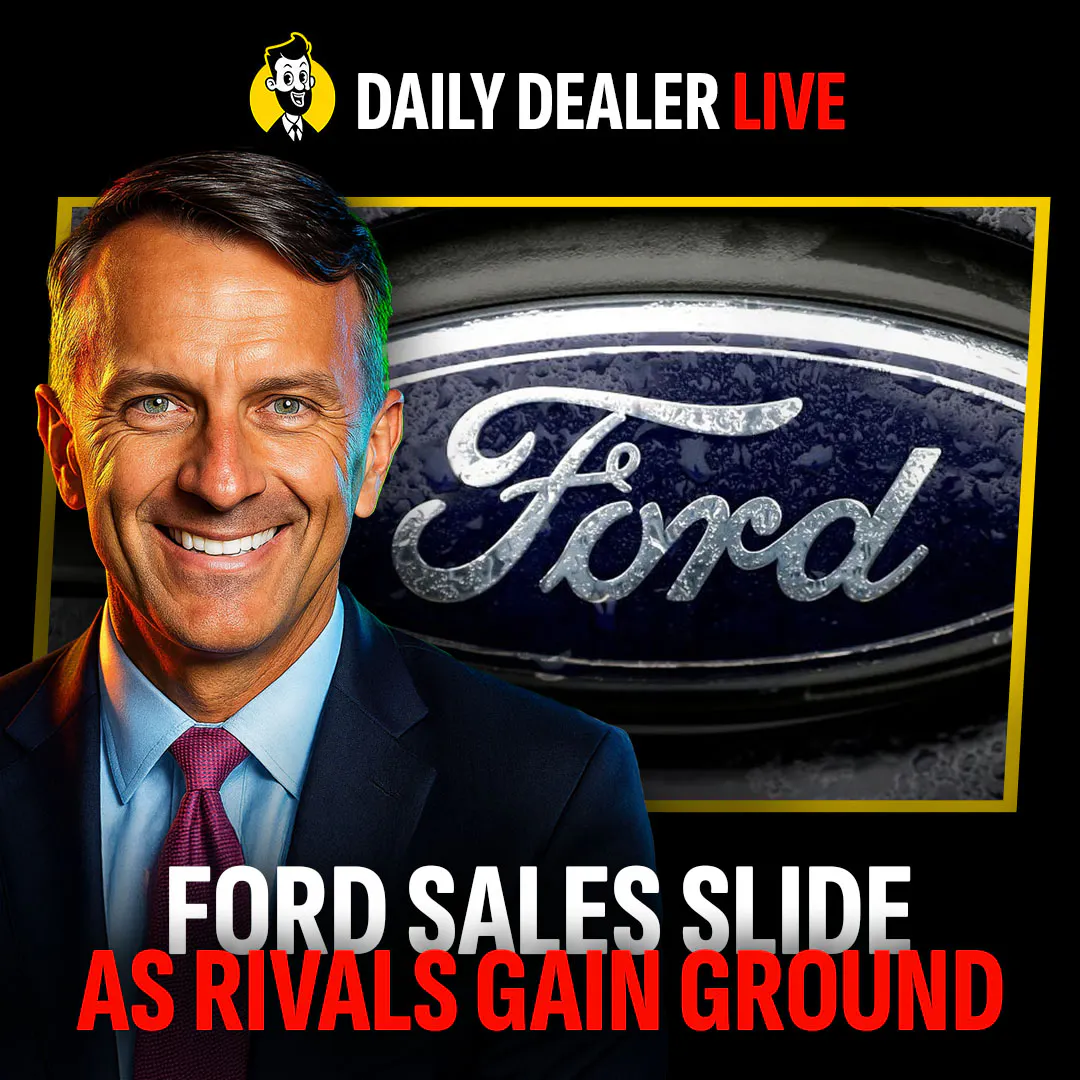
Next up today, Ford's Q1 sales fell 9% to 450,315 vehicles with the pressure concentrated
in its most important segments.
F-Series dropped 16% while Ram posted a 20% gain.
SUVs fell 7.8% while GMC had its best ever Q1 retail share.
EV sales were down nearly 70%, all while Cadillac rose 20%.
The bright spots were at the affordable end for Ford, Maverick, Ranger, and Bronco Sport
combined were up 8.4%, which is where dealer opportunity is the clearest right now, especially
with over 7.3 million vehicles already recalled in 26, adding pressure on some of Ford's highest
volume name plates.
Next up today, sticking with other OEM news, March sales were down across most of the industry,
though the split between winners and losers was clear.
Honda fell 12%, Honda Toyota 8.5, Mazda 25.7, and Subaru fell 23.5%, while Hyundai posted
its best ever Q1 on the back of hybrid demand, and Kia also hit a Q1 record led by the new
Telluride.
On the Detroit side, Stellanus was the stand out, Ram was up 20%, Jeep Grand Cherokee was
up 10%, and overall Stellanus brands were up 4% in Q1.
The through line is consistent, trucks and SUVs are carrying the market, and the brands
leaning hardest into that segment, well, they're holding up the best.
And wrapping up today's news segment with a trade story worth keeping an eye on,
Stellanus is in early discussions with the Canadian government about building Chinese
EVs at its bridled Brampton, Ontario plant, this in partnership with its Leap Motor Joint
Venture, which would mark the first major Chinese auto manufacturing investment in Canada.
For context, Canada cut Chinese EV import tariffs from 100% to 6.1% on vehicles under
33,000 in January as part of a broader push to reduce US reliance amid USMCA tensions.
If this moves forward, it adds fresh pricing pressure on entry-level EVs across the region,
and further complicates an already unsettled cross-border trade picture.
And as a personal aside, fascinating discovery to see Stellanus, an American OEM,
looking at doing a joint venture with Chinese just north of our border.
But that's a wrap on today's auto industry headlines.
And a reminder to everybody, thanks for being here.
Post your comments into today's social media stream.
We've got some urgent, relevant content today, including a California State Senator joining
the show. So we are interrupting gently Fixed Ops Friday today, which we'll do every now and
again for this content. We'll be back next Friday with Fixed Ops Friday.
So first up today, let's dive straight into it.
California State Senator Roger Nilo, he's Senator of the Sixth District,
and Eric Nilo, his son, National Business Development Manager at the Nilo Company,
and AutoFI Pro. Welcome both.
Thanks, Sam.
We're excited to have you both here.
Thank you for agreeing to join the show.
There's a lot to talk about.
But first, Senator, let's start with your story.
You've lived on both sides as a dealer and now as a State Senator.
What took you from the car business into politics?
And how does that dealership background shape your involvement in legislation today in California,
Senator?
Well, it's actually even more than that.
My first career was in public accounting before I joined the family automobile business.
So I say I'm an accountant by education, a car dealer by vocation, and a politician by avocation.
I got into politics by virtue of a lot of involvement as a dealer and as a member of
my community. Early on, all of our manufacturers are foreign manufacturers.
These days, a lot of cars are made here in the States.
But back then, virtually all of our products were made outside the country.
And free trade, while it's still a very important issue to us and to me personally,
it was essential then because we were dependent upon vehicles manufactured outside of the States.
And so I got very involved lobbying, if you will, at the federal level for free trade issues.
And then subsequently, I became very involved in a lot of local issues, regional and state
infrastructure issues, road development, flood control, water supply infrastructure,
and the relationship of our state government to businesses.
We have a rather heavy hand regulatory environment here.
So I got so involved in that, I decided at one point, maybe I could be more effective
on the inside as opposed to on the outside. And a friend of mine was running for the
state assembly who was on the county board of supervisors. And he and I were talking about
who should succeed him in a special election. And we decided it should be me. Although that's
not our decision, it's the voters decision. But I did run, I won that election. And that
launched me into politics at the local level, and then subsequently went on to the state level.
20 some odd years in total, yeah, almost 30 years as a state senator, I believe.
No, in politics, I was I served six years on the board of supervisors in the early 2000s,
and then six years on the assembly in the state assembly, I was termed out, we have term limits
in California of the assembly, I was out of office for about 12 years, and then ran for the
Senate in 2022. I have two terms in the state Senate, I'm completing one, I'm up for reelection
this November. And that would be my last term. So eight, total, it will be assuming I win my
election, I have to work on that. But after that term, I would be completely termed out of the
legislature. So Senator, it's an interesting path. The auto industry is one where, you know,
you have a lot of employees, you're able to help people realize their their potential,
you're contributing economically to an area. And you've given that up for public life, public
service. And I talk to dealers all the time, Bernie, Senator Bernie Moreno is a great example,
he's a US Senator in Ohio, and he did the same thing, he sold his dealerships.
Have do you feel like that public call to public life has been successful for you that you've
been able to make a difference? And what would you say is the biggest impact you've been able to have
during your time is in this public service? And what would you say to other dealers considering
it kind of frustrated with the state of politics? A lot of questions. Yeah, my recommendation to
other dealers is, if you're thinking about it, think again, it is it can be a very frustrating
experience. It requires patience. But the there's a lot of commonalities between politics and the
automobile business. Politics is really kind of a sales business. Getting things done involves
developing relationships, selling your ideas, being able to articulate your ideas, particularly to
people that might not disagree, might not agree with you. That's in the in the sales business,
that's sort of the equivalent of overcoming objections. And the management skills are important.
Also, I have a staff and managing them is very important. I'm proud to say I over the time that
I've been in politics, I've had almost no turnover of my staff. And that's because we have a great
relationship. So there are commonalities. It is, though, a an enterprise that as a low as an
elected official does require more patience than probably your typical car dealer has.
We can affect things a little bit easier when we're running our businesses. I found I couldn't
dictate it. I had to sell my ideas to my employees. But they were readily ready to accept my ideas
because because I was the boss. You signed the paycheck. Yeah, dealing with fellow elected
officials that doesn't work quite that neatly. But I think in the time that I've been in politics,
what I've been most proud about in terms of my accomplishments are not necessarily specific
accomplishments because I am after all a Republican in a deep blue state. And so my ability to
accomplish my major policy objectives is limited because of that. But I still have had some wins
where the other side does not necessarily agree with me. And that's what I'm proud of. I've developed
a reputation as a collaborator, a reputation who works well with people on the other side.
Really, some of my best friends in the arena are Democrats, people I've known for a long time and
work very well with. And I think that's enhanced my ability to get things done at the margin,
if you will. So all in all, it's been, I think, a great experience.
So Senator Eric, your son, who's with us here, he didn't go into politics. He stayed in the
family business, so to speak. That's right. Tell us your role in the Neal organization and
how are your perspectives different? Your dad focusing on policy in the Senate and you focusing
in business? Yeah, well, so my primary role in the company is helping to run what's called Auto
Phi Pro, which is a full service FNI provider. We partnered with United Car Care. We're an agent
for them. And we have, including our stores as a customer, we have outside dealer partners that
we work with. And that's my primary role. Politics never even entered my mind. He talked to dad,
talked about patients. I don't have that, you know, like he said, most car dealers don't have
the patience to do that kind of thing. That's not my wheelhouse. I like the car business and I'll
stay where I am. Yeah, yeah. Well, let's talk a couple of things that popped up in as I was doing
a little bit of background research. So Senator, one would expect that someone who's been in the
automotive business would do that would be a little biased towards the auto business. One thing
that stood out in your time is there was a bill that came before the state Senate that would cap
DOC fees and you held yourself out from that vote saying, look, you know, Neal Auto Group, it's an
auto business. I'm not going to have a say in this. Any backlash from that decision and what made
you decide to say, hey, I'm going to stand out and not vote on this, not be part of the debate?
Well, I do regularly abstain on issues that affect the retail car business.
It's not an actual legal conflict, but it certainly is a perceptive one. And I found my time in the
assembly in particular that as a local automobile dealer on issues dealing with the automobile
business, I was under a microscope unlike attorneys are when they're dealing with attorney-related
legislation, unlike doctors are. Similarly, it's always kind of, it's mystified me a little bit,
but nonetheless, I think it's appropriate for me to stay out of those issues. Now, it does
frustrate some of my car dealer colleagues. I can only imagine. I met with a group of dealers
and people from dealerships on that particular bill, which sought to increase the allowance
of the DOC fee. And I told them that I was going to abstain. I was told later that I irritated
a few of them, but, you know, think about it. If I'd have voted in favor of that legislation,
I would have been voting to put money in my own pocket. I don't think that's quite right.
And some of my colleagues didn't understand that, but I'm consistent on that. It's not a
sometimes thing. We had a legislation that dealt with the lemon law. And I did vote on that
because the lemon law is not a dealer obligation. But if it had to be for retail business, dealer
involvement, I do stay out. Why do you think there's a greater kind of microscope over dealers
versus other industries? And that'll actually lead us into this FTC conversation. But why do
dealers get so much scrutiny in the public sphere? Well, in my case, I think it's because
the coverage is local. And we have been here, we've been in the automobile business,
dealership business for over 100 years. My grandfather was a packer dealer in San Francisco.
And we've been here in Sacramento since 1955, beginning with Volkswagen. And now we have
10 dealerships, but we're very visible here. We're active in the dealership. The business is visible.
I'm visible because I'm in politics. And so it's a highly visible environment, if you will.
And so for me, it gains more attention. So this last month, the FTC, President Trump appointed
the head of the FTC, sent warning letters to 97 dealer groups across the country. So it must have
quite a few rooftops among those groups, warning them about advertising and pricing practices,
in particular as it relates to online advertising, and then also optional FNI products.
I'd be curious, Senator, your take, if you know this letter, if you've seen the letter,
on it, what does it mean from your perspective as a senator and also a dealer on oversight?
Is more oversight better? Is this something that the auto industry deserves? What's your
take on that? I'll give you sort of a two-phase answer on that. When it comes to regulatory policy,
generally, I have always preached what I call an economic development ethic. And that is,
regulations are always written to protect one of three categories, customers, consumers, that is,
employees, and or the environment. And what I always say, I'm not necessarily opposed to
regulations. But what we should do is make sure that the cost of complying with a regulation
does not exceed the benefit to the protected class, whomever that is. And those calculations
are not easy, but they absolutely have to be made to be true to economic development and to the
role of businesses who almost always are those that are subject to complying with regulations.
Now, with regard to this specific proposal, it's aiming to have full disclosure of transparency
on price representation. And that's a good thing. It has to be consistent and clear. And sometimes
that's where the problem develops is the clarity of it. Businesses can comply with any regulations.
They may or may not like it, but we can comply. Just tell us what it is, make sure that it's
consistent across the board and that it's very clear. And sometimes regulations fall short on
both of those points that I made. And actually, to your point, last week on this show, we had an
attorney from the Virginia Auto Dealers Association and also had legal counsel from a company called
KPA. And they both talked about how one element of this letter is disclosure of dock fees and
online advertised price. And there are some states where it's required to be disclosed. There are
some states where they say, don't require it, don't disclose it. It does bring up an interesting
tension between state and federal, right? The federal rule, it's not a law, FTC saying, hey,
we want full disclosure on this state law is saying, don't do it or do it differently.
Is there a need for federal guidance to clear up the murkiness of it all so everybody's operating
off the same set of rules nationwide, especially in this world where we're selling so much on the
internet and so much interstate commerce happens in the sale of cars, Senator.
Well, that is a very important point because some regulations are better dealt with at the federal
level. As an example, there's a debate going on with regard to social media regulation and
artificial intelligence regulation. And that really is much better handled at the federal level.
Problem is Congress isn't doing anything about it. But nonetheless, it would be. But when it comes to
retail disclosures and items of that nature, the regulation has to be really at the relevant
marketplace. And so federal regulation on these sorts of things, frankly, in my mind doesn't make
any sense at all, particularly when you use dock fees as an example, because the regulations of
that varies by state, but also the fees themselves vary by state. And the important disclosure is
where are the consumers that are being subject to the businesses that are making these disclosures?
And in our case, as an example, our disclosures are relevant pretty much to the Sacramento region,
perhaps northern California. But we don't have anything to do with the market in Utah.
So it would make much more sense to regulate that locally.
So Eric, you're familiar with the letter, you've heard it, you teach it, you live it day to day
inside the dealership from your vantage point is in the training role and the development
role. And in the operator standpoint, what does this letter mean to you and your clients and the
dealerships you serve, including your own within the NELO group? Well, I think primarily one,
compliance is just a huge issue. And in the NELO company, none of this really matters because
we're so compliant, we spend so much time on it anyway. And I think by and large, dealers do that
as a rule. There probably are dealers out there that are going to have a tough time trying to
adjust to a new way to operate under those sort of guidelines. But from our standpoint, and I
think a lot of our dealer partner standpoints, it's really just business as usual, we just have
to adjust a couple of things to keep complying the way that we should. Yeah. So let's transition off
the FTC letter and let's go to direct sales. So in California, much has been made about first off
Sony Honda's attempts to go direct to consumer and now Volkswagen. These OEMs are attempting to
circumvent the dealer network by going with sales direct to consumer. Should that be allowed? And
how should the state of California is one who kind of leads the way in some of this legislation
be thinking about that, Senator? That issue is dealt with in various ways around the country.
In California, a manufacturer cannot have a separate dealer network if they already have a
dealer network. But if it's a brand new manufacturer with no such infrastructure,
then a separate dealer network can work. Tesla is an example of that. In other states, Texas,
and I believe New Jersey manufacturers having retail stores is just not allowed at all.
But the issue is customer service. How is the customer best served? What model works best? And
as a dealer, obviously, we do have some bias, but it has always been my observation
that wholesalers are not necessarily real good retailers. It's a different skill set. It's a
different approach. It's a different mindset to the representation. Now, Tesla has its own
dealerships. In fact, we're happy that one of our buildings, they're leasing from us. So happy
days on that. But I don't know that you would find a whole bunch of glowingly happy customers
relative to their purchase experience. Whereas I'll guarantee you with the Nilo company consistently,
that does exist. We have not the expertise to build cars, not the expertise in logistics to
ship cars from point A to point B. But we do have the skills to treat customers in the way that
they're going to be happy with their purchase. And so I firmly believe that the dealer representation
model truly serves the customer the best. And as a dealership industry in California,
we fight to keep that. It's not just of an issue of economic interest, because frankly,
if you look at the manufacturer's approach to this versus the dealer's approach to this,
in each case, there is a profit motive. But I believe for the reasons that I articulated,
customers are better served under the dealer franchise system. So as different OEMs go state
to state, Volkswagen, Sony, Honda, attempting to test state franchise law, is that a threat
to the franchise system? Or do you think that ultimately the best system will prevail in this
case, the franchise system, because it best serves the customer? Yes and yes. Certainly,
it is a threat because manufacturers, a lot of manufacturers, if you gave them the choice,
might prefer to have their own dealerships. I don't think that's the case for all
manufacturers, though. The report earlier about Nissan, they said that their number one
objective is for dealer profitability. They realize, I think wisely, that their success
is in the success of the retail representation. So yes, it is a threat. But I think, again,
yes, it is provides the best service to the consumers. Yeah. And actually,
so a couple of comments coming online. Paul Salisman, politically, I think we're protecting
consumers by supporting the franchise model because it allows more consumer choice via
competition. So that choice sometimes is tough for the consumer to see that by
supporting the franchise model, they actually have more choice where individual stores compete
against each other. And in that marketplace of competition, the customer ends up being ultimately
better served. But sometimes that's tough to see. Igor Kaye comes in and says,
California only has an $85 dock fee. No one's getting rich from a dock fee that small. There are
some states where there is no cap to the dock fee. I think Florida may be one of those. And so it's
a substantial from a disclosure standpoint issue in those states with the larger limit than less.
Eric, any thoughts on the direct to consumer piece as it relates to Volkswagen and Honda
potentially trying to go direct around the consumer in your role in the finance world?
I don't know about necessarily the finance world, but I can tell you that if that precedents were
to be set, it puts a big strain on the current model. And we're a company that's operated for
years and years under the franchise model. There's confusion as we don't know what would happen.
Certainly that the idea is that these things won't go through. The Volkswagen
and Scout lawsuit was approved. It's going to happen. Obviously, this is years and years down
the road. But it's a big threat to the franchise model. And that's our livelihood.
Yeah. All right. Last political topic. And then I want to go into the finance world and in
auto dealership relations. So Senator, we're going to pull you into dealer operations here in
just a moment. But the last thing a lot of dealers are talking about is an attempt by Chinese
automakers to come into the US. You heard Stellanus working to put together a deal in Canada
to manufacture Chinese vehicles there. There are some in this industry, Senator Moreno and others
who say it will never happen. President Trump himself stood at a press conference in Detroit
months ago and said he's open to it. Others see it as an existential threat to the auto industry
in the United States. Yet some others counter would say if we don't compete against them,
we'll lose on the global stage. What's your take on Chinese technology coming into the US
senator? Is that something that we should be open to and allow free market to dictate? Or
should we resist it as a national security threat? Allow me to make one political point on this.
And that is that there are people who are saying that China is eating our lunch relative to producing
green products, if you will, solar panels, electric cars, etc. Our governor in his state of the state
addressed this year in fact cited that as more a complaint or a criticism of the Trump administration.
But I think it is extremely important to point out to people that the economy that is producing
those things is entirely driven, entirely driven by coal powered utility plants. In other words,
they are emitting pollution and greenhouse gases to an extent just by virtue of their coal fired
plants that exceeds that of the entire US economy. So I don't really want to hear about China being
a green economy, it is not. That point aside though, we are a global economy and I think the
latter comment that you made is relevant. We can't hide from it. Our current president's tariff
policies is trying to do that. It won't succeed because first of all he didn't have the power to
implement as we've seen. It has been very damaging to the economy. We have to compete on the global
stage and we have to compete with those Chinese vehicles. Now that's from a global perspective.
Now from a dealer perspective, our concerns about that would be how would they be coming into the
market with regard to retail representation. And I just refer to all the comments that we made
previously on that. But we can't deny that there's a global stage and we've got to compete.
Yeah. What would you say is the solution? Let them in and compete here in the US,
force them to partner with an OEM like it seems they may be doing in Canada with some restraints
and restrictions or keep them out until our technology catches up. And by the way, my own
personal opinion is the third is the worst option. I think it's tough to say we're never going to
keep up. There's got to be a middle somewhere Senator. If we keep competition out, we will never
catch up. It is competition that drives that competition for individual businesses. We are
really not capitalists. We would rather not have competition. Competition doesn't benefit the supplier.
Competition benefits the market and the consumer and the market, the providers in the market are
not going to improve their performance unless they're faced with challenges that provide better
products, better performance that is currently the case. So trying to protect our market
is a fool's errand. Yeah. So Eric, thinking about all these topics and these battles that the
Senator is dealing with in Sacramento, which is fascinating. It could extend for hours. Talk to
us about what you're seeing in store. What today in April of 2026 is among the biggest
profit leaks you see in the store right now, Eric? Well, I think from a macro lens, the biggest profit
leak is probably under trained staff. And you could dig into that from your service drive to your
FNI office to your salespeople to everybody. A lot of these guys have providers that come in
and they train staff and that's part of their service. The challenge is a lot of these guys
are being trained by men and women who worked in FNI or in sales or in the service drive 10 or
15 years ago. And that's great. There is knowledge there, but it's not current real world knowledge.
And so I think the challenge that a lot of these guys face is they rely on other people to train
their people and hope that it's going to be the best result. And I think that's a flawed
way to look at it. And it just inevitably creates profit leak all over the store.
And, you know, little bits of profit leak through each department adds up.
Yeah. What do you see is the biggest training error that you see. And then we're going to
bring a comment from Don Hall into today's show, which he's the head of the Virginia
Auto Dealers Association and one of our much esteemed contributors. So, Eric, what are in
March, April of 2026, one or two tips to training an elite team inside an auto dealer group today?
Well, I think it starts with who's doing your training. We happen to have people doing our
training that work in finance offices every day. And so, you know, Autify Pro, we understand
what the challenges are today. And, you know, I think providers have a good idea by and large
what's going on in the market. But it's just not the same as sitting in the trenches,
talking to customers every day, and then relaying that to people who you want to make sure are
running an elite department. And we've found through our work with other groups, I mean,
we have a group we took from their PBR from one number to another, but we increased it
60%. And that's really just based upon getting in the trenches, talking to them about what's
going on in the real world, and making sure that they're, you know, they're selling the right
products at the right time to the right people. You can't walk out of college and just start
training finance people, right? It's just not, it doesn't work. There's a much, there's enough
street level smarts that go into it that you've got to start there. So Senator Don Hall says
into the comments that Chinese Communist Party controls all auto manufacturers. Mark my words,
they should never ever be allowed in the US. These folks, folks wish to control the world.
Just say no. Do you think there's a political risk to allowing Chinese technology into the US
that would interact with our infrastructure, street signs, cameras and other things that's
worth fighting back even at the risk of losing the competitive side to them? Again, I'd say
yes and no to that. I certainly understand the point that he's making.
One of the biggest, maybe the biggest mistake that the United States has made in the last few
decades was allowing China into the World Trade Organization. Was that Nixon or who did that?
No, no, it was either Clinton or Bush. It was done in either the late 1990s or the early 2000s,
but it was a horrible blunder and it allowed them to do a lot of the things that they are doing now,
and I perfectly understand that point, both the potential unfair nature of the cooperation
because of government support, but I'd also point out that in the point of the European
competition, there's more government involvement in their industries than there is in ours also,
and we're competing reasonably well there. Then there is also the added threat from China,
the sort of scary things where they're spying on us. Some people might think, well,
you know, that's conspiratorial and paranoid, but I do believe that it is happening. All of those
threats are real, but if China is able to complete, compete in the world every place but the United
States, and we don't experience here the competition that drives our industry better,
there's a big downside to that too. Eric, CARS Act is something that is still alive and well in
California. It was struck down on a national level, and California seems to be moving ahead with it.
I think it goes into effect next year. There's a few components to it, three-day ride or return,
increased disclosure. Does that help or hurt automotive in California and should it be a
national policy that everybody plays equally, fair rules across the entire country,
or is it okay to allow a different set of rules across the country? If yes, how do you as a trainer
in the finance world and a dealer adapt to that, Eric? I think it's okay to allow different sets
of rules. The three-day ride or decision and these sorts of things, these are things as a company
we're already doing. We already have a seven-day return policy. Like I said, a lot of this stuff
for us really doesn't make a big difference. I think operationally, for some people who don't
offer that sort of thing, you just change the way you do it and you offer it. I don't think it's a
huge deal. This all started, I think probably back in 2007 or somewhere around there, eight,
with the Car Buyer's Bill of Rights. It offered things that the California car dealers never
had to deal with before that. It's just another layer to legislation like the Car Buyer's Bill
of Rights. It just adds a couple things that we need to do. Is it fun to do? No, but I think to
protect the customer is an important thing to do. If dealers outside the state or if other state
governments want to do that, to me, it doesn't matter. I won't say whether it hurts or whether it
helps, but it can't hurt to answer that question. Paul Elliott comes into the comments and we'll
encourage you to connect up on social media. He says, Eric, are you showing FNI products in the
showroom on the lot as an option, addendum? If no, why if you don't mind sharing? So are you
showing FNI products on the lot as an option or an addendum? And I don't think it would be an
as an addendum unless it was advertised with those products as part of the addendum on the lot.
That would be for the FNI office, I believe. We don't do a lot of addendums. We do sell a theft
product that is brought up very early on in the conversation. We pay our salespeople on FNI profit
or on products sold and we pencil every deal with FNI. And my opinion is it's very important to get
finance involved in a deal very early. Your odds of your product for deal being where you want it
are much greater when that customer knows the person that's actually selling
those products to them. So we don't addendumize anything like that unless it's a one-off on
a showroom car with maybe roof racks or something like that. By and large, we're talking about FNI
early and it shows in our numbers. And I think it's hugely important if you want a successful
FNI department. And to your point, I think the more disclosure, even the risk of over disclosure,
it's always the right way in automotive. And I think that's what's going to help us cast off
some of the negative stereotypes that have been there in the past. I think when the senator talks
about the increased scrutiny on automotive, it's something that came on us because of maybe bad
acts that happened in the 70s or 80s or some point in the past. And I think we're our best selves
when we do the right thing to create value for that consumer today. Elite disclosure, elite
products, elite value to that customer. And again, bringing a full circle back to the conversation
about direct to consumer, that's what will keep this franchise model solid now and into the future.
Last question up, we thank both of you gentlemen for being on the show today. Eric,
and then the senator Eric, what's one thing operationally that dealers should do right now,
April 2026 to ensure success for the year 2026? And then the same question to the
senator politically, but Eric, you first. Pay attention to FNI. I think that there's a lot
of dealers who don't take FNI as seriously as they should. And I think that if you put the
right process in for FNI, you know, with the state of car sales as they are now,
you're going to see a better return if you do. Senator dealers are so busy today,
they've got so many things on their mind, and they're doing the importance of being
involved and engaged politically. What would your rally cry be to dealers nationwide,
when they think about engaging with politicians, whether state or national,
what's one thing dealers should be doing today? I deal a lot with the business community because
that's a constituency of mine. And economic development, business health is very important.
I've talked about the role of regulations and how I view that. And I always say,
you better be at the table, because if you're not at the table, you're going to be on the menu.
And in California, we have a pretty good model. We have a state dealer association that isn't just
good at conducting good government relations, but it is very good at recruiting grassroots
participation. Every dealer should know and have a relationship with his or her congress
representative, state senator, and state assembly person, and their staff. We have dealer day here,
which is going to be next week, and dealers from around the state come to Sacramento and
they lobby everybody, but it's not a one-day thing. It's an ongoing thing. Have a relationship
with your representatives because that gets you at the table and keeps you off of being on the menu.
Well, very well said. Accountant, watch this. Dealer, state senator, California state senator
Roger Neal and Eric Neal, a national business development manager at Neal Auto Company. Thank
you both for being here with us today, sharing your perspectives on the show.
All right. We are going to raise, that was such a cool segment, a ton of comments online,
including eager Kay, who in response to the, what should we focus on? Pay attention to your
inventory. Learn to manage your inventory better in 2026. Eager Kay says, every politician now
repeats it ever since Ukraine talks without Ukraine. All right, episode, today's episode is
brought to you by Overfuel. Most dealership websites, well, they suck. They're slow, they're clunky,
they're hated by both shoppers and Google. Overfuel, they crack the code, lightning fast, AI-powered
sites built to attract, convert, and dominate every search experience. Is it time for a new website?
Go to overfuel.com, use the code CDG500 in the comment box for 500 bucks off. Thanks to Overfuel
for supporting today's comment, including that amazing conversation with Eric and the Senator
Neal from the state of California and their perspective on all the major things in automotive.
And speaking of interesting perspectives in automotive and a take on current events,
now we go to founder and CEO of TrueCar, Scott Painter. Scott, welcome to the show.
Thanks for having me. Appreciate you being here. You're here at a very relevant moment.
It's an inflection point, some would say, in automotive. FTC 97, letters out to 97 dealer
groups, probably spans tens, if not hundreds of rooftops across the country. Talk to us about
your take on that as President and CEO of TrueCar. Why does that matter to TrueCar?
Well, I think when I found a TrueCar almost 15 years ago now, it was really built as a price
discovery tool to help consumers understand affordability as it relates to their automotive
choices. We were really focused on new car pricing and obviously new cars and used cars are very
different, but I think the FTC letter really focuses on an issue around consumer protection and
whether or not consumers are getting a clear message about what they're buying.
That is a little bit different than some of the guardrails that have been put in place to cap
dealer fees and whatnot. And obviously, those are inconsistent from state to state,
so there's additional clarity that's needed there depending on what state you operate in.
However, I think clarity is something that we're super interested in for totally separate reasons.
I think that in service of our dealer, we want to make sure the consumer has clear information
because when they're understanding the price they're being presented with,
they become a buyer a higher percentage of the time. And what we see at TrueCar is two types
of shoppers, shoppers who know exactly what they want. They've picked a make model trim of car,
most times even the color. And what you need for them is total clarity, not just about the MSRP,
but what they're seeing out there as an advertised price because consumers tend to
shop across multiple platforms today. They also need to see what is your price, which includes
any factory incentives and rebates or credits or promotional numbers that come off of that
advertised price that don't affect dealer economics. And then I think this is where
the FTC is really focused, making sure that all the tax title registration and dealer fees are
added so you understand what is your drive off cost. So when you talk about all those different
fees being added, making sure that they're fully disclosed, that is some of the confusion nationwide.
You think about dock fee, you mentioned it, different from state to state. There's actually
different state laws that dictate disclosure or not. The FTC seems to be saying, hey, we want to see
it across the entire country and then totaled up at the bottom. Are digital lead providers part of
the problem in that total disclosure in requiring or not requiring that be pulled to the bottom? And
then in that race to the top of the list, dealers popping up to the top where consumers ultimately
end up going, do the digital lead providers make it worse because they're not monitoring whether
dock fee as an example shows up in that total price? Yeah, you know, it's interesting. When I
got back to true car, what I realized is the company had drifted very much into the business of
VIN based classified listings and leads. And that's really not the way the company was founded. I
think that lead generation is about making sure the customer has a clear price. And that's just
putting an advertised price on the car and making sure that, you know, at the core of this, there
are three sort of fundamental rules that dealer must put a VIN number on a car when they advertise
a car to avoid bait and switch. They can advertise the same VIN in two places for a different price.
That kind of activity happens all the time. We see it today with all the data we're collecting,
we're buying data from hundreds of sources. We see all the ads, not just the classified ads and
the marketplace ads, but also all of the dealer websites now are publicly available and we see
that in real time. But when a dealer advertises a car in two places for a different price,
that's a real issue in terms of bait and switch. And then obviously, all dealers on the new car
side are selling an appliance. It comes off an assembly line and, you know, in true car 1.0,
I heard a lot about the race to the bottom. And I think, you know, unfortunately, the reality is
for a dealer that advertises a commodity product or an appliance, anytime you put an advertisement
on that car, it is aspirationally the highest price you can charge everybody because it's a
one to many advertisement. And as a dealer, when you advertise a lower and lower price, you surrender
margin. I think one of the things that I really want to enforce coming back to true car and this
time around is, you know, just having had that experience being on the front line of that battle
and being almost, you know, positioned in the corner as the guy catalyzing that race to the
bottom, we really want to become the antidote to the race to the bottom. I think we do that.
How do you do that? I think it starts with clarity. You know, one of the things that I noticed when
I came back in, like, you know, we've got 11,500 dealers. It's a large dealer network. It's mostly
franchise dealers that sell new cars and also sell used cars. Of course, we now have independent car
dealers which only sell used cars. I think the challenge for new and used is fundamentally
different. In the new car market, we have something that you don't have in the used car market,
which is an MSRP on every VIN. So every single car produced has an MSRP and an invoice price.
That becomes an anchor for understanding what are you saving from that MSRP. The real
issue becomes what is the advertised price? And that is the promoted price that a dealer
goes to market with and what they put on the marketplaces or on their own dealer website.
But that advertised price should not and must not include OEM incentives that are not conditional
unless conspicuously and prominently footnoted. And that's where you can get into a little bit
of trouble. And we start to see, you know, some of the dealers that are on the program
do that in other places. And one of the benefits of having a platform where you're
really focused around price clarity for consumers, that is the value proposition. They're looking
to use that as part of their decision tree for, you know, understanding what they can afford.
So we have an option logic configurator that allows you as a consumer to come in and really see
all of the different features and benefits of different options and accessories. But each and
every one of those ladder up to an MSRP price. So we actually do have that kind of clarity.
And the good news about tech is once you build it once, you can enforce it across the entire
platform. And so for the dealers on our program, I think having the ability to first say, we must
see these advertised prices clearly. But the offer of one, this concept where we work with
affinity groups, and you're only eligible to receive that offer of one, if in fact you
raise your hand and say, I'm a Sam's Club member, or I'm a pen fed customer, or I'm
a member of one of our 200 affinity. So this is an eligibility only type of environment where
we are connecting our dealer who wants to sell a car to our consumer who wants to buy a car.
And when we say an offer of one, it is what prevents the dealer from worrying about this
race to the bottom, because an offer of one is an offer from the dealer to a specific customer
on a specific car for a specified period of time that will expire. And what that means is they are
free to charge other customers up to the advertised price without surrendering any gross.
And so this antidote concept of being an antidote to the race to the bottom is
recognizing first that an offer price on Truecar is not an advertisement of one too many. So a dealer
is very much allowed to then begin this frequency, this conversation with an individual consumer
to get them to buy the car without surrendering that opportunity across the overall marketplace.
So you're saying that because of the technology that you have at your disposal, the tool you've
built, you're able to create a price that is that one individual qualifies for, therefore making it
compliant with everything out there in terms of disclosure and rebate qualifying rules, all that.
But because it's for one individual, it's unique to that one individual, not to the market. And
that passes muster. Is that the tool you're working on?
First of all, I just got to say, I grew up in Sacramento. And so being on a podcast with Senator
Nilo is a big honor. Pretty cool guy, yeah. Super cool. And I mean, I grew up seeing the Nilo brand
and every day. But you know, Don Hall chimed in. And one of the first calls I made when I got back
into the office here at Truecar was I called Don, I called Brian Moss at the CNCDA. And I said,
what we want to do is make sure that we're understanding everything about not only the
CARS Act, but all of these regulatory things around clarity and disclosure so that we can
help our dealers to be the most compliant. And short of getting a good housekeeping seal of
approval from either organization, I am definitely not missing the learnings from Truecar 1.0,
where I'm talking not just to Don and to Brian, but all of the heads of the different ATAEs around
the country to make sure that we are helping dealers to be compliant and actually have a level
playing field. And this doc fee, I think is a huge one. How is the doc fee a huge one? Well,
in California, we have a cap. I mean, that's I think where government goes a little bit too far
and trying to cap profit. I think disclosure would be enough for that particular issue,
because it turns out if you disclose and something is sort of egregious in terms of its cost,
consumers can choose for themselves. It really is about having the discipline and the clarity
around what are those doc fees, and that should be sufficient. In Florida, there is no cap. And
when we have a dealer who might be in South Carolina or Georgia right on the Florida border,
where that consumer is playing by a different set of rules, depending on which state they're
buying the car from, our real goal is to make sure we're fully disclosing everything. And I think
when we do that in service of the consumer, by the way, not only are we chinning to the FTC's
guidance, we're also helping the dealer because when a customer comes in and has no surprises,
they buy with confidence and they buy a higher percentage of the time and that lowers dealer
cost. So several dealers that have been on this show and that have talked about the challenge
with that kind of race to the bottom, particularly with digital lead providers, and you say, hey,
we're not one, we'll let you have that in just a moment. They say, hey, enforcement has got to be
part of that, right? Long before we see any federal oversight or anywhere else. So Google months ago
came out with a policy and they said they're going to watch this, they'll match pricing with
transactions. And it seemed to not, you never heard about anybody that was taken off the platform,
they're not incentivized to truly do it and or beat anybody over the hands for it. How do you
handle that differently within this new TrueCar model that helps serve the dealers that are doing
it correctly, but also create a great product for the customer? I stepped back from TrueCar 1.0 in
2015. When I left, we had just over 2000 dealers on the program. They were all franchise dealers.
Today, I've got a five times larger dealer network, 11,500 dealers, a much bigger business.
Ironically, it makes less money on the top line and it doesn't make any money on the bottom line.
But I think that part of turning this company around is a real pivot from quantity to quality.
The metric that we need to focus on is not having more dealers at all costs. We need to have the
right dealers who want to play by the rules and want to fully disclose. And I think that if all
dealers are playing on a level playing field, that we do better. So what do you do to the dealer
that doesn't comply? It starts by having a clear set of rules. And so what we announced last week,
for example, is that if you're on our program, you have to have clarity around what is the
advertised price, what is your offer of one price, and you have to have an offer of one price that
is lower than your advertised price. Because if you come to TrueCar, the fundamental bargain
for a user, a consumer, an eligible affinity member is, I'm going to go to TrueCar to save
time and money. And if we don't help them to do that or understand how they're doing that,
we aren't serving the dealer either. And I think it's a flywheel, these two things go together.
And so if a dealer is not giving us an offer of one price, why be on TrueCar at all? Now,
with 11,500 dealers, one of the other things I'm learning about this business now that I'm back
is that we have a very real 80-20 problem. It's not that 80% of our business is the top 20% of
our dealers. It's more like 95% of our business is the top 5% of our dealers. We are very, very
focused on these larger dealer groups. And it turns out that they, for the most part, are all
looking for tools to lean in and to be fully disclosing and certainly be very compliant with
the law. But I will absolutely embrace pivoting from 11,500 to half that size of a dealer body.
People aren't playing by the rules, but it does start by having a very crisp ask. So we've gone
back and we've really said, we're going to enforce these rules. And we are now in the process,
right as we speak, of asking dealers to do some things they have sort of become very,
very relaxed about over the last five, six, eight years since I've been gone. And to some degree,
it's going back to where Trukar started, which is we must have clarity around these numbers. But
it starts with things like definitions of what is a price, what is a drive-off,
what's included, and getting consumers and our dealers.
So you've said that this process, this strategy, this approach isn't driven by the FTC
letter that's coming out. If that's the case, what did trigger these kind of new program
standards? And then second question, you've called yourself the most compliant platform in the
industry. Who's your closest competition? First up, what triggered the standard?
Well, I think given that Trukar is all about price and price discovery, that's the
fundamental rubric. I think, you think about Carvana, it's drive happy and they've got a
radically better process that they've engineered for their specific consumers. When Carmax first
came out, they were about the trusted white hat player in a black hat space. They really wanted
to be the good guy. I think Trukar is about saving time and money. And so if we don't do that,
we don't work. And if we don't work, we don't work for our consumers or for our dealers.
So the fact that there is focus on price clarity, I think is very timely. It's something that we're
going to focus on for separate reasons. But the two happen to be just happening at the same time.
So they help one another. And when we're out talking to dealers, we want price clarity for
consumers in service of the dealers to sell more cars. What the FTC is asking for happens to be
almost identical. The good news is that if the dealer does what we're asking, we will all be in
compliance. And so the comment about we are the most compliant is really based on getting the
dealers to do the things that we are asking them to do to work in our environment. And
when I say most compliant, I've reached out to these ATEs. We are not just hugging the cactus.
We want to help them help the dealer to comply with what they have to in this area.
As you mentioned though, the Legion partners, most of these are used car sites. Used car
pricing clarity is very, very simply about complying with the rules around VIN based listings,
not advertising the same car in the same place or different places for a different price,
not selling the car for more than the advertised price. That is about enforcement. Again, we're
much more about helping you save time and money on a new car purchase than a used car purchase.
We're getting out of the lead business. Like I said, we are really focused on bringing the
dealer buyers. Our close rates in historical programs like the USAA auto buying program
were as high as 40%. One out of two customers were buying a car that we brought to the dealership.
That's not Legion. That's not advertising. That's bringing you a customer who's ready to buy.
So Dan C comes into the chat says a clear set of rules is essential, but there has to be some
level of enforcement. Otherwise, it's useless. Inspect what you expect is fundamental. Otherwise,
you're just wasting everyone's time. And then Paul Salisman comes in and says,
who is True Car's customer? And I could see, is it the retail buyer? Is it the auto dealer
client? Who's the customer? So I think it's really important to understand that True Car is
a flywheel. It works in combination with consumers and dealers. And in very much the same way that
Uber is a digital bridge between a consumer who wants a ride and a driver who wants to give that
ride, True Car is a digital bridge between a consumer who wants to buy a car, save time and
money with a dealer who's willing to deliver on that promise. And if one doesn't lean in,
it doesn't work for the other. For instance, if we don't have consumers who are highly educated,
ready to buy a car and ready to be introduced to the dealer because of their in-marketness,
then we haven't served the dealer either. One of the things that I saw when I came into this
business was there was such a lack of willingness to discuss price. It had become a third rail
conversation that because of that, we lost our focus on the overall value proposition
when we don't serve a consumer who's looking to shop for a car and save money
with a dealer who's willing to meet them where they're at. We don't help either one.
So the answer is, at the end of the day, dealers pay our bills, OEMs pay our bills. I think that
to some degree, that's a bit of a trick question in the sense that if I say consumers,
then I'm saying that dealers are not a hit. Yeah, it is a trick question.
Props to you, Paul. Paul.
The dealer is our partner. And we are in service of that dealer, bringing them a customer with a
certain set of expectations to begin with rules and clarity. And we're going to enforce those
rules. I'm okay having half the size of the dealer network. What I do care about is quadrupling or
five-axing how many sales they generate. So I would tell you, your prediction for future state
automotive, I think we're better, the more transparent we are, the more direct we are,
the better we communicate with customers. And I do think it's a little bit of a trick question,
because I think those lead platforms, those lead provider platforms,
that do a better job of holding everybody accountable to that so that there's a level playing
field, not only do the individual dealers participating in that win, the customers win,
but also all of automotive wins. And that's what we want in automotive in 2026 is for
this to continue. So Scott Painter, founder and CEO of Truecar. Thanks for being back on the show
to share with us your perspectives on the FTC letter and the price of one. So thank you, Scott.
Thank you. All right. Well, that was quite an episode. We had a state center, we had a son,
Eric Props. Thank you for being on. Dennis Gingrich came into the comments. We actually had a
ton of comments we weren't able to bring in today, but we'll bring them in next time. And to you,
our loyal listening audience, as we head into this Easter holiday weekend, thank you for being here.
Thanks for watching Dealer Daily Live, where we break down the biggest moves in the car business
as they happen. Don't forget, we are here live every Monday, Wednesday, Friday. That means we'll
be back Monday, 1pm Eastern. So if this is your world, hit like, hit subscribe, turn on those
notifications so you never, ever miss a beat. And we'll see you next episode. Thanks for being here,
everybody.
About this episode
California State Senator Roger Neal and his son Eric Neal (AutoFi Pro) break down how dealership experience shapes policy, why dealers get extra scrutiny, and what they think about FTC warning letters targeting online pricing and optional F&I disclosures. They also argue the franchise model best serves customers, weigh direct-to-consumer threats, and discuss Chinese EV competition as both a global reality and a security concern. Then TrueCar founder/CEO Scott Painter dives into pricing clarity, “offer of one” vs race-to-the-bottom advertising, and how enforcement and transparency can help dealers and consumers alike.
Today's show features:
- CA State Senator Roger Niello, representing the 6th district
- Eric Niello, National Business Development Manager at The Niello Company and AutoFiPro
- Scott Painter, Founder and CEO of TrueCar
This episode is brought to you by:
Overfuel – Dealers: You’re torching $30 of every $100 in marketing spend when your site flunks Google’s basic performance test. Why keep using outdated website technology that's killing your profits? Overfuel is the new technical standard in automotive websites, proven to grow sales by 30%+. Whether you need more revenue or better support, they’ve got you covered. Go to https://overfuel.com/ and use code CDG500 in the comment box for $500 OFF.
Check out Car Dealership Guy’s stuff:
CDG Circles ➤ https://cdgcircles.com/
CDG News ➤ https://news.dealershipguy.com/
CDG Jobs ➤ https://jobs.dealershipguy.com/
CDG Recruiting ➤ https://www.cdgrecruiting.com/
My Socials:
X ➤ https://www.twitter.com/GuyDealership
Instagram ➤ https://www.instagram.com/cardealershipguy/
TikTok ➤ https://www.tiktok.com/@guydealership
LinkedIn ➤ https://www.linkedin.com/company/cardealershipguy/
Threads ➤ https://www.threads.net/@cardealershipguy
Facebook ➤ https://www.facebook.com/profile.php?id=100077402857683