LIVE
When you look at the consumers that are growing
in terms of their disposable income,
many of them look like our members.
And in order to attract that market share,
having more dealers in your network
that actually reflect America
is really a competitive advantage.
Hello and welcome to the Walkaround Podcast,
powered by JMNA Group.
I am your host, Mark Spoto, joined by the legend himself.
You're laughing, but you're a legend.
I don't know if you know that.
Man, listen, thank you, thank you.
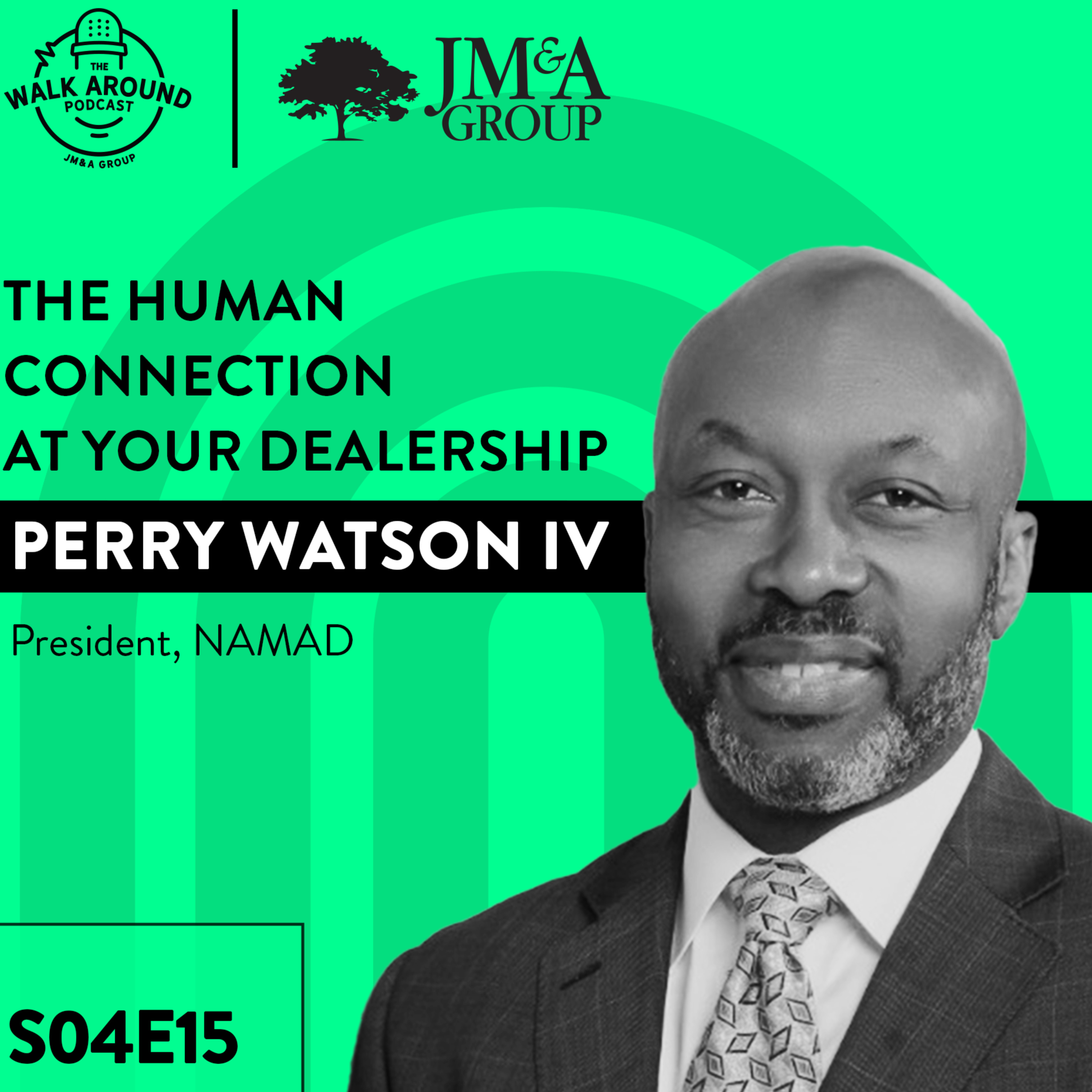
Perry Watson. Thank you.
Perry, first of all, what do you think of this setup?
The last time you joined us on the pod, we were on Zoom.
I know.
Heather and I were squeezed together in a conference room.
Right.
Thanks to being in Vegas at the Sirius XM Studios,
by the way, at the Wynn. Absolutely.
We've stepped up our game here a little bit.
Man. Would you agree?
I'm like, you guys got some money.
Well, hold on now.
Hold on now. I'm just kidding.
I love it, man.
This is super professional.
Well, thank you.
For those that don't know, as I mentioned, the legend,
Perry is the president of NAMAD for two and a half years
and is also the dealer principal of Lexus of Misha Waka.
Did I say that okay?
Former principal, but yes, and you did.
It's hard to say Misha Waka.
You did a great job.
Thank you.
And that is in South Bend, Indiana, of course.
Are you a big Notre Dame fan?
I am, you know, until they play Michigan State
and I got to go with my alma mater.
Okay. So, Perry, let's get right into it
in terms of what you're hearing
from your NAMAD organization.
How are things going in terms of the year for dealers?
Are they feeling optimistic?
Are they feeling pessimistic?
There's so much uncertainty right now
in the automotive industry with tariffs, interest rates,
affordability, there's so much kind of influx, right?
Going up and down.
What are you hearing from dealers right now?
You know, the temperament is pretty high
in terms of just great attitudes.
Most of the dealers are doing pretty well.
And you know, they're used to persevering
through all types of crazy market trends
and ups and downs and market disruption
from different technologies.
And so they're doing well.
I think that the tightening of inventory
is a little bit of a grumble.
Some of the other brands, you know,
a little more inventory.
And so trying to clear that inventory out
has been a big part of the discussion.
But for the most part, they're selling cars,
they're satisfying customers,
great relationships with the OEMs.
A lot of changes in terms of just the space
for just diversity overall.
But I'm happy to say that with the majority of the OEMs,
it's been a great dialogue.
A lot of courageous conversations, if you will.
But we're working through it
and we're in a good place.
I think most of our members would say
that they feel pretty confident
about the future of their business
as well as of NAMAD, so.
So let's talk a little bit about your experience.
You've had such a multifaceted career
from technology to operations.
How have those experiences led
to your leadership of the organization?
What are you drawing on from your experience
in the business to help lead NAMAD?
So I learned something from a gentleman
who actually was affiliated with NAMAD
when I was next-gen president, Dr. Jones.
And I didn't know this was scientific,
but he talked about the fact
that every new group goes through four stages.
There's forming, there's storming,
there's norming, and then there's performing.
I love that.
Well, I didn't know it was a whole scientific process,
but once I understood that,
I understood if you're going to have a high-performing team,
doesn't matter whether it's a family,
whether it's NAMAD, whether it's your car dealership team,
those four stages you have to go through them.
And so once I understood that,
I think from a leadership perspective,
it made me a lot more calm and confident
because if there are ever obstacles that play out,
I know that it's just part of the process.
But I know if we continue to work hard
and to be efficient and productive
and to be inclusive in terms of diversity of voice
that we're going to win.
And so here at NAMAD, that's what we've done.
I'm very, very close with my team,
but I'm also a servant leader.
My goal as a manager, even when I was in the dealership
world is to take away the obstacles for my people
to be able to do what they need to do
to satisfy the customer.
In this instance, it's to satisfy our dealer members
and our members in general.
And so I feel like that's been going very well.
When my team is excelling, I'm so proud of them
for what they've done in terms of pulling off
this 45th anniversary of our conference.
And I just give them all the praise
because they've done an amazing job.
What does success look like for you and your mind?
You mentioned doing all the things,
share a voice, messaging, and making sure we win.
What does winning look like in your mind?
Man, that is such a great question.
Number one, I think that we've talked about, we've educated,
and I think the OEMs in particular get it
that there is a serious business case for diversity.
When you look at the consumers that are growing
in terms of their disposable income,
many of them look like our members.
And in order to attract that market share,
having more dealers in your network
that actually reflect America
is really a competitive advantage.
And what's amazing is the OEMs that are doing that,
their numbers are showing it.
And that's a beautiful thing.
What you're touching on is so aligned
with what we were talking with Mark Bland, right?
Oh, yeah.
And he was making a very relevant point
in terms of the best thing a dealer can do
is connect with their community.
So how are you seeing dealers bring that to life?
What are some best practices that you know
are working well that other dealers
can start to adopt in their practices?
So I'll tell you, it's something that's very simple,
but man, it works so well
is making the dealership,
the actual center of the community,
meaning if you have certain groups in the community
that need to meet
and your hours are until six o'clock on Wednesday,
allowing them to utilize the showroom floor to meet
and have meetings and things of that nature
from let's say, six to eight.
Now all of a sudden your dealership
is not just a place to buy cars.
Right, it's part of the community.
It's part of the community.
I see that as like the number one thing
that our dealers are really winning with.
I also think that by being involved
from a standpoint of, you know,
issues that are important to your community,
whether it's, you know, kids,
whether it's, you know, the programs
to support reducing risk for cancer,
all of those different things, churches, all of that.
I think that it's important.
I also think that when you show up in communities
that normally maybe dealers don't show up in,
you know, whether it's the all women's golf outing
or it's, you know, the LGBTQ community,
you know, events in terms of,
because at the end of the day,
you're looking to sell cars
to as many people as you can, right?
And so I think the dealers that are really knocking it,
knocking the cover off the ball, understand that.
And they are making sure that all customers understand
that their dealership is their home.
You know, it's so interesting
because we've been talking so much
over the last couple of years about the buying process
and online sales and technology
and utilization of data.
And what you're saying really is just
about the human connection.
And how much of that do you think still needs
to be reminded of dealers?
In addition to their technology
and how they're engaging with buyers online,
but the human connection, the human element
is still such an important part of this business.
Would you agree?
You know what?
It's such an interesting question
because there was some data, I think,
Truecar put up this morning.
At some point in that process, even though it's digital,
they pick up the phone and they call the dealership.
Right.
And I think the reason that they do
is because everybody wants to make sure
that they have a connection during that process.
And I just think at the risk of going too far
with technology, we have to make sure
that we remember that the human connection
at the end of the rainbow is very, very important.
And that is quote unquote, the pot of gold, right?
It's to be able to, because it's not about the one car,
it's about, oh, my daughter needs a car now.
Let me call Jason, who's at the dealership
and have this process of someone that I know
that I trust, look out for a pre-owned vehicle
that may come into inventory.
Most things still remain true
and they will always remain true.
I mean, I won't say always,
but I think for today, that's very real.
So when you look out, going into 2026,
what are some of the priorities you're focused on
with the dealer body and the organization?
So we really have five main areas of focus
as far as name at.
One is retention of our dealer members' dealerships.
So we really are encouraging them
if you're gonna do a buy-sell.
Let's try to make sure we try to do it in-house
with our dealer network first if we can.
We don't want you to leave any money on the table,
but we wanna try to do it within the name at family.
We also wanna make sure that our dealers know
that if they do need assistance in their operations
that name at can be a resource for them, right?
So whether it's hiring people or trying to switch over
to virtual FNI versus traditional FNI,
we wanna be a resource for them.
Also expansion of our members' footprints
in terms of their businesses.
You know, look, I don't have to tell you,
these stores are becoming more and more expensive to acquire
and at the end of the day you have to have creative solutions.
So we are doing our part to dialogue
with all parties in the industry
to make sure that we are providing
or at least providing the gasoline
to speed up the process of those creative solutions.
Training is always at the center, right?
Operational excellence doesn't just happen overnight.
I like to tell people everybody wants to be Michael Jordan,
nobody wants to go to the gym.
But if you're gonna be a great operator,
you gotta get out of that store
and you gotta work on the business versus in the business.
And so we try to make sure that our trainings
are very impactful so that when they go back
to their stores, they can be even better
than they were before.
What are those attributes that you look for
in a good candidate?
Is there certain qualities or thematically
things that you see right away
and you're thinking this person's gonna make it
and they're gonna be successful?
Man, you know what?
I would love to sit here and give you a cookie cutter answer.
But I learned a long time ago,
if you look at Dean Smith,
who used to be a coach for North Carolina basketball.
And then you look at Bobby Knight,
who used to be a coach for Indiana basketball.
Very different styles.
Very different styles.
Now they both were winners, right?
So you can have an A-type personality
and you can have a person that's like super laid back
and relaxed.
It really just depends on if, in my personal opinion,
if they have emotional intelligence.
Because leadership is inconvenient
and situational management is always on the table.
And when those situations come,
if you don't have the right temperament,
then it could definitely derail you
from being a champion team.
So I think that that's the difference.
But that's hard to tell from someone
from just looking at them on paper.
Or so I'm answering your question,
but I don't know if there's an actual answer.
I think that's such a great point.
I noticed you didn't talk about financial literacy
or metrics driven or data driven.
The first thing that came to mind was emotional intelligence.
And I think that's really, really important to emphasize
because so much of leadership is perceived to be
you've got to be the expert.
You've got to know it all.
But really, you just have to know
how to deal with people.
You do.
And if you surround yourself with great people
and let them do what their experts in,
you've got a great chance of being successful.
So you mentioned training, recruiting.
What are you seeing from dealers that are doing that well?
Retention of talent is an ongoing challenge.
And it's something that dealers really have to be mindful for,
especially in their service business.
So what are some things that you think dealers
are doing well when it comes to retaining talent?
I think the dealers that are actually sitting down,
talking to their teams and finding out
what really drives individuals
are having the most success with retaining talent
in their dealerships.
Because I think it used to be different, right?
People were motivated by money.
They were motivated by status.
I don't know that that's as much of the equation today
as it was years ago.
I mean, that alone is not what is filling everyone's cup.
Absolutely.
So I think you have to know that.
They want to feel a part of something.
They want to feel included.
Yes, they want to feel a part of a team.
They want to make sure that there's work-family balance.
They want to make sure that they have all the resources
that they need to be successful.
So I think if the dealers that are understanding that,
you see more longevity in their staff.
And I think that that is,
you're going to see that more and more as time goes on
because money is not everything to everyone, so.
What do you think about some operational practices
that are working really well?
Are you hearing things that dealers are trying
that it's a game changer
or maybe they've acquired a new store
and they've really tried to implement
a certain operational practice
that is seemingly to work well for them?
Are you hearing anything?
I think that probably the one thing that stands out
is making sure that inventory is turned efficiently
and also in a manner that
that car is sold at the time that you take it in,
whether it's new or pre-owned.
So having a plan, right?
Understanding the market for that vehicle.
Understanding the right pricing
to have a quick turn time or velocity.
That's the key.
Because when the inventory turns, everything else works.
Service, parts, all of it.
And I think those are the dealers
that will survive no matter what, so.
And do you think at that point,
that's where you're really driving customer retention?
Where do you see that moving or playing out differently?
So I think customer retention
is a little bit of a different animal.
I think that people are so desperate
for a good customer process.
If they go through your process
and they feel that you're fair, you're transparent,
you're empathetic, you're knowledgeable,
they'll come back.
They will come back and they will refer friends.
And I think that that is a big part of retention
of customers.
On the service side, I definitely think
it's also very, very important.
If that first service visit goes well,
you gotta shot it selling another car.
I think also having your staff
reflect your community is another big part.
If I'm a female customer and I come in
and I see a female service advisor,
not that I only have to do business
with a female service advisor,
but it sends a signal that I'm welcomed here, right?
Right, I think acknowledgement is key.
This is something also we talked about
is the influence on the buying purchase
that women are having.
Is growing and is a bigger, bigger part
of our business now.
So for a dealer to be able to adjust
to that buyer differently,
especially a woman is vitally important, would you agree?
It is an absolute must.
And I think that dealers that understand that
will sell more cars, you know?
So let's talk a little bit more about technology.
AI, of course, big topic.
It's kind of like the new EV, right?
We've been talking a lot about EVs for years.
That has seemed to kind of stabilize
and now kind of on the hype curve is AI.
What are you seeing dealers utilize most
when it comes to AI?
Is it on the lead gen side?
Is it on the follow up side?
Where are you seeing AI trends going right now?
You know, it's all over the map
and it's pretty innovative, right?
Because I feel like dealers are using it
to craft a great customer experience.
They're using it to manage inventory properly.
They're utilizing it to communicate with their staff.
I mean, they're using it in HR, you know,
from an HR perspective.
But I also think that, you know,
they're smart enough to make sure
that the human element is still involved
because it's one thing to have AI answer a customer.
It's another thing for that customer to know
that there's a human being
on the other end of that communication.
Right, again, the human connection.
Exactly, so I think that's the balance
that dealers are trying to find.
But I do think that there's some pretty innovative ways
that AI is interacting with our members
and with dealers in general.
Right, I think the smart dealers are looking at it.
This is not a replacement.
Exactly.
Of process or people.
It's a way to make their experience more efficient.
Yeah, yeah, absolutely.
So, Perry, we are in Vegas.
And when you're in Vegas, you may like to gamble.
I don't know if you personally do.
Listen, I worked too hard for my money.
I haven't learned that lesson quite yet.
I go in.
I've watched you.
So, since we're in Vegas,
we thought we would do a little segment
that we're calling bet it or forget it.
All right, let's go.
So, this will be a little bit of rapid fire.
All right.
Want you to give us your opinion
if you're betting on it or you're forgetting it.
And let's see how it goes.
Okay.
Okay, are you ready?
I'm up for it, let's go.
All right.
This is one that we sort of talked about
and it's been a topic on many, many discussions.
But online vehicle purchases,
we will be the absolute norm by 2030.
Bet it or forget it.
I'm definitely betting it.
Okay.
Yeah.
So, tell us why you're more optimistic on online purchase.
I just think it's a part of the process.
And I think that COVID accelerated us
probably five years into the process
of being more comfortable with digital retailing.
And I think that has a lot to do with it.
And I also think that we do so many other things online
that it's just becoming part and parcel
to any type of purchase that we do.
Do you think dealers are getting it now?
Do you think they're figuring it out?
Yes.
I think they are.
I think COVID again forced them to figure it out.
I think there's different levels,
but I definitely think that the dealers are more comfortable
and I think the customers are more comfortable also.
Okay, so here's a good one.
Okay.
More OEMs will move toward a direct to consumer sale
in the U.S.
Bet it or forget it?
I'm gonna go a big forget.
Okay, that's what I had to figure.
I figured you'd say that, but tell us why.
What are you seeing in the OEM dealer relationship today?
Let me give you a scenario.
You're on vacation with your family.
Car breaks down.
Ghostbusters, man, who you gonna call?
You're gonna call your local dealer, right?
And at the end of it, I think you realize
that having that dealer network is reassurance
not just to the customer, but to the OEM
that the end customer is being taken care of.
And I don't see that ever going away.
I mean, I'll never say never,
but I definitely think that there's a place
for direct to consumer,
but service is the big part of that process
that I think when customers who buy direct to consumer,
they will even tell you that.
That part has probably been a little bit of a challenge.
From where you said,
are you seeing the OEM dealer relationships improving
or do you think there's more work to do?
And obviously that is a broad statement.
Some do it better than others,
but in general, where do you think we stand
just kind of with the relationship between OEMs
and the dealer body?
You know, I'm going to give it a B plus.
Okay.
I think we're in a good place.
I think even some of the OEMs
that had some struggles over the last 12 months
have found the right people to help lead.
And I think that even those OEMs now have,
they've seen the tariffs,
they know what the tariffs are going to do.
They have a sense of what the norm will be.
And so I definitely think that we're in a good place.
I think we're over the peak of the hill
and we're on the downslope
in terms of the pressure of the situation.
So you're optimistic?
I'm optimistic.
Great.
Absolutely.
Okay, so we talked a little bit about consolidation
and the opportunity to acquire a store.
Curious what you think on this one.
Dealer groups with 20 or more rooftops
will dominate the market by 2030.
Bet it or forget it?
Man, so I'm gonna go forget it.
Okay.
But only because I saw a statistic a while ago
and it really, I can't remember it.
But it was much lower than what I thought
in terms of the composition of large dealer groups
in our industry, especially over 20 dealerships.
Do I think they will continue to grow?
I definitely believe that.
But there's still a place for the midsize,
smaller.
Absolutely.
Absolutely.
I think that dealers will have to scale
in order to take advantage of economies of scale
as it pertains to operational cost.
So I think if you're a single point dealer
in whatever brand, I think that acquiring
another dealership or two,
it gives you the opportunity to centralize
maybe your accounting office or whatever have you, right?
So you can reduce some of that operating cost
and truly compete in the marketplace
and have more dollars fall to the bottom line.
So I think that stuff will happen.
But yeah, in terms of the dealer groups
taking over the world that have 20 or more dealerships,
I don't think they'll take over the entire marketplace.
Okay.
I guess that's what I was saying.
Okay.
Last one, the best new dealer hires
will come from outside the auto industry.
Bet it or forget it?
I'm gonna have to go forget it.
Okay.
So we talked a little bit about talent, right?
And acquiring new.
So why do you think the majority of new hires
will still be in automotive
rather than coming from outside?
You know, there's certain things
that we just can't teach you, right?
I mean, it's like when you go to the auction
and you're buying inventory.
You gotta know what you're doing.
Yeah, and I started out in the business,
I didn't know what I was doing.
So I could testify.
But that was also at a time where you had to stand
on the lane and flip through the book
and now you can do a QR code or whatever
and get all the data.
But I think expertise will always be in fashion.
And I think car people will always be in demand
as it pertains to our business.
So what's your advice for those
that are looking to get into the auto industry
and then grow within that industry?
Yeah, you know what?
Get in the industry, learn.
Have experiences, go to trainings.
This is a lifelong commitment
because these businesses, my father, who's a dealer,
told me something when I first started.
He said, you have to think of this business
as seven different businesses under one roof, right?
New use, finance, service parts,
body shop and rental.
And when you think about it like that, it's crazy.
It's complex.
I mean, you really, you have to understand
that you don't just jump in the industry
and know what you're doing right away.
You have to continue to be educated
because all of those seven different businesses,
the market changes, the market gets disrupted,
the customer needs change.
And so it's not that you can't come
from the outside and be successful,
but you really have to be a dedicated student of the game
in order to truly excel.
That's great advice.
Absolutely.
Perry, one last thing.
This is not a bet it or forget it, but sort of.
Okay.
I'm giving you a million dollar poker chip.
Oh yeah.
I am, well, figuratively.
Okay.
Not literally.
I got excited for a minute, man.
I'm like, okay.
Figuratively, you got a million dollar poker chip
and you're looking at your business as a dealer.
Where are you investing that poker chip?
Oh man.
You know what?
I would have to say,
I would really take that money
and focus on the customer experience.
Digital footprint,
making sure that I was providing the opportunity
to really get up to date
and futuristic in my service department, facility,
just making sure that I was providing
the best customer experience
because I'm assuming, right,
that I have the best staff, the best team.
Right.
If I can really invest in that portion of it,
I think we'll be all right.
And again, I think that goes back
to the overarching theme
of what you've been telling us today,
which is the human element in this business
is not going away anytime soon
and to improve on that customer experience,
make things easier, make things more efficient
then you're gonna win.
Absolutely, 100%.
Well, Perry, I'm gonna try my best
not to lose my money this week.
I know you won't.
I will not.
But I can't thank you enough for joining us,
taking time out of your busy schedule.
Best of luck to you.
If people wanna know more about NAMAD,
where should they go?
What should they do?
You can go to NAMAD.org
and that will give you
all the information you need about NAMAD.
And that's NAMAD.org.
Right.
And that's where you can find everything happening
with your organization
and all the great activities that you've got available.
Absolutely, absolutely.
Perry, again, can't thank you enough,
appreciate your time.
Thank you so much, appreciate it, love being here.
We really appreciate you joining us today
on The Walkaround
and we hope you enjoyed the episode.
Please be sure to like, share, subscribe and follow us.
We look forward to seeing you next time on The Walkaround.

0:00
31:34