LIVE
The automotive business is still a people-
A relationship business.
Yeah, tell us your thoughts on that.
Well, I mean, it's, we can have all the tools, systems, but if you don't have the people
to still interact with your customer, my customer, that's a problem.
Hello and welcome to the walkaround podcast powered by Jamen A Group.
We are here at the Serious XM Studios at Win Las Vegas.
I am your host, Mark Spotto, joined by my co-host, Heather Wilkinson.
And we have a very special guest with us today.
We were already dancing before this thing started.
So we've already, the party has already started.
The party has begun.
I cannot wait for this conversation.
Me too, Mark.
Heather, please introduce our guest because I've learned you guys have a history.
Yes, we do.
I am beyond honored and appreciative to have the opportunity to be here
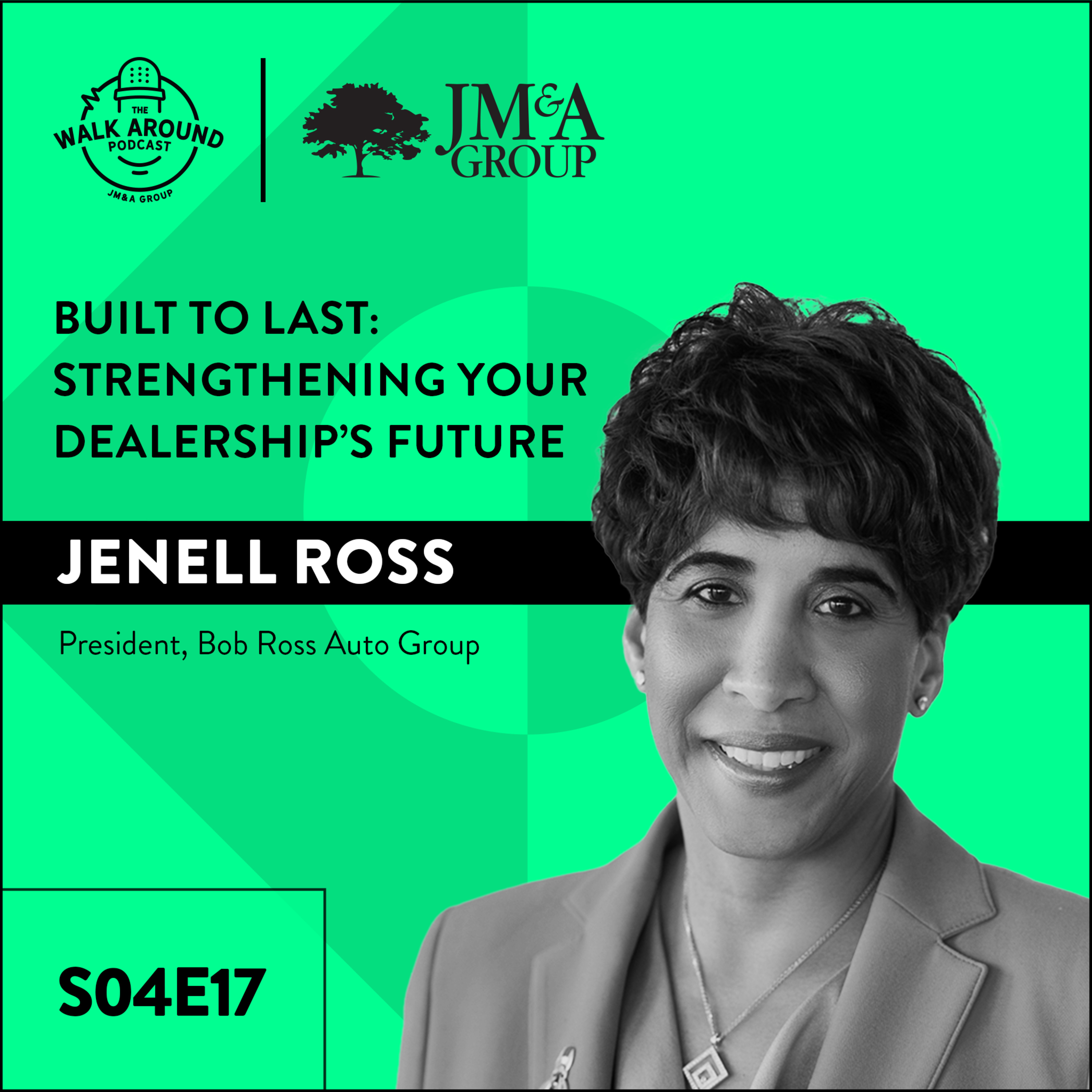
on the walkaround podcast with Janelle Ross.
Janelle's dad, Bob Ross, started Bob Ross Buick GMC Mercedes
Benz. Are we 51 years?
We are 51 years.
Young, well, yeah, years young.
And Janelle Ross has taken the helm and been such a leader in the automotive
industry, and she and I have had the pleasure of knowing each other since we
were very young girls and we're still very young.
And we are still young and fabulous because we were dancing
prior to getting started here today.
I was not dancing.
No one wants to see that.
No, the words.
I didn't know the words.
I didn't know the words.
But Janelle and I have known each other for a lifetime.
Our dads were Buick dealers.
Her dad was mentored my dad for many years and Janelle's insight
on the automotive industry and where we were to where we are today
and where we are going in the future is what we're going to dig into today.
Right, Mark? Yes, cannot wait.
Let's get to it.
Let's get to it.
Well, thank you, Heather and Mark for having me today and I'm excited to be here.
So when you think about the automotive business right now, are you positive
heading into the second half of this year?
Are you concerned?
Where's your mindset at right now on the state of the business?
Well, Mark, that's a loaded question because, as you know,
there's been a lot of volatility in the marketplace.
And unfortunately, I don't know what the best answer is.
Always want to be excited about the second half of the year,
but there is some room for caution and just wanting to make sure that
as a business owner and dealer and leader that I'm doing all the right things
to make sure I'm putting in my putting our team in the best position to be successful.
So I know I really didn't answer your question
because I think this has been the year of the unknowns and really trying
to figure out how to qualify and quantify where we are.
Yeah. So on the scale of positive or concerned, you're somewhere in the middle.
I would say somewhere in the middle.
There still has been a lot of success in the industry.
And that's where auto dealers, as we know, are very resilient.
We do like we don't necessarily like all the turmoil and topsy turviness
that sometimes goes with the business.
But unfortunately, we are risk takers and that is a part of our business.
Now, again, we would like to have some calmness along the way.
And hopefully some of that will continue to hopefully we'll get to some
of that more calm sooner than later.
You know, having been in the industry
and through so much from cash for clunkers through COVID.
And now, you know, we're looking at tariffs and affordability.
You talk about the resiliency of the industry.
What did you learn from your dad, Janelle, about resiliency?
You know, one thing that I learned from him
why I guess I would really take two things.
Number one, it's people.
You're nothing without your people.
And you have to surround yourself with great people.
They could be they need to be more skilled than you are,
have better ideas maybe than you do and have an open mind
to what they really bring to the table.
And that was really helpful for me as a 27 year old
African-American female that was thrust into the leadership
role of our dealership when my father passed at 62
to be surrounded by managers and key leaders in our organization
who some had been in the business longer than I had been living
and even some of them as long as I'd been born working for us.
So I had to rely on their skill set, their knowledge
to really make sure that we were doing the right things.
So one is people.
And two is never think that you know everything about this business.
My dad always says, you have to have the will and the want to continue learning.
And it's so true today because you think about all the automation
and technology and where we are.
I mean, he never had a computer on his desk,
but you'd ask him any number on the financial statement or where things are.
He could find it and here, you know, we were all accustomed to
finding it, right, not, not doing it to get to that answer.
And I can't imagine what he would be thinking today about where we are
with AI and digital retail and, you know, EVs, hybrids of, you know,
from a product perspective.
So I think having that openness to learn,
which brings us to name it.
Yeah. So Janelle, I want to I'm curious about what you said there
because yes, technology is a incredible expanding component of our business.
But you also talked about people and at its core,
the automotive business is still a people.
A relationship business.
Yeah. Tell us your thoughts on that.
Well, I mean, it's we can have all the tools, systems.
But if you don't have the people to still interact with your customer,
my customer, that's a problem.
And we are a relationship business.
We are a people business.
I always think that product can definitely be learned.
But the innate behaviors of understanding how to interact with people
is something that you got to have.
And if you don't understand, you know, I'm not looking for
to have Mark as a customer today.
I'm looking at Mark to be a customer today.
But is it your wife?
Is it other parts of your family?
Is it your kids when they get to have age to build that relationship?
And that's something that we've been very fortunate to have a lot of generational
opportunities and working with families in our community.
And I think that's when you really succeed.
So what has worked well for you that other dealers can start to think
about in building those relationships with customers?
I think it's just, you know, those building blocks of day one
understanding that everyone has a choice and the choices have gotten
even more complicated.
So, you know, being in Dayton, Ohio, we, you know, we have Buick, GMC,
and Mercedes Benz.
So in the 70s, 80s, 90s, we're GM town, right?
So that's where a bulk of our volume would be.
A lot of employees, retirees, family members, suppliers, you know,
you had the you had a great upper hand of at least having a cornerstone
of the market that were at least going to look to GM and take out all
the other players.
But then once they looked at GM, you know, are they going to Buick?
Is it GMC?
Is it Chevy?
So you're competing with lesser part of the market, right?
Well, fast forward when you no longer are in that having that
threshold and that loyalty factor, because the plants have closed.
And so there's not as much appreciation for the brands.
So now you're back into the open market, so to speak, right?
But it still goes back to people.
Yeah.
And you got to have the people on our team to make sure that, you know,
with those changes and and being able to adapt from, you know,
I don't want to say that they were order takers back in the day,
but it was a much different way of going about handling our business
than what it is today of trying to cultivate potential customers.
Well, it is a people business, but one of the things I've heard
you mentioned a couple of times is the evolution of our business.
And, you know, I know there's been a lot of innovation clearly
in your business and in your dealership and what you're doing.
You have a large presence in the automotive industry as being
a forward thinking dealer who's looking at how to improve things.
So what innovations, Janelle, or practices have really had
the biggest impact in your dealership?
Oh, that's a lot of questions.
And so I think, you know, there's so much out there
that we could be involved in and not everything is going,
not every system and not every tool is needed for every dealer.
That's why there's that's why everyone has a choice.
That's why that's how competition comes into play.
And you really, you know, as a leader, as an owner,
that's where you have to really look at what we represent,
what our brands are, what are the needs of our customers?
Because let's face it, a Kia customer may have a different
set of needs than even a Buick or a GMC customer
or a Mercedes-Benz customer.
So certain things may work.
And unfortunately, sometimes you have to go through trial and error
because it could be the best and the brightest and the greatest.
But what we were using before may have just worked out
a little bit better because we were able to fine tune it a little more
and making it work for us.
So I think we always have to have an open mind, but not,
you know, our teams sometimes get
because it may not be their investment. Yeah. Right.
So well, let's try this. Well, let's do this.
Well, what happened to using, you know, ABC before we get to X, Y and Z?
So I think from a leadership perspective, that's where we have to make that,
you know, that make sure that there's that accountability
for whatever we are using or whatever innovation, you know, digital retailing.
As a result of, you know, COVID, many dealers had to pivot in states
because they couldn't be, you know, eye to eye with their customer.
I'm in Ohio. We were deemed essential.
So there wasn't a day that we weren't closed.
So we had to figure it out.
So where maybe our digital retailing may not be as strong
as someone in Pennsylvania who was completely shut down or New Mexico.
You know, we had to navigate and figure out how we still sell vehicles
and service vehicles safely within those confines
and not be as focused on our, you know, our Internet and digital platforms.
Not that they weren't being utilized,
but we were just having to do things still more
in front of one another than than the others.
So your innovation took place around what your process was.
And it may not have been digitally driven.
But how are we going to continue to do this?
I mean, it was, you know, it's March.
It's Ohio. You could start getting out.
So the only thing that was open was the car dealerships,
Lowe's and the grocery stores.
So I don't need you to bring your entire family.
I mean, think about it to look for a car.
So, I mean, on one day, I mean, we had to start putting signs up to per family
because you can you can walk around a lot, but you cannot come in
because I mean, I still am responsible for our team
and not knowing, you know, they're in 20, there's still a lot of unknowns.
In 22, 23, there was still a lot of unknowns.
So just really trying to navigate through that process
and making sure that we were providing a safe environment
for our team and our customers.
Janelle, I want to go back to people a little bit, because, you know,
even with the best digital retail technology or the most dialed in process,
you still need a really engaged team and a strong team
to make your dealership a success.
So talent retention, it seems to be an ongoing challenge.
True challenge.
So what are some things that you guys have done
in terms of retaining, attracting talent into your business?
You know, one thing I think I've been very blessed, you know,
like I said early on about the longevity of the of our team,
even when my father passed, I just retired the last two managers
that worked for my dad and he passed in 97.
They just retired in 2021,
and I had a bulk of them retire from like seven, like 17 to 19,
like right before the pandemic.
So on top of going through the challenges of just survival,
you know, I'm going through the challenges of bringing on a lot of newer,
not newer, new managers, younger managers
that don't know me, don't know necessarily how we operate,
don't know your dad's history, don't know the history.
You know, and I'm used to being, you know, hey, Mark,
you know what I'm thinking?
Go ahead and finish it.
You and Heather got it.
I don't even need to finish what I'm talking about.
So I had to realize that I've had to take a lot of steps back
and, you know, provide that education, provide that knowledge, that background
and COVID has changed a lot of things.
I mean, it's changed the mindset.
I think it has made us realize we can be more flexible.
We don't always have to.
And I think the younger generation to their kudos, maybe.
Why are we doing this bell to bell?
Yeah.
You know, when I can be out enjoying my friends or my kids or my wife
or family, what have you and it's made
my generation have a different outlook on why we are doing this bell to bell.
So some good, some bad.
And, you know, I think that's where the flexibility comes in.
So now we're having different conversations with team members,
potential team members coming on board of realizing
maybe it is not a bell to bell situation.
Maybe it's something that can be, you know, co-partnered in a way
based upon a timing perspective, because you do have the skill set.
Those conversations, I don't think a lot of us were willing to have
pre-COVID because we're of the retail mindset that, you know,
in order to sell a car, you got to be there, even though your shift is
on that day, nine to two or nine to three.
That person may come in at five. Right.
And so I mean, I think that's.
I will say it has been a true struggle.
And I'm still trying to figure out where all the people are
that are hiding in somebody's basement, you know, because everyone's looking
for great people and you see, you know, we're on employment so low,
but it's we're not always getting what we need or what you're what we're accustomed to.
And not not without, you know, we understand what we need to train
and really bring and may have to bring more people along and groom them
and grow them on your own.
And that's where making sure that we're doing the things in the community
to let people know what automotive retailing is about,
because I do think we have a bad rap of who and what we are
until they get they get behind our walls and see what we do.
Janelle, someone like you is a true inspiration to women
that are in the automotive retail space.
How do you go about supporting because I know you support them
and finding women to get into the automotive industry?
And what do you think is holding them back in 2025?
So there's a lot of talent of women,
especially women of color.
And I just left the Wokan luncheon in our industry, but it may be access.
What do you mean we say access?
I mean, being in the room, having the opportunity to, you know, be a part of Wokan.
I mean, you think about when we started in the industry.
I mean, seriously, obviously, I grew up, we grew up in it.
There wasn't that sounding board for women, you know,
whereas male dealers have 20 group meetings, even from a minority dealer
perspective, there's opportunities to meet and have those collaborations.
But for women that it really hasn't been.
And even though and nothing to despite the women's networks
that have been out there in later years,
you know, Wokan kind of brings together the OEM, the supplier,
as well as the dealer side and bringing all of that together.
And that's not something you customarily see now.
So I think they're definitely not, I think they're definitely
have created something that's needed in a very comforting space
of not just networking, but really celebrating one another.
And I think that's what is a good start to what we need
to get more women involved in the industry.
And especially from a retail perspective, always want to see more women
been very blessed to always have women in key roles in our dealership
that were traditionally not women,
that a lot of women may not have held like service advisors.
We've had body shop managers.
My best parts counter are in both stores are women,
you know, obviously salespeople, but it's been a struggle to get those.
My obviously my comptroller or my strongest finance
F and I, manager is a woman.
So I mean, you know, we can definitely do the job.
They just need the access.
Yeah, that opportunity. Yeah.
Janelle, take us back.
You said you were thrust into this position
and have become a pioneer of leading a dealership group.
Take us back to what that feeling was like when you first got into it.
Like, were you scared out of your mind?
Were you excited?
Like, what was that like?
And then how how have you learned from those experiences?
Well, unfortunately, it was a Sunday and
my mother and I had been out of town.
My dad stayed back.
I mean, he was at home and we got a call and immediately
once finding that out and Heather's heard these conversations.
It's like when you you find out that a dealer owner passes,
it's very customary for the troops to just flee.
They're going to go somewhere else
because they don't know what what's going to happen and what's the stability.
They're still worried about their families,
which is what they should be and their positions.
So that Monday morning we went in,
you know, this is 28 years ago, so no internet,
but people have had the police scanners.
Yeah, yeah. So they would find out.
I was like, oh, my God, like, how do you even know this?
But, you know, and unfortunately, news travels fast, good or bad.
And it was a very calming
effect of everyone was we're here for you.
Whatever we can do, we're here to support you.
It was he's, you know, they were like, he's been a father.
He's been a mentor. He's been a brother.
He's been my boss. He's been a friend.
You know, he's helped my kids.
So it's something that I had not heard
because I had heard plenty of times at the dinner table
before the tragedies around those situations.
We have a receptionist who was at that point
would have been with us night, 10 years.
She was like, oh, my God, I'll never be able to say, you know.
You know, you've kind of, you know, what is it?
Thank you for calling Bob Ross Buick.
And I was like, all right, will you go home?
I'll answer the phone for the day because I mean,
the phone's like ringing off the hook.
And we had just the opposite.
We just had all the support.
We lost no one.
Everyone banded around us and really to
saw it as a great opportunity.
Now, mind you, that didn't mean that everyone wanted us to succeed
or me to succeed.
My mother made the decision for me to
step into the dealer role.
So I went and enrolled in the dealer academy through NADA
in the after six months after he passed.
So that first like year and a half is like a blur
because I was trying to do the academy and run a dealership.
But I was very thankful that I had gained and earned the respect
of the managers and key leadership.
How do you think you did that?
Well, I went in with understanding that.
They know way more than me.
And my dad did not go to college.
I graduated from Emory University.
And so at first he was like, well, you don't want to work in the car business.
You went and graduated from Emory.
So I was getting ready to take a position as a management training program.
You know, back in the day, that's what was out there.
So college.
And he was like, oh, no, you won't.
You'll be at the dealership Monday morning at eight o'clock.
I said, what am I going to do?
He said, I don't know.
I have the weekend to figure it out.
That was like, OK.
And that is that is real.
Right.
So I got there Monday and, you know, this was ninety two ninety three
and customer satisfaction indexes were now all the rage of,
you know, our industry, whereas, you know, you got to be compared to the Ritz
and Nordstrom's and and so he said, well, you know, figure all this out.
Figure what out?
He said, well, we need a program and we need, you know, to figure out
how we're going to, you know, find out how satisfied our customers are.
The Sewell Cadillac way.
Remember the Sewell Cadillac way.
Yes. So that's how I I mean, that was my
indoctrination into like the real side of the business after working,
you know, holidays and summers and that time and after school.
But that allowed me the opportunity.
You know, when you're dealing with customer satisfaction,
you're dealing with the good and the bad of every department.
Something good can happen somewhere, something bad.
You know, you get calls and you're calling people like, hey,
how was your service?
How would you enjoy your delivery process?
You know, well, the owner, he's crazy.
And I'm like, OK, well, now you're talking about my dad,
but I can't really like say you're talking about my dad.
So I mean, you just need to learn and I had the opportunity to go.
If I didn't know something to go to that team and say, hey,
what does this mean in regards to why they're they're not happy
with their service on what we did or what happened in the finance
office that, you know, what they thought was going to happen.
And so I just earned their respect and didn't know at the time
that I was really going to need it in a short time as someone
who had the opportunity to watch on the sidelines and hear from my dad
as he continued to mentor Janelle and talk to Janelle.
Janelle, you really rolled up your sleeves and did what you had to do
to continue the legacy that your mother and father started
and continued the journey that you're on.
And I mean, it just it's reflective of 51 years in business.
So what would you tell a dealer now who is starting out
in the business, you know, thinking about all those years
of getting involved, earning the respect and now in the position
that you're in, what would be your advice?
Surround yourself with the best talent you possibly can.
Have an open mind to make the changes that are necessary
to stay nimble and valuable.
Don't ever stop learning.
And something my dad always said, sell a few cars, make some money
and have some fun.
And on that note, yes, I think we it's time for best time for best.
And one thing I do know, I've known Mark for a long time
and I've known Janelle a lifetime.
I've got two gamblers sitting on either side of me.
These are true Vegas gamblers risk takers.
So I know we are headed down the right alley.
We're in Vegas.
We're in Vegas.
We might as well do it.
And the tables have been a little high here at the wind.
Yeah, they sure have.
OK, so here's how it's going to work.
We're going to throw out a trend or a hot take on something in the business.
And we're going to ask you, Janelle, to tell us, are you betting it or are you forgetting it?
OK. OK.
You ready?
OK. Here's the first one.
Gen Z will shop for cars entirely on mobile, no desktop, and they don't want to go in store.
Are you betting that or are you forgetting that?
I'm forgetting it. OK.
Tell us why.
Because I still think there I mean, there's a lot happening with Gen Z.
But I mean, they're the ones that are setting the pace.
They don't even want to drive the SUVs that their parents have.
So now we've gone away with a lot of sedans and passenger cars
and they're wanting to go in the opposite direction.
So I just think, you know, granted, I don't want a stereotype to say that
they're all going that way because I don't think they are.
Yeah. OK.
They still want to.
There's still something.
Now, I'm not. I would say.
Now, if you told me like how much I could bet on that, that's different.
How much would you go all in?
Would I wouldn't go all in? OK. No. OK.
All right. Here's the next one.
Customers will soon expect Amazon style delivery of cars.
Benning it or forgetting it?
We've seen it. OK.
So we've seen some success, obviously, with Kavana.
There is with other retailers in that nature.
But tell us, why do you think that's a forget?
Well, is there a time frame on this?
Are you saying that it's totally going to be?
Totally. With no time frame.
Correct. For getting it.
Tell us why.
Because there's still too many people that really do.
Come in and want to take advantage of the experience.
But again, that's one of those.
If I didn't have to go all in, if I would hedge that.
Right. And it goes back to what we were saying,
like this is still going to be a human driven people business.
It's like we want it to be totally transactional, but it's not.
So here's our next one.
This is just my opinion, people.
But I mean, there's value in that opinion.
And we want to hear it.
We do want to hear it.
Consumers, this is something that's close to our heart
on the FNI side of the business.
Consumers will expect to see FNI pricing
on the vehicle display page.
Consum repeat that for me.
Consumers will expect to see FNI pricing
on the vehicle display page.
Product pricing.
Product pricing.
Yes, product pricing.
Bet it or forget it.
You got some hard.
I'm going to have to go.
I'm going to pause.
She's going to stay with her hands.
Stay with her hands.
I'm going on the push.
Yeah, it's a push that that's a tough.
I mean, I know things are changing and evolving
and we have to have.
I know we have to have an open mind,
but I just don't know if.
If you had timeframes on these things,
then I would have a more definitive answer.
OK, that's fair.
Fair enough.
You know, if you told me by 2030,
I would say definitely forget it.
Forget it.
OK.
So we could see it.
I mean, all things are possible.
That's right.
I mean, because who would have ever thought
we're to an AI situation?
So I'm not ruling out any of it.
All right.
So let's go back to the people side of things.
The best new dealer hires will come from outside
of the automotive industry.
Betting it or forgetting it?
Since I haven't gone with it, I'll bet it.
OK.
So you see there's potential in hiring individuals.
I think so.
Yeah.
I think, you know, unfortunately,
I think that's where we're running into areas
of opportunity, we won't say concerns.
You know, we can get into the mode of, you know,
from a local perspective, you know, I'm in a smaller market
and there's only going to be so many people that are involved
in a dealership, right?
And so it's like, OK, well, they used to work for you
or they used to work for you.
And now, so it's that revolving door.
Is that really what we need or want to grow and move
forward?
So I think we do need to bring individuals in that have
been in maybe other types of sales or marketing positions
because you have to think, you know, 20, 30 years ago,
some of the positions that we have on our team didn't exist.
It wasn't really customary or needed
to have a college degree.
But now it's like, great, you have, you know,
different thought leaders from a marketing perspective,
product concierge, these internet specialists.
You know, I got diagnostic technicians
that are, you know, filling out a room with a problem.
They got to be able to navigate and read
and get into the nitty gritty of things.
And it's, you know, not just turning wrenches.
It's a different person.
Higher skill that we have today.
Higher skill.
Well, I think we are between happy hour.
And that's right.
So do we want to go with our million dollar?
The poker chip?
Yeah, the poker chip.
So Janelle?
Last question, Janelle.
You're at the table and you've
got a million dollar poker chip in front of you.
And you've got to place that bet on one investment
in your dealerships.
Where are you placing that bet?
From a department perspective.
From a department perspective.
Wherever you think is the most.
Where are you going to get the most value in that investment?
People.
How so?
It's a theme today.
I think so.
It is a theme.
Tell us more.
Can't do it without people.
I mean, right now, there's 100 people back in Ohio
that are making things happen before the end of the month.
So is it hiring practices?
Is it retention practices?
I mean, you got to I mean, it's a one whole collaboration
of making it work because even though I have three buildings,
even if I'm there in one building,
there's got to be people in the other buildings
in the other departments that are getting getting things done.
Understanding why they're there,
how their position plays into the the entire organization.
One thing that I always say to everyone on our team
is when someone says, oh, you know, when I did this
and I did that and I'm like, really?
So I understand you sold the car.
Did you clean the car?
Did you PDI the car?
Did you gas the car?
Did you wash the car?
You just sold the car.
Did you do the paperwork on the car?
So there's no one on our team that I said,
and I asked them, I said, who on who here
can do their job 100% on their own?
You got to sit back and think.
It takes a team to make it happen.
Coming in for service, the advisor, the lot tech,
the technician, all the way, the parts department,
all the way through.
It's a team.
It's hard to argue at that point.
It is hard to argue.
So do I still get the million?
You said it.
Well, at the end of the day, Janelle is a people business
and I would say the legacy that Bob Ross and Ray Wilkinson
have left for the two of us.
The automotive industry is lucky to have us
and we are very lucky to have you on the Walkaround podcast.
Thank you.
Thank you, Mark and Heather for having me.
Thank you, Janelle, appreciate the time.
We really appreciate you joining us today
on the Walkaround and we hope you enjoyed the episode.
Please be sure to like, share, subscribe, and follow us.
We look forward to seeing you next time
on the Walkaround.

0:00
33:16