Fixed operations are the parts of a car dealership that handle repairs, maintenance, and selling car parts, which help the dealer make money all year round.
A multi-point inspection is when a mechanic looks at many important parts of your car to make sure everything is working well and to find any problems early.
Transparent pricing means the car shop tells you exactly how much things will cost and what they are doing, so you know what to expect and can trust them.
DMS is a computer system that helps car dealerships keep track of cars, sales, and customers all in one place. It makes running the dealership easier and faster.
After you buy a car, the dealership usually connects you with the people who fix and maintain cars. This helps you know where to go when your car needs service.
Technician development programs are classes and training that help car mechanics learn new skills and get better at fixing cars.
LIVE
This is a game changer for dealerships and for the consumer
because the consumer now is getting transparency
from the dealership,
and dealers are seeing an uptick in work
because the work is being approved,
but dealers are seeing a big, big gain
in fixed operations in labor and parts.
It's everyone's dream to grow, to be a bigger dealer,
to be a better dealer, or even get your first dealership.
Car buying is about the people.
Everybody wants to know what's a car business like,
and they like to see it under the hood.
Welcome to the Walk Around podcast.
I am one of your hosts, Mark Spoto,
joined by my co-host, Heather Wilkinson.
Hello, Heather.
Hello, Mark.
I am thrilled to be with you.
This is fantastic,
and it is great for us to be back together again.
Always.
Interviewing some fantastic industry experts and dealers.
You know what I'm also thrilled about, our guest today,
Ted Ings.
If you don't know Ted, you're probably living under a rock.
I mean, he showed up to us with his own crew.
Yes, he did.
Reporters and videographers.
So there are people out there that may not know him.
So we want to bring you his insights.
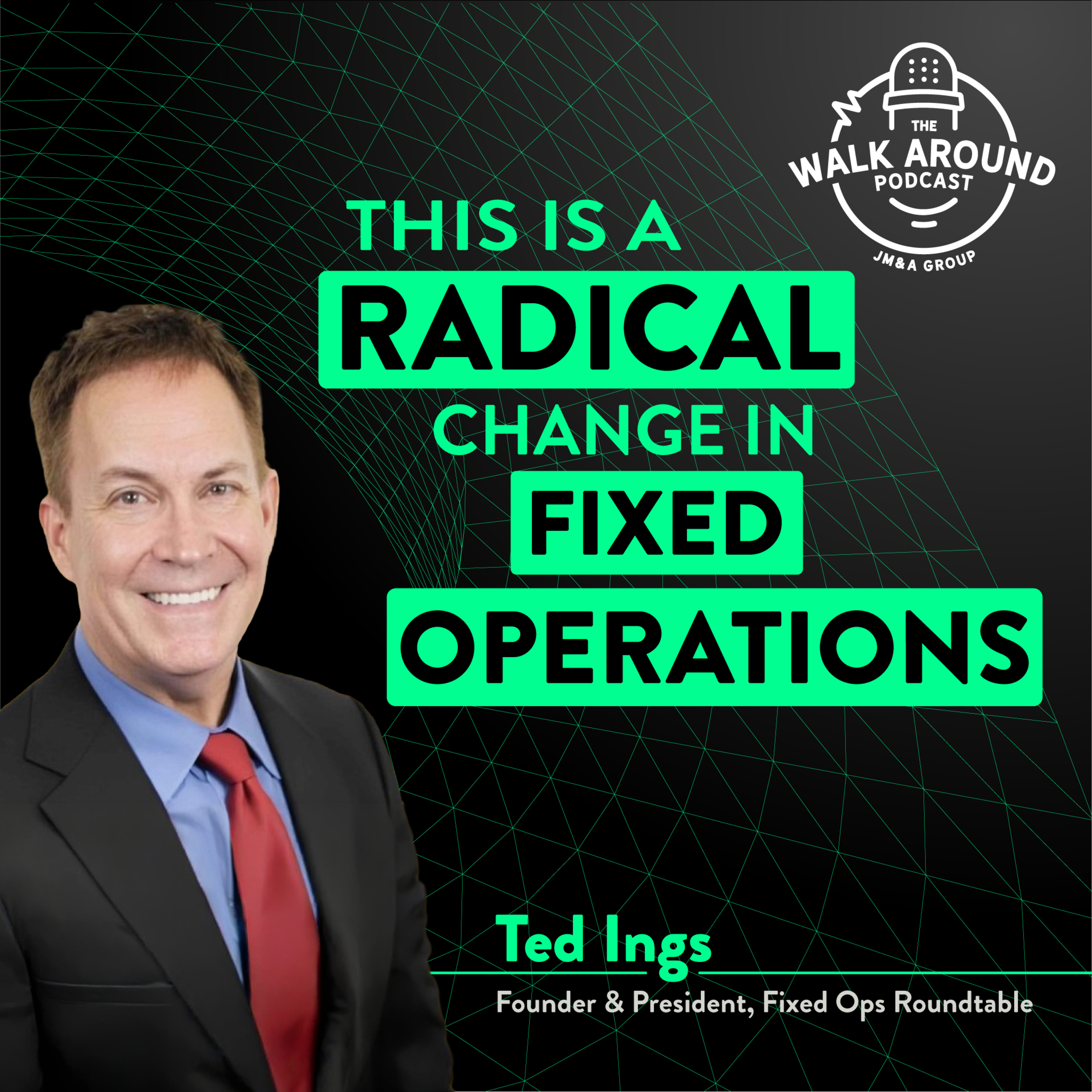
He is founder and president of Fixed Operations Roundtable,
and the Fixed Operations Department, the Service Drive,
it is such a huge opportunity for dealers into 2026 and beyond.
When you think about all of the challenges,
all the margin compression on the front end of the transaction,
what better opportunity is there to drive profitability,
to retain customers, to drive loyalty,
than focusing more on your fixed operations?
Would you agree with that, Heather?
I agree.
It is the heartbeat of the dealership operations service
in parts, especially when you look at the affordability
opportunities consumers are keeping vehicles longer.
Love the message that Ted gave today to our listeners.
Should we take a walk?
We should.
And when you think about how many touchpoints a service drive
has with your customers compared to anywhere else in the store,
it seems kind of obvious, but often neglected.
It's most certainly that.
And Ted gets into that.
So enough from us.
Let's hear from Ted.
We are thrilled to have Ted Ings with us
on the Walkaround podcast.
Welcome, Ted.
Thanks so much for spending time.
Guys, thank you.
I'm honored that you would have me in,
so I appreciate it very much.
It is a pleasure to have a Fixed Ops expert here
to share with our listeners all things they should be thinking
about to drive performance in their service and parts
departments, which are so critically important today
for dealers as we're dealing with affordability,
expense control, inflation, and the economic uncertainty.
Would you agree?
And the age of vehicles out there now
being approaching 13 years, right?
I think it's gone up to 10ths from last year.
I think it's 12.8 years, the average vehicle out there.
So people are investing in their vehicles
and dealers need to invest in their fixed operations
at the same time.
They most certainly do, Ted.
So let's just kick it off with, what would you say
is the biggest Fixed Ops innovation that
is making dealers more efficient?
You know, I would say, Heather,
that three or four years ago, Fixed Ops Roundtable,
we were probably more concerned with things like tools
and chemicals and stuff like that.
Today, it's technology and, in particular,
on the technology are these front-facing videos
that the technicians are performing now in the shop
that are going out to the customers,
giving them an update on the status of their vehicle.
The MPI, the multi-point inspection video
from the technician, giving them an update.
And historically, the tech in our industry
has been what, behind the door, behind the garage door.
You never saw the tech.
Never had or knew who he was or anything about him.
You talked to the service advisor
and that was kind of like the go-between, right, Mark?
So you had to wait for that update,
but now the tech is front-facing
and telling the customer in a video
that we're using our phones to watch.
And by the way, the customers dig it.
They like it because they're hearing from the doctor
working on the vehicle,
hearing what's going on with their vehicle.
They could see it's their car up on the lift.
The customer, I mean, we never get to see our car
up on the lift, right?
And here, that's our car.
That's our license plate.
And here, the technician is telling us what they saw, okay?
Whether it's maintenance or whether it's for bigger repairs.
And the technicians now in a professional manner
are addressing the customer.
And this is a game changer for dealerships
and for the consumer because the consumer now
is getting transparency from the dealership.
They're helping build trust with the doctor
who's working on their car.
And they can give an approval a lot quicker
or ask questions for clarification a lot faster.
And dealers are seeing an uptick in work
because the work is being approved and performed now.
We're historically now up until now
you didn't get those approvals
and at least not that fast if you did at all.
But dealers are seeing a big, big gain
in fixed operations and labor and parts.
It has to be impacting the credibility
from a customer's perspective of the recommendations,
seeing the technician working on their vehicle.
So they're more inclined to click, yes,
when they get that text message.
It sounds like it removes some of the mystery
from this whole process, right?
Where sometimes customers feeling they're left out
or they're uncertain of what's happening.
This kind of breaks down that barrier.
Yes, and to address what both of you just said,
we're also seeing that not only is the customer
watching these videos, the customers are sharing the videos.
They're sharing it with friends and family.
And by the way, the dealers are watching this
and they're measuring who's opening the videos,
how many minutes they're watched,
but they're also seeing many of the statistics among them.
How many times was it shared?
And it's amazing now that these tech videos
are being shared by the consumer and their friends
and saying, look what just happened at my dealership.
And now they're almost on a first name basis
with the technicians as well.
So that's huge.
Ted, is this a big change for a dealership to implement?
Is it a relatively easy process
to start using a technology like this?
Or is this a big degree of change management?
Well, it's a radical change and it is much easier now
because of the companies that have come in.
There are a lot of companies,
including some of the big DMS companies
who are all now very much involved
because the dealers are seeing high ROI.
And everybody wants to get in on it and improve.
And now we're working on improving things like the sound,
and we're moving background noise.
So that the technician now has a much better quality video
and things like video quality
are being scored by the dealers now.
So that's all new.
So it's relatively easy.
However, anything that involves change
is gonna revolve at resistance, right?
Heather, you know that.
And anytime we introduce something new,
whether it's a menu or whether it's a new process,
instinctively, and especially technicians
are gonna push back on that.
But once they see their fellow techs
are getting approvals and getting the work performed,
and not only that, it's saving time
in terms of efficiencies.
Because before you had to have the technician
maybe pull the car out of the stall,
pull it back into the lot, wait for the tech
to hear from the advisor or from the customer.
Now they're pulling it back.
They don't have to leave the bay now.
The car's still there,
and we have an approval within minutes to get started.
That sounds like an awesome opportunity for stores.
We wanna pivot a little bit, Ted,
and we hear a lot about the connection
between the service department and the CIS department.
Trying to build more customer retention,
trying to increase customer lifetime value.
What are some things you're seeing that are working
to help collaboration between service and sales?
Service drive acquisition,
which means sourcing vehicles on the service drive.
Reconditioning is bigger than ever
for dealers on the sales and on the fixed-up side.
There's a shortage of good-used cars.
It seems there always is, Heather, Mark.
The best place to find them may not be at the auction.
It's on your own service drive.
So dealerships who have put together a process
where they're now offering the customer
in a very, not a very pushy way,
but while the vehicle's in the shop today,
can we give you an estimate
of what that vehicle may be worth?
Courtesy appraisal.
Because we're paying top dollar today.
And if they have the dealership has a process to do that,
it makes it a lot easier for the consumer to say yes.
Now, of course, not every customer says yes,
but a very high percentage of customers will.
And the dealership already has the service records.
The car can be put up on the lift.
We're at the auction, they can't take a look at that.
And very often the dealership sold that car.
So that is bringing sales and service together.
And parts, this part doesn't get a lot of love, okay?
And parts is a huge part of the dealer profit equation.
You can't sell service without parts.
You gotta have those parts on hand.
So, reconditioning and looking at vehicles
and doing this acquisition process,
I think is a great example of sales
and service coming together.
Are there areas that we can improve on,
on the sales side and on the service side?
Absolutely.
I'll give you a great example.
One that historically we've been very poor at
as an industry and that's the sales to service handoff.
Once a customer buys a vehicle,
every dealership has a process
that the customer will be introduced
to the service department.
Do they do it?
Probably not too often.
And certainly, even the ones who do don't do it well enough.
I bought a vehicle recently
and the sales person never showed me,
when you come in for service, where do you go?
Do you pull into the shop?
Do you park out on the lot?
What is the process?
The customer needs to know that.
Because that's all part of building the relationships.
Again, the trust and the transparency as well.
Absolutely.
And I would bet with that communication,
that partnership,
we will see continuous increase in profitability
in our fixed operations,
which is a great way to head us into our segment of best bets.
You mentioned bets.
That's right.
Because we got some hot takes we want to throw at you, Ted.
Go ahead.
Based on your experience, based on what you're seeing,
we're gonna ask you, are you gonna bet this
or are you gonna forget it?
So bet it or forget it?
All right, I'll try.
Are you a gambler?
I'll try.
It depends on the question.
All right.
All right, so as a dealer,
a top service advisor has more long-term influence
on customer loyalty than your top salesperson.
Bet it or forget it?
Oh, bet it, a thousand percent.
A thousand percent.
Tell me why quickly.
Because how many customers does a salesperson talk to a day?
Whether they average eight to 10 cars a month sold.
So they talk to what, two, three, maybe, okay?
On average.
Service advisor's talking to how many?
Typically, average service department's
writing 20 to 25 hours a day.
So there's your answer.
You're exposed to more people.
And by the way, when the customer has a question on repairs,
do they want to ask the salesperson,
are they gonna go back to the service advisor?
They're gonna go back to the service advisor.
So bet on the service advisor.
All right, number two.
AI tools will diagnose vehicles
before a technician even opens the hood.
Bet it or forget it?
Get to be seen.
Get to be seen.
Okay, so you're kind of-
Maybe, it might happen.
Again, AI is a very good bet
as long as it doesn't disrupt
what the dealership is already doing well.
And I think that's what dealerships
are very much rightfully fearful.
Okay, I don't want to disrupt
something that's already working
unless it's proven that this is actually gonna happen, all right?
So in some areas, AI is working extremely well.
I'll give you an example on warranty.
Okay, warranty filings, things like that.
It's getting better on phone calls and incoming calls
and so on.
You're seeing some manufacturers now using AI as well
in that helping text with the diagnosis process,
but yet to be determined.
I'm on the fence.
And I think I've heard on FixOp's round table, Ted,
that AI is enabling processes for service advisors
to spend more time in front of the customer
and less time doing things that take up their time
and they're not engaging with that customer.
Am I correct?
Heather, I'm glad you're listening to this.
I've listened to the show.
I love it.
All right, last one.
The technician shortage will be the single biggest threat
to dealership profitability in the next two years.
Edit or forget it?
Forget it.
Forget it.
There's no technician shortage.
Really?
No.
There's no shortage of technicians.
You're sagging against what we're hearing
from a lot of people in the industry.
There's no shortage of technicians.
There's a shortage of technician development programs.
Awesome.
The shortage is dealerships who grow their own technicians
are doing extremely well
and they have a waiting list of techs
to come to their stores
because the techs know from their peers
who are the dealerships to work to or not.
Culture is a big factor, a determining factor
if a technician's gonna work for a dealership.
Think about it.
For years historically,
we have disregarded the technician.
It's dirty, they're uneducated, they're back there
and now they're now respected, right?
They're now some of the most highly educated
and skilled people in the dealership.
So the issue is not having technicians.
It's having a technician development program
to develop your decks
and not having to go out and recruit them
or try to recruit them from other dealerships,
which is a failing strategy.
That's right.
Well, we heard it here first, Mark.
We sure did.
If you're not listening to Ted.
If you're not listening to Ted.
You're doing something wrong.
Ted-ings, fix-ops round table,
development of your technicians, culture.
You guys are great.
This is fantastic.
Thank you so much, Ted.
Thank you, Ted.
Great to see you.
We really appreciate you joining us today
on The Walkaround
and we hope you enjoy the episode.
Please be sure to like, share, subscribe and follow us.
We look forward to seeing you next time on The Walkaround.
About this episode
Ted Ings, founder of Fixed Operations Roundtable, discusses how video technology is revolutionizing dealership fixed operations by increasing transparency and customer trust. Technicians now create front-facing videos explaining vehicle issues, leading to faster approvals and higher service department profits. The episode also highlights the growing importance of fixed operations amid rising vehicle ages and economic challenges, and explores improved collaboration between service and sales departments, including service drive vehicle acquisition. Ted shares insights on the critical role of service advisors in customer loyalty and the cautious integration of AI in diagnostics.
Ted Ings of Fixed Ops Roundtable shares fixed ops technology innovations, including technician video MPIs and AI, and explains how they improve transparency, approvals and strengthen overall service department performance.
Episode Breakdown
00:00 - Meet Ted from Fixed Ops Roundtable!
03:07 - What's the biggest Fixed Ops innovation?
05:29 - Measuring video engagement and ROI
06:04 - Implementing the technology
07:30 - How service drive acquisition is connecting departments
09:07 - Sales-to-Service handoff
10:20 - Service Advisors vs Sales: Impact on customer loyalty
11:03 - Will AI tools diagnose vehicles before techs?
12:13 - The technician shortage debate
For more information about our guest, visit their LinkedIn.
Liked this episode? Find our full episode library here.