Subcompact hatchbacks are small cars with a back door that opens up, making it easy to put things inside. They are usually cheap and good for city driving.
Vehicle segment means the type or size of a car, like small cars, big cars, or trucks. People usually look for cars in the group that fits what they need.
The Toyota Highlander is a type of SUV that many families like because it is reliable and has plenty of space. People often buy used Highlanders because they last a long time and are good for everyday use.
The Toyota Corolla is a small car that many people buy because it doesn't use much gas and is affordable. It's a popular car for daily driving and is often bought used.
An 84 month loan means you pay for your car over seven years. This makes monthly payments smaller but can cost more money in the long run and might make you owe more than the car is worth.
When you lease a car, you pay money every month to use it, but you don't own it. Usually, the company takes care of repairs and maintenance, so you don't have to pay for those.
Where a car is put together can change how much it costs. Cars made in the US usually cost less because they don't have extra taxes from bringing them in from other countries.
Fixed operations are the parts of a car dealership that fix and maintain cars, like the service and parts departments. They help the dealership make money even if fewer new cars are sold.
JD Power is a company that studies how happy car buyers are and how good cars are, helping people know which cars are reliable.
LIVE
It's when you're sitting around the kitchen table
paying bills, it's the monthly payment.
Yes.
That is affordability to consumers.
I see there's a lot of reasons to be optimistic for 2026.
The industry has a lot of good tailwinds coming into 2026.
It's everyone's dream to grow, to be a bigger dealer,
to be a better dealer, or even get your first deal shook.
Car buying is about the people.
Everybody wants to know what's a car business like
and they like to see it under the hood.
Welcome to the Walkaround Podcast.
Hello, and welcome to the Walkaround Podcast.
And I'm your hostess today, Heather Wilkinson.
And I'm so pleased to be joined by Tyson Jomney from JD Power.
And we're excited to take a little bit of a step back today
to look at the impacts of 2025, the affordability concerns,
consumer demand, and interest rates.
And hear from Tyson and his perspective
on what dealers should be excited about.
And Tyson, looking forward to the conversation today, right?
Yeah, Heather, thanks for having me.
Yes, it's very much.
So let's start with affordability, Tyson.
And that's been the hot topic.
It was a hot topic in 2025 and continues
to be top of mind for dealers.
Share with us today your perspective
on the affordability concerns that dealers have.
Well, a lot of people seem to think affordability is solved
or perhaps caused by subcompact hashbacks.
Like if we just have the cheapest vehicle out there,
then we have affordability solved.
And the reality is that's not how consumers shop.
Consumers shop by segment.
And if you're a family and you need a three-row crossover,
you don't frankly care if there's a hatchback in that lineup.
You need a three-row vehicle.
And so most consumers shop that way.
So for consumers to approach affordability,
one, it starts by segment.
And if you need a three-row,
if you need a mini-man or a pickup,
or if you're a commuter and you need a car to get you,
like we have to address consumers with where they are
and how they shop to start with.
So it's not just show them the cheapest vehicle.
It's show them the cheapest vehicle in their segment
and that meets their needs, of course, right?
But so that's kind of different from a lot of people
think about on the surface.
But then really the way consumers approach affordability.
And when I look at my data and my numbers,
I always try to take that consumer view of things.
It's when you're sitting around the kitchen table
paying bills, it's the monthly payment.
That is affordability to consumers.
I'm a data nerd, I'm an industry analyst.
I talk about transaction prices and incentives
and vehicle price and all these different metrics.
Consumers don't give a rip about that.
They want a monthly payment that they can afford.
And what are they seeing?
Well, of course, in the past several years,
a loan payment has gone up pretty significantly.
I think we know from roughly $500 ish for a new car
pre-COVID to these days $760 a month.
Just under $800 a month has become the norm.
The average vehicle.
And it's not just new vehicles,
it's used vehicles as well.
Back in the day, a $500 used payment
would get me a used Highlander.
Today that gets me a used Corolla.
I mean, things have shifted so dramatically
both on the new and used side.
But there are ways, of course, to address this.
The most obvious one, consumers can extend their term.
It does help, it does lower the monthly payment.
That may not be the right decision.
And as dealers, we'd certainly be concerned,
will this consumer stay out of market longer
if I put them in a longer term?
One of the things we were talking to a dealer about
is that term and the extended terms.
And we're starting to hear dealers
where they're in situations where customers
are looking at beyond a seven year term,
looking at 96 months.
And what's the data telling you about that?
And I know it can't be good for a consumer
to be financing a vehicle for 96 to maybe 120 months.
Please don't say that.
Right.
I mean, part of the challenge is
when we start talking about 84 months,
I'll be frank, a lot of consumers can't even do that math
because you have to start to use your fingers
to do that math.
Any loan that goes longer than a lot of marriages
is perhaps not something we wanna put consumers into, right?
We really need to think about that.
But for some consumers, that's the only thing they can do.
An 84 month loan on a truck,
maybe not as bad as an 84 month loan on a used vehicle.
So that is somewhat of a concern.
What we do see in the data though
is that consumers in longer term loans
have not significantly adjusted their return to market times.
They haven't.
So they're still coming.
So that's some positive news for dealers.
It is.
And it's driven by the fact that used values remain so high.
From COVID till now,
we've had a significant loss of new vehicle sales.
Yeah, not as many consumers were leasing vehicles
between 2022, 2023.
I know there were consumers that who were in leases,
they were buying them out and keeping those vehicles.
Right, we're not just losing that.
We're also losing, consumer, we didn't sell a new vehicle.
And when we sell a new vehicle,
we always get to use trade-in as well.
That, you know, a new vehicle sale is the marble
at the top of mouse trap
that always starts the whole thing going downhill
and, you know, creating all the magic.
We weren't getting the trade-ins either.
So we're losing used vehicle sales from lack of trades.
We're losing them from a lack of leasing
and then consumers buying out.
So we don't have a lot of used vehicles.
And that's helping to keep used trade-in values high.
So as a consumer, when we're extending them into terms,
longer terms, the good news is that
the used values are high
and we do forecast them to remain above historical mean
really through the end of this decade.
So do you have any data points that a dealer could draw off of
as far as acquiring used cars?
Is there some type of focal point that could be looking at
where they could increase that inventory
from a used car perspective?
Well, I mean, I think we all know the oldest rule in the book,
how to get more work your service lanes.
I think what, you know, what we really found
when you were talking about buying out leases,
a lot of consumers bought out their luxury cars.
And when you think about the luxury car lessee,
all they've known their whole life is a lease payment
and gasoline bills, you know, they don't think about,
they don't have to deal with maintenance.
You don't have to deal with repairs.
And now these consumers bought out their vehicle, their leases.
And now for the first time in their lives,
they have to get new tires.
They have to pay for oil changes,
let alone, you know, God forbid something breaks in the car.
Now they're in for some serious repair costs.
The service lanes, particularly for premium makes
is a fantastic way to source vehicles.
Cause my guess is a lot of those consumers,
they want to get out.
Yes.
And they want to trade in that car.
Absolutely.
Now I know that you just recently did some reporting out
on the OEMs and some data points around their performance.
Do you want to talk a little bit about that today?
Well, I mean, looking at 26, you know,
I hear a lot of negativity.
Maybe it's because I hang out on Twitter X
or whatever too much.
And, you know, I just see people, you know,
being intentionally obtuse there and pessimistic.
I see there's a lot of reasons to be, you know,
optimistic for 2026.
The industry has a lot of good tailwinds coming into 26
that maybe on the surface we don't think about.
I mean, interest rates continue to fall.
We know that the number of lessies coming back to market
this year are going to increase.
About 500,000 incremental lease returns
are coming to market in 26 from 25.
Those consumers have to get into another car.
So we have a built-in cushion there of another 500,000
or so sales on top of everything.
And in the industry, we're really at a midpoint
in the cycle dynamics.
What do you mean when you say midpoint
in the cycle dynamics?
Well, when we get to the top of the cycle,
we'll have three to four million units on the ground.
Incentive spend will be 10 to 12% of MSRP.
Fleet channel is stopped.
I mean, we're just putting cars everywhere
and trying to move the metal any way we can.
We're nowhere near those dynamics.
We have two million vehicles on the ground
for dealers to sell.
Incentive spend is contained.
We aren't really using the fleet channel very much.
So we have a lot of levers and release valves.
So the automakers have a lot of options
that they can do either to keep demand high
or if demand starts to flag,
they could step in with more incentives
and keep new cars selling right now.
So we have a lot of good opportunities here in 26.
Well, I love hearing that, Tyson,
because coming in, the concerns
that we've most recently heard around economic uncertainty,
inflation, affordability gave some concern
about the performance of the industry in 2026.
Can we talk a little bit about the SAR
and the expectations that you're projecting
or may feel like we may end up
from a SAR perspective in 2026?
Yeah, our SAR math was pretty easy.
It's exactly the same from 25 to 26.
Okay, so we're looking to be flat, okay?
We showed it to everybody yesterday.
We're like, no guys, we actually did the math.
This is just how it came out.
We weren't getting lazy here.
So we think it's gonna be a 16, 3 million SAR again.
We're probably on one of the more optimistic ones.
But again, we build our forecast from the bottoms up
and all these factors we just went through
indicate that we have a lot of reasons
that we can keep demand at that level.
So we do expect a 16, 3 million SAR.
We do expect transaction prices to go up about 2% this year,
which means that we don't expect tariffs to be passed through.
And that's interesting.
So because typically we've been hearing anywhere
from a 10 to 15% increase being passed through,
but you're only hearing 2%.
So automakers are absolutely absorbing those tariff costs.
They are getting hit.
Those are real.
And just because they're not showing up in the market
does not mean they don't exist.
Automakers are getting, but they can't pass them through.
And this is the interesting thing about the auto industry
being it's a global industry, a global supply chain,
global production base.
So if you're an automaker
and you assemble a vehicle in Japan or Korea
and you bring it in and you're getting hit with a tariff
and you want to pass that through,
in some cases, you really need to pass that through.
You would be the only one in the segment doing that
in your volumes with tank.
So as a result, particularly the larger vehicles,
full-size SUVs and crossovers.
So if you assemble yours overseas and bring it in
and try to take pricing,
you're going to get hit with volume big time
because most of those vehicles are assembled in the US.
And so that asymmetry is what is keeping the lid on prices.
The cost are real, the pricing has been very moderated.
Interesting.
Can we talk a little bit about interest rates?
I heard you mentioned, as we were going through,
you're talking about interest rates.
You see them not changing a little bit or going down.
What's your outlook for 2026
as it relates to the interest rates?
Well, I'm not an economist.
I do play one on podcasts though.
But we do expect interest rates to continue to fall.
They're down about 40 basis points
on the year over year basis as we exited 25.
So there's reasons to be optimistic
that interest rates will continue to moderate.
That said, they are still in the sixes,
six and a half percent range for an unsupported loan.
We do expect to see automakers continue
to offer supported interest rate loans for consumers.
When that will help in that regard,
I mean, when the standard rate is 6%
and someone offers you one nine or even zero,
that's a really big bonus for consumers.
Very much so.
And if the manufacturer plans to continue
to support with those sub-Vinnet rates,
support with these programs,
it sounds like the outlook for 2026
is a lot more positive than what we may have been thinking
prior to in the last month or so
from what I'm hearing you say.
Yeah, but think so.
And you mentioned leasing.
And one other way to address affordability
is that lease payments are about $120 cheaper a month
than loan payments right now.
So for a lot of consumers,
that's another way we can continue to keep affordability
in check is we can get consumers in leases as well,
but recognizing not everyone can lease
and that takes a little more selling.
But again, we are very optimistic
or at least we think 26 will at least equal sales to 25.
Transaction prices will go up,
which means the total dollars consumers are spending
on new cars in this country will set an all-time record.
So we expect to see that grow about 2% as well.
So it's a very robust industry.
Again, we're not at peak dynamics here.
We're mid-cycle.
We have a lot of reasons we can continue to do well.
It sounds, and that's what we want to hear.
Anything on fixed operations that the data has shown
that you see for 2026,
dealers are very reliant on their service and parts department
and the fixed operations covering their expenses
and being able to help maintain profitability.
Consumers are now, what's the average age of vehicles?
I heard just over 13 years now.
How is that going to be a variable for dealers in 2026?
We continue to see fixed ops being one of the, of course,
major profit centers of any dealership operation.
We are seeing a number of brands start to do particularly well,
whether it's service retention, fixed right first time,
doing very well in the FNI side of the business.
I don't know if there's any particular big breakthroughs
coming, but when we look at the three biggest expenses
that an automaker occurs after a vehicle is produced,
the marketing, the incentive spend and the warranty
and the ability to impact warranty expense
remains so big for automakers.
That's something they're going to continue to focus on
here in 26 and beyond.
I think we've got a lot to look forward to
based on what you've shared today, Tyson,
and we certainly appreciate thank you very much
for your perspective and sharing the insights from JD Power.
Again, we are looking forward to hearing more
throughout 2026 and looking at a strong SAR from 2025.
We'll be flat, but we're looking forward to a great year.
You heard it here first.
All right, thank you, Tyson, we appreciate it.
We really appreciate you joining us today on The Walkaround,
and we hope you enjoyed the episode.
Please be sure to like, share, subscribe and follow us.
We look forward to seeing you next time on The Walkaround.
About this episode
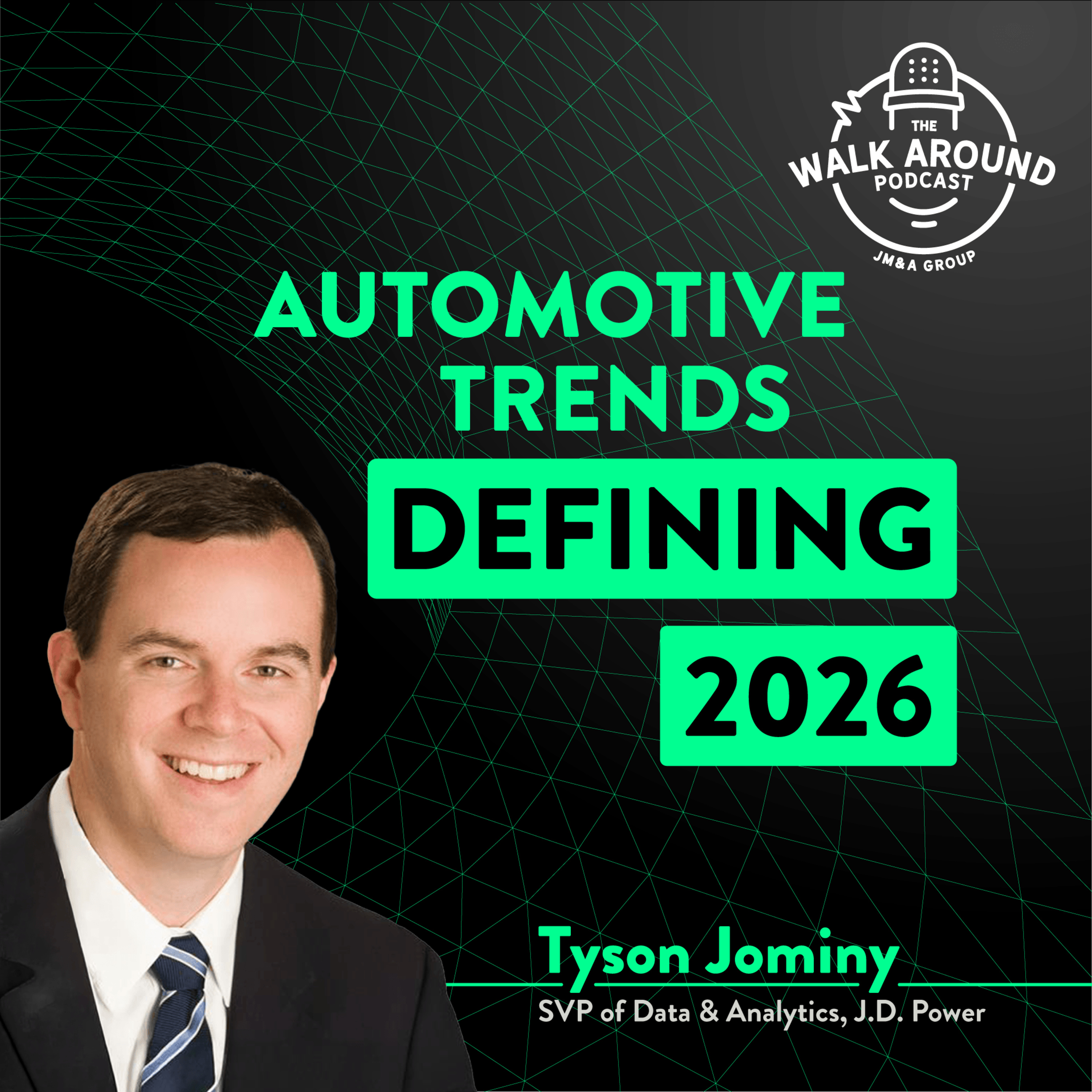
Tyson Jomney from JD Power shares an optimistic outlook for the 2026 automotive market, focusing on affordability, consumer demand, and interest rates. He explains that affordability is about monthly payments rather than just vehicle price, highlighting the rise in loan terms and the importance of segment-specific options. Tyson discusses the impact of lease returns, used vehicle inventory challenges, and automakers absorbing tariff costs. He expects flat sales at 16.3 million units and a slight rise in transaction prices. Interest rates are forecasted to decline, supporting affordability, while fixed operations remain crucial for dealer profitability.
Christian Crain, VP of Crain Automotive Holdings, discusses leading a 23-store dealer group, their focus on seamless operations and how they are addressing the affordability challenges their guests are facing now.
Episode Breakdown
00:00 - Meet Tyson Jominy from J.D. Power
01:05 - Affordability and the role of monthly payment
03:29 - What longer loan terms mean for dealers
04:36 - Limited used supply and strong trade-in values
05:38 - Service lanes as a used inventory opportunity
06:49 - Does the 2026 demand outlook remain optimistic?
08:47 - SAAR forecast and vehicle price expectations
10:40 - Interest rate outlook and OEM-supported financing
11:46 - Leasing as an affordability strategy for dealers
12:33 - Fixed ops profitability and warranty impact
For more information about our guest, visit their LinkedIn.
Liked this episode? Find our full episode library here.