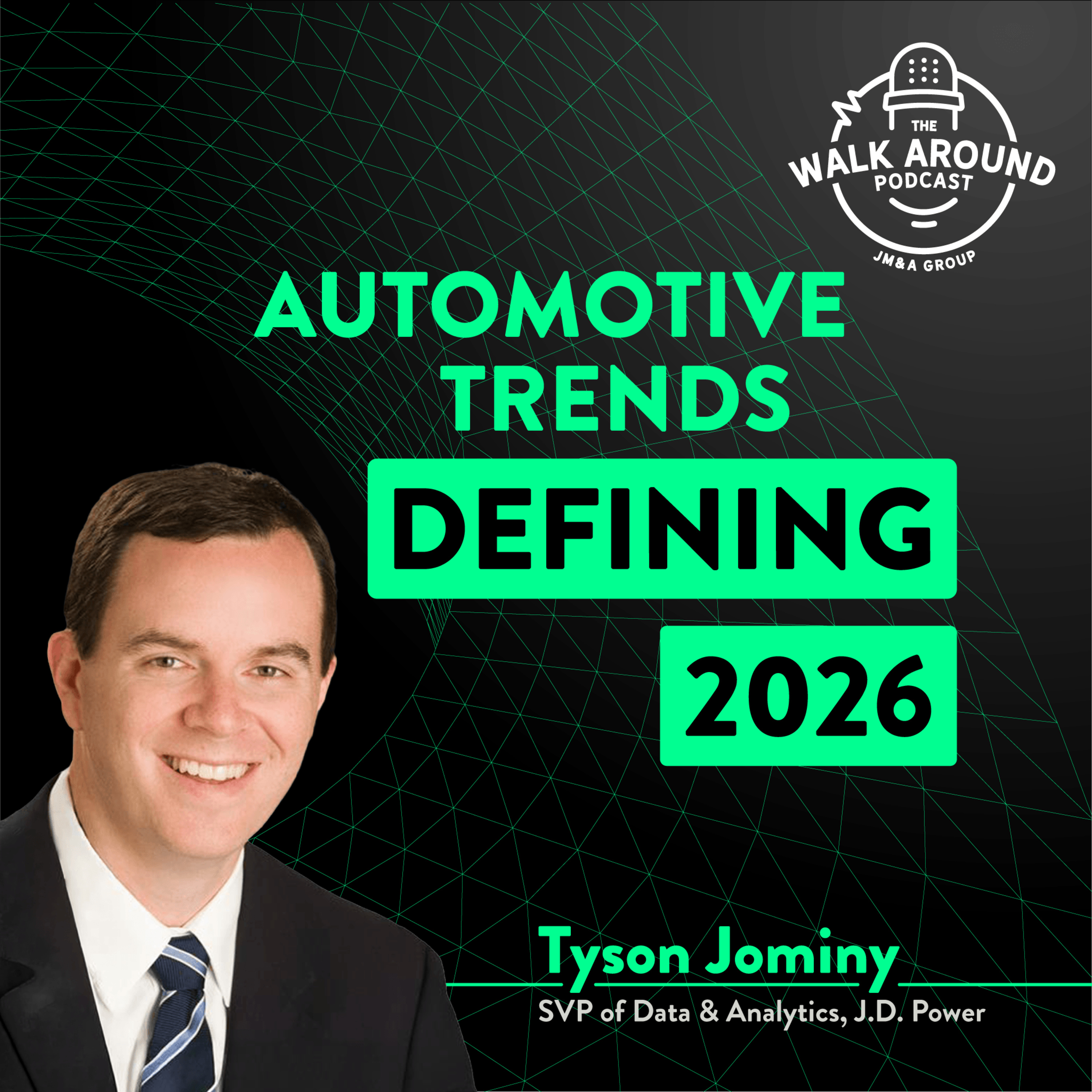
S5E06 - 2026 Automotive Market Outlook: Affordability and Demand
About this episode
Tyson Jomney from JD Power shares an optimistic outlook for the 2026 automotive market, focusing on affordability, consumer demand, and interest rates. He explains that affordability is about monthly payments rather than just vehicle price, highlighting the rise in loan terms and the importance of segment-specific options. Tyson discusses the impact of lease returns, used vehicle inventory challenges, and automakers absorbing tariff costs. He expects flat sales at 16.3 million units and a slight rise in transaction prices. Interest rates are forecasted to decline, supporting affordability, while fixed operations remain crucial for dealer profitability.
Christian Crain, VP of Crain Automotive Holdings, discusses leading a 23-store dealer group, their focus on seamless operations and how they are addressing the affordability challenges their guests are facing now.
Episode Breakdown
00:00 - Meet Tyson Jominy from J.D. Power
01:05 - Affordability and the role of monthly payment
03:29 - What longer loan terms mean for dealers
04:36 - Limited used supply and strong trade-in values
05:38 - Service lanes as a used inventory opportunity
06:49 - Does the 2026 demand outlook remain optimistic?
08:47 - SAAR forecast and vehicle price expectations
10:40 - Interest rate outlook and OEM-supported financing
11:46 - Leasing as an affordability strategy for dealers
12:33 - Fixed ops profitability and warranty impact
For more information about our guest, visit their LinkedIn.
Liked this episode? Find our full episode library here.
subcompact hatchbacks
""Well, a lot of people seem to think affordability is solved or perhaps caused by subcompact hashbacks. Like if we just have the cheapest vehicle out there, then we have affordability solved.""
Subcompact hatchbacks are small cars with a back door that opens up, making it easy to put things inside. They are usually cheap and good for city driving.
Subcompact hatchbacks are small cars with a rear door that swings upward, providing easy access to the cargo area. They are often considered affordable and efficient urban vehicles but may not meet the needs of larger families or those requiring more space.
vehicle segment
""And the reality is that's not how consumers shop. Consumers shop by segment. And if you're a family and you need a three-row crossover...""
Vehicle segment means the type or size of a car, like small cars, big cars, or trucks. People usually look for cars in the group that fits what they need.
Vehicle segment refers to the classification of cars based on size, purpose, and features, such as subcompact, compact, midsize, SUV, or pickup. Consumers typically shop within segments that meet their specific needs.
three-row crossover
""And if you're a family and you need a three-row crossover, you don't frankly care if there's a hatchback in that lineup.""
A three-row crossover is a bigger SUV with three rows of seats so more people can ride inside. It drives more like a car than a big truck.
A three-row crossover is a type of SUV that has three rows of seating, allowing it to carry more passengers, typically seven or eight. It combines the features of a traditional SUV with a car-like unibody construction for better ride comfort.
three-row vehicle
""You need a three-row vehicle. And so most consumers shop that way.""
A three-row vehicle is a car or SUV with three rows of seats so it can carry more people, usually seven or eight.
A three-row vehicle is any car or SUV that has three rows of seats, allowing it to accommodate more passengers, typically seven or eight. These vehicles are popular among families needing extra seating capacity.
pickup
""And if you need a mini-man or a pickup, or if you're a commuter and you need a car to get you...""
A pickup is a truck with a flat open area in the back to carry stuff. People use pickups to move things or for work.
A pickup is a type of truck with an open cargo bed at the back, used for hauling goods and materials. Pickups are popular for both work and personal use due to their versatility and towing capabilities.

Toyota Highlander
"Back in the day, a $500 used payment would get me a used Highlander."
The Toyota Highlander is a type of SUV that many families like because it is reliable and has plenty of space. People often buy used Highlanders because they last a long time and are good for everyday use.
The Toyota Highlander is a midsize SUV known for its reliability and family-friendly features. It has been a popular choice in the used vehicle market for those seeking a spacious and dependable vehicle.

Toyota Corolla
"Today that gets me a used Corolla. I mean, things have shifted so dramatically"
The Toyota Corolla is a small car that many people buy because it doesn't use much gas and is affordable. It's a popular car for daily driving and is often bought used.
The Toyota Corolla is a compact sedan widely recognized for its fuel efficiency, affordability, and reliability. It is one of the best-selling cars globally and a common choice in the used car market.
loan term
"One of the things we were talking to a dealer about is that term and the extended terms. And we're starting to hear dealers where they're in situations where customers are looking at beyond a seven year term, looking at 96 months."
Loan term is how long you have to pay back the money you borrowed to buy a car. Longer times mean smaller monthly payments but you pay more overall.
Loan term refers to the length of time over which a vehicle loan is repaid. Longer terms lower monthly payments but increase total interest paid and risk of negative equity.
84 month loan
"An 84 month loan on a truck, maybe not as bad as an 84 month loan on a used vehicle."
An 84 month loan means you pay for your car over seven years. This makes monthly payments smaller but can cost more money in the long run and might make you owe more than the car is worth.
An 84 month loan is a financing term where the borrower repays the vehicle loan over seven years. While it lowers monthly payments, it can lead to paying more interest overall and potential negative equity if the vehicle depreciates faster than the loan balance.
used values
"It is. And it's driven by the fact that used values remain so high."
Used values are how much used cars are worth. When used cars keep their value, it can affect how many new cars people buy.
Used values refer to the market prices of pre-owned vehicles. High used values mean used cars retain their worth well, which can impact new car sales and trade-in values.
leasing vehicles
"Yeah, not as many consumers were leasing vehicles between 2022, 2023. I know there were consumers that who were in leases, they were buying them out and keeping those vehicles."
Leasing a vehicle means you pay to use a car for a few years but don't own it. After the lease ends, you can return the car or buy it.
Leasing vehicles is a method of acquiring a vehicle where the consumer pays to use the car for a set period, typically 2-3 years, without owning it. Leasing affects new vehicle sales and the used car market when leases end and vehicles are returned or bought out.
trade-in
"And when we sell a new vehicle, we always get to use trade-in as well. That, you know, a new vehicle sale is the marble"
A trade-in is when you give your old car to the dealer and use its value to help pay for a new car. This makes buying a new car cheaper.
A trade-in is when a consumer exchanges their current vehicle as part of the payment towards a new vehicle purchase. Trade-ins help dealers acquire used inventory and can reduce the buyer's new car purchase price.
leasing buyout
"I think what, you know, what we really found when you were talking about buying out leases, a lot of consumers bought out their luxury cars."
Leasing buyout means you decide to buy the car you were renting instead of giving it back. This means fewer used cars are available for others to buy.
Leasing buyout refers to the option for consumers to purchase their leased vehicle at the end of the lease term instead of returning it. This reduces the number of used cars entering the market and can keep used car inventory low.
lease payment
"all they've known their whole life is a lease payment and gasoline bills, you know, they don't think about,"
When you lease a car, you pay money every month to use it, but you don't own it. Usually, the company takes care of repairs and maintenance, so you don't have to pay for those.
A lease payment is a recurring fee paid by a consumer to use a vehicle for a set period without owning it. Leasing often includes maintenance and repair coverage, which means lessees may not directly handle these costs.
maintenance
"they don't think about, they don't have to deal with maintenance. You don't have to deal with repairs."
Maintenance means taking care of your car regularly, like changing the oil and checking the tires, so it keeps working properly.
Maintenance refers to routine services needed to keep a vehicle running well, such as oil changes, tire rotations, and inspections. These tasks prevent breakdowns and extend the life of the car.
repairs
"You don't have to deal with repairs. And now these consumers bought out their vehicle, their leases."
Repairs mean fixing something on your car when it breaks or stops working right.
Repairs are fixing parts of a vehicle that have broken or worn out. Unlike maintenance, repairs usually happen after a problem arises and can be costly depending on the issue.
buying out a lease
"And now these consumers bought out their vehicle, their leases. And now for the first time in their lives, they have to get new tires."
When you buy out a lease, you decide to keep the car you were renting by paying to own it.
Buying out a lease means the lessee purchases the vehicle at the end of the lease term, taking ownership instead of returning it. This often leads to new responsibilities like maintenance and repairs.
oil changes
"They have to pay for oil changes, let alone, you know, God forbid something breaks in the car."
Changing the oil in your car helps keep the engine healthy and running well.
Oil changes involve replacing the engine oil and oil filter to keep the engine lubricated and running smoothly. Regular oil changes are essential for vehicle longevity.
lease returns
"We know that the number of lessies coming back to market this year are going to increase. About 500,000 incremental lease returns are coming to market in 26 from 25."
When people finish leasing a car, they give it back to the dealer. These cars then become available for others to buy or lease.
Lease returns refer to vehicles that are returned to dealerships or the market after the end of a lease term, typically increasing the supply of used cars available for sale or lease.
MSRP
"Incentive spend will be 10 to 12% of MSRP. Fleet channel is stopped."
MSRP is the price the car maker suggests you pay for a new car before any deals or discounts.
MSRP stands for Manufacturer's Suggested Retail Price, which is the price car manufacturers recommend dealers charge for a vehicle before any discounts or incentives.
incentive spend
"Incentive spend will be 10 to 12% of MSRP. Fleet channel is stopped."
Incentive spend means the money car companies use to give you discounts or special deals to help sell cars.
Incentive spend refers to the money manufacturers or dealers spend on discounts, rebates, or special offers to encourage customers to buy vehicles.
fleet channel
"Fleet channel is stopped. I mean, we're just putting cars everywhere and trying to move the metal any way we can."
Fleet channel means selling many cars at once to companies or rental places instead of to regular people.
The fleet channel refers to the sales of vehicles in bulk to businesses, rental companies, or government agencies rather than individual retail customers.
tariff
"and you bring it in and you're getting hit with a tariff and you want to pass that through, in some cases, you really need to pass that through."
A tariff is like a tax you pay when you bring a car from another country. It makes the car more expensive to buy.
A tariff is a tax imposed on imported goods, which can increase the cost of vehicles brought into a country. Tariffs can affect vehicle pricing and market competitiveness, especially for imported cars.
vehicle assembly location impact on pricing
"So if you assemble yours overseas and bring it in and try to take pricing, you're going to get hit with volume big time because most of those vehicles are assembled in the US. And so that asymmetry is what is keeping the lid on prices."
Where a car is put together can change how much it costs. Cars made in the US usually cost less because they don't have extra taxes from bringing them in from other countries.
Where a vehicle is assembled—domestically or overseas—can significantly affect its pricing due to tariffs and volume advantages. Vehicles assembled in the US avoid certain import tariffs, which helps keep prices more competitive.
interest rates
"Can we talk a little bit about interest rates? I heard you mentioned, as we were going through, you're talking about interest rates. You see them not changing a little bit or going down."
Interest rates are how much extra money you pay when you borrow money to buy a car. When interest rates go down, it can be cheaper to get a car loan.
Interest rates refer to the cost of borrowing money, which affects car loans and financing. Changes in interest rates influence consumer affordability and demand for new vehicles.
basis points
"But we do expect interest rates to continue to fall. They're down about 40 basis points on the year over year basis as we exited 25."
Basis points are a way to talk about small changes in interest rates. One basis point means 0.01%, so 40 basis points means 0.40%.
A basis point is a unit of measure equal to one hundredth of a percentage point (0.01%). It is commonly used to describe changes in interest rates or financial percentages.
transaction prices
"Transaction prices will go up, which means the total dollars consumers are spending on new cars in this country will set an all-time record."
Transaction price is the real amount people pay when they buy a new car, after any discounts or deals.
Transaction price refers to the actual price paid by consumers for new vehicles, including discounts and incentives, rather than the manufacturer's suggested retail price (MSRP). It reflects the real market value.
fixed operations
"Anything on fixed operations that the data has shown that you see for 2026, dealers are very reliant on their service and parts department and the fixed operations covering their expenses and being able to help maintain profitability."
Fixed operations are the parts of a car dealership that fix and maintain cars, like the service and parts departments. They help the dealership make money even if fewer new cars are sold.
Fixed operations in a dealership include service, parts, and repair departments that generate steady revenue and help maintain profitability independent of new car sales.
average vehicle age
"Consumers are now, what's the average age of vehicles? I heard just over 13 years now. How is that going to be a variable for dealers in 2026?"
Average vehicle age means how old most cars are that people drive. If cars get older, people might buy new ones less often but need more repairs.
Average vehicle age is the typical age of vehicles currently on the road, indicating how long people keep their cars before replacing them. An increase can affect new car sales and service demand.
JD Power
"and we certainly appreciate thank you very much for your perspective and sharing the insights from JD Power."
JD Power is a company that studies how happy car buyers are and how good cars are, helping people know which cars are reliable.
JD Power is a global marketing information services company known for its consumer satisfaction research, quality ratings, and industry insights in the automotive sector.
Request an Explanation
Heard something you'd like explained? We'll add it to this episode.
Sign in to request explanations for terms you heard.
Want to learn more?
Browse our glossary for plain-English explanations of automotive terms, jargon, and concepts.
Help improve this episode
See something that's not quite right? Our annotations are AI-generated and can sometimes miss the mark. Click the flag icon on any annotation to suggest a correction.