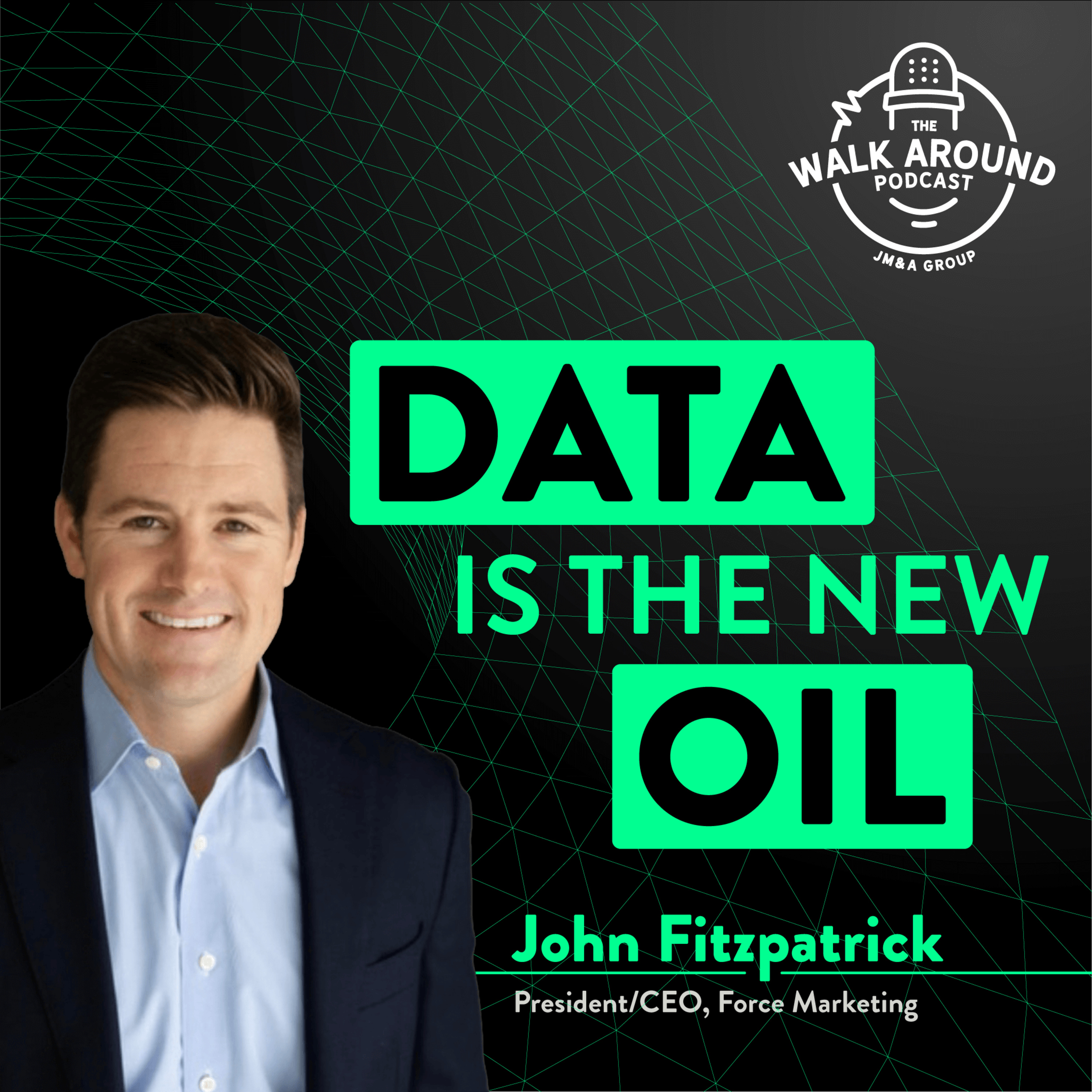
John Fitzpatrick, CEO of Force Marketing, shares insights on dealership marketing success through his 4A framework: audience, attention, automation, and attribution. Emphasizing the value of first-party data, he discusses personalized customer engagement and the critical importance of fast, consistent response times in sales and service. The conversation highlights the evolving role of AI in improving communication, stressing progress over perfection. Real-world examples, including Senator Bernie Moreno's responsiveness, illustrate how timely engagement builds trust. The episode offers practical strategies for dealers to optimize marketing investments and enhance customer relationships in a competitive landscape.
John Fitzpatrick, President & CEO of Force Marketing, joins the podcast to share insights on marketing trends in 2026, the future of AI and technology, customer engagement opportunities and strategies for dealership growth.
Episode Breakdown
00:00 - Meet John Fitzpatrick!
01:58 - Trends in Dealership Marketing and Customer Engagement
02:28 - The “4A” Strategy (Audience, Attention, Automation, Attribution)
04:54 - The Importance of Consistent Messaging and Response Time
08:52 - AI in Dealerships: Progress Over Perfection
12:15 - Treating Marketing Expenses Like Investments
14:51 - Marketing Opportunities in Fixed Ops and Service Retention
18:25 - “Bet It or Forget It” Segment
18:54 - AI Chat & Automation Replacing BDC Roles
19:40 - What is a Dealership’s Most Valuable Asset?
20:15 - Local Brand Awareness vs. Vehicle Inventory
22:12 - The Power of TikTok
For more information about our guest, visit their LinkedIn.
Liked this episode? Find our full episode library here.
""...and we know that they either submit a lead or they call the store...""
A lead is someone who might want to buy a car and has given their contact details so the dealer can talk to them.
In automotive sales, a lead is a potential customer who has shown interest in a vehicle, often by submitting contact information or inquiries through a dealer's website or third-party platforms.
""...they enter into the BDC environment, maybe the lead came through cars.com...""
BDC is a team at car dealerships that helps talk to people interested in buying cars and keeps track of them to help make sales.
BDC stands for Business Development Center, a department in car dealerships focused on managing customer leads, follow-ups, and communications to improve sales efficiency.
""...maybe the lead came through cars.com or one of the third parties...""
Cars.com is a website where people can look for cars to buy and dealers can find customers interested in their cars.
Cars.com is a popular online automotive marketplace where buyers can search for new and used cars, and dealers can generate leads by listing their inventory.
""And that's not only on the sales side, but on the fixed operations side of the service side. You've got seasonality in there, variability. What's going on?""
Fixed operations means the part of a car dealership that fixes and services cars instead of selling them. This part helps keep cars running well and makes money by doing repairs and maintenance.
Fixed operations refers to the parts of a car dealership that handle service, maintenance, and repairs rather than new or used car sales. This includes the service department and parts department, which often generate significant profits for dealerships.
""Gastly under-invested in fixed ops marketing. Oh, gosh, yes. Okay. 80% of our profits are made in fixed ops.""
Fixed ops marketing means the ads and promotions that help get people to bring their cars in for repairs and maintenance. This helps the dealership make money by fixing cars.
Fixed ops marketing refers to advertising and promotional efforts aimed at attracting customers to the service and parts departments of a dealership. Effective fixed ops marketing can increase service appointments and parts sales, which are crucial revenue sources.
"to take someone that comes in off a recall, that would be a warranty pay situation,"
A recall happens when a car company finds a problem that could be unsafe and asks owners to bring their cars in to get it fixed for free.
A recall is an official request by a manufacturer to return a vehicle or part to fix a safety-related defect or non-compliance with regulations. It usually involves free repairs or replacements under warranty.
"that would be a warranty pay situation, and also share with them the areas from a customer pay perspective"
When something is fixed under warranty pay, it means the car company pays for the repair because the car is still under a guarantee.
Warranty pay refers to repairs or services covered by the vehicle's warranty, meaning the manufacturer or dealer pays for the cost rather than the customer.
"that focuses on customer lifetime value, it's rooted in fixed ops. We know that if we sell a car to someone and we earn their first service appointment,"
Customer lifetime value means how much money a car dealer can make from one customer over many years, not just from the first car they buy.
Customer lifetime value is a business metric that estimates the total revenue a company can expect from a single customer over the entire duration of their relationship.
"and then there's a multiplier effect. Now that that Toyota dealer has 15 other dealerships across 10 different franchises,"
The multiplier effect means that when a customer does one good thing, like getting their car serviced, it makes it much more likely they'll buy more cars or services later.
The multiplier effect here refers to how an initial positive action, like a first service appointment, increases the likelihood of further purchases or business.
""...for the last five years, we've taken their fixed ops retention tool that started back in 1988...""
It's a tool that helps car dealerships keep customers coming back for things like oil changes and repairs. It reminds customers and makes sure they stay loyal to the dealership.
A fixed operations retention tool is a software or system used by dealerships to retain customers in their fixed operations departments, which include service, parts, and maintenance. It helps improve customer loyalty and repeat business by managing service reminders, promotions, and communications.
""...Our entire platform is built off Toyota, TLE and TLE from the ground...""
TLE is a Toyota program or tool that helps manage how they take care of customers and their cars. It's part of how Toyota keeps things running smoothly.
TLE likely refers to Toyota Logistics or Toyota Lease Experience, internal programs or tools related to Toyota's customer and operational management. In this context, it indicates foundational elements of the platform built from Toyota's systems.
""First one, AI chat or automation will completely replace BDC sales rolls by 2030. Bet it or forget it?""
BDC sales roles are jobs at car dealerships where people talk to customers on the phone or online to help sell cars and set up appointments. They help connect buyers with the right cars.
BDC stands for Business Development Center, which is a department in car dealerships responsible for managing customer communications, sales leads, and appointments. BDC sales roles involve interacting with potential buyers through calls, emails, and other channels to facilitate vehicle sales.
"Consumers have gone six hours away to get that Dodge Ram pickup truck that they've been wanting."
The Dodge Ram is a big truck that many people use for carrying heavy loads or towing things. It's a strong and tough vehicle.
The Dodge Ram pickup truck is a full-size pickup truck known for its towing capacity and ruggedness. It is popular among consumers who need a durable vehicle for work or recreation.
"...rand is so strong. Or ask Rita, Rita, that block Honda CRV I want is up in Tampa. Can you get it here for m..."
The Honda CR-V is a small SUV that many people like because it is dependable and roomy inside. It's good for families and everyday driving. The talk about it means people really want this car, and sometimes it's hard to find one nearby.
The Honda CR-V is a compact crossover SUV known for its reliability, practicality, and strong resale value. It's a popular choice for families and commuters due to its spacious interior and fuel efficiency. The mention likely refers to its strong market demand and availability challenges in certain regions.
- Meet John Fitzpatrick!
- Trends in Dealership Marketing and Customer Engagement
- The “4A” Strategy (Audience, Attention, Automation, Attribution)
- The Importance of Consistent Messaging and Response Time
- AI in Dealerships: Progress Over Perfection
- Treating Marketing Expenses Like Investments
- Marketing Opportunities in Fixed Ops and Service Retention
- “Bet It or Forget It” Segment
- AI Chat & Automation Replacing BDC Roles
- What is a Dealership’s Most Valuable Asset?
- Local Brand Awareness vs. Vehicle Inventory
- The Power of TikTok
Select text to request an explanation
Is your advertising and marketing expense
thought about as an expense or an investment?
Because if it is an expense line item,
then you're just kind of standing
and you're kind of always looking to cut it.
But if it's an investment
and you're always looking for the ROI
and you're shifting dollars in real time
based on where the ROI is.
It's everyone's dream to grow,
to be a bigger dealer, to be a better dealer,
or even get your first dealership.
Car buying is about the people.
Everybody wants to know what's the car business like
and they like to see it under the hood.
Welcome to the Walkaround Podcast.
I am one of your hosts, Mark Spoto,
joined by my co-host, Heather Wilkinson.
So glad to be here and so glad to talk about
our conversation today with John Fitzpatrick.
I mean, such great energy.
Yes, John Fitzpatrick, president and CEO of Force Marketing.
His team works with over 1,400 dealerships in the business,
everything from technology to marketing
to customer engagement.
And not only that, he taught us a new framework, Heather,
the 4A's.
The 4A's.
But do we want to give them all?
No, let's not.
Clearly we have more to learn.
Let's listen to our own podcast
and take a walk around with John Fitzpatrick.
Hello and welcome to you, John Fitzpatrick.
We really appreciate your time
joining us on the Walkaround Podcast.
Thank you so much.
Thanks for having me.
This is great, it's an honor to be here.
Thank you.
It really is, John.
And we are excited to hear your perspective.
You have 1,400 dealer partners
across in the automotive space that you work with.
And I know that, obviously,
where automotive dealers spend their ad dollars,
where they market, it's critically important.
So your insight is going to be great for our listeners.
So let me just kick it off with,
what trends in dealership marketing
and customer engagement are you following in 2026?
What are the hot things that you're following
for dealers that they should be thinking about?
Yeah, so the hot things,
first it's dealers sit on a tremendous amount
of first-party data.
And we've got to utilize that data in the DMS and the CRM
to make more personalized one-to-one conversations
with all of the customers that we serve
in our hyper-local marketplace.
That is a key component to what we're doing.
So in other words, if we're turning on Metta
or Google or Amazon or any of these media partners,
we want to make sure that for us,
they check a 4A strategy.
The first one is audience.
What audience can we help a dealer connect with?
Okay, this is a 4A strategy.
This is our 4A strategy.
All right, so we got to make sure listeners
are getting this way.
There we go.
Number one, think about audience.
Audience, okay.
So if you're a dealer,
think about the audiences in your DMS,
sold but never serviced.
That can be one audience.
Service but never sold.
That'd be another audience.
High APR percentage was the situations
where we can sort of restructure their monthly payment, right?
There's so many different audience types
sitting inside of the first-party data,
then you get your conquest.
On the service side,
you've got active, inactive and lost.
You've got so many different segments
that all require different conversations.
So first is audience and then on the media side,
how can I connect to those audiences?
Well, I think about attention.
That'd be the second A.
Where is their attention?
In other words, do I have their email
but I have no other touch point to them?
Well, then for us, our attention is through email.
Do we have their social media accounts?
Do we know what their meta account is?
Do we know what their Amazon account looks like?
Do we know what a household graph?
So for us, once we identify the household that they're in,
we build a household graph inside of our technology
that gives us every communication touch point,
tablet, email, every phone that's in that household.
And those are different ways we can communicate
through our media partners.
So attention would be the second one.
And it's automation.
It's very tough to have one-to-one conversations
if you don't have automation built into your processes.
Last would be attribution, right?
So how do we report back, much like a wealth advisor would be,
to what stock is performing better
and move the media dollars in real time
against where the biggest return on ad spend is?
That would be the fourth A for us.
So everything we're doing is fitting
within that 4A strategy for us,
whether it's product development,
whether it's how we're communicating
inside of an organization on a QBR
for one of our big dealer groups.
We say, here's what we did in the past.
Let's spend about 20 minutes of the hour there.
The rest 40 minutes is here's how we're gonna use that data
to make the next quarter a lot more efficient.
And so that's how we're thinking about everything.
I love that, John.
So let's dig in a little bit
because that framework is a really good setup
for what we wanted to talk to you about next.
When you think about the audience,
such an important part of the dealer's sales process
is consistent messaging and clear messaging
to their customers.
And in particular, making sure how they can message them
correctly from the website
and getting them into the showroom and that process.
Like, what are you seeing there that is working?
What are opportunities for dealers to be doing that better?
Yeah, so the response time isn't critically important,
as you guys know, right?
If we know that they're shopping
and we know that they came to the dealer's website
and we know that they either submit a lead
or they call the store,
they enter into the BDC environment,
maybe the lead came through cars.com
or one of the third parties,
it's critically important that we're the fastest
to getting in a conversation with them.
That's right, because when they've reached out,
they've reached out at least to three to five other opportunities.
That's correct.
Three to five other businesses.
And oftentimes, it's the fastest that gets back,
but then the most consistent, right?
Because you could be the fastest, but you didn't reach them.
You know, John, we were just talking about a friend of yours
who is very fast and consistent on their text messages.
And who is this?
You.
And this is...
Just now.
Just now.
Just now.
Case in point.
Case in point.
That's why you like him as a friend.
That's right.
Because he's so fast, he's so consistent.
And someone who is managing a great deal of affairs
in our country, right?
Yeah, Senator Bernie Moreno, great friend of mine.
You wouldn't know this,
but he is incredibly responsive in his text messages, right?
So now going back to what your point on the dealer side
is the response time and the way in which they process
that lead is critical.
That's right.
That's right.
And I, you know, so a lot of my relationship with Bernie
started when he was a dealer and he had all the stores.
And his response time was incredible.
And what he was doing was proving through his own behavior
that it's possible because he required all of his stores
to operate the same way.
That's right.
So it's crazy that it's a year ago,
but it was January 3rd.
He was sworn into the Senate.
I was there in DC with him.
And, and he came into a small group of friends and family
that were there and he, he said,
Hey, first thing I'm going to do is I'm going to operate,
you know, my seat in the Senate with my connectivity
to everybody that I serve in Ohio.
The same way I did with my dealerships
and we're going to have communication.
If you reach out to my office,
someone has to respond to you in 24 hours.
I love it.
When have you ever heard of that from a U.S. Senator, right?
And so they went from, I think, I don't quote me on the number,
but it was like, I think the previous Senator maybe had four
or five people that were, that were in and around response.
He upped that to 40.
Well, how else are you going to respond in 24 hours?
Right.
Because it was that important to him
that they heard the issues of his folks in Ohio
that were reaching out to their senators saying,
this is happening, that's happening, we need help.
And we, he went, he's like, I want to know,
A, we've heard you, we're on it, we'll report back.
You know, that was the fundamental belief of our founder.
That's right.
Mr. Moran, he believed in the 24 hour rule.
And it sounds like that's a common thread
in very successful people, very successful businesses.
You know, that's something similar that Rita Case
has shared with us in talking to Rita.
Rita has shared that she responds immediately.
She gives her cell phone number out to her customers.
It is critically important that you are there.
If your customers, your employees, your partners need you,
that you respond.
So if you think about a Senator Bernie Moreno,
back in 1960s, 70s, 80s, 90s, early 2000s, Mr. Moran,
and Rita Case today, if they can respond,
our sales and BDC markets, BDC marketing teams
could be responding to consumers to buy a car.
Amen.
Keep going.
You're speaking to the converted.
So let's talk a little bit more about that, John,
because, you know, with technology, AI, chat GPT,
there's certainly opportunities for dealers
to try to improve that process, response time,
customer communication.
But I think we're hearing maybe some mixed reviews
on how successful those tools really are for their dealers.
Do you see dealers using things like AI or technology really well
in that customer communication?
Or do you think we have some time to perfect that?
Well, first of all, it's early innings for AI, right?
Turn on CNBC.
Every category is trying to figure out how the AI revolution
sort of will change their business model.
I think it's going to change.
And it's the adapt or die sort of philosophy to some degree,
maybe without being that harsh.
But we absolutely need to be learning of ways for AI
to advance the customer engagement at a dealership.
Period.
And nobody has it perfect.
So we've got to look for progress over perfection
in this category.
So let's struggle, but let's figure out
why that AI agent wasn't perfect.
But were they quicker than the human?
Because if speed is the most important in consumers,
and by the way, we're all frustrated
when we order something on Amazon,
it doesn't come like that day, crazy.
So we know the behavioral habits that we're building.
Or within that three hour window.
That three hour window, right?
So we understand that, right?
We understand that data is the new oil
and has been for a long, long time.
We understand AI really is just pattern recognition
of a really good data set.
Well, think about how powerful the data set is
inside of the DMS and the CRM.
And we also know that those two tools
have a lot of dirty data,
because there's a lot of different folks
that input the data into those systems.
There's a lot of different leads
that get provided from different partners
and they're not always clean.
So we've got to make sure that cleaning is a daily thing.
So that the partners we're working with
from a data perspective
have to constantly be cleaning the data.
The prompts that we're writing in AI,
whether the reason I'm on sales or service
or any angle, are constantly being updated.
Because what we're asking AI is what they're doing.
We're having a conversation with technology and AI.
And it's back and forth, right?
So the prompts are very, very important.
But I want to be thinking about AI
as how are we advancing the communication set,
but not looking for perfection just yet.
Just not there yet.
So how is a human interacting with AI?
So I think the folks that are fearful
that AI could take over their job,
that is less for the person that leans into AI.
That is more for the person that does not lean into AI.
Those are those people that are unwilling to change.
That's right.
And any industry, but the automotive industry
is constantly evolving, constantly changing.
And if you want to stay in your four box,
then you will be eliminated.
But you wouldn't be with any category, right?
So whether it's AI, whether it was DR,
or whether it was whatever the topic is of the day,
if you weren't willing to learn more
about how that can help you in your profession,
well, then you're sort of on the other end of your career
in that category may die, right?
Someone else will come in and say,
no, I'm going to learn all the new tools
and I'm going to help advance the business using those tools.
John, let's pivot a little bit back to marketing.
That's your bread and butter, your career, your expertise.
When you look across dealers that you speak to day in and day out,
what is a common marketing misstep or mistake
that you see dealers continuing to make
because maybe it's just something that's a legacy initiative
or something dealers have always done
and you feel like we really should change this
or do it differently.
Are you seeing anything like that still happening?
I think generally speaking,
think about, look at an advertising budget at a dealership, right?
They've got all these different categories
of where their spend goes, right?
So think Google, think Metta, think Amazon,
think direct mail, email, my retention marketing,
and just third party lists, right?
It tends to be, unfortunately,
that each one of those line items is pretty stagnant.
In other words, I spend $10,000 with Google.
I spend $5,000 with Metta.
I spend $5,000 with cars.com, right?
Why is that not a variable that's changing
based on the data that we're getting back?
So we come in first and foremost and say,
is your advertising and marketing expense
thought about as an expense or an investment?
Because if it is an expense line item,
then you're just kind of stagnant
and you're kind of always looking to cut it.
But if it's an investment
and you have a conversation and a strategy
with your marketing team
that's very similar to your wealth management team,
then you're always looking for the ROI
and you're shifting dollars in real time
based on where the ROI is.
So what I'm hearing you say is
a mistake you see dealers making
is just not looking enough at how they're using that budget
or they're looking at it in a way that is
should be viewed more as how do you grow
or evolve that budget as opposed to keeping it
under control from an expense standpoint.
So a dealer or a GM watching this right now,
pull up your advertising expense
or is it an investment sheet?
Look at that line.
Pick a line and let's go with Google.
Did you spend the same amount this month
that you spent last month and the month prior?
If that number didn't change, you have a problem.
You're just doing something wrong.
That was definitely.
Right?
You mean to tell me we had the same exact buyers
for your brand in December as we did in January?
You mean to tell me that the shopper propensity
to buy was the exact same?
You mean to tell me that the people that went into Google
and your hyper local place is exactly the same?
There's no way.
And that's not only on the sales side,
but on the fixed operations side of the service side.
You've got seasonality in there, variability.
What's going on?
You struck a chord.
I'll give you an easy one.
You struck a chord, Heller.
I'm got to lose it.
For those that can't see this,
John's about to jump out of his chair.
Gastly under-invested in fixed ops marketing.
Oh, gosh, yes.
Okay.
80% of our profits are made in fixed ops.
Okay.
70% of our call volume that comes to the dealerships
is service-based even on a click from a sales ad.
Yeah.
Okay.
We get that all the time.
But we spend less than 5% of the marketing budget in fixed.
We were talking to a dealer,
and they made the extremely clear and relevant point
is how many customers are those service drive associates
touching versus the sales side,
but yet most of the effort,
most of the advertising goes toward the sale,
which is obviously important,
but why are you not shifting more to the area of the business
that are interacting and creating loyalty with your customers
more than any other?
Having the double the amount of traffic.
I mean, as we talked about, salespeople averaged 10 cars a month.
They've been averaging cars a month for quite a many decades.
And you have service advisors who are touching 25 to 40 customers a day.
A day.
Right.
Right.
And we're not investing our revenue from our marketing dollars
in the area where we're seeing the most customers.
And they're still too disconnected, right?
We know we have trade ins that are coming in,
those 40 opportunities per day.
We know that we have so many opportunities
to take someone that comes in off a recall,
that would be a warranty pay situation,
and also share with them the areas from a customer pay perspective
that they've been neglecting for whatever reason.
So maybe they came in off the recall,
but they have other needs in that particular vehicle.
I mean, there's so much opportunity on this side,
and it comes to bringing those datasets together.
So for us, we had an opportunity to take a look at
Gulf States marketing, which we had heard from Gulf States Toyota.
They were going to divest that property.
This was during COVID at the end of 2020.
I had on my big whiteboard, we need to build or buy a fixed ops retention tool
because if we're going to be the marketing company
that focuses on customer lifetime value, it's rooted in fixed ops.
We know that if we sell a car to someone
and we earn their first service appointment,
we're seven times more likely to get their second purchase.
And then there's a multiplier effect.
Now that that Toyota dealer has 15 other dealerships
across 10 different franchises,
like that's a big opportunity
from a customer lifetime value perspective.
So we jumped all over that.
I was in Houston the next day,
pleading to Dan Freakin and the family,
I said, please sell this asset to me.
And they're going, why would we do that?
Who do we know?
We don't know you.
We've never worked with you before.
I said, call my best clients.
And they said, give John a shot.
Lo and behold, we ended up acquiring that business.
And then for the last five years,
we've taken their fixed ops retention tool
that started back in 1988
that was help build Toyota care, by the way.
So think about loyalty from Toyota.
So our entire platform is built off Toyota,
TLE and TLE from the ground.
Now we work with all of the name plates.
Just a huge opportunity.
We brought that into audience IQ
so we could have one view of the customer
so that we could have a conversation
that wasn't just variable
and then a different one on fixed.
It was one conversation.
Because what does the customer want?
One conversation.
You want a full 360 view of your customer.
That's right.
Wow.
John, we could talk to you all day.
We want to end on a segment that we think
John is going to like.
You mentioned early innings.
So I get the sense you're a sports guy.
Oh, big time.
I married a sports broadcaster.
That's right.
So yeah, absolutely a sports fan.
Okay.
So we call this bedded or forget it.
We're going to give you three takes about the industry
and you tell us I'm all in or I'm out.
I'm betting it or I'm forgetting it.
Okay.
First one, AI chat or automation
will completely replace BDC sales rolls by 2030.
Bet it or forget it?
I struggle with completely.
Okay.
I want to say bet it.
Fair.
I want to say bet it.
I struggle with the word completely.
If you say the majority, then absolutely bet it.
Okay.
Love it.
Yeah.
Still need that human connection.
You do.
You do.
And there'll be maybe a leader of the AI agents that's human.
Right.
And so that'll be somewhat, that's going to be very necessary.
But full BDC centers have not proven that they can do what AI can do in seconds.
Okay.
Second one, I think I know where you're going with this.
We've already sort of talked about it.
But first party data will become a dealer's most valuable asset,
more so than their inventory.
Bet it or forget it?
I would change it again because it already is their most valuable asset.
It's not going to become, it already is their most valuable asset.
And it will just stay in that lead position because data is the new oil.
So the oil that they're sitting on in that first party data is incredibly valuable.
And any threat or risk to the dealer body is rooted in the first party data that they sit on.
Local brand awareness matters more than vehicle inventory when it comes to generating leads.
Those are so important.
They're so important.
We need an answer, John.
Someone play the Jeopardy music.
Inventory is really important.
You're going to forget it.
I'm going to forget it because inventory is so important.
And the more we get in an AI world and the more we're in a world where we're across all of these
different media platforms, your inventory has got to show up in front of the consumer.
And consumers will drive, they will go further to get the vehicle they want.
We hear time and time again.
Consumers have gone six hours away to get that Dodge Ram pickup truck that they've been wanting.
And I think coming out of COVID and when there was the supply chain and the inventory challenges,
people got used to, I may not need to go if I want this particular car.
I struggle with this question because I could argue both sides of the fence on that one.
That's a really good question because they'll also not consider inventory as the number one
reason if the brand is so strong. In other words, if they know Rita, you just mentioned Rita.
That's right.
Right, grew up in South Florida.
So I know that name brand incredibly well.
And I may opt to, if I live in Davy, Florida, I may go over to her Honda complex with all
the brand case and not necessarily even search for the inventory because it's less as important
because her brand is so strong.
Or ask Rita, Rita, that block Honda CRV I want is up in Tampa.
Can you get it here for me?
That's right.
That's right.
That's right.
Let me add one more.
Was that your last question?
That was.
I'm betting a lot right now.
And you had an earlier question on the power of TikTok.
Tell us more.
So TikTok invited me to be on the NADA live stage to kick off NADA here.
We've done some testing with them.
In our tests, they weren't ready for scale.
They weren't ready for this inventory piece, right?
So we knew that they had a huge audience.
We know that a lot of attention is being spent on TikTok.
So they already had my attention here with my 4As.
They didn't have the automation piece.
We challenged them.
And for the last 18 months, they built out a pretty robust automation piece that can tie
inventory in to their ad units in real time, much like you can do in Meta.
Now, the difference with Meta and TikTok is that TikTok is built around the audience
being served to the advertiser instead of the advertiser serving to the audience.
That is a significantly key differentiator.
So when you're thinking about TikTok, first, a lot of people had had a lot of pause
on the word TikTok from an advertising perspective for political reasons.
And where the data was housed.
Luckily, we can put that to bed now that it's a US-owned property.
Right.
Hopefully, we can.
I certainly can because the audience is so real and the attention is so dynamic.
It's addictive.
Yes.
Okay.
I am addicted to TikTok.
I would say first as I was trying to educate myself and then I went,
I'm spending hours, what used to be a Tony Robbins book before bed is now TikTok.
I would say even more hyper-personalized because there's the algorithm serving you
what you already like.
So for me, I get a ton of comedians.
I get motivational speakers.
I get food recipes to cook for the family.
I get plays because I'm a 10-year basketball coach.
I'm looking at different play sets.
So this is what I've searched for.
So they serve me more and more of that content.
And then me and my dad are sharing.
Keeping you on the platform.
I'll tell you what, it might be me and my dad are already super tight,
but it's brought us even tighter together.
If you go to our chat thread, it's TikTok's back and forth.
And then if we don't answer, he's like, did you watch what I sent you?
I'm like, no, he's like, you got to watch that.
We got to talk about it.
I do this.
I have an 18-year-old and if he doesn't watch what I send him, I get so annoyed.
So they're ad units super.
And by the way, it's still very much an untapped opportunity for dealers
because there's been all this hesitation for all these other reasons.
And now that they've got the automation piece,
which they also have the attribution piece.
In one of our studies, Honda Store in Nashville,
they spent $1,000, not a lot of money, $1,000 investment on the platform.
For 1,300 clicks to the site that we view as highly engaged.
And what we view as highly engaged is, did you spend more than a minute on the site?
You say, if you spend more than a minute on the site in today's environment,
you're pretty engaged.
You're definitely not fraud, you're not bot traffic, and you're searching around.
$1,000 for 1,300 people in a hyper-local marketplace, that seems like a good ROI.
And it was a fraction of what you could spend in some of the other media outlets.
So when you think about new opportunities,
when you think about new audience sets, it doesn't matter to me.
I'm an investment trader.
I'm day trading attention.
I don't get paid anymore if you put the money in TikTok
or Meta or Google, it makes no difference.
What makes difference to us is that the results are there.
Yeah.
And so when we see results, it's our duty to bring that up,
and there's a huge opportunity right now.
All right, dealers, marketing pros, you've heard it here.
That $1,000 was a marketing investment.
It was an investment, not an expense.
Remember that, dealers, marketing is not an expense.
It's an investment.
That's right.
I love that.
Thank you, John.
Thank you, John.
This was fantastic.
Appreciate your time.
Thank you so much.
I appreciate you joining us today on The Walkaround,
and we hope you enjoyed the episode.
Please be sure to like, share, subscribe, and follow us.
We look forward to seeing you next time on The Walkaround.
Request an explanation for:
2 cars
2 cars featured
Request an Explanation
Heard something you'd like explained? We'll add it to this episode.
Sign in to request explanations for terms you heard.
Want to learn more?
Browse our glossary for plain-English explanations of automotive terms, jargon, and concepts.
See something that's not quite right? Our annotations are AI-generated and can sometimes miss the mark.
Click the flag icon on any annotation to suggest a correction.