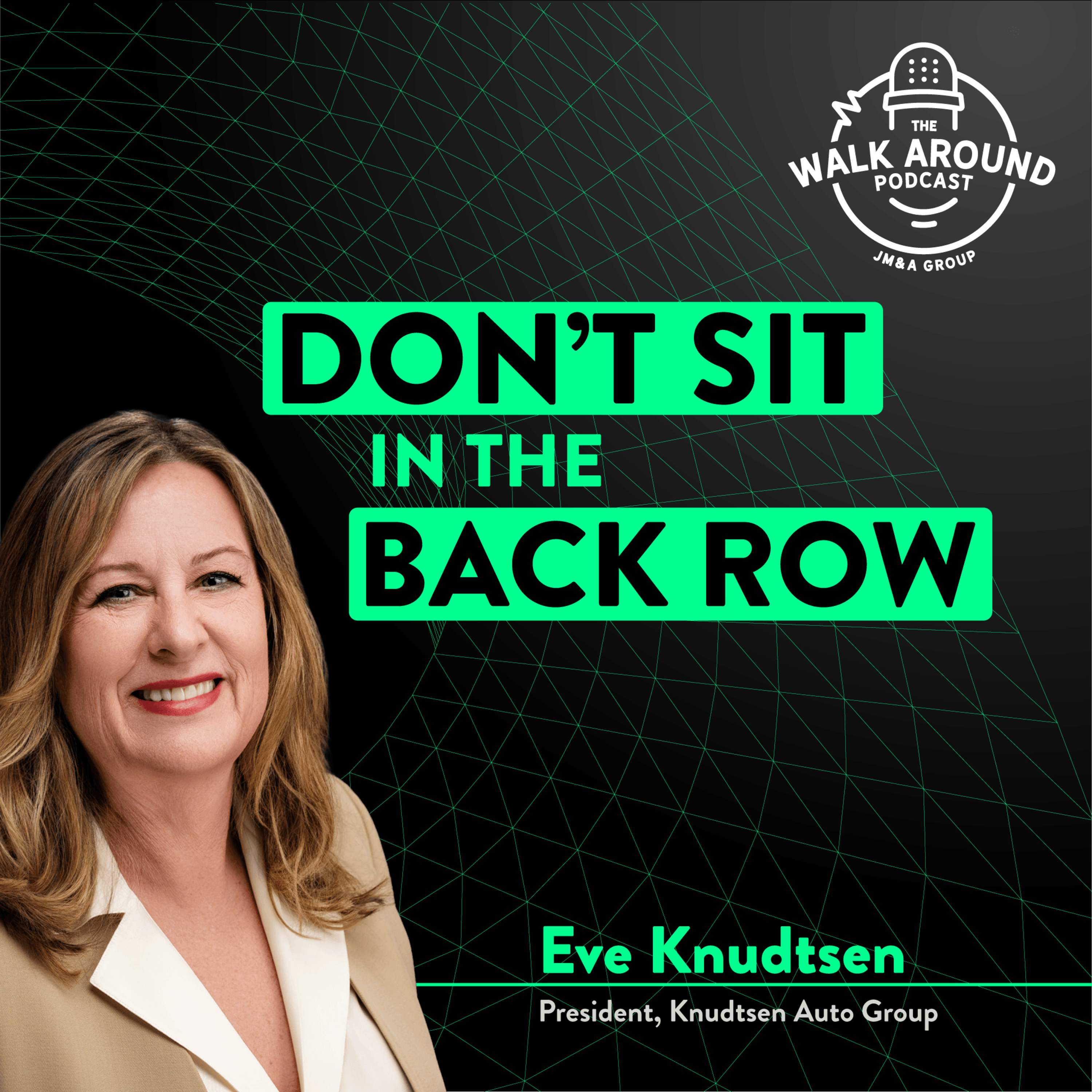
S5E07 - Finding Your Voice in Automotive Leadership
About this episode
Eve Knudson, president of Knudson Auto Group in Idaho, shares leadership lessons from a multi-generation dealership family and what it takes to “find your voice” in automotive. She argues for speaking up from the front row, staying resilient against naysayers, and building credibility through fixed operations by starting in parts and service. Looking toward 2026, she frames growth around a “hedgehog” strategy centered on service, backed by AI tools that handle calls and scheduling. She also emphasizes delegating responsibility, investing in leadership development, and treating F&I as customer experience to retain buyers.
Eve Knudtsen, President of Knudtsen Auto Group, is a third-generation dealer leading three stores across the Pacific Northwest. She shares insights on leadership, technology, culture and her experience as a woman in automotive.
Episode Breakdown
00:00 - Meet Eve Knudtsen!
02:31 - Making your voice heard as a woman in automotive
05:02 - Advice to women pursuing leadership positions
06:19 - Advice to those new to automotive careers
07:35 - What Eve is focusing on in 2026 at her group
09:23 - Areas of opportunity to improve customer service
12:12 - The result of implementing AI into the customer experience
12:55 - The leadership trait/habit that Eve swears by
15:47 - What’s a bigger risk to dealers? Technology adoption or talent development?
17:57 - The importance of culture in your dealership
19:43 - F&I’s importance in the customer experience
For more information about our guest, visit their LinkedIn.
Liked this episode? Find our full episode library here.
leadership position
"Is there any other piece of advice that you would give women who are pursuing a career in the automotive industry, especially a leadership position?"
They’re talking about moving up to a management or top role in car-related work. It’s not just about being good at the job—it’s about how you lead people and get your ideas taken seriously.
The episode is focused on how to advance into leadership roles within the automotive industry. That context matters because dealership operations, hiring, and customer-facing communication often shape how leaders influence culture and results.
first dealership
"It's everyone's dream to grow, to be a bigger dealer, to be a better dealer, or even get your first dealership."
A “first dealership” means someone is opening or buying their first car store. It’s a big move because it requires setting up the whole business—cars to sell, staff, and service.
Getting a “first dealership” is a major step in automotive retail ownership. It typically involves securing a manufacturer franchise, building inventory, and establishing sales and service operations.
Car buying is about the people
"Car buying is about the people. Everybody wants to know what's a car business like, and they like to see it under the hood."
They’re saying buying a car is mostly about relationships. If customers feel respected and understood, they’re more likely to buy.
This highlights a core dealership concept: customer decisions are heavily influenced by relationships and trust, not just the vehicle itself. Dealership leadership often focuses on communication, responsiveness, and culture to improve customer experience.
Knudson Auto Group
"So today, we are joined by Eve Knudson, president of Knudson Auto Group in Idaho."
This is the car dealership business the guest leads. Dealership groups like this usually run more than one part of the business, like selling cars and supporting them with service.
Knudson Auto Group is the dealership group where the guest, Eve Knudson, serves as president. Dealership groups like this often operate multiple franchises and manage both sales and service operations.
fourth generation ownership
"Yes, and having this be her fourth generation ownership of this dealership group for her family, she really pinpointed on leadership habits that you should swear by in order to be successful, which she's now instilling into her daughters"
This means the dealership is in the same family and has been run for many generations. It can influence how they treat customers and how the business is managed over time.
The phrase “fourth generation ownership” refers to a dealership group being run by the same family across multiple generations. In automotive retail, that often shapes how the business is managed, how customer relationships are built, and how leadership practices are passed down.
leadership habits
"she really pinpointed on leadership habits that you should swear by in order to be successful, which she's now instilling into her daughters who are taking over the dealership group."
They’re talking about the day-to-day ways a leader runs the business. The idea is that good habits help the dealership succeed and can be taught to the next generation.
“Leadership habits” in a dealership context usually means the repeatable behaviors and management practices that drive performance—things like communication, accountability, and decision-making. The episode frames these as principles that can be taught and sustained as ownership transitions to the next generation.
taking over the dealership group
"which she's now instilling into her daughters who are taking over the dealership group."
This is about who will run the dealership next. It’s a big transition because it affects how the business operates and how customers are served.
“Taking over the dealership group” refers to succession—handing control of the dealership operations from one generation to the next. In automotive retail, this can involve maintaining brand relationships, dealer operations, staffing, and long-term customer trust while modernizing processes.
dealers should never sit in the back row
"Eve, you've stated in previous interviews or speaking engagements, you've said that dealers should never sit in the back row. Can you tell us what you mean by that"
They’re not talking about cars here—they mean that if you want people to listen, don’t stay hidden. Sit closer so you’re more likely to be heard and taken seriously.
The speaker is using a dealership-meeting metaphor: “back row” represents being physically and socially removed from the decision-makers. In dealership culture, visibility and proximity can strongly affect whether your message is heard and acted on.
dealership world
"as someone who has really interesting insight about the dealership world?"
They’re talking about how car dealerships run day to day. That includes selling cars, helping customers, and managing the people inside the dealership.
“Dealership world” points to the retail side of automotive—how cars are sold, serviced, and managed through franchised dealers. Leadership in this space often involves influencing store operations, customer experience, and internal culture.
proximity means everything
"They can't hear you from the back. Proximity means everything. It does."
It means where you sit and how close you are to the people matters. Being closer makes it easier for others to hear you and pay attention.
“Proximity” here refers to being close enough—physically and socially—to influence the room. In automotive leadership and dealership settings, closeness to the audience and leadership often improves communication and follow-through.
parts department
"...it was always my plan to bring her in and have her start in the parts department and work in the parts department for a while..."
In a dealership, the parts department is where they sell car parts—like what you’d need for repairs or maintenance. Working there helps you understand how the dealership supports cars day-to-day.
The parts department is where a dealership sells and sources replacement components for customers and technicians. It’s often a key entry point because you learn inventory, pricing, and how vehicles are supported after the sale.
service
"...and then transition to service and work in service for a while."
Service is the part of the dealership that fixes and maintains cars. It teaches you how repairs actually get done and how customers are taken care of.
Service is the dealership’s fixed operations area focused on maintaining and repairing customer vehicles. Experience in service helps someone understand technician workflows, customer communication, and operational performance beyond just selling.
fixed operations
"...you really have to have that foundation in fixed operations. There's a reason why it's the backbone"
Fixed operations is dealership-speak for the non-sales side of the business—typically service, parts, and related customer support. It’s called the “backbone” because it’s a major driver of recurring revenue and builds long-term customer relationships.
artificial intelligence
""So technology, particularly artificial intelligence is something that we're looking at... what kind of processes has to go along with adapting to artificial intelligence?""
Artificial intelligence is computer technology that can learn and help with tasks. In a dealership, it can be used to help manage customer interactions, but you also need to adjust how your team works and train people to use it well.
Artificial intelligence (AI) refers to computer systems that can learn from data and perform tasks like understanding language or making decisions. In automotive retail, AI is often applied to customer communication, lead handling, and internal workflows. The key point here is that adopting AI requires process changes and staff training so the technology is used effectively.
roadside assistance
"[699.4s] and get our customers the right places, [701.6s] whether it's I need to schedule an appointment [704.2s] or help them stranded on the side of the road. [706.8s] Can you help send me a tow truck?"
Roadside assistance is what you call when your car breaks down and you need help, like a tow truck. The point here is that the system can help start that process quickly.
Roadside assistance is help provided when a vehicle can’t be driven safely—such as towing, battery service, or lockout help. Dealership service teams often coordinate these requests, and AI can streamline the initial intake and dispatch.
AI agent
"[706.8s] Can you help send me a tow truck? [709.3s] I mean, all of that, that AI agent can handle all of that. [714.1s] Have you seen an increase in the number of appointments"
An AI agent is a computer program that can talk to customers and do tasks for them. Here, it helps with things like booking service and getting help when someone breaks down, and then it hands off questions it can’t solve to a real person.
An AI agent is software that can handle customer requests automatically—like scheduling appointments or triaging roadside assistance needs. In a dealership or service setting, it reduces phone interruptions and can route more complex questions to a human advisor.
succession
"...taking over the succession from your father. Looking back, what is one leadership trait or habit..."
Succession is when leadership is passed from one person to the next. In a dealership, it’s about keeping the business running smoothly while new leadership takes over.
Succession is the process of transferring leadership from one person to another, often within a family-owned or long-tenured business. In dealerships, succession planning affects how operations, culture, and customer relationships are maintained during the transition.
Delegating responsibility
"Like, wow, this really worked. Delegating responsibility, I think has been a really important thing. When my dad ran the store..."
Delegating responsibility means letting other people run parts of the job. Instead of doing everything yourself, you give managers real ownership so things get handled faster and more consistently.
Delegating responsibility means assigning decision-making and ownership to managers or team leads instead of personally handling everything. In dealership environments, this can improve speed, accountability, and consistency across departments.
parts manager
"So you wanted your service manager to manage his service department, the parts manager to manage their department. And you hold them accountable too, right?"
The parts manager makes sure the shop has the right parts in stock or can get them quickly. That helps repairs happen without long delays.
The parts manager oversees the parts department, including inventory levels, ordering, pricing, and ensuring the right components are available for repairs. Good parts management reduces delays caused by missing or incorrect parts.
bet it or forget it
"And it involves a little bit of risk it or not risk it. We like to call it bet it or forget it. Are you a gambling person?"
It’s basically a “commit or don’t” question. Are you willing to make a real decision and stand behind it, or are you going to ignore it and hope it works out anyway?
“Bet it or forget it” is a game-like way to frame a decision: do you commit to a strategy (bet it) or ignore it and move on (forget it). In automotive leadership/dealer talk, it often maps to whether you’ll take a calculated risk on inventory, pricing, or marketing.
risk it or not risk it
"And it involves a little bit of risk it or not risk it. We like to call it bet it or forget it."
“Risk it or not risk it” describes a binary choice mindset—whether to take a calculated chance or avoid uncertainty. In the auto industry, this can relate to dealer decisions like stocking certain vehicles, adjusting pricing, or investing in customer acquisition.
auto dealer
"I'm an auto dealer. I am a professional. All right."
An auto dealer is the store that sells cars to regular customers. They buy cars in bulk, then sell them to people, often with financing options.
An auto dealer is the retail business that sells vehicles to customers, typically managing inventory, pricing, and financing arrangements. Dealer perspectives often emphasize how market timing, inventory selection, and customer demand affect profitability.
employee turnover
"There's a lot of initiatives right now because we are measuring turnover and we are measuring retention of employees."
Turnover just means how often people quit and leave a workplace. If turnover is high, it can be a sign that employees aren’t getting the support or growth they need.
Employee turnover is the rate at which employees leave a company and need to be replaced. In leadership development, tracking turnover helps identify whether management practices and career growth opportunities are working.
employee retention
"There's a lot of initiatives right now because we are measuring turnover and we are measuring retention of employees."
Retention means keeping employees from leaving. If retention is strong, it usually means people feel supported and see a future at the company.
Employee retention is how long employees stay with a company. Measuring retention alongside turnover gives leadership a clearer picture of whether training, career development, and management practices are keeping people.
career development
"to be able thinking in terms of career development for each one of their employees. And engaging with that."
Career development means helping people grow at work—learning new skills and having a path to better roles. It’s about planning for the future, not just doing the job today.
Career development refers to structured growth plans that help employees build skills and move toward future roles. In automotive leadership contexts, it’s often tied to training programs, mentoring, and clear advancement paths.
HR leaders
"So I'm working with actually HR leaders from other companies on what works for them, right? And helping to create training, right?"
HR leaders are the top people in a company who handle employee programs like training and development. Here, they’re being used as a resource for ideas that improve leadership.
HR leaders are senior human resources executives who shape hiring, training, and employee programs. The transcript suggests collaborating with HR leaders from other companies to learn what leadership development practices work.
leadership training
"So I'm working with actually HR leaders from other companies on what works for them, right? And helping to create training, right? That we can provide to all of our people that help them become better leaders and better people developers."
Leadership training is training for managers so they can guide their teams better. In this case, it’s meant to help them coach employees and develop future leaders.
Leadership training is formal instruction designed to improve how managers lead, coach, and develop teams. The transcript frames it as a way to help leadership staff learn how to support employee growth.
Peter Drucker
"Peter Drucker, known as the father of modern management said, culture eats strategy for breakfast."
Peter Drucker was a famous business thinker who studied how organizations work. People quote him a lot when talking about leadership and company culture.
Peter Drucker was a highly influential management thinker often called the “father of modern management.” His ideas are frequently used in leadership discussions, including the role of culture in executing strategy.
F&I
"[1183.2s] Well, this last one Eve is of course near and dear [1186.2s] to our hearts at JM&A. [1189.0s] Dealers who treat F&I as part of the customer experience [1193.9s] will outperform those who treat it as a transaction."
F&I means the dealership’s finance and insurance desk. It’s where you talk about car loans and optional add-ons like warranties. Some dealers make it feel helpful and customer-focused, while others treat it like a quick money transaction.
F&I stands for Finance and Insurance, the part of a dealership process where customers are offered financing and add-on products like warranties and protection plans. In automotive retail, how a dealer approaches F&I can strongly affect customer satisfaction and dealership profitability.
F&I professionals
"Right, and I pay my F&I professionals pretty well and I give them plenty of products and I tell them don't get too caught up in reserve, right?"
“F&I” means the dealership’s finance and insurance team. They help you get the loan and may also offer extra products that add to the final cost.
F&I stands for finance and insurance. In dealerships, F&I professionals handle financing arrangements and sell add-ons like warranties and protection products that can materially affect the deal’s total price.
Request an Explanation
Heard something you'd like explained? We'll add it to this episode.
Sign in to request explanations for terms you heard.
Want to learn more?
Browse our glossary for plain-English explanations of automotive terms, jargon, and concepts.
Help improve this episode
See something that's not quite right? Our annotations are AI-generated and can sometimes miss the mark. Click the flag icon on any annotation to suggest a correction.