They’re talking about moving up to a management or top role in car-related work. It’s not just about being good at the job—it’s about how you lead people and get your ideas taken seriously.
A “first dealership” means someone is opening or buying their first car store. It’s a big move because it requires setting up the whole business—cars to sell, staff, and service.
This is the car dealership business the guest leads. Dealership groups like this usually run more than one part of the business, like selling cars and supporting them with service.
This means the dealership is in the same family and has been run for many generations. It can influence how they treat customers and how the business is managed over time.
They’re talking about the day-to-day ways a leader runs the business. The idea is that good habits help the dealership succeed and can be taught to the next generation.
They’re not talking about cars here—they mean that if you want people to listen, don’t stay hidden. Sit closer so you’re more likely to be heard and taken seriously.
They’re talking about how car dealerships run day to day. That includes selling cars, helping customers, and managing the people inside the dealership.
In a dealership, the parts department is where they sell car parts—like what you’d need for repairs or maintenance. Working there helps you understand how the dealership supports cars day-to-day.
Fixed operations is dealership-speak for the non-sales side of the business—typically service, parts, and related customer support. It’s called the “backbone” because it’s a major driver of recurring revenue and builds long-term customer relationships.
Artificial intelligence is computer technology that can learn and help with tasks. In a dealership, it can be used to help manage customer interactions, but you also need to adjust how your team works and train people to use it well.
Roadside assistance is what you call when your car breaks down and you need help, like a tow truck. The point here is that the system can help start that process quickly.
An AI agent is a computer program that can talk to customers and do tasks for them. Here, it helps with things like booking service and getting help when someone breaks down, and then it hands off questions it can’t solve to a real person.
Succession is when leadership is passed from one person to the next. In a dealership, it’s about keeping the business running smoothly while new leadership takes over.
Delegating responsibility means letting other people run parts of the job. Instead of doing everything yourself, you give managers real ownership so things get handled faster and more consistently.
It’s basically a “commit or don’t” question. Are you willing to make a real decision and stand behind it, or are you going to ignore it and hope it works out anyway?
“Risk it or not risk it” describes a binary choice mindset—whether to take a calculated chance or avoid uncertainty. In the auto industry, this can relate to dealer decisions like stocking certain vehicles, adjusting pricing, or investing in customer acquisition.
Turnover just means how often people quit and leave a workplace. If turnover is high, it can be a sign that employees aren’t getting the support or growth they need.
Career development means helping people grow at work—learning new skills and having a path to better roles. It’s about planning for the future, not just doing the job today.
HR leaders are the top people in a company who handle employee programs like training and development. Here, they’re being used as a resource for ideas that improve leadership.
Leadership training is training for managers so they can guide their teams better. In this case, it’s meant to help them coach employees and develop future leaders.
Peter Drucker was a famous business thinker who studied how organizations work. People quote him a lot when talking about leadership and company culture.
F&I means the dealership’s finance and insurance desk. It’s where you talk about car loans and optional add-ons like warranties. Some dealers make it feel helpful and customer-focused, while others treat it like a quick money transaction.
“F&I” means the dealership’s finance and insurance team. They help you get the loan and may also offer extra products that add to the final cost.
LIVE
Is there any other piece of advice that you would give women
who are pursuing a career in the automotive industry,
especially a leadership position?
One of the things that people ask me is,
how do you handle those that might not be open
to hearing a female voice?
And I always say, next, right?
Because that's just kind of how I grew up.
I had to let that bounce off me.
If you have something to say, do not sit in the back row.
Sit in the front, because that's where you're going to be heard.
It's everyone's dream to grow, to be a bigger dealer,
to be a better dealer, or even get your first dealership.
Car buying is about the people.
Everybody wants to know what's a car business like,
and they like to see it under the hood.
Welcome to the Walk Around podcast.
I am one of your hosts, Mark Spoto.
Joined by my co-host, Heather Wilkinson.
Glad to be here.
Hello, hello, Heather.
Hello.
So today, we are joined by Eve Knudson,
president of Knudson Auto Group in Idaho.
And she brings such an interesting perspective
on leadership, certainly having a perspective
on being a woman in the industry and her career path.
And also an interesting concept of sinning in the front row,
as opposed to the back seat.
Yes, and having this be her fourth generation ownership
of this dealership group for her family,
she really pinpointed on leadership habits
that you should swear by in order to be successful,
which she's now instilling into her daughters
who are taking over the dealership group.
That's right.
Great conversation.
We can't wait for you to hear it.
Let's take a walk around with Eve Knudson.
Eve Knudson, welcome to the Walk Around podcast.
Thank you so much for sharing your time
and your insights with us.
Well, thank you so much for inviting me.
We have pleasure.
We are excited to have you here
and just hear your perspective.
Eve, your second generation, I believe?
I'm third generation, third generation dealer.
And I know you have your fourth generation coming along.
So I think hearing your perspective
on what 2026 looks like, your leadership perspective
are all going to be exciting topics.
Eve, you've stated in previous interviews
or speaking engagements,
you've said that dealers should never sit in the back row.
Can you tell us what you mean by that
and what has evolved in your perspective
as someone who has really interesting insight
about the dealership world?
Well, I always say along with that
is if you have something to say,
do not sit in the back row, sit in the front,
because that's where you're gonna be heard, right?
Particularly in that instance,
I was talking to a group of female
in the automotive industry and I was saying,
don't sit in the back row, sit in the front, right?
They can't hear you from the back.
Proximity means everything.
It does.
It really does.
And not only to have your voice heard,
but also to elevate that message to make change.
Right.
Oh, significant.
So how did that evolve for you?
How did you learn to become comfortable
sitting in the front row as opposed to waiting
or being more cautious about your thoughts
and opinions in the business?
My family's dealership passed from my grandfather
to my father and my entire life growing up.
I always heard from my dad and his leadership team
about how that was gonna transition to my brother.
And if I wanted them to do something different,
I had to make sure that they heard me, right?
And ultimately I was able to get them to hear me enough
that when the time came for dad to decide
who was truly gonna be his successor, he chose me.
But if I hadn't been in a position
where I could get that message through,
they wouldn't have listened to me
and they just would have gone ahead
and handed it to my brother
who my brother was my partner for a long time.
And then he decided he wanted to get
into a different industry altogether.
But when people ask him, Eric, why was it even not you?
He would say, because I wasn't willing to work as hard
as she was willing to work to get there.
Well, that's a good segue into our next question.
It most certainly is, absolutely.
So Eve, what I'm hearing you say, work hard, speak up,
sit in the front row.
Is there any other piece of advice that you would give women
who are pursuing a career in the automotive industry,
especially a leadership position at dealership today?
What else should they be thinking about?
So one of the things that people ask me is,
how do you handle those that might not be open
to hearing a female voice?
And I always say, next, right?
Because that's just kind of how I grew up.
I had to let that bounce off me.
So I would say to anybody, right?
It doesn't matter your gender, right?
The naysayers are out there, right?
You have to learn to be resilient
and just kind of let that bounce off you.
Move on to the next thing.
Yeah, now don't get caught up
in what other people think, just focus.
It sounds like for you, Eve,
it didn't matter what was happening with your family,
other family members or people in the industry,
you had a goal.
Exactly.
And I just had to keep pursuing it.
And didn't give up.
For those just getting started in their career
and automotive, is there an area of the business
that you think would be most influential
in accelerating your career?
Obviously getting as much opportunity
or finding a way into the business is first,
but as you grow into with a store or with a group,
where would you advise someone to take their path?
When my older daughter, who's my partner now, Lauren,
came in, it was always my plan to bring her in
and have her start in the parts department
and work in the parts department for a while
and then transition to service
and work in service for a while.
And when she had asked me,
why did you want me to do it that way?
I said, because when you finish that part in sales,
you are in sales for the rest of your career as a dealer,
but you really have to have that foundation
in fixed operations.
There's a reason why it's the backbone
of your business, not the back end.
I love that.
Yeah, most definitely.
So thinking about 2026,
big concerns around affordability,
concerns around inflation, economic concerns,
consumers are keeping their vehicles over 13 years.
What's on your mind as you look at 2026
and how to continue to grow your business,
continue to retain your customers?
What are the focal points you're thinking about, Eve?
Jim Collins wrote a book called Good to Great.
And in the book, he talks about the concept
of a company having hedgehog.
So hedgehogs in the wild have no predators
because when they sense danger,
they curl up into a ball and they become a very spiny
and something that the predators wanna leave alone
could be painful, right?
So we're looking at always at what our hedgehog is,
which is that intersection of what we do,
what we believe that we can be the best in the world
and what drives our economic engine.
For 2026, that has to be in the level of service
that we deliver our customers.
So our hedgehog has to be that customer service
is gonna drive our economic engine, right?
And that we can be the best in the world
at delivering service to our customers
so that they will come back and investigate
continuing to do business with us.
So it's, and it's also a little
of the Walgreens concept, right?
So how many times can we get the customer to come in
and visit us, right?
Whether they spend money or not,
we just need them to come in and see us.
So when you think about that goal
of improving customer service,
are you looking at it across different channels?
Are you trying to do more technology?
Is it more about refining processes in your stores?
Is it about training of your people?
Is it all the above?
Like what are the things you're looking at
to try to improve that customer service experience?
It is all of the above, right?
Because I heard someone say at a meeting I was at
that AI is not going to replace humans.
Humans who use AI will replace humans.
So technology, particularly artificial intelligence
is something that we're looking at.
How do we deploy this the best way that we can, right?
And so what kind of processes has to go along
with adapting to artificial intelligence?
And then how do we train our people
to be really good at interacting with our processes
and our artificial intelligence, so our technology.
Have you all implemented any AI tools
within your dealership and if so, what areas?
Yeah, we have.
So one of my stores is in an area
where I was having a really difficult time
keeping a receptionist, right?
And it's so important that calls get answered
and the company that had the dealership before I acquired it
had the, oh, what did they call that?
When you would call and you would get.
An answering service?
Well, it's not an answering service.
Autotend it, thank you.
And it seems so impersonal, but yet we could go with AI
and that AI agent sounds like you're,
almost like you're engaging with a person.
They even kind of have a sense of humor, right?
You can even kind of be trying with it.
Yeah, it's scary.
Yeah, so now I have a receptionist there.
There is a live person there, but I also have technology
that's there 24 seven, 365 days a year to help our customers
and get our customers the right places,
whether it's I need to schedule an appointment
or help them stranded on the side of the road.
Can you help send me a tow truck?
I mean, all of that, that AI agent can handle all of that.
Have you seen an increase in the number of appointments
that you're setting or do you have any measurable metrics
that you've seen since implementing that?
Well, I haven't put the actual measure to it.
So thank you for reminding me that I need to do that.
But so the feeling is this,
the feeling is my service consultants are now spending
more time with the customer who's there
because they're not being interrupted
by the phone all the time.
Now the phone call still come in
because the AI agent can help set an appointment,
but there are some questions that they can't answer.
And so they need to hand that call off
to a live service advisor.
Eve, we wanna go back a little bit
to your growth as a leader.
And as you were becoming more responsible
for this dealership group
and taking over the succession from your father.
Looking back, what is one leadership trait or habit
that you started that you would swear by
that worked for you
and that you would recommend to others
who are stepping into a leadership role?
Maybe they have managed a smaller team
and are now more responsible
or their responsibility has grown to a greater team.
And certainly, looking at the operations
across all areas of the business,
is there something that stood out to you?
Like, wow, this really worked.
Delegating responsibility,
I think has been a really important thing.
When my dad ran the store,
he would have weekly managers meetings
and he talked at his managers.
Not to his managers.
And when I took over those meetings,
one of the first things that I did
was start to train my managers
on how to be responsible for the operations
of their departments.
So we're gonna sit down
and you're gonna tell me what your goal is.
And then we're gonna talk about
whether my goal matches that, right?
And how we can come up with a common goal.
And then you're gonna need to report to me
every week on how you're coming with your goal, right?
And if you need help, you need to ask me.
You need to come to me.
I'm there to remove obstacles from your success.
If something's in the way of you being successful,
I need to know so I can help remedy that.
So you wanted your service manager
to manage his service department,
the parts manager to manage their department.
And you hold them accountable too, right?
I didn't, I don't need to hear, yes.
Oh yeah, boss, we can do that.
I need to know how, right?
If you're telling me that this is a realistic objective,
I need to know how you're gonna achieve it.
And they own it.
They own it.
That's exactly right.
Yeah.
Well, Eve, we've come to one of our favorite segments
most definitely.
On the walk around podcast.
And it involves a little bit of
risk it or not risk it.
We like to call it bet it or forget it.
Are you a gambling person?
Monado dealer.
So then yes.
So that would be a definitive yes
to the answer to that question.
That's what I always say.
People ask me about Las Vegas.
So are you gonna gamble in Las Vegas tonight?
And I go, oh my God, it's for amateurs.
I'm an auto dealer.
I am a professional.
All right.
So we are gonna throw out a take
or a statement about the industry.
And we wanna know if you're gonna bet it or forget it.
Okay?
First one.
The biggest risk to dealers
is not technology adoption.
It's talent development.
Bet it or forget it?
Bet it.
Bet it.
Tell us why.
Okay.
So one of the things that we're working on
in our organization is we tend to promote
into management flash leadership positions
people who are really technically good at what they do.
But we haven't done anything about looking at them
from the standpoint of can they help others be successful?
Right?
So that whole development for my organization now
is how do I take these really technically proficient people
with their jobs and help them become really good
at getting other people to be successful too.
Engaging with a team.
Yes.
And being emotionally intelligent
and being able to lead people.
That's right.
Is a skill beyond just the technicality of the area.
I think that's so great.
Is there anything that you're doing
that's working really well
and developing those next leaders that you're trying?
There's a lot of initiatives right now
because we are measuring turnover
and we are measuring retention of employees.
And we want our management staff, our leadership
to be able thinking in terms of career development
for each one of their employees.
And engaging with that.
But they don't know how to do it.
So I'm working with actually HR leaders
from other companies on what works for them, right?
And helping to create training, right?
That we can provide to all of our people
that help them become better leaders
and better people developers.
Well, I think that definitely ties directly to the third
the death.
Bet it or forget it.
So can I take that one and go for it?
All right, so Eve,
bet it or forget it.
This ties so much to what you're saying.
Culture matters more than inventory,
having the right inventory
and the success of a dealership.
Bet it or forget it.
Bet it.
Peter Drucker, known as the father of modern management
said, culture eats strategy for breakfast.
And I swear to God, I am living proof of that.
When I can have a great, great strategy,
but if I don't have the culture behind it
that wants to achieve it, not happening.
When you came into your role,
did you identify areas of the culture
that you wanted to change, improve, strengthen
or has the culture been what it is throughout?
There was a good culture, right?
I mean, when my dad was running the store,
it was a pretty small organization, right?
So there were like maybe 40 people now in one location.
Now I'm over a hundred in one location
and I'm 70 in another location.
So when you have that many people
and have many personalities,
you go through some changes.
So there are times there's kind of an ebb and a flow, right?
There are times the culture is really pulled together
and I think we kind of take it for granted
a little bit when that happens
because things are going so well
and now we're not working so hard on the culture
until all of a sudden we're going,
wait, where did this turnover come from?
Culture is something that you have to continue
to foster and develop
because just as difficult it is to build it up,
it can be torn down pretty quickly.
Well, this last one Eve is of course near and dear
to our hearts at JM&A.
Dealers who treat F&I as part of the customer experience
will outperform those who treat it as a transaction.
You know that my career started in F&I, right?
I know there was a reason why we liked to do it.
Exactly.
So it's a bet.
Yeah, for sure it's a bet.
What are some ways that,
how does that translate into the things
you're doing at your stores?
So in finance, every product that I offer
is designed to do one thing, retain the customer.
Retain the customer.
Right, and I pay my F&I professionals pretty well
and I give them plenty of products
and I tell them don't get too caught up in reserve, right?
Because I need you to be the customer retention department.
That is an interesting perspective.
You know, and it's really at the core
of some of the conversations we've been having
is the game about affordability
and how do you make it most attractive
for customers to stay in your dealership?
How do you make sure you have the right mix of inventory?
How do you make sure they have the best service experience?
I mean, Eve, thank you.
You're welcome.
Thank you for setting us up so well
and really honing in on what are the critical factors
to continue into a fourth generation dealership.
That's right, we wish you tremendous success.
Thank you.
Thank you so much for joining us.
We really appreciate you joining us today
on The Walkaround and we hope you enjoyed the episode.
Please be sure to like, share, subscribe
and follow us.
We look forward to seeing you next time on The Walkaround.
About this episode
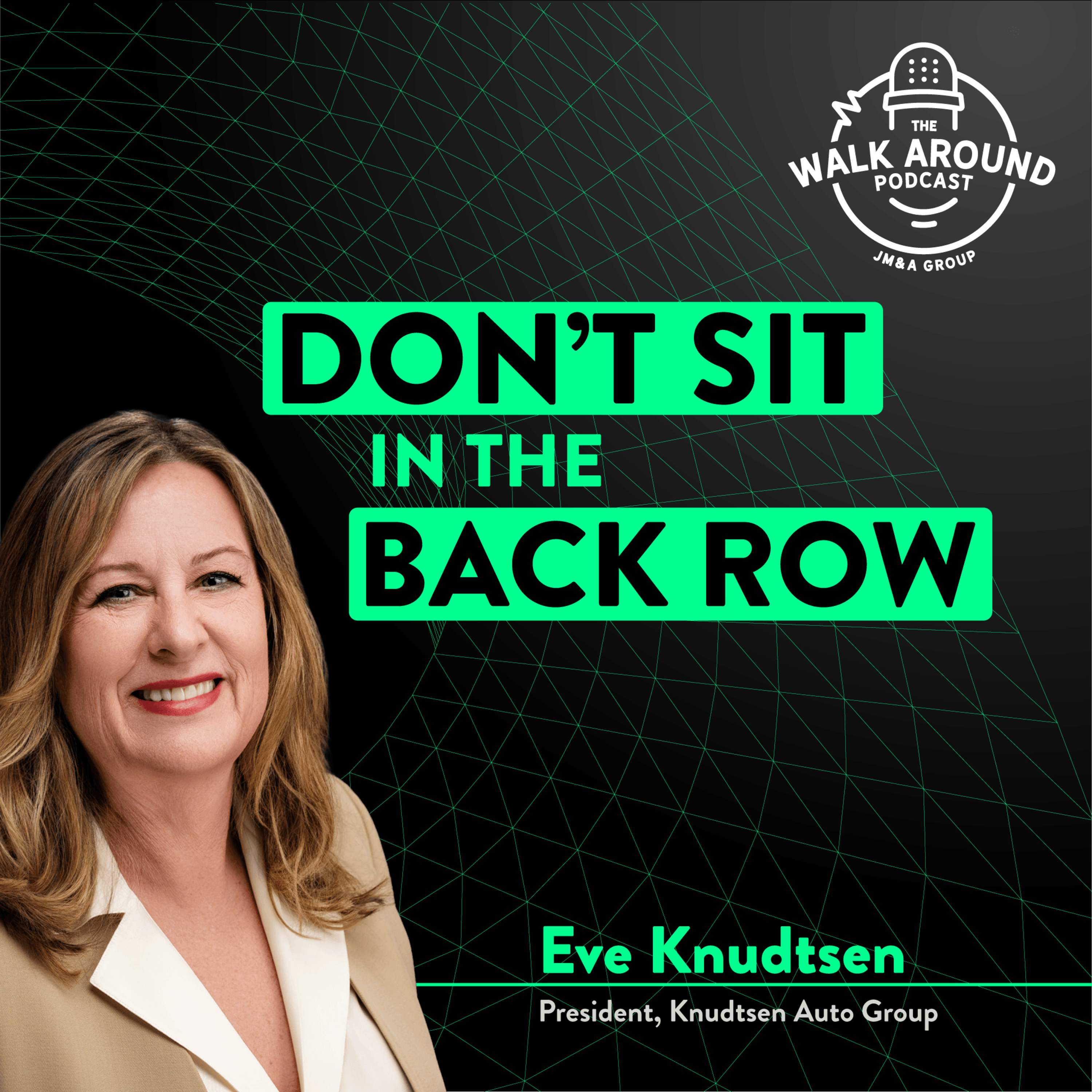
Eve Knudson, president of Knudson Auto Group in Idaho, shares leadership lessons from a multi-generation dealership family and what it takes to “find your voice” in automotive. She argues for speaking up from the front row, staying resilient against naysayers, and building credibility through fixed operations by starting in parts and service. Looking toward 2026, she frames growth around a “hedgehog” strategy centered on service, backed by AI tools that handle calls and scheduling. She also emphasizes delegating responsibility, investing in leadership development, and treating F&I as customer experience to retain buyers.
Eve Knudtsen, President of Knudtsen Auto Group, is a third-generation dealer leading three stores across the Pacific Northwest. She shares insights on leadership, technology, culture and her experience as a woman in automotive.
Episode Breakdown
00:00 - Meet Eve Knudtsen!
02:31 - Making your voice heard as a woman in automotive
05:02 - Advice to women pursuing leadership positions
06:19 - Advice to those new to automotive careers
07:35 - What Eve is focusing on in 2026 at her group
09:23 - Areas of opportunity to improve customer service
12:12 - The result of implementing AI into the customer experience
12:55 - The leadership trait/habit that Eve swears by
15:47 - What’s a bigger risk to dealers? Technology adoption or talent development?
17:57 - The importance of culture in your dealership
19:43 - F&I’s importance in the customer experience
For more information about our guest, visit their LinkedIn.
Liked this episode? Find our full episode library here.