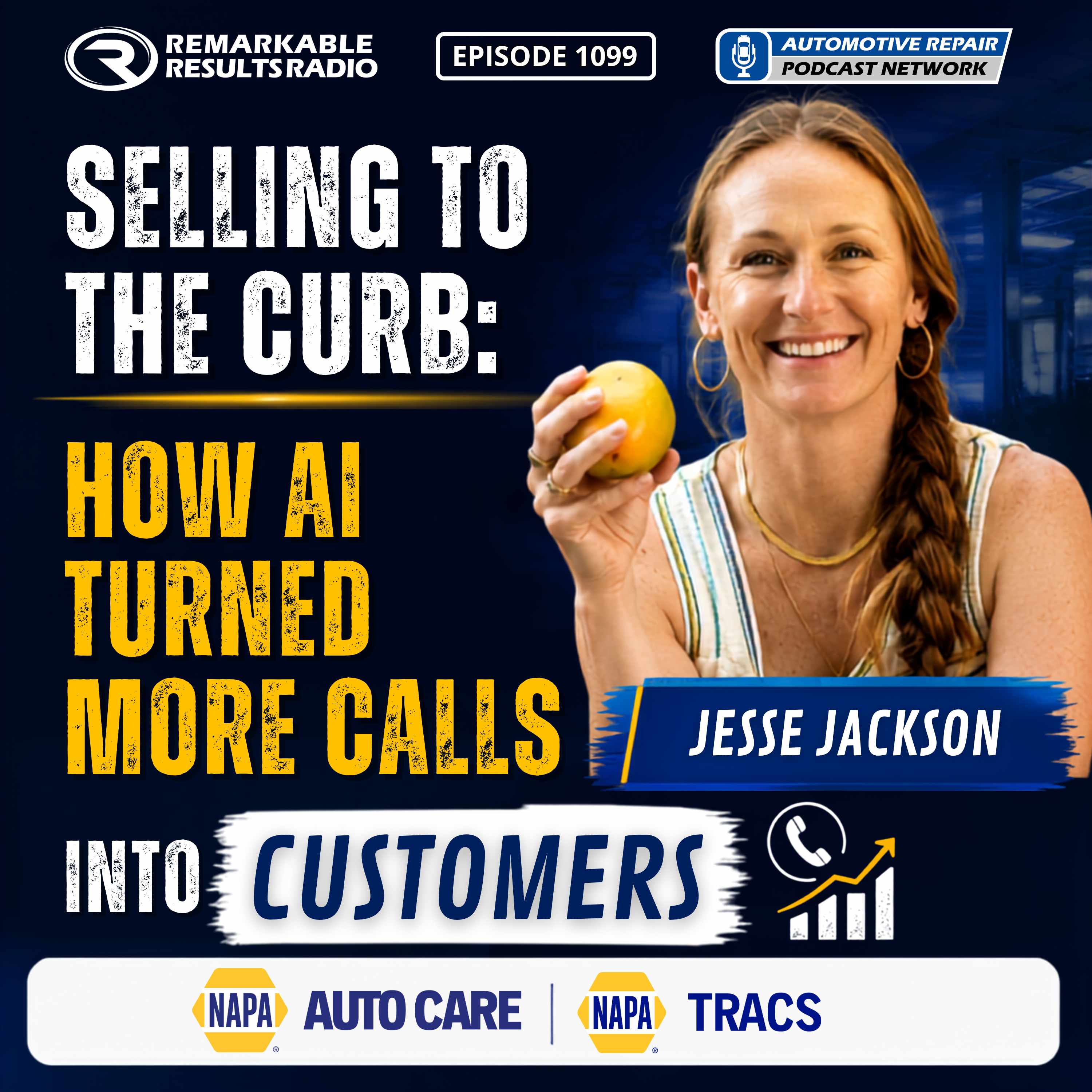
Selling to the Curb: How AI Turned More Calls into Customers [RR 1099]
About this episode
Jesse Jackson, founder of Mango Automotive, shares how she built a multi-location repair group across New Mexico, Arizona, and Texas—starting from one shop and acquiring eight over about four and a half years. The conversation focuses on leadership and culture (never yell, bonus well, have fun), scaling processes with SOPs, and using AI to improve phone-call conversions. Mango “sends calls through AI” to flag whether advisors are “selling to the curb,” then coaches and tracks results. They also tackle price-shoppers by offering quick price ranges to boost appointments.
What does it take to build one of the fastest-growing auto repair businesses while leveraging artificial intelligence to improve performance at every level?
In this episode, Carm Capriotto welcomes Jesse Jackson, Founder and CEO of Mango Automotive, to discuss how she scaled from zero to eight locations in less than five years. Jesse shares the leadership lessons learned through rapid growth, how custom AI tools are helping improve customer experience and operational consistency, and why she believes it's time to rethink how independent shop owners plan their exit from the industry.
What You'll Learn- How Mango Automotive expanded from a startup to eight locations through strategic acquisitions.
- The leadership challenges that come with rapid growth and why building a corporate support team became essential.
- The three cultural principles that drive employee engagement: never yell, bonus well, and have fun.
- How AI is being used to measure standard operating procedures and improve accountability.
- Why analyzing phone conversations with AI helps advisors convert more callers into customers.
- How providing realistic price ranges over the phone can improve appointment conversion rates.
- How AI-driven follow-up processes dramatically increased maintenance rebooking rates.
- Practical ways any shop owner can use tools like ChatGPT or Claude to evaluate service advisor performance without spending hours reviewing phone calls.
- Why thousands of shop owners approaching retirement may be leaving significant business value on the table.
- How Jesse's cooperative exit model could help independent shop owners achieve substantially higher business valuations than traditional private equity acquisitions.
Artificial intelligence isn't replacing great leadership; it's making great operators even better. Combined with a strong culture, measurable processes, and innovative thinking about business ownership, AI can help repair shops improve customer experience, scale more effectively, and create greater long-term value for both Jesse Jackson, CEO, Mango Automotive, 8 locations Learn more about NAPA Auto Care and the benefits of being part of the NAPA family by visiting https://www.napaonline.com/en/auto-care
NAPA TRACS will move your shop into the SMS fast lane with onsite training and six days a week of support and local representation. Find NAPA TRACS on the Web at http://napatracs.com/
Connect with the Podcast:
- Visit the Website:https://remarkableresults.biz/
- Subscribe on YouTube:https://www.youtube.com/carmcapriotto
- Follow on Facebook:https://www.facebook.com/RemarkableResultsRadioPodcast/
- Follow on LinkedIn:https://www.linkedin.com/in/carmcapriotto/
- Follow on Instagram:https://www.instagram.com/remarkableresultsradiopodcast/
- Join Our Virtual Toastmasters Club:https://remarkableresults.biz/toastmasters
- Join Our Private Facebook Community:https://www.facebook.com/groups/1734687266778976
- Join our Insider List:https://remarkableresults.biz/insider
- All books mentioned on our podcasts:https://remarkableresults.biz/books
- Our Classroom page for personal or team learning:https://remarkableresults.biz/classroom
- Special episode collections:https://remarkableresults.biz/collections
- Buy Me a Coffee:https://www.buymeacoffee.com/carm
The Automotive Repair Podcast Network: https://automotiverepairpodcastnetwork.com/
- Remarkable Results Radio Podcastwith Carm Capriotto:Facilitating Wisdom Through Story Telling and Open Discussion.https://remarkableresults.biz/
- Diagnosing the Aftermarket A to Z:From Diagnostics to Metallica and Mental Health, Matt Fanslow is Lifting the Hood on Life.https://mattfanslow.captivate.fm/
- Business by the Numbers: Understand the Numbers of Your Business with CPA Hunt Demarest.https://huntdemarest.captivate.fm/
- The Auto Repair Marketing Podcast: Marketing Experts Brian & Kim Walker Work with Shop Owners to Take it to the Next Level.https://autorepairmarketing.captivate.fm/
- The Weekly Blitz: Weekly Inspiration with Business Coach Chris Cotton from AutoFix - Auto Shop Coaching.https://chriscotton.captivate.fm/
- Speak Up! Effective Communication: Develop Interpersonal and Professional Communication Skills with Craig O'Neill.https://craigoneill.captivate.fm
augmented reality
"Then comes accelerator training program using immersive technologies like virtual reality, augmented reality, and AI driven simulations."
Augmented reality (AR) overlays digital information onto the real world, often through a screen or wearable device. For technicians, AR can display guidance, component locations, or step-by-step instructions while they’re physically working on the vehicle.
virtual reality
"Then comes accelerator training program using immersive technologies like virtual reality, augmented reality, and AI driven simulations."
Virtual reality (VR) is immersive computer-generated simulation that lets trainees interact with a realistic environment. In technician training, VR can recreate repair tasks so learners practice procedures safely before working on real vehicles.
AI driven simulations
"Then comes accelerator training program using immersive technologies like virtual reality, augmented reality, and AI driven simulations."
AI-driven simulations use artificial intelligence to model scenarios and adapt training experiences. In a tech training context, this can mean more realistic practice conditions and tailored feedback based on how the trainee performs.
breaks
"Trainees practice real world jobs, alignments, breaks, diagnostics, in a safe, virtual first environment with instant feedback."
In this context, “breaks” refers to brake-related work (the transcript likely intends “brakes”). Brake service and diagnosis are safety-critical repairs, so training technicians to handle brake tasks correctly is a major shop priority.
alignments
"Trainees practice real world jobs, alignments, breaks, diagnostics, in a safe, virtual first environment with instant feedback."
Wheel alignments are adjustments to steering and suspension angles so the tires track correctly. Proper alignment affects tire wear, steering feel, and how safely the vehicle responds to driver inputs.
diagnostics
"Trainees practice real world jobs, alignments, breaks, diagnostics, in a safe, virtual first environment with instant feedback."
Diagnostics is the process of identifying the cause of a problem using tests, measurements, and vehicle data. In modern shops, it often involves interpreting fault codes and checking system behavior to avoid replacing parts blindly.
AR capable smart safety glasses
"And once they're on the job, tech assist keeps that support going through AR capable smart safety glasses."
AR-capable smart safety glasses are wearable protective eyewear that can also display augmented-reality overlays. In a repair shop, they can show instructions or highlight information while keeping the technician’s hands and attention on the vehicle.
torque specs
"Your technicians can instantly pull up torque specs, wire colors, component locations, and even connect with a live expert who sees exactly what they see, providing guidance step by step."
Torque specs are the exact tightness a mechanic is supposed to use when tightening a bolt. If you tighten too little, parts can loosen; too much can damage the bolt or the part.
Torque specs are the exact tightening force (measured in units like ft-lb or N·m) that a technician should apply to a fastener. Using the correct torque helps prevent bolts from loosening or being over-stressed, which is especially important during repairs involving suspension, brakes, and engine components.
wire colors
"Your technicians can instantly pull up torque specs, wire colors, component locations, and even connect with a live expert who sees exactly what they see, providing guidance step by step."
Wire colors refer to the color coding used in a vehicle’s wiring harness to identify circuits and connectors. In diagnostics and repairs, matching the correct wire color helps technicians confirm they’re working on the right signal or power feed before making changes.
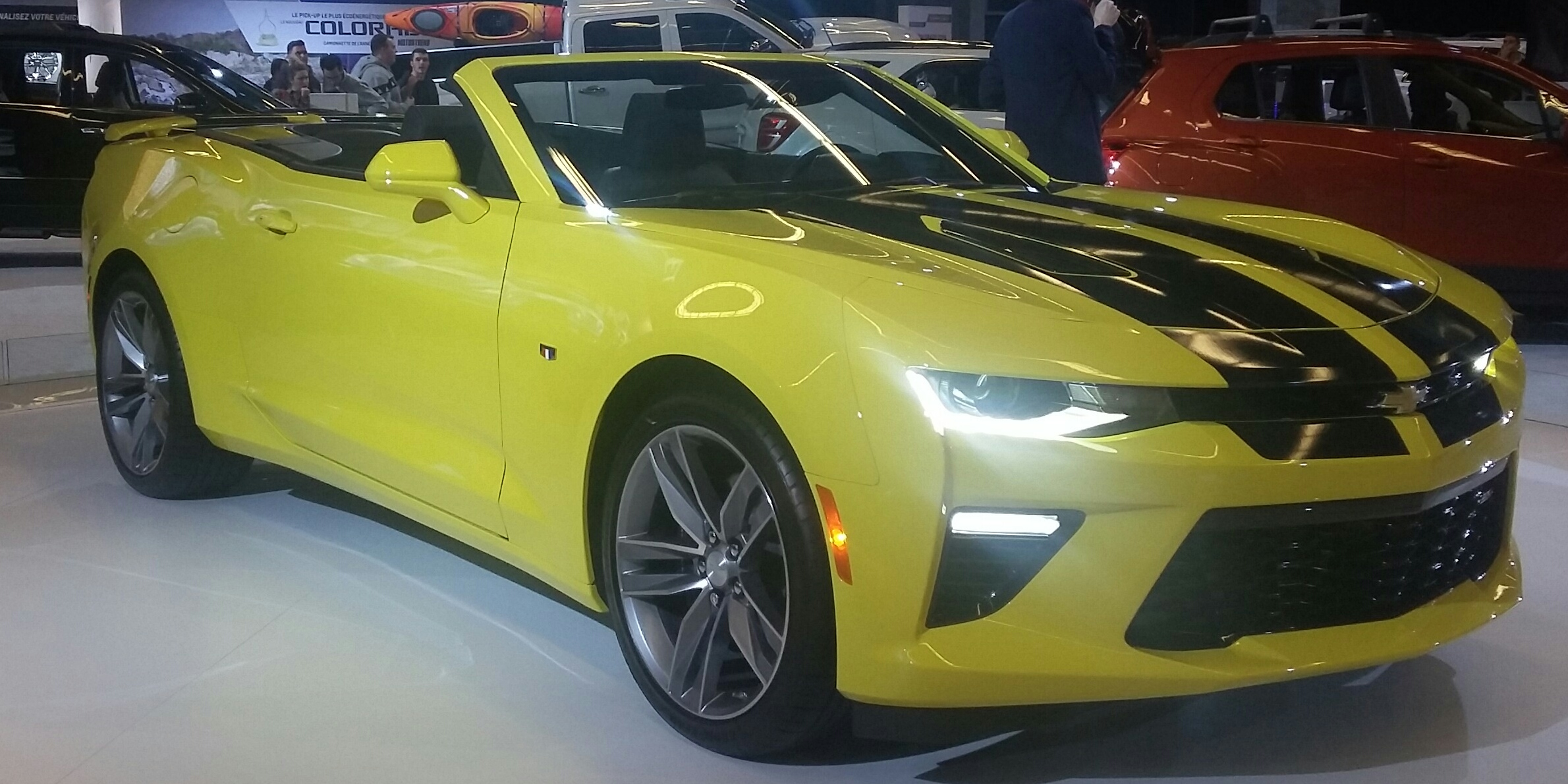
Chevrolet Camaro
"Oh yeah, that's just one for each shop. It's a mango and it's an orange 1970 Camaro, which you can barely see, and then one for each shop."
A Camaro is a classic American car. The 1970 version is a particularly famous year, and here it’s being used as a visual reference for the shop.
The Chevrolet Camaro is a classic American muscle car, and the 1970 model is especially notable for its styling and performance-era reputation. In this segment, the host mentions an orange 1970 Camaro as a shop display piece, tying it to the show’s automotive theme.
rally sport split bumper
"It was a rally sport split bumper."
“Rally Sport” (often abbreviated as RS) is a Camaro trim package, and the “split bumper” refers to the front bumper design that’s visually divided into sections. Together, they describe a specific 1970s Camaro appearance that collectors use to identify the car’s original equipment and styling.
Request an Explanation
Heard something you'd like explained? We'll add it to this episode.
Sign in to request explanations for terms you heard.
Want to learn more?
Browse our glossary for plain-English explanations of automotive terms, jargon, and concepts.
Help improve this episode
See something that's not quite right? Our annotations are AI-generated and can sometimes miss the mark. Click the flag icon on any annotation to suggest a correction.