Augmented reality (AR) overlays digital information onto the real world, often through a screen or wearable device. For technicians, AR can display guidance, component locations, or step-by-step instructions while they’re physically working on the vehicle.
Virtual reality (VR) is immersive computer-generated simulation that lets trainees interact with a realistic environment. In technician training, VR can recreate repair tasks so learners practice procedures safely before working on real vehicles.
AI-driven simulations use artificial intelligence to model scenarios and adapt training experiences. In a tech training context, this can mean more realistic practice conditions and tailored feedback based on how the trainee performs.
In this context, “breaks” refers to brake-related work (the transcript likely intends “brakes”). Brake service and diagnosis are safety-critical repairs, so training technicians to handle brake tasks correctly is a major shop priority.
Wheel alignments are adjustments to steering and suspension angles so the tires track correctly. Proper alignment affects tire wear, steering feel, and how safely the vehicle responds to driver inputs.
Diagnostics is the process of identifying the cause of a problem using tests, measurements, and vehicle data. In modern shops, it often involves interpreting fault codes and checking system behavior to avoid replacing parts blindly.
AR-capable smart safety glasses are wearable protective eyewear that can also display augmented-reality overlays. In a repair shop, they can show instructions or highlight information while keeping the technician’s hands and attention on the vehicle.
Torque specs are the exact tightness a mechanic is supposed to use when tightening a bolt. If you tighten too little, parts can loosen; too much can damage the bolt or the part.
Wire colors refer to the color coding used in a vehicle’s wiring harness to identify circuits and connectors. In diagnostics and repairs, matching the correct wire color helps technicians confirm they’re working on the right signal or power feed before making changes.
“Rally Sport” (often abbreviated as RS) is a Camaro trim package, and the “split bumper” refers to the front bumper design that’s visually divided into sections. Together, they describe a specific 1970s Camaro appearance that collectors use to identify the car’s original equipment and styling.
LIVE
This is the Automotive Repair Podcast Network.
Good afternoon, good evening, good morning,
depending on when you're listening to all my peeps out there.
Thank you so much for being here.
It's Karm Capriotto, Remarkable Results Radio.
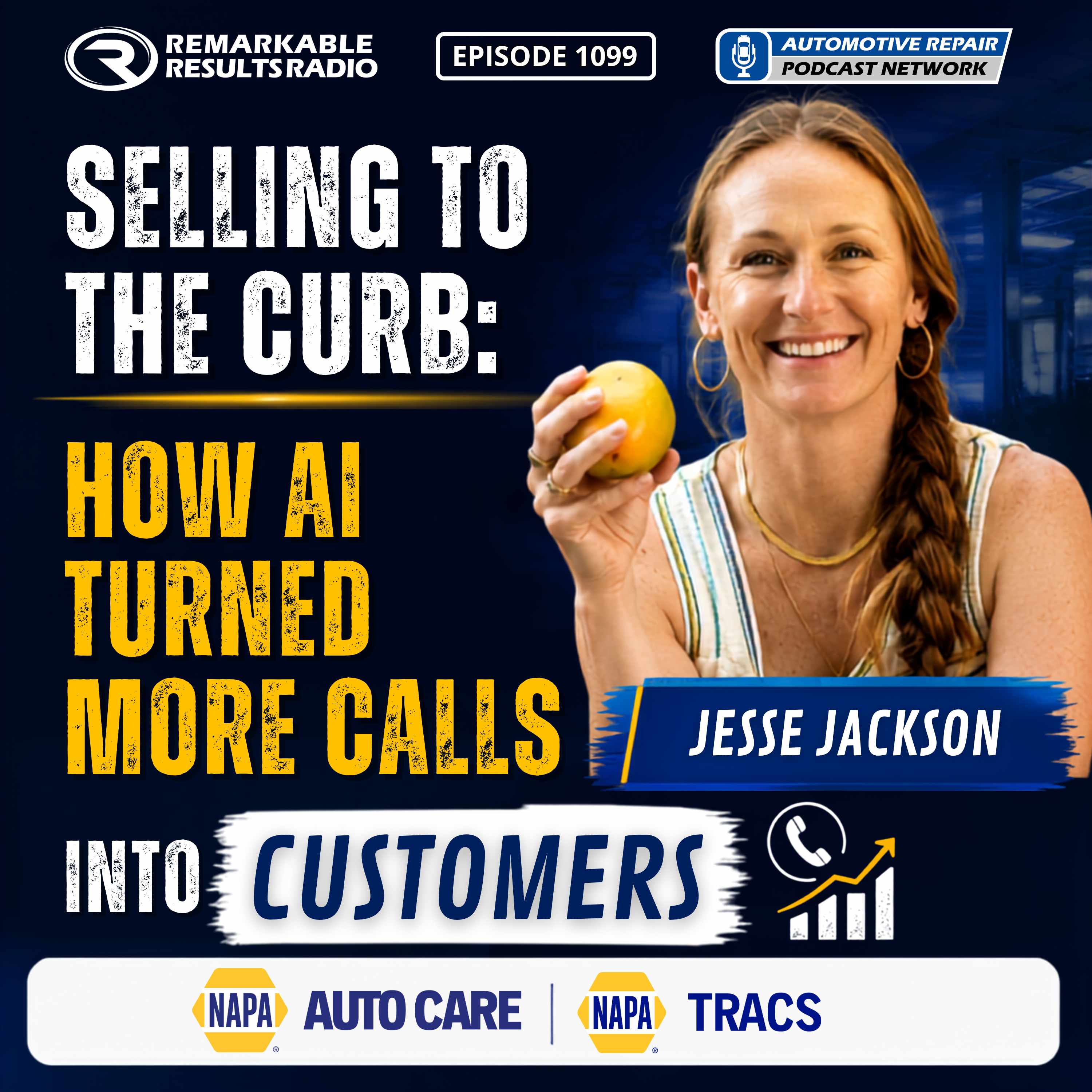
I've got Jesse Jackson with us, founder and CEO of Mango Automotive,
and she is going to talk about some really cool things here today.
We appreciate you being here.
And don't forget, just in case, you know,
Spotify is getting a little too complicated and or if Apple is,
we've got this fabulous app out there.
I'd love you to get it, ARPN.app, the Automotive Repair Podcast Network.
A lot of things for your smartphone, of course,
the ultimate professional automotive content playlist.
And you see, you recently played share all kinds of things,
make up your own playlists with our app.
You'll have a blast.
Hey, we always and for a long time,
have so appreciated all the great sponsors,
such as Napa AutoCare and Napa Tracks.
Hey, stay ahead of the curve with Napa AutoCare's newest auto tech initiatives,
fast track assessments, accelerator immersive training,
and tech assist smart support.
The future of technician training is here.
Connect with your local Napa representative for more information.
Hey, let's face it, your shop management system is the most critical tool in your shop,
and Napa Tracks will move your shop into the SMS fast lane
with onsite training, six days a week support, and local representation.
Find Napa Tracks on the web at NAPATRACS.com.
Okay, I'd like to introduce you to Jesse Jackson, CEO of Mango Automotive.
Hello, Jesse.
What's up, Carm?
Oh, man, I have to tell you, I have this big question.
Okay, so you get an idea.
Eight locations, New Mexico, Arizona, and Texas.
Stop me if I'm wrong.
And you were founded in 2021.
December 26, 2021.
Oh, is that right? Okay.
Barely in 2021.
Did you acquire locations when you first started or did you start from one?
We did. Well, we started from one, zero,
and we acquired all eight in separate transactions.
In five years?
Yep, four and a half.
So question, I can only imagine that the team you have is smart, powerful, resilient.
Could you have done this without, you know, just an incredible group behind you?
Oh, my gosh, definitely not.
I have my business partner, Brian, who joined Mango when we were nothing,
when we had zero shops.
So I'm forever thankful to him.
And I couldn't have done this without him.
As far as the corporate team, Brian and I were chief marketing officer,
human resources, accounts payable, all the things until we hit five shops.
At which point we, I think we had around 60 employees.
We collapsed and we hired finance and human resources and our district manager,
who yes, are all better at their jobs than we were at doing them.
Key word Jesse just said was the word collapse.
I just totally love that word.
We talk about all the issues that happened to us as CEOs and owners of businesses,
but I haven't heard the word collapse in a long time.
And that's one of those reality moments that just hits you upside the hat.
Yeah, we just did all the things until we literally could not do them just
before we opened our fifth location.
My business partner told me he was spending more than half of his hours every week
on recruiting alone.
I said, Brian, we should really hire that out.
And he said, no, no, no, we can't afford it.
And I still interviewed some people, show someone.
And then I will always remember we were in the back shop of our fifth location.
It was the day we were opening it.
And I looked at his face and I knew he was totally and completely overwhelmed.
I said, Brian, let's hire that HR person.
He said, okay, let's do it.
Based on 60 people your size, eight shops.
It's not difficult to do an ROI spreadsheet and say, if I could get Brian back
four hours working for, you know, not in the business, but on the business.
Those are no brainer decisions and I'm sure you made the right one.
Yeah, good for you.
I see something, the auto repair queen.
Hmm.
How did you get that moniker?
Interesting.
I spent about four of the last four and a half years that I've owned a mango
coaching in the acquisition space.
So this was more broadly like, how do you acquire?
How do you acquire with zero dollars out of your own pocket?
And it was in that space where I was exclusively doing automotive repair
that they started calling me the automotive repair queen.
Got it.
Your background.
What was it?
I was in software.
Well, first I was an environmental engineer.
Then I was in software in the product space for many years.
I happened into an automotive software and because I was chief product
officer, that's when I began to understand the landscape of automotive repair.
So then when we sold to private equity, I saw a huge opportunity in the
brick and mortar space.
There still is an opportunity with exchange of wealth in that space with
so many retiring owners that I moved into brick and mortar space and put
a hold on my software career.
The numbers are out there.
20, 30,000, if you will, silver tsunamis that would love to get out of
the industry, sell, succeed.
We're doing shows on how to value your business, how to work toward
valuing your business, how to find internal candidate.
We've done a ton of shows over the years on that.
As a company that has grown to locations in, as you said, four and a half,
five-ish years, there's so much opportunity out there for you.
And to be a multi-stater like you are.
And this is what I want other shop owners to think of.
By my count, there's 35,000 shop owners that are going to retire
in the next three to five years.
I cannot acquire 35,000 shops, and I don't want to see these
owners close their doors.
So that means the rest of us shop owners who are still in growth
phase need to have the opportunity to serve the generation that came
before us by picking up those shops and continuing their legacy
rather than letting them close.
Let's move into a couple of topics that you and I would like to talk
about.
Leadership and personal growth is one of them.
And I don't think you can do what you've done by not becoming a
student of it and being a great leader for your team so they can
aspire to the great culture.
Because there's a lot of toxic shop cultures out there.
You probably see them when you look at places to buy.
Yeah, that's for sure.
We started our culture just around a couple of ideals.
My business partner said, we never yell.
We bonus well, and we try to have fun.
And those three very basic shop tenants got us pretty far
in hiring.
Never yell, but bonus well.
And have fun.
And have fun.
If you were sitting to recruit a specialist or technician right in
front of you and you said, hey, this is what we do, that was
probably something, oh, I've never heard that before.
Yeah, there's a lot of screaming in our culture.
That's for sure.
Never yell.
I love it.
So emotional intelligence, coaching versus managing burnout
prevention and all those things they have to do with watching your
people, watching yourselves and being able to grow a great company
with your eye on the target of profitability.
Number one, what can you tell our listener about your role to
make sure your managers, your district people, because there's
a lot of people that are growing in multi shop operations.
And they say, oh, I did the first one.
Maybe I'm 10 years out.
Now I can do the second one real easy and people get hit upside
the head because they don't have some of this core stuff down.
Yeah, I think there's a lot of what we've done that has really
been like putting the wheels on while we're driving down the
road to use an automotive term.
But sort of, you know, when we had one shop, I remember talking
with Brian who he's really, he was our original district manager.
He's in charge of making, you know, the shops run inside the shop.
Like Brian, we need SOPs because we're going to grow big.
And he was like, I don't think we really need SOPs.
Like I'm covering our advisors lunches.
You could still be in the shops.
But then we reached this period where Brian, he couldn't even
feasibly be in three shops because you know how a shop time is
like you show up at a shop, you just get sucked in.
Like you're there for many hours.
So, I mean, there's a lot of stuff that we built as we grew.
But one thing that we're acutely aware of right now is then a
very standard moniker, what gets measured gets managed.
And so we'll train our front of the house team, for example,
on selling to the curb.
And then you can do test calls and you're shocked when they
don't make an appointment or sell to the curb, right?
And so I have a bunch of kids and I just remember like, you
know, it needs to be taught the same thing over and over again.
And we need to just, we're all human.
We forget things.
We go back to our habits.
So we don't yell once we teach something, right?
We're open to teaching it again and again.
But we were realizing is it's hard to see if our advisors are
selling to the curb without listening to every single call.
But now in the day and age of AI, we just built a dashboard where
we send all of our calls through AI.
We say, was that call convertible?
Could we have gotten them to come in?
And did we get them to come in?
And if we didn't, we put it on a checklist that they can look at
and call them back and check them off so we can increase our
conversion rate because as the owner, we know that every call
that's coming into the shop is costing us a lot of money.
But maybe our manager or advisor was busy or doing something
different and didn't give that call the attention they need.
So now we can look at those numbers actually happening.
I'm impressed with sell to the curb.
Does that mean the conversion of the call?
Is that what you're saying?
You want that vehicle to come up and over your curb
and into the building?
Is that what you mean?
Yeah, exactly.
I think sell to the curb is this idea of setting an appointment
and getting the customer in once they make the phone call.
I love that.
I want to stop you there for a minute and I want to share that
with our listeners.
Sell to the curb.
So many times you need if, what's the word I'm looking for?
Some kind of clever statement that helps people say,
sell to the curb.
It's instead of sitting down with someone says, let's talk
about what just happened, blah, blah, blah.
Sell to the curb describes, you know, four or five paragraphs
of how things need to be done.
And I love that when there's an issue, as you well, we'll go
through your AI and see that we didn't convert this.
Let's sit down and talk about selling to the curb.
They know exactly where you're going with that.
And it's part of the, in fact, it should almost be a little sticker
on the phone, right in front of the phone.
Smile, sell to the curb.
Right.
Smile, sell to the curb.
I love that.
And so as we're doing this analysis, because now we have
the tools to see it, we see this pattern emerging.
Who is the hardest to sell to the curb?
And that's price shoppers.
And I think there's an old, you know, thought process in our
business that if they're asking about price, that's bottom of
the barrel.
We don't want them to come in anyway, but we found that that's
not the case.
People are price conscious or they want to have a general idea
of how much they're going to spend before they come in.
So, you know, in automotive repair, it's been taught to us
and passed down, you know, between shops and coaching programs
don't give a price over the phone.
You can't accurately quote, tell them you need to see it,
have them come in.
But as we saw that dramatically decreasing our call conversion,
we built a tool where our advisors can quickly punch in
what the job is and we can produce a price range.
So now we can tell our customers, this is the price range
we expected to come back in and get more customers to the curb,
even those that, you know, are seen as price shoppers
and we might have previously lost.
So are you quoting a low and a high number to that client?
Yes.
Yeah, we quote a range.
It's pretty wide, right?
Because we don't have all the details.
The more details we can give our AI the closer to the price range.
We can get them, but it might be, you know, that break job
is going to cost between $600 and $900.
It's a pretty wide price range, but we found that to be a useful tool.
And you're converting to the curb because of you doing that?
Right.
It's increasing our conversion rates.
Brian was saying, who was saying we need SOPs?
Was it you or Brian?
It was me and the very beginning with Brian.
Now he sees the picture very clearly because Brian cannot be in eight shops
every day to have those SOPs or to make the SOPs happen, right?
I call them protocols.
Interestingly enough, I fell into that word a couple of months ago
when I realized it may describe how government works, but really not.
It's the protocols of the business and then underneath all those protocols
would be counter, would be sell to the curb, would be all of those policies
or procedures that would be under.
And so when you say, hey, we're slipping on our protocols
and I think SOP standard operating procedures get it critical important.
But I love to lift all of those little different policies and procedures
up into a singular overarching umbrella call protocols.
Yeah.
It's the same thing.
We really talk about them when we talk to our teams.
Like I'm calling them SOPs, but we talk about the non-negotiable.
So we have the six non-negotiables in the back of the shop in the front of the house.
But what I found is if you can't measure those non-negotiables,
if you're teaching sell to the curb and you don't measure how many calls
they're selling to the curb, that you might as well not have that non-negotiable
because it's going to fall by the wayside.
So you have to find a way to measure every single non-negotiable
or protocol as you're calling it.
You're absolutely right.
And I think one of the things that we're missing in a lot of the mid-range shops
that are really striving to be in the top shop categories are not measuring enough.
Number one, they probably just, number one, don't know how.
Number two, don't know what the formulas are because they don't have a coach.
And they find it impossible because of the workload that they put under themselves
to even find the time to do this.
And this is where you go from working on your business instead of working in it.
You had a coach, Brian you're coaching.
Explain to me where all this great knowledge, this detailed knowledge came from for you guys, Jesse.
Yeah, I think, you know, Brian comes from automotive repair.
He's essentially been in the business his entire life.
So he is, I didn't know how badly I needed Brian.
We sort of, I called him to acquire his existing shop and we ended up partnering together.
But he has all of the deep knowledge.
And then along the way, we've done different coaching programs.
So we pick up what we can of value.
You know, every coaching program has their sort of their way to think about it.
And you cherry pick what's valuable to you to build your own system, right?
And then you come up with some things of your own as well.
The automotive world is changing fast.
And customers are expecting speed, accuracy, and confidence in every repair.
To keep your shop competitive, your technicians need training that's smarter, faster, and future focused.
That's why Napa AutoCare is excited to introduce three new auto tech initiatives.
Fast track assessments, the accelerator training program, and tech assist.
It all starts with fast track assessments.
This tool pinpoints a technician's exact skill level, whether they're a student, job applicant, or a new hire.
So you know their strengths and where they need improvement without putting a customer's vehicle at risk.
Then comes accelerator training program using immersive technologies like virtual reality, augmented reality, and AI driven simulations.
It compresses years of technician development into just months.
Trainees practice real world jobs, alignments, breaks, diagnostics, in a safe, virtual first environment with instant feedback.
Instead of tying up your senior techs, they can focus on customers while new hires become billable, competent team members in record time.
And once they're on the job, tech assist keeps that support going through AR capable smart safety glasses.
Your technicians can instantly pull up torque specs, wire colors, component locations, and even connect with a live expert who sees exactly what they see, providing guidance step by step.
System integration with information platforms and DVI, streamline workflow, and boost efficiency.
This assess, accelerate, assist approach helps your shops deliver better quality repairs, faster training, and long term success.
The full solution launches March 2026, but beta registration is now open.
Won't your shop to lead the future of automotive training?
Connect with your local Napa representative today.
Hey, let's face it, your shop management system is the single most important tool in your shop, period.
Napa Tracks has made selecting the right shop management system easy by offering the industry's best, most comprehensive SMS.
Now it all starts when a local representative meets with you to learn about your business and how you need to run it.
After all, it's your shop, so it's your choice, and having local representation is a huge plus.
Customizing tracks to your business, whether you're a one person shop or a large multi-bay or multi-location company,
a representative consults with you to help optimize your shop's workflow, efficiency, and profitability.
Tracks always has the flexibility to do business how you need to do it, which means it can also grow as your business grows.
And unlike the other guys, we'll be there for you after installation with the best training and support in the business.
Yes, a learning management system tailored to each role in your company.
Simply put, tracks was designed and built for shop owners just like you.
Visit us on the web at NapaTracks, that's N-A-P-A-T-R-A-C-S dot com.
Well, thank you for your insight on leadership and all these great things that are so critical.
You mentioned the word AI just a little bit ago, and you said,
well, we'll throw some of these calls through AI and it'll come back and tell us some stuff.
As the leader of the business, you and Brian said to the team, listen, AI is here to stay.
We're going to learn how to use it.
We're going to be its boss, and it's going to tell us stuff and it's going to help us.
Is that your framework?
So a little bit, yes, and a little bit deeper than that.
And just because I have a software background, I have built specific tools for our team to use.
So instead of saying, throw this question into AI and get a pricing result,
I've built a specific tool that lives on top of our dashboard that helps them learn to both sell a job
and it allows them to price a general job and get a price range.
I have built a dashboard that runs every single call through AI, analyzes it,
and Auto creates this to-do list of calls that we think that they can rescue.
In that dashboard, we also measure whether they're making a future appointment for the customer.
When they check out, we want them to make their next appointment in four to six months.
So is that actually happening?
How much money are we losing in comebacks?
All of this stuff, I have used AI to build a dashboard to measure these metrics,
which directly correlate to our non-negotiables so that we can, as an entire organization,
keep track of what's important to us and easily dig down into the cause
when we have a drop in revenue or a drop in GP dollars.
Excellent.
In the next month, you mentioned make an appointment.
You just hit an incredible ding in my brain on how similar the dental business is
when you're getting just routine maintenance.
I just had routine maintenance done a couple of days ago.
Son of a gun, I couldn't leave the chair unless I had an appointment for six months.
Couldn't left.
Yes, I could have left, but it's just how they do it.
Based on your mileage, let's have you back in April.
We'll set a date, and if it doesn't work for you, we'll just move it around.
And then she says, I see this one filling that you have, and I think it needs to be replaced,
and blah, blah, blah.
She goes, can I go in and take a picture of it?
And I said, sure, go ahead so that she wanted to kind of capture that.
And while I'm sitting in there, I said, oh my God, they just did a DVI on my mouth.
And when the dentist comes in to do the review, I stopped and I said, I gotta share this idea with you.
You just did a digital tooth inspection, a mouth inspection, and I'm going crazy trying to draw the parallel and automotive.
And I said, now, if I don't set the appointment as I'm leaving to get this thing done,
are you going to text that photo of my tooth to me in three or four months?
And he goes, no.
And I said, your software should.
And he goes, that's a great idea.
So think about the client work that you have and the photos that you've been taking and how that can help support that.
And so I had to bring this whole automotive thing to the dentist's chair a couple of days ago.
It's perfect.
I mean, I think those are great stories for us to tell to our people and even to people that buy from us.
The dentist takes a look, does the X-rays and we're doing DVIs.
We got all this great photos for you and we got to get this work done.
Full for our entire existence, our rebook rates.
So making a future appointment for a customer were under 12% every week at every single shop.
Now that we're measuring it in the dashboard, we're seeing rebook rates between 50 and 90%.
So what a difference to not have to go out and find every single customer all over again,
but to have them already have an appointment on the calendar.
There's your proof. If you don't measure it, you can't get things done. You have to measure it.
Wow. What are you doing to train your counter people at Frontier Client Advocates?
Are you sending them to school? Are you doing videos? Do you have coaches for that?
What's your focus on making them the best?
Never-ending training. So we have a program that we send them through.
It's sort of a 12-week program and they complete that program online.
We do weekly service advisor training, so a different topic each week.
Our whole team gets on Zoom. We train them on that topic.
Well, a different topic each week at Infinium right back and repeat.
Cover the same topic all over again.
And we have an AI tool where if they open a ticket in our shop management system,
we, for that specific ticket, tell them how they should present it.
So the most critical items first, the items that should be done but don't need to be done right now,
this exact moment and things they can put off that essentially sells that entire ticket.
So they're not reading from this mostly, but they are reading through it to get a refresh.
Even our more seasoned managers are like, oh, sometimes I just need to reset my brain, right?
We all forget no matter how experienced we are.
They reset their brain with that AI script essentially written for that specific customer
and that specific ticket and then they sell.
Jesse, we have an AI tool that helps them.
Is this the one you designed or is it something else you're using?
Yeah, yeah, that one's called Guava.
I think it's at gitguava.ai.
That one is actually, it's coupled with the pricing tool and it's available.
Okay.
Yeah, it's gitguava.ai.
I haven't even put the pricing tool on the website, but it's bundled in there.
But that's your tool?
That's my tool, yeah.
Cool.
All right.
So with your software background, your writing tools, you have tools, you appreciate where AI is coming from.
And I guess your message to the industry is get on board.
Yeah, and I think not everyone is going to be creating their own tools, but look at what's out there
and you got to find a way to measure anything.
So if you don't want to use AI to measure, okay, the first thing I did before I created a tool was I went to my call dashboard
where most people have this that are using voice where it's transcripts of every call.
I just copy pasted those into AI tool of choice, right?
Chat, GBT, Claude.
And then asked it questions, like why are we losing calls?
Which calls do you think were redeemable?
Who should we call back?
That as opposed to listening to calls for 10 hours in a day, it can be done in almost an instant.
So you don't have to build a tool that does it automatically.
But think to yourself, if I have a non-negotiable, if I have an SOP, I have to measure it.
So how am I going to measure it?
And you as an owner can spend now 30 minutes by throwing something into AI and asking questions to get that measurement out,
especially if you just have one shop, right?
How quick is that?
But look for existing tools.
Those are nice.
But, you know, Chat GBT is either free or you can pay, you know, a small fee a month, same with Claude.
And you can get these same answers in a, quote, now new manual AI way that is still infinitely faster than we were doing it before.
So I would say look at your non-negotiables in this way of, how do I measure that?
And find a way to measure it even if it's, you know, manual-ish for now.
Otherwise, don't bother having that non-negotiable.
To your point, in AI, if you don't have Jesse's capabilities and powers and that background,
the thing that I continue to learn about AI, we've done a recent episode with Chris Cloutier on it.
He asked me to read a book, The AI Driven Leader.
And we really changed my thinking that AI is not necessarily a tool, but it's a partner.
But you have to say, hey, partner, here's how we're doing things.
You have to be in control and in charge of what you ask, why you ask.
I mean, you could even tell it, never say this to me, never suggest that.
And it'll learn that and it'll start getting in alignment with you and what your needs are.
I'll give you two little AI tips that I love, Carm, that make that,
before I build a tool, make things really easier, much easier and quicker.
One is you can establish a protocol in AI.
And you can say, this is called protocol, assess the call.
And every time I say use protocol, assess the call, I want you to look at all the call transcripts that I put in.
I want you to output which call transcripts need to be called back because we could have rescued them and we didn't.
Which advisors have a higher conversion rate?
What is the conversion rate for each advisor, et cetera, et cetera.
So then you only give it that prompt once.
Next time, all you do is copy, paste the transcripts and you say, do the call protocol, right?
And it'll remember that and do it all over again.
So it saves you a lot of steps when you start creating protocols.
Scary good.
The other tip is, Maya, because I heard you say you can tell AI not to do things.
AI is not that great at not doing things.
Actually, I found when I never do this and I sort of put it in my settings that it'll still do that.
But what it's better at is replacing things.
So what makes me crazy is that M- was the first thing I tried to train out.
And when I said, never use the M- it kept using it.
And I would say, I told you not to use the M- and it was like, oh, sorry, I forgot.
But then I said, instead of using the M- create a full sentence, put a period and start a new sentence,
and then it was able to do that.
So it's better to say, not this, but that, than just say not this,
because it's that old experiment of don't think of a purple elephant.
But if I tell you don't think of a purple elephant, but think of a pink turtle instead,
like maybe you can make that swap.
I'm having a blast with you here. This is cool.
I taught it to do no M-dashes with any other explanation and it did it.
So maybe I caught it in a good mood.
Your AI must be more compliant than mine is.
Oh my God. All right.
You just highlighted on consolidation and the opportunities that exist in private equity and exit planning.
Any advice, you're going to be out looking for shops and there's going to be shops looking to sell,
but there's also going to be people out there looking to buy.
We have such an interesting stuff merging together. Any great advice for our industry?
There's a couple things that we're doing and this is mostly for the shop owner who's looking to retire.
But I'm trying to think of what direction to go at this.
I think that it sounds like you've had a lot of full conversations around if you're looking to sell.
So we won't hit that, but I will talk a little bit to you about multiple arbitrage
because I think everyone in our industry should understand multiple arbitrage.
So what is private equity doing?
They're purchasing you for a 3x multiple.
Maybe if you have a half a million dollars in profit, maybe that's going to go up.
That will go up a little bit depending on what your profit is.
But what's their end game?
We saw someone just recently sell for a 16x and why did they get a 16x multiple?
Because they had 20 million in EBITDA and you might be thinking,
but I don't have 20 million in profit.
So what private equity is getting, they're getting the spread on what they're buying for,
which is a 3 to 5x multiple and a 16x.
So they're getting more than a 10x multiple on what you've built by doing nothing
but putting a bunch of shops together that have EBITDA.
I'm absorbing this and I'm making it part of my head is going up and down for yes, yes, yes, I'm with you.
That's multiple arbitrage and the reason why I'm so passionate about this
because a lot of times you have, we talk to owners all the time that have built their business for 30 years,
cannot retire on a 3x multiple and that's what the market is.
You know why they can't retire on a 3x multiple because they don't have any profit?
They have never designed their business to make money and then they're going to say to the private equity,
listen, I got the boat at the lake and all my grandkids cell phones and stuff like that
and they're looking for ad backs and they're tiny, they're small.
Make money, find a 20% net operating income so that you can get a 5x on it.
I mean, even if you have a 20% net operating income on a shop that's doing two or 3000000 dollars,
you're not going to get a 5x, you're going to get a 3x, a three and a half maybe.
Some of our listeners just say, Karm, you already lost me on this 3x, this 5x thing.
It's the multiple. Well, what's a multiple, Karm?
If you have your net operating income, the adjusted bottom and private equity comes in to your point.
Say you made half a million dollars consistently over the last three or four years as they look back
and they say, okay, well, then we'll give you three times that or a million and a half.
That is what the multiple is about and that's what the X means. So go ahead, keep going.
But then when lower market private equity resells your same shop,
then they're going to get like 15 times your 500k.
So that means they're getting seven and a half million and they only paid you one and a half million.
So they're getting six extra million just for buying you and bundling you with other shops.
Jesse, what if they came to me and I said, listen, you don't have anybody running this region.
I'll sell you my five stores. I'd like to stay on and I'll take 49% of the offer so I can get a second paycheck.
What do you think of that?
Yeah, there's a lot of that second bite of the apple happening and so long as you believe in what the company's doing
and they have majority, you can often get that.
But we are putting together another way, which is the co-op as we call it,
which is where we're putting together our own 20 million in EBITDA and we will sell, of course,
to larger private equity for a higher multiple and shop owners get a chance to sell their shop
for about three times what it's currently valued at.
So instead of getting a three times that 500k,
they could get more like a nine times that 500k and get 4.5 million because they earned it
and private equity was sort of the first one to start bundling shops,
but we believe that we should do it and reward shop owners who have been building something for the last 30 years.
When you say co-op, are you talking about getting groups together or individual?
Exactly, yes. A group of about 40 shop owners with 500k in EBITDA, about each where we amassed that same 20 million.
Interesting. So many things are going on in our industry and this co-op idea,
this is the first time I've heard it, maybe it's the second time I've heard it.
It's brilliant. I love it and you're probably going to lead this, right?
Yes, yeah. I mean, you know, I think people have said to me like,
oh, you're going to sell the private equity anyway, we have to stop the consolidation.
I would say we're not going to stop the consolidation.
We watched it happen and paint and body, which is now largely consolidated.
It hasn't happened in automotive repair, but it is happening.
So you can fight it, you can be that standout house with the freeway and the mall built around it,
or you can make use of the trend that you already see happening and make that work for you and your family.
So I'm not telling anyone what to do with their business or how to do it,
but we're just creating another option for those people who want to exit,
but doing it at three times their profit doesn't make sense for them.
This was so interesting and great. I love what you just said.
I think it's a perfect ending to this episode and we covered a lot of ground and thank you, Jesse Jackson, CEO,
Mango Automotive. Notice the mangoes on the back wall.
And since I don't know a lot about mangoes, what's all the words below that?
What's the plaques below those?
Oh yeah, that's just one for each shop. It's a mango and it's an orange 1970 Camaro,
which you can barely see, and then one for each shop.
So I got to fill that gap and then get another shelf.
An orange 1970 Camaro. My first car ever was a 1972 Camaro.
Oh yeah, that's what my mom drove when I was a kid.
It was a rally sport split bumper.
And if I was smart enough to keep it, it'd be worth a ton of money right now.
Oh God.
Shucks.
I know. Shuckaroos.
It's been great to have you on the show, Jesse. Thank you so much.
Thank you, Karm. Nice chatting with you.
Same here.
Thanks for being on board to listen and learn from the Premier Automotive Repair Business Podcast, Remarkable Results Radio.
Get your episodic education on the ARPN listening app at automotiverepairpodcastnetwork.com.
Also enjoy the podcast on our Karm Capriato YouTube channel.
Karm is all for advancing the professional automotive service industry.
Until next time.
About this episode
Jesse Jackson, founder of Mango Automotive, shares how she built a multi-location repair group across New Mexico, Arizona, and Texas—starting from one shop and acquiring eight over about four and a half years. The conversation focuses on leadership and culture (never yell, bonus well, have fun), scaling processes with SOPs, and using AI to improve phone-call conversions. Mango “sends calls through AI” to flag whether advisors are “selling to the curb,” then coaches and tracks results. They also tackle price-shoppers by offering quick price ranges to boost appointments.
What does it take to build one of the fastest-growing auto repair businesses while leveraging artificial intelligence to improve performance at every level?
In this episode, Carm Capriotto welcomes Jesse Jackson, Founder and CEO of Mango Automotive, to discuss how she scaled from zero to eight locations in less than five years. Jesse shares the leadership lessons learned through rapid growth, how custom AI tools are helping improve customer experience and operational consistency, and why she believes it's time to rethink how independent shop owners plan their exit from the industry.
What You'll Learn
How Mango Automotive expanded from a startup to eight locations through strategic acquisitions.
The leadership challenges that come with rapid growth and why building a corporate support team became essential.
The three cultural principles that drive employee engagement: never yell, bonus well, and have fun.
How AI is being used to measure standard operating procedures and improve accountability.
Why analyzing phone conversations with AI helps advisors convert more callers into customers.
How providing realistic price ranges over the phone can improve appointment conversion rates.
How AI-driven follow-up processes dramatically increased maintenance rebooking rates.
Practical ways any shop owner can use tools like ChatGPT or Claude to evaluate service advisor performance without spending hours reviewing phone calls.
Why thousands of shop owners approaching retirement may be leaving significant business value on the table.
How Jesse's cooperative exit model could help independent shop owners achieve substantially higher business valuations than traditional private equity acquisitions.
Artificial intelligence isn't replacing great leadership; it's making great operators even better. Combined with a strong culture, measurable processes, and innovative thinking about business ownership, AI can help repair shops improve customer experience, scale more effectively, and create greater long-term value for both
Jesse Jackson, CEO, Mango Automotive, 8 locations
Learn more about NAPA Auto Care and the benefits of being part of the NAPA family by visiting https://www.napaonline.com/en/auto-care
NAPA TRACS will move your shop into the SMS fast lane with onsite training and six days a week of support and local representation. Find NAPA TRACS on the Web at http://napatracs.com/