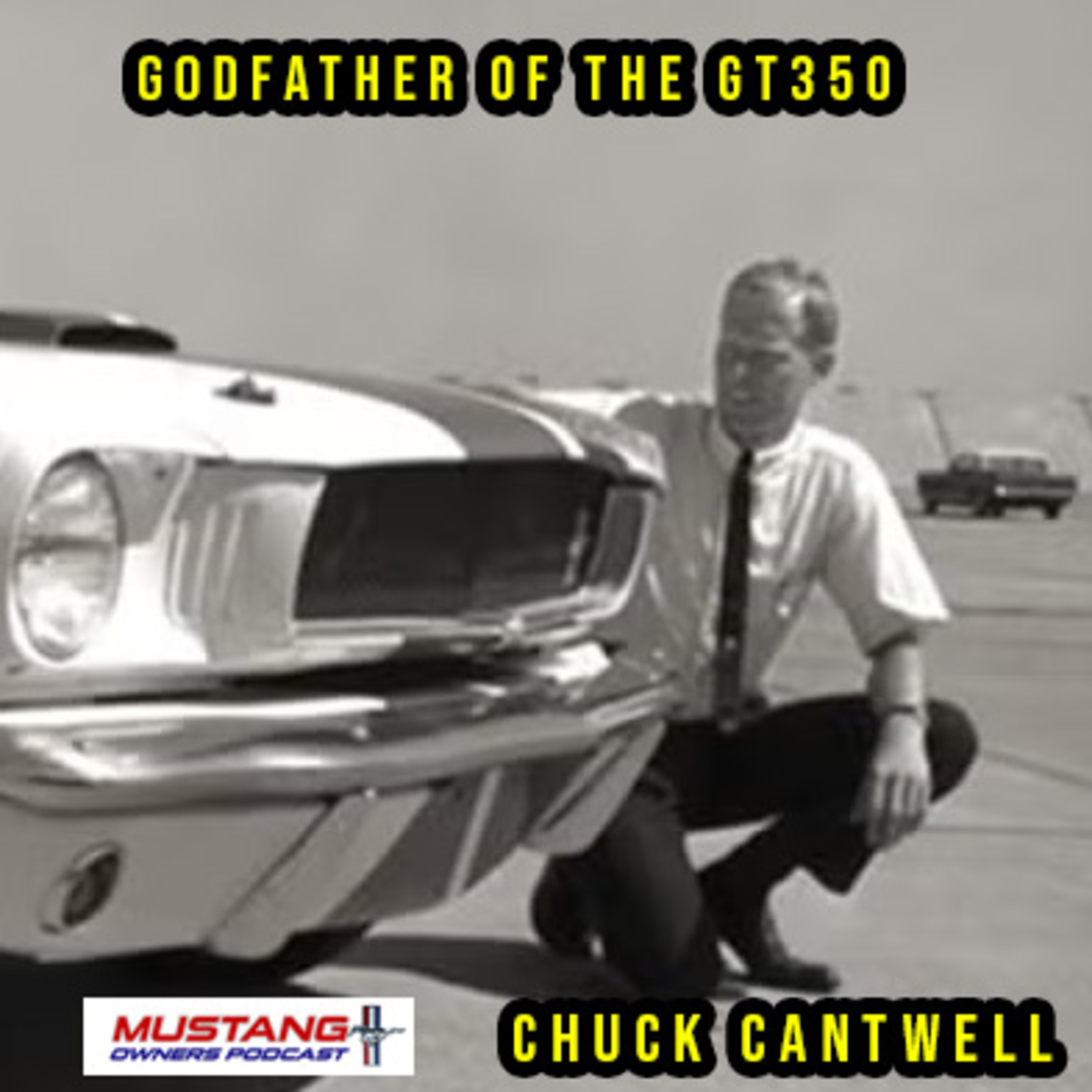
Shelby GT350 Legend Chuck Cantwell Shares Inside Stories You Gotta Hear!
About this episode
Chuck Cantwell, Shelby GT350 “godfather,” shares how the original street and race cars were engineered in tight coordination with Ford and SCCA rules. He explains the spreadsheet-driven planning, sourcing parts through Ford, and why both road and race versions faced different constraints. Cantwell recounts the push to get the Mustang approved for racing, the early testing, and Ken Miles’ involvement. He also covers the wild Hertz rental-car concept and why the GT350’s collector value surprised him. He ends by revealing he owns a 1966 GT350.
Yes, it’s true that the Mustang Owner’s Podcast was previously able to sit down for a long interview with Chuck Cantwell, the legendary project engineer for the original Shelby GT350, back in the spring of 2002. That’s when our podcast’s founder, the late Steve Hall, steered Cantwell through a load of questions with Chuck offering up story after story on this historically significant Mustang. But that was also when we were only on Spotify, and didn’t have the video to witness Chuck’s smile as he fondly recalled what went on behind the scenes introducing the Shelby GT350 to the motoring public. This time around John and Mike were able to get Cantwell join us for a recording session where we were able to ask his views on things we’ve never heard others ask him before. Listen in as we celebrated Chuck’s 92 nd birthday with more great stories behind the development of the Shelby GT350 that you won’t want to miss.
bullspend
"Flowing ad budget on metrics that look great, till the CFO sees them, that's bullspend. And marketers are calling it out in dashboard confessions."
“Bullspend” means spending money on marketing that seems impressive in reports, but doesn’t really help the business. The CFO is basically saying, “Show me results, not just numbers.”
“Bullspend” is a slang term for marketing spend that looks good on paper (metrics) but doesn’t actually produce real business results. It’s used here to contrast vanity metrics vs outcomes that matter to leadership.
LinkedIn lets you target by company, job title, and more
"LinkedIn lets you target by company, job title, and more. Advertise on LinkedIn."
LinkedIn ads can be shown to specific types of people based on their work details. That helps advertisers reach the right audience instead of everyone.
This describes audience targeting on LinkedIn—choosing who sees an ad based on professional attributes like company and job title. It’s a marketing concept, but it explains how campaigns are segmented to improve relevance.
Mustang Owners Podcast
"Hello Mustang fans and welcome to another episode of the Mustang Owners Podcast. I'm your host, John Clore, along with my co-host, Mike Ray."
This podcast is all about Mustangs and the people who own them. The goal is to share stories and insights from real owners.
This is the show’s framing: a podcast focused on Mustang ownership stories and community. Listeners can expect discussion centered on Mustang history, cars, and real-world ownership experiences.

Shelby GT350
"We are so pleased to bring to the podcast the, what they call the Godfather of the Shelby GT350. Chuck Cantwell."
The Shelby GT350 is a special, high-performance Mustang made with Shelby branding. People love it because it’s built to feel sporty and exciting, not just comfortable.
The Shelby GT350 is a performance model associated with Ford’s Mustang platform, built/marketed under Shelby’s name. It’s especially known for its track-focused character, high-revving V8 feel, and classic 1960s-era racing heritage.

Kia Soul
"...now, Mike, there's somebody who's over at the Kia Soul engineering department kicking himself."
The Kia Soul is a small SUV-style car made by Kia. It’s built for everyday driving and is known for its distinctive, boxy look. The episode brings it up because they’re talking about its engineering.
The Kia Soul is a compact crossover known for its boxy shape and easy daily usability. It’s discussed in the podcast because the conversation references the Kia Soul engineering team, implying a design or development topic. That makes it relevant even in a Mustang-focused show when the episode shifts to broader automotive engineering ideas.
race cars vs road cars
"...So they asked, what was the tougher one to do? Is was the race cars... Or the road cars... The three cars were, of course, had to be halfway decent cars. You could take take out the road and take your kids around..."
They’re comparing two different jobs: building a car to win on a track versus building a car you can actually live with on the street. The race version has to be fast, while the street version has to be comfortable and practical too.
The segment contrasts race cars and road cars, emphasizing that each has different priorities. Race cars focus on speed and track performance, while road cars must also meet usability needs like drivability and everyday practicality.
Ford
"...Or the road cars, you got to work with Ford... The both both had a lot of Ford input, of course."
Ford is the automaker behind the Mustang platform that the Shelby GT350 is based on. The hosts mention “Ford input” to highlight how the street-car development required coordination with the manufacturer’s requirements, not just racing goals.

Lamborghini Gt 350S
"...the Chuck Cantwell favorites? Working on the race GT 350s or the road GT 350s? Well, it was all a lot, a lo..."
The Lamborghini 350 GT is an older, classic sports car made by Lamborghini. It was designed for comfortable, fast driving rather than just everyday use. The episode mentions it as part of a discussion about classic performance “GT” cars.
The Lamborghini 350 GT is an early grand touring Lamborghini model, known for being part of the brand’s formative era. It’s brought up in the podcast in the context of race GT 350s and road GT 350s, suggesting a discussion about classic performance cars and their development. That makes it relevant as a historical reference point in the conversation.
SCCA system and rules
"linked into the SCCA system and rules as a group. So they had they had to meet the street requirements and and race requirements,"
SCCA is a racing organization with rulebooks for different classes. If a car has to follow SCCA rules, it means the design has to fit what that rulebook allows for racing.
SCCA (Sports Car Club of America) sets rules that determine what cars are eligible to race in specific classes. When a program is “linked into” SCCA rules, the car has to be designed so it can meet both the racing rulebook and the related street-legal requirements.
street requirements and race requirements
"So they had they had to meet the street requirements and and race requirements, but but have a separate design that made them appropriate for each one. ... the street cars had to meet certain parameters and the race cars hanging out with the engineers had to meet certain performance parameters."
This describes the balancing act of building a car that can be used on public roads while also being competitive under racing regulations. In practice, that often means meeting homologation-style constraints (what must be produced/approved for street use) while still targeting track performance.

name three fifty later
"was a liaison between Ray Gettison and Shelby if we're on this Mustang program as it was called. And we got a name three fifty later, but it was. There were there were so many things we had to line up"
They’re saying the project eventually got the “350” name, which points to the Shelby GT350. That’s the well-known Mustang-based Shelby performance car people recognize today.
“Three fifty” is the naming reference to the Shelby GT350, a famous Ford Mustang-based performance model. The discussion implies the program evolved from an internal “Mustang program” label into the Shelby GT350 identity.
transmission
"There's a lot of parts we got from from Ford, like the transmission was..."
The transmission is the drivetrain component that selects gear ratios to transfer engine power to the wheels. In this segment, it’s specifically about choosing which Ford transmission and gear-ratio setup to use in the program.
close ratio version
"...we could get a close ratio version that we decided and picked the years that we could..."
“Close ratio” means the transmission’s gears are spaced closer together. The goal is to keep the engine revs in the sweet spot so the car feels quicker when you accelerate.
A close-ratio transmission has gear steps that are closer together, keeping the engine in its power band more often. That typically improves acceleration and responsiveness, especially in spirited driving or track use.
assembly line
"...it was easier if we could do stuff at Ford. I mean, put it on the assembly line and they were extremely cooperative..."
An assembly line is how factories build cars step-by-step in a set order. They’re saying it was simpler when Ford could install the parts during the normal factory process.
An assembly line is the factory process where vehicles are built in a standardized sequence. The hosts highlight that it was easier to have parts installed at Ford during production, because it could be integrated into the normal build flow.
building the hot race car
"...more interested in your progress on building the hot race car, the GT 350 race versions..."
“Hot race car” just means a serious, performance-focused car built for racing. It’s not the same as a normal street car—it’s tuned and prepared for track use.
“Hot race car” is a colloquial way to describe a purpose-built, performance-focused race car. In this context, it implies Chuck was working on a track-prepped GT350 program alongside street-car development.
production of the road car
"...or was he just as interested in production of the road car? ...because that's that's I guess what was going to be paying for a lot of what he was doing with the race cars."
They’re talking about two different goals: building a race car for track performance versus building the street version people can buy and drive daily. The street car has to be reliable and practical, not just fast.
This contrasts race-car development with street-car production. Road-car production is about meeting customer needs, regulations, durability, and cost targets, while race development prioritizes performance and track-specific setup.
plan of what we at least a list of all the parts we had to have for both the street and the race cars
"...we had a plan of what we at least a list of all the parts we had to have for both the street and the race cars."
They’re describing how you plan a build by making a list of parts for two versions of the car—one for the street and one for racing. That way you don’t miss anything and you can compare what changes for track use.
This describes the practical engineering workflow of maintaining two related builds: a street car and a race car. Creating a parts list for both helps manage compatibility, sourcing, and how components differ between street and track requirements.
Formula One
"One of them was worked on Formula One, in fact, and in England. And so we had a very concentrated effort on make getting the first race car out."
Formula One is the highest level of race car competition. If someone worked on it, they likely know a lot about building and improving race cars.
Formula One (F1) is the top tier of open-wheel racing, known for highly engineered cars and strict technical development. Mentioning someone “worked on Formula One” signals they brought advanced race-car fabrication and engineering practices to the project.
building race cars on a deadline
"We wanted to do that by the sort of started in October, November, and we wanted to have a race car done by at least one race car and we done by the first of the year and then have a dozen done by the street cars done by the same period of time."
The segment focuses on project scheduling and production targets—starting in October/November, completing at least one race car by early January, and then having a dozen street cars done by the same period. This is a “how they got it done” story tied to racing timelines.
street cred
"because, you know, Iacoco wanted the street cred for that car. And as it came, but even Carol himself, over the secretary's car."
“Street cred” just means people think you’re legit and respected. They’re saying racing helped the Mustang earn a reputation with regular car buyers.
“Street cred” is slang for credibility and reputation—how believable or respected something is to everyday people. Here, the hosts describe how racing involvement and a performance car package helped Mustang gain mainstream respect.
K code
"We know we started out with a 260. And by having that K code that having a race car motor and then taking that to go compete, it changed the way people looked at Mustang that first year."
“K code” is basically a factory designation for a particular high-performance setup. Here, they’re saying that code helped make the Mustang seem more serious and capable.
“K code” refers to a specific engine/option code used on early Mustangs, tied to the high-performance 289 V8 used for competition. In the discussion, the K code is credited with changing how people viewed the Mustang in its first year.
hypo 289
"that allowed the Mustang to have the K code have a hypo 289, which I don't think Chuck, it may have gotten without, you know, the push"
“Hypo 289” means a more performance-oriented version of the 289 V8. The point here is that this engine helped the Mustang feel like a real contender, not just a regular car.
“Hypo 289” is shorthand for a “high-performance” 289 V8 configuration (often associated with a specific factory performance spec). The hosts argue that getting this engine into the Mustang lineup—via the K code and racing pressure—was a major reason the car gained respect quickly.
production car rules
"They they had their own rules, what you can do with a production car."
Racing series often allow only certain modifications to keep the car close to what people can buy. Those rules determine what parts you’re allowed to change and how much you can tune the car.
“Production car rules” are the regulations that limit what you can change on a street-based car for competition. The hosts mention that Shelby’s group had their own interpretation of what was allowed, which directly affects suspension and component choices and how competitive the car could be.
Riverside
"Shelby Miles and Bill Remington took the car out to Riverside and ran a lot of tests with that."
Riverside is a famous race track where teams test cars. They drove the car there to learn how the suspension and other parts would perform.
Riverside refers to Riverside International Raceway, a well-known U.S. road course used for testing and racing. The transcript says Shelby Miles and Bill Remington took the car there to run tests, which is a common step when developing suspension and performance components.
suspension
"they, they had an idea of what the suspension and some of the different main components were going to do for for the cars performance."
Suspension is what helps the tires stay in contact with the road and controls how the car handles bumps and turns. In racing, getting it right can make the car faster and more predictable.
Suspension is the system that connects the wheels to the car and controls ride quality, grip, and handling. The speaker ties early test results at Riverside to what the suspension and key components would do for the car’s performance, emphasizing how suspension tuning is central to racing development.
testing and Willis Springs
"Well, not really. We've done a lot of testing and Willis Springs. And we knew what comparative prices are not prices... The comparative times were on Willis Springs..."
They tested the car at a track called Willis Springs to see how fast it could go. By comparing times there to other cars, they could estimate whether they’d be competitive in the race.
“Willis Springs” refers to a test/track location used to evaluate performance. The key idea is that they compared lap times and competitiveness using prior data from that same venue, which helps predict how the car will do in upcoming races.
comparative times
"...The comparative times were on Willis Springs for different cars that were competitive last year. And we were we were adequately prepared to go that fast..."
They’re talking about comparing lap times. If your car’s times match or beat the cars you’ll race against, you can feel more confident you’ll do well.
“Comparative times” means using lap-time benchmarks from other cars to judge whether your car is competitive. It’s a practical way to translate testing results into expectations for race performance.
Ken Miles
"...And so we were, of course, Ken Miles gives extra emphasis on everything. And we went to the first race with Ken..."
Ken Miles was a legendary race driver known for his speed and feedback, especially in the Ford racing world. In the transcript, his “extra emphasis” suggests he influenced how the team approached setup, driving, or preparation to maximize performance.
point races
"...it won two or three races that it ran. They weren't point races, but they were against competitive cars..."
A “point race” is a race where you earn points based on where you finish. They’re saying they won some races that weren’t for championship points, but the competition was still tough.
“Point races” are events where finishing positions earn championship points. The transcript contrasts non-point races with “point races,” implying they still faced strong competition even when the event didn’t directly affect the standings.
halo cars
"Well, it was kind of like a double halo. You know, Mike, we talked about some of the performance cars that came out of Ford, and it was about the halo cars. You know, the standard model. And then there's the halo model."
A “halo car” is the coolest, most exciting model a brand makes. It’s meant to turn heads and make people want the brand, even if they don’t buy that exact car.
“Halo cars” are the flagship, attention-grabbing models a brand uses to build excitement and credibility. They’re often more performance-focused or more expensive than the “standard” models, and they help sell the rest of the lineup by association.

Ford Mustang GTD
"Yeah, and Shelby took it to a yet another level. You could buy a Mustang GT back then. But if you got a Shelby Mustang, that was something else."
A Mustang GT is the more performance-oriented version of the Ford Mustang. Here it’s mentioned as the normal option, compared to the more special Shelby GT 350.
A “Mustang GT” refers to the performance trim of the Ford Mustang line. In this segment, it’s used as the baseline comparison—something you could buy back then—before contrasting it with the Shelby-modified GT 350.
marketing stunt with rental cars
"...to go out and rent a racer through Hertz and and make these these GT 350s... you went and stuck them in a rental car dealership. Mike loves the rental car story."
This is basically a clever marketing idea: instead of only selling to racing fans, they got the Shelby GT 350 into rental fleets. That way, more people could drive it and see what it was like.
The transcript describes a nontraditional launch/marketing approach: placing a race-oriented Shelby GT 350 into the rental-car ecosystem. This is a “try-before-you-buy” strategy—letting everyday drivers experience the car’s performance without them already being enthusiasts.
Hertz
"...to go out and rent a racer through Hertz and and make these these GT 350s... you went and stuck them in a rental car dealership."
Hertz is a company that rents cars. The hosts are describing a marketing stunt where a performance Shelby GT 350 was treated like a rental car to get more people experiencing it.
Hertz is a rental-car company, and the story here is that Shelby American allegedly used Hertz as part of a marketing stunt. The idea was to get people into a Shelby GT 350 through the rental channel, which is unusual for a track-focused car.
SCCA rules
"It was it was a two passenger had to be a two passenger car to match the SCCA rules because you had to start with a passenger car."
SCCA is a racing organization that makes the rules for what cars can compete. In this case, the car had to begin as a normal passenger car, then be modified into a race car to fit the rulebook.
SCCA refers to the Sports Car Club of America, which organizes road racing and sets class rules. The key point here is that the car had to start as a passenger car and then be reworked into a race car to comply with those regulations.
street version vs racing version
"They they had a racing version. And so we had to do essentially the same thing with the Shelby."
Some race cars are based on cars you can buy on the street. The idea is that the street version exists, and the racing version is developed from it so the competition is “fair” and the performance is proven.
This describes a common motorsports strategy: manufacturers build a street-legal car and a racing version, then use the racing program to prove performance. The transcript emphasizes that if the Corvette had both, the Shelby program had to mirror that approach to compete effectively.
marketing-driven test drives / executives renting cars
"...they told us... we wanted to get young executives getting off the plane... what would they drive home?... And then when it showed up?... were you the one that said you really didn't believe those stories that people to rent them and take them home and take the engines out and return them?"
They’re talking about how car companies used to promote new models by letting important people drive them right away. The stories suggest some people would take the car home and even mess with it before returning it, which shows how valuable and exciting the car was.
This segment describes a launch-era marketing tactic: getting young executives to experience the car firsthand by driving it home after it arrived. The story also implies a “hands-on” culture where people treated the car like a trophy, sometimes even disassembling parts to return it.
engine
"...stories that people to rent them and take them home and take the engines out and return them?"
The engine is the main mechanical unit that makes the car move. The story is basically saying some people supposedly rented the car, took the engine out, and then returned it—though they’re unsure if it really happened.
The engine is the powerplant that produces the car’s driving force, and removing it would be a major, obvious change. In this segment, the hosts are debating whether people really rented a Shelby GT 350 and then removed the engine before returning it.
walk around
"...those guys with the to do the walk around and return the car didn't notice that your head year old six on there in it?"
A “walk around” is when you circle the car and check it over before and after. Here, it’s mentioned to suggest that if people were taking parts out, they should have been noticed during that check.
A “walk around” is a pre- or post-drive inspection where someone checks the car’s condition—often looking for damage, missing items, or discrepancies. In the context of the story, it’s used to question how someone could remove parts and still pass inspection.
race-prepped vs street setup
"A street Shelby was a decent race car, but it wasn't as fast as the race car when you had all the equipment on it."
A race car is set up differently than a street car. It usually has extra performance parts and is tuned to handle hard driving better, even if it’s less comfortable.
“Race-prepped vs street setup” refers to the difference between a car built for track use and a car intended for street driving. Track cars often add performance parts and safety equipment, and they’re tuned for grip and repeatable lap performance rather than comfort.
clutch is stiff
"it's an awful rental car. The clutch is stiff. It's loud. It's it's right. It drives like a the suspension's hard."
A “stiff” clutch means higher pedal effort and often a heavier or more aggressive clutch pressure plate. Performance clutches can feel harder to drive day-to-day, but they may offer better durability or more consistent engagement under hard use.
steers on a dime
"It drives like a the suspension's hard. It steers on a dime. He goes, This is not a comfortable car."
“Steers on a dime” means the car turns very quickly and feels precise. You don’t need to turn the wheel much to change direction.
“Steers on a dime” is a common phrase meaning the car turns quickly and precisely with minimal steering input. It usually points to responsive steering geometry and a suspension setup that keeps the tires working effectively.
launch timing spreadsheets
"you know, how many times when you were in the launch team, did you get those big, long spreadsheets like Chuck had to deal with, you know, all the launch timing and all that."
“Launch timing” refers to the precise timing and procedure used to get the car moving at the start of a race or event. Spreadsheets suggest a highly organized process—often coordinating driver actions, staging, and vehicle behavior to maximize consistency and performance.
Team Shelby
"we were so thrilled when we listened to your stories, we come and hear you talk at all these events, especially with Team Shelby. Now you're still connected with"
Team Shelby is associated with Shelby-branded racing and events, often involving organized participation, track activities, and community around Shelby performance cars. In this segment, it’s referenced as the context where Chuck’s stories and connection to the brand show up.
remake some of those cars from 1965
"Well, I don't I particularly don't think too much of that actually having that was their privilege and they got a group of guys together and a couple of them has been around ... and now trying to remake some of those cars from 1965?"
They’re talking about people building newer versions of an older car from 1965. The goal is usually to match the original look and feel, and that can make the cars more collectible.
The hosts are discussing modern recreations of classic cars—often called remakes or reproductions. The key idea is that builders use original-era specs as a “standard” to copy and improve upon, which can affect authenticity, collectability, and pricing.
Penske
"...you eventually left forward and Mike, you do know that he wound up in what was it? Was it 69 when you wound up going over to Penske?"
Penske is a big name in racing. When someone “goes over to Penske,” it usually means they moved into a serious, professional racing environment.
Penske is a major motorsports and racing organization, strongly associated with professional racing teams and management. Mentioning Penske here highlights that the guest’s career intersected with high-level racing operations, not just street-car culture.
Trans Am series
"...he wound up in what was it? Was it 69 when you wound up going over to Penske? And he ran for the manage the Trans Am general manager for the Trans Am series for the Camaros."
Trans Am is a well-known kind of American racing series. Mentioning it here means the person’s career wasn’t only about Mustangs—it was tied to racing at a high level.
Trans Am (SCCA Trans-Am) was a major American road-racing series. When the transcript mentions someone becoming a Trans Am general manager, it signals deep motorsports involvement that goes beyond just one brand or model.

Chevrolet Camaro
"...he ran for the manage the Trans Am general manager for the Trans Am series for the Camaros. So your knowledge is goes beyond just Mustang."
They mention “Camaros,” which are a Chevrolet model. In racing, certain Camaro versions were used and competed in Trans Am, so it connects to performance history.
The transcript references “Camaros” in the context of the Trans Am series. In Trans Am racing, specific Camaro models and their race-prepped versions were common competitors, which is why a team or series manager’s work would be closely tied to those cars.
cars you made at auction are worth a fortune
"...I don't think any of those Camaros went to auction last month. The cars you made at auction are worth a fortune. Chuck, did you have any inkling that these cars would be so crazily coveted by the Mustang collector"
They’re saying the cars sold at auction for huge money. Collector value usually comes from things like how rare the car is and how well it’s been preserved.
The hosts are talking about auction pricing and how certain cars become highly valuable to collectors. Auction results often reflect rarity, provenance, condition, and cultural significance—especially for iconic performance cars and limited-production builds.
Mustang Gt350
"Oh, and you know, I don't know if anybody knows, you know, you did do that book a while back Shelby Mustang GT 350 my years of designing, testing and racing. Carol's legendary"
The Mustang is Ford’s sports car. It’s known for performance and for having many special versions over the years. In this episode, it’s mentioned because the conversation is about the history of designing and racing the GT350.
The Mustang is Ford’s iconic sports car line, with a long history that includes performance-focused variants like the Shelby GT350. In this episode, the word “Mustang” is used in the context of a book and the legacy of designing, testing, and racing. That’s why it’s discussed: it ties the broader Mustang story to the GT350 heritage.
designing, testing and racing
"Shelby Mustang GT 350 my years of designing, testing and racing. Carol's legendary Mustangs, which you did with was a great call scum."
The phrase describes the full development loop for a performance car: designing the parts and systems, testing them (often repeatedly), and then racing to validate real-world performance. For enthusiasts, this matters because racing feedback is what turns a “fast on paper” idea into a car that’s consistent under stress.
processing of the cars and the parts
"had to go back all those years and try and all the names to remember all the how did you guys sit down and put all that down on paper? ... during the processing of the cars and the parts and everything to make the car a viable car and saleable"
They’re talking about the step-by-step work of turning ideas into real cars. That includes how parts are made and put together, then checked so the final car performs the way it’s supposed to.
“Processing” here likely means the production/development workflow—how cars and components were engineered, assembled, validated, and refined to reach a final performance target. In performance-car history, this is where engineering decisions become repeatable manufacturing outcomes.

Corvettes
"to make the car a viable car and saleable and fast enough to beat the Corvettes."
They’re comparing the Mustang program to Chevrolet Corvettes. Corvettes were one of the cars the Shelby team wanted to beat, so it sets the competitive standard for how serious the development effort was.
“Corvettes” refers to Chevrolet’s Corvette sports cars, which were frequent rivals to Shelby/GT Mustang programs in American performance racing. The key point is that the Mustang project was being evaluated against a benchmark competitor known for speed and track capability.

Shelby Mustang GT 350
"Chuck storytelling, which I highly recommend everybody on the podcast to grab that Shelby Mustang GT 350 my years of design testing and racing carols, legendary Mustang, make sure you go out and get Chuck's book"
The Shelby GT350 is a special, performance-focused Mustang made with Shelby’s racing know-how. People talk about it because it’s one of the most famous “track” Mustangs ever built.
“Shelby Mustang GT 350” refers to the Shelby GT350, a high-performance version of the Ford Mustang built by Shelby American. It’s known for its racing heritage and track-focused tuning, especially in the original early GT350 era.
sticky collector
"He had he had a cobra with $5,000 miles on it. So he was a sticky collector. Yeah. And so he had this this car in there."
“Sticky collector” is basically a joke way to say the person is a car collector who doesn’t let cars go. That can be a good sign because the car may have been cared for and kept longer.
“Sticky collector” is slang for someone who holds onto cars and doesn’t sell them easily. In the collector world, that often means the car’s ownership history is stable and the vehicle may have been kept with care rather than flipped frequently.

Ford Gt350
"But Mike, what does that say about Chuck Cantwell, the God father of the GT 350 that, you know, I'm gonna eventually put one of these in my he has a 66 GT 350 that he actually owns as"
Ford is the company that makes cars like the Mustang. In this episode, it’s mentioned because the discussion is about a person and a classic performance car history connected to Ford. It’s part of the background for the GT350 conversation.
Ford is the automaker behind the Mustang and many other performance and family vehicles. In this episode, the mention of “Ford” is tied to the legacy and people connected to the GT350 story, highlighting the brand’s role in that history. It’s included as part of the broader Mustang/GT350 context.

Ford Expedition
"...Because their wife wants them to drive that black expedition. No, that's the way it should be. I mean, part of..."
The Ford Expedition is a large SUV made by Ford. It’s meant for carrying people and gear comfortably, especially on longer trips. The podcast mentions it as a family-oriented vehicle choice.
The Ford Expedition is a full-size SUV designed for family hauling, towing, and long-distance comfort. It’s the kind of vehicle that shows up in owner stories because it can be a practical choice when passengers and cargo matter. In this episode, it’s referenced as a vehicle someone’s wife wants them to drive.
legacy
"No, that's the way it should be. I mean, part of the legacy and now he owns it and it'll forever be embedded."
“Legacy” here means the lasting impact—like how a car or a person’s work becomes part of the story for future fans. It’s not just about the car you own today, but the reputation it carries.
In car culture, “legacy” usually means the lasting reputation and influence a person, model, or racing history leaves behind. Here, it frames Chuck Cantwell’s connection to the GT350 as something that persists through ownership stories and community memory.
Chuck Cantwell inside stories
"Chuck Cantwell, thank you again for joining us. Shall be legend the man behind the GT 350. Happy birthday. And I really appreciate your time. And I appreciate being able to talk to you folks and and go over some of the stories that we've created over the years"
They’re talking about Chuck Cantwell’s personal stories and why his connection to the GT350 matters. The hosts are basically setting up the value of his book and stories.
This segment centers on Chuck Cantwell’s personal stories and his role as a key figure behind the GT350. It’s essentially a “what you’ll learn from the guest” discussion wrap-up.
SVT store.com
"Or if you want to catch some podcast merch, get on SVT store.com and grab yourself something nice like Mike's got right there."
SVT Store is a place linked to Ford’s performance branding. In this segment it’s mainly being mentioned for buying podcast or performance-themed merch.
SVT Store is associated with Ford’s SVT (Special Vehicle Team) branding, which historically produced performance models and parts. In podcast contexts, it’s typically used as a merch/official store link rather than a technical automotive supplier.
True Green
"Oh, perfectly struck true green the easiest way to get a golf course quality lawn click the screen now and get started today at true green.com exclusions apply see true green com for details"
True Green is a lawn care service. It’s just an ad in the middle of the podcast, not something car-related.
True Green is a lawn care service company mentioned during a commercial break. It’s not related to the automotive topic, but it’s a named company in the audio segment.
Request an Explanation
Heard something you'd like explained? We'll add it to this episode.
Sign in to request explanations for terms you heard.
Want to learn more?
Browse our glossary for plain-English explanations of automotive terms, jargon, and concepts.
Help improve this episode
See something that's not quite right? Our annotations are AI-generated and can sometimes miss the mark. Click the flag icon on any annotation to suggest a correction.