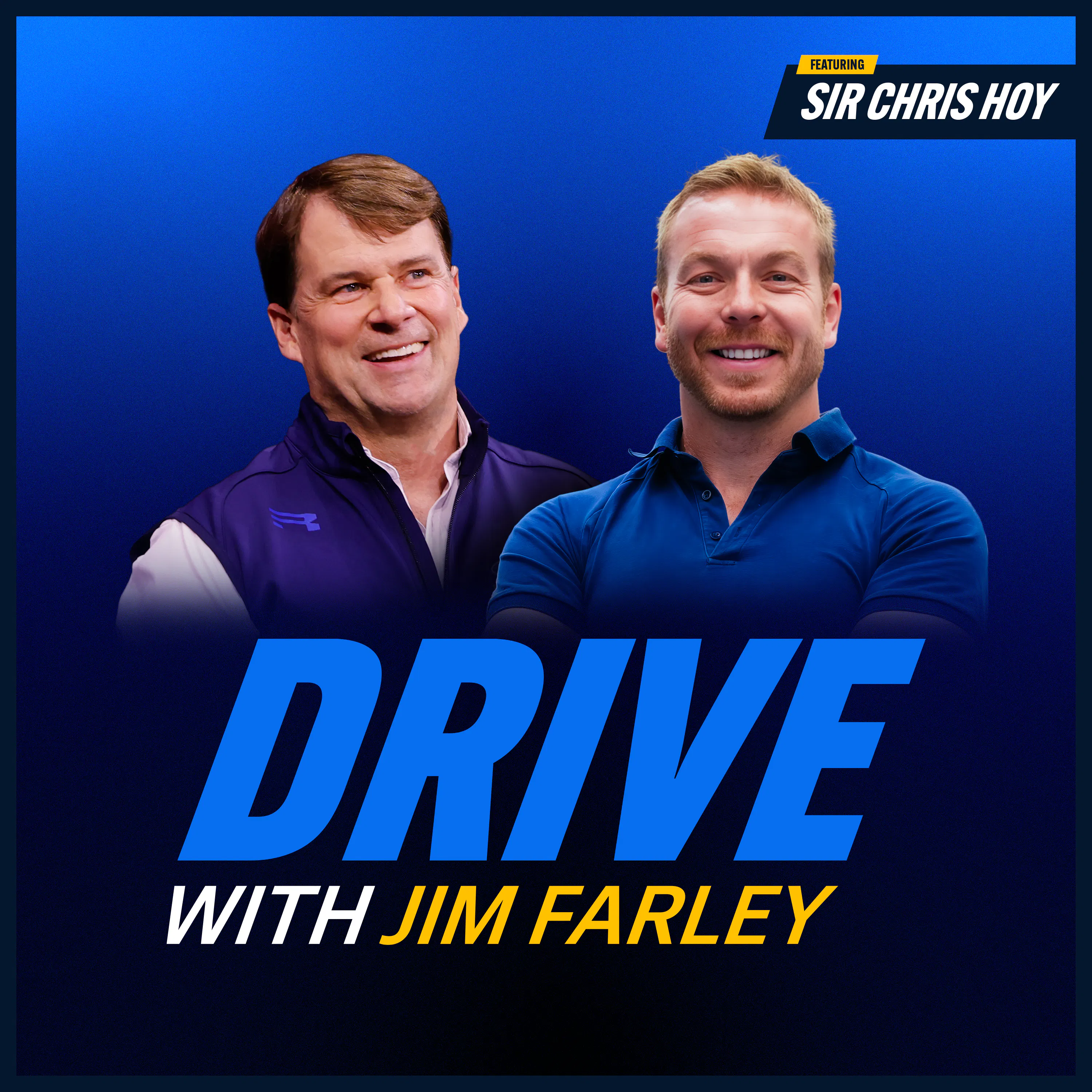
Sir Chris Hoy on Resilience and Reinvention from Olympic Gold to Le Mans
DRIVE with Jim Farley
Sir Chris Hoy on Resilience and Reinvention from Olympic Gold to Le MansDRIVE with Jim Farley · Apr 29, 2026
Annotations will appear as you listen
0:00
45:30
Concept
resilient enough to bounce back
He’s describing the ability to recover after things go wrong. In racing (and in life), that means not getting stuck on a mistake and trying again with a better approach.
Concept
reinvent himself as a race car driver
He’s talking about changing careers—from winning Olympic medals in cycling to becoming a race car driver. It means learning a whole new set of skills and adjusting to how racing works.
Concept
national lottery
A national lottery is a lottery where people buy tickets. Part of the money from ticket sales gets used to fund things like sports programs and facilities.
Topic
indoor track
An indoor track is a running track inside a building. It lets athletes practice during winter when it’s too cold or bad outside.
A velodrome is a special cycling track, often with banked turns. The angled corners help cyclists go faster and stay stable while turning.
Car
Schwinn Stingray
The Schwinn Stingray is a famous old-style Schwinn bike. The “banana” seat is part of what made it recognizable, and the host is saying it was the kind of bike people rode when BMX wasn’t as big yet.
Concept
Olympic program
The Olympics officially include certain sports. Once a sport is on that list, it gets more attention and usually gets bigger and more competitive.
Peak power is how hard and how fast you can “push” your body for a short burst. BMX riders need that quick burst to get speed and stay in control over jumps.
Concept
explosive power
Explosive power means you can generate a lot of strength quickly. That helps with fast starts and big jumps in BMX.
G-forces are a way to describe how hard the motion is on your body. When you’re speeding up, braking, or turning hard, you feel extra “push” compared to normal gravity.
Training data is the numbers you collect while you ride, like how hard you’re working and how your body responds. Coaches and riders use it to guide workouts.
Single track is a narrow trail where only one bike can fit at a time. It can feel more intense because you can’t easily move over if you make a mistake.
Corgi is another well-known UK toy vehicle brand. The speaker is comparing different toy brands that kids could buy in the UK, showing how car interest starts early.
The Nissan Juke is a small SUV made by Nissan. It’s designed to be easy to drive in the city while still giving you a higher seating position than a regular sedan. It may be mentioned because it’s a recognizable car model that can appear in TV and other media.
Concept
Juke for Hazard
This sounds like “Dukes of Hazzard,” a TV show famous for car stunts. The hosts are saying that show made them want to see American cars.
“Knight Rider” is a TV show where a special car helps fight crime. The hosts are talking about how they liked the show so much they even had a model of the car.
Anti-lag is a racing trick that helps a turbo stay ready. When you come off the gas and then press it again, it reduces the lag so the car responds faster.
The handbrake is a brake you can pull with a lever. In racing starts, it can be used to keep the car from rolling while the driver sets up the launch.
Term
launch button
A launch button is a special switch used to start the car’s “go” sequence. It helps the driver get the car moving as fast as possible by coordinating the launch steps.
The World Rallycross Championship is a racing series where cars compete on tracks that can mix surfaces like gravel and pavement. Races are short and chaotic, with lots of close racing.
A “complete novice” is someone with little to no prior experience driving fast or on a track. The speaker is emphasizing that the program is designed to coach beginners safely while still encouraging them to push.
A “road car” means a car set up to be driven on public roads. Sometimes people still take a road car to the track for fun days, even if it’s not a dedicated race car.
A track day is when you drive on a race track with other enthusiasts, usually for practice. It’s a safer, controlled way to learn how your car handles when you push it.
This is a Nissan GT-R that’s been modified for professional-style racing. “GT3” means it follows a common set of rules so different teams can race similar cars.
The European Le Mans Series is a set of long-distance races in Europe. It’s similar in spirit to the famous Le Mans race, where cars have to last and drivers have to manage pace over hours.
LMP2 is a class of race car for the big endurance events like Le Mans. It’s a step up from the entry-level prototype class and usually involves more serious teams and faster cars.
Concept
Olympic mentor for their Olympic partnership
They’re describing a brand partnership tied to the Olympics, where he’s involved as a mentor/ambassador. It’s about connecting a sports star with a racing program.
Le Mans is a race that lasts a very long time, so the car has to keep working reliably. A “prototype” is a race-only car built for racing, not something you’d see on a normal street.
Gran Turismo is a racing video game. The idea here is that playing it can make people more familiar with racing and cars, even before they ever drive for real.
Sim racing means racing in a computer simulator instead of on a real track. The point is that it’s becoming so popular and realistic that it can help people get ready for real racing.
GT Academy is a program that finds people who are good at racing games and helps them learn how to race for real. Coaches and training are used to turn that interest into actual driving skills.
“Sim work” refers to practicing in a racing simulator (software that models cars and tracks) to build skills like braking points, racing lines, and consistency. It’s often used as a training tool before or alongside real track driving.
A “test day” is a scheduled track session where drivers and teams focus on practice and performance evaluation rather than racing for points. Here, it’s described as a pro driver setting a target lap time and the trainee trying to match it.
Concept
road to Lamar
This sounds like a nickname for a step-by-step path toward a big racing goal. The transcript doesn’t clearly define it here, so listeners should treat it as a personal “career route” name.
Ford is a big car company. The conversation is about what it feels like to be the top leader there and how that pressure connects to a love of cars and racing.
“24 hours” means the race lasts an entire day. Instead of just going as fast as possible for a short time, teams have to plan for tires, fuel, and keeping the car healthy for hours.
LIVE
And you have to understand that all the lessons are in failure, all the important lessons are when you get it wrong.
And if you can be resilient enough to bounce back from them, then that's where you get some success.
I'm Jim Farley, and this is Drive.
Today I'm talking with Sir Chris Hoy, one of the most decorated Olympic cyclists in history, a six-time gold medalist,
who went on to reinvent himself as a race car driver.
To me, this conversation is all about resilience, how you keep improving, how you adapt,
and how you all find joy in each moment, even when life takes an unexpected turn.
So I wanted to start maybe in an unexpected place, which is being knighted, because this is quite exotic for Americans,
and probably most of the audience have never really met someone who's been knighted or can imagine so.
So take us behind the scenes. How did you find out? Did someone call you, or did someone show up at your front door?
Yeah, well, apparently they had sent me letters, and I hadn't received, they sent letters to an old address, so I didn't know anything about it.
And I was driving back home one night, it was raining, it was the middle of winter, and I was in the car with my wife and the phone rang,
and it was an unknown number, and normally I don't answer phone calls, I don't know who it is.
But I just, for whatever reason, I answered it, and this gentleman said, may I speak to Chris Hoy, and I said, well, speaking.
And he said, so-and-so, I'm from the Buckingham Palace, and I was wondering if you had received the letters we sent you,
and I said, no, I've not received any letters.
And then he said, well, we'd like to let you know that you've been offered a knighthood.
And at that point I thought, this is a wind-up, this is one of my friends playing a practical joke, you know.
And I was like, I looked at my wife and she's going, it's real!
And I was like, so I was like, I was absolutely astounded.
I greatly accepted, and over the phone, so they just called you.
Yeah, and I gave them the correct address, then they wrote back, and I accepted, formulate, and then had the ceremony a few months later.
And what was extra special about that day?
So you can receive, you know, knighthoods, and there's different grades of recognition.
Yes.
And my mother, who she had received a letter saying that she was going to be receiving an MBE, which is a member of the British Empire.
And we were going to get it on the same day, so she was getting it for services to healthcare.
She was a nurse, she did sleep studies and looked into sleep medicine for 30 years.
And I don't believe there's ever been a mother and son receiving an MBE and knighthood on the same day ever.
So it was the first time we got to celebrate together with a family, and it was like a really, really special day.
Oh my gosh.
So yeah, that was a big moment.
Do you kneel in front of, was it Queen Elizabeth?
It was Prince Charles at the time who's now the king.
Was it?
And so they have various members of the royal family who do these investitures, these ceremonies.
And for the knighthood, yes, it's like a little cushion on a stool.
And you kind of kneel down and they have the sword and they touch you on both shoulders with the sword.
And to be honest, I can't actually remember what he said.
I was so kind of in the moment.
I wasn't really paying attention.
Did your mom go first or were you second or was that independent?
Well, she was in a different group.
So normally they would have been in a different room while the knighthoods were taking place.
I see.
And they realized that it'd be a shame for us to miss our different ceremonies.
So there's a wonderful picture of kind of side on from the left hand side of me kneeling down.
So I'm on the right of the picture, King Charles now is on the left.
And then the distance, there's a doorway and there's a blurred image.
It's my mom standing watching me.
The ceremony take place.
Unbelievable.
And as a Scotsman, I have to ask, did you, did you wear a kill?
Of course.
Yeah.
And did you have a skin do?
Skin do.
And do you know what?
There's, I think there are, from memory, I think there's regulations about because a skin do for those who don't know it's a sharp knife.
I mean, it's an actual knife in your sock.
Yeah.
In your sock.
It's like a dagger.
And I think, I don't think we were allowed to take them in just for security.
But yeah, you have this skin do.
Well, it is England and you are a Scotsman.
So they probably learned the hard way not to let a Scotsman into Buckingham Palace with a knife.
Yeah, exactly.
Exactly.
I think they learned that the hard way a couple hundred years ago.
That's true.
I think what, what was it?
I read someone said, no, the Romans built a wall to keep the Scotsman out of England.
That's it.
We're at a term and bunch, I think, the Scots.
But it's funny, you get, you never really get used to being called sir.
Like it's part of your title.
So it's on my credit card.
It's on my passport.
It's, it's, you know, it becomes your name.
I felt really proud for my sport, you know, to have cycling back then.
There was nobody else that had been knighted yet.
Subsequently, there have been a few, but it was great to get the recognition because
my sport was quite a niche sport.
It was small.
It wasn't like road cycling is massive, but I did, I did track cycling.
And, and so it was, it was great.
We got some attention and it was off to the Olympics in Beijing where we won seven as
a team, you won seven of the 10 gold medals on, on offer.
And, and that was the time when cycling was really taken off in the UJ.
And, you know, cycling, I mean, most people thought, you know, British cycling, they
think maybe Southern Europe or South America or, and for someone to be recognized in your
sport globally that way is pretty amazing.
And now it's just kind of a thing.
I mean, your country is so, so well recognized as, as producing some of the best cyclists
in the world now and all the different disciplines you mentioned.
But back when you got recognized, it was something new.
Yeah, it was.
And, you know, you can retrace that all back to, it was in 1996 in Atlanta, the British
Olympic team, not just the cycling team, but the British Olympic team came back with one
gold medal and that was in ruin.
And we were, as a country, we were 34th, I think, going overall on the medal table.
We had a complete disaster.
And it was because of that underperformance that the prime minister at the time said,
like, we need to start investing in sport.
It's important for the national pride, for identity, for, for the generation, the next
generation to come.
We need to give, you know, facilities and support and financial support and coaching.
And that infrastructure wasn't there in the, in the late nineties or early nineties.
So, you know, like a lot to a ticket, like they call it national lottery over here.
You buy a ticket and you win a jackpot prize from those lottery tickets.
A certain proportion of the money goes to sport at good causes.
And so that was the start back in 1998 was the start of the national lottery and the
money from that went into sport.
And I was graduating from university at that time and I didn't have to go into full time
work.
I could go from being a student into training full time as an athlete.
And it came at just the right time.
I got a grant.
I got a certain amount of money to pay for my accommodation and food and travel.
And we also got a new facility, an indoor track.
We didn't have an indoor track until the mid 1990s in the UK.
So we had nowhere to train in the middle of the winter and we didn't have the money to
travel abroad.
So it was a very difficult situation.
Sure.
So that was a game changer.
Oh, it's huge.
And not just for cycling and for me, but for all the sport.
So you look at the UK now, Great Britain as a nation at the Olympics will be top four,
top five for most of the games now.
But that wasn't the case 25, 30 years ago.
Incredible.
And my kids went to school in the UK.
And one of the things that I noticed as American that really shocked me is that for a lot of
schools in the UK, unlike the US sport is kind of an optional thing.
Like you kind of opt in.
Whereas in the US, there's this incredible pressure for everyone to play a sport and
to kind of go to summer camps and, you know, given your, your excellence, where did the
cycling things start from?
Because from my standpoint, it must have come from you as a person, not because there was
a program.
Yes, exactly.
It was, I guess I just had a passion for all sport.
I loved playing football and rugby and I did athletic.
I did rowing a road for Scotland as a junior.
I loved all kinds of sports and I was good at them, but I wasn't great at them.
There was always somebody in each team that you would think, well, they're the ones that
will represent their country or go to the Olympics or whatever.
But I guess the cycling is bizarrely, you know, I wasn't inspired by watching the Tour
de France or the Olympics.
I watched the film E.T. when I was six and I saw BMX for the first time and that was
a spark.
And I thought, what is that?
You know, BMX wasn't a thing at that point.
It was just coming out in the UK.
And I saw a bike being used in a totally different way, going over jumps, carving through turns
and I just thought, this looks kind of cool.
And that's what I'd like to have a go of.
And I pestered my parents and I guess it all started from there.
So I learned to ride a bike and I got into BMX.
I raced BMX till I was 14 and then I tried mountain biking and then road and then eventually
the track on the velodrome.
And I think a lot of people don't realize, car people included, how taxing BMX was.
I grew up a generation before you.
And so for us, it was the Schwinn Stingray with the banana seed.
I'm surprised I had kids in the end and after all the jumps I did.
And we all grew up with Honda 50s and Trail 70s and, you know, Schwinn Stingrays.
But you were the next generation with BMX.
But then it became an organized sport and I think it's got to be one of the most taxing,
physically taxing sports, cardio wise, because you are all out for like, you know,
that sprint is just unbelievable.
Tell everyone about, you know, BMX and what you loved about it.
And how did you discover you were good at it?
It's an incredible sport.
And I think for a long time it was seen or was perceived as a kids sport.
And it was just something you did till you were 14, 15.
And then you graduated to a proper bike and, you know, that when you left it behind.
But since Beijing in 2008, BMX racing has been part of the Olympic program.
And with this, it's been elevated into the general media and general public consciousness.
And I think we've seen, as you say, what incredible athletes these BMXers are.
They need to have the same peak power and physical explosive power that I used to have on the track.
As a track cyclist, they need to have the nerve and the skill of, you know, a gymnast.
They've got to be able to just the eight guys or eight girls heading down off this massive start ramp.
That's like 45 degrees.
By the time they've hit the bottom of the start ramp, they're doing 40 miles an hour.
And some of the size of these jumps that they're going over are unbelievable.
Do you still love riding a bike though?
Like as a kid, the freedom of a bike?
Because I think I fell in love with cars riding a bike first.
That freedom of going anywhere with your buddies and or even by yourself.
Discovering something new.
As a kid, you don't get really freedom like that, especially nowadays.
Do you still have that joy?
Oh, I do.
It's funny.
You become, when you're right in the thick of it, and you're competing for the Olympics,
and it's all about the gold medal, and it's all about the end results,
and nothing other than winning is what you want, and it'll be a disaster if you don't win the gold medal.
Sometimes you can lose sight of that joy, and I think that I still love myself.
Even in that situation, I still loved the feeling of flying around the track.
I mean, you're hitting speeds of up to 50 miles per hour on the velodrome,
and you're elbow to elbow, and you're only inches off the rider in front of you.
You thought you're all packed in.
So much adrenaline, the G-forces, going through the rankings.
I loved it.
But I think after I retired, it took a while to step back from it to let the dust settle,
and then fall back in love with it again.
And I think when you don't have to worry about the numbers,
you don't have to worry about your heart rate, your power outputs, your training data,
and you just ride for fun.
And I think for me now, the biggest joy I get from cycling is mountain biking,
because you're not looking at any of the numbers.
All you're looking at is the trail in front of you and taking the big jumps
or carving through the corners, trying to stay on the bike,
which can be a challenge at times, but it's a social thing.
We go out with friends, we go away, and by the very nature of it,
you're in the middle of some of the most incredible countryside,
away from the cars, away from the noise and the traffic,
and you can just enjoy nature and the fresh air.
Boy, does that resonate with me.
You were a cyclist yourself, but you did a bit of cyclism.
Yeah, all the time.
I think I've separated my shoulders like three or four times.
I went for a mountain bike in Carmel by myself, single track,
you know, bombing around, I'm thinking,
oh man, I'm starting to get my handling skills right,
and then the next moment I'm on my ass on the tarot,
and I got a huge, huge, huge shoulder problem.
I'm limping into work, I got some really nice road rash,
and you know, I was like, this is great.
I hit a stump around a corner that was hidden,
and you know, that's, I mean, there's nothing better, I think.
I'm with you, there's nothing better.
Especially if you do it, I ride with a couple of flat trackers.
They're just like kids on a bike going, man, you were fast,
come on, you cut me off, you know.
It's like, we're back there at 14 years old just having a good time.
Yeah, that's what it's all about.
Yeah, and I really am curious about this car thing.
You know, what drives your passion for cars?
Where did it start from?
You know, what was your first cool car?
What do you think, you know, translates between two and four wheels?
Well, I guess like a lot of kids, it came from in the early days,
matchbox cars, you know, little small toy cars.
Oh, sure, yeah.
And then skillet.
Matchbox, Corgi, what?
Like in the UK, you got different brands.
Yeah, matchbox, I think, was the main one.
Okay, we have Hot Wheels in the US.
Yeah, we had Hot Wheels as well.
And from them, a lot of them were American cars
that I was interested in that you'd see.
Oh, really?
And yeah, but I think that also stemmed from TV shows.
So you had the Juke for Hazard, you had Knight Rider.
Knight Rider, all right.
Knight Rider was awesome.
And I had a Knight Rider model, not a small matchbox one,
but maybe, you know, I don't know, near their foot long.
Nice.
And I had so that bigger version of kick.
Yeah.
I loved that show.
And I still, you see clips of it now on social media,
and it brings you right back to being, you know, a 5, 6, 7.
Was it David Hasselhoff?
Yeah, David Hasselhoff.
And even the Juke for Hazard,
every show, every episode,
they would be jumping the General Lee over a river.
Can you imagine how many cars they wrecked at that show
over the course of that show?
Like how many cars they must wrecked?
Unbelievable.
And yeah, you think how many episodes and how many cars
within each episode.
Yes.
It was just, I just loved the idea of jumping a car.
And the first, you know, the first time I did it was in a Ford.
And it was, it was the World Rallycross Championship.
In 2010.
Oh, it started at the top.
Yeah, wow.
Well, you know, it may as well go straight in the deep end.
And I was doing, I was doing a series of shows called Dream Jobs.
And it was all basically different dream jobs
within motorsports.
So there was, I did a show on monster trucks,
the monster jam.
I did a show on Rallycross.
I did a show on GT racing, a show on Formula E.
But the Rallycross one was probably my favorite.
And I got, I met a guy in the UK called Ollie Bennett to race
in World Rallycross and he had a fiesta.
It's not just any old fiesta.
It's got 600 horsepower.
It's got anti lag.
It's a two liter engine, but it can produce so much torque.
You were doing not to 60 in less than two seconds.
Wow.
You know, in this day of, you know, I let your cars, it's easy.
You just put your foot down and you go.
But you had to hold the handbrake.
You had your thumb on the launch button.
You had your foot on the clutch, balancing the biting point.
And you had to release the launch button and the handbrake
as you drop the clutch.
And you'd get it right and hooks up.
My goodness, it was some machine.
And I had one day of testing in Wales.
And then it went out to Barcelona in Spain and did this round
of the World Rallycross Championship.
And you're lined up alongside Timmy Hansen and Nicholas
Gronholm and, you know, all these legends of the sport.
I can't.
And I was just the random guy who used to ride bikes.
And it was terrifying, but I had such a good time.
And within, for anybody who's not seen Rallycross, you have to.
It's absolutely, it's one of the most spectacular forms of motorsport.
It is.
There are no bumpers left.
You know, guys, this, you know, kind of not very respectful
for each other.
Contact is encouraged.
Yeah.
Exactly.
It's a, it's, it's like a, watching a WWE wrestling match.
That's a really good, a good analogy.
And it's, I had such a good time.
And on the track, there was a jump and that was the first time
I'd ever actually physically taken air on purpose.
Yeah.
And it was, it was a cool feeling.
There's been a few other times when it wasn't on purpose.
Yeah.
We don't talk with them.
That's great.
So it kind of came later in life, but you went right to race cars.
That's interesting.
Yeah.
And, and what do you think?
Because it was just, you know, you had that best in the world feeling
and you, you, you had, like racing is just that extreme version
of enjoying automobiles.
You think that's what connected you?
Yeah.
I think I, I went to, there's a track in the UK, um, in Bedford.
And it's like a, an old airfield that they have multiple tracks within.
Yes.
But they have like an experience centre there.
It's called Palmer sport.
And they have catering and atoms and M threes and single seaters
and Le Mans prototypes and Land Rover's off-roading is like,
they have about six or seven different vehicles.
And you go around each one of those on different parts of the track.
And you have 10 laps or you have a certain amount of time to set a lap time.
And you've got an instructor sitting with you.
And it's the best possible day of driving because as a complete novice,
you get, you get encouraged to push and to go as fast as you can.
And you've got structure.
And it's safe, right?
It's safe.
It's not.
It's exactly.
There's nothing to hit.
You can really push yourself beyond your, your capability.
So I did that in 2008.
And I loved, I actually loved it.
And I said to the guy, look, I want to do this more regularly.
How, how can I do it?
Because on the road, you can't drive cars fast.
You know, it's not safe.
Yes.
Yes.
You'll lose your license or, you know, have an accident.
Yes.
So he said, yeah, get yourself a small car.
So I don't know if you know the catering, this little kitchen.
Yup.
I had a load of super seven series three.
So I know the catering really well.
I actually went to the factory, took the tube to the factory about 30 years ago.
Cause I was thinking about buying a kit.
Oh, they're great.
Yeah.
It's, that's, they are great.
That actually was one of my favorite cars I've ever owned and built.
I built my, I found an old kit from the sixties that had been unbuilt and, and I built it in the, in the nineties.
Yeah.
I love the catering.
That is, those are amazing cars.
So you, you were in that series.
It's like a spec series.
Very competitive.
Yeah.
So I didn't, I didn't race it immediately, but I got one as a, as a road car, which I would use our drive to track.
Oh, I see.
Okay.
And it was just during my cycling career, the end of each cycling season, I would do maybe six or seven track days and then the car would go away the rest of the year.
Oh, really?
And then I got to the end of my cycling career and the end of, it was after the Olympics in London, 2012.
The DBC came to me and said that we know that you're a massive Colin McCray fan.
We would love you to do, there's, we're doing a series of documentaries, one on Jackie Stewart, one on Sterling Moss and one on Colin McCray as these racing legends.
And we want you to present the TV show.
And I was very honored because yeah, massive, massive hero of mine.
But those don't know sadly passed away in 2007.
Incredible.
He wasn't there to tell his own story, so I was there to present the show.
And it was while we were filming that show, we were doing some stuff at the track at Alton Park.
And a guy from Radical, Echo Roger Green came up to me and said, look, we're doing this novice race series next year with Radicals.
And we would love to have you on board.
We could get your car, get you some tuition, get your race license.
And I didn't need asking twice.
So yeah, I signed up for it.
And the next year I raced in Radicals.
And then the following year I raced with Nissan in the British GT Championship, in a GTR GT3.
And then the next year I did the European Le Mans series in LNP3.
And then the year after that I did Le Mans in LNP2.
So it was like a really, really short, crazy kind of condensed three years of racing.
And the reason it had to be so soon was that I signed up with Nissan for this as an Olympic mentor for their Olympic partnership.
And that was for Rio in 2016.
So they said, we've got a few years to get you to Le Mans if you want to do it.
And I was like, hell yeah, let's do it.
Oh my God, what an experience that must be.
That must have been such a cool story.
And such an accomplishment because leveling up your capability that quickly and then racing in a prototype at Le Mans.
And only a few years before that, you know, driving around in a catering for track days is almost inconceivable.
But I would imagine your Olympic career and the way you prepared for that and your body, your physical preparation and your mental preparation and all the people you could have access to must have helped you a lot.
But I really never have heard anyone to do it that quickly.
How did you get ready?
I think if I'd known how big a challenge it was, I might not have taken it on.
I thought, do you know what, I've been a fan of Le Mans for many years.
As a kid, I had a skillet trick set, you know, like the toy cars.
Yeah, sure. Slot cars we call them in the US.
So it was a slot car set and it was a Le Mans edition and the cars had lights so they could race through the night.
And I remember asking my dad, why do they have lights?
And he said because they race for 24 hours.
And even as a five, six year old, I remember being amazed by that.
And so I was aware of Le Mans, a fan of it for many years.
But I didn't, I didn't truly believe I was going to go there.
I thought, I'm going to write this, this kind of train as long as I can get as many racers, experienced it.
At some point is, some point is going to come to an end.
Yeah, yeah, exactly.
I'm never going to.
But you are a professional and look where it took you.
Well, I was, I was very lucky because at that time Nissan were very much into the PlayStation, Gran Turismo, bringing gamers.
You know, nowadays, sim racing is massive and there's big crossover between the virtual and the real world.
But back then it was a new thing and they had set up the GT Academy with Darren Cox.
And sure they had this, this team of coaches to help these kids who are gamers to become racing drivers.
So I benefited from that experience.
They had all these guys there to help the gamers and they were essentially doing the same thing with me.
A lot of sim work, a lot of tuition experience.
And I got to, yeah, it was, the trouble was that just when you got used to the car and the team and the way things were going, it was like, right, onto the next one.
Yeah, we're going to upgrade you.
Yeah.
Yeah.
And it was like, I was, I was so experienced, but I was determined and I was, I was quite a coachable individual.
Like I'll listen and I'll take on advice and I'll take on guidance and I want to improve and I enjoy improving.
I love having a target for every session.
And, you know, some of the most fun stuff I've done is just been a test day where the pro driver would set lap time and you have to try and match it or gets close as you can to it.
And if the satisfaction on that final lap, on the final session on that day and you get to within the time that you're trying to get here, whether it's a second or half a second or whatever the time is, it's, there's nobody there watching you.
There's no TV, there's no crowds, there's nothing, you're not getting a trophy, but the satisfaction.
But you know, but you know, you know.
Exactly.
So Chris, what is it?
I'm listening to you talk about BMX, you know, your whole cycling career and then I'm hearing about your road to Lamar.
What is it about you that makes you able to adapt like that so much better than someone else would have?
I'm not sure, I think.
And what lessons should we, the rest of us learn from that?
I think if I had a curiosity as to how far I can go in anything, whatever I've chosen.
Yes.
I want to know everything about it.
I want to get, when I get into something, I really get into it.
And then I want to see how far I can go.
As a kid, I never, as I mentioned earlier, and I never saw myself as a standout child who was exceptionally good at sport or anything.
I was good, but not exceptional.
And you would never have backed me back then to become an Olympic champion.
It would have been a ridiculous thought, but what I was good at was being better than I was yesterday.
So I was very good at improving, always improving.
They might have been slow, almost unrecognisably, just a little bit of an improvement.
And I was quite analytical too.
So even as a child, if I lost the BMX race, I would be devastated and I would be in the car on the way back home with my dad.
And I'd be sitting there in the back seat quiet, feeling a bit sorry for myself.
And my dad would tell me these stories afterwards.
I don't really remember that much, but he would say you'd be quiet and then you'd come out of it.
And then instead of blaming other people or situations or bad luck, he said you were very good at taking accountability and responsibility
and not blaming other people but saying, I did this wrong and I did that wrong and I want to be better at that next time.
And recognizing that the only way to get there is by hard work.
It's by training and practicing and I was good at looking at the older kids and what were they doing?
How were they so fast and how could they take those jumps so well or they started better?
Whatever the technique was, I would watch them.
So I guess I had a thirst for understanding what was the underpinnings of performance and wanted to see how close I could get to them.
But my dream was to become an Olympic champion, but I never, ever truly believed that would happen.
But I just thought, you know what, I want to see how far this journey would go.
Someone once said to me that one way of developing yourself is to put yourself in as many awkward situations as you can.
And I've always really believed in that.
And I don't know about you, but just listening to what you just said carefully,
it makes me think that part of your progress and success was also kind of getting passed when it didn't work out
or when someone said, well, you know, you didn't do that, that great.
And being able to kind of say, yeah, but you don't understand, like I'm never going to give up.
And not being too responsive to other people.
Do you know what I mean? It's like, yeah, I get it.
You're analytical and you're always going to get better.
But some of it is also your emotional resilience when people see you not succeed
and also kind of having that bother you a little bit.
Yeah, I think it's easy to take other people's opinions as facts
and when people say you can't do something or that has never been done before,
then you can subconsciously put a limit on yourself and what you think you can achieve.
And actually, you know, I've seen it time and time again with myself and with other people
where if you don't limit yourself, if you don't actually believe what people tell you that it can't be done,
you know, you want to prove it to yourself. It might be that they're right.
You never know. But equally, I want to know for myself and I want to see how far I can go.
And but most importantly, have fun doing that.
You know, I loved riding the bike and I loved racing cars and I love whatever I do.
I do it because I enjoy it and it's a passion.
And if it's your passion, then you work so much harder at it.
And you know, you have to work hard. And I think that there's there is a notion that talent,
I think talent is a misleading word.
And I think that it makes people think that it's easy or that it's just something you get out of bed
the morning and you're great to drive the car or singing or dancing or whatever your passion is.
Talent is I think you're better using the word potential.
So do you have potential in something because that because it means you've got to still work to get there.
The talent is like I just wake up and oh, you know, these talent shows on TV where they walk in and they look kind of scruffy
or don't look like they're going to be great. And then they just sing and their voice is incredible.
And it's as if they've discovered it for the first time that morning.
But of course, they've been singing and practicing for years.
But it's like this, the notion is, oh, I've got a talent. I just haven't discovered it yet.
What what can it be?
And you're expecting it to just suddenly land in your lap and tell you what it is.
You have to work hard and you have to persevere and you have to understand that all the lessons are in failure.
All that all the important lessons are when you get it wrong.
And if you can be resilient enough to bounce back from them, then that's where you get the you get some success.
Well, talk, let's talk a little bit about resilience and tell me a little bit more because when we met each other at Le Mans,
you mentioned the tour to four.
So tell us tell us about the audience about that and and why it's important for you and what we should all know about it.
Yeah. So two years ago, in September 2023, I went, the figure had a sore shoulder.
It wasn't going away. I'd had aches for a while and eventually went for a scan.
And I thought it was going to be something like tendonitis or, you know, some some minor thing that they could fix with a bit of physiotherapy.
And it was a tumor and turns out it was a secondary tumor from prostate cancer.
And I was given the news it was incurable in all in the space of about four or five days going from having a sore shoulder and being told,
you know, we'll get you a scan and see what it is.
Nothing serious to the worst possible news.
So as you might imagine, that turns your whole your whole world upside down.
And, you know, I was 47 when I got the news.
So very young for prostate cancer, but not it's not unheard of, but it is pretty young.
Like my grandpa had it, my dad had it.
And so it was one of these things that I always knew that I was always told when you're sort of 50 and older,
go to the doctor, get a PSA test, get a check, blood check.
But it was nothing that was ever I ever considered would be.
I always thought it'd be symptoms.
I always thought it'd be some sort of warning signs and there weren't.
So it's changed our lives.
But part of that, you know, you take time to absorb such shocking information and you need to kind of let the dust settle in and almost like a grieving process.
It takes time.
But then once I once I kind of got my head around it, I realized, well, I was given a prognosis of two to four years.
And I thought, well, I've got I've got time, you know, somebody who has a heart attack or has a car crash or something dramatic happens.
They don't have that good luck that they can have some time to get their affairs in order and to make the most of them to appreciate to truly appreciate life.
And so I thought, well, part of part of my my kind of coming to terms with it was, well, you know, earlier on I said to you about how there's big changes you look for opportunity.
And I remember sitting and I've talked about that for many years.
And I go back to that and I thought, well, how can I possibly find opportunity or any positivity in such a dark situation?
And then in the end, I thought, well, by talking about it and by raising awareness of it, it could save lives.
And therefore, when you step back and see the bigger picture, you're just one person, but you could save many people's lives here.
So that's what I did. And I set up this this event called the tour of the four.
It's a charity cycle ride. It's happening in Scotland.
And the aim was first of all to raise a lot of money.
So we're trying to raise a million pounds.
And we're at 913,000 as of today.
So that's well over a million US dollars, I guess.
But the other side, the reason it's called the tour of four.
Congratulations. That's amazing.
Thank you. Yeah, it's going really well.
And we've got thousands, I think up to 4,000 riders are taking part.
But the aim is also to change perceptions of stage four cancer.
So stage four cancer is when it's spread to the bones and there's no cure.
You can be treated for it, but there's no cure.
And so we have many people who will be riding on the day who are in the same situation as me
and have different forms of cancer, but it's at stage four.
And we want to change perceptions because there will be people who will be getting the worst possible diagnosis.
Well, this ride is going on and it's going to be under the news and all the TV channels.
And I thought it'd be quite a powerful thing to demonstrate that actually life goes on until it doesn't go on.
I mean, you have to meet the most of the present.
And whilst we all have plans for tomorrow, we all have some point of goals and exciting things to aim for.
All we actually have is the here and the now.
You know, the past has gone. That's history.
All we have is the present.
And it's understanding that and recognizing that no matter what's going on in our lives,
we have to bring ourselves back to the here and the now.
And that's how I've managed to deal with it.
And yeah, this big charity event is going on.
It's been it's been my focus.
It's helped us as a family.
And yeah, I think I've come to terms with it and we're dealing with it, I think, better than I imagined we could.
And yeah, just trying to get an overall net positive gain and going back to the you helping other people.
There has been a huge spike in the number of men who are going to the doctors to request PSA tests.
Good.
It's now, I think it was something like 5000 more men in the UK were tested during the first three weeks after my diagnosis was public.
And yeah, it's it's incredible the messages I get from from men and from their families saying,
because of your your diagnosis, I had no no symptoms, no worries, but I thought I wouldn't check.
Had a PSA test and it turns out I do have cancer, but I've caught it early.
And when it's caught early, prostate cancer is very treatable to you.
That must be very satisfying for you to think about all those people.
Exactly that.
And it lifts me up when, you know, I'm positive and I always look for the positive or trying to reject the negatives.
But even then, you still have difficult times and you have dark days.
You know, I've got two young kids and they're seven and 10.
So it's as you might imagine, it's been a very difficult couple of years.
But when you hear these stories, it gives you a purpose.
And you realize that it's it goes way beyond racing bikes or cars or anything like that.
This is, you know, it's life and death.
And if you can even we're trying to change legislation in the UK.
I went to see the First Minister of Scotland last week and we had a meeting and we're trying to get because there is
no screening for prostate cancer in the UK.
So we're trying to create some. Yeah.
And it's the most common cancer in England now.
And I think it's the third most common in Scotland.
And just being able to get men to go and get checked is such a such a difficult thing to get them to do.
So we need to have a.
Especially as you said, it's so curable.
Yes.
You know, it's a no regrets move.
Yeah, absolutely.
It can be done very simply with a with a blood test.
And you know what strikes me just listening carefully to you in the short time together is I have really never met many people who've accomplished so much but have so much joy at the same time.
Many people accomplish a lot kind of see life as just a series of conquests.
And there's something about you where you have a deep joy.
And what advice would you give kids about that?
Because they they would see this Olympic athlete who's accomplished so much, you know, and and there's so much pressure in our society as you said to kind of find what you're great at and be super ambition.
But at the same time, you are you are a person filled with joy.
What would you say?
What do you say to your kids about that tension?
That's a really good question.
And it's a difficult one because as a parent, you don't want to project your your passions onto your kids.
You'd love I'd love it if my kids going to cycling or going to cars or whatever it was.
But I don't want to be the kind of parents pressurizing them because it's a surefire way to put them off.
Yeah, you know, if you push too hard, you've got you've got to encourage and guide, but also they've got to lead you.
And I think the trying to, you know, what you're talking about in America with sport is the one thing I think sport teaches you all of us so much.
And you don't have to be an elite athlete to get these lessons.
It's almost more at the younger stages when you're at school.
It is a meritocracy.
You do, you know, there's no you get all these medals for participation, but kids still know they know who the best one is.
And they understand very quickly about winning and losing and the benefits of being able to accept when it hasn't gone your way.
And if you put that work in, then you get better at it and then you have more fun from it.
And it's not just about winning and losing.
I think it's about feeling like you're improving and feeling like you're, I don't know, I just, I just feel if I'm going to do something, I want to give it my all because there's only so many hours a day.
And it's not, it's not, it's not like I'm super intense with it.
But I just, when I find something that I enjoy, I just want to do it as much as I can and try and get as good as at it as I can.
And I think it stems from, I used to live, my grandparents used to live in the same house as us when we were kids.
And they died when I was a boy.
There you go.
Yeah, about eight or nine years old.
But I think my grandparents saying, if a job's worth doing, it's worth doing properly.
And that's, that was always the thing.
If you're going to do something, whether it's, you know, cutting the lawn in the backyard or putting up leaves or doing your homework or training for your racing or whatever it was.
You know, if you're going to do it, most of the hassle is actually getting yourself, getting the kids on or getting to the venue or whatever.
You know, there's a lot of effort to actually do something.
Sure.
You may as well go the extra 10% and do it well.
Do it well.
Yeah.
And, you know, it's, you know, you can see people that would turn off at races, even people who would turn up in the British team, teammates who were really good.
But they always just had that notion of, I've always thought they could just give a little bit more.
They would, they would be 1% better and they would win everything.
But I just felt like I got more out of myself than most people.
And I think there were more people out there or there were lots of people out there with more potential, but I was able to realize my potential.
There you go.
Well, that's great advice.
I have one question for you.
We're just in all my interviews.
Do you have any advice for the CEO for it?
Oh, I think the advice I've been giving people after my diagnosis, my cancer diagnosis is pretty simple.
And I've kind of alluded to already, I think it's living the night appreciate the moment.
And it's somebody in your position who has so much responsibility and pressure and you represent so many people and you represent a whole company.
You know, there's a lot going on your head.
I'm sure that when you lie down at night, you had the pillow.
What is easy for all of us to do is to spend so much time living in the future that we forget to live in the present.
And there's so much to worry about.
Most of stress comes from trying to predict the future.
And I think the key thing is recognizing what you have control over, but also recognizing more importantly what you've done and only focusing on what you have control over.
And all the different factors that may or may not happen, all the things that could happen or as long as you do your best and as long as you remember to enjoy today.
And because, you know, the reason that you're the CEO, there's well, there's many reasons that you're there.
But one of them is because you have a passion for motor cars and for motor sport and for Ford as a company.
And you tell yourself, you know, think back to your five, six, seven year old self.
How excited would he be to know that you're the head of Ford?
So it's yes, there's pressure.
Yes, there's expectation.
Yes, there's a lot on your shoulders, but also don't forget to remind your five year old self how cool it is that you're doing this job and how I'm sure he would have been absolutely stoked.
To think that one day he would be in charge of something as cool as Ford.
Well, I could say this with 100% confidence that I've enjoyed this conversation learning from you in this moment right now.
Just two guys talking about life, talking about our passion, bikes, cars, Chris, you are amazing person.
And I'm so thankful to have spent some time with you and also to meet you at Le Mans with Chris, Harris and really just spend a few minutes learning from you and your perspective.
And I also have to say thank you for giving me a target at Le Mans.
I was chasing you for...
Oh yeah, right.
I could get close to you.
I could see you just ahead and I was like, it would be cool if I could say I passed the CEO of Ford.
But yeah, I couldn't do it, but that was a lot of fun.
And thank you to all the guys at Ford for making that event which was so memorable and having raced there in the 24 hours.
It was great to come back and it's such a magical event and I had a wonderful time.
So thank you.
You
About this episode
Sir Chris Hoy traces a path from a childhood spark with BMX in E.T. to Olympic dominance, then into an unexpectedly fast climb through rallycross, GT racing, and Le Mans. Along the way, he reflects on British cycling’s transformation through investment, the discipline behind improvement, and the mindset that helped him adapt. The conversation turns deeply personal with his prostate cancer diagnosis and the Tour de Four charity ride, before ending on resilience, control, and living in the present.
Jim Farley talks with Sir Chris Hoy on DRIVE to discuss improvement through failure, resilience, and finding joy while adapting to change. Hoy traces his path from BMX—first inspired by the film E.T.—to six Olympic gold medals in track cycling. Hoy also describes his rapid transition into motorsport, progressing from track days to Radical racing and ultimately Le Mans. He then discusses his 2023 diagnosis of stage four prostate cancer, launching Scotland’s Tour de 4 charity ride to raise funds, change perceptions, and increase PSA testing awareness, while emphasizing living in the present. For more information on Tour de 4, visit: https://www.tourde4.com
00:11 Meet Sir Chris Hoy
00:47 The Knighthood Call
05:11 Cycling Recognition Boom
08:28 Finding Cycling Through BMX
15:04 From Bikes to Cars
16:38 First Rallycross Leap
19:17 Track Day Addiction
20:42 Caterham Kit Car Love
22:37 Fast Track To Le Mans
24:10 Training Like A Pro
26:59 Curiosity And Accountability
30:07 Resilience Over Limits
32:30 Cancer Diagnosis Shock
34:59 Tour De 4 Mission
42:35 Live In The Now
44:16 Closing
DRIVE with Jim Farley is produced by Jesse Baker and Eric Nuzum of Magnificent Noise. Our production staff includes Sabrina Farhi and Kristen Mueller with help from Lori Arpin, Angela Brewer, Max Owen-Dunow, Anne Roberts, Samantha Singhal, Darnell Macon, Brandon Kennedy, and Mark Truby.
Follow Jim:
YouTube: https://www.youtube.com/@Jim.Farley
Instagram: https://www.instagram.com/jimfarley98/
Threads: https://www.threads.net/@jimfarley98
LinkedIn: https://www.linkedin.com/in/jim-farley/
Bluesky: https://bsky.app/profile/jimfarley.bsky.social
Twitter/X: https://twitter.com/jimfarley98
Learn more about your ad choices. Visit podcastchoices.com/adchoices