A website conversion is when someone visits your site and then does what you want—like booking an appointment or asking for a quote. Higher conversions usually mean your website is doing a better job turning visitors into customers.
Automated follow-up means the shop automatically contacts people after they show interest, like after they fill out a form. It helps you respond quickly so those leads don’t disappear.
Return on investment (ROI) is a way to measure how much benefit you get compared to what you spend. In automotive training and equipment adoption, it often means tracking labor efficiency, fewer comebacks, faster diagnostics, and improved throughput.
ROI means “did the investment pay off?” In this context, it’s about whether paying for training and support helps the shop make money faster through more productive technicians.
Mixed reality is when computer-generated images are shown in your real space, like they’re “there” with you. It’s useful for training because it can guide you while you work.
XR is a general term for “smart” immersive tech. It can mean virtual reality or other ways of mixing digital stuff with what you see in the real world.
Virtual reality is when you wear a headset and it puts you into a computer-made environment. For training, it can let you practice without being in the actual shop.
A mock-up program means practicing on realistic training versions instead of a real car. It helps people learn the steps safely and get comfortable before doing it for real.
Augmented reality adds helpful computer information on top of what you’re already seeing. In this episode, it’s described as guidance you get while you’re actually working.
Technical service bulletins are official notes from the car maker about common problems and how to fix them. They can save time because they’re based on issues the maker has seen before.
An electrical problem usually means something in the car’s wiring or connections—like a sensor signal not getting through. It’s often diagnosed by checking wires and connectors.
A pin out is a diagram that shows which wire goes to which terminal inside a connector. It helps you figure out what wire you’re actually testing when you’re chasing an electrical problem.
A service advisor is the person at the shop who talks with you about what the car needs. They help explain the technician’s findings and what will be done.
Leak dye is a special fluid added to help find where something is leaking. After it’s added, you can check the area and confirm the exact source of the leak.
Smart glasses are like wearable screens. Here, the technician can explain what they see on the car while recording, so the customer gets a clearer picture of the problem.
A VIN is like a car’s fingerprint. Once you enter it, the system can look up the exact vehicle details and history so the inspection and recommendations match that specific car.
ASE is a well-known automotive training and certification organization for mechanics. The podcast mentions an ASE case study to show that the training method helped students learn better and feel more confident.
Wi‑Fi is the wireless internet connection. The training system uses it to pull down the right lessons and updates, so the shop just needs a working network and charged devices.
It means you practice something so many times that your body just does it automatically. That’s useful in car work because it makes the steps faster and more consistent.
Kukui's integrated platform, they deliver four times better website conversions,
automated follow-up, and real-time ROI tracking.
Get industry-leading customer support with Kukui. That's K-U-K-U-I dot com.
You're probably tired of chasing new customers who never return.
We understand. Pit Crew Loyalty ends the one and done cycle,
turning first visits into lasting reliable revenue.
On the web at pitcrewloyalty.com.
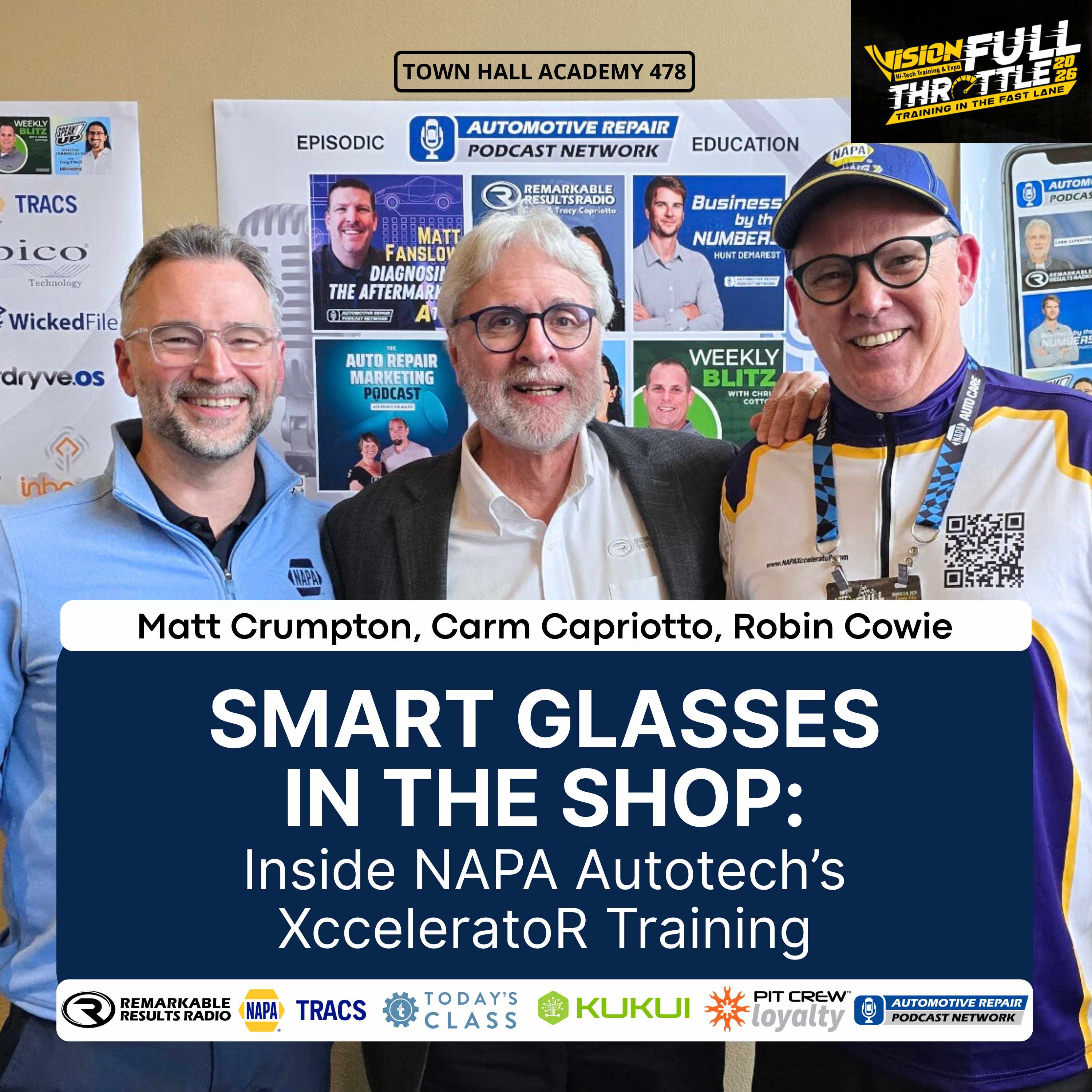
Okay, I'm with Matt Crumpton.
Are you still the director of program development,
or did you get 10 more titles that Jason gave you?
I think I got them without the titles.
That's a great answer. I love that answer.
But yeah, my job title's still the same, but yeah,
the responsibilities sometimes grow a little bit,
but that's the beauty of how our team works.
By the way, I read this article today about the shortest sentence in the world.
No, period.
We don't know that word.
It's not in the Napa lexicon, actually.
Robin Koeh is here, creative technologist, content producer development,
this whole AI point of view stuff.
So Napa saw the stuff that you did and said,
this guy may be able to help us go to the next level.
Is that what happened?
Yeah, and we got introduced to Napa through a friend.
It was the very beginning of the business that we had just started.
I think the thing that kind of started to make,
or at least caught Napa's attention was,
we were very, very focused on the return of investment,
and we were very focused on not the technology,
but the result and the impact that what we're doing could have.
So you work backwards.
And then we work backwards.
Yeah.
By the way, I forgot to mention that we are here at Vision 2026.
Thanks to Sherry Hamilton for giving us our same studio
that I think we've had for like eight years in a row.
This is such a cool place.
And in fact, I don't hear any air conditioning going on.
Usually, we always have a big hum up top.
Just look at Robin's shirt.
Do you have one like this?
Actually, I do.
I actually have the matching underwear as well.
In fact, whoa.
QR code right across the button.
We just went with the racing vibes all over that.
And I only wear it when I'm at the cabin with the wife alone.
That's right.
Wait, I have a cabin?
You tell me you go to the lake all the time.
Yeah, that's the lake.
That's where the Speedo version.
And so we were just coming out of lunch,
and I saw these like five or six, obviously your trainers.
We've actually got 10 people here.
We've got seven stations.
We're doing demos of the headsets,
demos of the glasses, demos of the mixed reality.
And we're just letting everybody get their hands on this stuff
that we've been talking about.
And I was with you guys at Apex where you, again,
you keep bringing on these incredible announcements
and these new levels that you're going at.
And I'm sure there are new listeners
that have not heard about this yet
because it's a pretty big world out there.
What's it all about?
And why is it so important and so critical
that we need to be in the stratosphere
as far as the level of education,
the ability to repair an efficient time frame,
and having knowledge at our fingertips?
Wow, I mean, when you want to talk about the 30,000-foot view,
is NAPA is always looking for solutions
to help its auto care centers and different types of customers.
And you look at the shortfall of technicians,
that's one major problem.
The speed to get a technician up to what we would call a billable state
to where that ROI for shop owners
that's investing in a young man or woman in this industry,
that has to ratchet up dramatically.
Also the level of technology today and how fast it comes,
any way that we can speed up education,
raise recruitment and retention,
and then also how do we speed up the ability
to reach out and touch information
and make everybody more efficient?
It's not just good for shop owners, it's good for technicians.
Technicians have a massive barrier eventually
when it comes to tools and investments and things like that.
So the faster we can get them up to speed or her up to speed
and be able to start to get that return of investment,
then everybody's winning across the board.
And this also allows us to attract
some new type of talent into the industry
and keep this industry rolling the way it should.
You inspired me to think that if I was a B&A tech working,
I got eight, nine years in,
my owner of my NAPA auto care or NAPA gold shop
comes in and says, look at guys, we're going there.
And I've got these glasses on and I am connected
to the outside world in my little old
cool little high technology bay here.
And all of a sudden I learned something new
because I asked and I was curious, where are the aha moments?
I guarantee you they're happening,
even from the trainers who are helping you do this.
Do you see that the aha moments, the learning curve,
even though we've got seasoned people,
are going to go on to the stratosphere?
This whole experience has been about, listen, truly,
when we first started working on this,
we went for two months, we just went and talked to shop owners
and we talked to techs.
And at the beginning, we were really working on
this kind of entry level tech question,
like how do we get guys and girls in high school?
How do we get them coming out of tech school?
Or how do we get people who are new to the shop?
How do we get them basically making more money
themselves individually as techs,
but then also making more money for the shop and etc.
We spent a lot of time listening to what those challenges were.
And the result of that is we developed 53 lessons
in virtual reality that basically provides the core information
that you need to know.
I love the way that Jim Przbilski had a training,
works with Matt, sums it up, he says,
look, breaks pay bills.
So start with, let's have people being able to fix breaks.
And at this show, we are delivering 21 of those 53 lessons.
And of course, the thing that we're addressing
is breaks pay bills.
And what we realized is, wow,
there's such a rich amount of Napa know-how.
And Matt and I were having breakfast,
I think it was at A-S-T-A,
and we're having breakfast and just talking about things.
And he just went on this, like, aha moment.
Like, you know, he said, you know,
what if we could take this know-how and this knowledge
and basically put it at the tip of your tongue?
And if you were in the context of like, oh, here I am,
whatever, I'm a C tech or a B tech,
and I reach this problem that I just don't have,
you know, the real answer for,
what if you could just ask that question
and instantly get a verified,
true, contextually accurate answer?
And I was like, yeah, man, we can do that.
See, I don't think there's anything you can't do.
I think that's what makes this so exciting.
Where we started and where it's kind of morphed
is every time we sit down and talk,
and the more we deep dive into the technology,
and of course, that changes so fast.
And the more that we get to test and play with the equipment
and all of its capabilities,
it just opens up another door and another door
and another door.
And it's been like lightning in a bottle
in the last six months of everything
that's kind of developed in the direction that we're heading.
I thought I was excited about it in April at Napa Now,
but now I realize what a difference it's going to make
because the training aspect,
we knew it was going to impact a lot of people.
The smart glass with the integrations
to be able to provide that type of service,
that impacts everybody.
So from shop owners to technicians,
all levels of technicians, things like that,
all of that can be impacted.
And we know we're working with some pretty special.
Napa Know-How is back.
That's right.
How cool is that?
Robin, are you like a kid in a candy store?
I am.
You know, I have a very weird origin story.
You know, my father, we're originally from South Africa,
he worked in these gold mines right out of,
he's an industrial psychologist.
And he picked up a film camera
and started filming from the point of view
of people who are trying to learn how to be gold miners.
And it was this kind of first person experience,
he called it point of view learning,
that became the basis of 50 years
of learning and development, training that he's done,
did a lot of work from Mercedes-Benz in Germany and Ford.
And so automotive and teaching people how to learn things
has been a part of my dad's life, his whole life.
And then I stole that idea of this kind of first person thing
when I was in film school
and I decided to apply it to a movie
called The Bly Witch Project and I made that film.
And that kind of changed my life
because obviously it was a great success,
but it really put me kind of with the ability
to explore technology.
I got into gaming, ended up running the Madden football franchise
for a couple of years and then really got into,
okay, how do we use this technology to help people?
And dad and I worked on a program
where we helped electricians, entry-level electricians.
We reduced the amount of time from about eight months
down to 15 days for entry-level electricians
to learn how to get into that business.
And that's when we decided, you know what,
we really need to take this to other enterprises.
We met Napa and that's how it got started.
So from this literally down in a gold mine shaft,
all the way to what we're doing now,
it's a really exciting process to bring these tools
to such an important career and such an important task.
The industry is going to start hearing about XR.
And when you say XR to me,
the next words that come out of your mouth are mixed reality.
Let's explain mixed reality to the audience.
Let them understand the options that are there.
Yeah, so extended reality, XR,
includes something called virtual reality.
So that's complete immersion.
So I want to basically transport you into a shop
and we built a studio.
We worked with Matt.
Matt took out one of the training centers
and we turned it into basically a capture studio.
And we then built that, a digital double of it,
in virtual reality.
By the way, is Jim Perlbisky,
is he signing autographs?
I mean, he's going to be the hit parade.
He's the new movie star, isn't he?
Between him and Daryl,
I don't need you to quote their ego anymore.
Yeah, Daryl's the guy.
Daryl won a great award at the conference.
He did.
He did.
The vendor major.
Daryl's the most amazing host.
Daryl stepped up, man.
Yeah, he did.
In virtual reality, you basically experience,
you see his big hands.
They call him Sasquatch.
You see his Sasquatch hands
and you see it from his point of view.
And so you learn from Daryl's point of view
as he shows you what to do.
And then you actually do that and test in it, right?
So that's virtual reality.
Then you got mixed reality
where you're looking through,
you're using real tools
and actually working on mock-ups.
Napa has been so successful
with their mock-up program
that they have for in-person instruction.
That, you know, this is such a big part
of what Matt does and Scott and...
So now imagine having those things,
but now you've got a digital help
so you're working with real things.
And then finally, now you're actually on the job
and you're wearing these very light glasses
and that's called augmented reality.
So you've got virtual reality, mixed reality,
and augmented reality.
Those are the technologies.
And who cares about the technologies?
We put it all together and it's called XR.
Did you ever think that you'd be
a glasses salesperson right now?
Because he came into the studio
before we sat down and he goes,
I got to show you these.
It's funny.
That's exactly what he did to me
before we came in here.
I'm pretty sure he gets a commission.
Yeah, like, hey, man.
Oh, man, come here.
I mean, I did order some,
so he does his job.
I'll take a couple.
I mean, these things are amazing.
Yeah, he's showing...
Look at the camera.
So they're super lightweight.
They've got dual cameras on either side.
You can take still pictures.
You can take video.
They got microphones on the belly here.
So you got stereo microphones.
He got speakers or you got these
that just slip into your ears
so you can hear really clearly.
And then essentially, you have the power
to basically talk into these.
It gives you information back.
You can take a photograph.
You can take a video.
That can then integrate with all sorts of technology.
So you can integrate with shop software.
You can integrate with DVI.
You can integrate with one of our new partners.
Can we mention who our partners are with Identifix?
Yeah.
So we've been working with Identifix
and their diagnostics tools
and all of the incredibly rich information
that Identifix has with Direct Hit.
Let's face it.
Your shop management system
is the single most important tool in your shop, period.
NapaTracks was built from the ground up
to make your business more profitable and efficient.
We provide an extensive set of tools
to increase and track profitability in real time.
NapaTracks offers the industry's best post sale support
hands down and we train your people on site.
Yep, on site.
And we offer remote refresher training 10 times a week
and customer support is open six days a week.
Give us a call, visit the website
or join our Facebook community today to learn more.
We'll prove to you that Tracks is the single best
shop management system in the business.
NapaTracks is always customized and tailored for you
whether you're a one man shop or a large multi-bay
or multi-location company.
After all, it's your shop.
So it's your choice.
Visit us on the web at NapaTracks.
That's N-A-P-A-T-R-A-C-S dot com.
Strengthen your shop's entire team with today's class.
Everyone from technicians to service advisors
can access impactful training on their phones
in just five minutes a day.
Opt for solo sessions or ignite friendly competition
challenging team members to climb the leaderboard
for the highest score.
Our effective daily training ensures measurable progress
helping you develop your team.
Train smarter, not harder with today's class
and transform your shop and your people.
Start seeing results today at today's class dot com.
With 900 plus years of combined team experience
we feel the growth of 2,200 plus shops
and have influenced three billion dollars in revenue.
Stop working harder, start working smarter,
get industry leading customer support
and book a demo with Cacui, that's KUKUI dot com.
You know most shop owners feel trapped
spending on ads while half their first time customers
never come back.
It's frustrating, it's exhausting and it's not your fault.
The industry average is 54%, one and done.
We understand how discouraging that can be.
Well pit crew loyalty changes the story.
Our clients cut that rate by up to 38%, raising lifetime value by more than 50%.
Loyalty members visit nearly three times more often, creating predictable revenue without
extra ad spend.
Pit crew loyalty where customers stay and shops thrive.
On the web at pitcrewloyalty.com.
Robin, is it coming to you through the earpiece or are you seeing it somehow?
No, so right now it's all audio.
And the reason is, and this goes back to that breakfast we were talking about, when you're
in the flow of doing the work that you're doing, if you've got to come out and interrupt
that work and go to a, you know, get out from under the vehicle, that kind of stops.
You want to be able to use your hands the whole time, just ask a question, get an answer
in your ears.
So right now we're just doing audio cameras, video.
And right now we're not doing anything on the screen because we don't want to get in
between the technician.
Now it may be, it does have the capability.
You know, Matt and I have really tried to like test something, learn something where,
you know, this has been a very live project.
We've purposefully tried to expose it to people so that they can tell us what they need.
And if somebody says to me, oh, I really need something on the display, we'll figure out
how to do that.
But for right now it's just audio, answers, questions, takes pictures, you know, and sends
it to other things.
So it's an input device?
But can you have a tablet and say, can you send it to my tablet?
So the wiring diagram that you want, you don't have to go back and type it in.
As a technician, if I need to look at a wiring diagram or something a little bit more in-depth
diagnostic process, that's when you should stop what you're doing.
Take the time to research, develop a diagnostic process and then walk through that process.
What we want to impact is, I don't want the technician leaving the car to look up a torque
spec, a location, a description of operation, a wire color or a pin out, or technical service
bulletins that may give me a head start of what items I need to test first.
And it's all in this idea of just trying to shave one to three minutes a job.
If you can do that, it's dramatically impacting.
It's going to be more in-depth than that.
That's where you do want the technician to step back and want to be able to look at things
in plain sight.
And again, you know, Matt Fanzlow talks about it, that diagnostic process is that don't
go head over heels into a car, create a plan and then work your plan.
So when we need to be able to do that, then we want them to take a break from the vehicle
and develop that.
But this is that quick hit information that keeps you at the car, keeps you in the rhythm
and in the flow.
And of course, I know my experience is sometimes I am laid out on my back in the floorboard
of the car, which is extremely comfortable.
Oh, right.
That's why you walk like you walk.
Right.
I walk at an angle and I keep making left-hand turns.
So but you look at it as I'm under the dash and if I had a light there, I'm still hands
free and I'm trying to track down a wire or electrical problem.
And I want to ask the pin out on a connector under the dash.
It's worth it if I can ask and it gives me that information instead of me having to crawl
back out and go over to the computer, pull something out.
Or even if you've already printed it, looking at pieces of paper, we're beyond that.
We have the technology to improve technician efficiency and also their lifestyle is that
they want to be able to be done with the job faster.
And if we can make that easier, we impact them in a positive way.
Let me ask a question about wearing the glasses.
And if I'm going to take a picture, I'm recording Robin.
If I'm looking directly at you, it's going to get you.
Is it my head?
It's not my eyes.
It's my head.
So I've got to make sure that I'm looking straight ahead if I want that picture.
So it's actually what was very important to technicians that we talked to was that it's
not always on, the device is not always on, you control it when you want to control it.
So you can activate it, you can say, take a picture or take a video, you're in control.
And, you know, I think everybody, we're not about spying on people or like, you know,
gathering all this, this is a tool like any other tool to be used when you need to use it.
And, you know, yeah, you can, it's very light, it's lightweight.
One thing I want to add here, and I want to be kind of clear about where we are in our journey.
We started a year ago listening, like I said, we've built really valuable VR,
which I think is what we've got right now.
And we have a very early version of the glasses.
That's where we are now.
By the end of the year, all of these things that we're talking about,
like Identifix and we've got other partners that we're talking to,
all of that will be incorporated into what we're doing.
And so that'll come out by SEMA.
And so this is an evolving product where we're building on top of the technology by
continuing to listen to what technicians need and what is actually valuable to them and for them.
So I want to make sure we make a distinction when Matt and I are talking about it.
We're actively not only thinking about it ourselves,
or Jim Prasbilsky or Darrell or any of the other Napa, you know, techs who are there,
but we're also talking to shops all the time.
We're talking to techs all the time and we're trying to figure out,
okay, what would be valuable to you?
And so it's really kind of building it in the open as we discover these things that have value.
So I just want to make that clarification.
I get the glasses right now.
Yes, sir.
And the possibility of this continuing to double what it can do is going to happen.
Let's say at once a quarter, something with this investment continued to have value
in say a year or with somebody say, way to get this done.
I mean, I hate when people don't want to get involved.
I guess my point is this investment, this commitment to this Napa XR,
it really should happen now.
Yeah, no, it is valuable now.
And we wouldn't be here putting it out here for people to purchase today.
Today's really the first day that people can get in.
At Napa Now, we had some super early believers.
We called them the early adopters.
And it was literally only Napa Now that we opened that window.
And those people amazingly came in and supported us right in the very beginning.
And then we've been listening to them the whole way through.
And so now a week ago, we opened it up for those early believers to purchase.
They were the first people who could purchase.
And now today is the first time anyone outside of those early adopters can actually purchase.
And that value will continue to stack.
Absolutely.
That's a perfect opening to what I was going to ask next.
And that is you had your vendor's summit a couple of weeks ago.
You gave some great awards out to people.
And when you think about all the vendors in the room,
there are so many that can play in this sandbox.
Oh, yeah.
And so let's just think about digital vehicle inspections,
comprehensive safety reviews.
If I was going to, again, maybe it's not happening today, but maybe it is.
I'm looking straight ahead and I take a picture.
I'm doing a video.
However you have to explain that to your glasses,
I can't imagine how much time it can save from inspecting and looking camera up,
picture and back.
You're already in the moment.
Why should you have to stop and click?
I think, yeah.
When you think of like DVI, and we'll just talk about that for a second,
but you look at it as a hands-free extension of that DVI tablet to be able to take videos,
pictures, be able to annotate instead of sitting there typing your notes in, things like that.
I also look at it from a customer experience is we all know a lot of customers today.
They don't want to talk to anybody.
Just send it to me through text.
Let me look at it and I approve or anything else.
But the more information you provide a customer, the more educated decision they can make.
But you still want to keep some personal touches there.
So if you think about if I am a technician or a service advisor,
I can click video and talk through and actually point live and sit there and say,
here's where the old leak is.
This is the process we need to do.
We need to clean this up.
We need to put dye in it.
We need to be able to test and things like that.
But this is where we're looking at and be able to add that to the DVI and be sent to the customer.
It's a lot more personal and then somebody can sit there and go, wow,
they're just talking to me like one of the other people and explaining what's going on with my car.
I think that gives a whole not a level of confidence.
So it's an enhancement.
Also, it's not always the easiest to take a tablet and shove it in an area to try to take a picture.
Exactly right.
And the thought that I had was in all the great DVI companies that are out there,
they're going to integrate.
You're walking down the line in the tablet, but the glasses are going to be integrated there.
If not wherever on the cloud, this picture goes as I'm looking at front end, for example.
So there's people that have to step to the plate and help you integrate the glasses, right?
I would almost envision it is, and once they select the vehicle on the DVI,
I want us to get to a point where they don't have to pick up the tablet at all.
It is select the vehicle, be able to take pictures and it prompts you to the next inspection,
the next inspection.
And you should say, are you recommending vakes?
Yes, no.
Are you recommending this?
Yes, no.
And it's all verbal and prompted in pictures and everything else.
And the tablet just stays on the docking station.
That's where I would like us to be.
Think about the amount of knowledge, for example, that's in tracks, right?
If that knowledge from tracks is actually then going to the DVI,
which that's already happening on some really important partners that we already have.
And then you've got all of that.
It's the ease of the interface.
It's the simplicity of, in a way, being able to talk to the car, right?
Because you've got all the history there.
You've got all the information.
Once you have that VIN number, it's like the VIN number is the gateway to the world, right?
But now you're just talking to that vehicle.
And like Matt said, I actually love, I'm going to start using what you just said.
It's about the humanity of it, right?
It's about the personalization of it,
both to the technician and also to the customer.
I love that because that is definitely, yeah, like in my stack,
whether it's XR or AI, I've got a lot of technology.
But again, who cares about the technology if you're not actually serving a problem?
Yeah, the technology is to supercharge everything, but we don't want to take away
the personal touch and the relationship piece of it.
So it's to find balance of using technology to enhance everything we're doing,
but not taking out all those personal touch points.
The words, seamless workflow, just flowed through me.
That the glasses can function as the next thing you're doing,
it's almost ready or prepared or all you have to do is hit a one particular button
and then jump into a project that it knows you're getting ready to do.
And think of an orchestration, think of the conductor.
You've got all these tools in front of you in this wonderful technology bay.
And the glasses are just sitting up on a shelf, brightly lit, just hanging there.
We've talked about that is that they're just sitting on a docking station
and when you need them, you pick them up and it's an extension.
But I'll say this, I mean, even going further is that
look at what a technician and shop owners, service advisors deal with every single day.
This is already a very tough industry.
Those days of working on cars, it's a little volatile because things can go wrong.
It's extremely challenging mentally, emotionally and physically.
Technicians go through a lot and they're never fully appreciated of
how difficult this job is.
All we want to do is give them a lifeline and say, we're here for you.
We understand what you're going through and we're trying to make your life just a little
bit easier. And if we can do that, then we're impacting our customers in a good way.
And that's really the number one reason we're doing this is we recognize because almost everybody
working on this project on the back end with development has been in that space.
We know how hard this job is.
And if somebody would have told me I had this 20 years ago,
15 years ago when I was turning wrenches, then yeah, I couldn't believe what I could have done
in my career. But I just think that that's what really we need to recognize is we're just trying
to impact them in a positive way. You would have said it's Disney back then.
This is Disney. And Robin, is it Disney? No, no, it's very real. I think I'll go one step further
because it is an ecosystem that we're really working on because when people use the glasses,
they're essentially updating the knowledge base by being in the real world doing real fixes.
I think sometimes training or learning development or whatever you call it,
sometimes it's gotten a bad reputation where maybe it's not connected to the real world.
Here's the theory of how to fix something. And then people often say, well, yeah, that's what
it said in a book. But when I actually got in the trenches and I was really fixing it,
this is the real world. And you call that experience, right? Well, the glasses can actually
then teach the virtual reality and teach that other side of it how to do it. It's a complete,
like continuous cycle of making it better. So every tech who uses these glasses are basically
helping their other brethren to use that term by improving the technology because it gets better
and stronger. And then that loops back to the entry level people, right? Like when we started this,
we were excited about getting young people into being an auto technician, right? Like we wanted
to reach out to them just like the people who bolt mad and from us who are excited about that
game world. When young kids put on that headset, they're like, I know this, like I know this,
you know, I've played lots of games like this. So it's like making that entire ecosystem work.
I love what you're saying. And I've never been more impressed with established industries
are focusing on young people and giving them not only is this technology tool going to make
us more efficient and smarter and better, but it lends itself to our younger people.
And I'm not saying it's a toy. It's not. No, but it's how they're going to want to exist in this
world. It's an app. It's a phone. It's a set of, you know, reality glasses. It's my screens. It's my
connection. It's my wireless. It's my Bluetooth. It's all this stuff and it's all wrapped into
where we've got to be in the future and how we're going to engage young people
in this high tech industry. Every industry is searching for the silver bullet of how do I
go after young demographics and attract them. We're no different in this industry. We just
struggled at it probably more than some others. This is one of those ways to get there. And I
think, you know, from the ASE case study that we did, there was one resonating thing that one of
the students said, he says, this allows me to learn and kind of a real world format without
the anxiety of making mistakes. Because you look at it, you know, when I started out, you made
mistakes. It was part of learning. Well, today's mistakes are three times more expensive than the
mistakes I ever made. Yeah. Now, maybe my first boss may argue about some of the mistakes I made,
but I do think that that's important is that when we have to look at is every generation is a
little bit different and we have to adapt to how do we attract them and how do we make them feel
comfortable and how do we educate them? Really the way that they prefer to be educated instead of
just trying to force a square peg in a round hole, we've got to adapt and say, this is the best
way that we can attract, train and retain. And that's the angle that we got to take. I think he
actually said is like the quote unquote is like it gave me the confidence to do this in the real
world. So it became that bridge, that word confidence is so important. So help me understand
the rollout, virtual mixed augmented. How do we get the virtual glasses and then the mixed
in the field? Can you do this online? Do you have to go to a center? We try to simplify it as much
as possible. It's XR, it comes in a package, right? So you get a headset, you got a pair of glasses,
we've got a package actually where you could get a headset that has three users and you got
three pairs of glasses. So you got two packages, one is a single headset glasses and then you
have one that's headset, three sets of glasses, three users of the headset. So those are the two
basic packages and it's all involved, right? And all the updates, all the customer support,
everything comes with it like going forward as you go forward. I was at NapaNOW and there was a
caliper in front of me. I guess it was virtual. Where's that augmented? A mix, a mix, okay. And
I had to pick the right tool. Oh, that was virtual. Okay. If I'm a shop and I'm hooked
to the internet and I'm doing this, do I as the shop have to know from, if you will, a teacher's
guide what to put in front of that student? You know, let's back up. The one thing I have gotten
from shops is like, what requirements do I need? That's good. And really, it's Wi-Fi. I will say,
like anything else, and shops already deal with this with diagnostic tablets, things like that,
especially ADOS equipment that are using camera systems, is sometimes there are some firewall
or security that you have to adjust. But for the most part, it's pretty plug and play. It's Wi-Fi.
Yeah. It's Wi-Fi. It's Wi-Fi and keeping it charged. It is a self-contained unit. So you just,
once you connect, you put it on, you connect it to the Wi-Fi and you go. And then you do need,
you know, basically, the reason it's using Wi-Fi is we've got so much content. Like,
think of this from my perspective, right? I made nine feature films. They averaged two hours.
We made 53 movies. That's what we've done over the last year. We've made 53 movies
over the last basically two years. We're making 53 movies. So it's a lot of content. And so the
reason it has to have Wi-Fi is it goes up in the background. You don't have to do anything. It goes
up, it grabs the next piece of thing and it brings it down. This is for the VR that we're talking about,
right? With the glasses, because it's audio, it's instant. It's real time. It's much what we call
lighter in the technology sense. So the glasses are hyper-contextual. You're asking a very specific
question about a very specific situation, a Torx spec, or a, you know, as the list.
TSP or location or description of operation. So think the glasses are very specific and
they're non-linear. They're not in a sequence. They're just whatever you need. The headset is
the opposite, right? It is, okay, especially as a beginner, here's the best practice. Do this,
then do this, then do this. And instead of just telling you do this, do this,
you're actively actually doing it in the headset. So you're learning by doing. You're not reading
text on a screen. Who wants to read like lots of text? People just want to fix things, right?
And that builds that muscle memory as well. It is over and over and over again. And by the way,
they're being kind of assessed or measured throughout that. So you can't just keep going
through the modules just because it's not a participation trophy. They've got to be able to
complete the module, answer the questions, have to be able to be at 100% before they can go to
the next stage. So again, muscle memory, repetitiveness, and what we used to call that was just work
experience. So now we're trying to do that at an accelerated rate before they even have to go out
there and touch a car and start actually changing parts. We teach five ideas and we test five ideas.
Teach five, test five. You don't get to idea number six unless you've passed all five of those ideas.
So teach five, test five. And my dad has been using that for years and it's what we're still using.
So that's fantastic. And then we worked incredibly closely, not only with the
amazing guys at Napa, but with the amazing people at AASC, because we wanted to make sure,
okay, you reach an end of a lesson and you're going to have to take your AASC certification test.
So we had one of the AASC instructors come in and say, okay,
from the lesson you just learned, here's the things that you really need to pay attention
to for your AASC test. Again, it's all about improving. It's got to be better for tax,
better for shops, better for customers. I love that hook. That's a great hook. And I don't mean
hook in a negative way. It's exactly what should be done. Are you having any fun, Robin?
Matt and I get them to laugh. He's playing music you're conducting. Am I right?
He is the orchestra. I cannot believe how many plates Matt spins. It's remarkable.
Look, the other thing that I have, you know, over the, since we talked and I've gotten to meet
this incredible group of companies that Matt has brought together and the partners,
the partner ecosystem at Napa is remarkable. The quality of people across the board.
And boy, they talk about like being honored to be part of this peer group. And that is all of,
you know, big tribute to Matt and his team. I think most of the partners would tell you that's
probably more Lauren than anybody else. I think they like Lauren more than they like me.
You're just tougher. I'm not mean. Everybody keeps thinking I'm mean. No, you're not mean.
You're tougher. Okay. Okay. Except that. Yeah. Especially with Jason, my boss. I'm really tough
on him. He deserves it. First responders who said, Hey, we're in. Yeah. And they're getting ready
to get on board. Yeah, those early adopters. Anyone else that's saying, I got to do this thing.
Is there a timeframe? Do we have to wait another few months before today's the day?
Because Napa, we're going to announce big here at Vision and you are.
Yeah. He's already got orders. Napa, accelerator.com is where you can go. Napa,
accelerator.com. That's what the X, not a A. Yes. Sorry. Accelerator X.
Accelerator. Thank you. Yes. Here at the show, we've got a QR code. We're wearing these, you know,
super obnoxious shirts. I love it. They're awesome. We've got QR codes here. You can
go to the website. You can call the AutoCare number, the AutoTech Napa Training Service Center.
It's a 1-800 number. We'll get that number over to you, Karn. But yeah, they can call and even
be walked through that way. But going back to the shirt when he says, Matt, I got to show you
something for Vision. And I was like, Oh my God, what is he thought of now? We get on a team's
meeting and he shows me this. And I was like, what is this? And he's like, this is a shirt.
We're going to, all of our teams are going to wear it at Vision. It's going to have QR codes that
go to this. I was like, you're going to be a walking billboard. And he's like, yes, yes, I am.
I was like, I love it. Just go ahead and do it. And he's like, I've got you one too. And I was like,
okay. So I can see somebody walking up to Robin here on the show floor. And they're walking up
to him and Robin smiles. He says, I'm just doing the QR code, man. I'm about taking your picture.
Because it's right here on his chest. I got front, front and back, front and back.
Right. Robin's going to be like, I'm married, like back off. And then he relies like, oh,
wait, you may be a potential customer. Look at this guy following Robin all over,
taking a picture of his back. What's going to be better is that there's a little like
wrinkle in these trying to flatten out his shirt so you can get a better picture of the QR code.
That's right. Exactly. It fits my curves too, Seth. You have them too? Oh, yeah, you know.
It's amazing how that happens. It's always getting around the corners that matters when you're racing.
Yeah. But I tell you that blue Napa logo up front really hides that really. That's right.
It's the dark colors. They're slimming. I got this strong belief. You take your weaknesses and
you make them straggs, right? Absolutely. Yeah. Yeah. This was great. Thank you for coming in.
I'm thrilled that you guys are on track. I mean, as far as, you know, the launch and
everything that's going on, I think this is so exciting and so healthy for our industry and to
be involved in helping get part of the message out. That's great. Robin,
all the great work that you're doing is your, his dad is more fun than Robin.
And he's 81. He's up there. He's up there. He's probably mad at me to say,
are you so easy? Don't treat me like that. I'm 50 years old. No. First of all,
you would never know. You can't keep up with him. No, you can't. No, he's amazing. He's on the team.
What I love about him is like, is a continual life learner. Yeah. And so many of the people
that we worked with like Daryl and Jim and like, and Matt, like, and actually most technicians,
they just love learning new tech and new things. And so I think that's the thing I respect the most
about my dad. You know what I call that? What's that? Being a perpetual student. Yes, sir. That's
what he is. That's what I am. I want to learn something new every day. And I just learned a
ton of stuff here today. Thank you so much to Matt Crumpton, director of program development
and Robin Coey, creative technologist, content producer, developer, and distributor of glasses
now I see. That's right. Hey, you like my glasses? I am going to be checking if there's a commission
going on. Thanks guys. All right. Bye bye. Thanks for being on board to listen and learn from the
premier automotive repair business podcast, Remarkable Results Radio. Get your episodic
education on the ARPN listening app at automotiverepairpodcastnetwork.com. Also,
enjoy the podcast on our Carm Capriado YouTube channel. Carm is all for advancing the professional
automotive service industry. Until next time.
About this episode
NAPA Autotech’s XcceleratoR training program puts smart glasses and XR into the shop workflow to speed up technician ramp-up and improve ROI for auto care centers. Matt Crumpton and creative technologist Robin Koeh explain how they built 53 VR lessons (21 shown at Vision 2026) and are evolving early glasses into a hands-free, audio-first “ask and get verified info” tool. They break down virtual, mixed, and augmented reality, discuss integration with DVI and Identifix diagnostics, and emphasize confidence, reduced job interruptions, and a continuous learning loop that grows the knowledge base.
Thanks to our Partners, NAPA TRACS, Today's Class, KUKUI, and Pit Crew LoyaltyWatch Full Video Episode
Recorded live at VISION 2026, host Carm Capriotto sits down with Matt Crumpton, Director of Program Development at NAPA Auto Care, and Robin Cowie, Creative Technologist, to explore the official rollout of NAPA’s Extended Reality (XR) training program.
The conversation centers around solving some of the industry’s biggest challenges: the ongoing technician shortage, the high cost of tools for new hires, and the need to get technicians productive and billable faster. By leveraging immersive technology that feels familiar to younger generations, NAPA is creating a pathway for new technicians to build skills and confidence in a low-risk, high-impact learning environment.
The XR ecosystem is built around three core technologies. Virtual Reality (VR) delivers immersive, point-of-view training with over 50 lessons focused on essential shop skills, reinforcing the idea that “brakes pay bills.” Using a structured “teach five, test five” approach, technicians develop muscle memory before ever working on a live vehicle. Mixed Reality (MR) bridges the gap between virtual and physical by combining real tools with guided digital overlays, allowing for hands-on practice with built-in support. Augmented Reality (AR) smart glasses bring the technology directly into the service bay, giving technicians instant, voice-activated access to critical information like torque specs, keeping them focused on the vehicle and saving valuable time on every job.
Looking ahead, the platform continues to evolve. Future integrations are expected to include shop management systems, Identifix, and digital vehicle inspections, enabling fully hands-free workflows and even customer-facing video communication directly from the bay.
After successful testing with early adopters, NAPA officially announced at VISION 2026 that its XR training packages are now available for general purchase, offering shops a powerful new way to train, support, and retain the next generation of technicians.