
SnailMail: What Child Do You Get Rid Of?
About this episode
Voicemails and texts drive the episode: listeners share Toyota sightings, road-rage triggers, and practical off-road/tool talk. The hosts debate annoying driving habits, especially missing turn signals and “blocking the intersection” by taking right turns on red when traffic is backed up. A big listener question focuses on how to motivate selling unused vehicles (including whether to sell a modified Jeep as-is) and the reality that the market is slow and financing is expensive. Tool organization tips, plus detailed E-locker troubleshooting, round it out, followed by a heartfelt mental-health call from Zach.
- Text Msg 1: Richard from Atlanta says Toyota are everywhere
- Caller 1: Uncle Weirdo talks about merging
- Caller 2: Richard from Atlanta, choosing what rig to sell
- Caller 3: Butt Dial Brian talks about Tool Storage
- Caller 4: Jeff Morgan from OR talks about ARB Lockers
- Caller 5: Jeff Morgan from OR teaches everyone how to troubleshoot an E-locker
- Caller 6: Zac from OKC talks about mental health
Join Our Discord: https://discord.gg/yFyFFkQbuy
Come hang out with us on the SnailTrail4x4 Discord — it’s the easiest way to connect with Tyler and Jimmy directly, chat with fellow offroad enthusiasts, and get first access to Group Buys and Treasure Hunt token drops.
CALL US AND LEAVE US A VOICEMAIL!!!! We want to hear from you even more!!! You can call and say whatever you like! Ask a question, leave feedback, correct some information about welding, say how much you hate your Jeep, and wish you had a Toyota! We will air them all, live, on the podcast! +01-916-345-4744.
An alternative method would be sending us an email at [email protected] or at [email protected]. You can also find us on Instagram at SnailTrail4x4 or 4x4ToyotaTyler
Listener Discount Codes:
SnailTrail4x4 –SnailTrail15 for 15% off SnailTrail4x4 Merch
MORRFlate – snailtraill4x4 to get 10% off MORRFlate Multi Tire Inflation Deflation™ Kits
4WheelUnderground – snailtrail 10% off
Ironman 4×4 – snailtrail20 to get 20% off all Ironman 4×4 branded equipment!
Sidetracked Offroad – snailtrail4x4 (lowercase) to get 15% off lights and recovery gear
Spartan Rope – snailtrail4x4 to get 10% off sitewide
Shock Surplus – SNAILTRAIL4x4 to get $25 off any order!
Mob Armor – SNAILTRAIL4X4 for 15% off
SummerShine Supply – ST4x4 for 10%
Backpacker’s Pantry – Affiliate
Toyotas
"Oh, got it. Like last week when he called in, he was talking about how he's just noticing Toyotas everywhere. So. Well, that's because they are a very popular vehicle."
They’re saying they keep noticing Toyotas everywhere. That’s partly because Toyota models are common, and it’s usually easier to find parts and support for them.
Toyota is being referenced as a very common vehicle brand in the listener’s area. In off-road circles, Toyota’s popularity often comes from the availability of parts, strong resale value, and a large community around models like the 4Runner and Tacoma.
voicemail
"Next up is voicemail back over to voicemails here. And we got uncle weirdo. Okay, uncle weirdo."
The show is taking calls from listeners and reading them on air. In this part, they’re reacting to what a caller said.
This segment is structured around listener voicemail calls. It’s a common format in off-road and automotive podcasts where community members share driving observations, questions, or stories.
merging onto the freeway
"I just watched the lady merging onto the I5 and almost ran herself off the freeway. Because he apparently does not know that if you're merging onto the freeway, you in fact do not have to ride away."
When you get on a freeway, you’re supposed to smoothly join the traffic flow. If you don’t merge correctly, it can make other drivers react suddenly and can lead to crashes.
The hosts are talking about freeway on-ramp merging behavior—specifically how drivers should blend into traffic rather than “ride away” or stay in the merge lane too long. It’s a safety topic because poor merging can force other vehicles to brake or swerve, especially when traffic is tight.
semi truck
"And this semi truck here is just driving, wasn't able to get over. And she's still yelling out and getting all the fingers."
A semi truck (a tractor-trailer) is much heavier than passenger vehicles and takes longer to accelerate and change lanes. That makes it harder for drivers to “thread the needle” during merges, and it increases the consequences of unsafe lane changes.

Tesla Semi
"you in fact do not have to ride away. And this semi truck here is just driving, wasn't able to get ov..."
The Tesla Semi is a large electric truck used to move goods. Instead of using diesel fuel, it runs on electricity. It may come up when people talk about whether it can drive and operate normally during demonstrations or real use.
The Tesla Semi is an all-electric heavy-duty semi truck built for long-haul freight. It’s significant because it represents a shift from diesel trucking to electric power for hauling, which changes how the vehicle is operated and supported. It may be discussed in the context of real-world driving or demonstrations, including whether it can move under its own power during events.
right-of-way
"Especially if you're the guy already on the freeway with the right-of-way and you cut off the fast lane just to let Fergie traffic over."
Right-of-way just means who is supposed to go first. If you already have the right to be there, someone cutting in can force you to slow down or swerve, which is why it’s so annoying and risky.
Right-of-way is the legal and practical priority of who gets to proceed first at a given situation (like merging or lane changes). In traffic, having the right-of-way means you generally shouldn’t be interrupted by someone cutting in, because it forces unsafe braking or evasive maneuvers.
cutting off the fast lane
"and you cut off the fast lane just to let Fergie traffic over. I'm all for being a nice neighbor."
Cutting off is when someone jumps in front of you and makes you react fast. On a freeway, that’s especially dangerous because speeds are higher and there’s less time to avoid a problem.
“Cutting off” refers to abruptly entering another lane in a way that forces other drivers to react quickly—often by reducing their available space and time. On a freeway, doing this in the fast lane can create chain reactions: sudden braking, lane weaving, and higher crash risk.
fun topic
"Yeah. And that could be a fun topic. I think it could too. Um, so fun fact or funny little tiny story, uh, before we start going into that,"
They’re about to switch into a new subject and tease what they’ll talk about next.
The hosts are setting up a new discussion segment, framing it as a “fun topic” before telling a story. This is a structural marker for where the episode’s main theme will shift.
snail armor panels
"My last stop to getting the fasteners for the snail armor panels, I was at that place and I was driving here."
“Armor panels” are protective pieces you add to a vehicle to help prevent damage off-road. If they’re buying fasteners, it means the panels bolt on and need the right hardware to stay tight.
“Snail armor panels” sounds like off-road protective body panels used to shield vulnerable areas (like lower bodywork) from rocks, branches, and trail debris. The fact they’re buying “fasteners” for them suggests the panels are mounted with hardware that needs to be replaced or upgraded for secure fitment.
fasteners
"My last stop to getting the fasteners for the snail armor panels, I was at that place and I was driving here."
Fasteners are the hardware that holds parts on—like bolts or screws. Using the right ones helps the armor stay put and not rattle or come loose.
Fasteners are the bolts, screws, clips, or other hardware used to attach parts to the vehicle. For armor panels specifically, correct fasteners matter because they affect how securely the panels stay mounted under vibration and impacts.

Kia Soul
"... go in the merge section of like I five and truck soul and everything heading up to the studio, but I w..."
The Kia Soul is a small car that looks boxy and is meant for regular daily driving. It’s the kind of vehicle you might see on roads during a commute. It’s not usually discussed as a specialized off-road vehicle.
The Kia Soul is a compact, boxy crossover-style vehicle designed for everyday driving with practical space. It may be mentioned in a route or commute context because it’s common, easy to drive, and fits into typical traffic patterns. In a podcast, it often comes up as part of the “what you see on the road” conversation rather than as a dedicated off-road machine.
merge section
"I just went, I was go in the merge section of like I five and truck soul and everything heading up to the studio, but I wasn't in the freeway merge. There's some lanes that shrink down in that section."
A merge section is where traffic lanes come together and cars have to “blend” into the same lane. It’s where people often get impatient or misjudge space.
A “merge section” is the part of a highway where lanes change and vehicles from an on-ramp or another lane must blend into traffic. It’s a common spot for confusion because lane widths and spacing can change quickly.
merge to the freeway
"You're on a non-ramp. You're trying to merge to the freeway. You don't have the right way."
Merging means getting onto the highway from an on-ramp or ramp area. It’s risky because cars are moving faster, so you have to signal and match the flow of traffic so others aren’t surprised.
Merging to a freeway is a higher-risk maneuver because you’re entering faster traffic and need to coordinate timing with surrounding vehicles. Proper signaling and awareness of who is turning or changing lanes reduces sudden braking and near-misses, particularly at rural exits where intersections can create conflicting movements.
blinkers
"but I'm just going to say blinkers. Okay. Yeah. I really wish people use their blinkers more because I hate, like there's many times that I would take advantage of a situation if I know people are turning."
Blinkers are the lights on your car that tell other drivers you’re going to turn. If people use them, everyone can make safer decisions instead of guessing what you’ll do next.
“Blinkers” are the vehicle’s turn signals, used to communicate your intended direction to other drivers. In off-road and rural driving, signaling early helps prevent confusion at intersections and during merges, especially when visibility or traffic patterns are unpredictable.
T intersection
"It's a T intersection. And so the traffic that's crossing in front of me could be turning in front of me or turning before me and I could leave and get out of their way."
A T intersection is a crossroads where one road dead-ends into another road. Because people may turn left or right from the cross street, it helps a lot when they signal so you know what to expect.
A T intersection is where one road ends at another, forming a “T” shape. It often creates ambiguity about who is turning and when, so turn signals and situational awareness matter—especially when you’re stopping at a sign after exiting a freeway.
signaling that you're going to turn
"...or they can move on with their day because now you're signaling that you're going to turn. ... And so like in my opinion, whenever I see somebody change lanes, make a turn, anything without a blinker, I automatically assume that they're an asshole in their everyday life."
This is about letting other people know what you’re about to do before you do it. If you signal clearly, other drivers can react calmly and give you room instead of driving unpredictably around you.
The speaker is describing “intent signaling”—using turn signals to clearly communicate your planned maneuver early. When other drivers treat that signal as real information (instead of ignoring it), it improves traffic flow and reduces the chance of conflict, especially when someone is moving into your space.
turn right on red
"The fucking assholes in the other direction that can turn right and end up in your lane going the same direction you are after that intersection. They take the right on the red"
They’re upset about people who turn right when the light is red (when it’s allowed). The problem is that those cars can end up in the same lane as you after you’re already stuck from traffic ahead.
“Turn right on red” refers to the legal maneuver where a driver turns at a red light after stopping, when allowed by local rules and signage. The speaker’s frustration is that drivers who can turn right may end up entering the lane of traffic that couldn’t clear the intersection, creating a conflict.
impeding traffic
"“I'm stopped here because when, if it turns red, then I'm going to be impeding traffic. And now I've, and then I'll be taking away your right away. If I go in the intersection and stop and you can't turn now.”"
Impeding traffic means you’re making it harder for other cars to move normally. In this case, stopping where you shouldn’t can slow everyone down and mess up other drivers’ turns.
“Impeding traffic” refers to slowing or stopping other vehicles by occupying space or preventing normal movement. Here, the hosts argue that stopping in the intersection can impede traffic and also interfere with other drivers’ ability to turn or proceed.
left turn on red
"“...the person that is doing like drives into the intersection on a left. And then it turns red and they're in the middle of the intersection.”"
This is about a left turn where the driver gets into the intersection but doesn’t clear it in time. When the light changes, it can trap the car in the middle and cause traffic to back up.
The hosts describe a scenario where a driver attempts to proceed on a left turn and ends up in the intersection when the light changes. This is a common intersection-behavior issue: turning movements can become problematic if the driver can’t clear the intersection before signals change.
blocking the intersection
"“...they just put themselves in the middle of the intersection and then the lights change. And now the people that have the right away, don't have the right away because they have blocking the intersection. You're blocking the intersection.”"
Blocking the intersection means you drive into the crossing but can’t get all the way through before the light changes. Then you stop in the middle and other cars have to wait behind you.
Blocking the intersection happens when a vehicle enters the intersection but cannot clear it before the light changes, stopping traffic flow. The hosts connect this to drivers “putting themselves in the middle of the intersection,” which forces others to wait and can create unsafe or illegal situations.
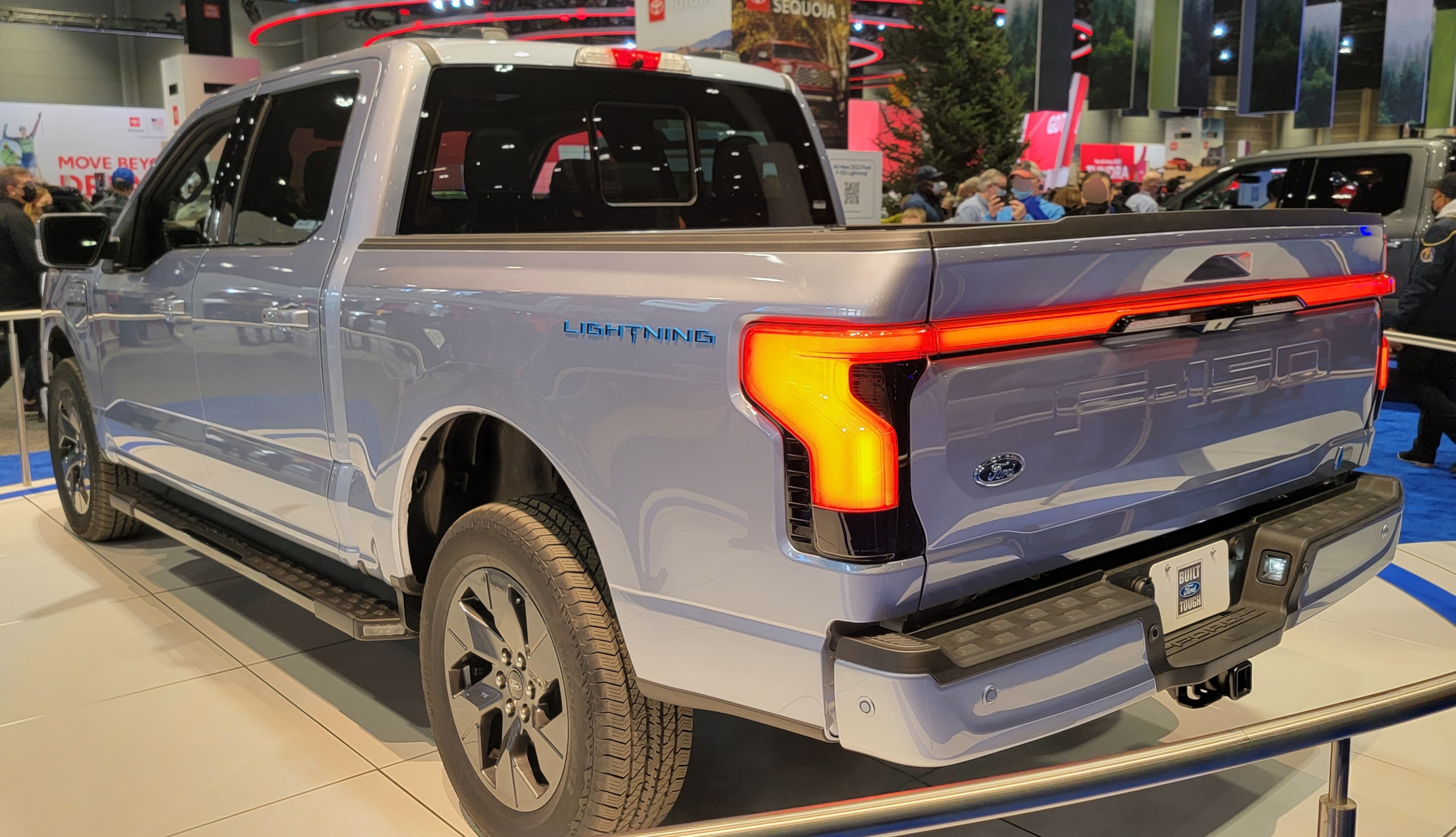
Ford F-150 Lightning
"...I really ought to sell it. It's a 94, a 94 F-150 Lightning. Like I said, I'm the second owner of it and had ..."
The Ford F-150 Lightning is an electric pickup truck. It’s meant for the same kind of everyday truck tasks, but it uses electricity instead of gasoline. If someone is selling one, details like how it’s been owned and maintained are important.
The Ford F-150 Lightning is an electric version of the F-150 pickup, combining truck utility with an all-electric drivetrain. It’s often discussed because it’s a practical way to use an EV in a truck format, and because ownership details—like battery condition, charging setup, and maintenance history—matter a lot. In the podcast context, it’s mentioned as a specific example of a Lightning being sold, including its ownership background and age.
suspension
"So I haven't found the way to get motivated to rip all the suspension off of it and kind of throw it back to stock so we can put it on marketplace..."
They’re talking about taking off the suspension parts. That usually means removing upgrades or changes so the Jeep (or truck) is back to how it came from the factory before selling.
“Rip all the suspension off” refers to removing suspension components—often to undo modifications or return the vehicle to stock before selling. For off-road rigs, suspension changes can affect ride quality, legality, and buyer appeal, so reverting to stock can make the sale easier.
throw it back to stock
"So I haven't found the way to get motivated to rip all the suspension off of it and kind of throw it back to stock so we can put it on marketplace..."
They mean putting the vehicle back to the original factory setup. That can help it sell faster because more people know what they’re getting.
“Throw it back to stock” means reversing aftermarket modifications and restoring factory configuration. In the used market, stock vehicles are often easier to price and attract more buyers because they’re less specialized and have fewer unknowns.
marketplace
"...so we can put it on marketplace and she can get what she can get for it."
They’re talking about selling the vehicle online through a local listing site. It’s a common way to reach people nearby who might be interested in a used off-road rig.
“Marketplace” refers to selling the vehicle through online classifieds (commonly Facebook Marketplace). For modified off-road vehicles, listing on marketplace can be a practical way to find local buyers who understand the vehicle’s intended use.
wheeling
"...it sounds like your Jeep is the first one you need to sell. And I'm saying that because you already have another Jeep. So and you're wheeling that more and you're using it more often..."
“Wheeling” means taking the vehicle off-road on trails and obstacles. If they’re using the Jeep for that more often, it’s harder to justify selling it.
“Wheeling” is off-road slang for driving a vehicle over trails and obstacles, typically in a controlled group setting. It implies the Jeep is being used for more demanding terrain than a daily commute, which affects whether it’s worth keeping versus selling.
bring it back to stock
"...I don't understand why you would take off the suspension parts and bring it back to stock. That was my question. Why don't you just sell it as is..."
They’re talking about returning a modified truck to its original factory configuration. The question is whether it’s better to sell it with the upgrades or spend time putting the original parts back on first.
“Bringing it back to stock” means removing aftermarket modifications (like suspension parts) and reinstalling the original factory components. The hosts debate whether it’s worth doing versus selling the vehicle as-is, factoring in labor time and how buyers value modified vs stock setups.
rear axle
"...and a 80 series rear axle, which is narrower than a lot of people want. And I said it was something like 600 dollars for the front axle... It was more or less, I'm like, you are taking the rear axle with you. I don't want it."
The rear axle is the main part that drives the rear wheels. If it’s the wrong width or you only sell part of what the buyer needs, it can be harder to sell or worth less.
A rear axle is the corresponding drivetrain component for the rear wheels, often including the differential and axle shafts depending on the vehicle. The discussion highlights how axle width and what’s included (rear axle vs front axle only) affects buyer demand and pricing.
front axle
"...I know that I sold a mini truck front axle and a 80 series rear axle... It was something like 600 dollars for the front axle..."
The front axle is the big assembly that helps the front wheels move and turn. If you’re selling one, people will want to know it matches their truck and isn’t worn out.
A front axle is the assembly that connects the front wheels to the steering and drivetrain. When selling or swapping axles, buyers care about width, condition, and compatibility with their setup.

80 series rear axle
"...I know that I sold a mini truck front axle and a 80 series rear axle, which is narrower than a lot of people want."
They’re talking about a Toyota Land Cruiser “80 series” rear axle. An axle is a big part of the truck’s drive system, and people pay attention to the exact version because it has to fit what they’re building.
“80 series” refers to the Toyota Land Cruiser 80-series generation. The rear axle is a major drivetrain component, and its width/fitment can matter a lot for buyers doing swaps or repairs.

Toyota A80
"more for the vehicle because it has those parts on it and maybe sell the stock parts with it or they come with it, you know, I know that I sold a mini truck front axle and a 80 series rear axle, which is narrower than a lot of people want. And I said it was something like 600 dollars for the"
The Toyota Supra is a sports car made for fast driving. People often modify them and may sell the car along with extra parts, so the listing can include more than just the vehicle itself. That can matter if you’re trying to understand what you’re getting.
The Toyota Supra is a performance sports car known for its strong aftermarket support and upgrade-friendly platform. In an off-road podcast context, it may come up because specific parts (or stock components) can be bundled with the vehicle when selling or building, which affects what’s included and what you’d need to source separately. That’s why it can be discussed alongside other vehicles where parts are sold with the car.
part out pieces of cars
"...I think that's a thing that a lot of people don't understand and realize when either flipping cars or trying to part out pieces of cars is the amount of time it takes to do that..."
“Parting out” is selling a vehicle’s components individually instead of selling the whole car/truck. The hosts emphasize the hidden cost: time—storing parts, waiting for buyers, and doing the labor to remove and sell items.
flipping cars
"...I think that's a thing that a lot of people don't understand and realize when either flipping cars or trying to part out pieces of cars is the amount of time it takes..."
“Flipping” refers to buying a vehicle, improving or changing it (sometimes including repairs or parting), then reselling it for profit. The segment frames flipping as a time-and-space problem, especially when modifications require extra work to undo or document.
sell assets to cover bills
"then yeah, you got, you got to sell assets. If you need quick cash to pay bills, cover stuff, whatever an emergency comes up, you got to sell assets in order to do that and make the, make the money work out."
If you need money fast, you might sell something you own—like a car—to get cash for bills. It’s basically turning your stuff into money.
Selling assets is a financial strategy where you convert something you own (like a vehicle) into cash to pay expenses. In car terms, it often means selling a vehicle you don’t drive to reduce ongoing costs and raise liquidity.
registration and insurance
"It's doesn't really ever get used and utilized. And I'm just paying registration and insurance on it every year."
Even if you don’t drive it much, you still usually have to pay to keep it legal (registration) and insured. If you’re not using it, those costs add up.
Registration and insurance are recurring costs you pay to legally operate and protect a vehicle. If a vehicle sits unused, these fixed costs can make it feel like a “dead” asset.
high boy
"Jason OCD just got a high boy. I don't know what those are. Really? He got a high boy clean inside and out for 60, 70,000 miles, original miles on it."
“High boy” usually means a truck or vehicle that sits higher than stock. It’s often the kind of setup people want for rough roads or off-roading.
“High boy” is commonly used in truck culture to describe a lifted or higher-clearance vehicle. In this context, Jason “just got a high boy,” implying a taller stance that’s often associated with off-road use.

Toyota 4Runner
"there's, you talked to Ryan. I'm after Ryan and he's always flipping second gen four runners. He's picking up four runners right now for under 500 bucks to part out, do whatever."
They’re talking about the Toyota 4Runner, a popular off-road SUV. They mention older “second gen” ones, which people often buy because parts are easier to find and the platform is well supported.
The Toyota 4Runner is a body-on-frame SUV known for off-road capability and a big aftermarket. The discussion references “second gen four runners,” which points to an older generation that many enthusiasts buy for parts or projects.
automotive interest rates
"I think that, you know, automotive interest rates right now on the automotive loans, you can't find an interest rate below 11%. Damn. Yeah. Which is brutal on a vehicle."
If car loan interest rates are high, the car costs more overall. That can make fewer people want to buy, which hurts used-car sales.
Higher auto loan interest rates increase the total cost of financing a vehicle, which can reduce demand and slow sales. When rates are high (the host cites around 11%), buyers become more price-sensitive and monthly payments rise.
prime rate
"Maybe. I mean, it might be high in general, but it, you know, 11% here might be 8% in Atlanta prime rate right now is 7%."
Prime rate is like a baseline interest rate banks start from. Your car loan rate is usually that baseline plus extra for the bank’s profit and risk.
The prime rate is a benchmark interest rate that banks use as a reference for setting other loan rates. The host’s point is that lenders typically add a margin on top of prime, so your auto loan rate ends up higher than the base benchmark.
ROI
"[1424.2s] have no use for it anymore, take the cash and put it into an investment of some kind, man. [1428.6s] ROI is your friend in my opinion. Yeah. So agreed."
ROI just means “how much you get back compared to what you put in.” They’re saying if you’re not getting much value from the vehicle, you might be better off investing the money instead.
ROI (return on investment) is a way to judge whether spending money on something will pay you back. In this segment, they’re applying it to vehicle-related decisions—like whether keeping a vehicle is actually worth it versus putting money elsewhere.
non-op
"[1436.0s] but not money losing in essence is just to put the vehicle on non-op and put it in the corner [1442.8s] of the yard or something, put a tarp over it or get a good cover and, you know, make sure that it's [1449.6s] winterized, let's say, and just let it sit there."
Non-op is basically putting your vehicle in a “not being driven” status. It can help you avoid some ongoing costs while the truck/SUV sits in the yard until you’re ready to use or sell it.
“Non-op” is a vehicle status (common in some states) that places a vehicle out of active operation, typically reducing or eliminating certain costs like registration and insurance while it’s stored. The hosts suggest using non-op to cut expenses when you’re not driving the vehicle and plan to sell later.
winterized
"[1442.8s] of the yard or something, put a tarp over it or get a good cover and, you know, make sure that it's [1449.6s] winterized, let's say, and just let it sit there."
Winterizing is what you do to keep a vehicle safe while it sits through cold weather. It helps prevent problems like freezing fluids or a dead battery.
Winterizing means preparing a vehicle for cold-weather storage so it doesn’t get damaged by freezing temperatures. In practice, it often includes protecting fluids, battery care, and covering the vehicle to reduce weather-related wear.
delayed tactic
"[1472.7s] So you don't have to worry about it too [1478.6s] much. So it's just another kind of delayed tactic. If you're not using the vehicle, just,"
They’re basically saying: don’t rush—wait. If selling is a bad deal right now, you can store the vehicle and keep costs down until you’re ready.
A “delayed tactic” here means postponing a decision (like selling or actively using the vehicle) to reduce costs and wait for conditions to improve. They connect it to the idea that the market may be unfavorable right now, so holding the vehicle can be financially smarter.
waterproof bag for your fluids
"One thing you waterproof bag for your fluids, that's super helpful because you can store your fluids in there in case they explode. It doesn't get everywhere. And then you can also use it as a drain pan."
If you’re carrying oil, coolant, or other liquids, a waterproof bag keeps them from making a mess if something spills. It can also help you catch fluid when you’re draining or cleaning up under the vehicle.
A waterproof bag for storing fluids helps keep liquids contained if a container leaks or ruptures. It also gives you a practical way to catch drips or use the bag as a temporary drain pan during maintenance.
drain pan
"And then you can also use it as a drain pan. If you need to drain out fluids or something like that, you have a bag to kind of like store that fluid in there without it going everywhere or all on the trail."
A drain pan is a container used to collect fluids when you drain them from a vehicle. In off-road or trail-side situations, having a drain pan (or a bag that can act like one) prevents spills on the ground and makes cleanup easier.
recovery shackles
"...it's not like recovery shackles or something like that where I'm using it on like a daily basis."
Recovery shackles are strong metal links used to connect your recovery gear to the car or to a tow point. You keep them easy to grab because you might need them quickly if you get stuck.
Recovery shackles are heavy-duty connectors used in vehicle recovery to link tow straps, recovery ropes, or winch lines to anchor points. They’re typically kept accessible because they’re needed when you’re stuck and need to get the vehicle out safely.
Bobcat
"I just put that city, city, yo crate in the back of Bobcat, right? And it's waterproof and I have all the fluids in it..."
Bobcat makes heavy-duty equipment, and the speaker is using a Bobcat-style crate as a tough container. The takeaway is that you can use rugged storage to keep fluids organized and contained.
Bobcat is a well-known manufacturer of compact construction equipment, and the speaker is using a Bobcat crate as a waterproof, modular container for fluids. The point is about repurposing rugged equipment storage to solve off-road maintenance and spill-containment problems.
recovery gear
"...your recovery gear should be one of the first things that you should be able to grab. So that's a great point as well."
Recovery gear is the stuff you use to get your vehicle unstuck, like towing and winching tools. The key idea here is to keep it where you can grab it fast.
Recovery gear refers to the tools and hardware used to extract a vehicle when it’s stuck—commonly including items like shackles, straps, and winch-related components. The episode emphasizes organizing it so it’s among the first items you can reach.
tool drawers
"And somebody was asking for pictures of how people store tools in their, their tool drawers. Yeah. And there, there's some really cool 3D print organizational"
Tool drawers are the drawers where you keep your tools. How they’re divided—like whether sections are fixed or movable—changes how easy it is to stay organized.
“Tool drawers” refers to the drawers in a garage workbench or tool cabinet used to store hand tools and small parts. The way drawers are divided (fixed vs movable dividers) strongly affects how quickly you can find tools and how well the drawer stays organized.
3D print organizational stuff
"And there, there's some really cool 3D print organizational stuff. After I kind of said that on the Discord, I went and actually like looked through."
They’re talking about using 3D printing to make custom organizers. Instead of buying generic storage, you can print pieces that fit your tools and drawers.
The host mentions “3D print organizational stuff,” meaning organizers made with 3D printing to fit specific tools or drawer layouts. This is a DIY approach that can create custom compartments when off-the-shelf organizers don’t match your exact tool sizes.
infinity grid
"I've seen some really neat things lately of people, how they're like, they design these little like grids, almost Legos. Yeah. It's called infinity grid."
“Infinity grid” is a modular organizer system. You can rearrange the pieces to make different-sized sections for different tools.
The “infinity grid” is a modular grid system for organizing tools, where you can configure different insert sizes and layouts. It’s designed so you can build custom compartments—deep, shallow, or long—by mixing standardized grid modules.
Gear Inch
"I have a really cool work bench tool storage. Thing from gear inch that has, it's the big, it's a big drawer."
They’re talking about a tool-storage product made by a company called Gear Inch. Different brands make drawer organizers that work a little differently, especially how you can rearrange the inside.
“Gear Inch” appears to be the brand/company the host’s workbench tool storage system came from. Tool-storage brands matter because drawer systems differ in how modular the dividers and pockets are.
dividers
"And then it's very, it's quite deep. Let's say it's two feet deep and it's got two dividers in it. And then it has pockets that you can sort of, or like dividers within that."
Dividers are the walls inside a drawer that split it into sections. If some dividers can move, you can change the drawer layout to fit different tools.
Dividers are internal partitions inside a drawer or organizer that create separate compartments. In this setup, some dividers are fixed (stationary) while others are movable, letting the user reconfigure the drawer into different pocket counts and layouts.
O-rings
"I carry extra O-rings that go into the differential. I also, anytime I pull the diff out, I don't give a shit if it's six months later, I change all the O-rings in it."
O-rings are small rubber seals that keep oil or air from leaking out. The speaker replaces them proactively because it’s an easy way to prevent leaks later.
O-rings are sealing rings used to prevent fluid/air leaks at joints and fittings. Here, the speaker carries extra O-rings for the differential and replaces them every time they pull the diff to avoid leaks.
ARB
"So ARB are my go-to. You can get parts. Don't give you any little part you need. I carry extra O-rings that go into the differential."
ARB makes popular off-road gear for 4x4s, especially lockers and air-related parts. The host likes it because replacement parts are available and they’ve had good luck with leaks and reliability.
ARB is an off-road parts brand known for lockers, air systems, and related hardware used on 4x4s. In this segment, the speaker says ARB is their go-to because it’s easy to source parts and they rely on ARB components for differential/locker service.
differential
"I carry extra O-rings that go into the differential. I also, anytime I pull the diff out, I don't give a shit if it's six months later, I change all the O-rings in it."
A differential is the part that helps your axle’s wheels turn at different speeds, like when you’re turning. If you’re installing lockers, you often have to open up the differential and keep it sealed so it doesn’t leak.
The differential is the gear assembly that allows the wheels on an axle to rotate at different speeds while still transmitting power. The speaker is talking about differential service and sealing (O-rings) when installing or maintaining locker-related components.
3AN stainless lines
"I carry is I run 3AN stainless lines, call my AirBs, and they make that kit now that you can retrofit all that to 3AN."
AN lines are aftermarket hoses and fittings that come in standardized sizes. Using stainless 3AN lines is a way to route air/pressure cleanly for an off-road locker system.
AN (Army/Navy) is a standardized fitting and hose sizing system commonly used in performance and off-road plumbing. The speaker runs 3AN stainless lines for their ARB air/locker setup and mentions a retrofit kit to adapt the system to that line size.
solenoids
"The reason I carry that is if one of the solenoids takes the crap up by the compressor, I can tee off both lockers to one solenoid."
A solenoid is an electrically controlled switch for air/pressure. In locker systems, it decides when the locker engages by letting the right pressure go to the right place.
A solenoid is an electrically controlled valve that directs air/pressure to operate lockers. The speaker carries a small part (a tee/adapter) so if a solenoid fails or is compromised, they can route control to engage lockers more reliably.
ohm value
"...check for resistance. It should have two, three ohms, one ohm of resistance in"
Ohms are a way to measure electrical resistance. If the locker coil’s resistance is way off, it can mean the coil or wiring has a problem.
An ohm value is a resistance measurement in electrical circuits. The speaker says the E-locker coil should read a specific resistance range (e.g., a couple ohms) when measured with a multimeter, which helps confirm the coil isn’t open or shorted.
digital multimeter
"If you get an open or infinite signal on your digital multimeter, that means the wire is burned up on the coil on the locker."
A digital multimeter is an electrical testing tool. It can tell you if a wire is broken (no continuity), if you have power (like 12 volts), and if a connection is making good contact.
A digital multimeter (DMM) is a test tool used to measure electrical voltage, resistance, and continuity. In this segment, it’s used to check for open circuits (burned wires) and to verify grounds and switch wiring.
continuity
"That's a good way to troubleshoot that you've got continuity going around that E-locker."
Continuity means “can current pass through this wire or connection?” If the meter shows no continuity, something in that path is broken or not connected.
Continuity testing checks whether electricity can flow through a circuit path. If the multimeter shows an open/infinite reading, it indicates a broken wire, failed switch, or blown fuse in the circuit.
coil
"...that means the wire is burned up on the coil on the locker."
The coil is like an electrical “magnet” part that helps move/actuate the locker. If the coil wire is broken, the locker can’t get the electrical signal it needs.
The coil is an electrically energized component inside the locker system that helps actuate the locking mechanism. An open/infinite multimeter reading suggests the coil’s wire is burned or broken, preventing the locker from operating.
12 volts
"...first thing I check is with the switch on, do I have 12 volts at the plug from the chassis?"
They’re checking whether the locker control is getting power from the truck. If there’s no 12 volts at the connector, the problem is usually in the wiring, fuse, or switch before the locker itself.
The segment uses “12 volts” as the expected power supply to the E-locker switch/plug from the vehicle’s chassis wiring. If 12V is missing at the plug, the fault is likely upstream (wiring, fuse, or switch).
ground
"I check the other prongs. Do I have a ground to check for my multimeter with continuity between that pin and the chassis somewhere?"
A ground is the “return” connection that lets electricity complete the circuit. If the ground is bad, the locker won’t work even if power is present.
A ground is the electrical return path that completes the circuit. The host checks for continuity between a pin and the chassis and expects a low resistance reading (a few ohms), which indicates the ground connection is intact.
fuse
"...or your switch is bad or your fuse is popped up on the chassis."
A fuse is a safety device that stops electrical power if something is wrong. If it’s blown, the locker won’t get power until the fuse (and the underlying issue) is fixed.
A fuse protects the locker’s electrical circuit by breaking power if there’s an overload or short. The host includes a fuse check as part of diagnosing why the system may have no power or no continuity.
E-locker
"...then that E-locker won't work. It'll just pop to use this because it's a short. Or if it's in the middle of the coil wire... But then the E-locker won't work because there's not enough current to pull the electromagnet..."
An E-locker is a switchable “lock” inside the differential that helps both wheels work together when traction is low. It’s controlled by electricity, so if the wiring or ground isn’t right, it won’t lock.
An E-locker is an electronically controlled locking differential (often used in off-road axles) that uses an electromagnet/solenoid to engage a lock. When wiring has a short, open circuit, or poor grounding, the electromagnet may not pull strongly enough to lock the differential.
third
"...if you wanted to pull the cover or pull the third, but I wouldn't do that."
“Third” is common off-road shorthand for the third member of the axle assembly, which houses the differential and related gearing. The host suggests you could access internal connections by pulling the third, but recommends against it as a first troubleshooting step.
electromagnet
"...That little solenoid is the same type of electromagnet that is in an E-locker. So it's the same troubleshooting would work. Do I have 12 volts? Do I have ground?"
An electromagnet is a magnet that only works when electricity flows through a coil. If the wiring problem prevents enough current from flowing, it won’t “pull” to lock the differential.
An electromagnet is a magnet created by running current through a coil of wire. The host ties this directly to E-locker operation: if the circuit has a short, poor grounding, or insufficient current, the electromagnet won’t generate enough force to engage the lock.
Land Rovers
"I know Don, some of those guys that run Land Rovers are going to struggle with that."
The host mentions Land Rover owners as an example group who might struggle with the E-locker troubleshooting steps. This is relevant because Land Rover off-road platforms often use electronically controlled locking differentials that can have similar wiring/ground failure modes.
Request an Explanation
Heard something you'd like explained? We'll add it to this episode.
Sign in to request explanations for terms you heard.
Want to learn more?
Browse our glossary for plain-English explanations of automotive terms, jargon, and concepts.
Help improve this episode
See something that's not quite right? Our annotations are AI-generated and can sometimes miss the mark. Click the flag icon on any annotation to suggest a correction.