A 3 wheeler is a vehicle that has three wheels instead of four, often used for off-road riding. Because it has a different shape and balance than a normal ATV or car, it can be easier to tip over if you don’t ride carefully. The podcast mentions it in connection with safety and training because people were getting hurt.
Car
Yamaha Tenere
The Yamaha Tenere is a type of adventure motorcycle built for long rides and rough roads. Here, it’s the bike the rider is planning to use for a special anniversary ride.
Full throttle means the rider is giving the engine as much power as possible. Here, they’re using maximum power for most of the straight before backing off for turns.
Drifting is when you steer so the bike goes through the corner at an angle instead of straight up and down. It takes skill to keep it controlled while sliding.
Stag pegs are extra foot pegs you can mount on a dirt bike. They help you rest your weight with your feet instead of hanging on with your arms, which makes long or rough rides easier on your back.
A cylinder head is the part on top of the engine where air and fuel enter and exhaust exits. “Cross-flow” means the intake and exhaust paths are arranged to flow more efficiently, which can help the engine perform better.
Independent front suspension lets the left and right front wheels react to bumps separately. That usually helps the car stay more stable and keep better tire contact on rough or uneven track surfaces.
Term
cylinder heads injection
This sounds like a racing fuel system upgrade tied to the engine’s cylinder heads. The idea is to get the right amount of fuel into the engine more precisely for better performance.
Paddle shifters are little levers behind the steering wheel. They let you change gears without moving a gear stick, which can help you shift quickly while driving.
Hollinger gearboxes are race-focused transmissions. They use closely spaced gears, which can keep the engine in the “right” rev range, but they also demand more precise driving.
The “gates” are the shift positions in the gearbox that tell you where each gear is. If they’re close together, it’s easier to grab the wrong one, so you have to be more careful.
Term
Supercross Masters
“Supercross Masters” is a supercross competition for a specific group of riders—often more experienced. It’s still the same kind of off-road motorcycle racing, but organized as a separate class/event.
Sprint car racing is a type of open-wheel race run on short tracks, often ovals. The cars are designed to be fast through lots of corners, and the racing schedule can involve many different tracks.
Valvoline is a company that makes car oils and lubricants. They also sponsor racing teams, which helps them get their brand seen while the team uses their products.
The Ford Bronco is a type of SUV designed for driving on rough roads and off-road trails. In the podcast, it’s brought up because the engine setup used a lot of fuel. That means it could be more expensive to run than you might expect.
Horsepower is a measure of how much power the engine makes. More horsepower usually helps the car accelerate faster and go quicker.
LIVE
A Listener production.
Good day everybody, Rusty here, all set for part two of my feature episode with Stephen Gawle.
If you've arrived here without cutting a full lap of part one,
you really need to do yourself a favor and check that out first,
from paddock bashing with his brother in makeshift carts and on foldout bikes
before getting his hands on that first proper dirt bike
that would set him on the pathway to Mr. Motocross success.
How his dad wasn't keen on him going racing early on.
A brief stint working around cars once school had wrapped up
and then total immersion in motorsport where he gets that trademark deep commitment from.
Some of the names that inspired on a trip to see the internationals at Oren Park
and the great battles that he had with the likes of Anthony Gunter
and witnessing the arrivals of Craig Dak and Jeff Leeske.
There's lots of great stuff here in part two including a little known supercars test
and we focus on his excellent training models or programs too.
Before we get back into it, a reminder about Gawle's excellent new book,
The Stephen Gawle Story, No Easy Way.
There is a link in the app description or you can simply go to
knoweasyway or oneword.com.au
Off we go with part two now.
Tell me about the light bulb moment for Academy then,
for schooling, for teaching and all that sort of stuff.
Was there a moment where you did something when you realized,
A, the beauty in that, how much you loved and enjoyed it
and how you wanted to embark on a bit of that?
Well, as I said before, I just love to see people do better with some help
and right from the, when I started my career in 77, 78,
I started teaching at Hungry Creek
and I just really enjoyed seeing the young kids go faster
and talk to you and respect you for your helping them.
So that carried on from 77 right through to 2003
because the last 15 years I traveled to Australia
teaching the Academy of Off-Road Writing with Yamaha
and many other sponsors.
And there was no real light bulb moment.
It was just enjoyment of seeing young people enjoy their sport
and of course when I got to a certain point with my racing
where I wasn't making enough money and I had an overdraft
and I had two kids look after, they had to be fed,
that was my job.
I knew to do that job so I was out there coaching.
My wife was handling the entries back at home
with a new brace business, with two kids.
Like I say to people, you're never going to be very successful
if you don't have a good team around you.
And through all of my career, no matter what I've done,
I've had good teams around me.
Whether it's Dean and our helpers with Speedway,
whether it's my wife for many years with being a team there,
with my motor cross racing, have a good team
of mechanics and support there.
If you don't have a team, you can't do it yourself.
Did that evolve some of the, you know, as you go,
not just maybe from a riding and a technique perspective,
does it evolve around mindset?
Does it evolve around dietary stuff?
How did the courses kind of evolve
and the teachings evolve over time?
Yeah, good question.
I certainly was a man before my time
when it come to the curriculum of the schools
because I could see that we had to teach kids off the track
with certain techniques to help them on the track.
So we would do balance exercise.
We do front brake skids.
We do front brake stoppies.
We do circles for lock.
And a lot of that was taught to me,
which I wish was across Australia now,
at the Illawarra Mini Bike Club.
And I did that stuff.
There was no racing.
There was slow riding.
There was flag bending.
There was hill climbing.
There was who could wheelie the longest.
All these basic skill techniques that mini bike
or that type of mini bike activity
is still very, very active in New South Wales.
Not much in Queensland.
Not much in Victoria.
Nothing in WA.
Nothing in South Australia.
And yet so beneficial.
So beneficial.
I'd really love to see that happen
as there were a few other goals in my life,
but maybe we'll talk about that a little bit later.
In time.
So I'm glad you brought up Illawarra there a moment ago.
In the book, you must get it.
You must get the book.
And I'll tell you more about it at the end.
There's a great photo.
I think Sir Jack Brabham turned up one day.
Didn't he?
You were very young.
I mean, the Formula One legend turned up.
Awesome.
From the academy side of things
and the connection with Yamaha
and the enjoyment of training, if you will,
there evolves an extension in this
because I think in the early sort of foray with ATVs,
Yamaha realized the need for safety
and rural environments and things like that.
And you became involved with them
around that sort of tuition too, didn't you?
Yeah, exactly.
Steve Cottrell again bought me into when I handed,
when I got out of the academy training,
I sold that business to Lyndon Heffernan,
who was my head coach for many, many years.
A great guy really knew what he was doing.
So he took that on board.
And Steve Cottrell said,
look, we've got a lot of dangerous activities
with four wheelers in Australia.
There's a lot of people getting hurt.
There's legal cases left, right and center.
So he sent me to America to become a coach with the SVIA,
which is the Specialty Vehicle Institute of America.
And they have ATV training.
Because in the 90s, when there was three wheelers,
people were dying all the time.
And the government said to the American motorcycle industry,
if you don't bring coaching and training in,
we're going to and change the design of these things.
That's why they went from three wheels to four wheels
to make them safer.
But then they'd put kids on them.
They didn't realize they had to be right or active
and shift your body weight around the wheels on the ground.
So I became an instructor.
Then I went back and become the chief instructor,
both in ATV and motorcycle racing with the SVIA
and bought that skill back to Australia to travel Australia
doing seminars at all the farm shows.
So I'd ride around on the ATV with a microphone on my mouth
and talk to people, loudspeakers.
So I did that up to 17 farm shows for a couple of years.
I got a little bit bored with it after a while.
That's why I finished up going to America to train Michael Boone
when he asked me to go across there.
But yeah, Yamaha believed in me to do all that.
And Rodney Jenner, who was another coach,
he went on to carry on to become a chief instructor
and to carry those farm show exhibitions on after I left
when I went to America.
So something to Yamaha again, there before their time,
they started doing that years ago to help safety,
to help the sport, not only in racing,
but in just safety with the farmers.
In daily life.
Before Speedway, what was it like framing the decision
to end kind of professional bike racing for you?
When did that decision come in?
You're still riding now.
I mean, you talked about that at the beginning today,
which I think is tremendous.
But from the professional side,
stopping that, how difficult was that?
What tell me about that process?
I think it was 86.
I unfortunately tore my other ACL and my right leg
at Tony Hatton's place,
testing a week away from the Mr. Motocross first round.
So I went to the first round and I got a whole shot
in the second motor, I think, and I was leading it.
I thought I can go out with a win here maybe
because I was thinking about ending my career.
And then I tore the knee up again,
and that was it for the day.
So I really at that stage, I saw that the end was near.
And that's why then I changed from doing racing to schooling
to jump the fence, so to speak,
and go to work and earn a living.
And that was the moment that I realized
when I tore that knee up on the other side
and I knew how long it would take to come good.
That year wasn't going to work well for me.
But I came back after that a few supercrosses.
You know, in 87, I finished second to James Deacon
at the Sydney Entertainment Center at a supercross.
So I was still having a go.
I won the 86 Fink Desert Race with the knee.
You didn't have to put your leg out on the ground
for the Desert Race.
So it slowed me up a little bit in motocross,
but I still did some other things.
Excellent.
Tell me about Fink.
I've covered that a few times for broadcast.
200 plus Ks from Alice Springs to Apertula.
Camp the night there.
Turn around from Fink and head back to Alice
all over the King's birthday weekend.
Iconic race mate.
It really is.
And it's a crazy race too.
It really is.
This year's the 50th anniversary of it,
which I'm going to ride the adventure bike out.
I'm going to ride the Yamaha Tenere out with two other winners,
David Armstrong and Alan Rowe from the same era that we won.
Excellent.
And when I first went there, let me tell you this story.
I first went there the first year,
invited out by Damien Rine and Eddie Bordesira
had a Yamaha for me all set up.
And in those days, it was down the service track.
Have you been there?
Yes, I have.
Well, the service track that you drive the car down,
that was the race track.
Race track.
OK.
I know it will.
It's as wide as a road race track and sometimes wider.
And we'll do a Le Mans start onto the track
and then two corners in 66 kilometres,
you backed out a full throttle.
So you're doing 160 to 170 the whole way down there.
Two corners, you roll off a little bit and back on again.
You're drifting through these corners.
We didn't have any nose protection.
So any little bit of sand coming off another bike,
you'd be dodging the roost.
It was just crazy.
I still remember it.
It was one of the iconic things that I did back in the day.
And I seized the bike one year going down there.
But yeah, just a crazy race.
And I get people nowadays say to me,
I want to do the thing.
And I say, really?
You really want to do the thing?
I said, do you know how hard it is?
I said, did you start training a year ago for it?
And more and more.
It's really tough.
It's really tough.
Very hard on the lower back.
But now they've got something called stag pegs.
They go on to the bike.
And people's rear of the boot can sit in the stag pegs
and take so much load off the arms and the lower back.
They really are helpful.
If you don't have theirs at think, you're going to suffer.
Yeah, definitely.
But it's a dodgy race.
I did it seven times or something.
But the last time I did it was when I had a really bad concussion.
I was trying to pass Kim Ashkenazi and got in bull dust.
I didn't see a washout outside of the track
because I just couldn't see it.
I was doing about 80 mile an hour, about 140 at the time.
And I hit this washout.
And a year later, there was an impression in this area
where I hit it because the water hadn't eroded.
It doesn't rain too much out there.
And lately it has.
But there was an impression.
The bike went 90 metres.
I went 60 metres.
But would you believe, I did not put a mark on my helmet.
So I flicked through the air.
Sailing through the air, mate.
60 metres I went and the bike went 90.
If I could have, I could have picked the bike up and kept racing.
But it wasn't that badly bent.
So I went wheel to wheel through the scrub, so to speak.
But that was the first time and still today I've ever been in an ambulance.
Really?
Yeah.
I got taken back to Alice Springs in Emmits.
But I got concussed because my brain was flicked in my head so badly.
Right.
And recently I've had neck surgery.
Oh yeah.
I've had three vertebrae fused by a legend surgeon here on the Gold Coast.
Matthew Scott Young is a war-renowned surgeon.
Surgeon, yeah.
He goes in the front, pushes the trachea and the suffix to the side.
He plated the tree and put a hybrid disc in one.
And that was a big sprint car crash at Grandville.
You saw this in your time.
But I managed to ride a right rear wheel of a slower car once,
being silly trying to set a track record on a heat raise.
And I finished up jumping from his right rear into the tyres on the pit wall.
And it come to a stop again at about 80, 140.
And that had no Hans neck devices.
Back then, yeah.
It was just a foam collar.
So those two incidents really set sail to my needing this neck surgery recently.
Yeah, okay.
You've taken us to Speedway, which I'm so pleased that you have.
And firstly, we share a little common family love of Sydney Showground.
My folks took me there before I could even walk, mate.
So I know why the Gaul family hold it in such high regard, right?
But my vivid memories are at paramatter of you and other tracks too,
but mainly paramatter.
Firstly, speed cars or midgets.
I can't ride.
I can't drive like you.
But I've been allowed the chance to drive two midgets.
I can vividly recall my father watching me do it this particular night
because he loved them ever since he was knee high.
And just practice nights.
I love those things, mate.
They're unbelievably cool.
You win a title in 87, 88 in that damn thing.
What was the move like, firstly, into Speedway?
The planning around that?
The learnings around that?
What made you hit the go button on that?
Mainly because Dean had a bad accident in Mount Kembley.
And Dean was, well, Phil Golding was with him.
He was one of our sprint car crew.
But Dean couldn't afford to be away from work.
He had money, had the pay, had overdrafts and things like that.
So he said, Steven, he said, do you want to have a drive?
And I went, oh yeah, why not?
It's like a big go-kart, isn't it?
I'll have a go at that.
So Dean had an autographed midget and it was a really good car at the time.
And when we won that Australian title, that was Dean's own car design.
He designed that chassis.
How special.
Yeah, he's very, very smart with all that stuff.
And he may not, and he still could drive too.
But he just, he did, he had a lightweight Mini Cooper S before that,
cross-flow heads, developed full independent front suspension on it,
was winning those races before he went to Speedway,
which was done by Howard Ravel, who was a legend back in the days.
And then Dean got into the dirt and then he got me into it.
And so that was the start.
And then in the midget, we just did well, you know,
like Dean would set the car up really, really well.
And again, I said to you before, without a team, you're nothing.
Nothing, yeah, yeah.
And Dean had the car really nicely set up.
We had good equipment.
Every time I went to America in the early 80s,
I'd come back with a whole package of cylinder heads injection,
all the time where you could put that into your bags, you know.
You get to the airport at LAX.
You got a lot of carry on, Mr. Gore.
Yeah, and you bribed the guy behind the counter.
I bribed a couple of times, a black dude at the front, you know,
one of the Negro guys at the front.
It was the baggage handlers that, hey, buddy, can you get this on?
It's a little bit overweight.
Sure, bro.
Give him a hundred.
No worries.
So back in the day where you could do that, you can't do it these days.
But anyway, I bought so much stuff back.
But yeah, it was great career.
Midgets were good.
Then Sid Moore, he gave me a drive in Melinda's Sprint car.
I got out of that.
I can still remember this.
I got out of the Sprint car after that race.
I don't know where I finished or what I did, but I got out of it.
I went, Dean, we need to do this.
This is just so much fun.
When you're talking the powder ratio of those things, and I know a lot of the touring guys,
touring car guys, the super car, they're scared to get in those things.
And because Gardner and Crompo did one night, I think, down there when you guys were in that
year or something.
Yeah, well, back that night, I started that.
I went to the promoter, Dave Lander at the time, and said,
why don't you bring a couple of the motorcycle heroes?
I know them all.
I'll get doing a Gardner and Lisky and Dak and have a little bit of a mattress.
Awesome.
And that's what got those guys into it.
Then Wayne enjoyed it.
So he drove our car a little bit.
And that led me to having a drive his Coca-Cola car.
Maybe we'll come back to that in a second with touring cars.
And yeah, they really enjoyed it.
But it was, yeah, Wayne did pretty good.
Didn't set the world on fire.
But then you don't, in anything you first get into.
And that leads me to when I got into his touring car at Orham Park, short circuit.
They say jokingly to me at the start.
If you can do the same times as Wayne, you might get a drive in this thing.
And I just want to get round the track.
And in those days, the guys, I watch it these days a lot.
And again, I watch it with some respect.
Yes.
Like I'm not trying to be cheeky here, but they've got an easy paddle shifters.
Back in those days, those boys had those Hollinger gearboxes
that the gates were really, really close.
And it was difficult to drive.
And of course you got used to it.
But I got into this thing and never driven one of these things before.
The Hollinger gearbox, I was more worried about the gearbox and steering the thing.
I got within about a second of a good time.
That's pretty reasonable.
So I was okay.
And I know Dick Johnson was looking at me at summer stage
because I had a year in a BMW Group E car supplied by Phillip Christensen.
And they had a Speedway Magazine, Phillip Christo,
who did Supercross Masters for me many years.
And that's something I should have chased too, but I didn't
because it wasn't dirty enough, I suppose.
But the Sprint car thing, you do chase significantly.
Yeah.
Well, again, because Dean really loved it
and that we had a great crew of Phil Golding and Rick Spence
and all the boys around us, they loved it.
And they were prepared to help us do a lot of the work, which I wasn't.
I was the great sponsor getter, the cleaner.
Valvoline, I think back then.
They were one of our big sponsors, Valvoline.
And Petters came on board when Dean was the Petters franchise.
Excellent.
So all that helped and all the money we made, we put back into it.
But, you know, we have regrets.
And one of my regrets with Sprint car racing
is that I didn't chase enough racing on a variety of tracks.
And that was the reason because we both had businesses.
Dean just had a Bronco with a motor
that sucked the juice like crazy.
We did the World Sprint Car Series one year
from Perth around the country.
And it was just too hard to fit into our lifestyle
with raising a family and everything else.
And we just after doing years of sacrificing the family,
I wasn't prepared to continually do that to my family.
So that's why we chased it at Grandville and Newcastle.
But we didn't go further afield too much.
And, you know, I know I could have done better
in the Sprint cars than I did.
But, you know, a fifth and almost a third
in the Australian Championship
when I got taken out in the last corner one year.
We won't mention the person's name,
but he said to me,
oh, that was a legitimate oof golly.
Everyone does that.
But I say at 80 mile an hour,
a metre and a half off the fence on the cush
and you're not focusing on what's coming up on your left.
And the slide job wasn't done much back in those days.
Hardly at all in the late 80s.
And yet this thing comes up underneath me,
wipes me out, puts me into the wall,
tears the front off the car
within nearly spitting distance of the checkered flag.
And the way the officials handled that situation
just left an eye with their mouths open.
We went, you know what?
We're not going to chase this anymore.
I did one more year of it and I went, nah, I'm out.
So I lost the love because of the way it was handled.
Really? Yeah, I did.
But I love racing those cars.
I got into Todd Kelly's car over 20 years later.
Did you?
Yeah.
No, sorry, 10 years later up at Archerfield.
And when it was a 410 instead of the 387 cubic inch
and with a wall on the outside of Archerfield
with a 410, 950, 60 horsepower,
you had to give that thing a lot of respect.
Anyway, that night I had a competitive lap time 10 years later.
You know, I still felt really, really cool in the car.
You know, I got out and Todd went,
looked like it was just yesterday, got out of it, Stephen.
So I was really pleased that I could do well from that time.
And I'd love to be in one now to tell you the truth.
But I haven't got that sort of money nowadays.
It is very, very expensive, like every motor racing.
Earlier in this chat Rusty and Stephen spoke about Jeff Leeske,
who came on for a feature episode back in 2021.
He's made the successful transition
from racing to industry management roles.
But there were learnings along the way.
Jeff has worked in senior positions at KTM and Husqvarna.
Nowadays he has his own Leeske Moto Imports
looking after legendary brands like BSA.
The reflections of his own racing career
are candid and captivating too.
A lot like this episode with Stephen Goall.
Back to the Convo now.
The book talks about, you know,
stopping professional racing however many decades ago it was, mate.
Was that difficult?
I mean, you light up with some of these stories
that you're telling me here now, how much you enjoyed and so on.
Was it a conscious decision to stop doing that stuff?
How tough was that to make?
Because it had been, other than the job at BMC and Jaguar there
that you talked about, it had been your life?
It was my life, yeah.
Motor racing across the board was my life.
And I think it was only because of family pressures
that I had to keep, you know, earning enough money
to keep the wolves from the door, so to speak.
That's pressure on yourself though too, isn't it?
You're wanting to do that.
Not necessarily what you're describing around
what your wife might be expecting per se.
That's the way you're...
Yeah, I'm thinking and of course, you know,
Gay was suggesting that we're going to maybe get serious
her life a little bit more.
And I took on the knee brace distribution
with the CDI knee braces out of America,
which gave the family amazing opportunities
to travel to America many, many times
and experience some really good trips over there.
So it wasn't all bad, but I did so many years of it.
It was sort of the natural thing to move on, I think.
You brought up a bit of coaching there before.
Can we...
And going to the States to help the likes of Matt Milladden
and so on.
What transpires there?
You're getting a call from Peter Doyle
or something or how did the connection come about there
in that sense?
Well, the initial reason why going to America to train
was a phone call from Michael Byrne,
who's over there training the Lawrence brothers at the moment
amongst others like Johnny Omara.
And Byrne rang me up and said,
I've got a factory Kawasaki contract.
I need some help.
He said, I really believe in you, Steven.
You helped me from a very early age.
I taught him up at Claremont in Central Queensland,
a mining town up there a long time ago.
And he said, would you come over and spend some time with me?
And at that stage, I could only do three months at a time
with the visas that was available.
So I spent the first year at three months,
came back for a week or two, then went across again
and blah, blah, blah, got through the year.
I did that for free.
Didn't charge any money.
What was Bernard, what was Bernard like, mate?
Because I have memories of him around kind of
the Chad Reed era and things like that.
What was he like to work with?
Oh, a great guy.
We got on really, really well heaps of natural ability.
Maybe not the same want that I could see
that I wanted out of him.
And unfortunately, it worked out
there was a little bit fragile.
When I say fragile, he got hurt easily when he fell off.
Now, whether you deem that as bad luck
or he was a bit fragile,
because some people seem to roll with the punches.
Like I've had a lot of bad crashes in my time
and I've rolled out of most of them
and stood up and walked away when I asked another one of those.
But some people don't.
They hit the ground and they don't know how to fall.
But anyway, Bernard was a little bit that way.
So that led me into it.
And I was with Bernard for a couple of years.
And then I'm of course at the Kawasaki factory practice track
on the edge of the 15 freeway down to San Diego
and James Stuart is in the same team.
So James is at the track and he sees what I'm doing with Michael
as far as breaking the track down with lap times
and lines and walking things and repetitiously doing things
and probably overhearing some of my talk
because you're in the same sort of area.
And this is the time where unfortunately,
Michael broke a ligament in his thumb,
missed two months,
missed making any points in the outdoors.
They put him off Kawasaki,
put him off and put someone else on.
I think it was Tim Ferry that replaced him.
And he, I could see no future with him anymore, unfortunately.
So this, this didn't happen at that time.
But James before, just before that said,
oh, Steven, would you be interested in coaching me next year?
And I was blown away.
Help, that's hell of a feather.
Like this guy is the one of the best in America
with Ricky Carmichael and he's asked me to train him.
And I'm like, wow, that's special.
And that's really, really nice.
And then Michael Singh come up and I went,
oh, okay.
So I have got a future here.
And then a couple of weeks later, Matt,
my laden rings me up and Matt goes, oh, Steven.
He said, my regular guy, Marty Kragels,
going back to Australia, he said,
would you join me to help me train and help motivate me?
And I went, oh, God,
I've got the best super bike race in America
and the best super cross racer arguably in America
asked me to train them.
This is unbelievable.
And it really took me back.
And I, what am I going to do?
So I thought about a lot.
I talked to Goat Breaker, was a good mate.
And Goat says, why don't you do both of them?
Yeah.
And I went, oh yeah, okay.
But to my disadvantage, it was my fault
that both of those fell in a hole.
I should have concentrated on one, not the other.
Again, spreading your wings too widely
is a problem that we have in life.
A lot of us get too greedy.
And it wasn't about the money being greedy.
It was about me taking on these notable people
and not trying to train them.
And we come up with all sorts of special things with Bubba
because Bubba wasn't that fit.
Although on a motorcycle, he was so efficient,
just like Toby Price.
He's another example of someone being extremely efficient
on the bike and doesn't need a lot of training
to get the job done.
Well, James was the same.
We put him through a beep test.
Do you know what a beep test is?
Where they run back and forth 20 meters to a degree of music
and they've got to keep up with the beep?
Well, he did 9.2 level, which is really poor.
Really poor.
And I was in my 50s, I was running 11.1 or something
at that stage.
9.2, anyway, we developed a training program
that would suit him.
But then going back, I probably should have concentrated
on just him and do what I know best.
And that's dirt bikes, more so than being involved
with Matt with road racing.
But you live and learn.
Matt's pretty, I mean, that stage of his career,
really dedicated athlete, mate.
Wasn't he pretty impressive?
He was amazing.
He had so much determination.
And he comes from a European background.
His dad was very aggressive and he bought that aggression
onto the track and that determination.
And good on him.
Seven USA Superbike titles is no easy feat.
That guy could certainly ride a motorcycle.
And, you know, he was another one that my academy's back
in the day.
And I thought I had a bit more respect with Matt,
but we fell out through.
I won't go there white.
We fell out.
But there was something that happened in his program
that I didn't like.
And he didn't like me not liking what he liked.
So I got turfed, unfortunately, which was a shame
because I bought some special things into his program
that he didn't think about that helped him.
So yeah, it was good fun.
Motocross of nations.
You talked before about the early years.
Let's fast forward to what you're doing now.
The joy of what you're able to achieve with the team
in relatively recent time and so on to have reignited.
Maybe isn't the right word, Gaulie.
I'm not sure, but but you've you've put some good impetus
into that.
Again, the group of you, haven't you?
And it's, it's fantastic.
Well, again, Greg, it's a team.
You know, Mark Lutzage, for instance, has been there
from day dot just about 86.
He was his first motocross of nations.
85.
He's a great fellow with crystal and things.
He's still very involved with MA of Australia.
He was the manager of the recent Oceana Australian team.
He is the chairman of the board, so to speak of us.
So we've got Jeff Lees, myself and Mark Lutzage,
where the Australian team in conjunction with Peter Doyle,
the boss of MA.
And then we've got Gary Ben and Michael Byrne,
who handle the race situation.
And they're the team, the race day guys,
the managers on race day.
So I still travel Australia to all the rounds of the
pro motocross, selling the merch.
A few years ago, I said, after going to the France round
at Urnais, which we're back this year to Urnais,
there was 101,000 people in this small valley in France.
It was the most outrageous event I've ever been to.
You know, as far as the French love motocross,
chainsaws with megaphones, engines being erect,
flares going up, music blaring with huge speakers in the middle.
It's just an amazing atmosphere.
And like there's 101,000 people there, it was just crazy.
So I said to Jeff, Jeff, we need to do a tour.
You just did a tour to the Isle of Man with a guy in Sydney.
And that Nick at Latitude Travel, he's now running the tours.
The first year in Matley Basin, we had 42.
Last year, we had 63 at the Ironman circuit in America.
And we already got 53 this year.
We were concealing it at 96, punters that come to the,
and they love it.
They have such a good time.
We in the VIP diamond area, the best viewer of the track,
at least you and I, we chaperone everyone.
They get free booze.
They get free food.
Great stories.
Great stories.
They see Australia win, you know, and the Lawrence boys,
they're just outstanding, those two.
Tell me more about them, mate.
I mean, we're enjoying in one of the many different divisions
of motorcycle racing in this country.
We are enjoying two guys in, you know, the best form of it
in the United States.
And they're kind of once in a generation riders, aren't they?
They certainly are.
You know, they've come from the Sunshine Coast
and Darren, the dad, you know, had them riding.
And, you know, Jet's just been this kid that's had a go over time.
And then, you know, and then Hunter's a lot more focused
like I was.
You know, a lot more focused, thinks about things a little more.
Jet just has a go.
But he's got this amazing ability.
He's just amazing.
And they've gone to Europe.
They've done the hard yards in Europe.
They've got good help over there.
Steph and Evets and others have helped him,
which are notable names, huge names in the sport over there.
And they've come back to America and they've tied in with good
people like Johnny Omar and now Michael Burns in helping them.
And so it's really good to see it's doing so much for
Australian motocross.
And all these young kids now that watch the Lawrence Brothers
in Australia, they're inspired so much, you know.
To me, it's just, I watch it every time, of course,
and I'm just cheering for the boys, you know,
hoping they do well and Hunter won again last weekend,
you know, in a day, in a day race at Nashville
and it was so cool to see.
But, you know, we've got, we can win three in a row this year.
And that's the first time, particularly if Kyle Webster
is a team member again, like he was the last two years.
Even last year, we set a new record with the same team members
won twice in a row.
That's never been done before.
And this year would be three times zero if Kyle makes the team.
So we'll see, we'll see what happens.
But I'm out there just chipping away, raising some money.
And it's not just the money, but it's also raising the importance
and the whole aspect around motocross foundations
that's an Australian effort, you know,
where we're out there doing anything.
Proudly in the green and gold.
Yeah, and people love it, you know, like as part of the crew
last year in the special VIP area, we had 65 of us,
all in green and gold, all yelling,
oi, oi.
All this was happening.
I know that sounds bogan, but it's sort of stuck
with this little bit and all the other countries in the VIP,
we're looking at it, it's going, oh, you know,
what are these bogans doing?
But we're yelling and making a big scene.
And it was just good fun, you know, just really good fun.
So if anyone wants to come to it,
they should try to get on to Latitude Travel in Sydney
and get their website, talk to Nick and get on board.
It's pretty cheap to do it considering.
And I just hope that they finish doing what they're doing
in the Middle East so we can fly there.
Can do it.
Yeah, yeah, do it with these two.
Get on the phone or make that happen.
Yeah.
Great experience with you lot.
I know what that would be like.
A couple of things here to finish.
Firstly, are our stocks for the future,
from what you're seeing of young kids riding,
from what you're seeing of the passion for the sport,
are we in a good place at the moment?
Do we need to do more work?
Where are we?
Where are we at?
Do you think for the future?
As far as skill and talent, it's everywhere.
Is it?
Yeah, it's everywhere.
But the want I can see isn't quite everywhere.
Where do they get that from?
That's a self thing.
It's a self thing that comes.
A parental thing?
Yeah, it can be a parental thing that's inspired
like Dazzy's done that for the Lawrence boys.
And they've done it hard.
And the boys owe it to the family.
That's why they're doing it so well.
So there's a reason.
There's not many rich families that do well at this game.
Jeff Leeske was an exception.
He just had that inner want.
He wanted to do it so badly.
Bob, his dad, rest in peace.
Bob, he helped too.
Helen, his mum.
They helped out as much as possible.
They had a bit of money to help in the early days,
which was great.
But Craig Duck didn't have any money.
Glen Bell didn't have any money.
All these people, they develop a want because they can see
that they need to do it.
And I think there's more money out there these days.
The base stations, the big SUVs that are taking bikes,
parents buy everything.
I think a lot of the time the kids just don't have the want
because it becomes too easy.
Normalised.
Yeah.
It's too easy for them.
They don't realise what they're getting.
And even Todd Waters out there, they said the same thing to me,
that he helps these young kids and he still beats them
in his ages that he is.
And he has a golden about.
And they go, what do you reckon?
You know, they have all these excuses.
And it's not about excuse,
about getting onto it and getting out there and doing it,
you know, and training hard, riding hard, riding in all conditions.
And, you know, from my point of view, one of my things that I
still like to do within the sport.
We briefly talked about the Illawarra Minibot Club
in the Jim Carnestal events, which I think is totally important
for kids to do under 12 years of age.
I don't think there should be any racing under 12
because the parents start racing, not the kids.
Got you.
Half the time or most of the time.
But the other thing I'd really like to see is the national training
facility where, but this takes money.
Nice.
And we need to have a national training facility where these
kids can come from probably 12 years of age.
They're not missing school.
They're still tutored with their school during the day.
But it's like getting a university degree where you still learn
the basics, but you get specialized in whether it's physiology,
psychology, whatever.
Well, then there's still physical training to do.
They're still learning about the motorcycle.
They're still out there in a track being trained by an expert.
So we're not far from this at a place like Queensland Motor
Park where I was today, you know, with a million or so invested
into that place with a gymnasium, a better restaurant,
accommodation for the kids, a manager's position to be, you
know, to be built, the infrastructures, they're already
except for those things.
And I just need to try to find some rich individual.
Loves the sport that wants to put in.
They can see that vision.
Yeah, they can see the vision that I've got.
And I can direct the vision.
And a couple of years ago in Salt Lake City, I talked to Hunter
Lawrence about this.
And Hunter said to me, he said, Steven, I think you're wrong.
I think they need to go overseas.
And Hunter, I agree with you, mate, but they've got to learn
about sport science and develop the want before they go overseas,
you know, and totally agree with what Hunter said at the age of
15 to 16.
Yes, they need to go there.
But prior to that, we need to give them direction.
The building blocks.
Yeah, got to be the building blocks.
So anyway, I'm keep chipping away at that one.
Good.
I'm not a believer in regret, mate.
You use that once in our conversation today.
Is there anything that you wanted to do that you haven't done
that you feel Steven Gore maybe should have done differently?
Not really.
If it was a different era, I'd love to have more of a go at
road racing, both in cars and bikes.
And bikes.
But that's a different era too.
So it's a regret, but not really.
Apart from that, I really have no regrets apart from a couple
of injured knees, which would have could have been better,
but you get that you play this game, the motorcycle,
and you've got expect to get injured.
Did you say they have to be replaced at some point?
Or what did you say before?
I really do need to new knees.
There's a surgeon here cross Chris Fitchula on the Gold Coast.
He's an adventure bike rider as well.
And he's been lining me up for an operation for about 20 years
now.
Why you've through fitness been able to avoid it or you ducking
and weaving here?
No, no, through fitness is helping through keeping muscles around
the joint.
Good.
Also, would you believe stem cell therapy?
Okay.
There's an osteopath called David Crosanic here in Ashmore on
the Gold Coast, and he's treated me with stem cell therapy,
which a lot of people don't believe in.
But I tell you what, it's kept me going.
I've lost the wear and tear in the knee to a degree.
I have no pain in the knee.
They look a bit ugly.
They're off to some angles, but they're still working.
And so there's things like that.
You love that stuff, don't you?
Like considering alternatives?
You're not afraid of that, are you?
No, no, I've had a go at alternatives a lot over time,
and a lot of them have been working well for me.
So for instance, regular doctors don't really suit me that much.
I'd rather naturopaths than osteopaths.
Okay.
Alternatives are nice.
You've kept your youth you bastard.
So that's something.
I'm trying.
I reckon you're doing pretty damn well.
I rattled off rather some of the statistics before, mate.
I haven't even touched on those.
I'll put them in the introduction to this wonderful chat
that we've had here today.
There are inductions into the Australian Motorsport Hall of Fame.
There is so much in the way of recognition for what you've done.
I love the fact that you are still getting out of bed every day.
A, you get a ride.
B, determined to see that next wave of kids coming through
and doing well and with all the right skill set on and off the bike.
I think that is just tremendous.
The book, for those of you listening and watching this on YouTube,
the book is called No Easy Way.
The Stephen Gawl Story.
It is edited by Andrew Club, rather clubby,
and the legendary speedway writer Dennis Newlon has taken part in this too.
It is a great work of art with some beautiful pictures in there.
Look for it, find it, grab a copy of it.
Thank you very much for coming into the studio and chatting with me today, mate.
This has been long overdue and a joy to do.
Thank you very much, Rusty. It's been great. Thank you.
Rusty's Garage is written and presented by me, Greg Rust.
Series editor and producer is Joel Harrison.
Audio production by Link Kelly.
If you've got a guest suggestion, get in touch with me on social media.
The Garage. It's where a journey begins with a tank full of passion-fueled stories.
About this episode
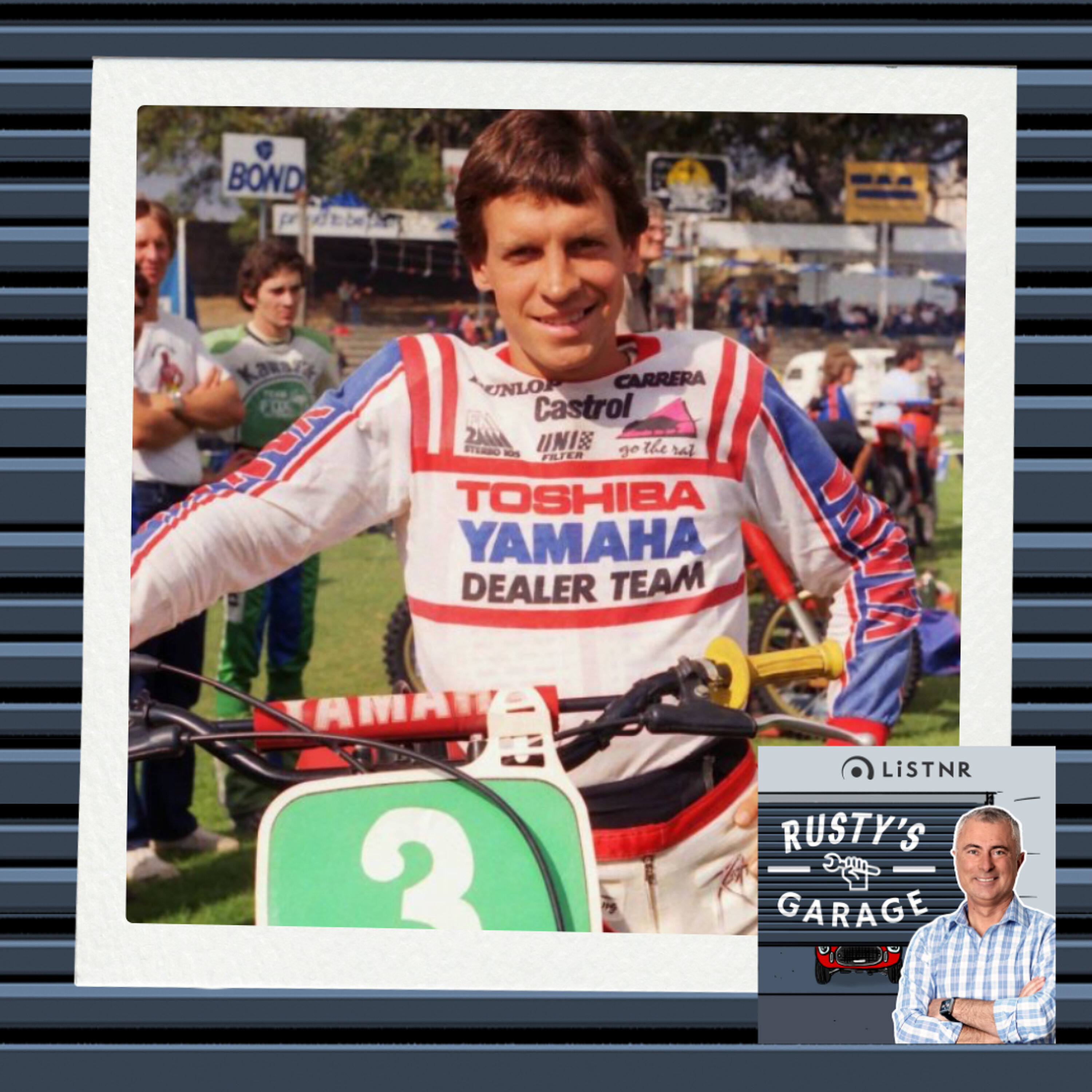
Stephen Gall’s coaching journey keeps unfolding: from “Mr. Motocross” roots and training drills to safety-driven ATV instruction and the shift from racing to mentoring. The conversation touches on how Yamaha and SVIA shaped youth programs after deadly three-wheeler incidents, plus the practical details of rider technique and fitness testing. Injuries, comebacks, and even a later anniversary ride show the long arc of grit. The hosts also pivot to speedway and midget racing, including engineering, gearboxes, and hard-earned seat time.
Morphing from racer to coach and why his personality was perfect for the role.
The constant thirst for information on how to be a better athlete which gave his academy international acclaim.
Branching out and tackling desert enduros as well as memories of Finke in a milestone year for the race.
A podium in the Castrol 6-hour - a late circuit racing bloom.
Childhood memories of the Sydney Showground Speedway a making the move into Midgets (Speedcars).
A 4-wheel title win and a Sprintcar crash which took its toll.
Plus the little known Supercars test and the juggle of trying to coach Matt Mladin and James Stewart Stateside.
In the midst of a ripper conversation we don’t get to every yarn….like his stunt coordination role on the recent Mad Max Movies - Fury Road and Furiosa for example - but if you find yourself wanting more check out his excellent new book ‘The Stephen Gall Story: No Easy Way’ available for order at www.noeasyway.com.au
Head to Rusty's Facebook, Twitter or Instagram and give us your feedback and let us know who you want to hear from on Rusty's Garage.