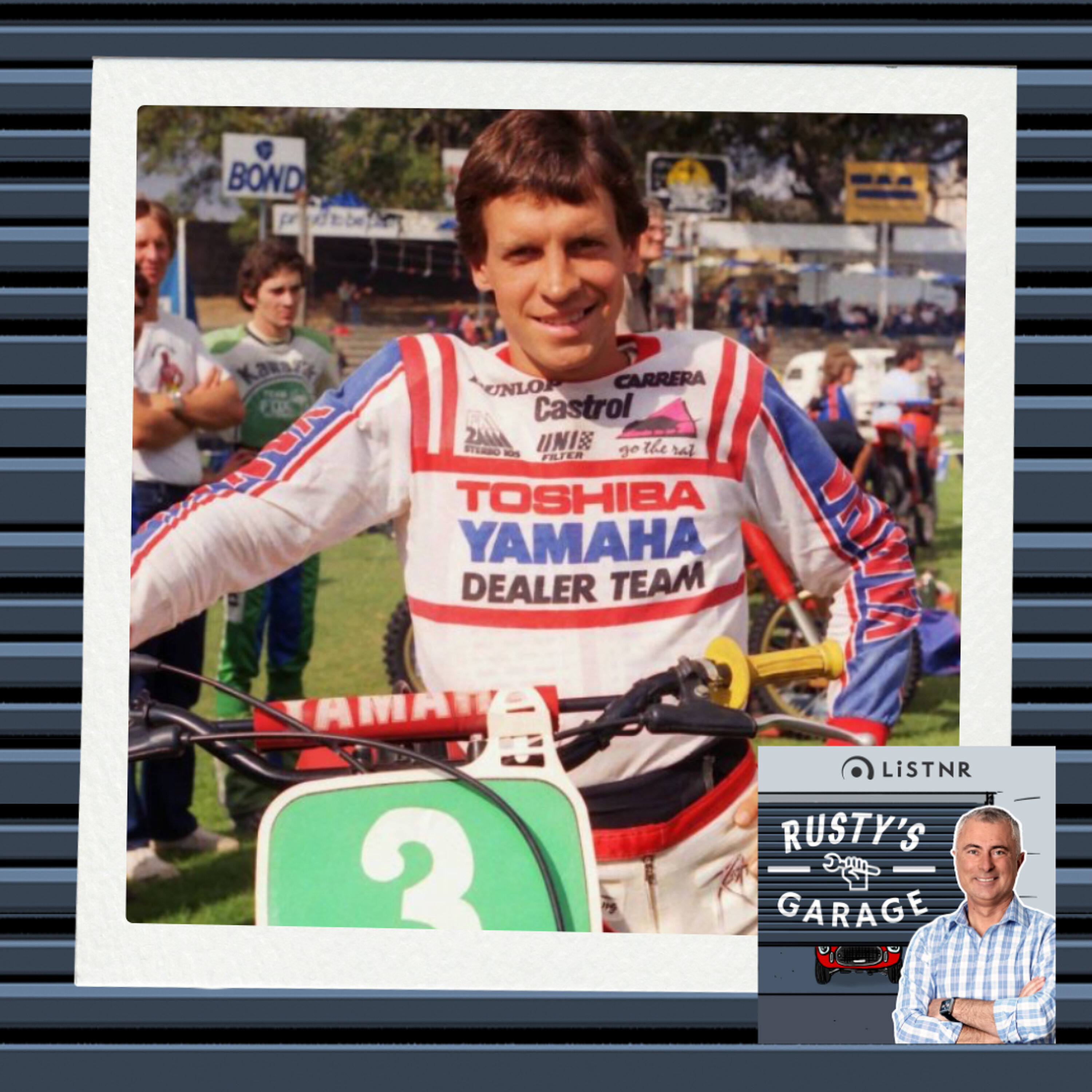
Stephen Gall | Part 2 - Mr. Motorcross to Midgets & coach extraordinaire
About this episode
Stephen Gall’s coaching journey keeps unfolding: from “Mr. Motocross” roots and training drills to safety-driven ATV instruction and the shift from racing to mentoring. The conversation touches on how Yamaha and SVIA shaped youth programs after deadly three-wheeler incidents, plus the practical details of rider technique and fitness testing. Injuries, comebacks, and even a later anniversary ride show the long arc of grit. The hosts also pivot to speedway and midget racing, including engineering, gearboxes, and hard-earned seat time.
Morphing from racer to coach and why his personality was perfect for the role.
The constant thirst for information on how to be a better athlete which gave his academy international acclaim.
Branching out and tackling desert enduros as well as memories of Finke in a milestone year for the race.
A podium in the Castrol 6-hour - a late circuit racing bloom.
Childhood memories of the Sydney Showground Speedway a making the move into Midgets (Speedcars).
A 4-wheel title win and a Sprintcar crash which took its toll.
Plus the little known Supercars test and the juggle of trying to coach Matt Mladin and James Stewart Stateside.
In the midst of a ripper conversation we don’t get to every yarn….like his stunt coordination role on the recent Mad Max Movies - Fury Road and Furiosa for example - but if you find yourself wanting more check out his excellent new book ‘The Stephen Gall Story: No Easy Way’ available for order at www.noeasyway.com.au
Head to Rusty's Facebook, Twitter or Instagram and give us your feedback and let us know who you want to hear from on Rusty's Garage.
See omnystudio.com/listener for privacy information.

3 Three Wheelers
"... ATV training. Because in the 90s, when there was three wheelers, people were dying all the time."
A 3 wheeler is a vehicle that has three wheels instead of four, often used for off-road riding. Because it has a different shape and balance than a normal ATV or car, it can be easier to tip over if you don’t ride carefully. The podcast mentions it in connection with safety and training because people were getting hurt.
A “3 wheeler” typically refers to a three-wheeled vehicle such as a trike or a three-wheeled ATV, used for off-road riding and training. The podcast context points to safety concerns in the 1990s, when these vehicles were associated with a higher rate of accidents and injuries. That’s why they come up alongside training—because stability and safe handling are critical with three-wheel designs.

Yamaha Tenere
"I'm going to ride the Yamaha Tenere out with two other winners, David Armstrong and Alan Rowe from the same era that we won."
The Yamaha Tenere is a type of adventure motorcycle built for long rides and rough roads. Here, it’s the bike the rider is planning to use for a special anniversary ride.
The Yamaha Tenere is an adventure/enduro-style motorcycle known for long-distance capability and rough-road comfort. In this segment, it’s the bike the rider plans to use for a 50th-anniversary event, alongside other winners.
Le Mans start
"And we'll do a Le Mans start onto the track and then two corners in 66 kilometres,"
A Le Mans start is a special race start where riders run to their bikes/cars and then get going. It’s a famous style of start from the Le Mans race.
A Le Mans start is a racing procedure where the cars/motorcycles are positioned and the riders run to them to start the race, rather than launching from a standing start in the usual way. It’s named after the 24 Hours of Le Mans and is used to create a dramatic, high-energy start.
full throttle
"and then two corners in 66 kilometres, you backed out a full throttle."
Full throttle means the rider is giving the engine as much power as possible. Here, they’re using maximum power for most of the straight before backing off for turns.
Full throttle means the rider has opened the throttle completely, commanding maximum engine airflow and fuel delivery (within the bike’s control limits). In this context, it describes holding maximum power for much of the run before easing off for corners.
roll off
"Two corners, you roll off a little bit and back on again. You're drifting through these corners."
Roll off means you gently back off the gas. In corners, that helps the bike settle and makes it easier to steer safely.
To roll off means to smoothly reduce throttle input—typically easing the throttle closed—before or while approaching a corner. This changes engine braking and traction behavior, helping the rider stabilize the bike for turn-in.
drifting
"Two corners, you roll off a little bit and back on again. You're drifting through these corners."
Drifting is when you steer so the bike goes through the corner at an angle instead of straight up and down. It takes skill to keep it controlled while sliding.
Drifting is a driving technique where the vehicle intentionally over-rotates and maintains a sideways slide through a corner while the rider manages throttle and steering to control the angle. On a motorcycle, it requires careful balance of traction, body position, and throttle to keep the slide stable.
stag pegs
"But now they've got something called stag pegs. They go on to the bike. And people's rear of the boot can sit in the stag pegs and take so much load off the arms and the lower back."
Stag pegs are extra foot pegs you can mount on a dirt bike. They help you rest your weight with your feet instead of hanging on with your arms, which makes long or rough rides easier on your back.
“Stag pegs” are aftermarket foot pegs used on dirt bikes to give riders a better place to brace their feet. By changing where the rider can support their body, they reduce strain on the arms and lower back during hard riding.
winning Australian title
"And when we won that Australian title, that was Dean's own car design. [872.3s] He designed that chassis."
They’re talking about a big racing achievement in Australia. It’s used to explain why the car design and setup were so important.
This segment highlights a competitive milestone—winning an Australian title—and ties it to the car’s design work. It functions as a narrative anchor for why the chassis and setup mattered.
cross-flow heads
"But he just, he did, he had a lightweight Mini Cooper S before that, [885.6s] cross-flow heads, developed full independent front suspension on it,"
A cylinder head is the part on top of the engine where air and fuel enter and exhaust exits. “Cross-flow” means the intake and exhaust paths are arranged to flow more efficiently, which can help the engine perform better.
Cross-flow cylinder heads route intake and exhaust gases through the head in different directions, typically improving breathing compared with “same-side” layouts. That can help an engine make more power and respond better at higher RPM—useful for racing builds like the one described on the Mini Cooper S.
independent front suspension
"cross-flow heads, developed full independent front suspension on it, [890.4s] was winning those races before he went to Speedway,"
Independent front suspension lets the left and right front wheels react to bumps separately. That usually helps the car stay more stable and keep better tire contact on rough or uneven track surfaces.
Independent front suspension means each front wheel can move up and down somewhat separately, instead of both being tied together. That improves grip and ride control over bumps, which matters a lot when you’re racing and trying to keep the tires planted.
cylinder heads injection
"Every time I went to America in the early 80s, [920.2s] I'd come back with a whole package of cylinder heads injection,"
This sounds like a racing fuel system upgrade tied to the engine’s cylinder heads. The idea is to get the right amount of fuel into the engine more precisely for better performance.
“Cylinder heads injection” here likely refers to a fuel-injection setup associated with the cylinder heads (i.e., injecting fuel in a way that matches the head’s design). In racing contexts, injection tuning can improve throttle response and fuel delivery for consistent power.
touring cars
"Maybe we'll come back to that in a second with touring cars. And yeah, they really enjoyed it."
Touring cars are race cars that are based on regular cars you can buy. This part of the story is about learning to drive one of those race cars.
Touring cars are race cars based on production models, typically with rules that keep them relatively close to what you’d find on the road. The conversation here uses touring-car driving as a reference point for how the driver got seat time and learned the car.
Orham Park, short circuit
"And that leads me to when I got into his touring car at Orham Park, short circuit. They say jokingly to me at the start."
A short circuit is a shorter race track. That can make driving feel more intense because you’re turning and braking more often each lap.
A “short circuit” is a track layout with shorter lap length, which usually means more frequent braking/turn-in events and faster lap-to-lap changes. The speaker references it as the place where they first drove a touring car and learned the pace expectations.
paddle shifters
"Like I'm not trying to be cheeky here, but they've got an easy paddle shifters. Back in those days, those boys had those Hollinger gearboxes"
Paddle shifters are little levers behind the steering wheel. They let you change gears without moving a gear stick, which can help you shift quickly while driving.
Paddle shifters are steering-wheel-mounted controls that let the driver change gears without using a traditional gear lever. They’re common on performance cars because they make shifting faster and easier while keeping both hands near the wheel.
Hollinger gearboxes
"Back in those days, those boys had those Hollinger gearboxes that the gates were really, really close. And it was difficult to drive."
Hollinger gearboxes are race-focused transmissions. They use closely spaced gears, which can keep the engine in the “right” rev range, but they also demand more precise driving.
Hollinger gearboxes are purpose-built racing transmissions known for their durability and close gear spacing. In motorsport, close ratios help keep the engine in its power band, but they can make the car harder to drive because the driver must be precise with timing and inputs.
gates were really, really close
"Back in those days, those boys had those Hollinger gearboxes that the gates were really, really close. And it was difficult to drive."
The “gates” are the shift positions in the gearbox that tell you where each gear is. If they’re close together, it’s easier to grab the wrong one, so you have to be more careful.
In a manual-style racing gearbox, the “gates” are the physical/visual shift positions that guide where each gear lever movement should go. When the gates are close together, it’s easier to accidentally select the wrong gear, making the car more demanding to drive.
Supercross Masters
"because it wasn't dirty enough, I suppose. [1095.6s] But the Sprint car thing, you do chase significantly. [1098.5s] Yeah. [1099.6s] Well, again, because Dean really loved it [1101.7s] and that we had a great crew of Phil Golding and Rick Spence"
“Supercross Masters” is a supercross competition for a specific group of riders—often more experienced. It’s still the same kind of off-road motorcycle racing, but organized as a separate class/event.
“Supercross Masters” is a motorsport event/class within supercross, typically aimed at more experienced or older riders. It’s part of the broader supercross racing ecosystem, where riders compete on closed stadium tracks with jumps and tight turns.
Sprint car racing
"because it wasn't dirty enough, I suppose. [1095.6s] But the Sprint car thing, you do chase significantly. [1098.5s] Yeah. [1099.6s] Well, again, because Dean really loved it"
Sprint car racing is a type of open-wheel race run on short tracks, often ovals. The cars are designed to be fast through lots of corners, and the racing schedule can involve many different tracks.
Sprint car racing is a form of open-wheel racing usually run on short oval tracks, where cars are built for high acceleration and frequent cornering. The speaker contrasts it with other forms of racing by saying you “chase” it across more tracks, implying a different racing calendar and track variety.
Valvoline
"I was the great sponsor getter, the cleaner. [1114.8s] Valvoline, I think back then. [1116.1s] They were one of our big sponsors, Valvoline."
Valvoline is a company that makes car oils and lubricants. They also sponsor racing teams, which helps them get their brand seen while the team uses their products.
Valvoline is an automotive lubricant brand that sponsors racing teams. In motorsport, oil and fluids sponsors are common because teams need performance lubricants and the brand gets visibility.

Ford Bronco
"...n because we both had businesses. Dean just had a Bronco with a motor that sucked the juice like crazy."
The Ford Bronco is a type of SUV designed for driving on rough roads and off-road trails. In the podcast, it’s brought up because the engine setup used a lot of fuel. That means it could be more expensive to run than you might expect.
The Ford Bronco is a rugged, off-road-capable SUV built for drivers who want strong traction and go-anywhere capability. In the podcast context, it’s mentioned because someone had a Bronco with a power setup that consumed fuel heavily, which is a common reason these vehicles come up in real-world ownership stories. It’s the kind of vehicle people discuss when talking about day-to-day costs and how modifications or engine choices affect fuel use.
checkered flag
"within nearly spitting distance of the checkered flag. [1211.1s] And the way the officials handled that situation"
The checkered flag is the race’s finish signal. If something happens right near it, that means it was very late in the race.
The checkered flag is the signal that a race has reached its finish. Mentioning being “within spitting distance of the checkered flag” emphasizes how close the incident was to the end of the race.
racing incidents and officiating
"And the way the officials handled that situation [1215.3s] just left an eye with their mouths open. [1217.6s] We went, you know what?"
They talk about a crash near the end of a race and what the officials did afterward—and how it changed the speaker’s feelings about racing.
This segment focuses on how officials responded to a crash and how that handling affected the speaker’s motivation to keep racing.
Archerfield racing
"Yeah. [1236.9s] No, sorry, 10 years later up at Archerfield. [1239.5s] And when it was a 410 instead of the 387 cubic inch"
They mention Archerfield as the track where they raced later, and describe how the car and track conditions made it feel intense.
Archerfield is referenced as the track where the speaker later drove Todd Kelly’s car, including details about the engine setup and the wall outside the circuit.
387 cubic inch
"And when it was a 410 instead of the 387 cubic inch [1244.4s] and with a wall on the outside of Archerfield"
“387 cubic inch” is the engine size number. The speaker is saying the car had a smaller engine back then, and later it was bigger.
“387 cubic inch” is another engine displacement class, used here to contrast with the later “410.” Displacement classes matter in racing because they influence engine design, tuning, and the kind of power the car can produce.
410
"And when it was a 410 instead of the 387 cubic inch [1244.4s] and with a wall on the outside of Archerfield"
Here, “410” is shorthand for the engine’s size—410 cubic inches. It’s a way racers quickly identify what kind of engine the car has.
In this context, “410” refers to an engine displacement class (410 cubic inches). It’s commonly used in American racing to label the engine size, which affects how the car is built and how it’s driven.
horsepower
"with a 410, 950, 60 horsepower, [1252.3s] you had to give that thing a lot of respect."
Horsepower is a measure of how much power the engine makes. More horsepower usually helps the car accelerate faster and go quicker.
Horsepower is a measure of engine power output—how much work the engine can do over time. When someone says a race car had “60 horsepower,” they’re describing how strong the engine is, which strongly affects acceleration and lap times.
Request an Explanation
Heard something you'd like explained? We'll add it to this episode.
Sign in to request explanations for terms you heard.
Want to learn more?
Browse our glossary for plain-English explanations of automotive terms, jargon, and concepts.
Help improve this episode
See something that's not quite right? Our annotations are AI-generated and can sometimes miss the mark. Click the flag icon on any annotation to suggest a correction.