A Chevrolet C10 is a pickup truck model that people recognize from older trucks. In this podcast, the C10 name is connected to an EV version or conversion discussion involving a Leap Motor C10. The point is how a truck like that can be used with an electric power system.
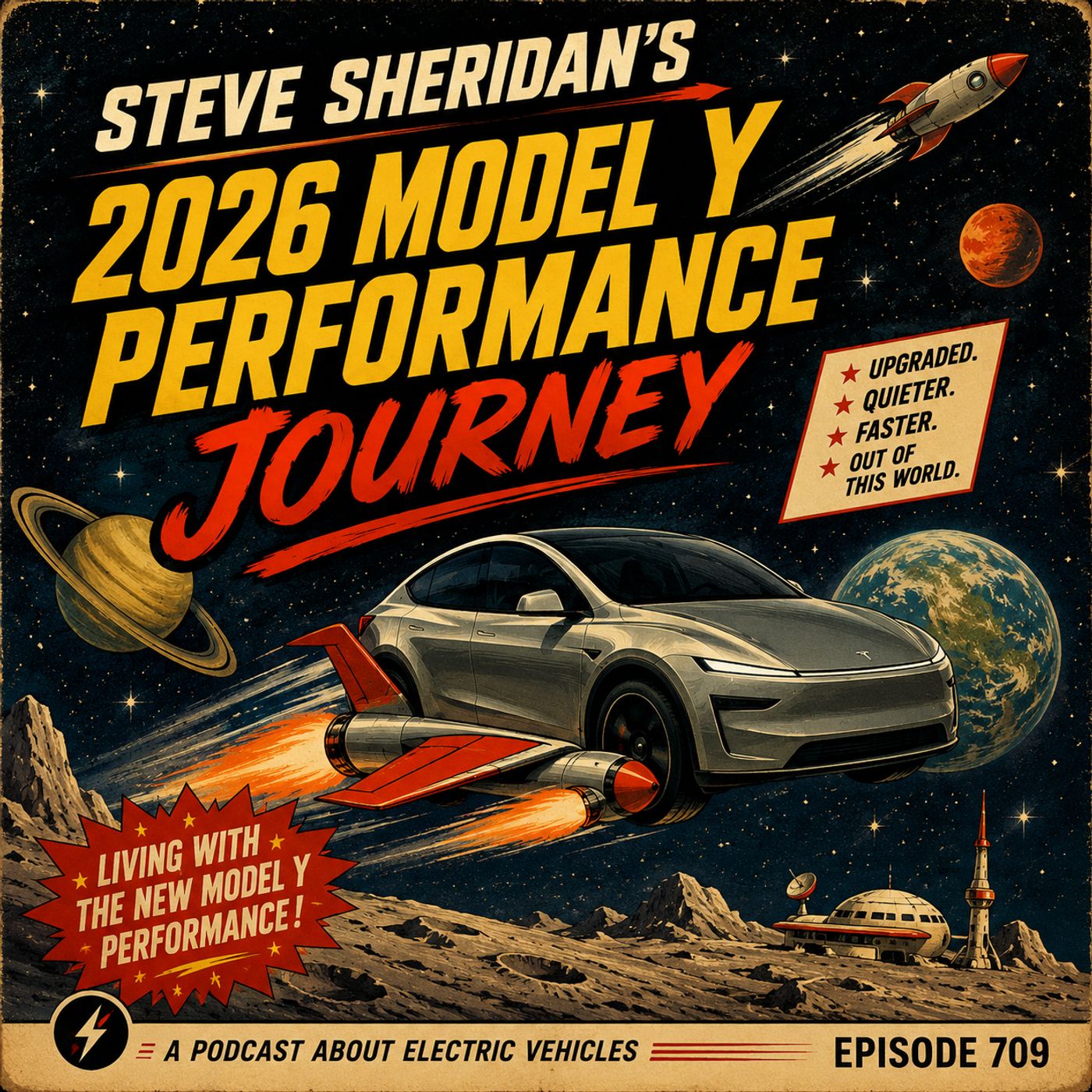
This is a Tesla Model Y, but the “Performance” version is the sportier, more aggressive one. It’s an electric crossover, and the episode is about the 2026 Performance model Steve bought.
The General Motors EV1 was an early electric car made by GM. It was designed to show that electric vehicles could be built and used like regular cars. The podcast mentions it because it’s an important part of EV history.
Ride quality is basically how smooth and comfortable the car feels over bumps. A “stiff” ride feels harsher, while a “softer” ride feels more forgiving.
A two-car garage is just a garage sized for two cars. In this story, it matters because the space is tight, so the car has to fit without making it impossible to park or get around.
The Tesla Model 3 is an electric car. Here it’s brought up because the speaker is comparing garage space—whether both cars can fit side-by-side in a small garage.
They used a spreadsheet to compare different electric cars. It helped them check measurements like length and then mark whether each car would fit (using red/yellow/green).
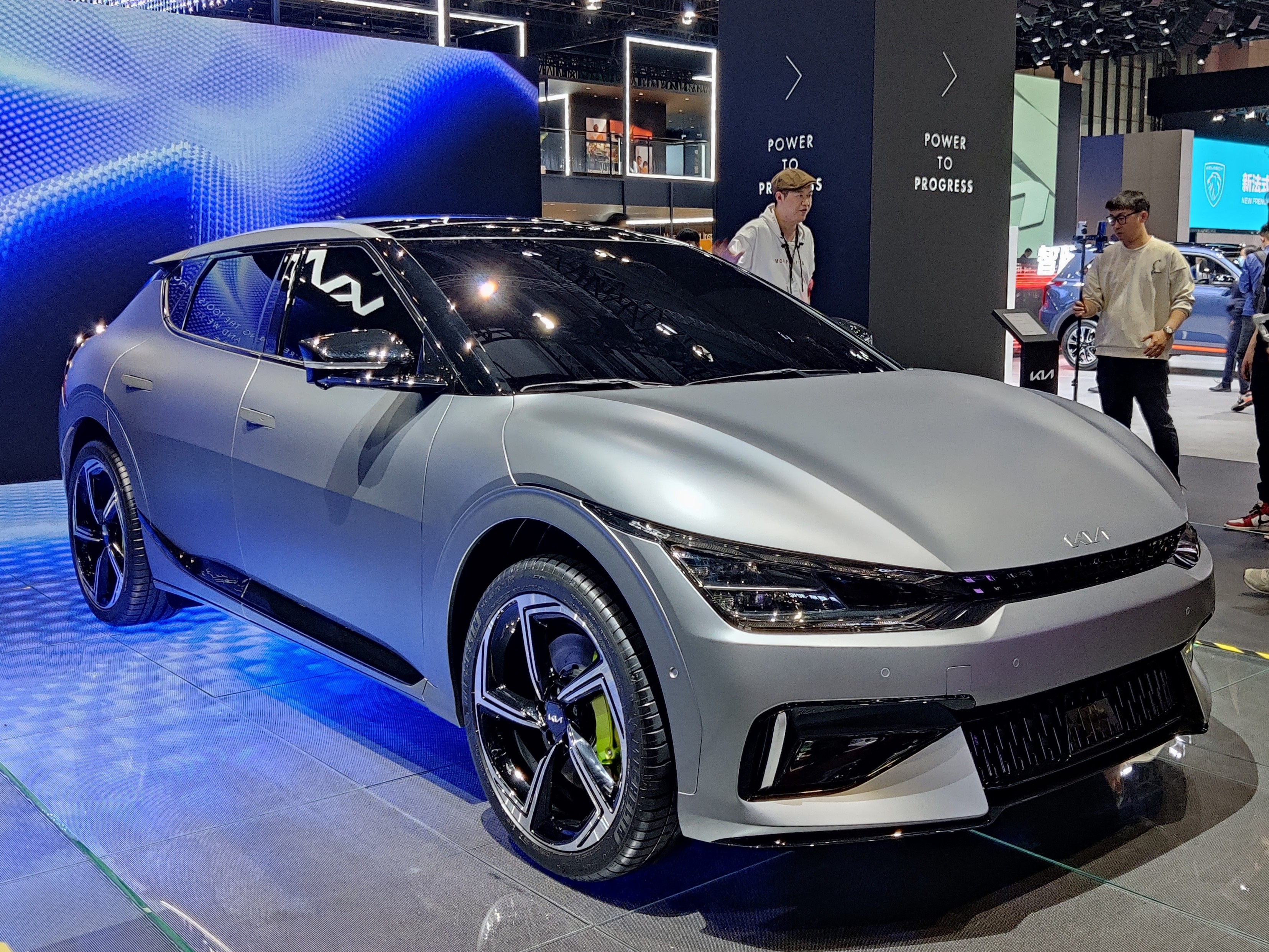
The Kia EV6 is an electric car in the crossover category, meaning it’s built for everyday driving with a higher ride position. It runs on a battery instead of gasoline. The podcast mentions it because it was one of the few EVs that fit in a tight garage space.
The tachometer is a gauge that shows engine speed. The host is saying their dashboard uses a round display area that can show different gauges depending on what you’re doing.
The speedometer is the gauge that shows how fast the car is going. The host is talking about where it appears on the dashboard and how it changes depending on which direction you’re turning.
One-pedal driving means you can slow down a lot just by taking your foot off the gas. The car uses its motor to slow down and recharge the battery, so you don’t have to use the brake pedal as often.
Regenerative braking is how an EV slows down while also recharging. When you lift off the accelerator or slow down, the car turns the motor into a generator and sends energy back to the battery.
Here, “feather” means gently controlling the gas pedal so the car slows down smoothly. It’s a technique to get the deceleration you want without jerky changes.
Brake pads are the parts that squeeze against the brake rotors to slow the car down. If you slow down mostly using regenerative braking, the pads usually wear more slowly.
Over-the-air (OTA) updates are software updates delivered wirelessly to the car, without needing a dealer visit. In this segment, the speaker credits OTA updates for improvements to the Model Y experience over time.
Suspension is what helps the car handle bumps and keep the wheels planted. They’re asking what was changed in the Model Y suspension so the newer one rides more comfortably than the older one.
Dampers are the parts of the suspension that control how the car bounces after hitting a bump. If they’re adjusted to be more or less responsive, the ride can feel smoother or more controlled.
Body roll is the sideways leaning of a car’s body when cornering or when the suspension is disturbed by bumps. The host says their 2020 Model Y showed more roll over bumps, while the 2026’s adaptive suspension reduces it.
“Dealerless” means you don’t buy the car through a traditional car dealership. Instead, you order it directly (in this case, online) from the manufacturer.
“Touchless” means the buying process is mostly done without in-person steps. You order online and handle the process remotely instead of going to a dealership.
A “projected” delivery date is an estimate, not a guaranteed day. The host explains that their Tesla’s delivery window kept moving as the factory and shipping schedule changed.
A delivery inspection is a careful check of the car when you pick it up. The goal is to spot problems early—before you’re stuck with them—like damage or parts that don’t work correctly.
The right rear seat is the seat on the passenger side in the back. They found it wouldn’t move back to the upright position—so it’s a seat adjustment problem that should be fixed right away.
HomeLink is a feature that lets your car automatically open things like your garage door or gate. In this story, the car didn’t include it anymore, so they had to get it added.
Wheel balancing is making sure the tire and wheel spin smoothly without wobbling. If they’re slightly off, you can feel vibration or hear noise, especially at certain speeds.
The front camera helps the car “see” the road for safety features. The car warned that the camera needed cleaning, and the speaker explains where it’s located.
An overflow lot is an extra place dealers store cars when their main lot is full. The speaker suggests checking what’s around your pickup location and doing a quick inspection before you drive away.
Paint protection film is a clear sheet you put on the car’s paint to protect it. It’s mainly used to stop small rock chips and scratches, especially on the front bumper and mirrors.
Rock chips are the little nicks and spots in your car’s paint caused by small rocks hitting it while you drive. That’s why people use clear protective film on the front areas.
A ceramic coat is a protective layer you put on your car’s paint to help it look shiny and resist dirt. People often pair it with PPF, which is the clear film that protects against rock chips.
PPF film is a clear protective sheet that you put on parts of the car’s paint. It helps stop small rocks and road debris from chipping or scratching the paint.
The Tesla Cybertruck is an electric truck. Here they’re talking about how it can power things outside the car—like appliances—using electricity stored in its battery.
A charge port is the EV’s plug-in spot for charging. In this case, they’re saying you can use it (with an adapter) to send power from the car’s battery to things outside the car.
This means the power coming out is like normal home electricity (the kind you’d get from a wall outlet). With the right setup, you can run some household devices from the EV.
These are cameras built into the side mirrors area so you can see around the sides of the car better. The speaker says using these views together makes it easier to know what’s around you.
“Full self-driving” is Tesla’s name for advanced driver-assist features. It can help with driving, but the speaker is saying they still rely on mirrors for safety and awareness.
A lane change is when you move your car into a different lane. The point here is that the speaker prefers checking mirrors first because the camera view can lag a little.
They’re saying the camera picture doesn’t show up instantly—it comes with a small lag. That lag can matter when you’re trying to decide quickly, so they rely on mirrors first.
Frontage roads are side roads that run next to a highway. They’re useful for getting around without staying on the highway, but you still have to deal with intersections and cars pulling in.
Ambient light is the soft lighting inside the car that sets the vibe. Some cars let you change the color, which can make the cabin feel more fun or personalized.
They’re talking about shifting gears by tapping options on the car’s screen instead of using a stick or buttons. It can feel weird at first, but it’s usually only for when you’re stopped, like going into Park or Reverse.
A touchscreen is a screen you tap to control things. In some cars, you use it to do actions that used to be done with buttons, like selecting drive modes or gears.
They’re talking about putting the car into “neutral” so it can roll correctly. For things like a car wash, the car needs to be in the right mode so the wheels can move without the car trying to drive.
A “car wash” in this context means an automated wash with rollers that pull the vehicle through. EVs often require a specific neutral procedure (or “service mode” behavior) so the drivetrain doesn’t engage while the rollers move the car.
In an electric car, “high voltage” is the big battery power that runs the drivetrain. If there’s a “high voltage problem,” the car may need to be checked by a technician before you can drive it.
Emergency flashers are the hazard lights that blink to warn other drivers. They’re often used when something unexpected happens or you need to be extra visible.
Acoustic glass is special window glass made to block more noise. It helps keep the inside of the car quieter by reducing sound coming through the windows.
Juniper is the name Tesla uses for a refreshed version of the Model Y. In this episode they’re pointing out the visual changes, especially the new light bar and redesigned rear lights.
A light bar is a long strip of lights across the front or back of the car. It’s used for visibility and styling, and in this discussion it’s part of the refreshed Model Y’s new lighting layout.
This means low-speed crashes where someone hits you from behind. The idea is that the bumper shape/position is designed to take the hit and help prevent expensive damage.
Wheel covers are decorative parts that sit on top of the wheel. Here, the host says these particular covers mainly change the look and don’t really prevent damage if you scrape a curb.
Curb rash is the scraped-up marks you get when you accidentally hit the curb with your wheel. It’s mostly cosmetic, but it can look bad on nicer wheels.
Range is the estimated distance a vehicle can travel before needing to recharge. The host claims removing the wheel inserts slightly reduces range (on the order of 1–2%), likely due to changes in aerodynamic drag and/or rolling resistance.
“Hardware four” refers to Tesla’s onboard computer hardware version used to run advanced driver-assistance features. The speaker contrasts it with “hardware three,” noting that cars with newer hardware get the newest updates and can access features like Full Self-Driving sooner or more reliably.
Here, “subscription” means you pay ongoing fees to keep using the self-driving features, instead of buying them once. The host is saying Tesla changed how you can purchase it, especially in the US.
FSD stands for Full Self-Driving. It’s Tesla’s software that tries to do more of the driving tasks for you, and in this story it’s something you can transfer to a different car and later get updated.
14.3.2 is the version number of Tesla’s self-driving software. The host is saying that after updating to that version, the car’s behavior improved in noticeable ways.
Term
full-cell striving
This phrase sounds like a mis-transcription of Tesla’s Full Self-Driving (FSD). The speaker is talking about the self-driving software on their car and how it gets updated.
“Hands off mode” is when Tesla lets you drive without keeping your hands on the wheel. You still need to watch the road and be ready to take over quickly.
They’re describing a tradeoff: they want the car to change lanes less, but they also want to keep going faster. The problem is that the system doesn’t let them control those things separately.
Term
Tesla interface
The Tesla interface is the screen and controls inside the car. The speaker is wondering if there should be more detailed tuning available, possibly through the app.
A Supercharger is Tesla’s fast-charging station network. Here, the host is saying the car can guide itself to the right charging spot so you can plug in more easily.
Here “noise” means how loud the car is—especially road and tire sounds. For an EV, people often care a lot about how quiet it feels compared with other cars.
LIVE
Hello everyone and welcome to Kilowatt, a podcast about electric vehicles, renewable
energy, autonomous driving and much, much more. My name is Bodie and I am your host and on today's
episode we have Steve Sheridan and he is going to tell us all about his 2026 Model Y performance.
It's a good chat. Steve and I sat down and we chatted. It's been a while. I think I said this
when I had Allison Sheridan on. Like I haven't talked to them like in real life, you know,
not in person, but in real life since January. So it was time. It was time to get together and chat.
Steve's got this beautiful Model Y performance. I'll let him tell you what the color is. But
yeah, I think you're all going to enjoy this. Now, I will say next Tuesday we should have
a news episode and then we have an interview with David. He's going to talk about his Leap
Motor C10 and then we're going to have Ford's earnings call and GM's earnings call because
I need to take a break. I had a lot of work stuff. I had a lot of part-time work stuff
and then just life. My kids graduated eighth grade or promoted from eighth grade. So we've had family
over and lots of activities this week. So I just need two weeks off to just kind of chill out and
relax and recharge, we'll say. So that's the plan for the next two weeks. I do think you're going
to enjoy today's episode. I think you're going to enjoy David's episode. Again, we'll have news on
Tuesday and then Ford's and GM's earnings call, which I expect will be a little bit shorter than
the other earnings calls that we've done this quarter just because Ford and GM don't always talk
about EVs. So we might be able to just knock those out real quick. So yeah, if you've emailed me and
I haven't responded back, don't worry about it because that is part of my plan on the recovery.
Two weeks is to get back with all the people I need to respond to. There's people who've requested
interviews that I have not been very communicative on, which is my fault, but yeah. So the goal is
to rest up, respond to emails, catch up with everything else that's going on in life,
and then come back bright-eyed and bushy-tailed. So with that, let's go ahead and welcome Steve
to the show. Thanks, Bodie. Glad to be back. I'm glad to have you back. Now, Steve,
Allison was on earlier this week and we have equal time doctrine here at the Kilowatt podcast.
So we had to have you on today and we're going to talk about the 2026 Tesla Performance Model Y
that you purchased recently. But before we do that, we have also because this show drips with
journalistic integrity. We have a correction from Allison's. Would you mind going over the
correction from Allison's podcast? Yeah, I believe this came out when you interviewed her
about what was the topic? The Spruce Goose and the EV1. EV1 and then you got off into a tangent,
or she got off into a tangent with the Spruce Goose, which was this large aircraft built by
Hughes Aircraft flown by Howard Hughes. But she wanted to correct, she said she correctly
said that the only plane with a larger wingspan than the Spruce Goose was the Stratolaunch that
flew in 2019. The Spruce Goose was huge. But she says that it was, in quotes, one of those big gliders
sort of planes made to go around the world without stopping. And she says she confused that with a
different flying machine, the Stratolaunch is a test-bed aircraft made to launch rockets into
orbit. She further says she finishes by saying, I apologize for my mistake and thanks Steve for
catching this egregious error. Most people probably wouldn't know what that aircraft, the Stratolaunch
was. But since I kind of followed space and rockets, that one caught my ear. And so I thought I'd
slip that in. Well, again, dripping with journalistic integrity at the Kelovot podcast,
so I demand corrections, even though I don't often do them. So Steve, back in late, late December,
you were able to get your hands on a 2026 performance Model Y. So previously to that,
you were driving a 2020 or 2021 Model Y? 2020. 2020 performance Model Y.
So why upgrade? What was the catalyst? Yeah, good question. And not huge driving issues. I was fairly
happy with my 2020, but the biggest complaint, concern was the ride quality. The 2020 performance
Model Y had a very stiff ride. Now, on the good side, that led to pretty good cornering,
fairly flat ride. But boy, you felt everything on the road, every bump,
both small and large bumps. I recall going, we visit our daughter in Sunday law down
towards San Diego often, and they have a very long, self-maintained driveway. And it's got a
few potholes and bumps. And the way I could tell was I could not carry Starbucks cups back up that
driveway without spilling them. Even with lids, they would be shaking so much they'd come out of
the little hole and I'd have stoppers in them. My new car passes that test now. It's got a much,
much better ride. And there are reasons for that. That's awesome. Now, anybody that listens to the
no-silly cast knows that there's one big test before you or Allison buys a car. There's one big
test that every car has to pass in order for it to wind up in your fleet. What is that test?
Yeah, the biggest constraint we have is our garage. Unlike most people that I've observed,
park both of our cars in our two-car garage. So we don't have a lot of room because we have
other things in the garage which have to be tightly packed around the periphery.
And so we don't have both front and back and side to side. It's very, very constrained. But she has
the Model 3. I had the Model Y and they both just fit just about perfectly in the space we had. So
that eliminated, you're asking why the performance Model Y. Well, staying with the Model Y, we knew
it would fit in the garage and measuring the other options, the other EVs. Many of them were just
too long. They wouldn't fit in our allowable space. And I know that Allison was working with and helping
Pat Dengler and Lynn. And Lynn has a short garage, right? Shorter than yours, even?
Yes. About the same, maybe a little short. Benches. Yeah, she has some benches there, work benches.
Yeah. So it's not like you guys don't know what the approximate size of any EV is at this point
because there has been so many that have kind of gone through the test. And one of the tests is
will it fit in the garage? Yeah, Allison came up with a spreadsheet with many parameters,
including length of the car. And as you go down and then she would grade, you know, red, yellow,
green, whether that met our criteria. And most of them are red too long in that category. So
I think the EV6, the KEV6 was one of the few that fit in our garage as well. But that car just
wasn't quite up to par for us. You mentioned here in our document that I had nothing to do with
other than the fact that I opened it. But you mentioned in the document that the camera views
were round. And my wife's carnaval has round, it's where the speed, the speedometer goes or
where the tachometer, depending if you're turning left or right when you turn your blinker on.
And it is maddening because you can't really, you don't get a really good view because you're
looking through the steering wheel to see where the cars are in your blind spot. Now,
it's better than nothing, but it's not as good as what the Tesla has, which is in the middle screen.
And then you can move it, you know, depending on where your eye hits that infotainment screen.
Yes. And more traditional rectangular views. Very few cars I think have the rounded camera view.
I mean, it is a stylistic choice, but I don't think it's a great choice.
I agree. And the other thing that was important was, you know, true one-pedal driving, which,
you know, lots of cars say they have, but rarely do they come straight out the box with one-pedal
driving. Exactly. Yeah. A lot of them, you know, almost all of the EVs have regenerative braking
of some sort, but how that's implemented is the key. And we, I don't know if we've just gotten used
to it, but we very much prefer Tesla style of regen braking, which basically is always on.
I don't think you can disable it. And it's in its full regen braking, which is great because then
you don't have to rely on your brakes. There are many times I will drive, you know,
someplace and never apply my brakes because it will come to a complete stop if you just
learn how to feather properly. That is let off the accelerator. So one issue is the brakes,
well, not issue. One bonus is the brakes will last forever on a Tesla because you rarely use them,
the brake pads. Yeah. It's only in an emergency stop is pretty much when I use them. Yes.
Okay. So we know, we know the stiff ride and the bupiness, which I have a problem with in my
car as well. Like I don't, I'm not driving my car down any dirt road or unmaintained road, even,
even occasionally, even, even rarely. I don't know that I've ever done that in the three years that
I've had it, but I do appreciate, you know, kind of what you're saying. Cause every pebble,
it seems like that car hits, you know, you just hit a pebble on the left side rear tire versus
the right side rear tire. It's still a very nice car and I'm not complaining about it, but it is,
it is a little bit more uncomfortable ride than say, I mean, a Cadillac is
forget about it, but say a similar car in the same space category,
it's probably a little bit more uncomfortable out of every car in that model wise category.
Remind me what year your Model Y is? 23. So they may have improved the ride from the 2020
to the 2023. I can't recall, but yeah, I think that 2020s were even stiffer. Wow.
Because they got a lot of complaints. Yeah. And again, mine's not bad,
totally not bad. I'm not, I'm very happy with my car. I will say that they did in my neighborhood,
because we don't have any joy in my neighborhood. So the city of Tempe takes care of all of our
streets and they resurfaced our streets and they, when they did that, they removed the lines on the,
so they put this black, nice, beautiful black slurry down, but we also have speed bumps in
my neighborhood and you can't tell that brand new black slurry on top of the pavement that
where the speed bumps are. So occasionally, I would be driving around not paying attention and
the next thing you know, I'd be bouncing my car because of that, those speed bumps. That didn't
happen very often, but I couldn't wait for them to put the speed bumps back. It could happen once,
at least once, coming into my neighborhood and once going out. Then I was like, oh yeah,
and you'd pay a little bit more attention. Yeah, you'll feel that in a Model Y.
Yeah, 100%. So what are some other things that kind of ticked your boxes when it comes to
upgrading your Model Y? Well, I guess some of the question might be why did I stay with Model Y.
The main reason for upgrading was the ride, but the reason I didn't look around too much for other
EVs to replace the Model Y was, I'm just happy with it other than that. It's got great acceleration.
I like and I'm used to the minimalistic look in the controls. I took a little getting used to to have
just one screen control with a few buttons on the steering wheel, but it's fine now for me.
I love the over-the-air updates and the improvements that come with it. It's just
all around. It's the package that suits me pretty well, suits me best.
Do you know what the...
What exactly did they do to the suspension that was better in the 2026 versus the 2020?
So I'm a little bit vague on whether... Well, in the normal 2026, let's say the non-performance,
they put in what they call adaptive suspension, which uses electronics to do something to adapt.
I don't know what they've done, but in the performance model, they have control over that
adaptive suspension. So you can set the stiffness level of the ride. And I think the way they do
this is not air suspension adjustment. This is adjusting, I believe, the
opening in the shocks, the dampers, so that they are more or less responsive to shock.
So it's a simpler way to implement ride quality, changes in ride quality. And they basically
have two selections, more sporty and more smooth. Gotcha. Do you ever find yourself just putting
it on the sporties? Occasionally, I do. It is a little more fun for cornering and off the line,
but I generally keep it in the more comfort mode, mainly because Allison much prefers that.
In the previous car, she couldn't even cross-stitch. This is where you have to use
needles and fine little holes in cloth. Was she in the driver's seat? She had trouble
nailing those holes with the needle because of the ride. Now it's no problem, but I keep it in that
smooth mode for her. Yeah. I wonder, my wife gets very carsick. And for whatever reason,
the way that the Model Y sits for her and her eyeliner, she will sometimes get
carsick just by driving on the freeway, just the way things are moving for her.
As a passenger or driver? Passenger. She does not like to drive my car. But
I wonder if that would, having the dampers make it a little bit more of a smooth ride,
would make that better or worse for her? I found, I talked about this roll with my 2020
Model Y, the body would tend to roll with bumps. I don't find that as much with this adaptive
suspension in the 2026. So it might help, but I mean, I would test drive it, see if it makes a
difference, if you're really interested. I don't think I can convince her to let me upgrade,
so I don't know right now. Yeah, you have a 2023, it may be a little harder to justify.
Yeah, and I also really want the Scout. So I got some more years typically, so
before I'd buy a new car anyway. So I'm thinking the Scout's the next car. We'll see what comes,
the seven years is a long time. Yeah, I've heard you talking about the Scout. I know that's on
your list. Man, sounds like a great car. In 2025, did you and Allison get over to see the Scout
booth at CES? We did not. Yeah, I was on the fence because I thought it was going to be more of
like a Rivian replica than it is, but man, nope. I was all jazzed up. As soon as I saw it, I was
like, oh, I love this truck. All right. Okay, so we talked a little bit about why you decided to
upgrade your Model Y. What was the buying experience like? Because you went through it in 2020,
which is pandemic buying. What about 2026 or 2025? How did that go?
It went pretty well, kind of as I expected it would. The delivery got bounced around a little
bit. Tesla, as many I think car manufacturers are now, is almost, it's dealerless and it's
almost touchless in that you don't really have to go in and make place the order with a dealer.
Everything's online. When I ordered the car online, the delivery date was projected to be the last
couple of weeks in December of 2025. This is for the 2026 model. It had just come out. It was just
being produced for the first time. I think October was when the first ones were released,
but I didn't get there on day one because I was still deciding. So last couple of weeks in December,
that got pushed out as time went on to January, February 26. This was probably in late November
when I found that out. No big deal. There was no financial reason for me to receive it in 2025
versus 2026. Then very late, I think December 29th, I got a notice from Tesla that they pulled
it back, the delivery date back to December 30th or 31st, just a day or two later than that notice.
I was expecting a month or two. Sure enough, it became available on the 31st, New Year's Eve
day, and we picked it up on that day. It was a pretty good experience. There were some issues
with the car. With Tesla, I got this long list to review and check out the car using that list.
Went over the car pretty thoroughly. Now, it was raining that day, which makes it harder to
check things like the paint quality and any imperfections exterior. We went through most of
the list and there were a few items that were problems. Probably the biggest was the right
rear seat would not fully, it would recline, but it wouldn't come back up, which is a problem. We
have a dog. We use that hatch area, but we were sure that was fixable and we didn't want to
not receive the car because of that. No problem. We just make a note.
They tried to fix it a couple of times right there in the lot, and then they even took it
inside, but they were not able to. There were a couple of other things that needed to be done
anyway. I wanted HomeLink install in the car, which it doesn't come stock with anymore.
We heard a little noise in the wheel, the front right wheel at lower speeds.
There was a slight imbalance in the front wheels that needed some balancing. We got an error on
the front camera that said it needed to be cleaned. This is the camera behind the windshield in front
of the rear view mirror. That's not something that the user can do easily. Took all those in
for service appointment, and all of them were fixed fine. Happy overall with the buying experience.
I think having a list is a really good idea. Obviously, you can go to any AI chat bot and
ask it to come up with a list and things like that. When Kerry Murphy was on a couple of weeks ago,
he was like, basically, no worry that Tesla overflow lots are.
Then, if the likelihood is wherever that overflow lot is, if it's close to where you're going to
pick up your car, that's where your car is going to be. Go through a couple of days before and
just look at things that need to be checked. Obviously, you're not going to know about the
noise with the wheels and the imbalancing and the camera issue or the seat issue, but if there's
scratches or just little scuffs on the wheel or whatever, that is something that you can
shorten the inspection that you have to do while you're at the pickup.
That's a great idea. Unfortunately, the place I went to didn't have an overflow
lot. It's behind basically a protected fence, but for other dealers or other
delivery locations, that might work. That was one.
What color did you get?
All of my previous Teslas and previous cars have been black, except maybe a couple of
early ones. I just like black for some reason. Since we keep our car in the garage,
they don't get that dirty, although when it rains, of course they do, but I'm in Southern
California. It doesn't rain too much. We like the look of black, but I was getting tired of it.
I've been seeing a lot of black cars on the road, so I went with a less common color, silver.
Technically, no. It's probably not less common. Tesla had three shades of gray slash silver,
and the one that I got was called quick silver, which I really took a liking to.
Probably the closest color that I could compare it to is the color of mercury.
It's kind of a deeper silver with an icing to it. I like that look highlighted with the
black trim around the car, so no black. It went silver.
Yeah. I think in our group chat, when somebody posted the silver car, I immediately said,
I do not like this, and you followed it up with, no, I like it. I like it quite a bit.
Not your favorite color. No. You know what? I have seen it in real life, though,
a couple times. There's a couple of running around the neighborhood here, and it's nice,
especially on, I think it looks better on the Y than it does the three, but
or if it even is the same color as the one that's on the three, I don't know, but
whenever I see the Y, I always have, I think back to that conversation of, I don't really like this.
Oh, I quite like it. Yeah, and on the performance, I think it looks even better,
because the performance has additional black highlights that are not in the standard
Model Y, both in the bumper, the front and rear bumpers, you get a little more black sheen
and the side view mirrors. I did not know that or even realized that, I guess.
It's a subtlety. Oh, crazy. What did you do to protect the paint?
Yeah, my Tesla is not known for the highest of paint quality,
and even so, even though we park it indoors, I decided to go with paint protection film on
the front facing surfaces of the car for those road trips to Vegas, for instance,
or up north when we go to Fresno. This basically just the front bumper, the side view mirrors,
and there's this one area on Model Y is just ahead of the rear wheels that flares out,
and I don't know about your car, but on my 2020 Model Y, due to dirt and rocks getting kicked
up from the front wheels backwards, that flare would get nicked up with marks and little
abrasions, and so it got that I couldn't take it out with anything, and it was permanent.
So I had them put an area of wrap in front of that flare or on that flare to keep the
rock chips down. I could have coated the entire car, wrapped it, but I decided just to save some
cost not to do that. Yeah, so you had the ceramic coat done,
and then you had the PPF film. Was that expensive? I think it's PPF first and then ceramic. Oh,
okay. Was that expensive? What was it? It was not cheap. All combined, it was on the order of a
couple thousand dollars. Okay. That's a lot cheaper than doing the entire car, wrapping the entire car.
Yeah, especially now. Yeah. Especially now, because I looked... No, I didn't look... Recently,
I was on social media and somebody was showing off their car, and they said, how much it cost.
But when I got my car, I went through and a lot of people asked me, was I going to put the film on
and get the ceramic coat? And I was like, you know what? I mean, I live in Arizona. It's inevitable.
The things are going to get damaged just because of where we're at. And I was like, if I want to
do this, then later on, I will just wrap it the color that I want it to be, which would be like
an orange or something like that. But as it is now, I'm like, eh. It is what it is. Right.
I'm happy with the result. It's got a nice shine to it, and the guy did a really good job.
Yeah. So you picked it up on New Year's Eve, and then you drove it to Vegas on
January 3rd. So I mean, whoever did the wrap really worked hard to get it done before your trip.
Worked over the holidays. Yeah, worked over New Year's Eve and New Year's Day, and we picked it
up on January 3rd, and then drove it to Vegas. I don't think we knew this right away.
Right. I think you'd already ordered your car before you found out that you get vehicle to load.
Right. Yeah. And that was a nice little bonus, kind of an unexpected bonus.
You know, we don't use it that much. I've only tested it just to make sure it works,
but it's nice to know it's there, and it's, it could be handy. I mean, basically this is where
Tesla, for the performance now, I don't think it's standard on the others. And also the
the Cybertruck has it, a more even more advanced version of this, but this allows you to plug
an adapter in the charge port and provide power from the Tesla's battery out to some load,
120 volt AC power up to 20 amps. So you could operate most appliances,
not high power appliances, but you know, a fridge or a washing machine. No, not that you
want to operate. At a campsite, that might come in handy.
The funny one that always amuses me in the commercials is when they're making their
margaritas at the campsite with the blender. Yeah. I mean, you can, I don't know if a lot
of people know this in marketing, but you can just put the mix in with ice. You don't have to blend
it. It's not necessary. Exactly. I'm sure all the other people at the campsite would enjoy the
sound of that blender. That's true too. They're there for peace and quiet, and they've got a
blender going on next door. Yeah. Yeah. And it calls in the beavers. And as everybody knows,
beavers are constant margarita hounds. Oh yeah. With salt. With salt around the rim. Yeah. They
like to chew it off. Wood cup. Okay. What about the, so it's got a bigger
screen than mine. It's got a 16 inch screen. Yeah, it's not. How do you like that? I like it.
You know, I think the previous screen size is 15.2 or four. So it's not that much bigger,
but it has a lot more pixels. So I think it's also higher density, more than the ratio of
those two areas would imply. And so it's a real crisp map lot. It seems that there's
more information. The rear view camera is just incredible. Oh yeah. Yeah, it's really good.
I don't even look backwards anymore with that. I mean, I don't look behind my shoulder. I just
look at the rear view mirror. That with the side view mirror cameras, looking rear into the side
of your back. Those three together just provide you all the visibility you need.
That's interesting. You know, Sierra was up here this week and she has a model three. She has
29, or 2021 model three, I think. And she uses full self-driving almost exclusively. She's one
of those folks. And we're driving and she's like, why aren't you using, because I still use my mirrors.
And I don't know if it's because I'm obligated to use my mirrors when I'm driving a fire truck.
Otherwise, you know, bad things happen. Or if it's just, that's just how I learned,
and that's how I'm more comfortable. But I do still look at this, the last thing I look at,
the first thing I look at is my mirrors. And the last thing I look at is the screen,
just to make sure, to confirm that everything is in fact clear. But yeah, she's like, why,
why don't you just, this is a better view. You know, for lane, yeah, for lane changes,
I do the same. I don't rely on the cameras. One of the reasons is the camera has a slight delay
before it comes up. So I do what you do. I first look at the mirror, and then I'll look at the
camera, like double check. That one, I have not learned to wing myself off of.
Yeah, I don't know that I ever will, but who knows. I do find, and this is a uniquely,
I think, Arizona problem, but we have, along the freeways, we have frontage roads. So you could,
you could travel along, let's say the 202, for instance, or the 101, we'll use that as an example.
You can travel along the 101 without ever having to get on the 101. You could just take the frontage
road. You're just going to hit stop signs or stop lights when you get to every major road.
But in those, you will have people coming off the freeway. And if you're on the frontage road,
and the people coming off the freeway, you have to yield to them. And it is, it is sketchy with
Tesla's little teeny tiny mirrors to be able to see like the full view. So what I do is I'll hit the
camera so I can see everything on the screen when it comes time to yield, because I have had times
where people rightfully so have yelled at me and honked at me. Well, I'm really yelled honked
at me in a very aggressive manner because I didn't see them because I was using my mirrors.
And I wasn't, I didn't think I, they were there. And it turns out.
Tesla's mirrors are a little on the small side and, and, and also the rear
field of view out of the, the view out of the rear window, little constrained.
Yeah. So I just bring, I just hit the button and bring them all up. And I still do the same thing.
I check my mirrors and then I look there because there's just a lot going on in those
situations. So just a tip if you're over in Arizona on the 101 for some reason.
Yeah. I've seen the same thing in Texas. They have a lot of frontage roads.
Yeah. I love them. Like there's no need for me. Like my kid's dentist is like one road south of
where I live, one major road south of where I live. And I don't want to get on the,
I don't want to get on the freeway for one exit. It's just, it's just easier.
Let's see here. Okay. So you have, you have lots of little ambient light in the card.
Do you notice that that's an added bonus? It's a nice to have. It's something I do notice. It's,
you know, did it, is it the reason I'd buy the car? No, but I'd certainly like it
better than not having it. And, and the fact that you can control the color makes it even a little
better. Yeah. Do the grandkids like that feature? Oh boy. They love the feature and, and they have
to pick the color of course when they get in. Right. There's even a rainbow color scheme,
you can, you know, that changes with, as it wraps around the car. This is interior now.
Right. Right. Right. They love that. That's a good point.
What about, so there's no more stock for you. How do you feel about changing the,
the drive in reverse and park using the screen? So let me just be clear. There is a stock on
the left for turn signal, which I would really have a problem with if they did away with that,
which they did in some models. I think they brought it back because there was so much user
complaint. But on the right, no stock. Instead to get into gear, you use the screen with a little
slide menu. And at first, a little awkward. I've gotten used to it. It's not a big problem. And
if you think about it, you're not changing gears unless you are stopped. It's not like you're going
from first to second to third. This is, you know, reverse, park, forward, neutral. And so you're
stopped and therefore it's okay to look at the screen to make that maneuver. It's other things
that you might be, where you might be driving and they force you to use the screen that bother me
more. This does not bother me. In fact, I've gotten quite used to it. It's more, it's almost
natural now. That's interesting. So it turned out okay. I always think of the Steve Jobs quote of
when somebody asks when they're going to get a touchscreen Mac. He's like, you really want to
hover your finger over. I don't know if it was exactly his quote, but that's kind of what he said,
right? I always think of that when I think of changing. But it's just, it's two seconds. And
like you said, you're always stopped. You shouldn't be moving when you're making the change.
And it would be nice. It is easy enough to get into neutral, but it would be nice when I go to
the car wash. Yes, I take my car to the car wash. I live in Arizona. I park underneath
covered parking at work. And by the time I get done the bird with 48 hour shift, the birds have
done damage to my car. It's got to go. The first, the first stop I make on my way home is the car
wash. But yes, it would be nice when I'm in the car wash and the rollers are coming up to take
my car away, not to be in panic to get that into neutral. Cause the very first time I pick.
So I went to pick up my car in 2023. It had a high voltage problem. So they wouldn't let me take it
thankfully because it would have been terrible if something happened, but it had a high voltage
problem. So they had to fix it. So they gave me a loaner and the loaner they gave me was filthy.
I do have to say I have not yet got a clean loaner from Tesla. I haven't had to have a car from them
very many times, but I'm like, these should be cleaner. Yeah. But everybody's very nice at
Tesla at the service center. And they, I tend to, I've experienced that they go above and beyond.
Like I'm okay with having a little bit dirty of a car and a better customer experience on the,
on the side of things when I'm actually getting serviced under my car. So it's fine.
Yeah. But I didn't know how to put it in to neutral. Like when I got, took it to the car wash
to get clean. Is it because it didn't have the stock? No, because I didn't know that it was
just half, you had to hold it up. I just thought, I was just pushing it up to that, that neutral
zone and it wasn't engaging and I was starting to panic. And then the rollers started coming and
kicking the, the car forward, but the car was in drive and the people were like,
put your car in neutral. I was like, I don't know how. So they had to stop the whole thing.
And there was a whole production and the manager had to come out and show me how to put the car
in neutral. And I felt like a dummy, like a big old dummy, but you learned. Yeah, I did. I did.
I would just much rather have that neutral just push the button and that then we're done. Also,
I would also like it to go in car wash mode anytime I put it in neutral.
Because that's the only time I ever put it in neutral. I wanted to go straight to car wash mode.
Feature request. One thing that people might wonder,
yeah, they may not unless they own a Tesla. Occasionally Tesla's screen will go blank.
Yeah. But they've designed the car so that you can still drive it.
However, what, what do you do if the screen is blank and your gear, your gear selection is on
the screen? Oh, it turns out there are selections on the roof right above the rear rear view mirror.
There are four buttons, illuminated buttons that are recessed. You don't really even notice them
and they may not even come on unless you're parked. I think that's the case. And for park,
reverse, drive neutral right up there and emergency flashers. So there's a backup, a manual backup.
Smart. Yeah. Yeah, I didn't know that either.
So we've talked a little bit about the suspension. One of the other issues is it's a little noisy
the car. You get a little bit more of the road noise and the traffic besides you than I would care
for. How does the Model Y handle that? Yeah, this is something I did not
research or wasn't the reason I bought the car. But when I got the new Model Y, I realized it was
much quieter and it was kind of a relief. They have added quite a bit of noise isolation to the
later Model Ys. And I think it was after 2024 or late 2024 that they put in things like
acoustic glass. It might be a double pane glass with a layer between.
They put in more sound insulation. I can even notice when I close the door now,
close the car door, it lands with a much more satisfying thunk, you know, that good sounding
thunk. And I think that's because the seals are better. It's just a better insulated car.
And so as a result, noise is much reduced. Now, I've read reports that the Performance Model Y
noise is a little bit higher than the standard 2026 Model Ys. Standard and I think they call it
premium and long range, the other Model Ys. Mainly because the performance has smaller
sidewalls and you get a little more tire noise as a result and larger wheels and
just a bit more noise there, but much, much better than the 2020 Model Y Performance.
That's good to know. I'm going to ask you about full self-driving, but I want to save that for
last. What are your thoughts on the overall just kind of look of the car compared to when you
compare it to what we'll just call what I drive, like a vintage Model Y, not this fancy one with
the bar across the front and the back. Yeah. Tesla has not changed the look of the Model Y
for many years since the introduction and I think the latest one is called Juniper and that came out
what in 2025? Was the Juniper design? Must have been May of 2025. I know it came out in different
parts of the world first. Yes, it did. But in the U.S., I think it was mid-25 and so the Juniper,
I like the look. The lights are different and it has a light bar in the front instead of
separated left, right headlights and the light bar then has the headlights, actually it has
the running lights integrated on the edges and when the running lights are on, the light bar is on
I think at nighttime. The headlights are under that and they're very small. They almost look
like it's a place where you should see fog lights, but those are the headlights, the full headlights
and I like that. It's a very clean look. The rear is quite different. There's now a light bar on
the rear, which only, again, illuminates at night and then the tail lights are a complete redesign
I like the look of that. Overall, it's a pretty clean look. On the rear, the one thing I didn't
like was there's a rather large area from the bottom of the, where the window meets the hatch,
the top of the hatch. Well, the rear end of the hatch, the top of the rear end to where the lip
is at the bottom is a pretty broad area and it looks a little empty. To me, that's where the
license plate went in your model and my model, previous modelize. It's now below that embedded
in the bumper, the license plate, but I've gotten used to that big area. It's not as bad as I thought
it might be. You know what? That's interesting you said that because I've noticed that too,
but I was never able to put my finger on why it looked weird. I think they've extended the
the bumper out a bit from the hatch, probably to reduce damage for small speed rear end collisions.
You get a little more absorption before it gets into the hatch area. It takes the bumper out,
but the hatch is not as damaged. That's just speculation in my part. But going on with the
looks, the wheels. Wheels are very important to me and performance model wise have 21 inch wheels.
They call these arachnids, five spoke design. They come with what do you call those,
arrow covers, individual inserts, not a full single arrow cover, but individual inserts around
these 10 different little V shapes. I did not like that look. It looked like plastic.
So I pulled all those out and it's a decent looking five spoke design without those.
I didn't feel the need to swap out the wheels like I did with my 2020 because I couldn't
stand the Uber turbine wheels of the 2020s. I mean, I don't know about Tesla. I'm talking about
third party now is though some of those individual, the wheel covers, they cover the
some of the road rash that maybe you might scrape up against something with your tire.
And then the plastic goes over the top of that. So it covers and I don't know. Again,
I don't know what why Tesla does it, but I do know that there's an aftermarket for hiding
your shame that you rubbed up against a curb. Yeah. These arrow covers do not protect the
wheel at all. These are just inserts in between the spokes. Oh, I see. Now, I think other model
Teslas do have arrow covers that protect the wheels, but these don't. You do sacrifice a little bit
on mileage as a result because you're removing the arrow covers, but it's probably on the order of
one or two or three miles. No, let me say that different. One or two percent of range is my...
No one has done a real precise measurement of that, but that's what I read online.
One to two percent, which I can live with. Yeah. Yeah. I mean, I have all sorts of people modify
their car and to our vehicles to get worse fuel economy. Yeah. But to make it look better.
Lifting it, but bigger tires on, you name it. Yeah. Yeah. All right. So it's very few mods.
I really know mods to this car. I'm pretty... Other than removing the arrow covers.
Yeah. Yeah. I'm less... I know that like Golden Tesla, if you follow him on
social media and like Instagram, he has this beautiful wrapped... Well, now it's one. He used
to have two and I think the other one got in an accident, but he has this beautiful golden black
wrapped Tesla and it's Model 3 was one of them. And I enjoy his content. He lives in the area
that I live in because I'll see him driving around every now and again. He's got two wrapped.
So yeah. I mean, there's all sorts of things that you could probably do to mod, but I think these
cars are cool enough on their own. Yeah. How much more do you need to customize, but...
You do see a lot of them on the road. I will admit that. I mean, being the...
One of the, if not the highest selling car in the US anyway, for... I don't know if it was this year,
but prior years it has been. You'll see a lot. And that's one of the reasons I also didn't mind
moving on to a slightly different style, body style with the Juniper design features.
I think, I don't know if we had this conversation, but when I picked my color for my Model Y,
I decided to spend an extra $1,000 for gray because I didn't want to... I didn't think
$2,000 for red was worth the money, but I didn't want it to look like every Model Y that came with
free white. And out of the colors, every other color was $1,000. Out of the colors that I liked,
it was the gray one. Great. And then like a month after that, Tesla made gray the standard color.
Thank you very much. Yeah. No, it was good. I was like, oh, all right.
Could have had that free. Yeah. I could have gone for white and just left it alone.
Okay. So now comes to full soft driving because you have hardware four.
You're getting the newest updates. Alison, bless her. She's on hardware three. She doesn't have
the newest updates. Although she did have the... She was able to test full soft driving before you
were. So it's a back and forth, I guess. What are your thoughts of full soft drive? First of all,
did you get full self-driving when you bought the car for free because you already paid for it?
Yes. And I didn't say that back as to why I picked the performance Model Y, but
when I bought the new Model Y, Tesla was having the deal where you could transfer
your full self-driving to another purchase of a Tesla. So I didn't lose that in
investments. I didn't lose that feature and have to pay for it all over again.
Back when I got it in 2020 was $6,000. That sounds like a deal now. If they even sell it,
do they even sell it or do you have to buy it month to month these days?
It's month to month. And there was in Europe for a little bit, you could buy it still outright.
And they recently, this week or last week, they decided they're not going to do that anymore.
So it's still subscription even now in Europe. How about the US?
Subscription. You can't buy it anymore. Cannot buy it. Okay. But I think before they cancelled that,
it was $8,000. $8,000? Yep. Yeah. So anyway, when I paid it, it was $6,000,
as you mentioned. So I got that transferred over. The transfer was, I mean, there were restrictions
as to how that would work. But as long as, and that just meant that you had to have the car
and not transfer it until you bought the new car, which was kind of strange.
They wanted to make sure you didn't, I guess, sell it to someone else and try to renew it
then or apply it to your new car. So I sold the car and transferred the FSD over.
It's, as you said, I have hardware for, so I now have the latest version of full-cell
striving today. It's 14.3.2, I believe. There may be a slightly later version coming out.
Yeah, I think .3 is either rolling out to people or just about to roll out.
Okay. So I do find it's much better. It's not 50% better, but some of the things I noticed
are solved. For instance, once in a while, when making a turn, you'd feel the car hesitate.
Let's say you're at a stop light or stop sign and you're going to take a right turn and Tesla has
to look for oncoming or perpendicular traffic and you'd feel this kind of a hesitation as to when
that's gone. It makes the decisions more like how I would make the decisions.
So I'm more comfortable with it. It does have a different type of modes for driving in terms of
speed or acceleration. Now the five modes that Tesla offers for full self-driving are sloth,
chill, standard, hurry, and Mad Max. They always have these creative names for driving modes.
I tend to drive in the hurry mode. Mad Max is just a bit much for me. That is when I'm in FSD.
But even so, there are times I'm not comfortable with it and I don't always drive in FSD using FSD.
I still am a little uncomfortable when quarters are very tight and speeds are high and I don't
trust it that much yet. I mean, I'm always driving with my hands ready if not touching the wheel
in FSD. Very few people I find do that as I look around. Now that we have hands off mode.
Yeah, my hands are pretty close if not slightly touching the wheel. But
still an improvement and I can see it getting to the point where I will be much more comfortable
with it. What about, do you think hurry, you per, well, let me start over here.
Do you think hurry is more your personal style or works better for driving in LA?
I think it's my, well, most of my driving is in LA, but I think it's my personal style because
I tend not to drive at the speed limit, wherever I am, LA or not, I tend to drive a little bit
faster, maybe five miles an hour, let's say on the freeway, at least five miles an hour, faster.
The thing that it does that I don't like is lane changing. It tends to want to change lanes
more often on the freeway than I would like. I'm one of those types, kind of a control freak
where I'm in the lane I want to be in and I want to keep that lane for the most part.
The exception might be if the car is navigating and needs to get off on an exit. I'm fine with the
car doing that automatically. But when I'm just driving straight for miles, I would like to pick
the lane and you cannot do that with full self-driving any longer. You used to be able to
do that, but I haven't found a way. If anyone out there knows a way, let me know. Now, if you go
to these lower modes, the sloth of the chill, lane changes will occur less often. So I have kind of
a dichotomy between how often I want to change lanes and how fast I want to go. They're not quite
compatible. That's interesting. I wish those two were independent and I could control them
independently. There should be. Maybe it's not in the... Maybe you wouldn't want to do it in the
Tesla interface on the car, but in the app, maybe there is a way to fine tune this kind of stuff.
Maybe there could be, not that there is, but maybe there could be a way to fine tune this stuff.
Almost like you're adjusting the EQ of a song. You're adjusting the EQ of your full self-driving
experience. Yeah, I'd like that. Now, I will say, even with my complaints of lane changes,
the lane changes themselves are better. They're better executed. Tesla would be kind of a
jerk sometimes when it would pull out in front of an oncoming car on your left. Let's say you
want to pass a car that's too slow, but you pull out in front of a car that's coming up on you.
I don't like doing that. No. That's a good way to piss off a driver and it does that less now.
It used to do it more. Now, I think it better considers the speed of the upcoming car before
it makes that decision to change a lane. That's good. What about, I mean, with 14.3.2, you should
be able to navigate to a supercharger and then have it do everything back into the stall. The
cable to plug into your car. Yeah, it's great. I mean, I tested that out and sure enough,
it worked much to my surprise. Now, full self-driving, you have options to pull into
a slot or into a driveway, not just to the side of the road where the address is.
I don't have it pull into my garage. I don't trust it that much, but I do trust it to pull
into my driveway. Now, there's no stock, so how do we start FSD? If you're driving along,
is it just an easy thing to start on the screen? Yes. I think it used to be a button
on the steering wheel for my 2020 or maybe the earlier version of FSD. I can't remember which
which was which, but now the only way to do it that I've seen is with a button on the
display and it's very prominent. It's easy to get to. No problem in activating it.
Now deactivating, I wish there was a cleaner way of deactivating.
Like if you touch the brakes or you steer hard, you can pop it out of FSD,
but there are times I don't want to do that. I just want to turn it off without
annoying the guy behind me that I'm hitting my brakes or jerking and annoying the guy to my left
or right that I'm making some weird maneuver. The pulling of the steering wheel seems like a great
way to turn it off if you're in an emergency. Yes. Not so great if you're not. That's another
one I would like to see is a way to disable FSD without doing one of those two things,
brakes or hard, hard jerk to the wheel. Yeah. There may be and I haven't found it.
What's cool overall though, you're happy with your new purchase. Very happy. Yeah, no complaints.
In fact, it's interesting I ran into a guy in the parking lot the other day, didn't physically
run into him, but got out of my car and he had a 2023 Silver Model Y and he said he came over
and wanted to ask me about my car because he's thinking of upgrading, of getting the 2026
Performance. I spent about a half hour talking to him like I've been talking to you about all
the features and he thinks he's going to get one, but I didn't have very many bad things to say about
it. He was most interested in noise first and ride quality second. He said, you'll be happy with it.
Interesting. Well, Steve, how would people find out what you're doing? Where would they go to find
that out? Well, if they want to see some of the videos I put together, you can find me at YouTube,
at SP Sheridan. I'm occasionally on Twitter, but mostly just tweeting articles of
interviews that Allison and I, well, Allison has done at CES and other trade shows
where I'm doing the filming and the editing and posting the videos. I'm also on Mastodon at SP
Sheridan and Threads and all the other, Blue Sky and that's about it at SP Sheridan.
Right on SP Sheridan everywhere. You got it. Everything good starts with SP Sheridan.
Don't tell her I said that. She'll find out. Oh, maybe she won't. Maybe she won't listen.
She may not listen to this at all. Well, Steve, thank you so much for coming on and sharing with
us. Just so people know, like we talked about this way back in, at least into January, if not
earlier than that. So it was nice to finally get you on and chat about what you thought of your
new car. Yeah, it was good talking with you again, buddy. It's always a pleasure.
All right. So I'm going to hit stop right quick. Good job.
All right, everybody. I want to thank Steve Sheridan for coming on the show and being so
just genuinely nice and patient and listen, Allison and Steve both wrote up show notes before
we ever sat down to record. I didn't have, I literally had to do nothing except for just
get on the call and have a conversation. It was some of the easiest shows I've done in the 10
years, almost 10 years that I've been doing this podcast. So yeah, that is, that's a nice, that's
a nice thing. What else? Oh, so I would highly suggest that you
go check out Steve's YouTube channel and it's at SP Sheridan. I'll put links in the show notes
because Steve, I mean, they travel. Allison and Steve do some cool trips and he's got,
if you haven't seen it yet, he's got some cool videos from when they were in Africa on safari,
photo safari, not killing animals safari. So I'll put links to all the Steve stuff in the show
notes. If you want to go and follow him, I would highly encourage it. All right. Well, that is it
for me today. This is amazing. We got an episode out on Wednesday, which the goal is always Tuesday.
We've got an episode on Wednesday. We've got an episode out on Friday. How nutty is that?
And it's an all Sheridan week. It's nice to have those. We should have all Sheridan weeks on the
podcast and talk to Steve and Allison and see if maybe we can make that work once a week. It's
just them. All right. I'm fading here. It's 817 and I'm tired. So I'm going to go ahead and call
it good. If you want to support the show, support kilowatt.com. And yeah, thank you all so much
for listening to this episode and I will talk to y'all soon.
About this episode
Steve Sheridan walks through upgrading from a 2020 Model Y Performance to a 2026 Performance model, with the biggest win being a dramatically better ride and much lower cabin noise. He and Bodie compare Tesla’s adaptive suspension, one-pedal driving, the Juniper redesign, paint protection, and the quirks of Tesla’s screen-based controls. The conversation also digs into full self-driving on hardware 4, including improved lane changes, parking, and the still-imperfect lane-change behavior on highways.
In this episode, I sit down with Steve Sheridan to talk about his upgrade from a 2020 Tesla Model Y Performance to the new 2026 Model Y Performance. Steve shares what motivated the change, including the significantly improved ride quality, quieter cabin, and refinements Tesla has made to the vehicle over the last several years. We discuss why the Model Y continues to be the right fit for his needs, from garage constraints to the features he values most, such as one-pedal driving, visibility, and Tesla's user interface.
Steve also walks us through the ordering and delivery process, including a few issues that popped up at delivery and how Tesla addressed them. We chat about his decision to go with the Quicksilver paint option, paint protection film, ceramic coating, and some of the cosmetic changes he made after taking delivery. Finally, Steve shares his thoughts on the latest version of Full Self-Driving, where it's improved, where it still falls short, and why he remains attentive behind the wheel. It's a fun conversation packed with real-world ownership insights for anyone considering the updated Model Y.