The segment highlights a technician shortage driven by an aging workforce—fewer young people are entering the trade. The discussion connects training partnerships (like NapaTracks) to helping shops and customers build a pipeline of new technicians.
Your labor rate is what the shop charges per hour for fixing cars. If they don’t want to raise it, they’re trying to keep prices steady even if costs are going up.
Marketing strategies are the planned ways a shop attracts and retains customers—like promotions, outreach, and advertising. In the segment, the speaker contrasts shops that avoid changing marketing with shops that actively market to drive growth.
Profitability structure is basically how a shop’s money is set up to make profit. The host is saying you can improve it by paying attention to how your shop’s system is configured.
A shop management system is the computer software a repair shop uses to organize jobs and money—like quotes, invoices, and scheduling. The point here is that the software has settings that can make the shop more profitable if used correctly.
Self-pacing training means learners can complete training modules on their own schedule rather than in a fixed class time. For shops, this can reduce downtime and make it easier to train staff around real work.
Inventory management is how a shop tracks parts and supplies—what’s on hand, what’s needed, and what’s tied up. Better inventory control can reduce stockouts, prevent over-ordering, and improve cash flow.
This is extra warranty coverage that lasts 3 years or 36,000 miles. It’s meant to reassure customers that if something goes wrong, the shop stands behind the work.
A “comeback” is when a customer has to return because the problem wasn’t fixed the first time. Fewer comebacks means less wasted time and fewer unhappy customers.
Post-sale support refers to help provided after a customer purchases a product—such as training, onboarding, troubleshooting, and ongoing customer service. In shop software, strong post-sale support can directly affect how quickly a shop gets value from the system.
A “donut gasket” is a ring-shaped exhaust gasket used to seal joints in the exhaust system, commonly at flanges or between exhaust components. It’s called “donut” because of its distinctive shape, and the correct size/material matters for sealing and leak prevention.
On older, carbureted engines, the choke helps the car start when it’s cold. A choke pull-off is a small part that uses vacuum to help the choke open at the right time so the engine doesn’t run too rich.
NAPA is a well-known place to buy car parts. The story is about how mechanics used to rely on people at the counter and paper catalogs to find the right parts.
NAPA Auto Care Centers are places that do car service and repairs. The speaker is highlighting how those local networks help shops and owners get parts and support.
A Volvo XC60 is a luxury SUV. This story is about a 2014 one, and it highlights that modern cars have lots of electronics, so the repair information can be long and detailed.
“Electrical” means problems in the car’s wiring and electronics. These jobs can take longer because the issue might not be obvious and you often have to test things in the right order.
A service advisor is the person who talks with the customer and turns the customer’s issue into a repair job. They also keep the customer updated and work with the mechanics to get the car fixed.
They’re saying a lot of car service customers aren’t just men—many are women. So the shop experience should be welcoming and easy for the customers who are really coming in.
An air filter cleans the air going into the engine. Shops often recommend it during routine service because it’s a normal maintenance item.
LIVE
This is the Automotive Repair Podcast Network.
Hey everybody, Karm Capriotto,
a remarkable results radio.
Good to have you here at Vision 2026.
There's so much going on here.
I hope in the next so many weeks
you can hear some of my recollections
as to how unbelievable this event has been
and some of the honors and the awards that were given.
We're brought to you here by NapaTracks.
You know, the more I learn about what NapaTracks is,
the more I'm so impressed with the number of people
that they have out in the field.
If you want to have a piece of software
that runs your business that does so much,
but maybe you don't know,
the NapaTracks is probably the one to get,
N-A-P-A-T-R-A-C-S dot com,
because they got people in the field.
And when we come back after giving great homage
to our wonderful sponsors,
you're going to meet one of those regional guys
from NapaTracks.
It all starts when a local representative
meets with you to learn about your business
and how you run it.
After all, it's your shop, so it's your choice.
Let us prove to you that Tracks is the single best
shop management system in the business.
Find NapaTracks on the web at N-A-P-A-T-R-A-C-S dot com.
Okay, so I am here with Evis.
Evis, welcome, Evis.
Let me apologize right away for my conference voice.
What we recorded yesterday was my calm voice,
and today's my conference voice,
because I spent an extra hour at the bar last night
that I should have really gone to bed
and stopped talking at the highest part of my voice
just to talk over people.
It was just so difficult to get your messages through,
but that's what happens, and I kept saying to myself,
this is going to hurt, so here I am with conference voice.
Look, Evis, let me just say your last name,
and I had to learn it, because there's so many vowels
and consonants in it.
And the alphabet, too.
Yeah, Hussinovich.
Very close.
Say it again.
Hussinovich.
Hussinovich.
Ah, okay.
I'm rewriting the phonetic way to say it.
Anyway, great to have you here, regional sales manager
for the Central Division of NapaTracks.
And by the way, I think there's a really good point
to talk about is that you don't have to be
a Napa Autocare to have NapaTracks.
Even a Napa customer.
You don't have to even be a Napa customer.
And by the way, I got to thank you so much
in the college that I'm an advisor for.
NapaTracks has decided to say,
we're going to come in and give the school NapaTracks
so that they can learn how to do stuff.
It's so important today to talk about that point,
because that's a very important point.
So us as Napa wanted to really work with the schools
and start working with those young kids,
because we know as a company that the average age
of technician is getting older,
and how do we help our shops?
How do we help our customers create more technicians
out there and give them some?
So we have partnered up with all the schools
across the nation to give them tracks.
So they have something to learn,
to learn about putting parts on cars,
writing estimates, and then also giving them labor guides
and repair manuals so they can learn
and be ready when they come out of school.
Well, thank you for what you're doing.
It's admirable.
One of the things that I continue to hear
wherever I go and whoever I talk to,
because I'm so curious, you know,
SMS is a cornerstone of any great professional shop today.
How much people don't really realize
all the features that their SMSes have.
And is that one of the great reasons
why Napa's got people on the street?
Well, one of many reasons,
but we still believe in the handshake business, right?
So you can't have a handshake business
without a person being in front of you.
So we still go back to the old days.
How was business done?
And so be able to help our customers,
work with them so we have guys on the street
that manage those territories, manage those markets,
and just go and be there with them in the field.
So you said to me before we turn on the mic,
come on out there a lot, even though I'm a regional guy.
I mean, I don't sit behind a desk, I'm out there.
What are you hearing?
Well, it depends where you go, right?
But that's a great point.
It depends on the market.
Some customers are busy doing a lot of great stuff.
Some customers have their struggles.
But when you find the ones with the struggles,
there's always a link.
I am not ready to increase my labor rate.
I'm not ready to change my price matrix.
I'm not ready to venture into different tools
or different marketing strategies.
So those guys kind of try and say,
hopefully my business grows organically, right?
Where the guys that are doing well,
they're doing a lot of stuff.
They're marketing well.
They are doing newsletters.
They're reaching out to their customers.
They're part of the communities.
And they're actually following the trends of growth
in different pricing and rules that they're doing in their shop.
Do they realize the profitability structure
that they could get if they paid attention
to the features inside of their SMS system?
100%.
So when you're there and you're asking these open-ended questions
and you're hearing things, does it give you a chance to say,
have you ever thought of the labor price matrix,
all of these factorizing features that are there
that give the guy his due profit?
And those are very tough conversations
because going to an owner that's very proud of his business,
how do you tell them you can do better without insulting them?
So you have to be very careful with those conversations
and you have to be very smart on how you speak about it
because a guy could be saying, hey,
I do a million dollars a year in sales
and I take home 60,000 and I don't have a boss and I'm happy.
Right?
And then you have a guy, I'm doing 2 million.
I'm putting $500,000 in profits.
I want to make 700, right?
You have to be very smart on how you have those conversations
because you do not want to insult anybody in your business.
I understand.
You're not their coach.
You're not their dad, their mom, their partner
and you have to tread carefully.
So you can't overstep your bounds with them.
But it's something that you almost have to point out to...
You say, listen, when you're ready,
this can be a great feature for you.
I think it's going to be great for your business.
We'll come back and we'll show you how it works.
Well, if we do point those out,
so we always talk about customers and you always ask them,
is there something you would like to do more or different in your business?
What do you feel like you have the biggest opportunities in?
Right?
And a lot of them start talking about technicians
or a lot of them start talking about I wish I had more cars.
And when they say I wish I had more cars,
I say, let's talk about your car counts.
So now we can go into numbers because now we're looking at numbers
and now you can point things out, hey,
why is your parts profit this way?
So now you ask them and they start telling you
where you can now start educating them
and some customers are happy and they're not going to do anything about it.
And some guys really listen about it and say, hey, show me about this.
Show me about the parts matrix.
Show me about the labor matrix.
So that's where you can get the conversation,
but you have to get to that conversation.
You can say, hey, your pricing is not good or it sucks if I may say that
and then go into something different.
So you have to be very, very smart.
I so agree that you're walking on thin ice
by trying to tell an owner something that he should do to make his business better
and what right gives you.
Wait a minute, I've got all my risk in this business
and you're just flying in here telling me I need to do this.
But probably, you know, a year later, he says, you know,
and I think you were right.
Thank you for pointing that out because I never forgot what you said.
And I thought about it.
I talked to friends in the industry and they're doing this and I'm not.
So I love the idea that if they don't quite know all the features,
even though you're not telling them what to do,
at least you're pointing out all the great job categories and all that stuff.
We did a great episode with Ben on job categories.
It was just so interesting and there's a lot of people that aren't using them.
A lot of people because they don't know.
The reason they don't know because, you know, people always ask,
you know, I have all these different SMS's out there.
Why is tracks so different? Why is this?
Well, differences are we have the people on the ground,
but we also want to partner them as a partner because hopefully in return,
they buy more and parts from us, right?
And we help them with their business.
But again, it's sometimes those conversations are easy,
but we have built different things to help those customers.
Like we have different modules that can take training and it's their self-pacing.
So some of the customers say, hey, you know, I don't know.
I'm okay with the prices I have.
A couple of things we ask them, are you part of a BDG?
So do you talk to other owners?
Do you work with other shop owners in your area?
Do you guys have a monthly or annual meetings
where you discuss business and how you help each other?
And then we also point them to our LMS, which is absolutely free.
Now they can learn about those different things that we do.
So you have to be very, very careful
because, listen, I mean, you know, I cover a big portion of the United States.
How many states?
I mean, if you started in top Minneapolis and you always get down to South Florida,
I mean, everything in between.
I just don't have the Upper East.
Wait a minute, they call Florida Central?
Well, yeah.
No, I'm just kind of kidding because it's how they draw the map.
It's how the map is drawn, right?
So I mean, I kind of follow Big L down the center of the country.
So, I mean, I go to owners that have never had a computer,
that we have to buy one for them.
They're handwriting.
I'm sorry.
And then I go to owners that have these computers.
They're like, look at this.
I have, you know, like big room with everything in it and it's like all connected.
But again, each of them runs a good business in their mind
and none of them like to be told what they want to be done.
So you have to be smart.
Again, I want to thank Sherry Hamilton for having us here at Vision in our studio.
We've been here for about eight years.
Unused features.
And I'm not trying to put you on the spot,
but what's out there that people aren't, it goes back to my point.
What aren't people using?
And oh, I wanted to also butt in and say, he mentions the acronym BDG.
And if you're not NAPPA, then that's the business development group and LMS.
If you're not a training geek or a perpetual student,
you would not appreciate what LMS is.
And that's the learning management system.
I mean, you guys are on fire with that.
Yeah.
I mean, it's probably one of the biggest tools we have created
and our national training director, Ben Dexter,
just does an amazing job at it and managing it.
So we're putting a lot of efforts toward it
because we're trying to have the customers use more of the softwares.
But I can tell you this, any software that's out there, right?
I think, you know, a lot of these guys have great softwares, great tools.
People use about 10 to 15% of the software.
And it's very...
Okay, you just rocked my...
Actually, you confirmed what I believe, what I see, what I hear.
And I am just pissed about hearing that.
And it goes back to, I was a technician.
I opened the shop, right?
I was only showed these things and it works for me, right?
So I'm going to build a ticket up to the level I'm willing to and then move on.
And then you have guys that use every single step of the software.
Everything.
And you have guys that use a great customer in Grand Rapids,
uses every single thing we have to offer.
And then I have guys that only thing to do is write up a ticket,
bill out and move on.
So, I mean, that's, you know, but all softwares have so many phenomenal features
that can help you managing money, managing customers, inventory.
It's all there. It's just what you want to use.
I guess the whole reason that this episode, doing this episode with you,
you have this important to me because I want to try to move some shop owners
off top dead center that aren't using enough of their software and to stop
and realize that it can do so much more, make you so much smarter,
provide the kind of information that you can use to react to how to grow,
build your business, how to look at efficiencies and all that stuff.
All hundreds of KPIs that people look at to make better profit and grow their business.
And I'm not telling them to do this, but it's maybe if you're stuck,
you have tracks, then get over to the learning management system.
And without committing, I'm going to do this.
Just embrace a lesson and say, oh my God, I didn't know that.
Put it in the back of your mind, reach out to your local people
and say, I want to do this. Somebody hold my hand.
I don't know if you guys have hand holding time.
We do and any of our customers that feel they don't not have enough information
or would like to learn more, we offer multiple things.
They can reach out to us on Facebook.
They can call in, you know, to their local Napa store and say, hey,
do you know who my tracks rep is if they don't know?
They can go to Napa tracks website.
If they put in the zip code, our website will show who their reps is.
Nice. They can pull up. They can get their cell phone number.
They can call them. They can schedule a time.
I mean, a lot of our guys do most of the guys every couple of weeks.
They sit at home on Fridays and they just do support calls, calling customers.
One-on-one conversations, teaching about different stuff.
But then any customer can go to tracks, click the help button and see Ben live every day.
See Ben live every day.
One o'clock central time.
Ben is available and then the LMS is available 24 seven and it's absolutely free.
If you really want to do stuff, you know, if you want to get better with inventory,
it's available.
If you want to have better profits and laborers, it's available.
If you want to have better accounting functions available,
if you want to figure out how to take your business to next steps, it's all there.
But they can always reach out to us.
I mean, that's why you said we are the guys still boots on the ground.
That is why we're on the ground because we still believe in the handshake business
because you don't have a handshake business being somewhere,
hoping somebody's going to call you and say, hey, use my software.
Have a good day.
We're going to be there with you.
So that's the big important part.
We want to help their customers.
See Ben live every day.
I love that.
What a cool little slogan.
Is that the name of his training?
No, it's just I came up with it.
I want to fly but it's live training.
Ben does it every single day for our customers.
He's a great guy.
He's been on the show a bunch of times and he's really knowledgeable.
The thing I love about Ben is all the years he spent down on the ground before he went out.
Yeah.
Ben was in the shop.
He spent at a great shop.
I've heard about the shop that he spent time at.
Ken Sawto.
Yeah.
Paranapato here.
Senator Goldshop.
I know.
Ken Sawto Georgia.
So a great customer of ours as well.
I know.
And Ben knows all about the business.
But then we have to hire him because he was also one of our biggest complainers.
So he can show us what we need to do and how he can help our customers.
I'll shut him up.
We'll hire him.
And he's been truly amazing.
I mean, he's what makes tracks different than everybody else.
It's the people.
I still believe that automotive industry, the parts industry for a long time will be all
about the people because you're dealing with people.
You have a customer walking in that has a problem, right?
And you are trying to solve that problem and you are going to call people to find those
parts and whatever it is to help your customer out.
So I think it all goes back to how this industry was built on.
It was in relationships.
Yeah.
Now that you know what it takes to become a Napa Gold Auto Care Gold Certified Shop,
let's talk about the real value, what you get when you achieve gold.
This isn't just about status.
It's about tangible benefits that grow your business.
Gold certified shops receive premium placement on NapaOnline.com at no additional cost.
With millions of site visits each year, your shop will be one of the top options consumers
see when they search locally.
That visibility, it means more cars in your bays.
You'll also get $1,500 annually in marketing funds for pre-approved co-branded messaging
helping you connect with your community while benefiting from the national reach of Napa Branding.
Combine that with preferential referrals and you've got a powerful marketing advantage.
Gold certified status enhances consumer confidence with an extended 36 month,
36,000 mile peace of mind warranty and local labor coverage proving you stand behind your work.
You'll also gain access to award winning Napa Auto Tech training for technicians and service advisors
helping improve efficiency, reduce comebacks and support retention.
Additional benefits include Napa Credit Card financing rebates, year round peak performance promotions,
Napa Tracks shop management software, SmartSign Pro customer engagement displays,
a team tool rebate to invest in your technician's success and a $300 annual credit toward
Master Technician or Blue Seal ASE certification.
Gold certified membership is designed to help you recruit, retain and deliver the best experience to every customer.
Are you ready to elevate your shop?
Contact your local Napa representative today to see if you qualify and start your journey to Gold certified.
Contact your local Napa sales representative today to see if you qualify and start your journey to Gold certified.
Let's face it, your shop management system is the single most important tool in your shop, period.
Napa Tracks was built from the ground up to make your business more profitable and efficient.
We provide an extensive set of tools to increase and track profitability in real time.
Napa Tracks offers the industry's best post sale support hands down and we train your people on site.
Yup, on site and we offer remote refresher training 10 times a week and customer support is open 6 days a week.
Give us a call, visit the website or join our Facebook community today to learn more.
We'll prove to you that Tracks is the single best shop management system in the business.
Napa Tracks is always customized and tailored for you whether you're a one man shop or a large multi-bay or multi-location company.
After all, it's your shop, so it's your choice.
Visit us on the web at NapaTracks that's N-A-P-A-T-R-A-C-S dot com.
What's your background? How'd you get into this?
My background, so...
Were you in computers and shop or something?
No, so my career started in outer parts in 2003.
Okay.
So this September of 2026, I'll be 23 years in automotive industry.
Wow.
So I spent 14 years with the competitor.
Alright.
Lived in a couple of different states, moved around for him, started on the calendar and just kind of walked my way up.
Got it.
And then came to Napa in 2017 as a business development manager at the Mount Vernon Local,
which was our company on stores and where they progressed and became an area manager,
worked on the distribution side, worked on the local side, and then I moved to Tracks in 2022.
What systems in your blood?
Automotivism in my blood.
So when I tell you I come from Europe and I don't really play sports.
Wait a minute, stop right there.
This man speaks four languages.
You just mentioned the word Europe, so I had a share with people.
You have kind of a little accent.
I don't have an accent.
No, you don't.
No, you don't.
Yeah, I remember what you were talking about.
Automotive was always the thing I loved.
Cars was always what I wanted to do.
So it's always worked in the industry, always wanted to be part of it.
So at a very young age, I mean, I still know how to read catalogs to look apart.
Stop it.
Oh, I have to tell you a great story.
So we go to this big Napa store near us and I wanted to tour, have Tracy.
You see the background of a store because that's where my legacy is.
And I never, ever had a chance to show her with the distribution side of the industry.
So we go to this Napa store and she looks in the back at these racks and racks and stacks of catalogs.
And she goes, what's that?
It's a library.
Exactly right.
It's a library of, it's cold.
Well, you know, growing up in other parts, computers only, like, you know, when I started,
people operate on the black and green screens.
That's what was on.
That's right.
So, you know, you can type in so many different things on there, but it's fine.
But a guy comes in and says, I have this part, you know, and I'm working on a 350 or a 351 or a 302 or a 306.
A lot of them, there was not a car attached.
It was just an engine.
And, you know, 350, you know, it was a truck motor or a car motor.
So there was differences, but parts are very identical.
We went to a catalog.
Yeah.
You did not put it in, because my favorite thing today is you go to any of the other parts
or say, I need a bottle of blades for my truck.
It's a two-wheel drive or four-wheel drive.
I don't know if it mattered.
It made a difference.
But, you know, that's what you get.
And, you know, the parts guys, either I'm sure they're listening, they've been a part of this for a long time.
You know, when you say, you need a donut gasket for 350, people just went to the shelf and grabbed it for you.
It was no...
Before computers, here's my story.
You just reminded me of a great story.
A guy's working on this hybrid engine.
He's built in a race car, and he comes in.
He has this choke pull-off with this bracket that's got to fit where it needs to go.
So what do you think we had to do?
Got the high-grade picture book of all the choke pull-offs, and we went page by page and saw if we could find the right bracket.
It didn't matter what it fit.
We were just looking for the part.
Now, today, you probably can take a picture of it within eight or nine seconds and find that part somewhere.
But years ago, man, we were flipping pages.
I believe strongly because, you know, when I go out to the field, I always like to visit the Napa stores and say hi to the people.
I always see one or two guys on the counter still using Cadillacs because it's still the gold for some of the older cars.
Because when you're looking for a choke in a computer, I mean, you know, who's the guy?
How did it ride it, right? How did it put the choke pull-off?
And, you know, what's the word they use, right?
Can you use natural language in the software?
You're not.
So sometimes the searches don't come up.
You still pull up that old good catalog and say, all right, let's go have fun with it.
I think I just age myself by telling that story.
I've aged myself, too.
But that's the cool thing, and that's why I love what I do is because you meet so many great people in this industry.
You meet so many great owners like Napa store owners for us and, you know, Napa Auto Care Centers
and then customers that don't even buy from Napa, right?
So, I mean, anybody is a great customer, right?
As a shop, so we want to help everybody equally because in the end of the day, if we help them be successful,
hopefully they buy them a little bit more parts from us.
That's the ultimate goal.
It is, isn't it?
Yeah.
AI, have any effect on where you guys are headed?
I mean, I have a customer in Southern Florida.
So, it was a 2014 Volvo XC60.
The repair manual for a navigation system is 19-something pages long.
And these all kinds have issues, but then as you find problems, there's more stuff.
So, he uploaded the entire manual.
He uploaded the chat GPT.
And it was really cool to watch him type in something about the car and the thing is spitting it out.
So, I think we're going to see a lot more use out of it because, you know, repair manual,
a Mitchell or all that or whoever, there's a lot of pages, right?
You can search it.
You can narrow down your searches.
But sometimes when it's a big procedure, especially electrical and some of the different stuff,
if you can upload it to artificial intelligence that can allow you to be more efficient and quicker,
I think we're going to see a lot more changes.
But I don't think as of yet today, I think automotive is still going to be this slow-moving machine,
but a lot of guys are making a lot of things simpler in that industry.
There's a lot going on with AI at the service and the DVI connectivity and to do the research on the CRM modules.
Correct.
There's a lot.
I'm seeing and hearing about a ton of software being written to seamlessly provide information to the specialist,
the techs in the base and the service advisor.
I am fascinated with how fast everything is moving.
And again, here's when I have this concern.
There's stuff that the SMSs aren't being utilized with.
Then there's going to be all this heavy-duty fun, exciting, fast-paced, flashing,
thunderbolt lightning stuff happening over here.
The guys that aren't doing a lot here, they're going to get so far behind.
And what I see that's going on with Trax is because you're in the field and because of your constant training
and every day with Ben training, you're providing a service to hopefully keep the person at least above water
in the things that they should know.
You would hope so.
Oh, that's just a heavy statement that you just said.
You would hope so.
You still find a customer today.
I can't even tell you how many customers I see a year, but I can tell you two weeks ago,
I saw 35 shops in Des Moines, Iowa with a couple of sales representatives from Napa there
and went and saw a bunch of good customers of ours existing and not existing.
Everyone of them was very different.
And we had Trax users.
We had other softwares being used there as well.
A lot of them are just scratching the surface.
And then you have the guys that are really dug deep inside of it.
And you would hope so that people were still adjusting to times
because I'm a strong believer in this.
I still believe that in the automotive industry, I think a lot of guys still think very old school way,
if I may say that, where we don't realize that majority of the customers are females.
Clean shops, presentable people.
Because I always say this in my user group meetings that I do across the country.
Those are also free by the way, user group meetings.
We set them up and Ben does a lot of them.
I do a lot of them.
And Jim Florman on the West Coast does a lot of them.
But always say this, a husband and a wife.
The husband maybe can go out and spend $100 or $150 or $20 without calling anybody, right?
But anything more, they pick up the phone and say, hey honey, this is what I need to do.
A wife goes to Target and spent $600 and she's like, ah, it was not that bad.
Tomorrow she goes here and spends more.
When I put this jacket on and I go to church Sunday, I'm going to be bad.
Exactly.
But you buy the t-shirt, it's like, why'd you buy that?
It doesn't look good on you, right?
So, you know, I always go back whenever you are building your shop or however you put in your front,
it has to match that customer.
You have to really think about who's coming there because husband may drop off the car
and he's going to work or the wife may pick it up and feel like the service is all those pieces.
So the guy still forget that.
I love what you just said about user groups.
You get a lot of feedback or you get a lot of questions.
How do I do this?
How do I do that?
Yes.
So typically those, when we set up those, we let the sales teams know so they go out and talk to customers.
And we have existing customers.
We have users that have had it for a long time.
And we have guys that are new or customers that are even just thinking about coming to track.
So all of those guys show up.
That's nice.
And then we kind of go around the room, ask them questions who they are and what do we like to learn, right?
And you know, you know, my favorite is like, I'm new.
I want to just see it all.
And then I have a guy's like, well, now I've used it all of it and I need to break down how the AR works, right?
I want to be able to send statements to all my customers.
So you go from something, I just want to see it to a very complex stuff, which is very simple inside the software,
but like showing all those different features.
And we teach them all in those three or four hours.
And those are typically done in the evenings when everybody's done.
We probably give them some food.
We make sure we feed our customer.
That's some important part.
That's nice.
Food's always good.
Yeah.
Do you find that when you show someone something and get them started, they actually then embrace it and use the tool that you've shown them?
I'm a hands-on learner.
You got to do this.
And I got to read these 30 points and I always say, God, can somebody get me started?
Can somebody show me how this works?
Maybe I don't have the tolerance for investing in the time.
And that's how I kind of look at some shop owners that don't use the entire comprehensive systems that they have in front of them,
is they just want someone here, drain on the keyboard, put your hand over here in the mouse, do this, boom, boom, boom.
I'll be back in two weeks.
You should be up and running.
That's easier said than done.
See, I knew you were going to say that.
And so my thought was this, maybe one thing at a time, go to Ben's class, go on Facebook,
start asking some questions and say to yourself, wow, I've never seen this module on tracks.
And I'm going here and it could be anybody's software.
It doesn't have to be tracked.
We're talking tracks because Elvis is here.
And make a commitment in your strategic plan to learn three or four new things this year that your SMS can do.
Or even the thing that you do every day is just building a sales ticket.
There's plenty of just building an invoice.
You can learn things about it.
It's not just what's your name, what's your phone number, what's wrong with your car, and build a ticket.
You've got to really explore and see all the options available to you.
So if I would say, make sure you understand how the whole invoicing system works and all the capabilities of that and all the stuff that you miss.
Because if somebody came in for an old change, have you done a good inspection?
Have you done DVI?
We mentioned DVI earlier.
And then have you talked to the customer about the health of the car?
Because here's the big thing.
The cars are getting older, as we know.
Right?
There are people not buying new cars.
Just like when you go to your dentist, I love using dentists.
Because when you go to a dentist, they say, particularly, and you say, hey, you know, great job, but we found some stuff in his pictures.
Right?
That's the DVI.
You know, I'm stealing this from somebody because he loves this.
So shout out to my boy, Kewani Stokes from Synchrony.
That's what he uses, what we talk about.
But then you take pictures.
Now they talk to you about it and say, treatment plan.
Just let's use that in the automotive.
Car comes in for an old change.
You inspect it.
Now you let the customer know, hey, here's some of the stuff that's going on with your car.
You know, we should start looking into this.
So I think just that beginning of that will take them a long way.
And then you can start in the other stuff.
But I agree.
Three to four things.
If everybody learned three to four things a year, it would be phenomenal.
I love treatment plan.
I don't know why I talk about the dental thing and the hygienist.
You can't get up from the chair unless you get your appointment, no matter what your calendar looks like.
How was Tuesday in six months?
Exactly.
And then when the doctor comes in and does that final inspection and says, well, look at karma.
Here's what we found.
You have an old silver filling and we're not quite sure what it looks like, but we've seen underneath.
It's like, I think the plan is to get me spending one or $2,000.
Exactly.
But the doctor says, listen, whenever you're ready, it's a treatment plan.
And I never thought of using that at our counters.
Listen, this is critical.
It's a must.
Tires are about ready based on the miles you travel.
Let's get this treatment plan for the safety of a vehicle going right now.
That's the biggest point.
So you say, you know, what do we use?
We're not even using what the beginning of the software can do for you.
Not alone.
All the other pieces because Cam, a treatment, because everybody wants to know that their car is reliable
because I feel the customers have an ABC cars, right?
So I call them ABC cars.
So husband and wife have a car and then you have a spare car.
Those days are gone.
Right.
People have an AMB car.
Yeah.
That AMB car needs to be reliable because they travel or the mom is taking the kids to volleyball
or taking them here or taking them there.
And the dad is going to work, right?
If one of those cars fails, those things don't happen now.
But if I brought my car to your shop last week and you change my oil and on Saturday morning,
I go out and my battery doesn't start.
Who am I going to blame?
Why don't you check my car?
Because now, you know, so just those simple things like tires, brakes being looked at
every single car that comes into your shop, looking at the fluids, all the important parts,
and then put that plan together and say, hey, Mr. Customer, you know, we've noticed your
tires and they could probably not have three, four, five months.
You know, here's some pricing options.
Hey, we have noticed that you haven't had any free slush in your car.
It's recommended, right?
And a lot of people say, I don't need that.
Well, it's the most forgotten service.
It's those simple things that people don't do.
You're right.
And it's important.
But that's all of those things help you.
We started this.
How do you make more money?
How do you be more profitable?
Well, just think about it.
If every old change you have done, you sold an air filter, my cabin filter, right?
What did you just do?
Huh?
Did you have to see more cars?
No.
Right?
If you inspected every car truly and did it the right way, what do you now build?
Because every, you know, we started talking about this too.
I don't have enough customers.
Well, if you do everything for your customer, they keep coming back.
Now you grow your business.
And that's just the beginning of what a software can do.
And that is what we love to do with our customers.
This is what we talk about with our shops when we are out there in the field.
Great stuff.
The whole under-performed maintenance thing and the utilization of your software to get
you that information and to work with your customers creating treatment plans.
I love it.
This was enlightening.
Thank you for coming in here.
Evis, who is Sanovic?
Who's Sanovic?
Who's Sanovic?
You'll get there in the next few weeks.
Again, I always apologize to someone that I can't say their name right.
It just pisses me off that I, but I'm going to say it over and over again after you leave.
And then never.
Thank you for having me.
From NAPA Tracks, thanks for NAPA.
NAPA Tracks are having us here.
You've got great people.
We love all your people.
You know, Ben has been a great contributor to the show because he brings this real world
view of stuff.
And your SMS system, it's the centerpiece of the success of your business.
Yes, sir.
Use it.
Thanks, man.
Thank you.
Thanks for having me.
About this episode
Shop owners leaving money on the table isn’t about working harder—it’s about using the shop management system they already pay for. Regional NapaTracks rep Evis Hussinovich explains how many shops only scratch 10–15% of their SMS capabilities, missing tools like pricing matrices, job categories, parts/labor profitability views, and DVI-style inspection workflows. He emphasizes careful, non-insulting coaching conversations, plus training support via LMS, live sessions with Ben, user groups, and field reps. The discussion also touches AI’s growing role in manuals and why underutilization will widen the gap as tech advances.
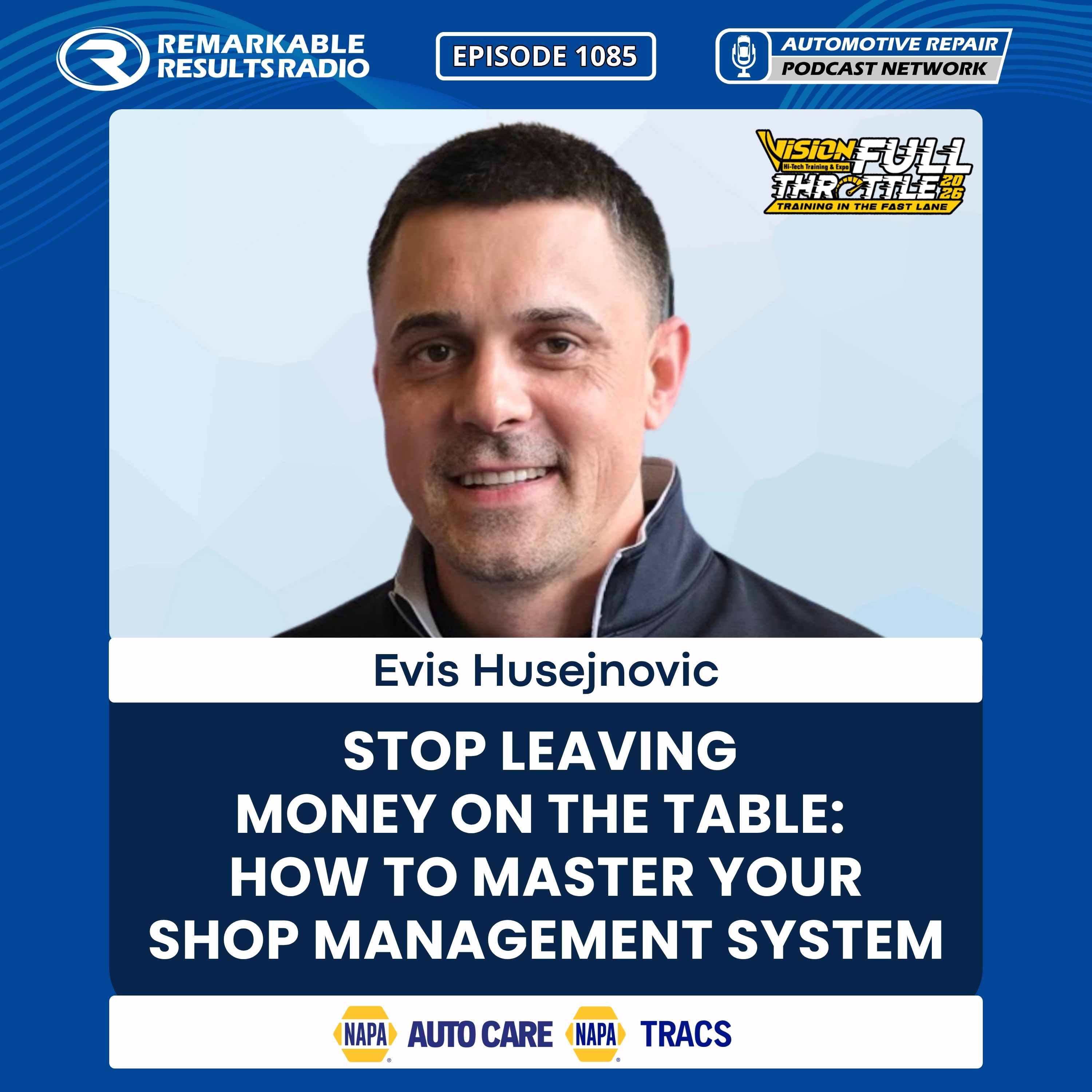
Recorded live at VISION 2026, host Carm Capriotto speaks with Evis Husejnovic of NAPA TRACS about how shops can boost profitability and customer service by better using their shop management systems.
Husejnovic highlights that most owners use only 10–15% of their software, often missing key tools for managing operations. NAPA TRACS addresses this with hands-on support, user groups, and daily training.
The conversation also emphasizes a “treatment plan” approach to digital vehicle inspections, helping shops increase revenue through thorough, preventative maintenance rather than higher car counts. While technology has rapidly evolved, Husejnovic reinforces that auto repair remains a relationship-driven, “handshake” business, and shares how NAPA TRACS is helping train future technicians through partnerships with technical schools.
Evis Husejnovic, Regional Sales Manager, NAPA TRACS will move your shop into the SMS fast lane with onsite training and six days a week of support and local representation. Find NAPA TRACS on the Web at http://napatracs.com/