Tesla Optimus fail, Rivian AI/Autonomy day, Mercedes GLB EV, and more
Electrek
Tesla Optimus fail, Rivian AI/Autonomy day, Mercedes GLB EV, and moreElectrek · Dec 12, 2025
Annotations will appear as you listen
0:00
59:43
Car
Subaru Uncharted
The Subaru Uncharted is a new car model from Subaru that has just been announced, and it comes with specific details about its price and features in the United States.
The Mercedes-Benz GLB is a fancy SUV that has a lot of space inside and nice features. It's made for people who want a comfortable and stylish ride, and it's popular among families. People talk about it because it's a good mix of luxury and practicality.
LiDAR is a technology that helps cars 'see' their surroundings by using lasers to measure how far away things are. It's important for self-driving cars to understand their environment better than just using cameras.
Radar is a technology that helps cars detect other objects and measure how far away they are by using radio waves. It's often used to help cars avoid collisions and maintain safe distances.
The Rivian R2 is a new electric car that Rivian is planning to make, and it's supposed to be cheaper than their first models. It's designed to be smaller and more accessible for everyday people. People are excited about it because it could help more people switch to electric cars.
Level four capabilities mean that a self-driving car can drive itself completely in certain situations, but it might still need a human driver in other situations.
The Rivian R1S is a new electric SUV that can go off-road and is built for people who love outdoor activities. It has a lot of space inside and comes with cool technology. It's talked about because it's one of the first electric SUVs made for adventure.
Volkswagen is a car company from Germany that makes many different types of cars, including popular ones like the Golf and the Beetle. They are known for their quality and technology.
A kilowatt hour is a way to measure how much energy a battery can store. In electric cars, it helps you understand how far the car can go before it needs to be charged again.
All wheel drive means that all four wheels of a car get power from the engine, which helps the car grip the road better, especially in bad weather. Subaru has a special version of this system that they say is very good.
Kilowatt charging is how fast you can charge an electric car's battery. The higher the number, the quicker it charges. For example, a 150 kW charger can fill up the battery faster than a lower-rated charger.
An entry level vehicle is a car that is cheaper and simpler, usually made for people who are buying their first car or want to save money. It doesn't have as many fancy features as more expensive cars.
An electric vehicle (EV) is a car that runs on electricity instead of gasoline. This means it doesn't produce exhaust fumes and is often better for the environment.
'Range' is how far an electric car can go before it needs to be charged again. It's important because it tells you how much you can drive without stopping to recharge.
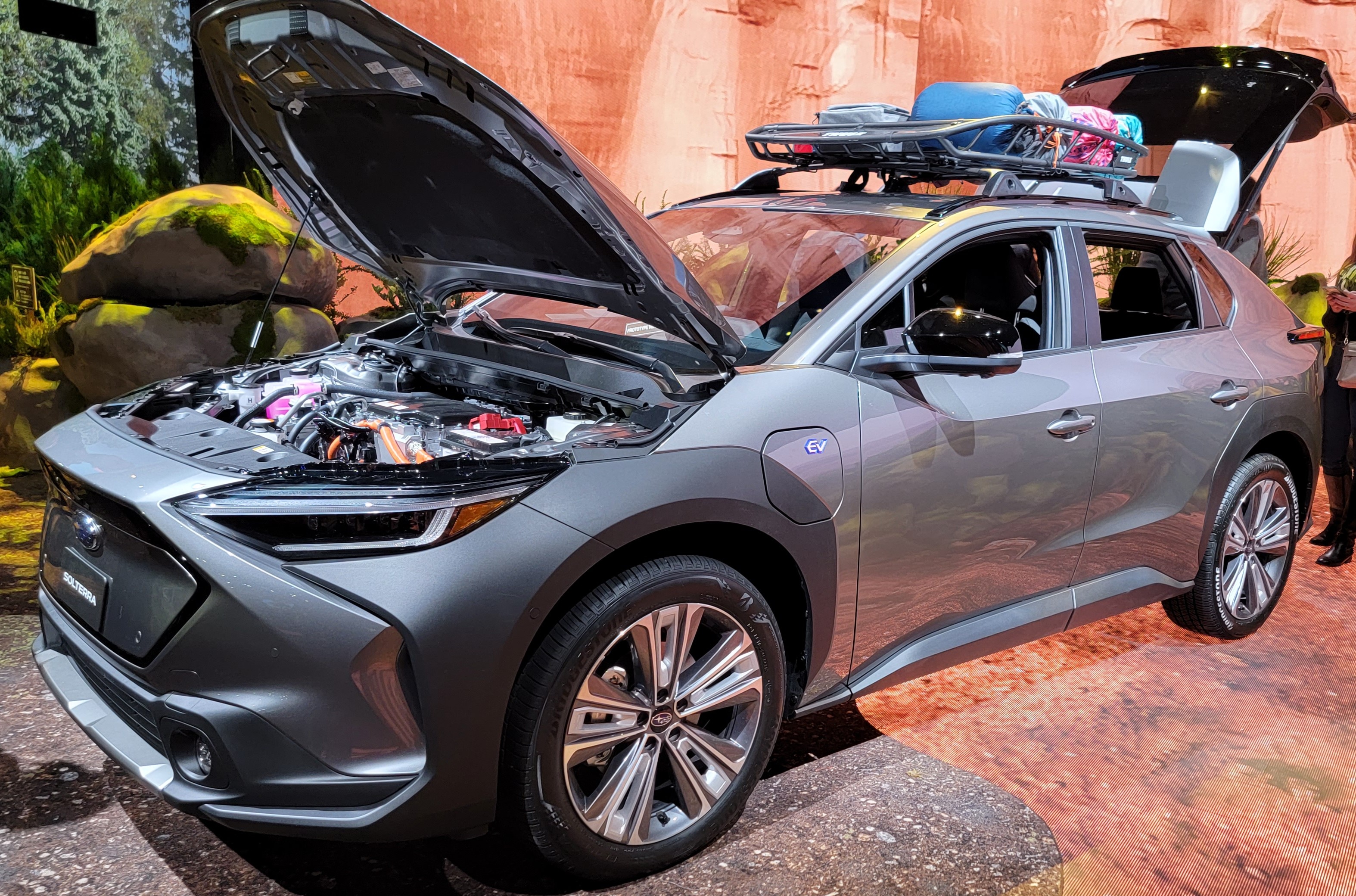
The Subaru Solterra is Subaru's first electric SUV, which means it doesn't use gas and is better for the environment. It's designed to handle tough roads like other Subaru cars, but some people think it doesn't stand out as much as other electric SUVs. It's mentioned because it's a new option for people looking for electric vehicles.
The Mercedes-Benz EQB is an electric SUV that runs on batteries instead of gas, similar to the GLB but more eco-friendly. It offers a lot of the same comfort and space but is designed to be better for the environment. People mention it because it's part of the trend of making more electric cars.
WLTP is a testing method used to measure how much fuel a car uses and how much pollution it produces. It's meant to give a more accurate idea of a car's efficiency.
The EPA is a U.S. government agency that measures how much fuel cars use and how much pollution they create. Their ratings help people choose more efficient cars.
A driving cycle is a way of testing how a car performs under different driving conditions. It helps determine how far a car can go on a full charge or tank of gas.
The G-Class is a fancy SUV made by Mercedes-Benz. It's known for its square shape and ability to go off-road, making it popular among people who want both luxury and adventure.
The MBUX screen is a large touchscreen in Mercedes cars that helps you control music, navigation, and other features. It can also respond to voice commands.
The Tesla Model 3 is a type of car that runs on electricity instead of gasoline. It's known for being faster than many regular cars and has high-tech features like a big touchscreen inside. People talk about it because it's one of the more affordable electric cars available.
A tax credit is money the government gives back to you when you buy something, like an electric car, to help lower the cost.
LIVE
And we are live for new episode of the electric podcast. I am Fred Lambert, your host. And
as usual, I'm joined by Seth Wynch. How are you doing today, Seth?
I'm good.
All right. Big show today. We're going to start with we're going to start with the Tesla Optimus
fell that was really revealing last weekend that happened last weekend right after the
podcast, but talked a little bit about it on the show. Then we're going to talk about the US
EV sales, especially Tesla, following the tax credit expiration. Then Elon just updated is always
used for rebel taxi timeline, but this one is a close one. So it's something to watch for the
next few weeks. Then we're going to talk about revian revian's AI and autonomy day. So that was
this week, and it was a big, a bunch of big announcement. Then we have a few new car on
meeting. Well, I mean, we've seen these car before, but we have for the Subaru uncharted,
we have the final pricing and specs in the US. We have the new Mercedes GLB that was available
fully also this week. Then we're going to talk a little bit about global AV sales and then before
then SK situation in the US that's going down right now was announced yesterday.
All right. If you're joining us live on the show, we welcome your comments and question. This is a
live show unedited. So if you guys have comments about anything we say, you can put them down
below. If you have a question for us too, you can put q-question and then we're going to answer it
at the end of the show. It can be about any of the topics that we're discussing today or any other
topics in the EV world. I'm going to remind you later on the show has more people come into the
live stream. All right. Let's jump into this optimist situation here. So this happened in Miami
last weekend. So last weekend Tesla had something called the autonomy visualized event. And the
optimist is such a minute robot, but there was a fails during the event, which the fell itself is
not that important. Like, you know, robots fails all the time. But the way it fails was really
interesting because it kind of killed the autonomy of the event. There was nothing autonomous
going on with this robot here. So this is the video. If you're watching live, if you're on
me, I'm going to explain it to you. But the guy walks up to the optimist robot that was there to
like, you're not rewind this. Get the refresh button. Yeah. So the guy walks up to the
optimist robot, which was handing out tiny little water bottle. And as you, damn it,
what's going on with the site? I don't know if it's a lag or if it's on my side, but
it's, it's when I use these stream yards. So if I'm not on stream yard, it's,
it goes fine. Do you want to share your, uh, your windows if, uh,
open your, if it's just really, it's me or your stream yard, because I mean, I was just on this
article before the show a moment ago, and it was playing just fine. So it clearly is, uh,
when I have this stream yard app going on, oh, I managed to put it on for a second.
As soon as I'm about to do mine, it usually comes in.
All right. A floor for the people that are listening onto only the robot,
the guy approaches the robot and the, um, the robot makes a brisk movement with, uh,
with its arms and, uh, a bunch of bottles falls to the ground. And then after that,
the robot brings its ends to his face in a, in a way similar to, uh, people,
someone grabbing a headset, a VR headset, and then removes as if it removes the end set,
and then the robot's crashes to the ground after it falls backward and crashes to the ground.
So it looks exactly like a remote operator is operating the robot with a VR headset,
and then something happens. We don't know what, and, um, people removes the end set,
and then the robot falls like a disengage, which by itself is a, is a hazard. Cause like,
why would the robot just falls to the ground if the person removes their, their headset?
There should be some, uh, uh, failsafe there that the robot just balance itself if it's, uh,
disconnected. Yeah. Okay. So you got it. So I'm sorry. It's just funny to watch this thing.
Yeah. Yeah. It is hilarious. I posted that in so many, so my, my post, my article was really
popular, a few hundred thousand hits, but also like posted, retweeted the article on Twitter
and with the video and it went viral. I got two million hits and so many Tesla fans on the video
like kept claiming that it was AI. It's AI. It's AI. There's, it's not AI. Everyone like Tesla
would have come out and confirm it by now. There's no evidence whatsoever that it's AI in there.
It happened. It really, it really did happen. Um, so yeah, it basically confirmed that Tesla's
demonstration, despite what Elon claimed lately, Elon tried to claim that now Tesla is doing like
AI demonstration of the robots. He said that when they brought it, that the premiere of Tron last
month, it was completely AI, which, you know, was clearly false. It was clearly pre-programmed
Kung Fu demonstration. Um, and, and now still like just handing out water bottle. It's still
being teleoperated beyond that. If you look at the video right now, um, the, at the very hand, when,
when right there, it's, you would have to zoom in a little bit more to see, but the, it really
smashes a water bottle where the water bottle explodes as it comes down, which I think is maybe
like even more important than the teleoperated stuff, which, you know, is shady in itself,
because it shows that Tesla is like kind of misciting the public into what the robot can do
right now. But it's also, it shows that the weird line that you have to walk when you have a human
and with robot where for the robot to be robust enough to be useful, it also is big and strong
enough to be potentially dangerous. Like you can imagine like a little dog or something,
they can smash the dog like that, like carrot, they chop it and, and hurt the dog or hurt even
someone or a child with that. So it is, there is a safety hazard. Like I always said that I think
the second I actually get to a useful reminder about before FSD, just because of the safety
concern, like 4,000 pounds vehicle going at high speed is extremely dangerous, more dangerous than
a low speed robot. But now seeing this, I'm like, oh, yeah, there is a real safety hazard involved
here too. That's something, it's something to consider. Alright, so you're going to have to
manage the, the, the webpage for that. If I'm having issues, so you didn't have any issues,
you can click to, or what browser are you in? Maybe I should switch my browser.
No, I'm on Chrome too. What's going on? Alright.
Next article is about Tesla's sales in the US. So Tesla based on Cox, so Tesla doesn't release
monthly sales data, but we are very particularly interested in the sales that are right now in
Tesla in the US because of the end of the tax credit. And based on Cox Automatives data,
Tesla sold just short of 40,000 units last quarter, not last quarter last month,
which is down 23% here over a year. So it's pretty stark decline, something you would expect from
the end of the tax credit. But something that I think is worth mentioning is that
the decline, so I cannot read this line here. I think it's the last line before the electric
stake. It's there. We, I compare the decline of Tesla's drop, 23% versus the broader drop of the
market, which is, can you see? I cannot read it from there. While a 23% drop looks bad on paper,
it's worth noting that Tesla is actually weathering the storm better than the rest of the EV market.
The raw EV sales were down 41% in November because Tesla's client was less severe than
its competition. The company actually saw its market share increase to 56.7% up from 43%
a year ago. But we kind of knew that Tesla would fare better and they're more competitive vehicles.
Elon claimed to, that's what Elon kind of paid for this to happen. He backed Trump with hundreds
of millions of dollars in you. This was something that would happen and his excuse for it was like,
yeah, I think Tesla's going to do better than the rest of the EV market without the tax credit.
So far, the evidence points to him being right about that. Now, even though he's right, is it
good? It goes directly against Tesla's mission to accelerate the events of sustainable transport
and sustainable renewable energy. So that's obviously not good. The way I feel is that it's
it feels like Tesla used the tax credit and other government incentive for the vehicle in the US to
reach volume production. And then as soon as it did, it pulled a ladder behind themselves
so that others cannot use it, which is bad as a whole. But also for Tesla itself is like,
what's the actual end game here? Okay, you're the biggest fish now in what is a smaller pond.
Because also what happens during that time is that the market share of vehicles in the US
dropped to 5%. It was already not good at 10%. Overring around 10%. It's shut up in Q3 at like
14% temporarily, obviously, but now it's back down to 5%. So you're just like the biggest fish in a
smaller pond while in Europe and in China, EV sales keep going up and Tesla sales keep going down.
So like it's not doesn't seem like a smart hand game to me.
All right, moving on to Tesla's RoboTaxi. This is Elon's RoboTaxi claim. So
by the end of the year, Tesla based on when Elon said just a few months ago, Tesla supposed to have
RoboTaxi covering half of the US population. That was sort of downgraded to a few cities by the
year. But now it's becoming clearer and clearer that if Tesla expanded a few more cities by the
end of the year, it's just going to be with this RoboTaxi name only system that is
Uber drivers using Tesla vehicles on Tesla's network with FSD as the main driving capability
of the vehicle. But under the driver supervision, it's becoming clearer and clearer and clearer.
So now that the other goals separately to that is in Austin itself, Tesla is supposed to remove
the supervisor from inside the car. So that's, you know, Tesla fully having the first level
force system ever once they do that, not as the market for Tesla because obviously other automakers
especially Waymo, other autonomous driving services like Waymo have achieved level four already.
But if Tesla removed that for the first time, they are officially caught up to Waymo on that front.
But we noted that the current crash rate even with the supervisor is much higher than humans,
so Tesla shouldn't remove that. This clearly is not ready. So we didn't expect Tesla to come
deliver on Elon's target that, you know, I think he said within a few months back in June that
so they are already behind that target. But now you said, you know, we're off to be before the
end of the year. And this week he said within three weeks, he said two to three weeks, Tesla is
going to remove, at least in some cars, he said the supervisor. Again, I hope they don't not because
I hope that this doesn't succeed. I'm saying that because I think it's a premature move because
from the very limited data that we have, and it's the best data that we ever had from Tesla on
that front because of the NHTSA reporting obligation for autonomous driving, the crash
rate is around 60, once every 60,000 miles, which is 10 times higher than human drivers.
And that's with a supervisor in there preventing, I would have to assume further crashes. So
it's just, it doesn't make sense to me unless something happened in the last week or two where,
you know, they have somehow accumulated millions of miles. But even then it doesn't make sense. It
looks like they are about like best case scenario, 100,000 miles per week with the robot taxi service.
So there's no real idea where this makes sense. Either Elon is lying and they won't remove the
driver or Elon is saying the truth and they're going to prematurely remove the supervisor.
I think that, I think I, I currently describe this situation.
Yeah. And I don't know if I would bet on Elon telling the truth. So I don't know.
I mean, I would also bet on Elon doing something prematurely just to take a win
for the market. So, you know, these, these two things are pretty close.
Yeah. All right, we're going to move on from Tesla of just 15 minutes into the shows that are
record for us. I hope that those who don't like to talk about Tesla too much going to be happy.
Next, we're going to talk about the Rivians AI autonomy date, but I want to remind you that
we are a live show. And if you guys want to ask us questions, you can put them in the comment
section below. We're going to answer them later in the show in about another 15, 20 minutes or so.
All right. Rivian AI day was on the 11th. That was yesterday, right? Yeah, that was yesterday.
So it's basically, there was two parts of it. There was the AI part that was specifically,
I mean, there's some AI going on in the autonomy front too. I don't know if you can open the
window. Sorry about that. Don't worry. There's a few videos in there that scooter
that are interesting in some, some images, especially the R2D2 inspired wrap on the
R2. And yeah, it's, so there's, there's some AI obviously in the autonomy aspect of it,
but there was also true separation from it because there was an unveiling of an AI agent
now that's going to be inside Rivian vehicle. So a lot of automakers have been integrating
LLMs. And we talked about Tesla with Iraq, we talked about Volkswagen with Charge PD.
We, we talked about the Chinese automakers, all the Chinese automakers have an AI in them now.
So, so everyone needs that. It's the new, it's the new way to interact with the vehicle.
Not, you know, it's optional. If you don't want it, you don't, you don't use it.
You're not a fan of AI at that. But in, in a day to day use, I have to say that
a large language model inside the vehicle is useful because it's a more natural way to interact
with the vehicle. It's not, you don't have to have like the exact sentence he needs to say to
activate a specific function. It's a little bit more, you know, fluid conversation. So they have
that. I think I read, I don't know if it was in Scooter's article or if it was in the original
unveiling, but I read that it's based on Google Gemini, I think. Sounds right. Yeah. Yeah, Rivian
is like really connected with Android and Google because I think the VP of software is like was
the leader of Android for a while. All right. And then on the other side, on the autonomy side,
there was a lot of unveiling. There was like the gen three autonomy computer. There was the
custom silicon processor. So just like Tesla Rivian is doing its own custom silicon for,
for the next gen Rivian autonomy feature. But the big thing is that Rivian is not going Tesla
away with the vision only. The video that set is showing right now is very interesting if you
can go back to the video right there. So that's a very cool video that shows
why Rivian is going with vision, radar and LiDAR. And they show this video where you can see in
real time from the same scene, you can see what a vision only system detects, what a vision plus
radar detects, and then what a vision plus radar plus LiDAR can detect. And you can, you know,
in this higher lighting scene here, you can see it's, you know, it's very similar. But then in
this scene, you can see the LiDAR system sees way further and way more objects than just vision.
And that's in the foggy scenario here. And here is just not foggy. I think it's clear scenario,
but it's dark. And you can see both the radar and the LiDAR system detects the people on the side
of the road way sooner than just vision only. So there's, there's obvious, my thing with the
vision only is like, yeah, obviously, if it can work, you can work vision only, is it going to
be as safe as LiDAR and LiDAR? Obviously, no. Why, then then you have to go back, why did Tesla
go vision only? Tesla go vision only a while back. I mean, you know, it was gradual, like they had
the radar at first, and then they removed the radar and the thing, but let's say 2019 was
basically when Tesla went like all in in vision. And that was just six years ago, but six years ago
LiDARs were way more expensive than they are now. So I understand that I was a cut cutting effort.
Okay. And now Elon's argument is that it was not just a cost cutting effort, it was that
he claimed that LiDAR made the system even less safe than vision only. And that is due to sensor
fusion. So it was difficult to efficiently and reliably fuse the input from the LiDAR sensor
and the and the vision sensors, the cameras. And he's right. It was, it was right back then. It
was super difficult. Still is a complicated problem, but much less today. Like, because
the sensor fusion is a difficult problem that Tesla couldn't solve back in 2019 and decided
not to work on it. This actually has just not worked on it doesn't mean that other automakers
and other companies working on full stop driving couldn't solve this issue. And they have and
especially with the advent of AI, which now end those a lot of the inputs from the, the different
sensors, the sensor fusion is now all it's a solve problem. That's, that's the thing. And, and
that's why you can make the argument that when it comes to complete sensor fusion system with
radar and LiDAR, Tesla is completely behind the competition might be a little bit ahead with vision,
but they are way behind with sensor fusion, which is a problem, in my opinion.
So yes, they're doing LiDAR, they're doing LiDAR. Apparently,
they're going to introduce it late 2026. So there's, there's things coming out this month.
There's things coming out early 2026 for, for all gens vehicle, but especially gen two.
And, but then the LiDAR stuff, which is the one that's going to enable l four level four self
driving is going to come late 2026 on the R2. And that's what we're seeing right now. If you
want to show us at the R2 D2 R2 Rivian. And that's the one of the other thing that's cool too,
is like one of the things that Tesla didn't like about LiDARs was the integration inside the vehicles,
which was right, like it was big pucks coming out of the vehicle just didn't look good for a
company that was trying to sell cars to consumers for a company like Waymo. They don't care as much
because no one's going to own the car. But then it's just about getting from point A to point B.
People don't care that much about how cool the Coral looks, you know, you don't, you know,
unless you want the Uber black and everything, you don't really care what your Uber driver
scars come out with. Only doesn't smell bad. But yeah, so the for the consumer vehicle,
it does matter if the car looks sleek and having big contusion coming out of the vehicle with
these LiDAR pucks didn't look good. But in this case, for the front, for a front facing LiDAR,
which is the most important one, obviously, Rivian was able to do a very minimal extrusion
from the windshield slash roof. That is not much bigger than, you know, the camera system for
the vehicle, which is also just underneath it. But yeah, so that was one of the big things. The
other one is like I said, the custom silicon, which enable a trillion operation per per second.
I think it's 800 tops per chip, 16,000 total. Yeah, five billion pixel per second processing
capability. We have the rivuling that's a low length and center connect technology between
the two chips that are on the on the computer. That's a new computer that's going to come into
the latest vehicles next year. What else? What else do we have here?
11 camera system. Okay, we'll already talk about the LLM.
They announced the price. So so they're the equivalent of the FSD is going to be now called
autonomy plus. And autonomy plus is launching in early 2026. And it can be bought for $2,500
or $50 a month subscription. So this is the competitor, the Rivian's competitor to FSD,
much cheaper. Obviously, now they're not promising like the vehicle to achieve any kind
of capability like Tesla. So that's the big difference here. So they are talking about,
you know, similar capabilities as FSD and obviously the hardware suite is even more
complete than Tesla's. But they're not there. They're saying that they plan to have level
four capabilities in the future, but they're not promising anything on the current hardware that
they're selling. Now, when they have the LiDAR R2s next years, that's probably going to be
another thing that's going to be really the one that's going to enable that. Now, the way that
they talk about it got me a little bit confused on that front. I don't know if Scooter had
so they weren't clear. So Scooter says LiDAR is likely to be introduced in R2 next year and
future manual beyond that and the new autonomy capabilities are on the way for a fee that will
include more ends free friendly routes around the US and Canada. So yeah, the ends free route
that's happening this month, I think, or next month max, but that's, that's for gen two R1s vehicles.
And right now there's 150,000 kilometers or miles, I should say, available of route that
do that. And then it's going to go up to millions of miles now. So that's a big upgrade already
that's going on. But the thing that confused me a little bit more when it comes to LiDAR is that
they said next year it's going to be introduced to R2. It's not clear if it's going to be
right away because the R2 is coming first half of 2026. And then there was some mention of
more like later in 2026 with R2s. So I think that could be like a little bit of a problem in
term of, you know, some people wanting to hold up for the R2s with LiDAR. But the same time,
and I'd like to have your opinion on this set. I think the demand for the R2 is through the roof
already. And I don't know that everyone's going to want that. I think a lot of people just want
a car that they can drive themselves and don't necessarily want the autonomous features.
So I think that Rivian can sort of afford to have a delayed launch of that. Do you think?
Yeah, I mean, that seems right. I mean, I guess why are they announcing this now versus
like when it's ready? I guess they want to get, you know, the people who have the generation
to R1s excited and keep selling those vehicles. But like, you know, to get the full suite of
stuff, you're going to need LiDAR or you're going to want LiDAR. They've kind of sold it. So
it's interesting. Also, Scooter notes that, you know, this is maybe stuff that's also coming
to Volkswagen. Maybe this is why the Volkswagen was like, Oh, we like that.
So is that is that his opinion? Or did he say like, was there someone saying that there?
He just says, take, for example, Rivian's view, you know, licensing. Yeah. But I would imagine.
No, it makes sense. It makes sense.
But also, you know, like, you know, people who have Rivians now,
like, they're not going to get much of this. If you have a version one of it,
you're not getting anything. Version R1s, version two, you'll get some of this stuff.
And then you got a way to provide R to get all of it.
I think the R1s, Gen 1, was it there something about the EI? Do the EI assistance you still get,
I think? Yeah, but I mean, that's, yeah, that's just compared to autonomy is not much.
Like a web browser. So, you know, some bad, some good, some in between.
Rivian stock didn't like the event itself yesterday. The stock crashed like 8%,
but then it jumped like 18% today. I think it's settled at like 13% or so. But it's way up from
the event. So I think, and as it should, I think it's, it's sure that Rivian is not that far behind
Tesla in this. In fact, in some ways, in level four, it might even actually be closer at the
consumer level than Tesla. And I think it's going to basically ensure that the R2 program is going
to be as complete as it gets. And when it comes to like the needs of everyone, those that actually
want to drive their car and those that are want the autonomous features, because like we see it
with a take rate of FSD, it's not that popular. Again, I think most of the value is in the full
self-driving unsupervised capabilities. So that might be just why the take rate is not great.
But I think also a lot of people just don't want to pay $100 a month for a car to drive you most
of the time. It's just not that great of a value proposition. You know what that thing is going
to do though? I think that's going to drive the price of FSD down. I wouldn't be surprised.
Yes, good boy. I wouldn't be surprised to see FSD costing $50 a month next year, sometimes next year
once the R2 launches and everything. Because now the idea of like, hey, Tesla is the only
car that can do that is like, yeah, yeah, I mean, it doesn't do what it says it's supposed to do.
But sure, it's the only one I can do that. Once it's not the case anymore, it's just,
you know, supply, a higher supply. The demand is already saturated from Tesla when it comes to FSD.
So I think I wouldn't be surprised if the price goes down either next year or even,
you know, I'm going to make a wild guess here. But the way that Tesla time,
the new free trial, the new one month free trial last month started late last month,
it's going to hand for most people before the end of the year. What if
Tesla reduces the price at the end of the trial for most people when they switch,
like when they take it away from them and like, hey, by the way, if you order now,
it's now $50 a month or, you know, $3,000 instead of $8,000 if you buy it outright.
And they do that right before the end of the year to just boost revenue
or boost even just the take rate, maybe the announced for the first time, the take rate.
Well, not the first time in the last few quarters, they sort of talked about it a little bit more.
But they can say, hey, now we have 20% of the people in the U.S. that buy FSD up from like
10% last year. Yeah, of course, you drop the price 50% to like, if they can show that that
they went from like 5% in 23 to 10% in 2024 and then 20% to 25, that is something that if you're,
you know, an analyst, you're like, oh, that's a crazy take rate. Of course, the price
again keeps going down, but it's something to look for. I wouldn't be surprised if this happened
before the end of the year. All right, moving on, we have Subaru, the new uncharted electric SUV
from Subaru. So we saw that car earlier this year. Look, I'm not showing my page right now.
You have it, but I opened the Subaru Uncharted article from Peter, and we have a Subaru Uncharted
ad on it. That's great integration. Yeah, great integration there. And to be fit for people
that are like, oh, you guys are bought out, like, no, that's not us. That's Google doing this
by its own. So we're not getting money directly from Subaru. It's like, we didn't know that had
that had will be there. Everything is through Google, but it looks like Google actually thought
like it would make sense for it to push that ad there. And now the ad just changed to pole
story. All right, so the uncharted EV, the next EV from Subaru, we got the price and final specs.
So you get a 74.7 kilowatt hour battery pack. And for the base version, it's rear wheel drive.
And then for the sports and GT version, you have all wheel drive with Subaru symmetrical
all wheel drive system. They always make me laugh a little bit when like Subaru still claims to have
this, you know, top of the line all wheel drive system when dual motors all wheel driver, you
know, we're not exactly the same, but they're, they are a lot closer to each other than the
mechanical all wheel drive system in IC cars. So the sport and GT variant gets you to the
sports gets you to run any five miles of range, the GT give you 270 miles of range.
You know, that's pretty good. 150 kilowatt charging 10% to 80% 28 minutes, you know,
not bad, but also would like to see a little bit more. I think 200 should be like the bottom
these days. But at the same time, like this is an entry level vehicle here, because the price is
is the most interesting part. So sorry, I said the rear wheel drive is forward wheel drive,
by the way, the base version. So the forward wheel drive starts at $35,000. And then if you
want the sports version to get the all wheel drive and the top range of 285 miles, that's $40,000.
Reasonable prices, new options on the lesser, the bottom part of the of the of the EV market.
Because now I mean $35,000 for a new car these days, it's like a good
yeah, way under average. Yeah, $18,000 on the average set, not just on the average,
$18,000 over the average. It's not bad at all. And this is in dealers early 2026 in the US.
Yeah, nice interior, like Subaru drivers, you know, they've been kind of waiting for like a
good EV. I saw this one when it was unveiled in New York City a few months ago. You know,
over 300 miles of range, like they're getting all the things that Subaru, you know, that's the
Solterra, come on. That was pretty weak sauce, like just a bit over 200 miles of range.
The sport and GT variants deliver 285 miles or 270 miles of range. So pretty close to 300 that
the high end I think is 308 miles, whatever something over 300. Pretty good setup. I think this
is like the Subaru that Subaru, this is the electric Subaru that Subaru owners are actually
going to want. Yeah, it looks good too. I think it's one of the better looking crossover
on the market right now, exterior-wise at least. The two-tone orange too,
is like especially nice. I'm sure that's an upgrade, but it's pretty good.
Mercedes-Benz has officially launched the GLB and Mercedes is not the same
company when it comes to electric vehicles than a few years ago.
And three or four years ago, they've upgraded quite a bit. I have to assume that a lot of that has
to do with their ownership. I think they are Italy owned by Geely now, like 20, 20, 30% or so.
Is that right? Yeah, yeah. Yeah, they're a big owner in Mercedes and I think they are the one
that's pushing them a lot to go better on electric and this, you know, I mean, what was the EQB?
Like the EQB was kind of disappointing, like smaller SUV, but now the GLB EV is beautiful.
Absolutely. I mean, in matte black, it's hard to go to go bad and matte black Mercedes-Benz is always
sleek looking, but this is not just on the beauty level that it's nice. It's the actual spec level.
So 631 kilometers shredded in 92 miles of range. That's WLTP, sure enough, but it's still going
to be over 300 miles on the EPA. That's for the GLB 250 plus. Then you have the 350 formatics,
so if you go all wheel drive, oops, we don't have the range there. Yes. Oh, yeah. Oh boy.
Just, it just dropped to 614 kilometers to an 81, 11 miles of difference for the all wheel drive.
That's quite efficient. It's on 85 kilowatt hour batch pack too. So it's not like,
you know, we've seen BMW like get these, these great ranges recently, but that's on like 100
kilowatt hour batch pack. So this is actually pretty efficient. Yeah, it's WLTP though. Yeah.
It's probably going to be under 300. On there, you think? You think it's going to lose 80 miles?
On the EPA? Yeah. I mean, it's a big car and it's 85 kilowatt hour. I mean, it's kind of like
close to a model Y. Yeah. I mean, I know that the driving cycle for the WLTP is a little bit
different in the US because, you know, it is European, not just European, it's a world standard,
but it's like mostly used in Europe. And there's more city driving, a little bit less highway. So
that affects the range, obviously. But one of the biggest changes that they don't account for
climate control to Europeans are weird about that. Climate control, both inside houses, inside cars
is not the same habits as the North Americans. But yeah, so I think there's a way to get close
to WLTP is just, you know, it's a lot more lenient than EPA. Let's be fair.
Oh, well, we wrote this article. It was Peter. That's a Peter article. Yeah,
it's Peter article. Peter did try to make his own little calculation here. And he said,
330 miles, he think it's going to be on the EPA scale. All World Drive 320. So I mean,
I'm leaning towards Peter here, maybe somewhere in between like 310.
Also, you go upper, you go a little bit more in here than the Subaru, and you get 320 kilowatts
of charging capacity if you're on a height of the world station. And that's going to give you
260 kilometers or 61 miles in just 10 minutes. The design, I mean, I think it's big upgrade compared
to some of the previous SUVs from Mercedes. I mean, I'm not going to say it looks like a G-wagon
or anything, but it definitely has more G-wagon vibe to it. Yeah, it's boxy.
The interior, I don't know, like if you scroll down a little bit, this is like...
That's the third row. Yeah, it is. Yeah, you do have a third row option. I think it's optional.
Yeah. Then after that, you have the picture of the front seat, which you have the giant
MBUX screen on this thing. Mercedes is Apple CarPlay, right? They do Apple CarPlay, right?
Yeah. So do we have pricing on this? For those of the U.S. Mercedes, we will be pricing the
closer to launch. Given the new 2020 6CLA EV starting at $47,000, the GZ is going to be
priced a little bit higher. So yeah, probably going to be starting in the low $50,000 range,
I would assume. Man, I think this is going to be a problem for Tesla. I'm going to be honest here,
but because Tesla makes a lot of money from the iron end of their lineup in the U.S. In China,
you cannot even sell those. I guess only sell the cheaper version of the Model 3 Model Y,
but the all-wheel-drive long-range Model Y, still it's going to be cheaper than this, probably,
but if you fully equip and everything, it's getting in the same price range. Between the I-X3
from BMW and the GLB from Mercedes going at X-Chic, I think that's a lot of pressure on Tesla for
the top end, because these are arguably more luxurious, more fresh looking. Model Y, we've
seen quite a bit. This is a little bit more luxurious, more understated, less techy, more
premium, let's say. I think I was going to put a little bit of pressure on the top end of the
on the feed in Model Y. Moving on, a little bit of data on global EV sales in 2025. The year is
not over, but we're almost done, so we already have a lot of data. It looks like EV sales globally
are up 21% this year. For all the people that says like EV demand is slowing down and blah, blah,
in a market like the automotive market, which is such a big boat to turn around the automotive
market, a 21% increase over a year, and we're talking about 21% increase on an already large
market, like it's 18.5 million units to date up until November. Still another month left, we're
past 20 million units in 2025. That's impressive. That's with PHEV though, I think.
So that's reference the European EV market. I think that includes PHEV though. But PHEVs are
not what they used to be, like especially you have to put like BYD in there and things like that,
and they sell a lot of PHEVs, but they are PHEVs that have like a more significant range in what
we're used to in the early PHEV days. Alright, one more news article, and then we jump into the
comments section. So if you guys have questions for us, you need to put them right now, we can get
to them in just a few minutes. I want to talk real quick about the announcement that happened
was it yesterday or Wednesday? It was yesterday. Ford and SK, well actually SK announced it. Ford
just said no comments, but they announced a split of their recent joint venture and huge joint
venture in the US to build three massive factories for battery cells. So that's that's quite a move
here. So effectively what happened is that if you remember back in 2021 SK, which is a South
Korean battery manufacturer, partner with Ford to build three massive factories in the US,
two in Kentucky and one in Tennessee. And the goal was to supply Ford with batteries for their
ambitious electrification plans. Now those inefficient plans have taken quite a step back.
And what happened is that they're basically dissolving altogether the joint partnership
and splitting up the assets. So the so is the one in Kentucky. So yeah, Ford, Ford keeps the ones
in Kentucky, which is actually just one factory because the other one is was still in construction,
I think. So I don't know what's going to happen with the second one. But the first one is in
production. And Ford is keeping it. And then the one in Tennessee is going to SK. So basically what
it allows is allow SK to now sell batteries from this factory in Tennessee to other automakers
than then then Ford. So then if you extrapolate from that, it means that basically Ford is seeing
its demand for batteries going down quite a bit, which is not surprising considering the scale
back of the EV plans in the last few months, especially since the removal of the tax credit
in the US. So really, really just bad news all around on that front. I mean, not that bad news
because I guess SK can turn around and sell that. I should mention they specifically said SK that
also enables them to sell to other automakers, but to sell to the energy storage market too,
because they're producing LFP cells of the battery, which are also used in energy storage.
So maybe like Tesla, for example, that was looking for locally made LFP cells could
buy from SK there for their mega packs and so on. So, you know, it's not all bad that that
could be a quick way to, I'm sure there's some kind of bidding war going on right now for the
capacity of that plan for people that are relying on the LFP cells from China. And those people are
mostly Tesla right now in the US. So not all that. All right, let's jump into the comment section.
All right.
Yes, I'm early. Hello. What do you think of the future of level two charging is J1772 or NACS?
NACS. Yeah. Actually, maybe the future of level two charging is not even level two. Maybe it's
maybe it's all DC charging. Is it going to be easier just to charge via DC? Like if they're,
I mean, if like, why have the inverter in the car? I always wondered why like,
why not just move the inverter out of the car? Like, you know, my lawnmower, for instance,
the inverter's outside, you just plug in a DC thing to it. Anyway, the future of long,
long, long in the future is going to be DC, I think. Yeah, there's also the now the home charging
station that are DC that are battery powered, like the bi-directional charging. I had an article
on the SIG energy system. I read this year that I was really impressed with. And these are selling
like crazy, like I said, like I talked to Sylvia a few weeks ago. And so Sylvia is a distributor
in Quebec. And I think he got like six or seven system for the for the first batch,
and he sold them right away. And now he just ordered like a million dollars worth of them.
And it's all sold out already. Like it's theater selling like crazy.
All right. I don't care what anybody else says. The top story of the week is the revelation that
the R2 will be equipped with Vidar. I mean, in the context of Tesla not doing Vidar. Yes,
that's a big deal. But like Volvos have Vidar. Like it's not it's not rocket science. Yeah,
I guess I guess it's one more people putting their like betting that the Vidar helps. But like I
said, I think I think it should be obvious to anyone that's been following the sensor fusion
stuff. Like Elon was right that it was a problem. The only thing is like he wrongly thought that he
could solve a Tesla with vision before solving sensor fusion. That was his only miscalculation
there. Yeah. And I think, you know, I probably should have said this during the
when we were talking about the post, but I think the idea is that you want to like if you're going
to impress regulators and then tell people that you're you want to be safer than events, right?
You don't want to be as good as I have eyes like that's what the cameras are basically like
if you want it to be super human humans. Yeah. If you want it to be super human,
give it super power and LiDAR is a superpower. Right. Exactly. All right. How jealous are the
engineers at Tesla watching the CEO of Rivian give his team all the sensors they need for
full self driving? Yeah, I mean, I think they're jealous of Rivian for a lot of ways like I've
I'm not going to name any names, but I've been to Rivian events and talked to Rivian employees
quite a bit. And a lot of them come straight from Tesla. And it feels like, you know, those
those cows that have been in the in the winter, they're stuck inside the like the little like
almost a prison like situation. And then after the snow melts and they let them out for the first
time, they had they had that energy to them. They're they're like, yeah, we're free with that.
Now we can can be yourself. All right. Did you see Ken Power and Kalmar collab? They are a leader
in port equipment like electric pork lift trucks and those huge straddle carries.
DDP London port installed 12 MCS chargers first of many. I think Scrawfinkel is the Ken Power
PR person. So yeah, send it to our tips line tip at electric.co. They appear to be marketing
the Tesla bot as a drink serving robot. So you can either spend 25,000 on a Tesla bot or get
even more functionality from a $150 soda stream. Yeah, I mean, not not for it. I mean,
it's a joke, but it's it's funny because it's not that far from reality.
Right. I wonder when the genie is out of the bottle and Tesla stock crashes now with Rivian chip
too. I know it kind of just feels like one of those things that it just keeps going,
like no matter how bad the news is, there's always just like.
But like I said earlier, I don't know if I said them on podcast or I said it on an article or
anything, but I think that the stock will probably on this, you know, Tesla, it works out and
can increase earnings like six to 10 times because that's what they need to go back to
sort of a normal price to earnings ratio. But you know, one of those need to happen.
And I think that it's going to happen once this actually solves autonomy and it works
in the market where there are just one competitor and scaling is not as easy a thing.
And not everyone wants to have a personal car that is self-driving. And they start to realize
just what the market is going to look like in the future where you have both self-driving
ride ailing system and consumer vehicles were self-driving to level four. I think
I think people are going to realize that it's not all rosy and it's all like crazy,
super high profit margin market. I think that's when they're going to come back to reality.
Yeah. All right. As soon as Tesla pulls drivers from their taxis,
it will be clear that the emperor has no clothes.
Yeah. I mean, like I said earlier, if they do it sooner, if they do it too soon,
it could be a problem. That's what I don't want. I don't want people to realize that Tesla is not
what it says it is by people dying. It's already happened. We already saw like crashes related
to Tesla's ADAS system. But there's always, with that situation, with the consumer version of it,
there's always, you can say that it was an abuse from the driver, which is technically true. So
the blame is sort of spread out between the driver abusing the system and Tesla,
mismarketing the system, leading to the driver abuse and everything. So it's a murkier situation.
If it's like there's no supervisor, no one in the car, and it crashes, and there's someone that's
hurt or ties, like all the blame is going to be on Tesla. It's going to be bad for the company.
I think that should be avoided for other reason than the fucking stock price.
Yeah. All right. Question. Croatia is ending net metering for residents solar in 2026. What do
you do now for best usage of solar electricity? What are the pros and cons of net metering and
future of it in the world? I think net metering being gone, I think that's time to get a battery.
Use your car as a battery. That's basically what net metering is, uses the grid as a battery.
It's still not ideal, though. Obviously, net metering makes sense. I don't know why they're
ending. I don't know particularly about Croatia's grid. So I don't know what's happening there.
But we are actually launching it net metering here in Quebec next year. There's countries doing
different ways. But I think even with batteries, net metering makes sense. If the grid needs the
electricity, you should be able to buy it from people producing it. It just makes sense.
Yeah. It makes no sense to kill it. Skeptic has solar, home solar, and if you lost net metering,
you get a bunch of battery capacity. Essentially, stay off the grid as much as possible.
If they don't want to help you out, or let you help them out, well, cut them off completely.
Someone claimed that during the demos, a Rivian rep said that adding LiDAR would be about the same
cost as premium paint options. Which are like $2,000? That's kind of expensive. I mean, I know that
like the Hesse LiDAR from China is like $200 or something.
I'm seeing a big Afila ad push. I think that's the Sony Honda.
I drove it. I drove it in Gran Turismo. Oh, nice.
All right. Are we going to talk about the Waymo causing new traffic jams and driving
into an active crime scene? I, for one, don't feel like Waymo is a finished solution,
and I don't trust being around them. I mean, the brake traffic laws, that's true.
I don't know if I saw the crime scene thing. I did see an abnormal number of
not respecting school buses stop signs. So that's obviously a problem.
It's not a complete product. That's for sure. It's not a finished product.
You said finished solution. If it's not a finished solution, it's still improving.
But you shouldn't be worried about being around them more than being worried about being
other driver, human driver. Statistically speaking, Waymo's data shows that they are safer than
humans right now already. So that's obviously good. And humans are not always great drivers.
You should be worried about them too. That's the case. But yeah, I mean,
obviously, any kind of bugs like that, traffic jams, I'm not sure. I do remember the two Waymo's
that were doing the Spider-Man to me in real time. That was interesting. But yeah, I mean,
there's still plenty of room to improve. That's for sure.
All right. L2 is important because it's much more kind of the grid. If people all relied on EVs
and DC fast charging, it would be a massive problem. Yeah, I'm not saying... So you can
charge... I mean, when everything's super smart, I think you can have a car charge at 3 a.m. at
full speed. That would be great. So it's really not about the speed or the grid. It's more about
having the ability to go to a high charge rate. And the DC... I'm just talking about DC. Instead
of having AC in the car and an inverter in the car, you can have that on the wall or wherever,
or hopefully you don't even need AC. You're getting DC from your solar or batteries or whatever.
All right. If EVs are the future, i.e. same car count, but all I see become EV,
which won't work with deep decarbonization, then the grid's energy availability would dictate
when and who is charging slowly. I'm not sure what the point is there.
The decarbonization. Talking about batteries or...
Yeah, I'm not sure. Can you talk about how successful is the Electric? Approximately a
number of readers, listeners, podcasts. In other words, how big a reach do you have?
I think we're like top 10... I mean, we're talking about the podcast. I think we're the top 10
podcasts. Last time I... Cars, yeah. The podcast reach... I mean, the live video between all the
platforms, like the live and then after effective videos, it's maybe like 5,000 people or something
like that, but then the odds you only were way bigger than that. What was it? Like 40,000
downloads or something like that per episode, per month? It's weird because it's hard to follow
that stuff because you have the chartify, which has Spotify numbers, but then you have to look at
Apple. Everybody kind of keeps their numbers closer to chest. Yeah, we get... I think we're
six figures of audio only, listeners. Yeah. And then the website itself is way bigger now
in millions of monthly readers on the Electric website. All right. Who are you kidding? Tesla
will never solve self-driving before they go under. I don't know about that. It's going to be pretty
hard to get Tesla to go on there. Yeah. Do you think anyone else... Then Alpetronic has a shot
in the U.S. market. ABB and others are vanishing. Well, we are there. I just can't power it. I just
got invited to go to Daytona 500 by ABB. So I don't know. Hopefully that invite is still good.
Well, I did do it. I did do it at 500. They have an electric part of that.
You're going to go? I think so. It's in February and it's in Florida. You're often in Florida,
February. Yeah. All right. But yeah, we have our scrumfinkel Ken Power fan. And also I think
Ken Power is going to be a big competitor on the U.S. market. They are bigger in Europe right now,
but they have great alt-ware. As a pedestrian or cyclist, you cannot make eye contact with an
AV to make sure that they see you and your intention to proceed through a crosswalk.
No, you can. Well, I mean, you cannot make eye contact. But now there are some vehicles that do
recognize hand signals. So you do a stop or you do a let-through. They will recognize it and
act accordingly. So I guess you're not technically making eye contact, but they'll see you and they
will try to interpret what you're doing. Which is not always great with humans too.
Yeah. The flooding situation though, I like go ahead and they're like, no, you go ahead.
All right. The Rivian engineers lighter cost similar to a paint option was about the $2,500
RAP plus price, not the LiDAR unit cost per car. So I guess that's the whole sweet
plus software at $2,500. Yeah, that makes sense.
What's the fastest DC chargers in the USA in Europe? There are more and more 350 kilowatts
or even stronger. There's 1,000 kilowatts now in China. I saw several of those stations in
Shenzhen last time I was there. In the US, it's 500, the biggest one.
I mean, for cars, yeah, but I think trucks are megawatts and more.
There's a few megawatts station for trucks now. Yeah, I mean, it's happening. It's
people don't know the level of complexity that goes with deploying a public DC fast charging
station. There's so many things that need to happen at once. I mean, yeah, that's where you
have to give the sleds flowers. Like they really nailed that process better than anyone on the
planet by a mile, which is why we were so shocked when Elon Musk fired the entire team that
he imagined like the best thing their company has ever done is deploy the best charging network by
far. And because you're just a little big ego knee jerk reaction guy, because you have a disagreement
with firing part of the team with the leader, you decide to fire the entire team was such
a bad decision. Well, the leader of the team, she wanted to save her employees and he was like,
employees who have demonstrated their incredible value to Tesla by by deploying the best
charging network in the world at a most efficient price and the best rate than any other automaker
and he and she's just out there defending her team is like, we are bringing more value to Tesla
than probably any other department. We haven't figured out where she went. Did she get like a
job at Rivian or something? Uber. She went to Uber. She she was the head of relativity at Uber
for a year or two. And then she was promoted earlier this year to she's the head of Uber
Fright now. Nice. I guess promoted. I don't know if it's a promotion. All right. That's it for
this week's episode of Electric Podcast. I hope you enjoyed it. If you did enjoy it,
please give us a like a thumbs up and subscribe, whatever it is on the app you're watching. It's
free to do and it helps the show more than you think. And we're going to see you sometime
in place next week.
About this episode
The latest episode dives into Tesla's recent challenges with the Optimus robot, which failed during a demonstration, raising questions about its autonomy claims. The hosts discuss Tesla's declining U.S. sales amid the end of tax credits, and Elon Musk's updated timeline for RoboTaxi services. Rivian's recent AI and autonomy day is highlighted, showcasing their commitment to integrating LiDAR technology in future models, contrasting Tesla's vision-only approach. The episode also covers new electric vehicle announcements, including Subaru's Uncharted SUV and the Mercedes GLB EV, along with insights on global EV sales and Ford's split with SK on battery production.
In the Electrek Podcast, we discuss the most popular news in the world of sustainable transport and energy. In this week’s episode, we discuss a very telling Tesla Optimus fail, Rivian's AI/Autonomy day, Mercedes GLB EV, and more.
As a reminder, we’ll have an accompanying post, like this one, on the site with an embedded link to the live stream. Head to the YouTube channel to get your questions and comments in.
After the show ends at around 5 p.m. ET, the video will be archived on YouTube and the audio on all your favorite podcast apps:
We now have a Patreon if you want to help us avoid more ads and invest more in our content. We have some awesome gifts for our Patreons and more coming.
Here are a few of the articles that we will discuss during the podcast: