The Chevrolet Trax is a small SUV made by Chevrolet. It is designed to be easy to drive in cities and has space for passengers and cargo. People like it because it is not too big but still useful for everyday driving.
Maintenance means taking care of your car regularly so it keeps working well and lasts a long time. This includes things like changing the oil and checking the tires.
Value proposition is how the repair shop explains why their work is worth the money, like telling you the good things about the repair so you feel okay paying for it.
A warranty means the shop promises to fix your car again for free if something they repaired breaks within a certain time. It's like a safety net for your car repairs.
Repackaging means changing how repair options are explained to customers so they understand better and can afford the work, while still keeping the car safe to drive.
The timing chain is like a metal belt inside the engine that keeps parts moving together so the engine runs smoothly. If it breaks or wears out, the engine can have big problems.
Lifetime value means how much money a customer will spend at a business over time. If customers come back more, the business makes more money from them.
Carfax is a company that gives reports about a car's past, like if it was in accidents or had repairs. This helps people know more about a car before buying or fixing it.
A transmission flush means changing the fluid inside your car's transmission to keep it working well. Doing this can stop big problems later and save you money.
A transmission overhaul means fixing or rebuilding the part of your car that helps it change gears. It costs a lot more than regular checkups or fluid changes.
Return on investment means getting more value back than what you spend. If you spend money fixing small problems early, you can avoid big, expensive repairs later.
Instead of going to the car brand's official service center, some people choose other repair shops that can fix their cars. These are called dealer alternatives.
An oil change program is when a shop offers to change your car's oil regularly if you pay them in advance or sign up, sometimes with different prices depending on the service.
Synchrony is a company that helps people pay for car repairs by letting them spread out the payments instead of paying all at once, sometimes without extra fees.
Payment option plans let you pay for car repairs little by little instead of all at once, making it easier to afford bigger bills.
LIVE
This is the Automotive Repair Podcast Network.
Hello to my listener base.
It's Karm Capriotto.
Thank you so much.
We couldn't be doing this each and every week for almost 11 years if it wasn't for you
and you hanging out and listening and hopefully one day here very soon you're going to download
our app.
Maybe I have to convince you in just a minute, but remember here on the podcast, the remarkable
results radio and today's Town Hall Academy.
Our purpose obviously is to advance the professional automotive repair service industry through
storytelling and open discussions like we have.
If you have not yet downloaded the app, please do that.
It's for your smartphone.
It's the ultimate professional automotive repair playlist.
It's the coolest thing ever, download while you're on an airplane, save favorites, build
a category library, see your recently played stuff, watch video right on your phone without
having to go over to the YouTube channel, Automotive Repair Podcast Network.com forward slash app.
You can find QR codes and links to your phone.
Yes, Apple or Android, Apple or Android, I'll get it.
And we want to thank you so much NapaTrax, today's class kakui and pit crew loyalty.
Hey, for over 30 years, NapaTrax has made selecting the right shop management system
easy by offering the best, most comprehensive SMS in the industry.
We'll prove to you that Trax is the single best shop management system in the business.
Find NapaTrax on the web at NAPATRACS.com.
Ready to optimize with today's class?
Boy, listen to an episode we did with David Boyes.
Great program, roll out a training plan for your automotive shop.
In just five minutes daily, you boost knowledge, retention and improved team performance.
Start seeing results today.
Join your peers at today's class.com.
Pit Crew Loyalty ends the one and done cycle, turning first visits into lasting reliable revenue.
On the web at pitcrewloyalty.com.
Hey, welcome back everyone.
I've got a heck of a crew here.
And we're going to talk about this whole affordability thing.
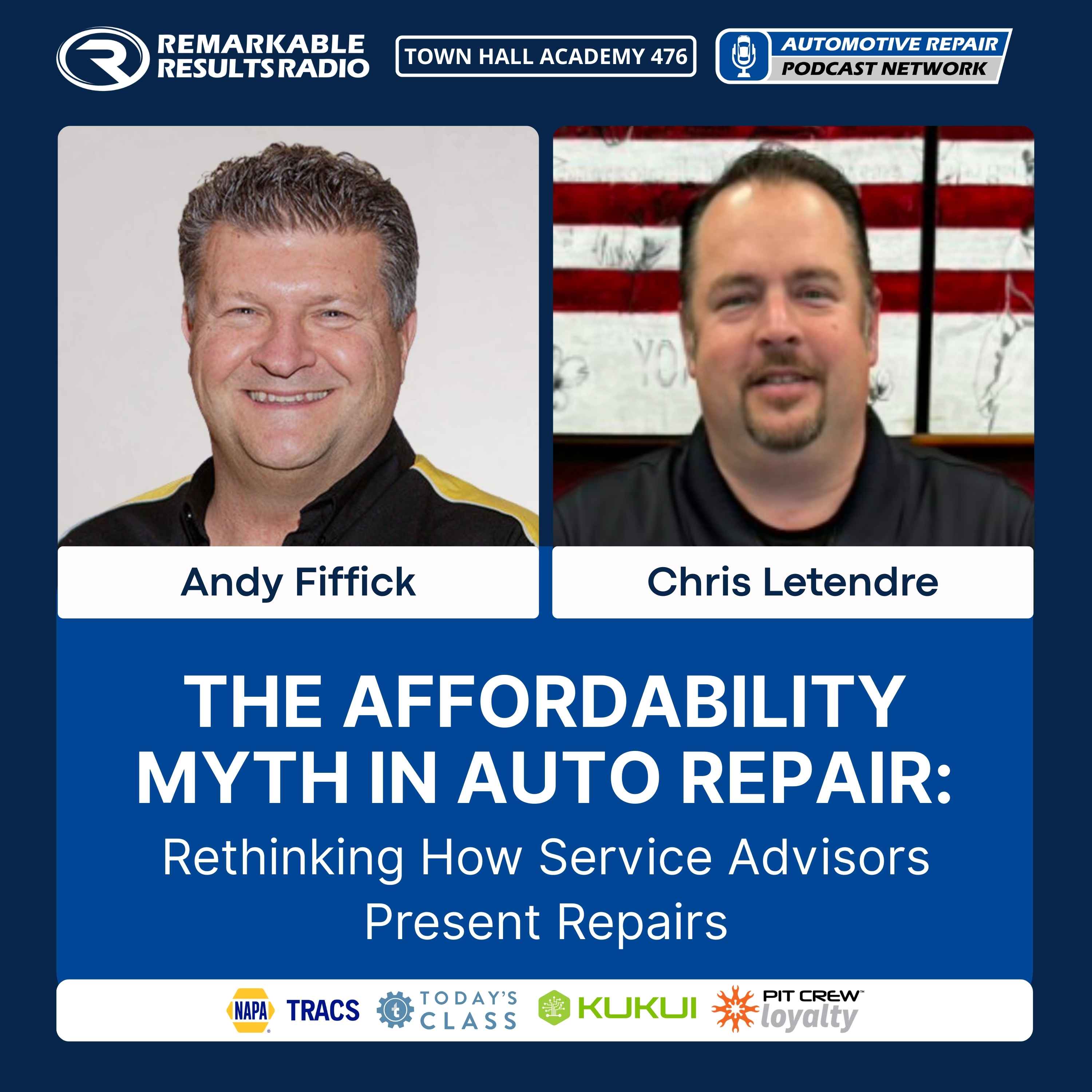
Andy, let me introduce my panel.
Andy Fific, president, founder of an 11 store, a franchise operation in Cleveland, Ohio,
Rad Air, also the former chairman of Max.
Hi, Andy.
Thank you.
Good morning.
Thanks for having us.
How does it feel to be retired from Max after all those years?
Um, you know, ex chairman now, so I'm still on the board, so not quite gone.
They still got your work and I get it.
Yeah, I'm still involved.
Chris Latender is here in, let's call him an inside sales coach,
support team for American Pride Automotive.
Six locations, right?
Yeah, six locations.
Correct.
Virginia, the Virginia area, both metropolitan and rural, deals with this type of stuff every day.
I hear from training and coaching perspectives for your counter people.
Welcome.
Yeah.
Well, thanks for having me.
Good morning, everybody.
His first time on the show.
Good to have you here.
So, okay, do we have an affordability issue?
All I hear about, frankly, I think it's kind of dying down because it seems that there's
some economic upturn going on, but there was this period of time that's all we could hear
about is affordability, affordability.
I was paying less for gas, less for eggs, and yet all we could hear about was affordability.
And I really thought long and hard about our industry and I'm sure there are people,
owners, service advisors that listen are saying, wow, we haven't felt it.
We're not sure.
Maybe we've done some missteps and that's the reason you both are here.
We want to know what's going on at your counters in your marketplaces.
I think we're going to tell the audience things that they may be surprised that it's not necessarily
affecting you as bad as the overall sentiment in our country of this economic affordability.
And another thing I think we want to open our eyes to is the national arrow is 800 bucks.
People may not have enough money for an emergency, yet what a perfect time to talk about maintenance,
getting that vehicle to last 250,000 miles.
We've been doing some episodes about that and that kind of takes that big, rock solid,
boom, heavy hit of an emergency thing and it kind of lays it out if you're doing the right things.
Andy, you told me this morning, I toured the shops, Carm.
I looked him in the eye and I asked him the affordability question.
What'd you hear?
I heard we really don't have one.
I went to all 11 shops this week and I asked all our service writers how bad it was about
the, you know, are we getting pushback on pricing?
And for the most part, no.
If you sell the value proposition of the job and you do your job properly, we're getting no pushback.
And for the five, the worst number I heard was 10%.
If you then re-explain the job, you offer any kind of value adjustment, i.e., offering a coupon,
offering a little bit less warranty.
You know, our general warranty is a lifetime warranty on our repairs here.
So you drop down to a two-year warranty using a little less quality part and you just do
any kind of adjustment.
You still get the job, but you just made a slight price adjustment of 5%, 10% and you still land the job.
You know, our whole purpose is to get the client back on the road safe.
You know, that's the whole purpose we're here.
Any of us are here for that.
So we just got him adjust our price a little bit, maybe adjust our warranty a little bit
and make the client happy.
And we really don't have that big of a pushback.
I think the pushback is more in our head than it is in the pocketbook.
Well, he just said an awful lot, Chris.
You agree or disagree with Andy?
What do you see?
I would agree, you know, a lot of times in our industry,
we create a problem that isn't quite there.
In a lot of the training we do here, we talk to advisors, for example, and we have conversations
where they'll share a fear.
All right, I'm about to call a client and go over a really big repair with them.
You know, I'm a little nervous.
Boy, this is going to sting.
And we have to remind everybody that, well, first off,
things really aren't a problem until they're a problem.
We have to take the cloud of pricing concern out of our conversations before it's there,
because we don't want to introduce it before it even happens.
That's one.
And two, we're kind of in a locked step, I would say, Andy, as far as that repackaging strategy
to taking the initial premium repair, and if we have to, looking it from the eyes of
what gets the car back on the road safest.
I mean, sometimes it's switching from a premium part to a white box part,
or sometimes it's changing our warranty approach or our repair approach to really,
at the end of the day, make sure we're operating with integrity and getting a car
back on the road the safest way we possibly can.
That's combating a lot of it, too.
Andy, I love what he said, repackaging.
That's really, in my mind, just a smart way for a service advisor to think about any pushback.
Well, let's just rethink this.
In his mind, it's a repackage move that he has to prepare himself for.
Again, what's our purpose?
And like Chris said, we got to get the car back on the road for the client.
What could we do in a service shop to do that?
And we have to do that.
And you do have that view, and offering payment options is a big part of that, too.
I cannot believe how many shops out there do not offer that option to their clients.
And that is a game changer for those shops that are not doing it.
I can't imagine not doing it statistically.
It's a big number in our organization to offer the payment options to your client.
Those that aren't doing it, you really need to start.
You know, it helps your public, especially today.
I love this.
These are your perceptions at your business.
You know a lot of people in the industry.
Are you way the exception to the rule?
Are there people struggling with getting things sold to learn and know how to repackage
to sell from their own wallet?
I mean, we hear this way often too many times that a service advisor is, if you will,
you said remove the cloud, the perception of, oh my God, I can't even believe Sally is here.
She's been here before that she can afford this $1,100 ticket.
And so right off the bat, there's almost like a posture, a lean back posture on getting to do
what's right. And Andy, to your point, we've got to do what's right to an affordability factor,
but get a reliable vehicle back on the road for our client.
If not, we're doing it wrong.
I like what Chris said a little bit ago too.
We did not break the vehicle.
We did not cause the problem on the vehicle.
We did not design a vehicle that made the repair so darn difficult or expensive.
We're only here as the stewards on how to repair it correctly.
And we really can't control with that ultimate cost is to repair it.
What we can do is present that repair to the client in the most value driven way,
is I guess the best way I could say it.
Here's what we need to do for you.
Here's the value you're going to see out of what we're going to do for you at the cost point we
got it. And that's where I think Chris alluded to.
When you have a new service writer or more of a Greenhorn service writer,
they're afraid of those big jobs because it's, oh my God, you know,
I'm going to scare to live in heck out of the client.
But if you break it down and you explain it to the client and you have compassion
and you show some empathy in it on what you need to do for them
and you're willing to work with them and help them out,
they will actually thank you at the end, you know, if you do your job right.
And that's how you have to handle those big jobs.
And that's how you really have to handle every job.
Again, we didn't create the problem and we really can't create,
and we really can't do much about what it costs to repair their vehicle.
And we didn't really tell them what vehicle to buy.
Now, if you go out and buy a BMW and you're going to expect a repair at Chevrolet prices,
we didn't create that problem either, you know, they kind of created their own problem,
you know, especially by an old one, you know, how many times do we see people go out and buy
cars that they really can't afford to maintain?
Overlook maintenance is a whole other item that we're kind of talking about here too.
They ignore their maintenance and then all of a sudden they got these big repair bills
because they ignored their maintenance. And that's a whole other animal.
If they would have done their maintenance, they might not be seeing us for that $2,000
timing chain job or other items that they ignored.
So, but again, being empathetic, you know, being having some sympathy for what the cost is,
you know, and how you present that is really, I think, the key.
You on track with that, Chris?
I am completely on track with that. You know, it's kind of funny.
We have weekly touch points. So, once a week, we have a 15-minute call with all of the
client-facing members of our team here, kind of a counter-rally is, I guess, the best way I
can put it. And we celebrate wins, we talk about maybe a loss or how to correct it with each other.
But we also talk about mine shifts, you know, and one of the
mine shifts we just talked about yesterday was the reality that we are not in the car business,
right? And it's kind of a funny thing, but we are not in the car business.
What we are is we're in the people business. We just happen to be automotive professionals.
And it's about how we're able to meet all these people in a way that makes sense to them
and be an outlet, right? To Andy's point, I didn't create the oil leak in that BMW 7 series,
but I sure know what's there and how to fix it. And how can we set the path that makes the most sense?
I heard someone recently blame the problems with the vehicle on the engineer who designed it.
And to me, if you're standing at a counter, I was like, listen, who is the engineer who
designed it that made this car come in every week to fix the oil leak? Let's help you get
over that and through that. You seem to be the most convenient person to blame because you didn't
blame doesn't work. Hey, let's face it, your shop management system is the single most important
tool in your shop. Period. Napa tracks has made selecting the right shop management system easy
by offering the industry's best, most comprehensive SMS. Now it all starts when a local representative
meets with you to learn about your business and how you need to run it. After all, it's your shop,
so it's your choice. And having local representation is a huge plus. Customizing
tracks to your business, whether you're a one person shop or a large multi bay or multi location
company, a representative consults with you to help optimize your shop's workflow, efficiency
and profitability. Tracks always has the flexibility to do business how you need to do it, which means
it can also grow as your business grows. And unlike the other guys will be there for you after
installation with the best training and support in the business. Yes, a learning management system
tailored to each role in your company. Simply put, tracks was designed and built for shop owners
just like you. Visit us on the web at Napa tracks. That's N-A-P-A-T-R-A-C-S dot com.
Hey, want to test your team's knowledge? Well, today's class quizzes show how much your techs
and advisors really know so you can train smarter and build a stronger, more efficient team.
Whether it's the basic quiz perfect for all techs to test their foundational knowledge,
the advanced quiz built for experienced technicians ready to dive into complex topics
or the service advisor quiz focused on communication and customer service. Now,
each one gives your team a clearer view of what they know and where they can grow. Take the
quizzes now at today's class dot com forward slash T C quiz. Shop owners, we know you are
overwhelmed with a flood of missed calls, empty bays and disconnected marketing tools.
Cacui has spent over a decade building one integrated platform for auto repair shops,
one login, one dashboard and mobile first websites that convert four times industry average,
smart, innovative CRM with automated follow up, 24 seven online booking and real time ROI tracking.
With 900 plus years of combined team experience, we feel the growth of 2,200 plus shops and have
influenced three billion dollars in revenue. Stop working harder, start working smarter,
get industry leading customer support and book a demo with Cacui. That's KU, K UI dot com.
You know, most shop owners feel trapped spending on ads while half their first time
customers never come back. It's frustrating. It's exhausting. And it's not your fault.
The industry average is 54% one and done. We understand how discouraging that can be.
Well, pit crew loyalty changes the story. Our clients cut that rate by up to 38%,
raising lifetime value by more than 50%. Loyalty members visit nearly three times more often,
creating predictable revenue without extra ad spend. Pit crew loyalty where customers stay
and shops thrive on the web at pitcrewloyalty.com.
So here we are with two really top people in the industry who are saying we really don't
have that problem because we've worked so hard to no like and trust, get our client to no like
and trust us in a highway. And the thing that worries me about the attitude inside the industry
a little bit and from the outside looking in is we're being bombarded with statistics paycheck
to paycheck 43% of Americans can't afford a thousand dollar emergency expense and on and on and on.
I sent both Chris and Andy all this research that I did and I'm not even sure it matters today.
And here's another observation that I have and help me with this.
You watch any TV say you do say you just watch an hour a day. I guarantee you're going to see
a commercial on bathroom remodeling gutters. You're going to see it on all kinds of stuff
in home improvement area windows roofing. These are big ticket items.
Those industries seem to even though there's financing there I get that but for people to
commit the money to repair a home which is the first largest investment versus the vehicle. So
there may be a trend that we need to be observant of that there are a lot of people asking for
bigger dollars to make the roof right the kitchen right the bathroom right and all these other things
why wouldn't we be doing the right thing for transportation. You may have hit on a point
there. I mean you know talk about if we had a national campaign on just maintaining your car
that way. Yeah I mean how much money could be saved if we just did all the preventive maintenance
out there. I think there was a statistic that came out from Carfax here in November that I think
was 62% of all vehicles on a road needed at least one major maintenance item that was overlooked.
62% and what many of them needed multiples of that. Yeah I mean and we all know you know
something as simple as a transmission flush you know a 250-350 service may prevent you from a
three to five thousand dollar transmission overhaul failure you know down the road. I mean to me
that's very much money well spent. It's a ten to one return on investment and you know and you know
if somebody gave you $250 and said go to Vegas put it on a table and I'll give you five thousand
dollars back who would not take that bet. Everybody would but when it comes to maintenance on your
car they don't do it. They wait till they need the five thousand dollar transmission rebuild
and then they complain about it. Well if you maybe would have done that maintenance back
in a hundred thousand miles you wouldn't need that transmission at two hundred thousand miles.
But as an industry Andy and Chris are we sitting down and giving them that longer range plan on
what needs to be done when? We are. I would imagine Chris you are. I know we have switched to a very
much relational experience with people where we're trying to build some long-term plans
but you know I and I'm going to rewind back to something you mentioned you know you said
you know sit down and watch an hour on television and look at the ads you get there.
I mean I think one of the things that we do fight that's almost industry generated is now watch
those television ads and see the ones for now I'll leave the manufacturer's names out of it
but when they tout the number one sedan with the lowest maintenance cost in the you know in the
country or the pickup truck that has the lowest cost of ownership right out of the manufacturer's
mouth it's maintenance free. This vehicle is going to do wonders for you so we have a whole
section of the industry who is indoctrinating people that if you come and purchase our car
whether it's new or not you're purchasing something that JD Power or anyone else has said
is going to be maintenance free for you. This is the lowest maintenance cost of any vehicle so
we're already planning that seed that maintenance shouldn't be in a worry for you and we're fighting
that battle as time goes on. Now these vehicles hit a secondary market you know and Andy I don't
know what your kind of key vehicle age range is but I know for us we start seeing vehicles around
the four-year mark you know we work as more of a dealer alternative we certainly don't
market to really older vehicles but I know we're catching the vehicle that maybe has not
come off a manufacturer warranty and that client wants a different experience a quicker turnaround
they don't want the dealership life anymore so they come to us but we still have to now fight
the battle of well my sales associate my manufacturer my advertising material all said
that the Cam Capriado 5000 was the lowest cost of ownership on the planet so we're already behind
the eight wall with these things it takes a lot of education to correct that. But yeah you're right
our key vehicle is in that you know five to 12 year old range you know even up to 15 years you
know cars are lasting so much longer you know in the truck market even a little bit older than that
you know you're seeing on the market still yet because they're not rusting out the way they used to
but yeah that's been a preconceived notion and it's even varies by brand you know the people that
for lack of better not pointing out names but the big three I think those people look at maintenance
less as an investment than the import cars the import people seem to look at oh that's an investment
I should take care of the maintenance on it they're more willing to listen to that that scenario
and the big three people look at it as like oh you're just trying to sell me something
you know so it takes a lot more education in there and a little bit more show and tell to do that
but again that comes down to building that relationship with your client and that trust
with your client and showing the value of what you're trying to do for them and maybe we're a
we're celebrating our 50th year in Cleveland here you know we started back in 1975 so we've had
five generations of building our goodwill in this industry in our town so our name has
proceeded itself quite well so I think that helps us but you know and we've indoctrated
our name so well in our group that people know they could trust us and we've got going on three
and four generations of the same family that come to us you know so but still you know in the old
days people would need us three to four times a year now an oil change you know intervals
increasing up there now we're seeing some families only one or two times a year so you need a lot
more new clientele so we're building new clients more and more all the time because the vehicles
are just built that much better so we're seeing influx of more new clients which you need to
win over more and more and as we know the younger generations are not as so keen to
being loyal to you you know so you really got to win them over and win them over big
and you guys probably noticed too that getting google reviews is not as easy as it used to be
either so you got to go really over the top to get google reviews so you really got to be on your game
on all aspects to win that client over and do such a great job for them and that starts with
you know that first phone call all the way up to that you know we call it the kiss goodbye
but you got to be on your game through everything but you know we're talking about pricing now
but really selling the value of what you do is what it boils down to and getting it out of your head
your head that you have a price problem so let me summarize this last let me see how long
about 20 minutes so far and we were talking affordability and there's been some great
discussion about the consumer's mindset you mentioned chris mind shift okay and when i think
of the consumer mind shift which i believe we're competing with at our counter we're competing
with the sales of the vehicles because they're doing it and saying anything that they can
maintenance free blob all this other stuff right just you know come in you know once a year get
your oil changed free oil change by the way and guys i got to share something with you that really
rocked me i'm watching an ad an alice ad for a car and i don't remember which one it was
but it was a hundred and ninety nine dollars a month and i was in my mind trying to think of
how stripped down this thing could be but the key to it was ultra low mileage lease
hundred and ninety nine dollars i pressed the the pause button so that i could try to read
the micro fine print at the bottom of the screen and i couldn't quite make it out but i'm wondering
i gotta guess what a ultra low mileage lease could be today and again i go back to this
whole affordability one ninety nine it's that it's that mindset i actually saw those ads and
i did pause it six thousand miles a year oh jeez that's grandma's car yeah six thousand some of
them are eight some of them are ten yeah they're trying to do the affordability thing and but
yeah they're they're playing all kind of tricks on it out there people aren't hearing the words
low mileage ultra low mile i mean when you put the word ultra in front of low
maybe we got to figure that out we have an ultra nice oil change program
we only give you half the oil the rest is an upcharge i'd love to see the point of sale on that
yeah yeah my guys would kill me if i brought that up so you know okay we've done some great
economic discussions here in this whole affordability thing but let's jump into and i still believe
today that the most important educational focus in our business trust me the specialists in the
bays they rule they need to have that forever eighty hours a year but i'm thinking critical
spots that counter guys and all that can happen from i have to tell you i think it's one of the
premier jobs having to know people you know this whole empathy thing and understanding
the vehicle and the workflow of the business i mean it is probably one of the most pivotal
points of the business what are you doing to to teach all that chris making a wish on my pillow
every morning before we start first off we have to have to have to make sure we operate in the mindset
of continuous education you know we have people in our organization who've been with american pride
for 10 years we have people who've been here for 10 months our due diligence to continue to reinforce
those points you know are we asking the proper questions are we asking people at our counters
right at the key drop what is your intention with your vehicle if your intention with your vehicle
is to ride this thing for two months until the 2027 x comes out we're spinning our wheels here
but if you tell me that your intention as a mom or a dad is to keep this vehicle for five years
because you don't want to make a change and you need this to get to three different schools and
two different band practices and if cannot miss a beat then we have a whole roadmap for maintenance
that we need to make sure we're laying out ahead of time it's asking the right questions and it's
continuously training everybody and asking those right questions i think back to something we're
talking about earlier you know we're talking about counter interactions and it reminds me of and how
you know people can you know not so prejudge i should say what somebody is willing to spend or
wants to invest in their cars and it makes me think of we kid around about the sophomore jinks
now we get brand new people to our industry and for the first five six months they're sponges
they're absorbing our new information they're learning they're taking all the training and
applying it they're following processes and procedure if we have a script that is not necessarily
has to be verbatim but that has to help them to negotiate and navigate a process is all well
and good and then right around six months people tend to go i know a little bit better than that
i know what my customers want i know what we should be doing here i'm gonna go out on my own
i'm gonna wing it a little bit and that's when we start having fall downs we start having those
failures in the system we start having people who prejudge what someone can afford or who
think that the second client they see that day just has no belief in maintenance so we're not
going to talk about it as strongly so it's a matter of those continuing education points to
reinforce this is our expectation we're going to inspect what we expect and we're going to continue
to move the needle using the same process every time i got to ask krista question here the sophomore
jinx i love that in fact i frankly i haven't heard that in all these years i've been podcasting
six months you say tell me about a legacy individual then there are a couple of years
do they ever go through that lapse all the time i call it getting fat dumb and happy
and as soon as they start seeing success they start thinking they could do better
that's the time that andy has to show up stay in the basics and not nice andy yeah oh oh my god
it's just evolution i wanted to add on something krista
asking all the right questions is the way to definitely start in that but it's the start of
the relationship you need to build a relationship with the client because how you're going to treat
the client's wife or significant other's car different how he may treat his truck we know he's
towing a boat or a camper he travels 25 miles to work she travels just the school and then maybe
to work for band practice with the kids or something so when you know the relationship and
you build a relationship with the client then you know how to treat each one of their vehicles
you know what tires you're going to recommend based on their their driving habits once you
have a relationship with that client you start building that one a mutual trust back and forth
then the price point goes away also you know that so you got to build a relationship with your
clients and all the rest of this starts to melt away but it has to be one of mutual trust and
respect in both directions you know you respect that client they're going to respect you and that's
really when your life starts to really get easy in your business and we've been doing it that way
for 50 years and you know so a repeat a return client rate is roughly around 78 to 82 across
their 11 stores you know so it's fairly high it has dropped down you know at certain locations
because again the cars are built better and and the service intervals are longer so it was as
high as 88 to 92 percent years ago because you were seeing people every 3000 miles the average
mileage in Cleveland is about 13 six per female about 15 five for male driving in Cleveland so
13 five to 15 five miles per driven per year in Cleveland so we're still seeing those clients
two times maybe three times a year for the guys twice a year some of them once twice a year
so it has dropped down so you don't have as many opportunities but we've been seeing for the new
clients we're bringing in we're getting them in with neglected maintenance so often neglected
maintenance is oil changes and people are ignoring their oil changes left and right
and how they get that message out I don't know I mean and I think to Chris's point
the manufacturers and our cars need no maintenance which includes I don't even check my oil
or tire pressure unless the light comes on we recently did a couple of episodes on the 250,000
mile maintenance strategic plan with your client and we talked a lot about setting the dental
appointment and you know getting that person listen we know you're driving about 13,000 miles we
need to see you in here in eight months pick the number whatever it is let's set an appointment
we'll remind you beforehand you got something coming up don't worry about it we'll send you
calendar invite all that stuff and one of the thoughts that came up I was with Rena Renebaum
and Brett Beechler was that at one shop in particular there was a cup of toothbrushes
in the front of the counter well dealing with a person this is here by the way have a toothbrush
on us brand new you're placing more than the six-month dental visit you should really replace
them every three but we'd like the vehicle back here well let's set an appointment now just like
you do at the dentist okay no problem let's do that they got a toothbrush in their hand I don't
know what it costs for a toothbrush buck and a half to but I don't know but what an idea to move
this individual to make a commitment of getting back in here and getting them in the groove
anyway I love the fact that you talked about stats Andy and how you look at your client base
and who's coming in and when they're coming in those are stats to pay attention to right Chris
oh absolutely and if you have that kind of loyalty I mean you have that speaks volumes to what
you're doing with your counter facing you know your front counter staff your teams you know
I'll actually I'll follow that up with a question if I could you know you're mirroring this focus
on relationships right it sounds like we're kind of in a locked step on that from a recruitment
standpoint are you finding that you're trying to pull talent from areas that we never looked at
before when we recruit talent for our counters we're looking at client facing team members
it's not so much the person who maybe knows a lot about cars or a lot about sales but the person
who truly takes joy in making friends who really is passionate about building relationships and
sometimes we find them at the local diner that everybody is going to eat breakfast at or the
Chick-fil-A or the shoe store or wherever it is but we're certainly opening our mindset when
our hiring processes and I don't know if that's just something that you're echoing as well or
okay Chris that's a great question and it's funny you brought that up because I haven't needed to do
that yet because we've been you know with the size of our organization I've been able to promote
from within because we got that depth thank god I got that depth all of our service writers we
promote recently there's always been guys that we brought up through the ranks but I went to lunch
the other day with one of our franchise operators to just review all of his numbers and everything
from the last two months and we're at the diner and the waitress that came up and waited on us
I actually mentioned to Bill you know Bill Sokarm my VP of operations and I we taught us that she
would make an awesome service writer she had the bubbly personality she could read people she knew
exactly what she was doing she was in her element she enjoyed talking to people I said I can make her
a service writer I would go back and talk to her if I could put her in the right spot but I have a
friend that does recruiting for a dental assistant company and I took this girl's name down and I
turned it over to her because I couldn't use her but I think my friend could but I think Chris you're
on to something they go out and find those people that you could just see bubble over enthusiasm
and what they're doing people facing I think they belong in our industry we hear that so much guys
just constantly looking for good people people and let's bring them inside the business either do
an upgrade or as so many people are growing today I had a brain pop about the sophomore jinx Chris
and again I don't know if it was you or Andy that said even some of our more established people may
have that brain fade and get too comfortable and my takeaway was from Ron Popiel remember
set it and forget it forget it yep you all remember that along many others yeah yes I know remember
the spray stuff in there anyway I'm sorry I didn't mean to laugh but some of that stuff was actually
like watching a comedy show you watch those commercials may millions I know but we cannot
forget the fact that some of our legacy people we can't just set it forget they've been here so
they need to be in this continuous education loop and they need to be constantly evaluated as to
you know and observed because we can just get a little lazy because we know our game so well
just yesterday uh Case Western Reserve uh here in town whether it's school of management puts on a
luncheon series every month brings in the speaker the founder's daughter of Chick-fil-A was the
speaker yesterday and I took my service writer from the Garfield Heights store to that luncheon
and she told the story of Chick-fil-A and I forgive me because I don't remember her name right now
and she was dead on honor messaging about everything about what we're just talking about
about how you treat your clients and perseverance and your purpose of what we do and how to treat
your client like family and you have to take your legacy people and remind them every once in a while
about what we're here for and how to do it and why we do it the way we do it and I was watching
Eric and his head was going like this through the whole luncheon oh yeah I remember now that's
why we do this that's why we do this you know and I wrote a few notes and when I called him up today
I literally just said eat more chicken and he broke out laughing he broke out laughing on the phone
and that just brought him back to what the message was yesterday I love that just drop us a sentence
and thank you boss what I find at Chick-fil-A is this high level of caring consistently yes and that
has to be one of their hallmarks Andy I didn't hear the speech but their culture and their consistency
of culture and caring seems to be you're my most important client at this particular moment in time
and we're going to make sure everything's right for you then the next one comes in it's the same
it's the drill their mantras do your best just do your best if not why not it was a great message
it was an awesome luncheon to go to and guys like us we need to remind ourselves sometimes too
I had a chance years ago to be at the Disney Institute for a meeting and the company in corporate
America that I was working for we were coming up with a new strategic plan and so Disney came in
to help get us focused you know all the papers up on the wall and all the breakout sessions
and one of the things that they said is we worked very very hard to figure out what our
theme park culture needs to be with all of our people all of our greeters our trash pickups
and everything and everyone and he says and it it took us days to come up with this and and here
it is this simple look him in the eye and smile that's it that's what everyone has been disciplined
on at any Disney theme park is look him in the eye and smile do we do that enough probably not
probably not okay big takeaway for the world for our industry there it is we want to talk about
affordability this episode as all of mine seemed to do found some really interesting pathways
to talk about the fact is summarize it Andy and Chris they don't have an issue yet they're
busting their hump to be sure that they don't but they're also listening and observing their
customers they know what their customers need and they want I'm going to give last word Chris
anything else you'd like to say and then I'll go to Andy and then we'll wrap it well I do want to
reflect back on something Andy was talking about earlier that certainly kind of came to mind and
that's if we're not offering financing options for our clients we're really missing the boat
and we first started doing really trying to indoctrinate this of this option into our staff
to make sure we're explaining this to our clients as a pathway for them a couple years ago one of
the things that came up and came out of those meetings was you know I'm I'm fearful I don't
want to give somebody this option have them think that I believe they can't afford their repair
and there's going to be a big shift there because and I'll use the best example and that is the
synchrony financing all right synchrony automotive financing everybody knows the name it's out there
synchrony isn't just for people who don't have the 1800 or 2000 dollars to spend on their car repair
you know synchrony has some programs out there that offer 0% for 12 months you know I might have
5000 dollars in reserve to pay for repairs or maintenance or anything else but maybe I want to
make smarter uses of my liquid cash maybe I want to take care take advantage of somebody else's
liquid cash use mine for a different purpose I mean take advantage of 0% financing a lot of
money people do so it's not just an affordability thing and if we keep it away from being in that
box if we take it out of that box of this is just for the folks who come in who don't have the money
now to spend on this repair and open that box up for everybody we're certainly going to have a lot
better conversations around vehicle financing vehicle repair financing I should say and Chris
you're dead on and you'll notice and if you the guys that I behoove you to look into it that aren't
doing it you'll find your ticket prices go way up because they'll say oh well let's do the tires
while I'm at it too because now I could afford to pay for it over six months at 0% you know just
throw the tires in I don't have to come back later to do them you know or the suspension or
whatever it is so financing is uh we call them payment option plans you know try to stay away
from that financing word but offering payment option plans your clients will open a big door
for you it's huge that's a great point one of the things that I like to discipline friends that ever
did that hey karm I just bought a blank I got 12 months or I got 60 months whatever and I says
do yourself a favor get on your computer bank go on the bank set this payment up every single
month but do it for 11 months or do it if it's 60 do it for 59 you never ever want to make a mistake
and I have to pay interest back to day one you never because again they're all a little different
how they work but the discipline is always do it one month less so you never get caught with your
pants down that's a great point great point Andy anything else build a relationship with your
client and most of this goes away hello there it is there's the title thank you so much Andy
Pific CEO president founder at the 11 operation franchise in Cleveland rad air and chris latender
is an inside sales coach and on the support team for american pride automotive with six
locations of virginia love andy everybody out there great people been on the show before and
Andrew Andrew and thank you guys so much for being here thank you guys thank you i appreciate
you guys nice meeting you chris thanks for being on board to listen and learn from the
premier automotive repair business podcast remarkable results radio get your episodic
education on the arp n listening app at automotive repair podcast network dot com also enjoy the
podcast on our karm capriato youtube channel karm is all for advancing the professional automotive
service industry until next time
About this episode
Exploring the so-called affordability crisis in auto repair, industry leaders Andy Fific and Chris Latender share insights from their multi-location shops, revealing that pushback on repair costs is often less severe than perceived. They emphasize the importance of repackaging repair options, building trust through relationships, and offering payment plans to ease customer concerns. The discussion also highlights challenges from manufacturer messaging about maintenance-free vehicles and stresses continuous education for service advisors to maintain empathy and effectiveness. Ultimately, the episode advocates for proactive communication and long-term maintenance planning to keep vehicles safe and customers satisfied.
Thanks to our Partners, NAPA TRACS, Today's Class, KUKUI, and Pit Crew LoyaltyWatch Full Video Episode
"I think the push back is more in our head than it is in the pocketbook."
In this episode, host Carm Capriotto talks with Andy Fiffick and Chris Letendre about the perceived affordability crisis in auto repair. Both guests challenge the idea that customers can’t afford repairs, suggesting that price resistance often stems from the service advisor's mindset rather than customer reality.
The discussion highlights practical strategies for improving repair approvals, including repackaging repairs with different parts or warranty options, presenting financing as “payment option plans,” and avoiding the “Sophomore Jinx,” where advisors begin to pre-judge what customers can afford. They also address the “maintenance-free” myth promoted by automakers and encourage shops to proactively educate customers with long-term maintenance planning.
Ultimately, the episode reinforces a key truth: auto repair is a relationship business. When shops build trust and focus on helping people, price objections become far less common.
Andy Fiffick, CEO Rad Air, Listen to Andy’s other episodes HERE