The Porsche 911 Carrera T is a special version of the 911 that is lighter and more focused on driving fun. It has some features removed to make it more sporty.
Summer tires are special tires made for warm weather. They work well when it's hot but can become hard and slippery when it's cold, so they're not safe to use in winter.
'Bullet proof' means that something is very strong and reliable. When someone says a car is bullet proof, they mean it won't break down easily and can handle a lot of driving.
A diagnostic fee is what you pay a mechanic to figure out what's wrong with your car. It's like paying for a doctor's visit to find out what's making you feel unwell.
Tire balancing is when a mechanic makes sure that your tires are evenly weighted so they don't shake or vibrate when you drive. It's important for a smooth ride.
Balancing tires means making sure they spin evenly when your car is moving. This helps your car drive smoothly and keeps the tires from wearing out too quickly.
The check engine light is a warning light on your dashboard that tells you something might be wrong with your car's engine. It's important to get it checked out if it comes on.
Four square is a way car dealers show customers different payment options when buying a car. It can sometimes make it hard to see the full price of the car because it focuses on how much you pay each month instead.
First pencil is the first offer a car dealer makes to a customer when trying to sell a car. It's important because it's the starting point for the negotiation.
Penciling a deal means writing down the details of a car sale for a customer to look at and agree to. It's a way for dealers to show what the customer would pay for the car.
High miles means the car has been driven a lot, which can lead to more problems or repairs needed. It's important to check how well the car has been maintained.
The timing belt is a rubber belt that helps keep the engine parts moving in sync. If it breaks, it can cause serious damage to the engine, which is why it's important to replace it regularly.
Towing capacity is how much weight a vehicle can pull behind it, like a trailer or camper. Knowing this helps you choose the right vehicle for your needs.
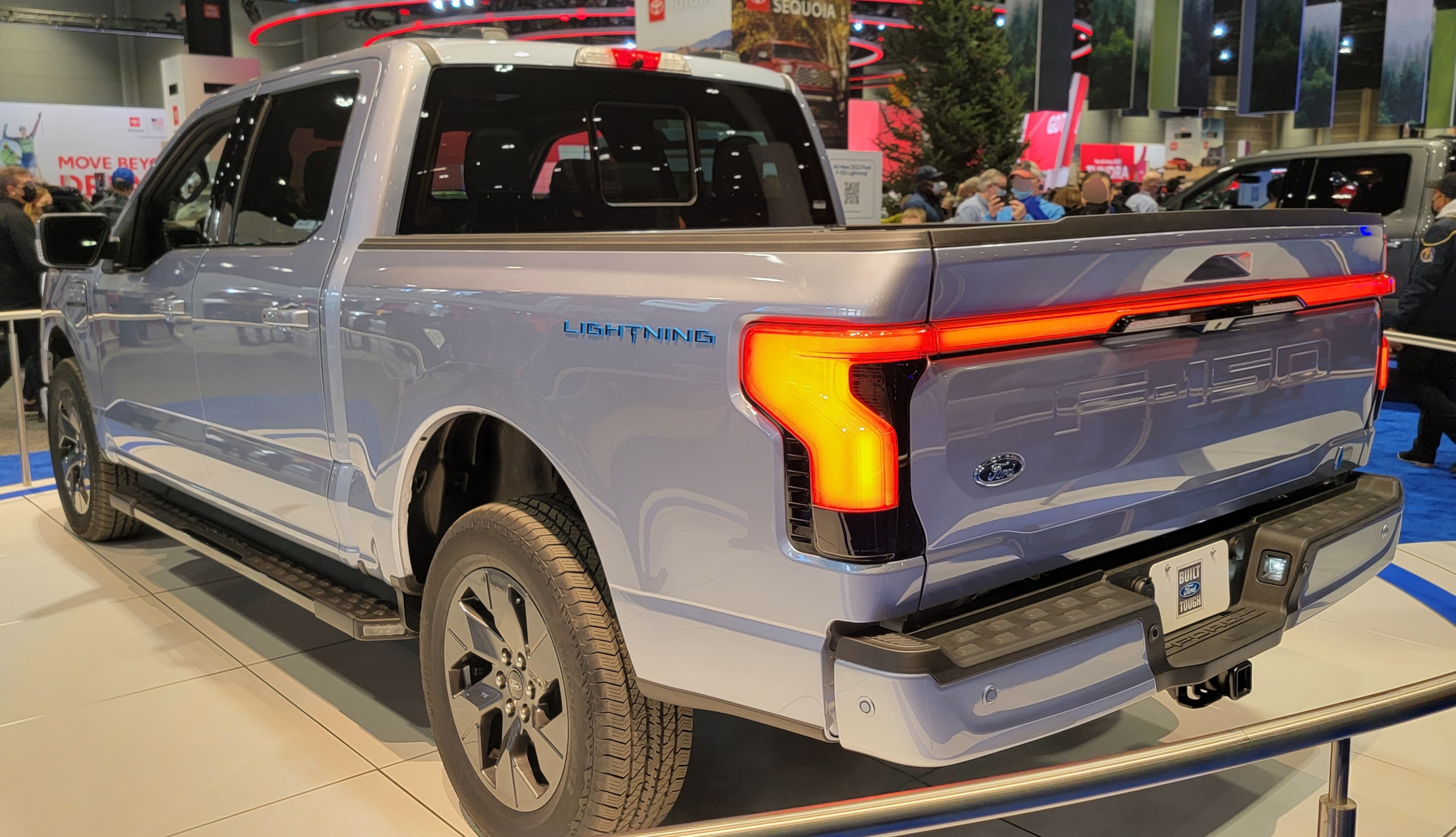
The Ford F-150 is a big truck that many people use for work or to carry things around. It's really popular because it can tow heavy loads and has a lot of space for passengers and cargo. People often talk about it because it's reliable and can handle tough jobs.
A 'budget buster' is something that costs a lot more than you planned for, making it hard to stick to your budget. Here, it means buying a new truck and camper could really hurt your finances.
Premium fuel is a type of gasoline that is more expensive and has a higher quality than regular gas. Some cars need it to run better and more efficiently, especially when towing heavy loads.
Gas mileage tells you how far a car can go on a certain amount of gas. It's important because it helps you understand how much money you'll spend on fuel when driving.
Miles per gallon (MPG) tells you how far a car can go on one gallon of gas. The higher the number, the better the car is at saving fuel.
LIVE
Hey folks, welcome to another edition of fresh one from the car guru.
You know, sometimes it's a busy life that I have in my, I start to say semi retirement,
but that's not fair because I come to work every day.
But I normally don't get here early like I used to.
For 47 years it was between seven and eight, and now it's 9.30 to 10.
Will you cut me some slack for that?
Can at least get that.
Most afternoons I can leave at about four.
That's from my car dealership, by the way.
If you're a new listener, I am a new car dealer.
I own a car, well, two car dealerships in Greenville, Tennessee.
They are a Nissan store and a Ford store.
We used to have Ford, Lincoln and Mercury Ford terminated Mercury.
We terminated Lincoln.
We just couldn't sell them.
And so we decided to just be a Ford dealer.
We had Mazda here as well, and we ejected Mazda so that we could get Nissan.
What would you do that?
But, well, I love Mazda.
We've had Mazda, well, we had had Mazda since 1977, but they had kind of gotten hard to
sell for us in our market.
And they're still not a real easy sale.
I mean, you have to be in a big market to be able to make any money selling Mazdas.
They're great vehicles, but they don't sell in volume.
So, there used to be a Mazda dealer in Kingsport, one in Greenville, one in Johnson City and
one in Bristol.
That's in Upper East Tennessee for you podcast listeners.
You know, those communities are all about 30 miles away from each other.
And only one lasted, the one in Johnson City.
So good luck with that.
I was doing some research.
I was really wanting to buy another Mazda Miata, though, like I need one, but I just
love that car.
I don't fit real well when I sit in and I'm six three and just from my eyebrows up is
above the windshield.
And then when I put the top up my head, I have to lean my head to the right or left and
kind of look sideways going down the road because my top of my head is smashed up against
the top.
Not a great driving position, but I really would like to have one.
They are just a blast to drive.
I've got a 2024 Porsche 911 Carrera T and I've had it for gosh, two and a half years
now and it's got 6,000 miles on it.
Don't get to drive it a lot.
I can't drive it when the temperatures are under 40 because it's got summer tires on
it.
Apparently they harden up and make it kind of difficult to hold the road.
But those Miatas, you can drive them whenever you want to and they are bullet proof.
So if you're in the market for a two door sports car, that's the one to buy.
I saw a Facebook post from somebody wanting to buy a 911 and they wanted advice on buying
one.
They were determined to buy one and my response was stop, drop and roll out of the Porsche
dealership and to a Mazda dealership and get you a Miata because they are much less costly
and far cheaper to maintain.
So avoid it if you can possibly avoid it.
I was driving back from lunch on yesterday and I saw a Porsche Cayenne parked in our
trade line.
That scared me a little bit.
You know, in Greenville, Tennessee, there's not a huge Porsche market.
And so I saw that and I was just hoping that my used car manager had enough sense not to
go out and buy one.
He does.
We traded for it.
So we'll trade for anything.
Like I said, I've traded for a lot of different things over the years.
Even burial plots.
Well, I didn't.
My dad did.
Okay, in today's episode, we're going to review the My Car Guru guidebook.
We're going to go through a lot.
Well, we're going to be doing that this week going through different chapters of the My
Car Guru guidebook, which is available to you.
If you just send me your email address to 423-552-2020, that's my cell phone, the only
one I have.
Send me your email address and I will forward you a copy of the book that we're going to
be going through.
And if you don't use email and all that stuff, just call the dealership 423-639-5151 and
tell our operator, hey, I need a copy of the guidebook and here's my address.
Give her your mailing address.
I'll print one out and I will not leather bind it.
It'll just be on eight and a half by 11 copy machine paper, but it's very readable.
You can fold it, put it in your glove box, pull it out when you need it, study it, copy
it, send it to your relatives, friends, relatives, neighbors, anybody that you like.
If you don't like them, don't send them the My Car Guru guidebook.
Let them continue to fumble and stumble through their car life, paying too much at every opportunity,
like buying a car, selling, trading, getting service, body shop stuff.
It covers pretty much everything, but we're going to go and expand on it.
Let's talk a minute about diagnostic fees.
What do you mean, Ledy?
Well, that's when you go into a dealership to get automotive service.
You've got a problem and you tell the service advisor, hey, my car is vibrating.
I can fill it in my seat and I can fill it in the steering wheel.
Here's what a lot of them are going to try to do to you.
They want to charge you a one hour, which is one hour of labor diagnostic fee.
Well, I mean, if your car is going down the road and it's vibrating.
The problem is more than likely you need to have your tires balanced.
You've probably thrown a weight.
So what does that cost?
Well, you know, I don't know, 80 bucks to have your tires balanced, maybe 90.
What are they going to charge for the diagnostic?
They're going to drive it down the road and charge you whatever one hour of labor is at their dealership.
If their labor rates $200 an hour, they're going to charge you $200 and then charge you $90 to $100 to balance.
Your tires and you are not going to accept that.
You need to find that out up front when you're talking to the service advisor.
You ask them this question, what is the total charge going to be to fix my vibration?
They say, well, we've got to diagnose it first.
And well, what does that cost?
Well, that's going to cost our diagnostic fee is $149.
No, we're not going to do it that way.
Let me tell you what I would like for you to do.
I'd like for somebody to go out and test drive my car and see if they believe it's the tires and then just balance the tires.
That's what it more than likely needs.
Yeah, but we don't do it that way.
Well, that's fine.
Then I'll just go someplace else.
Now I'm a regular customer here.
Do you want me to walk out the door because you're going to charge me a diagnostic fee?
Folks, you've got to push back on the diagnostic fee sometimes.
Now, if you've got a check engine light, that's different.
They've got to hook it up to a computer.
They've got some skilled technician is having to take the pulse, the blood pressure, check your temperature, listen to your heart.
Kind of like the doctor's office.
They've got to do a diagnosis.
And there are complicated engine problems, transmission shifting issues.
You know, sometimes there are other things like air conditioning systems.
It takes a long time to chase down a short in a wiring system.
Diagnostic charges are justifiable, but not when it's a straightforward thing like that.
There's a lot of people paying too much to have that kind of stuff done.
Okay, I'll take my first break.
I'll be back in a moment.
Okay, I am back.
The My Car Guru guidebook of which we spoke earlier is broken down into 10 different chapters.
And there's an introduction.
I've had a couple of people read this and say, well, that's kind of scary.
Here, I'll read it to you.
The car business is an easily corruptible business when bad actors and folks with questionable ethical standards get involved.
You know, that's really the only problem with the car business.
I truly believe that.
Otherwise, it's a very straightforward business and everybody would get a reasonable deal.
Maybe not the, you're not buying it for invoice or a thousand under invoice.
But you wouldn't have to worry about somebody payment packing.
You know, somebody charging you for things that you don't even know you're buying, trying to convert you to monthly payments, all that kind of stuff, all that rigamarole.
That's an old term.
Yeah, it's the bad actors.
I don't know how they get created.
I really don't.
I guess it depends on the first dealership that they go or where they go to work.
If the culture is such where the games that they play in the car business are okay, such as using the four square worksheet to work a deal with a customer or to negotiate with a customer.
It's definitely something that you need to avoid.
I saw a Facebook video of a guy working at a dealership.
He was bragging about the fact that they use four square.
He showed it on the, on his video.
And they was talking about what a joy it is when the customer buys on the first pencil.
What's that?
Well, it's just a car business slang term.
When you pencil a deal, you are actually writing up a transaction for a customer for their approval or their disapproval.
And four square is just a negotiating technique that is designed to deceive the customer and trick them into falling for a transaction that is based solely on a monthly payment.
But we'll get into more on that, not today, but later on.
But you have the bad actors learn these tricks from other bad actors.
And somehow they have learned how to justify it in their minds.
Like it's a game between them and the customers and they want to win it.
And there's also a problem with many dealers.
They simply go along for the ride and turn their heads the other way as long as the profits keep flowing in.
I know several dealers who operate that way.
They're seemingly good Christian men.
When you're with them, like you go to a meeting or something like that, they they behave like normal, nice guys.
I mean, you would never know that they rip customers off every day.
And I don't even know if they know it.
I think it's those bad bad actors that they have hired to sit at the sales desk where the manager sit or to be a salesperson at their dealership.
And they're able to justify it because the dollars keep flowing.
But my goal, just like with my podcast, is to provide you with ammunition, not bullets, but words and actions to defeat any kind of unethical sales tactics that that you're going to face.
And the thing about the car business is you can face them in the showroom on the lot in the finance office or in the service department or at the body shop.
Probably the only place that you're really safe in an unethical dealership is when you go to the parts department.
You're probably safe there because they those are your straightest shooters in a lot of these stores.
Everybody else, not everybody, but but a lot of them are playing it free and loose with the ethics.
So anyway, so the guidebook is really a roadmap to help you follow a process that has a lot of potential pitfalls and the financial mistakes that people can make can be very costly.
So the first thing that I talk about in chapter one buying a new car is something that a lot of people just don't take the time to do.
And that's to sit down and get out a piece of paper and write down the things that are most important to them.
Number one, can my budget handle it?
Do we have any business at all going out to buy a vehicle?
Now I have a couple parents right now.
I mentioned this the other day that are wanting to buy or wanting me to look for a vehicle for their new 16 year old and they want a safe SUV all wheel drive for under $12,000 and they don't want a lot of miles on it.
Well, folks, that's impossible.
That can't happen.
That could have happened 15 years ago, but that can't happen now.
To get anything like that, especially with low miles, you're over $20,000.
That's just the way the market is.
And so they need somebody to explain that to them.
I'm glad they called me because they could go from dealership to dealership, check all the different sources online.
They're not going to find anything like that and I could save them a lot of trouble.
So what can your budget handle?
They're going to have to settle for a vehicle that's a little bit older than they thought they would and with more miles.
And they're going to have to make sure that they get inspected.
There's a whole lot of extra steps that you need to take when you're buying an older vehicle with high miles.
And just little things like you need to make sure if the thing has a replaceable timing belt, was the timing belt replaced?
You can buy a used vehicle.
And oh, you just think it's wonderful and you're driving down the road and all of a sudden you hear a snap and a pop.
And all of a sudden you have pistons and valves coming into contact with each other and the engine is destroyed.
Why?
Because the timing belt was never replaced and it broke.
It's a rubber belt.
It's inside the engine.
In my mind, they shouldn't put anything inside the engine made of rubber unless it's a gasket or something like that.
A lot of manufacturers do that.
And so it's a maintenance thing.
And if you buy a vehicle that has a replaceable timing belt, you need to make sure that it was replaced at the proper intervals.
That's not an inexpensive repair either.
It can be as $600 to $1,000 to replace that belt.
Can your budget handle it?
You know, that's the first thing you have to answer.
And then what type of vehicle and features fit my lifestyle?
I mean, you need to consider, do you commute a lot?
What about your hobbies?
What about your cargo needs?
What about family size and comfort?
Like I got in my wife's armada yesterday.
And I have kids in jump seats behind me, behind the driver's seat.
And I put my seat where it's comfortable for me.
And they're saying, pop, pop, you're squishing my legs.
And so I had to move the seat up to where I'm not comfortable anymore.
Imagine when that six-year-old becomes 12, it's going to be even more of a problem.
So that armada would not work for us if we're going to be hauling the children
because I cannot drive in a scrunched-up position.
Hurts my legs.
So these are things you have to take into account.
Do you have any special needs?
Like me, a tall spouse, elderly passengers, pets, any kind of towing needs.
Are you going to be pulling a camper?
You're thinking about buying a camper?
Please don't.
But if you're thinking about it, then you need to buy a vehicle that has the towing capacity
to haul that camper.
You don't want to go pick out a camper and you're so happy with it.
And then the people selling the camper say, what kind of truck do you have?
And say, well, we have a half-ton, a Ford F-150.
Well, that won't work.
You're going to have to have at least a 250, maybe even a 350.
So then you've got to go out and buy a new truck.
Well, you're upside down on the one that you have.
Plus, you're buying a camper that will be worth half of what it is in two years.
That's a really good recipe for a budget buster.
Then you have to think about operating cost, fuel.
Like I found out this Armada, I didn't realize this, this thing recommends premium fuel.
What does that mean?
Well, I can run it on unleaded, but I won't get as good a gas mileage and it won't be as powerful when I'm towing.
I'm not going to tow with that thing anyway.
And it'll run fine.
I've checked it out.
It gets about 17 miles per gallon around town on regular fuel.
If I burn premium fuel, it gets about 19.
I don't care about two miles per gallon.
I really do like the vehicle, except that I'm squashing my grandkids' legs.
So, okay, and then also what are your occasional needs?
Vacations, hauling, long trips.
You know, some of this can be met.
I know a lot of people who buy the vehicle that they want and then we go on vacation.
They rent a vehicle, like from Enterprise, like a van, because they have a lot of people they need to take on vacation.
You know, I just wouldn't want to buy a vehicle and drive it all year round when really the only time that I need something with that kind of capacity is one week a year.
I mean, that makes a whole lot more sense to rent something and pay a whole lot more as far as the overall cost.
Because, you know, renting trucks and renting RVs, things like that, it's not cheap.
But my goodness, it's a whole lot cheaper than buying one.
I mean, I look at how many people have campers and they sit out there for probably 11 months of the year.
And they only camp 30 days and boy, it's worth it, right?
Well, not always.
And I intended to go camping last year.
We were going to go five times.
We went once.
Previous year, we went twice.
I'm not sure I can justify that.
Okay, I'll be back in just one minute.
You can see that there's a lot of information, a lot of things to think about in the My Car Guru guidebook.
We've just gone through step one of buying a new car.
We haven't even gotten to putting every car through the tests, the different tests, the eye test, the hearing test, the smell test, the butt test, the driveway test.
That's the next section.
And then the defensive buying plan, focusing on the four targets.
Now, I talk about that a lot and I've had a couple of my friends who are regular listeners and said, when you quit talking about that?
Well, I quit talking about it when people get the message because this is where most of the money is wasted.
So we're going to be going through some of these the rest of this week and I promise we'll get into some serious service stuff because there's a lot of money wasted there too.
You know, and again, to me, the most important thing that a car buyer can do is develop a relationship with the people that you are doing business with.
If you are a Honda buyer and you bought it from a local Honda dealership, then go back there for everything and honor those people with the truth, just like you expect from them.
If they screw up, tell them and do it in a nice way.
Speak to the service manager.
If you get bad service, go speak to the GM, the general manager or to the dealer in most cases and most of the dealerships in the tri-cities.
The dealer, the guy who owns the place is nowhere to be seen.
Now, there's probably four or five stores in all of the tri-cities where the dealer is actually there every day because they own multiple dealerships and they have some type of centralized office.
I mean, there's several dealerships in Upper East Tennessee that the corporate owner is based in, what, Charleston, South Carolina?
And they own 50 or 60 dealerships, so you're going to have to deal with, like, the general manager or the general sales manager, but you need to go up the food chain.
Because a lot of the salespeople and service advisors, if you go complain to them, they don't pass it up the chain because it makes them look bad.
But if you have an issue and you wanted to keep doing business with those people, then tell them about the issue.
And then get to know their names.
Get their cell phone numbers.
If they'll give them to you.
I bought my service advisors cell phones that are company phones.
They have their own personal phones, but that's what their cell phones are for.
So that they can give out their number and that my customers can talk directly to them and not have to go through a telephone tree or anything like that, not have to wait for somebody to be paged.
They can call each or their service advisor directly.
Now, anytime that you can give a consumer direct access to the person they need to talk to, that's a good thing.
And if you develop a relationship with that dealership, they'll give that to you.
And it's a great feeling when you walk into a business and you have a problem and they look up and they see you and they say, hello, Mrs. Jones, how are you today?
What can we do for you?
You know, isn't that a great feeling that somebody knows your name?
It's like cheers where everybody knows your name.
It's a good thing.
Well, thank you for listening to this edition of My Car Guru.
We'll keep diving through the guidebook and if you want one, just text me your email address to 423-552-2020 and I'll get one in your hands and you can follow right along.
I'll see you next time.
About this episode
Exploring the My Car Guru guidebook, this episode dives into the intricacies of buying and maintaining vehicles. The host, a seasoned car dealer, shares personal anecdotes about his experiences with different car brands and offers practical advice on navigating the car market. Key discussions include the importance of understanding diagnostic fees, the pitfalls of unethical sales tactics, and how to assess your vehicle needs based on lifestyle. Listeners can also request a free copy of the guidebook to follow along with the episode's insights.