
The best substitute for a Car Guru in your life is the Car Guru Guidebook...and it's free
About this episode
Exploring the My Car Guru guidebook, this episode dives into the intricacies of buying and maintaining vehicles. The host, a seasoned car dealer, shares personal anecdotes about his experiences with different car brands and offers practical advice on navigating the car market. Key discussions include the importance of understanding diagnostic fees, the pitfalls of unethical sales tactics, and how to assess your vehicle needs based on lifestyle. Listeners can also request a free copy of the guidebook to follow along with the episode's insights.
Email Lennie at [email protected]
Nissan
"They are a Nissan store and a Ford store."
Nissan is a car company from Japan that makes many types of vehicles, including electric cars.
Nissan is a Japanese automotive manufacturer known for producing a wide range of vehicles, including sedans, SUVs, and electric cars like the Nissan Leaf.
Lincoln
"We used to have Ford, Lincoln and Mercury Ford terminated Mercury."
Lincoln is a luxury car brand that is part of Ford, making high-end vehicles with lots of features.
Lincoln is a luxury vehicle division of Ford, known for producing premium sedans and SUVs that focus on comfort and technology.
Mercury
"We used to have Ford, Lincoln and Mercury Ford terminated Mercury."
Mercury was a car brand owned by Ford that made cars for the average buyer, but it is no longer in business.
Mercury was a brand of automobiles that was part of Ford, aimed at the mid-range market but was discontinued in 2010 due to declining sales.

Mazda Miata
"...earch. I was really wanting to buy another Mazda Miata, though, like I need one, but I just love that c..."

Porsche Carrera T
"I've got a 2024 Porsche 911 Carrera T and I've had it for gosh, two and a half years now and it's got 6,000 miles on it."
The Porsche 911 Carrera T is a special version of the 911 that is lighter and more focused on driving fun. It has some features removed to make it more sporty.
The Porsche 911 Carrera T is a lightweight variant of the iconic 911 sports car, designed for a more engaging driving experience. It features a more stripped-down interior and performance-focused enhancements compared to standard models.
summer tires
"I can't drive it when the temperatures are under 40 because it's got summer tires on it. Apparently they harden up and make it kind of difficult to hold the road."
Summer tires are special tires made for warm weather. They work well when it's hot but can become hard and slippery when it's cold, so they're not safe to use in winter.
Summer tires are designed for optimal performance in warm weather conditions, providing better grip and handling on dry and wet roads. However, they can harden and lose traction in colder temperatures, making them unsuitable for winter driving.
bullet proof
"But those Miatas, you can drive them whenever you want to and they are bullet proof."
'Bullet proof' means that something is very strong and reliable. When someone says a car is bullet proof, they mean it won't break down easily and can handle a lot of driving.
In automotive terms, 'bullet proof' refers to a vehicle's reliability and durability, suggesting that it can withstand various driving conditions without significant issues. It's often used informally to describe cars that are known for their robustness.

Porsche Cayenne
"I was driving back from lunch on yesterday and I saw a Porsche Cayenne parked in our trade line."
The Porsche Cayenne is a fancy SUV that offers a lot of power and luxury. It's designed for people who want a sporty feel in a larger vehicle.
The Porsche Cayenne is a luxury SUV that combines sports car performance with the practicality of an SUV. It's known for its powerful engines and high-end features.
diagnostic fee
"They want to charge you a one hour, which is one hour of labor diagnostic fee. Well, I mean, if your car is going down the road and it's vibrating."
A diagnostic fee is what you pay a mechanic to figure out what's wrong with your car. It's like paying for a doctor's visit to find out what's making you feel unwell.
A diagnostic fee is a charge that service centers apply for the time and expertise needed to identify issues with a vehicle. This fee typically covers the labor involved in troubleshooting and may not include any repairs that may be needed after the diagnosis.
tire balancing
"The problem is more than likely you need to have your tires balanced. You've probably thrown a weight."
Tire balancing is when a mechanic makes sure that your tires are evenly weighted so they don't shake or vibrate when you drive. It's important for a smooth ride.
Tire balancing is a maintenance procedure that ensures the weight of the tire and wheel is evenly distributed around the axle. This helps prevent vibrations while driving and extends the life of the tires and suspension components.
labor rates
"If their labor rates $200 an hour, they're going to charge you $200 and then charge you $90 to $100 to balance."
Labor rates are how much a mechanic charges you for their work, usually measured by the hour. Different places can charge different amounts.
Labor rates refer to the hourly charge that a mechanic or dealership applies for their work. This rate can vary widely based on location, type of service, and the specific dealership or shop.
balance tires
"...charge you $200 and then charge you $90 to $100 to balance your tires and you are not going to accept that."
Balancing tires means making sure they spin evenly when your car is moving. This helps your car drive smoothly and keeps the tires from wearing out too quickly.
Balancing tires involves adjusting the weight distribution of the tire and wheel assembly to ensure smooth rotation. This process helps prevent vibrations and uneven tire wear while driving.
check engine light
"Now, if you've got a check engine light, that's different."
The check engine light is a warning light on your dashboard that tells you something might be wrong with your car's engine. It's important to get it checked out if it comes on.
The check engine light is a warning indicator on a vehicle's dashboard that signals a potential issue with the engine or emissions system. It can indicate anything from a loose gas cap to more serious engine problems.
four square
"He was bragging about the fact that they use four square. He showed it on the, on his video. And they was talking about what a joy it is when the customer buys on the first pencil."
Four square is a way car dealers show customers different payment options when buying a car. It can sometimes make it hard to see the full price of the car because it focuses on how much you pay each month instead.
Four square is a negotiating technique used in car sales that involves presenting four key financial figures on a grid to the customer. This method can sometimes be misleading, as it focuses on monthly payments rather than the overall cost of the vehicle, potentially obscuring important details.
first pencil
"He was bragging about the fact that they use four square. He showed it on the, on his video. And they was talking about what a joy it is when the customer buys on the first pencil."
First pencil is the first offer a car dealer makes to a customer when trying to sell a car. It's important because it's the starting point for the negotiation.
'First pencil' refers to the initial offer made to a customer in a car sales negotiation. It is often seen as a significant moment, as it indicates the dealer's first attempt to close the deal.
pencil a deal
"Well, it's just a car business slang term. When you pencil a deal, you are actually writing up a transaction for a customer for their approval or their disapproval."
Penciling a deal means writing down the details of a car sale for a customer to look at and agree to. It's a way for dealers to show what the customer would pay for the car.
To 'pencil a deal' means to write up a transaction proposal for a customer, outlining the terms of the sale for their approval. This term is commonly used in the automotive sales industry.
high miles
"There's a whole lot of extra steps that you need to take when you're buying an older vehicle with high miles."
High miles means the car has been driven a lot, which can lead to more problems or repairs needed. It's important to check how well the car has been maintained.
'High miles' refers to a vehicle that has a significant number of miles on the odometer, often indicating more wear and tear. Cars with high mileage may require more maintenance and inspections before purchase.
timing belt
"And just little things like you need to make sure if the thing has a replaceable timing belt, was the timing belt replaced?"
The timing belt is a rubber belt that helps keep the engine parts moving in sync. If it breaks, it can cause serious damage to the engine, which is why it's important to replace it regularly.
A timing belt is a crucial component in an engine that synchronizes the rotation of the crankshaft and camshaft, ensuring that the engine's valves open and close at the correct times. If a timing belt fails, it can lead to severe engine damage, such as pistons colliding with valves.

Nissan Armada
"...I got in my wife's Armada yesterday. And I have kids in jump seats behind me..."
The Nissan Armada is a big SUV that can fit a lot of people and stuff. It's great for families who need extra room.
The Nissan Armada is a full-size SUV known for its spacious interior and strong towing capacity. It's designed to accommodate larger families and cargo needs, making it a popular choice for those requiring extra space.
towing capacity
"But if you're thinking about it, then you need to buy a vehicle that has the towing capacity"
Towing capacity is how much weight a vehicle can pull behind it, like a trailer or camper. Knowing this helps you choose the right vehicle for your needs.
Towing capacity refers to the maximum weight a vehicle can safely tow. It's an important specification to consider when purchasing a vehicle for activities like hauling trailers or campers.
half-ton
"...we have a half-ton, a Ford F-150. Well, that won't work..."
'Half-ton' is a way to describe how much weight a truck can carry. It means the truck can handle about 1,000 pounds of stuff in its bed.
'Half-ton' refers to a classification of pickup trucks that can carry a payload of up to 1,000 pounds. This term is often used to describe the Ford F-150 and similar trucks.
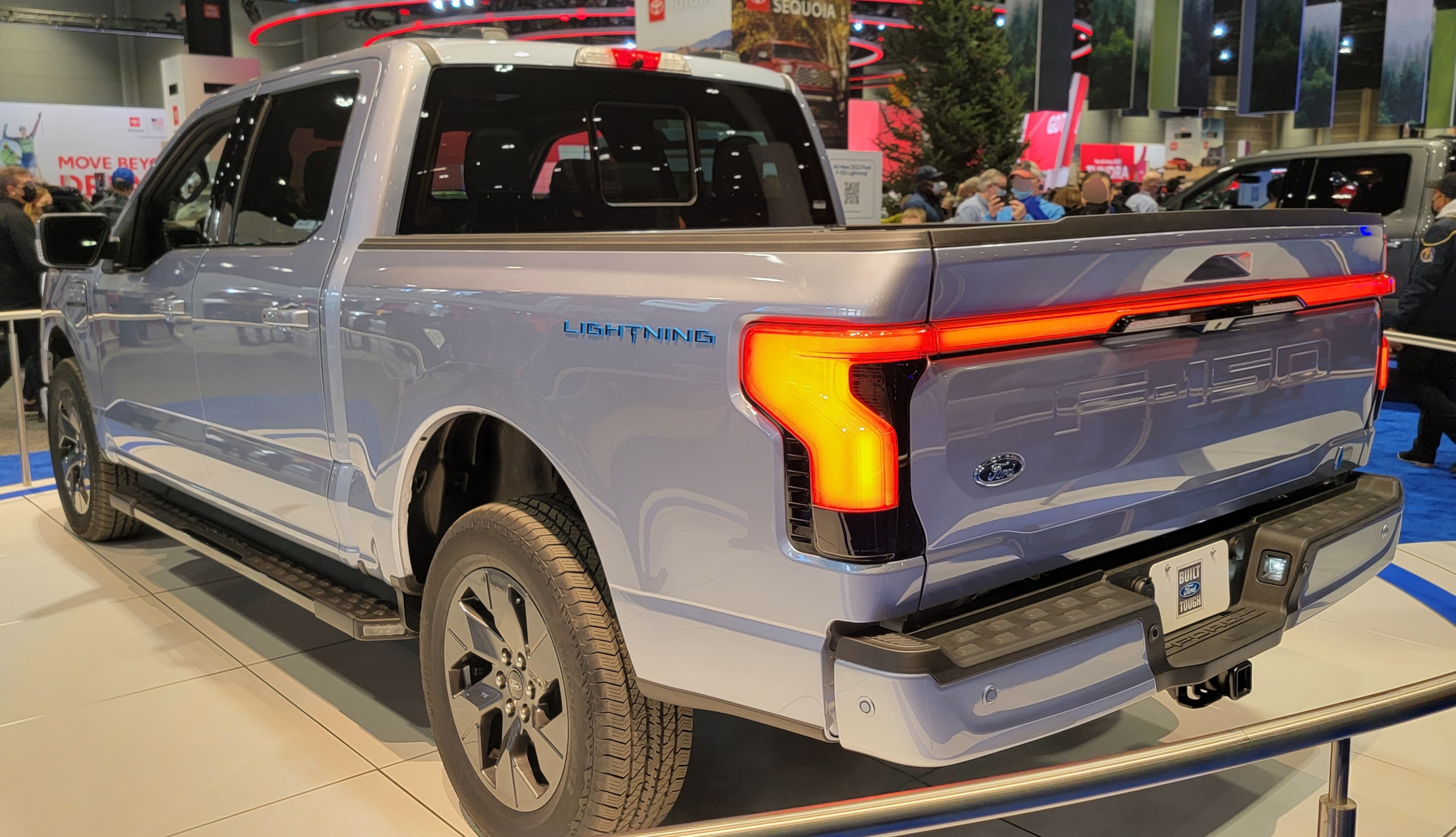
Ford F150
"And then the people selling the camper say, what kind of truck do you have? And say, well, we have a half-ton, a Ford F-150. Well, that won't work."
The Ford F-150 is a big truck that many people use for work or to carry things around. It's really popular because it can tow heavy loads and has a lot of space for passengers and cargo. People often talk about it because it's reliable and can handle tough jobs.
The Ford F-150 is one of the best-selling pickup trucks in America, known for its versatility, durability, and strong performance. It has been a staple in the truck market for decades, often praised for its towing capacity and range of available features. The F-150 is frequently discussed due to its popularity among both work and recreational users.
upside down
"...you're upside down on the one that you have. Plus, you're buying a camper..."
If you're 'upside down' on a car, it means you owe more money on it than it's worth. This can make it hard to sell or trade it in.
Being 'upside down' on a vehicle means that the amount owed on the vehicle loan is greater than the vehicle's current market value. This situation can complicate purchasing a new vehicle.
budget buster
"...that's a really good recipe for a budget buster."
A 'budget buster' is something that costs a lot more than you planned for, making it hard to stick to your budget. Here, it means buying a new truck and camper could really hurt your finances.
A 'budget buster' refers to an expense that significantly exceeds one's budget, often leading to financial strain. In this context, it describes the financial implications of buying a new truck and camper without proper planning.
premium fuel
"Like I found out this Armada, I didn't realize this, this thing recommends premium fuel."
Premium fuel is a type of gasoline that is more expensive and has a higher quality than regular gas. Some cars need it to run better and more efficiently, especially when towing heavy loads.
Premium fuel typically has a higher octane rating than regular unleaded fuel, which can improve engine performance and efficiency, especially in high-performance vehicles. Using the recommended fuel can help prevent engine knocking and maintain optimal power.
gas mileage
"Well, I can run it on unleaded, but I won't get as good a gas mileage and it won't be as powerful when I'm towing."
Gas mileage tells you how far a car can go on a certain amount of gas. It's important because it helps you understand how much money you'll spend on fuel when driving.
Gas mileage refers to the distance a vehicle can travel per unit of fuel, typically measured in miles per gallon (MPG). It is an important factor for consumers as it affects the overall cost of operating a vehicle.
miles per gallon
"It gets about 17 miles per gallon around town on regular fuel. If I burn premium fuel, it gets about 19."
Miles per gallon (MPG) tells you how far a car can go on one gallon of gas. The higher the number, the better the car is at saving fuel.
Miles per gallon (MPG) is a measure of how far a vehicle can travel on one gallon of fuel. It is a key metric for evaluating fuel efficiency, with higher MPG values indicating better fuel economy.
Request an Explanation
Heard something you'd like explained? We'll add it to this episode.
Sign in to request explanations for terms you heard.
Want to learn more?
Browse our glossary for plain-English explanations of automotive terms, jargon, and concepts.
Help improve this episode
See something that's not quite right? Our annotations are AI-generated and can sometimes miss the mark. Click the flag icon on any annotation to suggest a correction.