LIVE
This is the Automotive Repair Podcast Network.
Hey, everybody, Karm Capriato.
Good to have you.
Couldn't have done this ever without you, your support, your downloads.
Don't forget, we have ourselves our own listening app.
We're so proud of this.
We worked on it for about a year.
That's kind of overlaying my face if you're watching on YouTube.
And we've got the QR codes up in front.
And if you want to just get it and download it, it's the Automotive Repair Podcast
Network.com forward slash app.
But anywhere on that site, you can actually download the app, have fun with it.
I love it.
We're constantly making improvements to it.
You're going to absolutely love it.
I've got Kristal Zellmer on the other side of recognizing our great partners.
Hey, stay ahead of the curve with Napa AutoCare's newest auto tech initiatives, fast
track assessments, accelerator immersive training, and tech assist smart support.
The future of technician training is here.
Stick with your local Napa representative for more information.
Hey, let's face it.
Your shop management system is the most critical tool in your shop.
And Napa Tracks will move your shop into the SMS Fastlane with on-site training, six
days a week support, and local representation.
Find Napa Tracks on the web at NAPATRACS.com.
Okay, Kristal.
Hi.
Hi.
Good morning.
Oh my God.
Good to have you here.
This is your going to be your fourth roundabout with us on the podcast.
And I'm so excited to have you back.
I love just getting in chatting with you.
One of the episodes was the power of enrollment, building high-performing teams.
We can't learn enough about that.
We also did the cost of needing to be right, finding balance in life and in business.
And a lot of the surveys that I've absolutely done with shop owners is work-life balances
in the top three of challenges that they have.
So episode 1014, if you want to listen to the need, the reason you want to need to be
right for balance in business and in life.
And then another one with Dave Shadeen, we talked about actionable tips for enhancing
self-awareness.
I hear about self-awareness all the time everywhere, everywhere I go.
Is that what keeps you in business?
The fascinating part about self-awareness is it feels like the information around it has
gone up and the execution of what to do once you have an awareness, the needle hasn't moved
quite as much.
So I feel like we're on the right track and still deeply needed.
So we're learning but not doing.
Partially in my experience.
We're in an information age, right?
So we've got a lot of information.
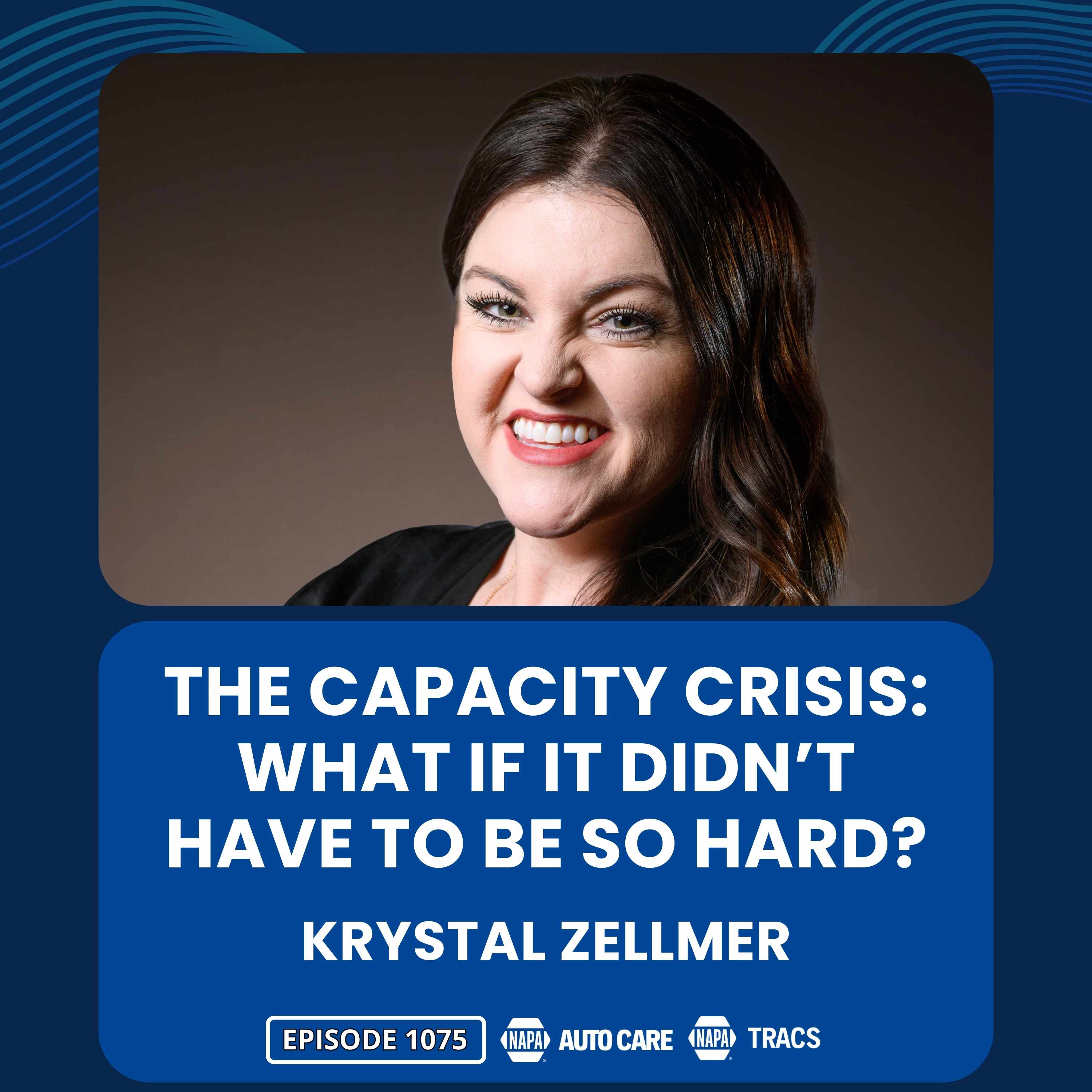
Crystal Zelmer.
I never even said your last name in the beginning.
The Clemmer Leadership and Character Development Group and Coach Dave Shadeen introduced us a
long time ago and it was so great to have you here.
We had a discovery call.
We're playing around with the title of this and I want to kind of tease our listener.
Either stop making things hard or do you have the capacity crisis?
And I got to tell you, for all the people that I know in the industry, we all could
benefit from the fact that we make things hard for ourselves or because I make it hard for
myself, I don't want to give it up to anyone else because I think I'm the only one who can
do it right.
That forces my capacity to be so diminished that I'm doing so much work and I'm being
labored, I believe, under all kinds of crazy stress.
And I know you help people all day long with this.
It's one of my favorite things to coach people on actually.
So let's jump into this capacity crisis.
I think common among the leaders in our industry, we lack formal training and we struggle with
self-confidence.
We think we know, but we don't.
I think we stumble over decisions, strategic plans, trying to be a better leader.
This is coming out sometime in January of 2026.
I think it's a great opportunity for people that say, hey, I want to be a better me
in 2026.
Absolutely.
One thing that I ask myself often, especially when we're talking about then making it harder
than it needs to be is, am I being busy or am I being productive?
And how many times are we sprinting full speed on a hamster wheel that's not actually
producing an end result that we said we wanted in the first place?
So we're spending a lot of time, a lot of energy invested in something that's
keeping us really busy and not necessarily having the return on the investment of our
time or our energy that we were hopeful for in the first place.
Got it.
Capacity crisis is what you called it.
We're trying to work smarter, not harder, but I think you believe that that mantra
is misapplied.
Well, I do.
So we do this sunglasses thing, which I'm sure you can go back to another episode
and look at because when you have a revelation of a belief system that you
hold in your heart, which is all, that's what we do.
Then you have awareness, self-awareness around how you're operating on automatic
when you're not really paying attention.
Now, something most people operate within is life is hard.
It's exhausting.
It takes so much effort.
Running a business is hard.
The economy is hard.
Having employees is hard.
Like all of that stuff is just exhausting.
And our thought is, what if it didn't have to be hard?
What if it was easy?
What if it was a challenge and you were up to it?
Now, that is a liberating place to experience and run your business from, right?
That's a, what if it didn't have to be hard?
And so many times because we have a deep-seated belief system that life
is hard, we will make things harder than they needed to be in the first place,
which I'm sure you experience a ton of.
Now, how many times have we had the awareness, had the revelation swung
the pendulum all the way to the other side?
And the idea or the philosophy was never that couldn't do hard things.
It was, what are you making hard that didn't have to be harder in the first place?
So what I have also found from leaders is, and people in general,
is they don't want to do hard things, which that's where the capacity crisis
comes in in my experience.
And the people listening might be dealing with this with their employees
or with other shop owners or maybe other professionals that they work with
or even customers that are coming in.
We were talking about maintenance the other day.
And what if your clients have a belief system that maintenance is hard?
Doesn't need to be, was I was talking to a different automotive professional
about this.
He was really on the concept that his clientele didn't want to do maintenance.
It was this, well, I hope I don't have to call you this year.
And his whole philosophy was, well, if we do this thing right,
you won't be in the emergency in the first place.
Let's take care of the maintenance so that you're not in the hard
situation, the pendulum swinging in my experience.
Okay, you said something just a bit ago, running on automatic.
And if we go on automatic, it sometimes isn't pretty.
How do we prevent that?
How do we ground ourselves to know?
I feel so good.
I'm doing my things, but your people aren't listening.
They're not following.
They're looking at you kind of, are you kidding me?
I can't believe it's coming out of him.
But you are, this is your automatic.
This is your backdrop, if you will.
Is there a button or a switch or a timer?
Oh my God.
Is there a timer?
Everyone's going to check yourself.
Check yourself.
Yeah, I mean, that would be a great tool to leverage would
be to set some sort of self-awareness check for yourself.
I've never talked about that before.
The way we teach it is the way to discover your automatic
patterns, we call them your sunglasses, is to notice
your feelings, notice your behaviors, and then work
backwards at what's the thinking that's driving
that thing on automatic.
Now your whole life becomes a training ground because
you're constantly notice your feelings and noticing
your behaviors and working backwards to identify
the thinking that's driving that.
And then once you have that revelation of the
thinking that's driving it, then you're back in
the driver's seat of your life and you get to make
a choice.
So you had the self-awareness and now you get
to change behavior.
Business owners, I might be touching on a hot button
here.
Another great way to have a self-discovery is to be
really open to feedback from the people around you.
Now, I don't know about the other people standing
on the phone that takes a level of humility.
That's not necessarily common to be willing to
receive feedback, not just from people that you
consider peers from everyone in your life, from
the people that are operating as your employees,
your customers, your significant others, your
children, and all of that.
Once you're in that mode, when you receive any
comment or conversation or anything, now you can
go, oh, that's information I could use on a
potential pivot.
Now we teach in our organization that feedback
is neutral.
It's not positive.
It's not negative.
If you can become neutral to feedback, now you
can actually leverage it as information to make
different choices.
If you think there's a more effective choice to
be made.
This is exactly what you're here for.
You're here to give us as much information you
possibly can in the shortest time allowed.
I'm thinking about, I asked you the question
is how do we prevent this automatic runaway?
And just hearing you, I'm thinking, what about
a timeout?
I know you may have mentioned the word rewind,
but every once in a while we need to almost come
out of our automatic man, person, lady, and say,
well, what just happened?
What did I say?
What did they say?
What were the reactions to this and learn from
those timeout or rewind steps and if on an
individual basis and then you went into this
feedback loop and I thought it was fabulous where
while I'm trying to assess me and what just
happened, look in the rear view mirror for just a
moment in time and I got to go back and forward.
But what I'm learning maybe at the end of the
day, you go to one of your most personal people
and say, listen, you were around me all day
today.
I did something a little earlier.
I kind of maybe went off the wall.
What's your thoughts on that?
That helps build what we're looking to build a
stronger level of self-awareness, being a
great leader and getting people to follow.
And if they believe you're open to feedback, you
just actually created the context of your
organization that you're hung.
We say, you know, we feedback for breakfast,
lunch, and dinner.
You create a context in your organization that
you as the leader are open to feedback.
Now everyone in your organization is going
to follow that and when a client comes back
unhappy, they're going to be so much more willing
to hear it, to wrestle it, to work with it because
contextually you as an organization are open
to that conversation.
It's huge.
The automotive world is changing fast and
customers are expecting speed, accuracy,
and confidence in every repair.
To keep your shop competitive, your technicians
need training that's smarter, faster, and
future focused.
That's why Napa AutoCare is excited to
introduce three new auto tech initiatives.
Fast track assessments, the accelerator training
program, and tech assist.
It all starts with fast track assessments.
This tool pinpoints a technician's exact skill
level, whether they're a student, job applicant
or a new hire.
So you know their strengths and where they
need improvement without putting a customer's
vehicle at risk.
Then comes accelerator training program using
immersive technologies like virtual reality,
augmented reality, and AI driven simulations.
It compresses years of technician development into
just months.
Trainees practice real world jobs, alignments,
breaks, diagnostics, in a safe virtual first
environment with instant feedback.
Instead of tying up your senior techs, they
can focus on customers while new hires become
billable, competent team members in record
time.
And once they're on the job, tech assist
keeps that support going through AR capable
smart safety glasses.
Your technicians can instantly pull up torque
specs, wire colors, component locations and
even connect with a live expert who sees exactly
what they see, providing guidance step by step.
System integration with information platforms
and DVI, streamline workflow and boost efficiency.
This assess, accelerate, assist approach helps
your shops deliver better quality repairs,
faster training and long term success.
The full solution launches March 2026, but
beta registration is now open.
Want your shop to lead the future of automotive
training? Connect with your local Napa representative
today.
Hey, let's face it, your shop management system
is the single most important tool in your shop.
Period.
Napa tracks has made selecting the right shop
management system easy by offering the industry's
best, most comprehensive SMS.
Now it all starts when a local representative
meets with you to learn about your business
and how you need to run it.
After all, it's your shop, so it's your
choice and having local representation is a huge
plus.
Customizing tracks to your business, whether you're
a one person shop or a large multi-bay or
multi-location company, a representative consults
with you to help optimize your shop's workflow,
efficiency and profitability.
Tracks always has the flexibility to do business
how you need to do it, which means it can
also grow as your business grows.
And unlike the other guys will be there for you
after installation with the best training and
support in the business.
Yes, a learning management system tailored to each
role in your company.
Simply put, tracks was designed and built for
shop owners just like you.
Visit us on the web at Napa tracks.
That's N-A-P-A-T-R-A-C-S dot com.
You said to me in our discovery call, you are
responsible for your results and you are not
your results.
Yes, my mentor Kimberly Zing taught me that.
That rocked me a lot.
You are responsible for your results and you are
not your results.
So the story behind that and how I got it was
I had said I was going to do something and I
didn't create what I said I was going to.
And I was down.
I was my show.
You could tell that I was carrying it and
it was heavy and as business owners, I'm maybe
people on the line can relate to that.
You're responsible for people.
You're respond.
I take that really seriously.
I'm responsible for feeding families.
I'm responsible for making sure the business
works.
I'm responsible for client retention and continual
acquisition of client.
I'm responsible at the end of the day for a
lot of this stuff and that can become heavy.
When we miss the mark or I miss the mark and she
was watching me basically allow my misses to become
my identity and it was weighing me down.
So she just said, you know, you aren't your results.
Right.
It kind of flattened me because I had become so
attached to.
I am what I can create and we do a whole piece on
this and I can take out the flip chart if you want
to or maybe even just paint the picture in people's
minds.
But basically if I believe I am my results, then
I'm going to be like a buoy in the water.
When I create good results, I'm going to allow
myself to have a good day when I create quote
unquote bad results.
Good, bad, right or wrong, right?
No, fully believe in that, but that heaviness that
came with not just I made a mistake.
Now I am a mistake and that's the birthplace of
like shame and guilt and all this stuff.
So she flattened me.
You are not your results.
You're responsible for your results, but true
responsibility, personal responsibility at its core
best has no heaviness attached to it.
My dad used to say that if you're still feeling
heavy after you come from personal responsibility,
you're actually still in victim.
You're just no longer a victim to the situation.
You're a victim to your results.
You're a victim of your choices.
Totally different place to play.
It reminds me of taking blame and I get and I
understand that if I'm the leader and I'm responsible
for the profit and the forward success of this
business, hiring really great people, developing
a great team, all the 30 to 50 things you're
responsible for and you don't take the blame.
And I think there's a lot of, how do we get out of
the blame game?
Yeah.
When personal responsibility turns into blame, shame,
guilt, it's ineffective.
Different mentor of mine used to say, Crystal, you
know, shame isn't an indicator that you care more.
Like, wow, at some level, I had this belief that
if I felt really bad about it, then people would
know how much I cared.
And the reality was I was wasting a ton of energy
that I could have been using to solve problems on
feeling bad about the problems that I didn't
solve well.
And that's to me, not good stewardship of my
energy.
Powerful stuff.
If I don't know how to solve problems, I've got
to go get help.
I need a peer group.
I need a coach.
I need someone to help me know this stuff so
that I can get up and over it and not feel the
blame game.
Again, you said shame is it's not an indicator
that you care.
I was using it as that, which it's got it.
So don't use shame.
Go get help.
Figure out what you got to do next.
And again, I've been an advocate for the last
10 plus years on getting coaches and or mentoring
group, networking group, peer groups to help
an individual up and over getting out of there.
Oh, well, my ego tells me that I'm, you know, I'm
smart and I know everything and I can't get help.
I would never want to admit to anybody that I know
that I went and got a coach.
And then when I see people get coaches in in
10 years, they have so much money, so much
opportunity.
They're getting ready to retire because they've
done so well.
It'd be like, my heart hurts, but I'm not
going to go to the cardiologist.
Well, we're right back into if it's hard to
do it hard, but it doesn't have to be hard.
And I think most people don't hire a coach because
they have no idea that they're making it harder
on themselves and then it needs to be.
If there's 10 options available, getting a coach
is basically like hiring an assisted advantage.
Some people won't do that because they think
it doesn't count if I didn't do it myself.
It's not real.
If I didn't pull up my own bootstraps,
you know, assisted advantage.
I got a coach because I'm failing.
No, you got a coach because you wanted
an assisted advantage.
Well, yeah, we teach it in our organization as
leveraged leverages and assisted advantage.
Oh my God, I even love that get leverage.
See, and that's a really powerful positive word.
I got leverage.
I got leverage.
Yeah.
And most people see leverage as like if you
were being leveraged, like you're being
taken advantage of, which is just a different
automatic set of sunglasses that will keep
you from receiving leverage, which is actually
a great thing and just an assisted advantage.
If I gain leverage and I can actually leverage
that to grow my business, I got leverage
so that I can leverage.
Absolutely.
Did that all make sense?
I did to me.
I'm rambling.
Oh my God.
One of the other things that we talked
about and I think this kind of falls
into this is the M&M, the peanut M&M metaphor.
We've got to share that.
Yes.
So this exists in one of our books when good
intention runs back into reality by Brian Klemmer
and he uses this analogy like Europe peanut M&M.
You were in front of me.
We would be going back and forth, right?
As the audience listener on the very
outer layer.
There's a colored candy coating, right?
That makes it green, makes it red,
makes it whatever it is right underneath
that there is a white candied shell.
Underneath that is the chocolate layer
and inside that is the peanut M&M.
So if you were going to bite that in half,
you would see all the different layers
that would exist within this peanut M&M.
Our belief is that is a representation
of layers of you.
So on the very outer coat, you have
your actions and your behaviors.
You are not your actions and you are
not your behaviors.
Those are just the outer layer
that everybody can see.
Now people may judge you on that thing,
but you are not your behaviors.
How do we know that?
Because you can change them.
They're their choices, right?
Just underneath your actions and your behaviors
is your feelings and your emotions.
So that white kind of candy coating,
we consider that layer your feelings
and your emotions.
So your feelings typically drive your behaviors
and your actions.
Get angry.
You say something you didn't want to say.
You feel elated over something.
Now you are giving generous whatever the thing is.
So that layer, that feelings and emotions layer,
you are not your feelings.
And to be really frank, we often identify
ourselves as our feelings.
And I'm going to suggest that that's not
doing great things for our society.
If we're, I'm angry.
You're now making a self proclamation
about who you are based off of something
that can be very fleeting.
I have a friend of mentor, coach, whatever.
Somebody I saw on stage that I really appreciate.
Dr. Dave Martin said he posted this meme
and I share it all the time.
He said, was it really a bad day?
Or was it about five minutes that you milked all day?
Gosh, isn't that so true?
I had a five minute experience, a 30 minute phone call.
I didn't like and did I call the whole day?
Was I angry all day because of a five minute
interaction that I didn't appreciate?
So you are not your feelings and you are not
your emotions and you're not your behaviors
and you're not your actions.
Just under that is your chocolate layer,
which is the thinking layer.
Now, when we say thinking, I'm not talking
about positive thinking.
I'm talking about the thinking that exists
at a subconscious level.
You're thinking in your heart.
That is where your paradigms, your programs,
your belief systems, we call them sunglasses.
That's where those exist.
So in that layer that thinking at the heart level layer,
that is again, not you and those are the things
that because they're running so under the surface
that most people don't even realize they're thinking.
Now, it's also been proven that I've been taught
that all thinking comes first.
The thought precedes the feeling,
precedes the behavior.
So if you look at that in a chain of events
and if you really wanted to change a behavior,
the greatest way to do it is to change a belief
system that you have in your heart.
That's what we would call transformation
because it's inward outchange.
There's multiple different types of change,
but that's like long lasting transformation
happens when you have inward outchange,
meaning you change something at that chocolate level,
that thinking in the heart space level.
Now, you are not your thinking.
How do we know that?
Because you can change it.
You can change belief systems that you hold in your heart
through repetition and emotional involvement.
Repetition and emotional involvement are the ways
to change the thinking that you have in your heart.
And you are not your thinking.
You're the nut in the middle.
You're that inside core piece.
That's you.
That's the piece of you that's rooted in identity.
Now, I'm a born again believer.
We could go into a whole different route there
and like that nut in the middle.
That's you.
So if you can really begin to go,
Oh, I'm not my thinking.
I'm not my feelings.
I'm not my behaviors.
Now you have some separation from.
I think some of the heaviness that comes
when we think we are all of those things.
Now all of those things were responsible for because
at the end of the day,
life has prices and benefits and you are going to reap
prices and benefits for all of your thinking,
all of your feelings,
all of your behaviors in real time.
It's just they're not who you are.
And Brian used to say all the time that your past
does not dictate your future unless you allow it to.
It doesn't have to dictate your future unless you allow it
to.
Did I go deep on you, Carm?
Yeah, you did extremely deep.
And if you're watching on the video,
you could see my face or my eyes in this heaviness of
thought and my big takeaway here is if you're the core
nut inside,
what's above it are layers that you have to be worried.
You have to control or manipulate or am I thinking
right?
All of those things are choices you make.
They're my choices.
I'm the nut.
I'm in the middle.
I'm the core and all these layers on side of me.
Frankly, it's what you get that I allow you to get.
Yes.
Oh, there it is.
There it is.
It's what you get that you allow to get.
Yeah.
What I allow you to get.
Oh, damn.
This is heavy.
This is heavy.
I was going to go liberating.
Okay.
Yeah, that too.
For business owners,
that means you lost your temper one time.
That's not who you are, you know, you lost a client.
That's not who you are.
You were in the red instead of the black one year.
That's not who you are.
It's just a choice.
It's just a season and it's all balanceable.
If you stay in the game.
Okay.
You said the word balanceable that I love and I
thought of the word fix.
It's all fixable fixable.
Yes.
And if it's fixable, it's balanceable because I love
the word balanceable.
The more I think about you, you can do it.
I will fix that.
No, if I fix it, it's got to fit in the solution and
the culture and that's why it's balanceable.
It's a new word.
I actually thought I said balanceable.
So balanceable I think is even better.
I love it when something new comes out of the best.
I heard balanceable.
I like it.
We're running with it.
Yeah, to me that makes a lot of sense because if you go
for a fix, it doesn't necessarily mean it's going to
make things level.
You know, we may put pressure on the teeter totter
thing here.
There needs to be pressure on both sides in order
for it to balance out.
So if not every fix is going to work, I guess is
what I'm saying.
Yeah.
And you'll only know what works to fix and what
doesn't based on the results of whether or not it
does.
And what will fix in one season will not fix in
another season.
I can only imagine that business looks completely
different for shop owners right now than it did five
years ago, than it did 10 years ago.
Heavy, heavy, heavy.
Every time I hang out with Crystal, this happens
and I always say, I'm not worthy.
You're so smart.
This is that personal development place of going
like, oh, there's so much more.
There's always so much more.
There's a lot there.
Hey, there was one other thing we talked about and
I really want to cover it before we end.
And we were talking about delegation versus dumping
and I loved the things you said is this type A
drivers, they dump tasks on people without proper
training or mentorship because we can.
And again, you'll hear me say so many times
because I've just gotten to learn from a lot
of incredible people.
So I will always give credit back to where
I got certain revelation.
It was a mentor of mine, Bob Harrison, and he was
talking about leverage from the perspective of
increase in multiplication and that you really can't
multiply until you figure out how to delegate.
And then he went into this coaching moment that
he had around, did you delegate or did you dump?
And then I started unwinding all of these
things and I don't know if there's any other
dominant personality styles on the phone on the
line on the podcast.
I personally would get so much that I felt like
I quote unquote had to get done and I would
feel all this heaviness and then I would choose
overwhelm and then I would be in this breaking
point where I was like, I finally set it up
where I have to trust somebody to do something
and then I would just hand over all of this
stuff that people really weren't trained to do
or do well.
Here's the scary part.
We talked about the need to be right episode.
If I already operate from a belief system or a set
of sunglasses that nobody else can do it as well
as I can do it.
And then I get myself into this pickle where
I've set it up to where I'm dumping on people.
Then I get to be right about the fact that
other people can't do it as well as I can.
I take it back.
Now, my need to be needed.
My need to be important.
My need to be the center of the, you know, and I
don't mean that from a negative perspective.
I'm just saying we all build in these different
beliefs unconsciously.
Nobody's doing it consciously.
And now my people around me who desperately just
wanted to help me felt incapable.
Now they feel like I've taken it back and I've
created all of these painful interworking
dynamics that just didn't work.
We can lead this right back into feedback.
What if people not doing the task up to my standard
didn't mean they weren't capable?
What if that was just feedback for how I trained
them in the first place?
No blame, no shame, no guilt.
And if they didn't do it the way I wanted it done,
then all I go is, oh, I didn't spend enough time
training them the way that would have served them
to do it how I was expecting it to be done in the
first place.
You just described a lot of issues that exist in
small business today.
Totally.
And I go back to the thoughts of the lack of the
processes and the systems that we don't have.
We expect someone to do something they were never
coached, trained, mentored about.
It's not right.
And then you go off the deep end and the
ugliness that the whirlwind of ugliness and the
people unwilling to even lift a finger the
next time you request help support or you're even
delegated, they may just half delegate the task
because they know they're never going to do it
right.
Yeah.
So delegation versus dumping, the word delegate
means you've really taken the time to explain
what the end result needs to look like and it
needs to be laden with policies and systems and
culture and ethics and all that stuff.
It just needs to be whatever the word right means
and needs to be right.
According not not according to you, but according
to the person who finished the job when the
person finished the job.
You could say, hey, do you think that's right
according to you?
Yeah, there's a great question.
If you're trying to become a better delegate or
not a dumper and you think you may have dumped
then ask the person you're not happy with
their work, but are you happy with your work?
Yeah, so good.
I love the gym analogy.
Like I use it all the time.
If you and I went to the gym together and you
watched me lift weights, you have no muscle.
You can watch me lift weights all day long.
You will not gain any muscle.
How many times have we trained people by going
come watch me lift weights and then
they still don't have the muscle to carry
the task you're asking them to do in the
first place.
The leadership is not about just knowledge training.
It's about can you carry the weight of what it
takes for customer relations?
So now it's allowing them to lift a lighter weight
until they're used to what that feels like.
Now they have capacity.
They have some wins under their belt.
Instead of going, hey, go lift that 350 pound
dumbbell that I've been doing for 20 years.
Like yes.
And they have a practice with what it takes
to build the muscle to be in the place
where then they're your trusted guy and
maybe they still can't lift 350 next to you,
but you've watched them lift 250.
So now they can take all 250 and under problems
and you take the 250 and up until they lift more
weights, lift more weights, lift more weights.
And now you're not just dumping a problem.
They don't have the muscle to handle.
You've actually built up the muscle within them
to be able to sustain the kind of leadership
you're requiring from them.
What an incredible ending to this episode
because I just wrote down this metaphor.
Do they have the muscle and everything's the muscle?
Emotional intelligence is the muscle.
Their skill set within the automotive is a muscle,
their ability to do the finances and muscle
like it's all a muscle.
Do they have the muscle?
Whatever the request was, you're going to lift 100.
You're going to live 300.
Do they have the muscle to do that particular job
or task?
And if they don't have the muscle, the answer isn't going,
you're not capable because that's where our capacity
crisis is coming in.
Then we're going, I'll just take it all back.
It's like, okay, well, 250 didn't work.
Let's try 100 and watch you do some reps
and watch the muscle.
And so let's find the place where your capacity is
because capacity is this fascinating concept
because I really believe capacity grows
with testing and it shrinks when it's not used.
So if I'm always playing under the weight in which
somebody can carry, I'm actually responsible
for their capacity shrinking because I as a leader
have not placed on them proper response.
Yeah.
Sounds like three syllables.
Well, and I keep going back to if you haven't read
the book, the anxious generation, it's really good
whether or not your parent, just a great book.
And he talks about trees in there's anti fragility,
which is basically like trees in a biodome
will not be able to with they can't grow and they
can't survive even though it's perfect conditions
because there's no wind and the wind creates deeper
roots.
And so when we take away the wind, that that's the
visual that kept coming to me.
When we take away the wind, what we're really
doing is we're taking away their ability to deep roots.
We get to keep the testing.
We get to keep the strength building.
We get to keep putting people and ourselves in
positions of things that we don't know if we can
handle because it tests our muscle gives us feedback.
We start again.
Stop the episode.
Go back to the beginning where we talked about
capacity crisis so that you can get this thing
looped in and when you said they can't grow
without wind.
And so if you don't have wind in your life, you
can't grow and wind must be the challenges that
we face in our own personal growth and self-awareness
and confidence and capacity and this perpetual
students see that we need to have in our life.
So good.
My dad used to say, you know, if he used to
threaten to fire people who weren't failing.
Sounds crazy.
It's true.
If you're because, you know, and two of my really
profound mentors would like, when was the last big
mistake you made?
They're like, Brian, we haven't paid any is clean
record.
And he's like, well, then I'm going to get to let
you go because if we're asking other people to
risk and we're not, you're not growing.
If you're not risking, you're not growing period.
And if you're not failing occasionally, you're
not in the arena.
It was one of the John Maxwell books that hit me
so hard when I started to become a fan of his
and starting to read because I realized I was a
really poor leader fell forward.
You know, I think that was one of his books.
If you're not failing, you're not growing.
And that's where the ego needs to get out of our
world in our life and realize that it's part
of the wind.
Totally.
And what if we could culturally get into place
and I do love to do this where like somebody
falls that's around us, like another business owner
or like way to go.
You're on the field.
You know, you know, that's the kind of culture
I want to live in.
Like you made a big mistake.
Welcome to the party.
Like grateful to be alive right next to you.
This was way too much fun as we always seem to
get together and we get into these deep little
cool pockets or zones and they have so much
for this so much here for people to take away.
This is worthy of a double listen at least.
Crystal Zellmer VP.
Clemmer leadership in character development.
Wow.
Your fourth episode with me.
Please go back and listen to the other ones.
We'll have them on the show notes.
Crystal, thank you so much for being here.
We'll get to do it again.
I'm so grateful, grateful for the opportunity to
be with you and your people.
Thank you.
Thanks for being on board to listen and learn
from the Premier Automotive Repair Business
podcast, Remarkable Results Radio.
Get your episodic education on the A-R-P-N
listening app at automotiverepairpodcastnetwork.com.
Also enjoy the podcast on our Carm Capriato
YouTube channel.
Carm is all for advancing the professional
automotive service industry.
Until next time.
0:00
39:51