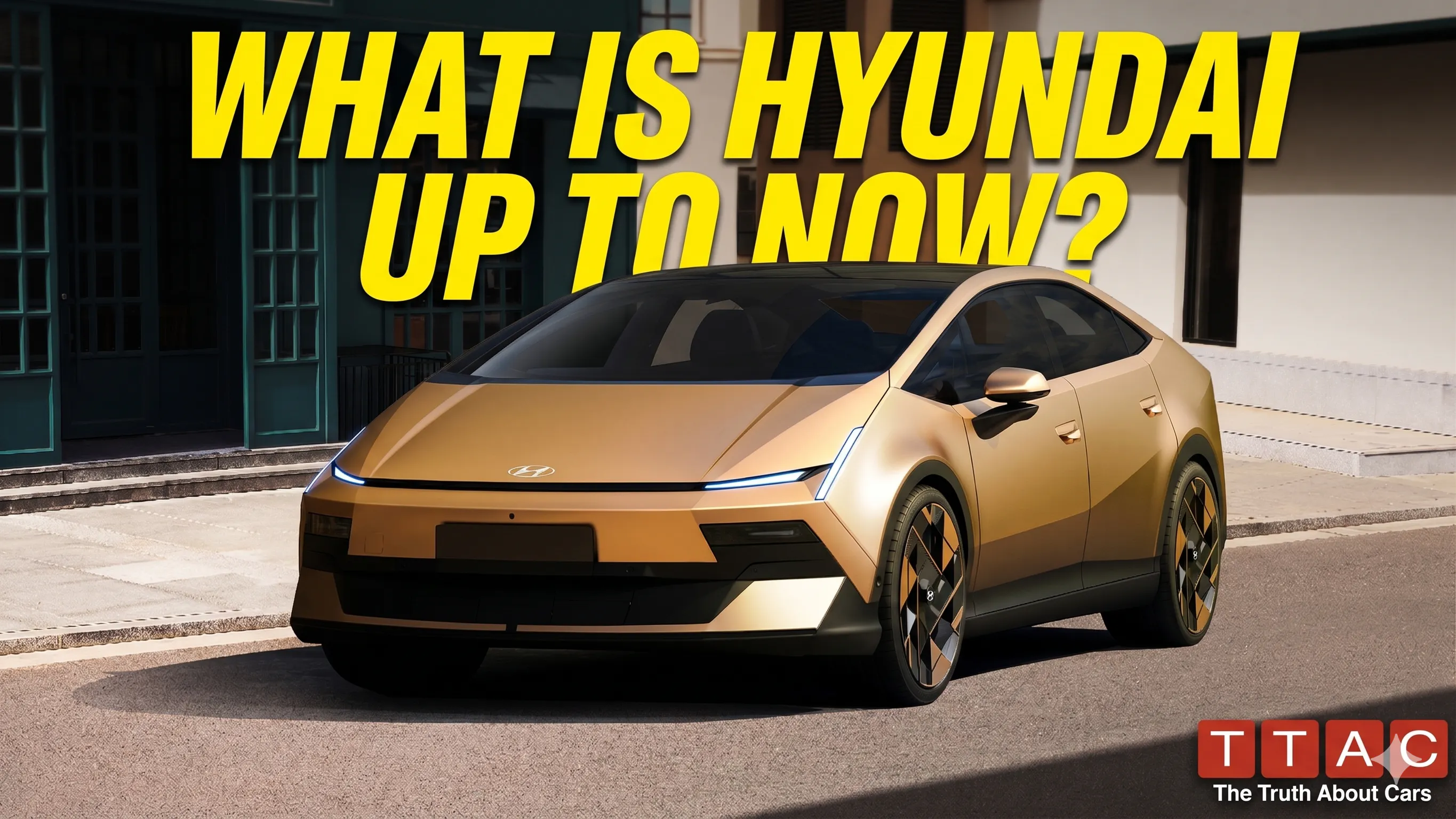
The Future of Hyundai EVs and Where the Brand is Headed Next
The Truth About Cars
The Future of Hyundai EVs and Where the Brand is Headed NextThe Truth About Cars · Apr 24, 2026
Annotations will appear as you listen
0:00
35:44
Car
Hyundai EVs
They’re talking about Hyundai’s electric cars. EVs run on electricity from a battery instead of gasoline, so the ownership experience can be different—especially for charging and some maintenance items.
“Brake repairs” is a broad term covering work on the braking system, which can include pad replacement, rotor service, caliper work, brake fluid service, and inspection of related components. The key point is that brakes are safety-critical, so the job is more involved than many basic DIY tasks.
Brake pads are the friction material that clamps against the brake rotors to slow the vehicle. When you replace them, you’re restoring braking performance and ensuring proper wear and stopping power.
When you buy brake parts online, you can’t just pick any “brake pads.” You have to make sure they match your specific car so they fit and work properly.
They’re using the Dodge Challenger as an example. Some Challengers have upgraded brakes from the factory, so you have to buy pads meant for that specific brake setup.
The caliper is the part that grabs the brake pads and pushes them onto the brake disc. Some cars let you change pads without fully removing the caliper, while others require taking it off.
Hydraulic brakes use fluid pressure to make the brakes clamp down when you press the pedal. If there’s a leak or air in the system, the brakes can feel weak or spongy. That’s why brake fluid and the system’s condition are important.
The brake rotor is the metal disc that the pads squeeze against. When you brake, friction between the pads and rotor slows the wheels down. If the rotor surface is damaged, braking can feel uneven or noisy.
A C clamp is a tool you can use to push the brake caliper piston back so you can fit new brake pads. The wood is there to prevent scratches or damage while you clamp it. It’s a common DIY step for brake pad jobs.
The handbrake is the parking brake that keeps the car from rolling when you’re stopped. On many cars it works through the rear brakes. Because of that, the rear brake calipers can be trickier to service than the front.
Some brake calipers need a special tool to turn the piston back the right way. The tool matches the caliper’s shape so you don’t force it incorrectly. Using the right tool makes the job safer and easier.
Inside the brake caliper there’s a piston that pushes the brake pads into the rotor. On some cars, the piston has to be turned like a screw before it can go back in.
A brake job is when you replace or service parts that help your car slow down. It’s a common repair, so there are lots of guides online—especially if you’re doing it yourself.
A “meta plant” is Hyundai’s term for a facility that goes beyond traditional vehicle assembly by integrating multiple production functions on site. In this segment, it’s described as an assembly plant plus battery production and even seat manufacturing, with EVs built there as well.
Robotics means using machines to do repetitive or heavy tasks in the factory. In this case, robots help move cars and parts so workers can focus on other jobs.
A hybrid vehicle uses more than one power source—typically an internal combustion engine plus an electric motor and battery. The hosts mention hybrids as a future production direction for the same facility, implying flexible manufacturing planning.
Automation is when machines handle work that used to be done by people. The point being made is that it can take over the hardest repetitive steps and free people up for other work.
Concept
robot as was the start, the consumer electronic show
CES is a big tech event where companies show off new gadgets and technologies. They’re saying this robot idea started there and later found real uses in manufacturing.
The Hyundai IONIQ 9 is another fully electric Hyundai model mentioned in the lineup. The takeaway is that Hyundai wants to give shoppers more than one EV choice.
Range anxiety is the fear that an EV won’t have enough battery to reach a destination or a charging station. The hosts discuss it as a major reason some people hesitate to buy EVs, even as vehicle range improves.
A charging network is the set of places and systems that let EVs recharge. The idea is that more coverage makes EV ownership feel easier and less stressful.
Circle K is a retail and fuel-station brand that’s mentioned here as a partner in expanding EV charging infrastructure. The relevance is that charging access often depends on where stations are installed.
Electrify America runs fast charging stations for EVs. The point here is that there are already charging networks in place, and more coverage is coming.
A plug-in hybrid is part electric and part gas. You can charge it like an electric car, but it also has a gas engine as backup.
Concept
EV test credit
The “EV test credit” appears to refer to an EV-related government incentive or tax credit that can influence consumer demand. The hosts are asking whether reducing/eliminating that credit caused a drop in EV purchase intent, and Hyundai’s response is that demand remains strong.
Tariffs are extra taxes on imported stuff. If parts or cars are brought in from other countries, tariffs can make them more expensive, so Hyundai is trying to build more locally to avoid that.
Localization means making the cars (and more of the parts) in the country where they’ll be sold. Hyundai is saying that helps them deal with tariffs and keep costs under control.
“Ramp up” describes increasing production volume over time as a new factory comes online and supply chains stabilize. The segment notes that tariff impacts may be felt during the ramp-up period, even if the long-term plan is to localize production.
They mean how many people are actually buying electric cars. At first, only enthusiasts bought them, and now the conversation is about getting regular buyers to switch too.
Concept
early adopters vs mainstream adopters
Early adopters are the first people to try EVs. Mainstream buyers are the bigger group, and they usually need more convincing—like lower prices and easier charging.
Hyundai’s Boulder is a concept car—basically a preview of what a future vehicle could look like. They’re talking about whether a real, production version will be built as a truck, an SUV, or both, and how close it will look to the concept.
A midsize truck is a pickup that’s not as big as the largest full-size trucks, but bigger than the smallest compact ones. It’s a common category because it balances practicality with easier everyday driving.
Body-on-frame means the car’s body sits on a separate “frame” underneath. This layout is popular in trucks because it’s strong and flexible, making it easier to build versions meant for towing or off-road driving.
The pickup truck segment is just the category of pickup trucks and the people who buy them. The speaker is saying Hyundai wants to go after those buyers first.
The Hyundai Santa Cruz is Hyundai’s pickup truck. The speaker says they’ve learned from it, but it’s nearing the end of its production run, and a new body-on-frame approach could deliver more capability for buyers.
Multiple trim levels means the same vehicle model will come in different “packages” with different features. The speaker is saying Hyundai could offer versions that are better for off-roading and also versions aimed at different budgets.
From a towing standpoint just means how good the vehicle is at pulling a trailer. Trucks can be built to tow more effectively because their frames and setups are designed for that job.
A longer bed is the part of a pickup truck where you can carry stuff. Having a longer one usually means you can haul more, which can attract more types of buyers.
“Lock” usually means the car is set up to keep both sides working together when traction is poor. That helps the vehicle move when one wheel would otherwise spin.
A “caution for cause” is when the race slows down because something happened on track. That pause can help or hurt drivers depending on timing and strategy.
“Overtime” means the race goes a little longer than planned because of a late caution. NASCAR tries to finish the race with a fair, competitive restart.
They’re talking about oval race tracks that are about 1.5 miles around. On tracks like that, the racing can sometimes look similar lap after lap, unless something dramatic happens.
These are planned slowdowns during the race that are meant to keep things organized. They give teams a predictable moment to pit, rather than waiting for an accident.
Stage racing breaks a race into sections, and drivers can earn points at the end of each section. That affects when teams pit and how they manage tires and fuel.
The “outside lane” is the higher line around the track. Sometimes it’s faster because the car grips better there, but it depends on tires and track conditions.
When they say a driver had a “better handling car,” they mean it was easier to control and stayed grippy in the turns. That often shows up as smoother steering and less sliding as the race goes on.
They’re pointing out the finish was extremely close—only about a tenth of a second. In racing, that’s basically “who got the better run” at the right moment.
A “1.5 mile” race means the track is about 1.5 miles long. Track length affects how the cars behave and how tires wear, which can change how much passing you see.
Tire pressure is how much air is in the tires. If it’s too high or too low, the car won’t grip the road as well and the tires can wear out faster. In racing, teams watch pressure closely because it changes how the car feels lap after lap.
Goodyear is a major tire manufacturer and a long-time supplier in NASCAR. When the transcript mentions “Goodyear’s instructions,” it’s referring to recommended tire setup/pressure guidance that teams are expected to follow for performance and safety.
A photo finish is when the winner is so close that they need a replay or photo to be sure. It usually means the cars were running very evenly right to the end.
Topic
move back to Chicago
They’re talking about where the races are going next, including a return to Chicago. Different tracks and dates can change how the cars behave, so teams adjust their strategy.
Pit road strategy is about deciding when to come in for service during the race. Teams try to time it so they lose as little track position as possible and get the right tires/fuel. The hosts say this kind of decision-making helped make the race exciting.
Talladega is a big NASCAR track where cars often run very close together. That “drafting” can make passing exciting, but it can also lead to big crashes if something goes wrong. The hosts are hoping for a clean, competitive race.
A superspeedway is a big NASCAR track designed for very high speeds. Cars often race in tight groups, using the air behind other cars to go faster. That can make the racing intense and sometimes more dangerous.
Daytona is another famous NASCAR track where cars race at very high speed and often run in packs. That can make the racing close and dramatic, but it also raises the chance of big pileups. Here it’s used as a comparison for the upcoming Talladega race.
A “big one” is NASCAR slang for a huge crash involving lots of cars. It can happen fast when cars are running close together. The hosts are hoping the race stays clean and avoids that kind of incident.
A “draft parade” means the cars mostly just follow each other in a line because of the slipstream effect. It can look exciting, but it may not feel like true racing if nobody can really pass. The hosts are hoping for more real passing and less of a procession.
LIVE
Hello, and welcome to the Truthball Cars podcast. I am Tim Healy, the managing editor, and this
week we talk about Hyundai's EV future with the automakers Dan Wang and Miles Johnson.
T-TEC contributor Matthew Guy and I discuss brake repairs and yet another NASCAR photo finish,
this time at Kansas. All that and more on this week's T-TEC podcast.
On the Truthball Cars podcast, we spend a segment every week talking about the stuff that we use
in our homes, in our cars, and on our cars, as the case may be, tools, cleaning products,
and the like. And we have T-TEC contributor Matthew Guy with us to do so. Matthew, how are you?
Hi, not bad. How are you doing?
I'm well. I'm well. So let's get into it. You said you did some work on your brakes.
Yeah, I did a set of brakes on a vehicle yesterday and I thought it would be a good
topic for today's podcast because it's definitely the type of task that is a little bit more involved
than some of the other wrenching things that we've talked about, you know, change in oil and
change in cabin filters and stuff like that. Like those are really good things to start off with
if you're just getting used to wrenching on your vehicle. Brakes are a little bit more involved,
but if you've gained a bit of confidence by doing some more of the simple tasks and then
also leaned on some other resources online for familiarity with what you're diving into,
it's not, in most cases, super, super complicated, at least to just swap out some brake pads.
So I thought I'd just talk about some general tips and some general tools that I was using.
This vehicle, I was doing brake pads all around and so I just picked them up at the local parts
store. It was like 34 bucks, right, for a set of brake pads. They're so cheap these days. Probably
about the only thing that relates to cars that is affordable these days. Yeah, the way it's gotten.
With fuel and motor oil and everything just going up, but these were still very, very affordable.
And it's important when you go into the shop, where you go to your favorite online website to
buy auto parts, to know that when you're looking at brake pads, you'll have to be presented with a
whole bunch of different options for your car. And of course, this assumes that you've punched in
the correct model of year, you know, to make the model, even the trim. And it's important to get
all of these details right when you're buying brake pads, because they can be very, very different.
On the Challenger, for example, the Challenger has a Brembo brake option from the factory. And
those pads are really different than the pads for cars that do not have that option. So just make
sure you got the right stuff before you start tearing into it and taking stuff apart with your
tools. But once you're in there, I know you got the right pads. It's generally a pretty simple
job. A lot of the ones, the one that I was working with, it was just a small economy car belonging
to someone else. And these brake pads, you don't need to remove the caliper. Some vehicles, you
need to take the caliper off altogether. And then you're looking at the caliper upside down,
almost like an upside down loaf of bread. And then the pads slide out from the bottom. That's
one way to do it. Another way that some brands will do it is the caliper itself stays on, the big
bracket. But there are two generally 916 bolts, you would remove one and loosen up the other. And
then the top of the of the caliper just swings up. And I like those a lot more because the less
stuff you need to remove, the less chance there is that you're going to round out a bolt or break
something that you really don't want to break, right? And then in this instance, you just slid the
pads out from against their home where they used to be on the rotor. And I like that more because
another, I guess, word of advice for people who are doing brakes, and if you do need to remove
the brake caliper, make sure you don't let the brake caliper hang by its hose. There will always be
a hydraulic hose going from the brake system to the brake caliper. And you don't want to put any
undue stress or strain on that hose because it might tear. It might get damaged in some way
because those calipers are not like, you know, even if they are three, four pounds, it's enough
weight that it could stretch that rubber hydraulic hose. And you don't want that because then you
got a whole new set of problems. Your brakes are going to not work properly. A fluid is going to
leak out and all that type of stuff. So what I like to try to do is take an old metal coat hanger
or a piece of twine or something like that and just support the brake caliper up in the air.
Generally, I just tie it to the suspension spring that's generally right there above it.
Makes sense. Yeah, right. So just some tips and some tips and tricks there for stuff we use this
week for brakes just because it's fresh on my mind. This one definitely was in dire need of
brake pads. So we definitely had to with hydraulic brakes in the front, you can just imagine that
there are well on all four corners, but there are going to be at least one piston that will
hydraulically push its way out when you apply the brake pedal, right? So I just you probably heard
me clap my hands together then I was as if anyone can see me pretending to actually just push on
the brake pedal in the car. And when you do that, how a braking system works is one of the things
that happens when you push on the brake pedal is that the piston in the caliper pushes your brake
pads towards the brake rotor, and then the whole unit slows down. That's how your car slows down.
So naturally, there's not going to be as much room in there. The caliper piston is going to be
pushed out a little bit because as the brake pads wear, the piston needs to move a little bit further.
So generally, on cars up front, you can use a C clamp and a bit of wood to make sure as barrier
so that you don't damage anything to push that piston back into the caliper. And on the rear of
most cars, because of the the handbrake, generally, there's a mechanical or electric handbrake
that one has to one has on their car. The pistons in those calipers generally screw out almost like
if you're unscrewing a fastener from the wall or something like that. So you can't just you can
and I've done this like very first set of brakes I did decades ago, right? I was trying to push that
piston back in push all my might to like with all kinds of tools not working. Why? Because you have
to screw them back in just like that fastener into a wall. And a lot of car companies with an eye
to service ability will have a couple of notches in that piston and couple of different ways you
can buy special tools. And we talked about this one time on the on the podcast month or two ago,
I guess, where you can buy an actual tool that fits over this universal, there's a whole bunch of
different knobs on it, extensions on it. And then you can just crank it down using that tool fits
into the slots. But I was using yesterday a set of needle nose pliers, and they fit into those two
notches in the piston of this particular car pretty well. And then you just turn the pliers
around clockwise. And then it screws that piston back into the into the caliper. So with those,
you know, sort of tips under your belt, the wealth of knowledge that's out there on YouTube,
research it, you can see all this stuff on YouTube for just about every car that's out there. And
especially if you're wrenching on your own, it's probably on your own car. By the time it needs
brakes, it's probably going to be a pretty common car. You know, people have done the job before
is what I'm trying to say. You're not the first one to put brakes on the type of car in which you
are working, generally speaking, unless there are engineers listening to our podcasts, we're
working on prototypes. And I hope they are. Hello. So yeah, but I just thought our listeners would
appreciate some some tips and tricks. And at least, if nothing else, get you started on your
journey for finding a bit more of make a model specific information, giving you some search
terms to use when you're looking for a bit of detail. Makes sense. Is there anything else you
want to talk about when it comes to brakes, or any any safety issues that we haven't already
covered that you need to or want to go over? Yeah, no, I mean, it's all the basic safety stuff.
The main thing, you know, for in terms of keeping your sanity is making making sure you
have the correct parts before you leave the parts store or before you hit checkout on the website.
Makes sense. All right, so we've had Matthew Guy talking to us about brake jobs here on
the truth about cars podcast. Thank you, Matthew. Thanks very much, Tim.
On this week's truth about cars podcast, we are in Savannah, Georgia with Dan Wang from Hyundai.
He is a senior manager of advanced vehicle technology. Is that correct, Dan? That is
correct. As well as Miles Johnson from the Hyundai PR team, and we're talking meta plant and Hyundai
INEek 5 and INEek 9. So either one of you gentlemen can enlighten us on how the meta plant works.
First of all, why is it called the meta plant? Well, the meta plant name comes from the fact that
the facility transcends just it's not just an assembly plant. It's also a battery plant on site,
they're making seats on site, and they're making EVs on site, INEek 5 and 9 are both produced there,
and the future is very bright for the facility. So the name meta plant means it transcends,
it's not just an assembly plant on that facility. It transcends the name a little bit in the fact
that there's multiple battery plant, assembly plant, seat plant, all kinds of different things being
manufactured on one campus. So meta also means transform. Is there a way to, is Hyundai trying
to transform manufacturing at all? Well, it's our most advanced assembly plant in terms of the
amount of robotics that are inside the facility. I think you saw that today, the robots moving to
pick the cars up and move them around. I think the fact that it's only making EVs at this point
in time, you know, moving the car business or the car world ahead with future powertrains,
the facility will have vehicles that hybrids in the future that will be produced there,
but the future is very bright for the facility. Yeah, Miles, this might be the trickiest question
I'm going to ask, but there's a lot of backlash right now against AI as people are afraid to
loosen their jobs to AI, but this plant obviously automates more jobs that other plants may be
using humans for. So how do you balance getting, creating jobs here in Georgia with the fact that
some of the plant's processes are pretty highly automated? I would say on the automation front,
you're taking the toughest jobs and automating them. So just you saw at the end of the line,
there were people who used to have to jump in and out of the cars to move them to the railheads
and climb in and out, drive, start, repeat the process over and over and over again.
So the automation is taking some of the toughest jobs and then that allows the employees to work
on some other things, some other tasks. So I think that's our philosophy going forward. Atlas,
the robot as was the start, the consumer electronic show, it has applications and doing some things
like sorting parts. It's a big six foot robot, weighs 200 pounds, can do certain tasks that a human
would have trouble doing repetitively over and over again. So that automation is coming,
but it's meant to augment the workforce that's there. Okay, and we'll switch gears and talk
down a little bit about EV Future now. We all know and our listeners know that you guys can't
comment too much on Future Product. We also, this podcast is going to go live before a certain
embargo breaks. We can't talk about a specific product just yet. But just in general, this
meta plant and then Hyundai's EV Future plans, 33%, I think you said was Hyundai EV sales or,
excuse me, 33% of current Hyundai sales are EV or electrified, correct?
I believe so. Is that? Yeah, that's correct. So where is Hyundai going with both EVs in general
or with EV specifically and electrification in general?
I think if you look at our lineup, we're covering all the bases and offering a broad
variety of options today. So we've got traditional ice or internal combustion engines.
We've got the hybrid. We've got plug-in hybrid. And of course, we've got the
BEVs or the full electric EVs with the IONIQ 5, IONIQ 9 in particular for our lineup.
At least for the foreseeable future, we want to continue to offer choice to our consumers
because an EV may not suit everyone in all situations. So we'd like to be able to offer
the choice that'll meet the consumer for what they need in terms of mobility.
Yeah. And so I guess I'm trying to figure out the way to phrase this, but how is Hyundai
specifically addressing it? And you and I had a conversation offline a little bit about charging
availability or lack of charging availability and how that is still a sticking point for a lot of
potential EV intenders, even with better range these days. So how is Hyundai,
other than offering, continuing to offer internal combustion engines and hybrids,
how is Hyundai sort of addressing those needs for customers who maybe are EV intenders but
a little bit hesitant either because of charging or range anxiety or that sort of thing?
Well, I think the most recent announcement that we've made as part of our effort in the
charging network with IONIQ and with Circle K, we're offering another set of network infrastructure
in addition to the Tesla supercharging network that we have, the Electrify America and Chargepoint.
So month after month, there's going to be better and better coverage as far as infrastructure
and charging. From a vehicle standpoint, we also offer Hyundai Home as an opportunity to charge
with electric vehicle supply equipment inside the house. And beyond that, what we're really
trying to do is offer the alternative to a BEV, which would be the interim step
as a plug-in hybrid or even a hybrid.
Has Hyundai seen any drop-off in EV intention with the reduction with the elimination of the EV
test credit? On that front, I think we continue to offer very, very compelling products. As gas
prices have spiked a little bit, we saw a little more interest at five and nine. Five is selling
extremely well. It was up last month, 13%. So is the interest out there? Yes. We did a re-pricing
on the IONIQ 5. I think TTAC covered that. It's been very, very successful. And then we're managing
our costs. So we're able to make the pricing compelling on the IONIQ 5. It's a dynamite product
as well as the nine. So I think we're doubling down our efforts and showing off the new assembly
plant this week is just another example of that. How does the meta-plant, and I understand that the
plant was in the works long before the 2024 election. So I bear that in mind. But how does
having a new plant in the States play when it comes to tariffs that have been enacted since
Trump won? Well, I think localization is the key. We've said that from the very beginning. We've had
a very, very successful assembly plant in Montgomery, Alabama that's running flat out. And now we're
around our second act here in Alabama or in Georgia with the meta-plant site. And the future is very,
very bright for what the capacity of that plant can do. And it's about American jobs, hiring Americans
to work in that factory. Are you seeing any effect from tariffs? Because even though the car might
be built here, obviously the supply chain, some parts might be built overseas or in Canada. Has
that really impacted Hyundai at all? Or is it because so many cars are built in South and built
in States, not been too much of an issue? Well, I think it's going to take time for us to ramp up
this facility. I mean, the goal is to get to 80% of the car sold in the US will be manufactured in
the US. So that process of localization is taking place. But the impact of the tariffs is there,
but we're working towards the long term. I'm going to ask Dan or Miles to put on your crystal ball
for just a second. And obviously, EVs have grown and the market share took a step back and then
growing again a little bit. And obviously, there's external factors you can't control,
such as fuel prices, tax credits or lack thereof, that sort of thing. But just overall,
without giving away product secrets, where do you see the EV market overall going over the next
five to 10 years, growth-wise? I'll take a stab at it first and then I'll hand it over to Miles.
I don't foresee a dramatic change in the near term for EV market demand. We've seen some of the
early adopters get their EVs. Now we're at the stage where we're approaching the later
phases of the early adopters and maybe the early parts of the mainstream adopters. And those are
the tougher segments where we've got to really understand what their needs are and meet them
for what they want. So the mass market tends to be a little bit more careful. We've also seen a rise
in prices of EVs. So it's starting to become a little bit tougher as far as purchasing a vehicle.
Maybe in the mid to long term, we might be able to see greater adoption of EVs,
but I think a lot of it is going to be contingent upon a couple of things, infrastructure,
home charging, and then also just the overall price of the vehicle driven by battery costs.
So if we can get those down, we should be able to see a greater adoption of EVs
that will also hopefully keep pace with infrastructure growth. You're seeing the
infrastructure showing up in places like Florida and Texas. Those are states that we do well in.
So I think the opportunity to sell more EVs in those states and California obviously has always
been a hotspot for EVs, but just looking at the IANA map that we showed in the briefing,
you'll see those stations are popping up in key markets in Florida and Texas like that. So that's
where you'll see us double down our efforts in the near term. And then long term, our forecasting
is showing it'll be flat for a year or so, but then EVs will continue to rise. They offer a
compelling solution. The average IANA 9 driver uses it 35 miles a day. That's easily handled and
topping off at home if you invest in a 220 volt charger in your home, which isn't terribly expensive.
So the future is bright, the infrastructure is getting better. We've got great products.
Yeah, okay. And so then let's end this interview with a bit of a gear switch to what you showed
in New York, the Hyundai Boulder concept. So obviously, Hyundai has already said publicly
that that preview is a pickup truck. I guess I had a couple of questions, one of which I probably
already answered too. But will we see an SUV version of the Boulder? And how closely will
whatever gets built, whether it's a truck, SUV or both, how closely will it yield to
the concept styling? And is there anything you can share spec-wise?
So the only thing we've confirmed is a midsize truck by the end of 2029 or by 2030.
That is 100% a goal project. So what does body on frame let you do? I mean, you can certainly do
different things with body on frame in terms of the sizes. And then whether you do all kinds of
different, is it bigger? Is it smaller? Is it more off-road? Is it less off-road? It gives you
so many options. So the Boulder concept was kind of, if you looked at it from a size standpoint,
it's a little bit bigger than some of the players that are out there, but maybe a little smaller
than some of the other segments out there. So it's really kind of studying whether you
go bigger, you go smaller, but once you have the body on frame architecture,
allows you to reach out to those spaces. I do think they're very, very established players in the
truck segment and the pickup truck segment. So that is going to be our very, very first focus,
is to go after those buyers. We learned a lot with the Santa Cruz, which I own and love my Santa
Cruz, but we learned a lot from that. So first application is the truck. But then once you have
the body on frame architecture in your quiver sort of thing, you can do all kinds of different
things with it. So we like the response so far on Boulder, the styling cues, but whether we go with
an SUV, that hasn't been decided yet. Does the Boulder mean anything for Santa Cruz?
Well, Santa Cruz is at the end of its life cycle. And I think a body on frame vehicle will be a
little bit more compelling in terms of what you're able to do with it in terms of capabilities.
Multiple trim levels at different price points can do more extreme off road things, but then
you can also make it more capable from a towing standpoint, whether it's a work truck or maybe
it's just a sport truck as well. But the longer bed will be much more attractive for a wider set
of buyers. And I think body on frame is what people expect in that segment. Excellent. So once again,
this is the Truth About Cars podcast. I'm Tim Healy, the managing editor. We are here with Dan Wang
and Miles Johnson just outside of Savannah, Georgia, driving I&E 5 and I&E N as well as we
toured the Hyundai MetaPlant earlier today. And for those of you who listen to this podcast when it
first goes live, we're teasing a little bit of Hyundai News next week, so stay tuned for that.
And again, Dan and Miles, thank you so much for your time. Yeah, and I hope you had a great time
driving the XRT on the off road course here, certainly tuned for snow or weather and whatnot.
Yeah, that was a fun exercise. A little bit of lock and some drifting and that sort of thing.
Feeling like a little bit like a rally driver. So once again, thank you guys from the Hyundai
team and we'll go ahead and wrap this segment here on the Truth About Cars podcast. Thank you. Thank you.
This week on the Truth About Cars podcast, our NASCAR segment will focus on the race
at Kansas and the photo finish. And as just about always, we have TTAC contributor Matthew Guy with
us. Matthew, how are you doing today? Hey, doing awesome, man. How about you? I'm doing well. So it
was a lot of racing on my TV over the weekend to cop a good chunk of the IMSA race Saturday,
a little bit of sport cross biking as well. I didn't watch that closely because I don't
know the sport particularly well. And then I watched, you know, the NASCAR race at Kansas,
as well as the IndyCar Grand Prix at Long Beach following that. So a lot of racing and I apologize
to our listeners if I mess up and mix up a detail from IndyCar and NASCAR. I watched them back to
back and that's a lot of racing in the course of about five or six hours. So anyway, let's talk
about Matthew. Let's talk about what happened at Kansas. The last lap shootout or last two laps,
there was a spin that created our first caution for cause as the day as the back marker spun out. And
then Christopher Bell had been kind of in position to win the race. He'd been kind of dominating all
day. Come out of that caution for the overtime and we get, Bell has kind of, and I've watched
the replay a few times. I'm not really sure how to describe it, sort of kind of blocked or he
couldn't quite block Tyler Redick and kind of got his car out of shape and he was a little out of
control. He had to kind of catch it and he lost some track position and then Denny Hamlin was
involved and then all of a sudden Kyle Larson runs out with two laps to go and he looked like Kyle
Larson was going to run away with it or excuse me, it looks like Kyle Larson is going to run away
with it. And then all of a sudden Tyler Redick catches him and passes him and it was just kind
of chaos and a very close finish at Kansas yet again. Yeah, it was very close and yet again,
you're right. Cause sometimes, and I'm guilty of this more than anybody, you're just knocking on the
1.5 mile tracks as being cookie cutter and such and not having a ton of action. And
with that said, right, there were no, except for the very last one
and that caution that came out, there were no like quote unquote natural cautions. They were just the
ones, the competition cautions that are thrown for stage racing. And other than that, I mean,
it was a clean race. I lost you for a minute there. So you may have to go ahead and just
restart that for our listeners. We had a little technical difficulty. Sorry about that.
Sure. Go ahead, Matthew. And you were saying that you, last I caught, you were saying that you
kind of bag on 1.5 mile tracks being predictable. So kind of just restart it from there.
Sure, absolutely. And sometimes I do, right? But because in this instance, I mean, there were no
cautions and that's fine. You do, everyone wants a safe race, right? But there were no natural
cautions at Kansas until the very, very last, I think it was the penultimate lap actually,
something like that. And that bunched up the field and we ended up getting, I think everyone,
just about everyone that were up towards the front anyways, dove to the pit road for tires.
And the catalyst for that was a spin on lap 266. It was just a penultimate of the regularly
scheduled distance, right? And so that instance caused the caution, which set up the overtime.
And Danny Hamlin had retaken the lead from, from Redick. Redick actually brushed the wall
at one point and I was listening to this on. Yeah, he did. Right. And I was listening to,
you know, to the radio and whatnot and whether that was just a miscalculation or getting excited,
seeing the next wind coming up in the column. Because I mean, the man and his team has five
wins through the first nine races, which is absolutely remarkable. And there's all kinds
of conspiracy theories floating around online because of course you had the 2311
winning, in my opinion, winning the, the legal battle against NASCAR. But then as someone else
rightly commented, well, the other team that was part of that lawsuit, they're not doing too well,
are they? Right? So if, if anyone's thinking that NASCAR has given them extra horsepower just
because as part of the settlement, that's, I know that that's, that's, that's just silly, right?
Yeah. But I just think Tyler Redick is on a hot streak. He's on a heater.
Totally, totally. And it's a phenomenal, phenomenal and fascinating dynamic when this
happens. Like what happened at the, at, at the track at Kansas, because you have the 45 leading
for 2311, which is owned by Denny Hamlin. And then you also have Denny Hamlin himself,
who is driving for another team. Uh-huh.
It's not up with them at that one or two passing each other.
Always confuses me.
Because you have, so the man who is in second place, fighting for the lead,
owns the car that is leading. So it's going to be a pretty good day for Denny Hamlin,
no matter if he finishes first or second in that instance. He finished fourth, by the way,
if you're wondering. Anyone?
Yeah, he did. I was going to say, I remember he was top five. I remember seeing him
interviewed in the pits after the race.
Yeah. Yeah. So got the top five there. But I mean, once the outside lane opened up for
Redick, they're just in the overtime. I do feel that he had a better handling car.
And better than Larson, because Larson came in second. It was only,
God, it was only 10th of a second. It wasn't very much. Yeah.
Right. It was really, really close. So I do, I enjoy those finishes. And it harkens back to
what we were talking about last week about watching the last 10 minutes. Yeah.
You mean it's exactly, right? So it comes down to it.
Yeah. And I will actually contradict my own stance from last week. And I thought this race,
and you and I have both kind of bagged on the 1.5 mile races. And I've definitely made the
point that a lot of NASCAR races aren't particularly interesting to the final 15-20 laps
depending on the track. This race was actually interesting throughout. It was,
mostly because it was clean and there was some good passing. And it was,
it wasn't a parade of, of no passing and, and stuff like that. And there was, you know,
I don't remember everything on top of my head that went on. I'd have to go back and read a recap.
But there were, there were things happening with tires. Morning, the team's running low tire pressure
against good year's instructions. So then we had some tires, not quite like Phoenix,
but we had some tire issues early on in the race. And we had some competitive drivers kind of,
I think it was Joey Logano had a rough day, kind of dropping out. Alex Baldwin was back in his
car, but I think he was still struggling. I don't think it was the vertigo. I think the car just
wasn't very good. So you had, you had stuff like that. You had storylines like that in addition
to Tyler Redick winning another one of the photo finish. And of course you did have a good, you
know, I would watch that replay if you haven't seen it already. I'd watch that replay. NASCAR put
it on social media. I watched it again on either Twitter or Facebook either Monday or Tuesday after
the race. And you really think Larson's going to win. And then all of a sudden it's like ready
comes out of nowhere. And it's kind of a confusing. You must have to watch it two or three times just
to see, because there was just a lot going on. So it made for a more interesting race than usual,
I think. And, you know, I'm hoping that for the next time that they're out of track like that,
which there'll be several times, several more times this season, including the move back to
Chicago and in July, I'm really hoping that we start seeing more racing like that when they're
on these on these short tracks. So not short tracks, excuse me, mile and a half tracks,
short track obviously was the week before at Bristol. So I had that in my head.
So Matthew, I don't know if you had anything you wanted to add, otherwise we'd kind of
keep NASCAR short and sweet this week. Yeah, other than you were talking about like no cautions,
I mean, it was still there were very entertaining portions to this race. Yes. That proves, you
know, what we've been saying forever that you don't need a lot of cautions and you don't need
or want a lot of wrecks. But just because a race is almost caution free does not mean it was boring
just like a hockey game. If it ends in if it was one nothing was the final score. That doesn't mean
it was a boring. Right. It could be tense throughout. Sure. Bingo, right. Lots of saves. And then here
in this instance, just you hit the nail on the head, some good passing and some good strategy
on pit roads. So no cautions doesn't mean it was a boring race. And this one ended up pretty
close at the end. It was fun to watch. And looking forward next week to Talladega.
Yeah, Talladega. So we're going back to a super speedway for the first time since I believe the
first time since Daytona, I don't think I'm missing a race off the schedule. I apologize
that I have the schedule in front of me. But back to this, you know, the spring Talladega race,
and I think that is going to let me just don't check the schedule. I don't believe if you have
a super speedway. But anyway, we have a should be really interesting race, you know, I'm hoping
we can avoid the big one, the big Rex, which often are an issue at Talladega and Daytona. And
I saw an ad as I don't know if this was as the broadcast was concluding, if I saw it a little
bit later, watching something else on Fox, but Fox's marketing for Talladega showed a lot of
Rex and a lot of big ones and a lot of cars going flying from recent races there. So I'm hoping we
don't actually have that. Although every every super speedway race, the two times a year tell
Talladega and Daytona, those are always concerns. So let's hope for another clean race that's also
interesting, and not just a draft parade. Yeah, and let's let's let's see what happens and see if
Talladega can get he's at I think five or six already now. Yeah, five of nine. Yeah, so that's
crazy. So we'll see if someone else can pick up a win this year, or if it's going to be
Talladega yet again. So Matthew, thank you so much for hanging out for our NASCAR segment here
in the Truth about Cars podcast. And to our listeners, go ahead and check out Talladega,
we'll talk to you after that. Thank you, Matthew. Thank you. That's all for this week's
Truth about Cars podcast. I am Tim Healy, the managing editor, and you can find us wherever
you get your podcasts. You can also find us online at ttac.com. That's ttac.com or truth about cars
all spelled out.com. We thank Dan Lang and Miles Johnson from Hyundai for their time. And we also
thank Matthew Guy as well as Matt Poskey for editing. Most of all, we thank you for listening.
We'll see you next time.
About this episode
Hyundai’s EV push takes center stage with Dan Wang and Miles Johnson touring the new Hyundai “MetaPlant” in Savannah, Georgia—an automated, EV-focused campus that also builds batteries and seats. They discuss Hyundai’s broader electrification strategy (ICE, hybrids, PHEVs, BEVs), charging partnerships and home charging, and why they’re aiming to keep EV choice flexible as infrastructure and pricing evolve. The show also covers Matthew Guy’s practical brake-repair tips (pads, calipers, piston tools, safety) and a NASCAR Kansas recap featuring a chaotic overtime photo-finish and what it means for upcoming Talladega.
On this week's TTAC podcast, Tim is at the new Hyundai Metaplant in Savannah, Georgia, with Dan Wang, a senior manager at Hyundai, and Miles Johnson from the Hyundai PR team. The trio talk about the future of Hyundai's EV efforts, how AI is impacting the industry and what the heck a metaplant is anyway.
Plus, Matthew Guy drops in to discuss some critically important maintenance topics, specifically focusing on brake repair.
Learn more about your ad choices. Visit megaphone.fm/adchoices