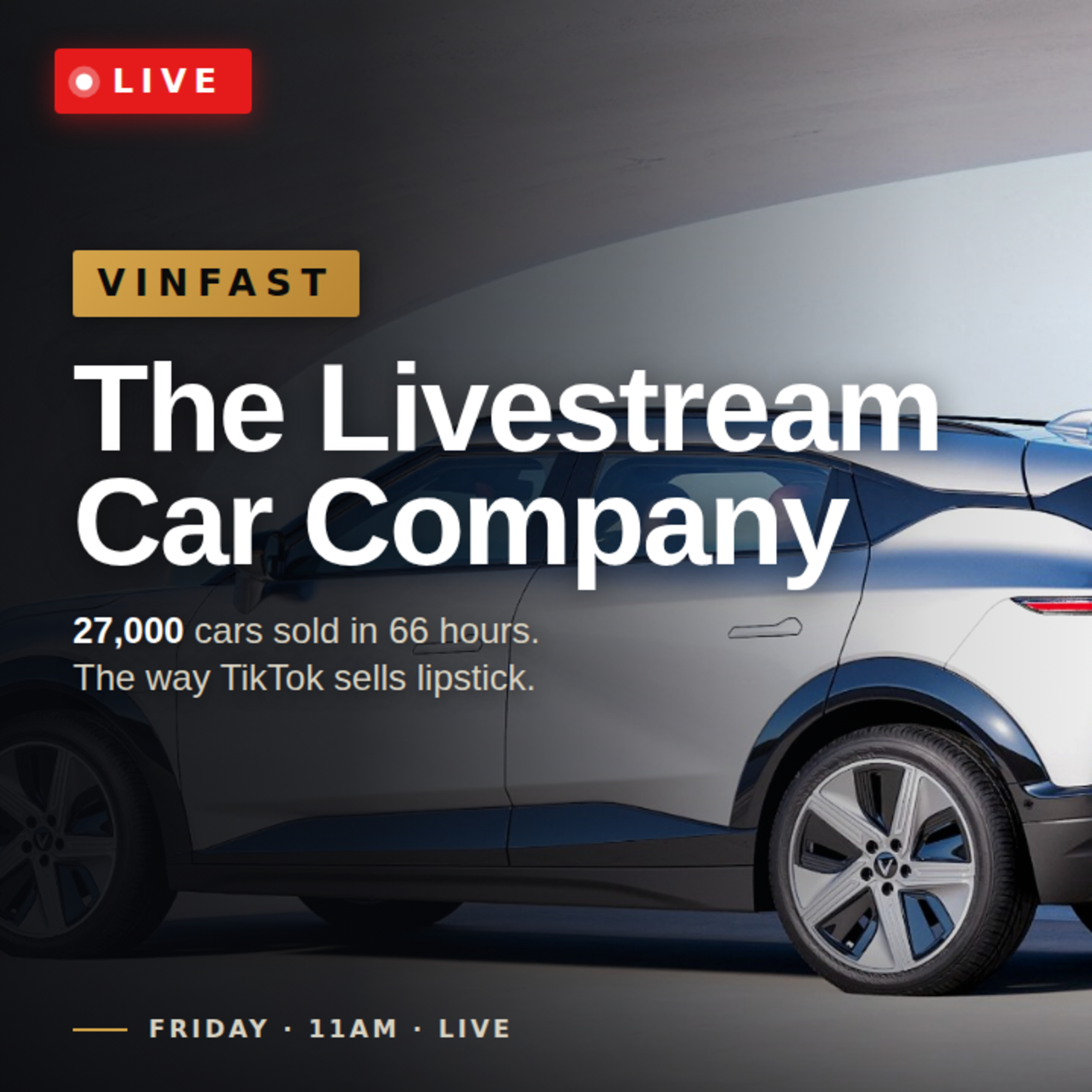
The Livestream Car Company: Inside VinFast's $530M Pivot
About this episode
VinFast’s pivot is the thread: the show walks through its $530M restructuring and “asset light” shift, then zooms in on how live-stream car sales drove rapid deposits and pre-orders. The hosts connect that playbook to broader UK EV retail changes—used EV prices moving, faster sales, and battery-health reassurance—while also tackling the cost side of ownership. Public DC charging is getting pricier, so they share ways to find cheaper charging and use battery certificates to protect used values.
VinFast's $530M restructuring, the livestream model that sold 27,000 cars in 66 hours, used EV prices turning a corner, and UK public charging now at 79p/kWh.
This week on Primetime EV Live, we go deep on one story. VinFast. The Vietnamese EV brand listed on the Nasdaq has just announced a $530 million restructuring. They're going asset-light, separating brand from manufacturing and rebuilding their European presence through dealer partnerships.
The more interesting story is how they sold cars in the first place. In May 2024 they took 27,649 pre-orders for the VF 3 mini-SUV in 66 hours through nine livestream sessions on Vietnamese e-commerce platforms, with 15 influencers. The same way TikTok sells lipstick. We look at what that model looks like, whether it's coming to Europe, and what it tells us about how cars get bought now.
Then: used EV prices in the UK rose 1.1% in April. The first growth of the year and the strongest of any fuel type. The early-adopter phase is officially over. Plus the Zapmap Price Index for April 2026 - public rapid charging now at 79p per kilowatt-hour, up 3p in a single month. The 9× home-vs-public gap, the 7 million UK drivers without a driveway, and what to do about it.
CHAPTERS
00:00:00 Introduction
00:01:30 What is VinFast and what's happening in May 2026?
00:08:00 How does VinFast sell cars on livestream — and is it coming to Europe?
00:15:00 Are used EV prices going up or down in the UK in 2026?
00:22:00 How much does public charging cost in the UK in 2026?
00:28:00 Your questions: batteries, VinFast UK, home chargers, used Teslas
00:29:30 Club CTA and sign-off
Sources: SEC filing 12 May 2026 · AAA Data · Cazana · SMMT Q1 2026 · Zapmap Price Index April 2026
Join the Primetime EV Club - free - at primetimeev.com/club for the best UK charging rates and lease deals every month.
Brand partnerships: [email protected]
VinFast
"The company is Vinfast, the Vietnamese electric car maker, listed on the NASDAQ, they've just [4.7s] lost a $530 million restructuring, they've gone what they call asset light, selling [10.1s] off their Vietnamese manufacturing, restructuring their finances and repositioning the whole [14.8s] business."
VinFast is an electric-car company from Vietnam. The host is saying the company just went through a big financial change after losing a lot of money.
VinFast is a Vietnamese electric-vehicle maker that has been trying to scale quickly while managing heavy upfront costs. In this segment, the host frames VinFast’s recent actions as a major financial pivot after a $530 million restructuring.
asset light
"they've gone what they call asset light, selling [10.1s] off their Vietnamese manufacturing, restructuring their finances and repositioning the whole [14.8s] business. [16.1s] And the most interesting bit isn't the financials, I'm going to go over and show you some stuff"
“Asset light” means a company tries not to own as many costly things itself. Instead, it leans more on other companies to build or handle parts of the operation.
“Asset light” describes a business strategy where a company reduces ownership of expensive assets (like factories) and instead relies more on partners, contracts, or outsourcing. In VinFast’s case, the host says it’s selling off Vietnamese manufacturing as part of that shift.
live social shopping
"And the much bigger story underneath it, that live social shopping is [95.0s] now a billion dollar industry that's starting to land in Europe, cars included."
This is about buying things during live video streams. The host says this style of shopping is spreading, and even car sales are starting to use it.
The host is discussing “live social shopping,” where products are sold during live streams and viewers can buy in real time. They argue this model is becoming a major industry and is now being applied to cars.
ZAP map index
"and public charging on the rapid network just got more expensive again, 79p per [120.4s] kilowatt hour weighted average on the ZAP map index."
ZAP-Map tracks EV charging prices in the UK. The “ZAP map index” is a way of summarizing those prices into a single number.
The ZAP map index is a pricing index based on data from ZAP-Map, a UK EV charging information service. The host uses it to claim a weighted-average public charging price increase.
NASDAQ
"Vinfast is a Vietnamese electric vehicle manufacturer listed on the NASDAQ since 2023... If you're a Vinfast investor on the NASDAQ, the bet is asset-like business turns profitable faster than an asset-heavy one."
NASDAQ is where public companies’ stock trades in the U.S. The episode mentions it because Vinfast is publicly listed there, so its restructuring affects investors.
NASDAQ is a major U.S. stock exchange where companies list shares for public trading. The transcript references NASDAQ because Vinfast’s restructuring is being evaluated by public-market investors and reflected in SEC filings.
Vingroup
"owned by Vin Group, Vietnam's biggest conglomerate... Vingroup, the parent company, is on the hook over over $2.5 billion in loan guarantees."
Vingroup is the bigger company that owns Vinfast. The episode says Vingroup is backing a large amount of loans, so it’s taking on a lot of the financial risk.
Vingroup is the parent conglomerate behind Vinfast. In the SEC filing summary discussed here, Vingroup is described as being responsible for more than $2.5 billion in loan guarantees, which matters because it shifts financial risk from the operating unit to the parent.
SEC filing
"On the 12th of May, 2026, Vinfast filed the USSEC announcing a $530 million restructuring... Here's what the SEC filing actually says in plain English."
An SEC filing is an official document a public company submits to U.S. regulators. It’s meant to clearly tell investors what the company is doing and why.
An SEC filing is a formal report submitted to the U.S. Securities and Exchange Commission that discloses material information to investors. Here, the transcript uses the SEC filing to describe Vinfast’s restructuring plan and the rationale behind it.
asset-like model
"On the 12th of May, 2026, Vinfast filed the USSEC announcing a $530 million restructuring... pivoting to what it calls an asset-like model... If you're a Vinfast investor on the NASDAQ, the bet is asset-like business turns profitable faster than an asset-heavy one."
An “asset-like model” is a way of running the business that tries to use less expensive, factory-style ownership. The goal is to spend less money up front so the company can start making money sooner.
An “asset-like model” is a business structure where the company aims to look more like a lighter, less capital-intensive operator—typically by reducing direct ownership of heavy assets like factories. The idea is that this can improve cash burn and help profitability arrive sooner compared with an “asset-heavy” setup.
asset-heavy
"So they're separating the capital heavy bit, making the cars from the hand heavy bit, just being marketing and selling them... the bet is asset-like business turns profitable faster than an asset-heavy one."
“Asset-heavy” means the company is tied to expensive things it owns, like factories. That usually costs more money to run, so it can take longer to become profitable.
“Asset-heavy” describes a business that relies heavily on owning and operating large physical assets—like manufacturing plants—so it tends to require more upfront capital and ongoing fixed costs. The transcript contrasts this with Vinfast’s move toward an asset-like structure to reduce cash burn and speed up profitability.

Hyundai Genesis
"...ounced UK plans back in 2022. They hired a former Genesis UK boss, Andrew Pilkington, to set it up. They we..."
Genesis is a luxury car brand connected to Hyundai. The podcast is talking about plans to bring the brand to the UK and get it set up there. That matters because it affects where you can buy and service the cars.
Genesis is a luxury brand associated with Hyundai, and the podcast mentions UK plans and setup efforts. In this context, it’s relevant because it signals how a new or expanding brand is positioning itself in the market and building a presence. That can affect availability, servicing, and how quickly models appear in the UK.

VinFast VF 6
"Vinfast announced UK plans back in 2022... They were going to launch the VF6 and the VF8, a compact SUV"
The VF6 is a Vinfast electric vehicle model. The hosts mention it as part of Vinfast’s plan to sell EVs in the UK.
The VF6 is one of Vinfast’s planned EV models mentioned in the transcript as part of the company’s UK launch plans. It’s referenced alongside the VF8, suggesting a lineup strategy for a compact SUV segment.

VF8
"Vinfast announced UK plans back in 2022... They were going to launch the VF6 and the VF8, a compact SUV"
The VF8 is another Vinfast electric vehicle model. The episode says it’s a compact SUV, which is the kind of EV many buyers look for.
The VF8 is Vinfast’s other model mentioned for the UK launch plans, paired with the VF6. The transcript describes it as a compact SUV, positioning it as a mainstream, high-volume type of EV.

VinFast VF 3
"Vinfast Part 2 live social shopping, live stream car sales, TikTok shop Europe, Vinfast VF3. It's the stuff we're going to look at... In May 2024, Vinfast launched the VF3, their mini SUV using nine live shopping sessions on Vietnamese e-commerce platforms..."
The VinFast VF3 is the small SUV VinFast used to test a new way of selling cars. Instead of traditional showrooms, the company used live-stream shopping to collect pre-orders and deposits quickly.
VinFast VF3 is VinFast’s mini SUV, and it’s the specific vehicle used as the case study for VinFast’s live-shopping sales strategy. The episode describes how VinFast launched the VF3 in May 2024 using multiple live shopping sessions to drive pre-orders and deposits.
TikTok shop Europe
"Vinfast Part 2 live social shopping, live stream car sales, TikTok shop Europe, Vinfast VF3. It's the stuff we're going to look at."
TikTok Shop is a shopping section inside TikTok where you can buy products directly from the app. The episode brings up Europe to suggest this live-stream shopping approach may spread there too.
TikTok Shop is TikTok’s in-app shopping feature that lets viewers discover products and buy without leaving the platform. The episode mentions “TikTok shop Europe” to connect the Southeast Asia live-shopping model to potential expansion in Europe.
Vin ID
"In May 2024, Vinfast launched the VF3... using nine live shopping sessions on Vietnamese e-commerce platforms, Shopee and Vin ID hosted by 15 influencers."
Vin ID is VinFast’s own platform/account that the episode says was used to host the live shopping sessions. It’s part of how VinFast organized the VF3 launch online.
Vin ID is referenced as the host platform/account used alongside Shopee for VinFast’s VF3 live shopping sessions. In this context, it functions like a brand-owned channel that helps coordinate the live-stream sales event and audience engagement.
Shopee
"In May 2024, Vinfast launched the VF3... using nine live shopping sessions on Vietnamese e-commerce platforms, Shopee and Vin ID hosted by 15 influencers."
Shopee is an online shopping app/website. In this segment, it’s one of the platforms VinFast used to run live streams for selling the VF3.
Shopee is an e-commerce platform used in the episode as one of the channels where VinFast ran live shopping sessions. It’s part of the “live social shopping” distribution mix that enabled the VF3 launch to generate pre-orders and deposits quickly.
live commerce
"Let me walk you through how it actually works because if you haven't seen a live shopping stream... live shopping or live commerce or social commerce is exactly what it sounds like. A person on camera, live, streaming on TikTok or Shopee..."
Live commerce is basically shopping during a live video. You watch someone show the product, and the buying steps are built into the stream so you can order immediately.
Live commerce is the broader umbrella for real-time, stream-based selling—where product pages, payments, and order confirmation are integrated into the viewing experience. In the segment, it’s used to explain how viewers can click, pay, and place orders while the presenter is demonstrating the item.
non-refundable deposit
"this is the bit that's clever, you could place a non-refundable deposit, just put a deposit down live while watching."
A non-refundable deposit is a payment you make to reserve something, but you can’t get it back later if you change your mind. Here, it’s how viewers commit while watching the stream.
A non-refundable deposit is money paid to reserve a purchase that cannot be reclaimed if the buyer backs out. In this segment, it’s used to convert live viewers into committed pre-order intent quickly.
pre-orders
"By the end of the three days, they had 27,649 pre-orders for a car that started at around $9,000."
Pre-orders are orders placed before a product is delivered, often used to gauge demand and secure early production slots. The segment cites VinFast’s pre-order volume as evidence that live-stream deposits can drive rapid commitment.
live shopping
"The thing I find genuinely interesting about this, and this is what European car brands are quietly watching, is what live shopping does that conventional car retail doesn't. It compresses the funnel. You go from having heard of the car to deposit paid in 15 minutes, which I think is generally and genuinely incredible."
Live shopping is when a seller shows a product on a live video and lets viewers buy or put money down immediately. The idea is that it shortens the usual waiting and decision process.
Live shopping is a sales model where products are demonstrated in real time and customers can buy immediately—often by placing orders or deposits during the broadcast. The hosts argue it “compresses the funnel,” moving people from first hearing about a product to paying in minutes.

Peugeot E208
"There have been experiments. Stelantis have done live streams for the Peugeot E208."
The Peugeot E208 is an electric Peugeot 208. The hosts mention it as an example of a European brand trying live streams, but not at the same scale as VinFast.
The Peugeot E208 is an EV version of the Peugeot 208 that the segment cites as an example of an experiment with live-stream-style selling. It’s mentioned to contrast European OEMs’ smaller-scale attempts versus VinFast’s full live-deposit approach.
Stelantis
"There have been experiments. Stelantis have done live streams for the Peugeot E208."
Stellantis is a big car company that owns multiple brands. In this clip, they’re mentioned as having tried live streams for an electric Peugeot.
Stelantis (as spoken) refers to Stellantis, the automaker formed from the merger of Fiat Chrysler Automobiles and PSA. In the segment, Stellantis is cited for doing live streams for the Peugeot E208.
Renault
"Renault has run live Q&A sessions for the Renault 5, the Chinese premium EV brand uses a model that's adjacent to live commerce on the European stores, but nobody has done what VinFast did."
Renault is a car brand/company. Here, they’re mentioned as doing live Q&A sessions about the Renault 5.
Renault is the automaker referenced for running live Q&A sessions around the Renault 5. The segment uses Renault as an example of European OEMs experimenting with live video engagement rather than full live-stream car sales with deposits.

5 Renault 5
"...t E208. Renault has run live Q&A sessions for the Renault 5, Renault 5, the Chinese premium EV brand uses a m..."
The Renault 5 E-Tech Electric is an all-electric car based on the Renault 5 name. The podcast mentions live Q&A sessions, which are used to answer questions about the car and how it works. It’s an EV aimed at regular buyers, not just specialists.
The “5 E-Tech Electric” refers to the Renault 5 E-Tech Electric, an all-electric version of the Renault 5 nameplate. It’s being discussed in the context of Renault running live Q&A sessions, which suggests the car is part of a broader push to explain features and ownership details to buyers. In an EV podcast, it’s relevant because it represents a modern, mainstream electric model with a strong marketing focus.
Tesla
"Tesla started the model with shopping in Westfield and so on, where you went into shopping centers and started seeing the vehicles and that's happening more and more. So it was more like a product experience and you'd have what felt like going to an Apple store with experts talking about the vehicles"
Tesla is a major electric-car company. The point here is that they sell cars in a more “store experience” way, with people who know the cars, instead of a traditional dealership setup.
Tesla is an EV brand that helped popularize a more direct-to-consumer buying experience. In this segment, the host compares Tesla’s showroom-style approach (like visiting an Apple store) to traditional dealerships that may be less EV-knowledgeable.
BYD
"They have to be adopted by BYD and everyone else really, really cleverly. That said, the generation buying their first car right now, early 20s, late teens, bought their phones on Instagram"
BYD is a big electric-car company. In this part, the host is using BYD as an example of a brand that’s already good at selling EVs in a way that others can learn from.
BYD is an EV and battery-focused brand mentioned here as a benchmark for how other automakers can “adopt” or execute retail strategies. The host implies BYD and others have already built experience in markets where these approaches are common.

Dacia Spring
"Live social shopping is going to land in Europe, probably not for premium cars first, probably for budget electric runabouts, something like a Dacia Spring or a BYD Dolphin"
Dacia Spring is a relatively affordable electric car. The host is saying that live-stream shopping may start with cheaper EVs like this before moving up to more premium models.
Dacia Spring is a budget-focused electric car that the host uses as an example of the kind of EVs likely to be sold via live-stream shopping in Europe first. The implication is that lower-cost “runabout” EVs are a natural fit for this retail style.

BYD Dolphin
"Live social shopping is going to land in Europe, probably not for premium cars first, probably for budget electric runabouts, something like a Dacia Spring or a BYD Dolphin or a Surf or a Future City"
BYD Dolphin is a compact electric car. The host is using it as an example of the kind of affordable EV that could be sold through live-stream shopping in Europe first.
BYD Dolphin is a compact electric car used here as an example of the “budget electric runabout” segment. The host’s point is that live-stream retail is likely to arrive in Europe first for cars like this, not for high-end EVs.
used EV prices
"used EV prices in the UK have just gone up for the first time this year. Used car electric prices in the UK rose 1.1% in April 2026."
Used EV prices are what people pay for electric cars that have already been owned. The host says in the UK those prices have started going up, which changes the “is it a bad time to buy?” math.
Used EV prices refer to the market value of previously owned electric vehicles. The host cites UK data showing used EV prices rising for the first time that year and uses it to argue that hesitation about buying a used EV is becoming less rational.
Kazana
"The strongest performance of any fuel type according to new data from Kazana. Used EV are now the fastest selling fuel type in the UK retail market"
Kazana is a company that provides market data. The host uses its numbers to support the claim that used EVs are selling faster than other types of used cars.
Kazana is referenced as the data source for UK used-car market performance by fuel type. In this segment, it’s used to support claims about EVs becoming the fastest-selling fuel type.
used EV are now the fastest selling fuel type
"Used EV are now the fastest selling fuel type in the UK retail market, selling 33% more in March and April than in the first two months of that year."
This means used EVs are selling faster than other kinds of used cars. The host is using that as evidence that more people are ready to buy used electric cars.
“Fastest selling fuel type” is a market metric describing which category of used vehicles moves quickest in retail. The host ties this to EV demand and to the idea that the “doctor phase” (hesitation period) for used EVs is ending.
depreciation curves
"Three year old Teslas were dropping faster than Bitcoin, Audi e-trons, Mercedes UQCs, depreciation curves that look like a ski slope."
Depreciation is how much a car’s price falls as it gets older. The host is saying EVs are losing value more slowly than many people expected.
A depreciation curve describes how a car’s value drops over time after purchase. The segment argues that EVs’ depreciation is changing—so used EVs are holding value better than fuel-powered cars.

Audi Etrons
"segment of the retail market. Three year old Teslas were dropping faster than Bitcoin, Audi e-trons, Mercedes UQCs, depreciation curves that look like a ski slope. Dears got their fingers burnt, buyers held off because everyone was waiting for the next price drop. That's now ended."
The Audi e-tron is an all-electric SUV made by Audi. The podcast is talking about how some electric cars can lose value faster than expected after a few years. That matters if you’re thinking about buying one used.
The Audi e-tron is a fully electric SUV from Audi, aimed at buyers who want a more traditional premium-car experience in an EV package. It’s being discussed in relation to depreciation, with the podcast noting that some used EVs can drop in value quickly. That makes it relevant for anyone considering buying a used electric SUV and watching resale risk.

Volkswagen Id3S
"... lease in proper volumes. The Tesla Model Ys, the ID3s, the Kia Enaros, the Polestar 2s, they're hitting..."
The Volkswagen ID.3 is an all-electric hatchback made by Volkswagen. Many people lease them, so when leases end, more show up as used cars. That’s why it’s brought up when talking about used EV prices.
The Volkswagen ID.3 is a compact electric hatchback from Volkswagen, designed for everyday commuting and mass-market EV use. It’s mentioned alongside other models as leases end and more cars enter the used market. That makes it a useful reference point for how EV supply affects pricing and availability.

Polestar 2S
"...The Tesla Model Ys, the ID3s, the Kia Enaros, the Polestar 2s, they're hitting the used car market with realist..."
The Polestar 2 is an all-electric car made by Polestar. The podcast is talking about how more of them are becoming available used, which can influence prices. It’s mentioned because it’s part of the EV models people can buy second-hand.
The Polestar 2 is a fully electric fastback/saloon-style car from Polestar, built to compete in the premium EV segment. The podcast mentions it in the context of used-car market entry, implying that more lease returns are starting to affect supply and pricing. That makes it relevant for buyers watching how EV depreciation and availability play out.
three to five-year-old EVs
"Auto-trader data shows three to five-year-old EVs are now selling in just 25 days on a four-core petrol equivalent..."
This is the age range where lots of EVs start showing up as used cars. The host uses it to explain why sales are picking up now.
“Three to five-year-old” is the used-car age band where lease returns and early depreciation effects are most visible. The segment uses this window to argue that EVs are now selling quickly because buyers see realistic prices and credible battery-condition data.
four-core petrol equivalent
"Auto-trader data shows three to five-year-old EVs are now selling in just 25 days on a four-core petrol equivalent, 35 days."
The host is comparing EVs to petrol cars using a common yardstick, so buyers can judge whether the EV deal is actually good. The exact wording here sounds like a transcription glitch, but the idea is a like-for-like comparison.
“Petrol equivalent” is a comparison metric that translates EV costs or pricing into a petrol-car baseline so shoppers can compare apples-to-apples. The “four-core” phrasing appears to be a transcription error; the intended meaning is likely a specific petrol-car reference category used by the data source.
battery degradation
"And this one's a bit of downstream work that we've been doing on the show this year, is about battery degradation and that it has begun to crack."
Battery degradation means the battery slowly doesn’t work as well as it used to. The host says new data suggests the drop in battery health is smaller than many people worried about.
Battery degradation is the gradual loss of battery capacity and/or performance over time and use. The segment claims that real-world data is showing degradation is less severe than some buyers feared, which affects used-EV confidence and pricing.
battery health
"The UK's largest study showed average battery health of 95% across 8,000 EVs."
Battery health is basically how strong the battery still is compared to brand-new. The host says a large study found the average EV battery was still around 95% after a few years.
Battery health is a measure of how much usable capacity a battery has compared with when it was new. The segment cites a UK study reporting an average battery health of 95% across about 8,000 EVs, supporting the idea that used EVs are becoming easier to buy with confidence.
manufacturer warranty
"The first owner depreciation [1082.8s] has happened. Your manufacturer warranty is still active on the battery in most cases."
A manufacturer warranty is the coverage provided by the automaker, and for EVs it commonly includes battery-specific terms. The host’s point is that battery warranty coverage can still be active on many 3-year-old EVs, which affects risk and used pricing.
DC fast charging
"We're showing that the prices are rising, [1154.5s] especially DC fast charging. Public charging in the UK, 2026, using the Zatmap price index, rapid charging prices..."
This is the faster kind of public EV charging. It can refill your battery quickly, but it often costs more per unit of energy than slower charging.
DC fast charging is a method that supplies direct current to an EV battery at high power, enabling much quicker top-ups than standard AC charging. It’s also typically priced higher, so changes in DC fast-charging rates can materially affect real-world running costs.
Zatmap price index
"Public charging in the UK, 2026, using the Zatmap price index, [1161.0s] rapid charging prices..."
It’s a way of tracking EV charging prices over time. The host uses it to show whether public charging is getting more expensive.
The Zatmap price index is a published measure used to track EV charging price changes over time. The host uses it to quantify how much rapid/public charging costs have moved month to month.
Octopus Electroverse
"and the octopus electroverse we're looking at too. Okay. So this is the last story."
Electroverse is a charging service brand in the UK. The host mentions it to show what charging prices look like across networks.
Octopus Electroverse is a UK EV charging service/brand referenced as part of the host’s comparison of charging prices. In this segment, it’s used as an example data source for how public charging costs are changing.
kilowatt hour
"the rapid network has gone up another three pence per kilowatt hour in a single month. [1179.9s] ...was 79 pence per kilowatt hour."
A kilowatt-hour (kWh) is the amount of electricity you’re buying. Charging prices are usually listed per kWh, so it’s the main unit that drives your total cost.
A kilowatt hour (kWh) is a unit of electrical energy. EV charging prices are commonly quoted as pence per kWh, so kWh directly determines how much you pay for a given amount of energy added to the battery.
pay-as-you-pride gop
"The weighted average prices pay-as-you-pride gop, the weighted average pay-as-you-gop price [1186.3s] to charge an electric car on the UK rapid and ultra rapid public network in April 2026..."
This is a specific way of calculating charging cost averages. In this segment, it’s mainly used to estimate what the typical rapid/ultra-rapid charging price was in April 2026.
This appears to be a transcription error for a specific charging-rate metric/plan name used to describe how much you pay per charging session or per unit energy on UK rapid/ultra-rapid networks. The key point in context is the host’s use of a weighted average charging price for April 2026.
off-peak tariff
"Home charging on an off-peak [1210.1s] tariff is still around 8.5 pence per kilowatt hour..."
Off-peak means electricity costs less at certain times of day. That’s why charging at home overnight or during low-demand hours can be much cheaper than public fast chargers.
An off-peak tariff is an electricity pricing plan where the cost per kWh is lower during designated low-demand hours. The host contrasts this with expensive public rapid charging to highlight why home charging is often far cheaper.
AC
"where pricing is for AC, [1226.4s] rapid DC, and all the pricing on your home networks as well"
“AC” is the type of electricity you typically get at home. EVs can charge on it, but it’s usually slower than the fast public “DC” chargers.
“AC” means alternating current, the electricity type commonly used for home charging. Most EVs use onboard electronics to convert AC to the battery’s needed form, which is why AC charging is usually slower than DC fast charging.
rapid DC
"we updated this morning before the show on where pricing is for AC, [1226.4s] rapid DC, and all the pricing on your home networks as well"
“Rapid DC” is a fast-charging setup you usually find at public stations. It can refill an EV much quicker than charging at home, but it often costs more.
“Rapid DC” refers to DC fast charging, where the charger sends direct current straight to the vehicle’s battery system. It’s typically much faster than AC home charging, but public DC prices are often higher.
home networks
"rapid DC, and all the pricing on your home networks as well and where they are right now."
They mean the electricity plan you use at home. Your plan affects what you pay per unit of electricity, which changes your EV charging cost.
“Home networks” here refers to the electricity tariff/plan you’re on for charging at home, which determines your electricity rate. Different tariffs can materially change the cost per kWh for the same amount of charging energy.
EV tariffs
"If you're charging a home on octopus go or an intelligent octopus or [1240.9s] any of the dedicated EV tariffs"
“EV tariffs” are special electricity rates for people who charge an EV at home. They’re often cheaper at certain times, so you can save money by charging when the rate is lower.
“EV tariffs” are electricity pricing plans designed for EV charging, often with time-of-use rates or dedicated pricing structures. The goal is to make home charging cheaper during off-peak windows.
Intelligent Octopus
"If you're charging a home on octopus go or an [1235.5s] intelligent octopus or [1240.9s] any of the dedicated EV tariffs"
Intelligent Octopus is a home electricity plan. The show mentions it because it can make charging at home cheaper than using public fast chargers.
Intelligent Octopus is another UK electricity tariff brand referenced for home EV charging. In the segment, it’s grouped with other dedicated EV tariffs that typically keep home charging costs lower than public DC charging.
Octopus Go
"If you're charging a home on [1235.5s] octopus go or an intelligent octopus or [1240.9s] any of the dedicated EV tariffs"
Octopus Go is an electricity plan for home charging. The host uses it as an example of a cheaper home rate compared to public fast chargers.
Octopus Go is a consumer electricity tariff brand used for home EV charging in the UK. The segment contrasts its typical home charging rate against expensive public fast-charging prices.
public rapid charger
"over nine, if you drive past a public rapid charger this week, they'll be quoting 85 pence per kilowatt hour"
A “public rapid charger” is a fast charger you use away from home. It can refill your EV quickly, but it often costs more than charging at home.
A “public rapid charger” is a fast-charging station available to drivers outside their home, typically using DC fast charging. Because it’s public and high-power, pricing can be much higher than home charging.
Zatmap data
"Now the public networks aren't doing this for [1279.7s] fun. The Zatmap data tells us why."
“Zatmap data” is the information the host is using to show how charging prices changed. They use it to explain why public charger prices went up.
“Zatmap data” refers to charging-price information attributed to Zatmap, used to explain why public charging costs rose. It’s presented as the evidence source behind the pricing changes in March and April.
Instavolt
"Two major networks have pushed prices up substantially in March and April... [1289.5s] Instavolt has been sitting at the top of the price range at around 85p per kilowatt hour."
Instavolt is one of the public EV charging networks being compared. The episode says its prices are at the high end compared with others.
Instavolt is a charging network brand mentioned as having some of the highest public per-kWh pricing in the segment’s comparison. The host uses it to illustrate how much costs can vary between networks.
GridServe
"GridServe sits between 79 and 93p [1305.1s] depending on speed. Total energy is at 79p flat for their 150 to 400 kilowatt sites."
GridServe is a company that runs public EV charging stations. In this segment, they’re mentioned because their charging price changes with how fast you charge.
GridServe is a UK charging network brand discussed here in terms of its public DC fast-charger pricing. The host notes the per-kWh range varies depending on charging speed.
connected curb
"But here's the bit that goes deeper. We covered this with [1331.3s] connected curb a few weeks ago."
“Connected Curb” is mentioned as a previous segment where they covered this topic. It’s basically a reference to earlier discussion about charging costs.
“Connected Curb” is referenced as a prior episode/source where the host covered the same charging-cost issue. It’s used as a pointer for listeners to earlier discussion rather than a technical charging concept.
EV charging fairness gap UK 2026
"The 7 million UK drivers with driveway are stuck paying the public rate for all of their charging, not 10% or 20% all of it... That is the EV charging fairness gap UK 2026."
The “EV charging fairness gap” is the idea that not everyone pays the same for charging. People who can’t charge at home often have to use expensive public chargers, so their costs are much higher.
The “EV charging fairness gap UK 2026” describes a cost imbalance where drivers without home charging (e.g., flats/terraces/council blocks) must rely on public chargers and therefore pay much higher rates. The episode frames it as a major unresolved barrier to equitable EV adoption.
public charging networks
"Octopus Electroverse is genuinely one of the best public charging networks in the country right now in terms of deals."
Public charging networks are the services that run EV chargers you can use outside your home. Different networks can charge different prices, so it pays to compare.
A public charging network is a company (or group) that operates EV chargers in public locations and manages pricing, access, and sometimes payment apps. Networks can differ a lot in cost and reliability, which is why comparing them matters.
plunge pricing
"They aggregate over 50 networks and give you a single tariff card worth looking at and they do a lot of plunge pricing on there as well."
Plunge pricing means the cost to charge can suddenly get much cheaper at certain times. It’s designed to help you save money if you charge when the price drops.
Plunge pricing is a pricing strategy where EV charging rates can drop sharply at certain times or under certain conditions. The goal is to encourage charging during cheaper windows and improve value versus flat-rate pricing.

Dodge Charger
"...ead now and the lazy answer of just use whichever charger comes up is costing people 15 quid a stop. Three,..."
The Dodge Charger is a car that’s built for performance and a sporty driving feel. In this podcast context, it’s being mentioned alongside charging and running costs, which is about what it costs to keep a car going. The key point is the discussion of expenses rather than the car’s charging hardware.
The Dodge Charger is a performance-focused sedan/coupe-style car known for strong power and a traditional muscle-car feel. It’s mentioned in the context of charging costs, which suggests the discussion is about how EV charging expenses can add up depending on where and how you charge. Even though it’s not an EV by default, it can still come up in broader “cost to run” conversations.
destination charging
"Three, look at destination charging. Think about where you're going and how you're going to use the car."
Destination charging means charging your EV at a place you’ll be parked for a while, like a hotel or store. Since you’re not just “topping up,” it can make charging cheaper and easier.
Destination charging refers to charging at places where you’re likely to stay for a while—like hotels, supermarkets, or retail parks. Because you can charge while you shop or eat, it can be cheaper and more practical than charging briefly at high-cost roadside stations.
seven kilowatt point charges
"Just don't sit on one of those seven kilowatt point charges from years ago because you won't get much in there and they're actually quite expensive now."
Seven kilowatts is a slower charging speed. If your charger is slow, you have to wait longer to add the same driving range, so the cost can end up higher.
“Seven kilowatt” refers to the charging power level (7 kW), which is relatively slow compared with modern fast chargers. If you rely on older 7 kW outlets, you may need to spend longer charging to add the same range, which can make them expensive in practice.
pence per mile
"Everyone else is paying 23 pence per mile to drive electric"
“Pence per mile” is a way of pricing EV charging by how much it costs to drive a mile. It helps you compare EV costs to gas, but it depends on how efficiently your car uses electricity.
“Pence per mile” is a pricing model that converts charging cost into an estimated cost per unit of driving distance. It’s meant to make EV fuel costs easier to compare against gasoline, but the exact outcome depends on your car’s efficiency and charging rates.
2 quid a liter
"which is still cheaper than 2 quid a liter at the pump but the gap is narrower than it should be."
“Quid a liter” is just how much petrol costs per liter. They’re comparing that to what it costs to drive an EV.
“Quid a liter” is a shorthand for the gasoline price per liter, used here to compare EV charging costs versus petrol. It’s not an EV-specific technical term, but it’s part of the episode’s cost-comparison framework.
public charging prices
"So I'll put the public charging prices up. So let's just go into our Q&A now and make sure we've got that."
Public charging prices are the cost to charge your EV at public stations. They’re usually charged per unit of electricity, so the price can change depending on where you plug in.
Public charging prices are what you pay to charge an EV at shared charging stations, typically billed per kWh and/or per session. They can vary by operator, location, and time, which is why hosts often compare them to home charging costs.
state of health
"The UK's largest battery health study looking 8000 EVs showed average state of health at 95% across all ages."
State of health is a way to measure how “healthy” an EV battery is compared to brand-new. If it’s high, the battery has lost less capacity and should still give you good range.
State of health (SoH) is a battery metric that estimates how much usable capacity the EV battery has compared with when it was new. Higher SoH means less degradation and more expected range over time.
Geotab
"The data is now consistent across Geotab, P3 and the UK study."
Geotab is a company that tracks vehicle data (often for fleets). Here, the host is using its data to support claims about how EV batteries age.
Geotab is a telematics and fleet-data company that collects vehicle usage information. In this context, the host cites Geotab data as part of the evidence about EV battery health over time.
P3
"The data is now consistent across Geotab, P3 and the UK study."
P3 is mentioned as another source of EV battery-related data. The host is saying the results match across different sources.
P3 is referenced as a data source used by the host to support claims about EV battery health consistency. The key point for listeners is that the host is triangulating multiple datasets, not relying on a single study.
home charger
"Question three, is it worth getting a home charger now that the grant is £500?"
A home charger is a charging box you install at your house so you can plug in your EV at home. It’s usually easier and can cost less than charging at public stations.
A home charger is an EV charging unit installed at your residence, allowing you to charge overnight or whenever electricity rates are favorable. Home charging is often cheaper and more convenient than relying on public chargers.
grant
"is it worth getting a home charger now that the grant is £500? Yes."
A grant is money from the government that helps pay for something—in this case, installing a home EV charger. It lowers what you have to pay out of pocket.
A grant is government financial support that reduces the upfront cost of installing equipment—here, an EV home charging setup. The host cites a specific per-socket amount and a start date to estimate net cost.

Tesla Model Y
"Question four, should I buy a used Tesla Model Y in summer 2026? Lots of questions around this because used Model Y Teslas have fantastic cars..."
The Tesla Model Y is an all-electric SUV/crossover. The discussion here is about whether buying one used in summer 2026 is a good time based on prices and availability.
The Tesla Model Y is an electric crossover that’s become one of the most widely traded used EVs in the UK. In this segment, the hosts focus on when to buy it used (summer 2026) and how pricing and supply are trending.
early adopter phase of the used EV market is over
"Used EV prices rose 1.1% in April for the first time this year, and Kazana data suggests the early adopter phase of the used EV market is over."
“Early adopter phase” means the first group of people who were eager to buy EVs. The idea here is that the market has moved past that initial rush, so prices may behave more normally.
The “early adopter phase” is the period when the first wave of buyers drives demand and pricing behavior. Once that phase ends, the market can shift toward more typical supply-and-demand dynamics, which can affect how quickly prices stabilize.
charging cables
"There's charging cables, there's quite good quality stuff, there's charges coming through, so let's see how it goes."
Charging cables are the cords/connectors you use to plug your EV into a charger. The hosts are saying people are starting to sell these accessories through TikTok before selling full cars.
Charging cables are the physical connectors used to link an EV to a charging station or home charger. The segment notes creators are experimenting with selling charging cables, implying accessory-first commerce before full vehicle sales.
Request an Explanation
Heard something you'd like explained? We'll add it to this episode.
Sign in to request explanations for terms you heard.
Want to learn more?
Browse our glossary for plain-English explanations of automotive terms, jargon, and concepts.
Help improve this episode
See something that's not quite right? Our annotations are AI-generated and can sometimes miss the mark. Click the flag icon on any annotation to suggest a correction.