They’re talking about Max Verstappen’s mindset and driving style—how he approaches races and pushes the car. The idea is that attitude and confidence can be as important as the car’s speed.
They’re talking about Red Bull as the team Max Verstappen drives for. If a driver changes teams, it can change the car they get and how competitive they are.
They’re saying Mercedes would be the most likely team for Max Verstappen if he left Red Bull. In F1, switching to a powerhouse team like Mercedes usually means getting a different car and different engineering support.
They’re suggesting Ferrari could be another possible team for Max Verstappen. The point is that team changes in F1 can be huge because the car and engineering team are different.
In F1, the race engineer is the person in the garage who talks to the driver during the race. They use the car’s data to help the driver decide things like how hard to push and how to manage tires.
A team principal is the top leadership role at an F1 team, responsible for overall direction and major decisions. They oversee strategy, staffing, and long-term planning—like driver selection and how the team responds to personnel changes.
Brand
Laurent Mechiers
They’re imagining Laurent Mechiers as the person running Red Bull. The idea is that the team’s top leader would decide who replaces a star driver.
They’re debating what it would take to be the best possible F1 driver overall. The key point is that being great isn’t just about being fast—it’s also about being consistent and making the car work well across a whole race.
Concept
AI
They’re talking about AI as a hypothetical super-driver. The idea is that if AI could do everything perfectly using data, it might beat the best humans.
In Formula 1, there’s a rule that sets a minimum weight for the driver. That means drivers can’t be too light, and teams have to plan around it—so being very small or very light doesn’t automatically mean you’ll be faster.
They’re saying Adrian Newey believed that having a smaller, lighter driver could help the car. In racing, even small weight differences can affect how the car handles.
They’re describing an older idea that smaller, lighter drivers had an advantage. Before modern weight rules, being “jockey-sized” could help the car feel better and be faster.
They’re saying that in the past, some drivers tried to get lighter by cutting weight in unhealthy ways, including dehydration. The rule changes were meant to stop that.
Concept
80 kilos rule came in around 2018
They’re talking about when the weight rule changed. Around that time, drivers had to stop chasing extreme weight loss because the rules set a floor.
They’re talking about putting the driver’s weight as low as possible in the seat. That can help the car feel more stable and balanced, which may give a tiny speed advantage. It’s not about “more weight,” it’s about where the weight sits.
If you sit higher, you can often see the track edges and curbs better. That can make it easier to judge where the car is relative to the kerb, which helps you drive more confidently and consistently. Less guesswork can mean faster lap times.
An aerodynamicist is the person who works on how air moves around the race car. They look for ways to make the car “cut through” air more efficiently. The idea is that if the helmet sits lower, it can slightly improve airflow and reduce drag.
Street circuits are temporary or semi-permanent tracks built on city streets, typically with tight corners, walls, and limited runoff. The hosts suggest aerodynamic advantages from driver positioning may matter more on street circuits because the racing line is constrained and small efficiency gains can compound over many laps. It’s a track-type-specific argument about where aero and visibility pay off.
This is basically how a driver acts when the race is happening. It’s about how hard they push, how risky they get, and how they try to win while still staying within the race rules.
This is the driver’s mindset away from the track—how they train, think, and deal with stress. The idea is that who they are off-track can show up in how they race.
They’re describing a driver who’s obsessed with squeezing out every last bit of speed. Instead of being “good enough,” they aim for the absolute best performance, even if it’s only a tiny improvement.
They mean pushing right up to the boundary of what the rules allow. In F1, sometimes the fastest approach is also the one that tests how strictly the rules are enforced.
They’re talking about breaking or bending the rules more than the sport intended. In F1, that can cause penalties and arguments, because the goal becomes winning at all costs.
They’re talking about how a driver’s personal values affect how they race. Some drivers are more willing to take risky chances, while others avoid actions that could hurt others or break rules.
In F1, if a driver breaks a rule, they can get a penalty that costs time or positions. Sometimes a driver thinks the penalty won’t ruin their race, so they’ll still try a bold move to win.
“The last 1%” refers to the final, marginal gains that separate top drivers from the rest—small improvements in decision-making, braking points, tire management, and racecraft. It’s often about pushing right up to the limit without crossing into mistakes or rule violations.
They’re talking about how much drive and emotion a driver has for winning. Some people race with intense passion, while others focus more on a calm, calculated approach.
A “never settling” attitude is the mindset of continuously pushing for better outcomes rather than accepting whatever position you’re currently in. In racing, that can mean taking calculated risks, staying aggressive in overtakes, and constantly looking for opportunities even when the race is going “okay.”
They’re using famous F1 drivers—Schumacher and Verstappen—as examples. The point is to talk about what teams value in a driver beyond just driving fast.
They’re saying being a great driver isn’t only about lap times. It’s also about how you act and work with your team—like communicating well and helping the engineers do their jobs.
They’re talking about the public side of being an F1 driver. Beyond racing, you also have to do interviews and media work, and teams care how you handle that.
It means getting the whole team excited and focused. In racing, the driver can influence how hard and how smart the team works together, which helps results.
“Basics” here points to foundational driving and feedback habits that improve lap time: consistent technique, clear communication, and disciplined execution. In F1, small improvements in how you drive and how you relay data can compound into meaningful performance gains.
They’re describing how a top driver learns the team quickly. It’s not just about driving fast—it’s about communicating well so the whole group can improve the car together.
Term
title-winning-ish positions
They mean Vettel was often running in spots that could lead to a championship. But when crashes or mistakes happen from those positions, you lose big points and momentum.
They’re talking about moments where the driver loses control (“spins”) or gets into trouble (“incidents”). In F1, even one of these can ruin a race because you can lose time, positions, or the whole result.
“Pop culture zeitgeist” just means what’s popular and talked about in everyday culture. They’re saying F1 became more mainstream because top drivers helped it show up in the broader public conversation.
“Lewis” refers to Lewis Hamilton, whose public profile and off-track efforts are discussed as part of what makes him valuable to the sport and to teams. The segment contrasts his media/brand impact with what actually translates into lap time.
Lando Norris is discussed as an example of a driver whose honesty in interviews breaks from the usual PR script. The hosts connect that communication style to how fans perceive drivers and how teams evaluate a candidate beyond racing performance.
“PR mold” refers to the tightly controlled messaging drivers are often expected to deliver to media—what they can say, what they can’t, and the “approved” lines. The hosts argue Norris stands out by being more candid, which changes how fans connect with drivers.
“Daniel Ricardo” is a reference to Daniel Ricciardo, whose media persona is described as energetic and character-driven. The hosts argue that such personality can boost visibility and fan engagement, but may not directly improve racing results.
“Personal brand” is the idea that a driver’s public image—how they speak, behave, and connect with fans—can influence opportunities and team decisions. In this segment, the hosts distinguish brand value from direct racing value, suggesting teams may care about both.
They’re describing a disagreement between two things: being likable/marketable versus actually helping the team win races. The hosts think both matter, but not equally.
They’re asking a big question: does being smarter (or learning faster) really make you win in Formula 1? In reality, winning depends on many things, but drivers who can quickly understand what’s happening and adjust tend to do better.
“Driver chatter” refers to the constant communication between the driver and the team during sessions—describing grip, balance, braking feel, and what the car is doing. The segment links it to “intelligence” or the ability to compute and interpret feedback in real time.
Concept
TC
“TC” sounds like a nickname for someone in the conversation. It doesn’t appear to be a car or racing technical term in this excerpt.
It’s the skill of figuring out what the car is doing and how to drive it better. Instead of just being naturally quick, the driver can “read” the car and improve it over time.
They’re saying top drivers don’t just drive—they understand how the car behaves in different situations. That helps them make better decisions mid-corner and across a whole race stint.
A corner isn’t one single moment—it has stages. Great drivers handle braking, turning, and accelerating in a way that matches what the car needs at each stage.
A stint is the time you spend on track between pit stops, and the car changes as the tires wear and fuel runs down. Good drivers adapt their driving style as conditions evolve.
In F1, the car’s shape and airflow are a big deal. Aerodynamics help the car stick to the track, especially in corners, and it can change depending on speed and how the car is positioned.
Mechanical engineering is about how the car’s parts work together—especially the suspension and how tires grip the road. It affects how the car responds when you steer, brake, or accelerate.
In F1, races can be won or lost by tiny time differences. So teams work hard to squeeze out every small advantage from the car and the driver’s driving.
FP1 refers to the first Free Practice session of an F1 race weekend. It’s an early on-track opportunity for drivers to gather baseline data, test setups, and understand how the car behaves.
A driver debrief is the structured discussion after a session where the driver reports what the car felt like and how it behaved. Teams use that feedback alongside telemetry to diagnose issues and refine setup and strategy.
Williams is an F1 team with a strong engineering background. They apparently used to give new drivers a test to see how well they could understand technical information and work with the team.
This sounds like a test where drivers have to look at technical information, like data and graphs, not just drive fast. The goal is to see whether they can understand what the car is doing and explain it clearly to the engineers.
Data traces are basically graphs of what the car is doing over time. They help the team figure out why the car felt a certain way and where it could be faster.
Telemetry is recorded car data (like what the suspension and brakes are doing). A “data trace” is the timeline of that data, and the test is basically asking the driver to read it and figure out what happened.
Dampers are the parts that control the suspension’s up-and-down movement. When the car hits a bump, dampers help keep the tires in contact with the road instead of bouncing.
Grip is how much the tires can “hold” the road. A driver with a good feel for grip can tell when the tires are close to losing traction, so they can go faster without spinning or sliding too much.
Microslides are very small slips at the tire-road contact patch. They’re like the tires “warning” you they’re about to lose grip, and a skilled driver can react before it becomes a full slide.
Opposite lock is when you turn the steering the opposite way of the car’s slide. It helps stop the slide from getting worse, but you have to do it at the right moment and not too much.
Concept
seek time
Seek time is the time it takes a driver to “figure out” the car and start driving it at its best. A faster learner can get to the right feel and pace sooner, especially as conditions change.
Term
Sergei Sorokin
Sergei Sorokin is a real Formula 1 driver. The host brings him up as an example while talking about what skills make a driver great.
It’s not just about going as fast as possible. The top drivers can drive aggressively but still keep the car under control so they don’t spin or crash.
The Dodge Challenger is a performance car made by Dodge. It’s built to be fast, especially in straight-line driving, and it’s known for its strong engine options and sporty style. People bring it up when they talk about cars that can really “go up against” others.
This describes performance in reduced-traction conditions, where tires generate less usable grip. Drivers who excel here can manage weight transfer and throttle/steering inputs to keep the car stable and avoid sudden loss of traction.
Racecraft is how good a driver is at racing other cars, not just driving fast. It includes things like when to brake, where to position the car, and how to out-think rivals during the race.
Wheel-to-wheel means racing right next to another car. The best drivers can do it while staying in control—so they don’t get pushed off line or lose time.
Brand
Aston Alonso
This is likely referring to Aston Martin, another F1 team. They’re saying Alonso was still great even after moving teams.
This is about braking timing. If you brake later than the other driver, you might not have enough space to turn properly, so you can run wide or go too deep—and the defender keeps the advantage.
It’s about where the driver puts the car before a corner. By taking away the inside option, the driver forces the other car to choose a harder line or risk getting out of shape.
Concept
Saturday vs Sunday
Saturday is qualifying (one-lap speed). Sunday is the actual race (staying fast for a long time and making the right strategy calls).
A pole lap is the fastest lap in qualifying, and it puts you at the front for the race. Monaco is a track where it’s hard to pass, so starting up front often matters a lot.
They’re saying Alonso’s best strength shows up during the race itself, not just in qualifying. It’s about staying fast and controlled for many laps, managing tires, and making good choices over time.
Slipstream is when one car benefits from another car’s airflow. If you’re close behind, the air resistance drops a bit, so you can carry more speed and have a better chance to make a move.
Concept
clinical
“Clinical” means staying focused and making the right calls under pressure. In racing, being calm helps you react correctly instead of panicking.
Car
Fernando Alonso in those Ferrari years
This is about Fernando Alonso when he drove for Ferrari. They’re saying that during those years—especially 2012—he looked like an extremely complete driver: consistent, fast, and good at managing races.
Consistency means you’re not just fast once—you keep performing well again and again. In F1, that’s huge because one bad weekend can ruin your championship.
Car
Vettel in the Red Bull years
This is about Sebastian Vettel while he drove for Red Bull. They’re saying that even with a strong car, his results and championship performances were a big part of why he was considered close to “perfect.”
A team leader is the driver who helps steer the team day-to-day. They’re good at communicating with engineers and making sure the whole team is working toward the same goal.
Car
Lewis 2008
Lewis Hamilton’s 2008 season is highlighted as a peak moment—coming in strongly and ultimately winning the title late in the year. The segment uses this as evidence of championship-level consistency and race-winning execution.
This means Lewis Hamilton finished in the top three in nine races in a row. That’s a big deal because it shows he was consistently fast and the car/reliability/strategy all worked out repeatedly.
This is about an overtake right at the start of an F1 race in Melbourne. The first corner is where drivers have to be brave and precise, because there’s little room and everyone is fighting for position.
A debut season means a driver’s first season in F1. It’s a big challenge because they’re still getting used to everything, so strong early results stand out.
Concept
tactics vs pace
They’re basically comparing two things: how fast the driver is (“pace”) and how smart the driver is about strategy (“tactics”). Great F1 drivers do both, not just one.
Topic
2016 end-of-season run
They’re talking about the end of the 2016 season when the championship situation was very tight. In that kind of scenario, drivers can’t just play it safe—they often need to win and take more chances.
This is about the Brazil Grand Prix during a close championship battle. When you’re chasing the title late in the season, you often have to take bigger risks and win races, so it becomes a great test of driver skill.
It means a driver won the championship two years in a row. That’s harder than winning once because the car, rivals, and conditions all change year to year.
They mean the 1993 British Grand Prix at Donington Park. It was a rainy race where the track got slippery, and Senna made a huge comeback from near the back.
LIVE
From Taco Night in Tulum to Sushi in Tokyo, everybody's rewarding and post-worthy with
MX Gold's four-times membership rewards points at restaurants worldwide.
Wherever you dine, points are piling up.
So bring your friends along for your next course, because it's not all about the posts.
It's about the company and the memories.
How can Gold from MX sweeten your next food moment?
Learn more at americanexpress.com slash explore Dash Gold. Terms and points cap apply.
What is the closest we've got to the perfect drive? It could be past or present.
That's a pretty brutal question.
Fernando Alonso in those Ferrari years is for me the closest we've had to perfection.
Lewis is also buried, guys.
Pete Lewis is tough to beat as well.
Pete Lewis is really impressive.
I think Lewis 2007 was even more impressive than Lewis 2008.
He can't have been the best version of himself when he turned up.
Hinch, what about attitude?
I'm going to go with like the Max Verstappen approach and attitude in the car.
I was looking at a Max and someone like Michael Schumacher.
What about marketing and media then?
It's nice to have someone that's got a big personality and walks into Austin on a horse.
That's coming at the cost of something else though.
If Max leaves Red Bull, where's his most likely destination?
I think Max only leaves if he's going to Mercedes.
The only other one I'm thinking is you're going to be surprised by this but Ferrari.
Hello everyone and welcome to F1 Nation.
I'm Tom Clarkson and joining me on the show as usual is former F1 driver Jolien Palmer
and IndyCar race winner James Hinchcliffe.
Good to see you.
Now, last week we reacted to the news that Max Verstappen's race engineer,
Giampiaro Lambiassi, is leaving Red Bull and joining McLaren.
We also talked about how that might impact Max's future at the team.
I asked both of you if Max were to leave and you were Red Bull team principal Laurent Mechiers
who would you pick to replace him?
J.P., you said Leclerc, Hinch, you said Piastri.
And that micro disagreement got me thinking because I'm intrigued by the fact that you both picked a different driver.
So let's start today's show by discussing what makes the perfect F1 driver.
First of all, does that person exist?
Well, probably not, do they?
Because there's always someone that's better than the best that's out there.
If you put AI out there in some form, if you ticked all the boxes to 100,
they'll be better than the almost perfect best drivers out there.
So I think you have to say that there's potential for anyone to be better.
But there are some really talented drivers out there at the moment that are pushing it.
It kind of depends on what categories you want to break down.
I agree with J.P., nobody's perfect.
There's always going to be an area that somebody can improve on.
Actually, I do want to also caveat that I did last week say that I was also thinking Leclerc,
but I went with a backup option just for the sake of the conversation.
So we were still somewhat aligned there.
But no, I think if you want to genuinely create the perfect all-round form of the one driver,
there's a bunch of different categories I think that you have to address.
And I think you could pull traits from a bunch of drivers that we all know
and combine them to make the best because I don't think one driver has it all.
Let's break it down then into some categories.
Why don't we start with physique, tall, short, what do we want?
I didn't think we were going to start on the physical part of it.
That's one thing I hadn't thought about.
Well, Adrian Newey will tell you that you want the smallest, lightest driver.
Okay, there's now a prescribed weight limit for the driver.
But back in the day, it was all about having jockeys driving these cars.
That's what Adrian wanted.
So that doesn't apply now though, right?
When I was racing, you still wanted to be a jockey in the car.
So that was in the era before we had the weight limit that's now set at 80 kilos.
So I was coming in at 73 with Kit as lean as I could be over six foot.
But then, you know, I was always one of these tall drivers that was pushing for,
let's have a mandated minimum weight limit because it's not healthy.
We're not eating any calories.
We're going dehydrated into the races.
And then you'd have little Felipe Massa, I don't know, 56 kilos with Kit saying,
no, this is how it is.
This is how it's always been.
So even up until my day, oh, man, it's a killer for the taller drivers.
So now that rule came in, sadly, shortly after I stopped racing.
I think it might have been even the year after in 2018, which kind of negates the maximum gain that the small drivers can take.
But you still, if you want to be panicked about it, you still get weight down low.
If you had a smaller driver, if you had a small...
You've got to be a little bit stocky because you've got to be strong to drive these cars as well.
But then sometimes, you know, taller drivers sit a bit higher and they get a better viewpoint of curbs and those sort of things as well.
So even your Yuki Senodas can't sit absolutely on the bottom.
They still have to sit up.
But I guess they've got a little bit of weight down low, which must be a marginal gain.
Hinch, what about attitude then?
If we're going to continue to categorize these guys...
Are we taking Yuki's physique? Is that where we're starting?
Yeah, that's fair. I mean, I was kind of with you that it's not as...
Physique, again, was a category that caught me off guard to open with.
But yeah, even with the weight limit, you are right. There is still a small advantage, no pun intended.
Do you reckon that you could do a...
Do you reckon you could do a taller driver, a George Russell?
Maybe you could even go as far as saying an Esteban Ocon, but with massive legs and massive glutes.
So you've still got that weight low down, but you've got a little bit more height in the car to get the perspective as well.
Can we fine tune this?
We are getting very, very specific.
No, no, because here's the thing, your perspective about the higher drivers is good.
But I think there's still an arrow thing.
I do look at George's drive around. He does look so much higher in the car.
I bet there's an aerodynamicist somewhere back at Mercedes HQ thinking,
man, I wish that helmet sat a little bit lower in the car.
So I still, from an aero standpoint, think, you know, maybe it's an advantage on street circuits.
You know, I always like being maybe a mill or two higher in your seat on a street circuit for that sort of visual line of things.
But no, I still think, OK, we'll go with a roughly yukie size driver.
You introduce the next category hinge.
Well, I mean, you would set attitudes so we can carry on down that path.
And I think that I think there's that even has two subsections, right?
I think you have to have the on track attitude.
Then I think you have to have the off track attitude.
I do think those two can be different.
I think a lot of drivers have, I don't want to say different personalities.
I really do think your personality out of the car translates to to who you are and how you drive inside the car to a certain extent.
But I think there's always an extra bit of an edge, right?
Once the helmet goes on and, you know, look, JP is the nicest guy in the world.
But I'm sure when he was out in a Grand Prix, it was, you know, elbows up when needed to be and and could be that killer instinct.
So I think you need.
This will be a good one. This will this will this will get JP and I on a track here.
I'm going to go with like the Max Verstappen approach and attitude in the car.
In terms of that relentless pursuit of the absolute nth degree driving to within that fraction of a limit of the rules, sometimes maybe once or twice a season beyond.
But I think that he is, you know, his his approach in the race car is just so fully committed.
That kind of attitude in the car, I think is is crucial.
I sort of agree to the to the most extent you've got.
I was thinking in terms of like your your relentless pursuit of perfection in the car, your don't settle for second.
Don't settle for anything less than the maximum you can possibly get.
I was looking at a Max and someone like Michael Schumacher.
What they've both got in common is a level of controversy where they've pushed the rules too far because they've been so desperate for executing the absolute maximum rather than necessarily
accepting on any given day that it's not on.
That's not the move.
They will try something that will then get them into trouble.
So that's where I don't know the the line of how you want to be as a racing driver.
I guess it depends on your own ethics and morals there with how much you're willing to risk.
I mean, and certainly in Schumacher's case, reputation as well at times when you look at Hereth 97 and certainly sort of like the Raskas.
We're talking big, big things that have happened in the past and Max is 21 as well.
You know, there was a lot of big moments where he was getting penalty after penalty or at least conversational penalties in the past as well.
Not quite on Schumacher's level.
So that you can see in the multiple world champions that trait of I will win.
I will find a way to make something work that I think other drivers probably don't quite have that last 1%.
Whether you necessarily want the last 1% is it down to a personal preference, I guess.
Is it an ice cold attitude or is it is it passion?
Do you need passion as well in the genre lacy mold?
For me, it's like it's just a clinical.
Can I make this move?
And if it's even feasible that I might, I might as well try it.
It's kind of just an absolute desire for success.
It's the second doesn't cut it sort of mentality.
Whereas I think other drivers, like I said, would probably not have that.
I'm going to ruffle so many feathers by going for this.
So I'm going to, this could be a risky one.
This could be, I do think when you look at Max, you look at Schumi, you see drivers that will take chances on taking penalties on getting it wrong to actually win a race that other people wouldn't win.
It's never settling.
Yeah, it's the never settling attitude, right?
Whether you're racing for seventh and eighth or first and second, the attitude from this driver behind the wheel is the same.
Their approach is the same.
Any car in front is a car that should be behind and they're going to do anything in their power to get there.
Instead of your job post getting buried in a sea of listings, indeed, sponsored jobs helps you stand out and hire faster.
Your listing jumps to the top of search results, so the right candidates see it first.
And it really works.
According to indeed data, sponsored jobs posted directly on Indeed get 45% more applications than non sponsored jobs.
Plus, there's no monthly subscription, no long term contract, you only pay for results.
One of the things I love about Indeed is how quick and efficient it is.
Hiring can feel overwhelming, but with sponsored jobs, the process moves faster and you attract stronger candidates.
There's no need to wait any longer.
Speed up your hiring right now with Indeed.
And listeners of this show will get a £100 sponsored job credit to get your jobs more visibility at indeed.com slash F1 Nation.
Just go to indeed.com slash F1 Nation right now and support our show by saying you heard about Indeed on this podcast.
Indeed.com slash F1 Nation times and conditions apply.
Hiring indeed is all you need.
Okay, so in car, you guys are mentioning Schumacher and Verstappen.
What about outside the car?
Just while we're talking attitude, you know, a willingness to do all the marketing stuff and talk to the media.
How important is that today?
I mean, we all sit here and claim it's really important, but is it really if you're a world championship winning racing driver?
You just do your talking on the track, right?
No, not enough 1, 2026.
And again, I think this one kind of needs to be cut down into two different categories because I look at it as off track who you are within the race team.
And then off track who you are with that media kind of hat on and all the commitments required there in mind.
If we want to start with the former, you know, the attitude that these drivers bring to the race teams has a tremendous effect and a tremendous impact.
I think on the outcome of the team, you know, I've said a million times in a million conversations that racing is not about cars or engines or tires.
It's about people, right?
And you get the right group of people and you motivate them properly.
They can do incredible things.
And for me, when I think back of drivers that really had a handle on knowing how to get the best out of their team, I would probably go with Schumacher on that one.
I've heard so many stories from people, you know, that worked at Ferrari at the time or worked at Mercedes when he had a stint there.
I've heard other drivers say it as well.
Whatever you thought of them in front of a microphone, whatever you thought of them, you know, behind the wheel, Michael had a unique talent in really rallying the troops, right?
Really getting the race team behind him demanding and expecting the absolute best out of them, but doing it in a way where that's also what they wanted to do.
And they felt empowered to do it and they felt like, you know, they would be appreciated for the effort.
So I know I've heard Vettel say that he sort of modeled his approach after that and that worked quite well.
There's actually just recently an article interviewing Sam Bird, who was the Mercedes reserve driver when he was there, when Schumacher was there.
And that was one of the points that he made even late in his career.
He was one of the guys that just really knew how to get the team behind him.
And I think that's so important.
I thought you were about to give Sam Bird the biggest leg up there.
You got, you know, Schumacher, you've got Vettel, you've got Sam Bird.
I thought that was a curveball that I didn't see in this conversation.
Maybe he saw that and that's how he, I've not worked with him.
I don't know personally, but maybe.
But, you know, he saw, obviously, yes, Schumi, as you said, in those days.
Vettel was the driver that I was thinking of, actually, in more recent terms.
Because you want to be the team leader, don't you?
You want to be galvanizing of everyone in the garage that they all know that they're pulling for you.
You're working really hard.
You are staying late. You're knowing the team inside out.
That includes everyone in the garage.
Loads of the people in the factory understanding exactly who does what, how things are put together.
And it's hard work doing that anyway, before you even get on to, like, your driving
and focusing on the absolute, you know, your basics of what's going to make you quicker.
Actually, just galvanizing everyone else.
And I think Seb was a driver that was very good from early on at coming in
and just understanding the people in the team.
Red Bull, yes. Do you think Seb had the same effect at Ferrari?
Certainly initially, I think he did, yeah.
I think you saw the spring in his step when he changed over to Ferrari.
He was there alongside Kimmy and I just felt like the team was rallying around Seb very early.
Obviously, then he had the couple of years where he had quite a few spins and incidents
from title-winning-ish positions and then it starts to unravel a little bit.
But I still think he had the support of the team pretty well until Charlotte Clair came in and did a great job.
And I think that's the personality that you saw from Red Bull.
Again, probably dwindled a little bit when Ricardo came in at the last year of Red Bull
and Seb was maybe just waning in that motivation.
Move to Ferrari and I think you saw the same process happening again.
Okay, so what about marketing and media then?
It's tough to not look to Lewis in the sense that in a global sport in the way the world is in 2026,
he brings an attention and kind of bring...
I think he really helped bring F1 into sort of the pop culture zeitgeist, right?
Yes, there are times where you put a microphone in front of him and he doesn't necessarily give you what...
As a member of the media you're looking for, he's human at the same time.
So I think the profile and the willingness to kind of almost go above and beyond just the media commitments of F1
and to do more to help grow the sport, I think Lewis was great in that.
And this might be an unpopular take, but I'd say a little bit of Lando Norris
because what I love out of Lando is the honesty that you get when the microphone's in front of him.
You feel like you're talking to a human being.
Drivers for so long were just beaten into this kind of PR mold of here's the line you have to say,
here's what you can and can't say, things like that.
And Lando was breaking some of those rules in a good way.
He was being very honest about his own shortcomings and when you spoke to him,
you knew you were going to get an honest and sometimes emotional response.
And I think that's a good thing.
Yeah, I agree with that.
My one thing is I don't know if, because I was thinking when you talk like media personalities,
how people are in front of camera and Daniel Ricardo is someone that springs to mind.
Right, what a character.
Yeah, that was another one, yeah.
When things are going well and Danny Rick's in happy bubbly Danny Rick style,
you're thinking this guy is really bringing an extra energy and a vibrancy around Red Bull particularly in those days.
With all of it, though, you have to think how much of that is actually important for a racing driver.
It's important for their own personal brand.
But if I'm a team looking to sign someone, I guess the brand is important.
So Lewis brings a huge amount to Ferrari and your Danny Rick in the past would have bought a lot in terms of character and personality.
It doesn't necessarily help you on the track.
So there's a sort of split there with it's nice to have someone that's got a big personality
and walks into Austin on a horse.
Great. That's coming at the cost of something else, though.
You've been trying out the horse, but you could have probably arrived 15 minutes earlier and said hello to everyone in the garage or something.
All of these guys' time is finite.
So it's trying to find the balance between it all.
What about intelligence?
Is that important?
I mean, I love interviewing Fernando Alonso because he has a ferocious intellect
and you've got to be on your A-game to have a proper conversation with him.
And I'm sure that translates into everything he does,
whether it's talking about the car to an engineer or doing the media commitments we've just been talking about.
I would argue quite strongly that all the greats are intelligent. Would you agree with that?
Difficult to tell, isn't it? What quantifies as intelligence?
We speak to people.
I think their experience gives you a level of intelligence of knowing what to do
just by growing up and experiencing things and understanding wrong paths to take the right path.
I find it difficult to say who is intelligent and who's not necessarily.
Everyone has their own ways of working.
I would have thought on the face of it intelligence makes a good difference.
But then is there definitely a correlation between success in a Formula One car and intelligence?
I don't know if there's that much correlation and it depends how you define intelligence.
But an ability to absorb information and react to it?
Of course. That's like the most important thing in the game, isn't it?
And when you hear all the driver chatter and everything, is that necessarily...
Is that intelligence or is that having an ability to compute things?
I guess I'm rambling now, but maybe that is a part of it.
Whether it's like you're like book smart intelligent with a high IQ
or whether you can process things in different ways.
That's what I'm saying. There's loads of different ways to be intelligent.
Yeah, I don't think you need a master's degree to be a great Formula One driver.
But I think I know what you're trying to say there, TC, and I do agree.
I've had experiences in my career, for obvious reasons I won't name names,
where I raced against drivers that were just, they were massively talented.
And they got to a certain part of the sport off the back of pure ability.
They had no idea why they were fast. They had no idea how they were fast.
They were just fast. You put them in a machine, they will drive the wheels off it,
probably faster than anybody else could. But if the machine's not perfect,
they don't know how to make it better. They don't understand where their strengths are.
So to me, that racing intelligence, that driving intelligence comes from that understanding of the car.
Formula cars are a very complex machine, understanding how it works
at different phases of a corner or different phases of a stint.
That does take some need of general intelligence.
You need to have a bit of a grasp of engineering, of mechanical engineering, of aerodynamic engineering.
So I do think so. I think anytime you get a driver with boatloads of natural talent,
I always think, I guess to end that part of the story, they have so much ability,
they don't know why they're fast and ultimately their career plateaus.
Because you get to a level where you have these drivers out of massive amounts of talent,
but also are wildly intelligent and you put them together.
And yes, the first person that comes to mind to me was also Fernando Alonso.
We talk a lot about Max Verstappen's extra capacity in the car.
I do think that's an intelligence indicator. Guys like George Russell, Carlos Sainz,
we've talked about this in the past. I really do think that intelligence is a key part of it,
especially in the more modern area of Formula One,
just because these cars are getting so much more complex and understanding all the systems
to be able to maximize everything to that last 10th, 100th is crucial.
You've put that way more eloquently than me, Hinge. I guess it's important to have it.
We're not talking about pub quizzes here.
No, but what I would say is I, to give props to Sergei Sorokin,
because he was super intelligent and he sat in for me, Magnuson, back in the day in FP1s.
You could see his intelligence working and he'd sit in the debrief and give the most thorough debrief
for a guy that's just sat in the car.
I think he had gone to uni and he was a book smart driver that was super thorough with his debriefs.
You could see the intelligence and obviously he didn't have the longevity of career,
but that's probably because he didn't have the talent of the other guy.
He was probably one of the smartest guys I came across in Formula One
in terms of the debriefs and the intensity of work, but obviously he had one of the shortest careers.
You know that Williams used to set an engineering test for all new drivers.
I just found that interesting that they felt you did it. What kind of questions?
You're a 100% man, weren't you?
I remember doing it and there was a question that didn't make any sense.
I think I got one thing wrong. It was loads of data traces, loads of plots and everything,
but it was a fascinating thing. Anyway, I won't go into the detail of that.
I don't even know if they still do that.
But JP, I find it interesting that a team felt the need to test their drivers in that way.
Isn't that quite a Williams thing as well, though?
I feel like it's a legacy from Frank Williams, Patrick Head, the minds that set it up of like an old school.
We want intelligent drivers. We want drivers that can understand exactly what we want from a car and all of this stuff.
It's certainly a benchmark for when you're going to sign as a driver, then let's see who we're dealing with here.
Generally, it was like 50 questions. It was a really good test because there were questions that would...
Give us an example of a question in the Williams test.
You'd get like a data trace and there'd be all sorts of plots and one would be like,
let me know when the car goes over a bump and there'd be a damper plot that goes...
But there'd be amongst loads of other lines and you'd have to work out where was the bump on the data.
So that was like quite a... Probably on the more challenging end of it and there were various...
Just all sorts of like technical questions.
I want to take this test so back. Do you think if I asked James Valos, he'd send me like the PDF?
That would be great. You say, you, me and Jamesy and Brundle, I'll do the test.
That's the new pub quiz, yeah.
Yeah, exactly.
Brilliant. Guys, are there any other categories we haven't spoken about in what makes the perfect Formula One driver?
It's the big one, isn't it? It's like talent.
So it's a feel for grip and that's for me more than any of these sort of like your brain function, your physique.
It's having this sixth sense for grip and it's a feel through your body of how hard you can push into any corner.
Feel the microslides on the front axle, the rear axle.
Know then how much opposite lock or steering input, brake input, pedal input to catch the slides.
That's the magic.
All of these things, I think we're talking about the last 10%.
The 90% is in, I would say, like a natural feel.
Or let's say 60% of that is a natural feel, 30% of that is experience and seek time as well.
That's for me the magic beyond all of this.
So when I come up with the Sergei Sorokin example.
How do you quantify that? Is that just the stopwatch tells you whether a driver's got that or is it feedback?
No, I think it's, well, there's a little bit back into feedback, but it's fundamentally the stopwatch, isn't it?
And it's your ability to be quick without crashing, your ability to then be quick when it rains and you're on slicks and you need to just suddenly switch on the,
hang on, we're now going 15 seconds a lap slower, but I can't afford to be 16 seconds a lap slower.
So I need to be on the limit of this grip now, but who the heck knows where the grip is?
And that is when you see the ultimate skill set of the driver, which is literally a natural feel for grip through your body,
knowing what the tires, what the car's saying to you and driving to the limit of that.
And that's what, let me down because I didn't have it as much as the rest of them.
So who is it then?
All, when you look at all of the grates, they've got most of these attributes that we're talking about or all of them.
And then you're talking like this feel for grip and you, with different eras, it's just so difficult to challenge.
I mean, obviously someone like Senna had this in abundance when you look at his old drives in the Lotus, in the Toleman.
They're the magical days where you realize this guy is unbelievably skilled and then of course gets into McLaren and figures it all out.
Fernando, for me, takes so many boxes.
When it rains, when it's whatever he's able to get, I think there was a quote a while ago where he could get 9 out of 10 in all of these scores
and it makes him a formidable challenger.
Then you've got Lewis, absolutely.
Max, completely.
You know, all of the grates, but to try and, I don't know, go on, Hench, are you going to pluck a name?
No, I mean, again, I mean, Senna was the first thought and then Max was the second just because Senna for all the obvious reasons, right?
All the races you just mentioned, we've watched the on-boards, we know what it's like.
For me, the thing that always stood out about Max was these last few seasons, the first run of FP1, he'd be a second clear of the field.
That would eventually get to within a tenth or two of them, but that ability to feel the grip when the grip was on the lower side,
he would immediately, and then you look at the drives in the rain, the last few seasons that we've seen from him, unreal.
But it's funny you mentioned Fernando because I was going through all this while we're sitting here and I was like,
it's weird that we haven't brought his name up more because I feel like he is a lot of these things as well.
And if there's one category I'll add to it to finish it off, it would be just pure racecraft, right?
The wheel-to-wheel ability to battle come out on top.
He's, for me, as good as I've seen.
You know, I think back to Pico Alonso in 0506 and then even late Alpine, early Aston Alonso, still had some incredible races.
Wasn't racing for the win anymore, but some of the drives, some of the way he could control a battle from in front or behind, so, so impressive.
One of the best at it.
It's almost his ability to keep cars behind that was more impressive than overtaking cars in front.
It's like you could see the future sometimes.
He reads racecraft so well that he will calculate before you get to a corner, say, I'm going to brake here.
If you brake later than me, fair play, but you won't turn the corner from there.
So this is where I'm going to position it and this will see me come out of the corner ahead.
And the same when you look at his race starts, he will position his car so often just in the perfect spot where he'll cover off the inside.
He'll know that anyone that brakes later than that will go in deep.
He'll be probably avoiding the collision that will inevitably happen there.
And he just has this foresight into racing and certainly there was such a difference in caliber when I was racing.
I was racing him in the McLaren Honda days and he was a cut above.
Honestly, I've sort of prided myself on my racecraft coming through GP2 and I thought I was not bad, but you'd race him and I was taught a lesson or two a few times.
He was something else.
JP, the great irony about Alonso and he admits this himself is that he says, I probably am not the fastest over one lap.
My big day is Sunday and to go back to your point about talent, surely that is manifested most on a Saturday, that feel for grip over one lap in qualifying.
We think of Senna's 1988 pole lap at Monaco where he was one and a half seconds faster than Prost.
And yet we're eulogising about Alonso whose speciality was 56 laps on a Sunday.
Yeah, but he's not bad on a Saturday, is he?
I think he's maybe not the absolute fastest there's ever been, but he's not far away.
And then when you do think racecraft, you think it's kind of judgment.
These are like split second judgment decisions when you're coming into a corner, you're in the slipstream of the car ahead and you're thinking, can I, can't I?
If you did there in those moments, you get it wrong, you crash, you have to be clinical and you just have to have that clarity of thought.
And maybe it's back to your intelligence and having that in the car, which I think he's got abundances and abundance of.
Also reactions, something else, just plain and simple.
His starts, his ability to catch moments, you might feel the grip, but you've got to then react as quick as possible and moving scenarios as well.
When you look at even Colopinto, that start in Melbourne when he almost rear-ended Liam Lawson, having those reactions is got to be right up there as well.
One driver, please, from each of you. What is the closest we've got to the perfect driver? It could be past or present.
Can I give you a... I was thinking about this. Fernando Alonso in those Ferrari years is, for me, the closest we've had to perfection.
Especially 2012, when he nearly won the title. But that was when I thought he is ticking all of these boxes, the consistency of it as well.
It's not necessarily... I mean, he's obviously not had more than the two-time world championships and things have gone away from him and he's not necessarily been a galvanizing force all the time.
But in that window, I thought at Ferrari, that is just such a brilliant all-round picture of a Formula One driver, I think.
Yeah, that's a tough one to answer, T.C. That's a pretty brutal question. That's a really good response, though.
Alonso in the Ferrari years, I think, is right there. I think Vettel in the Red Bull years is pretty close as well, because I know the car had its advantages, but you think back to how they finished off 0-9 and then the subsequent championships.
You mentioned the point, J.P., about the way he rallies the team and was a team leader. He was beating a very talented driver, a multiple Grand Prix winner. He was up against a pretty strong teammate in his tenure there.
But then, you know, Lewis is also buried guys in those similar situations. I don't know if it was an answer.
Peak Lewis is really impressive. When was Peak Lewis? When was Peak Lewis, do you think?
I knew you were going to follow up with as soon as I said that.
So I would say 2008 was Lewis coming in with a plum. And some of the drives he put in that year obviously won the title right at the end.
But when you think back to Silverstone, when he was clearly a class ahead of the rest and he nearly lapped the whole field, didn't he?
And a few other drives around that time. The skill set that he had, he had the team fully singing off his hymn sheet.
Can I count to this, J.P.? I think Lewis 2007 was even more impressive than Lewis 2008.
In his first year, was it nine consecutive podiums? I know the McLaren that year was very good.
But nine consecutive podiums to start his Formula One career.
He went round the outside of Fernando Alonso at the first turn in Melbourne, the first race.
He was perfect, actually, for those first nine races for, you know, in his debut season.
Come on, come up with a better season. I mean, you think too late.
Well, I think we're also completely disregarding the Mercedes years here.
Because of young Lewis, he was so exciting when he came in.
But when you think of Hamilton in those earlier Mercedes years, some of his drives then as well.
You think of the Bahrain one with Rossberg coming out on top.
And we think about this Fernando, the tactics and all the racecraft.
That was such a display as well as having pace.
The races at the end of 2016, I know he didn't win the title.
But when he went on that run and he had to win every race to try and beat Nico,
the Brazil Grand Prix where we think so much about Max, but Lewis just romped it in a different league as well.
That was an unbelievable part of his career.
And he just wasn't massively challenged.
So it's difficult to quantify it there.
But you could still see the skill that he had.
Right.
So, JP, you're still staying with Alonso in the Ferrari era.
I think as a patch, I'm going for Alonso Ferrari.
Hinch, are you going Hamilton then?
Yeah, I might go Hamilton 07 because I was with you on that one as a rookie.
I would argue, JP, that he was probably better in 08 because you've got that year of experience.
That's just a natural thing to happen.
But the relative performance and the fact that he did it as a rookie in 2007.
Alongside Alonso.
Alongside a guy that we were literally just talking, preaching all of his strong attributes,
coming off his double...
He was the back-to-back Rating World Champion and he nearly got owned by a rookie.
But guys, he can't have been...
I know what you're saying. I was watching it as well. It was amazing.
He can't have been the best version of himself when he turned up.
That's the only thing. You have to say it was amazing, but he must have got a little bit better.
The competition just changed, didn't it?
Yes.
I think everybody leveled up. He did as well.
But that one stands out to me still as just one of the most impressive seasons of anyone ever.
Okay.
And I'm going to throw in Senna in 1993.
If you can remember that.
Can you remember that?
Yeah.
In that my current.
I was two.
Up again.
Oh, you were two.
But up against the all-conquering Williams that year, Donnington 93 when he went from fifth to first in the rain.
Just that hunger.
We've sort of referenced hunger a lot really in this chat.
And just that desire, that hunger, the ability, that feel for grip back to Donnington as well.
I felt that was peak, Senna.
He was out to prove something.
He wanted that Williams drive for the following year and he made his case.
He made Frank Williams had to employ him.
He had, I'm afraid, although Alan Prost has a contract for 1994.
We're actually going to replace him with that in Senna because how can you not?
Ultimately, it was the case.
This episode is sponsored by Quints.
This time of year is always a bit tricky when it comes to choosing what to wear.
One minute, it feels like spring has properly arrived.
The next, you're reaching for an extra layer again.
My wardrobe definitely needs to reflect that.
A few reliable pieces that work across different situations and still feel comfortable to wear.
And I'm sure it's the same for a lot of you listening.
Well, Quints is the first place you should look.
They focus on high quality, everyday essentials made with premium materials like 100% European linen
and their incredibly soft Flonit Activewear fabric.
Their linen pants and shirts are lightweight and breathable,
exactly the kind of pieces that make sense when the weather starts warming up,
but you still want something versatile.
And their Flonit Activewear is designed with comfort in mind too.
Moisture wicking, anti odour and the kind of thing you could easily wear all day.
And what's interesting about Quints is how they keep their prices so reasonable.
Their pieces are often 50 to 60% less than similar brands
because they work directly with ethical factories and cut out the middlemen.
So you're paying for quality materials, not brand markups.
Refresh your wardrobe with Quints.
Go to quints.com slash nation for free shipping and 365 day returns.
Now available in Canada too.
Go to quints.com slash nation for free shipping and 365 day returns.
Quints.com slash nation.
Let's talk very briefly now just about the driver market for 2027.
Max has a contract with Red Bull that lasts until 2028,
but he does have performance clauses in it,
which means he can move elsewhere if he's not in a certain position in the championship by a certain time.
Firstly, is Verstappen the first domino that needs to fall
if we're going to have a driver market frenzy in the summer?
He's the biggest one, definitely.
I think if something happens there, then is whether he moves to another team,
in which case we've definitely got a frenzy on our hands.
If he doesn't, then everybody leaves, then there's a space at Red Bull
which could see an opportunistic driver elsewhere move there.
So I think he's the most topical at the moment.
We said last week is probably fairly likely that he'll move at this point.
So I think that's where everyone's going to be looking right now.
If he stays, are we expecting quite a quiet market at least at the sharp end?
Do we think the top four teams, if Max stays at Red Bull, will remain with their current lineups?
I would think so.
I think everybody in those teams is performing at a decent level.
I don't think Lewis is stopping because that's kind of the obvious one.
Was Lewis going to wait to see how the new Ferrari was?
And if it wasn't great, he'd hang it up and then Bearman sort of got a seat waiting for him at Ferrari.
But it seems like we're seeing some old Lewis.
Ferrari's done a good job with the car.
So I would imagine the front half is probably pretty static.
I could see a decent amount of movement in the back half regardless though.
I think Lewis is probably the biggest question mark.
If Max stays at Red Bull, I think it's where the Lewis carries on.
He's 41 as well.
And it will be obviously whether he keeps up this level of performance
throughout into the contract part of the season in the summer.
And whether he believes that Ferrari can deliver him a title still.
And if he still has the hunger to go at it.
At the moment, I agree with you, Hinch.
I could see him staying on and all parties seem happy.
But 41-year-old Lewis there maybe is the bigger question mark.
The Mercedes and McLaren guys won't change unless Verstappen enters the fray.
And I think if anything did happen to Lewis,
I think it would be a fairly slam dunk Oli Berman promotion.
Assuming Berman carries on on his trajectory as well.
If Max leaves Red Bull, where's his most likely destination?
Is it Mercedes, you know,
given all the conversations he's had with them over the past 18 months, 24 months?
Well, it's basically Toto Wolf being put in the same position that Frank Willings was put in, isn't it?
You know, because Toto's got two very high performing drivers,
two drivers that he has brought up through the sport
and groomed into to be, you know, very well-rounded performing Formula One drivers.
But there's just so many sound bites from last season of, you know, him dreaming of working with Max.
How could you not have the conversation?
Now, how much of that is politicking?
How much of that was just trying to, you know, destabilize the Red Bull camp?
Very likely, right?
It's very possible.
I think Max only leaves if he's going to Mercedes because Max just wants to win
and it doesn't seem like the advantage they have is going anywhere anytime soon.
So if he's anywhere, it's there.
But who makes room for him? Tough call.
So the only other one I'm thinking is you're going to be surprised by this, but Ferrari.
Alpine.
Oh, OK.
No, no, you don't mean that surprised.
Yeah.
They've got the financial clout, you mean?
Well, again, if you've got, on the one hand, you've got Lewis.
And as I said, I think Ollie Berman is obviously, you know, part of their set up and would go there.
On the other hand, you've got Charles.
And to me, he's a driver that has all the talent to be a world champion
and is waiting at Ferrari for them to have the car to do it.
And if they can't progress this year at the start of a new set of regulations,
I don't know the detail, obviously the details of his contract,
but I imagine he'd be someone that would just be touting around elsewhere
to just see if this is his moment now.
New regs, it's still not happening, if it's still not happening.
And there could be an option to look elsewhere.
And I think he would be an attractive signing for any of the other top teams.
So then if you're Ferrari with a vacancy like a Leclerc,
then I think you've got to go hard for Max.
I don't see Max at McLaren.
I see him definitely.
Even with Lambi Assi.
Even with Lambi Assi moving to McLaren.
I think it would only work if one of the McLaren drivers wanted out.
I think McLaren had done a great job to keep their drivers happy.
They're both performing to a good level.
They are harmonious after everything last year as well.
And I don't see management opting to sign Max over keeping Lando and Oscar.
I think they've done a good job with a young lineup.
So even if GP comes in, I think that's more for GP than it was to bring Max into the fold there.
And I think I could see Max going to a big manufacturer, going to a Mercedes.
Or then does he take the latest big name driver to plunge to Ferrari
and see if he can emulate Michael Schumacher and deliver a title there.
And he's the sort of guy with all of these other qualities that possibly could galvanise them there.
The missing ingredient.
Who knows? Who knows?
There's all so many effs and butts though, aren't there with this?
Well guys, finally, I just wanted to reflect on the Bahrain and Saudi Arabian Grand Prix
because these last two episodes of F1 Nation should have been reviews of those two races,
which are no longer taking place in April due to the ongoing situation in the Middle East.
But while we can't wait to go back to racing at Sakir and Jeddah again,
I thought it would be a good chance to just very quickly discuss our favourite memories of those two races over the years.
Who wants to start? Bahrain.
I don't know how this is going to go over. Please take this as I mean it.
Let me finish my thought before there's any judgement here.
For me, when I think of Bahrain, rightly or wrongly, what comes to mind first and foremost is Grojan's crash.
And the reason I bring it up in this sense is because while the accident was horrific in everything,
it's just so dramatic in how it played out, it was such a human moment.
For me, it was a really beautiful moment, the aftermath.
When he's out of the car, you see the emotion of everybody in pit lane.
You hear from him after the fact, you see all the systems work.
That was an accident that nobody should have survived if I'm being totally frank.
And the fact that he got himself out of the car, the design of the car, the people at the racetrack,
everything that had to go into making that a survival incident for him.
I just really saw the humanity of Formula One in a cutthroat world where everyone's out for each other at all times.
There was this kind of beautiful reminder, a horrific thing that took it to come to the light.
But a beautiful reminder of the humanity of the sport and that even though everybody is fiercely competitive,
we are all here, we are all human, we are all on the same page in the bigger picture of things.
So I know it's not a typical huntrack moment to memorialize in that sense.
But for me, that's one of the most poignant moments that I've witnessed in racing.
I wish I come first now, it's tough to follow on from now on.
You're looking at me with that great pass.
Yeah, exactly.
Well, we've got a big picture now, let's bring it back to a good dice I enjoyed once.
Sorry, sorry.
Shall I go with the dice?
2022, let's bring it back to the racing.
So I would say obviously 2014 is probably the one that you're expecting somewhere, T.C.,
that you've got up your sleeve with the jewel in the desert.
But I actually wasn't really watching it because I was racing in GP2 and I left.
I think I was flying home and then I saw the highlights and I was like, wow, I wish I'd watched that.
So for me, it was 2022 when you had the new regs last time and you had Leclerc and you had Verstappen,
trading blows, lap after lap, a pretty good race in Bahrain.
And it's linked to Saudi as well because then you had the same two the next week in Saudi having the same battle.
And it was like, wow, new set of regs, so entertaining.
You had Ferrari coming out on top just, but the fight between those guys was pretty special to watch.
What do you reckon, T.C.?
Well, I did have 2014 up my sleeve, not only for that on track battle,
but also that was the first year that the Bahrain Grand Prix went under lights.
First time it was a night race and that was really exciting.
It wasn't the first night race in Formula One history because of course we'd had Singapore since 2008.
But I thought the whole track looked fantastic under the lights.
And then when we were gifted that amazing battle between those two Mercedes drivers, it was the perfect evening.
Now, you referenced Saudi.
Can we just a quick memory from Saudi or I guess are we all pointing in the same direction 2021?
Can I go first this time?
That qualifying lap from Max that wasn't quite what was he?
He was quarter of a second up on Lewis Hamilton until he got to the final corner,
locked up going in and kissed the wall, kissed probably a little bit more than that on the way out.
But that was almost the perfect qualifying lap.
And it summed up the drama of that stage of the 2021 season perfectly for me.
Yeah, I've mentioned 22 already, but nothing will top 21 in Saudi.
And actually just being in the paddock at the end of that year was a different feeling to anything I've felt since I've been in media.
The tension that was different to anything last year as well.
We have three drivers going for the title, but the Mercedes V, Red Bull, the Stappen versus Hamilton,
it was a war that had been waging all year and then it came to a head in that race, didn't it?
It was the race of many controversial moments.
But you could just feel the jeopardy and the tension and the whole paddock was just watching on at the box office stuff at the front.
Love them both.
I mean, 22 was kind of the first one that came to mind just because of the new rules, that great battle between Charles and Max.
So I'll throw in an honorable mention then since we've already said those two, which is Bearman's debut.
Very impressive run and, you know, could be known as the first race in the start of an incredibly long and storied F1 career.
Yeah, it was incredible.
He qualified 11th, finished seventh, having been parachuted in on Saturday morning, replacing Carlos Sainz with his appendicitis.
Well, guys, what a chat.
Thank you both very much for your time.
Bearman and this time next week, we will be previewing the Miami Grand Prix because we're almost going racing again.
But guys, thank you for your time.
And for you listening at home, don't forget to check out F1's other official podcast this week.
My guest on this week's episode of F1 Beyond the Grid is Cadillac Test Driver and F2 racer Colton Herter.
That's out on Wednesday and you can watch our chat on the F1 YouTube channel as well.
And Colton's team principal at Cadillac Graham Loudon is answering your questions on the latest episode of F1 Explains.
That's just below this show on the F1 Nation feed.
Thank you very much for listening.
As I say, we'll be back next Monday to preview the Miami Grand Prix.
So we'll speak to you then.
F1 Nation is produced by Formula One and AudioBoom Studio.
About this episode
The F1 Nation crew debates what “perfect” looks like in a driver, arguing no one is flawless and that perfection is a blend of physique, attitude, intelligence, feel for grip, and racecraft. They compare traits from Alonso, Schumacher, Verstappen, Hamilton, Senna, and Vettel—down to how drivers manage teams, handle media, and push rules. The discussion also turns to the 2027 driver market, focusing on how Verstappen’s contract could trigger domino moves. They wrap with favorite Bahrain and Saudi memories, from Grosjean’s survival to 2021’s title-tension finale.
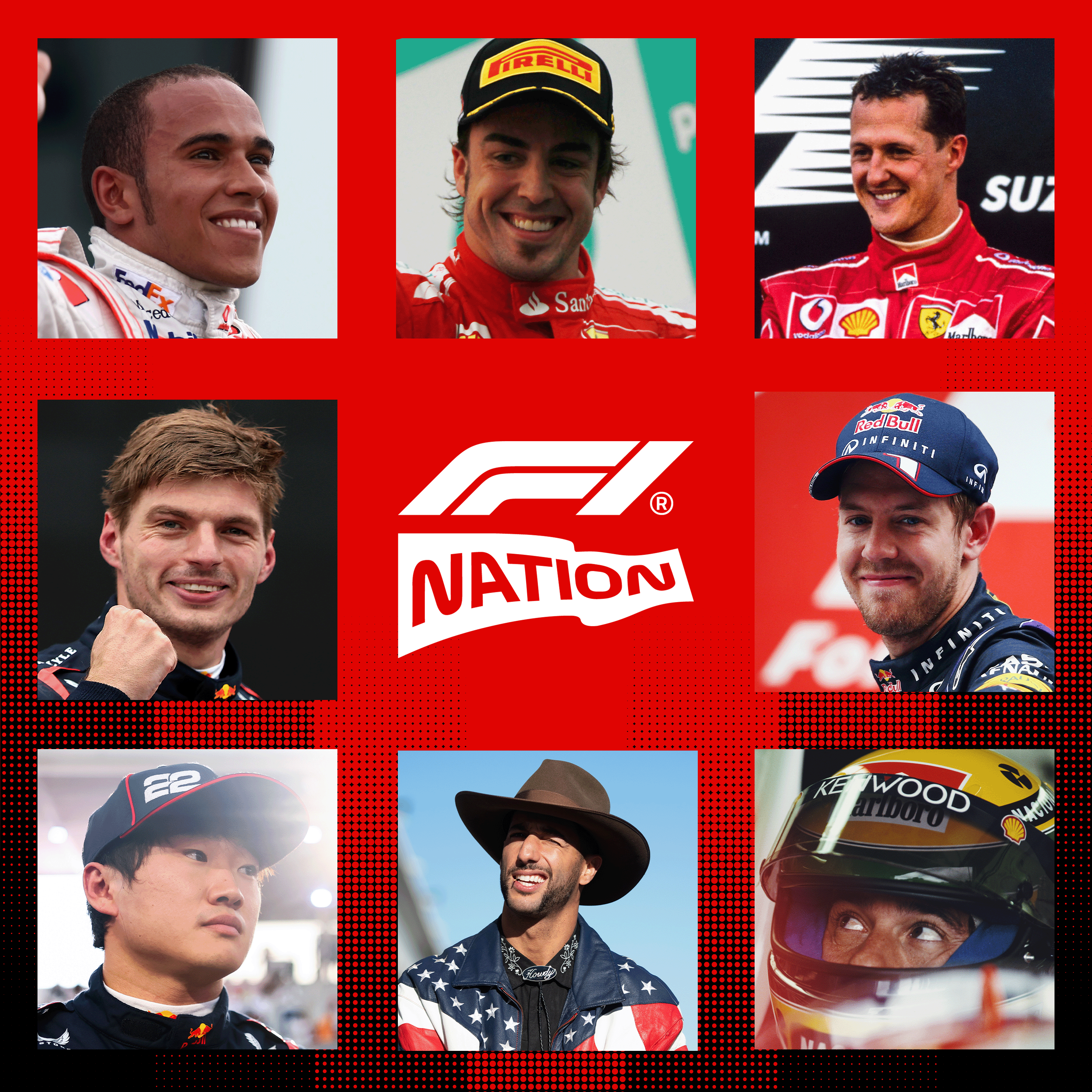
Verstappen's mentality? Schumacher's teamwork? Alonso's intelligence? Tsunoda's physique? Tom Clarkson is joined by former F1 driver Jolyon Palmer and IndyCar race winner James Hinchcliffe to build the ‘perfect’ F1 driver.
They debate the key attributes needed to become the best in the pinnacle of motorsport and which drivers from past and present are closest to perfection.
Plus, the guys chat about the possible driver market ramifications if Max Verstappen does leave Red Bull Racing and they share their standout moments from the Bahrain and Saudi Arabian Grands Prix over the years.