Hey, everybody, Karm Capriotto, Remarkable Results Radio in another Town Hall Academy, good to have
you here.
Thanks for your loyal listenership, I sure appreciate it.
And you know, we always say this, listen to learn just one thing and I just recently
added and implement it.
And if you take great ideas down from all the episodes that you listen to and you
don't react to it then, shame on you, got to do that.
Hey, Breaks4Brests is coming up and it's in October.
I think one of my guests that are on here, I think they're the number one donator to
Breaks4Brests, October of this year, Breaks4Brests.com.
We have a great episode coming out soon as one of the best we've ever done, up to
two million bucks raised so far over the 11 years that Breaks4Brests is out there.
It is one of the most worthy causes in finding a breast cancer vaccine.
And also, hey, thanks so much to our sponsors.
Hey, let's face it, your shop management system is the most critical tool in your shop.
And NapaTracks will move your shop into the SMS Fastlane with on-site training, six
days a week support, and local representation.
Find NapaTracks on the web at NAPATRACS.com.
Hey, how well does your team know their stuff?
They're automotive skills with the Today's Class Basic Advanced or Service Advisor quizzes.
It's a quick, effective way to spot gaps and grow stronger teams.
Take the quizzes now at TodaysClass.com forward slash T-C quiz.
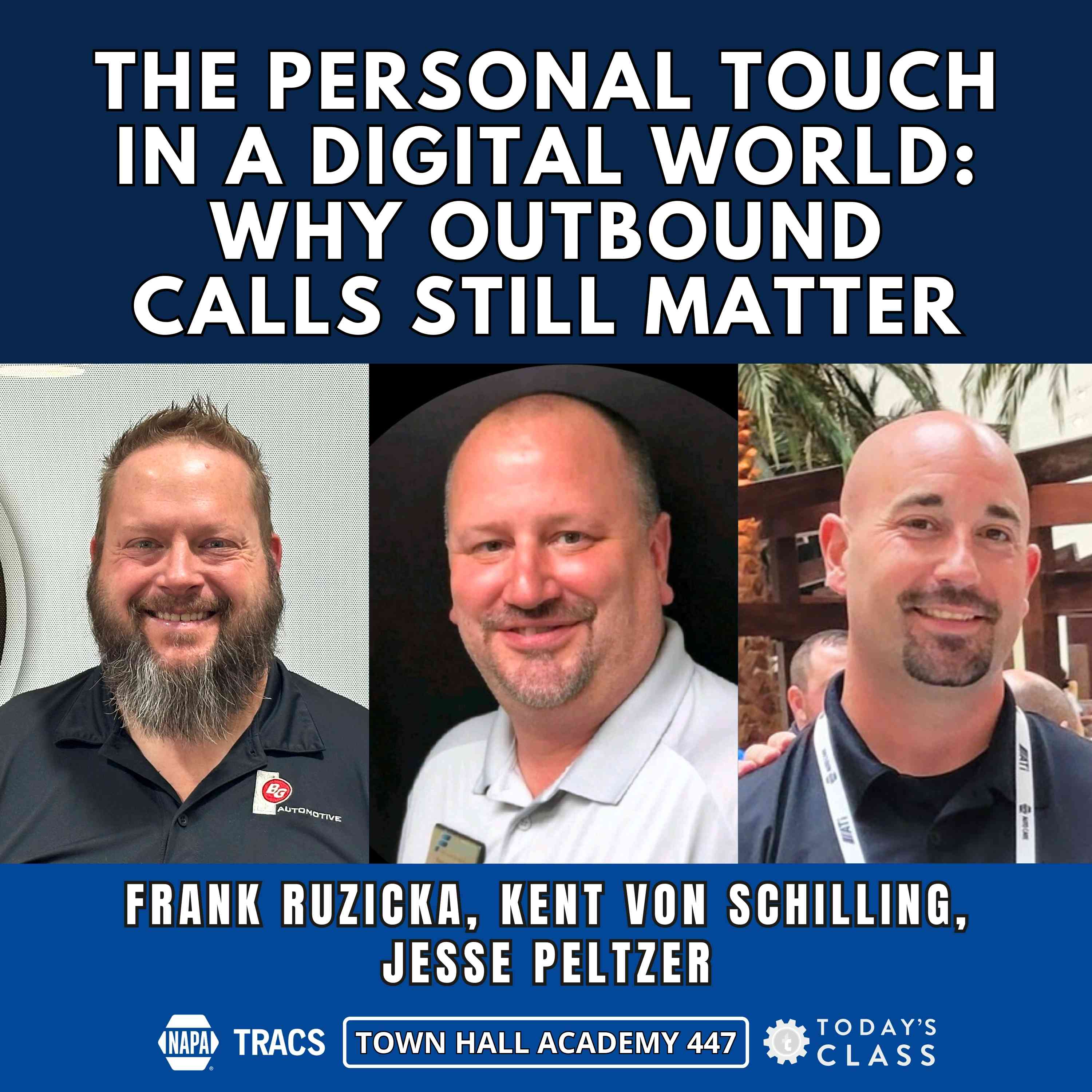
I've got one hell of a panel.
At least Dan Taylor tells me this.
Frank Rozick, a BG automotive, Brian Gossel, five locations Fort Collins, Colorado area.
He's the store lead at the Webster location.
And I can't wait to hear about all the great stuff that you're doing to make up on calls.
Jesse Peltzer, Peltzer area manager for AutoStream AutoCare.
And AutoStream is one of the biggest donators for Breaks for Breasts.
Thank you for all that you guys do.
You're overseeing five of the store's locations as the area manager.
And it's a 10 location operation.
Great people out there.
Kent Von Schilling, Chief Operating Officer of Ferber's Tire and Auto, Richmond, Virginia,
oversees the day-to-day operations of four repair shops and one body shop.
Yes, that makes things fun.
You know what?
I could go on to a litany of questions that I'd love to ask an automotive guy who's leading body shop.
But look at, we're here to talk about outbound calls.
We were just talking before I flipped on the record button and saying,
if I got a phone call from a repair shop saying, you know, even if it's a week later,
everything's still okay with your car.
And I say the word, things are great.
I just committed some kind of loyalty to you.
And what I would love to know in this episode is why it's important.
How are you guys getting it done?
There's so many excuses why people can't make outbound calls.
And Dan Taylor has proven to me how when you look at the metrics of the time that
you end up having in a day that they can be done.
A lot of people will go to voicemail and you can leave a very positive voicemail.
But I would love to know from you, Jesse, is just a routine call or
is this a big commitment to the company?
Well, I mean, I think the big commitment to the company would stand out, right?
And it's not just a little call.
You're proving to yourself the integrity of what you just did for the client.
You know, it wasn't just a cash grab for lack of a better term, right?
You really valued what you did, advised them on, repaired and, you know,
everyone subsequently cares about the relationship you're fostering with them.
So checking out to make sure everything's okay seems pretty natural to me.
Absolutely can't.
You make phone calls for Virginia inspection, I find that so interesting.
First of all, thank God Virginia still has state inspections, number one.
Agreed, 100% there.
Yeah, I literally was in one of my shops last week and a long time customer
came in and said, you saved me.
And I said, what do you mean?
And she said, you called and reminded me about my state inspection.
What if I'd gotten expired?
Well, we all know it's not that big of a deal, but it's a huge reminder.
I mean, to your point, we have CRMs where you can send a text message,
but the actual call to have that conversation with the customer
goes so much further in our relationship model that we built.
It's just huge, in my opinion.
Good for you, Kent.
Frank, the psychology behind the call from an advisor's perspective, what is it?
What I found is that the biggest pushback I get from advisors is they feel
like they are cold calling somebody asking for another service or following up
with something.
It seems to be their biggest roadblock.
And the second one is I don't have time.
I don't have time in my day to get this done.
And if you look at the metrics of it, like you said, there's plenty
of time in the day, especially if you set reasonable goals
and reasonable expectations for what we're looking for.
If a single advisor services 25, 30 cars a week, on average,
I find it hard to believe that they can't find a room to call 25 people back
the next week.
OK, can I throw the Dan Taylor stats at you all?
And I know you know them, but I want to read them out here for our audience.
First, the statistics.
If you make 10 calls, you'll leave eight or nine voice messages.
Of those eight or nine, one or two people will call you back within a day
or two. But Dan has this really great routine on how to ask for that call back.
If you make 10 calls, you will make two appointments, maybe not for tomorrow,
but a couple of days out for the following week.
And if you make 10 calls a day for a week, that's what would be 50 calls.
I can guarantee you that you'll have six to eight appointments
within the next two weeks.
That's pretty powerful stuff instead of waiting for the phone to ring, right?
100 percent. Yeah, absolutely.
Sometimes we forget the phone's work both ways.
So we expect people to call us.
We help them when they call us.
But as we know, life is busy and I put oil stickers to my own cars
for the same reason why I put them in everybody else's.
Because I can't remember when the last time I did whatever else I did.
So life gets in the way and we have to be the ones that reach out to these people.
But how about the cars that are popping up on their computer screens
that you need to have that your oil changes do or maintenance's do?
Does that work or is that just a nuisance for people and they just turn it off?
I think it's a nuisance, but, you know, it's an alert that's necessary, right?
So the nuisance becomes the necessity.
So you get the phone call from the shop saying, yeah, yeah, yeah, I know.
But thanks for calling.
Yeah, I mean, that's where the text messages.
I feel like, you know, the CRM or at least using a text platform
to reach people is sometimes, you know, you can get them get their attention
and not need to get them on the phone.
So each client would dictate that how they like to be communicated with.
That's the key. Am I right?
I believe so in your CRM program, if you're going to sit and do
outbound calls and it says positively, absolutely no phone calls, only text,
then you will then act accordingly.
Certainly. Yeah. Adhere to that.
I mean, if not, pardon me, you're going to fall on deaf ears
and that's, you know, what you're trying to do.
OK. If it's text only, are you finding that people are texting back?
Well, tell me when I can come in or I'll call you soon.
How does the two way work with text?
What we found in if it's text only, you know, our CRM,
basically our guy that does Rick is his name, that does our outbound calls.
He'll go in and start that conversation pretty quickly.
I mean, he's pretty witty, so he'll come back and forth
and go right along with the text.
To second that, our advisors and our sales staff on the front counter,
they know when to make notes.
So if you come in and you say, don't ever call me,
we have one person to share and doesn't want to be called once to be text.
So we make a note that Rick can see that we all see that way moving forward.
He's only communicated by text message.
So that's a vital part, at least for us.
Guys, I need to know something.
I just spoke with somebody the other day who said the phone's not dead.
Carm, people still use their phone,
even if it's for mindless scrolling and texting.
People still want to talk on their phones.
And I kind of tuck my head on the side a little bit.
I says, wow, I find it fascinating that that individual would say that.
Is he right or wrong?
Frank, any idea you thought it's really hard to answer that
because we a lot of the newer generation wants to text.
They do not want to talk to me on the phone.
They prefer to communicate in that direction.
But a lot of my customer base of a certain generation
would prefer phone calls.
That's the point. It's age based.
Wow, age based.
So if you were talking to an individual with gray hair,
wears a white shirt to a podcast,
would you think I want a phone call or a text?
I would ask you the question.
Do you prefer communication via text or phone call or email?
What works best for you?
I'm here to facilitate whatever your needs are as far as automotive
but communication wise, you leave the charge on that
and I'll just respect whatever your wishes are.
You know, Frank, I'm getting too many spam calls.
I guess you should just text me.
Absolutely. I can definitely do that for you.
I know I know about you guys, but the spam epidemic is getting terrible.
It's actually hurting the value of picking it up and talking to a person.
In that particular instance, and I mean, everybody can relate to that
regardless of what part of the country you're from.
You could have that conversation at the counter and say,
I'm going to start off by sending you a text message
with your link for your inspection.
After that, I'm going to text you that I'm going to be calling you.
So expect my phone call after that.
Just setting up the expectation for that customer
so they know that when they get that random phone number,
that it's you and they answer the phone call.
Jesse, we talked about some high level.
Now I want to get into the real meat.
Is it bringing in value?
Are we bringing in appointments?
You know, even though we talked high level earlier,
the call for many of your people may be very difficult at time.
But do they come over the hump and realize, listen,
I know that we're talking about maybe two out of 10,
but those two out of 10, it's important.
I mean, they need more work.
They want to keep their car current.
They appreciate us.
We're developing loyalty.
Talk to me about the mechanics on how it's working for you.
You can get a lot of details out of it
if you're asking the right questions when you get them on the phone.
You know, you got to hit the key points
so they still in the area.
Do they still have the car?
And then first and foremost, it's identifying
if you're a change in management
or if there's been a lapse in their visits,
quickly saying and identifying, you know,
how can we haven't seen you?
Just asking them why they haven't come back.
And then at that point,
hopefully being able to navigate them in a positive way.
Let's face it, your shop management system
is the single most important tool in your shop.
Period.
NapaTrax was built from the ground up
to make your business more profitable and efficient.
We provide an extensive set of tools
to increase and track profitability in real time.
NapaTrax offers the industry's best post sale support
hands down and we train your people on site.
Yep, on site.
And we offer remote refresher training 10 times a week
and customer support is open six days a week.
Give us a call, visit the website
or join our Facebook community today to learn more.
We'll prove to you that Trax
is the single best shop management system in the business.
NapaTrax is always customized and tailored for you
whether you're a one man shop
or a large multi-bay or multi-location company.
After all, it's your shop.
So it's your choice.
Visit us on the web at NapaTrax.
That's N-A-P-A-T-R-A-C-S dot com.
Hey, wanna test your team's knowledge?
Well, today's class quizzes show how much
your techs and advisors really know
so you can train smarter
and build a stronger, more efficient team.
Whether it's the basic quiz,
perfect for all techs to test their foundational knowledge,
the advanced quiz built for experienced technicians
ready to dive into complex topics
or the service advisor quiz
focused on communication and customer service.
Now each one gives your team a clear review
of what they know and where they can grow.
Take the quizzes now at today's class
dot com forward slash TC quiz.
Let's talk about a customer that you've had.
They were just in three, three or four months ago
and they may not necessarily be a repeat
or have a ton of loyalty.
Will they take your call?
And if they do take it,
what's the likelihood that you grow them more
inside of your business?
Well, I found in a three to four month window
you should be able to get those folks back in
pretty easily, whether you're doing just a follow up,
just touching base saying hi, from that standpoint
or maybe you're making a decline
service recommendation call based on
tires or brakes or a safety item.
A lot of those times you're in that still
should be in a good spot unless they had a poor visit.
And I would think that we would have identified that
in one of our thank you calls in the days
after the visit.
So hopefully there wouldn't be any kind of issues
to be navigating at that point.
And it would just be more so the conversation of
let's forward schedule your next visit,
whether it be oil change or let's revisit
some of the more serious things
that we just didn't tend to last time, right?
Speak to those.
Can't your thought on that question
about within three or four months
they've been at your place
and to get them back in to develop loyalty?
A hundred percent.
I mean, not to say the same thing Jesse said,
but like that's what our whole model
is a relationship model.
We want you to come back.
We want you to choose Ferbers.
You have lots of options, right?
But we want to be the to excel
and be your go to place.
How many times does the customer say
you have to have a good doctor
if they have a good auto repair shop?
We want to be that repair shop.
And what we've learned in the short four months
we've been doing this is we do a pretty good job.
But we've also learned there's some things
and some equal sequences we need to work on
that for the customer to make it better.
Like what?
Honestly, early on our DVI,
when we would send our DVI
we weren't uniform across the company.
One shop was color coding.
One shop would color code 50% of the time.
And Rick, who again does a great job
jumped right in with both feet
and said we got to fix this right away.
We want the same experience across all four stores,
you know, body shops different.
But so that's something we jumped into
and it's been huge.
And we've learned that that's to be uniform as we grow.
We got to have the process in place
and make sure it was just towing that line
and staying between those guardrails.
We have an episode coming out on process and systems.
You just nailed it.
And especially you guys are all multi-shop operator companies
and how difficult it must be for all of your jobs
to keep everyone on the same page.
Right, Frank?
Absolutely.
That's 90% of my job.
Can you echo anything more
that Kent or Jesse said on this?
They said they pretty much have to nail on the head,
but I think the biggest point
to making these outbound phone calls
is not necessarily you're not trying to sell them anything
or you're not trying to remind them
that their car is broken
or they need to spend money with you.
It's just you're staying current with them
in their decision making
of what's going on in their lives.
People use their cars every day to live,
to pick up their kids, pick up groceries.
And you're just reaching out saying,
this is what I think we should do to keep you on the road
because I care.
And we don't have to do it today.
And that's not what this is about.
This is me just letting you know that I care.
Frank, you just said no sale.
I believe you just said that.
This is a no sales call.
And I want to bring up six different types of calls.
And this is from Dan Taylor.
He sent them to me.
Number one is a thank you call.
Easy peasy, appreciate you.
Number two, it's time to make an appointment call.
Number three is the deferred work call.
Number four is what happened to you call.
Number five, your warranty is about to run out
which I think is really cool, powerful.
In courtesy, winter, summer, fall, spring, vehicle check.
Wow, who could argue with any kind of strategy
in those calls depending on the timeline
from the last time that they were in or weren't in?
Do you sit down with this is a hierarchy and say,
this call we're making is going to be a,
what happened to you call this call we're making
is going to be a deferred work call?
Who picks that strategy?
So kind of how I outlined it for myself
and the advising team here is that
it's based on the timeframe from the point of visit.
So within a week, we have a phone call out to them
just to say thank you for coming into joint
and using our services.
And then making sure everything went well.
If something didn't go well, we try to figure that out.
At that point, we're not doing anything
as far as related to anything other than what they did.
So kind of reassuring that they did a great job
fixing their car with us.
Three weeks out, we'll make a phone call
and that'll be your deferred work
to like whatever that might be.
Depending on what the situation is
then around the six month mark,
we aim for our re-up on the oil change,
see where they're at, see what's going on.
And then 12 months out is we miss you.
We haven't seen you in a while.
What's going on?
Like can I help you?
The warranty phone calls are out from out that
and we found that if you just break it up by timeframe
then we're touching customers multiple times a year
just by leaving a voice message saying how are you doing?
Can I get you on the schedule?
Stuff like that and just staying current with them,
making sure that when they do need a problem fix
that we're the ones on their mind.
How are you tracking this?
Is it CRM or is it a process sheet, Excel spreadsheet?
How are you tracking?
I made this call here was the outcome
and then in six months we're going to make it again
because processing system and making this work,
it can't be haphazard, right?
It really can.
We have to be really forthcoming with our note taking
in our program and our point of sale system.
We have the ability to see when the last time
we saw a customer in so we can track based on that.
We go into the customer's account.
We can see the notes that were made
from the last phone call so we can kind of see
what was said and kind of follow up with them there.
I challenge all of my teammates to talk to the people
they've already talked to in person.
Like reach out to those customers
and be that guy that like I saw you 12 months ago
for that oil change.
I saw you six months ago for breaks.
I'm calling just to make sure that your oil change is good.
I'm your guy.
They call up and say, I want to talk to Frank
is what people I want people to say.
So they know who they're talking to
and then I have that relationship with them.
And at that point we can come up with a plan
for the car.
Is this car going to last your daughter through college?
Is this car going to last you another year?
We need to figure these things out.
And I know that information.
And so when you call up, it's like,
hey, you got some things going on.
We just need an oil change today.
We got six months to go until that finish line
before your daughter graduates and we get her a new car.
So it's all about the relationship building
and touching those people and just staying current.
So Jesse, if Frank calls you and says, I'm your guy,
are you good with that?
As long as I was happy with the visit
and felt that it was my money was valued.
Yeah, 100%.
I'd let him be the guy.
Thanks, Jesse.
How are you guys tracking all of this, Jesse?
Making sure that you take good notes,
the good discipline, which calls you're making.
Day to day we do Excel sheets for thank you calls.
So each following day everyone has to follow up
on the previous clients.
They record that an Excel sheet
that's sent in at the end of the week
has all the calls made.
Forward scheduling are kind of made the same way.
We try and get those just wrapped up
at the end of the week,
but they do so many per day to make sure
that the upcoming appointments are set to come in.
We use that as a chance
to also talk about past recommendations.
The CRM does a lot of the stuff in between.
I'd say probably the, you know,
we're on the six month mark
and you kind of, you know,
just automated services that'll send out.
So that takes a little bit of the desk work out of it.
And then at one year we'll hit them
with the where have you been, right?
Kind of checking in when we missed you kind of.
And then at the 18 month to 24 month
is when we're going to be reaching out for warranty calls
because we have a two year and 24,000 mile warranty.
So we kind of let that get right to that ending point
and, you know, try and reestablish a relationship there
just for the benefit of the warranty period.
And again, if it's only text,
you're letting your CRM do it.
So the counter staff or the advisor
that may have worked with it
or the director, if they're familiar with the client,
you know, from previous visits,
I would have them write a personalized message out
to that nothing that's just going to be
a stamped kind of interaction
because me personally,
when I get the redundant same messages from people
that I receive them,
I just don't feel that that's a genuine, right?
They are not really caring, right?
That's just the automated.
I'd like to feel a little bit more fabric of the visit,
you know, so that's what I did when I sent them out
is I queued to certain things that may have taken place
or certain things I have noted in their system
on their profile to really tap back in
so they feel the value.
And it's not just as though we're like,
Hey, where have you been?
Come see us, you know, put some money into the car.
It's not that it's really checking on them
and seeing if everything's okay.
Kent, do you guys do personal messages?
We do.
If it's a CRM to the sales team, yes.
If it's from my outbound call guy,
then he relies on the messages we put in
much like Frank was talking about
to know what's going on with that car.
But yes, on a day to day, on the front counter,
personal messages all day long, yes.
Kent, can your company survive without doing this?
The simple answer is I would say no.
I mean, I'm a firm believer.
Like I said, we started this four months ago
and it's been huge.
I mean, the amount of Google reviews we've seen,
just the positive messaging we've seen,
just the responses that we've gotten, it's amazing.
So I think this, to your point, you said it best.
Like the phone is not dead and Frank said it too.
Like it goes both ways.
So this is the future in my opinion.
People want to still talk.
Yeah.
Kent, you just blew me away by saying four months ago.
Frank, how long you been doing it?
We've been doing it since December,
so about seven months.
And Jesse?
Since AutoStream has been around, basically.
I've been there doing it for four years, so.
Okay, so you've got the legacy behind you.
AutoStream couldn't work without this.
It's foundational in your company.
Yes, sir.
And Kent and Frank, you probably, wow, Jesse,
I guess we should do this in Dan Taylor being a coach
and building the process and the reasoning behind it all.
You couldn't go back, Kent or Frank?
Frank, you couldn't go backwards, could you?
Absolutely not.
In this day and age, there's a lot of places
that can fix cars and repair cars.
It's what sets you apart.
And in the AI-driven world that we live in,
it's that personal one-on-one connection
that really is gonna set you apart.
I can't foresee us going back to doing it the old way
of just sending out random marketing points to customers.
I want to be able to talk to them,
make sure that they're doing okay,
make sure they still have the cars.
Ask all those questions that we need to know
and build that relationship with them
because I find, and this is just my belief
that the more and more we get automated,
the more and more that personal one-on-one connection
with the human being is gonna be important.
Jesse, I think of the word opportunity for growth.
And you guys have been doing it for a long time.
When you think about, let me see,
I'm gonna spend money on AdWords.
I'm gonna do all of these things
that I could find and bring in new accounts
and be involved in the community.
And right here, this opportunity for growth
is where's my phone?
It's right there and it doesn't matter if it's text
or if it's voice or voice mail.
Aren't people striving for connections and connectivity?
Yeah, they want you to value the relationship
and that's exactly what that communication does.
I mean, sometimes it's the best thing
to just to reach out because,
I'm sorry to have a client reach out
just through the text platform back to the CRM
because they wanna share something,
conversation-wise that it's taking place
with an advisor or the director.
So they're valuing that friendship relationship,
the rapport on just not an automotive level, right?
That's all you know, I think you've really won
is when you're having that kind
of the foundational relationship.
Agree, guys?
Absolutely, 100%.
It's a duh moment, duh.
Ever have your client leave with a reservation
for future maintenance like we do in the dentist chair?
100%.
I like to take credit for what I'm about to say,
but I can't, I have to give it to one of my teammates.
He coined the term the digital oil sticker.
Now, we've been using oil stickers in cars
since Thaddeem and I was a kid.
And so we're already doing it,
but what we're doing is we're just letting
the customer know that I put in the computer
for a digital oil sticker that is set for the date
that your next oil changes do.
This is gonna be an appointment
that we're going to set for you for you to call.
We're gonna call and reach out to you and see where you're at.
If we have to push that out two months
because you haven't driven that much
or whatever that looks like for you,
this is what that looks like.
So it's just relaying to something
that people already are accustomed to,
but making it digital so that,
hey, you don't have to think about it.
I'm gonna call you in six months
or whatever that's set out to be.
So the digital oil sticker,
I'm just gonna shout out to my teammate for that one.
Is that copyrighted or trademarked or anything?
Steal it as much as you want.
I think everybody should use it because it's easy.
People know what state oil stickers are for
and when you say, hey,
just put it in the computer digitally.
They're like, that's amazing.
All we're doing is setting up a appointment reminder
for us to call them in six months.
Well, I'm impressed by digital.
Yeah, me too.
It's a, we have your back policy.
We have your back moment.
And we have your back through this digital oil sticker
reminder that we're setting an R system for you.
You do that for me?
That's the moment that goes on up here.
This industry of ours is amazing
to have entrepreneur people like you guys,
leaders like you,
teams that wanna bring new policy ideas
and systems together.
And then there's all those other ones out there
that are struggling and says,
I can't make any money.
I can't find anybody to come and work here.
And you guys are like forward leaning over
your skis proactive in all of these systems
and policies, never forgetting that the clients,
the number one reason you do all this stuff.
That's it.
Yeah.
Without them, we're just sitting here
with a bunch of wrenches in our hands.
And you say goodbye and thank you very much
and how many shop owners don't think
of what happens next.
It's not hopefully they call,
hopefully they see a Facebook post.
Hopefully, hopefully it's like, wait a minute.
Hey, we'll talk soon.
Hopefully, right.
Hey, listen, I know it's not a perfect world
and some of that stuff's gonna fall off.
But if you don't purposefully do this stuff
and reach out and I think it's all about
building a relationship period, done.
If they love you and the service was great,
the follow-up is good, the warranties are covered,
the maintenance is being protect my back,
we've got your back.
Who would go anywhere else?
Now, I know that's not a perfect world
and I know it's never gonna happen 100%.
But what do you think?
You got a 90% chance of having them back?
Any idea?
Guys ever felt that?
I think on a positive interaction
with the actual repair or service
with the follow-ups and the continued following up,
I would say 90% is a very conservative number.
I would say it's a lot higher than that.
Just because, again, we can't control a lot of things
in this world, but we can control the experience
that you have here at our shops.
And with that alone, that could seal a deal
for a lifelong customer.
Yeah, great.
Again, back to that relationship model,
that's what people want, that's what we're giving them.
Like, I mean, you said a best car,
we've got your back, we're here.
God, that is just so cool.
The digital oil sticker, we have your back.
It's like, I never looked at my roof.
Do I need a new roof?
I mean, there's so many things that go on in our world
that over time, we gotta pay attention to them.
I think people just, they get a car
and they set it and forget it
and they never think about it.
And in fact, it's, I guess, it is our job in this industry
not to do a rom-po peel on your car.
I don't know how many young people know who that is, but.
You remember that to set it and forget it, the commercial?
With the rotisserie, yes.
The rotisserie I've been running.
I remember that now.
Yeah, you just have to set it and forget it, you know?
Hopefully it's cooked when you get home.
Well, and it's funny that you say that,
because I made mention before
that I put oil stickers in my own cars.
How many times you hop in the car
and kids are screaming at backseat
and you are like, you know what?
I'm gonna check my oil sticker, you know?
I'm late on my own oil sticker.
So like someone calling me and telling me,
hey, you need to get this done.
It alleviates that decision fatigue of like,
okay, what do I have to do next then?
Just, you got me.
So what do I gotta do?
Yeah.
Oh my God.
It's the shoemaker with the, you know,
holes in the shoe.
You gotta hold their hands sometimes.
It's another great reason for these outbound calls.
It's another great reason for, you know,
setting a forward reservation,
but I do love the idea that,
I don't know what I'm gonna do in four months.
I maybe, don't worry about it.
We got your back.
We'll remind you, we'll call.
We'll do whatever we have to be in touch with you.
But according to all of our records,
we're gonna be doing four months.
We got your back.
Ooh.
This could be the biggest episode of the year, guys.
Well, and if you think about it also this way,
and this is kinda how I mentally approach it.
The only time you look for service is when you need it.
So if my roof is leaking,
I'm looking for a roof or if my pipe's leaking,
I'm looking for a plumber.
I don't want my customers or my clients
to be the one like my car broke down.
I need to find a repair shop.
They already know where they're going.
They're just calling me and I'm setting up the tow.
In a world where we're bombarded consistently,
constantly 24-7 with advertisements,
that phone call just saying,
hey, haven't seen you in four months, how you doing?
Frank, it's like that fast-paced Amazon world.
How many of us ignore the ads they come through?
I do.
Yeah.
If I get an ad that will not go away,
I can't even get the justification of a story
until I read 10 paragraphs and am forced to watch 20 ads.
I'm out.
And I'm not sure if that signal back to the either author
or the advertisers gets up there,
but it's so, so annoying.
That stuff probably makes us not want to take your call
or maybe not want to follow up on your text
because again, there's extreme
and then there's nice that you guys are doing.
It's the soft touch.
It's like, it always sends back to the relationship.
Like, I'm not some advertising guru.
I'm not some guy that's in an office somewhere.
I've met you.
I know what's going on with your car.
Like, I know your kids are at soccer right now.
Like, I'm the guy that you want to call
because I'm not at some entity somewhere.
Wow, guys was an enlightening episode.
It really was.
Let's go around the room.
Anything in your talking points that we didn't cover
or any final comments?
Let's do this.
We'll do Frank Kent and then Jesse will be last.
Hey, Frank, thank you so much for being here.
We appreciate a BG automotive out there in Colorado.
Any final words?
No, I just want to say thank you for the opportunity.
I know the caliber of the other shops
that are on the screen right now
and I'm thankful to be on with them
and be able to talk about this.
Cause again, I'll just re-emphasize the fact
that we live in a digital world.
So a handshake can go a long way.
Thanks so much, Frank Kent, COO, Ferber.
I would say, again, thanks for including me.
I respect both these gentlemen,
Jesse and I know each other really well.
And I spent some time with Frank
and I love your show, of course,
but I hate to keep saying relationship,
but it's all about the relationship and being personal.
Like, people want that touch.
They want, like Frank said, soft touches.
That's all it is.
Just checking in on you.
Like Dan would say, just checking in on you.
How you doing?
You know, and you're going to build that relationship
in the short four months we've done it,
we've seen a huge return on investment.
I still do believe people want a personal touch, guys.
I still do.
As tough as this whole digital world of no personal touch,
we could set ourselves apart
because that vehicle isn't one and done.
It's got to come in.
It's got to do things.
It's got to be looked at.
Wow.
Jesse, area manager at AutoStream Car Care,
one of the largest donors to Breaks for Breast.
Thank you for all that you guys do for that.
I know that the founders of Breaks for Breast
sure appreciate you guys.
Any final words, Jesse?
Thanks again for having me, Karm.
Great time.
Guys, thank you very much for everything you guys
were able to share.
I just think the call is the callbacks
and that personal touch are the cherry on top
of, you know, a relationship and a visit.
So I stand behind them
and I think everybody would see success if they utilize them.
Wow.
Great words, guys.
Good wisdom.
Thank you for being so candid and share.
I have some of the best notes of the year
sitting in front of me.
The digital oil sticker.
I have your back.
Woo, I love it.
All right, guys.
Hey, look it.
If you learned anything on the show today,
just implement it.
And whatever you do, please do it well.
Thanks.
Thanks for being on board to listen and learn
from the Premier Automotive Aftermarket Podcast.
Until next time.
About this episode
Exploring the significance of outbound calls in the automotive repair industry, this episode features a panel of experts discussing how personal communication fosters customer loyalty. Guests share insights on effective strategies for follow-up calls, emphasizing the importance of maintaining relationships with clients. They highlight the balance between digital communication and personal touch, with anecdotes illustrating how proactive outreach can lead to increased appointments and customer satisfaction. The conversation also touches on the challenges and metrics associated with making these calls, reinforcing the idea that genuine connections can set businesses apart in a competitive market.
Thanks to our Partners, NAPA TRACS, and Today's Class
This episode explores how today’s top automotive shops are transforming their business by taking a proactive approach—reaching out to customers instead of waiting for the phone to ring.
You’ll hear strategies to overcome common service advisor objections, such as “cold calling feels pushy” or “I don’t have time,” supported by Dan Taylor’s compelling data showing that just 10 calls can generate 2 appointments. We’ll break down the different types of high-impact calls, thank you calls, deferred work reminders, and even simple “we miss you” check-ins that strengthen relationships and keep customers engaged. Plus, learn why tailoring outreach—whether by call or text—based on each customer’s preference ensures communication feels genuine, not generic.
This conversation reveals why outbound calls aren’t just a task, but a growth opportunity. In an increasingly digital world, it’s the personal touch that builds trust, sets your shop apart, and keeps customers coming back. Don’t wait for loyalty, create it.