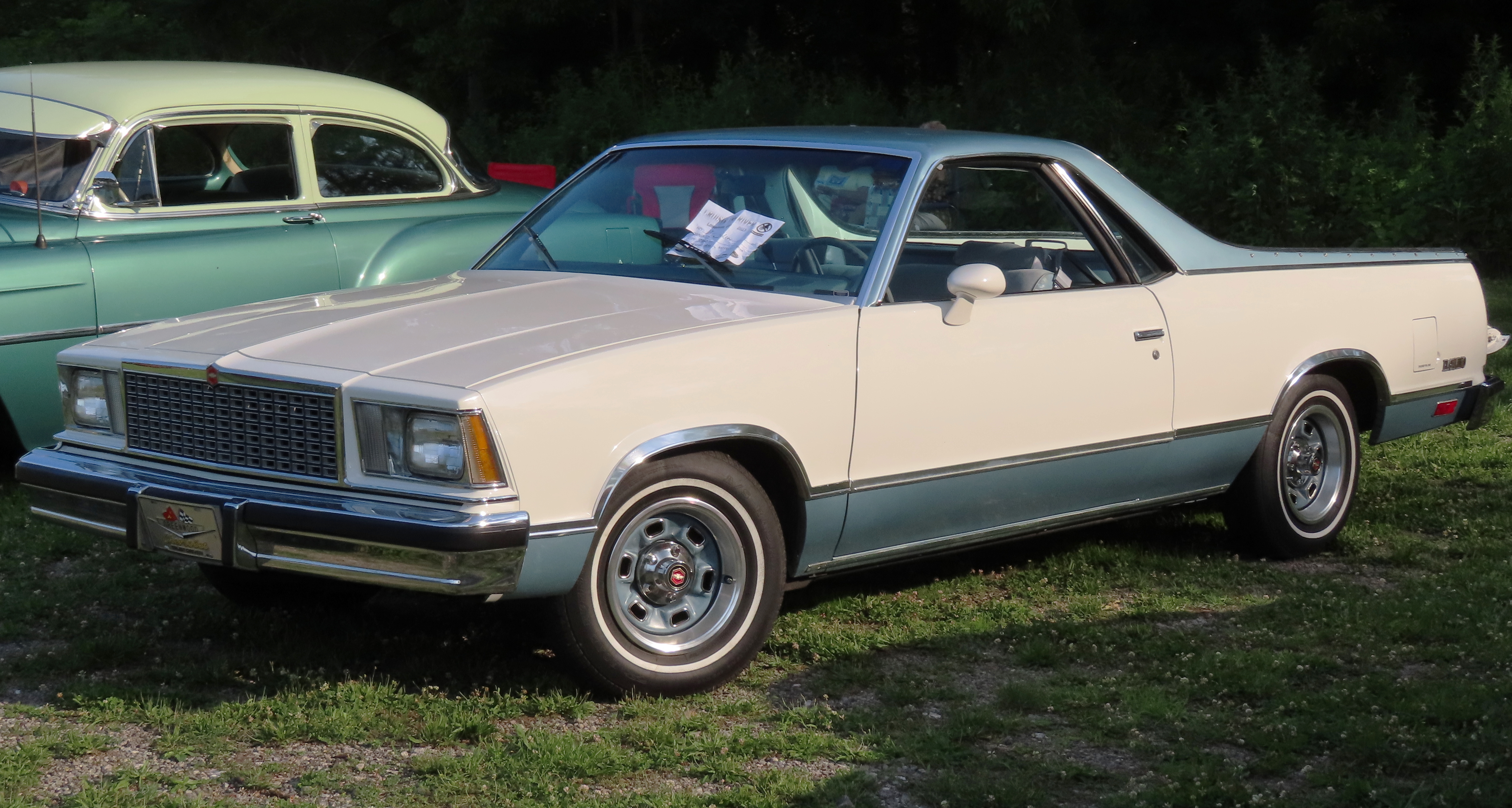
The El Camino's journey from its 1959 debut to its eventual decline is explored in detail, highlighting its unique blend of car and truck characteristics. Kurt and Ben discuss the vehicle's origins, its design evolution through various generations, and the cultural context that influenced its popularity. Personal anecdotes add a nostalgic touch, while debates about its identity as a muscle car versus a utility vehicle reveal the complexities behind its appeal. The episode also touches on the future of small trucks and the longing for a modern revival of the El Camino.
Topics:el camino historydesign evolutionmuscle car identitycultural significancepersonal storiessmall truck revivalautomotive nostalgiamarket trendsperformance vs utility
It's a car! It's a truck! No! It's an El Camino! Listen as CarStuff crew discuss the venerable Chevy El Camino, and mull the future comeback of the light-utility pickup truck.
"...hat would be an interesting example. So the Honda Civic, right? The Honda Civic comes out in 72,"
Select text to request an explanation
This is an I Heart Podcast.
Guaranteed Human.
Hear that?
That's what it sounds like when you plant more trees
than you harvest.
Work done by thousands of working forest professionals
like Adam, a district forest manager
who works to protect our forests from fires.
Keeping the forest fire resistant,
synonymous with keeping the forest healthy
and we do that through planning more than we harvest
and mitigate those risks through active management.
It's a long-term commitment.
Visit workingforestsinitiative.com to learn more.
With Black Friday's savings at the Home Depot,
you can get up to $1,400 off plus get free delivery
on select appliances like LG,
America's most reliable line of appliances.
Check out the newest LG refrigerator
with new mini craft ice straight from the dispenser.
Shop Black Friday's savings on select LG appliances
plus get free delivery now at the Home Depot.
Free delivery on appliance purchases of $396 or more
offer valid $11,5 through $12,3 US only see story online for details.
And Doug, here we have the Lemo Emo
in its natural habitat helping people
customize their car insurance and save hundreds
with Liberty Mutual.
Fascinating.
It's accompanied by his natural ally, Doug.
Lemo, is that guy with the binoculars watching us?
Cut the camera. They see us.
Only pay for what you need at LibertyMutual.com.
Liberty Liberty Liberty Liberty Liberty.
Savings very underwritten by Liberty Mutual Insurance Company
and affiliates Excludes Massachusetts.
Welcome to Car Stuff,
a production of iHeartRadio's How Stuff Works.
Hello again, all of you car stuff head gaskets.
This is Kurt Garin coming to you from the side car
of the out of control car stuff motorcycle
as we careen down the highway of life.
Then as to my left behind the handlebars
at full throttle and I suspect he is out of his mind on coffee.
And me, well here I sit,
leather helmet and goggles firmly affixed to my noggin face
forward facing the onslaught of the chilly mid fall air,
completely unable to influence what this madman next to me
is about to do.
But hey, what can you do?
Welcome to another wild ride here in the land of car stuff.
Ben, can you hear me over there?
Yes, Kurt, I can hear you.
Thank you again for having me back on the road.
Having me back on the air, although I am not 100% on board
with that description of these unhinged coffee-fueled lunatic,
I cannot object to its accuracy.
We had a lot of conversations off air, you and I,
didn't we after our previous episode on the cars of breaking bad?
Well, yes, we did.
We talked about, let's see,
we really took some pot shots
at the poor old Pontiac Aztec in particular,
but during that exploration,
you and I started talking about some cars we love,
and some cars we hate,
a long time car stuff listeners
will recall my very, very complicated
hate, hate relationship
with a particular minivan known as the Honda Odyssey.
You and I have talked about this.
Did we talk about this on air the last time?
I don't think we were on air when we were talking about it.
And since then, I had one negative experience with an Odyssey
and it may be in line with some of yours,
but please continue.
No, no, please come with me.
Well, it was just one of those road situations
where you're just trying to make some progress
and there's this one person that doesn't want you to.
So it may just happen to be in a Honda Odyssey.
You know what happened?
The words out.
They know that you and I work together now telling you
there's a vast and insidious conspiracy.
You know, jokes aside,
I want to thank everybody over the years
who has sent me wonderful email about
or wonderful Facebook messages, tweets and so on,
about the Honda Odyssey,
about many Vans in general.
And there's a very weird commercial
that some of your co-workers and I filmed a while back
about many Vans.
I've got to send you or maybe we can post it
on car stuff's Facebook page too.
But with that being said, jokes aside,
here's the beef with Honda Odyssey's.
When you buy a Honda,
no, this is a true story, Kurt.
When you buy a Honda Odyssey at a dealership,
you know, you get engine wise,
it's a pretty good vehicle, right?
Spec wise, pretty good vehicle.
If you're a person who feels like there's no such thing
as too many cup holders, Honda Odyssey,
that's the right for you.
But if you have a problem with the price point
or something like that,
the dealer takes you into a back room
and they say, hey,
we're going to give you a discount on this van
so long as you let us install this one extra feature
and this feature recognizes
when there's a guy named Ben Bullin in a Monte Carlo
within about a half mile of you
and it slows your vehicle down
and makes sure, like, this weird autonomous system
makes sure that you're directly in front of his car.
And, you know, understandably,
people buy a Honda Odyssey are like, well,
you're going to knock 5K off the price,
then a course I'll do it.
Sure.
So that's my beef with them.
Yeah, and they must have updated the software on that.
It's a close deal after you.
Yeah.
Well, what's a car that you particularly love, Kurt?
Well, all the top of my head
and El Camino comes to mind.
Ah, you've hit upon the topic of today's episode.
So behind the scenes,
this is a weird one.
By the scenes when you and I were working on
our previous episode on the cars of Breaking Bad,
we also talked about the spin-off film
to Breaking Bad that came out called El Camino.
And at some point,
I don't know if we ever mentioned this on air, man,
but at some point we were both baffled
that there had never been a car stuff episode on El Camino.
Or as we call it here in the US,
the El Camino,
which should be hilarious to anyone who speaks a lick of Spanish.
Because what we're saying is the road.
You know, it's like saying ATM machine or VIN number, right?
Vehicle identification number number.
The El Camino, man.
By the way,
I'm going to continue calling it the El Camino.
The El Camino fully entire time.
The El Camino is a fascinating vehicle.
It's sometimes like a platypus of the road.
You know what I mean?
It's not quite fish.
It's not quite foul.
It's something different,
something unique, a mixtape.
And you and I have some personal stories about the El Camino,
but I have the following proposition.
Why don't we start with the origin story of the actual vehicle,
which may surprise some people, some 80s babies,
maybe surprise how old this vehicle actually is?
El Camino was introduced.
The first generation was introduced in 1959.
It was basically a response to Ford's ranchero.
But even before that,
in Australia, in the 30s,
they created this vehicle known as the coupe utility.
So the idea of a car that had some of the attributes of a truck,
the idea that was around for a while before they started showing up in America.
And even in the early 50s Chevy and Ford made light-duty trucks.
Like the Chevy made a truck called the Task Force.
It was a light-duty pickup truck.
But the El Camino brought in some of that,
I guess the elegant lines of the late 50s and early 60s,
the chrome trim, some of the more visually appealing aspects of the sedans at the time.
Yeah.
You can look at some pictures of the first generation El Caminos.
And you can clearly see the aesthetic you're talking about here, Kurt.
I do have to also confess I have a weakness for those flowing lines
that space age retro futurism so common in Ford's and Chevy's of the 50s and into the 60s.
We do have a previous episode on car stuff about euths in Australia and their origin.
For anybody who wants to check that out,
there's a really cool quote that you found about the euth as well,
like the way it was marketed in Australia, right?
Yeah, so it was a farmer's wife in Victoria, Australia.
She desired a car that quote,
to go to church in on a Sunday in which to carry our pigs to market on Mondays.
And so that encapsulates the entire concept here.
You know what I mean?
The idea that instead of buying two separate vehicles for two separate specific tasks,
right, you can buy something that fulfills both of those functions.
This is a question that we'll come back to, right?
Because what we're going to see here is going to be ultimately a battle between some of those functions.
Is a daily driver or your good-looking car, right, your business car?
Is that the same thing as your hauler, your work vehicle?
The folks who made the cameo carrier and the folks who made the El Camino,
and the folks who made the euths in general,
their answer to that was, yes, it can be the same thing, forward the future.
What a time to be alive, you know what I mean?
Life gets messy.
Spills, stains, and kid chaos.
But with Anneve, cleaning up is easy.
Our sofas are fully machine washable, inside and out,
so you never have to stress about messes again.
Made with liquid and stain-resistant fabrics,
that means fewer stains and more peace of mind.
Designed for real life, our sofas feature changeable fabric covers,
allowing you to refresh your style anytime.
Need flexibility?
Our modular design lets you rearrange your sofa effortlessly.
Perfect for cozy apartments or spacious homes.
Plus, they're earth-friendly and built to last.
That's why over 200,000 happy customers have made the switch.
Get early access to Black Friday pricing right now!
Sofa started just $699.
Visit washablesofas.com now and bring home a sofa made for life.
That's washablesofas.com.
Offers are subject to change and certain restrictions may apply.
And Doug, here we have the Lemo Emu,
in its natural habitat, helping people customize their car insurance
and save hundreds with Liberty Mutual.
Fascinating. It's accompanied by his natural ally, Doug.
Lemo, is that guy with the binoculars watching us?
Cut the camera! They see us!
Only pay for what you need at LibertyMutual.com.
Liberty Liberty Liberty Liberty Liberty Liberty.
Savings very underwritten by Liberty Mutual insurance company and affiliates
excludes Massachusetts.
Hear that?
That's what it sounds like when you plant more trees than you harvest.
Work done by thousands of working forest professionals like Adam,
a district forest manager who works to protect our forests from fires.
Keeping the forest fire-resistant, synonymous with keeping the forest healthy,
and we do that through planning more than we harvest
and mitigate those risks through active management.
It's a long-term commitment.
Visit workingforestinitiative.com to learn more.
So let's dive in a little bit into the first generation
of try not to crack up when I say this.
The El Camino.
The The Road.
It was based on a station wagon that Chevrolet produced at the time
was the Brookwood station wagon.
So the first generation spanned two years,
1959 to 1960.
And throughout the generations, by the way, the El Camino,
it kind of flops back and forth between car,
muscle car, light utility, truck,
and it kind of has this funny quest of finding its place
where it fits in in the car universe, I guess,
and maybe ultimately that's why it disappeared
because it was just kind of always that it sat in the middle somewhere
between car and truck, obviously,
but also between car that you would want to be in every day
to a car that you may have had to have another car to seat
maybe more than two to three people.
Right.
If you wanted to.
Want to ride in the bed.
True.
Which became unacceptable at some point.
I know.
For some reason, yeah.
Which you and I both probably grew up in areas
where it was completely normal to just hop in the back of the pickup truck.
Right.
Yeah.
Sometimes.
Yeah.
So I liked that we're starting with the first generation here.
And I like that you mentioned the ranchero earlier
because the El Camino was the last time I'm going to laugh and say that.
The El Camino was a little edgier.
It was more stylized.
It was hiper than the ranchero.
And when it first came out,
it sold more quickly than the ranchero.
Something along the lines of like 22,000 to 14,000.
And then it also, while it was clearly based on the Brookwoods wagon,
it had some different variants.
You had some more options.
You could get it with any full-size Chevy drive train.
It had a single trim level.
And then we can dive into the stats a little bit.
Let's look at the price point.
So the 1960 model, next model year,
still has that kind of classic or what would come to be classic.
Belier look, right?
The 1959.
But how much did it cost?
The starting price was around $2,366.
And that was with the 6-cylinder engine.
You could also get a V8 for around $100 more,
which was a 283 cubic inch engine.
So let's do just a little bit of inflation calculator math.
You ready?
All right, let's see.
Let me get a drum roll here.
$2,366 in 1960 is equivalent to about $20,071.
$20,058 in 2018.
So $20,000, functionally.
That's nothing to sneeze at.
That's definitely an investment, especially when you consider that
these weren't super practical for a lot of people in the US.
Yeah, for sure.
Especially around the time the baby boomer generation.
So you had larger nuclear families after World War II.
Right.
And we needed space for the kids.
And one thing you told me that I thought was very interesting was
you said, when I look at the first generation Al Camino,
I'm also kind of seeing the story about the time.
Yeah.
Yeah, it seems like you step back and you look at the Al Camino
throughout the generations.
It directly reflects the time that it was produced.
And that kind of sounds obvious.
If you look at any car through any generation,
you could say that, however, the uniqueness of the Al Camino
being a car truck kind of makes it...
It's just interesting to see what the manufacturer made the Al Camino.
It's like, do we make it more like a car?
Do we make it more like a truck?
Do we make it a muscle car?
Right.
Do we make it an economy car?
So in general, the general look of the car, the general feel of the car,
you can tell where the industry was at at the time.
And that is kind of neat about the Al Camino, for sure.
Right.
And we're looking at this hybridization, right?
Again, two separate vehicle concepts,
smushed together into one thing.
You could make an argument here that the Al Camino has always been
a little more car than it is truck, right?
I would say so.
It's strange because the big truck parts,
or truck aspects attributes for lack of a better word
of the Al Camino are going to be the bed and the fact that it's a two-seater.
Those are the defining traits.
And most of the other stuff, all car.
By way of contrast, we can look at another attempt
to compromise something that is incredibly prevalent
in modern pickup trucks today, which is the extended cab.
We're kind of, we're coming toward the same thing
from a very different direction.
Since this is an audio podcast,
what everybody is listening to know,
that what I'm doing is staring off into the middle distance,
completely out of my mind at caffeine, gesticulating wildly
with my two hands about to like slap together
because the extended cab pickup is trying to also function
as a family vehicle.
And in some cases, it's doing it successfully.
You can comfortably seat a family of four to five
in an extended cab, right?
Depending on the make model, et cetera.
With the Al Camino, there's not an extended cab.
It's just the two seats and the pickup.
But like you said, and I love this idea, man.
Like you said, we can conduct a bit of forensic work
based on the way that the Al Camino evolves
or is changed with successive generations.
We can also see the way American culture is changing
or at least car manufacturers perception
of American car cultures.
There was a gap first of all between the first
and second generation of a couple of years.
However, when the Ranchero continued success
in the two-year absent, so Chevy said,
okay, well, let's take another stab at it.
So they began to base the Al Camino on the chevelle.
It definitely has a scale back appearance
as the chevelle did at the time.
The chevelle is smaller, muscle car type vehicle.
So Chevy began to make a car
that was leaning in that direction.
So leaning away from luxury headed towards performance.
But not quite there yet.
We've got this interesting thing here
is now we're moving from two unrelated functions, right?
Family, daily driver, work vehicle, hauler.
We're moving from two unrelated functions
toward two functions that are arguably oppositional.
A high performance vehicle is built to avoid weight
and a hauling vehicle is built to move
with as much weight as reasonably possible.
So this is one of the areas
where we see the contradiction of design
in the Al Camino come to the forefront
is in the second gen.
However, do you want to point out
they still look very cool.
They do.
Yeah.
As far as weight and weight distribution,
it is interesting to have a muscle car
with little weight on the rear wheels.
Yeah.
But I guess you could put some weight back if you wanted to.
Yeah, sure.
In 1964, when the second generation was introduced,
it was initially introduced with six-cylinder engine,
but very soon after that,
they were throwing V8s in there.
I think the 327 cubic inch was a V8 engine.
Yeah, yep.
350 horsepower.
So not slack there.
So throughout the year's 64
till the second generation ended in 1967,
they dramatically increased power
and function to get towards the third generation.
They changed the dashboard layout to a horizontal speedometer,
which was becoming popular at the time.
I remember when growing up,
I was driving some of my older,
older cars that had the horizontal speedometer.
The thing that freaked me out is maybe just the illusion
or the spatial reasoning involved.
I started thinking less in terms of the numbers
more in terms of where this thing is.
And where the indicator is.
And that's a terrible way to think about driving.
Because I'm like, well, as long as it's,
as long as it's not all the way to the right, we're fine.
We're not really speeding.
We're only speeding if it's laying down
and completely flat on the right.
Don't try that at home, kids.
In the culmination of the generation in 1967,
they introduced the collapsible steering column.
Disbreaks were now an option.
They included an automatic transmission as an option.
And they also introduced rear air shocks,
which would raise and lower the rear end.
We're in this plus, minus, plus pro-com,
pro-kind of situation here.
Collapsible steering column.
Great.
Disbreaks.
Thank God.
Also, I hope this is not a hot take,
but having an automatic on a muscle car.
I don't feel like that's the right move,
especially considering that's a 1967 automatic.
The El Camino at this point is a muscle car
that has the handicap of a pickup bet.
Now, I'll say it, because that's what it is.
If you think of a muscle car mission, it has a handicap.
The center cannot hold.
This is an unsustainable situation.
And they, I don't know.
It's interesting because we see from the second generation
on that the El Camino does have its own evolution,
but it's also following the Chevelle's evolution.
A change in the Chevelle affects a change in the El Camino.
And this holds true for the third generation, right?
Yes.
So third generation range from 1968 to 1972.
And yeah, the design changed along with the Chevelle options.
Paralleled the Chevelle's options over the years.
This one will be familiar.
I mean, this is when, this is the muscle car generation.
Yeah.
These are the years of the muscle car El Camino right here.
So the second generation was kind of walking us up to this point.
Society was changing.
The baby boomer children of the early 50s were starting to drive.
And this is what they wanted.
And what do they mean to?
I like it.
This particular generation of El Camino and Chevelle.
Very beautiful cars.
The body style did change between the 1969 and 70 year.
Oddly enough, it's the same generation.
There's, to me, there's a big difference between those two.
Even when we're talking Chevelle, the 70s Chevelle, that was the year, man.
That was like the year that had the gigantic engine in it.
That's four, three, fifty, eight, right?
It was a four, fifty, four.
Oh, that's right.
Yeah, because three, fifty, eight was 1969.
Yeah.
So they bumped it up for 54, 450 horsepower.
This is the very end of that muscle car unrestricted.
No worries about gas mileage.
None of that garbage.
Right, right.
We're just going to see how big of an engine we can put in the car.
And then we're just going to put it in there.
Yeah.
So it's a beautiful thing.
But we're winding back to 68 a little bit.
So the El Camino was based on the four-door Chevelle station wagon slash sedan.
It was bigger, yet lighter than the previous generation.
Which, if you were to look at it, it would be hard to believe that.
We also know that this was 68 was the year the super sport was launched, right?
Super sport version.
Yeah, so that was a 396 cubic inch El Camino SS.
One thing interesting that you pointed out to me here is that there was a noticeable engineering problem,
or design problem with the 69 model.
Yeah.
So they put the backup lights.
They moved them from the rear bumper up to the bed.
So if the tailgate was down, you couldn't see the backup lights.
You know what?
Maybe it was on purpose.
Maybe they were like, you know what you really need when you're reversing this car.
You need to be kind of a wild card.
People need to not know where you're going and what you're doing.
Exactly.
Is he going forward?
Backward?
Who knows?
You know, keep life interesting.
Exactly.
Why not?
Of course, when you're driving the SS version, you would want to leave that tailgate down.
Because if you left it up, I'd believe the airflow might be a little bit restricted.
Yeah, it's like that one of the kids call it the Naruto run.
You heard it?
That's it.
It's some thing on the internet where people are saying that if you run with your arms pointed out behind you,
you run faster.
I haven't checked into the science.
You know, I'm not.
Yeah.
I'm not going to buy.
I'm not buying that.
Yeah.
It's from a mechanical standpoint.
It would be the best way to run.
Yes.
Further research isn't necessary though.
There we go.
And when we get to 1970, the El Camino, it's bittersweet, right?
Because this is, I think we can both agree.
This is the apex moment.
This is the highest performing El Camino, at least maybe not in terms of sales.
But in terms of its on the road abilities.
It has some drawbacks depending on where you put the tailgate.
No one knows if you're going to go forward or backward.
And also, it's officially a muscle car.
It hits all, it ticks the boxes of a muscle car.
But it's a muscle car that happens to have a pickup truck on its blood.
Right.
Right.
So what happened that stopped this clear trend?
Because if we're being honest, we see from 1964 all the way up to 1970,
we see this clear trend toward building more performance into the front end.
It's becoming more and more muscle car, also kind of following the market at the time.
But it still has this pickup truck bed that's becoming more and more of a legacy.
Right.
It's sort of like an interesting novelty attached to the El Camino.
So there's something that happens right around 1970.
What you're getting at would be fuel regulations or octane fuel, a more fuel economy,
centric mindset in the United States.
I don't think the gas crisis had fully kicked in yet, but the riding was on the wall.
The car was changing forever.
And American car companies were about to jump on the bandwagon or get left behind.
This was it.
This was the end of the muscle car as we know it.
So as we knew it.
Yeah, as we knew it.
Yeah.
So in 71 lower octane, unlettered fuel mandates are an effect.
And this means that the El Camino is from 71 on start using lower compression engines.
Right.
And then we see oddly enough, despite these mandates,
we see that the GMC spirit is introduced this year, which is GMC's counterpart to the El Camino.
And other than those regulations, not too much like fundamental,
there aren't too many fundamental shifts in design or in specs until we get to the fourth generation,
which I know a lot of us listening have been waiting for.
The fourth generation was from 1973 to 1977.
So 1973 solid dramatic redesign of the El Camino.
It still was based on the Chavelle station wagon.
And it was the largest El Camino to this point ever produced.
I probably the largest El Camino ever produced because I believe the next generation is a little smaller.
Yeah.
Front discs are now also standard in 73.
So Ben, why in particular do you say that this generation is special in terms of our story here?
This version of the El Camino is one that I think a lot of people growing up or our age are probably familiar with.
This is also, I've got some personal bias here, Kurt, because this is also the first El Camino that I had experience with.
And that was a 19.
I want to say it was a, I want to say it was a 76 with the quad headlights.
My father had gotten into a very serious argument with a guy that he was getting this El Camino from.
And the argument which was with a coworker of his went this way.
The coworker said, let me just give this to you.
Just take it out of my yard.
My wife is so pissed that this thing is sitting here.
It takes like, you know, it takes like a quarter oil to get it anywhere.
It's in bad shape.
It's what we, it's a huge POS since we were a family show.
That means piece of stuff or piece of stink, whatever you want to call it.
And so on the other side of this, my dad,
Neil Mann is like, it's like, no, I can't do that.
We have to have the title.
There has to be an exchange of money.
I want to give you at least a hundred bucks.
And so after they had this, this drag out argument, I would just take it.
I'll feel bad.
I will just let me give you some money.
This became like our work vehicle for taking care of the yard moving stuff around.
And this thing was in my, in my mind, it's very old when we got it.
This thing was in my mind our Flintstones car because the shotgun seat had a hole in the undercarriage that had plywood over it.
I kept trying to convince my dad to let me move the plywood to let you know how old I was at the time so that I could do the Flintstones.
By which yes, it is as dumb an idea as it sounds today.
The idea was I was like, I'm going to put my feet through it and then I'm going to run along with the car.
The reason I still have feet today is because, thank God, there was an adult around to convince me.
They took a very, my parents took a very interesting tack with this.
They said, they didn't try to convince me that I couldn't do it or tell me that I couldn't do it.
They did tell me obviously, but they didn't try to convince me that that itself was a bad idea because of the physics involved.
Instead, they convinced me, the first time they told me they would, you know, from the era of corporal punishments.
They made it clear there would be consequences if I tried to do this.
And then they also got my head man and they convinced me that the Flintstones was a crappy cartoon.
And by doing that, you know, they made it uncool because I wanted to do this.
But this thing had a drinking problem but with oil.
And it was one of those things where we thought, you know, forget blue book value.
Because whenever you're fixing a used car, you always want to compare it to the value of the vehicle.
And this thing was scrap metal that happened to be held together by duct tape wire, some prayers to a higher power.
And, you know, eventually my dad ended up giving it away.
But I will always remember that 76 El Camino because I was certain.
I was a kid at the time, but I was certain that when I got to be 16 years old, this would be the car is going to drive.
And I thought I was going to be like hot stuff, you know, at the high school parking lot.
But you also had some experience growing up with El Camino's, right?
I wanted to rewind the first second and ask you if there's a story as to why that hole was in the floorboard on the passenger side.
You know, it was clearly not an intentionally made hole.
It looked kind of like rusted.
So rusted, got into it that quick.
You know what, I don't know, I don't know the story of the Flintstone shotgun hole.
You know what, how about this? I will check can get back to everybody on that because the weirdest things seem normal when you're a kid and looking back in my in my 30s and thinking, yeah, it's.
It's unusual for a car to have a hole in the undercarriage like that.
Well, did you all drive it around other than from here to there around the house? Did you all drive it out to the store?
Yeah, like maybe maybe around the block in the community neighborhood.
So it wasn't really a daily driver or something.
Yeah, no, no, no, no, very like you would haul sod in it and stuff like that.
You know, I feel like those types of cars people used to have those types of cars.
Oh, for sure.
And not many people retain a car now just to kind of do.
The car with the hole in the floor.
Yeah, the beater.
Yeah, the beater.
So the era of the beater is kind of over.
This is an interesting thing that you bring up and it touches on a larger concept here.
You're right.
A lot of people just have a daily driver now, right?
And I think part of that is because we know that the entry level price for a new car don't ever buy a brand new car by the way.
And we know the entry level price for a new car just to stand not even a bunch of bells and whistles.
That price seems to continually rise.
And maybe part of it is that we also see more people living in cities.
So they're living with less land.
I think I would like to think that the death of the beater has been the news of the death of the beater to quote Mark Twain has been greatly exaggerated.
Because in rural areas and the countryside and stuff, you still need a vehicle like that.
You know what I mean?
You still have to go off the road.
You have to go into a field or you have to haul some messy, heavy stuff.
And what are you going to do?
You're going to take the nice car?
Are you going to screw up the nice car?
That's how I always think of it.
I don't have a beater right now.
Wait, no, wait, no, that's not true.
I do have a beater.
It's my daily driver.
It's my money car.
No, yeah.
So my personal story has to do with the next generation.
So we're looking at the fifth generation.
Oh, yeah, yeah.
So the 1978 to 1987.
Now it's based on the Malibu.
Or at least in the early part of this generation.
It was based on the Malibu.
This is the one that I think of when I think of El Camino.
My grandfather pretty much exclusively drove this.
We used to do a lot of fishing.
Okay.
So this is perfect for carrying all that gear
and going out into the on the tight dirt roads.
And now this one is based on the Malibu, correct?
Back to the start of this generation in 1978.
El Camino had its own unique chassis for the first time.
So it wasn't based off of the actual undercarriage of any particular car.
You can kind of tell by looking at it's this different stature.
It doesn't seem like a car stature.
Yeah, yeah.
So this is where we see this fifth generation
based on the Chevy Malibu for a while.
It's generally based on the GMG platform or the G body.
And the day of the muscle car, El Camino,
is long gone by this point, right?
And now people are focusing more on economy and fuel, right?
And when we say people here, we mean car manufacturers.
We don't necessarily mean drivers
because anybody who wanted a muscular El Camino
is holding on to it for dear life, right?
Speaking of fuel, from 82 to 84,
diesel engine was included in the El Camino.
It was an old-smobile engine.
Believe it, became known for reliability issues.
However, it did have some signs of life back
towards the muscle car, towards the SS.
Even though this generation of El Camino is based on the Malibu,
there were SS models made by Chuchu Customs.
So they were commissioned by Chevrolet
to make these cars.
Chuchu Customs was based in Chattanooga, Tennessee.
And the El Caminos that they produced
had the more of a Monte Carlo front-end.
A lot of people may be familiar with this,
but it technically is the same body, same generation
as the Malibu-based El Camino.
So it just kind of has a different nose clip on it.
There were no performance modifications.
This was purely a visual aesthetic upgrades,
but very iconic-looking vehicles.
It made for a nice-looking El Camino.
Life gets messy.
Spills, stains, and kid chaos.
But with anive, cleaning up is easy.
Our sofas are fully machine washable, inside and out,
so you never have to stress about messes again.
Made with liquid and stain-resistant fabrics,
that means fewer stains and more peace of mind.
Designed for real life,
our sofa-speecher changeable fabric covers.
Allow you to refresh your style anytime.
Need flexibility?
Our modular design lets you rearrange your sofa effortlessly.
Perfect for cozy apartments or spacious homes.
Plus, they're earth-friendly and built to last.
That's why over 200,000 happy customers have made the switch.
Get early access to Black Friday pricing right now!
Sofa started just $699.
Visit washablesofa.com now,
and bring home a sofa made for life.
That's washablesofa.com.
Offers are subject to change and certain restrictions may apply.
And Doug, here we have the Lemo Emu,
in its natural habitat,
helping people customize their car insurance
and save hundreds with Liberty Mutual.
Fascinating.
It's accompanied by his natural ally Doug.
Uh, Lemo?
Is that guy with the binoculars watching us?
Cut the camera!
They see us!
Only pay for what you need at LibertyMutual.com.
Liberty Liberty Liberty Liberty Liberty Liberty.
Savings very underwritten by Liberty Mutual Insurance Company
and affiliates excludes Massachusetts.
Hear that?
That's what it sounds like when you plant more trees than you harvest.
Work done by thousands of working forest professionals,
like Adam,
a district forest manager who works to protect our forests
from fires.
Keeping the forest fire-resistance,
synonymous with keeping the forest healthy,
and we do that through planning more than we harvest,
and mitigate those risks through active management.
It's a long-term commitment.
Visit workingforestinitiative.com to learn more.
On the way to the El Camino's demise,
there were a lot of pitches, internal and external
for ideas of resurrecting or reinventing the El Camino,
and that makes sense because since its first generation,
the El Camino has continually been kind of reinvented
as people try to figure out,
should this be more truck?
Should this be more car?
Can we put these two things together in an effective way?
So the end of the El Camino era in 87.
Shortly before that,
production was moved to Mexico,
so the riding was on the wall there.
In the early 80s, the S10 was introduced.
So it was filling that small truck category
and fast forward to the 90s
when some of these concepts started showing up.
The SUV was starting to creep in to the picture then.
Ford had the Bronco and Chevy had the Blazer
and GMC had the Jimmy and those cars evolved
and really the manufacturers haven't looked back since then.
Yeah, you're right.
Before the demise of the El Camino
and even after I went to Mexico to die,
like Ambrose Pierce,
even before that occurred,
GM in particular kept reworking ideas
for possible resurrections of the El Camino
new iterations thereof and so on.
In 1992,
they unveiled this concept car, El Camino.
It was more or less a pickup version
of the Chevy Lumina.
You can imagine how ugly it looked.
Just take a second to imagine that, folks.
Yes, correct.
You win the prize.
It was just as ugly as you imagine.
There was a Pontiac G8 ST concept
that they showed at the 2008 New York Auto Show.
I'm going to show you this one, Kurt.
What do you think, just initial reactions?
It's pretty ugly.
It's just, it's Aztec Ugly.
Yeah, oh, wow.
That's our new, you know what?
I propose that's our new rating system.
Especially ugly, it's Aztec Ugly.
It's just trying, you know, it's the platypus problem.
It's trying to be two different things at that point.
However, I would argue that for a time
during a certain period of the El Camino's rise,
and it's fall, it did somehow,
maybe not 100%, but somehow a kind of like 70 to 80%
nailed what it was trying to do.
You know what I mean?
You know, it's not a secret that I would love
for the El Camino to return.
I think it would be cool if it was done right.
I don't think we are alone
in yearning for the return of at least a small pickup.
Why do we pick up?
Maybe even the El Camino, but hey,
we can't get too greedy here.
Right, right.
But it looks to small truck.
It seems like if you want,
and this goes for cars too,
if you want a small truck or a small car,
they're either comically small
or they're way too big.
If you can't reach behind you and tap on the glass,
then you're not driving a small truck.
If you look at things like the best small trucks
for 2019, you know,
you go to any auto blog
or even Gelopnik or CarMax,
or whatever,
you'll see that a lot of them
still have extended caps.
Have an extended cap to me
does not make it a small truck.
We were seeing this trend
and it happened with the many Cooper as well.
We're seeing this trend toward bigger and bigger things.
There's this mission creep
in the footprint of a vehicle.
I am not in any way,
shape or form,
saying that there's something wrong with big vehicles.
You need vehicles with that horsepower,
with that firepower sometimes.
But like you're saying, man,
for anybody who wants a small pickup truck,
so two-seater, you know,
okay, maybe with that pretend
middle seat that no one ever wants to use.
So let's just call it a two-seater.
If you want one of those right now,
you don't have a ton of viable alternatives.
Before I was brought out of cryo sleep
and returned to car stuff here,
I was listening to some of the recent episodes
that you and Scott had done
and one thing that I think is particularly relevant
to this conversation is the earlier episode
about the Ford Ranger,
since it was out of commission from 2011.
You guys asked a really good question,
like, will this Ranger actually be
the small pickup truck people want?
So we just pulled this up on our car stuff
community Facebook page
and we're seeing some pretty good conversations here.
Rudy M. notes that the Ranger Raptor
is available as a factory model
and has a pretty good review of it
and says it's tough as nails,
includes all the extras.
Alex S. says the new Ranger is too big and too expensive.
Whatever happened to the small basic simple trucks.
There you go.
And I think that's what they're,
I think that's what they're going for.
And you can see the conversation
when Alex S. continues on in the conversation,
says the new Rangers are the size
the F-150 used to be.
I don't want to truck that big.
I just want the old Ranger size.
It's just unfortunate that we don't get
to decide what the automakers make.
A lot of the options they include
in the cars now,
they're outdated several years after
they're introduced,
like the displays and things like that.
It just seems like we're steering in that direction
towards more automation in cars
and having a basic pickup truck
doesn't fit into that model.
I hate to say it.
But there may be a day when we're
not driving our cars anymore.
I hear you, man.
And it's something that honestly bugs me
more than a little bit
because there's an ongoing dilemma
I've had here.
If you,
okay, let's get apocalyptic real quick, right?
So imagine there's something
where some sort of
a global event occurs where
the EMP, right?
Electromagnetic pulse.
Disabled all computers.
Electronic devices. What have you?
Older cars
at the past a certain age will work
because they're purely mechanical devices, right?
I've been looking
increasingly toward getting a new car.
Which I hate to do.
I'm probably going to keep the money car low.
I'll make it a full-time beater.
But I've been looking at this
and you know,
what's this concerning
is there's this tendency
or there's this increasing trend
of cars being made
such that the owner
is not allowed to work
on certain aspects or components of the system.
And to me,
that shows us
that is just one aspect
of our society's increasing move
away from an ownership society
toward a service society.
Technology is like that already.
Computers are becoming where
you can't replace components anymore.
Everything's affixed to this
circuit board, basically.
So yeah, cars are going that way too.
In the design of the vehicle,
they can say it performs a certain way.
It gets this kind of gas mileage.
And they can regulate certain components
of the car just the last longer.
I mean, a lot of it is for our own good.
True.
Does the restricts,
restricts a lot of the things
that you can do, a lot of the modifications that you can do?
Yeah, yeah, exactly.
Never thought it would be a hot take to say,
I think that when you buy something,
you should own it
and you should be able to do what you want with it.
I never in a million years thought
that would be a controversial opinion.
But apparently a lot of car manufacturers disagree with me.
I wonder what they think
about the El Camino too.
And I'm, you know, I know I'm giving,
but a lot of these high-level manufacturing decisions
are made after extensive research.
You know what I mean?
So you and I are talking about what we like,
what we want as drivers.
And what they're thinking about
is a decision that can make
or lose billions of dollars.
You know what I mean?
So they're coming at it from a different direction.
Well, and also,
when we get nostalgic about cars,
when car fans get nostalgic about cars,
they tend to think of the older days
as being the better days.
Cars are more beautiful.
The engines were more powerful.
Sounded better.
The exhaust smells, you know.
So as time has gone on though,
cars have gotten a lot more fuel-efficient.
You can now buy a car new
or use cars very few miles on it.
And you could drive it relatively maintenance-free
for 150 to 200,000 miles
before you would have to change,
you know, before you would have to consider a major repair.
As long as you do your basic maintenance,
fluids, things like that,
you know, spark plugs,
and filters, and all that stuff,
you're good to go.
And now that has not been the case in the past.
You know, we've gotten to this point now
where tolerances are just so strict
that it's really making for better cars in a way.
But it is also taking some of that romanticism away.
I always think of now try to try to ask this question.
Which cars are we going to look at in 30, 40, 50 years
and say, like, man, that car is classic?
I think about that too.
You know, it's also a function of time.
You're bringing up some really great points here, man,
because
so there were other vehicles around
during the reign of the Model T.
Model T is widely considered a classic.
It's a function of its age,
and it's also a function of its prevalence,
its ubiquity.
There were just so many Model T's around
that you're more likely to find one in the wild.
So with that in mind,
maybe we would ask,
let's see what would be an interesting example.
So the Honda Civic, right?
The Honda Civic comes out in 72,
and it eventually becomes
the, for a number of years,
the most popular car
in the United States.
Like several decades down the road.
But when it becomes the most popular car in the United States,
it also becomes one of the most stolen vehicles in the United States.
Because you can, you know, chop it down
and you can sell the parts
that always be someone to buy it
because they, they're odds of owning a Honda Civic
or needing to repair one
are so much higher.
So, I'm sorry, I wonder what a Honda Civic
eventually be a classic.
It's tough because now we're trying to think what future historians,
future car buffs,
will explore, you know,
and what they will, what they will value.
Like I'm going to be honest, man,
I know I keep
winging and moaning about this morning, Carlo,
this automotive albatross around my neck.
But the fact of the matter is
that I am going to keep it
and wait until I can get
those special license plates, man.
And not have to take it to emissions ever.
You know what I mean?
It's a good look.
So, I'm going to at least keep that,
keep that beater until it's an antique.
And then, you know,
I don't know, maybe when I'm 80, I can sell it.
Yeah, I mean, car colliding in the future,
you know, again, it's hard to predict.
But like, what will that be?
You know, be back eventually.
Who knows?
It's just not looking good.
It's not looking good for the El Camino.
It's not looking good for the small truck.
But we could start a small revolution here.
Maybe with our car stuff,
gear heads,
the lug nuts.
And gasket heads alike.
Thank you so much for tuning into today's
episode, folks.
Kurt and I would like to hear from you.
First off, big question.
What did the El Camino be resurrected?
Or something like it?
Second question.
Are there any other vehicles that you would like to see
back on the road?
If so, what are they and why?
Last question.
For me, at least.
Small pickup trucks.
Not the ones being marketed as small pickup trucks today.
These are modern times.
But actual small pickup trucks.
Should they come back?
Should they not?
Why would you get one?
Let us know.
You can find us on Facebook and Twitter at carstuffhsw.
You can also check out every single episode of carstuff
that Kurt Scott and I have ever done on our
website, carstuffshow.com.
And let me tell you, folks,
there's a ton of stuff out there.
You can listen to that YouTube episode.
You can watch it at the top of 4-3,
which is my favorite number.
And thanks everyone for listening.
And we will see you next time with more carstuff goodies.
Carstuff is a production of iHeartRadio's house stuff works.
For more podcasts from iHeartRadio,
visit the iHeartRadio app,
Apple Podcasts,
or wherever you listen to your favorite shows.
This is on 5 Star Theater Presents.
Real customer reviews performed by Ed Helms.
Tonight's review, Tactical Jacket.
I was living a simple life.
Didn't get out much.
Then I bought this jacket.
And everything changed.
Women came flocking to me from
Lance Domestic and Foreign.
On the 245-day sailboat voyage home,
I was attacked by a shock.
I knew it was the jacket he was after.
Giving up the jacket.
In exchange for my life.
5 stars.
Amazon customer 69.
Shopped the perfect gift to this holiday on Amazon.
What a match if we got y'all?
This is that classic HBCU vibe.
Non-stop action.
The bed is rocking and the crowd lit.
Chance echo.
Trump beat you.
Everybody's showing that school pride.
Game like this?
This is for an ice cold Coca-Cola.
Ah, Chris Van Refreshing.
That's a game changer right there.
Mmm, yeah.
That tastes always.
It's the right note.
Just like a band-in-a-half time.
And just like that, we're back at it.
Passionate fans, school colors everywhere.
And an ice cold Coca-Cola?
That's a winning combo.
No matter the sport, no matter the yard.
Everybody knows.
Fan word is thirsty word.
Coca-Cola and keep that HBCU pride going.
Running a business is hard enough.
Don't make it harder with a dozen apps
that don't talk to each other.
One for sales, another for inventory,
a separate one for accounting.
That software overload.
ODO is the all-in-one platform that replaces them all.
CRM, accounting, inventory, e-commerce, HR.
Well, the integrated, easy to use
and built to grow with your business.
Thousands have already made the switch.
Try ODO for free at ODO.com.
That's ODO.com.
This is an I Heart Podcast.
Guaranteed Human.
Request an explanation for:
16 cars
Scroll for more
16 cars featured
Request an Explanation
Heard something you'd like explained? We'll add it to this episode.
Sign in to request explanations for terms you heard.
Want to learn more?
Browse our glossary for plain-English explanations of automotive terms, jargon, and concepts.
See something that's not quite right? Our annotations are AI-generated and can sometimes miss the mark.
Click the flag icon on any annotation to suggest a correction.