
The Texas Mile is a unique speed event that challenges participants to achieve their top speed over a one-mile stretch, rather than competing head-to-head like traditional drag races. Hosts Scott and Kurt discuss the event's history, its evolution since 2003, and the impressive growth in both participants and spectators. They highlight the recent record-breaking run of a modified 2006 Ford GT, which reached 300.4 mph, and compare it to other high-speed events. The episode delves into the technical aspects of the vehicles, the strategies employed by racers, and the excitement surrounding this one-of-a-kind automotive competition.
Imagine a mile of open pavement in front of you, and no fear of a speeding ticket or jail time. Seems like a dream, but it’s a reality for drivers at The Texas Mile. Listen in as Scott and Kurt describe why the Texas Mile is such a unique test of speed.
"...but it's called the Texas Mile, and it has a lot of similarities to a drag race. But this is a unique competition of speed."
The Texas Mile is a special event where cars race to see how fast they can go over a mile. It's different from drag racing, which is all about quick starts over a shorter distance.
The Texas Mile is a unique speed competition where participants attempt to achieve the highest speed over a measured mile. Unlike traditional drag races that focus on acceleration, the Texas Mile emphasizes top speed over a longer distance, attracting a variety of vehicles and enthusiasts.
"...I've got a kind of a banged up front bumper on my car and it's got a crack in it right now."
The front bumper is the part of the car at the front that helps protect it in case of a crash. It also makes the car look good and can help with how the car moves through the air.
The front bumper is a key component of a vehicle's exterior, designed to absorb impact and protect the car's body and occupants in the event of a collision. It also plays a role in aerodynamics and aesthetics.
"...it's got a crack in it right now. So I'm looking to do something that's called, this is the term I've seen used for it, called the drifter's, I think it's called the drifter's stitch."
The drifter's stitch is a way to fix a broken bumper using zip ties. It's a simple and cheap method often used by people who race cars, especially in drifting.
The drifter's stitch is a method used to repair damaged body panels, particularly bumpers, using zip ties or similar materials. This technique is popular among drift car enthusiasts for its quick and cost-effective nature.
"...it's like, you know, going to the drag races, like where it's amateur and pro and you know, it's kind of a big mix."
Drag races are competitions where cars race in a straight line to see who can go the fastest. It's a popular type of racing that you can see at events with both beginners and experienced racers.
Drag races are a type of motorsport where two vehicles compete to see which can cover a straight distance, typically a quarter-mile, in the shortest time. These events can feature both amateur and professional drivers, showcasing a variety of vehicles and modifications.
"...you don't get quite as up close and personal when you're at the typical race track, unless you spring for the optional pit pass..."
A pit pass is a special ticket that lets you go into the area where the race cars are worked on. It gives you a chance to see the cars up close and maybe meet the drivers, which is different from just watching the race from far away.
A pit pass is a special ticket that allows spectators access to the pit area of a racetrack, where they can see teams work on their cars, meet drivers, and get a closer look at the racing action. This experience is typically more immersive than just watching from the stands.
"...you don't see like a Formula One team pull up with their F1 car and run this mile. You don't see, and honestly, they would probably be beaten by some of the guys that build cars in their own garage..."
Formula One is a type of car racing where teams race very fast cars on special tracks. It's known for having some of the best drivers and the most advanced car technology.
Formula One is a premier international auto racing sport known for its high-speed cars and advanced technology. Teams compete in a series of races known as Grands Prix, held on various circuits around the world.
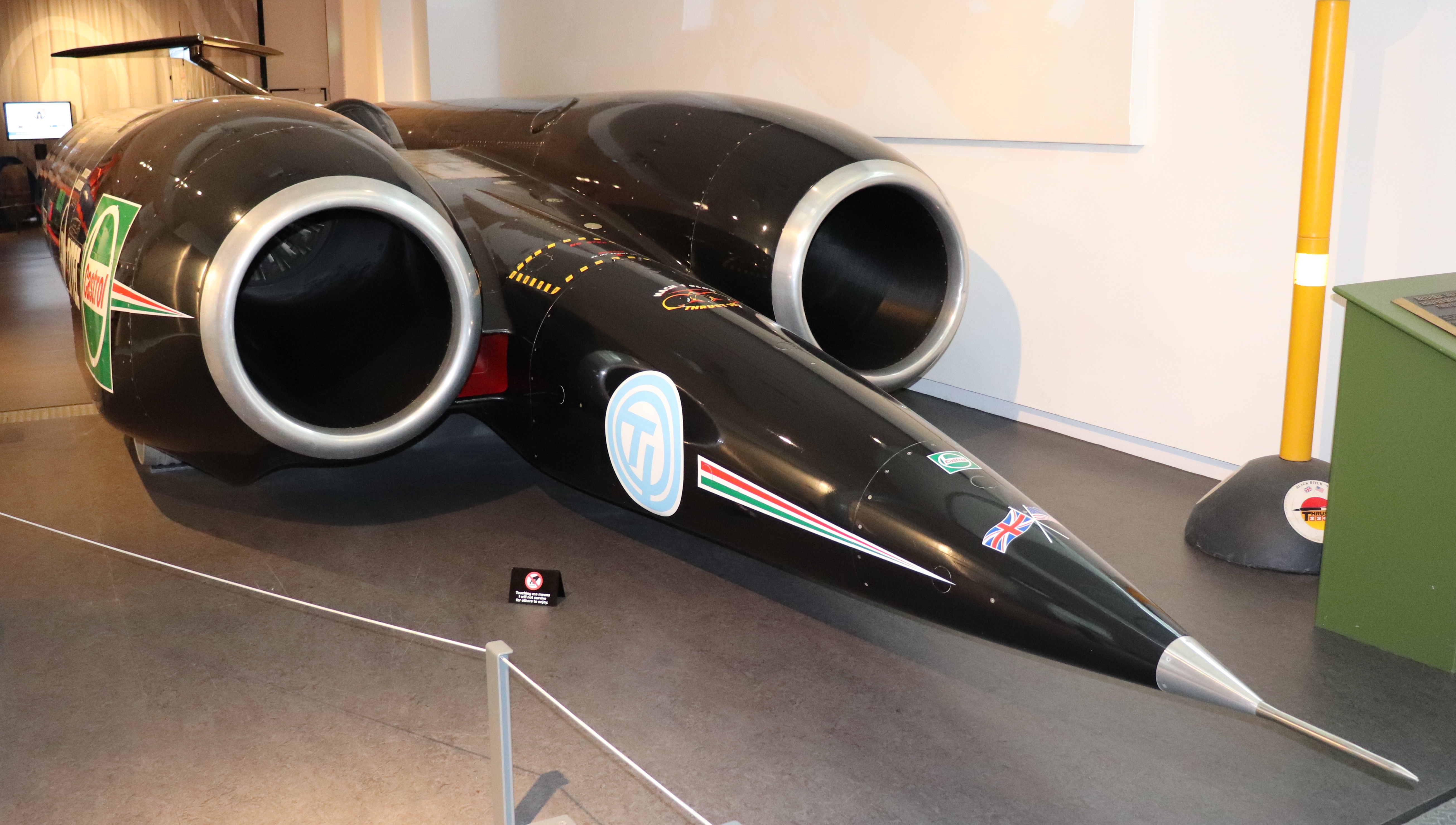
"...we've talked about the thrust SSC and the land speed record attempts, and we'll probably talk many more times about stuff like that."
A land speed record is the fastest speed a car has ever gone on land. People try to break this record by driving on flat areas like salt flats where they can go really fast without obstacles.
A land speed record is the highest speed achieved by a vehicle on land, typically measured over a specific distance. These records are often pursued on flat surfaces like salt flats, where conditions are optimal for high-speed runs.
"...we've talked about the thrust SSC and the land speed record attempts, and we'll probably talk many more times about stuff like that."
Thrust SSC is a special car built to go really fast on land. It holds the record for the fastest speed ever reached on land, going over 763 miles per hour.
Thrust SSC is a British jet-propelled car that holds the world record for the fastest land speed, achieving over 763 mph in 1997. It was designed specifically for breaking the land speed record.
"...I believe it's a quarter mile, and then another at a half a mile, and then they give them the final mile speed."
The quarter mile is a distance of 1,320 feet that cars race to see how fast they can go. It's a popular way to test how quickly a car can accelerate.
The quarter mile is a common distance used in drag racing to measure a car's acceleration and speed. It is a standard benchmark for performance testing, allowing comparisons between different vehicles.
"...even the quarter mile speeds are about what you would expect from a dragster."
A dragster is a car made for racing in a straight line as fast as possible, usually over a quarter mile. They are built to go really fast in a short amount of time.
A dragster is a specialized type of car designed specifically for drag racing, which involves short, straight-line races over a quarter mile distance. These cars are built for maximum acceleration and speed.
"...between the quarter mile and the half mile, I look at it as the first quarter mile..."
The half mile is a distance of 2,640 feet that racers sometimes use to see how fast their cars can go. It's longer than the quarter mile, so cars can reach higher speeds.
The half mile is another distance used in racing, measuring 2,640 feet. It is often used to evaluate a car's performance over a longer stretch than the quarter mile, allowing for higher speeds to be reached.
"...from whether it be Bugatti, or Lamborghini, or whoever is running the air Ferrari, or any of those that run with these top-end speed records..."
Bugatti is a brand that makes very fast and expensive cars, famous for their speed and luxury.
Bugatti is a luxury automobile manufacturer known for producing high-performance hypercars, including the Veyron and Chiron, which have set numerous speed records.
"...or Lamborghini, or whoever is running the air Ferrari, or any of those that run with these top-end speed records..."
Lamborghini is a car brand that makes very fast and flashy sports cars, often seen as a symbol of luxury and performance.
Lamborghini is an Italian manufacturer of high-performance sports cars, known for their aggressive styling and powerful engines, such as the Aventador and Huracán.
"The world's fastest accelerating modified road car, 0 to 60 miles per hour and 1.797."
0 to 60 miles per hour means how fast a car can go from a complete stop to 60 miles an hour. It's a way to see how quickly a car can speed up.
0 to 60 miles per hour is a common performance metric used to measure how quickly a vehicle can accelerate from a complete stop to 60 mph. It's often used to compare the acceleration capabilities of different cars.
"It kind of makes sense for electric, I guess, to be the fastest because it has instant torque. Every bit of the torque is available, the second you push that accelerator."
Instant torque means that electric cars can get power right away when you press the gas pedal, making them feel very quick compared to traditional cars.
Instant torque refers to the immediate availability of torque from an electric motor as soon as the accelerator is pressed. This characteristic allows electric vehicles to accelerate quickly and smoothly without delay.
"However, I'm going to have the surprise that they're measuring 0 to 60 speed. That must be just kind of their own thing."
0 to 60 speed tells you how fast a car can go from a complete stop to 60 miles per hour. It's a way to see how quick a car is.
0 to 60 speed is a common performance metric used to measure how quickly a vehicle can accelerate from a complete stop to 60 miles per hour. It's often used to compare the acceleration capabilities of different cars.
"But the top, I think I know which one you're talking about, this is an older car that they've retrofitted with electric cars. This is a 60's model Mustang. A 68."
The Mustang is a famous car made by Ford, known for its sporty look and powerful engine. The 1968 model is a classic version that many people love and sometimes update with new technology.
The Ford Mustang is a classic American muscle car that was first introduced in 1964. The 1968 model is part of the first generation, known for its iconic design and performance. It's often modified or retrofitted for modern technologies, including electric powertrains.
"...that one actually has the electric vehicle speed record in the Texas mile at 178 miles per hour. And it did that back in March of 2015 and it hasn't been beaten since."
An electric vehicle speed record is the fastest speed that an electric car has reached over a certain distance. It shows how fast electric cars can go and how they are improving over time.
The electric vehicle speed record refers to the highest speed achieved by an electric vehicle over a specific distance, in this case, the Texas mile. This record showcases advancements in electric vehicle technology and performance.
"...this bike at the time that he was riding had something like 650 horsepower on a motorcycle. It's a high booster and they call it a conventional motorcycle..."
Horsepower is a way to measure how powerful an engine is. The higher the horsepower, the faster and stronger the vehicle can be.
Horsepower is a unit of measurement for power, commonly used to describe the power output of engines, including those in cars and motorcycles. In this context, it indicates the performance capability of the motorcycle being discussed.
"...however, when you look at it, I mean, it's modified because it did have a turbo did have panels put on it..."
A turbo is a part that helps an engine get more air, which makes it more powerful. It can help a motorcycle or car go faster than it normally would.
A turbo, or turbocharger, is a device that forces more air into the engine's combustion chamber, allowing it to burn more fuel and produce more power. This modification can significantly increase the performance of a vehicle.
"So what happened? Well, a Ford GT broke the 300 mile per hour mark at the Texas Smi..."
The Ford GT is a super-fast sports car made by Ford, designed for speed and performance. It's famous for its cool looks and powerful engine, and it recently made headlines by going over 300 miles per hour, which is incredibly fast for any car. People talk about it because it's a symbol of what modern cars can achieve in terms of speed and technology.
The Ford GT is a high-performance sports car that pays homage to the iconic Ford GT40 from the 1960s. Known for its sleek design and advanced engineering, the GT is significant in the automotive world for its racing pedigree and cutting-edge technology, including a powerful twin-turbo V6 engine. The recent achievement of breaking the 300 mph mark highlights its exceptional performance capabilities and engineering excellence.
"Anyways, the company's name is M2K Motorsports. And the car itself is a, is a first generate..."
M2K Motorsports is a company that works with cars, often improving their performance for racing or other purposes.
M2K Motorsports is a company that specializes in automotive performance and motorsports. They may offer services like tuning, modifications, and racing support.
"It's not designed from the ground up to go fast, it was built upon an already existing car. The engine block is I think a stock engine block as well. All that stuff to me is cool because it's not completely custom."
A modified car is a car that has been changed from how it was originally made. People often do this to make the car faster or look different.
A modified car is one that has been altered from its original factory specifications, often to enhance performance, aesthetics, or both. Modifications can include changes to the engine, suspension, body, and more.
"...the production car that did 300 miles an hour."
Going 300 miles an hour means the car is incredibly fast, much faster than most cars you see on the road.
Reaching 300 miles an hour is a significant milestone in automotive performance, showcasing extreme engineering and design capabilities in production cars.
"I don't know what, I'm going to spitball here. I'm not going to even begin to know the actual number, but let's say that the car was designed to go 190 miles per hour. That was the top speed and that's what they thought would be maximum on this."
Top speed is the fastest a car can go. It's an important number that shows how powerful a car is.
Top speed is the maximum speed a vehicle can achieve under optimal conditions. It is an important performance metric for cars, often highlighted in specifications.
"They didn't test the aerodynamics beyond that for this thing to take off in the air at a certain speed. That's what happens. When you mess around with the aerodynamics of a vehicle, it becomes a wing and you become airborne at a certain point."
Aerodynamics is about how air moves around things like cars. Good aerodynamics helps cars go faster and use less fuel by reducing wind resistance.
Aerodynamics refers to the study of how air interacts with moving objects, particularly vehicles. It plays a crucial role in vehicle design, affecting speed, fuel efficiency, and stability.
"There's so much that goes into these cars and the modifications that they have to make in order to do this."
Modifications are changes made to a car to make it better or different. This can mean adding new parts or changing how it looks.
Modifications refer to changes made to a vehicle to enhance its performance, appearance, or functionality. This can include upgrades to the engine, suspension, or bodywork.
"the MK2 Motorsports prepped Ford GT retains the stock 5.4 liter V8 from the previous generation Ford GT."
A 5.4 liter V8 is a powerful engine with eight cylinders that helps the car go fast. It's larger than many other engines, which gives it more strength.
The 5.4 liter V8 is a type of engine configuration that features eight cylinders arranged in a V shape, with a displacement of 5.4 liters. This engine is known for its power and performance in sports cars.
"We've all seen those dyno videos of cars breaking the straps, or breaking the chains, and just cataclysmic failures that happen."
Dyno videos are recordings of cars being tested on a machine that measures how much power they produce. Sometimes, these tests can go wrong and cause the car to break parts, which is why they can be exciting to watch.
Dyno videos showcase the performance of cars on a dynamometer, which measures power output and torque. These videos often highlight the limits of a vehicle's capabilities, sometimes resulting in dramatic failures when the car exceeds its power limits.
"...they were X-rayed before they even put them on the car in order to make sure they're free of imperfections."
An X-ray is a way to see inside things without opening them up. In this case, it's used to check tires for any problems before putting them on a car.
X-ray technology is used in various industries, including automotive, to inspect materials for internal flaws without damaging them. In this context, it is used to ensure tires are free of imperfections before installation.
Select text to request an explanation
This is an I Heart Podcast.
Guaranteed Human.
Hear that?
That's what it sounds like when you plant more trees
than you harvest.
Work done by thousands of working forest professionals
like Adam, a district forest manager
who works to protect our forests from fires.
Keeping the forest fire resistant,
synonymous with keeping the forest healthy
and we do that through planning more than we harvest
and mitigate those risks through active management.
It's a long-term commitment.
Visit workingforestinitiative.com to learn more.
With Black Friday's savings at the Home Depot,
you can get up to $1,400 off
plus get free delivery on select appliances like LG,
America's most reliable line of appliances.
Check out the newest LG refrigerator
with new mini-craft dice straight from the dispenser.
Shop Black Friday's savings on select LG appliances
plus get free delivery now at the Home Depot.
Free delivery on appliance purchases of $396 or more
offer about $11,5 through $12,3 US only see story online for details.
And Doug, here we have the Lemo Emu
in its natural habitat, helping people
customize their car insurance and save hundreds
with Liberty Mutual.
Fascinating.
It's accompanied by his natural ally, Doug.
Lemo, is that guy with the binoculars watching us?
Cut the camera, they see us.
Only pay for what you need at LibertyMutual.com.
Liberty Liberty Liberty Liberty Liberty.
Savings very underwritten by Liberty Mutual Insurance Company,
and affiliates excludes Massachusetts.
Welcome to Car Stuff, a production of I Heart Radio.
I welcome to Car Stuff on your host, Scott Benjamin.
And I am Kurt Garren.
Well, we've got one today that I think is going to peak your interest
and hopefully the interest of a lot of our listeners as well.
We're going to talk about a very specific event.
It's kind of, I think, it's one of a kind.
I've never heard of an event like this,
any other place in the world, really.
It's different than a drag race, but it's called
the Texas Mile, and it has a lot of similarities to a drag race.
But this is a unique competition of speed.
And it's worthwhile for us to dig into this.
And I do want to tell you, Kurt,
just so that you're not taken off guard by this.
But we have done a previous episode of this,
this archive goes back all the way to 2008.
And back in August of 2012,
we did an episode that really was kind of the ins and outs
of the Texas Mile, and kind of what it's all about
and where it was and everything.
And the record holders that were the current record holders
and how some strategies, I guess,
to get the best time and whatever.
We just had a whole bunch of topics that were we covered in there.
Of course, all of that's changed now since 2012.
And I mean, seven years later,
you can imagine that not only is technology,
grown in leaps and bounds, you know,
since then, you know, the guys building the cars
are learning a lot more and they're growing faster and faster every year.
There's been some notable events that are things,
I guess, events you can call it events, I guess it happened.
And there's even been a change of venue since then.
I mean, just real quick.
And I want, I'll be honest with you,
we're going to jump into the topic a little bit later.
There's a little bit of other stuff that I want to talk to you about
before we start here.
But I want to talk to you just a second about what you,
what's your gut feeling about the Texas mile?
I mean, just like a general,
when you first heard about this,
initially I compared it to a drag race.
But as I looked into it a little bit more,
I drew vast differences between this particular type of racing
and a drag race.
First of all, it's a time trial type setup.
It's not, two cars aren't competing against each other.
It's more like a qualifying event
and a drag race would be more than a head-to-head race.
But what, I mean, we'll get to the specifics of that.
But getting to specifically what you thought when you first saw
maybe a car going, I'm going to say,
above 200 miles per hour, that's not the record, by the way.
We'll tell you what the record is later in the show.
But let's see, the first time you saw a car
achieved 200 miles per hour in one mile from a standing still.
I mean, it's crazy, isn't it?
Yeah, it is crazy.
I'm used to seeing drag races in a quarter mile,
very different types of cars.
It's not over in a few seconds,
so there's a lot of factors that come into play.
Cooling is one of them.
We saw some interesting cooling tactics, didn't we?
Yeah, normally they would cool the car with air flowing
through holes in the car.
That's not the way to go fast.
You want to make the car as slick as possible,
so there's other techniques that they use to cool the engines down.
That's a good way to put it.
I like how you said that because you can't have a ton of openings
and vents, and I guess full face of a vehicle that you normally would have.
You're trying to minimize that because these are modified cars
that we'll talk about.
And there are different tactics that these racers employ
to go and do what they do on these,
well, it's two weekends a year.
And again, all of this we're going to get to, I promise,
because the Texas smile is definitely an interesting and unique event
in a lot of ways.
And you can see my notes are crazy again today.
I have a pile of notes in front of me
and for new listeners or listeners that aren't familiar
with my note system, I'm very analog.
Before we begin.
I've got a kind of a banged up front bumper on my car
and it's got a crack in it right now.
So I'm looking to do something that's called,
this is the term I've seen used for it,
called the drifter's, I think it's called the drifter's stitch.
Is that was zip ties?
It is.
Okay, I've seen that before.
Okay, yeah.
And you know what, it's surprisingly easy to do
and surprisingly holds really well.
I've done it already on this repair just in a minor way,
but I did it in a very, not half hazard.
I mean, it looks good.
You can't even see them hardly.
That's there.
It makes the crack and the bumper disappear really.
It holds everything together.
It's just, you drill a couple holes on each side of the crack
and then run a zip tie through and you do that a couple of times.
It looks like stitches that you would put in somebody's body.
Head, arms, wherever.
You get a cut.
It's a lot like that.
Oh, my voice cracked there.
That's kind of funny.
Yeah, like anybody would go and get stitches at the doctor.
It's very similar for your bumper and it's a low cost,
easy way to do repair.
I mean, you know, I guess it depends on the color of the vehicle.
I've got a dark, dark blue vehicle, so I'm using black zip ties.
And you know, the wound in the bumper pretty much disappears.
It's really nice.
And I think I need, maybe at the most like two more stitches
to make this whole thing work.
How many are in there at the moment?
Right now I've got three.
Three.
Three.
And I need two more.
I've just discovered that the supporting structure behind it
was jostled just enough that it's not quite holding up in the corner.
So I need to add some to the corners.
I know this is all very specific to me and my car.
But I wonder if anybody else out there has either done this drifter's stitch
or has heard of it or anything like that.
If you haven't looked at it online, you look at some photos online.
And you'll see some good versions of it, some bad versions of it.
It looks kind of neat.
It looks like a Frankenstein kind of repair made to a car.
But it works in a pinch and it definitely is not going to cost you a whole lot of money.
It makes a huge improvement in the way the car looks after a minor incident.
I've had a minor incident in my car.
They employ this technique a lot of north, I believe.
Oh, is that right?
Yeah.
What do you mean?
Well, that's where I've seen it.
Okay.
Like where?
Boston.
It snows a lot there.
So maybe you hit things a little more often.
The one I saw last was I didn't count.
But it looked about like 40 stitches in the corner of a bumper.
That's impressive.
Yeah.
No dent.
It was just a straight crack.
Mm-hmm.
It's weird.
It's about 40 zip ties holding it.
It almost looks like a decal that somebody's put on the car doesn't it?
I had to look close to appreciate it completely.
Yeah.
Yeah, that's interesting.
And that's a great theory behind why maybe you would see this more in the north.
I guess that's true.
I can't go get a new bumper every time you need a little something.
So what happened Scott?
What happened?
What happened?
You want to tell us the story?
Or is it too painful?
I will tell you.
You know what?
Yeah.
I had a little incident here in the office area in the parking structure.
Bumped a wall.
Just a kind of column or was it one of the columns?
Oh, now you're going to make me tell the whole story.
No, I'm not going to.
No, it wasn't.
It wasn't a column.
No, it was one of the ramps.
But anyways.
There's so much damage on those columns down there.
And I'm wondering who's doing it all.
Because that was a first for me and hopefully, hopefully now it's been the last.
But okay.
To me, this is like, this is really personally upsetting because I try to keep them looking
almost new inside and outside as long as I can.
And I've been pretty successful with it my whole life.
This little minor incident with the front is really, really upsetting to me.
And I, you know, I know you can take it to the body shop and just have it be done with
it, but it's expensive.
I don't know.
Maybe it's too much inside baseball about my own vehicle, but I think a lot of people
find themselves in the same position and look into that, you know, that drifter's stitch
if you want to for a simple answer or an inexpensive answer.
Yeah.
Maybe try it yourself.
Yeah.
It's an option.
Maybe you could even practice on, you know, a junkyard bumper or something if you want
it to, but it's very easy to do, very, very simple to do.
And a lot less money than taking it to a body shop.
A lot less.
Yeah, okay.
Well, listen, I probably have wasted more than enough time.
I think maybe it would be a good time to take a break and we can come back.
And then finally, begin our talk about the Texas smile.
There's nothing like sinking into luxury.
Anabay sofa's combine ultimate comfort and design at an affordable price.
Anabay has designed the only fully machine washable sofa from top to bottom.
The stain-resistant performance fabric slip covers and cloud-like frame duvet can go
straight into your wash, perfect for anyone with kids, pets or anyone who loves an easy
to clean, spotless sofa.
With a modular design and changeable slip covers, you can customize your sofa to fit any
space and style, whether you need a single chair, love seat or a luxuriously large sectional.
Anabay has you covered.
Visit washablesofas.com to upgrade your home.
Sofa started just $699 and right now, get early access to Black Friday savings, up to
60% off store-wide with a 30-day money-back guarantee.
Shop now at washablesofas.com, add a little to your life.
Offers are subject to change and certain restrictions may apply.
And Doug, here we have the Lemo Emu in its natural habitat, helping people customize their
car insurance and save hundreds with Liberty Mutual.
Fascinating, it's accompanied by his natural ally, Doug.
Uh, Lemu, is that guy with the binoculars watching us?
Cut the camera, they see us.
Only pay for what you need at LibertyMutual.com.
Liberty, Liberty, Liberty, Liberty, Liberty.
Saving's very underwritten by Liberty Mutual insurance company and affiliates excludes Massachusetts.
Hear that?
That's what it sounds like when you plant more trees than you harvest.
Work done by thousands of working forest professionals like Adam, a district forest manager who works
to protect our forests from fires.
Keeping the forest fire resistant, synonymous with keeping the forest healthy, and we do
that through planning more than we harvest, and mitigate those risks through active management.
It's a long-term commitment.
Visit workingforestinitiative.com to learn more.
And we're back, and then your host Scott Benjamin, and across from me, is Kurt Garin, how
you doing, Kurt?
I'm doing well, Scott.
How are you?
Still hanging in there, huh?
Okay, good.
I'm going to keep checking in with you just to make sure I'm still here.
Until finally, you know, one day I'm going to say, you know, I'm your host Scott Benjamin
and one day you're going to say-
I'm just going to jump right in.
You're going to be like, and I'm Kurt Garin and today's a beautiful day or whatever
I don't know.
Something like that.
It is.
It's a real beautiful out there.
It actually is.
It's a really nice day.
You know what?
Now that we're talking about beautiful days, I guess we probably should mention that it
will probably be a beautiful day in late October in Texas, just guessing, when they are running
the next edition of the Texas smile.
This is an event that runs twice a year.
They run it in March, which is no problem for them.
There's going to be no snow, of course.
You might have rain issues.
I don't know if they ever have or not.
And then there's another one in October.
So it's run twice a year every year and this year they are running it at a new place.
Actually they have for a couple of years now called the Victoria Regional Airport in
Victoria, Texas.
And they've completed this race since-
And I keep calling it a race.
I don't mean to do that.
It's- we should just say event, maybe.
And just call it an event or-
To speed event.
Yeah, and it's weird.
They call it-
Here's the funny thing is they put it in the genre of auto show.
And it's not an auto show by any means.
I don't know why they did that, but I see it more as like a contest or even-
A test of your vehicle or an exhibition.
An exhibition of speed, maybe.
Yeah.
A proving ground.
Yeah, I think a lot of people do look at it as a test event.
Yeah, sure.
I think that's how they view it.
I mean, it's a chance for them to go out and just show what they can do, show what they
can put together.
It's not a show in the traditional sense where you walk around the car and peek in and
look at the interior, but you can see it run down the track.
Which is nice.
Yeah.
I mean, it's nice to be able to do that because a lot of times you don't see cars in motion.
You go to a car show and you see all these fantastic vehicles, but they're all parked.
Yeah.
You might get to hear them start off or watch them pull onto a trailer or something
like that.
But this is one where you get to go and see them actually run.
It's like, you know, going to the drag races, like where it's amateur and pro and you know,
it's kind of a big mix.
And yeah, I guess any day at the track really, but you don't get quite as up close and personal
when you're at the typical race track, unless you spring for the optional pit pass and,
you know, get to go and walk around the vehicles and get a little more hands on or
not hands on, but just, you know, closer to them and talk to people.
Let's just kind of go through some real simple basics of this whole thing.
And then we'll move on to some specifics because there's some interesting specifics,
I guess.
Most notable change, I guess, is the change in venue.
I mean, this is its third home since 2003.
It's been run since 2003.
It began in a place called Goliad, Texas.
Goliad, and I looked up how to pronounce Goliad, that's, that's correct.
Goliad, it was ran there until about, I think, March of 2011.
So it ran there for a good long time around eight years.
The funny thing about this is that it started with only about 35 people, it was, began
by a couple out of the Houston, Texas area, a guy named Jay Mattis and his wife, Sharon
Mattis.
And they had a company I think that they called JNS Mattis Motorsports Incorporated.
And I'm sure that that's still around, I think, I think it is in some way.
Of course, a couple still, still around there, they're still running this thing.
It started, again, 35 participants and almost no spectators because no one really knew
about the event.
It wasn't how, you know, heavily promoted it.
I guess the people that participated probably told friends, maybe, and that was about it.
But very few people showed up to that.
It's a lot different today, I mean, they've changed venues three times.
The second move after they went from Goliad, they went to, the town's name is Beville, Texas
and the, the forum or the, the actual venue is Chase Field Industrial Complex.
Then they finally relocated just in 2017 to the new place that they're running, which
is the Victoria Regional Airport, which is in Victoria, Texas.
Now these are all kind of around the Houston area, which makes sense, you know, from where
the couple began.
And they don't want to move it too far, I guess, because it's, you know, it's a, it's
a regional specialty event.
But these number of spectators has gone up immensely from this.
The number of participants has gone up incredibly from, from the first days, just to, it's become
a huge, huge thing.
It's one of the only places you can go and enter your car and test it out in an event like
this.
Of course, there's regional drag strips that you can go to every Thursday night or whatever
and see what you can do.
But to get on a mile in a straight line, have professional timing equipment and medical
staff and just everything there for you to do this, it's, it's rare that you find out.
How much is it to, to sign up?
You know, I was looking at number.
I, I mean, my average person can't do it anymore.
Well, I don't know.
I mean, I wouldn't be so sure for an event like this, because it's, it was like they
try to keep it somewhat open at least.
Well, let me just, I'm just going to just let it out here.
I, why not?
Why hold back on this?
But here's a, here's a, just an idea of what you're paying for these.
You know, it's not, it's not a high dollar event like you would think.
I'm looking right now at some information that came from the Texas Mile website, which is
TexasMile.net.
So if you want to go there and, and look up all this information, you can, but just to get
an idea of how low dollar this whole thing is tickets for, it's a three day event.
It's a whole weekend.
If you're a, I mean, just a spectator, $25 per person for all three days.
You just get a wristband for $25.
It gets you in for three days of activities.
And now that you can, even if you, if you wanted to, you could stay on site, you can camp
there, I guess, on the, on the, on the property, which is really cool for a very low price.
I mean, I know it sounds, well, just compare this to renting a hotel room, but one night is
only 60 bucks.
If you want to, you want to stay two nights is 120, three nights is $160.
And that's if you want to set up, you know, a motor home or a camper on site and stay there.
I don't know if they allow tents, the, you know, the information wasn't specific about
that.
You can contact them and find out.
And I'm not trying to sell tickets for them or anything like that.
I promise.
But it says they do not sell out of tickets, but I guess they, they never run out.
But the number of spectators here, and, you know, oh, I should say that kids under 12
are free.
So that's a bonus too.
And I think that they're, yeah, so $25 or free is really the price point for something
like this.
I don't know what the registration is for the drivers.
It can't be a whole lot of money.
There's, there's shaded seating, there's bleachers, but they say you probably should bring
a folding chair if you want to just kind of hang out and, you know, one of the grassy areas
and watch and catch everything because it is a long day.
I mean, they start in the morning early, goes all the way until dusk, I would guess.
You know, it's not sunset, but dusk.
So it's, it seems like a good mix of cars to a good mix of shops that are really into
the speed.
And then just average folks with nice cars, I just want to go out there and run the mile.
There's a healthy mix of both amateur and I would call them professional, like these people
that do the high speed runs are professional race shops, professional engineers.
Absolutely.
They're in shops, building cars to specifically run in this event.
And we're going to talk about one car and specific that's what was built.
The record holder, of course, we'll get to that later in the podcast to promise, gosh,
I'm all over the place.
I apologize curtain and listeners because I'm just skipping all over the place.
But I feel like there's just, there actually is a lot of new information.
You know, the spectators and the number of, of entrances is something we should talk
about because I just kind of breathed over that a moment ago.
And I said, you know, back in 2003 and Goliad, they had 35 participants and almost no
spectators.
There are very few people there outside of the timing individuals and, you know, the staff
that operates it and the participants.
There were very few people there outside of that.
Well, now as of 2018 or at the 2018 event, I think it was the March event.
They had something like 2600 spectators at this thing.
So it's really grown in popularity.
I can only assume that it will go up with social media, you know, reach and all that, you
know, that they're kind of able to garner more attention from this community and from,
you know, people that are interested in this sort of thing and not just from the United
States, but everywhere.
People come from, you know, from Mexico, from Canada, from Saudi Arabia, from France, they're
from all over the world now participating in this thing, which is really cool.
And the number of participants, they went from 35 again in 2003.
It's climbed steadily.
Now they allow something like 250 or more participants tonight.
One thing about this particular event, when you throw it back to the beginning of spectator
type racing, which I guess goes back to the beginning of the car, the fact that you
can watch these cars do this thing and maybe it's something that you can go and watch with
that hope of maybe one day you can get your car out there and do it.
Unlike going to a professional sports car race or Indie car or NASCAR, you can't really
dream of doing that if you're just the spectator, the fan.
Yeah.
Well, like you said earlier, that this is a nice, healthy mix of people that have built
a car in their garage and want to bring it out and try it.
It could be a really kind of a hot street car that they have just never been able to really
push to the maximum, to the limit.
And it also could be like these shops that specifically build cars for this event, with
the one mile run in mind, and that's the main goal, and that's all they do.
They just do that with that one car, and they might have a customer that comes in and
says, I want to be in this.
Here's my budget.
Here's the car I want to start with.
Here's whatever.
They have lots of sponsors and all that.
It's a lot like professional racing would be for some people, but what you don't see
is you don't see like a Formula One team pull up with their F1 car and run this mile.
You don't see, and honestly, they would probably be beaten by some of the guys that build cars
in their own garage, which is unbelievable to me.
It's such a strange contest, and maybe we should talk about just like, I hope I'm saying
this right way, the right way, but some of the uniqueness of this event, because there's
so many things about it that are different.
First of all, it's a full mile run.
It's not a quarter mile like you would find in a drag strip.
It's not a long distance run either.
It's a full, I guess a mile is a long distance, but you start a standing start.
A standing start, not a rolling start, as the speed record would be, for example, like
the land speed record.
Generally, they want to get up to a certain speed before they start the car.
When we start talking about times, they're not times, rather, because that's another thing
I want to talk about.
But when we start talking about top speeds in this one mile, you've got to remember it's
a car that's going zero miles per hour, the clock starts, as it crosses that one mile
mark, all they're measuring is just the speed, not the time.
That's unique in that if you're going for a top speed run, typically, if you're out
in Utah on the salt flats, or any desert run, or anything like that, we've talked about
the thrust SSC and the land speed record attempts, and we'll probably talk many more times
about stuff like that.
But they have the advantage of having this ramp up, I guess, a long, long run.
It could be miles long to ramp up to the speed.
Then there's a timed mile, and then they have a long way to shut down.
This one is just that mile.
You don't get to start at 180 miles an hour, and then try to get to 250 miles an hour.
If to start at zero and try to get to 250 miles an hour in that short amount of space,
the speeds are measured along the way and displayed to the spectators.
So there's great big boards that have LED readouts that show the speeds.
I believe it's a quarter mile, and then another at a half a mile, and then they give them
the final mile speed.
I don't think they bother with three quarter mile speed.
If they do, I haven't seen it in any of these videos.
But one of the things that strikes me is even the quarter mile speeds are about what you
would expect from a dragster.
You watch the private teams at drag strips, and you get about what you would think out
of that.
That mile speed goes up considerably.
I mean, they're going really, really fast, a lot of them are at this point.
Then you have the mile speed, and what's shocking to me a lot of times is the difference
in speed.
You said this to me off air.
The difference in speed, you would not expect it to jump up so much between the half
mile and the full mile, but it does.
Yeah.
Well, even between the quarter mile and the half mile, I look at it as the first quarter
mile, they try to get the car to hook up, as opposed to drag race, you want it to hook
up right away.
Yeah.
The first quarter mile is getting everything stable, because you're going to start going
much faster, and cars that aren't necessarily designed to go that fast, or at least from
the factory.
No, they're not.
I guess the point I'm getting at is from the half mile to the end, that's when they're
really applying the power and trying to keep everything stable, and just, it's interesting,
how much you could, trying to hook up all that power to the pavement in a half a mile
is interesting to watch that increase and see.
Oh, I agree.
And what we're accustomed to seeing from the production car speeds, when we watch these
record attempts from whether it be Bugatti, or Lamborghini, or whoever is running the
air Ferrari, or any of those that run with these top-end speed records, or KonaSeg, or
any of those.
They get to a certain point in those cars.
They relatively slowly increase speed after about, I think it's like, after, right around
200 miles an hour.
That's when things start to get a little dicey on it.
Yeah, well, especially between like 250 and 300, I mean, super incredible.
Again, watching one of the production cars do it attempted in a very professionally-made
YouTube video that's done in Germany, and again, I'm going to get to it, but we kind of
have already talked about it.
The guy says, and this is the way he put it out paraphrase.
He says, you know, a lot of people or most people will, at some point, be able to achieve
150 miles per hour in their life in a car.
And I don't know about most, but a lot.
And again, this is the guy from, he's a German race car driver, so he probably has a skewed
view of what people can do on that.
Let's say a few people are going to go 150, but then he says, you push it a little bit
more and you go 180 miles an hour, and that's a lot different than going 150 miles an
hour.
So you wouldn't expect it.
He said, if you go from 180 to 200 miles an hour, that's like a whole different world.
He said, like, it's something that you only can get to your experience, like, you don't
know what that feels like until you've done it.
And then he said, once you go from 200 miles an hour to 300 miles an hour, it becomes
like this ridiculous, just, I don't know, just a mess.
Like, it really messes with your head, is what I mean, like, it's not, things aren't
happening when you would normally perceive them to happen.
It's much, much faster and it just doesn't make sense to your brain.
You can't even comprehend what's happening because everything is flying past you at such
a great rate of speed and we're not talking about being in a desert area where these runs
are made, these production car runs are made.
They're made on a track in Germany that has trees near it and guard rails and cameras
and everything all over the place.
And lines on the road, it's a lot different.
You get that real sensation of speed.
Getting back to the Texas mile, it's not just cars because we're just talking about cars
See something that's not quite right? Our annotations are AI-generated and can sometimes miss the mark.
Click the flag icon on any annotation to suggest a correction.