The Texas Mile is a special event where cars race to see how fast they can go over a mile. It's different from drag racing, which is all about quick starts over a shorter distance.
The front bumper is the part of the car at the front that helps protect it in case of a crash. It also makes the car look good and can help with how the car moves through the air.
The drifter's stitch is a way to fix a broken bumper using zip ties. It's a simple and cheap method often used by people who race cars, especially in drifting.
Drag races are competitions where cars race in a straight line to see who can go the fastest. It's a popular type of racing that you can see at events with both beginners and experienced racers.
A pit pass is a special ticket that lets you go into the area where the race cars are worked on. It gives you a chance to see the cars up close and maybe meet the drivers, which is different from just watching the race from far away.
Formula One is a type of car racing where teams race very fast cars on special tracks. It's known for having some of the best drivers and the most advanced car technology.
Car
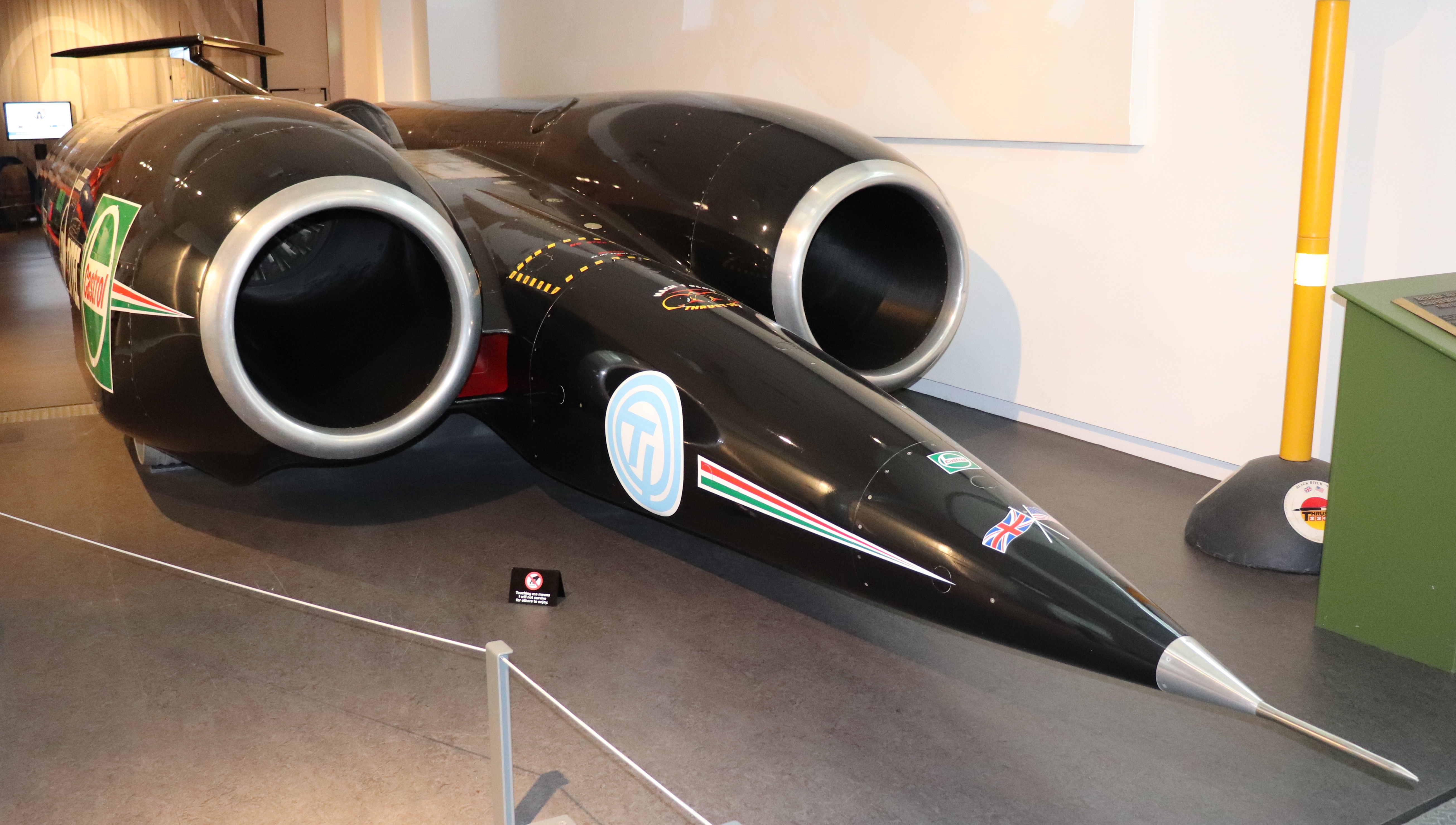
Thrust SSC
Thrust SSC is a special car built to go really fast on land. It holds the record for the fastest speed ever reached on land, going over 763 miles per hour.
A land speed record is the fastest speed a car has ever gone on land. People try to break this record by driving on flat areas like salt flats where they can go really fast without obstacles.
A dragster is a car made for racing in a straight line as fast as possible, usually over a quarter mile. They are built to go really fast in a short amount of time.
The half mile is a distance of 2,640 feet that racers sometimes use to see how fast their cars can go. It's longer than the quarter mile, so cars can reach higher speeds.
Instant torque means that electric cars can get power right away when you press the gas pedal, making them feel very quick compared to traditional cars.
The Mustang is a famous car made by Ford, known for its sporty look and powerful engine. The 1968 model is a classic version that many people love and sometimes update with new technology.
An electric vehicle speed record is the fastest speed that an electric car has reached over a certain distance. It shows how fast electric cars can go and how they are improving over time.
The Ford GT is a super-fast sports car made by Ford, designed for speed and performance. It's famous for its cool looks and powerful engine, and it recently made headlines by going over 300 miles per hour, which is incredibly fast for any car. People talk about it because it's a symbol of what modern cars can achieve in terms of speed and technology.
A 5.4 liter V8 is a powerful engine with eight cylinders that helps the car go fast. It's larger than many other engines, which gives it more strength.
Dyno videos are recordings of cars being tested on a machine that measures how much power they produce. Sometimes, these tests can go wrong and cause the car to break parts, which is why they can be exciting to watch.
come out and do it and electric cars, electric cars, yeah, there's all kinds of categories.
They have this electric car, the fastest, I need to make sure I phrase this right because
I'm sure there's nuance.
Oh, I bet there are yet.
Don't worry about this one.
Don't worry about this one.
The world's fastest accelerating modified road car, 0 to 60 miles per hour and 1.797.
It kind of makes sense for electric, I guess, to be the fastest because it has instant torque.
Every bit of the torque is available, the second you push that accelerator.
However, I'm going to have the surprise that they're measuring 0 to 60 speed.
That must be just kind of their own thing.
Probably, yeah.
But the top, I think I know which one you're talking about, this is an older car that they've
retrofitted with electric cars.
This is a 60's model Mustang.
A 68.
A 68.
Yeah.
That's back.
And they call it the zombie 222.
And I wonder, you know, okay, because they call it the 222, I wonder if that's their goal.
If that's what they're shooting for.
That one actually has the electric vehicle speed record in the Texas mile at 178 miles per
hour.
And it did that back in March of 2015 and it hasn't been beaten since.
178 miles per hour is pretty darn impressive for, think about the aerodynamics of a 68 Mustang
fast back.
Imagine pushing that up to 178 in just one mile.
I mean, that's impressive.
Yeah.
That's the impressive part.
Yeah.
If you had 10 miles, maybe you could get it up to that speed.
Yeah.
You know, you have to have a safe area to do it and all the testing and everything, you
know, to go along with it.
But I think the one mile thing is probably the most important, or the most, I don't know,
the most, yeah, maybe the most important number in this whole thing.
Yeah.
Really?
Did I ever run the Texas kilometer?
I don't think they have, no.
Not in Texas.
You get shot if you even, if you even mentioned the kilometer in Texas, but, you know, we
should, you know, we should say this though.
And I know we've been just doing miles per hour here because we're a US based show.
But I guess for anyone who's interested, the top speed, if you, if you're talking about
going 300 miles per hour, if 300 miles per hour is something like 483 kilometers per hour,
and the distance that we're talking about here would be, if you're doing, you're, you're
getting in a vehicle to 483 kilometers per hour in just 1.6 kilometers of roadway.
If you want to look at it that way.
So it's, those are the types of distances and speeds we're talking about.
If you've been confused by the mile per hour thing or, you know, having to go to your,
your conversion chart and rapidly, you know, punch in numbers before we take a break,
I want to say one more thing.
And I only want to do this because I don't like to end on a sad note.
And I think we should talk about something a little bit sad, well, it was sad, but it's
not breaking news.
I guess it didn't happen just now, something a lot of people probably already know about.
And we'll come back with some happy news in just a moment.
But one of the guys that we talked about in the previous podcast in the car stuff episode
in 2012, we were talking about him just breaking the record, you know, he had, he had just
achieved a record of something like 278.6 miles per hour at the, at the Texas smile.
And he was a current record holder.
He was on a motorcycle.
His name was Bill Warner.
Of course, we were talking about him in the present tense.
He was still around doing what he was doing.
But unfortunately, Bill Warner died not much later.
The very next year in a motorcycle accident, doing, of course, doing what he does and
there what he did, which is a, you know, achieving land speed records.
So he broke the record again.
He broke the 300 mile per hour barrier in 2011 at a different event, I believe.
And then that is when, actually, you know what, that's when we had our podcast right after
the 311.
So we were, you know, owing an eye and about the, you know, getting past 311 miles per
hour on a motorcycle on pavement at that time.
And again, some specifics I can go into in just a second.
But just after that in July of 2013 is when he died, again, not breaking news by any means,
but I think that we need to mention it because of, you know, the focus that we had on him
and the first podcast that we did.
This bike at the time that he was riding had something like 650 horsepower on a motorcycle.
It's a high booster and they call it a conventional motorcycle, you know, where the, the rider's
exposed.
It's a traditional motorcycle, I suppose, however, when you look at it, I mean, it's modified
because it did have a turbo did have panels put on it.
So it's kind of like, I guess a street modified high a booster with, uh, with a turbo, streamline
a record is a lot faster.
It's like another 70, 80 miles an hour faster than this.
So, you know, once you enclosed the rider becomes much more aerodynamic.
He was in an open bike and again, he passed away.
I believe it was in, yeah, July of 2013 and it was well he was trying to break, um, break
a record in, I think he was in Maine, only 44 years old, but we've heard of land speed record
people.
That's how they die.
They kind of know the, the risks and the, the dangers involved in that and they accept
that.
And I'm sorry to hear that, you know, he passed, but I figured we should just mention it,
you know, that that's somebody who we've lost along the way.
I want to get into some happier news.
So let's, uh, let's, let's finish up by talking about the current record holder at
the Texas smile in just a minute after we take a break.
Tired of spills and stains on your sofa?
Wash away your worries with Anabay.
Anabay is the only machine washable sofa inside and out.
Where designer quality meets budget-friendly prices.
That's right.
The sofa started just $699.
Enjoy a no-risk experience with pet-friendly, stain-resistant and changeable slip covers made
with performance fabric.
Experience cloud-like comfort with high-resilience foam that's hypoallergenic and never needs
fluffing.
The sturdy steel frame ensures longevity and the modular pieces can be rearranged any
time.
Shop washablesofas.com for early Black Friday savings up to 60% off sight-wide, backed
by a 30-day satisfaction guarantee.
If you're not absolutely in love, send it back for a full refund.
No return shipping or restocking fees.
Every penny back.
Up right now at washablesofas.com.
Offers are subject to change and certain restrictions may apply.
And, Doug, here we have the Lemo Emo in its natural habitat helping people customize
their car insurance and save hundreds with Liberty Mutual.
Fascinating.
It's accompanied by his natural ally, Doug.
Uh, Lemo?
Is that guy with the binoculars watching us?
Cut the camera.
They see us.
Only pay for what you need at LibertyMutual.com.
Liberty Liberty Liberty Liberty Liberty Liberty.
Savings vary.
Underwritten by Liberty Mutual Insurance Company and affiliates excludes Massachusetts.
Hear that?
That's what it sounds like when you plant more trees than you harvest.
Worked on by thousands of working forest professionals, like Adam, a district forest manager
who works to protect our forests from fires.
Keeping the forest fire resistant, synonymous with keeping the forest healthy, and we do that
through planning more than we harvest, and mitigate those risks through active management.
It's a long-term commitment.
Visit WorkingForestInitiative.com to learn more.
We're back, and I'm your host, Scott Benjamin.
And I am Kurt Garin.
Oh, you got a Kurt.
Great.
You called me off guard a little bit, but I'll jump in there real quick.
I had to run over to the mic from the computer.
Y'all there couldn't see that.
Fantastic.
Well, you're quick.
Quick on your feet.
Exactly.
Good work.
Good work.
I did me to catch you off guard.
Faster than this 4GT we're about to talk about.
Oh, yeah.
Maybe.
Right.
All right.
So here's the deal.
All right.
The current record was just broken recently.
Now, this is, we're doing this podcast in 2019.
We are in between events in 2019.
So there's already been the March of 2019 event,
and there's going to be the October of 2019 event.
We're doing this in September, so right before this.
And it's always the last week in March and the last week
in the October.
Yeah.
So if you want to plan for it in your schedules,
or you want to look up, you know, maybe a time
when you can travel down to the Houston area,
and maybe catch this thing live, definitely do that.
I mean, it's a worthwhile thing, and you can go to, you know,
I'll give you the website so you can go and look at it.
What was it?
Texas, Texas Smile.net.
Yeah, Texas Smile.net was the site.
So check that out if you want to.
Again, we're not selling tickets or anything.
So it's just an awesome event.
Yeah.
Do it.
Go see it if you're in Texas.
Hey, do it if you want to.
I don't care either way.
I don't care either way if you go.
Yeah.
I mean, I don't mean to be flipping about it,
but I don't care.
Yeah.
You'd like to go.
I personally would love to be there and witness one
of these because I think it just, it's just awesome.
I would have loved to have been there last March to see this.
Yes.
Okay.
So last March, something incredible happened, right?
Right.
Okay.
So what happened?
Well, a Ford GT broke the 300 mile per hour mark at the Texas Smile, 300 miles per hour.
Now, it's three, I think the actual record, I mean, just, it's just barely above it.
It's 300.4.
Yeah.
Okay.
300.4.
And I know that's nitpicky, but when you get to those speeds, that's going to be important.
Right.
It matters.
And 300.5 next year, and that will matter.
299.9 is not 300.
That's how it is?
This is a current record that's held at the Texas, Texas, Texas Mile, and it's by a company
that built this car specifically for a customer that wanted to do this or for themselves.
I don't know if it's in the cells or customer, not sure, but the, yeah, the focus has always
been on the company.
Anyways, the company's name is M2K Motorsports.
And the car itself is a, is a first generate, I shouldn't say first, it's a version of the,
the GT, the Ford GT that was put out back in the mid 2000s.
So it's a 2006 Ford GT, not the current one, not the, not the, you know, $400,000 one.
It had a Gulf livery, which I think is really cool, you know, the blue and orange.
The number on the car is significant.
You know, the number on the car just by the number on the car that they ran this year
is 293, 293 was their previous record that they had made back in, I want to say it was
2017.
Yeah, it was 2017.
So 2017 is when they ran 293 miles per hour and they were thinking like, oh, we are so
close to this.
We're really, really close to this.
And I saw an interview that was done by the owner of this company on a local channel.
It was, it was done on KPRC.
They interviewed the owner of the shop and he said, you know, back when we started this
whole project, the goal was something like 235 miles an hour.
That was like the record and that's what they wanted to beat.
They wanted to go 235.
He said 300 miles per hour is, it was never even a dream at that point.
But as the years progressed, they decided that we've got to keep up with, you know, exactly
what's going on and, and, and keep up the speed with the current records.
And, and we tune this and tweak that and, you know, reengineered this part and make
this a little more dynamic underneath the car or, you know, whatever, they did a lot of
work on the vehicle.
I know I'm just paraphrasing this in a horrible way, simplifying what they did exactly.
But they brought the car back just two years later and they ended up topping 300 miles
per hour.
And they did it in a series of, of several runs.
And I kind of see it as, as I think that Texas mile people have confirmed, these were
kind of like, shake down runs for them.
They knew that they could get close to 300 or 300.
They were hoping for it.
Of course, big celebration when they did hit it, but the early runs were nowhere near
that speed.
The, the early runs were relatively low speed and, and of course, they weren't sandbagging
because there's nothing, nothing to be gained from that.
But over the course of a three day weekend, you know, they ran and I think I want to say
it was four runs.
The first run was something like 175 miles per hour, somewhere near there.
The second run, they really, they, they, they amped it up at this point 240 miles per
hour in the next run.
And that puts them already in an elite group, I guess, because the 200 mile per hour club
is a big deal.
Texas mile.
If you can get your car to go 200 miles per hour, that's, that's pretty impressive.
By any standard, really.
I mean, I think that's cool.
So they're already in that, and they had been before with their 293 or whatever.
The next run, they say the third and final run, but I think there was a fourth run.
I think there was another one stuffed in there somewhere that, you know, maybe didn't
go so well that they didn't even report.
The third and final run, which they're claiming is a third and final run, was the one
that they reached, they finally reached the 300.4 mile per hour mark.
And I'll tell you this.
I learned this along the way, and this is so impressive to me.
You know, we talked about the difference between quarter mile, half mile and full mile.
At the half mile mark on the 300 mile per hour run, they were already going 240 miles per
hour in a half mile.
So that's incredibly fast already.
They're already topping, you know, what a lot of cars do in the full mile at the half
mile.
And then not only that, they gained 60 miles per hour in between the half mile and the
full mile.
And to gain that, I'll tell you in just a minute why that isn't so impressive to me.
But to gain 60 miles per hour in that relatively short amount of space, and I know that time
doesn't come into this, but we're only talking about a run that, you know, from beginning
to end is like maybe 22 seconds, 21 seconds somewhere around there.
That's the full length of time it takes them to go one full mile.
So really, really impressive.
I mean, it's just unbelievable that they were able to do that, but again, it took them
two years of engineering and refining and changing things around to be able to get that
extra seven miles per hour out of this vehicle.
And you know, they were just working at it all the time, you know, trying to really amp
this thing up to get it to that 300 mile per hour mark, because that's a huge milestone
for them.
They're always going to be in their record books as breaking that and doing that.
So that's kind of infamy for them, I suppose.
And one interesting thing to me is that it isn't necessary, I mean, it's a race car, but
it's not necessarily a purpose built dragster type car.
No.
It's a say standard 2006 4GT.
Yeah.
If you can call it standard, right?
Right.
Right.
It's a car's body itself is not engineered like a dragster would, for example, it's a road
going car.
And so therefore it has these built in limitations to overcome such as holes for the production
car would have for cooling and things like that.
Yeah.
And tire width.
I don't know if they mess with anything like that.
I think that they had to.
I want to tell you just a little bit more about the car itself, you know, about the
engine and just a tiny bit more, because I don't know a whole lot about it, just a little
bit.
And then I want to like make this comparison between the production vehicles that are trying
to achieve 300 miles per hour and then what this company has done.
Yeah.
But it's important to remember that the car that's hitting the air is basically the 4GT.
It's not designed from the ground up to go fast, it was built upon an already existing
car.
The engine block is I think a stock engine block as well.
All that stuff to me is cool because it's not completely custom.
Exactly.
Not completely custom.
It's modified.
It's modified.
I think it's in a tasteful way, I guess, as well as trying to get it.
You know, the car is a classic.
Yeah.
Oh, yeah, for sure.
It's cool to see this classic car go 300 miles an hour.
Yeah.
It is.
I mean, it's, you've said a mouthful here.
I don't even know where to begin.
It's fascinating to me that they can take that design and push it to that extreme.
We were talking about the Bugatti, the production car that did 300 miles an hour.
And it was designed with this in mind.
The body reshapes itself at certain speeds.
Doesn't happen on this car.
Yeah, no.
And there's so many little nuances to what we're talking about here.
And I know we're not going to do it justice by having this just good.
We can have a different discussion, I think we should someday, about these modified versus
production car requirements, standards, whatever, the arguments against and for and all that.
I think that there's a lot there that we can talk about a ton.
I know we've already mentioned a few, but yeah, when you start talking about tires that
have to go 300 miles per hour, you're not going to go down to the general tire store
and pick those up.
No.
It is an extremely sleek looking car.
You look at the 2006 Ford GT and it has the appearance of a race car.
It really does.
But it's not a custom built dragster.
It's not a car that was built to go 300 miles per hour.
I don't know what, I'm going to spitball here.
I'm not going to even begin to know the actual number, but let's say that the car was designed
to go 190 miles per hour.
That was the top speed and that's what they thought would be maximum on this.
They didn't test the aerodynamics beyond that for this thing to take off in the air at
a certain speed.
That's what happens.
When you mess around with the aerodynamics of a vehicle, it becomes a wing and you become
airborne at a certain point.
Small airplanes and large airplanes can fly at these speeds and do fly at these speeds.
Keeping the car on the ground is a huge issue.
There's so much that goes into these cars and the modifications that they have to make
in order to do this.
A couple of things that MK2 Motorsports did to the Ford GT to keep it stock if you want to
put it that way.
I'm laughing when I say this because when I read this next paragraph, I'm reading from
an article that came from a site called The Drive and it was written just after the record
was broken.
On March 25th of 2019, if you want to go and look at this article, you can do that.
It's on the drive.
It's all about the 300.4 mile per hour run and it says, and I'll just read this one paragraph
directly here.
But it says, well, the MK2 Motorsports prepped Ford GT retains the stock 5.4 liter V8 from
the previous generation Ford GT.
So you're right.
It is a stock block and it's stock engine size, I guess.
It's been, well, they say, seriously amped up to deliver stratospheric horsepower that
not even a dyno can handle.
The guess on this car is 2500 horsepower.
Now, 2500 horsepower in that car that originally, I don't know what it had probably.
I'm going to, again, I'm going to guess.
I don't have the stats in front of me.
Maybe 500, 600 horsepower at the most.
There's somewhere around there, ballpark, to put 2500 in there.
This is only a guess, by the way, because when they said on a dyno, it's hard to strap
a car down in a way in such a manner that you can test it beyond somewhere roughly around
2000 horsepower.
It does exceed 2000.
They think it goes up to about 2500, but it's nearly impossible to keep it on the dyno
at that point.
I mean, with chains and everything, it's chain straps.
We've all seen those dyno videos of cars breaking the straps, or breaking the chains,
and just cataclysmic failures that happen.
Horrifically expensive accidents that happen in shops, and you don't want to be those
people.
They do your own the car or hook the car up.
You don't want to be either one of those on either side of that, but 2500 horsepower is
an estimate.
Of course, reaching 300, and we've talked about the, it's quite an achievement, I think
we can all agree, right?
The question that was posed by the author of this article is a good one, and he says that
typically these types of records that are set by private companies or private tiers,
I think, is what they call them.
Typically, the manufacturers don't get too rattled by these.
They don't say like, well, jeez, we're building $500,000 supercar.
Why can't we get ours to go 300 miles per hour?
They don't say that to themselves.
It's like a different sphere that they're operating in, because they know they're not going
to create a 2500 horsepower car that is specifically built for one event in order
to break that one record, and then that's it.
A car company, a big company, do you think about the money that they would have to unload
on a project like that, and the teams and the testing, and it becomes a logistical nightmare
for them to do that?
Bugatti has done that in a sense.
The question here at the end of this article is kind of funny, because they're saying it's
an impressive feat to reach 300 miles per hour anyway, and to do it in one mile is even
more impressive, and then just that it's a private company that was able to do it out
of some, and I'm going to say a little shop, but it was a motorsport shop.
Will they take any notice of this?
Will Bugatti take notice of it?
Will Conaceg take notice of it?
Will they be kind of ruffled by this one?
And again, this is written in March of 2019.
Well, in August of 2019, in August 2nd, that's when Bugatti made their 300 mile per hour
run, and I know they were working on it long before that.
It doesn't just happen in a couple of months like that.
It doesn't work that way.
But it was a production car, and it wasn't in a mile.
Yeah.
Yeah, and so many other.
OK, the tires.
So their tires are really specific in that, remember, they were X-rayed before they even
put them on the car in order to make sure they're free of imperfections.
And they're not, I don't think that they're doing that with these, you know, these tires
on this Ford GT.
I just don't think that it's happening that way.
Yeah.
I know if they're extreme quality and everything's well balanced and, you know, broken
in and perfect, it's absolutely perfect, but they didn't go as far as to X-ray the tires
before they made their run.
These are tires they have to glue on to the rims.
Apparently tires don't hold up very well at these speeds for very long.
So we're talking, you only have a short amount of time on a set of tires at these speeds
until they just become obliterated.
Yeah, and that's just one element of this, right?
I mean, I mean, there's so many things that we mentioned, you know, the aerodynamics,
and we mentioned that the shape of the body of the Bugatti changed, you know, as it went
faster and faster, it was on a track.
Here's the other thing.
Okay.
So, gosh, I feel like I'm going crazy or something.
I got so much to get out of it.
You're out of it.
Yeah.
You're out of it.
I am.
I really am.
I feel like, you know what?
Here's what's going to happen.
Here's what's going to happen.
As soon as we're done and I say, you know, thanks for listening and all that to our
listeners.
And, you know, I send them on their way and they're out, you know, doing their own
research and digging up all this stuff and looking at the Texas mile and buying tickets
and all that.
I'm going to remember about 10 things I didn't say in this podcast, even though I've been
going a mile a minute, just, ah, a mile a minute, it's fine.
That would be really slow at this, at this competition.
That'd be 60 miles an hour.
That's not a good at all.
All right.
Anyway, I was thinking back and I was thinking, okay, so is this a response to the Texas
mile record?
I don't, I don't think it is.
I think the timing is a little strange.
I think it's a little suspicious that, you know, they decided, all right, now is the time
we're just going to go do it.
I just feel like the 300 mile per hour mark for car is that number.
Yeah.
Nowadays.
Well, nowadays it's like a 200 mile an hour number was, I don't know when it's like these
two.
I was going to say like 25, 30 years ago, I mean, or more.
Yeah.
It's just, it's just the nice round number that takes a lot of fine tuning to get there.
You know, we should talk about someday soon is 400 coming, but I don't know.
I'm not sure.
I mean, well, technology, the whole talk about tires, that's a limiting factor.
Yeah.
And, um, and all of this and as technology gets better, I'm sure that we'll be looking
at 400 miles an hour.
Just why not?
Well, I mean, right now we've mentioned the electric car, the Mustang.
It's interesting they chose a Mustang from the 60s to do it because the, the combustion
Mustang in the 60s, it would be interesting to know how fast they could run the Texas
mile.
Yeah.
Yeah.
So it's almost like now electric cars are where combustion engines were in the 60s,
where are they going to be 60, 70 years or now, where the combustion engine is going
to be, where, where rubber compounds going to be.
And I'll tell you this, you know, again, I'm skipping all over the place, but going back
to the Mustang that you just mentioned, you know, the, the 68 Mustang, the, the electric
version that did this Texas mile run, the record run, they give it an equivalent horsepower
rating.
You know, how they can, you know, can I kind of extrapolate what it would be in horsepower?
800 horsepower.
Yeah.
So that's far, far above what the, uh, the 68 Mustang fast back had, of course.
So it would be interesting to see what the, you know, internal combustion engine version
of the 68 Mustang could, could muster in the one mile run.
And maybe, maybe it's been run there, right?
I mean, you know, out of all the cars out of 250, probably twice a year for 16 years, I
would guess that somebody has run a 68 Ford Mustang, you know, fast back at some point,
maybe, maybe, maybe.
All right.
So back, finally, maybe, maybe we're going to wrap this up and go on to the road here
exactly.
Yeah.
Well, you know, I was thinking about this, this Bugatti thing and how they, they ran,
they did a 304 mile per hour run in August of 2019.
So not long after the Texas mile, you know, was achieved at 300.4, I was watching these
and trying to draw comparisons and, you know, contrast and, you know, figure out what's
happened in here.
But now, remember, I said the GT had 2500 horsepower and that's an estimate.
It might be more, it might be a little less.
The Bugatti, of course, had a, the, Sharon had so many modified, had lots of modifications
to it.
And of course, I'm sure that the, the GT does as well.
But the big difference here is that this is a road going production car technically.
I mean, it can be sold to the public.
It can be driven on the roads.
And that's one thing that Bugatti has to deal with the builders at M2K Motorsport don't
have to deal with.
They don't have to worry about mass production of this, not mass, but limited production
of this one vehicle.
It's a one of a kind.
It always will be, but they're dealing with just that one event, that one record.
And it's kind of like we run it, we're done with it, and then maybe improve it for next
time.
But that's it.
The other thing about this is that Bugatti had a quad turbo W16 that was tuned up to
like 1600 horsepower.
So it had almost a thousand, it had like 900 less horsepower to get up to the speed.
But one thing that is most, the most striking about this to me and the most, maybe the most
impressive about the Texas mile and the 4GT's attempt or the 4GT's record run is that it
did it from a standing start.
And it only went, you know, those, what it's a mile, 5,280 feet, I think.
It went that distance and achieved 300.4 miles per hour, and that's short amount of time.
I mean, just imagine the force on the human body and the vehicle at that time.
When you look at the Bugatti run and again, all the specifics, the altered body and the
tires and the engineers and the teams and everybody involved, fine, maybe, maybe there's
some of that going on with the GT.
But here's the other thing.
They did it to the special track, you know, under very controlled, very controlled conditions
that they were able to enter the track at 180 miles per hour.
That's where they start at when they enter the straight.
Then it takes them the entire 5 mile straight to get to 304 miles per hour.
When you watch the way that the speed grows and I'll be specific here because you remember
the half mile speed for the Ford GT, it was 240 miles an hour and then it got up to 300.
If you watch the speed grow on the dials, the readings or whatever they give you on the
YouTube videos for the Bugatti run, once they get to, you know, if they, let's say you
could even start at 240.
The way that the miles per hour count up is like this, it's like 241, 242, 243, 244.
The Ford GT didn't have that luxury.
It was like going leaps and bounds up to 300 miles per hour.
It was accelerating so fast after the 240 mark that it's just unreal to think about.
I mean, considering when you look at the Bugatti and what it's intended purposes, you know,
it's intended to go fast, that's what it was built for.
Go fast and to break this 300 mile per hour run, this particular model, the Sharan, was
built for this test and it will be sold, of course.
But the way that it grows from 240 to 304 is much, much slower, still impressive.
These are all impressive, still impressive, but much, much slower than the Ford GT.
Yeah.
This is a completely different race or test.
The text of smile seems like a strict power test.
It's a brutal test.
It's a brutal, brutal test, isn't it?
I mean, and the footage from it is incredible to be able to see it.
Now, you don't get a lot of shots of like the car at the finish line going by at 300
miles an hour.
You don't see that because it's already in the distance it's gone and the spectator area
where all the filming and everything's happening.
I wish they had more cameras on the track, watching the cars go by at that speed, but you
kind of rely on, you know, the GoPro cameras that are in the vehicle, you know, by the drivers
themselves.
And of course, that gets into weight and aerodynamics and all that.
Then you're also dealing with the spectator views, people that are there with them on
the team to film the event.
You don't get a whole lot of like sensation of the cars passing you at the top speed.
I don't know why that is.
Maybe it's because they don't want anything on the track that could damage or harm the driver
or, you know, if there's something went terribly wrong, which sometimes does, you know,
anytime you're talking about these speeds, you don't want any obstructions in the way you
want to be able to have plenty of room.
They've got a half mile slow down area that they run off area with sand at the end and everything.
But I just I find this whole thing fascinating, but there are other mile events, the Arkansas
mile.
The Arkansas mile.
I didn't know that.
That's another one.
You know what?
I'm going to immediately look up the Arkansas mile as soon as we get out of here.
I really am.
Colorado mile is another one because the Arkansas mile, the Colorado mile.
All right.
I'm finding out new things every moment here.
But if you don't know anything about the Texas mile or, you know, a little bit about
it now, you don't know everything, of course, because we're just kind of scraping the surface
on this thing and it's fascinating to watch really if you're into that type of racing.
It's really, really cool.
If you're just like speed.
There's a lot of little nuances that you can kind of dig into and find out about and,
you know, specific drivers and types of vehicles that are run there and, you know, current
records and all that.
And like I said, I probably neglected to, you know, give you all of the information.
So if you want to dig into the Texas mile and find out what it's all about again, please
do so.
But I do want to tell you that we are on all forms of social media that you can think
of.
Everything under the sun.
Really?
Okay.
Well, there's maybe three.
All right.
So we're on Facebook, Twitter, and Instagram.
You can find us there.
You can always, you know, kind of give us a little bit of feedback there if you want.
We are car stuff HSW at all three of those.
And we do have, of course, a big archive of material that you can find on iHeart.com.
If you get your podcast there or you can go to Apple Podcasts and leave some feedback
at either one of those places, you can find our extensive archive on iHeart.com.
If you want to go to Apple Podcasts, I think you're limited to the most recent 300.
And of course, tell your friends because we're always trying to grow the audience and get
more people involved.
So we really do appreciate it and we will catch you next time.
That's right.
See you later.
Car stuff is a production of iHeartRadio.
For more podcasts from iHeartRadio, visit the iHeartRadio app, Apple Podcasts, or wherever
you listen to your favorite shows.
Enterprise leaders are revolutionizing their marketing operations with AWS AI.
This proven technology turns resource-intensive advertising processes into intelligent autonomous
systems that deliver real-time optimization on a global scale.
Amazon's own transformation journey shows the true power of enterprise AI innovation.
And now, your organization can tap into the same technology that drives Amazon's advertising
success.
AWS AI, where advertising meets intelligence, discover the Amazon ad story at aws.com slash
AI slash our dash story.
This episode is brought to you by PBS, Home of Ken Burns.
His newest film, The American Revolution, reveals untold stories of people.
Some familiar, many forgotten, who risked everything to change the course of history.
It's the story of a war that was bloody, complex, and profoundly consequential.
Ken Burns and his co-directors Sarah Botsdine and David Schmidt shine a light on how this
historic fight for independence lit the spark for freedom that still burns today.
Stream the American Revolution on the PBS app.
Don't miss it.
It's Ryan Seacrest for Albertsons and Safeway.
As winter approaches, make sure you set aside some time for self-care now through December
2nd.
Get great savings on personal care essentials when you shop in store or online by two participating
self-care items and save $3.
Shop for items like Tressemé Shampoo, Dove Shampoo, Dove Men's Care Body Wash, Dove Body
Wash, and Axe Shower Gel and save $3 when you buy two or more items.
Offer ends December 2nd.
Restrictions applying.
Offers may vary.
Get Albertsons or Safeway.com for more details.
This is an I Heart Podcast.
Guaranteed Human.
About this episode
The Texas Mile is a unique speed event that challenges participants to achieve their top speed over a one-mile stretch, rather than competing head-to-head like traditional drag races. Hosts Scott and Kurt discuss the event's history, its evolution since 2003, and the impressive growth in both participants and spectators. They highlight the recent record-breaking run of a modified 2006 Ford GT, which reached 300.4 mph, and compare it to other high-speed events. The episode delves into the technical aspects of the vehicles, the strategies employed by racers, and the excitement surrounding this one-of-a-kind automotive competition.
Imagine a mile of open pavement in front of you, and no fear of a speeding ticket or jail time. Seems like a dream, but it’s a reality for drivers at The Texas Mile. Listen in as Scott and Kurt describe why the Texas Mile is such a unique test of speed.