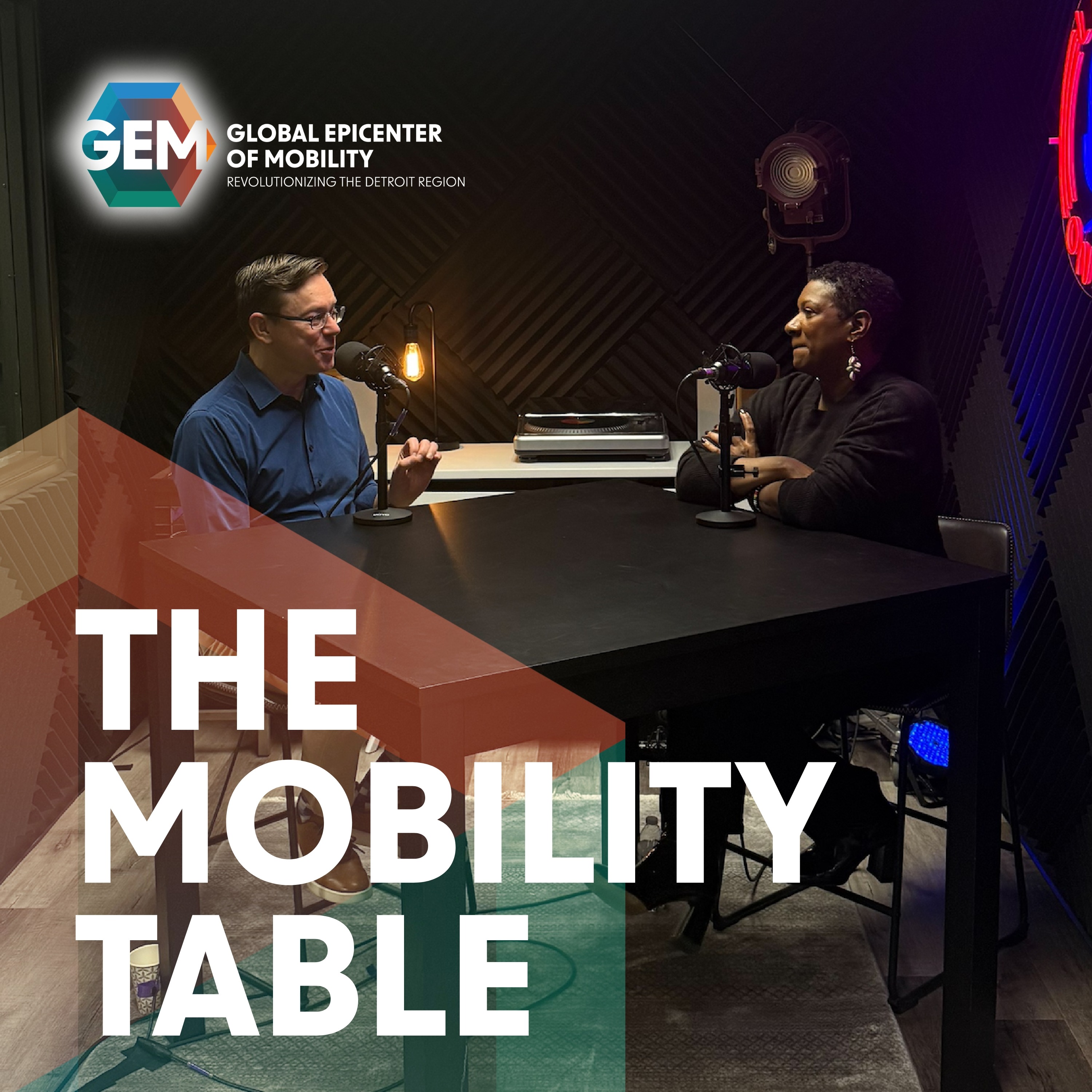
Exploring Detroit's advanced mobility ecosystem, Meaghan Kennedy of Orange Sparkleball shares insights on how diverse players—from automakers to startups—connect and innovate. The conversation highlights the shift from traditional automotive supply chains to a more collaborative, tech-driven innovation system. They discuss the importance of inclusivity across the region, the role of social network analysis in mapping ecosystem relationships, and how understanding these connections can drive deliberate growth and pilot projects. Meaghan also explains the origin of her company's unique name and the value of blending research, engagement, and human-centered design to foster a thriving mobility community.
Meaghan Kennedy came to the table to discuss GEM’s social network analysis research – completed alongside Orange Sparkle Ball – and what the results mean for the future of the Detroit region and other mobility hubs.
Meaghan Kennedy is the founder of an innovation and impact-focused company, Orange Sparkle Ball (OSB) – which works to move organizations’ initiatives forward through research, technology, human-centered design and organizational goals. Before founding OSB, she worked at the Centers for Disease Control and Prevention as an epidemiologist.
"If future mobility is going to happen in the Detroit region, we need to start doing things a little bit more like it happens in Silicon Valley..."
Future mobility means how we will get around in the future, using new types of cars and technology like self-driving or electric cars.
Future mobility refers to the evolving ways people and goods will move, often involving new technologies like electric vehicles, autonomous driving, and shared transportation models.
"as you kind of think about how things have shifted between this kind of traditional automotive ecosystem to this new thing..."
The automotive ecosystem is all the people and companies that work together to make and sell cars.
The automotive ecosystem includes all the companies, suppliers, technologies, and processes involved in designing, manufacturing, and selling vehicles.
Select text to request an explanation
Welcome back to the mobility table.
Today's episode is all about the mobility ecosystem in the Detroit region,
all the players, and trying to understand how they work together.
We'll be joined by Megan Kennedy from Orange Sparkleball to take us deeper into that.
But first, Janine, let's talk about that topic. We've got a lot of assets in this region that
can help mobility companies, players, people, but it's a lot to wrap your hand around.
It is a lot to wrap your hands around. And can we, before we go to that, can we just talk about
the fact that there is a company named Orange Sparkleball? Indeed. I think, in fact, I know
there's an interesting reason behind that. We're going to get that from our guest. Awesome. But
it's neat. You know, it's a little indication of how kind of novel and interesting and more techy
this mobility system is than we're used to in just the traditional automaker supply or ecosystem.
Absolutely. And you know, from my lens, so I am the mobility engagement officer for the Global
Epicenter Mobility, which, as we talked about before, is housed at the Detroit Regional Partnership.
But it's really about how we are moving a coalition forward to really build out this new ecosystem
for advanced mobility. And my lens is making sure that as we do it, we do it in a way that leaves
no one behind. You know, any organization, business, individual that wants to get involved with the
advanced mobility ecosystem has an opportunity to do that. And connectivity is critical. Like how
we ensure that everyone who wants to unwrap into the space knows where they can go in,
knows who some of the key players are, knows how information and resources flow
is really important for the health of this ecosystem and to make sure that everyone has
an opportunity to get involved. No, and it's also, you know, frankly, keeping up with the times,
right? If future mobility is going to happen in the Detroit region, we need to start doing
things a little bit more like it happens in Silicon Valley, like it happens in some of these
innovation systems that are so much less vertically structured. I mean, yeah, think about your
experience, right? Because you have so much historical experience in automotive. I mean,
as you kind of think about how things have shifted between this kind of traditional
automotive ecosystem to this new thing, like, what are you seeing just from your own experience
being in advanced mobility for the last couple of years? Well, you know, Janine, it's so much
different when we talk about new technologies, right? Because we are in this town, in this region,
so used to, you know, an automaker needs a part, so they put out bids and so on. And, you know,
quite often that decision is made on price or some other factor. But we're talking about
innovation here, right? We need to bring in someone who is, you know, in a classroom, in a garage,
somewhere creating something truly innovative. And how does that automaker, how does that
drone maker, how does that, you know, electric boat manufacturer come to find out that this
opportunity even exists, right? We need very different ways of doing it. And so to me,
not only, not only do we need a different process, but we need understanding, right? Who are the
players that can make that happen? Do they know about each other? Right, right, right. You know,
when I was doing some work with this, with the ecosystem, we did some, let me just say this,
when you're doing this kind of work, you use all kinds of tools. You bring all kinds of tools to
the table to help you, like, clearly see where the opportunities are to kind of cut through the
complexity of things. And we did a project where we used human-centered design and rich
pictures to allow members of our ecosystem to kind of picture what this ecosystem looks like,
what it looks like now and what we want it to look like. And one of the things that we saw was
that it is a complex and messy sandbox. And I say it that way because I'm a system thinker. So I'm
looking at just all these different players, all these different things that are popping up. Like,
yes, there's the Global Epicenter Mobility, which is us, and we're kind of this regional backbone
organization. But there are all these other, like, many ecosystems popping up, you know?
Let's say things in words that people probably have heard, like Michigan Central and New Lab and
Centropolis and others that are coming into the space. There are just so many different players.
And one of the big challenges is how do these folks connect? How do they communicate to each
other? How do we ensure that information is flowing in all kinds of ways, not just amongst
those players, but frankly, across our region. So, you know, you've got your shiwasis, you've got
your Monroe's, you've got your Genesee counties that are oftentimes excluded from these kind of spaces
because perhaps they're not right here in this kind of central location. So how are we intentional
about making sure that we are connecting those folks together and seeing them and sharing that
information so that we can move towards what we talked about before, which is like just this North
Star of this Global Epicenter Mobility in the Detroit region? Yeah, no. And I feel this is where
our experiences connect, right? Because you are the engagement officer. I'm the research guy,
VP of Mobility and Research having spent a whole career in the research field. You know,
so it's taking that ecosystem and giving it an understanding. Can we put parameters, numbers
around it and understand how it actually serves as kind of a living, breathing organism? I think
that's what makes this podcast with you and me so interesting because I think that both of us
sitting here at the table have different perspectives and different views of what we see around the
Advanced Mobility Ecosystem. And I think that's what makes this work, not just the podcast,
but the Advanced Mobility Ecosystem in general. It takes everyone, so not just your technical
research, engineer folks too, but we have to remember the human component of this as well.
And that's why I'm glad that you and I are here together. And even with this orange sparkle ball,
which I love when I put my research hat on, my like nerdy research, not that you're nerdy,
but when I put my fairly nerdy research hat on, I love to get into the data because of my perspective,
because of how I see things. As you said, right, we have this fabulous ecosystem, but for the
research guy, it's necessary to quantify it, measure it, understand it, get a feeling for
how the players work with each other. And it turns out there is a process. There is an
established way of getting our hands around this. And to get us that information for this
Detroit Regional Mobility Ecosystem, we worked with Orange Sparkle Ball and we're pleased to
welcome our guest, Megan Kennedy today.
Welcome, Megan, from Orange Sparkle Ball. I know I mentioned this at the beginning because I love,
I love, love, love the name of your company. So as the founder, where did that come from?
Thank you very much for asking. You might be shocked, but I'm asked this all the time.
I, when I first started the company, which was a long time ago, didn't really understand a whole
lot about business. And my accountant said, you need a name that everyone else doesn't have.
And at the time, this is going to show a little bit about my eccentricity.
I was talking to my cat, Max, a lot about his Orange Sparkle Ball toy. And so I said,
what about Orange Sparkle Ball? No one will have that. I love it. It's been true. I love it.
Safe to say. I love that. And it resonates. It definitely resonates. It does. You know,
Pickle Ball was named after the guy's dog. Oh, Pickle. I didn't. Yeah, I didn't know that.
He said, Pickle, go get the ball. And it became Pickle Ball. Like this is just random information
I have. Anyway, apparently someone had a dog named Dennis at one point. Oh, you're funny. Okay.
All right. Megan, thank you so much for being here. You know, what I love about you is I see
you everywhere in the ecosystem. Like anytime I go out and about in the advanced mobility space,
you are always there. And I love that about you. But tell us a little bit about your work. So the
social network analysis that we've talked about is really critical for people to understand
why something like that matters, that we as an organization and as an entity would actually
do some research using a social network analysis. Tell us a little bit about that.
For sure. Before I go into that specifically, I'm going to back up and just talk about Orange
Sparkle Ball works in innovation ecosystems. And that really is everything from kind of granular
on the ground running pilots to setting up innovation programs. So something like a gem,
you know, usually a little bit smaller than a gem, but how do different sectors work together
to understanding ecosystems, innovation ecosystems. And we kind of think of that as a layered
process, because they're all important in pushing toward growth. And the reason that you want to
understand the ecosystem is because then you can make really deliberate decisions
about how should we do this pilot? Who can we pull in? Who do we need? Who's not part of this
ecosystem? So let's take one more step back. Because no, seriously, because I think this is
important. And we talked about this at the beginning of our podcast. And that was this idea of not
wanting to use jargon, because we don't want to hide opportunity behind jargon. So one of my favorite
words is ecosystem, right? But let's talk about like, what is an ecosystem? I think that's important
just for people to understand. For sure. And this also talks about kind of what is the edge of an
ecosystem. Because when you talk about an ecosystem, people assume that that means that's a defined
thing. It is not at all. An ecosystem is a group of organizations and people typically working
toward a similar thing. They might not even know that they're part of an ecosystem.
But when we think about how do we look kind of from the 10,000 foot view down,
we try to figure out who is working on mobility. They might not select in as I'm part of the ecosystem.
But we want to make sure that they're included because we think they're key.
And Megan, you know, when I took this job on, I saw that there was a plan for a social network
analysis, right, which is the way that we measure that ecosystem. And I have to confess at the time,
despite having spent my whole career in research, I saw that term social network analysis. And I
took it to mean, you know, we're going to be evaluating people's connections on social media,
some kind of, you know, linked in connection analysis. And it's so much more than that. And
it really opened my eye to a whole new field of research that I didn't know had an established
paradigm. And so, you know, before we get into the social network analysis that you did for
GEM, can you tell us, you know, what it is, how it works? You know, how is it more than just Facebook
or LinkedIn connections? For sure. And social network analysis is a type of analysis that
predates all of the sort of what we think of as social media. But it's all about how are people,
entities, things connected, and it's used across kind of fields. So it might be used in library
science to understand how information, how papers are being referenced, or my background's in public
health. It was used in public health to understand disease transmission. So it's very much about
looking at the interworkings of groups of things. Interesting. And, you know, what's interesting
too, that you just said, you said public health background. Yeah. And I have a nonprofit background
and, you know, Bernard is coming from research as we build out an advanced mobility ecosystem
that is really complex. You need all kinds of different tools at the table to make it happen.
So talk to us about the gym advanced mobility ecosystem, the advanced mobility ecosystem,
the social network analysis that you did. Because I think one of the things that we talked about
that I've heard you say before is you can really see how we are transitioning. So from being this
kind of traditional vertical manufacturing ecosystem to something that is now more reflective of an
innovation ecosystem. Can you talk a bit about that? For sure. Just as background, we're in now
year three of measurement. So that is, we're doing that right now, but we have two years of data.
We'll end up having four years. So I'm really excited about that. Right. And that, by the way,
that measurement, I just want to say for our audience, it's in rounds. So we get discrete chunks.
So because it isn't continuous, you know, we see, you know, the year one, year two, year three,
we're literally watching the evolution of a system in revolution in a way.
Yeah, 100%. That's a really, that's a lovely way to say that. But so in year one, that's kind of
our baseline. And just to sort of set the stage for this, I have not seen other economic development
uses of social network analysis where there's it's longitudinal to Bernard's point,
and we'll end up with four years of data to really see the revolution.
But in, in year one, and you guys have both referenced this, what we saw in the data is
there was a sort of core group of organizations who were heavily connected to each other. And so
when you think about heavily connected people or organizations are what we're, we're studying here
is organizations. They typically those that group of organizations typically like has the
information about what's happening in the region might have information about new funding opportunities,
that kind of thing. And they're not on purpose, like holding that, but they're not just they're
not connected broadly. So they end up being sort of the nexus of influence, I'll say. And
in year one of our measurement, we saw a structure more like that. So Bernard to your
earlier point of vertical integration. And that's very much a manufacturing type pattern.
In year two, we saw a much more disseminated. We the connections were more disseminated. So
instead of having that core group of heavily connected organizations, and then the rest of us
in year two, we started to see much more kind of diffuse connections. So we were having other
organizations brought into those conversations. And then there's another metric that can be used
that's about influence. So are you in that measures like as an organization, are you connected to
other influential organizations? And we saw that start to go up in year two. So that means
to us, we're looking at in real time, this diffusion of influence in the gem ecosystem in
southeast Michigan, around mobility, rather than that sort of core group. Is that a good thing?
Well, I do innovation work. So I'm clearly biased. I think it's an amazing thing.
Because when you look and I'm going to get a little geeky, I'm going to try not to geek out.
But hold on, where's my geek? No, I'm just kidding. You're surrounded by it.
I am surrounded. I love it. Please go ahead. So innovation typically is a marker of
the beginning of economic growth. So it's new ideas, new technology. And if you look at, say,
a pattern of like a traditional manufacturing ecosystem, and again by that just a group of
organizations working together, and a pattern that sort of Silicon Valley would have in a network
analysis, what you see when I'm using that as sort of the archetype of innovation ecosystem,
what you see there is a very diffuse network. So no one holds all the power in the network.
Information travels throughout the group of people. You know, you might have people that
work for a bunch of different companies, and information moves with them. That breeds new
ideas. And there's tons of research showing that that sort of when information is exchanged,
leads to new ideas. Yeah. Megan, please check me on this. But I'm intrigued by the fact that
you could see such a marked difference from year one to year two. That's just one year.
And something tells me if we'd done this analysis five years ago, 10 years ago,
this region, this ecosystem was not transforming nearly as fast. But to me, it tells you how
transformative, how revolutionary these changes are if in only a year's time, you can see the
ecosystem actually looking demonstrably different. We were actually pretty surprised.
Yeah. So yeah, no need to check you at all. We're really interested to see what year three
also looks like, because my assumption, obviously, is that that kind of diffusion will continue.
I wish we had many, many years so that we had that sort of line over time.
And one of the things we're doing is looking at, are there other types of data we could
bring in to both validate this, but also try to get a little bit more of a picture of
before we had the network analysis? You know, a couple of things for me.
We talked about this earlier on another podcast that we did. But it's this idea that
Detroit has a certain vibe, like the ecosystem has a certain vibe. And at least what I feel
and what perhaps makes it so welcoming is people are so willing to share information.
Like there doesn't seem to be this hoarding of information. You are always a great example.
I know for me, for example, you are always connecting me to different people. And like
the intentionality of making sure that you know this person, that you know this person,
knowing that I'm a connector as well. So how can we in our position with the global
office and our mobility make sure that we're connecting people with intentionality?
But just this idea of sharing information and not hoarding information, I think, is important.
Many of the partners that are part of GEM were really originally part of that group,
that well connected. And in fact, if you think about GEM and looking at the analysis that you
did, I mean, our folks that we are partnered with are amongst the most connected in the region,
right? Like on so many various levels, our nodes, is that what they're called?
Yeah, nodes. An organization is a node in SNA parlance. Yes. Yeah, nice work.
Thank you.
So but our node is really well connected. Like lots of these different nodes that are part of
the global office and our mobility, if you look at them, they're like these bright stars that are
just, you know, we have all these different connections. And I think when I look at the
information, I want to make sure I'm always looking at who's not connected. And I know
you've done some work around like who's not connected. Can you talk a little bit about that?
For sure. And I also want to get back to the really connected nodes as well. So I'll table
that for a second. When we do this type of sort of visual representation of the data, and you
can see that it kind of, you know, the end of it is this tale of organizations. And those are
organizations that typically they have been included in the network analysis. We think they're
doing mobility work, but they're not really heavily connected to the rest of the ecosystem.
So the first thing we'll do is look at in that, you know, sort of tale. Is there anything we can
think of that we could intentionally pull those organizations into? That's a really easy and,
you know, pretty quick way to do it. It can be an informal working relationship. It's just giving
them basically a seat at the table or an entree into the work. Yeah. And Mika and I should say we
actually have. We have very much made this research actionable by intentionally taking some of those
institutions that don't look connected enough, or you would think that X would be talking to Y.
And we've actually, you know, it's not just coming up with measurements or numbers. We've
actually made some of these relationships happen. So hopefully we're also fortifying the ecosystem
as we're studying it. 100%. So every time you make one of those connections, you're pulling that
more influential organization that you're connecting the least influential organization to,
you're pulling some of their influence to the new organization you've introduced. And that's
really powerful. I know that there we have, we have as a team kind of pulled some organizations in
and I've seen them now, you know, just kind of anecdotally be everywhere back to my I'm overexposed.
Yeah. I'm totally teasing you. But all of a sudden those organizations that really were not much in
the conversation are in every conversation. And that's a huge win. Absolutely. What were you
going to say about the nodes? Oh, thank you for reminding me. And year one in that data, we did
see a lot of the, the sort of key gem organizations as has having a lot of influence and being
heavily connected. What we also saw is organizations that are not typically thought of as mobility
organizations, having just as much influence. And that's one of the things that I always talk about
in what I'm talking to people about ecosystems. There are some organizations who wouldn't
necessarily opt into like, hey, I'm a mobility organization, they hold a lot of influence.
And so just being open to who else should we have here who's really influencing our work,
but might not like, you know, raise their hand to want to be involved. And who may be influential,
especially as you think about place based economic development, right? So who may be influential in
this region that we, they need to have the information about the advanced mobility work and
then the opportunities because they are influencers within their space, their nodes,
absolutely. You know what I'm saying? Like they're their own nodes, but we need to make sure that
they have the information so that they can also spread and connect as well. When you just hit it,
I love that. So Bernard, to your point about making research actionable, one of the things
that's core to how we work is we don't just do research to do it. So we always want to figure
out how to make it actionable. And then Janine, what you just talked about is if we have an
influential organization that isn't, wouldn't consider itself a mobility organization,
but we know that their constituents can really benefit from some of the maybe workforce programs
that are happening in the mobility space, getting them that organ or that information so they can
disseminate it, then opens the doors in completely other ways. And we're kind of using their influence,
obviously, for good. And as you're talking, you know, I think back to my career in automotive
research right now, it's all mobility wide. But there was always this idea when it came to plant
location, headquarters location and so on. This is a business that loves clusters, right? And I
feel like now we're seeing why. You know, what does it give you to locate in a place where you have
so much access and so much help? And the increasing openness just seems to be bringing even more value
to being in the heart of a cluster like the Detroit region. That's right. Oh, good. Bernard,
high five on that. Well, thank you. I'm just saying that like that's the whole thing about the whole
like global epicenter of mobility, right? That that's why Detroit, the Detroit region, that's why
here, because because you can see all of those connections. But we also talked about, you know,
places around the world saying, you know, they want to be the Detroit of China. They want to be
the Detroit of Korea. You know, what does that mean? You know, in terms of actually becoming a
Detroit, it's bringing that ecosystem forward. And right now, no one else can match it in terms
of what this region provides. 100%. I think there's also a little bit of an intangible. And I'm
speaking beyond the data here, but I'm speaking based on my experience in innovation ecosystems.
You talked about people are really willing to share information. That's key because that cluster
doesn't really work if people are really precious about kind of not bringing in other people
in Detroit. And I think this is a huge differentiator that people are willing to share information,
bring other people in. I think we have all kind of we have a shared value that is we're all in
this together, we are going to pull forward. And I think that's what's missing in a lot of the
ecosystems I see. I love that. You know, I'm always getting emotional, right? It makes me a
little teary, too. It is a value that we have in the Detroit region. And I feel that and I feel
that whenever I interact, you know, out in the in the ecosystem. So, you know, as you think about
kind of what's happening in terms of like the health of the ecosystem, like what does a healthy
ecosystem look like? What does a healthy innovation ecosystem look like? Like can you give like
kind of parameters around that? Yes and no. Okay. How about I think that is the, you know,
one million dollar question. A lot of people measure that in different ways. So, you know, if you
you can look at, you know, GDP and that kind of thing, more traditional economic development
data, you can look at number of patents created. So, if you go to the entrepreneurial folks,
they'll have like we want patents and we want tech transfer and that kind of thing.
My personal opinion is those leave out a really whole part of the ecosystem. So, I think we have
the opportunity to define that for the field. I personally think it is, you know, I talked about
that kind of way we visualize the data and it year two was a sloping look at influence. So,
higher influence but then sloping down. Year one was a ton of influence here and let it cliff.
If we can continue that sloping where we can bring up the influence that kind of tail groups have,
that is my definition of a healthy ecosystem because we know we built in all this other
connectivity with more groups. And so, you know that information is being shared. Connections
are happening. One of the other things I've been thinking a lot about is trust. Absolutely. Like
can we measure trust? And trust I think is when you see information being shared that you know
there is trust there. And I think that's one of the big issues. Let me ask you this question.
So, we have our advanced mobility ecosystem and we are focused in on particular things like supply
and workforce and testing improving and all these kind of things, right? But there are,
there's another kind of ecosystem out there as well and maybe it's around design and it's around
those that are looking at design. They're looking at electrification. They're looking at infrastructure.
They're looking at all these other kinds of things. I would say in some ways we have one
piece of something bigger. Agree. What do you think those other kind of big pieces are? Oh,
questions ahead of time. No, you did not. But nice question. I love it. I think about if you,
like that's often called like the creative economy. So, if you think about we, you know,
Jem has been focused on sort of the, I would say what came out of automotive and trying to kind of
supercharge that conversion to mobility, which in and of itself is a much more broad
understanding, you know, automotive is a very specific vehicle and with specific technologies
that Bernard, you can talk about way more than I can. But mobility can be anything. So, it can be
a drone that goes in the pipes of a city. That's a mobility and that's one of the startups that's
really taken off here. It can be an electric boat, can be an Evital aircraft. All of a sudden we've
broadened a lot and that will help what you're talking about pulling in all these people who
wouldn't can, they wouldn't raise their hand to say I'm a mobility person. Right. And Megan,
to give credit to you and your team and as we wrap up here, the approach that you have taken to
measuring just that, you know, really has been unique, right? I mean, special enough where you've
now co-authored journal articles about how unique this is to actually bring this information to light.
Spoken on national panels. In fact, international panels, including Scotland even, right? Because
social network analysis may not be new as I found out, but the way that you and your team have
approached this really has been groundbreaking and I want to make sure that we're giving you
credit for that. I appreciate that. I'm going to put it right back. We have co-authored journal
articles. Thank you kindly for that. We know where the Brain Trust resides in this field,
but you're very gracious to say so. Well, thank you. I know we've got to wrap up. This has been a
joy. I honestly, you know, I always enjoy talking to you. You're brilliant. You know, data should
never just sit and not be used. It really needs to be used to build strategy, to create connectivity,
to build that trust that we talked about. Yeah. And to make sure that we are leaving no one behind
that should be a part of this advanced mobility ecosystem. So thank you so much for your time
today. We appreciate you. Thank you both and thank you for trusting me to come in without
pre-sign questions. No, no. Thank you for sharing our table today. Thank you for joining us for
this episode of the Mobility Table. We've had fabulous discussion about some really critical
mobility topics for the Detroit region. We've got some fantastic guests coming up on future episodes,
so please join us then.
Request an explanation for:
Request an Explanation
Heard something you'd like explained? We'll add it to this episode.
Sign in to request explanations for terms you heard.
Want to learn more?
Browse our glossary for plain-English explanations of automotive terms, jargon, and concepts.
See something that's not quite right? Our annotations are AI-generated and can sometimes miss the mark.
Click the flag icon on any annotation to suggest a correction.