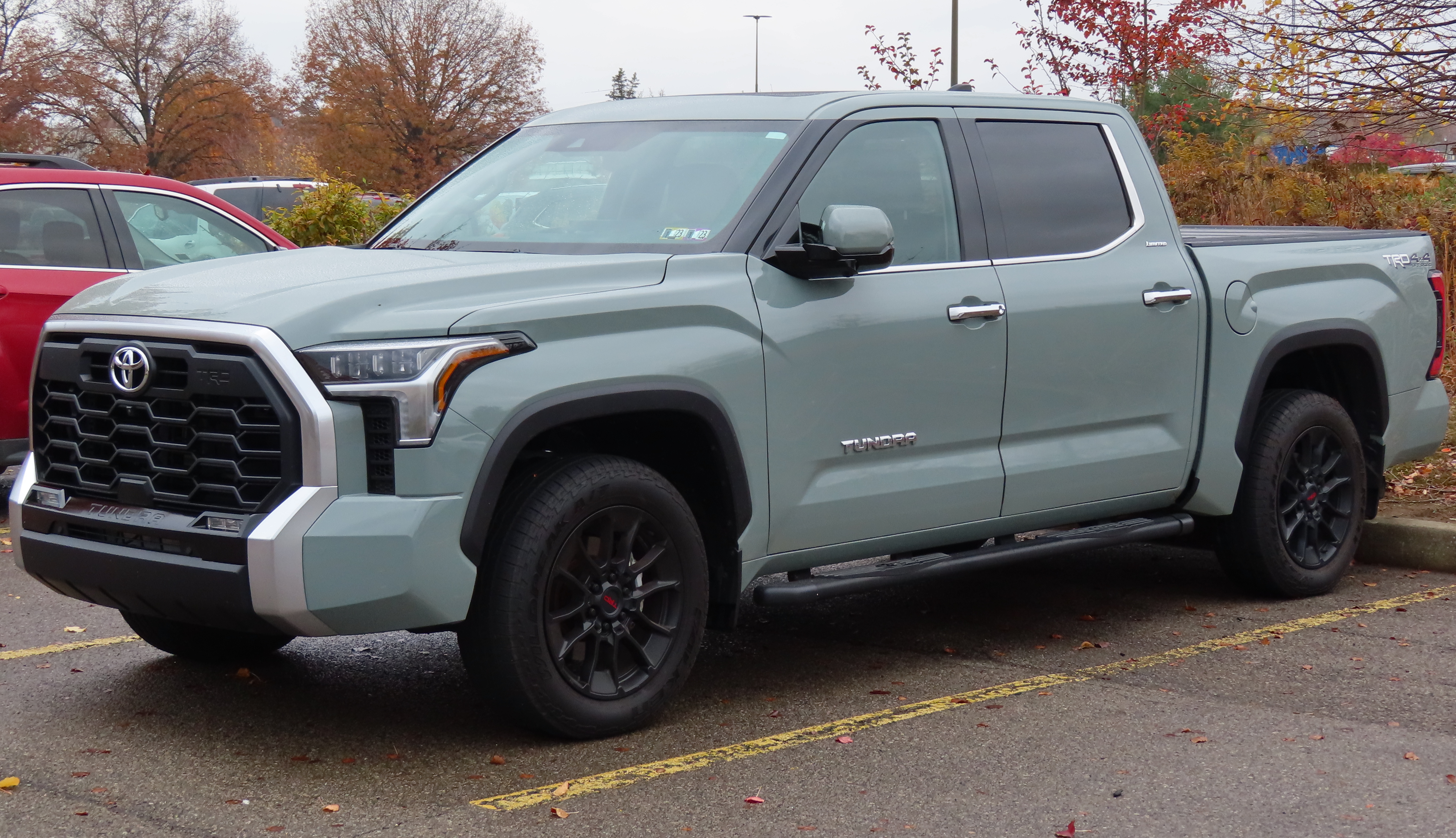
The Toyota Tundra is a full-size pickup truck. In this episode, they’re talking about recall issues tied to the engine, and how that affects what people choose to buy.
A recall is when a car company says, “We found a problem, and we need to fix it.” Here, the hosts say recalls are one reason some people avoid newer trucks.
The Dodge Power Wagon is a pickup truck made for off-road use. It’s designed to handle rough conditions and tough jobs. The podcast mentions it as part of a group of truck news items.
Term
tier D pro
This sounds like a specific trim/package name for the truck. The host is connecting it to the fact that this version has Fox shocks that need periodic rebuilding.
Fox shocks are a type of suspension shock made by Fox. The key idea is that they’re designed so you can rebuild them when they wear out, instead of always buying a whole new shock.
Rebuilding a shock means taking it apart and fixing the worn internal parts. It’s usually cheaper and can extend the life of the shock compared to replacing it completely.
It means a regular replacement shock you can just buy. The point here is that some shocks (like Fox) can be rebuilt instead of replaced with a brand-new one.
Upsizing a tire means putting on a bigger tire than the factory size. That can change how the truck rides and handles, and it can also affect things like the speed reading.
The concern is that some leftover junk from building the engine can end up inside it. If it blocks the oil system, the engine doesn’t get proper lubrication and can wear out or fail.
Oil passages are the internal “oil highways” inside the engine. If something blocks them, parts don’t get enough oil, and the engine can start getting damaged quickly.
The “bottom end” is the lower part of the engine where the crankshaft and bearings live. If that area gets damaged, it’s a big problem because it can lead to severe engine failure.
The main bearing is a small part inside the engine that helps the crankshaft spin smoothly. If Toyota redesigned it, they’re trying to fix a problem that showed up in how that part works.
NHTSA is a U.S. government agency that deals with vehicle safety. If you see information on NHTSA.gov, it usually means the recall or investigation details are documented officially.
A voluntary recall means the company decides to bring vehicles back to fix a problem. It’s still a formal recall, but it’s initiated by the manufacturer rather than by a government mandate.
“0W-20” is the label on a specific type of engine oil. It means the oil stays easier to pour when it’s cold and is thinner when the engine is hot, which can change how well it helps move dirt and tiny particles to the filter.
They’re talking about oil being less thick when the engine is running. If the oil is thinner, it might not carry tiny debris away as well, so more of that debris could end up stuck in the oil filter instead.
The oil filter is the part that catches dirt and tiny particles from the engine oil. The worry here is that with thinner oil, less debris may get carried away, so more could stay trapped in the filter.
Term
6.2 liter V 81
A “6.2-liter V8” is a type of engine with eight cylinders arranged in a V shape. They’re saying GM used a thicker oil for that engine as part of a fix, suggesting oil thickness can matter for engine protection.
“Thicker oil” means the oil is more viscous, so it’s not as thin when the engine is hot. They’re saying it might help, but they don’t think it’s guaranteed to solve the real problem by itself.
Lubrication is how engine oil coats moving parts so they don’t grind against each other. More lubrication and better oil flow can reduce wear and help the engine run more smoothly.
Tolerances are how precisely engine parts are made to fit together. If the tolerances are a little looser, it can help oil move and lubricate the engine more easily.
Emissions are the harmful gases a vehicle puts into the air. The government wants engines to produce less of them, which can push manufacturers to change how the engine is designed.
Efficiency is how well the engine turns fuel into motion. If an engine is more efficient, it usually uses less fuel, but it can require more precise engineering to achieve.
Regulations are rules from the government that car makers have to follow. Here, they’re pushing cleaner and more efficient engines, which can change how the engine is built.
The Toyota Tacoma is a mid-size pickup truck. It’s popular because it can handle truck tasks like hauling and towing, but it’s generally easier to drive and park than bigger trucks. The podcast mentions it because many people buy Tacomas.
In recall paperwork, “potentially involved” means the company thinks certain cars could be affected. It doesn’t necessarily mean every one of them definitely has the problem.
This is an estimate of how many of the cars in the recall group actually have the defect. The hosts are saying it’s tricky to calculate exactly, so the real-world impact can be uncertain.
The Buick Model 27 is a Buick vehicle being talked about in terms of ordering availability. The podcast suggests it’s something people have been waiting to order and that it’s now available to order. It’s mentioned as part of a broader ordering discussion.
Engine options are the different engine types you can choose when you order a truck. The host is saying Ford is taking some of those choices away for the Super Duty.
This means the diesel engine is tuned to make more power than the standard diesel. It’s usually set up to handle that extra pulling force, especially when towing.
A 10-speed automatic has more gear steps than older transmissions. That can help the engine stay in the “right” spot for smooth driving and stronger pulling when you need it.
The Ford F-250 is a big work truck built for towing and hauling. The host is talking about what it would feel like if an F-250 had the higher-power diesel setup they’re discussing.
When the host says “up to four or five different engines,” they mean multiple distinct powertrains offered for the same truck lineup. Different engines can require different components and calibration, which increases complexity in production and inventory.
Here, “streamline” means making the lineup simpler. Fewer choices can make it easier for the factory to build trucks without getting stuck waiting on parts.
The host is describing a “slate truck” as a simpler, more basic truck build. The factory makes it in a standard way, and then people add accessories later.
The Porsche 911 is a famous sports car from Porsche. Here it’s mentioned to illustrate that some cars let you customize lots of details, which can drive up cost.
“Bespoke” here means the car is made to match the buyer’s specific preferences. That kind of customization often costs more than building one standard version for everyone.
The destination charge is the amount you pay to get the truck from where it’s built to the dealership. It’s one of the extra fees that can make the final price higher.
The Honda Ridgeline is Honda’s pickup truck. Here they’re talking about the current version’s engine and transmission, and how Honda may be moving toward a hybrid version later.
A nine-speed automatic is the truck’s automatic gearbox. It has more gear steps than older automatics, which can help the engine stay in the “right” spot for smoother driving and efficiency.
The Honda Passport is a mid-size SUV from Honda. It’s built for everyday driving with extra room compared to smaller SUVs. The podcast mentions it because it’s being compared to newer Honda models and their update timing.
“Seven” sounds like a model name or number being mentioned in a list of possible trucks. The podcast doesn’t give full details in the snippet, but it’s being treated as something that could be part of future options. It’s included as a “maybe” in the conversation.
A hybrid uses two kinds of power: a gas engine and an electric motor. The idea is to get better efficiency than a normal gas-only truck without needing to plug in like a full electric car.
The Ford F-150 is a popular big pickup truck. This part is about the hybrid version, and how Ford is planning to build a lot more of them each year.
Term
base Excel model
“Excel” is a trim level, meaning a particular version of the truck with a certain set of features. The host is saying the hybrid version isn’t available on the cheapest version, so you have to buy a higher trim to get it.
XLT is a mid-level version of a Ford truck. Here, the host is saying you can’t get the hybrid on the cheapest trim—you have to at least choose XLT (or higher).
Lariat is a higher trim level on Ford trucks. In this segment, it’s mentioned because the hybrid option is only available when you move up to trims like XLT or Lariat.
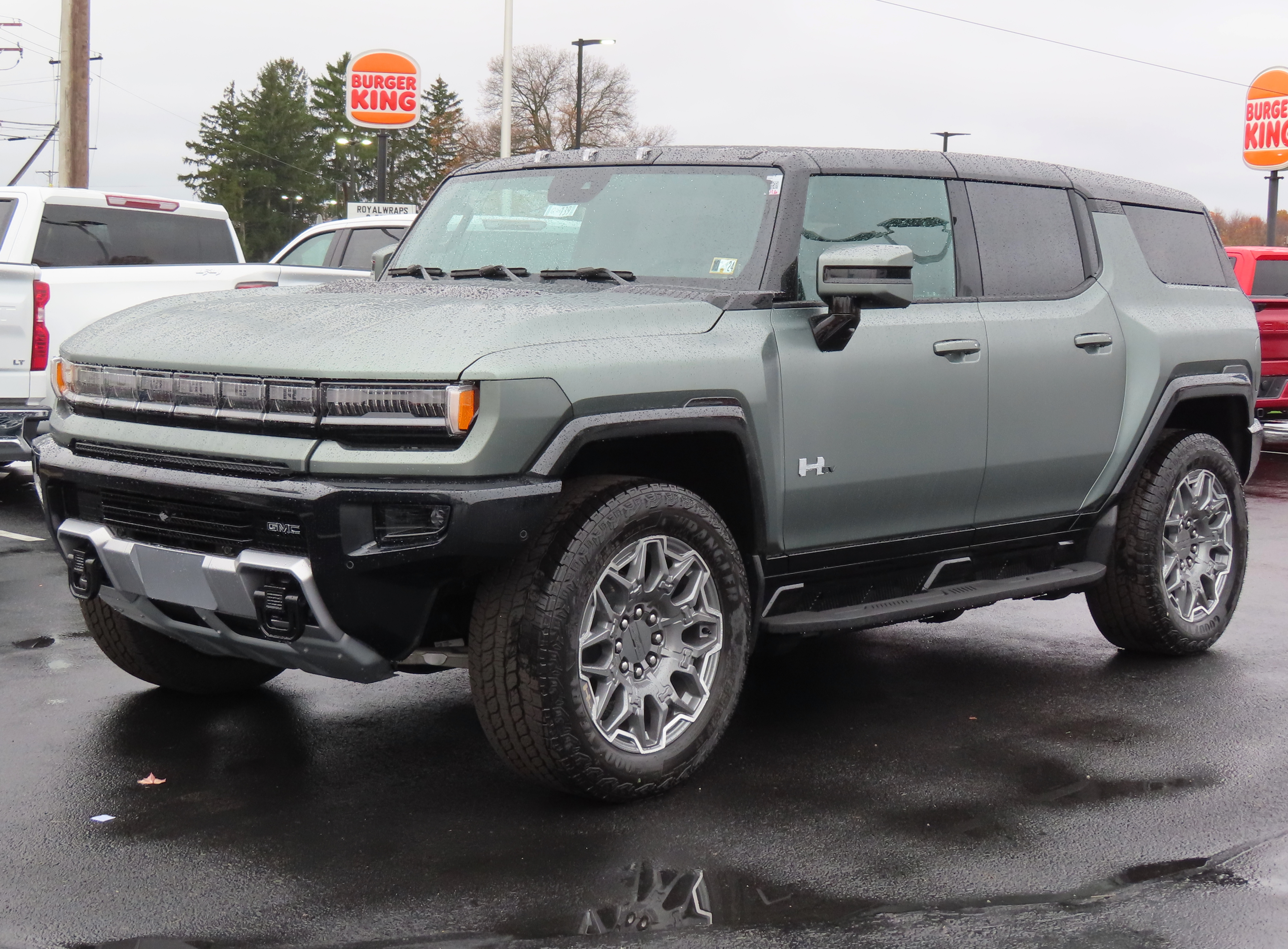
They’re talking about a GMC Hummer X concept lineup—basically a preview of what a future truck could look like. The host says it seems built on the same general idea as the current Hummer EV, just with different styling details.
The Hummer EV SUV is an electric SUV. It’s part of the Hummer EV family and is designed to be capable off-road. The podcast describes it as closely related to the existing Hummer EV setup, just in an SUV form.
“37s” means the truck is shown with very large tires—about 37 inches tall. That usually helps off-road by giving more clearance and grip, but it can make the truck heavier and less efficient.
Here, “screens” means the truck’s digital displays—like the infotainment screen and other panels for settings and information. More screens usually means more of the truck’s controls and info are handled digitally.
Term
seven iPad side by side
They’re describing an interior with multiple big tablet-style screens lined up next to each other. The idea is that the truck’s controls and information would be shown on lots of displays at once.
These are off-road “shape” measurements. Approach and departure angles tell you how well the vehicle can go up and down bumps without hitting the front or rear. Ground clearance is how much space there is between the bottom of the vehicle and the ground.
Wheelbase is the distance from the front wheels to the rear wheels. It affects how stable the vehicle feels and how much room it has inside. Longer wheelbases often ride smoother, while shorter ones can turn more easily.
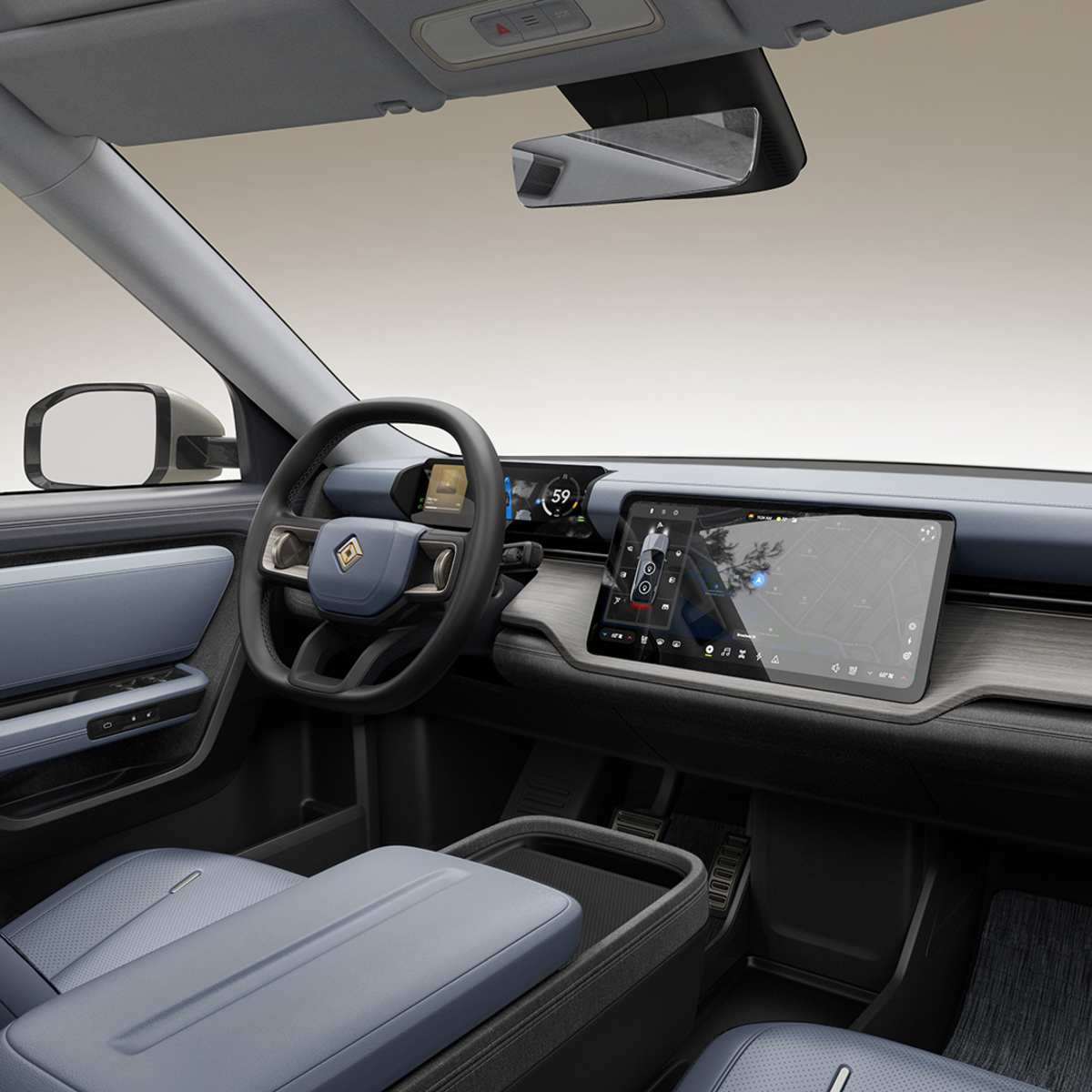
The Rivian R1S is an electric SUV built for outdoor/adventure use. Here, it’s mentioned as a comparison for the kind of vehicle size and vibe being discussed. It’s one of the better-known EV SUVs aimed at people who want to go off the pavement.
The Rivian R2 is Rivian’s smaller electric vehicle compared with its bigger models. The hosts mention it to help you picture the size/positioning of the concept they’re talking about. It’s basically Rivian’s way of offering a similar EV style in a different size.
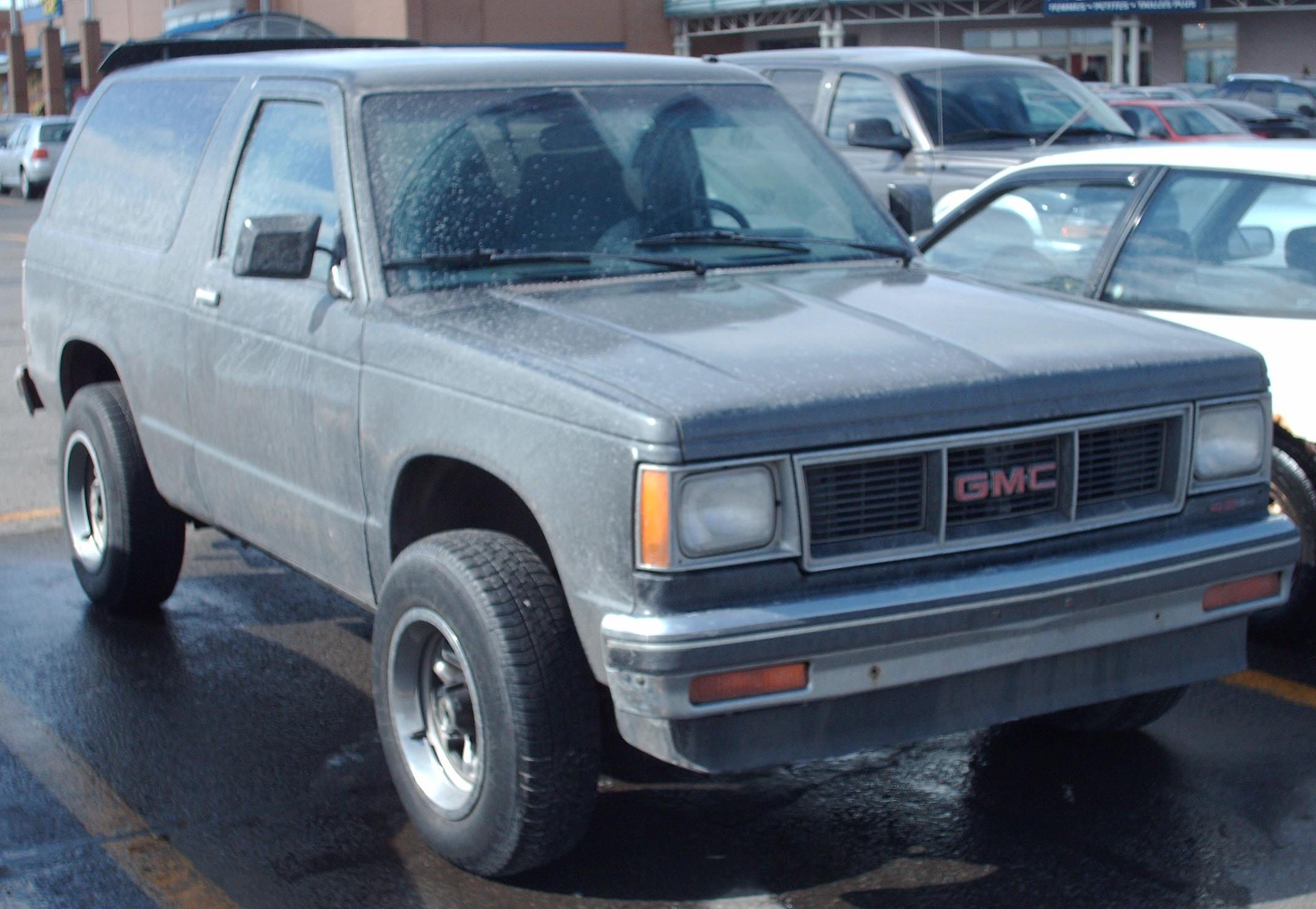
The GMC Jimmy 3 Doors is an upcoming or rumored GMC SUV idea with a three-door design. People are talking about it because it could be a smaller SUV option with a simpler, more compact layout. The podcast mentions it because there’s a lot of buzz about it.
“Competitive advantage” here means something a company has that helps it beat competitors. The idea is that automakers don’t share future plans so rivals can’t copy them.
Alignment is how straight the wheels are pointed and how they sit relative to the road. If it gets knocked out of alignment, the truck can pull or the wheels can look crooked—exactly what they noticed after the heavy off-road run.
Concept
downsize it
Here, “downsize it” means making the truck smaller and lighter. The idea is that less weight means less stress on the wheels and suspension when you hit rough obstacles.
Electric assist means the electric motor helps the gas engine when you need extra power. It can make the car feel quicker without needing a bigger engine.
A modular architecture is a vehicle design approach where key components (like platforms, mounting points, and powertrain interfaces) are standardized so multiple models can share them. The host is saying the GMC Hummer “X concepts” seemed innovative because they were thinking about how to build the truck family more flexibly.
An overland expo is a show/event for people who travel long distances by road and trail, usually with camping gear. They’re suggesting the truck could be tested and shown in that kind of setting.
The Ram Power Wagon is a special Ram pickup made to go off-road. It’s designed for tough trails where you need good traction and control, especially when climbing steep or uneven obstacles.
Ram Off-road Park is a place built for off-road testing. It has obstacles designed to let them see how well trucks handle tricky terrain without getting stuck on random stuff.
A 30-degree slope is really steep. Climbing something that steep tests whether the truck can keep traction and move slowly without spinning its wheels.
A locker is a feature that helps both wheels on an axle spin together. That way, if one wheel starts slipping, the truck can still keep moving—especially on steep or rocky trails.
A front locker locks the front wheels together so they can keep pulling even if one side slips. They’re saying it would make the truck even better for the kind of obstacles they were tackling.
The Lotus Excel is a sports car made by Lotus. The podcast mentions it in connection with off-road versions or setups and larger tire sizes. That’s why it shows up in a conversation about equipment and configurations.
Stellantis is a big car company that owns multiple brands. Here, they’re talking about Stellantis planning updates for the next few years and hoping the Power Wagon gets changes too.
Cummins is a company that makes diesel engines. They’re saying the Power Wagon would be even better if it came with a Cummins diesel setup, especially alongside bigger tires.
A locker is a feature that helps both wheels on an axle turn together. When the ground is uneven and one wheel slips, lockers help the truck keep moving.
Term
35
“35” means 35-inch tires. Larger tires usually help a truck clear obstacles and keep traction off-road.
A sway bar helps control body roll on-road, but it can limit how much each wheel moves on rough ground. Disconnecting it lets the suspension flex more so the tires stay in contact with rocks and bumps.
Articulation is how well the suspension can “flex” over bumps and rocks. Better articulation helps the tires stay planted instead of lifting off the ground.
Four-wheel drive (4WD) means power is sent to both the front and rear axles, improving traction when surfaces are slippery or uneven. The host’s point is that if you forget to engage 4WD during a boat launch, the truck may only have rear-wheel drive, reducing grip as the trailer and boat load shift.
An open diff is a drivetrain setup where the wheel with the easiest grip gets the most power. If one wheel is on slippery ground, it can just spin instead of pushing the truck forward.
“One-wheel peel” describes a traction failure where one driven wheel spins and the vehicle doesn’t move efficiently. It commonly happens when the other wheel has better grip but the differential can’t transfer torque effectively (as with an open diff).
Tread is the pattern on a tire that helps it grip and push water out of the way. If the tire is “treadless,” it can get slippery fast on wet ramps and won’t bite well.
Term
peg leg burnout
A “peg leg burnout” is a slang term for when one tire spins and the truck doesn’t really go anywhere. It’s like the tire is just burning rubber while the rest of the truck can’t get traction.
The Power Wagon is a Dodge truck trim built for off-road use. Here, the point is that it’s capable enough to handle a tough, wet ramp situation without getting overwhelmed.
A “Cummins version” means the truck uses a Cummins diesel engine. Diesel engines like these are often chosen because they make strong pulling power for towing.
The Dodge Dakota is a pickup name that the podcast says is coming back in some form. It also mentions an SRT version, which usually means a higher-performance trim. The point of the mention is that there are plans for a Dakota model and performance options.
LIVE
We have a lot to talk about on this episode of TFL Talking Trucks.
That's true because there have been some pretty big developments over here at the office.
We also have a lot of news to talk about because as always with the truck world there's a lot
going on.
So I finally, after talking about this for several months maybe, I finally sold my Toyota
Tundra.
That's right.
It's gone.
We're going to be talking about Tundra's decent amount.
Because well, it brings up another topic, right?
Because when I was selling my Tundra, I can tell you a little bit more about this.
The gentleman who was purchasing it from me mentioned that he was avoiding the new Tundra
and I said, why?
He said because of recalls.
So there's some updates on recalls that I want to talk about.
Yeah, we want to go through that story a little bit, but to your point, values of the previous
generation Tundra, like what you had, are pretty high because there are a lot of people
out there that trust the previous generation truck a lot more than any brand new Tundra
because of the admittedly fairly sizable recall on those engines.
Exactly.
So let's talk about that.
We also have some truck news with 2027 Ford Super Duty and what Ford is doing there.
They are removing engine options from the list.
Also Honda Ridgeline news, GMC Hammer news and RAM Power Wagon news.
Exactly.
So there's a bunch going on, but we're going to start out with the Tundra.
So should we go ahead and dive into talking a little bit more about the recall?
Well, yeah.
Well, no, no, I want to tell you about my truck.
Okay.
Yeah.
We'll start with Andre.
Right.
Thanks.
So first of all, I don't know about you.
I often get super attached to vehicles that I own and when I published my truck, which
was a 2019 Toyota Tundra on Facebook Marketplace, this is not sponsored by any Marketplace,
by the way.
Yeah.
It'd be cool if it was.
It'd be cool if it was sponsored by a giant corporation, but it's not.
We're sponsored by you guys, listeners and viewers of this podcast.
And we are live on Patreon.com right now.
Yeah, that's true.
Slash TFL car.
So you can always go on there and ask us questions as we're recording these live.
Yeah.
And make comments, feedback, anything.
So I published it on the Marketplace and then I'm like, really, am I really doing this?
And yes, I was really doing it.
I took all the pictures, you know, I tried to be very thorough, published all the pictures
on there and I put up my price all very close to $40,000.
It was like $39,500 that I put my price at because I purchased the truck for about like
$42,000, $43,000, I thought this was a year and a half from now, right?
It was a long time ago.
And admittedly you haven't put tons of miles on this truck because obviously we test a
lot of trucks here at work.
So there's plenty of times when you're not driving your own truck because you're testing
vehicles that we have at the office.
Yeah.
So I think I put on about 17,000 miles in about a year and a half.
So not an insane amount of miles, but some.
We've taken several road trips down to New Mexico and some other areas.
So and then I get a lot of feedback from the marketplaces.
So first a couple of people, you know, messaged me there and then like five dealerships.
Oh, really?
So I wanted to talk to you about this too, because I guess a lot of people put no,
no trades, no dealers, like comment into their description, but I don't know if that
matters because those bots, I think they're mostly bots, but they're just looking for
like interesting recent vehicles and they're like, give us a VIN number.
We'll, we'll give you a value, you know, right away.
So I got a lot of dealer messages.
I've never dealt with that because everything I sell on marketplaces is a
hoopty of, you know, typically beyond 20 or 30 years age, which I don't think a lot
of dealership bots are necessarily going after.
Well, that's another interesting topic, right?
Because when you're selling something so valuable, right, we're talking about like
$40,000 or maybe less, there's always some nervous energy there, you know, am I
going to find a buyer who's legit, you know, are they going to try to scam me?
That's a lot of money, right?
It's a big vehicle, yada, yada, yada.
So I think that's why a lot of people go to a dealer, right?
And basically, because a dealership is there, the dealership has the money, you
know, usually you could kind of trust that the deal is going to go through, but
the dealer is going to lobel you, right?
Yeah, cause they have to make money.
So yeah.
So that's kind of the trade off there.
Anyways, I sold it to a nice gentleman here in Denver.
Great.
We worked out the deal.
He didn't lobel me.
And it sold pretty quick.
Yeah.
Well, like within a couple of days, it was gone.
And I was crying.
Yeah.
You're not going to see that.
I was upset it was gone, but it was a really solid truck, dude.
Absolutely.
I mean, we did a lot with it also for some videos.
Um, and I mean, I changed the oil in it regularly, according to the schedule.
So, so it was really solid truck, but I did find a couple of problems with it.
Like a leaking shock, for example.
Yeah.
So it didn't have anything major, certainly not anything in the scope of needing
to replace an engine.
No, did not have to do anything with the engine other and some oil changes.
Uh, the transmission was also really solid.
But you know, these high performance shocks, it's a tier D pro, right?
It's got Fox shocks and they need to be rebuilt.
A lot of people don't understand that or don't know about it.
Yeah.
You can rebuild them.
You don't just have to replace them with an off-the-shelf new shock.
But they usually have their own schedule, right?
It's like 50, you know, it depends on how you use it, of course, but it's usually
around 50 to 60,000 miles, maybe sooner.
Sometimes where you actually, they recommend you rebuild them.
The original Ford Raptors, you know, those Fox shocks, um, they were famous
for needing to be rebuilt as well.
So, so we did the maintenance on it.
Yeah.
So nothing that was a really huge deal.
And it makes sense that the truck sold pretty quickly because we're here in Colorado.
A lot of people drive Toyotas in this state.
It's a really popular brand.
And I'm not surprised that there was a lot of interest in this truck and they do
really hold value well, which is one of the nice things about it.
Because yeah, you know, like you said, you put almost 20,000 miles on it.
You had it for closing in on two years, almost roundabout.
And, and I sold it for like 38 ish.
Yeah.
So I was pretty happy.
Yeah.
And I think the, uh, the buyer was also happy, uh, about this.
And it's not like you had to pour money into it either.
You put tires on it more, more out of the desire rather than.
Yeah.
I put a slightly upsized tire on it.
Yeah.
So, so there, there's, uh, the BFG, uh, Keo three.
Yeah, exactly.
I'm going on a BFG event later today.
Nice.
I want to hear more about that when you come back.
Yeah, absolutely.
So again, one of the reasons that there's a lot of interest in these trucks is
because there has been this pretty high profile recall, as I'm sure most of you
know, with the brand new Toyota Tundra and it's V 63 and a half liter V
six, what's interesting in this is that enough time has gone by with this, that
there's a lot we know from this recall, but there are still some unanswered
questions and there's a lot of confusion.
Um, and you may have seen this online, right?
So because there were several waves of this recall, right?
They, they recalled about a 100000 vehicles, then added to that
recall and then recently just like in late May, just what the, almost a couple
of weeks ago, there was another almost 44,000 Toyota Tundra V six engines that
were recalled or trucks with those engines.
To my understanding, some of the trucks that have since been recalled were
built after Toyota was aware of the initial issue.
So it seems like it's, it's been a problem that has been a difficult one to
address.
Yes.
The initial concern when, when these recalls first came out was debris left
over debris in the engine from manufacturing.
Yeah.
From the manufacturing process.
Yeah.
Um, there, there have been people that have torn down these engines, looked at
them and found damage even beyond the bottom end, which can absolutely happen.
If you have debris that are clogging oil passages and you're getting poor
oiling inside an engine, obviously that can wreak all kinds of havoc over the
motor from top to bottom, but really the, the bottom end has been the big issue
with this.
And as part of Toyota's fix for this issue, they've actually gone and
redesigned main bearing.
And number one, the, the number one main bearing they've done and redesigned it,
which is interesting because to me that sounds like, and again, we, we get
pretty limited information on this.
We, we can see NHTSA documents.
Yeah.
Cole can produce a call, can pull up one of these documents.
NHTSA.gov is a government organization, right?
And they're kind of monitor and facilitate a lot of these recalls.
Sometimes they, you know, kind of initiate those investigations, but this
is a voluntary recall by Toyota.
Yeah.
And yeah.
And now they're stating, um, about redesigning that main bearing,
which is interesting because the initial issue, which is debris in the engine
leftover from the manufacturing process, that sounds like more of an issue in
manufacturing and execution, but if you're going in and redesigning a bearing,
then that almost seems like maybe it could be an engineering issue.
And, and so there is a lot of topics we can discuss here because, um, also,
um, what comes up in this discussion on everywhere I've seen is oil, right?
Oil, oil, oil.
And there's a trend recently over the last, what, 10 or so years, maybe
longer, that the oils are getting a little bit thinner in new vehicles.
Um, and, uh, currently, I just looked this up, um, Toyota recommends in
brand new generation of the Tundra, uh, zero W 20 oil.
And a lot of people are saying that, uh, when the oil gets thinner, it may
lose some of its ability to kind of flush some of the debris because let's face
it, I mean, we're, we're talking about small, you know, microscopic debris.
And so a lot of it could be flushed and be leftover in the filter, the oil
filter for the engine.
And a lot of folks are saying that maybe they're just traditional people, you
know, for old school people that are saying thinner oils are not doing their
job, which, which could be a factor, but it seems like the issue goes beyond that.
And, and if you look at even other similar recalls that are out there in
the industry, like GM, with their 6.2 liter V 81 of their fixes for
the issues they've had with that V eight is to run a thicker oil.
Now that might help, but most people, especially that own those vehicles
are looking at that as, as kind of a bandaid, not, not really the fundamental
fix to an issue that needs to be in place to make it never happen again.
So sure, I mean, potentially a thicker viscosity oil could help with this issue,
but I'm not sure it's, it's really the root problem.
Exactly.
Yeah.
So, so the fact that Toyota, you know, studied this and good job to your right.
I mean, they're really facing this problem.
Yeah, they're being proactive.
Yeah, they're being proactive.
They're doing a lot of engineering that has to do with this issue.
So they've retested and tested and did a lot of different things and redesigning
the bearing, maybe to allow for, you know, maybe not such tight tolerances, right?
Maybe, maybe they're relaxing some of the tolerances just to allow a little bit
more lubrication, a little bit more flow, right?
So you're allowing the engine to run a little bit, a little bit better.
But I think what, what is driving all this stuff?
I think really power and efficiency requirements, right?
The government is saying, you know, they want cleaner engines.
They want, you know, fewer emissions, higher efficiencies.
So there's a lot of regulations that are pushing this and customers, a lot of
people who are buying trucks, they're saying we want more power, right?
So there's a lot of kind of demand on these engines.
Yeah.
But what's interesting is that even though certainly this generation of the
Tundra has taken a hit in its reputation because of this, again, high profile issue,
the sales are not dramatically suffering as a result.
Yeah.
This is a little surprising to me.
Um, and by the way, called before we move on to sales of the Tundra,
over there, a couple of comments, um, in, in our, in our life feed, uh, just
watched Andre's power wagon vacation video.
Great stuff.
Thank you, Adam, Adam, Adam is here.
Four by four enthusiasts is here.
Um, we're going to talk about the power wagon in a little bit.
Yeah.
We'll talk about a little bit more about power wagon stuff.
Um, and hey, your, your bike video is showing up, uh, here as well.
Yeah.
Up there on Patreon first dirt.
Yeah.
Yeah.
We've got a little Honda mini bike.
It's pretty fun.
Yes.
So anyways, so Tundra sales, you would think, you know, talking to the gentlemen
who purchased my use, Tundra, um, he was turned off by the news.
Right.
Yeah.
Um, but, uh, looking at the data and Toyota report sales monthly.
Uh, many manufacturers don't, uh, some manufacturers do.
Toyota is one of those in the United States.
They're reporting monthly and I just, um, did some research.
It's kind of hard to find some of those documents.
Um, it's not obvious.
Uh, what's really obvious is those quarterly reports that they do for each
quarter of the year.
Um, but recently, so earlier this year, like January, February and March, the
sales of the Tundra were kind of declining compared to previous years.
But recently in April and May, I saw the data that those sales are coming back up
and actually they're one of the best ever for Tundra.
Yeah.
Even compared to previous generations of the truck in any other year.
So there's still people out there buying the Tundra.
It's not to say that sales on the truck haven't been impacted because like you said,
I mean, we've come across several people that aren't going to buy a new
Tundra specifically because of this issue, but it's not impacting enough people to
have a dramatic effect on how this truck is actually performing.
And then obviously Tacoma sales are huge, are huge.
And Tacoma is also having some issues, you know, um, as far as some of the recalls.
I mean recalls affect everybody, but, but at least right now Toyota, especially
with a lot of their hybrids, and we're not just talking about trucks here, a
lot of the hybrids, um, you know, the forerunner hybrid and everything else,
those hybrid sales are coming up.
So people appreciate a lot of their hybrid technology.
And I think they're kind of drawn to that.
Um, so maybe things are okay.
And also, uh, Cole, if you go back to that government document that Toyota
submitted, I wanted to point out, uh, they're talking about like the total
number of potentially involved vehicles in this latest, uh, Tundra recall,
it was 43,566 vehicles were potentially involved.
And then it says estimated percentage with defect one percent.
Yeah.
Which, which is a hard thing to fully estimate grass to accurately
estimate, yeah, but, but if it's 1% of that recall, that's a very, I mean, yes,
if you having that problem, it's, it's completely, you know, it takes over
your life because you're losing your pickup truck.
But if overall speaking, that's a small number.
Yeah.
Yeah.
I mean, if, if you're personally being impacted by this, then it's kind of hard
to, to see the force for the trees, trees, you know, it's going to be front
and foremost in your mind.
But, uh, yeah, I mean, if that's true, that's not necessarily a massive number
of, of vehicles compared to the number that have been manufactured.
What's interesting as well about this, which is another question that we have
that so far is unanswered is why are the only trucks that are being recalled?
And, and apparently the only trucks impacted by this non hybrids, because
those engines are built in the same plants in Alabama.
And also Japan, some of them come from different plants, right?
Yeah.
And, um, this least most recent one is affected, uh, via Alabama manufacturing
facility.
Um, that's a great question.
And I've read through a lot of these documents.
It's not really clear.
Um, we know that some Lexus vehicles are affected by this recall as well.
Um, the previous version of this recall for the engine, like the GX and also
the LX vehicles, but once again, no hybrids as far as this, you know, V six
when turbo is concerned are affected by these recalls, which again, is, is
interesting because, um, because the engine is mostly the same.
Yeah.
Mechanically, there doesn't seem to be a good reason why that would be the case.
Exactly.
But they're talking about like strain of the engine and maybe some of the
temperatures involved.
And I'm imagining this is just Andre, you know, uh, brainstorming.
If the electric motor in that hybrid system is helping enough, right?
Providing additional torque, additional power is that that engine is less stressed.
Yeah.
Um, and maybe that's enough for that engine to be solid.
But if you don't have the electric assist, um, on this engine, maybe just, you
know, under certain conditions gets so worked up and push close to its limit.
Yeah.
And maybe it's being pushed.
Yeah.
Yeah.
Could be.
It's hard to say because again, that's, that's not the kind of information
that's freely available, nor, nor, you know, I don't think manufacturers are
going to come out and say that.
Yeah.
It's, it's as much as possible.
It's our job to, to go to these manufacturers and ask them those questions
directly, but they aren't going to tell us that.
Yeah.
Not, not that freely.
No, no, we can ask all day, but it doesn't mean we're going to get the answers.
So, so that's kind of what's going on with the Tundra recall.
I mean, I think, uh, we've talked enough about this.
Uh, and, um, actually Roman met somebody recently that had the engine replaced in
that Tundra, and now they're having an issue again.
I did, I wasn't there.
So I didn't really speak to this, this, uh, guy, which, which I would have to
imagine is a pretty unusual situation, especially if, if, if it's true that only
around 1% of vehicles are affected to have to have an engine swapped out
twice is yeah, that's plus, if that happened to me, if this was my only vehicle,
this would be, I mean, a huge problem for my life, right?
Cause I, I probably relying on that vehicle to commute or do whatever else I'm
doing, so that would be a pretty big problem for me.
Anyways, so let's switch to some more news.
So let's switch to Ford.
Um, you and I spoke about this offline, uh, uh, about this, um, for some time,
but 20, 27 model year super duties.
You can now order them.
I was actually in Michigan, uh, several weeks back looking at the new
car heart edition of the super duty, uh, which they have coming out, but they
also published their order guides.
So basically you can call your dealership and start ordering these trucks.
And one big item was pretty obvious is that they're removing engine options
from the super duty.
Yeah.
So the two more affordable versions of both gas and diesel V eights are gone now.
So no more 6.8 only the 7.3 gasser.
And if you're going to get a power stroke, it's all high output.
So no more standard output, which, you know, that's, that's more power.
It's those are the engine options that I would rather have.
If, if all things can consider it, yeah, well, all things being equal, I guess,
but that's the problem is that not things aren't necessarily all equal because
our question is how is this going to impact pricing structure?
Yeah.
And we don't have all the information from Ford on this yet.
Because so they introduced the 7.3 gas big, you know, good, good unveiling.
It was, I think 2020, 2020, right?
Because we had a truck, RF to 50 long term truck.
Yeah.
I had that super tremor, super tremor.
We were kind of modifying it and using it for at least a year or two.
Um, then they added a 6.8 liter and they said it's just kind of downsized
version of the 7.3.
Yeah.
We never really had tons of time with the 6.8.
We, we got to test that engine, but not extensively.
No, because it wasn't in the test fleet.
Yeah.
And basically that engine was a little bit more affordable, but I think a
thousand dollars or maybe $1,500 than the 7.3.
So, but I never understood completely understood the differentiation, right?
Because the horsepower numbers were close.
The torque numbers were not that far off, right?
It was just that the 6.8 was kind of the base engine for that work truck, for
the Super Duty XL, or maybe some of the other work truck models that they had.
So I never understood why that engine was there other than save you a little bit
of money, right?
Yeah.
And I'm sure that Ford would argue the take rate for the 6.8 was pretty low.
So they're making the 7.3, the standard engine.
So now you get more standard horsepower, right?
Is maybe the way they would pitch it.
The question is how much does a bigger standard engine with more standard
horsepower cost?
Yeah.
Because if it lifts prices of all super duties for 2027, that's not what we're
looking for.
No, you know, day and age where price is a big point of contention with
pickup trucks as it should be.
It's justified.
Yeah, but I just want to make this one final point about the gas engine in the
Super Duty is that it has two different transmissions.
So for the base F two 50, it's called the torque shift dash G transmission,
which is a little bit lighter duty than the 73 with the torque shift
10 speed and also the high output diesel with the torque shift 10 speed.
They're all 10 speeds.
It's just that the base engine has a slightly less capacity on this transmission.
And I think that's kind of how they also save a little bit of money is to offer
like, if you're not towing all the time and, you know, if you're not, you know,
pushing in a truck with big tires, like the tremor is not available with that
transmission, the best transmission.
So if you're buying a tremor or something big, something with bigger tires,
that, you know, high out high capacity transmission is going to be available.
I mean, you can kind of see this on TFL truck.com.
There's a table that I published about how the, you know, which trims get
which engine.
Yeah.
And then of course on the diesel side of things, everything is high output.
So 500 horsepower, 1200 pound feet of torque, which is, you
imagine getting a two door, two wheel drive F 250 with 500 horsepower in it.
I can't imagine it because it's, believe it or not, something I've thought
about before because it does sound like fun, but here's the thing.
How much did that high output engine cost previously?
Just over $13,000 just for that option.
Yeah.
So it's a, it's a lot of money.
And I, yeah, again, this is not something that we know yet.
I'm sure we'll find out very soon, but I doubt that they're going to be discounting it.
So I wrote a piece on this on TFL truck.com and my initial take and my
headline was that after looking through the order guide, it looked like a
simplification or streamlining of their superduty production process because
some of the issues manufacturers like Ford ran into this.
And I think Chevy and Ram did the same is that they offered like seven trim
levels and like 10 different packages for some of those trim levels.
And then like up to four or five different engines.
And then so the overall combinations of options were in the millions, right?
And that's something that's very complicated to keep track of, especially in
the day and age of different shortages of different parts and tariffs.
And so it looked like to me that they're trying to streamline it, but they
also added several more tremor options, right?
You can now get a tremor with a long bed.
Yeah.
So they added some, some content and some options, but it looked like they were
removing some engines and maybe some of the other trims just to kind of
streamline the process.
Which, which could be, uh, you could make an argument that they're trying to
make the trucks more affordable by creating some savings by simplifying their
lineup, which, which is a possibility is if you look at how cars are manufactured,
it's, it's very different depending on the type of vehicle.
You've got, think about it like two ends of the spectrum.
You've got the slate truck on one end of the spectrum that's built one way where
they basically make it one way.
And there's a bunch of accessories that you could get for it.
And a lot of those accessories, you stick them on yourself.
Yeah.
So that's a way that they save a lot of cost there versus something like a
Porsche 911 where you can change the color of the seat belts and the gauges and
the stitching, stitching in the brake calipers.
And you can pick what badges you want on the side of the car.
So that's an incredibly bespoke manufacturing process.
And that is one of the many reasons that's a very expensive car.
So, you know, maybe we could hold out some hope that Ford is going to simplify the
lineup and pass some of those savings along to consumers, but I'm also not
going to hold my breath for it.
Yeah.
Because, you know, when you are selling those high horsepower engines, you know,
the 73 and the 67 high output diesel, um, those are in many
people's minds are premium engines.
So a manufacturer like Ford may say, you know what, we're giving you a lot of
horsepower and torque, you're going to have to pay for it.
Yeah.
So they could raise prices as well.
It seems like, especially with trucks today, the best we can hope for is prices
not going up any further.
If, or quickly, yeah, if prices can stay the same, you know, consider yourself
lucky is, is kind of where it seems like we're at.
The destination charge on a new heavy, uh, heavy duty or full size pickup truck is
now $2,795 almost 20.
Yeah.
You and I could buy regardless of where you pick up the truck or where you live.
Regardless, you could be living in Kentucky next to the Ford factory and the truck
would just, you know, come, comes over because we've, we've done exactly that
before, not necessarily with a Ford, but we've picked up trucks at a dealership
that was next to the factory was literally within view of the assembly line.
And how much is the destination price?
It's exactly the same price.
Um, but if you live in Anchorage, you know, it's a whole different story.
You know, if you live in Alaska, that truck makes sense.
That truck may travel a long way to get to you.
Yeah.
So it's something that we've talked about in the past is kind of a sneaky way that
prices climb on these vehicles because it's not reflected in the MSRP because
that's applied to the cost of the truck after the fact.
So you're looking at the website.
You see a certain MSRP, but yeah, it's going to get about $3,000 more
expensive by the time you actually have it in front of you.
But I have one more idea about why this is happening to the 20, 27 super duty.
And the emissions regulations are getting a little bit stricter for that model
year and moving forward.
And we'll talk about another vehicle that's being affected by this, uh, right,
right, right next, but this could be a Ford's response to some of the, you know,
more strict emissions regulations, which is weird because the administration,
um, US government right now is relaxing some of these standards, right?
But many manufacturers are still assuming, you know, we're marching on, you
know, that we're still doing what we've been planning to do.
So this may be also a reaction to simplify because they don't have to retest
all the engines, you know what I'm saying?
Sure.
And re-certify every single version of this.
Yeah.
Not necessarily, well, cause especially lower output engines, if anything
would have fewer emissions, but you would hope more so the cost of, yeah.
Resortifying everything.
Yeah.
So I don't know.
This is just my once again, brainstorm because I think I haven't specifically
asked for this, but like you said, I mean, this is kind of competitive advantage
for them.
So me asking, so tell me everything about how come you're doing this?
Yeah.
That, that's not something that they would want to talk about.
Ultimately, I'm sure this decision makes a lot of sense for Ford as a company
because I'm sure they spent plenty of time thinking about doing this.
They're publicly traded for profit company.
Yeah.
So it's something they surely put plenty of thought into.
Our question is more so how will this affect the consumers?
And I think we'll get a much better answer to that question once we have all the pricing.
Exactly.
And maybe we'll, we'll do a video about this, you know, we'll configure the trucks,
you know, the way we want them and we'll tell you everything about it.
So let's switch gear a little bit more to Honda.
One of our favorite brands as far as just overall vehicles.
So more engine related.
Yeah.
And we have a story about this on TFLtruck.com as well.
So for 2027 and maybe a tiny bit beyond it, they're pausing production of the
Ridgeline.
Can you believe it?
I know.
Has, has that happened since?
Well, anything is possible these days.
You know, uh, when, when Jaguar took a sabbatical and they said, and they said that
we're going to stop selling Jaguars for a little while, all Jaguars, by the way.
I was like, wow, how can you do this when you have a for-profit company?
Yeah.
And of course, Jag is kind of a niche brand.
Yeah, but Honda is not.
Honda is not in the Ridgeline has a, definitely a cult following.
There's obviously plenty of people that absolutely love and swear by the Ridgeline
and for good reason, they are very useful trucks.
But the reason that they're pausing this Ridgeline is interesting.
2027 emissions regulations.
So this kind of backs up to what I was saying, you know, related to the Ford,
maybe certification, uh, but the three and a half liter V six non-turbo inside
the Honda Ridgeline, and they have a nine speed automatic.
Uh, that combination is a little bit older than the, the new pilot and the new
passport and some of the other vehicles they have.
So they're saying they're going to wait a little bit until they can get the
new hybrid online, uh, but that's a little bit could be a year or could be
more, um, as far as model year is concerned.
Exactly.
So if you're in the market for Ridgeline, now might run out and get one now.
Yeah, that's, that's our consumer advice, but it does sound like Honda is
working on a V six hybrid powertrain.
That's going to be kind of the next generation of propulsion for these
vehicles, as well as like you said, the pilot.
Exactly.
And also, um, this is a trend that I've been seeing in the industry, like for
the stock and heavily into hybrids, they're going to invest more.
They recently had a meeting in Las Vegas where our friend Sam was from
will bearings podcast and Sam told me that they're going to shift more focused
to like Maverick hybrid.
And they also talked about introducing hybrids in other vehicles like Broncos
and Rangers and who knows, maybe even super duties.
They didn't say that specifically, but at least for the Maverick Ford stated
that they're going to be shifting up to about 75 or 80% of all Mavericks are
going to be hybrids.
Yeah.
Honda is doing this to your is really good at this because looking at the sales
for the Toyota vehicles, I mean, RAF fours are selling great hybrid, you know,
hybrid, all of their hybrids are selling really, really well.
Yeah.
And it makes sense.
It's kind of a half step in between that arguably gives you the best of both
worlds and especially in a truck like a Maverick, I think it makes a lot of
sense in a truck like the Ridgeline.
It makes a lot of sense because it adds a lot to the practicality everyday
usability of a vehicle like that, which is 100% the whole reason why people go
for the Ridgeline certainly not a lifestyle truck.
It's not a show up and, you know, impress everyone with your huge 37
inch tires.
No, it's not.
No, and, uh, but it's a cool, useful vehicle.
Very useful and it being a hybrid is probably going to make it that much more
useful.
So I think it's a smart play.
And in recent years, Ford with their F-150 hybrid, they've expanded how many
hybrids they're building.
So it used to be, I don't know, like 40 or 50,000.
Then they went to like almost like 120,000 hybrids that they're, they said
they were going to build per year.
But unfortunately, what I noticed with Ford F-150 hybrids, they are not offering
it like as a base Excel model, you have to buy like a XLT or a Lariat, you know,
so they're building more of them, but they're also charging more for it because
they're requiring you to buy a higher trim level of those trucks.
And it's interesting because they even did something similar with the
Maverick where it used to be the base Maverick that you could get for under
$20,000 was a hybrid, which is great because it makes it that much more
economical, cheap to buy and cheap to run.
But now the hybrid's actually the more premium option.
Exactly.
So once again, you, they're thinking manufacturers are thinking we're giving
you more, so we're going to, we're going to charge more for it.
Um, next up on our news list is something that's been puzzling me, but also exciting
me, uh, which is GMC Hummer X concept vehicle lineup that they unveiled about
almost a week ago.
Um, I wrote a story about this on TFLTruck.com.
I wanted to ask you, dude, what do you think about these concepts?
Because I thought they were cool.
Yeah.
Well, the more you look into it, the more interesting it is because at a glance,
my first impression of this was essentially that it's a modified Hummer EV as we
know it now because you, you look at it.
It has the same general proportions and very similar styling in a lot of ways.
Very blocky, very blocky, played around with the bodywork quite a bit.
Still got massive 37s on this concept that they're showing.
It's still got tons of screens in the inside.
In fact, one of these concept trucks has essentially seven iPad side by side,
which is an interesting strategy, but you could mix and match.
You can remove iPads or you can add iPads.
I mean, you can do whatever you want it to.
You could.
You could.
It's funny because I think, I feel like the consensus, and especially in the truck
world, is that a lot of people.
Fewer iPads is better.
Are saying, yeah, why are there so many screens inside the car and no physical
buttons?
Yeah.
And this concept makes a concept that is only screens.
Yeah.
I mean, maybe you could configure those screens into a big middle finger because
it's just going against the grain a little bit, I would say, of what a lot of
people seem to be asking for.
But it's only a concept right now.
It's a concept.
But you dig a little deeper into it.
And what I think is interesting is that this is not just a modified Hummer EV as
we know it now.
No, it's a bit small, actually significantly smaller.
So it's narrower.
It's way shorter than the current Hummer EV lineup.
Ian, I think they look amazing.
They also showed an SUV.
There was a pickup truck.
They have an SUV that looks very sporty, kind of slant back look with once again
giant off-road tires, also electric.
So they spoke about these kinds of being electric.
But dude, they have a lot of really attractive kind of this blocky design with
a lot of ways to modify them, you know, remove doors, remove, you know, add
accessories, a lot of really cool stuff.
But they published a lot of data about these trucks.
Yeah, they gave some real numbers, not only tire size, saying that has as much
as a 37, but they were giving approach, departure, ground clearance.
Yeah, Cole, if you go back just to the written portion of this post, I think I
have some data in this post.
Let's see.
Maybe it's up above.
Yeah, there you go.
So for example, that's the SUV, a wheelbase has 116 inches, which is a
little bit longer than like a forerunner, but it's about the same as like a four
door Bronco.
If you scroll up a little bit more, Cole, there's a pickup truck data right there.
This one is 130.7 inches wheelbase, which is almost the same as a Chevy Colorado.
Yeah, so this is really a midsize concept vehicle, which is cool because it's almost
a little bit like, think about, you know, the Rivian R1S and the Rivian R2.
In photos, it's maybe a little hard to tell that they're very different vehicles,
but you've got almost like a Russian doll stacking kind of thing, nesting dolls.
Yeah, exactly.
Um, so that's an interesting idea, something else that you mentioned in your
article that that is an interesting thing and something worth talking about because
there's a lot of buzz around it is GMC Jimmy.
A lot of people are talking about an upcoming GMC Jimmy, a more rugged four by four.
And one of your questions was, could there be any trajectory of this, this concept
into a GMC Jimmy?
What I think would be interesting about that, if that were the case,
is that the Jimmy historically didn't have any Hummer affiliation and Hummer is very specific.
I liked your idea of that Hummer concept being basically the new H3T or just a standard H3.
H3, an SUV four.
Yeah, exactly.
So we still have nothing official on the GMC Jimmy side, right?
There was a rumor, somebody said they talked to somebody in the know,
but of course, manufacturer doesn't, you know, they're not commenting on future products.
Yeah, especially something like that.
They're going to hold pretty close, pretty close to the chest because once again,
competitive advantage for them.
Anyways, but I was really excited by the design of these things,
just overall sizing of them, because they're a little bit more not compact,
but they are smaller because current Hummer EVs, they're gigantic and they're very heavy too.
Which is a challenge off-road?
Exactly.
Because they're off-road vehicles, but when you have something 9,000 pounds plus the humongous width
and size of this thing, right, it's a challenge.
And that's not just to say that it's a challenge because of any, you know,
because of a particular kind of trail or because of any lack of
comfortability, off-roading, a larger vehicle, because even compared to other large off-road
trucks, like one we'll talk about momentarily, the Power Wagon, which we love, the Hummer EVs
are tough because they are so heavy in excess of 9,000 pounds.
There's one off-road shoot that we did with one of those trucks on that platform.
I believe it was a Hummer EV.
And we were trying to do the razor rocks.
It was throwing torque at one of the front wheels to try and get it up over the rocks.
Eventually it did, it's got a lot of clearance, but by the end of that shoot, the alignment
was bad.
And I think there was just so much weight and so much torque sitting on one tire as a
truck was just on three wheels.
So all of that force ended up tweaking the alignment on it.
And we drove home with the wheel cockeyed.
That's interesting.
There wasn't any hard impact.
It's just that the truck is so heavy.
I think there's only...
Basically finding limits, basically, of the entire thing.
Obviously, alignments are an adjustable thing.
And I think there's only so much friction and tension that those adjustments can take
before it gets thrown out of alignment.
It's just a challenge in the size and weight of this vehicle.
So if they were to take this and downsize it, I think it would make it better in most ways.
And also maybe you also make it a hybrid, right?
Maybe give it a small engine with an electric assist.
That could remove a lot of the weight out of the system.
Yeah, I think we're watching the video you're referring to.
This is a Hummer EV truck trying to climb.
It doesn't look particularly athletic because it is so heavy.
So it would be cool if they made a more compact version of it.
But what excited about me about these X concepts from GMC Hummer is that
it seemed like it was innovative, right?
They thought about a modular architecture.
They thought about cool design elements, accessories that go along with it.
What I found puzzling also is that they did not invite any traditional journalists
to this event where they introduced it.
Which, yes, I'm a little bit bumped personally on the personal side.
But I'm more curious about maybe it was just because it's a concept.
They didn't feel like traditional journalists were supposed to be there.
But I don't know what the backstory is, obviously.
But I thought it was interesting that they didn't invite a lot of YouTubers to this.
Yeah, because it would have been cool.
It would have been a cool thing to shoot.
Maybe we can get a hands-on with it soon.
I mean, what if they brought it to an overland expo?
I mean, that could be something interesting.
Yeah, exactly.
So GMC, are you listening?
Maybe we'll get a chance.
Are you listening?
Now, the last thing we want to talk about is, once again, another large off-road truck.
But one that's been around for a very long time and that has...
We also just showed an off-road video.
So, Cole, if you could bring up our off-road video with the Ram Power Wagon.
This was quite interesting.
Yeah, especially because of the truck that's not in the Power Wagon.
We took our Bob Deuce and a half on 46-inch tires to an off-road park down in Colorado Springs
that we like a lot called Ram Off-road Park.
They've got pretty wide open obstacles and features, which is awesome because if you're
testing trucks like these, you don't want to be rubbing up against trees.
So this is a place that you could put even this Bob Deuce on 46s into some tricky scenarios
trying to get up some particular obstacles.
What was it like driving it up this 30 degree slope?
It's like driving a townhouse up the side of a hill.
It's pretty cool, but that Deuce is obviously such a beast.
Its ability to crawl, having the rear lockers, pretty awesome.
I think if we also had the front locker, then that would be also pretty incredible.
But we had this Deuce and the Power Wagon together at this off-road course.
It's the only situation where you're going to look at a Power Wagon and say
that you didn't bring enough truck.
So I was just driving the Ram Power Wagon.
This is a tradesman Power Wagon 2026 model that we have in our long-term fleet.
Here I am.
If you're watching this on TFL Talk, you could see me standing next to it.
I was just driving it here and I was just looking down on everybody on the road.
You know, there are some cars around me.
But not Tommy and I in the Deuce.
I'm looking down and a lot of the cars and I feel like I'm sitting really up high.
And then I parked it next to the Bob Deuce and the Half and next to you in the truck.
And I felt like a brother Maverick.
Because I was looking up at your truck.
So it was a really cool comparison, more for entertainment.
Well, 100% for entertainment value, not really for any useful consumer advice.
I don't think people are cross shopping the two.
But it was a lot of fun to put them together.
And as always, the Power Wagon even in stock form is so impressive.
I think it would benefit from a bigger tire.
Because a 33 on a truck that size.
It's not enough.
I mean Ford is doing 35s on their Tremors and Excel off-road models.
GM is doing 35s on their ZR2s.
You can get a GMC Canyon with 35s from the factory.
Yes. So I'm thinking, you know, Stellantis announced their updates that they're
thinking for the next four years.
I'm guessing, I'm hoping that the Power Wagon is on that list of updates.
Yeah.
That will get bigger tire as well.
Yeah. And especially in Cummins form.
Because this Power Wagon that we're testing is a gasser.
But hopefully soon we will have the opportunity to drive one of the Cummins Power Wagons.
Which I think is a really great combination.
The fact that you could buy a diesel powered heavy duty truck with a selectable front and rear locker
is awesome.
I think that's really cool.
So we're looking forward to that.
But especially with that amount of torque, having a 35 from the factory on a truck like that would be great.
Yeah. And so when we were at the Rema Ford Park, I had a lot of confidence going into it.
But the obstacles we chose were very hard on purpose.
Yeah.
We're climbing like what a 30 degree boulder field right now.
And I even though I had, you know, all the lockers engaged,
my disconnectable front and the sway bar was disconnected.
You know, I had all the articulation.
I still got hung up a little bit.
So, so I was not invincible.
I thought I would be invincible, but I was not just quite as invincible as I was.
But with a slightly more clearance, I think this truck is just unstoppable.
Yeah.
Some extra tire, which is also easy enough to do in the aftermarket.
And a lot of people do for good reason.
So power wagon was awesome.
Also seeing the deuce hit some some hard.
Some really hard obstacles because it's difficult to find obstacles that can challenge a deuce and a half.
And we did manage to find a few which is pretty cool because watching a truck of that size on
tires.
Look, it's dancing.
That size actually struggle is.
So Tommy jumped in just for a little bit and you were filming,
and I was filming this too with Cole.
Yeah, this truck was just hopping, trying to get over this boulder.
And this, this, by the way, this Bob Deuce and a half weighs at least 11,000 pounds.
Yeah.
I mean, this is a very heavy machine.
Yeah.
Again, not light on its feet.
Although funny enough, it's not that much heavier than a Hummer EV.
I know.
I know.
Yeah.
Yeah, but pretty cool.
If that's a video you want to check out, it's on TFL off-road.
Again, any time that we take this deuce off-road, it is quite the spectacle.
So it's worth seeing.
And then I just recently published just this morning, actually.
Cole and I, Cole helped me edit this.
My vacation video where I kind of, it's kind of a tradition.
You know, once a year, I do this, kind of a several days at the lake.
And I often bring like a new pickup truck that we have in our test fleet.
And I did the same thing with a ramp power wagon here.
You can see we're launching the boat right there.
And look at this.
I'm backing it up just fine.
I was able to back it up.
Yeah, I know.
Yeah, apparently on these videos where you take your boat to the lake,
typically the most replayed parts of the video are you backing the boat into the water,
which obviously-
Which is understandable.
As much time as you spend back in trailers goes flawlessly.
But there are some fun videos out there of people back in trailers.
And misadventures that some people have.
You know, the horrible thing that I sometimes see online is where
you see the boat on the trailer and the truck attached to it underwater.
That's the thing that is like nightmare.
Well, I've even seen a video of a truck on a boat ramp pulling ahead.
And instead of a boat coming out of the water,
there's a truck that comes out of the water and a boat behind it.
So somebody's trying to pull out whatever was sunk.
Below it.
You know what?
I think that happens sometimes.
And I don't know exact science behind this.
Not in the power wagon, though.
No, nothing bad happened in the power wagon.
But I think the science of this is this.
So you get to the lake, right?
You have all your friends and all your family there.
Everybody is hyped, right?
Everybody's hyped up, maybe on energy drinks and stuff.
And then you're like, let's go boating, man.
So you forgot.
You forget.
This is what I'm thinking.
You forget to unstrap the rear strap.
You know, the boat is strapped down to the trailer, right?
Let's say you forgot to do that.
You're like, all right, let's go.
Let's launch the boat.
You know, you put the plug in, right?
So everything is fine.
The plug is in the boat.
You're backing down the ramp.
And then the boat has a lot of floatation, right?
So I think it could be possible that the boat starts to float the trailer up
and maybe unloads the rear tires of the truck.
Are you following me?
And sometimes if you forgot to throw the truck into four-wheel drive,
you only have rear drive at this point.
And let's say you start slipping.
I don't know.
Maybe then you freak out.
And then all of a sudden your truck and trailer are under water.
I don't know how this happens.
There's also plenty of videos that I've seen of trucks that were,
you know, that are two-wheel drive with an open diff.
So basically one-wheel peel and you get just peeling up the ramp.
You get your, at this point,
treadless tires with a little water on them.
And bad things happen.
Yeah.
You just do a little peg leg burnout while your truck backs further in the water.
But why couldn't the person in the boat, let's say this is happening.
Throttle it up a little.
Throttle up.
Boom.
And just push the entire thing up the ramp.
Just I like that idea.
Use a little bit of throttle.
Yeah.
I don't know.
But none of that happened here.
The power wagon is very capable.
You could see the hitch is not even in the water.
So we backed all the way up.
And in some vehicles, you know, you kind of bury the trailer.
Is that a way safe hitch?
Oh yeah.
You betcha.
See, it's not under water.
Everything is cool.
I had my boat trailer converted to electric brakes.
So I don't have a surge brake.
So that's why I unplugged it.
There's my pup.
His nickname is now the subwoofer.
Yeah.
Yeah.
Because it got a little stormy and your dog decided to hide.
In the subwoofer box.
Yeah.
So his name is now, I think Cole will show this in a second.
I was replacing a speaker on the boat.
And I removed the subwoofer underneath the steering wheel.
Oh, he's doing some knee boarding?
Yeah.
I did a little bit of knee boarding.
Nice.
You should come out next time, dude.
Yeah.
Yeah.
Andre sent me a picture of them out on the lake.
There is a subwoofer.
Yeah, exactly.
There he is.
He was a normal woofer now.
He's a subwoofer.
Yeah.
Yeah.
But then the storm came in.
Everything got drenched.
All of our, most of our gear was wet.
So it was fun.
Which I would imagine at the lake,
you bring gear with the expectation that it might get water on.
So I wasn't too upset, but we were camping.
So some of our camping gear got wet as well.
So anyways, it was a fun for everybody.
Power wagon did great.
My efficiency was around 10 MPG pulling fully.
You know, we had all the gear in the back of the truck.
You were probably pretty maxed out on payload
because you had your family with you too, right?
We had four people in the truck.
And the dog.
He weighs 25 pounds.
So he's all right.
We had all the tents.
We had three tents.
We had a couple of coolers, you know, all the stuff.
So I think we were close to 1500 pounds, probably.
Nice.
Yeah.
On this truck.
Yeah.
No, again, power wagon don't care.
It did not care about this vacation.
It pulled through and saved us.
I mean, pulled the boat out in the rainstorm and it took us home.
So.
Which is exciting.
But again, I am still very excited for the Cummins version
of this truck.
Also very excited for a lot of what's going on over at Stilantis.
Like, like we've talked about the Rumblebee, the Ram branded SUV
that's going to be coming, the Dakota.
And they even said they're going to do an SRT version of the Dakota.
And the rampage.
Yeah, there's well rampage is going to be like a Maverick fighter.
Yeah, yeah.
Nice.
A lot of a lot of cool stuff in the news and on the way from them as well.
You know what's happening next week.
Gavin and I are going down to Texas to Dallas.
And we are going to be driving several new Rams.
Like the Rumblebee.
No, unfortunately.
Dang.
Sorry.
But if you're listening to this podcast, you will know that we'll be driving several,
almost every trim available of the new Ram 1500 and some heavy duty Rams too.
So not the Rumblebee.
But not.
I'm sorry.
Not the Rumblebee yet.
Not yet.
But that's coming soon.
Should I take the Rumblebee to the lake?
That's my question.
Yeah.
Why not?
Why not?
Yeah, why not?
Can you imagine that SRT Hellcat engine just launching that boat like a champ?
Maybe maybe you should hit them up and see if they'll provide a Hellcat engine for your boat.
Ooh.
So you can tow a Hellcat with a Hellcat.
Dude, I need a new boat.
Yeah.
I think like a long offshore, like a cigarette boat with a couple of Hellcats,
like twin screw.
Your family would love it if every time you're taking them water skiing.
Rip the handle right out of their hands.
Andre, cut it out.
You can get up on plane really quickly then.
Yeah.
Yeah.
Yeah.
That's, stay tuned.
That's a good idea.
Maybe, maybe a twin Hellcat.
I would love to see you knee boarding behind a Hellcat motor.
You know what?
You know some boats, some ski boats have Raptor engines.
They're called, they're labeled Raptor and they're usually supercharged Ford V8s.
Why not have a Hellcat boat?
I mean, I think you just pointed to something.
We're onto something.
That we need.
Yeah.
One, your boat is a Taiga.
It could be a Hellcat Taiga.
Wow.
Yeah.
Yes.
Yes.
Okay.
That's my best impression of a Tiger.
Yeah.
No.
All right.
Well, on that note, I think we should end.
Yeah, probably.
Yeah.
That's quite, quite the one to end on.
So, yeah, no, tons going on in the truck world.
Lots to look forward to.
Are you doing your next podcast with those rams?
Yeah.
So, the next podcast, you will see exactly what I mean.
So, we will do a podcast from Texas.
I'm hoping we have enough time.
Yeah, because we talked a lot about Toyota, Ford, GMC, and then a little bit about Ram at the end.
So, next week is going to be a big ram podcast.
Mostly ram podcast next week.
So, Statian, please come back.
And if you're, I was going to do something you do at Carish.
A Carish podcast?
A word.
I think Hellcat boat.
Yes.
If you, if you listened all the way through, please comment Hellcat boat.
Yes, if you made it this far.
So, it's two words, actually.
Yeah.
I'm sorry.
Two good ones.
Hellcat boat.
Okay, thanks.
About this episode
Buyers are hesitating on newer Toyota Tundras because “because of the admittedly fairly sizable recall on those engines,” and the hosts dig into why the V6 recall is so confusing—multiple waves, debris clogging oil passages, and Toyota’s fix via redesigned main bearings. They also share a personal 2019 Tundra resale experience, then pivot to truck news: 2027 Ford Super Duty ordering changes, plus powertrain/trim strategy and pricing realities. The rest of the show ranges from shock rebuild intervals to off-road and EV concept talk.
( https://www.alltfl.com/ ) Check out our new spot to find ALL our content, from news to videos and our podcasts! In this episode of TFL Talkin' Trucks, Andre shares a huge personal update: he finally sold his beloved 2019 Toyota Tundra V8 on Facebook Marketplace. He pulls back the curtain on the bittersweet process of letting it go, dealing with online buyers, and why previous-generation V8 trucks are skyrocketing in value right now. It turns out the buyer was explicitly looking for an older model to avoid the highly publicized engine recalls plaguing the brand-new twin-turbo V6 Tundras. Andre and Kase dive into the confusion surrounding these recent factory recalls, explaining why a tiny fraction of affected trucks is causing such a massive headache for owners, and how Toyota is handling the fix.
Beyond the Toyota drama, the guys break down major upcoming shakeups across the truck industry for the 2027 model year. First up is Ford, which is simplifying its heavy-duty Super Duty lineup by dropping its base engine options, making bigger, high-performance engines standard. Then, they drop a bombshell about Honda pausing production on the cult-favorite Ridgeline pickup to retool it with a next-generation hybrid system to meet stricter government emissions laws. Finally, they react to GMC's wild new "Hummer X" electric concepts, debating whether these smaller, blocky, modular midsize trucks are a preview of a highly anticipated off-road SUV revival or just an excuse to build a cabin that replaces every single physical button with a wall of screens.
( http://www.patreon.com/tflcar ) Visit our Patreon page to support the TFL team!