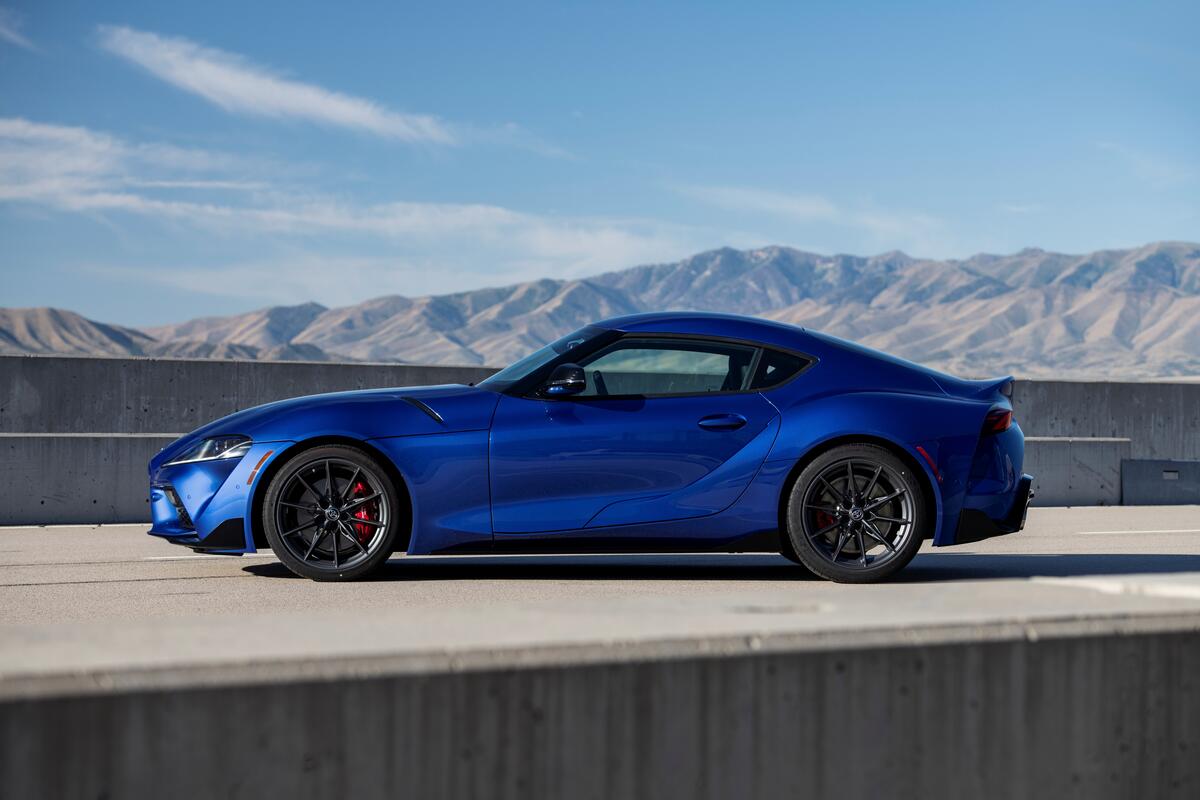
The Toyota Supra is a sports car made by Toyota. It’s designed to be fast and fun to drive, with a focus on performance rather than everyday comfort. People mention it because it’s a well-known model that many car fans recognize.
This is a plan for a city center that’s covered by a huge dome. The idea is to keep the environment controlled, which also changes how people and vehicles move around inside.
“No surface streets” means there aren’t regular car roads at ground level. Cars would be kept out of pedestrian areas, usually by using tunnels or other dedicated routes.
“People movers” are like automated shuttles that move people around a specific place. Instead of cars driving on roads, it’s usually a dedicated track or guide system.
“Multi layered tunnels” means there are multiple levels of tunnels underground. That can help route different kinds of vehicles separately and move more traffic through the same area.
They’re talking about two vehicle types: regular cars and bigger work vehicles used for business or services. The plan routes both through dedicated underground paths.
The Volvo EX 30 is Volvo’s small electric car. It’s designed to be easy to park and maneuver in crowded places, but still fit people and everyday stuff. In this segment, they also explain it’s built on a shared platform from Geely, with Volvo branding.
EV means “electric vehicle.” Instead of using gasoline, the car runs on electricity stored in a battery. That’s why people talk about EVs when comparing different electric cars.
A “platform EV” is an electric car built on a shared underlying design that other cars may also use. In this case, the host says the Volvo EX 30 is based on Geely’s electric-car foundation, then Volvo applies its branding and details. That shared base can influence how the car is laid out and built.
LIVE
Have I ever shown you my Mickey Mouse impression?
You've done your Mario impression for me in the past,
but I've not heard it. They're a little similar.
All right, give me Mickey, give me Mickey.
Oh boy, will you look at that?
That is really good. You sound like Walt himself doing Mickey.
Right. Didn't he do Mickey for like 20 years?
Yep, yep, yep. He didn't at the very first,
and then one of the animators convinced him to do it,
and then yeah, he did it for 20 years.
Have I ever given you my Donald Duck impression?
Oh, wow. Okay. Well, now I do.
I need to sit down for this one.
You might need to. All right, here we go.
It's about right.
I have a great Donald Duck trivia for you coming up.
Oh, all right. Save it. Save it.
You're going to be blown away.
I'm pretty sure you didn't find it.
Great. All right.
Onto the episode.
Let's do it.
Is it you who got the truth now?
Is it you?
Sit me down.
Say it straight.
Another story on the way.
Who got the truth?
Welcome to the spring 2026 season of Acquired,
the podcast about great companies and the stories
and playbooks behind them.
I'm Ben Gilbert.
I'm David Rosenthal.
And we are your hosts.
Today, listeners, we finally tell the story
of the Walt Disney Company.
Unbelievably, in 11 years of doing Acquired,
we have never told Walt's story.
And it's been a glaring omission.
It is the entertainment company different
than all the rest.
It's over 100 years old.
And it has played a prominent role
in almost all of your childhoods.
And if you're a parent,
likely your parenting journey too.
Oh, yes.
I'm looking at you, David Rosenthal.
Oh, yes.
And it has played a prominent role
in Acquired history too.
Our very first episode, Pixar,
done Lucasfilm, we've done Marvel,
done ESPN.
Although those are a whole different version of Acquired.
We may need to decanonize those
and redo them the proper way.
That's part of this.
Listeners, since there are tons of biographies
and documentaries and places analyzing Walt's psyche,
we're gonna focus today on Acquired's sweet spot,
which is the business.
What is it that Walt's merry band did
from the 1920s onward
that made them succeed uniquely well in Hollywood?
And when you look at Disney's profits today,
it is in a whole different league than Paramount
or Universal or Warner Brothers
or any of the other sort of classic Hollywood studios.
The business of feature film production
is a mediocre one,
especially by the standards of what we study
on this show here with Acquired, except for Disney.
Yes, exactly.
And I will say, I am a huge Disney fan.
I grew up on Aladdin and the Lion King.
My first movie in theaters was Beauty and the Beast.
I'm a huge Star Wars nerd
and my wall was plastered with toy story posters growing up.
But somehow I knew nothing about the company's early history
before starting this research.
Nor did I.
For example, it started in Kansas City.
There was a character that was supposed to be Mickey Mouse
before Mickey Mouse, but was lost in a contract dispute.
Or that many of the movies I watched in my childhood
are actually from 50 years before I was even born.
Snow White was produced before World War II,
Pinocchio, Bambi.
These films are from the 30s and 40s.
They even predate the existence of televisions
in people's homes.
Yep.
And importantly for Acquired's roots,
this really is a technology story.
Giant innovations that often bet the whole company
on things like synchronized sound
or the crazy idea of a feature length animated movie at all.
Or the multi-plane camera to photograph the whole thing
and turn it into a movie.
And of course, building a giant theme park in Anaheim
when nothing else like it existed.
And they really did invent the entire concept
of the flywheel business model
that so many entrepreneurs are trying to copy.
Oh yes.
So today listeners is the Walt Disney Company,
part one, Walt's era.
Woo.
Well, big news from here at Acquired HQ.
This episode has a companion PDF
with visuals, charts, tables and illustrations
of key concepts, including Acquired's version
of the Disney flywheel.
We did a pilot of the idea after our Vanguard episode
and we got such overwhelming positive response
that we are doing it again.
So you can get access and follow along
by clicking the link in the show notes.
You might say we're building out our own flywheel here.
We are.
We're building out our own episode cooking.
And we're taking this timeless IP
that we are developing and figuring out
even more things to do with it.
That's right.
All right, so you can join the Acquired email list
at Acquired.fm.email.
That's where we'll send our big takeaways
from each episode, past episode corrections,
exclusive behind the scenes photos
that we founded our research.
And it's where you can vote on future episode topics.
Plus we will give away a little hint
each time about the next episode topic
that's Acquired.fm.email.
Come talk about this episode with us in the Slack
that's Acquired.fm.slash Slack.
And before we dive in,
we wanna thank our presenting partner, JPMorgan.
Yes, just like how we say every company has a story,
every company's story is powered by payments.
And JPMorgan is a part of so many of their journeys
from seed to IPO and beyond.
So with that, the show is not investment advice.
David and I may have investments in the companies
we discuss in this show is for informational
and entertainment purposes only.
David, take us in.
Well, first a thank you to my main source for facts
and Walt quotes on this episode,
Neil Gaibler's biography Walt Disney,
the triumph of the American imagination.
Gaibler I think was the only author who had full access
to the Disney archives and all the research he did
for that book is just incredible.
Yes.
Well, with that, we start in Chicago in December 1901
where Walter Elias Disney is born.
And the family lore is that the Disney's are descended
from the French Disney's of Normandy.
How do you spell that?
D apostrophe I S I G N Y S of Normandy
who came over to England with William the Conqueror in 1066.
That's family lore, unverifiable.
Yes, at this point, lost to history.
Yes.
So Walt's father, Elias, was sort of a frustrated entrepreneur.
He was variously a carpenter, landlord,
a farmer, newspaper route owner,
and eventually a failed jelly factory investor.
But Elias's younger brother, Robert, Walt's uncle Robert,
was the successful one in the family.
He was a real estate speculator among other things.
And that is what brought the family to Chicago
at the turn of the century.
He had invested in a bunch of real estate in Chicago
in the Midwest.
And so Elias came also to seek his fortune there.
Now, when Walt is four,
Elias moves the family out of Chicago
to an idyllic farm town also in the Midwest
where Robert had just purchased another tract
of real estate, Marceline, Missouri.
And Lily and Disney, Walt's future wife
would say about Marceline.
It was the most important part of Walt's life.
He didn't live there very long.
He lived in Chicago and Kansas City much longer.
But there was something about the farm
that was very important to him.
And Elias moved the family
because it was kind of like,
let's get out of the dangerous city of Chicago
and raise the kids right.
So sort of somewhere small town.
I think Marceline was actually created
because they needed somewhere
for the Santa Fe Railroad's division point.
Yes, yes.
Like when it was going to maybe Chicago and Kansas City
and they were like, and this place on the map looks good.
And they started the town of Marceline.
Exactly, exactly.
And Robert, the uncle had bought real estate there
kind of speculating again that this is Marceline's gonna grow.
So Marceline was like basically a Disney movie.
There's orchards and ponds and animals and farmhouses.
There's also this charming little town
that the railroad had created with a main street,
a main street USA, you might say.
But that's getting out of ourselves.
So while the family's living there,
Uncle Robert's wife, Walt's Aunt Maggie,
every time that they would come visit Marceline
to check up on their real estate investments,
she would bring Walt gifts.
And one year, when Walt is probably six or seven years old,
Aunt Maggie brings him a big chief drawing tablet
and pencil set and Walt is enraptured.
He starts sketching all the time, drawing,
sketching everything you can see.
And as the legend goes, one day,
Walt's retired neighbor asked the young boy
to draw him a picture of his favorite horse.
And the neighbor loves what Walt draws so much
that he pays him a nickel for it.
And he hangs it in a frame in his house.
And Walt, his mind is blown, young Walt,
he's like, my hobby, my art, it can make me money.
Now, whatever the exact truth of that story is,
there is no doubt that somewhere in Marceline,
in pre-pubescent Walt's mind,
a connection is forged between these two great forces,
art and commerce.
And that would go on to drive not only the rest of his life,
but the company, the studio, the movies,
made and changed America.
Absolutely.
The thing about Marceline though,
you said it's idyllic and like it's out of a Disney movie,
the reality of living in Marceline and life on the farm
is that it was very hard.
All the kids are involved,
there's not magical economic prosperity everywhere.
It's sort of a tough life,
even though he can sort of remember it
as an idyllic childhood,
which I also think is quite the foreshadow
of kind of the Disney version of things in the future.
It is both remembered as idyllic,
but also was hard as the real world is.
Yes, and I think it's because of the age Walt was
when he was there.
So they lived in Marceline only from when he was like
four to eight or nine years old,
before he gets really put to work.
So he gets to just enjoy all this bliss around him.
Yeah, the reality is it's pretty tough
for the family to make a living.
And in fact, they can't.
So Elias adds farming to his list of entrepreneurial failures.
And when Walt is nine years old,
they have to move the family again out of Marceline
to Kansas City,
where Elias decides he's gonna purchase a paper delivery route
for the Kansas City Star newspaper,
and he's gonna put the family to work delivering papers.
There are so many protagonists that we study unacquired
who started their career as newspaper boys.
I was gonna say, just like Jack Bogle from Vanguard
delivering papers in his youth and having to get up
at four in the morning and falling asleep at school
because he has to work so hard.
Like this is quite the reversal here for Walt from Marceline.
But he never stops drawing
and he never stops making money from it.
In Kansas City, he would draw frames for the local barber shop
who would pay him either a nickel or a free haircut for each.
And that would be Walt spending money growing up
that he would earn from his art.
Yep.
So later, when Walt enters high school,
Elias moves the family back to Chicago again,
this time for the jelly factory, which ends up failing,
where Walt becomes the cartoonist
for his high school newspaper.
But he's not there long before he leaves high school
to go join the Red Cross and get shipped off to France
as an ambulance driver during World War I,
where unfortunately, he would acquire a chain smoking habit
that he would keep up for the rest of his life
and eventually would kill him way too young.
Yep.
But Walt's not in France for long before the war ends.
And in the fall of 1919, he lands back in Kansas City
where Roy Disney, his older brother who is,
I think eight years his senior.
Nine years maybe.
89 years older.
Yeah, much older.
Yep, is living.
And Walt has a plan that he's gonna seek his fortune finally
as a true professional cartoonist.
So through Roy, he gets introduced
to an advertising art shop that's looking for apprentices
to help draw like flyers for the upcoming holiday rush.
And Walt works there for six weeks through Christmas time
and then gets unceremoniously laid off.
But he gets two things out of this brief experience
as an employee.
One, he gets a credential.
He can now say that he is a professional artist.
All you have to do is get paid to do something
and then you become a professional.
Exactly, exactly.
And you get something else.
A co-founder, another young apprentice from the art shop
named UB Iwerks.
I sort of think of UB as the Steve Wozniak of Disney.
Yes, absolutely.
Walt is like the original Steve Jobs
and I think you can definitely make the case
that UB is the Steve Wozniak.
Although I think Walt was more hands-on.
Yes.
Walt was also an animator.
UB was just a better animator
and Walt was a camera operator
and Walt was building stuff, doing things with his hand
and he was in the primary technology
and artistic trade that his business was in.
So after the two of them get laid off,
Walt suggests that rather than go look for jobs again,
they should just start their own studio together.
I mean, hey, they're professional artists.
Like why not?
So they create Iwerks Disney Commercial Artists,
incorporated.
Supposedly in that naming order
so that it didn't sound like a optometrist shop
like Disney Iwerks.
How amazing is this?
In the first Iwerks in Disney partnership
in Walt Disney's first business,
he was not the main name on the door.
At least he was not the first one.
Yes, not the main name on the door,
but he is the driving force behind the business.
So he goes out to pitch prospective clients
around Kansas City for the services
of this new Iwerks Disney commercial artists firm.
And one of the clients that he goes to pitch
is a up and coming company called
the Kansas City Slide Company,
which happens to have become the country's largest producer
of advertising slides and short commercials
that would get shown in movie theaters
before feature films.
And the slide co has so much work at this point in time
that all of these films and movie theaters
are taking off around the country
that they say, hey, you guys seem talented.
We don't wanna just contract with you.
Why don't you come work here full time?
So Walt and UB's first entrepreneurial venture
quickly comes to an end and they go join the slide company.
Now, the reason that they specifically wanted Walt
and UB is that they have a relatively new business line
at the slide co, which is producing animated commercials
to run in movie theaters before films.
And this is what Walt and UB
end up getting put to work doing.
And they both just fall in love
with this new art form of animation.
It's like everything that Walt and UB too loves about drawing,
but it's more than just art.
It's technology, you know, you need cameras,
you need film, you need all these new inventions
to make animation happen.
Yeah, and at this point,
animation was really primarily used in advertising, right?
There wasn't really a successful thriving industry yet
as entertainment of its own based on animation.
It was like very, very early
and to the extent that it did exist as entertainment
and shorts, short films, cartoons on its own,
it was all based in New York, like not in Kansas City.
But the whole industry is only like barely 20 years old
at this point in time,
because you couldn't produce animation on any sort of scale
until you had widespread commercially available
film cameras and film projectors.
Like this whole art form is brand new.
It couldn't exist before the technological innovation of film.
Yep, that's exactly right.
So part of the reason that cartoons are working well
in advertising right now for the slide co,
is that it's this novelty, almost gimmick.
It captures people's attention.
Even though they have no color, no sound, no story,
it's just a series of like visual novelties.
It's something they've never seen before.
Of course, it's interesting.
Yep, and in Walt's mind,
who really is always thinking about
how can I make a business out of a career out of this?
This is also what makes it super attractive to him.
Because the whole industry is so new of animation,
he figures that he can quickly become as good or better
than anyone else in the world at it.
Unlike if he's gonna try and be the best commercial artist
in the world, good luck young Walt Disney
in Kansas City, Missouri.
Oil painting is thousands of years old.
Right, right, right.
But becoming the best cartoon animator.
Small pool.
Yeah, he and I might have a shot here.
Yep.
So Walt and Nub start experimenting on nights and weekends
with their own work,
just trying out, creating their own animations,
using the slide co-equipment and cameras.
And Walt puts together a few short cartoons
that he creates all himself.
He brands them as quote, Laffograms.
And he ends up selling them on the side
to a local movie theater chain to run before features.
And the Laffograms become a hit in Kansas City.
Audiences love them.
I love that the thing that led to the Walt Disney Company
is called Laffogram, like Laff-O-Gram.
It reminds me of, what was the Rolex watch,
the Turnograph?
Oh yeah, yeah.
Yeah, it's such a hokey name for what ends up becoming,
well, this doesn't become Disney,
but the spirit of which becomes Disney here.
And the thing that they're doing, they're so primitive.
There's no sound, there's no voices, there's no color,
there's barely backgrounds.
Yeah, it's so different from what you're used to today.
Because of those limitations,
you can't create a story or a real sense of character
for any of the characters that are in there.
Like you can't build a relationship with the cartoons
that are being made at this time,
like you can with Mickey Mouse or Donald or Goofy or Minnie.
The only emotion you can invoke is humor,
and the only real way to do humor is slapstick.
So it's just these like super exaggerated,
they call them gags, like things that a character does
that isn't necessarily consistent with anything else
that they've done within a few minutes
of starting gag happening and ending,
or sometimes even a few seconds.
And honestly, that's actually not that different
than film itself overall at this point in time.
Charlie Chaplin is the big star in America
and around the world, the big movie star right now
in the silent era.
And most of his movies are exactly what you described, Ben.
Honestly, it's all physical comedy, sort of slapstick.
It's the stuff that my toddler laughs at.
You could resummarize every scene of every comic
and most movies by going, oh, he fell down.
Exactly.
So in May of 1922, at 20 years old,
Walt decides that these Laugh-a-grams
that he's making are having enough success
that he's ready to leave the slide company,
go out on his own again,
and he found Laugh-a-gram Films Inc.
And once again, he convinces Abaiworks to quit
and come along too, along with a few other animators
from the slide company.
And it's another failure
because despite the Laugh-a-gram's local popularity
there in Kansas City, by the time we get into 22, 1923,
animation and cartoons in general around the country
are starting to lose their appeal.
The novelty is wearing off, the fad is dying down.
There's actually a survey of theater managers
right around this time in like 1922 or 1923,
where one of the questions is what filler options
do your audiences like to see
around the feature film that you're showing?
Cause it also would be newsreels or live comedies
or short serials.
Remember, there's no television.
There's not even really radio at this point in time.
If you want to get news or any kind of entertainment,
you go to the movie theater.
All right, I got a stat on this.
In the 1920s, the average American went over 40 times
per year to the theater.
Wow.
This is what you did every week for entertainment.
Compare that to today where like maybe you go once a year.
It's two.
The average American goes to a movie theater twice a year now.
Yeah, I mean, back then it was like,
you could go to the movie theater
or you could go see a live show, ballet or opera
or like a sporting event, like a baseball game
where you go to the movie theater, that's it.
And when you go to the theater, it was a bundle.
I mean, yeah, you were there for a production,
but I think the point you're trying to make is
there were also these cartoons with gags,
there were newsreels,
there was the feature you're there to see,
but it's sort of this like bundle of,
all right, let's see what the theater has in store
for me today.
Yeah, exactly.
So this survey of theater managers,
only 23% of respondents say that they show cartoons
as part of the bundle and that their audience is like it,
which is by far the lowest of any of the other filler options.
So Laffagram can't really find a market outside
of their local popularity in Kansas City.
And in 1923, the company goes bankrupt and shuts down.
And Walt is now this sort of 1.5 times
disgraced entrepreneur here in Kansas City.
Following right in his dad's footsteps.
Yeah, yeah, yeah, exactly.
And he raised money from people in Kansas City,
friends, family.
He went and lost people's loan capital that they gave him.
Yep.
So Walt goes to Rich Uncle Robert for advice
on what to do given his failure.
And Robert says, you know, kid, best thing to do
if I were you, I would just skip town.
Get out of there.
Which actually is really sound advice for back then, you know.
People's reputations did not travel with them.
Nope.
Your credit was the credit locally that you had
with the people in your town and no other way
to find you otherwise.
Now it just so happens that both Robert
and Walt's older brother Roy have just also skipped town
from Kansas City and moved out west to Los Angeles.
So Walt packs his belongings,
which is basically nothing at this point in time,
hops aboard the Santa Fe train bound for LA
and joins them in Hollywood.
And when he arrives there in the summer of 1923,
he's 21 years old.
He stays with Uncle Robert.
And initially, you really can't make this up.
I couldn't believe this when I read it.
Walt at first thinks that he's come to Hollywood.
He's gonna get a directing job in Hollywood
at one of the studios there.
Well, yeah, he has abandoned the idea of animation.
He basically thinks he's too late.
He's seen some of the stuff that comes out
of the New York cartooning scene.
And he's like, well, I'll never be as good as them.
So I need to go start over something completely new.
Right, which is sort of, you know,
silly and wrong in and of its own.
But also like the hubris that he thinks
that he could just show up in Hollywood
with no directorial experience
and become the next DW Griffith.
That is Walt for you.
Do you know this story of the Universal lot?
No, no, no.
So he rolls up to the Universal lot after getting there,
having no job, no money, borrowing a bed.
And he goes and has fake business cards made
that says he is with Universal.
He's just the Kansas city representative.
So no one at Universal would really know who he is.
And he gives it to the receptionist on the Universal lot
and he walks in.
And so he spends at least a day from what I could tell,
roaming around and learning as much as he could
about film production.
And like internalizes a lot of those lessons.
And then he tries to come back in future days
and say like, oh yeah, I'm sort of like with Universal.
And now I have experience and can you give me a job?
And he ends up running out of money and doesn't get a job.
That is amazing.
I didn't know that story.
So once he inevitably gets rejected
at all the major Hollywood studios,
he says later, when things began to look hopeless,
I got my cartoon things out again.
And he sets up shop animating again.
He's like, well, as you said, Ben,
this is the one thing I know how to do.
I should try that.
And at this point, pretty much the only popular cartoon
left in the industry is Felix the Cat,
which is created by Pat Sullivan out of New York
and distributed by the pioneering Margaret Winkler
also in New York.
So, well, has one thing, one asset leftover
from his failed Laugh-a-Gram days,
which is a reel of a hybrid live action cartoon short
that he had created with a,
right before he left Kansas City,
called Alice's Wonderland,
about a real life little girl
who interacts on screen with cartoons
that they've drawn over the film.
Which is like completely pioneering technology.
The other people who were doing animation this time
were just doing cartoons.
These Alice comedies, as they came to be called,
were a new process by which you could go
and film a real life actor
and then have them interact on screen
with cartoon characters and put them in the cartoon.
Yes, very cool.
And also had the unique property of being cheaper to produce
than full animation,
because you only had to animate the characters,
not all the backgrounds and everything.
Right, yeah, there is this funny counterintuitive thing
that live production is much faster and cheaper
than animation.
You just have a film camera
and you pointed at something in the world that exists
and you kind of get everything
that you're pointing it at for free.
Like the actor is interacting with a bunch of stuff
and when you're making an animated film,
you need to draw literally everything from scratch.
It's much harder and you need to do it
frame by
rather than the world just sort of happening around you
and you taking these exposures in a video camera.
Yep, so Walt sends Alice's Wonderland off to Winkler
and she likes it.
So she commissions Walt to create 12 more Alice comedies
for like $15 to $1800 each.
She does and David, did you know we have seen this contract?
Was this in the documents that we saw
in the Disney archives?
Yes, so listeners for this episode,
David and I went and spent a few days down in Burbank
looking through the corporate archives
and one of the things that the archivist pulled for us
was this contract and I have a photo of it,
I'm looking at it right now,
agreement entered into this 16th day of October 1923
between Walt Disney of 4406 Kingswell Avenue,
Hollywood, California, blah, blah.
And yeah, you're exactly right,
for 12 negatives of subject series
and then in all caps, Alice comedies and-
Amazing.
I also have a picture of this on the last page
of this contract,
because this is effectively the contract
that puts Disney in business.
I mean, this becomes the Walt Disney company.
Yeah, this is the moment, beginning of Disney.
You can see his signature,
which is much less flowery than the version
that you see in the Disney logo.
He would sort of evolve it over time.
But yeah, this is the moment.
Disney, Walt is in business.
It's his first actual commercial big time deal.
Yes, and I think when Walt sort of gets word from Margaret,
he runs into his brother's room.
His brother, Roy, actually has tuberculosis at this time.
It is in like a hospital ward
and he sort of runs in and shows in the contract
and says, we got it, it.
We're in business, we're doing it.
And you know, $15 to $1800 a film
is a lot of money at this time.
And Roy talks through with him and says,
okay, let's get right to work.
And he literally stands up and leaves the hospital ward.
It's like, all right, my tuberculosis is behind me.
And the two of them found the Disney Brothers cartoon studio
right there in October, 1923.
As a true partnership between the brothers,
Roy manages the business and the finance.
Walt manages the creative and they get to work.
So Walt, of course, writes a by works back in Kansas City
and several of the other talented animators
that they knew there and says, all right guys,
I got it this time, come on out to California.
We finally got a deal.
We're gonna build a real company
and a real animation studio.
And they do, the behemoth we know as Disney today
is the Disney Brothers cartoon studio
and a whole bunch of Kansas City guys
that moved out to join Walt to start cranking away.
Yep.
And the Alice comedies become a moderate success
in the marketplace.
Again, I think the novelty of cartoons plus live animation,
audiences are entertained for a few years.
Ultimately, the Disney Brothers studio produces 57
of the Alice comedies from 1923 to 1927.
And then in 1927, Winkler's relatively new husband,
Charles Mintz, who actually got to start working for her
in the business.
By this point in time, he has taken over
as sort of head of the business.
He is no longer getting along with Pat Sullivan,
the creator of Felix the Cat.
Big opportunity.
Big opportunity.
And he has brokered a little arrangement
with Universal Pictures, the big New York film distributor
to on the slide create a new character to rival Felix.
Now, mind you, he and Winkler are still the distributor
for Felix, for Sullivan.
And they're creating a new character
to compete with him on the side.
Sort of like they're building their own chips
while still buying Nvidia.
And so he turns around and taps Disney.
And says, hey, Walt, can you make us a new series
and a new character?
Like Felix, but not Felix, like maybe not a cat.
Right, we need it to be plausibly different
while still having everything that made Felix successful.
Yes, so Walt and a cast about, what can we come up with?
It's like a cat, but maybe shares a lot
of the same recognizable attributes,
like a lot of white fur, a tail, some big ears,
easy to draw in black and white.
And they come up not with Biky Mouse,
but with Oswald the Lucky Rabbit.
And Oswald is a big hit.
He's got the backing of Universal distribution behind it.
That's a big hit for Universal,
big hit for Winkler and Mintz,
and a big hit for the Disney Brothers cartoon studio.
And it's not surprising because if you give
the creative brief to Walt and up,
take something that's kind of working,
but apply your style.
Their style was great.
I mean, they were emotional animators.
There's a great quote in the book,
Walt Disney and American Original by Bob Thomas,
that says, before Disney cartoons were slapdash,
two-dimensional characters in bizarre movement
before elemental backgrounds.
Disney insisted on rounded humanized figures.
He wanted the humor to come out of the character,
not the outrageous action.
So it's sort of like, hey, here's the template,
but Disney-fy it or I-Works-fy it
in a way that really can speak to people.
Well, I think it really was the partnership
of the two of them.
I think I-Works had like immense artistic talent
as an animator and was able to do that.
And Walt had taste.
Like he recognized it and he knew when and where to apply it.
Yep.
So on the back of the Oswald success,
the Disney Brothers cartoon studio grows
pretty quickly from this rag tag group from Kansas City
to like a real operation, like a real, you know,
at this point, bordering on major animation studio.
They hire about 25 employees
and start churning out Oswald cartoons.
Yep.
They move into a real studio building
on Hyperion Avenue in the Silver Lake neighborhood
of Los Angeles.
And when they move there, Walt and Roy decide
to get unclear which brother's instigation
that they need to rename the company and the studio
from the Disney Brothers cartoon studio
to the Walt Disney studio.
So there's two stories about this.
I was gonna say, I've seen both.
One is that it was actually Roy's idea.
Yes.
Because he's like, hey, you know,
we need to start building a brand.
Like people need to know who is making these Oswalds
and it should be the Walt Disney studio.
And you're very clearly the front man,
you know, you're selling, you're the visionary,
you're the sort of creative talent.
And this is a creative company.
Of course it should be you.
Yep.
The other story is that Walt's always had a dream
since he got to Hollywood of having his name
up on a neon sign.
Now that they have their own real studio,
he wants a neon sign constructed
that says the Walt Disney studio,
which I think does happen.
Yes.
We'll put the photo in the email.
The Hyperion Avenue studio has this really cool sign
or did for a long time before it got knocked down.
And I think it's a script mall or something today.
And in that vein, now that the studio
has become a real operation,
Walt moves from actually doing a lot of the animation
and camera work, mostly to overseeing the studio,
which you have to with an operation of 25 artists
and creative people and camera folks.
You need someone who has an overall vision
and taste to drive everything.
Yep.
Now, as Walt is transitioning from sort of doer
to really studio head.
And worth knowing the ownership of Walt Disney studios
that would become Walt Disney productions,
that would become the Walt Disney company
was at this point 60% owned by Walt and his wife
and 40% owned by Roy and his wife.
Yep.
So Vince, the husband of Winkler back in New York
who has sort of already proved his stripes by his dealings
with Felix the cat and Pat Sullivan.
He senses another opportunity.
He thinks that Walt has become superfluous.
And that it's actually just the animators who really matter.
And because the Walt Disney studio
doesn't actually own the IP of Oswald the Lucky Rabbit.
Universal does.
Although the Walt Disney studio was acting
like this was sort of their creation that they owned.
Yeah.
I don't think Walt or Roy really read the fine print
on the contracts here.
So in early 1928, Walt and his wife, Lillian,
who Lillian also was an early studio employee.
In the Inkin paint department.
Inkin paint department, that's right.
We'll get to that.
They make a fateful trip as a couple to New York
where one of the items on the agenda is for Walt
to go meet with Mints and ask for a raise
in the amount that the studio is getting paid
per Oswald short.
So Walt sits down with Mints and Mints is like,
well, I don't know about paying you more.
I don't think I like that idea.
In fact, I'm not even really sure, Walt,
what you are doing around here any longer.
But I'll tell you what, I'm a nice guy.
I'm willing to let you and your little studio
stay involved here and keep making the Oswalds.
But we're gonna have to pay you less, not more.
Like $500 per cartoon, less.
Which my understanding is that basically wiped out
the margin and they were saying,
we'll pay you cost to make these Oswald cartoons.
Yeah, I think Mints had basically calculated,
okay, if Walt takes this,
then I'm willing to let his studio keep making it.
And if he doesn't take it, then it's all equal to me.
I'm just gonna steal his animators
and go make it myself.
And crucially, before this meeting even happens,
he's already stolen the animators.
Mints has an ace in the hole.
He has, I think, signed contracts
with nearly all the animators except Ub Iwerks.
He has sort of through an act of subterfuge
gotten in touch with each of them individually
and brought them over.
Yeah, only Ub and I think maybe two or three other animators
refused to sign these secret deals with Mints
and stayed loyal to Walt and to Roy.
Once Walt realizes this, there's nothing he can do.
Like it's a free country.
He can't force his animators to stay.
He doesn't have employment contracts with them.
And he also doesn't have any control or rights
to the actual Oswald IP.
So he has no leverage.
He's got nothing.
He's got no customer contract.
He's got no employees.
He's got no intellectual properties.
Suddenly the enterprise value,
so that the entire value of Walt Disney Studios
is effectively zero.
Yep, it is a extremely bitter lesson for Walt and for Roy.
And it is one that you can bet they never forget
for the rest of their lives.
And really like everything in Disney's history
and all of the enterprise value that Disney has built
that we will see all across the rest of this episode
traces back to this moment.
It's a hard reaction to this lesson.
Totally.
I have a fun bit of trivia for you, Ben.
So as I think you know, Disney eventually does get
the rights to Oswald back.
This is gonna be my trivia for you.
Oh!
All right, actually ask your question.
We might have different takes on it.
Disney eventually does get the rights to Oswald back
in 2006.
Bob Iger, one of his first access CEO did the deal.
Yes.
Do you know how Bob got Oswald back for Disney?
So let's see.
By this point Disney had acquired ABC.
Yep.
Which had acquired ESPN.
And who owned Oswald at this point?
It was Universal, which was owned by NBC,
which is now owned by Comcast.
Correct.
So there's an ABC asset that Bob effectively trades
in exchange for Oswald.
And I think that ABC ESPN Monday Night Football asset
is Al Michaels.
Al Michaels, the Monday Night Football commentator.
Like a sports team trade.
To NBC in exchange for the IP rights to Oswald the rabbit.
And Oswald is repatriated and NBC gets Al Michaels
and all is right in the world.
Amazing.
So back to 1928.
Walton Royer basically back at square one here.
They have not really just nothing.
They actually have less than nothing
because Mintz ever the, well really just kind of weasel
is the right word.
Yeah.
He makes Walt and Walt Disney Studios
finish out the current Oswald contract
which still had a few cartoons left to animate on it
and pay all of the animators who had all betrayed him
and were all about to defect.
Mintz is like, no, no, no, you've got a contract.
You're going to keep paying these folks
while they finish up the last couple of shorts
on this contract.
Just brutal.
Absolutely humiliating for Walt.
And so then as legend has it
on the long, long train ride back home from New York,
Walt is struck by a bolt of inspiration.
And he scribbles a sketch for a new cartoon character
right there on his drawing pad on the train trip.
A character that wouldn't just reverse all the woes
of the Oswalds and turn around the company's fortune
but would maybe become one of if not the most recognized
figure in all of human history.
But before we tell the story of Mickey Mouse,
now is a great time to thank our friends at JP Morgan.
Yes, our presenting partner.
So today we are sharing a story
from one of JP Morgan's partners
and a company that you may know, Bill,
which is formerly Bill.com.
Right, Bill is the financial operations platform
for half a million small and mid-sized businesses,
what they call the Fortune 5 million.
They help manage and maximize cash flow for SMB companies
and Bill's DiviCard product is what employees
at those businesses use to fund their operations
day to day.
So here's a scenario that many listeners
may have experienced.
Someone on your team maxes out the credit line
on their corporate card with an unexpected purchase.
You send a wire to pay off the card
so you can continue using it,
but it takes two to three days to clear.
Meanwhile, your team can't transact.
Yeah, Bill solved that for its half a million customers
using an embedded payment solution from JP Morgan.
With API based sub-ledgering,
they can manage millions of payments in real time
on any platform all with one bank account.
Every Bill customer gets a unique virtual account number.
So the moment a payment is received,
the credit line is restored.
The result is a way simpler way to receive
and route payments at scale.
And the actual numbers are awesome.
Payment posting went from two to three days to seconds.
Inquiries dropped 83%.
Even Bill's own treasury team reclaimed 20 hours a week
from manual reconciliation.
For decades, these were Fortune 500 only capabilities,
but Bill and JP Morgan figured out how to deliver
that same infrastructure to the Fortune 5 million
while also improving Bill's internal operations.
You can read the full case study as always
at jpmorgan.com slash acquired.
And something else, if you wanna join us
and JP Morgan in person, we'll be on stage
at the We Are Developers World Congress
in San Jose this September.
Click the link in the show notes to learn more.
Okay, so David, how does this Oswald catastrophe
lead to Mickey Mouse?
All right, so here's the story of Mickey Mouse
as Walt would tell it.
March 1928, he and Lillian are on the long train ride
back home to LA from New York.
He's struck by the bolt of inspiration
for a new cartoon scenario about a plucky mouse
named Mortimer who is attempting to fly an airplane
just like his hero, Charles Lindbergh.
And this would go on to become
the Mickey cartoon plane crazy.
So Walt shows his sketches that he's making to Lillian
and Lillian says, I like it, but Mortimer?
That's too sissy a name.
How about Mickey?
And thus Mickey Mouse is born.
Now, the real story is more likely
that Walt and Lillian get back to LA
and Walt is like sweating.
So he and Roy and Ab and a couple other animators
who stayed loyal to them hold up
and they start brainstorming ideas
for some kind of new idea or new character
that they can create to replace Oswald
and turn around the studio's fortunes.
And also when you see Mickey and you see Oswald,
it's not hard to imagine where Mickey Mouse came from.
It's like kind of like, shore in the ears, make him circles.
You know, they both kind of have this white face
and the black outline.
I mean, it's really just the same brief
that created Oswald.
It was like, hey, take Felix and do something like Felix,
except this time it's take Oswald
and do something like Oswald.
And make damn sure we own it.
Yes, exactly.
So they land on the idea of a mouse.
And didn't Walt claim that he sort of like always
had a fondness for mice
because there were mice that would like jump in his trash can
in Kansas City while he was animating and...
Sure, whatever.
You know, it's all just part of the Walt myth.
Yes.
And at least according to the Neil Gaibler book,
most likely, Ab is the one who first draws Mickey,
not Walt on the train.
But either way,
Ab definitely was the primary animator
of the first Mickey's for the whole first series of Mickey's,
including Steamboat Willie.
So by the summer of 1928,
we finished out the Oswald contract
and Walt and Ab and the small little merry crew
have gotten two Mickey shorts ready for production,
plain crazy and the Gallup and Goucho.
And Walt takes them around to distributors.
You know, the Walt Disney studio is well known at this point.
This seems like it would be promising new IP
and none of the major distributors are interested.
They're like, yeah, I don't know.
Mickey, it's like Oswald, but...
Without all the, you know,
thousands or hundreds of thousands of raving fans for it.
So... Exactly, exactly.
And then comes the Eureka breakthrough idea.
One of the gang recalls that the jazz singer,
the famous first popular talky,
he did movie with dialogue and sound
that had just come out the previous fall,
when they went to see it,
that there was a cartoon screened alongside it.
And Walt, when he hears this,
puts the two ideas together in his mind,
of a cartoon and sound.
And supposedly he says, that's it, that's it.
That's what we've gotta do.
Stop all these silent pictures.
Now at this point, people had made cartoons with sound,
but nobody had ever made a cartoon
with sound like the jazz singer had sound.
Synchronized sound.
Synchronized, yes, exactly.
Where what was happening in real time in the cartoon
was then played in sound,
exactly synchronized in the movie theater.
Yeah, the concept before was there's music that plays,
but it's only loosely attached.
And this is to the frame and to the beat of the music.
Like if you see Mickey on screen,
bop into something, then you might hear a xylophone
on the exact same downbeat, play a note.
Yeah, it's not just that like there's some music
accompanying this cartoon that you're watching,
it's that what is happening in the cartoon
feels like it is producing the sound.
Yes, there's a great business model lesson in this,
which is with the first two Mickey's flopping,
if you just do the same thing as an existing competitor
who already has distribution, brand customers,
it's not enough.
You need to go do something leveraging
a new piece of technology or a new platform.
You gotta come at it from an orthogonal way
in order to leapfrog and make people pay attention to you.
Otherwise you're just a like smaller worse also ran.
Totally, and that can be anything.
I mean, the only reason that the Oswalds worked,
even though they were a rip off of Felix,
it was because they came built in
with the universal distribution.
But yeah, Walt taking out the Mickey's before bringing sound,
like he's got nothing to bring to the table here.
Yeah.
So Walt lines up access to the Cinephone Sound Recording
System from a character named Pat Powers,
who had actually helped create universal,
some number of decades earlier,
and then had gone on to become a sound accolade
and entrepreneur developing a sound system
for this new movie technology.
And so Walt and Ub and crew,
animated a test sequence of a Mickey with sound,
and they screen it for all their wives and girlfriends.
And Ub writes later of what happened next
when they screened the synchronized sound Mickey
for the first time.
I never saw such a reaction in an audience in my life.
The scheme worked perfectly.
The sound itself gave the illusion of something emanating
directly from the screen.
Walt kept crying, this is it, we've got it.
It turned out that sound was the critical enabling technology
for animation to go beyond a novelty
and allow the characters that are on screen
to actually have personality that audiences connects with.
So interesting.
And it's not obvious at first.
Until you do.
I mean, it's obvious in retrospect,
but you can totally see how when Walt had this insight
and then they made the investment
because doing a test animation and synchronizing the sound,
like even to show a little screener
must have been really hard at the time
because none of the tools existed.
They sort of had to invent the way
to synchronize the drawings with the music and the systems.
It's sort of a big bet even to try
and see if that creates personality.
Right, right.
And sound did the same thing for live action movies,
but it's not that big a leap to have humans talking,
like humans talk.
Sound just made it way better.
Sound for cartoons was this giant leap.
These characters, this art can now be actual characters
with personalities in a way that they couldn't before.
Non-obvious at the time,
completely obvious in retrospect.
Yep, so they make Steamboat Willie
as the third Mickey, but the first with synchronized sound.
Which we're gonna skip over the whole headache nightmare
of creating this thing,
but it was like Walt constantly going back and forth
to New York, betting every last dollar that he had,
inventing all these new processes,
trying different ways to get an orchestra
synced to the sound.
Oh yeah, they like animated a little ball on the screen
that would sync to the orchestra as they were playing.
Yes, and he couldn't get the original conductor
of the orchestra to actually use his method.
The orchestra guy was like,
eh, trust me, and then it was all out of sync
with the screen.
The net of it is it's a giant, painful,
operational struggle to get this thing out,
but my God, does it hit?
Yes, well, you know,
this is the nature of the New York distributors.
They get it made.
Walt takes it and shops it around,
all the big folks in New York,
and they're so conservative, they're like,
well, this is cool, but I don't know
how audiences are gonna react to this.
We kind of want to see a test first.
I don't want to be first in line.
Yeah, exactly, exactly like VCs.
Like, oh, so Walt decides that he's gonna take matters
into his own hands, and he goes directly
to the manager of the Colony Theater in New York City
and cuts a deal for $1,000 to run Steamboat Willie
before the features that they're showing
in the Colony Theater.
So going around distributors just to get this
in one theater as a test.
And so Steamboat Willie premieres in New York City
on November 18th, 1928, before the film Gang War.
Nobody really remembers Gang War
because Steamboat Willie is a revolution.
Critics love it, audiences love it.
Yeah, isn't there some famous story
of people sort of standing up and screaming,
we want Steamboat Willie again
instead of playing the main feature?
Yeah, yeah, exactly, exactly.
But still, you know, Disney now needs to find a distributor.
And now he's got the proof point.
These New York distributors, they're still so conservative.
They're like, well, you had one hit.
I don't know that like we can really trust
that this isn't just a fad,
that the future sound mickeys are also gonna be a hit
and that you can repeat the magic.
And famously, one distributor while Walt is meeting
with him here, and he's trying to explain to Walt
why he's gonna pass again on the Mickey deal,
picks up a package of lifesavers candy.
And he says to Walt, the public knows the lifesavers brand.
They know what these are.
They don't know Walt Disney and they don't know your mouse.
I can only imagine Walt sitting here just seething.
But this makes a huge impression on him.
I think this is an important thing about Walt.
He definitely has a huge ego, right?
He is very willing to learn,
even from pretty obnoxious people.
He's like, you know what, you're right.
Oh, I think he's motivated by learning.
He's motivated.
I think he's an engineer.
I think he loves picking things apart
and learning the way they work.
I think he's motivated to make the best art he can
in addition to making the best business he can.
So if someone's gonna offer him a lesson,
a way to learn something, yeah.
Yeah, he'll take it.
He'll take it even if he might be mad at the person.
So he writes about this moment later.
From now on, the audience was gonna know
if they liked the picture,
they were gonna know Walt Disney's name.
Ultimately, what Walt does is he turns to Pat Powers,
his partner in the sound technology,
who had been one of the original universal executives,
and they cut a deal where Powers
will be Disney's direct distribution agent
in return for just 10% of the gross revenue on the Mickey's,
which seems like a pretty good deal.
Yeah.
And indeed, it was kind of a too good to be true deal
because Powers, like all these New York guys,
was basically plotting to do the exact same thing
as Mince to Disney.
He wanted to start working with Walt,
give him a sweetheart deal,
and then lure away the animation talent,
because Powers, remember, has the sound technology
that he's given to Walt.
So he's thinking, if I get the animators,
what do we need Walt for?
So this explains the sweetheart deal on distribution
because that was the real prize he was after.
And just a year later, in 1930,
Powers does the unthinkable.
He convinces Ub IWorks to quit and leave Disney.
He says, we're gonna get you set up with your own studio.
You're gonna work with me, we're gonna create new characters.
It's the exact same thing that Mince did to Disney last time.
Absolutely brutal.
Except it plays out the exact opposite way.
Because Walt's learned his lesson.
Walt has learned his lesson.
By the time this happens,
over a dozen Mickey shorts with sound have come out.
Every single one of them branded prominently upfront
and at the end a Walt Disney comic
and they had become huge hits.
So even though Powers steals IWorks away, nobody cares.
Everybody still wants the Mickey's,
everybody still wants Walt Disney comics.
Disney has made himself the lifesavers of animation.
Disney first switches to Columbia for distribution
and then to United Artists
and audiences just keep loving Mickey.
In fact, they love him so much
that it leads to the discovery of a whole new business model
for Disney and the company,
the intellectual property flywheel.
And it starts with the Mickey Mouse Club.
This is wild.
I had no idea about the origins of the Mickey Mouse Club.
Basically discovered by Disney by accident.
Totally by accident.
So in the summer of 1929,
just a few months after Steamboat Willie
and the first sort of nationally distributed Mickey's,
the manager of the Fox Dome Theater
in Ocean Park, California,
contacts Walt with an idea.
Why don't we partner to start a Mickey Mouse Club for kids?
I've got like a thousand kids
who keep showing up here at the theater every weekend
and all they wanna do is watch the Mickey's
again and again and again.
I think we should capitalize on this.
We can create a club, like a kids club,
and we can charge parents a membership fee.
The kids will love it.
The parents will get them out of the house every weekend.
It'll be great.
And we can pilot it here at the Fox Dome Theater.
And then if it works,
I think we can franchise this nationally.
And so this is exactly what Walt
and this theater manager do.
The way it works when they take it national
is that theaters would buy a quote,
Mickey Mouse Club Charter from the company,
from the Walt Disney studio.
It's like a franchise type.
Yeah, like a franchise right for $25.
And then as part of the club,
the kids and their parents would gain the right
to buy exclusive Mickey merchandise.
I mean, it's kind of amazing, right?
Pay to become a member of a club
to dedicate yourself to fandom
so you have the right to buy more things.
The right to buy more things.
Yes, so like hats, buttons, banners, et cetera.
And all of this revenue is getting split back with Disney,
the $25 club charter,
and then all the merchandise revenue.
Pretty quickly, there are 800 Mickey Mouse Clubs
across the country with more than 1 million total members.
That is more members than the boy and girl scouts
of America combined at this point in time.
That's insane scale and insane speed of adoption
pre-internet.
Right, right.
Pre-internet, pre-cable, pre-broadcast TV.
The ability to get a million Americans doing something
within a few years is like, how did that even work?
I mean, I'm trying to think how word
could even spread that quickly.
I guess through Disney's distributors to the theaters.
Well, this is like a no brainer proposition
for a movie theater operator.
You're gonna take your Saturday or Sunday afternoons,
which are probably reserved mostly for kids anyway,
all your matinee showings.
You're gonna convert it into a Mickey Mouse Club.
Kids are gonna love it.
They're gonna buy a bunch of stuff
that you otherwise wouldn't have the opportunity
to sell to them.
Parents are gonna love it
because they get rid of the kids.
And then for Disney,
they're just getting this turbocharged distribution
brand recognition of Disney the company
and Mickey Mouse the character.
Yeah, it's amazing.
Okay, so they take the learnings
from the Mickey Mouse Club, right?
And they kinda lean into Mickey
in a big way at the corporate level.
Totally.
So just a few months after the Mickey Mouse Club kicks off,
in January, 1930,
they launched a daily Mickey comic strip
with King Features Syndicate in newspapers
around the country.
It gets published daily in 60 US newspapers
and then also internationally in 20 more countries
around the world.
So Disney is getting paid
to produce a Mickey comic strip,
which only cost them the salary of the one animator
that they have making it every day.
A 24 year old named Floyd Gottfriessen,
who would do it every day for 45 years.
Wild.
So not only are they getting revenue for this,
they're getting free daily advertising
and IP exposure to probably a 100000000 plus people
through this newspaper comic distribution every single day.
And even if they weren't getting paid for it,
the marketing on that,
so that people go see Mickey films.
Exactly, yeah, it never becomes a huge revenue
or profit driver for them,
but like that free daily marketing
and most major newspapers around the country is incredible.
Yep, interesting to know Oswald actually was on a candy bar
back in the day,
but when Walt, who at the time saw that he owned Oswald,
had the opportunity to monetize it,
he was like, I didn't even consider it.
It doesn't need to be an additional revenue stream,
it's just really good for me if Oswald is on the candy bar.
So that's sort of, they're getting the seeds of like,
okay, we're making some money on the comics,
but it really is like a massive marketing engine.
Well, you're teeing up the big one here,
which is March and Consumer Products.
Yep.
So pretty quickly after Steamboat Willie,
Walt is walking the street in New York
and a man comes up to him,
like comes up to Walt Disney on the street
and offers Walt $300 to license the Mickey character
to put it on a series of children's writing workbooks
that he's producing there in New York.
And this is like really early days,
Mickey's just starting to work,
the studio still needs money,
so Walt's like, sure, yeah, I'll take 300 bucks, why not?
And 300 bucks in 1929, it's a lot of money.
I mean, this is the beginning of the Great Depression.
Yes, yes, Mickey takes off during the Depression.
In fact, he sort of becomes like a national champion,
it's part of his success that people view
plucky Mickey's success as a mouse, as the underdog,
as like something that Americans can identify with
through the Depression.
And life is hard.
I mean, having a sort of way to disassociate a little bit
and just enjoy a like fun loving problem free cartoon.
I don't think people know this.
Mickey's role in these early comics
is exactly what you're saying, the underdog.
He's getting himself into these tricky situations
by someone that seems bigger and stronger
and he's able to figure it out and emerge.
It's the American spirit.
Yep, yep, yep.
So back to the writing tablets.
They take off and do huge, huge sales.
Disney doesn't even know how much sales
because all they have is 300 bucks
and a handshake from this guy.
So Walton Roy figure, all right,
we need to get smarter about merch.
So they contact an ad man in Kansas City
that Walt admired named Kay Cayman,
who had owned an advertising firm
and they agree to do a deal
where Kay becomes the exclusive commercial products agent
for all Disney merchandise licensing beginning in 1933.
And the deal they do is that Disney would get 60%
of the first $100,000 in royalties
that Kay is able to generate from licensing,
Disney brands and mascots.
And then after the first 100K,
they would split every dollar of licensing revenue 50-50.
And there would be a lot of dollars after the first 100K.
This is a huge moment.
I mean, there is a real case to be made
that besides Walt and Roy and, and, and, uh, by works too.
But at least on the business side, besides Walt and Roy,
Kay Cayman was the third most important person
in the first, you know, half century of Disney.
All right. So make your case.
What, what, what goes on to happen here?
So within six months, Kay takes Disney merchandising
from this hodgepodge of random licenses
of guys that Walt met on the street.
And many of which were a lot more than 300 dollars.
Yes, yes, yes.
To a real professional operation doing $6 million
of gross merchandise sales within six months.
That then grows over the next two years
to $70 million annually of gross merchandise sales
all around the globe from over 40 separate,
super high quality consumer product partners.
So the most successful and famous example of this
is the deal that Kay does in 1933,
right after he takes over with the Ingersoll Watch Company.
This is crazy that within just a few years,
they can be at a $70 million level in 1935 of merch.
I mean, there's so much pent up demand to buy Mickey Mouse
stuff that you can sort of explode out of the gate.
I don't even really understand how Kay lined up 40 merchants
and got all this stuff manufactured and distributed
in such a short period of time.
Well, I think part of it though is that he's like
a real professional and well respected in the industry
with contacts, but yeah, to your point Ben,
there's just so much demand for Disney merch.
So the $70 million is a like gross sales
to the end consumer number.
So most deals that Kay would do would be for 5% royalties
on the wholesale price of the goods
and the $70 million was retail.
So if you assume 100% retail markup,
that's $35 million in wholesale revenue.
Disney and Cayman are splitting 5% of that number
between them, but even that is $1.75 million
split 50-50 between Disney and Kay.
This is like an astronomical number
and it is a way, way bigger and better business
than the cartoons themselves at this point in time.
It's funny, I found the comment on the Disney Family Museum
site that by the late 1930s, royalty income from merchandise
had exceeded revenue from film rentals, but-
It wasn't even by the late 1930s.
It was 1934.
It was quick and it was by a lot.
Yes, yes.
So just to illustrate the difference,
the distribution deal that Disney does with United Artists
for the Mickey films and for the Silly Symphonies,
which is the second cartoon series
that Disney starts in the 30s,
Disney gets an advance of $15,000 per film,
but Walt is always investing ever more and more
in the production of the cartoons themselves.
By this point in time in the mid-30s,
he's investing like $30,000 plus per cartoon.
He's only getting a $15,000 advance.
So it's not even guaranteed that each individual cartoon
would be profitable.
Usually they were, but they would have to earn out
on the back end, compare that to half of basically
$2 million in pure margin, almost pure margin revenue
coming in from K every year.
It doesn't even matter that Walt is investing everything
back into the cartoons.
He's got this money spigot coming in.
So summarizing that, films are tens or low hundreds
of thousands of dollars of profit coming in
and the merch is on the order of a million dollars.
Yep, and film profitability is highly dependent
on a film by film basis.
It's got to play out in theaters, et cetera, et cetera.
All right, so I cut you off on the Ingersoll Watch Company.
Yeah, just as one example of like the deals
that Kay is doing, in 1933, right after he takes over,
he does a deal with the Ingersoll Watch Company
to manufacture the famous Mickey Mouse Watch.
That watch would sell 2.5 million units
over the next two years.
The Ingersoll Watch Company was about to go bankrupt
during the Depression.
It saves the company.
And wasn't it the most popular watch in America?
I think that's right, at least for some point in time
during the 30s.
Fascinating, and of course the modern Apple watch,
Mickey Watch face is a reference to this
because he's using his arms to point to the times
on that original Ingersoll Watch.
This is a whole different shape of a business
than has ever existed before.
I mean, it's funny, we started the episode
comparing Disney to other Hollywood studios,
but this is not a Hollywood studio.
They're not shooting live action films.
They're making these cartoons.
The rest of the industry is kind of doing slapdash ones.
They're doing like really high production value
sound synchronized cartoons.
And they're actually making more of their money
from merchandise.
They've got these Mickey Mouse clubs.
The comic.
Like this is a new thing that no one else is doing.
Yep, this is the birth of the Disney flywheel,
and nobody else has it.
So is this a point where, David,
I could make my pedantic aside
that I've been telling you about?
Yes, yes, yes, go for it.
We had a great email from a listener a couple months ago
about how flywheel, this term that everybody uses
in business is actually completely the wrong term
for what you want to describe.
So Disney is famous for this concept.
As is Amazon, and it inspired Azilly and other founders
to try and articulate their own flywheel and draw it out.
But hilariously, David, as you say, it is a misnomer.
It describes the wrong physics phenomenon.
People are trying to describe a system
that has a positive feedback loop
where inputs into one element of the system
are amplified and add energy
to other parts of the system.
But that is not actually what a flywheel is.
A flywheel is a primitive battery.
It is a way to store energy to be deployed later.
Yeah, it's like a version of the same mechanism
that a spring serves in a mechanical watch.
Right, exactly.
But in reality, there's not really a better shorthand
for system of integrated components
that creates positive feedback loops.
So we will continue alas to use the phrase flywheel,
but the important thing here is that Walt really did
sort of either discover or invent this business model
of the intellectual property flywheel
that we see replicated all over the place today.
I mean, I think it really revealed itself to him and Roy
in these early years of Mickey.
And it's probably worth taking a moment
to talk about why this works so well.
So the most important thing,
and I don't think this was premeditated in any way by Walt,
but it was just something he innately cared so deeply about,
is to make the highest quality,
genuinely most compelling new IP as possible
that audiences can build a deeper relationship with.
This is like what Walt was building to,
and up to through all of his early years in animation,
all the technical innovations,
every step was getting to a character
that audiences can fall in love with.
Now, critically for Disney,
and again, I think completely accidentally discovered
by Walt, the IP that works best for flywheel dynamics
almost has to be animated, i.e. not live action,
because with live action characters,
the characters are too bound up in the actors
that play them, and that creates all sorts of problems.
Like one, especially today,
it makes your economics as a studio just like way worse
because you gotta pay the stars so much.
Right, there's wholesale transfer pricing,
a huge amount of the margin you could get ends up
getting paid out to effectively your partner
in creating the character, the actual actor.
Whereas Mickey works for free.
Now, you gotta pay the animators,
paid very well to animate them, it's a-
That's on the value capture side,
but on the value creation side,
which I think is the more important thing,
Mickey is always available to work.
Yes, yes.
And Mickey doesn't age.
Yes, exactly.
You can create a eternal character through animation
in a way that you just can't when you're using real people.
I mean, Star Wars is greatest Star Wars-ism,
we'll talk about it later in the episode,
is gonna have a problem when Mark Hamill
and Harrison Ford die.
I mean, I guess unless AI gets really good.
And live action is sort of dated to a time and place
in a way that cartoons can sort of transcend.
Yes, yes.
And they can always exist in the present
in a way that we're gonna talk about Davey Crockett later,
but at some point it became completely uninteresting
to watch Davey Crockett,
even though he was like a complete heartthrob obsession.
That was great IP for the moment,
it just wasn't as durable.
Yeah, live action IP with very few exceptions
tends not to have the staying power
over decades and generations that animation does.
Yeah, few exceptions being like James Bond,
but God, if they tried to do all sorts of crazy stuff
in order to let that IP keep living.
I mean, like there's been 67 James Bond's,
and they have to keep rebooting the story over and over.
Exactly.
Okay, so that's step one.
Genuinely great IP that audiences fall in love with
has to be at the core.
Then step two, you need to maximize the distribution
for that IP as wide and as far as possible.
In its primary delivery vehicle.
So like Mickey in those films,
get those films into as many theaters as possible
to just completely saturate the world.
It's sort of a scale economies thing.
If you're gonna invest a whole bunch
in making it the very best you can,
then you need to distribute it everywhere
in order to maximize the impact
from that huge upfront investment.
Which of course applies to any film and any IP,
but for Disney and the flywheel business model,
they're willing to make every sacrifice possible
to maximize distribution because they know
that they're gonna monetize through the flywheel
in a way that nobody else can.
If they saturate all of America
or all of the English speaking world with a character,
then that character, that movie
can become a shared cultural memory.
So then that leads right into the third thing,
which is the ancillary nodes of the flywheel itself.
Once you've got the great IP,
once you've distributed it as widely as possible,
then you wanna get that IP into as many other arenas as possible.
And this is exactly what Disney was doing.
Right, other mediums.
Merch, clubs, comics, books, magazines.
The beauty here and the discovery that Disney makes
is that when you put the IP into these other ancillary nodes,
it doesn't cannibalize the core IP.
Like you're not gonna oversaturate Mickey
by having a Mickey comic strip and daily exposure
in the way that if you released a new Mickey film
every single day, people would get tired of Mickey's.
If you structure the nodes of the flywheel, right,
the additional exposure reinforces the core IP.
That's really interesting.
So you do need some scarcity of the character
in its main medium,
where you need like a really high quality bar
and not oversaturate there.
But in your secondary mediums,
then you can cover the earth and be like everywhere all the time.
Exactly.
And so then if you flash forward to today
and like the problems that Hollywood
and most other studios have,
and Disney too, especially with Marvel,
if you come out with sequels all the time
at this like ever increasing cadence of the core IP
and the core delivery vehicle, people get tired of it.
That's super interesting.
But the flywheel lets you get that constant exposure
without oversaturating the core IP.
It's like absolutely brilliant.
Not to mention releasing films is actually not
and never has been a great business model.
It's just not that high margin.
It's not that repeatable or predictable in its success.
So you kind of...
You have to invest years ahead in production
before you get any payout.
Right, right.
In any studio that is purely a studio is in for a rough go.
But if you're trying to basically create this
like durable platform of profit
with all of these ancillary businesses,
then you can focus on scarcity, quality, innovation
in the kind of primary medium.
Yeah, because you know you're gonna drive revenue
basically in perpetuity out of it through the flywheel.
Do you think...
I'm thinking about this as it pertains to acquired.
We're so obsessed with quality
and just being in one medium.
Do you think that it is okay
to lower the quality bar outside the primary medium?
Like can Disney throw Mickey Mouse on all sorts of crap
without diminishing the brand of Mickey Mouse
as long as the primary medium of film
stays really high quality?
Basically, I think the answer to that is yes.
Huh.
At least for Disney.
I don't know about acquired.
Yeah, I don't know if it applies to premium brands
or luxury brands, but...
You gotta be really careful about what the mediums are.
This is why comics is so perfect for the flywheel
because people are used to consuming a daily bit of content
in a comic strip and they don't have expectations
that it's gonna be a great masterpiece
like Snow White or Steamboat Willie each time.
Right.
And when you read the non-canon Star Wars books.
Yes, it doesn't detract from the canon.
That's exactly right.
It does deepen your fandom.
Yes, exactly, exactly.
So all of this as Walt starts to understand
the business model power of what they've created
leads him right to the natural conclusion
that Disney should basically always invest
as much time and money as possible
in the creation of new core IP.
And Walt is starting to get a crazy idea
of how he might be able to do that,
which is to create Hollywood's first full length
animated feature film, Snow White.
Yeah, and David, you put it in such a capitalist way there
that it's to maximize the amount of dollars
that you sink into making the quality
so that it federates onto this flywheel.
Sure, there was an element of that.
There also is an artist with Walt
where he's been creating these cartoons.
He's starting to like really identify
with the artistic community,
with the fine artists of the time,
build a lot of those relationships.
And he wants to create something that is sort of seen
as not only a technology breakthrough,
but like an art breakthrough.
Can he create a masterpiece in this new medium?
And can he play with your emotions?
I mean, we know that cartoon characters
in a slapstick way can make you laugh,
but there is this like total open question in the world
of can you create animation so realistic
and characters so compelling
that you can make audiences cry?
That's the other side
of the ludicrously capitalist big investment
into Snow White.
You're totally right.
I'm looking at it through like a business model,
capitalist lens and I don't think Walt
was thinking about it that way specifically.
He did want to build the most successful company
that he possibly could.
That could take bigger and bigger swings.
So listeners, before we tell you the story of Snow White
and how it came to be,
now is a great time to tell you
about one of our favorite companies, Versel.
So building software in the agentic AI era
demands a completely different kind of infrastructure.
So that's exactly what Versel has been building.
Their tools in their agent stack have been huge
for companies like Notion, Brex and Neon
for shipping agents to production.
And they just made some really big announcements on stage
at their annual conference called SHIP,
which David and I actually spoke at last year.
One of the biggest announcements is Eve,
Versel's open source agent framework.
Yep, Eve is the glue that ties their agent stack together.
Building an enterprise great agent
that used to take weeks with Eve, it now just takes minutes.
Think of it as like the next JS for agents,
opinionated, open source, and it runs everywhere.
And Versel uses it for their whole business.
Their data agent gives the whole company
on demand analytics scoped to each person's permissions.
Their sales agent nearly doubled pipeline coverage
and their autonomous AI sales rep platforms
is in the top 10% of their human reps,
you know, for only a few thousand dollars a year.
They also rolled out new support for enterprise apps
and agents because here's what every executive is realizing.
Once everyone can build an agent,
the hard part is knowing who can access what
and what every agent is actually doing.
Wouldn't it be nice to run your agents and apps
inside your own cloud so that everything you build
stays within your own security boundary?
Versel does exactly that.
Versel's your one stop shop for the agentic era,
tools, frameworks, infrastructure,
all engineered to work together and built for enterprises.
And one last cool thing,
their ship conference is hitting more cities worldwide.
So you can find out more at versel.com slash acquired,
that's V-E-R-C-E-L dot com slash acquired
and just tell them that Ben and David sent you.
All right, so David, before we tell the story
of how Snow White came to be,
we got to tell the nickname of Snow White,
the project that was going around Hollywood.
Do you know what that was?
Disney's Folly.
Yes, yes, I think it was maybe Walt's Folly,
but either way, it's the exact same thing
that people said about Trip Hawkins
when he was working on Madden about Jack Bogle
with Bogle's Folly with creating the Vanguard Index Funds.
We got to start a Folly tracker here on acquired.
Yeah, a Folly tracker.
But yeah, I mean, even for Walt Disney,
as successful as he and the studio have become,
the idea of a feature length animated film
was crazy in 1930s Hollywood.
And it had never been tried before.
I mean, Roy tried to persuade him not to do it.
He argues that it's gonna bankrupt the studio.
Yeah, this is a multimillion dollar undertaking
when David, as you were talking about before,
the shorts were like $15,000, $30,000 undertakings.
Yep, Walt would say later about Snow White,
we had decided there was only one way
we could successfully do Snow White,
and that was to go for broke, shoot the works.
There would be no compromise on money, talent, or time.
We did not know whether the public
would go for a cartoon feature,
but we were darn sure that audiences
would not buy a bad cartoon feature.
So good.
It had to be a masterpiece,
or the whole thing was gonna fall apart.
Okay, so why was this so expensive?
Why such a giant undertaking to create
a animated feature full length film?
Listeners, I thought it'd be fun on this episode
to dive into the process and give everyone
a little primer on what are the steps
to create an animated film.
Yes, it's a true technical wonder,
and you and I got to actually do it
when we went to visit the Disney studio.
It was so fun.
Well, one part of one frame of it.
One tiny part of inking and painting.
Listeners, we'll include some behind the scenes
ink and paint photos of David and I in the email.
So let's start with the goal.
The goal is to create the illusion of motion
with a series of still frames,
like a ton of still frames,
24 still frames per second.
So that requires a lot of clever tricks
to make it economically possible,
to make it consistent, and to make it enjoyable.
And if you really do your job,
to make it emotional for the viewer.
And to be clear, live action film is the same thing.
It's an illusion.
But as we talked about earlier,
it doesn't cost anything to animate the humans.
And you get physics for free.
So believability comes for free.
You don't have to do clever things like figure out
how do things stretch and squish
when someone bounces on the ground?
It all just sort of happens
because you're shooting it in the real world.
So where does it all start?
It starts with a good story.
So there's something called the story department
that kicks off the process with little sketches
that are sort of pinned to cork boards.
And so these story meetings are great.
You have people acting out alongside the drawings
to illustrate their idea,
how the characters move and interact and talk.
And Walt was famously amazing to watch
when he did this acting.
So this then gets put into a story reel of static sketches,
just kind of illustrating the main flow of the story.
At this point, it is super easy to edit, reorder,
change dialogue, anything.
I see where you're going with this at this point.
At this point.
So then the sound department gets involved
and that's both music and voice.
So first you'll have oftentimes a temp voiceover.
So the animators have something to animate to
if you don't have the real actors
laying down the vocal track yet.
You also have the music scored and recorded at this phase.
And the way that animation and sound are synced at this point
is through something called bar sheets or exposure sheets
where the entire film, this is going to sound insane,
is broken down by frame, by syllable of dialogue,
and by beat of the music.
And these are mapped together.
So this way the animator can do their drawings
exactly to the music and dialogue.
Now you can kind of understand the insanity
of what Steamboat Willie was trying to do
and why that was so difficult.
The Disney studio kind of had to invent this process.
Yeah.
And that was what, 78 minutes long?
Yes.
Meanwhile, you have the layout department
who is doing the staging, the camera framing,
the composition of these shots, the lighting for every scene.
Now when I say things like staging, there's no stage,
camera framing, there is a camera,
but that's not even the camera this is referring to.
This is where the synthetic camera is aiming
in the synthetic action.
Composition, lighting, this isn't like lighting,
the way you think of lighting,
this is this very abstract art of imagining
what it would look like if these characters were real
and there were real lights
and figuring out how to draw that scene.
Then this gets forked into two parallel processes
where background painters are doing their work
on these gorgeous watercolors on paper and oil paintings
on these super wide panes of glass
to allow for the panning across the scene.
Whenever you go into the Disney archives,
you can see these, I don't know, four foot wide
by something like eight inch tall backgrounds
because the camera has to pan around
as the characters move around against the background.
And then the other side of the fork is the animators
who are doing their work on the characters themselves.
Yep.
Yeah, the backgrounds are just beautiful
when you see them in person.
That was my favorite part about the archive
to get to see the backgrounds of Snow White
or Cinderella or the other great Disney classics.
You just look at them and think, oh my God,
these are right up there with Rembrandt's or Picasso's
or they got, they should be in a museum.
And they are basically in a museum.
Disney has 11 rooms in the animation research library
which are temperature controlled and humidity controlled.
And they've got all these UV filters all over everything.
And there's these drawers and inside,
almost looks like data centers
where they have all of these old background paintings
and all the drawings we're about to talk about.
Yep.
So the animation department then develops
what's called a character model sheet
that shows the character from several different angles
in positions they're likely to be in throughout the film.
This is distributed to each animator
who works on that character.
Because often, and by necessity,
there are multiple since that character
is going to exist on film for 80, 90, 100 minutes.
There's a lot of drawing to do.
Then there's the model department
who makes something called a maquette.
The animators who are drawing a character
hundreds and hundreds or thousands of times
or tens of thousands of times need a consistent
physical reference that they can hold and rotate
and examined under a lamp.
So these are eight inch tall versions
of the characters that are-
The original statues.
Right, they're perfect so that you can kind of say,
how would they look from that angle?
How would they look if I stood eight feet away?
Then you have animation itself.
So it starts with sketching on paper
with a pencil or with charcoal.
And they're literally sketching one frame at a time.
And they are flipping pages on their pad of paper
back and forth, back and forth over and over again
to get a feel for how the emotion of the drawing
is coming through frame to frame.
Does this character move like I think they should move?
Are they consistent in their motion?
Is their clothing sort of twirling the right way
when they turn left?
It's an insane art.
Are their mouths speaking correctly?
Yeah.
Right, as the character drifts closer
to the synthetic camera, are they getting big
in a way that feels consistent with the laws of physics?
My mind is so blown by the skill and talent of these people.
So 24 frames per second means 12 to 14 drawings per second.
So I think 1,000-ish per minute.
That's around 80,000 in a feature-length film of this era.
And of course, that's if there's only one character
doing one thing on one layer.
Yes, there's usually about what, double that?
Triple, quadruple, yeah.
So there's two ways that this can happen.
One is the most clean and obvious one straight ahead,
which is where an animator draws every frame in order.
Or there's something called in-betweeners
where lead animators draw the key frames
with the essential poses or major character movements.
And then the assistants or the in-betweeners
go to the drawings and they sort of bridge
between those frames.
And the goal of doing this is to make
the most efficient use of the skilled artist's time
on the film.
Now over a time, a division of labor started to emerge
where, which kind of makes sense,
a super skilled animator would do work kind of fast
and loose with sketches that had little extra lines
hanging off everywhere.
There'd be like revisions on top of their original drawing
without actually cleaning up the mistakes underneath.
And then it was handed over to a cleanup artist
to trace their drawings with a single line
versus the hairy mess to kind of get it ready
for the next stage.
But again, preserving the same correct emotion flow,
bounciness shape form of the lines.
Both the in-betweeners and the cleanup artists
were kind of a result of the industrialization
of the animation process versus the early days
in the early Mickey ones of a kind of a single artist
animating the entire thing.
Yep, by this point as they're heading into snow white,
this had become a real scale production process.
I mean, it wasn't quite like an assembly line.
This is still art here, but it's a lot closer
to Henry Ford than it is to Picasso in his studio.
At least you do need to sort of synchronize
and coordinate teams and make the highest use
of the most valuable scarce resources, stuff like that.
So then there's ink and paint.
So let's talk about inkers.
Back in 1914, Earl Hurd had invented a concept
known as Cell Animation, C-E-L,
where you would draw with ink on the front
of a piece of transparent plastic,
or cell in the business short for celluloid.
And that way you could keep redrawing
just the character in each frame
and the background could stay static.
That essentially made animation possible at all in 1914.
You could imagine if you had to just redraw every line
on every frame every time, one, it would look crappy
because things would sort of wiggle all over the place
when the film was actually playing,
but two, it just was economically infeasible
to draw every line every time.
Yeah, it was not scalable.
So it had evolved since then
where there were now armies of people
who were almost exclusively women at this point in history
who would literally duplicate every line
that the animators drew on paper with pencil
and they would trace over their entire drawing
with ink on cell, every single frame.
Yes.
So what you would see on screen in a film
is actually not the direct work of an animator,
but it's the painstaking work of an inker
who traces over the animators line
on the transparent celluloid instead of on paper.
Yep.
And then the inkers would flip the cells over
and pass them off to the painters.
Yes.
So this is how they get color in.
You want your outlines on the front,
so it masks any colors that sort of overflow
out of the dwarf's shirt or Mickey's shoe.
And then on the back, that's where you do your painting.
You put all the colors on.
And David, what you were referring to is you and I
did some painting on a pre-inked Mickey Mouse.
Hey, we did a little bit of inking on the front side.
We did a little bit of inking.
Inking is harder than painting.
Painting is forgiving.
Yeah.
But Disney has this room with thousands and thousands
of colors of handmade onsite paint
that is a production facility for paint color
and applying that color to animation cells.
It used to be called the rainbow room.
Those colors, that paint went into
Snow White, Cinderella, Peter Pan, Alice in Wonderland.
Thousands of people each making thousands of drawings.
It multiplies fast.
So then you've got your special effects layer.
So like Tinkerbell's wings use effectively spray paint,
like a little paint gun,
so it can be partially translucent
or the dwarf's glasses or sparkles
or another thing in special effects is like water effects.
What if you want to make it look like
there's a little bit of ripple in the water
or some depth of field on some leaves
that are closer to the camera.
So before any of this inking and painting,
which was super expensive and time consuming,
they would do something called a pencil test
where they would take the pencil sketch drawings on paper
and put them all through the camera.
So the animators and Walt could look at the rough action
and see if it felt right.
See if it had the right physics,
correctly represented each character's tone and emotions.
It's almost like a higher fidelity prototype
than the one that we first talked about.
That came out of the story meetings.
It was a way to catch things that weren't working
before you got all the way to full fidelity.
Then camera, this is like the coolest part of the whole thing.
The multi-plane, this is incredible.
So Disney and Bill Gehryt took the idea
of a multi-plane camera that had existed before Disney.
Ub Iwerks actually built one of the first
advanced multi-plane cameras back in 33
while he was away from the company doing his own thing
using parts from an old Chevy.
Yes, yes.
And then Walt rehired Iwerks later to come back
and lead within Disney.
Yep, like process improvement for how we do animation.
So Disney created the first one to be used in a feature film.
It is unbelievably cool.
It has an entire massive room to itself.
There's a team of operators to make it work.
You had to climb a ladder to get all the way to the top.
So here's how it works.
There's a still frame photo camera
mounted on the top of this thing, pointed straight down.
Yeah, it's like what, probably 15 feet tall?
That feels high, 10, 12.
But something like that.
There were up to seven planes that you could use.
So you've got these horizontal planes between the floor
and where the camera is mounted, you know,
up 12 feet in the air.
Typically with the character on the celluloid
almost all the way close to the top of the camera,
unless you had like special effects
or some foreground obscuring the character
or something like that.
And then all the elements of the background
at various sort of different depths away from the character
are painted on panes of glass and paper below that.
And you'd want the background broken out
onto multiple panes so you could do things
like a parallax effect if they were sort of panning by.
Or if you wanted to do like an establishing shot
to zoom in on a subject from far away,
you could progressively in every single photo
that the camera took, every frame,
bring the panes of glass closer to the camera
at different calculated rates.
So the distance between the planes could be adjusted
to really sell the animation.
David, you and I saw one of these
in the corporate archives in Burbank.
You've actually seen two of the three that exist, right?
Yes, yes.
One of the other ones is at the Walt Disney Family Museum
in the Presidio in San Francisco,
which is an incredible museum and resource
that informed a lot of this episode.
Worth calling out, this is a photo camera,
not a movie camera.
So it would just photograph one frame at a time
and then all the technicians would adjust all the knobs
and layer placements for the next frame.
So when you look at the level of invention required
to create a multi-plane camera and operate it,
you kind of start to understand how these guys
in the animation department could evolve into imagineers.
Yes.
Like there's a lot of physicality involved in animation
that I don't think I really understood
until diving into this process.
You know what?
What's happening at Disney
isn't just the intersection of art and commerce,
it's the three-way intersection of art and commerce
and engineering and always has been.
Yep, I think that's right.
All right, so that's the animation process.
That is why this is such a giant difficult undertaking
to create something like Snow White.
Absolutely enormous undertaking.
So when all is said and done,
it takes one and a half million dollars
of investment over three years of studio work
to create Snow White.
Remember, this is at the same time
as Disney is making short cartoons for like,
I don't know, 20, $30,000.
And even that is way above what anybody else
in the industry is spending.
This is $35 million inflation adjusted.
And yeah, movies are like $300 million budgets today,
but imagine nobody's doing that
and you have the first idea to create an animated movie
and you're like, I'd like $35 million of budget to make that.
Right, when Roy said that he was worried
it was gonna bankrupt the studio,
like Roy was being the rational one.
Yes.
They have to take out a whole series of loans
from Bank of America in order to finance production,
even with all the money they have coming in
from the flywheel and consumer products
and the Mickey Mouse Club, et cetera.
Ben, as you were saying, all the art and the work
that goes into it, 2000000 sketches
and 250,000 finished drawings and cells go into snow white.
This is at a scale so beyond what anybody else
in the entire entertainment industry is doing.
Gabler in his book uses the analogy of,
it was like a Gothic cathedral in animation.
That is like the only kind of analogy that makes sense here.
They staffed up to 750 studio artists
and did three years of nonstop work on production.
Yeah, incredible.
They actually went so far as to hire actors
to play each of the roles.
Yes.
And put them in full costumes
so they could film them for inspiration
just so that animators could watch
and see the natural motion.
So it would look as lifelike as possible
to sell the illusion.
This is so much different than animating a cartoon mouse.
The massive investment in all the little details
just to make the viewer buy in emotionally
to these characters.
My favorite one of these little tidbits
is that the actress who played snow white
even wore a hair helmet
since the drawn characters proportions
were actually pretty different than a real life woman
so that they could kind of get a sense
from watching the test footage
how the character moved around in the world.
Yeah, I mean, you made the point a few minutes ago, Ben,
that Walt Disney wasn't doing this
because he was some capitalist.
I think he really did recognize
the incredible flywheel business model
that he had sort of accidentally created
and leaned into it, but like,
that's not gonna motivate him
to film a whole live action version in costume
just so that they can make sure they get the spirit right.
Like, this is art that they're creating.
And obsession with quality.
Absolutely.
So the movie finally premieres in Hollywood
on December 21st, 1937.
And I mean, it's one of the greatest films ever made.
The Academy Awards creates a special Oscar
for Snow White, a special award.
Yeah, because they didn't think it could be eligible
for Best Picture.
Right, right, right.
This movie, I don't wanna bury the lead,
it was the highest grossing film not only of the year,
but ever.
Ever.
It did $8 million of rental revenue
on a $1.5 million production cost.
And like, the category was so new and different
that they were like,
instead of being eligible to be nominated for Best Picture,
let's just create a special new category for it.
So the Oscar statue that they give Walt and Disney
for Snow White is the only one that's ever been made.
It is a large Oscar, it is Snow White,
and then seven little Oscars below it.
Walt personally would go on to win more Academy Awards
than anyone in history.
Walt has 26 Academy Awards.
The next highest is 13.
Yes, I mean, the audience reception was incredible.
Like you said, Ben, it was the highest grossing film
ever made of any kind, animated or otherwise,
in history to that point.
The critics reception is equally glowing.
Time Magazine writes prophetically
that Snow White is an authentic masterpiece
to be shown in theaters and beloved by new generations
long after the current crop of Hollywood stars,
writers and directors are sleeping
where no prince's kiss can wake them.
Of course, foreshadowing the Disney vault.
Snow White is alive and well today
as my two young daughters will attest.
Yeah, an interesting thing about this story,
I'm curious since you have daughters who watch it, David,
is it's kind of dark and Walt did meaningfully change
the brother's grim story that he sort of adapted it from.
It's very interesting that all of these early Disney's
cartoon movies, animations are adapted fairy tales
or adapted existing lore that Disney sort of changes.
The film was not really made as a children's movie.
No. Yes, it was animated, but it's dark.
No, and in fact, a lot of those decisions
like giving each of the seven dwarves personalities
in part were motivated to soften the darkness
of the fairy tale and Walt would always say
that he didn't make movies for children,
but of course he wanted children to be able
to watch them too, but some of the decisions
were actually made with the flywheel in mind
and the dwarves personalities is one of these.
They wanted to sell a lot of seven dwarves merchandise
and what better way to do that
than to give them all distinct personalities.
That is true, when you go to Disneyland,
there's a lot of people walking around
with like dopey and grumpy. Exactly, exactly.
So as we said, the movie itself, extremely profitable.
It does $8 million in film rental revenue
against the $1.5 million production cost
just in its first theatrical run.
Which dramatically changes the studio's financial position.
Yes, yes, now it is a bit of a misconception
that the profits from Snow White, the film itself,
would end up paying for the new Burbank studio
that Walt's about to construct.
That's not entirely true.
I think most of the film profits from Snow White
went to repay all the loans to Bank of America.
Yes, so listeners, it's worth diving into a little bit
of the complexity of how each of the parties
in the value chain of making and distributing movies work.
There's the studio like Disney, who makes the actual movie.
There's a distributor like United Artists or RKO
who does a lot of stuff.
They take the finished film,
they create all the prints that'll go to theaters,
they have the sales force that sells the film to theaters,
they plan the film's marketing.
They also ship the films and handle
all of the billing and payments.
And then of course there's the theater
or the exhibitor as they're called.
And so Disney has this 1944 annual report for employees
that David actually found when we were in the archives.
We were flipping through annual reports
and you were like, what is this?
There's two reports for 1944, what's going on here?
And they actually had a different one for employees
than for shareholders.
The annual report for employees has this great graphic
that says where does the money come from?
And it has a breakdown of if for a dollar
getting spent at the box office, what are the splits?
And so 65% actually gets retained at the exhibitor
or the theater.
13% goes to the distributor and 22% goes to the studio.
And so when we've been saying rentals,
here's the interesting thing about that.
The distributor and the studio come together
and they actually rent their collectively owned film
to the exhibitor.
So this $8 million is actually even higher than you think it is.
The gross box office would be significantly higher
than $8 million, like two and a half X or something.
And that 8 million is the 13% plus the 22%.
Right, it's the share of Disney the studio
plus their distributor.
That's exactly right.
And so then I know I'm doing some financial gymnastics here.
Well, hey, all of this Hollywood accounting
even through to this very day is so obscure and arcane,
I think on purpose so that neophytes to the business
don't really understand the deals that they're making.
If you go look at what is really the source of truth here,
the 1940 IPO prospectus,
which we are gonna get to,
you can very clearly see that over a one year
and nine month period, they make $4.5 million
in film rental income the producers share.
So this is just Disney's from Snow White and the Seven Dwarfs.
So that's our real source of truth that we know,
$4.5 million.
Now, they had about $2.3 million of debt
from the $1.5 million of production costs
plus the interest that they owed Bank of America.
Yep.
So a huge portion of the net that they're taking home
just from the box office of Snow White
is going to repay the debt,
let alone operating expenses for the studio, et cetera, et cetera.
So yes, it's like great for the company,
but it's not quite as transformative
from the box office alone as people would think.
So they effectively have $2.2 million leftover
after paying the theater, paying the distributor,
paying back the principal on the loan and paying the interest.
Okay, $2.2 million in 1937, still a lot of money,
but they wanna go build a gigantic campus.
Yes, but Ben, of course,
Disney isn't just making $2.2 million in profits from Snow White.
There's all that good, good flywheel revenue
to come along with it.
So, if Walt thought that the flywheel worked well
for Mickey Mouse, Snow White is like a whole another level.
So before the film is even widely released
around the country,
they have their next major flywheel node,
their next business model innovation, already in market.
The movie soundtrack.
I couldn't believe this when I learned it.
Snow White was the very first movie soundtrack
ever created and sold to the public.
It all started with Snow White.
There were no movie soundtrack albums before then.
And it is a huge hit, both because it's a great soundtrack,
but before this album,
there was never anything that audiences could take home
actually of the picture that they saw in theaters.
There's no home video, right?
There's no streaming, there's no television.
You go to see something in the movie theater.
Sure, you could buy a piece of merch,
like a doll or a costume,
and there were a lot of those out there for Snow White,
but you couldn't take home the movie
except in the form of the soundtrack.
And the songs are quite catchy.
With a lot of work and stuff.
So the soundtrack is huge.
Beyond that, there supposedly,
I read our 2,183 separate SKUs of Snow White merchandise.
They get pumped into the global markets
by K.K. Mann's Consumer Products Organization.
Unreal.
The New York Times actually writes this
that quote, sales of Snow White products
might be America's path out of the depression.
That's how successful it was.
I mean, this movie was such a grand success artistically
for while film-wise for the studio,
for the whole medium of animation and legitimizing it
right alongside live action,
and for the flywheel business model of Disney.
So all of this enables Walt to pursue his next dream,
which is that he wants to build
a brand new state of the art animators paradise.
Ben, as you alluded to, the new Disney Burbank
animation studio, still the corporate headquarters
of the company to this very day.
Right, he basically sees the success of Snow White
and thinks, oh yeah, we're gonna do a lot, lot more.
A lot more.
Let's build all the infrastructure
and really do that right.
Yes, so Walt's goal with the new Burbank studio
was to be able to house 1200 plus animators and staff
up from, call it 300 before Snow White,
and then Ben, what did you say, 750
that the ranks had swelled to during Snow White?
And he thinks that with this new campus,
everything that they're gonna install there
and all the additional staff,
that Disney will now be able to produce two new feature
animated releases every single year, plus shorts.
So like it took three years to make Snow White.
With all the learning from that,
all the innovations of the new campus, all the new staff,
he thinks they're now gonna be able to pump out
great new feature films every six months.
Which was a complete pipe dream
and they never really built to do.
Walt also in his mind,
think comes to see this Burbank campus
as really a utopian like place,
kind of almost like a college campus.
I mean, Walt didn't even graduate high school,
let alone go to college,
but he intentionally places it in Burbank,
which back then was like the sticks outside of LA.
He wanted the Disney lot, the Disney studio
to be this special place, kind of away
from all these other studios controlled by their
distributor bosses back in New York.
And he kind of, I think really wanted to create this band
of merry men and women type feeling
where they could achieve the impossible,
like producing two feature animated films a year.
Well, the thing he sort of didn't factor in is that
you might be able to make Snow White faster in the future,
but every idea that you have is gonna be
a different new idea that's gonna be more ambitious
and have more cost and require more people.
And so this Burbank studio was necessary
even to keep producing films every three years.
But the lot itself is unbelievable.
It's 51 acres, there are sports fields, a cafeteria,
there's art classes, there's massages available,
there's sunbathing in the penthouse club.
In many ways, this is like the Googleplex
before the Googleplex.
This is 1940 when they opened this.
And you're right, it's kind of designed to keep you there.
Why would you need to go anywhere else?
And really there's nowhere else to go around here.
It reminds me a little bit of Epic Systems too.
Yeah, yeah, yeah, very similar, very similar.
So here's an example of the lengths
that they went to on this campus.
So I was looking at Google Maps planning our visit, David.
And it looks weird, it's offset from the Burbank
street grid at an angle.
And we asked the person who was showing David and I
around listeners why this is,
and he said that it was Walt's priority
when they were building it to offer the exact perfect
conditions for lighting to animators.
Which of course, David, you know the spoiler here.
Yes, to have offices that face north
because northern light is true light.
Do you know why northern light is preferable?
No, I just know that that's what
our very kind tour guide told us.
So if you are in the northern hemisphere,
the sun moves across the south sky.
So if you're north facing windows,
your window offers the most consistent
and non-direct light.
And so every animator got a window
and they built the building shape
so that there's a whole ton of north facing sides.
Like the whole thing almost looks like a CPU heat sink.
It's like got fins so that it's got
all these north facing windows.
It's for the time it's an architectural marvel.
It's one of the first buildings with air conditioning
in southern California.
The windows had custom built sort of slats
that were adjustable.
So the animator could let in the exact right amount
of sunlight, indirect sunlight that they wanted
into that room.
And once they sort of got this building
architecturally laid out on the campus, they're like,
yeah, let's build the entire campus around this.
And to me, it really symbolizes that
animators are the crown of Disney in this era.
In the way that at Google, it's engineers
and at Apple, it's designers and at Microsoft, it's PMs.
The animators, to the extent that anyone but Walt has the power,
the animators are sort of the most valuable resource.
Yes, yes.
It's an animation driven company.
Yes.
So it's got this like utopian vibe, but there were trade-offs.
I mean, this was huge compared to the old Hyperion site.
People are more sectioned off to do their specific work.
You had less access to Walt to know exactly what was going
on upstairs if you were the rank and file.
But to achieve all this, Walt does need capital.
Yes.
Oh, yes, he does.
He doesn't want to give up any control,
but eventually he and Roy decide we've only ever
taken on bank loans.
Maybe we need another source of capital.
Yep.
I've got the numbers on all of this.
So the Burbank campus construction costs alone
were $3 million.
So that's more than the money they had left over
from Snow White proceeds after they repaid the Bank of America
debt, but obviously they had all the revenue from the soundtrack
and the consumer products and all the flywheel revenue coming.
But still, they're planning to do Pinocchio.
They're planning to do Fantasia.
Right.
So the $3 million is just to build the facility.
Then they got to staff it with 1,200 animators.
So that's an extra 450 new animation staff they need to hire.
And to feed Walt's vision of having multiple films
in production at the same time, he green lights production
on Pinocchio, Bambi, and Fantasia all at the same time.
And all of these were completely different animation styles.
Yes.
And completely different from Snow White.
If you look at these films, we sort of have this notion today
of like, oh, it's the Disney style.
That is not really reflective in the darkness of Snow White
in Fantasia's really experimental, artistic, vignette style
set to classical music.
And Bambi is, again, another completely different take
of a very naturalist film.
These are wildly different skill sets
and bigger and bigger investments using completely new techniques.
So you're not really just like making more Snow Whites.
You're doing like discontinuous unknown high risk bets.
Walt can't help himself.
Yes.
So in total between the $3 million for the campus
and then these three movies that they all have in production,
which collectively cost about $5 million
in so-called negative costs before they get released,
so before they earn a dollar of revenue.
By early 1940, Disney's yeah, in this new campus
and set up for this next phase of the company.
But they're $8 million in the hole.
So Bank of America had loaned them another $4.5 million.
They just keep going to Bank of America over and over again,
just remortgaging the company.
And then the hope was that Pinocchio,
the first of the new films to come out,
would be a hit and earn profits quickly.
Unfortunately, World War II had started in Europe
by early 1941, Pinocchio gets released.
So international box office is basically zero
and Pinocchio ends up losing money, like a lot of money,
over a million dollars in losses on Pinocchio alone.
Yeah, in a scale economies business,
if you lose out on potential eyeballs and potential revenue,
but your fixed costs stay the same,
that's super, super bad news.
There's no ability to retroactively scale back
how ambitious you're being with investing in a film.
You've already spent all the money to create it
and now you find out that you can't distribute it
to half the screens.
Half of your audience?
Yeah, not good.
Not to mention the impact on all the rest
of the flywheel businesses,
like not a lot of Pinocchio merch getting sold in Europe
in summer of 1940.
No.
So after Pinocchio's a flop,
Walton Roy decided they basically only have one recourse
at this point because Bank of America
is not gonna loan them any more money.
They need to sell equity in the company for the first time.
So in April, 1940,
Disney retains investment bankers
and sells 3.875 million
of convertible preferred stock with a 6% dividend,
which technically is Disney's IPO.
Is it technically, it doesn't go on a stock exchange,
it's just over the counter.
It's a public offering, I guess,
but it's a pretty small group of the public.
Exactly, exactly.
It is a non-exchange traded public offering.
And it's got this 6% cumulative dividend attached to it.
So the expectation when you're investing is this company
is gonna pay me 6% of my investment back every year.
So it's actually a pretty sweet deal for the investors.
They sell 30% of the company to do this,
to raise that, it's funny, you said 3.875,
a little bit of that went to the bankers.
So they only raise about $3.5 million
directly to their balance sheet,
but they give up 30% of the company to do that
and it comes with that 6% cumulative dividend
to those shareholders.
Wow, so this means they're flying even closer to the sun
than I realized,
because they've got the $8 million in sort of investments
that they need to fund.
And they have 4.5 million from Bank of America.
And then if they're only getting 3.5 million
in proceeds from the IPO,
that's exactly $8 million.
They are shaving off every piece of their current self
and future cash flows to re-bet the farm.
That is the way to think about this.
So that summer in 1940,
Walt has a rather ominous get-together with Henry Ford
of the Ford Motor Company.
Just sort of as like a friendly meeting
of these two American business titans.
And while they're together,
Walt mentions to Henry about the IPO that they just did.
And reportedly Ford tells him,
"'Walt, if you sold any of it, you should have sold all of it."
Aminous, ominous.
A real board of directors gets established
for the first time as part of this.
And the preferred get a director on the board.
So an outside voice in the company
who certainly is not gonna share Walt's vision here.
So by the end of the year in 1940,
despite the capital raise from the stock offering,
Disney's in a cash crunch.
Walt, before the IPO, had even set up a kind of
like proto-employee ownership system
where they set aside 20% of the company's equity
and used that stakes profit distribution
to fund an annual employee bonus pool.
They have to eliminate that like months basically
after Walt institutes it.
And what they end up doing as a result
is they raise salaries of the few top animators in the firm.
And then they keep the same or they lower salaries
for everybody else in the Burbank lot.
And this causes huge resentment
and unrest in the animation workforce.
Yeah, I mean, I bet that's gonna make no one happy.
But this is the like literal trade-off.
This is, we spent a bunch of money on Pinocchio.
We didn't have Europe.
So we lost a bunch of money on that.
We still have big ambitions.
And like this is Walt's implicit choice here
with going out and raising all this debt,
raising all this equity, betting the firm again.
Yep, this is the downside of Walt's
always go for broke and shoot the works philosophy.
Yep.
And it leads probably to the darkest moment of Walt's life.
That would change his relationship
with the company forever.
Forever.
And irreparably his relationship with Disney Animation,
the strike.
So on May 29th, 1941, the Screen Cartoonist Guild
which is a union that had unionized
every other major animation studio in Hollywood
and New York over the couple of years leading up to this.
Which there were several of at this point in time.
We've been sort of very Disney centric
but there is an industry around this.
Yep.
Decides finally to target Disney employees.
Now, there's a reason why the Screen Cartoonist Guild
had stayed away from Disney,
despite it obviously being the leader in animation
up until this point.
Which is, I think Walt's utopian dream
more or less was true or at least true enough.
Like he established the bonus pool for animation.
He constructed this campus.
Everything you were talking about earlier Ben.
But here with the cash crunch, that all comes crashing down.
Yeah.
There's a great excerpt from the book,
The Animated Man by Michael Barrier.
In the spring of 1941, under pressure
from the Bank of America and holders of preferred stock,
Walt Disney Productions agreed to scale back
its production cost to about $15,000 a week.
According to Walt Disney himself,
that meant he had to hold the negative cost
of new features to about $700,000
or one third the cost of Pinocchio or Fantasia,
which was also in development at the time.
Since labor costs made up 85 to 90% of Disney's total costs,
implementing such severe economies
would mean laying off more than half the staff.
So you've got cost reduction
in some of the people sticking around
and you've got big layoffs
because Pinocchio didn't pay back.
Yep.
Well, layoffs coming.
They haven't happened yet.
And this is part of why the organization
and the strike happens.
So hundreds of employees end up striking.
They pick it, the Burbank campus, they march all day,
they carry signs with slogans like Snow White
and the 700 Dwarves, or what is a drawing of Pinocchio
with the caption, no strings on me.
The strike lasts for three and a half months.
And it's a completely shattering event
for Walt personally and for the company.
As the union is organizing the employee base
in the days and weeks leading up to the strike,
Walt decides that he's gonna make a speech
and address the entire company, which he thinks,
well, he will explain his position
and the challenging state that the company's in
and it will resolve everything
and the employees will rally around him and the company.
Unfortunately, it has the opposite effect.
It is a complete disaster.
He lectures the entire company for nearly three hours.
Some of his lines from the speech,
which he had written out ahead of time, so it's preserved,
are my first recommendation to the lot of you is this,
put your own house in order.
You can't accomplish a damn thing
by sitting around and waiting to be told everything.
If you're not progressing as you should,
instead of grumbling and growling, do something about it.
And then don't forget this,
it's the law of the universe that the strong shall survive
and the weak must fall by the way.
And I don't give a damn what idealistic plan is cooked up.
Nothing can change that.
Probably not what you wanna tell your employee base
after you just slashed their salaries.
Yeah.
Yeah, a labor magazine would write afterwards,
Walt Disney's speech recruited more members
for the Screen Cartoonist Guild than a year of campaigning.
Yeah, about the worst reaction that you could possibly have.
I don't know if you found this in your research,
but it seems like he's kinda deluded here into thinking,
well, it's not actually my employees that are doing this,
it's these communist, very few communist agitators
who have undercover become my employees
and they're riling up the rest of them.
And Walt's like kind of removed himself
and he's in denial that this is actually
what his workforce wants.
The family atmosphere that we had at Hyperion
is now a real corporate, have and have nots here
on the Big Burbank campus.
Yeah.
Yeah, it's a mess and then it gets worse.
So in the middle of the strike,
which again lasts for three and a half months
that hundreds of employees are gone from their jobs
that are not working and marching
and protesting outside the company.
While they're trying to make Bambi,
which is equally ambitious.
Right.
Walt is just so depressed and in denial
and upset about the whole thing
that in August of 1941,
he agrees to go on a goodwill trip to Latin America
with Nelson Rockefeller's office
of the coordinator of Inter-American Affairs.
This is the trip that ultimately results
in the Disney films Saludos Amigos and the Three Caballeros,
if you've seen those or been to the Three Caballeros ride
in Disney World in NEPCOT, it's actually great.
It also results in Roy having to resolve the strike
because Walt is uninterested in dealing with it.
Yeah, the real reason Walt goes on this trip
and he would write about it, he would call it a quote,
God send and say that it gives him a chance
to get away from this God awful nightmare in Burbank.
Yeah, he basically just leaves the country
and walks out on the whole thing
and tells Roy to settle it.
I'm leaving for 10 weeks, do your best.
Yep, so while Walt is gone in Latin America,
Roy does settle the strike after federal mediation.
Disney ends up recognizing the Screen Cartoonist Guild Union.
They raise salaries for the remaining employees
and they agree to a negotiated layoff
of over 500 employees.
So taking total headcount before the strike
down from 1200 to under 700,
these are the layoffs, Ben, that you referred to.
The studio would never fully recover from this,
certainly not under Walt and not for many, many years afterwards,
really not at all in the period of classical animation
before computer animation comes along.
And sort of equally as importantly,
Walt would never recover from this
as it pertains to his relationship
with the company Walt Disney Productions.
It no longer feels like his family,
it feels like a creation he's made
that has sort of run away from his control.
Yep, he ultimately does decide that the company Disney
and he Walt Disney have a creative and business future,
but yeah, he never has the same relationship
to the studio or animation after this.
He apparently, according to Don Lusk,
who was an animator there, made a list
of everyone who went out on strike
and said that everyone on this list isn't true to Disney
and one day will not be here.
Yeah, so Ben, you mentioned Walt's sort of anti-communist
streak that comes out of this.
Yeah, for the rest of his life,
he would blame all of this on communist influences
in Hollywood.
He would actually testify after World War II
in front of the House Un-American Activities Committee,
HUAC, as a friendly witness corroborating
communist infiltration in Hollywood.
He named names of people who he said were communists
based on things he had heard about them,
like no even proof.
And you've got like a major figurehead
of a big US corporation testifying,
there's always video of it of him saying,
I believe so and so as a communist.
Of course, this would lead to the famous Hollywood Blacklist
and all the terrible stuff that comes out of that.
One thing later sort of by association with this,
people would accuse Walt of being anti-Semitic
since much of the communist movement in the US
and especially in Hollywood was in the Jewish community.
Gabler investigates this pretty thoroughly in his book
and concludes that there's not any evidence
that Walt ever really was anti-Semitic.
I turned over every stone I possibly could on this company
and we spent, I don't know, the better part of the year
so far researching this and I found zero evidence of that.
Yeah, same, definitely anti-communist for sure.
Yep.
But anyway, so speaking of the war.
By the way, this is like four giant blows
to the company in a row.
You've got Europe dropping even before the US enters the war.
You've got the European distribution falling off.
There's a thing we didn't talk about which was Fantasia
tried to make this giant bet in a new type of sound
for movies called Fanta Sound.
This alone almost killed the company.
The budget for Fantasia was 50% bigger than Snow White
and in the first run at the box office,
they tried to use Fanta Sound,
this new sound technology they had invented
and distributors didn't pick it up
to do like a real first run.
And so out of the $2.3 million budget,
in that first year it came out in 1941,
they recouped 325,000.
Wow.
That is a giant loss on Fantasia.
I think Disney was also funding the development
and distribution of Fanta Sound.
So you've got those two then the strike,
now the US enters the war.
Yeah, one more note on Fantasia though,
before we talk about the impact of the US entering the war,
do you know what ultimately ended up happening with Fantasia?
They made Fantasia 2000, 60 years later.
No.
Yes, that is true, but that is not what I was getting at.
So yeah, the initial release of Fantasia,
as you said, was a total flop.
They couldn't exhibit it anywhere,
lost tons and tons of money.
Later, it has this huge resurgence.
I mean, I remember when I was growing up as a kid,
my parents loved Fantasia.
Yeah, I actually thought Fantasia was a modern movie.
It's crazy to me that it was Disney's second.
Right, right, right.
I think it was like the 60s and the hippies
that thought like, oh, this is like the coolest thing.
So Fantasia, if you look today at the list
of inflation adjusted top films in history
by box office gross inflation adjusted,
Fantasia is the 24th highest grossing film
in Hollywood history.
So it has a whole second life.
And kind of timeless.
Totally, it's an amazing, amazing production.
I mean, the music, the symphonies, the sound,
it's, go watch Fantasia if you've never seen it.
It is well worth your time.
And now a hard cut over to World War II.
Right, yeah, yeah, yeah.
Okay, so back to 1941, no sooner does Roy settle the strike
than Pearl Harbor happens and the US now enters World War II.
And unlike many of the other great American companies
of that era that we've covered on this show before
where World War II was great for their business
like Coca-Cola or Mars or Lockheed,
World War II is a disaster for Disney.
Nothing of value gets built for Disney during the war.
It basically breaks every single node in the flywheel.
And on top of the strike, it just completely grinds
to a halt, all new core IP production for the studio.
Yeah, so the first thing that happens is within hours
and then days of Pearl Harbor getting bombed,
the US military moves into the studio.
Yes, yes.
They look at Burbank and they think this is a great asset.
And so there are hundreds of troops.
There are two reasons that set up shop using the sound stages
to work on all the optical systems for anti-aircraft.
Sound systems are awesome.
There's no windows.
It's a giant room.
I mean, like it's the thing you would want
for stuff like this.
The second reason that I suspect you're hinting at, David,
is it is real close to Lockheed.
Yes, real close specifically
to Lockheed Skunk Works department,
which is in Burbank, the secret Lockheed Skunk Works
airplane hangers and department was in Burbank
because Burbank was the sticks back then
and Disney is right next door.
So that's probably the bigger reason why the military
requisitions the Disney lot is to protect Skunk Works.
Fascinating.
So you've got that happening.
You've got a whole bunch of the animators getting drafted.
I mean, so your down man power,
you're just coming out of the strike.
You have these huge failures in Pinocchio, Fantasia,
and also Bambi.
Again, you've lost European distribution.
And so the appetite for making more things
like those three movies drops to like zero.
I mean, at this point, there's a financial reality
that Disney owes a dividend to these shareholders,
which interestingly enough, it actually suspended.
In 1942, they actually didn't pay out the dividend,
but they do have to pay Bank of America.
The films aren't gonna be the thing doing it.
And conveniently, they've got the US government saying,
can you help us with some propaganda films?
Can you help us encourage people to pay their taxes
and buy war bonds and support the troops?
And so Disney kind of looks at everything,
how it's all playing out and says,
yeah, that's what we're gonna be doing for the war.
So all of the studio production work during the US's time
as an active participant in World War II,
yeah, basically just gets repurposed
to propaganda and training materials for the government.
And insanely, they do use Disney IP.
Like you see all these crazy old posters with like,
Donald Duck holding a gun.
And I mean, the stuff you sort of would never see
with these characters today,
but not only did Disney say we're work for hire,
they said we can use the Disney IP.
But interestingly, David,
do you know about Mickey Mouse's role?
Ooh, no.
They really did not employ Mickey Mouse.
They protected Mickey Mouse from the war image.
And Donald Duck sort of led the charge
on all the war films.
Well, part of this is because
canonically Donald Duck is a sailor, right?
Oh, okay, that makes sense.
Yeah, yeah, but that makes sense to protect Mickey too.
And Donald's also the more like fighter of a character.
Mickey started off as this troublemaker,
but then kind of became the like nice protagonist.
The goody-touchies and then Donald was the foil.
Yeah.
Yeah, so all of this though, to our point earlier,
does nothing either for the flywheel model
or for generating new IP to feed it?
Or pushing the envelope of technology
or pushing the bounds of creativity,
like all the things that contribute to Disney's core.
They are financially floated though by the war.
I mean, the way that they make it through this period
is that they actually are generating net income reliably,
not a lot, but-
From the government work. Exactly.
And there's one other big innovation,
an actual bright spot that comes out of this
back against the wall moment during the war
that the company's in financially.
Do you know what that is?
Ooh.
Oh, the Disney vault.
The vaults, yes. Yes.
So in 1944, the company is so cash-strapped
that they come up with the, again, at the time,
crazy-seeming idea to re-release Snow White in theaters.
Because, hey, we can't make new stuff,
but people sure like that old movie.
Let's just put it in theaters and see what happens.
And the thing you gotta remember is,
with no home video and no TV,
no one had seen Snow White in seven years.
Exactly.
It truly vanished off the face of the earth,
except for the copies of the film
that were held in the Disney vault.
In the Disney vault, yes.
So in 1944, they re-release Snow White in theaters,
and it brings in $3 million in revenue to Disney
on just a few 100000 in costs.
They basically just gotta print a few new copies of the film
and then distribute it out to theaters.
Right, the theaters get their normal cut,
the distributor gets their normal cut,
but Disney's cost to develop the film is like zero.
Yeah, they've already developed it.
It's already done.
This is an enormous boost for the company.
And Ben, to your point about the seven-year gap
since the initial release,
it turns out conveniently that seven years
is just about the right amount of time
for a new generation of children to come along
and reach an age where they would be interested
in consuming Snow White that haven't seen it before
and they discover it for the first time.
And yet it's infrequent enough
that it doesn't dilute the IP.
So Walt's got an amazing quote on this,
actually from the second re-release in 1951 of Snow White.
In the eight years since then, our first re-release,
our potential audience has been increased
by 25 million children who either were not born
or were too young to attend a motion picture theater in 1944.
You're an adult much longer than you're a kid.
It's so amazing.
And they totally stumble into the seven-year thing.
Like it's not like they intended
when they made Snow White to say,
okay, we're gonna put it in the vault
and then seven years from now we're gonna take it out.
It just happened that seven years later,
they had a big cash crunch, they needed some easy profits
and they put Snow White back in theaters.
And seven years, give or take a couple of years
basically becomes the core Disney IP cadence
to this very day.
And Disney could uniquely do it versus other studios
because their IP was more timeless.
It's animated and it's based on these timeless
sort of lessons and these fairy tales of old.
Like they're these simple but resonant stories.
And it carries through right to today.
What is the cadence between Disney's frozen movies today?
Frozen one comes out 2013,
Frozen two comes out 2019,
Frozen three slated for release next year, 2027,
six to eight years, like clockwork.
It's interesting, they've applied it to sequels now too.
All right, so now we've got four components
to the flywheel business.
Your original three, genuinely compelling new intellectual
property with characters that you resonate with,
two, maximize distribution of each element
in the primary delivery vehicle.
You've got three, feed that IP into as many
ancillary profitable flywheel nodes as possible.
And now we've got four, the vault, the re-releases.
Strategically, re-release it every seven or so years,
frequently enough to capture each new generation
of children, but not too frequently
lest you dilute its impact.
With effectively evergreen content.
Yep.
Roy has a great quote that he would tell
the Wall Street Journal many years later,
our product is practically eternal.
And it's so true.
So despite this genuine innovation
of adding the vault concept to the flywheel,
by the time the war ends in 1945,
Disney is not in a good place.
The flywheel is basically completely broken.
There hasn't been any compelling IP generated
for the past several years.
And worst of all, Walt himself is disengaged
and disillusioned.
But clearly something happened
because the Disney we know today is quite successful.
Yes, but before we continue the story.
Yes, listeners, this is a great time
to thank our friends at ServiceNow,
longtime friends of the show.
So if you are managing a large enterprise today,
you've got AI everywhere.
You've got co-pilots and models and agents
all running across every team.
And the promise was simple.
Add AI and the results will follow.
But enterprises are now realizing
that the hard part was never adding AI,
it's making it work.
Right, it's got to have the right context
and connect to the workflows that matter.
Plus, it's got to be secure, state governable,
and still be able to take real actions.
You get all that working together
and that's when magic happens.
Yes, and for those like two of you out there
who've never been to Disneyland,
the magic isn't just from one great ride.
It's from the whole experience being seamless,
the daily parades, the sight lines,
the characters appearing exactly at the right moment.
It looks effortless, but behind the scenes,
thousands of moving parts are being coordinated
in real time from a control center that nobody ever sees.
And that's what ServiceNow has been building
for over 20 years.
The foundation AI needs to succeed.
And they've done it at scale,
over a 100000000000 workflows,
trillions of transactions,
and the operational knowledge
of how work actually gets done.
That's why more than 85% of the Fortune 500 work
was ServiceNow.
And as the AI control tower,
they're giving companies a single place
to manage all of it, not just agents,
but every AI system across your business.
So listeners, if you are wrangling AI across your company,
go check out servicenow.com slash acquired,
and just tell them that Ben and David sent you.
All right, so we're coming out of the war.
There's sort of a few moving parts here at Disney right now.
So the revenue from the government has dried up.
So the thing that was putting them
on sound financial footing is not there
for the sort of quick revenue hits.
The long-term stuff, other than the re-releases,
they haven't stoked the fire in a while.
So the strategy over these next few years
is to sort of kickstart, to try to do stuff
that doesn't cost a lot of money,
but might have a lot of return.
And so they try a bunch of stuff.
On the animation side, they do packages
where they take a bunch of shorts
and they package them together as feature films.
These are movies that you almost assuredly
have never seen called like Make Mine Music
or Fun and Fancy Free, not big successes.
The other thing they try in animation
is to go back to the original Alice's idea
of combining animation and live action.
The result of that is the movie Song of the South, whoof.
Yeah, which historians look back on
as racist and deeply problematic
and Disney has never released on home video or streaming.
So not a big success for the flywheel there either.
And for the first time in animation,
there's now actually real competition in the marketplace.
So before the war, Warner Brothers had started Looney Tunes
with like Daffy Duck and Boogie Pig,
and then Elmer Fudd and of course, Bugs Bunny.
Ironically, it's a former Disney Story Department employee
Charles Thorson that does the initial designs for Bugs Bunny.
And then in 1940, same year,
it all started to fall apart for Disney.
Joseph Barbera and William Hannah start working together.
They produce Tom and Jerry for MGM.
So the other major studios...
And the Flintstones.
Yeah, the Flintstones, of course.
Yeah, the other major studios are starting to creep in
on the animation game.
And so by this post-war period,
these other studios had grown in popularity
and were really starting to rival Disney.
Meanwhile, Disney, they go the other way
and they get into live action.
Yeah, they somehow had a bunch of cash tied up in Europe
that they couldn't repatriate.
So they needed to spend it in London.
So they went and shot a live action film, Treasure Island,
in London, which did well for them.
Live action is far less expensive to create.
You can do it fast and they needed to do something
with this cash, but you're not buying
a lot of Treasure Island merch today.
It's not durable, like the animated stuff.
As we talked about earlier,
live action doesn't feed the flywheel,
at least for Disney in quite the same way.
Yep, they started doing nature documentaries.
They did one called Seal Island, shot in Alaska.
They also started studying the emerging TV medium
to see if they should do something here.
But at this point in time, decide, eh, basically not.
But we'll watch it and see.
We're very interested.
But Walt Hart really was in animation.
He wanted to get back to making animated feature films
that pushed the envelope.
Roy, meanwhile, hates this idea
since the studio is not on good financial footing.
It has lots of debt.
Walt ultimately has to give an ultimatum
that if we don't get back to this,
then we should just sell the company.
Like what are we even doing here?
In 1950, Roy capitulates and the company went
and raised another $2 million to finance their next film,
which was Cinderella.
The first bright spot in a long time.
And their first full length feature film in eight years
since Bambi in 1942.
And the way they made Cinderella was quite different, right?
Yeah, so Walt pounds the table to make this thing.
And then he kind of realizes the way they are gonna make it
feels compromised to him.
Cause the budget just can't be what they were blowing before
in those early 40s to try to really push the envelope.
Yeah, there's a great quote from the animator Frank Thomas
who worked on Cinderella.
We planned Cinderella more carefully
and shot it all in live action first so we could judge it.
This was without costumes or a set.
Just go on a soundstage and see
whether that scene's going to work.
Walt said, we can't afford to animate it and then change it.
The animation has to be right the first time.
Yeah, not the mindset that they took into Snow White.
And this basically flips the like live action animation thing
from a source of inspiration and study to a crutch.
So they were filming every scene and then rotoscoping
effectively like tracing the live action footage
out of the camera to make it animated,
which can lead to this much more rigid feeling animation.
Also, once you film it, you are completely locked
into that view.
It's not like you can move the theoretical camera
because you haven't really built the muscle
to animate in that style for the film.
So you're kind of stuck with this
and how it looked in the camera is how we trace it on paper.
It just had less of the lavish detail
that they put into Pinocchio and Bambi.
All this ultimately leads to like,
Walt's heart is just not in it.
He kind of helps kickstart the whole thing,
but then is not engaged during the production of this film.
It does end up being a critical
and commercial huge success though.
Yes, I believe it makes basically the same amount
of money as Snow White.
I think it does $8 million in film rentals
in the first year.
Yep, on a cost of 2.2 million.
So really this is the first big financial success
for the company since before the war.
It's the biggest success since Snow White.
It got the company back on sound footing
after a pretty gnarly time.
Gnarly decade there.
But yeah, so Cinderella is a huge bright spot.
It was a one-time financial boost to the studio
that didn't solve all the company's problems,
but it did get animation back on the right foot creatively.
Even though Walt was no longer, you know,
as deeply involved as he was in the Snow White era,
it did turn things around enough
that like at least they were making quality work again.
And like obviously those films still hold up today.
Over the next few years,
they then released Alice in Wonderland,
which surprised, ballooned over budget and did not pay back.
That is in part because a lot of historians say
it's a film that Walt felt like he should do
because of his reverence for the source material,
but never quite had a clear idea
on exactly what to do with it.
So it's hard to put together these sort of disjoint vignettes
into one cohesive film, but artistically beautiful.
So put a pin in that, we'll come back to it.
But interesting comment on Alice
from the 1951 annual report from Roy.
Alice has not performed as well at the box office
as Cinderella because of these circumstances,
which were generally poor attendance at theaters.
He actually blames the macro, which is interesting.
And because Alice in Wonderland is our highest cost feature,
it is not expected to produce a profit
from its first release.
However, it is a classic property,
which should be a valuable asset to the company indefinitely.
And hey, he was right.
Yep.
All right, so we've talked about Walt being disengaged here.
What is he doing?
So Walt is playing with trains.
I mean, I-
Yes, he is.
That's about the best way that I can frame this
is he's getting really into trains
and really into miniatures.
Yes, trains specifically model trains
and miniatures like miniature furniture
and like rooms and homes and miniatures.
Yeah, I mean, gosh, I said we weren't going to dive
into Walt's psyche on this episode,
but I kind of think about this.
This is me editorializing as this like soul searching half
decade where he's just looking for what is he going to get
passionate about next?
Because he's sort of bored.
Like animation isn't doing it for him the way that it used to.
And he's like reaching back into his childhood for inspiration.
And the way Walt would frame this is that he was developing
these hobbies to keep his mind off of the problems at the studio.
That's what he would always say.
Right, that these were nice things to do after a hard day at work.
Yep.
But they became obsessions.
Yes.
When I said reaching back to his childhood,
there was a train that ran through Marceline,
which is why Marceline existed.
And there's this like deep seated psyche around trains
and small town America.
He and some of the other senior animators developed this interest
in large scale model trains, which are one eighth the scale
of an actual railroad train.
So like big like ones you could ride around sitting on top of.
There's amazing old footage of Walt like riding around on these
these one eighth scale trains.
Yep.
So Walt took this extremely seriously.
He ends up traveling to the 1948 and 1949 Chicago train fair.
And he kind of dove into this community of fellow train enthusiasts.
I was thinking this was strange.
Like I kept reading about this and I was like, this is wild.
There were 6000000 train enthusiasts,
like model train enthusiasts at the time.
This was actually like a pretty big thing.
Yeah.
This isn't like billionaire hobbies today.
This is like a Walt is hanging out with other enthusiasts kind of
man of the people style.
Yes.
And it was something that was really tangible for him to do with his
hands.
I mean, he was building some of the train cars himself.
He actually had a workspace in the machine shop in Burbank where he was
building with the machine shop staff.
There was a guy, Roger Broggy, who sort of led the machine shop team
who would go on to build a serious, serious model train for Walt.
Roger would also become just a foreshadow here, the first imagineer.
Yes.
Yes.
Yes.
Well, just to foreshadow even more, all of this would lead to
imagineering.
Yes.
So this team in the machine shop and Walt end up building this train.
And, and David, you were saying like man of the people style in a very not man of
the people style thing, he ends up sinking $50,000, which is like a giant amount of
money at the time and a huge amount of his personal liquidity in 1950 into
building a train in his backyard.
There was a half mile of track that went through a tunnel.
That tunnel that which he dug under his wife's garden on its own was 90 feet long.
Yes.
When Walt gets obsessed with something, he goes to unreasonable extremes.
When he and his wife were looking at houses to figure out where, what property
they were going to buy and then build a house on, a major consideration was,
is there room for a giant train to be laid out?
He ends up, it's on Carrollwood Avenue, I believe, Carrollwood Street.
Yep.
He ends up naming it the Carrollwood Pacific.
The steam engine is named the Lily Bell after his wife.
It's a whole thing.
Yep.
And if you go to Disneyland or Disney World today, most of the steam engines of the
railroads are named in callbacks to this period and this inspiration in Walt's life.
So there's the Lily Bell engine at Walt Disney World.
There's the Ward Kimball, who is the original animator that gets him into this hobby.
There's the Roger Broggy, as you're saying, and then there's also the Roy Disney.
Oh, nice.
I did not know that.
So this is great quote in a PBS American Experience documentary by historian Nancy Cohn, where
she's reflecting on Walt in this moment.
And her quote is, I can't control my employees, turns out.
I can't control the larger stage right now.
I can't even completely control my company.
So here's a world I can recreate down to the smallest detail that is mine and perfect.
And it would become something much bigger that would also be his and also be perfect.
Yes.
So out of this stew comes Disneyland.
Yes, which is so funny because Walt would insist in interviews until his dying day that
quote, the idea for Disneyland came about when my daughters were very young.
And as I'd sit there while they rode the merry-go-round, I felt that there should be something built where
parents and children could have fun together.
So that's how Disneyland started.
It all started from a daddy with two daughters wondering where he could take them, where he could have a little fun with them too.
It's also that.
You know, I'm sure that's part of it.
Yeah.
Some of both, but really the trains.
Okay.
So how did Disneyland happen?
Well, the initial thing was actually pretty small.
The initial idea.
Yes.
There was a name floated Mickey Mouse village that sort of quickly changed to Disneyland since it was much more about his new passions, trains, Americana and miniatures than it was about Mickey Mouse.
And he started working with artists to sketch out what it would be.
And the constraint that he had was we've got this 16-acre plot of land that's adjacent to the Burbank studio lot between that and the river.
So that's sort of what we're working with here.
And that's the natural place you would put this.
Of course.
Of course.
So in March of 1952, Walt announces it, Disneyland, to be constructed on that little strip of land for a cost of $1.5 million.
A snow white.
Yeah, we should speak in units of snow white.
It's actually cheaper than a snow white given the inflation.
Yeah, right.
Much cheaper than a snow white.
It's now been 15 years.
So he decides, I'd actually like to spend some money on a larger study for this because I've got a couple of like artists renderings here that include cool little river and a train that runs on this.
And we're going to figure out, you know, attractions that go in this thing.
But we really got a jam a lot in here.
So I'd like more money.
Roy and the board are none too enthused about this.
Yeah, think about everything that we have said over the last, I don't know, hour about the state of the company.
And Walt is saying, hey, I found a thing I'm interested in.
Can I have some money to explore building this kind of like inarticulatable idea?
Yeah, right next to the studio lot.
Yeah, kind of goes over like a lead balloon.
Yes.
So the Walt Disney Company at this time called Walt Disney Productions does not free up the purse strings for this.
So what does Walt do?
He kind of talks to Roy about it and they figure out a path forward.
He's going to start his own company that would get formalized later in the year in 1952 that ends up being called WED Enterprises.
WED, Walter Elias Disney.
Yep.
His personal company that he can do weird personal stuff with.
Yes.
So over the course of 1952, Walt starts poaching people from Disney to work on this thing.
And at first it's just like a half dozen people and they're set up in a building on the back lot at Burbank.
These would become the first imagineers.
Yes.
And the interesting thing is the people he's poaching, these are artists and they're animators.
They're being hired to build a theme park and like big physical trains.
This gives you a sense of Walt's leadership style.
He would take a talented creative person and he'd be perfectly willing to assign them to things that they've never done before and say, yeah, you'll figure it out.
We also just got to pause here for a minute and really underline what's happening here.
This is Walt Disney.
Yes.
By this point in history, he is the Walt Disney.
He has come up with a crazy new idea based on his obsessive hobby with model trains that the board of Disney Studios has basically rejected.
And so he has gone full crackpot like Colonel Kurtz style and started his own separate company on the Disney campus where he is poaching and recruiting some of the best Disney animators and artists.
To come over and stop doing animation and start working with him, building a theme park.
That is what is happening here.
I was about to make the comment, oh, this sounds a lot like Elon Musk, but none of Elon's companies have a board that would vote against him.
And so that's really the only difference here.
It's kind of like Elon before Elon.
Yes.
So there ends up being two problems with this plan.
One is Walt and the architecture company that he hired kind of come to the conclusion that this plot of land, it's just too small, even with all the clever ideas to be space efficient.
There's just too much that he wants to do with this Disneyland concept.
It keeps growing in scope to accomplish all of it in that little strip of land.
The second problem is after provisional approval, the Burbank City Council starts to learn more and they decline the proposal since they do not want a quote carnival like atmosphere.
Right there on the side of the river.
You could describe Disneyland as lots of things, but carnival like atmosphere.
Clearly they did not get the vision.
Right.
The magic is that it isn't.
Exactly.
Like very easily could have been.
So they need to find a bigger plot of land and they need to work with a team that is really good at odd research based tasks.
And you're never going to guess listeners where he goes for this is like a crazy nugget of history.
He goes to SRI, the Stanford Research Institute.
If you've heard SRI before is one letter off from Siri, which was a spin out of SRI.
Yes, that SRI.
That it was.
I was just going to say that you just triggered like, you know, probably 2000000 phones.
Some of which are running the beta so they'll have the new Siri AI.
Yeah.
Yeah.
Yes.
Yeah.
SRI is the research firm that Walt hires to go identify what ultimately becomes Anaheim.
The perfect spot.
They absolutely knock it out of the park.
But when you describe it, the site sounds completely nuts.
Ten times bigger than the original site.
A full 160 acres.
25 miles away from Los Angeles.
It is currently just some orange groves.
Anaheim itself was a small farming town.
There wasn't even a highway connecting it to Los Angeles.
There was a planned highway.
Yes.
So there's a quote from the animated man by Michael barrier.
The SRI analysis from August 1953 took into account a large number of factors, including likely population growth, freeway construction, and the effect of terrain on television transmission.
Since the idea was that TV will play an important part in the promotion and development of Disneyland.
The study pointed toward a location southeast of Los Angeles in Anaheim in Orange County, just off the Santa Ana freeway.
That freeway was then under construction, but most of it between downtown Los Angeles and Orange County was scheduled for completion.
The foresight of all the factors that they considered there.
Just incredible.
So there is one problem though, which is great.
We found the perfect site.
It's 160 acres and we're going to do this much bigger and better than we were before.
We're going to need some money.
We're going to need a lot of money.
So Walt goes back to the company.
Yes.
And remember, they had no interest in pursuing this, which is why he had to set up WED in the first place.
It's becoming clear that this is happening.
Walt Disney is a force of nature and Roy becomes supportive or at least as supportive as...
Get strong armed into supporting this.
Right.
While still trying to protect the company.
And so in 1953 in April, Walt Disney Productions Board of Directors, this is a public company, agreed to a personal services contract with Walt and contracts with WED to design and build a public company.
And so Walt and Walt personally don't have to take any risk, at least in this part of it.
It is just like, we will pay you whatever it is plus your profit margin to go build stuff.
And you know, it's kind of a blank check.
There are some pretty wild other terms in this personal services contract.
According to a 1990 article, decades later in the LA Times, Walt is allowed to pursue outside projects, which effectively gives him all the benefits of being a free agent while still drawing his $153,000 salary from Walt Disney Productions.
Okay.
Another point.
Walt argues that he should be compensated for the use of his name.
He ends up being a free agent.
So here's the next bullet point.
He will now get the right to invest alongside Walt Disney Productions in each live action film project, which he would later do on Mary Poppins and other films.
So what happens if he gets the right to invest in Walt Disney Productions?
Walt says he will be compensated for the use of his name.
He ends up getting it.
Again, worked into this deal and the contract awards him 10% of all merchandise sold.
Wow.
I actually didn't find this.
This is wild.
So here's the next bullet point.
Walt's live action film project, which he would later do on Mary Poppins and other films.
So why did he negotiate for this?
I mean, my feeling about Walt after doing all this research is that he didn't actually really care that much personally about money.
Was he trying to accumulate cash so that he could fund Disneyland?
Exactly.
Exactly.
There's also some like personal stuff tied up in here, his relationship with the company where he's like, it's not really mine anymore.
So I kind of want more out of it.
That's sort of the less generous take on it.
But he and Roy definitely kind of came to this understanding of, well, if Walt is going to have to fund a lot of this, then we need to figure out a way for Walt to get more cash so that he can do that.
Yeah, I see.
This is happening no matter what.
So we can do it the easy way or we can do it the hard way.
It is interesting on his relationship with money.
He was interested in money, but for the sake of deploying it.
I mean, hoarding money was never his thing.
Like he did live extravagantly compared to most people.
He had that train and, you know, a vacation house and Palm Springs and all that.
But it's not what the other big Hollywood moguls were doing.
Lily in Disney has a comment in 1956.
She said, I've always been worried.
I have never felt secure.
Never.
He's always telling us how wealthy we are, how much we've got and we haven't got.
Anything.
And she's kind of right.
Because he's always putting it back in.
Yes.
And it's all tied up in the enterprise value of Disney, which he keeps sort of remortgaging
and re-betting the farm.
Yes.
So there's that angle.
He also always believed in the park, just like he always believed that animation, feature
animation had a long runway ahead of it.
And I was trying to think of the best way to contextualize this.
So to validate him there, this is a crazy stat and just how right he was about all of this.
Walt built this company over his entire lifetime from age 21 until he died in 1966.
And if you look at the company's market cap today compared to where it was in 1966, 99.95%
of the value was created after Walt Disney died.
Yep.
There was just so much more running room with his concept than he had time on this earth
to execute.
Yep.
And you know how I know the 1966 market cap?
Is this ringing any bells for you, David?
No.
So during the Buffett partnerships, Warren Buffett saw that Disney was an underpriced
asset in 1966 right before Walt died.
Wow.
So Buffett bought a bunch of the stock in 1966 since it had a market cap under $90 million
at the time.
Under $90 million.
The company was doing $21 million in pre-tax earnings and at this point, because this is
after Disneyland, this after a bunch of stuff, it had more cash than debt.
Wow.
This is like Ben Graham bargain investing.
And even more so like Charlie Munger investing because it was a great business at a great
price.
Yeah.
Wow.
A $90 million company doing $21 million in pre-tax that has Disney's flywheel is the buying
opportunity of a lifetime when Buffett bought it.
That's why he's the goat.
He did, of course, sell it.
Yeah.
Right.
Well, that was the right move after Walt's death as we will see in a few minutes.
Anyway, that's sort of how I would characterize Walt's relationship with Wealth and sort of
what his goal was in this personal services contract.
This whole thing ultimately becomes so contentious that three board directors actually resign
from the public company.
There's also a shareholder lawsuit that gets brought and for sort of strange reasons it
doesn't end up going through.
The remaining board members end up approving it.
Essentially, it was Roy's way of saying, okay, the company doesn't want to be too tied up
in this project if it fails, but we will provide you a way to get more cash flows from the
company so you can figure out how to do more of the funding of this thing yourself.
Wow.
Fascinating.
So like just to reflect to this point in history, this is something I really never realized.
The origin of Disneyland is at least so far in the story, not about the company intentionally
looking for more places to put its intellectual property.
No, it's very intentionally not the flywheel in the beginning.
Right.
There are essentially zero synergies as conceptualized so far for Disneyland.
Yep.
But all of that's about to change because Disneyland even post all of the budget expansion after
I am moving to Orange County and 160 acres is getting so out of hand in its budget that
it needs to actually come back to the company.
Sort of.
Sort of.
So here's the corporate structure.
Originally they thought they would need about $5 million for the Anaheim Disneyland.
To spoiler, they would go way, way over that.
But because they thought it was going to be this expensive, Walt went back to the company
again and said, look, I know we did this personal services contract thing.
I think it's better if this is actually a Disney thing and let's figure out a way to
really tie it all together here.
At a $5 million price tag, the company cannot afford to fund this.
If you look at 1952 when planning began, Walt Disney Productions made less than half a million
dollars in net income.
So 10 times that for the park's budget is not going to fly.
There's not cash for it.
But at this point, the company is kind of like, all right, the proverbial train is moving
forward here.
There is actually a good plan to integrate a whole bunch of Disney stuff into the park.
This can be a Walt Disney Productions thing in one way or another.
We're good for $500,000, but we need to go find the bulk of the $5 million somewhere else.
What can we do?
So in order to go get the bulk of the financing for the park, Walt comes back fully into the
fold at the Disney studio and does something that no other movie executive is willing to
do at this point in time.
He embraces television.
He goes to the TV networks for money.
Yeah.
And the fascinating thing is it's in part because they don't really want a pure financial
partner for the park.
They don't want to just go raise a bunch of debt that they'll then have to pay back.
This is Hamstrung them so many times.
They're trying to think creatively of how can we do a one plus one equals five thing
here where we have this Disneyland Inc. joint venture and someone else is building this
thing and funding it.
So yeah, at the time, the prevailing sentiment in Hollywood was that TV was a threat.
If Hollywood movie studios started putting their content on TV, it would steal audiences
away from the theaters.
It's just like in our NFL episode where baseball was deathly afraid of television.
I think the quote was radio wets the appetite for attending baseball games live and TV satiates
it.
Yes.
But Walt realizes just like the NFL did, that TV actually was a huge new opportunity.
It says when television first hit, I went back to New York and I spent a week in New
York just to study television.
I had the feeling then that it was important and that we ought to get in it.
The feeling of the motion picture business was that television was something we should
fight or we should ignore it and maybe it would go away or some darn thing.
I said, television is going to be my way of going direct to the public.
By passing the middleman, I said, Roy, this television thing can be the greatest thing
because we will be going direct to the public.
And he also thinks it might be his ticket to financing the park.
So ABC had been wanting to do something with Walt.
I mean, lobbying over and again.
Because Walt did this one special a few years before, I think it was on NBC, not ABC.
And it was great.
Like there is something very compelling about Walt Disney and Disney stuff in a television
special. Yes. Yes.
Avuncular Walt Disney beaming into living rooms around America.
But ABC is the third place network.
They don't have as many affiliates.
They don't have as much reach.
If you're going to get a partner for something that you really want to take
advantage of the full reach of a television network, it's not ABC.
You really want CBS or NBC?
Yes.
And so Walt actually goes to CBS and NBC with this pitch.
I think it might be Roy actually flying to New York and doing this.
But they're not interested, at least for the whole package that Walt is proposing.
Yes, they both say, hey, Walt, we would gladly do a regular television series with you.
But I don't know about this park thing.
You're asking for the better part of 5000000 dollars so that we can build a theme
park with you and that's a bundled deal with doing a TV show.
This is really weird.
Yep. ABC, though, Ben, as you were saying, they're the newest of the networks
and they're struggling to catch on.
They need something like Disney and Disneyland to break out.
So they say, yes, Walt's line on this was that ABC needed the show so badly
that they bought the amusement park with it.
Do you know the structural thing with the television industry that was going on in
1952? No.
So back in 1948, and I promise this is related, back in 1948, the FCC paused the
ability to get a new broadcast license while the FCC was sorting out some
technical and policy problems.
It was supposed to last like six to 12 months, but it ended up lasting four years
until 1952, a freeze on the ability to get a new broadcast license.
So the existing big four networks, which are about to be three, NBC, CBS and ABC,
became pretty entrenched.
Meanwhile, the number of households with TVs was absolutely exploding.
It went from 9% of households in 1950 to 65% just five years later in 1955.
Yeah. So all these networks now have basically government protected
all the gopally accidentally in this massive new market.
Yes. So if ABC could put on a hit show, like there's not that many choices of
stuff to watch at any given time because of this supply demand mismatch on content.
Suddenly a giant swath of Americans could pay attention instantly.
So they're like really hungry for super compelling content.
So Walt goes to ABC kind of knowing this and knowing they're in third place and
says, okay, I will make this show for you.
But A, you're doing the park with me and B, I have complete say on what happens
during the program and I can change my mind anytime and there's no part of the
contract about what I'm making for you.
And ABC says, yes, absolutely.
That sounds fine, Mr.
Disney. Yes.
So ABC ends up investing $500,000 in equity in Disneyland Inc.
Same terms and amount as Disney productions.
In addition, though, they also guarantee four and a half million dollars in bank
loans. So boom, there's the rest of the financing that they think they need to get
Disneyland off the ground in debt guaranteed by ABC.
And they would televise the TV show, but Walt Disney productions would have to
produce it, but they're actually buying a pretty expensive TV show also.
So in addition to this 500,000 and the 4.5 million, ABC is also going to pay
$5 million per year to Walt Disney productions to make the show that
they're going to put on the air.
And it was ABC's to air for seven years, which made it the largest TV
program and contract in history.
Yes, this is an absolutely over the top deal.
There is one other deal point, which is ABC negotiated to have the right to all
the profits from Disneyland's food and beverage for the first decade.
They're like, hey, we need something else out of this.
Yes, yes.
But a part of this contract that is completely set in stone is the opening
date, July 17th, 1955.
Interesting.
I didn't realize that the opening date was set in this contract with ABC.
Either way, they do get the television show and it works out to be a great
deal for everybody involved because Ben, to your point about supply and demand,
it becomes a huge hit, like instantaneously when it launches in the fall of 1954.
The content is basically a behind the scenes look at all the different lands
and content for each.
So Tomorrowland, Frontierland, Adventureland, etc.
Yep.
So pretty quickly Disneyland, because of course they name the TV show the same as the park.
Sure.
I mean, if Walt gets to control the programming, like why not just make it
the most perfectly aligned advertisement every week for a whole year to get ready?
Yes.
So it quickly becomes the second most popular show on television after I love Lucy.
And it's the first ABC program to crack the top 25 shows ever.
Like it was all NBC and CBS until Disneyland.
Unbelievable.
Also, ABC lets Disney run trailers inside each episode for their current
theatrical release.
Yes.
So it both promotes Disneyland and the current movie slate.
It becomes a whole nother note of the flywheel.
Yes.
And for the first time they get repeat exposure.
I mean, Disney only gets a touch point once every few years with a consumer with a movie.
And maybe you watch their shorts.
But with TV, it's this way to build a repeated relationship.
They had this in a certain way with the comic strip before, but this is like that on steroids.
Yes.
So in that same fall and winter of 1954 into 1955, the show has its first big like viral
moment even before the park opens.
So in December of 1954, Disney begins a three part live action miniseries on the show about
the story of Davy Crockett.
Davy Crockett.
Oh, that's right.
And America goes nuts for Davy Crockett.
For listeners who don't know, Davy Crockett is like a historical American figure that fought
and died in the Battle of the Alamo in Texas over a century before this.
Which Disney highly fictionalizes the character?
Yes, totally.
But this miniseries becomes a massive flywheel moment for Disney.
Totally unintentionally.
Davy Crockett, Coonskin caps become the must have kids product of 1955.
They sell 10 million caps in 1955.
Even better, the theme song, the Ballad of Davy Crockett, you know, King of the Wild
Frontier reaches number one on the Billboard charts in America and sells 7000000 records.
In total, Disney would go on to do around $300 million of gross sales of Davy Crockett
merchandise, which at this point they fully in-house commercial products.
K.K.
Cameron had tragically passed away in an airplane crash in 1949 after which they in-house all
of this within Disney.
So if all that happened with the same splits we mentioned before at 5% royalties on that
$300 million, assuming again, a 100% retail markup from wholesale, that's seven
and a half million dollars to Disney, which, you know, I think is more in actual revenue
to Disney than they had earned from any film at that point in history.
And David, this is really going to play your mind.
That is actually more than the amount of income they had received ever
cumulatively from first run animated features.
If you add up all the pluses and all the minuses, by 1957, the money they had made
ever in profit dollars from their first release films was a hair over $7 million.
And they made, by your estimates, seven and a half million.
They made more from Coonskin caps and record sales.
Incredible.
And what timing right before Disneyland opens.
It's insane.
Amazing.
Disney absolutely crushed the timing on switching their horse to TV or sort of embracing TV
and embracing it in this huge way.
And not just with programming, but directing all this attention at Disneyland.
We gave that stat earlier all the way in the 20s that the average American went to theaters
over 40 times.
By 1947, that number was down to about 32 times.
And by 1956, the year after Disneyland opened, it was down to 14 times per year.
Thanks to our friend, Arvind, at Worldly Partners for gathering all this data.
So movie executives really had good cause to be concerned about TV.
Absolutely.
Attention was shifting to television.
And right as it was shifting in droves, boom, that is right where Disney showed up
in this like multiplicative way, you know.
Yeah.
Man, incredible timing.
And Walt, as ever, had a quote on this.
This is from the special that he did back in 1950 as an experiment.
He said, I regard television as one of our most important channels for the development
of a new motion picture audience.
Millions of tele viewers never go to a picture theater and countless others infrequently.
In these highly competitive days, we must use the television screen along with every
other promotional medium to increase our potential audience.
Man, was he right?
Man, was he right?
And it's just so incredible that because he started playing with trains, Disney became
a major force in television and, of course, opened the park.
Yes.
OK, so how does this all come together?
We've got this like joint venture called Disneyland Inc.
It's got 500000 dollars from Walt Disney Productions.
It's got 500000 dollars from ABC.
It's got 200000 dollars from Western Publishing, who distributed their
books and then Walt himself put in 200 and 50000 dollars.
That's right.
I did see that.
Yes.
And then they've got the four and a half million of debt guaranteed by ABC.
Exactly.
So there's a total of six ish million dollars that they have to spend to build the thing.
Plus, there was actually another 2000000 of 10 year bonds that ABC was committed to
if they really, really needed an extra 2000000 dollars to flex from a budget of six
to a budget of eight.
So then I've read a bunch of places this ended up costing 17 million dollars.
Yes, that is correct.
So the cap table is Walt Disney Productions and ABC each own 34 percent.
Western Publishing owns 14 percent and Walt himself personally owns 17 percent.
And there is a contract between Disneyland Inc.
and Wed Enterprises, which Walt owns a hundred percent of to actually build it all.
So all of this leads up to July 17th, 1955, the opening of Disneyland that would change
the company forever, that would change American vacations forever, that would lay out a giant
part of Disney's business model going forward, the opening of Disneyland.
Yes.
But before we do that, now is a great time to thank our friends at Statsig.
Yes.
So Walt Disney had this idea that he would often talk about, plusing.
Most amusement parks would be effectively complete at opening, and then they'd call
it finished, but not Disneyland.
Walt treated the park as something that you have to keep improving forever.
And he constantly looked at how guests move through it.
Yep.
This idea, though, only works if you can see what's happening.
You can't improve an experience on a hunch.
What mattered was how guests really behaved, not what anyone assumed in a meeting,
which is largely the same problem that product teams have today, just at speed and scale.
You can ship faster than ever now, but the hard part becomes knowing which changes
actually improve the product.
And now coding with AI only raises those stakes because LLMs are non-deterministic,
meaning that the same input doesn't always produce the same output.
So a small change to a prompt or model can have surprisingly large downstream effects.
Offline evals will really only get you so far and you need to be getting signals
from real users and making decisions on that.
And that's where StatSig comes in.
They offer product teams experimentation, feature flags and product analytics all in one place.
You can ship quickly, roll out changes safely and measure how those changes impact
users making your product actually better instead of just guessing.
Yes.
So just like Walt continuously was plusing Disneyland still today, StatSig is how you
improve your product after you've shipped it.
You can learn more at StatSig.com slash acquired and just tell them that Ben and
David sent you.
All right.
So the development of the park, the team at WED had been getting inspiration and sort
of concepting and iterating while all the ABC stuff is happening, while the hype
building around America is happening.
And of course, well, the financial negotiations are happening.
So in September of 1953, as legend goes, Roy is about to walk
into meetings with television executives and Walt famously locks himself in a room
with Herb Reiman for an entire weekend and says, Herb, can you draw the first full
drawing of Disneyland?
And Herb looks at him and he's like, Disney, what?
Is it the first time hearing of this?
And he's like, the theme park, you're going to come work on that with me.
And he's like, I don't even work here.
I used to work at Disney, but I don't work here now.
And Walt was like, yeah, but you're the guy to do this.
And so Herb kind of looks at him and he says, can you tell me a little bit more
about this theme park?
Walt, this is metaphorical, kind of locks the door.
Yeah.
He's like, great, I will stay here all weekend with you and tell you about the theme park.
And out of the weekend emerges this beautiful drawing that we will send out
in the email, acquired.fm slash email that they can use as a sales tool for the
first meeting with ABC.
You've got a castle.
You've got mountains.
You've got the railroad.
You've got the river.
The bones are all there.
The core vision of what Disneyland is.
Yes.
Yes.
Other wet employees, meanwhile, start traveling all over the U.S.
looking at the best existing theme parks.
Walt and others travel overseas to places like Tivoli Gardens and Copenhagen to get
sort of a completely different take on how they could do a park with green space.
Much more pleasant, less carnival like safer, kind of a less seedy experience
than you were getting in theme parks in the U.S.
That is the goal.
So this year leading up to the park, what we are about to describe is completely
insane.
Remember, I said that the date was fixed in the television deal in part because
the TV show was going to culminate in a live broadcast of the actual park opening.
And there was all sorts of like brand new technology and logistics and operations
that ABC was going to bring to bear for that.
So they were they were planning around that.
And there are some sources that say that it was 366 days to build the park.
If you actually look at physical construction, it was less than that.
Eleven months.
Wow.
So they end up building Disneyland in one third the time that it took to make snow white.
Incredible.
This whole thing sounds like a fever dream when you describe it.
A main street reflecting how Walt pictured the ideal small town from his childhood.
Multiple rivers with different types of boats.
There's going to be multiple rivers, robotic animals coming out of the water on the
jungle cruise, a castle, American Indians performing live shows of dances, cars that
kids like three year old kids can drive around and crash into stuff.
Still my favorite part of Disneyland.
Yes.
Autopia.
An intense amount of greenery and trees that all had to be brought in.
I mean, they're doing pine trees and they're doing palm trees.
Absolutely exquisite landscaping to reinforce how pleasant and safe of a place that it
was a passenger train built from scratch on real railroad ties that had to be laid down.
This thing is like Walt's fever dream reflection of America all in the most
idealized, safe, clean, cheery way possible.
They've got the past.
They've got the future with Tomorrowland and Frontierland and Adventureland, but no
sign of the present.
So you can be completely immersed and disconnected from your day to day troubles.
You know what?
I actually never realized that Disneyland is 100% about the past and the future and
0% about the present.
And about the fantasy.
Yeah.
You can go to fantasy land.
That's your other option if you don't want the past or the future.
So the first part of construction is the 20 foot high berm insulating all of Disneyland
from the outside world with the Disneyland railroads sitting right atop it.
To this day, I think the most impressive thing about Disneyland is the sight lines.
Despite several very, very different environments on a relatively small plot of land.
I mean, from Star Wars today to Frontierland, Adventureland, Tomorrowland, Main Street,
you really only ever see what the Imagineers want you to.
And it creates that unique experience where Main Street can feel nostalgic and wholly
different than the jungle over at Adventureland and very, very different than the strip
Malmania happening just a few acres away on any side of you.
Yep.
I'll just keep going on the insanity of building this thing.
There wasn't yet any on site buildings to fabricate the rides.
So they did construction at Burbank.
That's right.
And they trucked it all down.
That's a 50 minute drive.
If you don't hit traffic and the highway was still being built.
So it's all on surface streets.
It's crazy.
Think of the scale of the stuff that they were building.
Yep.
Halfway through construction, they discover that rivers of America almost doesn't work at all.
When they filled it with water, the water just drained into the dirt underneath.
And David, as you mentioned, cost ballooned from the original 5000000 to a total of 17 million.
But that's actually pretty cheap.
Totally.
I did the inflation math.
That's 200 and 10000000 dollars today.
You absolutely could not build anything remotely close to Disneyland today for 200000000 dollars or in a single year.
It is astounding how it all got built.
Also, very, very convenient for Disney that they sold a lot of Coonskin caps as the budget was ballooning.
Yes.
And found sponsors to sponsor lands and rides and drew on every ounce of debt they could.
Yes.
This is the other just like absolute Galaxy Brain Walt addition to the flywheel that he brings in with the parks.
Corporate sponsorships.
Yes.
There were 65 corporate sponsors in Disneyland within the first few years of it opening.
So at opening, there was Richfield Auto for Autopia Bank of America.
Of course, they had to be there sponsor of Fantasyland Coca-Cola as well.
You won't believe this.
In addition to Coca-Cola Pepsi, they had a sponsorship in Frontierland.
Coke actually didn't become the exclusive supplier sponsor until 1990.
Yeah, that's right.
American Motors, Santa Fe Railway, TWA for the Rocket to the Moon.
Monsanto was actually a sponsor.
That's right.
Carnation, Kodak, the list goes on.
But I do have one favorite, David.
The National Rifle Association.
Wow, Frontierland?
Yes.
Inside the Davy Crockett Museum, there was a shooting gallery.
There you go.
And it's unclear from the historical records if it is technically a sponsorship, but the rifles were provided by the NRA.
Like real rifles.
There you go.
Flywheel in action.
Yes.
So I was trying to do some comparison on this 17 million inflation adjusted to 210 million.
The rise of the resistance Star Wars ride that they built in 2019, which is excellent if you've never been on it, was rumored to cost anywhere from 200 million to 450 million for just one ride.
Right.
And they built the whole park for less than that?
Yes.
Man, the things you could do back then.
Yes, right?
I mean, permitting was pretty light back then.
So we get to opening day.
How does it go?
Well, less than half of the planned rides were open.
And just to give you a sense of how down to the wire it came, Walt personally put on a mask and was helping to paint the 20,000 Leagues Under the Sea exhibit the day before it opened.
Opening day comes.
It's nearly 100 degrees in the middle of July in Southern California.
That created issues with the newly poured asphalt.
And there are legends of women's high heels sinking into the asphalt because of that.
There are water fountains, but they don't yet have the plumbing finished to turn on.
So if you want something to drink in this 100 degree heat, you can go buy a Pepsi.
Exactly.
The restaurants ran out of food.
Rides were breaking down.
Mr. Toad's Wild Ride went down because it was too much for the power grid.
And the Mark Twain Riverboat began to sink since the operator let 500 people onto it, which was double the 250 that he was supposed to.
But despite all of this, it is a giant, giant hit.
That first day that was technically a preview day for press and invited guests.
15,000 people were invited, but it is believed that 30,000 attended.
And then that was in person.
Yes.
Then there's the TV show.
So ABC rolls in with 22 live TV cameras and a giant crew to operate it all with 1955 technology.
The viewership numbers are astonishing.
It was the world's largest live telecast ever.
83 million people tuned in to watch from home.
Which means that nearly half of America watched this broadcast.
Watched this 90 minute commercial.
Right.
Yes.
It's crazy, right?
It's live coverage of this like Wackadoo amusement park opening.
On the one hand, why would you want to watch that?
On the other hand, you've been conditioned over the last year by one of the most popular television programs in America that this is going to be a giant deal.
So you better be watching when it happens.
Do you know?
I'm sure you do.
But do you know who the three anchors were that ABC hired to do the opening?
One was Ronald Reagan.
Yeah, Ronald Reagan is the big one.
Art Linklater, Bob Cummings and future president of the United States of America, Ronald Reagan.
It's crazy.
The TV strategy just absolutely knocked it out of the park.
What does half of America tune into anymore?
I mean, ever.
Yeah.
I mean, even the Super Bowl today, which is the biggest television event in America, only gets about
40 percent of US households tuning in.
And this was just to watch guys talk about what's going on behind them in an amusement park.
No, I think it was that America had been primed via the TV show for the whole past year that this was going to be the event of 1955.
Yeah.
So cool.
By the end of the first week, there was 160,000 visitors.
Two months after opening, the millionth visitor walked in.
And in the first year, there had been 3.6 million visitors.
Yeah.
In the second year of the park's operation, it does over 4000000 visitors, which makes it more popular than both the Grand Canyon and Yellowstone National Park.
It's like the most popular park in America is now Disneyland.
And today the park has over 900 million visitors since opening day.
My favorite little bit of trivia about Disneyland was learning about the original business model.
So you used to have to pay to get on the rides.
You'd pay, I think it was a dollar for admission to the park.
And then you could buy booklets of tickets that would get you admission to the various rides and attractions.
And different rides and attractions would have different ticket grades and would be priced differently.
It was this whole complicated business model that they obviously have drastically simplified since and raised prices astronomically.
Yes, absolutely.
And I mean, the biggest sort of success of the whole thing is it just couldn't be farther from a carnival or fairground.
And that turned out to be a great, great business.
Yes.
Harrison Price, who led the research at SRI for Disneyland, said, Disney's rethinking of the American amusement park had striking and immediate business consequences.
Because his park was such a pleasant place, people stayed there longer.
And because they stayed longer, they spent more time.
Basically, Price said, he tripled per capita expenditures because he tripled time.
And then of course, you know, fast forward to today at Disneyland or Disney World.
You go for like 14 hours.
Yeah, right.
Oh, per damn.
And you're not going there for just today.
You're going there for multiple days.
Right.
You're making a whole trip out of it.
And if you're going to Disney World, then they're there a whole week.
Yeah.
So I promise we won't do too much part two foreshadowing on this episode, but this is just one point I got to drive home.
Disney Parks Inc.
Today does $36 billion in revenue and $10 billion in profit per year.
That is twice the amount of profit that their entertainment division produces.
Yeah.
Also, just wild to think about physical amusement parks having essentially a 30% net income margin.
Right.
What other physical park operator is going to operate with those kind of margins?
And the fact that it's a bigger business for Disney than their movies.
Yes.
Like twice as big of a business.
And this is, you know, there's 160 acres in California.
There's a big swath land in Florida.
There's five or six of them around the world.
There's some cruise ships.
And that spits off more profit, twice as much profit than all of the other Disney things you can experience anywhere anytime.
Well, we're going to get into this in a minute here.
Really, the impressive thing is that Disney films are now great again and still the parks do more revenue.
We're about to hit a period where the parks do a lot more net income than the films because the films suck.
Now, reflecting on all this, Disneyland actually was not a bet the company moved for Walt Disney productions financially.
It was cleverly structured by Roy to not be.
But reputationally, it absolutely was.
I mean, people were willing to take these giant leaps on Walt because of who he was and what he had accomplished the same way that they do with Elon or Steve Jobs or Warren Buffett getting deals that no one else could get.
So Roy was like great at making sure it wouldn't financially bankrupt the company, but Walt was sort of betting that reputation.
Extremely publicly to half the households in the US.
So not only was he betting the company, he was betting his own personal fortune too.
Remember that $250,000 that he put in?
Yep.
He sold his vacation house in Palm Springs.
He borrowed $100,000 against his life insurance and he took on a personal loan to fund that obligation.
Yep, all true and all necessary because of how they had always operated the company.
He wasn't taking lots of cash out of the company until the sort of renegotiation of his employment contract.
So there is a fascinating coda to all this crazy corporate stuff on how the park was formed.
You might be wondering, well, wait, doesn't the Walt Disney Company own the park out right now?
I mean, when you visit Disneyland, don't you assume, hey, wait, this is just part of Disney?
What about that weird joint venture thing and ABC and Walt personally?
So here's how it all goes down.
The headline is the Walt Disney Company would not actually own the park and everything within its borders for a full 27 years after opening in 1982.
So here's the full story of who sold what and when.
Pretty quickly, Walt Disney Productions exercised their right to buy out Western publishing and Walt personally.
So by 1958, three years after opening, they owned 66 percent.
But the buyout right to ABC's stake, that wasn't pre-negotiated.
So in 1960, when the company actually had enough cash to do it, that's when Roy negotiated, hey, we'll pay you $7.5 million to buy out your stake.
So by 1960, the publicly traded company Walt Disney Productions did own all of Disneyland Inc.
But that leaves wet enterprises, which had been hired as a contractor to build all the stuff.
Yes, and wet enterprises is imaginary today, Disney Imagineering.
Yes. But wet enterprises, the entity at this point in time, also owned rights to some elements in the park.
Right. And it wasn't consolidated into Disney the company yet, right?
It was still this separate thing owned by Walt.
Right. So, which Walt is the 100 percent shareholder of, actually owned the railroad outright.
It had been negotiated as a part of the personal services contract because it was like, hey, I was already doing this side project.
And now I'm just putting it on Disneyland.
It all comes back to trains.
So he got ticket revenue from it as an annuity, basically.
Right. Because all the rides cost money.
So the railroad at Disneyland was Walt's.
Same thing with the monorail.
These were not owned by Disneyland Inc.
They were owned by WED.
Amazing.
We also mentioned since WED was Walt's personal company, it owned Walt's name and likeness, which led to that 10 percent royalty on merchandise.
In 1963, eight years after the park opened, Roy was getting very nervous that the public shareholders would sue over this admittedly very tenuous structure.
So they reached a deal.
WED would get sliced into two pieces.
Imagineering the architectural engineering department and everything else.
Disney productions would buy the half of WED that was imagineering.
So they finally in-house'd Imagineering in 1965.
The rest of the holdings would be renamed RETLAW, which is Walter backwards.
Right. Right.
And inside of RETLAW, Walt would get to keep the trains, the monorail and his 10 percent royalty.
This is in 1965.
That would actually last all the way until 1982, nearly three decades after the opening, where the company says enough is enough goes to Walt's family because this is after he passed away.
And they bought out the name rights, the monorail and the railroad in exchange for $43 million of Disney stock.
Insanely, WED Enterprises, which would later be RETLAW, got a total of $75 million in checks from Walt Disney Productions for the Disneyland Railroad and for the monorail between 1953 and 1981 and another $46 million for name royalties.
Wow. So I guess the question as a Disney shareholder would have been, was it worth it?
Right.
And the obvious answer is yes.
I mean, there's all these conflicts of interest everywhere and this would never fly today with sort of modern shareholder and SEC and securities laws.
But in practice, if you were a Disneyland shareholder then and you held through all of this, that worked out great for you.
Well, speaking of how great it would have worked out for you, after the launch of the TV show, the park, the company is just firing on all cylinders again.
And Disneyland, the combination of the television show and the park have really added a fifth element to the flywheel business model.
That's right.
You've got one compelling great IP, two maximized distribution in the core vehicle, three feed the IP and do as many ancillary vehicles as possible.
Four, you've got the re-releases in the vault and now five, parks and television.
This is a television to amplify interest in all of the characters.
You've got parks to do almost like the extreme bottom of funnel, the way to experience the most Disney thing you possibly could experience every once in a while, but a huge monetization event.
And of course, you do that.
I mean, I just got back from Disneyland.
Guess what we're watching?
A lot of Toy Story this week at my house.
It's a refresher on your fandom.
Thinking about it more now, television was adding another node to the flywheel, for sure.
The parks are almost this like hybrid flywheel plus IP because all of the core Disney IP, of course, goes into the parks.
I mean, you've got the Peter Pan ride, you've got the Star Wars rides today, but the parks are also not just a destination.
Right.
They're a source of IP development, not just a sink of IP development.
And I mean, this would literally become true with Pirates of the Caribbean much later.
I mean, that's got to have gross billions after all these sequels.
You actually have new IP generation coming out of Imagineering and the parks.
Right.
A lot of stuff hasn't done as well.
Like Haunted Mansion has never really worked as a movie.
Yeah, it never really worked.
Double Cruise.
But yeah, that is a great point that the parks serve as a way to feed the rest of the flywheel, not just be a sink of it.
So this year, 1955 with the park, with TV revenue from Davy Crockett and Mickey Mouse Club, this is basically the inflection point for the company.
Revenue doubled from 54 to 55, and it would just keep on climbing for decades from this point forward.
Disney effectively stops being a movie studio and it becomes this new form of diversified, stable entertainment company.
Yes.
In November of 1957, Disney finally lists its stock on the New York Stock Exchange.
Stock had obviously been held by the public ever since the 1940 stock offering, but it wasn't listed
and traded on the New York Stock Exchange until 1957.
Interestingly, post IPO, Walt and Roy do still effectively control the company.
47% of the voting power of the company is held by the Disney voting trust.
And so you just don't need that many other shareholders for your votes to carry the day.
Yeah.
So even as a public company, it was still their sort of family company.
Yeah.
For a little bit, that would sort of wane over the decades from here.
Yeah.
Once the company's listed publicly and people start to realize the incredible power of the business behind Disney.
In early 1958, the Wall Street Journal runs a front page story about Disney's unique business model.
And this was one of the most fun things to discover in our research.
So the article's title is Disney's land, Walt's profit formula, dream, diversify and never miss an angle.
And this article in the Wall Street Journal is where the famous Disney flywheel illustration comes from.
Ben, you are holding up live that you have framed in your studio.
This has been on the wall of my office for years.
So the legend that's out there that everybody believes is that this was a napkin sketch that Walt himself drew.
No, it was actually created by a Disney studio artist as an illustration for this Wall Street Journal piece.
Disney confirmed this for us when we were visiting them in the archives.
And then we asked the Wall Street Journal to pull the original piece out of their archives.
We'll link to it in the show notes.
So cool that this is the origin of where it all came from.
Yeah, it serves as an illustration for something that at the time was actually a pretty difficult to articulate concept of a business flywheel.
I will say the word flywheel never appears in the Wall Street Journal article.
No, that nomenclature would get added later.
But it was like the journal saying, hey, Disney, help us with some kind of illustration that makes this point that you have a wholly unique new business model in the media landscape.
And it's a beautiful, beautiful diagram.
The whole article is great.
Roy has these amazing quotes within it.
He says, our diversified activities are related and tend to compliment each other, helping us to do relatively fine business in the face of otherwise difficult times for the motion picture industry.
Integration is the key word around here.
We don't do anything in one line without giving a thought to its likely profitability in our other lines.
So spot on.
And then they walk through the steps of the company's flywheel with their plans for their upcoming feature film release of Sleeping Beauty, which was still a year away from release at the time of the article.
In 1958, how crazy is this at Disneyland, which opens in 1955, there is the centerpiece of the whole thing is Sleeping Beauty Castle.
That movie wouldn't come out for another four years.
Right.
They were building hype for a movie that was basically in pre-production at this point.
In fact, it was based on concept art that was effectively a German castle because it was so far from the film.
Yes, incredible.
So the article walks through at Disneyland, they have installed animated dioramas as an attraction that they're charging a 35 cent admission fee for.
These are animated dioramas of Sleeping Beauty, the upcoming movie.
Next, Disney is producing and selling Princess Aurora dolls and costumes.
They are working on producing and publishing books of the Disney version of the fable that will be told in the movie.
Of course they are.
And of course there are segments in the Disneyland TV show about Sleeping Beauty.
They're already preparing the soundtrack album to go on sale before the movies released.
And then finally, comics of Aurora and the Sleeping Beauty story are already starting to come out as part of the Disney Treasury of classic tales syndicated comic strip.
Fascinating.
Just amazing.
The other thing this article reveals is that Disney was intentionally making its TV shows in color even when TVs were still black and white because they thought it was likely TVs would go color soon and they knew that the IP they were making would stay valuable for decades.
I mean, the foresight, they are so bought in on we're just dumping valuable IP onto the pile and we want it to live forever.
Yep.
Now there is one other thing we haven't talked about, which is that Disney in-house their own film distribution right before the launch of Disneyland.
Yes.
Yeah.
And this actually comes up in that journal article too.
Yep.
They create something called Buena Vista distribution and they left RKO Radio Pictures, who had been their distributor since I think 1936.
Howard Hughes ended up owning it and it had been kind of a train wreck as he spiraled out of control toward the end of his life.
Disney didn't really want to be a part of that chaos.
And at the same time, Walt had really started thinking about Disney as vertically integrated entertainment, not just a film studio who would rely on others for distribution.
So in 53, two years before Disneyland opened, they incorporated Buena Vista.
The Living Desert was their first film, it's one of these nature documentaries.
Then quickly thereafter, they did Lady and the Tramp and 20,000 Leagues Under the Seas distribution through Buena Vista instead of through an outside distributor.
It was kind of like a test, like can we pull this off?
They got pretty good at it pretty fast with the exception of International, where they then had to rely on sub distributors for a long time.
But Disney had become such a household name, especially because of that weekly ABC show and because of Disneyland, where they were pretty uniquely well suited to actually self distribute without a middleman.
I mean, this is like Walt's dream from the early cartooning days.
It's kind of surprising that they didn't start doing it after Snow White.
I mean, who's going to turn down a Disney picture?
All right.
You teed me right up because I was wondering the same thing.
Cash flow.
You can't be a distributor unless you're on great financial footing because the cash flow cycle means that you are fronting money to print films, distribute them before you actually get paid by the theaters when tickets sell.
So Disney didn't have the working capital to pull this off until their real strength in the mid fifties.
That's such a good point.
I always had wondered why more studios didn't vertically integrate and own their own distribution.
And that makes sense.
You need a lot of working capital to do so.
It's exactly right.
In the long run, it's a pretty amazing strategy since they'd been paying, I don't know, what is it, about a third of the total rentals to another distributor.
And especially with these re-releases.
Yeah, it's an absolute no brainer with the re-releases.
At this point, Disneyland plus the merchant licensing provides this really stable foundation.
They almost like re-platformed the business is one way you could put it, where it's the same spiritual entity, but instead of the business being in the films, they now have the business in this stable foundation.
And they do the films to like add new stuff to the pile, but the platform itself is Disneyland, TV, and merchant and licensing.
So then a few years later in 1961, Walt Disney Productions, after 22 years of being in debt to Bank of America, finally paid off their last loan.
Roy must have been so happy on that day.
And Walt was already scheming how to blow some more money.
Yes.
So one thing we foreshadowed is Sleeping Beauty.
We talked about Sleeping Beauty Castle.
You might be wondering what ended up happening with the film.
This, like many of the other films we talked about, did not recoup costs.
I mean, since then it's done phenomenally well and made probably hundreds of millions of dollars in cumulative profit for Disney, but did not pay back at the box office.
Part of that was it had a really high production cost, right?
After all the success of Disneyland and all the bali-hooing about the flywheel and everything in the Wall Street Journal article, I mean, they really went-
And all the height they're building around it.
Whole hog on this one.
Yeah, they spent $6 million making it.
It was the most expensive to produce to date.
Yeah.
But yeah, I mean, Walt was pretty distracted with Disneyland, so he wasn't that kind of authoritative voice to help the team find the great story in there.
But yeah, if it wasn't such an extravagantly detailed animation piece, then it probably would have been profitable.
And hey, given the company's business model, they're happy to play the long game.
Right.
So the weird thing is the financial blip that happens in this year, 1959.
Everything is true about this really stable platform.
But if you look at that year, the financial year 1960, the company actually shows a loss.
Like they flip briefly from looking increasingly profitable to suddenly net income negative because sleeping beauty had that hole.
ABC canceled Zorro and Mickey Mouse Club, which were both TV shows that Disney was making, which was related to Walt Disney Productions blowing up the Disneyland deal and saying,
you guys are kind of difficult to work with now.
We want to buy you out of Disneyland and ABC is like, all right, then we're going to stop paying you huge sums for your TV shows.
And giving you all this free marketing.
So that relationship ended there, at least for for the moment.
ABC would come back.
Yes.
But the takeaway is the company is actually financially stable now that this is OK.
Yeah.
The last time that Walton, the company that beg on investing in production ahead of revenues was 1940 with the move to Burbank and having Pinocchio and Fantasia and Bambi and production all at once.
Any one of those almost killed the company on their own.
Yeah.
Now, though, post Disneyland, they've got this stable base that they can take these big swings.
Yeah.
Merchant licensing taught them to crawl and then they walked and ran with Disneyland in terms of that stable platform.
Just to illustrate this bounce back point, here's the trend.
1957, they do three point 6000000 dollars in net income.
Then the next year, three point nine.
Then the next year, three point four.
Then 1960 happens that perfect storm of badness.
One point 3000000 dollar loss.
Then they bop right back 1961, four point five.
Then five point two.
Then six point five.
Then seven, then 11, then 12.
I mean, they just stability.
Mm hmm.
And then Walt decided that it was too stable.
And he needed to blow it all up again.
Or at least he wanted to.
So he starts wondering, how can I bet it all again?
And in a bigger way, right?
Is Disneyland like as a theme park going to really be my legacy?
Are these animated films really going to be my legacy?
Shouldn't I do something actually meaningful to the world?
Yes. I mean, this idea of a physical Disney location worked really well.
But what if we don't stop at an amusement park?
What if the next time we build an entire city?
Maybe like an experimental prototype community of tomorrow, you know, Epcot.
And if you think, you know what we're talking about
because you've been to Epcot, that's not what we're talking about.
That's a theme park named Epcot.
But Walt had this insane, insane vision that never got built,
but got pretty far along in the process for.
Again, a fever dream, not just of a place that you go for a day,
but a place where you live and you work and you are transported
in futuristic transport mechanisms and all the most innovative companies
locate their innovation centers all in one place together.
And there's this beautiful tower in the center of it.
I mean, this is the ideal future.
So this was Walt's final project, the Florida Project
that never got built, as you say.
And I think it all kind of stems back to Burbank.
And that brief moment before the strike when the studio at Burbank
really was this utopian physical place that was the perfect marriage
of art and commerce.
I really think that that's what Walt always wanted to realize in the world.
And now after the success of Disneyland,
his ambition is restoked and he wants to build it in this city.
To my mind, the most interesting part about this is how far it got.
Yes, yes, yes.
So the way that Walt starts working towards realizing this vision
is the 1964 World's Fair in New York.
So Walt gets this great idea leading up to the fair
that Disney on the success that they have at Disneyland
can partner with other big American companies and institutions
to create Disney sponsored pavilions and exhibitions at the fair
that they can then transfer into Disneyland.
But even more than that, the New York World's Fair can serve as this sort
of undercover test bed for this big idea of an East Coast city
that will be a partnership between American industry, Disney and the public.
So the four exhibitions that they create for the 1964 World's Fair,
many of which should probably sound familiar to you.
It's a small world sponsored by Pepsi and UNICEF,
which is actually designed by Mary Blair,
who's this famous designer.
She brought modernism to Disney.
She's the one that basically did all the concept art for Alice in Wonderland,
which is why it looks the way that it does.
She's kind of responsible for that aesthetic.
And she was one of the original team members of Imagineers that came over from
WED and I believe the first female Imagineer.
That's right. That's right.
And then she's the one who does Small World.
Yep. By far, the most successful pavilion at the fair.
That makes its way to Disneyland.
So that's one to the Carousel of Progress sponsored by General Electric,
three, the Magic Skyway sponsored by Ford,
and then four great moments with Mr. Lincoln,
sponsored by the state of Illinois.
And that last one is how Disney
Imagineering develops audio animatronics for Abraham Lincoln.
Yes. This whole thing is this amazing test bed for audio animatronics,
which Disney kind of invents and then popularizes in Disneyland and then in Disney World.
Yeah. And because it's Disney and part of Disneyland, we think, oh, yeah,
audio animatronics like Disney.
They're like, these are robots
that Disney Imagineering is inventing in the late 50s, early 60s.
Well, David, you and I have had the privilege of being at some pretty cool
robotics conferences and you meet these like PhD researchers
who are sort of in and out of Disney.
Like that is still where a lot of cutting edge robotics happens.
Yes. So all four of those rides after the fair get ported right over to Disneyland
because of course three of the four.
Oh, Ford one does not.
The part of the deal is that Walt says you have to pay a million dollars
to use my name as a part of your attraction,
of course, in addition to footing the bill for building it.
But I'll forgive that million dollars
if you let us put it in Disneyland afterwards,
because we want to get some value of it out after the fair.
And Ford says, we'll just pay the million.
Poor decision on Ford's part.
I know. OK, so three of the four get ported over to Disneyland.
But all of it leads right into planning for the Florida project.
And I think while the Florida project initially is not a theme park
and Walt very much is uninterested in building an East Coast Disneyland.
He says it explicitly over and over again.
He does have a nagging concern
that an East Coast audience is more sophisticated than a West Coast audience.
And there isn't demand for a theme park like Disneyland in Florida.
And I always think he uses that as kind of his like emotional
defense mechanism air cover for why he's like, oh, I don't want to just do the same thing again.
I think it's like I'm afraid it'll fail.
And one of the big takeaways from the world's fair is no,
people would absolutely love a Disneyland type thing,
especially with audio animatronics and all this cool new technology
you're developing for the world's fair.
Well, obviously, if Disney is going to do anything on the East Coast,
it should be in Florida.
I mean, it has the warmest year around weather and even more important.
Abundant cheap land.
Abundant cheap land all throughout the state.
Yeah. So Walt, like you said, had no interest in just building another Disneyland.
So what is this Florida project?
I had heard about this lore and legend over the years before doing the research,
but diving in, it blew my mind and it will blow yours too,
hearing about what Walt's vision for it was.
The ambition.
So one, it starts with a brand new airport of the future
paired together with a vast entrance complex and park.
Two, there will, of course, be a theme park,
a new Disney World Magic Kingdom theme park
that was initially intended to be five times the size of Disneyland.
Just for just for the theme park.
Three, a 1000 acre industrial park
intended to house satellite R&D offices
for America's greatest companies.
Think everybody that Walt is partnering with at the World's Fair, Ford,
G.E. Pepsi, all the companies that are corporate sponsors back at Disneyland.
He wants them to go.
Yeah, Monsanto move their most advanced R&D teams to this new city in Florida.
And then for most important, the heart of the whole project is Epcot.
But again, not the Epcot you know today.
So Walt's Epcot was going to be, in his own words,
a living blueprint of the future where people actually live a life
they can't find anywhere else in the world, a showcase to the world
for the ingenuity and imagination of American free enterprise.
And basically it is a sci fi city.
Meanwhile, I got to say they couldn't open most of Tomorrowland
for 1955 when they opened Disneyland and they're having a really hard time
keeping up with the pace of technology.
I walk through Tomorrowland even today and I'm like,
this all feels really dated and nothing like tomorrow.
I think Walt himself has a famous quip on this, which is
tomorrow comes a lot faster into today than we can kind of keep up with.
So you could imagine if they actually built this thing,
it very quickly would would not feel like the future.
I mean, you plow a bunch of capex into concrete and futuristic concepts.
New stuff gets invented real fast and then it's ugly and old.
That's a good point.
But perhaps you haven't heard the vision for what this city is.
Please, please lay it on me.
OK, it will have a radical radial design plan.
So the city itself is going to fan out like spokes on a wheel
from a domed central downtown hub.
Yes, you did hear that right.
A 50 acre enclosed climate controlled, fully domed central
downtown city that will have no surface streets,
fully pedestrian walkways.
Monorails.
Well, yes, the only motorized forms of transportation will be monorails
and this new concept of people movers.
And then below ground, there will be a vast network of tunnels,
a multi layered tunnels underneath the ground for cars and industrial vehicles
to circulate throughout the city.
On the edge of this downtown dome, there will be high density apartment buildings
surrounding that there is a vast green belt of parks and recreation facilities.
And then finally, the outer ring of the city is low density, single family home
neighborhoods. And the plan is that 20,000 people will live here in this city
with full self governing infrastructure, so schools, public services, everything.
And it is all going to be founded as a new city in the state of Florida.
This is unreal.
Self governing, but in a special district, carved out and controlled
lawfully by the Walt Disney Company.
I mean, it sort of sounds like a, I don't know if it's a utopian or a dystopian
film or both.
Yeah, it's definitely ambitious.
So on November 15th, 1965, Walt's along with Roy and the then governor
of Florida, Hayden Burns, hold a press conference where they announce
that Disney has been buying land in central Florida under various
subsidiaries and obscured names so no one would catch on to what they're doing.
Yep. And that a very large new Disney project will be coming to the state
and that planning has already begun and they will be seeking public approvals.
They bought 27,000 acres.
That is the size of San Francisco.
Yes, yes, twice the size of Manhattan.
It's almost 40 square miles that they have purchased in the middle of Florida.
And it's all swamp land right now.
It's uninhabitable.
And so in May of 1966, so a few months later, they get government approval
to drain the swamp and prepare to build Walt's vision.
Let's go.
If only so in late October of 1966, Walt records a film of a pitch
full reveal for the Epcot vision.
Willing to it in the show notes, you should absolutely go watch this movie.
It is the second to last recorded appearance that Walt makes in his life.
And he has no idea.
The last one I think is a day or two later.
And he ends the video with speaking for myself and for the entire Disney
organization. We're ready to go right now.
Unfortunately, he dies.
About two months later, his death is both incredibly
fast, incredibly unexpected and of course, kind of a slow motion disaster
that's been brewing his whole life ever since he started chain smoking in France
when he was 17 years old.
I mean, he was notorious for his hacking cough.
That is how people knew that he was approaching if you were in a building on
the Burbank campus.
Yeah, you'd hear him hacking.
So that summer in 1966, Walt had started experiencing pains in his body.
He assumes that it's all the stress from, you know, these new projects that he's
working on, or maybe it's old polo injuries that he has, or maybe it's this
nagging cough, but obviously it's cancer eating away at him.
Finally, in November of 1966, so right after recording the Epcot pitch video,
he checks himself into the hospital where doctors find a pretty massive tumor
in his lungs.
They do emergency surgery to remove it.
He comes back to the studio afterwards and the company announces publicly that
Walt is back.
They say he's going to recover, but the cancer is metastasized and the doctors
tell him, hey, you probably only have a couple of weeks or months to live.
His health goes downhill quickly.
And on December 15th, 1966, just 10 days after his 65th birthday, Walt Disney
passes away right in the middle of this Epcot thing.
I mean, what a sliding door moment.
He was always escalating bigger and bigger and bigger.
It would have always been right in the middle of the biggest thing he's ever
done. That's such a good point.
Mickey was synchronized sound.
Snow White with the first animated feature film, the Burbank campus, plowing
cash into all the expensive failures after Snow White, Disneyland.
Every point in his life, he was betting the farm over and again,
and he always pushed all his chips in.
It would have always felt like this.
That's such a good point.
If they had pulled off the Florida project, what would he have done next?
Right.
Like a colony on the moon.
Yeah. I got to be honest, though, I will say I don't have the faith after
watching a lot of videos and documentaries and reading about the Florida project.
It just doesn't make sense to me.
And it may have protected his legacy that he didn't live another 10 or 20 years
to see this through.
Yeah. I mean, even just building a domed city, like how would you actually do that?
And look, I could be completely wrong.
They invented, you know, amazing thing after amazing thing, but this one felt nuts.
I mean, it was. I think it's a totally fair point.
So immediately after Walt's death, Roy renames the whole Florida project, Walt
Disney World in his honor.
And Roy postpones his own retirement to dedicate himself to finishing this project.
And in fact, just a couple months later, in May of 1967, Roy gets full approval
from the Florida state legislature to build EPCOT, to build Walt Disney
World and importantly, to carve out the Redie Creek Development District, which
gave the company a lot more autonomy over the area containing the land that they
purchased than they ever had in Anaheim.
And famously, Walt was very regretful that they didn't buy up all the land around
Disneyland, too, because he just hated all of the, you know, hotels and restaurants
and crummy stuff around there.
And they run the show there in Florida.
That they do.
But Roy is not Walt and he's not willing to bet the company like Walt was.
So he does see Walt Disney World through, but he dramatically scales it back, mostly
because he doesn't want to take on any additional debt for the company.
So he sets a goal that he's going to get this thing constructed without raising
debt for the company.
Which is unbelievable.
They built the Magic Kingdom, the Walt Disney World.
The theme park.
Copy and paste of Disneyland in Florida for $400 million with two hotels and no debt.
Yes.
That is an incredible achievement.
Yes.
And it is absolutely not what Walt would have done.
No.
So it's just the Magic Kingdom.
There's no city.
There's no EPCOT.
There's no airport.
There's no industrial park.
It's more or less like, hey, we've got all this land and we're extremely confident
that Disneyland is going to work here.
So we'll build it.
And it was extremely successful.
Yep.
But it's not betting the company and it's not blazing a new trail.
I mean, look, like how could you say Disney World isn't a success?
Like it's an incredible success.
And there's like so much cool innovation there.
The underground tunnels, they took everything about Disneyland and made it better.
Yes.
OK, now we don't have to have people wandering around carrying trash bags.
OK, we don't have to have characters appearing in the wrong land
because the only way for them to come, quote unquote, on stage is through a door
that's inconveniently placed.
We've got this network of underground tunnels where we can all do it exactly
the way that we would have wanted to.
I'm pretty sure the underground tunnels are actually street level
and all of Disney World is up one story.
It's this whole insane concept of what if we could do Disneyland over again,
but not as cowboys as real planners and builders and engineers and a much bigger budget.
Which may actually be to your point, it's probably just as likely,
if not more likely that Walt Disney's death when it came preserved his reputation.
And that this this might have actually been the better path for the Florida project.
May have been regardless, though, what it is not is shooting for the stars.
And after Walt's death, the company basically stops doing that
and every dimension Roy himself tragically dies two and a half months
after opening Disney World at the end of 1971.
It's kind of poetic.
It seems like he said he was going to see this thing through and he did.
And he did for his brother. Yeah.
And then what follows is basically kind of 13 years of Disney becoming a parks company.
Yeah, I mean, if you look over at the film's side of things,
the last film that Walt worked on was Jungle Book,
which ended up coming out after his death in 1967.
He was deeply involved in this one.
It was a smash hit grossing $23 million,
$23 million in its first box office run,
which implies a cut of about $11 million for Disney and Buena Vista
on a budget of just $4 million.
This, though, would be Disney's most successful film for the next two decades.
Yeah, yeah.
That's bigger than Cinderella, certainly bigger than Sleeping Beauty,
101 Dalmatians, any of the other movies around that era.
Yep.
So the financials of the company keep growing,
but really it's all because of the parks.
And you can see it when you look at the numbers.
So in 1972, the first year of Disney World,
films do 78 million in revenue and 44 million in profit.
Parks do a whopping 223 million in revenue
and 38 million in profit.
And then all the rest of the flywheel consumer merchandising, etc.
does 27 million in revenue and 13 million in profit.
This is before the corporate expenses.
Yes, before the corporate expenses.
OK, so what are the three profit numbers for each of those again?
So you've got in 1972,
44 million in profit from films.
Yep.
Biggest profit engine.
It's actually a lot.
The IP of the company is still in good shape here in 1972.
Parks do 38 million in profit and other flywheel businesses do 13 million in profit.
OK, so parks and movies are pretty comparable then.
Yes, pretty comparable right after Disney World opens.
Yep.
But then 12 years later, by the end of this period in 1984,
Parks and consumer products generate 250 million dollars of operating income
on over a billion dollars in revenue while film and TV barely breaks even
with only 2.2 million dollars in operating.
Whoa.
So yeah, by the end of this period here,
basically IP wise, the company is creatively bankrupt
and they're running a parks and merch business.
No way.
OK, give me the profit numbers from 1984 again.
So together, Parks and consumer products generate 250 million in operating income.
So quarter billion dollars from the parks and consumer products.
And film and TV is 2.2 million.
Unbelievable.
It really illustrates what happens to the company during this period.
It's funny because I only have the top line numbers from all the annual reports
that we took photographs of when we were in the archives.
Revenue goes from 100 million in 1965 to 1.4 billion in 1984.
And then over on the net income after all the corporate expenses in 1965 goes
from 11 million all the way up to 97 million in 1984.
So if you just look at the whole business.
Yeah, the consolidated financials.
Looks great.
But what you're sort of illustrating is the core is rotting.
Yes, that they are not contributing new IP onto the pile that consumers love.
Otherwise, we'd be seeing that in the films division.
Name a Disney film from the 70s that you can even think of today.
They're just harvesting over in the parks.
Yes.
So really the biggest problem, what this comes down to is that
American myth making moved on and moved elsewhere.
So this is the era when George Lucas makes Star Wars and Steven Spielberg
makes Indiana Jones and E.T.
And these guys become the new American storytellers, not Disney and not Disney
animation, Disney animation during this decade goes from a staff of roughly
500 at the time of Walt's death all the way down to just 125 by the early 80s.
There's all sorts of problems, the films they do make or disasters.
The worst example of this is the Black Cauldron.
Did you read about this?
Yeah, wasn't it like 10 years in development?
10 years in development and production ties up the studio forever.
And then when they eventually do release it in 1985, it's a total flop.
And it's super dark, right?
It's like a scary kids movie.
Yeah, it's a PG rated Disney animation.
It was the first one ever rated PG.
Yeah, yeah, yeah.
They do have some success with live action since 1964 with the massive
success of Mary Poppins, which won five Oscars.
They kind of leaned into that side of the house.
Yep, they start Touchstone Pictures and that has a couple big hits like Splash
is a big hit for them.
Yeah. But animation, the core of the company is dying.
And of course, Mary Poppins was made during Walt's life Walt's involvement.
Before his death.
But to your point, all episode, you know, great.
They started Touchstone Pictures.
Great. They made 20,000 Leagues Under the Sea and Old Yeller and the
absent minded professor and they made a bunch of Herbie the Love Bug live
action movies in the 60s and 70s.
And that's not to hate on any of these things on their own.
Like my parents loved Herbie.
I remember them talking about it.
They showed it to me when I was a kid.
Is that durable IP that feeds the flywheel of Disney?
No. No.
No. So then in 1984, basically the inevitable happens.
Wall Street corporate raiders come gunning for Disney.
I mean, it's an easy target, right?
The financials look great.
There's a lot of net income here.
And there's also a lot of hard assets between the parks, the real estate,
the old films in the vault.
This is like easy pickings to come in, take over the company.
It's super undervalued, right?
Yeah. Yeah.
I mean, the market cap of this company is only like 2000000000 dollars
despite one and a half billion in top line revenue and call it a hundred
million in net income.
But this would be super easy to break up Disney, sell off the theme park, sell
off the IP to other movie studios.
You could come in and make a killing doing this.
And that's what Saul Steinberg tries to do.
Come in, raid the company, break it up for parts.
But, David, I think you're getting ahead of yourself.
I'm pretty sure this should be how we start part two.
Yes.
This is the story for next time.
But just know for now, there's a little teaser that this period of the company
ends, improbably not with Disney being broken up, but with three complete
outsiders coming in to run the company.
None of whom have any history in animation, any familiarity with the
flywheel business model or any experience or demonstrated ability to operate
anything outside film and television.
So like running parks, doing merch, nothing, none of that.
And those three men, Michael Eisner, Frank Wells and Jeffrey Katzenberg
would pull off probably the greatest media company comeback in history.
So that's what two Paramount executives and a lawyer turned Warner Brothers exec.
Yep.
That's right.
It's like the other Hollywood studios executives are going to team up and come
in and save Disney.
Doesn't sound like it's going to work, but we'll have to tell that story on part
two because boy did it ever.
All right.
Well, should we do some analysis?
Yes, absolutely.
Do you still like the thing that we did on Vanguard, which has have one big
question that we try to answer?
And I think the question should be why has nobody else built an IP flywheel like Disney?
Hmm.
Is it as simple as Disney was the first IP flywheel company?
And so they've been the biggest.
I mean, no, that's not it.
But it is interesting.
They are the first and they're like the biggest best IP flywheel company at that
point in history, 1984.
Yeah.
And I mean, really, like even to today, I don't think any of the other movie studios
out there, any of the other major studios are anywhere near as good a business.
No, they're all terrible businesses.
Yeah.
Despite having at this point going on a hundred years of watching Disney operate
and seeing exactly how the flywheel business model works.
I mean, the Wall Street Journal wrote that article in 1958.
Why has nobody else copied them successfully?
To be fair, okay.
The terrible business thing is not fair.
The business of movie production on its own is a terrible business.
But the other studios, like you got to give Universal a ton of credit.
And I guess that's my point.
Universal is probably the closest.
But even then, it's not Disney.
I mean, isn't Universal running effectively the same playbook, but with less valuable
IP or IP that they don't own?
So they have to sort of share it, think like Harry Potter.
Yep.
Or just at smaller scale.
Yeah.
Still, nobody else is Disney.
And to me, I think it all comes back to when we first talked about the flywheel all
the way in the beginning of the episode.
I think animation is super, super key.
I mean, Bob Iger, when he took over the company in 2005, had that famous quote of
as animation goes, so goes the company.
Yep.
There really is something unique about animated IP and its timelessness in the ever
availability of its stars in the better economics of not having to share too much
on the back end or in merchandising fees, et cetera, with stars.
And then I think really just like the ability of people to form deep lasting
relationships with the characters versus live action.
And because Disney's always had animation in its core, that's what creates all this
special IP.
And it's all created in-house.
You know, it's funny I threw out Harry Potter.
Universal doesn't own all of the rights to everything Harry Potter, but Disney for
sure does own all the rights to everything Buzz Lightyear, not now that they own Pixar
or Aladdin or Mickey Mouse.
Like this is true vertical integration.
Yes.
Yes.
There's also Disney for all its ups and downs made the decision to never sell its
catalog so they could compound longer than everyone else.
A lot of these other studios have sold their back catalogs and some of them are
worthless since it's live action films in black and white that no one's ever going to
watch.
But Disney hasn't.
They own everything they've ever made and that ties to Walt's Oswald experience.
Yep.
And I think there's something else too that only comes when you really fully
embrace the flywheel business model and the tradeoffs that it involves.
And it's the vaulted the reissue strategy.
Yeah.
Disney.
Let's put Marvel aside for a minute.
With the exception of Marvel.
You got to put Star Wars in that pile too.
Because I know where you're going with this.
The way you feel about Marvel, I feel about the over exploitation of Star Wars.
Yeah.
Okay.
Okay.
All right.
Let's let's put Star Wars aside in the pile to core Disney and Disney animation and Pixar
have been so disciplined over the years about metering out their content and the core
delivery of that content on an infrequent enough basis that it doesn't dilute it.
And Marvel ironically, I think really is the counter example here.
Yeah.
It was on a great, great run, but honestly, it feels like the Disney
plusification of Marvel.
We'll get to this in the next episode.
But that my gripe would be that the developing a lot of content to always have
something fresh there.
Maybe what the issue that we're both describing is actually a blurring of Flywheel
point two and Flywheel point three point two was maximized distribution of each core
IPs primary initial delivery vehicle.
And your point three was feed IP into as many ancillary profitable flywheel nodes as
possible kind of feels like with direct to consumer Disney plus those two things got
confused.
Yeah.
And like, what's the difference between ancillary content and primary content?
It all ends up in the same place.
And that's kind of how I feel when I watch some of the over exploited IP.
It goes back all the way back to the point you made six hours ago or whatever that you
have to be really clear about giving a nice lane around your primary medium and
delivery vehicle.
So that stuff still feels scare special and canonical.
Yep.
Yep.
Yep.
But I think for every other studio out there, their incentives have always been and are
always going to be released as much content as quickly as possible.
Yeah.
Especially once they have a franchise that's working, get the sequels out as fast as
possible and get the sure profits from them.
And Disney is playing a many decade compounding game, which can take three decades to really
kick in and all these other studios change ownership every decade.
And so there's really not the right like ownership incentive structure to play a
three decade game.
Yep.
And I think this impacts the creative decisions too, because when you don't need to
release content, you can keep working on the content and make sure that you only release
it once it's truly great.
Yeah.
There's one other point on this, though, that we haven't really touched on, which is
universe cohesion.
Here's my favorite way to make the point.
What's your favorite paramount song?
Right.
Yeah.
No idea.
The Top Gun theme song.
What's your favorite universal song?
Right.
Yeah.
But like everyone's got a litany of answers to what's your favorite Disney song?
Yes.
They actually managed to associate all of this love and heritage and fandom and universe
interaction with the studio itself.
It's back to becoming the lifesavers of animation.
Yep.
So, OK, as I was thinking about this, I was trying to ask myself, are there any other
companies in the broader entertainment landscape?
Ah, you got it.
I thought I was going to get you.
Which is so great because Nintendo and Disney, Nintendo started on the back of
Disney, right, as we talked about on our Nintendo episodes.
Right.
It was the Disney license for the playing cards in Japan that kicked off modern
Nintendo.
Yep.
Yes.
But yes, they have the exact same ethos and flywheel.
But interestingly, they sort of don't play together now.
I mean, that's the thing about vertically integrated companies is they don't really
work together.
Right.
And Nintendo has partnered with Universal now for their perks.
I kind of suspect the way that a relationship between Disney and Nintendo,
the only way it could work would be if one of them buys the other.
Right.
Yep.
Yep.
Great.
Seven powers.
Great.
So listeners, this is the part of the show where we walk through Hamilton Helmer's
Seven Powers framework that effectively helps analyze why does a business get to be
more profitable than its nearest competitor and do so sustainably.
And those seven are scale economies, network economies, counter positioning,
switching costs, branding, cornered resource and process power.
And I think we're just analyzing this for pre-1984 Disney.
Yep.
Well, easy one to start with, counter positioning for days, being willing to
invest in a feature length animated picture.
I mean, that was the peak of this relative to anybody else doing animation leading
up to Snow White.
Right.
Because their competitive set would have needed to be people who have the talent
of their animation staff, which is not zero people, but few people, and who had
all the cash from Mickey and the Mickey merch, which would have been almost no one.
I don't know.
Actually, that's almost like capital as a moat to go pursue Snow White because
there was no one else who really could have done it.
You know what?
You're right versus the other animation studios, but Disney was counter positioned,
I think, versus the big live action studios because they never would have made
a three year, one and a half million dollar investment in a film.
When it was so easy.
Nor do they have the capability though.
Yep.
So let's see, early on, I mean, branding pretty quickly played a role as soon as Mickey
Mouse was established.
Walt Disney production, absolutely.
Yeah.
Yeah, you'd pay more for a Walt Disney production than other ones.
It was brand for Disney itself.
I wonder if there was process power, reading in some of the old
recollections of animators.
It seems like there were people that kind of traded between studios and left and
started rival studios and they were able to produce great work.
So maybe there's not process power.
I mean, the big two, once it started to really kick in are scale economies and
network economies.
The flywheel is sort of all about that.
These films are all scale economies.
So it's can I go plop down 6000000 dollars and then get the entire world to
care about my movie for a year and make as much as possible on that?
And then expand it out into the flywheel and take advantage of all those
ancillary streams.
And then of course, the network economies of if you have a big enough release, it
is a cultural moment.
Yeah.
It matters to the world.
Right.
Gosh, I see it with my girls now today buying, you know, the Aurora costume that
their friends also have so that they can dress up and play together.
Yeah.
The flywheel is built on network economies.
It's like a combination of scale economies and network economies.
Scale economies to enable the investment in the IP.
And then network economies across all of the nodes.
But the whole thing, if you were to go ask that question of why isn't another
company able to replicate the success of Disney to any of the very smart
executives and their great teams that work at competitive companies, they would
say, oh, because Disney has the cornered resource of all that IP.
And like, what do you want me to do?
I can't devise a strategy that's going to work in the next five to 10 years to
suddenly beat Disney when they have a hundred years of heritage and the world
caring about their IP.
The entire thing is predicated on that.
Yep.
Yep.
Which really comes down to Walt always playing the long game and always being
willing to bet the whole farm.
Yep.
And being right enough times and managed to survive through the times where he
was wrong, that it worked.
Yep.
All right.
Contestants.
Yes.
So mine is Disney managed to take not only a set of IP and build their flywheel, but
a cohesive set of IP, an opinionated universe of timeless stories about durable
emotional story arcs that are universally applicable, that work together as one.
And that is something that can stay relevant and of course monetize for a
very long time across generations.
They can't fully avoid being a hit space business.
They are a movie studio, but they've gotten about as far away from it as they
possibly can.
Mm hmm.
It's funny listening to you say that.
I think that entire passage could equally apply to Nintendo.
Yeah.
Which really just shows how the companies, they are the two flywheel companies.
They are the two intellectual property flywheel companies out there.
Yeah.
Okay.
So my quintessence goes all the way back to the beginning of the episode and
Marceline.
Of course it does.
Art and commerce.
Those two things got married in Walt's head when he was a little kid and that
is Disney.
It really is art.
When Disney is at its best, what they make is not just a commercial product.
It exists at a higher level than that.
And it is married to this incredible commerce engine that is in of itself
beautiful and like Disneyland and Disney World and all the parks are the most
perfect expression of that in.
That sounds exactly right.
The sight lines, man, the, the, I like going to Disneyland just to walk around.
It's the craziest thing.
I had the rides are free and I have just as much fun not going on them, even though
I've already paid for them.
Any parent who's been to Disney with their kids knows exactly what I'm talking
about and it is like irreplicable at any other company or place in the world.
All right.
Before we do carve outs, I've got one fun little thing that didn't make the
narrative.
So when Disney launched Donald Duck in 1934, they hired radio actor Clarence
Nash to do his voice.
Do you know how Clarence Nash got his start doing animal voices on the radio?
You won't guess it, but it's an awesome acquired crossover.
He was the radio spokesperson for Adore Dairy Farms in Southern California.
Trader Joe's.
Trader Joe's.
That's awesome.
Crossover.
Trader Joe's Donald Duck.
There you go.
Trader Joe's original milk supplier before they got bought by Trader Joe's
competitor, 7-Eleven.
Yep.
That's right.
And of course, Trader Joe's itself was in part inspired by the enchanted
tiki room at Disneyland.
That's right, which we didn't talk about.
But Walt also owned that personally.
It opened in 63.
He put up the capital for it.
I think Wed owned it and he was ticketed separately.
I think it was like an extra 75 cents or something to go to Walt Disney's
personal tiki room, which is why it's named that.
Tiki room.
That's right.
All right, carve outs.
What you got?
All right.
Follow up to yours from the Vanguard episode.
The shoes Brooks Vanguard's are indeed great.
I ordered a pair.
They're excellent.
I'm not wearing them today because they're not squishy enough to stand for
whatever we're at nine hours.
Yes, but they are great shoes.
I got two pairs.
I wear them around the neighborhood.
They're awesome.
I have two YouTube channels.
Oh, nice.
One is defunct land.
I used to watch this channel all the time.
I forgot about it for a while and then I rediscovered it while we were doing
research.
It is the stories of either defunct or never built theme parks.
And it walks you through the insanity of Action Park in New Jersey.
Yeah, I think that's right.
Tons of great Disney ones, Disney parks that were never built.
There's a great one on the Florida project.
So I highly recommend defunct land.
My second one is Animagraphs.
There's not a lot of videos on this channel, but they're all so cool.
It is 3D models explained by a narrator of how really interesting pieces of
machinery work.
I've used it for at least two episodes that I can think of off the top of my head.
One, how a mechanical watch works and two, how a Formula One car works.
I highly recommend the channel Animagraphs.
That is awesome.
I also have two carve outs.
My first one is we got a new car.
Hey, Volvo EX 30.
The little guy.
The little guy.
A is awesome.
It's like the perfect car for San Francisco.
It fits in tight parking spaces, but it can hold my whole family.
Hold a bunch of gear.
Be.
Oh my God, Chinese EVs are incredible.
So Volvo is owned by Geely, which is a Chinese company.
And the EX 30 is a Geely platform EV with Volvo branding, unlike the other
Volvo cars.
And this thing is crazy.
It only costs like $35,000.
And it's awesome.
Unfortunately, that leads to C, which is Volvo just canceled it in the US
right after.
No way.
Yeah, I think because of tariffs.
Yeah.
Oh, it is an amazing car.
You can no longer buy it in the US, but you can internationally.
It was a short window.
And like, man, I get Chinese EVs now.
This is a really, really good car for not a lot of money.
Okay.
My second carve out is the San Francisco Symphony.
Jenny and I went the other night.
They have a new music director coming in, Ellen Chan.
And this was her first performance since being named music director.
She's awesome.
She's 39 years old.
She's so much fun and so much energy and going to the symphony, which I hadn't
been in forever, made me realize that actually through classical animation, I
got a ton of exposure to classical music growing up, I think more than anything
else, like through Disney films and looney tunes and Warner Brothers.
I was just sitting there like, man, I feel like I should be watching
some animation right now.
Awesome.
All right.
Well, we have got some thank yous to people who helped us with our research.
But first to our partners this season, JPMorgan, trusted, reliable
payments infrastructure for your business, no matter the scale, JPMorgan.com
slash acquired to Vercel, the developer tools and cloud infrastructure to
build and scale fast, secure applications on the web, Vercel.com slash acquired
to ServiceNow, the platform that puts AI to work for people.
ServiceNow.com slash acquired and StatSig, bringing experimentation, feature
flags and product analytics into one unified system for product teams.
StatSig.com slash acquired.
Thanks to all four of these companies for being awesome partners with us this
season as we wrap here with this finale and leave you with a cliffhanger here
over the summer when we'll be back for our fall season in August.
Disney part two.
Yes.
The Renaissance.
Ed and David will return.
Yes.
As always, thank you to all of our sources, the books that we read for this episode.
They're all linked in the show notes and a special thank you to Arvin Navaratnam
at Worldly Partners for his great write up on Disney linked in the show notes.
Arvin for folks that don't know is at Worldly Partners, which is a long term
investment firm focused on multi-decade compounding businesses.
Very sympatico here with acquired.
Learn more at worldlypartners.com.
He provided us with the data on the rise of televisions, actually some annual
reports that we were missing even from our time in the Disney archives for the
original offering document for Disney selling shares to the public.
All sorts of awesome stuff.
Personally, thank you to Jeffrey Katzenberg.
We had a great breakfast when I was down in Burbank and helped us out a lot with
research and you'll hear a lot more about him on part two to Josh Damaro, the new
CEO of the Walt Disney Company for his time chatting through some stuff that we
were wrestling with and helping us with research.
Also to Nancy Lee and all the Disney folks in the archives, animation research
library and all the other great folks in Burbank we met with on our research trip.
That really was incredible.
Thank you to all of you.
To Mike Miller, former Wall Street Journal editor and now frequently helping us
with acquired episodes.
Mike, you are awesome.
To Graydon Hor, who emailed us last year with the observation that the entire
business community misuses the phrase flywheel.
Yes.
Appreciate your help, Graydon.
Glad we finally found the perfect episode to bring this up.
Well, speaking of the Wall Street Journal, thank you to Ben Cohen and Emily
Nelson over there who helped us track down the original flywheel article.
We will link to that in the show notes.
Can't wait to share it with all of you.
To Mitch Lasky, our friend, Mitch Lasky, former partner at Benchmark who helped
me think through a whole bunch of the flywheel dynamics.
To Ryan Shear, who is Walt's great grandson and is on the board of the Walt
Disney Family Museum here in San Francisco, which really is a excellent museum.
And it's done by the family.
It's about Walt the person.
Highly recommend going to see it next time you are in San Francisco.
If you liked this episode, go check out our recent episodes on Vanguard, Ferrari
and Coca-Cola and back in the archives, our two part series on Nintendo.
I think a lot of that is going to rhyme with Disney.
Indeed.
You can click the show notes to get access to the PDF companion with visuals,
charts, tables and illustrations of key concepts.
You can also get it by joining our email list, acquired.fm slash email.
It's where we send out our takeaways from each episode, past episode
corrections behind the scenes photos.
And it's where you can vote on future episode topics.
Plus we give away a little hint each time acquired.fm slash email.
And we are writing in the Wall Street Journal.
You can get access to read the columns at acquired.fm slash WSJ.
And if you sign up there, we will email you every time the column comes out.
And we will make sure that you get an unpayable link.
So whether or not you were a journal subscriber, if you were on that list,
acquired.fm slash WSJ, you can always be able to read our article.
Every time we make an episode, we write an article now.
And with that listeners, we'll see you next time.
We'll see you back here this fall for Disney Part Two.
Yes.
About this episode
Disney’s story gets told as a business flywheel: early animation breakthroughs, the Oswald-to-Mickey scramble, and the push for synchronized sound that made characters feel alive. The hosts connect Disney’s IP strategy to distribution, branding, and merchandising—then show how parks and TV added new “nodes” to the loop. Along the way, they hit key turning points like Steamboat Willie’s premiere, the Mickey Mouse Club’s scale, and the Disney vault’s role in re-releases, plus the later shift toward theme-park profits.
The Walt Disney Company is the most successful enterprise ever created for monetizing human nostalgia. Today it’s the king of global entertainment, holding the intellectual property rights to the childhood memories of billions of people (including, likely, all of you) and is a reliable, predictable profitable business. But it didn’t start that way.
During Walt’s era, Disney operated like an unhinged moonshot factory, blowing its finances on one seemingly crazy project after another, like the very first feature-length animated film or a theme park inspired by Walt's fascination with model trains (spoiler: Disneyland). Walt’s relentless ambition to bet the company over and over again not only created some of the most monumental artistic achievements of the 20th century (Snow White, Fantasia, Disney Imagineering), but also resulted in the accidental invention of the modern “flywheel” business model. In this episode, we tell the story of the ultimate marriage of art, commerce, and engineering — The Walt Disney Company: Walt's Era.
Sponsors:
Many thanks to our fantastic Spring '26 Season partners:
00:00 Start 01:09 Intro 06:03 Walt's Early Life & Artistic Calling (1901-1919) 12:37 From Commercial Art to Laugh-o-grams (1919-1923) 23:04 Hollywood, The Alice Comedies & Oswald's Loss (1923-1928) 43:31 Mickey Mouse & The Synchronized Sound Breakthrough (1928) 01:01:53 The IP Flywheel & Mickey Merch Explosion (1929-1933) 01:09:57 Analysis: The Disney IP Flywheel Unpacked 01:59:02 Snow White & The Folly That Defined Animation (1937) 01:41:08 The Burbank Studio & Pre-War Struggles (1937-1941) 02:04:20 The Animators' Strike & Walt's Disillusionment (1941) 02:15:44 World War II & The Accidental Disney Vault (1941-1945) 02:24:27 Post-War Slump to Cinderella's Comeback (1945-1950) 02:33:46 Walt's Obsession: Model Trains to Disneyland (1950-1952) 02:38:44 Financing Disneyland: ABC, SRI & Davy Crockett (1953-1955) 03:17:00 Disneyland's Grand Opening & The Evolving Flywheel (1955-1958) 03:39:04 The Florida Project: Walt's Vision for EPCOT City (1958-1966) 03:54:20 Walt's Untimely Death & Roy's Legacy (1966-1971) 04:00:06 A Parks Company & Creative Decline (1971-1984) 04:09:44 Analysis: Why No Other Disney Flywheels? 04:17:15 The Seven Powers of Disney 04:20:30 Quintessence: Art, Commerce & Timeless IP 04:23:47 Carve-Outs + Outro
Note: Acquired hosts and guests may hold assets discussed in this episode. This podcast is not investment advice, and is intended for informational and entertainment purposes only. You should do your own research and make your own independent decisions when considering any financial transactions.