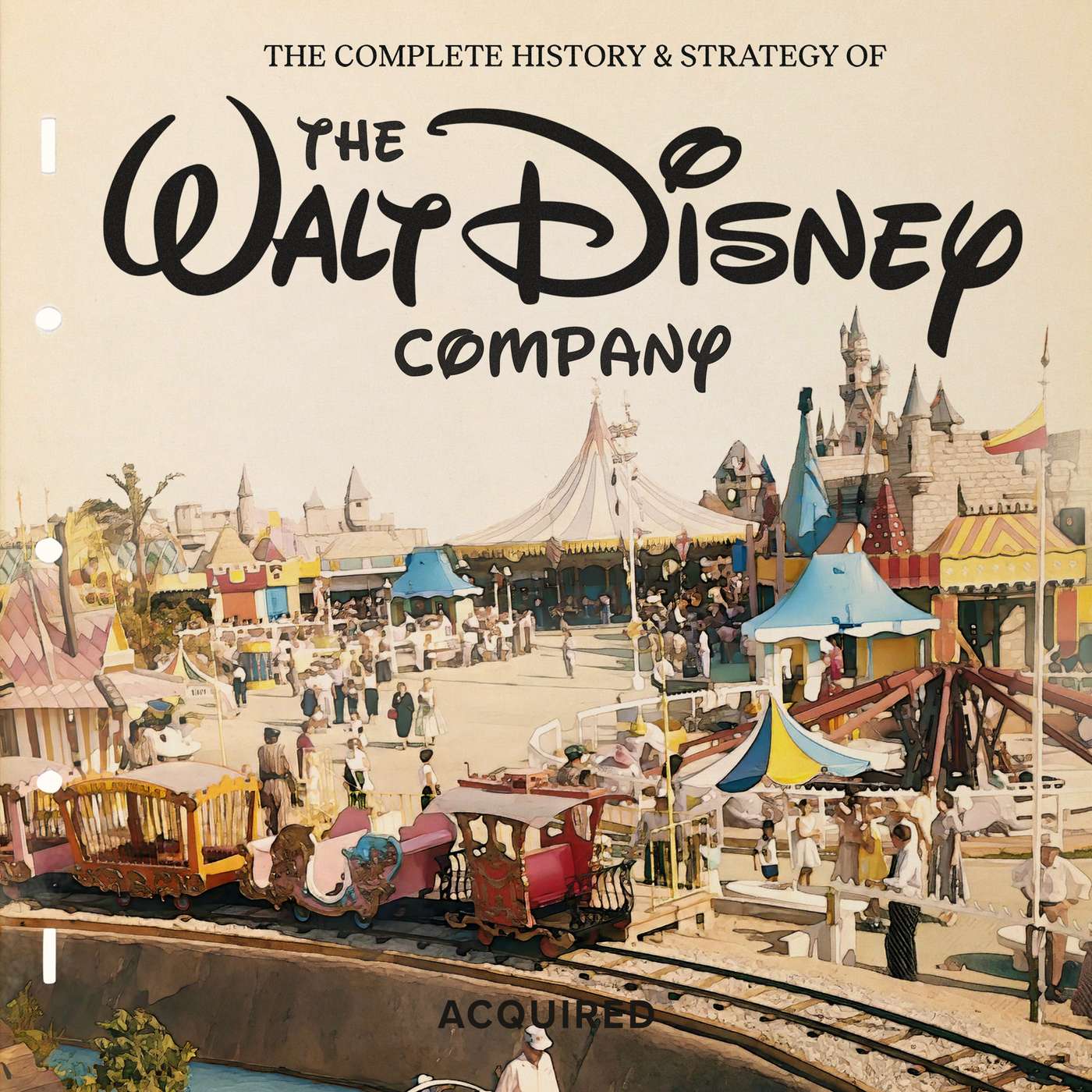
About this episode
Disney’s story gets told as a business flywheel: early animation breakthroughs, the Oswald-to-Mickey scramble, and the push for synchronized sound that made characters feel alive. The hosts connect Disney’s IP strategy to distribution, branding, and merchandising—then show how parks and TV added new “nodes” to the loop. Along the way, they hit key turning points like Steamboat Willie’s premiere, the Mickey Mouse Club’s scale, and the Disney vault’s role in re-releases, plus the later shift toward theme-park profits.
The Walt Disney Company is the most successful enterprise ever created for monetizing human nostalgia. Today it’s the king of global entertainment, holding the intellectual property rights to the childhood memories of billions of people (including, likely, all of you) and is a reliable, predictable profitable business. But it didn’t start that way.
During Walt’s era, Disney operated like an unhinged moonshot factory, blowing its finances on one seemingly crazy project after another, like the very first feature-length animated film or a theme park inspired by Walt's fascination with model trains (spoiler: Disneyland). Walt’s relentless ambition to bet the company over and over again not only created some of the most monumental artistic achievements of the 20th century (Snow White, Fantasia, Disney Imagineering), but also resulted in the accidental invention of the modern “flywheel” business model. In this episode, we tell the story of the ultimate marriage of art, commerce, and engineering — The Walt Disney Company: Walt's Era.
Sponsors:
Many thanks to our fantastic Spring '26 Season partners:
Links:
- Sign up for email updates, get our takeaways and research photos from each episode, and vote on future topics!
- The Acquired Disney Companion PDF
- Our Disney column in WSJ
- The original 1958 WSJ “Flywheel” article"
- Walt Disney: The Triumph of the American Imagination by Neal Gabler
- The Animated Man by Michael Barrier
- Walt Disney: An American Original by Bob Thomas
- Building a Company: Roy O. Disney and the Creation of an Entertainment Empires by Bob Thomas
- The Disney Version: The Reedy Creek Improvement District in the Contemporary Florida Story by Richard Schickel
- PBS American Experience: Walt Disney
- Disneyland Handcrafted
- Walt's 1966 EPCOT pitch video
- Worldly Partners' Multi-Decade Disney Study
- The Walt Disney Family Museum
- All episode sources
Carve Outs:
- Brooks Vanguard sneakers
- Defunctland YouTube Channel
- Animagraffs YouTube Channel
- Volvo EX30
- The San Francisco Symphony
More Acquired:
- Get email updates and vote on future episodes!
- Join the Slack
- Check out the latest swag in the ACQ Merch Store!
00:00 Start
01:09 Intro
06:03 Walt's Early Life & Artistic Calling (1901-1919)
12:37 From Commercial Art to Laugh-o-grams (1919-1923)
23:04 Hollywood, The Alice Comedies & Oswald's Loss (1923-1928)
43:31 Mickey Mouse & The Synchronized Sound Breakthrough (1928)
01:01:53 The IP Flywheel & Mickey Merch Explosion (1929-1933)
01:09:57 Analysis: The Disney IP Flywheel Unpacked
01:59:02 Snow White & The Folly That Defined Animation (1937)
01:41:08 The Burbank Studio & Pre-War Struggles (1937-1941)
02:04:20 The Animators' Strike & Walt's Disillusionment (1941)
02:15:44 World War II & The Accidental Disney Vault (1941-1945)
02:24:27 Post-War Slump to Cinderella's Comeback (1945-1950)
02:33:46 Walt's Obsession: Model Trains to Disneyland (1950-1952)
02:38:44 Financing Disneyland: ABC, SRI & Davy Crockett (1953-1955)
03:17:00 Disneyland's Grand Opening & The Evolving Flywheel (1955-1958)
03:39:04 The Florida Project: Walt's Vision for EPCOT City (1958-1966)
03:54:20 Walt's Untimely Death & Roy's Legacy (1966-1971)
04:00:06 A Parks Company & Creative Decline (1971-1984)
04:09:44 Analysis: Why No Other Disney Flywheels?
04:17:15 The Seven Powers of Disney
04:20:30 Quintessence: Art, Commerce & Timeless IP
04:23:47 Carve-Outs + Outro
Note: Acquired hosts and guests may hold assets discussed in this episode. This podcast is not investment advice, and is intended for informational and entertainment purposes only. You should do your own research and make your own independent decisions when considering any financial transactions.
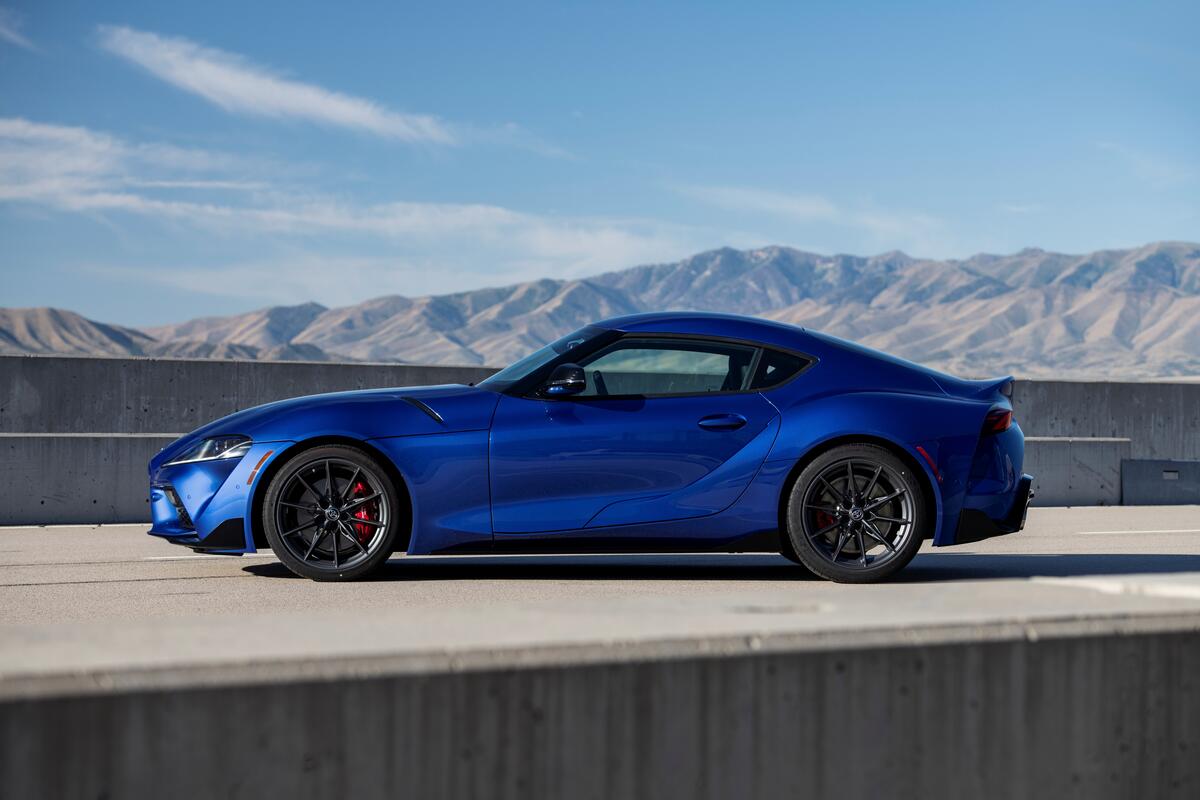
Toyota A90
"Wow. A $90 million company doing $21 million in pre-tax that has Disney's flywheel is the buying opportunity of a lifetime when Buffett bought it."
The Toyota Supra is a sports car made by Toyota. It’s designed to be fast and fun to drive, with a focus on performance rather than everyday comfort. People mention it because it’s a well-known model that many car fans recognize.
The Toyota Supra is a performance sports car known for its strong acceleration and driver-focused design. It’s often discussed because it represents a modern, enthusiast-oriented take on a classic nameplate, making it a frequent topic when people talk about iconic sports cars and what makes them desirable. In a podcast, it may come up as an example of a high-demand, high-appeal vehicle that people associate with performance and brand value.
fully domed central downtown city
"A 50 acre enclosed climate controlled, fully domed central downtown city that will have no surface streets, fully pedestrian walkways."
This is a plan for a city center that’s covered by a huge dome. The idea is to keep the environment controlled, which also changes how people and vehicles move around inside.
A “fully domed” city concept encloses the central urban area under a large structure, typically to control climate and reduce exposure to weather. In transportation terms, it implies traffic and pedestrian movement are designed around a contained environment rather than open streets.
no surface streets
"A 50 acre enclosed climate controlled, fully domed central downtown city that will have no surface streets, fully pedestrian walkways."
“No surface streets” means there aren’t regular car roads at ground level. Cars would be kept out of pedestrian areas, usually by using tunnels or other dedicated routes.
“No surface streets” describes a transportation layout where cars and other vehicles don’t travel on open roadways at ground level. Instead, movement is routed through dedicated systems (like tunnels or elevated transit) to separate vehicles from pedestrians.
monorails
"Monorails. Well, yes, the only motorized forms of transportation will be monorails and this new concept of people movers."
A monorail is a train that rides on one track instead of two. It’s often elevated and can move people around without cars on regular roads.
A monorail is a rail system that runs on a single rail or beam, usually elevated. In transit planning, it’s often used to reduce street traffic and keep vehicles separated from pedestrians.
people movers
"the only motorized forms of transportation will be monorails and this new concept of people movers."
“People movers” are like automated shuttles that move people around a specific place. Instead of cars driving on roads, it’s usually a dedicated track or guide system.
“People movers” are automated transit systems designed to move passengers around a specific area (like an airport, theme park, or planned city). They’re typically short-route, guided systems rather than regular street traffic.
multi layered tunnels
"below ground, there will be a vast network of tunnels, a multi layered tunnels underneath the ground for cars and industrial vehicles to circulate throughout the city."
“Multi layered tunnels” means there are multiple levels of tunnels underground. That can help route different kinds of vehicles separately and move more traffic through the same area.
“Multi layered tunnels” refers to stacking multiple underground roadway or utility levels in the same footprint. For vehicles, this can increase capacity and allow different traffic types (like cars vs. industrial vehicles) to circulate without interfering.
cars and industrial vehicles
"a multi layered tunnels underneath the ground for cars and industrial vehicles to circulate throughout the city."
They’re talking about two vehicle types: regular cars and bigger work vehicles used for business or services. The plan routes both through dedicated underground paths.
This phrase distinguishes passenger cars from heavier “industrial vehicles” (like service trucks or commercial transport). In a tunnel-based city plan, separating these categories helps manage different sizes, speeds, and operating needs.

Volvo EX 30
"My first one is we got a new car. [15915.3s] Hey, Volvo EX 30. [15918.5s] The little guy. [15919.5s] A is awesome. [15922.9s] It's like the perfect car for San Francisco."
The Volvo EX 30 is Volvo’s small electric car. It’s designed to be easy to park and maneuver in crowded places, but still fit people and everyday stuff. In this segment, they also explain it’s built on a shared platform from Geely, with Volvo branding.
The Volvo EX 30 is a small, battery-electric crossover from Volvo, built to be easy to live with in dense cities. The host highlights it as a “little guy” that fits tight parking spaces while still carrying a family and gear. It’s also discussed as a Geely-based EV platform with Volvo branding.
EV
"[15928.7s] Hold a bunch of gear. [15929.8s] Be. [15930.3s] Oh my God, Chinese EVs are incredible. [15933.5s] So Volvo is owned by Geely, which is a Chinese company. [15937.7s] And the EX 30 is a Geely platform EV with Volvo branding, unlike the other"
EV means “electric vehicle.” Instead of using gasoline, the car runs on electricity stored in a battery. That’s why people talk about EVs when comparing different electric cars.
EV stands for “electric vehicle,” meaning the car is powered primarily by an electric motor and a battery rather than a gasoline engine. In this segment, the host uses it to compare “Chinese EVs” and to describe the EX 30 as an electric platform car. The key idea is that energy comes from electricity stored in the battery.
platform EV
"[15933.5s] So Volvo is owned by Geely, which is a Chinese company. [15937.7s] And the EX 30 is a Geely platform EV with Volvo branding, unlike the other"
A “platform EV” is an electric car built on a shared underlying design that other cars may also use. In this case, the host says the Volvo EX 30 is based on Geely’s electric-car foundation, then Volvo applies its branding and details. That shared base can influence how the car is laid out and built.
“Platform EV” refers to an electric vehicle built on a shared vehicle architecture (the underlying design and engineering base) used across multiple models or brands. The host’s point is that the Volvo EX 30 uses a Geely-developed EV platform, then gets Volvo branding and tuning. This can affect packaging, electronics, and how the car is engineered.
Request an Explanation
Heard something you'd like explained? We'll add it to this episode.
Sign in to request explanations for terms you heard.
Want to learn more?
Browse our glossary for plain-English explanations of automotive terms, jargon, and concepts.
Help improve this episode
See something that's not quite right? Our annotations are AI-generated and can sometimes miss the mark. Click the flag icon on any annotation to suggest a correction.