Formula 1 is framed as “the World Cup of Engineering” and “the World Cup of Office Politics,” where teams design cars from scratch, run on data, and move the “entire circus” between races. The hosts connect the sport’s origins and governance to its modern business reset: new regulations, grid expansion, and a U.S. broadcast shift to Apple TV. Bernie Ecclestone’s centralization of TV rights, promoter fees, and sponsorship helps explain how F1 became a global, high-value entertainment product—then Liberty Media accelerates growth with storytelling like Drive to Survive.
Formula 1 is three competitions in one: a 200mph battle of the world's best race car drivers, the world cup of engineering where thousand-person teams spend hundreds of millions designing cars from scratch, and — as one of our listeners perfectly put it — the “Real Housewives of the Garage”, a soap opera of billionaire egos, team politics, and paddock drama that makes for incredible reality television. It's also the world's most popular annual sporting series with over 827 million fans globally — a fact that would shock most Americans, who until a recent viral Netflix series had barely heard of it.
Today we tell the story of how a chaotic, deadly, and gloriously dysfunctional European racing series became one of the greatest business stories in sports. For decades, brilliant engineers and daredevil drivers dedicated their lives (and too often lost them) to a league controlled for 45 years by a single man: a former London car dealer named Bernie Ecclestone, who centralized power and extracted billions, while also undeniably single-handedly making the sport successful. Then, in a move no one saw coming, the American company Liberty Media bought the whole thing in 2017, installed a team of Fox Sports and ESPN veterans, and did what Bernie never would — professionalized it. All of a sudden famously money-losing F1 teams turned into real businesses, with the average team valuation today clocking in at an astounding $3.6 billion. Buckle up for one of our most-requested episodes: the wild story of Formula 1.
Sponsors:
Many thanks to our fantastic Spring '26 Season partners:
00:00:00 Start 00:00:37 Intro 00:05:52 Origins of F1: Britain, Italy, and Monaco 00:30:43 Bernie's Entrance 00:37:42 Bernie Consolidates Power 00:50:33 F1 as a Global TV Sport (Except America) 01:08:08 F1's Incredible Engineering Achievements 01:19:34 Senna's Crash and a New Era for Safety 01:33:18 The Many Owners of F1, and Bernie's Liquidity Drama 01:57:48 FOTA: The attempted breakaway series 02:05:07 RedBull, Mercedes, and Reinventing the Sport 02:42:33 Liberty Media buys F1 and Brings it to the Modern Era 03:05:03 Drive to Survive 03:26:45 Apple, TV Rights, and Success in America 03:41:52 F1: The Business Today 03:56:23 Analysis: Why Did F1 Work… and Was Bernie Necessary? 04:05:40 7 Powers 04:08:23 Bear vs. Bull Cases 04:16:32 Quintessence 04:20:08 Carve-Outs + Outro
Note: Acquired hosts and guests may hold assets discussed in this episode. This podcast is not investment advice, and is intended for informational and entertainment purposes only. You should do your own research and make your own independent decisions when considering any financial transactions.
"...is now owned by the publicly traded U.S. company that has owned the Atlanta Braves, Sirius XM and Live Nation. That is Liberty Media. And against all odds, Liberty has managed to turn the sport, the teams and the drivers into real viable businesses."
Liberty Media is the company that owns Formula One. The hosts are talking about how it helped turn racing into a much bigger and more profitable business.
Liberty Media is the corporate owner that controls Formula One as a business asset. In this context, the important point is that Liberty turned F1 from a loosely run sport into a professionally managed, commercially valuable enterprise.
"1906, the automobile club of France, which was the largest in Europe at the time, hosts an inaugural race just to the southwest of Paris called Le Mans, L-E-M-A-N-S. And this group of organizers, they decided to call this Le Mans race by a very literal name in order to attract spectators and participants."
Le Mans is a famous race in France. It's one of the best-known names in racing and is especially associated with long-distance events.
Le Mans is a famous French endurance-racing venue and one of the most important names in motorsport history. The name is tied both to the city and to the race tradition that helped shape modern international racing.
"You had Monza pop up in Italy, you had the Monte Carlo race in Monaco, you had the Nurburgring in Germany, et cetera, cetera. You probably heard of all these places."
Monza is a famous race track in Italy. It's one of the historic names in Formula 1 and racing generally.
Monza is the famous Italian motorsport venue near Milan, best known today as the home of the Italian Grand Prix. It's one of the classic European tracks that helped define early international racing.
"In 1949, the FIA announces the inaugural Grand Prix World Championship for Formula One drivers, a global drivers competition of seven of the most prestigious Grand Prix races set to begin the following May 13th with the running of the British Grand Prix at the Silverstone Circuit."
Formula 1 officially started in 1950 with its first race at Silverstone in England. Before that, big races existed but there was no single championship that tied them all together.
In 1949 the FIA announced the inaugural Grand Prix World Championship for Formula One drivers, with the first race held at Silverstone on May 13, 1950. This founding event marked the formal start of Formula 1 as an organized global drivers' title rather than a loose collection of national Grand Prix events.
"...with the running of the British Grand Prix at the Silverstone Circuit in England. And that becomes the first race of the first season officially of F1."
Silverstone is a race track in England. It's one of the most famous tracks in Formula One and hosted the first official F1 race.
Silverstone Circuit is a famous motorsport track in England and one of Formula One's historic venues. It matters because the episode places the first official F1 race there.
"A very small area in the English midlands within tens of miles of each other. ... So one of these newly unemployed Royal Air Force pilots is a man named Colin Chapman, who also happened to be a mechanical engineer."
70% of Formula 1 teams are based in the UK, and most of those are clustered in a small area of central England called the Midlands. This goes back to after World War II, when the area had lots of airfields and skilled mechanics looking for work.
The hosts note that 70% of Formula 1 teams are based in the UK, concentrated in a very small area of the English Midlands "within tens of miles of each other." The clustering traces back to post-WWII airfields and a large pool of unemployed Royal Air Force pilots and mechanics with mechanical-engineering skills — Colin Chapman being one of them.
"One of these newly unemployed Royal Air Force pilots is a man named Colin Chapman, who also happened to be a mechanical engineer in addition to a former pilot and who, along with Enzo Ferrari, probably did more than any single person to shape the first era of F1."
Colin Chapman started Lotus and was one of the most inventive engineers in racing history. He came up with many of the design tricks that modern F1 cars still use.
Colin Chapman was the founder of Lotus and one of Formula 1's most influential engineers. The episode credits him with introducing sponsorship logos to the sport (painting his Lotuses in Gold Leaf Tobacco colors) and championing downforce as the path to faster lap times. He also designed the chassis for the DeLorean DMC-12 and died of a heart attack at 54 as the DeLorean embezzlement scandal broke.
"So one of these newly unemployed Royal Air Force pilots is a man named Colin Chapman, who also happened to be a mechanical engineer in addition to a former pilot and who, along with Enzo Ferrari, probably did more than any single person to shape the first era of F1. So Chapman founded the Lotus Racing Team in 1952 with 25 pounds as his initial startup capital in a set of empty stables in North London."
Lotus is a famous racing name. Here it means the team Chapman founded, which became known for clever and lightweight race cars.
Lotus is a legendary racing marque, and in this context it refers to Colin Chapman's early Formula 1 team. The brand became famous for lightweight engineering and innovative race car design.
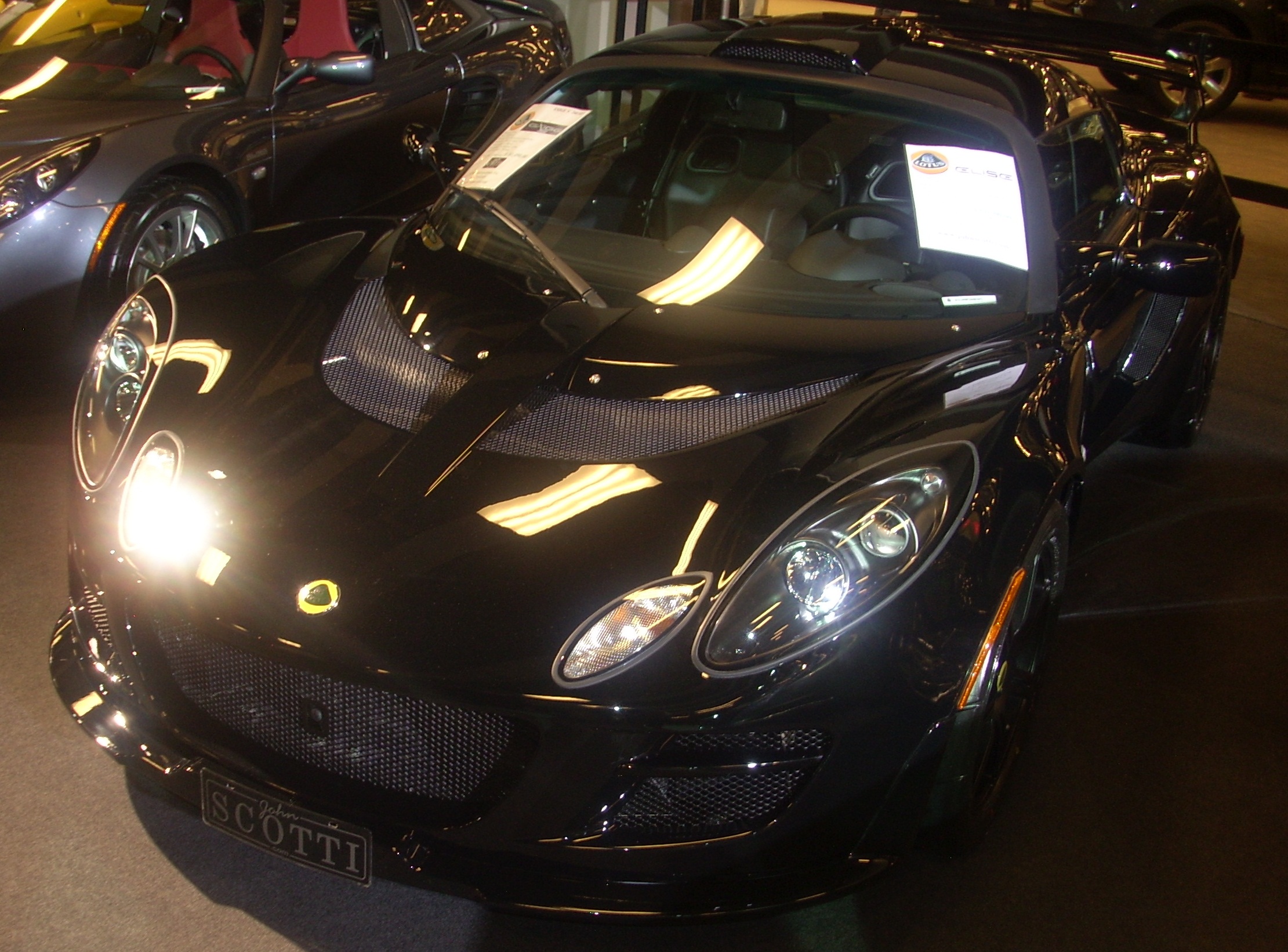
"In fact, the first Tesla Roadster was based on a Lotus Elise chassis. That's right."
This is Tesla's first sports car. The hosts are saying it borrowed its basic body structure from a Lotus, which helped Tesla get started.
The Tesla Roadster was Tesla's first production sports car, and the original one was built on a Lotus-supplied chassis. That makes it an important early example of Tesla using an existing lightweight sports-car platform before it had its own dedicated EV architecture.
"In fact, the first Tesla Roadster was based on a Lotus Elise chassis. That's right."
The Elise is a very light Lotus sports car that's famous for handling. Tesla used its underlying structure for the original Roadster.
The Lotus Elise is a lightweight mid-engine sports car known for its bonded-aluminum chassis and extreme focus on low mass and handling. Here it matters because the first Tesla Roadster was based on the Elise's chassis, showing how influential that platform was.
"The third Italian founding pillar of F1 Ferrari. Undeniably, the most important team, company and person of this first age of F1 was Enzo Ferrari."
Enzo Ferrari is the man behind the Ferrari name. He founded the company and helped make Formula 1 what it is today.
Enzo Ferrari was the founder of Ferrari and, in the hosts' framing, "the most important team, company and person" of Formula 1's first era. He founded the company before World War II purely to race Alfa Romeo cars; Ferrari only began making road cars after the war, but the road-car business became inseparable from the F1 program.
"So Chapman, when he goes out in the 60s and finds a sponsor to finance his building activities, he paints his lotuses red and white in the corporate colors of his new sponsor, Gold Leaf Tobacco."
Gold Leaf was the first big sponsor whose colors went on a race car. Before then, F1 cars were painted in national colors, not company colors.
Gold Leaf Tobacco was the sponsor Colin Chapman brought to Lotus — its corporate red and white were painted onto Lotus race cars, marking the moment Formula 1 went from country-coded livery to commercial sponsorship. The episode treats this as the origin of modern F1 sponsorship.
"Ironic because then the EU would legislate tobacco advertising and sponsorship out of existence in the early 2000s once again."
For decades, cigarette companies were the biggest sponsors of Formula 1 teams. Their logos covered the cars and drivers. Then governments banned that kind of advertising, and those sponsors disappeared.
Tobacco sponsorship was the dominant funding source for Formula 1 teams from the late 1960s until the EU banned it in the early 2000s. Cigarette companies poured billions into F1 livery and trackside ads before the regulatory shutoff forced teams to find new sponsor categories.
"Go look at any of the sports historical greats like Ayrton Senna or Michael Schumacher or Alan Pras. They all had the Marlboro logo all over them. Or John Player Special."
Marlboro is a famous cigarette company that sponsored F1 teams for decades. Its red-and-white logo was everywhere on race cars until laws banned tobacco advertising.
Marlboro is the cigarette brand cited as the most dominant sponsor in Formula 1 history. Its branding became so common it visually defined entire teams and eras — until the EU's tobacco-advertising ban forced it off the cars in the early 2000s.
"Go look at any of the sports historical greats like Ayrton Senna or Michael Schumacher or Alan Pras. They all had the Marlboro logo all over them."
Senna was a legendary Formula 1 driver. The hosts are saying even the biggest stars were covered in cigarette sponsor logos back then.
Ayrton Senna was one of Formula 1's most iconic drivers, and the transcript uses him as an example of the era when tobacco branding dominated the sport. He is not a car, but his name is central to the history being discussed.
"They all had the Marlboro logo all over them. Or John Player Special."
John Player Special was a cigarette brand whose black-and-gold colors became a famous Formula 1 paint scheme. It's one of the most recognized looks in the sport's history.
John Player Special was a tobacco brand whose black-and-gold livery became one of the most iconic looks in Formula 1, especially on Lotus cars. It's a defining example of how completely cigarette sponsorship shaped team identity in F1's tobacco era.
"Chapman designed the chassis for the DMC 12, you know, like the back to the future car. Which would be awesome if the car didn't suck and the company didn't end in a giant scandal."
This is the silver car from Back to the Future. It was a real car made by DeLorean, and the company had a very messy history.
The DeLorean DMC-12 is the stainless-steel sports car made famous by Back to the Future. It became notorious not just for its looks, but for the troubled DeLorean Motor Company and the scandal around its founder, John DeLorean. Colin Chapman of Lotus designed its chassis.
"And just so people can really picture it, I think you kind of know what an F1 car looks like now. An open wheel car with a giant spoiler or rear wing."
It's a race car where the tires stick out instead of being hidden under the body. Formula 1 cars are the best-known example.
An open-wheel car is a race car with its wheels exposed outside the bodywork instead of covered by fenders. This layout is common in Formula 1 and other single-seater series because it prioritizes aerodynamics and racing performance.
"And just so people can really picture it, I think you kind of know what an F1 car looks like now. An open wheel car with a giant spoiler or rear wing."
This is the big wing on the back of a race car. It pushes the car down so it can corner faster.
A rear wing is an aerodynamic device mounted at the back of a race car to generate downforce. In Formula 1, it helps the car stick to the track at high speed and is a major part of the car's aero package.
"It's got a front wing. When we first started here in 1950 and really even into the 60s too, these cars didn't look anything like that."
It's the wing on the front of the race car. It helps push the car into the track so it can corner faster.
A front wing is the aerodynamic surface at the nose of a Formula 1 car that helps create downforce and control airflow. In modern F1, it is a major tuning tool for grip and balance.
"This was so far ahead of its time back in the 1950s and also totally by accident, which leads us then to the third Italian founding pillar of F1 Ferrari. Undeniably, the most important team, company and person of this first age of F1 was Enzo Ferrari."
Ferrari is the famous Italian car and racing name. In Formula 1, it's the team everyone thinks of first, and the podcast is saying the sport feels more important because Ferrari is in it.
Ferrari is the iconic Italian racing and road-car brand, and in Formula 1 it has been the sport's defining marque since the beginning. The key thing here is Ferrari's identity as the team that helped legitimize Formula 1 itself, not just as a carmaker that happens to race.
"While they were racing one of their cars in Le Mans, it actually crashed and killed 82 people."
In 1955 a Mercedes race car crashed into the crowd at Le Mans and killed 82 spectators. It is the worst accident in racing history, and Mercedes stopped competing in racing for decades afterward.
The 1955 Le Mans disaster was the worst spectator accident in motorsport history. A Mercedes race car crashed into the crowd, killing 82 people and the driver. Four of the remaining Grands Prix that season were cancelled. Mercedes pulled out of all racing immediately and did not return to Formula 1 for roughly 40 years — until they re-entered as engine supplier and later bought Brawn GP.
"Oh, it's Bernie. Yep. It was the person who quite literally would replace Enzo in that quote. Bernie Eccleston, the Supremo impresario owner of F1."
Bernie Ecclestone was the businessman who helped run and monetize Formula 1 for years. He was one of the most powerful people in the sport.
Bernie Ecclestone was the longtime commercial controller and power broker of Formula 1, shaping the sport's business side for decades. The hosts describe him as effectively replacing Enzo Ferrari in the sport's mythology and influence.
McLaren here is the racing team, not a specific car model. They're talking about which old F1 teams were around in 1972 and which still exist today.
McLaren is being referenced as a Formula 1 team and business entity. The discussion is about the old team landscape and which organizations survived into the modern era.
"So it's worth taking a pause to say the FIA is still the governing body of the sport of this racing series. And so Bernie takes over this thing called the Constructors Association, but really the FIA and their set of rules is still governing what happens between these teams at the racetracks."
The FIA is the rule-making body for Formula 1. It decides what is allowed and what isn't, and teams have to follow its rules.
The FIA is the Fédération Internationale de l'Automobile, the governing body that writes and enforces the rules for Formula 1. It controls the sporting and technical regulations that teams must follow at the racetrack.
"This results in a whole series of protracted negotiations between Bernie and the Constructors Association and the FIA that finally get hammered out in 1981 with the first Concorde Agreement, which is still the name of the FIA. Roughly every five year agreements that govern F1 to this day."
This is the big contract that decides how Formula 1 is run and how the money gets split up. It's one of the main reasons the sport has a stable structure.
The Concorde Agreement is the long-running commercial and governance contract that sets the framework for Formula 1 between the teams, the FIA, and the commercial rights holder. It is central to how F1's money, rules, and power are divided, which is why it gets renewed in multi-year cycles.
"Formula One Promotions and Administration or FOPA. Not to be confused with FOCA, F-O-C-A, which was the Constructors Association that just did that deal with the FIA."
This was the group that represented the Formula 1 teams. They were involved in negotiating with the sport's governing body.
FOCA stands for the Formula One Constructors Association, the group representing the teams' commercial and political interests in Formula One. Here it's mentioned as the organization that had just done a deal with the FIA, which is part of the sport's governance structure.
"He also had a right hand man and essentially number two in the business, a former Formula two driver and also owner of another team in the league, the March team, a man named Max Mosley, who happened also to be a lawyer."
Max Mosley was the lawyer and longtime FIA leader who worked closely with Bernie Ecclestone. He helped write the rules and contracts that defined modern F1.
Max Mosley was Bernie Ecclestone's right-hand man and a long-serving FIA president. A trained lawyer and former Formula 2 driver, he was the legal mind that papered Bernie's deals and shaped F1's commercial and governance structure.
"But then a third really should officially go to FOPA. I'm the one that created this and we're producing the broadcast. So after a whole bunch of negotiation, it ends up splitting out that the FIA gets 30%. FOKA and the teams get 47% and FOPA, Bernie's company gets 23%."
This was Bernie's Formula 1 business company. It handled the money and commercial rights around the sport.
FOPA is the Formula One Promotions and Administration company, Bernie Ecclestone's commercial rights vehicle in Formula 1. It is the company that received a share of the sport's television revenue in these negotiations.
"And of course, who's the logical buyer now? Mercedes. They don't currently have a motorsport team. They clearly are interested."
Mercedes is the company that bought the team and turned it into the powerhouse F1 outfit people know today. They're not just talking about the car brand here, but the business side of owning a racing team.
Mercedes is being discussed here as the corporate buyer that returned to Formula 1 as a full works team owner. The key point is the business move: Mercedes bought control of Brawn GP, then built the dominant factory team that later won multiple drivers' and constructors' titles.
"It moved the sport from being about pure horsepower to being about energy management. And as a result, the driver's lives got way busier."
Modern F1 isn't just about who has the most powerful engine — it's about who uses their stored electric energy most cleverly across a race. That's energy management.
In F1, energy management means controlling how much electrical energy is harvested, stored, and deployed over a lap. It is a core racecraft and engineering skill in the hybrid era — the hosts cite it as the shift that took the sport away from raw horsepower.
"Now they're managing battery deployment, harvest modes, engine maps, and they're doing this at unreal speeds."
F1 cars store some electric power and can release it for an extra boost. Deciding when to use it is part of the race strategy.
Battery deployment is the controlled use of stored electrical energy from the hybrid system to give the car extra performance. In F1 it's a strategic tool — drivers can spend that energy for attacking or defending, and the team manages it across the race.
"Now they're managing battery deployment, harvest modes, engine maps, and they're doing this at unreal speeds."
In a hybrid F1 car, the driver can switch between different ways of recovering energy when slowing down. Picking the right one means more electric power available later.
Harvest modes are the different settings used to recover energy in a hybrid F1 car, usually by converting braking and exhaust energy into electricity. Managing them in real time is a core skill of the hybrid era because the amount of energy banked determines how much extra power the driver can deploy later.
"Interestingly, by the 1980s, it was producing so much downforce that the drivers could take these corners at super fast speeds and it actually became a safety hazard, especially because if the car would go up on a curb or the skirt slipped in any way, the cars were then going way faster than they otherwise could have without that sort of sucking to the ground, the ground effect to cause the traction."
This is a racing trick that uses air under the car to help push it down onto the road. More grip means the car can go through corners much faster.
Ground effect is an aerodynamic principle where airflow under the car creates low pressure and effectively sucks the car toward the track. In Formula 1, it dramatically increases cornering grip, which is why it became so influential and later so heavily regulated.
"And then of course there's turbochargers, which are an insane invention. This harnesses the unused energy from the exhaust gases to spin a turbine and then use that to compress the air that is going into the engine, which ultimately means then there's more oxygen in each engine cycle."
A turbocharger uses waste energy from the exhaust to pack extra air into the engine. More air means the engine can make more power without getting bigger.
A turbocharger is an exhaust-driven compressor that forces more air into an engine. In Formula 1, turbocharging became a major performance technology because it lets the engine burn more fuel and make more power from the same displacement.
"I mean, you had paddle shifters and carbon or even just turbos. I mean, so many cars, even like not sports cars are turbos these days."
These are the little levers behind the steering wheel that let you change gears without a clutch pedal. F1 invented this for race cars, then it spread to regular cars.
Paddle shifters are steering-wheel-mounted controls used to change gears, usually in automated manuals or dual-clutch transmissions. They became common in performance cars after being developed in F1 — one of the clearest cases of racing technology making it to consumer vehicles.
"So the systems are traction control, anti-lock brakes, active suspension, semi-automatic transmission. All of these worked together and the car even automatically adjusted its ride height customized to each corner on each racetrack."
Normal suspension just reacts to bumps. Active suspension can change how the car sits and handles on the fly. F1 used it so effectively that other teams complained the car was almost driving itself.
Active suspension is a suspension system that uses hydraulics or electronics to change ride and handling characteristics in real time. The Williams car used it to adjust ride height and cornering grip on the fly — so effective that competitors accused them of building a car that drove itself.
"So the systems are traction control, anti-lock brakes, active suspension, semi-automatic transmission. Speaking of road relevance, David, and transferability to consumer cars."
These are brakes that help stop the wheels from skidding when you brake hard. They let the driver keep more control while slowing down.
Anti-lock brakes prevent the wheels from locking up under hard braking. In racing they help maintain steering control at the limit, though they were controversial in Formula 1 when electronic aids were being restricted. The technology trickled down into consumer cars.
"So the systems are traction control, anti-lock brakes, active suspension, semi-automatic transmission. Speaking of road relevance, David, and transferability to consumer cars."
Instead of pressing a clutch and moving a shifter, the driver just clicks paddles on the steering wheel to change gears. F1 used this and then it spread to expensive road cars.
A semi-automatic transmission lets the driver shift gears without a traditional clutch pedal, usually through paddles or buttons. In Formula 1, this was part of the move toward electronic driver aids in the early 1990s — and one of the technologies that filtered down to high-performance road cars.
"So the systems are traction control, anti-lock brakes, active suspension, semi-automatic transmission. Speaking of road relevance, David, and transferability to consumer cars."
When a car accelerates hard, the tires can spin out. Traction control automatically pulls back power to stop that. F1 had it for a while, then banned it.
Traction control is a driver-aid system that reduces wheelspin when the driven wheels start to lose grip. In Formula 1, it was one of the electronic aids that made the car easier and faster to drive — eventually restricted as part of the regulator's push to put more emphasis back on the driver.
"All of these worked together and the car even automatically adjusted its ride height customized to each corner on each racetrack. So competitors saw this and got so mad and accused Williams of making a car that drove itself."
This means how high the car sits off the ground. Lower or higher ride height changes how the car handles and how much air goes under it.
Ride height is the distance between the car's body and the ground. In racing, changing ride height alters aerodynamics, grip, and how the car behaves over different corners and surfaces — the Williams active-suspension car adjusted it automatically per corner.
"Things are a lot safer, but obviously they still have a long way to go. So what happened after Senna's death from a safety perspective and what impact did it have? The biggest one is they just slowed down the cars."
Ayrton Senna was one of Formula 1's biggest stars, and his death forced the sport to take safety much more seriously. After that, F1 changed the cars and tracks to make crashes less deadly.
Ayrton Senna's fatal crash in 1994 was a turning point for Formula 1 safety. The sport responded with major changes to car design, track layout, and driver protection standards.
"So they actually looked a little bit more like the tires we use on the roads instead of the flats or the slicks that you see real race car tires."
Slicks are completely smooth race tires with no tread pattern. They grip the road better in dry conditions but are unsafe in rain.
Slicks are racing tires with no tread, designed to maximize contact with the road and provide the most grip on dry surfaces. They are common in motorsport because they deliver far more cornering traction than treaded road tires, but they're useless in the wet.
"His new offshore entities a special $1.4 billion dividend. ... It's called the burning bonds. ... The offering was intended to be $2 billion, but Morgan Stanley could only rustle up $1.4 billion worth of money willing to do this deal. ... Three days later, Bernie is having triple bypass heart surgery."
Bernie Ecclestone had Formula 1 take on $1.4 billion in debt mainly to pay a giant dividend to himself, just days before he went in for major heart surgery. The bonds got the nickname "burning bonds" because of how aggressive the financial maneuver was.
The "burning bonds" were the $1.4 billion debt issuance Bernie Ecclestone orchestrated to fund a special dividend to himself and his offshore entities, three days before his triple bypass heart surgery. The deal was intended to be $2 billion but Morgan Stanley could only raise $1.4B — a textbook case of a controlling shareholder loading the company with debt to pay themselves out.
"In March, H&F gets an unsolicited over the top bid from a German new media company called EM.TV to buy their entire stake in slack slash F1 immediately right away. This is the height of dot com craziness right before the crash."
EM.TV was a German company that bought media businesses. In this story, they tried to buy Formula One very quickly during the internet boom.
EM.TV was a German media company that made an unsolicited bid for the Formula One stake being discussed. It's notable here because it represents the speculative, bubble-era buyer chasing media assets.
"Then you have a new set of races like Bahrain and China that had just come on. The flyaway races. They are paying huge fees to F1 in order to have their races on the calendar."
These are races held far away from the sport's home base in Europe. Because they're harder to stage, the host countries often pay a lot to get them.
Flyaway races are Formula 1 events held far from the sport's European base, requiring long-haul travel and logistics. In F1 business terms, these newer venues often pay high hosting fees to secure a place on the calendar.
"It's not a local entrepreneur race promoter with a racetrack. These are sovereign deals. To construct a new $270 million F1 track around the Olympic Park and pay F1 $50 million a year for seven years to host the race."
Some F1 races aren't put on by a local company — they're set up by an entire country's government. The country builds the track and pays F1 a big fee to come race there.
A sovereign deal here means a race-hosting agreement made directly with a national government, not with a private promoter. In F1 these deals are how flyaway races in places like Bahrain, Abu Dhabi, and Sochi got onto the calendar — governments fund the track and pay tens of millions per year for the brand association.
"We are going to help you guys institute a cost cap on manufacturing and we'll help you design it. Let's get it approved by all the teams. This will save you basically what they're proposing is the F1 equivalent of a salary cap in other sports like the NFL or the NBA, except instead of on the players, the salary cap is going to be on the investments into the cars."
A cost cap is a budget limit. In F1, it keeps teams from spending unlimited money to make faster cars.
A cost cap is a spending limit imposed on Formula 1 teams to control how much they can invest in car development and operations. It is meant to reduce runaway budgets and make competition more sustainable.
"In 2009, eight of the 10 teams threatened to pull out of the sport and start a rival breakaway league called FOTA, the Formula One Teams Association. They announced that they're doing it and they're creating their own series starting in 2010."
In 2009, most F1 teams threatened to quit and start their own rival series. The group they formed was called FOTA. It was a serious enough threat to change the negotiations.
FOTA was the Formula One Teams Association — the 2009 breakaway threat where eight of ten teams banded together to start their own rival series. It gave teams leverage against Bernie and the FIA in the cost-cap fight and remains the closest the sport has come to splitting.
"...you know about Spygate and Crashgate. Both of these McLaren magically wound up with a giant binder full of the complete specification of Ferrari's car for that year."
Crashgate was a Formula 1 cheating scandal. It involved a race crash that was allegedly planned to help a team's strategy.
Crashgate was the Formula 1 scandal in which a race incident was allegedly manipulated for strategic gain. It is one of the sport's most infamous examples of deliberate race manipulation and governance failure.
"...you know about Spygate and Crashgate. Both of these McLaren magically wound up with a giant binder full of the complete specification of Ferrari's car for that year."
Spygate was a cheating scandal in Formula 1. One team was accused of getting secret information from another team's car design.
Spygate was the Formula 1 espionage scandal involving allegations that one team obtained another team's confidential technical information. It became a major political and legal controversy because stolen design data can be worth enormous competitive advantage in F1.
"Do you know what they did in Monaco? I read about this but I can't remember. There's not room for the Red Bull energy station because it's Monaco and there's not room for anything."
This is the Formula 1 race held on the streets of Monaco. It's famous because there's almost no room for anything, so teams have to get creative.
The hosts describe Monaco as the locus where Formula 1's identity was forged — "the unifying factor that pulled together the glitz and the glamour and the luxury and the hardcore racing." Grace Kelly's 1956 marriage to Prince Rainier III brought Hollywood prestige to the principality, and the Monaco Grand Prix has been F1's annual concentration of that mythology ever since. The street circuit's extreme space constraints (no room for the Red Bull energy station) are part of its character.
"So all of this is masterminded by Dietrich and the young team principal that he hires takes a chance on to run the team, Christian Horner."
Christian Horner is the boss of Red Bull's Formula 1 team. He's the person who helps run the racing operation and make big decisions.
Christian Horner is the long-time team principal of Red Bull Racing. He's a central executive figure in the team's rise from newcomer to dominant competitor.
"So they're building a super car, limited production and all that. But like a car that you can go buy and race on a racetrack. I think it's the RB17. It's the last thing Adrian Newey did when he was there, is design this car."
The RB17 is a very limited, very expensive performance car from Red Bull. It's special because a Formula 1 team is basically building its own exotic car.
The Red Bull RB17 is a limited-production track-focused hypercar project associated with Red Bull Advanced Technologies. It's notable because it represents Red Bull acting like a car manufacturer, with Adrian Newey involved in the design.
"So Braun figured out a whole bunch of stuff together with Schumacher. And Schumacher's work ethic was unbelievable. He was like a driver and an engineer or like a driver and a mechanic."
They mean Michael Schumacher, the famous Formula 1 driver. He was known for working closely with his team and helping improve the car.
Michael Schumacher is the seven-time Formula 1 champion and one of the most influential drivers in the sport. In this context, he is being described not just as a racer but as someone deeply involved in car development and setup work.
"We should note here for folks who are not deep F1 fans, though one, I think maybe the only part of F1 cars that are common mandated across the whole league. Tires in the halo."
The halo is a strong safety bar around the driver's head in an F1 car. It helps protect drivers in crashes and is one of the few parts every team has to use.
The halo is the cockpit safety structure mounted around an F1 driver's head. It became one of the few standardized parts across the series, which is why the hosts mention it as an exception to F1's otherwise highly custom engineering.
"Remember we said a minute ago that in 2008 with the financial crisis, Honda exits the sport."
When the 2008 financial crisis hit, Honda decided it could no longer afford its Formula 1 team and pulled out. The leftover team was bought for £1 and famously went on to win the next year's championship.
In late 2008, the global financial crisis triggered Honda's abrupt withdrawal from Formula 1. The team they walked away from was sold to Ross Brawn for £1 and rebranded as Brawn GP, going on to win both championships in 2009 — one of the sport's greatest underdog stories. The crisis also triggered the FOTA breakaway threat from the major teams.
"Well, it turns out that before the Honda engineers got pulled away back to Japan, they had come up with a new aerodynamic innovation called the double diffuser. Oh, yes. I have no idea how this thing works."
It's a racing part that helps the car stick to the track by controlling air under the car. People cared about it because it was so effective that other teams thought it might be illegal.
A double diffuser is an aerodynamic device at the rear of the car that helps manage airflow under and behind the car to create more downforce. It became famous in Formula 1 because teams argued over whether the design exploited a loophole in the rules.
"All of this is masterminded by Dietrich and the young team principal that he hires takes a chance on to run the team, Christian Horner."
Dietrich Mateschitz started Red Bull and turned the brand into a Formula 1 team owner. His approach changed how companies use racing as marketing.
Dietrich Mateschitz was the founder of Red Bull and the architect of Red Bull's Formula 1 strategy. He bought what became Red Bull Racing from Ford for £1, hired Christian Horner to run it, and rewrote the F1 sponsorship playbook by turning Red Bull into a team owner rather than just a sponsor.
"We went to the Las Vegas Grand Prix with Service Now and part of the whole weekend of festivities they had planned for us was a luncheon with Jensen Button. He was telling the stories of the Braun GP."
This is the Formula 1 race in Las Vegas. The hosts are using it as the backdrop for meeting people and talking about racing stories.
The Las Vegas Grand Prix is a Formula 1 race held on a street circuit in Las Vegas. In this episode, it serves as the setting for the hosts' meeting with Jenson Button and the discussion of F1 history.
"He was telling the stories of the Braun GP. I did not appreciate this is the outlier of outliers. No team has been on this shoestring of a budget with this type of Frankencar and this real underdogness and performed in such spectacular success the way they did."
Brawn GP was a Formula 1 team that came out of nowhere and won the championship. It's famous because it was a tiny, unlikely team that beat much bigger rivals.
Brawn GP was the one-season Formula 1 team that won both championships in 2009 after a dramatic takeover from Honda. It became famous as one of the sport's greatest underdog stories because it turned a near-dead project into a title winner almost overnight.
"they still end up winning both the constructors and the drivers championships. So in one year, this team and Ross Braun went from like new Honda team principal to nearly out of the sport to owner of his own team for one pound to world champion."
This is the team title in Formula 1. It goes to the whole racing team, not just the driver, based on how many points both cars score.
The constructors' championship is the Formula 1 title awarded to the team, based on points scored by both of its cars and drivers. It matters because it measures the overall performance of the organization, not just one driver.
"So in one year, this team and Ross Braun went from like new Honda team principal to nearly out of the sport to owner of his own team for one pound to world champion."
Ross Brawn is the person who took over the team and helped turn it into a champion. He's one of the key figures in this famous F1 comeback story.
Ross Brawn is the engineer and team boss who turned Honda's abandoned F1 project into Brawn GP and won both championships in 2009. He is central to the episode because his leadership and technical decisions made the underdog story possible.
"It's the last thing Adrian Newey did when he was there, is design this car."
Adrian Newey is the most legendary engineer in Formula 1 history. He designs race cars that have won many championships across different teams.
Adrian Newey is described in the episode as "the single most legendary F1 car designer, probably in history" — compared to Kelly Johnson at Lockheed's Skunk Works. The hosts repeat the line that "he can see air." He was poached from McLaren to Red Bull (where his designs powered the Red Bull dynasty), and his final Red Bull project was the RB17 hypercar before moving to Aston Martin as team principal.
"...they bring in Austrian businessman who previously hadn't been an investor in the Williams F1 team named Toto Wolff. And again, if you watch Drive to Survive, you definitely know Toto."
Toto Wolff is the person who helped run Mercedes' Formula 1 team. He became one of the most important bosses in modern racing because the team got so successful under his leadership.
Toto Wolff is the Austrian motorsport executive who became the key leader of Mercedes' Formula 1 operation. He is notable for helping turn Mercedes into one of the dominant teams in modern F1 and for being a central figure in the team's rise in value and success.
"They're a totally new breed of team principals. These guys are CEOs."
This is the person who runs an F1 team day to day. They make big decisions about drivers, strategy, and how the team is managed.
A team principal is the top operational leader of a Formula 1 team, roughly analogous to a CEO or general manager. In modern F1, the role can overlap with corporate leadership, strategy, and public-facing management.
"So starting a few years after CVC and Bernie reacquired F1 the league, CVC starts reselling minority pieces of F1 to other asset managers out there, including BlackRock, the Norwegian Sovereign Wealth Fund, Norwiches Bank at increasing valuations. They also load F1 up with a bunch of debt again and pull cash out. They actually put $4 billion of debt on the league."
CVC is an investment company that buys businesses or stakes in them, tries to grow their value, and then sells later. In this episode, it's one of the main owners of Formula One's commercial rights.
CVC is the private equity firm that owned a major stake in Formula One during this period. The hosts are describing CVC as a financial owner that bought, leveraged, and later sold pieces of the business at higher valuations.
"Debt that the company has for a combined total enterprise value of $8 billion. ... Liberty bought in 2017, the company for $8 billion."
In 2017, the U.S. company Liberty Media bought Formula 1 for $8 billion. This marked the end of Bernie Ecclestone running the sport and the start of the modern era.
Liberty Media acquired Formula One in 2017 for an $8 billion enterprise value — the deal that ended the Bernie Ecclestone era and started the modern, professionally managed F1. Bernie was ousted shortly after the acquisition closed, Chase Carey was installed as chairman, and the new ownership drove the Drive to Survive partnership, U.S. expansion, and team-friendly cost cap.
"The plan that they announced is that former Fox and News Corp. executive Chase Carey, who had been president and COO of News Corp, would become chairman of F1. Chase Carey had been a total legend at Fox. Chase helped Rupert launch Fox Sports and built the whole Fox NFL program."
Chase Carey is the TV-and-sports executive Liberty Media put in charge of Formula 1 after buying the sport. He had run programs at Fox like the NFL deals and brought that playbook to F1.
Chase Carey was Liberty Media's hire to replace Bernie Ecclestone as chairman of Formula One after the 2017 acquisition. A former Fox and News Corp executive who helped build Fox Sports and the Fox NFL program, he brought professional media-and-league management to F1 and is credited with the transformation that paved the way for Drive to Survive and the U.S. expansion.
"So there was almost no U.S. market development. I mean, by this point they had Circuit of the Americas in Austin, but no other U.S. races yet."
This is the Formula 1 racetrack in Austin, Texas. The hosts are using it as an example of how few U.S. races F1 had at the time.
Circuit of the Americas, often called COTA, is the Formula 1 track in Austin, Texas. It matters here because the hosts are discussing how limited the U.S. race calendar was before F1's recent expansion.
"McLaren somewhere right in that neighborhood too, around 650 to 700. 420 for Red Bull Racing. 15 years ago, all four of those teams were operating at a loss..."
This is the Red Bull Formula 1 team. They're talking about how much money the team makes and how it's run like a business.
Red Bull Racing is the Formula 1 team brand associated with Red Bull's racing program. It's relevant because the hosts are comparing team revenues and discussing how the team intentionally manages profitability.
"I mean, think back to 10, 20 years ago, Mercedes was just like luxury cruisers, you know, like, yeah, they had AMG. You could get more horsepower in your S-Class, but like, nobody thought these things were Ferraris. Now, they're a legitimate sports car maker."
The Mercedes-Benz S-Class is a large luxury car made by Mercedes-Benz. It is designed to be comfortable and full of features.
The Mercedes-Benz S-Class is the brand's flagship luxury sedan, long associated with comfort, technology, and prestige. In this context it is being used as an example of how Mercedes was once seen mainly as a luxury maker, even when performance versions existed.
"Oh, and your revenue streams, right. Well, the Paddock Club, that's all going to belong to us. And the sponsorships on the racetrack, that's going to belong to us too."
This is the fancy VIP area at an F1 race. Companies and wealthy guests pay a lot for special access, food, and hospitality.
The Paddock Club is Formula 1's premium hospitality product, sold to sponsors and high-end guests. It is a major revenue stream because it packages exclusive access, food, and luxury event experiences.
"We've alluded to this a little bit and Red Bull and Mercedes and Lewis Hamilton were starting to push the edges, but F1 had a huge social media problem."
Lewis Hamilton is the famous Formula 1 driver they're talking about. He became one of the sport's biggest stars and helped make F1 feel more mainstream in the U.S.
Lewis Hamilton is one of Formula 1's defining drivers and cultural figures, and the episode is using him as a major media-era force in the sport. He matters here because his celebrity and social-media presence helped push F1 into a more modern, global media era.
"So Netflix and Liberty start talking. F1 was also pitching Amazon on doing something, trying to get a little bit of a bidding war here."
Netflix is the streaming company that made Drive to Survive. In this conversation, they're talking about Netflix as a business negotiating for the rights to make the show.
Netflix is being discussed here as a corporate buyer of sports-documentary rights, not just as a brand name on a show. The key point is that it negotiated with Formula 1 and competed with Amazon for the league-wide series rights.
"Once Netflix secures these rights, they then start working down a list of production companies. Box to Box films wins because they had done that 2010 Senna documentary, which is great."
This is the TV and documentary production company that made the F1 show. They're the people actually filming and editing the series.
Box to Box Films is the production company that made Drive to Survive. They're important here because they won the job to produce the series after Netflix secured the rights.
"...suddenly then all the Mercedes and Ferrari partners and sponsors are coming to them and going, why are we not in Drive to Survive? Why are we not getting these impressions? What are you doing? And so then, of course, in the later seasons, all the teams are in it."
This is the Netflix show about Formula 1 racing. It made a lot more people care about F1 by turning the season into a dramatic behind-the-scenes story.
Drive to Survive is Netflix's Formula 1 docuseries that helped turn F1 into a much bigger mainstream entertainment property. It matters because the show changed how casual viewers understood the sport and its personalities.
"So then three years later on in 2024, once there are more U.S. races on the calendar, which we'll get to in a second, viewership of the Miami Grand Prix in 2024 was 3.1 million Americans."
This is the Formula 1 race in Miami. They're using it as an example of how a U.S. race can attract a lot more viewers.
This is the discussion of the Miami Grand Prix as a U.S.-based Formula 1 race that helped boost American interest. The hosts use its 2024 viewership as evidence that local races can dramatically increase audience size.
"There is no promoter. Rather than charging a fee and having someone else run the race, they say, okay, we're going to forgo the promoter fee and we're just going to operate this race ourselves."
It's the money a city or organizer usually pays to bring an F1 race to town. In Vegas, they're saying F1 skipped that normal setup and ran the event themselves.
A promoter fee is the payment a race organizer normally pays to host a Formula 1 event. Here it's important because the hosts are explaining how the Las Vegas race model differs from the usual F1 business structure.
"On the back of that, Apple comes in over the top for the US media rights negotiations with a five-year deal at $150 million a year."
Apple is the company behind the iPhone and Apple TV. Here they're talking about Apple as a business that might pay for Formula 1 rights.
Apple is being discussed as a corporate bidder for Formula 1 media rights. The point here is not the consumer brand but the company acting as a strategic buyer in sports media.
"So we've got the return of consumer auto manufacturers. Stake has become Audi. Honda is partnering with Aston Martin."
Audi is the German car brand. They're entering Formula 1 by taking over an existing team rather than building one from scratch.
Audi is the German luxury brand entering Formula 1 by taking over what was the Stake/Sauber team. It's one of the signature "return of consumer auto manufacturers" moves the hosts highlight as part of F1's modern growth — Audi is buying its way in rather than starting from scratch.
"Honda is partnering with Aston Martin. Ford has joined with Red Bull as an engine partner. Honda used to be the partner who would make Red Bull's engines in around 2019."
Honda has been in and out of Formula 1 for decades, sometimes as the team owner and sometimes just supplying engines. They're a big part of the partnerships behind today's grid.
Honda has a long Formula 1 history as both a team owner (the team they abandoned in 2008 became Brawn GP) and as an engine partner. In the modern era they have supplied Red Bull's engines and are now joining Aston Martin — central to the manufacturer-partnership story.
"Ford has joined with Red Bull as an engine partner. Honda used to be the partner who would make Red Bull's engines in around 2019."
Ford is coming back to Formula 1 as the company that supplies engines for the Red Bull team. They had been out of the sport for a long time.
Ford is rejoining Formula 1 as Red Bull's engine partner — a major manufacturer return after years away from the sport. The arrangement matters as part of F1's modern wave of OEM partnerships and the engine-supply chess game between teams.
"But speaking of a marketing exercise, Cadillac is entering the sport this year. And you might say, well, that's a whole team."
Cadillac is an American luxury car brand that's joining Formula 1 as a new team. It's a big deal because no American manufacturer has been in the sport at this level for a long time.
Cadillac is the GM-owned luxury brand entering Formula 1 as a new team — the first American manufacturer entry in decades. The hosts frame it as both a marketing exercise and a serious team commitment, and as part of the broader return of consumer auto manufacturers to the sport.
"...people talk about the sustainability of the power units, like the engines in the cars, when they are flying the whole circus around the world every week on a fleet of 7777s."
In F1, this means the whole hybrid engine system that powers the car. It is more than just the engine block; it includes electric parts too.
In modern Formula 1, the power unit is the hybrid propulsion system, not just the engine. It combines the internal-combustion engine with electric motor and energy-recovery systems, which is why F1 talks about efficiency and fuel use in technical terms.
"Don't die on the hill of sustainable fuels. How about just putting two races really close to each other and just rearranging the flight calendar a little bit?"
These are fuels designed to release less carbon when burned, made from things other than crude oil. F1 is moving toward them as part of being more environmentally friendly.
Sustainable fuels are fuels designed to reduce net carbon emissions compared with conventional petroleum, usually bio-based or synthetic. In F1 they're part of the sport's broader sustainability push — but the hosts argue the bigger environmental win is rearranging the race calendar to reduce logistics flights.
Start
Intro
Origins of F1: Britain, Italy, and Monaco
Bernie's Entrance
Bernie Consolidates Power
F1 as a Global TV Sport (Except America)
F1's Incredible Engineering Achievements
Senna's Crash and a New Era for Safety
The Many Owners of F1, and Bernie's Liquidity Drama
FOTA: The attempted breakaway series
RedBull, Mercedes, and Reinventing the Sport
Liberty Media buys F1 and Brings it to the Modern Era
Drive to Survive
Apple, TV Rights, and Success in America
F1: The Business Today
Analysis: Why Did F1 Work… and Was Bernie Necessary?
7 Powers
Bear vs. Bull Cases
Quintessence
Carve-Outs + Outro
Select text to request an explanation
I was just listening to the F1 theme song to get pumped up.
Me too, were you really?
Yes, it's so good.
I just got new speakers here in Acquired HQ North, and actually thanks to a recommendation
from a listener in the Acquired Slack, and yeah, it was bumping.
Amazing.
All right, let's do this.
Let's do this.
Who got the truth?
Is it you?
Is it you?
Is it you?
Who got the truth now?
Who?
Is it you?
Who got the truth now?
Who?
Is it you?
Is it you?
Is it you?
Sit me down, say it straight, another story on the way, who got the truth?
Welcome to the spring 2026 season of Acquired, the podcast about great companies and the
stories and playbooks behind them.
I'm Ben Gilbert.
I'm David Rosenthal.
And we are your hosts.
Today, we dive into a sport that started in the 1930s that began for the pure love of
auto racing, extremely dangerous auto racing.
After World War II, the British Air Force veterans and mechanical engineers joined the
sport to push the limits of technology and physics.
It eventually became the sport of rich guys who want to own teams to gallivant around
Europe losing colossal sums of money along the way.
And in fact, David, since the sport began, over 100 separate teams have entered and exited
the competition, mostly because they went bankrupt.
And today, the sport has been dragged kicking and screaming into being professionally managed
and is now owned by the publicly traded U.S. company that has owned the Atlanta Braves,
Sirius XM and Live Nation.
That is Liberty Media.
And against all odds, Liberty has managed to turn the sport, the teams and the drivers
into real viable businesses.
Today's episode listeners is on Formula One, the world's premier motorsport series.
Woo, I was going to save this for later in the episode.
But do you know what else among the many other like hundreds of companies that Liberty has
owned? Do you know what else they owned?
You won't guess it because there's so many.
Excite at home.
No way.
From our Google series.
Throwback.
That's awesome.
Well, listeners, really what we're doing here today with Formula One, it's three sports in one.
It is, of course, the world's best race car drivers showcasing their skills.
But it's also the World Cup of Engineering.
These days, it's fair to say that the races are more determined by the design feats of the
thousand plus people that work on each car than the drivers.
And Formula One is the only motorsport in the world that requires a team to design and build
their own car from scratch, which is an insane engineering feat to enter the competition.
And as one listener put it to us, it's also the World Cup of Office Politics.
Or as another one put it, it's Real Housewives of the Garage, which that makes for a
fantastic Netflix show.
Does it ever?
We might talk about that towards the end of the episode here.
Yes.
The sport itself is completely insane.
It is a grid of 20 drivers competing at over 200 miles per hour in races that last 190 miles.
And they do this every week or two in a different city around the world.
They load the entire circus, the cars, the teams, the hospitality onto a fleet of seven
Boeing triple sevens between races, and they set up shop in 24 different cities from
Monaco to Bahrain to Melbourne, Australia.
Each car costs $20 million to make and hundreds of millions of dollars to develop.
The cars have three to 600 sensors on them.
And shockingly, to me, as an American, David, I don't know if you knew this before we started
researching, it's actually the world's most popular annual sporting series with over 827
million viewers.
Yeah, I had no idea until we started researching.
Because we're Americans.
And, you know, the Olympics and the World Cup don't count because they're every two
and four years.
So pretty crazy.
Listeners starting in just five days, a season will kick off that's going to see some of the
biggest changes in the sport in decades.
So we've got new regulations, which means all new car designs, an expansion to an 11th team
with Cadillac, Audi and Ford are also entering the sport and a brand new broadcast
partner in the US in Apple TV.
And well, everything got much more professionalized.
It's still owned by a bunch of rich guys who love auto racing.
They're just no longer money losing rich guys.
That's right.
So listeners, just like our NFL NBA and IPL cricket episodes, this show is about the
business of F1.
So we apologize in advance if we don't spend time on your favorite rivalry or regulation
detail or the V10 engine sound.
You can join the email list to get updates every time an episode drops at acquired.fm
slash email.
You get to vote on future episodes and the email list is just getting much, much better.
So we now have episode summaries, our big takeaways and exclusive photos from our
research process that's acquired.fm slash email.
Chat about this afterwards with us, with the whole acquired community in the slack
acquired.fm slash slack.
And before we dive in, we want to thank our presenting sponsor, JP Morgan payments.
Yes.
And just like how we say every company has a story, every company's story
is powered by payments and JP Morgan payments is a part of so many of their
journeys from seed to IPO and beyond.
So with that, this show is not investment advice.
David and I may have investments in the companies we discuss and this show is for
informational and entertainment purposes only.
David Rosenthal, where do we dive in?
Well, first off, we owe a huge thank you to Joshua Robinson and Jonathan Clegg,
who are the sports editors over at the Wall Street Journal.
And just recently published, I think the best business history book of Formula
One called the formula.
It was one of the main sources for this episode and they both actually helped us
in the research.
So thank you guys.
Yep.
So Ben, Formula One, as we know it really started after World War Two in 1950.
But unlike a traditional company or even many of the sports leagues that we've
studied over the years, it doesn't have a exact sort of founding moment.
Its origins are really part and parcel with the beginning of motor racing itself.
So it didn't take long after the invention of the modern automobile, which is
generally agreed upon to be by Carl Benz in Germany in the late 1800s, that people
had the idea to start racing.
Yeah.
I mean, after all, like people raced horses.
Why wouldn't they race cars too?
Yeah.
So throughout the first few decades of the 1900s, various automobile clubs popped up
across Europe and they would host these races.
They'd sell tickets and advertising to fund prize purses and drivers and
manufacturers would travel from all over the world to compete in these races.
1906, the automobile club of France, which was the largest in Europe at the time, hosts
an inaugural race just to the southwest of Paris called Le Mans, L-E-M-A-N-S.
And this group of organizers, they decided to call this Le Mans race by a very
literal name in order to attract spectators and participants.
They call it the Grand Prix de Le Mans, literally translated as the big prize.
It's great.
Carries all the way forward to this day.
Yes.
The names in this sport are very literal.
So the success of this Le Mans Grand Prix causes a bunch of similar races to
pop up across Europe all throughout the teens and twenties, copying the same rules
or formula as the automobile club of France.
You had Monza pop up in Italy, you had the Monte Carlo race in Monaco, you had the
Nurburgring in Germany, et cetera, cetera.
You probably heard of all these places.
Yep.
Eventually, in the 1920s, all the major European automobile clubs get together in
Paris and they say, why don't we centralize oversight of this formula into one
international organization?
And that becomes after a series of name changes over the years, the
Federation Internationale de l'Automobile or the FIA, which still exists today and
still administers the rules of Formula One.
And as Josh and Jonathan point out in the book, the sport is literally named after
the rule book.
There's a lot of fighting about the rules in this sport, both when they're setting
the rules every few years and in races, when they're going up to yell at the race
stewards, oh, this is illegal.
This is not illegal.
Anyone who is sort of complaining that this sport is too into the rules needs to
remember it is named after them.
It's named after the rule book.
Yes.
Okay.
So at this point, you've got all these Grand Prix and these famous racetracks that
you know today and you have the FIA as this sort of rules body overseeing the common
regulations amongst them, but they're all independent events.
There's no championship series.
There's no league.
There's one winner at the end of each race and then you go to the next race.
Yeah.
There are a couple of attempts before World War II to create a championship series,
but they all fizzled.
And then of course the war disrupts everything after the war.
However, there's renewed interest.
Everybody wants to have a world drivers championship.
And so in 1949, the FIA announces the inaugural Grand Prix World Championship for
Formula One drivers, a global drivers competition of seven of the most
prestigious Grand Prix races set to begin the following May 13th with the running
of the British Grand Prix at the Silverstone Circuit in England.
And that becomes the first race of the first season officially of F1.
1950.
Now, there really are three sort of foundational pillars of this early era, the sport.
There's one in the UK, there's one in Monaco and there's one in Italy.
So taking them in turn, first in the UK, Britain was and is the heart of the sport,
both in the early days and all the way through to today.
So today, 70% of the F1 teams are based in the UK.
Really, the only notable exception is Ferrari, which of course is in Italy.
Yes.
All of these teams, despite having such different cultures and opinions and rivalries,
a giant amount of their employees, at least on the technical side, work in a
very small area in the English midlands within tens of miles of each other.
Yes, it's like very seemingly random.
So why was the UK and this weird part in the middle of the country, like the natural
home of F1, if anything, given the proto history, it should have been France or
maybe Germany.
Well, after World War Two, Britain had been, as you alluded to in the intro,
absolutely the right set of circumstances for this all to come together.
Yep.
One, unlike Germany, they'd actually just won the war, but the country was in bad
shape and in desperate need of entertainment and redevelopment.
And then unlike France, Britain had a ton of empty airfields and lots and
lots of newly unemployed British fighter pilots and mechanics.
And what better way to redevelop the infrastructure in the heart of the
rural area of the country than to put all of these people and abandoned
airfields to work racing fast cars.
And much like the development of Silicon Valley, which we talked about in our
Lockheed Martin episode, there's sort of this positive feedback loop that keeps
that area, the main area for this.
So there's universities that specialize in aerodynamics and engine design and
mechanical engineering.
It's still the best place to source talent to build an F1 team.
Yeah, even the teams that are owned and nominally operated by companies in
other countries, most of them still base their actual operations in the
countryside in the UK for this reason.
Yep.
So one of these newly unemployed Royal Air Force pilots is a man named Colin
Chapman, who also happened to be a mechanical engineer in addition to a
former pilot and who, along with Enzo Ferrari, probably did more than any
single person to shape the first era of F1.
So Chapman founded the Lotus Racing Team in 1952 with 25 pounds as his
initial startup capital in a set of empty stables in North London.
Even then 25 British pounds was not enough to build a car capable of racing
an F1.
So he had to have another way of making money.
In parallel, he also started the Lotus Roadcar business, which quickly became,
you know, look, hey, it's not Ferrari, but like decently successful.
In fact, the first Tesla Roadster was based on a Lotus Elise chassis.
That's right.
So in 1958, Chapman finally has enough capital together to build an F1 car.
He enters his first car in Formula One and he revolutionizes the sport.
I mean, today teams are super professional operations with hundreds of engineers
and tons of equipment.
Back then it was much more like the early days of the NFL.
You have like one or a couple people who are team owners, managers, coaches,
and sometimes also players or drivers.
Yes.
And it says a lot that there actually was not a Constructors' Championship
when it first got started.
That wasn't until 1958.
Yes, it was just about the drivers.
Right.
It was just the drivers' championship.
Because often these were the same people.
Right.
So for anybody who follows the sport today, there's sort of two different
things you're competing for.
Can the driver individually win the season or can the team between its two drivers
win the Constructors' Championship?
Called the Constructors' Championship, of course, because each of these teams is
required to construct their own vehicle.
Yep.
And enter two cars and thus two drivers in the competition.
So Chapman was the first constructor to realize that building a winning race car
wasn't just about adding more horsepower to the engine.
Which was kind of the Ferrari prevailing people at the time.
That was Edzo's, you know, arguably till he died, what he really cared about was power.
Chapman had a great quote on this.
He said, adding power makes you faster in the streets.
Subtracting weight makes you faster everywhere.
So he realized like a whole bunch of stuff, like being lighter is better, having better
handling is better, because it's not like these race tracks or like NASCAR race tracks
It's a very technical sport, not just from the engineering for the cars, but also for
the drivers.
Yep.
There's one other very important element that Colin Chapman introduces to the sport
during his time in F1, which was sponsor logos on the cars.
So until Chapman adds sponsorship to his cars, all the F1 cars had just been painted
whatever color the FIA assigned their country.
Yes.
And that's how you have silver with Mercedes and British racing green and of
course Ferrari red.
And they stick to this day.
So Chapman, when he goes out in the 60s and finds a sponsor to finance his building
activities, he paints his lotuses red and white in the corporate colors of his new
sponsor, Gold Leaf Tobacco.
And this is the start of one of the most important partnerships in F1 history, fast
cars and cigarette companies.
Yes.
And this was illegal for a long time.
The FIA did not allow you to have sponsorship.
And then they realized, OK, we're being too much a purist about this.
These teams are all going to go out of business, but there are companies lining
up to try to pay them to put the logo on it.
OK, this is the way to make the sport viable.
Yep.
Ironic because then the EU would legislate tobacco advertising and sponsorship out of
existence in the early 2000s once again.
But it's actually really weird.
Go look at any of the sports historical greats like Ayrton Senna or Michael Schumacher
or Alan Pras.
They all had the Marlboro logo all over them.
Or John Player Special.
I mean, there were these cigarette companies, some of which I'd never even heard of,
but they're so dominant on the cars for a long time there that you actually don't
see the team name, at least on the liveries now, you see the team name and their big sponsors.
This looked like it was Team Marlboro Racing or Team John Player Special, not,
you know, McLaren or.
Yeah, I mean, they actually painted the cars to look like cigarette boxes going down the track.
Yep.
Unfortunately, his story has a sort of strange and sad ending.
Did you find this, Ben?
Oh, yes.
Yeah.
So in the late 70s and early 80s, he gets tied up in an embezzlement scheme with John DeLorean.
Chapman designed the chassis for the DMC 12, you know, like the back to the future car.
Which would be awesome if the car didn't suck and the company didn't end in a giant scandal.
Totally.
The company collapsed and British prosecutors accused John DeLorean and Colin Chapman of
each embezzling $8 million in government incentives that they supposedly were going to use to build the factory.
Chapman dies of a heart attack once this comes out at age 54, truly sadly.
And then DeLorean goes on to be arrested by an FBI sting in LA, attempting to buy 220 pounds of cocaine with the intent to distribute,
to like pay off his debts for DeLorean.
Man, you can't make this stuff up.
He was a man with a dream, David.
Through all of this, though, the cowboy nature of the teams, the individual, iconic,
classic owner slash mechanic slash designer slash drivers, the cigarette money, the vague or not so vague whiff of fraud,
that totally embodies the early era of F1.
It was the Wild West in Europe.
Yep.
And just so people can really picture it, I think you kind of know what an F1 car looks like now.
An open wheel car with a giant spoiler or rear wing.
It's got a front wing.
When we first started here in 1950 and really even into the 60s too, these cars didn't look anything like that.
They look like soapbox derby cars.
That's exactly right.
Almost like little bullets.
Yep.
So the UK contribution and the Chapman story really reflects this Wild West aspect of F1.
If that's all there was in the beginnings of the sport, I don't think we'd be doing this episode today.
Right around the same time that Lotus is coming into the league, there's another very different founding pillar number two of F1 taking place in Monaco,
which is that in 1956, the sovereign Prince Rainier III of Monaco, as we talked about at great length in our Hermes episode, married the American movie actress Grace Kelly and brought her to live in the Prince's Palace of Monaco.
This brings together all of the old world luxury and heritage and legitimacy of Europe with the glitz and the glamour of Hollywood and the New World in a way that's still very much part of F1 today.
I mean, basically this marriage was like the 20th century's version of Travis and Taylor, the NFL and, you know, Swifty crossover.
Like it was the crossover event of the century.
So as we said a minute ago, there had been Grand Prix races on the streets of Monaco for many years, going back to before World War II and the track and the location was already quite prestigious.
But when Princess Grace comes to the party, things go to a whole new level.
So all of her Hollywood circles start coming out to the race to visit her.
And conveniently on the race calendar, it just happens to coincide with the Cannes Film Festival right up the road in Cannes in France.
So Frank Sinatra becomes a regular attendee to the Monaco Grand Prix, the Beatles, the Rolling Stones, etc.
Eventually, many of most of the F1 drivers start moving to Monaco and becoming stars themselves.
I mean, like today, Lewis Hamilton, Max Verstappen, Charles Leclerc, Lando Norris, they all live in Monaco.
Well, it also has some tax benefits.
Yeah, it also has some tax benefits.
But for anybody who has been to Monaco or seen pictures of Monaco or really any towns sort of on the French Riviera in that area, you might think, wait, but it's like cliffside.
And the streets are all really narrow and old and winding.
These cars that we were talking about at that time, it kind of made sense to race those cars in these types of environments.
It makes a lot less sense now.
There's no chance they would add Monaco with the cars being the size that they are today to the race calendar.
Yep. But there is also no chance that they would ever get rid of Monaco.
This is what brings luxury into the sport.
And today, again, also, this doesn't seem that radical.
It's part of Sports League set up Playbook 101.
Like, look at, you know, our episode on the IPL.
This was so far ahead of its time back in the 1950s and also totally by accident, which leads us then to the third
Italian founding pillar of F1 Ferrari.
Undeniably, the most important team, company and person of this first age of F1 was Enzo Ferrari.
Enzo actually founded the company before World War II purely as a racing company.
It wasn't a racing Alfa Romeo cars.
Yes, that was the purpose of the company was to race Alfa Romeo cars.
Also a red racing team because they were Italian.
Yes, indeed.
Ferrari itself didn't start making cars until after World War II.
But of course, when the F1 championship series starts in 1950, Enzo has to join.
This is the pinnacle of racing.
And Ferrari is the only team that's been part of every single F1 season going all the way back to the beginning.
There's a funny thing here where you might think, oh, Formula One, that's the big established series that legitimizes an
automaker by being a part of it.
It actually works the other way with Ferrari.
Ferrari participating in Formula One legitimizes the series.
Ferrari, if they ever decided to stop racing in Formula One, would make people go, oh, so what is the big racing series?
Yes, totally.
Formula One is actually the marriage of two separate things, the teams and the racetracks.
Unlike just about every other sport out there, these are separate entities.
It'd be like if the Seahawks were a team that would play wherever.
Whenever they could get a game going.
And they didn't have any relationship with Lumenfield in Seattle.
So what Formula One, the organization is doing is they are bringing this set of teams and this set of racetracks on the calendar,
this set of Grand Prix together.
And in the early days, it was kind of a different set of teams and drivers at each of the Grands Prix.
Who can we get to come race at this track when?
And it would come together in a very haphazard way.
So back to Enzo and Ferrari.
Unlike Chapman and Lotus and the Brits, Enzo actually had business sense.
He was an entrepreneur and he was the first person who realized that there was an absolutely incredible business opportunity at the
intersection of these really fast cars, these sort of legitimizing racing heritage and all the glitz and the glamour and the wealth of the
celebrity that was represented by Monaco.
And that opportunity was selling fast cars to the rich and famous.
Yep.
So Ferrari pretty quickly after World War Two becomes a legitimate luxury brand.
I think you could maybe even argue they are the only legitimate luxury brand established in the second half of the 20th century.
Oh, that's interesting.
Yeah.
And it's very impressive how fast it happened.
Before the war, it was Enzo racing a bunch of Alpha Romeos.
And then suddenly it's Ferrari.
Right.
Because as he's participating in F1, Enzo is also hand-making cars for all the European royalty and all the American movie stars that are flowing through.
F1.
And so just like the equestrian heritage kind of serves as the legitimizing soul of Hermes, motor racing and F1 serves as the legitimizing soul of Ferrari.
It's just that they were co-developed together here in the 50s and 60s after World War Two.
So we need to talk much more about Ferrari on another episode of its own.
Oh yeah, we should do a Ferrari episode.
For the purposes of F1, they really were that unifying factor that pulled together the glitz and the glamour and the luxury and the hardcore racing.
Because the Ferrari cars became this tangible way that fans, even though they couldn't afford to buy them, could relate to what was happening on the track by dreaming about buying these road cars that they saw their favorite celebrities or royal monarchs driving around.
Because a lot of these other teams are building one or two or three cars, period, and they're racing them and then that's it.
Yep, totally.
Whereas with Ferrari, probably every boy growing up around the world, you know, myself included probably you too, like has had a poster of a Ferrari or a model of a Ferrari in their bedrooms.
OK, so you might be wondering, where are the Germans in all of this?
We've talked about the Brits with Colin Chapman.
We talked about Monaco.
We talked about Ferrari.
In the fifties, Mercedes actually was a major player in Formula One and auto racing.
But while they were racing one of their cars in Le Mans, it actually crashed and killed 82 people.
Oh, yeah, it was one of the worst disasters in motor racing history.
They actually pulled out of, I think, all racing and they didn't return to Formula One for another 40 years.
That accident was so devastating that four of the remaining Grants Prix were canceled.
Racing was just so dangerous in this time.
I mean, you had 14 deaths in F1 alone, not even counting other racing series or audience attendees across this first decade.
Totally.
Mortal danger was actually, I think, a core part of the appeal of the sport in those early days.
What better to go along with all your glitz and glamour than an element of mortal danger?
These guys were gladiators.
They were risking their life every time they got in a car.
In the 1950s, you had 14 deaths.
So that's 1.4 a year.
In the 1960s, you also had 14 deaths plus 15 spectators in the 1961 Italian Grand Prix crash.
In the 1970s, didn't get much better.
You had another 12 deaths and then it starts to get safer from there.
And we'll talk about all that later.
But the first three decades, you were on about a one to two death per year rate.
So that's five to 10% of the entire racing field would die every year.
Yep.
And there were many, many more crashes and many, many more injuries.
These were just fatalities.
Famously, Nicky Lauda's head caught on fire and he was scarred for the rest of his life.
Yeah.
And then he was back out racing several weeks later.
It's insane.
It's unbelievable.
So back to Ferrari though.
He's really the entrepreneur that figures out how to build a real big business at the intersection of everything that's going on here.
He's just doing it through his road car business.
There's a great quote from another team owner during this era.
And it goes, Formula One is Ferrari and Ferrari is Formula One.
It's that simple.
This is another team owner that is saying that, like a competitive team to Ferrari.
And you might know who the team owner was who said that quote.
Oh, it's Bernie.
Yep.
It was the person who quite literally would replace Enzo in that quote.
Bernie Eccleston, the Supremo impresario owner of F1.
Owner of some part of F1, but controller of all of F1.
So Josh and Jonathan in the formula book have a great quote about Bernie and Ferrari.
As it turned out, no one would get richer off the Ferrari Mystique than Bernie, a man who has never once employed in Maranello.
Yep.
And that will be our protagonist today.
But before we begin Bernie's tale, now is a great time to thank our presenting partner, JP Morgan Payments.
Yes.
The modern sports fan experience extends far beyond just attending an event.
The entire customer journey from tickets to concessions and merch, practically every
touch point involves a payment.
And when they're fast and frictionless, it makes the entire experience better for fans and the business behind it.
As you've heard us talk about, JP Morgan is always investing in the latest technology and hardware for seamless transactions.
And ironically, making the payment stage effectively invisible.
Take biometric payments.
Our live show at Chase Center was one of the first events there to offer JP Morgan's pay by face experience at
concession kiosks.
We tried it ourselves.
The technology is awesome.
You enroll on your phone, you just scan your face at the kiosk and then you've paid no phone or card or anything needed so you can get back to your seat faster.
So flash forward to today.
JP Morgan Payments literally set the benchmark for bringing this end to end biometric checkout solution to market.
They just earned best in class honors for it.
And David and I know that having the most cutting edge payments technology like biometrics might not be a top priority for your business today.
But it doesn't have to be.
And that's the point.
Exactly.
JP Morgan is thinking about all this and investing ahead so you don't have to.
Whether you're looking for next generation hardware payments, APIs, or you simply want more payment flexibility and security.
They're all in one global payments infrastructure is what sets them apart.
They help companies of all sizes thrive in today's fast changing digital economy.
You get what you need now with the ability to scale as your business grows and technology advances.
So if you want to learn about how JP Morgan Payments powers seamless experiences for fans and businesses across all industries, check out JPMorgan.com slash acquired to discover what solutions can help accelerate growth for your business.
OK, so David, enter Bernie Eccleston.
Bernie Eccleston.
So Bernie was born in 1930 and he was a hard scrabble kid.
He grew up in Suffolk, which is to the northeast of London.
His dad was a commercial fisherman and his mom was a authoritarian homemaker, according to many biographies about him.
Well, you never really know what the legend's about, Bernie, but that's the story, at least as he wanted it told.
Yep.
After the war, Bernie ends up getting into the Wheeler dealer business in London with surplus cars and motorcycles from the war.
He opens his own showroom in the outskirts of London, where he starts to specialize in selling luxury automobiles to the newly rich and famous.
Basically, he becomes like the London celebrities car guy.
You know, you got your jewelry guy, your clothes guy, you got your drugs guy in the 60s.
You got your car guy.
Bernie's the car guy.
People refer to him as a former used car dealer, but that's not really right.
Yeah.
Well, I mean, it is right.
He started that way.
It's like calling someone else's puzzle dial Rolex a used watch.
You know, it's not really used.
No, no, it's like you want a Ferrari or you want a Bugatti?
Hold the phone.
Let me make some calls and see if I can get you one.
Right.
There's also always been plenty of gossip over the years that Bernie was involved in more underground activities, shall we say, at the time.
And Bernie himself would encourage this.
So specifically, there was a longstanding rumor that Bernie was the mastermind behind the great train robbery of 1963, where 2.6 million pounds was stolen from a British royal male train.
This is like one of the most famous train robberies in history.
Bernie loved this speculation.
It's 2005, a long time later.
He finally addressed it when he's what, 70 years old or something.
Yeah.
75 years old.
He gives a quote to the media when asked about it.
There wasn't enough money on that train for me to be involved.
I could have done something bigger.
You start to get a flavor of who Bernie is, which actually is correct, given what he would go on to do.
Very great.
2.6 million pounds.
That's jump change.
So criminal mastermind or not, Bernie is smart.
Once he gets into hawking cars to the new money rich folks in London, he doesn't just sell them the cars.
He also steers them into financing, which I think is basically how car dealers make money.
They mark up the cars a little bit, but then they really get you on the financing and the servicing fees, et cetera, et cetera.
And when you're selling really expensive cars, the financing fees start to add up.
So this nets Bernie his first small fortune.
Now, the deeper that he gets into this luxury auto world, Bernie has the same realization that Enzo Ferrari had a decade or two earlier, which is that motorsport and racing is the legitimizing heritage of all of these fast luxury cars.
So just like Enzo himself, Bernie wants to have his dealership and his brand associated with Formula One.
So in the mid sixties, Bernie starts hanging around with F1 drivers and being the wheeler dealer that he is, he pretty quickly becomes the agent for a few of his pals, negotiating better deals for them with their teams for their salaries, you know, for a small fee, of course.
Yes, of course.
Eventually he cooks up a scheme with one of his star clients who actually drives for Lotus for Colin Chapman, a driver named Yocan Rint to leave Lotus and buy a team together for themselves.
They're going to become not just the talent, you know, Yocan's going to become an owner.
Yocan at the time, he's one of the best drivers in the world.
He's on top of the standings in F1.
He's blowing away the field throughout the 1970 season.
And then tragically, during his practice session at the fourth to last Grand Prix of the season, crashes and is killed.
And Rint and Chapman were constantly fighting about the safety of the Lotus's that he was driving.
Rint was so far ahead of the pack in the standings when he was killed that he would actually win the driver's championship that year.
Oh, he still won, right?
Yeah, posthumously.
He's the only driver ever to win a championship posthumously.
So he got zero points in all of the races after his death, but he was so far ahead that he still won.
Bernie, as the story goes, is devastated after Rint's death.
And to honor the memory of his friend, he decides that he's going to carry through on the plan that they had together, the dream they had.
And in 1972, Bernie buys the Brabham F1 team for 100,000 British pounds, which would be about $2.3 million today.
Today, I think every single F1 team is worth at least one and a half billion, I think is the floor.
That's exactly right.
Bernie doesn't make that much money on the Brabham team, as we will see.
But he sells it for what, 5000000 later?
5000000 a couple of years later.
Yeah, so, you know, a nice return.
But definitely the fact that team valuations go from 100,000 pounds to a floor of one and a half billion is thanks to Bernie.
Well, thanks to Bernie for part of it.
And then specifically, thanks to Bernie leaving after that.
Yes, for the other part of it, as we will get into.
So when Bernie buys the Brabham team in 1972, along with it, he also gains membership into the quote,
Formula One Constructors Association.
Now, this is a very loose organization.
Organization is being generous here of all the team owners that Colin Chapman has actually kind of taken the lead in pulling together back in 1963, with the original purpose solely of coordinating joint travel and transport logistics to getting their teams and cars to all the various races around the world.
It's like, hey, you're my bitter rivals.
I never want to associate with you.
I battle to the death with you out on the tracks, but we are going to the same place.
We're going to the same place.
Why don't we share a ride, so to speak?
And today, actually, Formula One management does handle all this.
And I think they make a little bit of profit on it.
Like it's a service that they sort of sell to teams, the tiny amount of profit relative to the rest of it.
But they handle the logistics of moving the whole circus around the world.
Yep.
Well, one thing I can guarantee is that once Bernie takes it over, he's definitely making a profit on it.
So Bernie, when he joins this owners table, shall we say, pretty quickly realizes a couple things.
One, except for Enzo Ferrari, none of these other guys have a lick of business sense.
All they care about is fast cars and winning races.
Whatever money they have or don't have, it's all going down the tubes in pursuit of victory.
The second thing he realizes is that except for Ferrari, and by this point in time, Enzo has sold half the company to Fiat.
So he has major resources behind him in Italy.
None of these other guys actually have any real money.
I mean, for God's sakes, Colin Chapman is about to nearly go to jail over an 8000000 dollar embezzlement case with Delore and 8000000 dollars went a lot farther back in the 70s.
But these cars are quickly becoming very expensive and the teams are becoming very expensive to run.
There is not a sustainable way to run a team.
I think the average tenure over the entire existence of Formula One is about six years for a given team.
Just to make this exact point, here is the list of F1 teams in 1972, the year that Bernie buys into the league.
Lotus, Tyrell, McLaren, probably know that.
Ferrari, you definitely know that.
Serti's, March, BRM, Matra, and Brabham.
So there's two that exist today.
And at that point in time, only one of them is a real business.
So Bernie sees this and he's like, dang, there's an opportunity here.
All these other guys are focused on winning races.
Yeah, I'd like to win, but I really care about getting rich.
And there's quite a void of power here that I can insert myself into.
So just to paint the picture of the business state of F1 when Bernie came into the league,
each individual team negotiated their appearance fees with each individual Grand Prix separately.
So they're like a whole bunch of Grand Prixs, each with their own race promoters and organizers.
There are a whole bunch of teams, nine of them to be exact, and they're all negotiating separately with each other.
Assuming there's, I don't know, 15 races or something, that would be 135 distinct agreements between teams and local races.
Everybody's getting paid wildly different amounts and usually not very much.
And these things sort of need to depend on each other because how valuable is a race to go to if the other teams aren't going to show up to that one?
Right. I mean, this is like the sports business world's worst practice, number one.
Not only is it bad for overall revenue, you have no centralized leverage over the tracks if you're all negotiating separately,
to your point, Ben, it's just plain bad for the sport.
How are you supposed to sell tickets until fans they should come?
You don't know if Ferrari's going to show up or if McLaren's going to show up.
There's no way to know as a fan until you actually showed up at the racetrack who was going to be there.
The other aspect of the sport that I say would be in shambles, but wasn't even in shambles because it didn't exist,
was broadcast in television and promotion.
There was none of it.
Yeah, thankfully, Bernie came along before that became too big.
I mean, can you imagine if each of these racetracks was trying to do their own media rights deal?
I mean, he came along at the perfect time.
It was already criminally too late that F1 and the Grand Prix hadn't gotten to television.
I mean, we're talking about the mid-70s.
If you look over at the NFL in America, they're already making like 50 million plus a year in broadcast rights.
Yeah, it was 10 years into there.
I think 1961 was their first national broadcast deal.
I mean, they'd already launched Monday Night Football in 1970.
It's not like there wasn't a playbook for this out there.
Yes.
F1, meanwhile, is just as, if not more popular, is a global sport, has great demographics,
and is making zero dollars in media rights.
So Bernie shows up.
He's hardly a media professional here, but even he can see that there's room for improvement on both of these fronts.
Even before realizing, hey, media rights are going to be super valuable.
The thing that he clearly sees is centralizing these negotiations is going to be the way to extract the most value.
Yes.
There's two opportunities here.
The near-term easy one is centralize the negotiations with the race tracks, extract the most value, capture a bunch of it for myself.
And then there's a longer term play of like, ooh, what can I do about these television deals?
I think it's actually worth one more quick pause here to compare, contrast Formula One and the NFL and Bernie
and Pete Rizel, because these are sort of happening at the same time.
But Bernie is like the anti-Pete Rizel.
You know, Pete Rizel was this consummate manager, professional media guy from Los Angeles.
He started as the LA Rams PR guy.
And then he gets drafted by the owners of the NFL to be an employee of the league, to serve them and their interests as commissioner.
And the league is owned 32 ways by the owners of the teams.
Right. So Rizel's unifying vision to the NFL owners was communist capitalism, as we talked about on that episode, like, hey, this league first, we're all in this together.
Let's centralize our negotiating and our media rights so that we can all grow the pie and share the spoils evenly.
Bernie's MO doesn't league first, it's me first.
He does centralize things, but it's not like Formula One becomes owned by all the teams equally.
It's more like he says, OK, I'm going to start a company.
And that company is going to go sign agreements with racetracks.
And then you're all open to do business with me to figure out what it's going to be like for you to race at those racetracks.
Yep. So the way he does this, he proposes to the other team owners.
Hey, obviously we need to centralize our negotiations.
And, you know, I can tell that you guys don't want to do this or you would have already done it.
Why don't you just leave it to me?
I'll take care of everything.
You give me your rights for your team appearances and I will go fight with these race promoters, many of whom are probably gangsters themselves.
And I will get us the best collective deal.
I'll tell you what, I will even take all the risk and guarantee to all of you other guys up front that you're going to get paid at least as much as you're making now.
And you must come to the races.
That was the teeth.
No more of this like I might show up.
I might not.
Yes, that was also part of the motivation of we got to fix the sport.
Nobody says, so I'll do all this and I'll just take a small fee off the top for my services.
Supposedly in the meeting of the constructors association, he verbally says that he will only take 2% of the total race fee revenue off the top for his services.
Really?
But of course, nobody writes anything down because Bernie never writes anything down.
And when the dust finally gets settled and many decades later, all of the books and stuff become public through whole series of court cases, turns out Bernie's actually taking eight percent.
Off the top for his fees, which is, you know, a healthy amount.
In addition, he's also an owner of one of the teams.
So he's getting his owner split.
Honestly, 8% is not bad.
If you are massively increasing the amount that every team is getting paid by doing this and you are sort of like organizing and orchestrating the sport, taking 8% for those services, it seems quite reasonable.
Absolutely great point.
And you are 100% correct.
Bernie is doing a great service for all the F1 teams and owners.
He is instantly making the sport a lot more valuable and sustainable and sustainable.
Totally.
Every single team would go bankrupt except Ferrari.
Otherwise.
Yep.
So before Bernie gets there, the average prize, purses and payments that teams would get from a Grand Prix.
And obviously they varied wildly.
But on average, it was like $10,000 per team.
So like nothing.
In Bernie's first year running the show, he takes the average prize and fee payment up to $40,000 a year.
So 4X in one year.
And then a couple of years later, by the mid-70s, it's up to 150K per race.
And then by the end of the decade, he's gotten it up to 200K.
So like massive, massive improvements.
Per team per race.
Yeah.
So suddenly you can start to actually fund your operation if you know that every time you show up to the track, you're getting 200K to do it.
As Bernie would never fail to point out, all of the other team owners should be massively grateful to him for essentially saving their asses here and funding their teams.
Yep.
And back to the original purpose of the Constructors Association of Coordinating Travel Costs.
Bernie also goes out and negotiates competitive rates with freight providers and massively improves travel costs on the logistics side of the business for the teams.
Basically, Bernie's sort of first act in F1 reminds me of one of my favorite sayings that I heard earlier in my career from a mentor.
He may be a thug, but at least he's our thug.
Yes.
So it's worth taking a pause to say the FIA is still the governing body of the sport of this racing series.
And so Bernie takes over this thing called the Constructors Association, but really the FIA and their set of rules is still governing what happens between these teams at the racetracks.
He's just the one sort of organizing the commerce through the Constructors Association.
Yes.
And importantly, the FIA is the one who blesses each of the racetracks with being a Grand Prix part of Formula One.
So what happens next, as you might imagine, these race promoters are none too happy about this little guy from England coming and beating them up.
Right.
Someone's aggregating all this power in the ecosystem and they're negotiating with us and it doesn't feel good because they've got all this leverage now.
Yep.
They go to the FIA and say, hey, you got to do something about this Eccleston guy.
He thinks he's running F1.
Yep.
This results in a whole series of protracted negotiations between Bernie and the Constructors Association and the FIA that finally get hammered out in 1981 with the first Concorde Agreement, which is still the name of the FIA.
Roughly every five year agreements that govern F1 to this day.
Do you know why they're called the Concorde Agreements?
I do.
That is the physical location in Paris of where they were negotiated, right?
Yes, of the FIA headquarters at the Place de la Concorde, which gives you a sense here.
The Place de la Concorde in Paris is one of the ritziest, most famous parts of Paris.
It was a bunch of like stuffy bureaucrats.
And so what is the FIA?
Is it a nonprofit?
Is it a government body?
Is it like an NGO?
It is an NGO.
That's exactly what it is.
It is an international organization that was formed by all of the respective European country motoring clubs.
So the FIA also regulates like rally sports, endurance racing, et cetera, et cetera.
It's not just Formula One.
It's just that Formula One is the pinnacle of racing.
So it's a standards body.
Yeah, exactly.
So in this first Concorde Agreement, the two sides, Bernie and the Constructors Association and the FIA and Race Tracks by proxy, agree on four things.
One, the FIA will have full, unilateral and unchallenged jurisdiction over the rules of the sport going forward.
The Constructors Association and Bernie, they have no say over the technical rules of the sport.
Two, the Constructors Association teams will commit to showing up and participating in every official Grand Prix race.
In return, all of the race fees and prize money now contractually must be paid centrally to Bernie and the Constructors Association.
And two, Bernie and the Constructors Association will control all rights and income from any future televising of F1 races for the next five seasons.
Banana.
Banana. No rights to the race organizers.
No rights to the FIA.
All the TV money flowing through Bernie.
Which if you look today, that is the single largest revenue stream of the whole thing.
Of course, how could it not be?
Yep.
So what's interesting is both sides here actually feel like they're getting a pretty good deal.
And to be fair, the reason that they thought that was the TV media rights weren't actually worth anything yet.
Well, did they put in that the TV media rights when they do happen, Bernie still only gets 8% and the teams get the rest of the 92% or is that yet to be negotiated?
Gray area.
Okay.
Bernie thrives in the gray zone.
So at the time, European and British television was a mostly state controlled with organizations like the BBC and its peers all across Europe and be very far behind the US in terms of monetization and sophistication of televising sports, especially, but any kind of media.
And again, these are mostly like the equivalent of PBS in the US.
They're public broadcasters.
There's not a competitive ecosystem.
There's really one party to go to.
Yep.
So the teams and the FIA and the tracks, yeah, even though they're giving up all the TV rights to Bernie, they don't look that valuable to them.
They're like, all right, you want to go have a boondoggle and see if you can figure this out.
Good luck to you.
Right.
And to be honest, it sounds hard to film.
You've got these race tracks with 15 turns and cars that whiz by real fast and crappy technology at the time to try to film them.
And you want to go do business with the government to try to get them to broadcast.
OK.
Yep.
Have fun.
So Bernie, unclear if he had a vision for this all along or if he was like, oh, here's something I can grab.
Let me go see what I can do with it.
Either way, he basically executes it perfectly.
So once he gets the TV rights, he goes to an umbrella group of all the public broadcasters all across Europe.
Called the European Broadcasting Union.
It represents 92 different countries, national public broadcasters, including the BBC in the UK.
And says, hey, you have a lot of F1 fans in your respective countries.
That's a big sport in Europe.
I now have the rights to broadcast this sport.
How about I'll sell them to you for super, super, super cheap.
A couple million a year for all 92 countries.
So like amortized and aggregate, basically nothing for any individual broadcaster to take these rights.
The only thing I want them all to do is promise to show every single race on the calendar, not just the ones that are in their home country.
So seems like a pretty good deal, right?
So he's in grow the sport mode, right?
Not capture value right here.
This is a growth opportunity.
Yep.
This is a long game.
So they all say yes.
And then Ben, as you were saying a minute ago, it pretty quickly becomes clear.
Hey, all 92 public broadcasting entities don't really have the expertise or the interest in figuring out how to televise this sport.
Seems hard.
It's still true today.
The way that most of the broadcasters around the world take F1 is they take one main feed that is produced and then they
do more stuff on top of it.
So this is when that starts.
Bernie says, all right, no problem.
I'll take the risk.
I'll fund the investment upfront personally to create a central single television feed for each race that Formula One quote unquote slash me, Bernie.
Yeah, what is Formula One at this point?
Yeah, what is Formula One?
So we should say Bernie loved to operate without contracts.
Here's his exact quote.
I carry out my business in a very unusual way.
I don't like contracts.
I like being able to look someone in the eye and then shake them by the hand rather than do it the American way with 92 page contracts that no one reads or understands.
If I say I'll do something, I'll do it.
If I say I won't, I won't.
Yeah.
And who owns these things?
I don't know.
I'm making sure it happens.
So Bernie goes and sets up a new company.
Formula One Promotions and Administration or FOPA.
Not to be confused with FOCA, F-O-C-A, which was the Constructors Association that just did that deal with the FIA.
Right.
That Bernie is now de facto head of but doesn't have any legal ownership of.
Right.
The first thing that he has FOPA do is create this centrally produced TV feed from England and then distribute it out to all the various broadcasters all across Europe.
He just keeps running this playbook over and over again of, OK, cool.
I'll centralize something.
I'll aggregate something.
And now I have leverage to go and do business with the rest of the ecosystem.
Yep.
And his plan has been like you identified.
I'm going to get all of these public broadcasters across Europe to basically go develop the market for me.
Right.
They're making the next negotiation much more favorable to me.
They're out there right now.
Sure.
We didn't really exchange much money, but they're out there building the brand, getting people are excited.
And then as soon as that agreement period is up, then I'll go to them and say, OK, it's really expensive and I am the one who you have to pay.
Yes.
I'm going to be sitting in the middle as the choke point for what will now be a hugely in demand television product, which is exactly what happens.
Now, Bernie also gets really lucky here because in the intervening years, the pay TV ecosystem in Europe finally comes online.
So one of the reasons why America was farther ahead in developing the television market is that cable and pay TV had become a thing earlier in America.
And so there's just a lot more bidders for content out there in America.
When Bernie started this adventure, it wasn't clear that the same thing was going to happen in Europe, but it did.
Yeah.
And there was one other element that developed in all this too.
In addition to these agreements that Bernie was having everyone sign, race organizers were required to surrender income from trackside advertising and corporate hospitality to Formula One owned entities.
So this now means that the race organizer, the track business model is really just ticket sales.
Yep.
So as it's becoming clear that TV rights are now going to be really valuable, the original 1981 Concorde agreement term comes up.
And Bernie now needs to go negotiate a new deal.
Oh, because FOPA and the TV rights were actually not a party to the previous Concorde agreement.
Right.
Exactly.
It didn't exist yet.
Bernie created it in the interim.
So the other two sides, of course, come in and they're like, hey, thank you for making TV rights a thing.
We're pretty sure they're going to be valuable going forward.
We deserve a cut.
No teams, no tracks, no races.
We want in on this.
Yep.
So Bernie says, okay, okay.
He starts with, why don't we just divide it all up a third, third.
FOKA and the teams, you'll get a third.
FIA, you guys can get a third.
But then a third really should officially go to FOPA.
I'm the one that created this and we're producing the broadcast.
So after a whole bunch of negotiation, it ends up splitting out that the FIA gets 30%.
FOKA and the teams get 47% and FOPA, Bernie's company gets 23%.
FOPA is just a guy.
You're just saying, and 23% of it goes to me, a thing I fully own.
Yes.
This company that I created, Bernie is a master at playing everyone off here.
This split gets negotiated before Bernie really ramps up running bidding processes in each country for the TV rights.
So he actually renews the European Broadcasting Union deal for another three-year term to sort of keep growing the sport and not value maximize just yet because he doesn't want a lot of money to start going to the other organizations.
So that was the second Concord Agreement.
When the third Concord Agreement comes up for negotiation in 1992, Bernie goes to the FIA and he's like, you guys, you're getting the TV money, but you can't be happy because it's really not that much.
You know, and there's a lot of complexity here.
You're an international organization.
What if I just make this easy for you?
I'll pay you a flat fee.
Rather than you taking 30%, I'll pay you $5 million a year going up by $1 million every year, up to $9 million at the end of this term in exchange for your percentage of the TV heroes.
This will be way easier for you.
And the FIA is like, great.
That sounds like a great deal.
Let's do that.
So Bernie now has the 23% he originally had plus another 30% that used to belong to the FIA for which he has to pay $5 to $9 million a year.
And you can actually imagine if you're an international regulatory standards body, the fact that a guaranteed payment is being made available to you so you're not taking risk anymore might actually be great.
Of course.
And this is the justification that they all give to the press when the deals are done.
So deal gets done.
Bernie's now got 53% plus all of his cuts that he's taking from the constructors association for his services plus his team ownership, etc.
etc.
Deal gets signed.
He goes out runs auctions across Europe and really across the globe with any TV provider who's interested in showing F1.
All of a sudden TV rights go from small single digit millions in aggregate to F1 to over 25 million a year just flowing into FOPPA and Bernie from the TV rights.
Oh, wow.
But call it 40 to 50 million a year.
So a big, big step up.
Okay.
So how do the teams feel about this?
I mean, then suddenly there's this guy that's getting half ish the revenue from the broadcasts of their sport.
That is the key question.
You would think that the other owners would be pretty pissed and some of them were to be fair.
One of the other owners Ken Tyrell of Tyrell, which fun fact is actually the forerunner of the Mercedes team today.
Publicly accuses Bernie of quote stealing F1 from the teams.
But that's kind of a minority opinion.
By and large, they're all still pretty grateful to Bernie at this point because turning F1 into this major TV sport meant that all of a sudden all of their individual team sponsorship deals just got way, way, way more valuable.
That makes sense.
Before F1 was televised, all that sponsors were getting when they got their logos on the cars was just exposure to whoever happened to show up at any given track for any given race.
And really, it wasn't even the totality of the fan base that showed up.
It really was only fans that were sitting close enough or at the right angles where they could actually read the logo is on the cars.
It's interesting because at this point in time, the more valuable real estate would have probably been the trackside advertising.
Whereas today, the trackside advertising is not nearly as valuable as the space on the car because the cameras stay fixed on the cars and on the drivers.
That's the valuable space that people are after.
And unless you're televising it, the cars are the thing in motion whizzing by.
Right.
Yeah, there's no way you're going to be able to read what's on an F1 car when it's whizzing by live.
Right.
So this is when sponsorship money and in particular, tobacco money really starts funneling into the sport.
In aggregate until it finally gets banned by the EU in 2006, tobacco company advertising poured $4.5 billion into team sponsorships in F1 over the years.
That is a lot of money.
And that was just one category.
And in particular, part of the reason why tobacco is so interested here is there was sort of a loophole that as there was all this pressure to ban tobacco advertising.
On TV and on radio and on billboards and in newspapers, putting on a car that happened to show up in a TV broadcast.
Oh, that was a sponsorship of a team.
It's sort of this way that the tobacco companies got to stay on TV and it was heavily associated with a brand image that they wanted to cultivate.
It's glamorous.
Their speed, it's risk taking.
They get to do these full takeovers of the liveries of the cars.
I mean, it is a full screen ad.
It's just not classified as a TV advertisement.
Okay.
So finally, thanks to tobacco companies and TV media rights and Bernie, there's all this money flowing into Formula One to fund these ever increasingly expensive operations.
And of course, the question then is what do they do with all this money?
You know, these teams want to just go out and beat each other.
And so they're going to spend into an infinite limit to attempt to do so.
Oh, yes.
And of course, they come up with some pretty clever ways to invest slash burn that money.
And make the cars go faster on the grid.
Yes.
But first listeners, now is a great time to thank longtime friend of the show, ServiceNow, the platform that puts AI to work for people.
And listeners, we're doing something fun and special today.
One of the main ways that we did research for this episode was to go to the Las Vegas Grand Prix with ServiceNow.
And we spent a ton of time with their CMO and EVP, Colin Fleming.
Colin also happens to be a former Red Bull test driver.
So it was amazing to hear a lot of research directly from him and just grill him with questions all weekend.
We have him here with us today.
Hello, Colin.
Thanks for having me, guys.
So we thought a fun thing to do this segment would be to share one of the F1 tidbits that you shared with us when we were in the Paddock Club together.
So what is one of the things that you think most people don't know about the sport?
Everyone talks about the technology and speed, but the under discussed component is the human side.
An F1 driver is operating at fighter pilot like cognitive load for 90 minutes straight.
Six G's under pressure, which means they're head weighs like 80 pounds at that moment.
Their heart rate is 180 beats a minute or more and they've lost 5% of their body weight during the course of the race.
They're doing this, making micro decisions of thousands of times with no timeouts, no commercial breaks.
And I don't think there's another sport like it.
We're talking a lot this episode about the specific technologies that were leaps forward in different F1 eras.
What do you think was the most significant over the years?
For me, it was the hybrid introduction.
I think it was 2014.
It moved the sport from being about pure horsepower to being about energy management.
And as a result, the driver's lives got way busier.
Now they're managing battery deployment, harvest modes, engine maps, and they're doing this at unreal speeds.
And Mercedes cracked it first.
They want eight straight championships.
Okay.
Now from the service now angle, I'm very curious why you decided to sponsor an F1 team in Aston Martin.
What is the business case?
Three things that are really critical for us.
Storytelling, hospitality, and brand.
It's a super complex sport.
And as we know, logistics, technology everywhere.
And that is the life that our customers live every single day.
So we didn't just slap a logo on it.
We deeply embedded our technology into the organization to help them really find that one tent that performance they're all looking for.
The hospitality gives us the opportunity to tell that story and the brand is truly a lead.
We're thrilled to be part of it.
Okay.
Last question while we have you.
What's the latest in the world of service now?
Well, anybody that's deploying AI today knows it's absolute chaos.
It helps companies turn that chaos into control, giving them visibility, governance, orchestration, and to really understand what value it's bringing together.
So we think the answer is ultimately this incredible probabilistic intelligence with deterministic controls and that orchestration layer from service now.
And in May, we're going to show it all off at Knowledge.
We'll be there.
Amazing.
We hope all of your listeners will join us.
Well, a huge thanks to Colin for joining us today and to our friends at ServiceNow.
You can go to servicenow.com.
slash acquired to learn more.
Okay.
So we're in this era now where team owners have a lot more resources at their disposal.
And boy, are they deploying it.
Ben, what are some of the crazy things that they start doing during this time?
So in 1968, Colin Chapman from Lotus had become a really big believer that the way that his drivers could go faster in the turns was applying more downforce.
So they'd have better traction on the road.
And they put the first air foils or wings on the car.
And in 68, that was just really small wings.
They almost look like early Formula One.
The cars that were just these like long tubes, but with like little hints of what Formula One would become on them.
And that's kind of amazing transitional period.
We'll link to it in the show notes.
And then don't they go till like big wings before the FIA regulates those out of existence, right?
There is a lot of experimentation.
Yeah, that happens in this period.
It's really fun.
In the email, we'll put a bunch of pictures of crazy F1 cars that were technically within regulation when they were first tried before all these tactics were made illegal.
But it's probably time to stop and do a little physics lesson here.
I never really understood this.
So this is listeners education for me.
Lighter cars are faster.
So why would you want to put a spoiler on a car that pushes it into the ground harder?
You don't want a heavier car.
And so you sort of have to separate this idea of downforce pushing down on the ground from just weight.
There are ways to get downforce, which can be good.
That is different than a heavy car.
Yeah, it's funny.
Before doing this episode and learning all this alongside you, I always just sort of assume that at least road car manufacturers put this stuff on cars to make them look cool, not to actually do anything.
Right.
But you want downforce to make it stick to the road better on turns.
But the issue, of course, is that with a big spoiler, yeah, you're creating downforce, but you're actually creating a ton of drag also.
So the car is facing resistance to going forward as a byproduct of what you're attempting to really do is force the car down.
So if you focus too much on optimizing for downforce on the turns, you end up slowing yourself down in the straightaways.
So the takeaway from lesson number one here is downforce good drag bad.
Yep.
So let's flash forward nine years from that 1968 initial aerodynamics experiment.
So we're now here in the late 1970s.
Lotus is still working on this issue.
They were trying to figure out a way to produce downforce that doesn't produce a lot of drag.
And what followed is the stuff of F1 lore.
You will hear racing nerds talk about the Lotus 78 and the Lotus 79 as if these are like gilded vehicles.
Mythical beasts.
Yes.
So the first breakthrough is, well, wait, what if we can turn the whole car into a wing?
I mean, rather than our traditional shaped car with a wing slapped on top, what if we made it actually part of the body style itself?
So the whole thing gets pushed down.
And when you look at the Lotus 78, it really does look like one big wing.
I mean, Google it, we'll put it in the email.
It's really cool.
The second breakthrough is a fun one from the world of fluid dynamics.
Everyone listening is probably familiar with how airplanes generate lift.
The wing is shaped in a special way such that when the plane moves forward, you generate high air pressure underneath the wings, low air pressure over the wings.
And thus the airplane is pushed up into the air.
Well, what if you did the opposite?
That is what the Lotus team did.
They shaped a car like an upside down airplane wing.
So the bottom of the car had a special skirt on it that shaped airflow to speed up under the car, squeezing air into a very small space since it's super close to the road.
As the air molecules move along at high speed under the car, which creates that low air pressure zone and then carefully control the air with a gradual upslope and a diffuser to guide how the air comes out from underneath the car in the back.
The effect this had was to create low air pressure under the car, high air pressure over the car and essentially suck the car onto the ground.
And in physics, this is called the Venturi effect.
So the areas under the car are called Venturi tunnels.
That's why it is funny when you and I were at the biggest Grand Prix and we kept saying, oh my God, these are like fighter jets on the ground.
They actually are like fighter jets on the ground.
Yes, they really are like upside down fighter jets.
So did it work?
Absolutely.
Mario Andretti upon driving it said that it cornered as if it was painted to the road and he won both the driver's championship and Lotus won the constructors championship in 1978.
Interestingly, by the 1980s, it was producing so much downforce that the drivers could take these corners at super fast speeds and it actually became a safety hazard, especially because if the car would go up on a curb or the skirt slipped in any way, the cars were then going way faster than they otherwise could have without that sort of sucking to the ground, the ground effect to cause the traction.
So in 1983, these ground effects were outlawed and regulations were updated to say that you must have a flat bottomed car.
Interesting.
Yes.
But for fans of ground effects, they would make their way back for the 2022 to 2025 regulations, which that's what we saw in Vegas, David.
It was crazy cool to watch because I think 70% of the downforce from those cars is created by the ground effects, not from the pushing down of the spoiler, but the sucking of the car onto the track.
And so it was kicking up all that dirt, especially during qualifying, because it's driving around on these Las Vegas roads that just have sand and dirt and silt that sort of builds up and creates these just like huge clouds of dust in the air from all the sucking.
And then qualifying in the rain was insane seeing like all the rainwater just shooting up off of these cars.
Yeah, the rooster tails as they call it.
And I think it was two years before we went in Las Vegas, one of the cars even sucked up a drain cover that had been welded shut and basically wrecked the car.
But these cars produce so much downforce that if you drive over even a welded shut manhole cover, it sucks it right up.
Wild.
Yeah.
So ground effects very, very powerful.
There are a few other just giant leaps forward that would happen in areas other than aerodynamics also.
So engines over the years have gotten way more fuel efficient with only 50% of energy in an F1 engine lost to heat compared to 70 or 80% in a road car being lost to heat.
So this obviously is something that F1 teams care a lot about because if it's more efficient, you can carry less fuel, have a lighter car go faster.
So huge, huge advantage.
They've also gotten a massive increase in horsepower tripling from 300 something horsepower engines when we first started in the 50s to a thousand-ish horsepower coming out of these engines today.
Insane.
In cars that are light enough that you could basically pick them up a half to a third as heavy as like an average road sports car.
The F1 cars are that light because of all the carbon bodywork.
Yeah.
So a thousand horsepower in something that's basically light as a feather as far as cars go.
And then of course there's turbochargers, which are an insane invention.
This harnesses the unused energy from the exhaust gases to spin a turbine and then use that to compress the air that is going into the engine, which ultimately means then there's more oxygen in each engine cycle.
So you can have a more powerful combustion every single engine cycle and thus more power again in the car.
Which actually raises an important point too.
It's not like any of these teams, even the ones that were backed by actual car manufacturers, were doing this with the goal of advancing technology for consumer road cars.
But as a byproduct, a lot of this technology over the years did make its way into the consumer landscape.
Yes.
And it did become an intentional strategy over time and it provided air cover for a lot of spend, especially for these constructors that were also consumer car makers.
If they could say, oh, this is R&D and stuff's going to go into cars.
And it did.
I mean, you had paddle shifters and carbon or even just turbos.
I mean, so many cars, even like not sports cars are turbos these days.
And a lot of that technology got perfected in F1.
Yeah, I think people sort of overstate this when they say there's all this technology that came from F1 cars.
But I think it's more like the technology was sort of iterated and perfected or they would explore new material science or something in F1 cars that would eventually go into road cars.
Yep.
So that's engines on top of aerodynamics.
Then there's this whole third category where they really had a breakthrough in electronics.
So all the cars we've been talking about at this point were very, very manual and analog.
And in the early nineties, the Williams team comes along and realizes, oh, this technology is finally good enough for us to try to automate some of the systems in the car in real time.
Let's add software, baby.
This is the early nineties.
I mean, this is pre-internet.
So they come up with this whole crazy broad set of ideas.
And remarkably, they implement basically all of them and they work very, very well.
So the systems are traction control, anti-lock brakes, active suspension, semi-automatic transmission.
Speaking of road relevance, David, and transferability to consumer cars.
Yeah, totally.
All of these worked together and the car even automatically adjusted its ride height customized to each corner on each racetrack.
So competitors saw this and got so mad and accused Williams of making a car that drove itself.
But for a couple of years, this was legal.
And they won both drivers and constructors championships in 1992 and 1993 with Nigel Mansel and Alain Prost.
In fact, the car was so dominant that Prost's old teammate and rival from McLaren, the great Ayrton Senna, who we have not yet talked about on this episode, the three-time world champion, wanted to jump ship from McLaren to join Williams.
And Prost was actually retiring after that 93 season.
So a spot did open up for Senna to join Williams in 94.
But then the FIA made it illegal to do all this software stuff.
Change the rules as soon as he gets there and says, hey, you can have all these electronic driving aids.
I mean, I know it makes the car really desirable, but no, this is not the same sport anymore because it actually decreases the amount that the driver matters so much.
That we aren't really willing to go there.
So Senna is then left on a new team with a car that's just on par or quite possibly behind the quality of the whole rest of the grid when they had to take out all these electronic innovations.
And sadly, early in that 1994 season, the racing world would witness its most infamous and fatal crash in that Williams car.
Yeah, which was obviously Senna's death in 1994, which becomes this global moment.
I believe still to this day, Ayrton Senna's funeral in Brazil is the largest attended public funeral in history.
I think 3000000 people showed up in the streets for his funeral.
It's this horrible tragedy.
He had just sort of gone from rising star to clearly the best race car driver in the world, just this natural talent.
There's a beautiful documentary released in 2010 for anybody who's interested to go learn about his life and this crash.
I mean, one, it signed this light on just the sport in general in a way that hadn't happened since the modern television era began.
Two, it specifically signed a light on how unsafe it still was.
Yeah, so it's interesting because by this time the fatalities had really dropped off.
So we mentioned, I'll just go through the counts here by decade, 1950s, there were 14 in the 60s, there was another 14 in the 70s, there were 12.
Yeah, you have more than one a season.
Yes.
So then they start implementing a bunch of obvious stuff.
The FIA has to inspect every track and make sure it is complying to all the rules before every race.
You can't have straw bales anymore.
That's right.
The barriers used to be straw bales.
Yes.
Now you need these guardrails.
They have to be double reinforced.
You need separation on the pit walls.
There was a lot of stuff going on sort of near the pits that drivers were going too fast or accelerating too fast.
Finally, you get fireproof overalls in the 1970s.
You get fuel safety cells, mandatory seat belts, multi-point harnesses.
So big steps in the 70s.
Yeah, this is one of the craziest things to me in doing the research was for a long period of time, F1 drivers actually
refused to wear their seat belts because they wanted to get thrown out of the car so they didn't catch fire after it crashed.
Right.
Insane.
They didn't want to limit their options in a dangerous situation.
So after all that, then in the 1980s, you have four deaths, a lot better than 14 or 12.
And in the 90s, the only two deaths were this one weekend, Roland and Senna.
And so it did kind of come as a shock because I think people felt like, oh, we're through this era.
Things are a lot safer, but obviously they still have a long way to go.
So what happened after Senna's death from a safety perspective and what impact did it have?
The biggest one is they just slowed down the cars.
Right.
I mean, all this R&D and sticking to the road and getting crazy traction and taking high speed turns, the faster you go, the more dangerous it is.
And so interestingly, F1 racing today is not that much faster than it was in 1950.
The top speed is like 40 miles per hour faster than the old top speed.
I would have thought, oh, all this R&D, these cars are probably 234 times faster.
No, they're not.
And so right after Senna's death, they limited the aerodynamics of the cars.
You couldn't use as big of wings.
You couldn't use as big of diffusers.
In 1998, a few years later, they grooved the tires to reduce cornering speed.
So they actually looked a little bit more like the tires we use on the roads instead of the flats or the slicks that you see real race car tires.
There were also some structural things they put into the cars.
So deformable crash structures, survival cells, front impact testing, higher sides on the cockpits.
And they changed the tracks too.
A lot of corners were given larger runoffs and upgraded barriers.
So that all did help.
But in the 2010s, there were also two fatalities.
And so this is when the really big noticeable change happened.
The halo.
The halo.
So in 2018, in response to the 2014 crashes, the FIA says enough is enough.
We are going to mandate that every car has this really, really rigid, robust, heavy thing
that you put right on top of the driver.
And there's a giant bar directly in the center of the driver's field of view.
So there's a giant compromise here.
But it has saved at least three people's lives since then because it can protect a driver even when a car is upside down and skidding.
These innovations have made it so we've had zero fatalities since 2014.
It's, I think, the longest stretch in F1 history without a fatal accident.
Yep.
It certainly seems like this board is a lot safer these days.
Yeah.
It's still dicey, but over the last 70 years, they've observed all the lowest hanging fruit of ways that they can protect the driver.
Yep.
So bring it back to the business narrative here.
What are the kind of great ironies here of the obvious right decision to focus on safety and slow the cars down?
Is it just further fuels this sort of spending spiral amongst the teams?
Because the harder you make it to go fast, the more they're going to be incentivized to spend every last dollar and look in every last little corner and find every last little loophole to get an advantage.
Yeah.
I mean, when the sport first started, there were giant gains to pick up left and right.
And you could sort of do all sorts of crazy stuff.
And we were talking about all the different car designs with spoilers that are up on giant poles and truly wacky ideas.
There was a six wheeled car.
That's right.
That's right.
Because it wasn't in the rules that you only had to have four wheels.
And over time, as they start adding more and more guidelines for safety and for all these other reasons, the way to succeed in Formula One shifted from making a more powerful engine or figuring out the very best arrow to figuring out how to exploit the rules.
Yeah.
And do more and more exotic stuff.
Yes.
What is left unclear in the rules where I can see a little bit of daylight between what they intended to write and what they did write?
And what can I catch that the other teams won't catch?
And how do I sync 50 million dollars of R&D into achieving some speed outcome with that?
It's really funny.
I hadn't thought about this till now, but actually the right analogy is the semiconductor industry and more is like a different set of rules.
It's like the rules of physics instead of the rules of the FIA.
But as you progress like TSMC and ASML, they got to spend incrementally more and more CapEx and more R&D every year to push the boundaries farther and farther.
And all the low hanging fruit is gone and they get more and more exotic with lasers melting tin just in time, you know, etc.
It's a good point.
Yeah.
I hadn't thought about that way.
Meanwhile, while the teams are spending themselves into unprofitable oblivion, Bernie starting in 1993 becomes the highest paid
corporate executive in Britain, taking home in 1993, 44.5 million dollars in cash.
And that's only what's reported to Her Majesty the Crown in that year as we'll get into.
He's also getting older by this point in time.
He's in his late sixties.
He's on his second marriage.
He has two young daughters with his second wife, Slavica.
And he starts to think about estate planning and maybe some liquidity for his family and his estate.
But in doing so, he just about causes the whole thing to fall apart because even though he was the highest paid corporate executive in Britain,
that didn't necessarily mean that he was running FOPA and F1 like any kind of professional organization.
He did everything himself and intentionally didn't keep any records.
He minimized the number of contracts that he would sign intentionally.
He kind of operated F1 like a sole proprietorship, shall we say.
The whole corporate operation was run out of a building in London that was also his house.
Seriously, like the bottom floor floors of the building were F1 offices and then he had the floors above.
And supposedly he had all the rooms in the offices bugged so he could listen to what everybody was saying at every point in time.
And famously, he would kick everyone out at 6 p.m.
He'd be like, all right, leave my house now.
It's time for y'all to go home.
Wow.
This continued until Liberty takes over at 2017.
He had a few lawyers and finance people to make it all function, but there was no marketing department for F1.
There was no research or data department.
There was no sales department besides Bernie.
Well, there weren't actually that many things to sell.
They weren't selling a lot of sponsorship at the league level at that time.
That was pretty much all teams.
I guess TV rights you have to sell.
Exactly.
Like yes on the sponsorship side, but TV rights, you know, they're in 90 soon, 100, 120, 130 countries all with different contracts and different providers.
Bernie's just out there doing this more or less all by himself.
Though we should say he also had a right hand man and essentially number two in the business, a former Formula two driver and also owner of another team in the league, the March team, a man named Max Mosley, who happened also to be a lawyer.
Very useful for Bernie's activities.
There's this great quote that Bernie recalls saying to him when they first start working together.
Your problem, Max, is you always want things absolutely clear.
And sometimes it's better if things are not clear.
So he gets with the program and they pretty quickly become two peas in a pod.
In 1993, that same year that Bernie becomes the highest paid executive in the UK, he kind of shadow arranges to get Max installed as the new president of the FIA.
Meanwhile, he had already somehow connived to get himself Bernie already an official role at the FIA as the vice president in charge of promotional affairs.
In addition to all this at one point along the way, he also took over as the promoter of the Belgian Grand Prix at Spa.
Oh, so he was paying a race fee to himself.
Yes. So at various times, Bernie was serving in a principal role in all of the major F1 stakeholder categories.
Team owner, race promoter, official FIA representative, and of course, CEO and owner of FOPPA and de facto the league itself.
And I think at every point in time, he was always in at least two, if not three or four of those roles simultaneously.
Unbelievable.
He really takes the, you know, no conflict, no interest phrase to new heights.
Absolutely unbelievable.
There's a great quote from Eddie Jordan, who is a Formula One legend.
Do you know this quote?
No, no, no.
He said that Bernie Eccleston was someone who sold Formula 14 times, has never bought it back,
has never lost its control and still owns it.
And do you know the most important thing?
He never effing owned it in the first place.
Yes.
So let's tell that story about how he sells it four times, never buys it back and still owns it and never owned it in the first place.
That is such a great quote.
I hadn't found that.
I love it.
I love it.
Yes.
But listeners, before we do that, now is a great time to tell you about one of our favorite companies.
Versel.
And funny enough, as we were preparing for this episode, I was in the pit lane at the Las Vegas Grand Prix and I ran into none other than Versel founder and CEO,
Gier Morausch.
Of course he did.
Which is very fitting, since Versel is known for speed.
Yep.
Yep.
Yep.
Yes.
They are known for lightning fast performance and the insane iteration velocity that they enable for developers.
So it's no surprise that they are emerging as the ideal production layer for AI agents.
Yeah.
I mean, gosh, all signs are pointing to 2026 as the year that AI moves into actual agents that do actual work.
But building an agent is the easy part.
Operating a whole fleet of agents at scale, that's hard.
And doing it with governance, isolation, enforcement, really hard.
So that's where Versel comes in.
They've already built the modern platform for the web that is trusted by companies from Notion to DoorDash to Stripe.
And that makes them uniquely positioned for the agentic web because they already power the plumbing underneath many of the world's biggest applications.
Yep.
If you're building with AI right now, you're almost certainly already touching Versel's infrastructure.
Their AI gateway and sandbox are used by everyone from one person startups to the biggest global enterprises.
And their AISDK is the toolkit to build AI-powered products.
And it's downloaded 7 million times each week.
They recently launched Versel Agent, a suite of AI-powered developer tools that they are calling self-driving infrastructure for building, deploying and operating agents.
It's the first step toward a fully autonomous cloud operation.
Versel is your one-stop shop for everything you need to build for this AI era.
Agents, apps, sites, dashboards, whatever.
With Versel, you can just ship.
So you can visit versel.com.acquired to get started.
That's V-E-R-C-E-L.com.acquired and just tell them that Ben and David sent you.
Okay.
So Bernie's many sales and monetization opportunities.
Here in the mid-90s, he starts exploring liquidity options for himself.
And in particular, he wants to funnel that liquidity into a new set of offshore vehicles to avoid British estate taxes for his family after he dies.
And, you know, this is like a natural activity for somebody approaching their 70th birthday.
What Bernie didn't foresee or anybody else is...
He had another 25 years at least in him.
At least because he's still alive in 2026.
Yep.
Now, also to be somewhat fair here, protecting his estate from the heavy British inheritance taxes is a legitimate concern because otherwise there would be no way that his family could keep control of F1 after his death.
They would have to be broken up and sold just purely to fund the estate taxes.
So if you actually are a team, this is starting to become kind of an existential risk of what if Bernie dies suddenly and then they have to sell F1 off into different parts with different owners.
And you say, you know, if you're a team owner, it's not just if you're a team owner.
If you're a team owner or a race promoter, you want to play in here.
So it just so happens here in the mid to late 90s that we're in the height of the dot com era.
Wait, that plays into this?
Oh, yeah.
So what's the natural thing to do?
Bernie's got an IPO F1.
Oh, I've totally missed this.
Oh, yeah.
Oh, there is so much delicious chaos that gets unleashed here.
By this point in time, Bernie's various companies, and there are even many more than we have talked about on this episode just for simplicity.
Collectively, they're earning about 250 million British pounds a year in revenue and they have 50% plus EBITDA margins.
And remember, this is at a time when the British pound is worth call it 60 to 70% more than the US dollar.
This is a very IPO-able business if it were a regular business.
Yes.
Nonetheless, times are so crazy that Bernie hatches a plan with his bankers at Solomon Brothers to consolidate all the various F1 companies that he owns into a single holding company called SLEC Holdings, S-L-E-C Holdings.
And he's going to transfer his ownership of that new company to his then second wife, Slavica, for tax reasons.
So S-L-E-C was short for Slavica Eccleston and float it in a dual-listed IPO in the US and England with an anticipated valuation of around $4 billion.
We should also note here too, we've been a little glib in this episode.
In 2023, Bernie ultimately pleaded guilty to tax fraud as a result of all the machinations we're about to talk about and had to pay a 653 million pound payment to the crown in back taxes and fines.
He also received a, I think, 17 month jail sentence, which was then suspended, probably in large part to his advanced age.
Crazy.
All of this lurking in the background may have been part of the reason that famously he turned down several offers of knighthood throughout his life.
Although you'd think it would actually bode better for you if you're a knight going into some lawsuit with the government over owing the government money.
Good point.
Yeah, does the crowns see one of their own? I don't know.
Anyway, as he starts formulating all these plans with Solomon Brothers, they're like, well, I see your revenue. EBITDA.
And what were those again?
250 million British pounds of revenue and call it 50 plus percent EBITDA margins on that.
Whew, good business.
Yeah, great business.
What they don't see is any sort of formal legal control or document that he has from anybody giving him the actual rights to a lot of this.
You know, he's got the actual rights to the TV stuff, but the promoter fee stuff, the transportation.
We haven't even mentioned the paddock club that gets set up along the way here.
There's a lot of money flowing through that.
And to be clear, these are all income streams to Bernie.
I mean, of course we've talked about the media rights, but what a race promoter does is if F1 is thinking about going to a racetrack, the person who owns the racetrack or a company affiliated with the racetrack or a government affiliated with the racetrack pays a giant amount of money to Bernie for the privilege of having a race there.
That's a promoter fee.
Yep.
So conveniently, right at this same time as they're doing IPO preparations, it comes time to negotiate the fourth conquered agreement with the teams and the FIA.
In this new agreement, Bernie swaps in a new entity called Formula One Constructors Association Administration Limited.
A new company.
Oh, by Bernie, Foka Ah for the original Foka so that he can now legally have all the rights to everything he's doing.
And remember who the new president of FIA is that just got installed?
Max Mosley.
Yeah.
So he's just going to rubber stamp it?
Of course.
Or that's at least the belief.
Yeah.
Well, it passes.
Let's just say that.
The path is now paved to IPO except there's one snag that comes up.
News of the plans as well as Bernie's recent sort of consolidation of legal power gets leaked to the press.
And this causes the European Union antitrust investigators to start poking around.
You don't say.
Bernie is doing so much self-dealing here that there's no way he's going to survive an investigation.
So Bernie shelves the IPO idea and also resigns from his official role as a vice president of the FIA.
And the combination of those two things is enough to at least get the EU off his back for the moment.
But he needs another plan for getting liquidity.
So he switches banks to Morgan Stanley and convinces them that instead of IPOing, they should issue debt on F1 and use the proceeds from the debt to pay himself
and his new offshore entities a special $1.4 billion dividend.
What?
Secured by the future TV right streams, by the revenue streams from the future TV rights.
This deal actually happens.
It's called the burning bonds.
It is always something you should be a little bit worried about if a company is raising a giant amount of debt principally to pay out its primary shareholder, a special dividend.
Yes, especially if it's Bernie.
Why would you buy that debt?
That's a really good question.
The offering, I believe, was intended to be $2 billion, but there was not enough demand and that Morgan Stanley could only rustle up $1.4 billion worth of money that was willing to do this deal.
Either way, the deal happens on a Friday.
All gets done, debts issued, Bernie gets his dividend, money gets transferred to the offshore entities.
On the following Monday, Bernie calls up his bankers and says, oh, there was something else that I didn't tell you.
I'm having triple bypass heart surgery today.
Today.
So they just did the debt deal.
Three days after.
Just issued the special dividend, took $1.4 billion out.
Three days later, Bernie is having triple bypass heart surgery.
The entire future success of this thing is heavily dependent on Bernie being in the seat.
Yes.
Fortunately for him and everybody else, he survives the surgery, gives a quote to the press from the hospital room, I have disappointed so many people.
Which later, one of his principal bankers would recall her response being, if you make it out alive, I'm going to come kill you myself.
Oh, man.
Well, Bernie survives.
Later that year, we're in 1999 now, his wife, Slavica, I really Bernie, starts selling off equity stakes in slack holdings to various private equity firms, including cannot make this up.
In February of 2000, they sell a 37% stake in F1 to Helman and Friedman, the giant private equity firm based in San Francisco.
H&F then goes and buys out some of the other minority owners that Slavica slash Bernie had been selling stakes to.
And Helman and Friedman collectively gets a 50% ownership stake in F1.
Then they go negotiate with Slavica and Bernie, an option to buy another 25% from them for 600 million pounds and gain 75% majority ownership of F1.
So they get the option, the options papered one month later in March of 2000.
This was in March of 2000, right when the dot com crash happened?
The dot com crash is about to happen, but it gets crazier before the bubble purse.
Really?
In March, H&F gets an unsolicited over the top bid from a German new media company called EM.TV to buy their entire stake in slack slash F1 immediately right away.
This is the height of dot com craziness right before the crash.
So this German company EM.TV, they had just previously bought the Jim Henson company in the U.S., which of course makes the Muppets.
And they were just trying to roll up all of these media properties and they were going to bring them into the digital era or something, some sort of dot com fever dream.
H&F hits the bid.
They sell out.
So how long did H&F own Formula One?
One month.
H&F owns Formula One for one month.
They make an immediate 241 million pound profit in one month.
On how much invested?
1.1, 1.2 billion invested.
Oh my God.
So, you know, a 20% return, but like in a month.
I got more.
So 50% of F1 is now in the hands of EM.TV.
They want to exercise the 25% option that H&F had negotiated, but they don't have any more cash.
They blew it all on the first transaction.
And the Muppets.
The Muppets.
So EM.TV goes out and does another 1.6 billion euro debt deal to raise the money.
So they take 600 million from JP Morgan and Lehman Brothers and they take a billion from a local German bank called Bayern LB.
They use this debt.
They exercise the option.
They now own 75% of F1 and Bernie and Slavica hold the last 25%.
Wow.
And then the bubble burst.
Wow.
So all that was done like in days, weeks.
Like right up to the end times.
The music is ending as this is all happening.
Bernie meanwhile is just getting tons of money into his bank accounts.
The bubble burst, EM.TV misses their interest payments.
Shocking.
Shocking.
Shocking.
Another German media mogul named Leo Kirsch comes in and saves the company.
His company Kirsch Media takes over EM.TV.
They now assume F1 ownership.
18 months later, they go bankrupt.
So 2002, the net result of which is that ownership of the 75% stake in F1 transfers to the debt holders.
Which is who?
Bayern LB, the German bank, JP Morgan and Lehman Brothers.
With Bernie and Slavica still owning the 25% minority share.
Oh my God.
Crazy.
Okay.
So it all comes to a head in 2004 when the banks are super frustrated because Bernie's still running the thing as he always did, paying himself everything.
The banks keep trying to tell Bernie what to do.
They're like issuing him directions as if he's their employee and Bernie just keeps ignoring them.
So the bank consortium sues Bernie for control of the sport.
The judge rules in favor of the banks.
However, Bernie addresses the media after the court proceedings and says that the verdict would mean quote, nothing at all.
And he's planning to continue business as usual.
Because he's got an ace up his sleeve.
Separately, he has been negotiating with CVC capital partners, the large European private equity firm.
The deal gets done with CVC.
They buy out the banks.
They also buy out Bernie and Slavica's 25%.
So more money going to Bernie now here.
Whoa.
But Bernie will remain CEO.
To just an employee hired by CVC to continue being Bernie.
And he gets the opportunity to use some of his proceeds to invest with CVC alongside them in the deal.
Amazing.
All told, CVC and Bernie for his portion spend about $2 billion acquiring 100% ownership.
They finance 1.1 billion of it with another set of debt.
So they put 900 million of cash equity into the deal.
Compared to, I believe, over 3 billion that Bernie and his trust had pulled out of the company through all the debt and equity machinations that we discussed earlier.
Unbelievable.
Oh my goodness.
This is important to know the CVC slash Bernie buy-in to this new F1 entity is about 900 million of equity.
Yes.
$2 billion total purchase price, including the debt.
Bernie resumes his job with renewed vigor.
Now that he is newly incentivized to grow revenue and profits again.
So the first thing that he does after CVC cleans up the ownership is he kind of goes right back to his original bag of tricks, which is extracting more money from race promoters.
So by this point in time, 2005-ish, there are basically three types of Grand Prix races.
You have the prestigious historic ones like Monaco and Monza and Silverstone.
They're not going anywhere.
The European Heritage Tracks, if you will.
Exactly.
They don't pay nearly as much in race fees to F1, but they're sort of there to build and maintain the brand.
Then you have a new set of races like Bahrain and China that had just come on.
The flyaway races.
They are paying huge fees to F1 in order to have their races on the calendar.
We're talking two to three X.
Yes.
$30, $40, $50 million a year-ish.
And today even ended the $60 million.
Yes.
The problem slash opportunity at this point in time is you had a whole bunch of races in the middle.
Canada, Australia, Spain, Belgium, the second race in Germany that wasn't the Nürburgring,
the second race in Italy that wasn't Monza, et cetera, cetera.
Those other races actually made up most of the calendar, but they neither brought in a lot of revenue nor were they any sort of strategic value.
Nobody got excited.
Right.
They were just an expansion opportunity for the sport.
They weren't a way to find new audience.
Yep.
So Bernie goes out and he courts Abu Dhabi, Singapore, and India to come in and displace some of those middle races and be new ground priests.
And just like Bahrain and China, these are big money deals.
So India is $40 million a year just in race fees to F1.
Abu Dhabi is the biggest.
They commit to a billion dollar total F1 investment over the coming years, including constructing a whole new track from scratch in the desert outside the city.
So Bernie's on a roll with these new races.
So then in the early 2010s, Bernie lands the big one, Russia.
He'd been trying to get a Russian Grand Prix for a long time.
Russia had just won the 2014 Winter Olympic bid for Sochi and put $50 billion into the ground in infrastructure at Sochi for the Olympics.
Bernie and F1 goes and convinces them that the best way to sort of amortize the cost of this investment in Sochi is to put a race there after the Olympics.
Probably not wrong.
Totally not wrong.
So they sign a deal with Russia.
And of course, it's a deal with the state.
You know, anytime you're negotiating with Russia, the state.
Increasingly, a lot of these flyaway races are.
Yes, it's not unique to Russia here.
It's not a local entrepreneur race promoter with a racetrack.
These are sovereign deals.
Yes.
To construct a new $270 million F1 track around the Olympic Park and pay F1 $50 million a year for seven years to host the race.
It is an amazing Bernie and Putin story.
As they're in final negotiations for the deal, the Russian contingent asks Bernie to fly over to Sochi and sit down with Putin to finalize the deal.
To which Bernie responds, do I look stupid?
If they think I'm going to go negotiate this contract with Putin, no way.
If they want me to go, they can send back the contract first signed, which they do.
And then Bernie goes to Sochi and sits down with Putin and do a press conference and announce the whole thing.
I guess that's how you negotiate with Putin is you don't negotiate with Putin.
So ultimately the Russian Grand Prix would get canned early in 2022 after Russia invaded Ukraine.
I was going to say it's not on the calendar I saw.
No, no.
Bernie would get asked on a British morning TV show after the Ukraine invasion what he thinks about all this.
And he famously says that Putin is a quote first class person and that he Bernie would take a bullet for him.
Wow.
Okay.
Yeah, okay.
I did hear from some folks that I talked to and I always ask the question, what's it like working with Bernie?
Overwhelmingly, people said delightful.
I can believe that.
That like when all the dust settled, like the term, you kind of look at the terms and go, oh, whoa, there's actually not much here for me.
Yeah.
But just delightful to work with.
He's a very loyal partner.
Yeah.
So anyway, that's the racetrack side of things under the reinvigorated Bernie and CVC.
The other big piece of course is the team relations side of things.
We previewed this earlier, but at this point, the whole stick of, hey, I'm getting rich, but you're getting rich too has way worn out.
It's welcome.
There's also the fact too that now it's not just Bernie getting rich.
It's the private equity firm that's also getting rich on the backs of the teams and all the investments that they're making into the cars and R&D.
And by this era, in the kind of mid late 2000s, it's truly gotten out of control.
The top teams are spending like four to $500 million a year on their cars.
And the race calendar is insane because it started in the 50s, 60s of, hey, we'll go wherever we can get enough teams to race.
And then it turned into we'll go wherever anybody will write a $40 million or larger check.
Let's put this circus on a plane to Russia.
And now, by this point in history, we're talking about here, the mid late 2000s, the broadcast calendar makes no sense.
You've only optimized for who will pay us the biggest race promotion fees.
These races are being run at all hours of the day and night.
Yes.
So team relations are pretty bad.
And then 2008 hits the biggest teams with the biggest budgets.
Yes, they're spending themselves way into the red, but at least they were sort of backstop by actual consumer car manufacturers that own them and we're investing into them for all sorts of, you know, strategic or R&D.
Or brand marketing purposes.
So, you know, you had Honda in the sport, Toyota, BMW, obviously Ferrari.
Renault.
Yep.
As we hit 2008 in the financial crisis, the consumer car businesses for all of these guys except Ferrari just fall off the cliff.
So all of a sudden it becomes no longer tenable either financially or just public perception wise for Honda or BMW, et cetera, to keep operating these money sinkhole F1 teams.
Yep.
So as they get into 2008, Bernie, CVC and the FIA all team up and they flow to solution, a lifeline to the teams.
We are going to help you guys institute a cost cap on manufacturing and we'll help you design it.
Let's get it approved by all the teams.
This will save you basically what they're proposing is the F1 equivalent of a salary cap in other sports like the NFL or the NBA, except instead of on the players, the salary cap is going to be on the investments into the cars.
Yes.
And there are some teams that are a fan of this and there are other teams who hate this more than anything they could possibly imagine.
Yes.
Specifically Ferrari and McLaren.
Ferrari would like nothing more than to lose half a billion dollars a year making their F1 cars as long as they get to win.
They do not care.
It pays back infinitely in brand marketing if they are just a winning F1 team for their particular line of business.
You know what car manufacturer is basically unaffected by a global financial recession?
Ferrari.
Yes.
Their customers are staying on the wait list no matter what the financial climate is out there.
So Ferrari and McLaren has a lot of the same dynamics.
They threaten to pull out of the sport and ultimately they bully all the other teams into joining them in opposition to the cost cap.
There's also all of this pent up bad will against Bernie, all these deals that have happened, CBC, the FIA, etc.
In 2009, eight of the 10 teams threatened to pull out of the sport and start a rival breakaway league called FOTA, the Formula One Teams Association.
Yeah.
They announced that they're doing it and they're creating their own series starting in 2010.
Yeah.
So the Formula One Teams Association or FOTA was really two things in one.
One, it's can we band together as a team to negotiate as one to get leverage in whatever we're negotiating over?
And in this instance, it's we don't want a cost cap.
The other thing is it is a legitimate breakaway series, which would be a really hard thing to start.
And to go figure out how to sign all these new deals with the best tracks in the world and media rights deals, there's a lot of value in what Bernie and the series are actually doing.
Yeah.
So it works.
The cost caps didn't happen.
They did impose a 10 year freeze on engine development.
And so in the short term, this is kind of how these negotiations go.
And the teams got what they wanted without actually having to leave by having a credible threat to leave.
Yep.
And specifically what they got was Max Mosley's resignation from the FIA or at least agreement not to stand for reelection.
It's hard for them to actually link arms for too long because kind of two reasons.
One, Bernie and Max could offer different things to different teams to get them to individually cave.
So like they can go to the Bronn team and we'll talk about the Bronn team in a minute, but there was this shoestring budget team scrappy upstart.
Bernie had been withholding their payments from the previous year when they had raced as Honda because Bernie's opinion was, well, you're not the same team.
So you don't deserve your payout.
And so, oh, save it.
Save it.
Bronn really needs the cash.
So it's very easy to go and get them to capitulate when you owe them a few million bucks and you're going to wire the money immediately as long as they break breaks with the other team.
It's a great way to bust a strike.
But the biggest thing is it's just this kind of misaligned incentives where all these constructors actually have very different reasons for racing and different incentives.
And so it's hard for them to be unified on anything given the wildly different incentive set.
So I don't know if you knew this, David.
I talked to Zach Brown, the CEO of McLaren Racing to prep for this episode.
And I specifically asked him why teams don't form a breakaway series now.
And we'll talk about the economics of what the business looks like today.
I need a great answer.
So he said prior to Liberty's acquisition of F1, there had been many discussions and even attempts at a breakaway series.
Of course, the teams would unite around the sport themselves, but it always fell down when the teams had to discuss how to share the pie.
And it's one of these things where Ferrari is going to say, we're entitled to this and our heritage for the sport and McLaren and Mercedes.
They're going to say, oh, we're really good.
So we deserve more.
So yeah, they just never would agree on how to divide up the pie.
Yep.
The net of this is that team and league relations in F1 are at a all time low here at the end of the 2000s.
Yeah.
And we didn't even talk about if you're a fan of F1 during this time period, you know about Spygate and Crashgate.
Both of these McLaren magically wound up with a giant binder full of the complete specification of Ferrari's car for that year.
And there was all giant hullabaloo and court hearings and everything about these stolen documents.
And did they use them to win?
Yeah.
At the same time you have Crashgate.
Yeah, this is bad.
Where it ended up looking pretty conclusive that a team intentionally had one of their drivers crash in order to get a safety car to come out, which would advantage their other driver to do better in that race, putting one of their drivers life at risk.
Not just one of their drivers, like other drivers too.
Yes.
Could be involved in the crash.
And they're covering it up.
These are major sports integrity issues.
Yes.
Public trust is at an all time low.
Yeah.
Yeah, yeah, yeah.
So, ironically, miraculously, and certainly despite all of Bernie's best efforts to the contrary, pretty much this whole situation gets fixed by two new teams that enter Formula One who knew that they were going to be in the same car.
Who nobody saw coming.
One of which was a auto manufacturer and a dark horse re-entrant into the sport.
Yep.
The other was a, well, I was going to say energy drink manufacturer, but I don't think we can say manufacturer because they don't actually make the drink.
An energy drink company.
An energy drink marketing company named Red Bull.
But before we tell their stories, now is a great time to talk about one of our favorite companies, Statsig.
Yes.
Long time acquired partner.
There is a reason why the best product teams at companies like OpenAI and Notion, Atlassian, Figma, Rippling, Brex, and more rely on Statsig, whether they are iterating on their core product features or shipping AI powered experiences at scale.
Yep.
In the crazy speed of today's AI world, shipping fast is just table stakes now.
It's basically trivial to build and deploy your app constantly.
The real advantage is how quickly you learn what changes actually created value for customers and how fast you can use that signal to guide what you ship next.
Whether it's a feature tweak, a pricing change, a performance improvement or an AI update like a model change or prompt adjustment.
They're not relying on instinct.
They're measuring what actually moved engagement retention and ultimately revenue.
And as more teams build with AI, that learning loop becomes even more important.
Building with LLMs introduces non-determinism into your product experience.
The same input doesn't always produce the same output and behavior can shift in subtle ways in real world use.
So doing offline evals will give you part of the picture, but you can really only understand the impact once your product is live with real users and then you can measure how their behavior actually changes.
It's very different than the way that you would ship features in a pre-AI world where you knew exactly what the software was going to do in production.
Yeah, exactly.
So this is where Statsig comes in.
It brings experimentation, feature flags and product analytics into one unified system so teams can ship safely, test rigorously and directly link what they changed to how users actually behaved.
The result is a tighter feedback loop and learning that compounds over time so you don't just ship more, you ship better.
So if you want to make learning your competitive advantage, whether you're building new AI experiences or just evolving your existing core product, go to statsig.com.acquired to get started.
All right, so David, you mentioned an energy drink company.
Yes.
So let's start with Red Bull.
The Red Bull company story itself absolutely deserves its own acquired episode someday because it is truly insane.
So briefly, Dietrich Matyshitz was an Austrian toothpaste salesman for Unilever and PNG who goes on a business trip to Thailand in 1984,
decides to radically change his life and brings back a local Thai energy tonic to start bottling and selling or again, I can't even really say that because he outsources manufacturing, bottling and selling it and turns it all into a company that now does over $10 billion a year in annual sales.
Like astonishing.
The key pillar of what Red Bull, the company actually does is, of course, marketing and one of the main pillars of its marketing strategy has always been extreme sports.
Red Bull, their entire business model is, yeah, we sell these drinks, but really you're buying the drinks to associate with a lifestyle and we need to educate you about the lifestyle that you are associating yourself with.
So in 1989, like, I mean, actually five years pretty quickly after Dietrich starts the company, Red Bull sponsors its first F1 driver and then they steadily grow their investment in the sport until ultimately they become the title sponsor of the Sauber team in 1995.
Is that the team that's now Audi?
Yes.
Sauber steak.
Sauber steak.
Yep.
Yep.
Yep.
Yep.
The Red Bull entrance into F1 was so perfectly timed because this is right as the EU regulation is coming online forcing tobacco finally out of the sport.
And so the great irony is that it's actually like an energy drink company that replaces the cigarettes.
There's a great quote that Josh and Jonathan have in the formula.
Two decades after Marlboro execs looked at F1 drivers and saw the heirs to the American cowboy, Matashits recognized them for what they really were.
Overcaffeinated adrenaline junkies with scant regard for their personal safety.
It was a match made in marketing heaven.
Perfect.
Perfect.
So Red Bull totally breaks the mold of what an F1 sponsor should be doing.
Previously the sponsors were all leaning into like the prestige aspect of the sport, you know, the luxury, the aristocraticness of it, you know, all the Monaco stuff, the oil companies, the watch companies.
None of these sponsors are rocking the boat.
Right.
And importantly, just like F1 and Bernie itself, none of these sponsors except maybe the cigarette companies are interested in younger audiences.
Bernie has a great quote about this when he's asked about the challenges F1 faces of its aging demographic.
He says that younger audiences are not a priority because they quote, don't buy Rolexes.
Yet.
Yet.
Yet.
That is the key thing, Bernie.
Yet.
Yet.
Anyway, Red Bull though, of course, is the opposite of this.
They are all about young people, the extreme lifestyle.
They don't just sponsor F1.
They sponsor all these extreme sports like jumping out of planes in the stratosphere, you know.
Balloons.
Yeah.
They are unique among the F1 sponsor set.
The problem though for Red Bull is that Sauber isn't very good.
So there's another great quote from Mattisheitz in the formula.
If an insurance company sponsors a team and that team loses, people don't change their insurance company.
But when the Red Bulls lose, people get a new drink.
Yeah.
In 2004, Red Bull dumps Sauber and makes the radical decision that rather than sponsoring another team, they are going to directly get into the business.
And Mattisheitz and Red Bull buy the failing Jaguar racing team, which was at this point in time owned by Ford, because Ford had acquired Jaguar and with it came the F1 racing team.
Jaguar was going through all sorts of trouble, as was Ford during the financial crisis and the lead up to it.
Things are so bad for the team that Ford is willing to sell the whole team to Red Bull for one British pound.
Really?
I didn't realize that.
Yep.
The purchase price that Red Bull paid was one British pound to establish Red Bull racing.
Now the problem is they still got to make the team good, but...
Can we talk about the like amazing full circle moment of this year now that Ford is...
Yes.
...partnering with Red Bull on their power units?
Yes.
Yes.
It's so full circle.
It's amazing.
Also, Ford actually did make engines for F1 for a long time.
So it's interesting that like their exit from the sport was they were no longer an engine manufacturer, then they had this weird team with Jaguar.
They devastated that and then their dormant in the sport for...
20 years, yeah.
Back to Red Bull taking over.
Yes, they need to make the team good.
Obviously, that's not going to happen overnight, but they start putting steps in place.
What they can do now that they actually own a team instead of just being a title sponsor is they can act however they want within the paddock.
So when Red Bull rolls up to the paddock the next year in 2005, which remember is the first year of CBC's ownership in the new Bernie regime,
they bring no joke, a mobile nightclub named the energy station as their team paddock facility to all the Grand Prix around the world.
And they have a radical open door policy.
So previously the paddock was like the sacred place.
Corporate sponsors and high rollers could spend for paddock club access was very limited.
Red Bull rolls in and we're like, the door is open all the time.
Anybody who is in the paddock can come in to our energy station.
You could be from any other team.
You could be any other sponsor.
You could be a guest.
Just come on in and party with us.
So they have DJs at all hours.
They have a team of girls, the Red Bull formula UNAS team of hostesses who are there.
They have a swimming pool on the roof.
Do you know what they did in Monaco?
I read about this but I can't remember.
There's not room for the Red Bull energy station because it's Monaco and there's not room for anything.
And so they constructed a temporary building that they put on pontoons and they have it out in the harbor.
Amazing.
They're just like giant middle finger to the whole establishment.
Yes.
There's alcohol everywhere, drinks are flowing and of course there is Red Bull.
I mean it's genius.
It's absolutely genius.
So all of this is masterminded by Dietrich and the young team principal that he hires takes a chance on to run the team, Christian Horner.
If you watch Drive to Survive, you probably know all about Christian Horner.
Yes.
Other team owners and principals and Bernie hates this.
They hate it.
They hate it so much.
They're trying to control everything.
This is a serious sport.
This is a serious enterprise.
And here's Red Bull just partying.
And Red Bull got much better as a racing team but the essence of the strategy is basically still the same.
They generate zero profit despite being one of the best teams and the highest revenue teams or near zero profit.
Very thin to create the biggest marketing spectacle that they can to sell energy drinks.
It's just a super different business model than anyone else in the...
It's almost like Amazon and streaming, you know, like Prime Video, which we'll talk about later.
The business model is not the streaming.
It's the retailer.
Anyway, obviously all the other team owners hate it, but the drivers and the staffs love it.
You know, these are all young people mostly who are driving the cars, working on the engineering, his mechanics, etc.
All of a sudden there's like a 24-7 party following them around the world.
Like, hell yeah.
So McLaren goes so far.
They even forbid all members of their team from entering the energy station.
Like it's like a fireable offense if you're caught.
No fun.
And honestly, like you're going to go have drinks.
You're probably going to share a team's secrets.
It's probably a good policy.
Exactly.
Exactly.
So one night back to Christian Horner and the strategy of like how do we actually start building a winning team here?
He clandestinely invites McLaren's legendary technical director over to the energy station for a chat late at night against rules.
And that technical director just happened to be a man named Adrian Newey, the single most legendary F1 car designer, probably in history.
The way people talk about Adrian Newey is basically the same way that they talk about Kelly Johnson from Skunk Works from our Lockheed Martin episode.
And I've heard the comment from more than one person, it's like he can see air.
Yes.
He is a savant of aerodynamic design.
And Adrian's book is great, talking about sort of his career in F1 and what he's learned.
He still draws by hand.
Yeah.
Yeah.
In the age of CAD and AI and everything.
He just sort of like envisions physical forms of cars, how air will flow around them and then draws with a pencil.
Yep.
So Horner and Dietrich lure Newey into joining Red Bull.
And this is how they build a winning team.
It takes a couple of years to ramp.
But starting in 2010, so what's that?
Five seasons after they enter the league, Red Bull starts a run of four consecutive drivers and constructors titles from 2010 to 2013.
And importantly, for the product on the field, up until this point, the racing had gotten pretty boring.
Because Ferrari had been on this huge run where Michael Schumacher was just dominating the sport and like blowing away all competition.
Well, I mean, there were some years where it really came down to the wire or didn't go Schumacher's way.
But if you were an F1 fan in the 90s and early 2000s, it is totally fair to say there was Schumacher and then there was everyone else.
Yep.
And that had started to fade as we'll get into in a minute.
And was this Sebastian Vettel in 2010 that kicked off the Red Bull run?
Yep.
This starts a new dynasty within F1 of an energy drink company.
I know.
And it's so fun watching.
I mean, they are truly a central figure of the drive to survive narrative, starting with Sebastian all the way through, you know, Max is arguably the best driver in the sport today.
And so it's so fascinating that he's on an energy drink team.
Right.
The most insane thing about Red Bull, I think, is I used to think they were like a sponsor, like, oh, this energy drink company uses F1 for marketing.
But they have developed so much competency in actually being a constructor that...
They're building a car, right?
Like a road car.
Yeah, they're like a real car company now.
Yeah.
Not technically a road, but track.
So they're building a super car, limited production and all that.
But like a car that you can go buy and race on a racetrack.
I think it's the RB17.
It's the last thing Adrian Newie did when he was there, is design this car.
And I mean, you look around at like, what does a car company do?
It makes the body.
It makes the power units.
Red Bull has Red Bull powertrains, which is a lot of former Honda people that they've sort of hired.
And now they're working with Ford.
But like they do a lot of the things that a car company does.
Yep.
It's an incredible story.
And as you start to think about dragging this sport, kicking and screaming into the 21st century and positioning for the social media era,
you could imagine that this is a really good thing.
So meanwhile, during this era, as we alluded to earlier, there is another hugely successful team that builds its own dynasty.
That comes out of nowhere.
Also gets purchased for one British pound.
And listeners, I suspect unless you are a hardcore F1 fan, you probably will not be able to guess what team this is.
But see if you can figure it out as we go along.
But who is it in 2006, David?
What is the team's start as?
So we talked a second ago about Michael Schumacher's dominance of the league in the late 90s and early 2000s at Ferrari.
Side note, did you know he is one of the first athletes to pass a billion dollars in career earnings?
It was apparently right around the same time as Tiger Woods.
No way. I didn't know that.
Yes.
How?
Michael Schumacher was getting paid $60 million a year in that era.
Like that's what Max and Lewis make today.
And with all the inflation that's happened, with the growth of the sport, this illustrates just how much Ferrari is perfectly willing to burn money to win.
They will generate an infinite amount of losses in order to win in Formula One.
You had the driver of his generation, sort of the person who took the torch post-Senna and is so obviously the best driver.
And obviously, most athletes that you would think of who have become billionaires didn't become billionaires because of their sport salaries.
Right.
It was off the field.
And Schumacher had a lot of off the field stuff too.
Interesting.
Interesting.
All right.
Well, so one thing we didn't talk about in Schumacher's dominance at Ferrari was like, yes, it was him.
He was the driver of his generation.
But it was also the engineering team behind him.
And specifically the engineering team led by technical director at Ferrari at the time, Ross Braun.
Okay.
And the whole tires thing.
We got to talk about that.
Okay.
Real quick.
Well, I'm going to do it.
Okay.
So what Braun realized, maybe not first, but I think better than anybody was the dynamic we talked about earlier that after the FAA started clamping down so much on the
rules, the way to win was to exploit loopholes.
So Braun figured out a whole bunch of stuff together with Schumacher.
And Schumacher's work ethic was unbelievable.
I mean, there's another great documentary that people should watch Schumacher on Netflix, but he was like a driver and an engineer or like a driver and a mechanic.
He's always in the garage.
He's there at all hours.
He's getting as many test laps in as he can.
And this is an era where you could do that.
He's spending, you know, if he's not on the track and he's not in the garage, then he's working out and his work ethic is just like unbelievable.
Yeah.
He's an animal.
He's the Max Verstappen of his era.
But he's got a wrench in his hand.
And he's like, yes, he's also an ultimate collaborator for the engineers.
Yes.
So they figure out that there's a loophole with the way tires work in F1.
So for a brief period of time, you could pick between one of two tire manufacturers.
Yes.
Bridgestone had a big issue.
So almost everyone said, oh, we're going to move away from Bridgestone to Michelin.
And Ferrari and Ross Braun in particular realized, well, wait a minute, if we're the only ones that stick with Bridgestone, like, yeah, it's counterintuitive to do that because like these tires apparently have a big problem.
But like, if we send a bunch of engineers over there, they send a bunch of engineers over here.
We can effectively have custom made tires just for our car and just for Michael's driving style.
And so they spent a year working together, basically getting to develop their own custom tires.
Whereas everyone else who were on the Michelins had to use this sort of like common denominator tire that worked with all the cars and all the driving styles.
Yep.
It's important.
We should note here for folks who are not deep F1 fans, though one, I think maybe the only part of F1 cars.
That are common mandated across the whole league.
Tires in the halo.
Tires in the halo.
Yep.
Whereas if you look at like NASCAR or like other motorsports out there, a lot of stuff is mandated to be common and like the degrees of freedom of parts of the car that you can actually engineer is like much, much, much narrower.
It's part of what makes F1 unique and so expensive is that every car truly is custom engineered except for the halo and the tires.
Yeah.
Teams are designing their own bolts.
Yes.
Yes.
So here, Bron and Schumacher and Ferrari are like, oh, wow, we just found a way to custom engineer our own tires.
Like, oh, yeah.
So that was a big part of Schumacher and Ferrari's dynasty.
So the FAA eventually closes the tire loophole.
So Bron leaves Ferrari and becomes the team principal of Honda, which he joins in 2007 ahead of the 2008 season.
Now, remember we said a minute ago that in 2008 with the financial crisis, Honda exits the sport.
Yep.
So Bron is one year into the job and they come to him and they're like, ah, sorry, we're going to shut the team down.
We got to get out of the sport.
Like this is untenable in this environment.
We can't be operating an F1 team.
Bron is scrambling.
He just went from like top of the world at Ferrari to getting to be team principal at Honda and now he's out of a job with as good as he is, no real prospects for another one because this is bad times for the sport.
And there are very limited chairs in this world.
Yes.
Yes.
So he's scrambling and he's like, wait, wait, wait a minute, Honda.
You're worried about looking bad to the public and shareholders by continuing to operate an F1 team in this climate.
You know what's going to make you look even worse if you lay off the like thousand people that are part of this team.
So how about instead?
Instead, you just give me some time.
You know, I understand you might need to lay everyone off.
Look, that business reality, give me a few months and I will find a buyer for the team.
I just need you to keep everyone employed so that there's something to sell.
Yes.
Yes.
Looks around, can't find anything as you would expect.
2008, the world's falling apart.
Back to Honda and says, look, I know we have very limited time left.
We're not going to find another buyer.
What about a management buyout?
Yeah, I'll take it off your hands.
And when I say buyout, I'm also not really going to give you any money.
Yeah.
But what if, what if there's some period of time where you agree to keep funding people's salaries.
I'll give you one British pound.
Yep.
You give me the team and then at some point you're fully out, but we have some sort of consulting agreement in the meantime.
Some contract.
Some, you know, runway down to, you know, do a soft landing here for the team and these people.
But you get to tell your board and the shareholders that like you are no longer wasting money on this extraneous thing.
And you're not going to lay off, you know, 1000 people in England.
Yep.
Yep.
So apparently, I don't know if you read this, Bernie of course gets wind of what's going on.
Oh, Bernie does not like Ross Brown.
No, no, no, no, no.
He doesn't like Braun anyway.
He definitely doesn't like somebody else buying a team for one pound.
He tries to swoop in and convince the Honda board that they should sell it to him instead.
Oh, I didn't realize that.
Yes, yes, yes.
Never mind that he's like head of F1.
Yeah.
Well, he's just.
He's still willing to buy the team.
He just generally doesn't like the idea that there's a transaction that doesn't go through him.
Yes.
Or that there's a good deal to be had and he's not getting in on it.
Great drama.
If only this drama could be televised.
In fact, there is a great Keanu Reeves documentary.
Yes, yes.
Called Braun.
Called Braun on this team.
It's awesome.
Anyway, back to the story at hand.
Amazingly, Honda doesn't go with Bernie.
The board decides, you know what?
We're going to stick with who brung us.
We'll sell the team to you, Ross, for one pound.
But when we say we're out, we'll fund you for the year, but we're really out.
We're not going to give you an engine.
Right.
Right.
So Ross is like, but surely I can just like enter into a commercial agreement and pay you
like $15 million or, you know, whatever it is to be the engine supplier and you'll give
me an engine.
Like you've already made the engines in the years past.
They're going to be the same or similar.
This used to be your team.
Right.
Nope.
They're like, this is where we draw the line.
We can't be putting any more money besides the salaries these people into F1.
So quick pause.
It is worth noting not every team makes their own engines.
There's only at any given time a handful of engine suppliers.
And so like Mercedes today makes the engine for the Mercedes car, but McLaren also goes
and buys the engine from Mercedes.
So this is like a reasonably common.
Yeah.
Ferrari all supply engines to other teams.
Right.
Like Cadillac is racing in a Ferrari engine.
Yep.
Yep.
Exactly.
So Ross is desperate.
He goes in chats with Mercedes, who as you said, Ben had been out of the sport since
I think 1955 or whatever we said earlier.
Yeah.
They at this point in time do not have a team and since that horrific crash all those decades
before, not in F1, not an F1, but they had been supplying engines to McLaren.
So Mercedes says, okay, Ross Braun, we have our McLaren relationship.
That's very important to us.
But we respect you and your body of work at Ferrari and we respect what you're trying
to do here.
We will supply you an engine for 2009.
We're still loyal to McLaren, but we will give you an engine so that you can compete
with your team this season and not shut it down.
And it's sort of doesn't fit in the chassis that Honda had developed.
They had to do some real aftermarket janky stuff.
So everyone thinks this car is going to absolutely suck.
Suck.
Yes.
Suck.
Well, the team is called Braun GP.
It's not even like a real company.
The team just looked at Ross Braun and they were like, you're a leader.
So how about calling it Braun?
Like the whole thing.
Yeah.
They couldn't even line up a title sponsor.
And they're even landing sponsors for like individual races because they can't actually
land the whole season.
It's the financial crisis.
Nobody wants to, yeah, exactly.
The whole thing.
Nobody expects anything performance wise out of this team.
Yes.
Well, it turns out that before the Honda engineers got pulled away back to Japan, they had come
up with a new aerodynamic innovation called the double diffuser.
Oh, yes.
I have no idea how this thing works.
I just know that it performs like a beast.
And most things you read about it really don't explain how it works either.
In general, what diffusers do is they direct the airflow that is coming out from the bottom
of the car up and sort of out of the way to ideally shape the aerodynamics as the air escapes
the back of the car.
Somehow they came up with a double version of it.
But everyone is challenging it at the beginning of the season going, wait, wait, wait, this
isn't legal.
It performs so well that by midseason everyone else has adopted a double diffuser too.
Yeah.
I mean, you're burying the lead, which is first race of the season in Australia in Melbourne.
These two Braun GP, Frankencars roll out and they win first and second place.
They blow away the field.
Jensen Button, who was the first driver on the team, he wins six of the first seven races
of the season.
It's like sending the sport into chaos.
Yes.
And I wish I had known this, David.
We had just started our research on F1.
And we met Jensen.
We met Jensen.
We went to the Las Vegas Grand Prix with Service Now and part of the whole weekend of festivities
they had planned for us was a luncheon with Jensen Button.
He was telling the stories of the Braun GP.
I did not appreciate this is the outlier of outliers.
No team has been on this shoestring of a budget with this type of Frankencar and this real
underdogness and performed in such spectacular success the way they did.
Yeah.
Usually it's like either your Ferrari and you invest hundreds and hundreds of millions
of dollars or your Red Bull, you hire a way, Adrian Newey, and even then it takes several
years to develop a winning car.
This just doesn't happen in F1.
No.
And so, David, how does the season end?
So, by like a hair's width, Jensen and Braun had accumulated enough of a lead in the first
half of the season that even though they don't win a single race in the second half of the
season after everybody else also figures out the double diffusers, they still end up winning
both the constructors and the drivers championships.
So in one year, this team and Ross Braun went from like new Honda team principal to nearly
out of the sport to owner of his own team for one pound to world champion.
This is what makes F1 great.
It's really not watching the races.
The races are fine.
There's not that much passing.
Once you get through the first turn, you know, you kind of know who's most likely to win
and it's probably from one of the top four teams anyway.
It's not any given Sunday, the way that NFL gave us.
But this act of heroics and teamwork and personality and perseverance and engineering, like this
is what makes F1 great.
So there's just one problem for the new world champions.
They don't have funding for the next year.
There's no way as cool as it would be to continue the Cinderella story.
Braun GP and its current financial state and ownership can't continue for the 2010 season.
There's just not enough money to invest in developing the next car, et cetera, et cetera.
So Ross knows that he has to sell the team.
And of course, who's the logical buyer now?
Mercedes.
They don't currently have a motorsport team.
They clearly are interested.
They make your engine.
Make the engine.
They've just had all of this success with Braun.
Yeah, they have the strategic partnership with McLaren, but like, hey, what's McLaren
compared to an opportunity to own their own team?
So they announce in the off season that they're dumping McLaren, Mercedes is, and buying a
75% majority share in Braun for $200 million and renaming the team to Mercedes.
The storied Mercedes team that you know of today, where Lewis Hamilton won six drivers
championships and the team won eight straight constructors championships, is the team that
rises out of the ashes of Braun GP.
Incredible.
Just incredible.
The first thing they do after they buy their team, they're so excited, they hire Michael
Schumacher to come out of retirement.
Lewis Hamilton is still a young kid at this point in time.
They hire Schumacher out of retirement to come reunite with Braun, the dream team, and
you know, drive this monster car.
Yeah, doesn't work out.
It's like Jordan on the Wizards.
Yeah, this is the Jordan in the Wizards area.
Although, I mean, I was going to say it's like Tom Brady, but Tom Brady won a Super Bowl
with the Bucks.
Yeah, yeah, no, Schumacher and Braun and Mercedes do not win another Super Bowl.
Everybody else had picked up the double diffuser and that really was the advantage that they
had.
It wasn't any more than that.
And I think Mercedes thought they were buying something that had somewhat of a durable advantage.
You know, oh, maybe you've started thinking about next year.
The team really hadn't.
And so there's sort of this realization at Mercedes of, oh crap, we bought a lemon.
We need to put hundreds of millions of dollars into this on top of that stake that we already
bought.
And to Mercedes' credit, they did.
I mean, they could have cut their losses and said, that doesn't make sense for us.
And instead, they built arguably the best Formula One team to ever exist across multiple decades.
Well, they bring on a partner.
Yes.
So after a couple of years of Schumacher and Braun.
Braun, by the way, who bought the team for a pound and then sold 75% of it for $200 million.
Yeah, he's doing just fine.
But after a couple of years, Mercedes decides this isn't working.
They fire Braun and Schumacher, which is crazy.
Who fires Michael Schumacher?
Right.
Mercedes, F1.
This is what happens.
And they make two key hires in each of their places.
This team principal, they bring in Austrian businessman who previously hadn't been an
investor in the Williams F1 team named Toto Wolff.
And again, if you watch Drive to Survive, you definitely know Toto.
Probably the best Formula One team executive in history, certainly by valuation increase.
Yes.
Yeah, I've got some numbers for you later on.
Why?
Yes.
Okay.
Put a pin in that.
And you're possibly higher to replace Michael Schumacher as your number one driver on the
Mercedes team.
Well, obviously, you know the answer.
A young British racing driver, Lewis Hamilton.
Yep.
Yep.
So Toto, Lewis, and then the other driver they bring on, Nico Rosberg, as you said,
Ben, would go on to win eight Constructors' Championships in a row.
And Nico won the Drivers' Championship one of those years.
He beat his teammate, Lewis.
Yeah.
And they go, well, they had Lewis Hamilton, so how good was the car really?
It's like, no.
No, no, it was the car.
The one year that Lewis didn't win, Nico won.
Yep.
Certainly the most dominant run in the history of the sport.
And this ended Red Bull's own run.
But what was so great for the sport during this period is it's not like the Schumacher
era where the top team is just blowing away the field.
You now have this great drama of the fight every season between Mercedes and...
Is it Vettel?
Is it Hamilton?
Is it the young up-and-coming for Stappen?
Yes.
Yes.
It's these epic dramas that are playing out on the track.
And really it's these two teams that create the modern era for the teams and for the sport.
I mean, Christian Horner at Red Bull and certainly Toto at Mercedes.
They're a totally new breed of team principals.
These guys are CEOs.
And Zach Brown at McLaren is also...
He actually is the CEO of the team.
Right.
He's literally not the team principal.
He is just the CEO.
He's just the CEO.
They're playing roles that nobody at the team level had ever played before, except Enzo
Ferrari and Bernie.
Bernie of course had greater aspirations.
They're building these businesses.
They're not just building race cars and race teams.
So just to quickly take the Mercedes example, Ross Braun buys it in 2008, 2009 for one pound
from Honda.
Mercedes buys it a year later, 75% of it for 200 million pounds.
Today, Mercedes is worth $6 billion under Toto.
Not Mercedes, the car company.
The Mercedes racing team alone just did a minority transaction valuing the team at
$6 billion.
Yes.
That is what twice as much as all the cash that Bernie pulled out of F1 in its entirety
during his heyday, just for one team.
Yep.
And speaking of valuations and Bernie and cashing out.
In 2016, as all this is taking place, F1 finally lands in the right set of hands to
shepherd the sport going forward.
Yep.
So starting a few years after CVC and Bernie reacquired F1 the league, CVC starts reselling
minority pieces of F1 to other asset managers out there, including BlackRock, the Norwegian
Sovereign Wealth Fund, Norwiches Bank at increasing valuations.
They also load F1 up with a bunch of debt again and pull cash out.
They actually put $4 billion of debt on the league.
I mean, this is what private equity does, but...
And the cash flows are growing at F1 thanks to the new races and the increasing TV contracts,
et cetera, et cetera.
But by 2016, CVC is now down to a 35% ownership stake.
They've pulled out a total of $4.5 billion of cash through a combination of the debt
and equity sales.
Remember, they and Bernie only put in $900 million to start.
And they still own the largest single stake in 35% in the league.
But it's time for a transition of power, shall we say, a full exit.
And we've checked in a few different times along the way.
What is Formula One at this point?
Because it was the weird Bernie entities and that it was the holding company in his wife's
name.
Yep.
At this point, it is a company that is owned by CVC.
But interestingly, a thing to know is that company doesn't actually own the sport.
But what it does have, did you find this, David, the 2001 deal?
How is this the 100-year management rights?
The key asset that this company owns is in 2001, Bernie had secured the 100-year commercial
rights to Formula One from the FIA.
In a no bid process.
In a no bid process for $360 million.
When you think what is the asset really, the asset is the right to run the business of
what FIA defines as Formula One.
Yep.
So basically all the commercial activities accept team sponsorships, which are the providence
of the teams, and race tickets, which are the providence of the promoters.
There's some other little things that the teams make money on and that the promoters
make money on, but basically, yes.
In September of 2016, it finally gets announced that the American media company Liberty Media
is acquiring F1 for $4.4 billion of equity value and assuming all of the outstanding
debt that the company has for a combined total enterprise value of $8 billion.
The way they do it is interesting.
Liberty and John Malone and Greg Mafay, we've talked about Liberty many times over the years
on acquired.
They are masters of deals and financial engineering.
The way they do it, they initially acquire a 18-19% stake in F1 from CVC.
So enough to make them the largest shareholder.
And then they actually change the whole name of Liberty Media, the company, the publicly
traded company, into the Formula One group, create a new tracking stock to track the value
of F1 group.
F-W-O-N-K or FWONK as the investment community refers to it.
I know.
It's so great.
And then they issue FWONK shares to the remaining equity holders, including CVC and Bernie, etc.
such that 100% of the company is now liquid and publicly traded.
The completely fascinating thing about Liberty Media today is it sort of doesn't exist anymore.
They bought F1, then they did enough other spin-offs through the Atlanta Braves spin-off,
through Liberty Live, the Live Nation spin-off.
At this point, 90% of Liberty itself is Formula One, and the stock is actually Formula One.
It's like they spun out everything else that was left, and so the holding company is actually
basically Formula One now.
And so the plan that they announced is that former Fox and News Corp. executive Chase
Kerry, who had been president and COO of News Corp, would become chairman of F1, but that
Bernie would remain as CEO.
Now Chase Kerry had been a total legend at Fox.
I mean, I remember him when I worked at News Corp and at Dow Jones.
Chase helped Rupert launch Fox Sports and built the whole Fox NFL program.
That was Chase.
So he's the right man for the job.
And he brings over a team of all the NFL OGs, Fox and NFL OGs.
So Sean Bratches, who had been one of the key people who had built ESPN during its kind
of parallel rise with Sports Center and comes and joins the team.
The whole thesis is that Formula One is this incredible sport, incredible fan base, incredible
asset, and we can see with what's going on at Red Bull and at Mercedes that it's going
to crush in the modern era.
It just needs the right management to get out of the way and let this happen.
And that Bernie had sort of systematically under-invested, which created opportunity.
So there was almost no U.S. market development.
I mean, by this point they had Circuit of the Americas in Austin, but no other U.S. races yet.
There was very limited sort of storytelling around the sport and digital investment.
There was no social media presence.
The property was mostly behind like a closed paywall with restricted access, especially
in the U.S.
And really, it was about old white guys with money as the demographic.
So if you kind of looked at it with a modern media company approach, you're like, oh, there's
low hanging fruit everywhere here.
Yeah, asset just waiting to be unlocked.
So pretty quickly when Chase and Liberty come in, it becomes clear that there's not enough
room for two bosses in F1 of Chase being chairman and Bernie remaining as CEO.
I mean, really, as long as Bernie's there, there's not room for anyone else to run anything.
So on January 23rd, 2017, after they had announced the acquisition the previous fall, Liberty
announces that Bernie is stepping down as CEO.
He will become honorary chairman emeritus and an advisor to the board of directors of F1,
but not actually on the board.
So in other words, Liberty fires him.
I mean, they had to.
There's no way that they could do what they wanted to do and what needed to be done as
long as he was still there holding the reins.
This is a classic, what got you here won't get you there situation.
All that stuff that Bernie did, no doubt built the sport and created the sport.
And the way in which it needed to go from here, Bernie could do almost none of those
things and was probably holding it back at this point.
Yep.
Yep.
So I was doing the math on his run.
What year did he sort of start becoming the steward of Formula One?
1972.
And he left in 2017.
The long run.
45 year run.
I can't think of a sport, a sporting league in the world that was basically controlled by a person
for almost half a century like that.
The closest that I can think of is Pete Rizel, 30 years at the helm of the NFL.
Yep.
Yeah.
So Chase takes over as CEO and he and Liberty know they have their work cut out for them.
So they come up with a four point plan.
Number one, most importantly, they need to fix the relationships with the teams.
Thanks to Red Bull and Mercedes, teams had started to become more successful financially,
more business minded on their own.
But the relationship with Formula One, the league was still like highly contentious through all of
this, arguably even more so as they were growing in power under Bernie.
So the cost cap is the obvious thing to do.
It has to happen.
Really, it was the indication of how broken things were before that Bernie and the FIA
couldn't get it done and it resulted in the photo breakaway attempt.
Because if you don't have a cost cap, you are just going to have teams that have some either
independent funding or some other business that lets them go hundreds of millions of dollars into
the red, which basically means everyone needs to to compete with them, which means that other than
those 1234 teams, you're just going to keep churning your bottom six on the
grid over and again because they can't run a viable business.
So number one priority is they got to fix the teams, which they do in the first concord agreement
that Liberty negotiates.
They get everyone to agree to a cost cap of $145 million in expenses on the car.
So not including driver salaries that's separate.
This is huge.
Not including the three most powerful executives or the highest paid executives,
not including marketing spend, and power units are outside the cost cap too.
It's a cost cap for sure.
It gets some of the job done, but if you spit off a lot of cash, there's still plenty of ways
to spend that cash to become more successful.
Yes.
That is definitely true, but I think it really does end up functioning
as intended like a salary cap in other sports.
The Cowboys can spend a lot more on marketing than the other teams.
But they haven't been to the Super Bowl in a while.
Yeah, right, right.
The amount that they can spend on their equivalent of the car on the field, in that case, the players,
is same as everybody else.
And they also implement wind tunnel restrictions.
You can only spend so much time in the wind tunnel.
We already have the restrictions on testing in season.
So there really are at this point heavy restrictions.
It's gone from $145 million down to $135 million, but then it got adjusted now up to $170 million
with inflation and with adding more races, because you get to add more to the cost cap for that.
They're now spending every team under $170 million.
Then there were several teams that were spending $400 million before.
This is huge.
It instantly makes every team at least close to break even.
It doesn't make every team profitable, but it makes a lot of teams profitable.
And for the top teams, this overnight makes them like immensely profitable.
So when we talked about Mercedes going from being worth one pound to $6 billion, this is why
the Mercedes team is a great business now, like an NFL level business.
And Ferrari obviously hasn't traded, but certainly is worth more than that.
And every team, as we talked about at the top of the episode, is worth at least a billion and a half now.
Yeah, so the numbers on this now are the average revenue per team today in 2026 is about $430 million.
About 60% of that comes from sponsorship, and the next highest comes from the sort of distributions
coming from Formula One Group.
And we'll talk about how those distributions work later, but what's their share of media rights and everything.
Then they have kind of 5 to 15% that come from selling merch or engines or licensing or garage
tours or what have you, but 60% is sponsorship.
And so if your average revenue per team is around $430 million, and the cost cap is only $170 million
plus your driver, plus your marketing expenses, plus your...
You can kind of see how these become pretty quickly at least break even or close to break even businesses.
Now, there are some outliers toward the front of the grid, like you were saying.
Mercedes does $800 million in revenue now.
Wow.
Ferrari 670, McLaren somewhere right in that neighborhood too, around 650 to 700.
420 for Red Bull Racing.
15 years ago, all four of those teams were operating at a loss, and 10 years ago, most of them were operating at a loss.
Yeah, it's interesting. Back to your point earlier about Red Bull Strategy, they could be making much more, I think, and they intentionally choose not to.
That's exactly right. They try to keep their profit margin, their operating margin at like 1% or less.
So McLaren now does 70-ish million in profit. Ferrari does about 80 million, but the real outlier,
Mercedes doesn't estimated 200 million in operating income from Formula One now.
Wow. I mean, that's like the level that Bernie was making for the whole league a couple decades ago.
Right, 25% operating income.
And on top of being phenomenally profitable, Total Wolf estimated in 2021 that Mercedes,
that he thinks Mercedes gets $1 billion of advertising equivalent value for being involved in the sport.
Yeah, easy.
So on $600 million of total spend last year, Mercedes generated a double bottom line of over $1 billion in marketing equivalent value, plus $200 million in actual profit.
I mean, think back to 10, 20 years ago, Mercedes was just like luxury cruisers, you know, like, yeah, they had AMG.
You could get more horsepower in your S-Class, but like, nobody thought these things were Ferraris.
Now, they're a legitimate sports car maker.
We should say Total Wolf is just so unbelievably impressive.
So they're an extreme outlier in doing 200 million a year in operating income.
And this isn't like they're under investing.
They're a competitive team at the front of the grid, so they're not holding back an R&D investment.
That $6 billion number that you cited, David, is real because that is a transaction that happened
where the CEO of CrowdStrike bought into Toto's holding company to get a sort of proxy ownership in the team.
So why does Toto have a little holding company of his own?
Unlike all the other team principles, Toto is a major equity owner in the team.
So when he joined the team in 2013, he negotiated to own almost a third of the team,
which at the time, the whole team was worth about $165 million, and it's now 13 years later worth $6 billion.
So he's now a billionaire from his team ownership, even though it's actually like the main owner
is Mercedes. He just managed to become a major equity owner, and that is really unique among team principles.
So that's obviously priority number one for Liberty is we got to fix the teams sport.
Less obviously, priority number two was they had to fix the relationships with the race promoters,
with the tracks. Talk about a stakeholder that Bernie had just been extracting from.
The whole calendar, as we talked about a minute ago, was just designed to maximize
race fee payments to F1. There was zero consideration or thought at the league level
about how to make the races themselves successful. Like how do you market each one and grow the pie
and avoid a situation where you have this huge middle of the pack of the races that nobody cares about?
That's not good for the sport. I mean, when Liberty came in, there was so much mistrust
with the race promoters that other than the just straight economic fee payments,
none of the races shared anything with F1 the league. So no data on fan attendance,
no marketing strategies, nothing.
Well, think about just how squeezed you were getting. You walk up to F1 as a race promoter and say,
hi, I'd like to have a race, please. I own a racetrack. And they say, okay, well,
Send back this contract and a $50 million pay.
Right. Pay us $20 million if you're one of the European tracks. Pay us $40, $50 million if you're
one of these new U.S. ones trying to come online. Pay us $50 to $60 million if you're a Middle East
sovereign wealth fund. Oh, and your revenue streams, right. Well, the Paddock Club, that's all going
to belong to us. And the sponsorships on the racetrack, that's going to belong to us too.
I guess you can sell tickets. You should set up some hot dog stands. I think
Food and Bev, that you do. Oh, yeah, but also Food and Bev for Paddock Club.
Oh, but no cameras, because of course, we've already sold the media rates and that
exclusively flows to us and you don't get to participate in that.
So you probably aren't going to be profitable on this. And if you are,
certainly not in the first few years, you might want to get your local government to kick in.
This is going to be great for the city, which it is. So my advice on getting profitable on this
thing would be go get some tax help. Find other people's money. Yeah, exactly. Exactly.
So one of the first things they do is they get all the race promoters together, you know,
in a room and say- They're business partners. They should be.
Yes, we're partners. We're partners. They're not competing with each other.
We got to work together here and let's share data. Like, hey, there's a lot of hardcore fans that
like travel race to race. Shouldn't we all be sharing data and like marketing to those people
and getting them to come to more races in more cities? Just no brainer stuff. Ultimately,
the vision here, which has mostly been realized, I think, is this is an opportunity for 22 Super
bulls every year in cities and countries around the world. When F1 comes to your country, comes
to your city, it is an entire weekend that should be treated just like the Super Bowl. So like,
let us help you make that happen. Let us help you get musical acts. Let us help you coordinate
the celebrity attendees. Let us help you coordinate social media. Austin has been really smart about
this, the Circuit of the Americas. They've landed Taylor Swift, Ed Sheeran, Sting, Eminem, Garth Brooks.
They really do turn it into this just giant festival and it all kind of stems from
an admission that the race might not be that good. So you need to provide an experience
for everyone. I think they would argue that the whole weekend needs to be great. Right. There's
one of four teams who are going to be on the podium and after you do the qualifying, whoever's
in pole has a very good chance of winning. After the first turn, if there's no crashes and after
the first lap, then we pretty much know. So I hope the rest of the activities are fun.
So fix stakeholder relations with the tracks, number two. Number three, fix stakeholder relations
with the fans. We've alluded to this a little bit and Red Bull and Mercedes and Lewis Hamilton
were starting to push the edges, but F1 had a huge social media problem. Bernie and F1 had been doing
everything they could to keep the sport in the heyday state for them of the mid-90s where
he controlled everything. It all flowed through Bernie. Control over growth. If you have to pick
between those two things, control. Yes. I control TV. I control the presentation. race
fees. I control the journalist access. I control who gets to go where in the paddock club and when,
who gets to see what, etc., etc., etc. It was so bad that Lewis Hamilton, when he came into the sport
as this incredible star who had global appeal, was the first real F1 driver to become a legit
celebrity in America. The first superstar black athlete in Formula One. First black athlete,
period. There were no other black athletes before or since. All the things that Lewis Hamilton is,
he, being a native millennial, wanted to have an Instagram account. And that's underselling,
being one of the most famed savvy individuals. That too. And what he had that he brought into
Liberty's office was a stack of cease and desist letters that Bernie kept sending him
to take down posts on his Instagram because he was, quote, illegally distributing F1's intellectual
property. That's how bad this was. Nothing sums it up better than that.
Yeah. So Liberty immediately is like, yes, please Lewis, post as much as you want on your Instagram.
Yep. And then finally, and related, there was also just a whole basket of low hanging fruit
opportunities to grow the sport. So one of these was eSports and video games. There had been an
independent video game studio in the UK that had been making official F1 video games for several
years. Shortly after Liberty acquires F1, that studio gets acquired by Electronic Arts, makers of
Madden and FIFA that do billions of dollars of revenue for EA and their league partners every
year. Liberty works with them. Another initiative. Again, member Chase and the whole crew, they're
coming from the NFL world. Among the many things that the NFL has done so great over the years
is turning all the off-season content into exciting marketable events like the NFL draft.
Well, what's the equivalent of the NFL draft for F1? The testing period. Let's televised the
testing period. Let's make it an event. Let's generate revenue and grow the sport.
Can we generate narrative out of it? I mean, all the sports journalists who cover F1 right now
can't stop writing about how little track time the Aston Martin team has gotten because of the
new crazy stuff that, by the way, Adrian Newey is now designing for Aston Martin. He's team
principal now. So he's got some new crazy design that isn't, I guess, super reliable yet. And so
there's all these great stories being talked about of how are the drivers going to do when
they've had so little time to actually practice with all the other drivers. This is exactly what
you want. Yep. And all that was just falling on the floor before. No engagement, no revenue,
no utilization of that. Yep. So then the last bucket is also pretty obvious. We should probably
go start courting Hollywood. Racing movies seem to be pretty popular. They're medium popular.
People like them, especially for the budgets that they've been made for in the past.
Certainly this is a sport that lends itself to visually compelling narratives.
I think you're right that the initial thing was, oh yeah, people like racing and this is visually
compelling. That was actually wrong. That is not the correct thesis, but it is the place to start.
Yep. Of course, what we're getting at is they end up with, I think, the most impactful piece of
sports media in history. Ever across any sport. Absolutely. And that is Netflix's drive to survive.
Oh yeah. All right. So they go to Netflix. These clever F1 guys,
and they say, hey, I think you should do a series. And the initial idea, David, like you're saying,
is race cars are cool, visually compelling, people like racing. Seems like a no-brainer.
And what it would evolve to, really, it's a human drama. Yes. It's about when we said there's three
concurrent competitions. There's a driving competition. There's the World Cup of Engineering,
and there's the World Cup of Office Politics. It turns out the World Cup of Office Politics
is an amazing, amazing thing for effectively a reality TV show. Especially...
It's the most compelling television product. When you then, as secondary flare elements,
layer in, race cars going super fast. Occasionally crashing. Yes. Attractive mid-20s dudes in the most
extravagant, amazing places on earth, swimming and being on yachts and partying the night before
your big race. And it's just perfect. It's incredible. But the human story, that is the
killer unlock of Drive to Survive. And it was so perfectly made for what everybody in the sport
needed at the time. Because if you had made Drive to Survive for, I don't know, let's take the NBA,
sure it would have succeeded on a lot of the dimensions you just mentioned,
but the hardcore fans would hate it. Because they'd say like, this isn't basketball. Come on.
Right. This is just fluff for attracting new audiences. The thing about F1 at this moment is
everybody was so starved for access. Any glimpse behind the curtain that even the most hardcore
petrolheads, who would be the first to say like, yeah, of course this isn't the sport. This isn't
F1. They loved it too. They'd never gotten to peek behind the curtain. All right. So how did it come
to be? So Netflix and Liberty start talking. F1 was also pitching Amazon on doing something,
trying to get a little bit of a bidding war here. Who's it going to be? Netflix or Amazon or someone
else? Amazon already had something in the works with Mercedes and Lewis Hamilton that was just
focused on them, but hilariously, F1 and Liberty control the actual track rights. So even though
Amazon was going to get the rights to Lewis and Mercedes, they couldn't film the documentary on
track. So it kind of ruins the whole thing. Ultimately, you do need F1 to play ball. So Amazon
ends up bidding the most for the league wide thing, the thing that would become Drive to Survive.
Liberty comes back with that bid and hand to Netflix and says, hey, can you guys match this?
Rumors are that it was about double the Netflix bid. This is the rights payment that
Netflix or Amazon would pay to F1 for the right to go make this series. Which is the way it used to
work, but based on how successful Drive to Survive has become, you don't have to pay the sports
leagues anything anymore. Netflix doesn't pay those sports leagues. Even the NFL, they don't pay them
anymore. It's such a giant, giant spotlight on your sport. Yeah. There's small numbers. I think
it was the order of like 5 million versus 10 million or something like that. But Netflix comes back
and says, you know what? We're at our ceiling, but we do think we're the best partner for this.
So our offer remains the same. If you guys are really focused and really mean it about growing
the sport is the priority here, our global audience is going to grow the sport. So Liberty
goes for it. They say, yep, we're in for the lower price. And at this point in time, Netflix's
audience in the US was something like 2X what Amazon's was. Once Netflix secures these rights,
they then start working down a list of production companies. Box to Box films wins because they
had done that 2010 Senna documentary, which is great. I highly recommend folks find it and watch it.
Box to Box had already been working with Red Bull Racing on a documentary idea just focused on them.
I had heard rumors that the whole thing started as a Red Bull documentary. Now it makes sense.
Yes. So ultimately, the Red Bull idea gets scrapped along with that Lewis and Mercedes idea that
Amazon was working on that gets scrapped. Although listeners, we have heard rumors that
that one is back in the works now with someone else. F1 takes a big leap of faith and gives
Netflix and Box to Box films complete creative control and final cut, which I also think is
really important that this is a highly opinionated version with full access that is not controlled
by the sport. The other really interesting nuance here is Netflix is like, yo, yo, we make
highly produced content that doesn't come out right away. We can't turn around a new episode
every week during the season. Right. Drive to Survive comes out right before the next season
starts. And all of once. Vengeable. Always a season behind. In fact, if you're listening to this
episode, then like three days ago, the most recent season of Drive to Survive will come out. So
Mercedes interestingly declines to participate probably partly because of the documentary
that they think they have in the works at the time with Amazon, but also because they're Mercedes.
Right. This seems like a risk. They've just won everything you could possibly win like eight
years in a row. They're very profitable or they're getting very profitable at this point.
Why would you take any risks? And then Ferrari looks over and says, well, if Mercedes is out,
we're definitely out. We're Ferrari. So things are actually looking kind of dire.
Netflix is left with the bottom eight teams. And they ended up creating something really
amazing out of Daniel Ricardo. I mean, that first episode just hooked a lot of people.
After the success of seasons one and two, which we heard was kind of a slow burn. People loved it
if they watched it, but the algorithm wasn't surfacing it to that many people. And over time,
they sort of realized, oh, wow, this is actually applicable to many more people than we thought.
Young women across America and the world are into this and we thought it was going to be 50-year-old
petrolhead men, or at least we feared that it might be so we sort of started in that narrow circle.
As it grows and season two is doing well and season three was this massive
smash hit, suddenly then all the Mercedes and Ferrari partners and sponsors are coming to them
and going, why are we not in Drive to Survive? Why are we not getting these impressions? What are
you doing? And so then, of course, in the later seasons, all the teams are in it.
Amazing. So the other thing you may remember is, seasons one and two were fully filmed,
released, and on Netflix when the pandemic hit. But it was sort of like the perfect thing for
everybody to get really into just when they were starting to get trapped at home. And F1 actually
did a pretty amazing job of reacting to the pandemic. Within a few months, they were back on
the track racing. They were doing these clever sort of double headers where they would race
twice in a row at the same track. They were creating bubbles just like other sports were
creating bubbles. But the pandemic was weirdly very successful for the sport because they had
Drive to Survive ready to watch and the sport sort of lent itself to their ability to recover quickly.
Remember when everyone was building an F1 simulator and playing the e-sport too?
Yes. So eventually, it would become the number one Netflix show in 93 countries at peak. And when
you try to walk through some of the numbers trying to figure out what actually was the impact of this,
in the first week, and this is an official reported number, there tend to be over 500,000
accounts that view the new season just in that first week. And with the Netflix stuff,
it's always reasonable to multiply it by two or three because of password sharing. So call it like
a million and a half people that watch just in that first release week. We heard elsewhere
than in the fullness of time, a season of Drive to Survive is viewed in the sort of low tens of
millions of accounts. So again, with password sharing, you could generously assume, call it 40 to
50 million unique people would watch the show. Which by the way, that is a huge number of people
watching a single piece of non-live event, non-sporting event content.
In fact, it's, here's a funny story. I was watching Drive to Survive the most recent season with my
wife to prep for this episode. And while we're watching it and Christian Horner is getting
interviewed, I made a comment of like, that's crazy. He gets fired. He's not with Red Bull anymore.
And she's like, whoa, spoilers. And I was like, that happened six months ago. Like that's,
her mental model is real life is irrelevant. Drive to Survive is canonical. That's the really
unique thing about this sport is how many more people are fans of the sport, but don't watch races.
Yeah. And this is where the modern media business model that Liberty Cayman embraced
thrives and Bernie World never could have realized or seen this. Everybody still makes money,
even when fans only watch Drive to Survive. Why did the Mercedes and Ferrari sponsors pressure
them to participate? It's all the impressions of the sponsor logos. Yeah. Okay. So impact.
Obviously Drive to Survive worked, but how do you slice it? How much? What stats did you find,
David? So one part of the Liberty strategy that we hadn't hit yet, because we were saving it for
Drive to Survive was bring this sport to America. Yes. Feels like it should have an audience here
in a way that it never had under Bernie. And so Drive to Survive was a big part of that strategy.
So if you look at F1 viewership in the U.S., in 2018, before Drive to Survive launched,
about half a million Americans watched races in 2021 that has doubled in three years to
over a million Americans watching F1 Grand Prix. I don't know what percentage of that doubling
is attributable to Drive to Survive, but it's not 10%. It's probably more like 80%. So then three years
later on in 2024, once there are more U.S. races on the calendar, which we'll get to in a second,
viewership of the Miami Grand Prix in 2024 was 3.1 million Americans. Now granted, that's optimal
like a U.S. time zone, a U.S. race, so there's natural interest, et cetera. But like the idea
that 3.1 million Americans would be watching an F1 race before Drive to Survive, totally insane.
It's more than most NBA games. So that's just in America. Globally, F1 added 73 million new fans
between 2020 and 2021 alone during the COVID period. That's a 20% increase in fans during COVID.
The stat on that in the U.S. is that the U.S. now has 52 million American fans,
which has doubled since Drive to Survive came out. Most of those fans don't watch the races.
Right. The average viewership of a Grand Prix in the U.S. is about 1.3 million people today.
Miami is a giant outlier at 3.1 million U.S. viewers. But there's all sorts of other ways
that fans can engage with F1 beyond the races. And then probably the most obviously directly
attributable stat to Drive to Survive, the percentage of F1 audience that is women
went from 7% to there are reports out there that it's like 40% today.
Of F1 fans or women. Of F1 fans. Again, not watching the races necessarily,
but follow the sport if you're interested in what's happening.
Yeah. One quote I heard in research was that Liberty helped F1 move away from the male
stale and pale audience. Yes, that it certainly did. Thank you, Daniel Ricardo.
Yes. So staying on the America strategy for Liberty and F1, obviously adding races in the U.S.
is a big priority here. I think Austin went much better than they thought it was going to.
Yeah. And Austin obviously launched before Liberty bought the sport, but they make it a priority.
Do you know about the previous U.S. track record? Oh, it's awful. It's so bad.
They race in Long Beach at one point, right? Yeah. So anyone who's familiar with F1 today
probably doesn't realize there were nine different races historically that attempted to run in the
U.S., all of which are defunct and they typically only lasted a year or a few at a time. It's so bad.
The most successful one, long-running one, was in upstate New York. Yeah, Watkins Glen, right?
They held Gransbury in Phoenix. They did have one in Vegas before, but it was confined to just the
Caesar's Palace property and it was just like all tight turns back and forth and
and back and forth. They were in Detroit and they were also at the Indianapolis Motor Speedway,
where the Indy 500 is, but they never really made a good impression. Yeah, well, there was a bad,
there was a horrible thing where like half the teams refused to race one year there, right? And
the fans revolted and threw stuff on the track and like, yeah, it was bad. Yeah. So the U.S.
track record, not good. And then they come in and do brand new from scratch built track for
Circuit of the Americas in Austin and does quite well. You now have that. You've got in the similar
time zone window in the Americas, you've got Mexico City, you've got the Canadian Grand Prix in
Montreal and you've got the Sao Paulo race. So you now have sort of four in this time zone window
and Liberty and F1 really go for it at this point. Yes. So pretty quickly after Liberty buys the league,
they start working on adding another race in the U.S. And that becomes Miami, which launches in the
2022 season. And then just one year later, they launch the Vegas race. But this is a different
type of race. There is no promoter. Rather than charging a fee and having someone else run the
race, they say, okay, we're going to forgo the promoter fee and we're just going to operate
this race ourselves. We're going to take all the risk and get all the reward. But it's a pretty big
bet because they actually bought the real estate to build the paddock club. So after talking to a
lot of the different folks around F1, I would say it hasn't been an obvious win. I don't think they
will pursue this model elsewhere if I'm reading the tea leaves right now. These things take a
long time to pay back. And I think they've sunk over half a billion dollars into building this out.
And they really shut down the city for a long period of time and block off a lot of stuff to
make it happen. It's much easier to run a business where you say, you know what, we're not going to
keep every little bit of upside for ourselves. You guys handle that. We'll just take the money.
Yes. Bernie had some things, right? Yes. He had a lot of things, right? Yep. But there are now
six races in the North American, South American time zone. And the US is the biggest media market
in the world. So they're leaning in hard. Yep. Well, speaking of the paddock club you mentioned,
it has totally transformed since Liberty's acquisition of F1. You and I got to experience it
with ServiceNow in Vegas. We were just beginning our F1 research at that phase. And we left for
weeks afterwards saying, oh, F1 is a corporate sport. The consumer side must really not be big
at all. But man, this is the most B2B thing we've ever seen. There's a Stratichery interview that
Ben Thompson did with Mike Cannon Brooks, the Atlassian CEO last year. They're the title sponsor
of Williams. And Mike says this. He says, hey, we view our Williams sponsorship and our F1
participation as we get to have a mobile executive briefing center that we can go around the globe
throughout the year and bring our customers to this amazing event and have an amazing customer
example to show them in Williams of how they use our software. I don't think Atlassian has
a physical executive briefing center. I think F1 and the paddock club is their executive briefing
center. It's funny. Yeah. Since this was our first experience with it, it was shocking to me
realizing how large the consumer element of the sport was globally. Because in America,
it feels like this, like a little enterprise software conference. Exactly. Okay. So what are
the economics of all of this? And how does that play into F1 as a business? So apparently the title
sponsorship at the front of the grid now can be a 50 to 100 million dollar deal. And Oracle's title
sponsorship of exactly per year of Red Bull Racing is reportedly 100 million. Other places site that
the big title sponsorships are more around 50 million. But either way, really big numbers and
right in line with the biggest deals that F1 itself does. So the LVMH deal is $100 million per
year. And that's the Louis Vuitton banners everywhere, Tag Heuer being the official timekeeping sponsor,
the LV trunk. And of course, they spray Moet all over each other on the podiums. So you get sort of
wrapped in a blanket of LVMH now when you watch a race. Yes. And back to the impact of Drive to
Survive for a minute. Oracle's CMO said, I believe on an earnings call that Drive to Survive was the
reason that they decided to get into F1 and do the big Red Bull sponsorship.
Really? Yes. Fascinating.
That they weren't engaged with the sport beforehand and then started to watch Drive to Survive and
that led to ultimately a multi-hundred million dollar investment over several years.
It's 500 over five years is the rumored value. So thank you, Netflix, for that gift.
So the cheapest deals you can get, let's say you want to slap your logo on a car somewhere,
you know, a little under a bumper or something. The cheapest deal is about a million dollars.
And that's a back of the grid car. The most valuable real estate, I thought this was interesting,
there's an air box on the car that sort of sticks up behind the driver's head that you can see from
the side. Those go for the sort of six to 7000000 dollar range. And the logo placement on
a driver's chest is also very desirable. That's about a million and a half, especially toward
the front of the grid. And this really is the way that these teams make money. It's about 60%
of the revenue comes from sponsorship. And the teams are now averaging about 200 million dollars
of total sponsorship per team. But average is kind of the wrong way to look at it because it varies
wildly from front of the grid to back of the grid. The other big thing is that hospitality
is rolled in. So if you're entertaining a client at a football game, like let's say you do a big
sponsorship deal with an NFL team and you get a suite, you get three to four hours together.
And most of that is actually consumed by watching football because you care about it. It's an exciting
game. Anything can happen. If you bring a client to an F1 race, like Service Now brought us,
you spend three days together. And the race is only like two hours. And actually in the race,
there's not that much you need to pay attention to most of the time, that there's some really
exciting moments and you pay a lot of attention then. But there's plenty of time for a conversation
otherwise. So it's much more conducive to forming real relationships versus a traditional two,
three hour sports game. And you get to do it in geographies where your business operates all over
the globe, not just a stadium near your office. And I even heard some comments of sponsors saying,
oh, we didn't even bother with a logo placement on the car. It's actually more about the
relationships and hospitality. Totally. So I can totally see why if your strategy is something
like Atlassian and this is our mobile briefing center, it's really only F1. I mean, maybe like
tennis or golf or something like that that you could think about as an alternative.
Here's my last bullet point on this. Ultimately, this sport is a magnet for sponsors because it is
a global reach for brand. It's humans pushing the limits both in physical competition and
engineering cleverness. It's bleeding edge technology and the sport is premium, if not luxury,
and it's positioning in almost every market around the world. All right. Media rights?
Media rights. Well, to put a bow on the Liberty strategy or at least the come to America part of
it, right after Liberty takes over in 2017, they do a deal with ESPN, much like Bernie's original
European Broadcasting Union deal. Liberty says, will you please show all of the F1 races on the
calendar on ESPN? We will give it to you for $0. Was it actually zero? It was actually $0
for the 2018 season. I think maybe 2019, 2020 as well. We just want to grow the sport.
Yep. Get something going, some traction in America.
And ESPN, despite being a cable company, not a broadcaster, does have huge reach. It's the most
valuable channel in every cable package. Yeah. If you're a sport and you want to grow in the US,
you need to be on ESPN. Previously, F1 had bounced around for a while, it was on the
paid channel. It was on NBC for a while, but only certain Grand Prix. They didn't show the whole
season. Anyway, after Drive to Survive in COVID, those rights become a lot more valuable
in America. So ESPN comes back in for another three-year round of rights. In 2022,
after the sport has grown so much, ESPN does start paying real money for the rights,
rumored $80 to $90 million a year for a three-year deal for the US TV rights.
Up from zero? That's huge.
The ESPN contract ends in 2025. In the interim, Apple had their own F1 media success on their
hands this past summer with the F1 movie with Brad Pitt. F1 the movie to say the title.
Precisely, David. Which grossed $630 million worldwide at the box office. The highest amount,
not only for a racing film, for any sports movie ever, and the highest grossing box office movie
of Brad Pitt's entire career. That's wild. This massively exceeded people's expectations.
It kind of shouldn't. It was Brad Pitt, it was beautiful camera work, it was a feel-good story,
it had incredible special effects. It was the same director and producer of Top Gun. People were
calling it Top Gun on land. You can't go wrong. The only thing working against it really is it
was a racing movie. Racing movies other than Ford versus Ferrari haven't ever really been big box
office smashes. Even that was fine. Nobody had ever made a racing movie like this before.
If you do the quick math on that $630 million and call it $30 a ticket, you come to the number of
21 million tickets sold at the box office. Depending on which estimates you believe from
our drive to survive conversation earlier, there's a chance that the movie actually reached more people
than drive to survive has. Or at least it's in the same ballpark. Either way, both are home runs.
On the back of that, Apple comes in over the top for the US media rights negotiations with a five-year
deal at $150 million a year. Rumored. Rumored. But probably close. Probably close for the media
rights. On the one hand, sure, this is not NFL dollars yet, but this is real money.
For again, a geography that was zero when Liberty took over was a huge deal to get ESPN up from zero
to call it 80 to 90. Now you're talking about almost double that. For Apple, this is probably
just the tip of the iceberg of what they can do with F1. If you think about a bull case for F1 here,
33% of F1's revenue comes from media rights. That $140 million is only 13% of the total
media rights worldwide, which is $1.1 billion total. This is important to F1, but this is not.
The bulk of their consumption and the bulk of their media rights dollars are outside the US.
And hey, Apple's a global company. Sure, they love their US Apple TV subscribers and Apple
customers, but they love their European and Asian and Middle Eastern customers just as much.
They'd love to show them you could imagine F1 on Apple TV someday.
The real bull case for, I know we'll do bear in bull case later, but just to pull this one forward,
for F1 here is in a lot of those markets, like we were talking about earlier,
they've got these vertically integrated, the channel is the broadcaster is the network thing,
and they don't have a competitive bidder. And so with Apple, with Netflix, with more likely Amazon,
I think then Netflix, but with streamers and with YouTube buying media rights, now you have
these tech companies as real viable bidders against the one or two broadcasters in the country.
So you actually can sort of more fully realize the media rights when there's a real market for them.
But I will say, just so listeners are really grounded in this, US viewership is only 1.3
million people actually watching any given race with a peak of 3.1 million at the Miami Grand Prix.
That is half of what NASCAR averages. This is not even the number one motor sport in the US,
and actually quite far from the number one motor sport in the US. International viewership is 60
to 70 million people on a race weekend. So the US, if they crack the code, man, the US has running
room ahead of it. Yep. And I mean, hell, clearly it's working so far. Yes. All right, before we
catch up to today, should we do the quick update on the teams that are hitting the grid this year?
Yeah. Got some new teams coming in. So we've got the return of consumer auto manufacturers.
Stake has become Audi. Honda is partnering with Aston Martin. Ford has joined with Red Bull as
an engine partner. Honda used to be the partner who would make Red Bull's engines in around 2019.
And then in 2021, Honda left the sport. And Red Bull, instead of picking another engine
supplier, they actually took it in-house and started Red Bull powertrains with Honda's technology
and technical support. And I think they hired a bunch of the people away from Honda.
Yeah. This Ford partnership is actually like more of a partnership with Red Bull and less of a street.
We're supplying you the engine. Oh, yeah. Ford is very much not supplying the engine to Red Bull.
They are a sort of an engineering partner on Red Bull powertrains. And I know there's engineers
sort of flying back and forth and multiple Ford sites that are sort of collaborating with Red
Bull on building their engines. A lot of shade has been thrown at Ford, saying that this is just a
marketing exercise. And hey, Red Bull was all prepared to take engine manufacturing in-house.
Why do they need Ford's help? But speaking of a marketing exercise, Cadillac is entering the
sport this year. And you might say, well, that's a whole team. That's not just marketing. They're
really an equity owner and putting their best foot forward. This is a team called Cadillac that
uses Ferrari engines and a lot of other components too. The whole power unit, the gearbox, I mean,
it's like still a major deal that it's a major American manufacturer that is joining the sport.
But this is a Cadillac with a Ferrari under the hood. And Cadillac is shelling out $450 million
in an expansion fee, effectively, just to join the grid.
It's just great for the sport that all of this is happening. So great.
And just really reflects how far things have come with relations with the teams. It's so healthy
that manufacturers are coming back and the number of teams is expanding.
To the GM Cadillac versus Ford kind of opposing case studies are really interesting.
I kind of love the rivalry though, right?
Yeah, the rivalry is amazing.
Snapping at each other. They're really getting in the F1 spirit.
And it's really unclear what you should do and what the better strategy is. You pointed out some of
the downsides in both. The upside for GM and choosing to use Cadillac as the brand is they
own the team. They can over time invest, build this into a powerhouse, or if they can, that would
be great. They're certainly going to start in the back of the pack. It would be a real coup
if they didn't. Whereas Ford is coming in with Red Bull, one of the top teams. They're going to be
on the podium from season one.
I know, it's kind of genius. Real big blue oval on that car. They announced and unveiled the car
in Michigan. It was like a Ford Red Bull event.
Meanwhile, GM and Cadillac unveiled theirs during the Super Bowl, right?
They did with a Super Bowl commercial and then with an activation in Times Square.
I love it. I love to see it.
And the other big thing for this year is there's a new Concorde agreement complete with a full
rewriting of the rule set by the FIA. So there's a resetting of the field.
People always say these things come with a big reset, but do I think Mercedes and Red Bull and
McLaren are not going to be three of the top four teams? No, I think that's going to stay.
Have we seen anything in preseason from any of the teams at the back of the grid where they
have some magic car that they've developed? Not really. The biggest thing I think we've seen
is Ferrari, who is a front of grid team, is doing something very clever to create down force with
their exhaust, but we'll have to see how that actually plays out. We should say there's
some excitement around this new rule set where it's going to enable more passing,
which should make for more dynamic races, which I've been ripping on the whole time.
I do like watching F1 races, but I do also think they could learn something from the NFL and figure
out how to make it more competitive and a better pure sport. More exciting, yeah, better product
on the field. On the cons, man, there's a lot of griping about these hybrid engines.
Max Verstappen called it like a souped up Formula E car or something, which is,
you know, it's actually perfect Formula One drama that he's out there making fun of the cars even
before the season starts, but everything from the noise to the Max's comment about how they drive to
the kind of confusing nature of watching the sport and trying to, on top of everything else,
now understand the strategy behind battery preservation, that might be a little tough
for them to overcome in presenting to the viewer, especially new viewers.
One thing that we heard kind of unanimously from folks who've been around the sport for a while,
it's just sort of a shame that no one can experience the old cars anymore. You can watch
videos, you can listen to audio recordings. The early 2000s, V10, you just had to be there.
But everybody says, yeah, there's nothing like having one of those old big engines go by you and
just the sound and the power and the vibrations or something you would never experience anywhere
else certainly kills any, you know, sustainability angle that Formula One is trying to push these
days. Okay, I have a major beef with this. So there's two reasons why they switched to hybrid
engines. One is road relevance because 10 years ago or whatever, everyone thought that electric
cars were going to take over the world or at least hybrid cars were, and it was good to start
investing in Formula One in these technologies so they could trickle into the cars that everyone's
driving. Adoption has been much slower than we expected there. The other reason is this
sustainability push, which look, I'm all for sustainability. The carbon footprint of Formula
One is absolutely hilarious to me when people talk about the sustainability of the power units,
like the engines in the cars, when they are flying the whole circus around the world every
week on a fleet of 7777s. I mean, okay, the European races, everything goes by truck,
which is a little better, but it's still 300 trucks. If you line these up, it would form a
convoy over five kilometers long. And so I was trying to like do some math of, okay, how much
of the carbon footprint is actually from the power units themselves when they're driving on track.
During the 2019 season, the logistics operation, moving these cars in the circus around,
accounts for 64 times the emission of the cars themselves, even when you include practice,
qualifying, and races. I mean, these F1 tanks have 30 gallons of gas max, right? It's three 30
gallon tanks over the course of a weekend. And there's only 22 cars. It's a rounding error.
This is a complete farce. I think I'm hearing a passionate argument from you to bring back the
V10. I've never heard one and I want to hear one. I don't know. My general belief on this is let the
sport be the sport and do whatever is going to be the best sort of fan and driver experience.
And I think they are trying to cram too many things into F1. Like let it be a sport.
Secondarily, let it be a innovation playground for auto manufacturers. But like, don't die on the
hill of sustainable fuels. How about just putting two races really close to each other and just
rearranging the flight calendar a little bit? That would do so much more even if you just change
one race than any compromises you're making on power units.
Well, you know what would make a really big impact to American viewership of F1 races and
adoption of the sport if they stop going head to head with the NFL on Sundays in the fall.
Yes. In research, we heard some strong and very compelling arguments for
creating sort of a mini season in the spring for US time zones. Yeah. And kind of staying over here,
so it's good for a carbon footprint. It's great for viewership because you get six races that all
build on each other and excitement. It's great for US ratings, the biggest media market in the
world. I'm amenable. I think it's a win-win and bring back the V10s and, you know, what do Americans
love more than loud engines? That's right. That's right. All right. The business today.
Tell us about the business today. Yes. All right. So, Formula One Group does $3.4 billion in revenue,
and the most recent numbers here are from 2024. The revenue mix is the media rights, which is
broadcasting is exactly 33%, about $1.1 billion. Race promotion is the next biggest budget at
29%, about $1 billion. Those are the fees from the race promoters. Exactly. Advertising and
sponsorship is the smaller bucket, 19%. That's $630 million. It is their fastest growing.
And to be clear, that's advertising and sponsorship to the league. Yes. Just at the
individual level. Not to the individual teams. Which you'll notice that $630 million is pretty
small compared to the sum of all the teams. The teams earn about $2 billion in total sponsorship
across all of them, which makes sense because the teams actually have a lot more to sell in the way
of driver access, hospitality packages, speaking engagements, garage tours. Also, the best sponsorship
placements are on the cars and the drivers, which the teams own. So, the camera is actually focused
on those while the walls of the track just kind of go whizzing by, which is why they need to repeat
the same logo a thousand times on the wall of the track for you to get an impression of it. So,
the best assets that are sponsorable actually belong to the teams. This is one of the really
unique aspects of F1 as a sport that actually allow it to operate in this really weird way where
the league is not owned by the teams because so much of the meteorite's value de facto will go to
the teams. Like, as the meteor reach grows, the value of the team's sponsorship grows, and that's
their primary revenue driver. Right. Yeah, it's a funny way to think about it. Their exposure
grows, therefore, their own direct sponsorships can grow. Yeah. So, back to the revenue mix we
talked about for the parent company, 33% broadcast, 29% race promotion, 19% advertising and sponsorship,
and then they've got this other bucket at 19%. That's hospitality packages, merch, and licensing.
So, that's on the revenue side, total $3.4 billion. Now, let's look at costs. The biggest cost is the
distribution to teams, which we haven't talked that much about how this works yet. This couldn't
be more different than the way it works in the NFL. The NFL splits the league revenue exactly 32
ways even. No questions asked. Communist capitalism is delightful. The distribution to teams is
renegotiated in every Concord Agreement. Both the split with Formula One group is renegotiated and the
distribution mechanisms amongst the teams. Yeah. Exactly. They currently distribute about 37% of
Formula One group's revenue out to the teams, which comes to $1.27 billion, of their $3.4 billion.
There are three components to how this formula works. The first is equal participation. The second
is the Constructors' Championship Allocation, which is kind of interesting. The Drivers'
Championship has nothing to do with how prize money is paid out. It's just about the Constructors.
And then the third is historical length in the sport. Ferrari. So, for a long time, Ferrari was
guaranteed at least 5% of the total pool, just as like a thank you for being Ferrari. You've been a
part of the series every year since its inception. You help legitimize the sport. You continue to
help legitimize the sport. Absolutely. This has gotten negotiated away a little bit over time,
but when you look at the rumored distributions, because the Concord Agreements are not public,
there is definitely still a large chunk as a thank you for Ferrari, for being Ferrari.
And you know what? They're worth every penny. So, the stats that I've seen is that even today,
in the Max Verstappen, Lewis Hamilton, well, I guess Lewis is now with Ferrari, but thinking back
to when he was with Mercedes. I know, I still think of Lewis as a Mercedes driver.
I think it's Mercedes. Yeah, yeah, exactly. Even today, 30% of all F1 fans, their favorite team,
is Ferrari. Wow. So, when you blend those three factors together, the participation,
which is equal to the constructor's championship allocation and the historical length in sport,
the estimates are that the top team gets around 14% of the pool and the bottom team gets around
6%. So, to keep the math kind of simple, imagine it as the top team getting 140 million-ish in prize
money and the bottom getting 60 million-ish. This is a lot closer than it used to be. The
constructors used to wildly skew the distribution and the Ferrari premium was even higher. But,
this is holding the sport back. In my opinion, you get a positive feedback loop and a negative
feedback loop at the top and the bottom. And so, we're sort of stuck in this world right now where
the teams on the front four or five of the grid stay there and the back stay there. And
you could make the argument that, hey, making another 20, 30, 40 million dollars from the back
of the grid is not going to make you magically competitive. But every little bit helps. And I
think these things are non-linear. They sort of spiral up or spiral down. It's maybe another way
to think about it. And for every 10 million dollars you get out of the constructor's championship,
you probably can go find 20 or 30 more million in sponsor dollars. So, a few people have tried to
tell me, hey, I actually don't think money is really the answer here. It's certainly not helping to
keep the back of the pack penalized with less dollars per year. People want to see the stars win.
That's true. But the bottom five may as well not even be racing.
Well, you need them on the grid. But you need some warm bodies there.
Just to like clog it up, the risk causing crashes and getting in the top few guys' way. And I guess
that throws a race up in the air and anything can happen. But yeah, the back of the grid is just
the back of the grid. Yeah, but I can't imagine it being a healthy state for this board if there were
only five teams. True. Very true. All right. So back to Formula One itself by the numbers.
There's 830 million people who identify as fans globally. This is different than viewers.
There are 450 million global TV viewers the last time that they broke this out and reported it in
2021. Seems to have become like a state secret since then, where they no longer report this
information. Now on to team valuations. So as of 2025, Forbes estimates team valuations at about
$3.6 billion on average. This has been a huge, huge growth recently. It's an 89% increase in the
last two years. Wow. It's completely night and day since they put in the cost caps. I mean,
these teams used to be basically worthless in the Bernie era and now have an average value of $3.6
billion. Yes. Every team is now north of a billion dollars with the least valuable team,
Haas at 1.5 billion. Then at the top end, we've got six and a half billion dollars for Ferrari.
Again, not the best business, but the most valuable asset. Love Ferrari. $6 billion for Mercedes,
4.4 billion for McLaren and 4.35 billion for Red Bull Racing. The multiples on these things
are very silly. If you compare them, because again, most of these teams except for
the top three, proves very, very little in the way of profit. If you look at an NFL team,
they actually spit off a lot of cash. If you look at these teams, even the most connected to their
intrinsic value, Mercedes, is trading at 30 times operating income. They trade at values because
they're scarce assets, not because they are cash generative assets. Yes. People got very excited
when they started not being absolutely horrible businesses and when they started being fine
businesses, everyone pulled forward many, many years of growth and potential profitability
into their valuations. Or they basically said, I don't care what the valuations are at all.
I'm a sovereign wealth fund or deco billionaire and this sounds fun. Yes. In defense of this,
I can think of a million reasons why being an owner or part owner of an F1 team
makes lots of sense. Is a highly profitable trade for a person or an entity. The funny thing is a lot
of these people, if they're currently cash flow negative, if they ever decided to sell the team
would make up all the cash that they lost in the business ever from the asset appreciation.
Right. It's almost like you're loaning money to the team for a while and then you get it back.
Market cap of formula one itself. Now remember Liberty bought in 2017, the company for $8 billion
with $4.4 billion of that being equity value. Today in 2026, it is a market cap of $22 billion
with an enterprise value of $25 billion. Liberty has done quite well turning $4.4 billion of equity
in 2017 into 5x that in nine years. That's about a 22% compound annual growth rate.
Then on top of the series itself, formula one group being worth $25 billion of enterprise value,
you look at the teams, those if you sum them all up are worth another $36 billion or so,
not including Cadillac yet. There's a grand total then of $61 billion of enterprise value
between the teams and formula one itself, interestingly skewed toward the teams.
Yeah. That is valuing the races at zero, which I think the races probably have value.
What did you say you think that F1 invested in Vegas, half a billion?
Half a billion. Okay. Let's say the ground per year all worth half a billion just as a swag.
There are 22 of them. Is that right? There's another $11 billion in value.
You're assuming that's money well spent?
Well, if formula one itself is willing to put $500 million up to stand up a grand prix,
then that seems a reasonable proxy for the value of a grand prix.
Yeah. That's a great point. You say, okay, the whole sport inclusive of races then has 70-ish
billion of enterprise value all told. Kind of fun.
This seems reasonable.
Like mental gymnastics to go through to think about how the value all breaks down.
Yeah.
So then my key question and the one unfilled in puzzle piece in all of your minds should be,
Ben and David are obsessed with the communist capitalism of the NFL.
And the fact that the NFL, the NBA, MLB, NHL, these are thin leagues.
These leagues do not retain earnings or have their own enterprise value.
They are purely distribution mechanisms where nothing's left over at the end.
Like pass through entities of a sort.
This is a fat league much like the UEFA Champions League or IPL.
It's a company. It has its own earnings. It generates profits. It has enterprise value.
So the key question you should all be thinking about is,
are teams getting their share of the overall dollars compared to what Liberty gets?
And how does it compare to a league like the NFL where the teams are entitled to all the profits?
Well, on the one hand, we can look back at the percent of F1 management revenue that goes to
teams, which was 50% back in 2018 and has shrunk to about 37% last year.
So something's going on there. F1 is actually getting leverage over the teams.
On the other hand, there's actually just not that much operating income left over
once Formula One pays for all the other stuff.
Generated $492 million in operating income on revenues of $3.4 billion.
So even if we take all that operating income and we say, okay, what if we were to distribute
that $490 million to the teams? That would only grow the teams distribution from $1.27 billion
to $1.76 billion. In other words, the teams are already making 72% of what they would make
if they owned the league because there's just not that much profit left over after all the
costs to run the league, after selling all the sponsorships at the league level,
general overhead, administration, and of course, running the Las Vegas race.
Yep. I suspect if we were to have access to all the books during the Bernie era,
that would be a very different story. And I think it's because what's going on is Liberty
is investing in the sport. Yes. Certainly, there would be more operating income if Vegas was not
on their books. It has reached this very interesting equilibrium where if the teams were making
significantly less than this 72% of what they could make, I'd start going like, gosh, maybe they
should break away. Maybe the league is keeping too much, but it somehow seems like this 28% of
what the teams are leaving on the table is just right. The racing series is complicated and expensive
and has to maintain this big global footprint and run this logistics operation. And ultimately,
we are not starting from a whole cloth here. The F1 management exists, and it's just a matter of
every time the Concorde rolls around, how much leverage do the teams have in that particular
year? Yep. So that leads us to, I think maybe the most interesting question of the analysis
section for this episode, which is, did F1 require Bernie? Yes. That is the key question.
To get to where it got to. Obviously, there is this incredible counter example out there with the
NFL of a similar dynamic, arguably a much more complicated dynamic, because there were a lot
more teams in the NFL that needed to be wrangled. Yep. It was Heroes Work by Pete Rizell to get
them all to buy into communist capitalism. I think though, you did need a Bernie to get F1
to where it is today for two reasons. One, doing this episode and telling the Bernie story
has made me appreciate much more how unique what Pete Rizell did at the NFL. It's like
DHawk at Visa. Yes. He was an N of one person who did an N of one job. You could rerun that
experiment a thousand times and almost assuredly not end up with the NFL today. I mean, the other
major US sports haven't managed to do it. Nope. I mean, the NBA is inching closer, but still isn't
there. Baseball is a long way away. Yep. At a minimum, I think you absolutely needed a strong
individual personality to emerge at the right moment in time. For the NFL, that was Pete Rizell
in the 50s and 60s. For Formula One, that was Bernie in the 70s. Then you're kind of at the
whim of the personality of that person. Is there something about the other parties you're dealing
with and their personalities or something about the global nature of the sport? Here's
why I was going with the second reason why I think you needed a Bernie. The global nature of the sport,
the insane logistics required to be operating a global sport. The idea that an employee,
the F1 teams could have gotten together and hired an employee like the NFL did with Pete Rizell
to go and create all this. There's no way you could incentivize somebody in the right way.
Why was the NFL able to do it? Could Pete Rizell have developed the same structure in F1?
No, definitely not. Why? To go and negotiate with all of these teams, tracks,
all of these broadcasters, the FIA and this crazy NGO rules regulator.
You think because of the complex multi-partiness, you have to have the incentives of being your own
entrepreneur with a company? Not just an entrepreneur. I think you need somebody
truly with Bernie's background. Ruthlessness. Ruthlessness. You need a street fighter to do this.
Pete Rizell was many great things, but he was not a street fighter.
What do you think? I largely agree with you. You have nothing more to add and Charlie's words here.
Nothing more to add. All right, power. Power, yes. But actually, first, there's something interesting
to think about, which is power between teams. F1 has become about exploiting the tiniest little
advantages or cracks in the rule book, as we've talked about. Usually, other teams can figure out
what you did and copy it very soon, like within a few races. There are some advantages that last
a whole season. If you do something different in the fundamental layout of the engine or battery
or gearbox, that will buy you a year of edge, if it is the correct decision. There's real magic
when you can do something that lasts multiple seasons, like what Mercedes did where I can't
exactly explain to you why, but something happened where they were just better at designing the car
than anybody else and they won for eight seasons or having a driver that was just so much better
than anyone else in that era with Lewis Hamilton. But those things are more operational excellence
than strategy. I mean, the drivers are the ultimate definition of not a power because anybody else
can hire them. Right, not a power. I think they exist entirely outside the world of strategy.
It's competency. It's operational excellence. Being good at aerodynamics and car design and
engine design is kind of that too. The thing that I would throw out here is I think skill or
operational excellence is actually more important in building a successful F1 team than strategy
because a lot of these ways that you can win via strategy have a short window that closes
when other teams can quickly arbitrage the value away. From what I can tell, almost all
durable advantages in F1 that last 34 seasons or more come from operational excellence.
Yeah, I could probably make an argument for scale economies too, in that even with the cost caps,
if you have more financial resources, you're going to be able to
exploit more loopholes. Hire the best driver. If you have an extra $100 million versus your
nearest competitor, you pretty much should be able to go sign the best driver of the world.
At least there. That's I guess more like balance sheet financial scale economies, but
there does seem to be persistence in the top teams on the grid. That doesn't seem related to power to
me. What power do you have? You're just saying that you think the top teams on the grid just are,
they're just operationally better. Yes, competency, skill competency, operational excellence,
not a strategy they pursued that differentiated them on a durable basis. I think that exists
year to year, but not for an eight-year winning streak. I could see that by your argument.
The teams are all about operationalism. The teams are powerless.
Yeah, which I think is what you want when you're designing a league. I think in sport, yes, you
always want the most talented and highest performing team to be able to win, and you don't want
structural barriers or advantages. Absolutely. The way that you sort of do want if you're a
investor. Yeah, let's narrow this at least to the front half of the grid. Put the bottom teams
that are always the bottom. There's definite negative power spirals for the bottom set of
teams, but for the top half of teams, over the arc of a couple seasons, there is transference
among that set. Yes. Okay, I buy it. Exactly.
And so, thus, there must not be real power there. Yes. Great, I like it. All right,
so back to the Formula One group. Yeah, let's analyze the takeoff phase different than the
scale phase. Why did it become the premier motor racing series? Why is it bigger than Lamar or
IndyCar? I can think of a few reasons. I believe Formula One is the only racing car series where
pretty much everything is custom engineered by the teams. There's very little stock elements to it,
which inherently makes it more interesting and exciting to the prestige, luxury, old world,
European royalty ties, plus the crossover with Hollywood. And once you have that, you can hold
on to it. That's a cornered resource that no other racing series once you have it can get it.
Rally racing may be cool. Grace Kelly was never going to go to a rally race or all the slew of
celebrities who come to F1 races these days. Probably most important, though, I think is the
FIA's explicit designation of Formula One as the pinnacle. You have the more or less global
regulating body for many other motorsports, though obviously not all FIA doesn't regulate NASCAR or
IndyCar or stuff like that, but for many other sports explicitly saying this is the pinnacle.
Right, so you sort of have a like a regulatorally granted monopoly.
Yes, it's like the royal seal of approval. Yes, our normal capitalist forces aren't really allowed
to play out in the same way because it's been declared. It is the number one racing series in
the world. It's right there in the name, Formula One. That would be a cornered resource in the
power framework for sure. So now let's ask a more literal question, which is just the seven powers
framework applied to the Liberty Media Formula One entity today. The framework for power is what is
it that enables your business to have persistent differential returns or basically to be more
profitable than your closest competitor on a sustainable, durable basis?
Yes, and the seven are scale economies, network economies, counter positioning,
switching costs, branding, cornered resource, and process power.
All right, so what is stopping someone from eating Formula One's lunch today?
What is stopping the teams from breaking away and starting a photo?
That's the biggest thing is that your suppliers, both at the track side and at the car side,
could build something and go around you. It's expensive and annoying to do that.
Formula One is pretty interesting as a sports league in that it has inherent network economies
within the boundaries of the sport of the Grand Prix and the teams.
Yep. There's also real branding power. People will tune in to watch F1 in a way that they
wouldn't tune in to watch FOTA. It is designated as the pinnacle of motorsport.
Yes. They've got that as a cornered resource that has been designated by the FIA. I think
that's what I would classify that as. There are switching costs certainly for the teams.
Major switching costs for the teams and the circuits too.
Yep. In fact, this is actually looking like a very protected business. The more we analyze it,
they're pretty dug in with all their parties.
Look, it really speaks to how powerful the F1 group is that despite all the years of abuse
from Bernie, the circuits and the teams never actually broke away.
Yep. Certainly scale economies. This type of racing series is so expensive to operate
that you have to have this scale.
Yep. You have to amortize all the overall costs of the league across a series of 22 races.
22 races across the teams, across all the viewers such that you can generate the billion dollars
in media rights. Yep. Actually, I'm coming away feeling like this is very defensible.
This is very defensible. I guess the key to the whole thing is fans continuing to care.
All right. Baron Bull. Yep. Let's do it.
Okay. I have a table setting exercise for us getting into this.
Great. Great.
So there are 830 million global F1 fans for a league that does 3.4 billion and teams that
generate another 2 billion or so on top of what the league pays them. That's about five and a
billion dollars gross total revenue across the whole sport for 830 million fans.
Wow. Sure feels like there's a lot of room to grow there.
The NFL generates 23 billion dollars of revenue across just 180 million fans.
So that's four times the revenue on one-fifth the number of fans.
Yep.
The NFL monetizes a fan at 127 dollars per year and Formula One monetizes a fan at 7 dollars per
year. David, what is going on here? Well, one major thing that is an issue for F1,
similar to IPL on our IPL episode, they just don't have anywhere near as much inventory as the NFL.
22 races a year and there's no path for them to get to 100 races a year.
Unless they start sending like just haas and Mercedes are going to head out to this circuit
on this day and at the same weekend you're going to see Red Bull. It's not happening.
Yeah. So they're just fundamentally limited by inventory. Now that said, the flip of that is
they absolutely have the opportunity like Liberty identified to make those 22 races into 22 Super
Bulls, which they're well on their way to doing. Right. They have to. So there's that.
The biggest thing is the US is the biggest media market in the world with the highest
revenue per consumer and the highest subscriber fee per media broadcast. And you just don't
have penetration here yet. They're working on it. So that I think is like the easy answer.
And then I think inventory, you're right. There's sort of a structural thing.
And then that leads to, hey, if you really care about growing revenue and you really care about
the US strategy, you've got to fix the race calendar. Yes. You cannot be going up against the NFL
in the fall and especially not with two of the three big US races in the fall.
Yeah. So that's a bull case. They figure that out. Another bull case is actually around the
European TV rights. The thing we were talking about, they more fully realize the value where
you have actual competition bidding for those rights. And since so many of the viewers are
there moving the needle a little bit, actually is a giant amount of revenue change for F1.
Yep. The last bull case that I had thought of that we haven't really covered yet is a US driver
or US team becoming world champion. That could really kickstart fandom here.
I think there's a related bull case of a champion or champion level female driver emerging in the
coming years. Yeah. Feels like that's gonna happen. Has to happen, should happen. And given how much
of the sports fandom has already shifted towards women thanks to Drive to Survive and the movie,
that feels like it could be a further acceleration there. Yep.
Bear cases. The biggest one that I just keep hearing is that it is more of a parade than a race.
I mean, like NASCAR, you have aggressive overtaking lap after lap. It's just constantly exciting.
And F1 is this beautiful competition, but so much of it is strategy, engineering,
stuff that happens in qualifying, conserving resources, bidding at the right time. It takes
away from the natural observability of the sport. And so the bear case is that despite everything
they'll try to do in regulations to make it more competitive, these are really big cars because
of safety that it's just hard to pass and you're really incentivized to conserve fuel,
not burn your tires when you don't need to, etc., etc. Yep. Which puts a natural ceiling
on the amount of fervor around it. Yep. One thing that I think you could have argued a couple
years ago was a bear case, but I think has been put to rest is this was a COVID-driven fad.
I think F1 has proven enough staying power post-COVID. That's true. I probably would have
bet that actually it was a COVID fad in the U.S. one or two years after Drive to Survive,
which would have been wrong. I mean, it was really in that category with COVID tropes.
You got your Peloton, you got your F1 simulator, you're watching Drive to Survive and Tiger King,
but of that set of activities, F1 feels like one of the few that has persisted.
Yep. If you're an investor, one reason why you might not give it the multiple that it used to have,
like Liberty bought it for 18 or 20 times earning something like that, one reason you might not be
as generous in its future growth is it's optimized now. A lot of the low-hanging fruit that was
available for Liberty to do is levers that they have pulled. Everything from here is going to be
a little bit more of a multi-decade slog than some easy quick fixes. Not that that's really a bear
case, but it won't show up right away. Yep. This last thing that I just keep thinking about,
I don't know if it's a bull case, bear case, it really could be either, is the broadcast right now,
at least when I watched it last season, do leave a lot to be desired if you are not super into the
sport. There's this bull case of bringing Drive to Survive storylines into the race. Let us see
the drivers before the race more. After getting to know these people so much on Drive to Survive,
it felt weird that I was watching a race and I didn't get any of their human side.
Yeah, it's like a different product. It's like, are these the same people? It says their names,
but I can't see their face. I can barely hear their voice. Once or twice a race, I get some little
tiny amount of radio chatter. I think there's more you could do of bringing the people from Drive
to Survive into the race. They're the same people, so you should be able to do it. Second,
data visualization to make the dynamic moments of the race. There are amazing moments in the race,
but make them more understandable to new fans. If we're likely to see an overtake five laps from
now when so and so has the right tires and so and so else, it's pitted. Exposing that, start talking
about it, building toward it, and help me visualize it. Why is that going to happen in five laps and
not two laps? A sensible way to show, hey, that person on our little thing, it says they're in
first, but really they're not in first because they haven't pitted yet. Those other four people
have, so some of that stuff. Help me understand better what's going on. This is actually an
opportunity, or maybe we could frame it as part of the bull case for Apple's involvement in the
sport. They already developed special cameras for the F1 movie Apple did, and they're bringing those
to their coverage of the races. It's basically an iPhone, and they rearrange the components to fit
in the standard F1 camera package. Yep. It's not that difficult to imagine some of the Vision Pro
technology being really game changer on this front for F1. I'm not even really thinking about
consumers wearing Vision Pro and watching these things, but to your point about seeing the drivers
experiencing the drivers more during the race, Apple absolutely has the technological ability
and resources to invest in helmet cams, driver facial recognition, reconstruction.
What do they call it in the Vision Pro where I could take a video call wearing the Vision Pro,
and it uses my avatar. Do that with the drivers. Totally. I don't know. It'd be hard though,
their faces are so squeezed in those helmets, but you're right. There's technology solutions to this.
A choir doesn't need to do product development for Apple and F1 here, but this is a bull case for
Apple becoming a major partner of F1. Yep. Anything else in Baron Bull? That's what I got.
All right. Quintessence. Oh, man. Listeners, this is where we try to land the plane. What is the
thing that's still on our mind? Land the F1 car. Yes, to pit the car that we still can't stop thinking
about. Box, box, box, box, box. Box is loud. All right. So here's mine. It won't come as a shock to
anyone, but I am so astonished that this is a sport that might be durably popular with a giant
group of people who never watched the sport. I can't think of another sport where that is true,
where someone would say, oh, I'm a big football fan, but I've watched zero NFL games this year.
But there are lots of people who say they love F1, who can name people who will buy merch
who will associate and purchase from sponsors of teams and who can tell you who won the championship
last year, but will never tune in live. And that might be like the majority of the US audience.
Yep. I can't think of another one either. Yep.
Whew, my contestants. This is by far the most complex sports business in league,
certainly that we have studied. And it's hard to think of others at this scale that might
match it in complexity. It's more akin to a boxing or UFC with this sort of
a competition happens in a place at a time. It's not anybody's sort of home stadium. There's a promoter.
Yep. But this has 10 teams, not two fighters, and they have 300 million dollar race cars.
With a thousand person teams behind it, I was going to make the point earlier in the episode
that it'd be like if the equipment manager and an NFL team was the most important person.
On the team and had 800 people who worked for him or her. Yeah. I can't imagine any other sport
that is anywhere near as complex as this. And so you've had this crazy history as a result,
but it's still been durable because nobody else could pull all of these disparate parties together
in the way that Formula One has managed to. The activation energy to do something similar
than this is prohibitively insane. Yes. Yes. The next Formula One is not a direct thing that looks
like Formula One. It's something completely different that can start small and grow organically from here.
To the point you made a few minutes ago, nobody would ever draw up a league that looked like this
on paper. Right. It's like wonderfully organic. Yes. Yes. And chaotic. And it's funny, even though it is
thick league or a fat league just like IPL cricket is, that started out of nowhere and came out,
guns blazing and burned hot and worked. Yep. And this is kind of the opposite. It took 70 years.
Yep. All right. That's my quintessence. What I got. Carvouts. Carvouts. Let's do it. So for anyone
new to the show, this is where we highlight one or two things that we have loved recently that are
totally unrelated to the episode that we wanted to share with all of you. So for my wife's birthday,
we went to Marymore Park in Seattle where they have a, I can't figure it seems reasonably permanent,
but it's a tent with a Cirque du Soleil show in it. And the show is called Echo and it is so awesome.
The Cirque du Soleil blows me away every time, but the performers are just otherworldly in their
talent. They're unlike many live performances. It's not like, oh, we'll see if this works. And if
not, I can bail out and I have a fallback plan. There's no fallback plans. They hit their marks
perfectly every time doing absolutely super human stuff in an awe inspiring way. Go see it if you
can or really any Cirque du Soleil. It's just so, so impressive. I want to go see five more. Like,
I'm in. I'm super. Yeah, you make it sound like actually really awesome. If you appreciate
N of one performers who are doing something that you'd have to train your entire life for it and
you're the very best in the world and you make no mistakes and it's coupled with like unbelievably
creative, clever things where you think like, how do they even think of this? That's Cirque du Soleil.
Awesome. My second one is super quick. The Seahawks just won the Super Bowl and NFL films
released on YouTube, a 40 minute cut of the game called Mike Dup. And you get to hear a whole
bunch of the players talking to each other and it is awesome. Whether you're a Seahawks fan or not.
It actually makes the game interesting. God, was that a boring Super Bowl and I loved it.
We had a great time. God, that Super Bowl game was like an F1 race.
It was super, super special doing the innovation summit and then going to the game with you.
That was a real life moment. Yep. All right. My first carve out is tonal, the exercise equipment
so we have some acquired listeners at tonal and they heard me on a previous carve out talking
about how I'd redone my home gym and which I'm very happy about, but it is a very small space
is on my bottom floor here in my San Francisco house. And so, so space is at a premium before we
redid the space. I had a full squat rack in there. I had enough room for that and kind of don't have
enough room for it anymore. And so the folks at tonal reached out. This thing is awesome. It just
mounts to the wall and it takes up no space. It's perfect and it's better than a squat rack because
I can do a infinite number of strength training exercises on it. So very happy user of tonal now.
Thank you for making my home gym much better. My second carve out is continuing my truly amazing
and gratifying saga as a parent of my older daughter discovering video games because I've
been documenting this whole saga via carve outs for the last several months. Listeners have been
reaching out and one of my old classmates from college, Ryan actually sent me an email about
a game called Princess Peach Showtime. Nintendo finally got the picture that like, hey girls are
a growth audience for them and they made a princess peach game where peach is the heroine.
Peach goes to a magical theater and an evil witch named grape takes over the theater and
peach has to dress up in different costumes and go reenact all the plays to save the theater.
My daughter loves this thing and it's been so fun to watch her like become an expert at this game.
The way that I fell in love with Super Mario 64 back in the day. It is so, so, so cool. So highly
recommend to anyone with little kids and a Nintendo switch go get Princess Peach Showtime,
especially if you have a young daughter. Might be their gateway into video games.
Nice. Well, we have some thank yous and lots of great people we spoke with this episode.
But first to our partners this season, JPMorgan Payments Trusted Reliable Payments Infrastructure
for Your Business No Matter the Scale. That's JPMorgan.com slash acquired.
Vercel, the developer tools and cloud infrastructure to build and scale
fast secure applications on the web. Vercel.com slash acquired. To ServiceNow,
the platform that puts AI to work for people. That's servicenow.com slash acquired.
And to StatSig, bringing experimentation feature flags and product analytics into one
unified system for product teams. StatSig.com slash acquired. As always, you can click the
links in the show notes to learn more or see all of our sources. And special thank you,
as always, to Arvind Navaratnam at Worldly Partners for his awesome, awesome write up
on Formula One linked in the show notes. Arvind really did a banger job.
I mean, it's so great. He does a great job every time, but like,
this was a banger. He's become a really dispensable part of research for acquired episodes.
Similarly, on my end, thank you again to Joshua Robinson and Jonathan Clegg
at the Wall Street Journal, authors of the Formula, truly the best business history book on F1 out
there. All right. And I've got a great list here. Big thank you to Zach Brown, the CEO at McLaren
Racing. Thanks so much for your time in prepping. To Greg Maffay, the former CEO of Liberty Media,
when they of course bought Formula One from CBC. Thanks, Greg, for helping me understand
the whole company. To Brandon Rieg, who oversees nonfiction and sports at Netflix. Very helpful
for understanding Netflix's strategy with Drive to Survive and the impacts it had. To James Gaye
Rees, the co-founder of Box2Box Films, the production company behind Drive to Survive.
To Eddie Q at Apple, longtime Formula One fan. And of course, who recently bought the U.S. broadcast
rights. To Pawan Gami, Alex Knight and Jimmy Fairbanks, who are equity investors and analysts
who really helped me understand the investor perspective on Formula One group in Liberty Media.
To Sid Trevetti, partner at Foundation Capital and lifelong F1 fan. To John Najafi, the former
vice chairman of McLaren Racing. And from Ford, Will Ford and Mark Rushbrook, who obviously did
the big engine partnership with Red Bull Racing. Thanks for your time, guys. Yep. To Nathan Bachez,
my good friend and longtime F1 fan. To our friends at Shopify, Toby Lutka and Mikhail Parakin. Both
total motorsports nuts and Toby actually races in another racing series. So kind of fun to get his
perspective as a driver. It was super fun talking to Toby. To Andrew Craig, former chairman of IndyCar
and Sports Marketing Consultant. To Mike Miller, former Wall Street Journal editor, who helped us
think through a lot of the big beats on the story on this one. To our friend Dustin Sedgwick, who has
done partnerships and sponsorships with teams and races all over the course of his career.
To Colin Fleming and the whole ServiceNow team for bringing us to the Paddock Club for the Las
Vegas Grand Prix for some first-party research. To Bobby Epstein, CEO of the Austin Track,
Circuit of the Americas and promoter of the U.S. Grand Prix. And lastly to our friends at D'Lupa
for providing us with some amazing financial models and spreadsheets of all the historical data on
Formula One, just like they did for us on Coca-Cola and Google. Yep. And just one more on my end to
Chase Carey, a board member now of Liberty and Fox, but obviously former CEO of the F1 group.
Thanks for chatting with us. Really, quite the cast this time, David. These lists are getting
a little nuts. In addition to all the people that we aren't even saying that helped us too. So thanks
if you didn't hear your name. Yes. All right. If you liked this episode, go check out our other
sports episodes, the NFL, NBA, IPL, cricket, some good ones in there. And now if you're fired up
about F1, the first race is just a few days away. So if you want to see any images from this episode,
you can join our email list, acquired.fm.slashemail. We'll also share our big takeaways from every
episode, episode summaries, where you're going to get involved in helping us pick future episodes.
We do polls and little hints to that email list of what our next episode will be. So sign up at
acquired.fm.slashemail and come talk about it in the Slack at acquired.fm.slashslack.
With that listeners, we'll see you next time. We'll see you next time.
you
you
Request an explanation for:
5 cars
5 cars featured
Request an Explanation
Heard something you'd like explained? We'll add it to this episode.
Sign in to request explanations for terms you heard.
Want to learn more?
Browse our glossary for plain-English explanations of automotive terms, jargon, and concepts.
See something that's not quite right? Our annotations are AI-generated and can sometimes miss the mark.
Click the flag icon on any annotation to suggest a correction.