About this episode
Vanguard traces how Jack Bogle and Vanguard helped reshape public investing through low fees, index funds, and an unusual customer-owned structure. The story starts with the Great Depression’s financial shock, then follows Bogle’s Princeton-to-mutual-funds path and the conflicts embedded in early open-end funds. It moves through Wellington’s “go-go” era, Bogle’s mutualization push, and the mechanics of indexing and S&P 500 tracking. Later chapters cover ETFs, the 2008 crisis, and Vanguard’s post-crisis growth and advisory expansion.
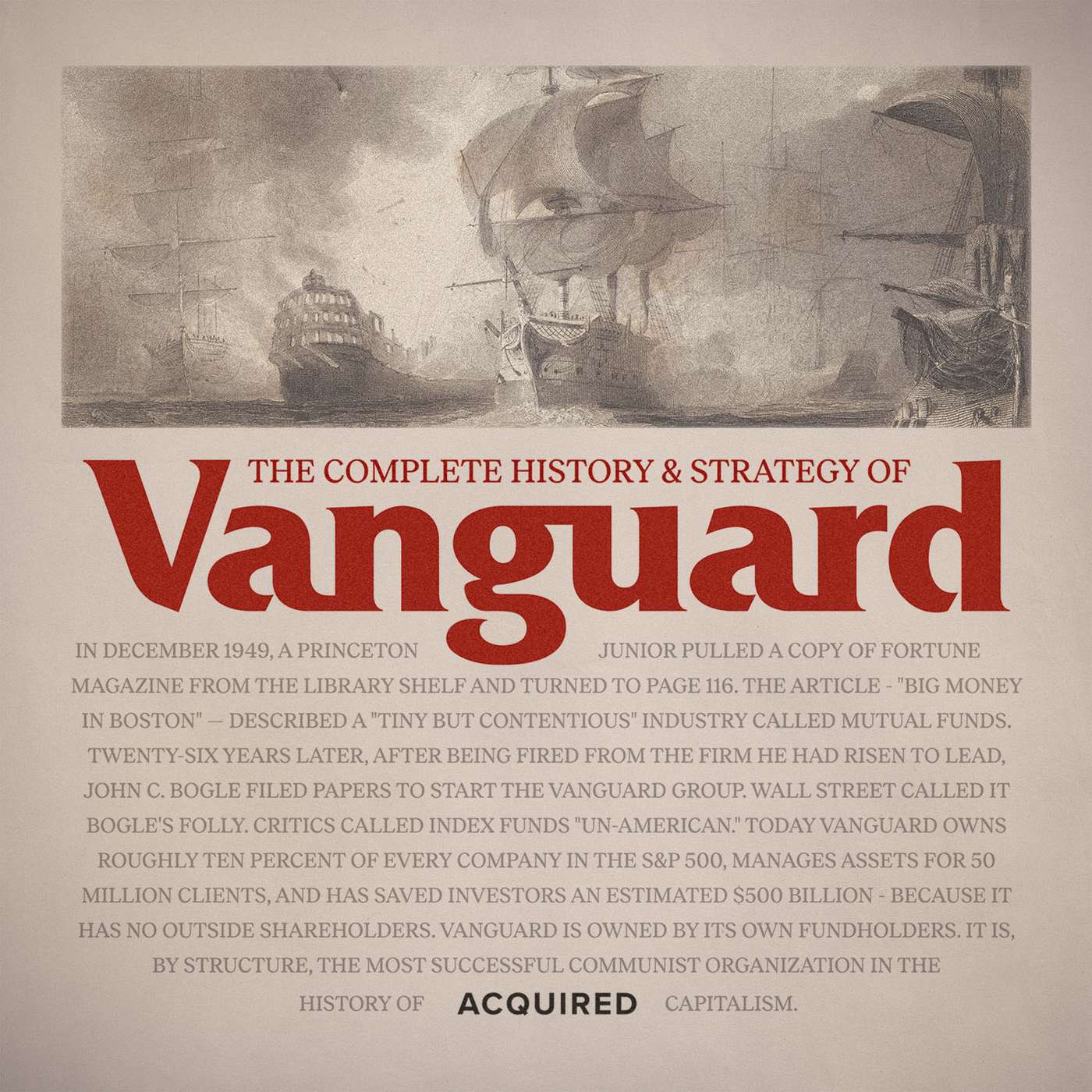
Vanguard is the most effective vehicle ever created for participating in the fruits of American capitalism. Today it’s the single largest equity owner of the majority of corporations in the S&P 500, on behalf of 50 million clients (including, likely, many of you). And yet Vanguard itself is essentially a communist organization — it has no shareholders, makes no profits, and operates more like REI than Fidelity. If you own a Vanguard fund, you own a piece of the firm itself. Any excess margin instead gets returned to clients in the form of lower fees, which since 1975 have added up to roughly five hundred billion dollars transferred out of Wall Street managers’ pockets and into retail investors’ savings accounts. And oh yeah, it all started as a cockamamie revenge plot by a guy who’d just been fired by his partners. Today we tell the story of communist capitalism at its finest — Vanguard.
Sponsors:
Many thanks to our fantastic Spring '26 Season partners:
Links:
- Sign up for email updates, get our takeaways and research photos from each episode, and vote on future topics!
- Our Vanguard "episode preview" in WSJ
- Stay the Course: The Story of Vanguard and the Index Revolution by John C. Bogle
- The Bogle Effect by Eric Balchunas
- Worldly Partners' Multi-Decade Vanguard Study
- Worldly Partners' Article Generational Investing: The Discipline Behind 100+x Outcomes
- All episode sources
Carve Outs:
- Our WSJ pieces on Ferrari and Vanguard
- MacBook Pro M5 Max
- Michael MacKelvie on YouTube
- The Super Mario Galaxy Movie
- Brooks Vanguard sneakers
More Acquired:
- Get email updates and vote on future episodes!
- Join the Slack
- Check out the latest swag in the ACQ Merch Store!
00:00:00 Start
00:00:41 Intro
00:05:30 Jack Bogle's Early Life & Family Ruin (1929)
00:12:34 Princeton Thesis & Mutual Funds Emerge (1949-1951)
00:27:20 Joining Wellington Management (1951)
00:30:38 The Go-Go Years & Fidelity's Ascent (1958-1965)
00:40:36 Jack Takes the Reins & The Ivest Merger (1965)
00:46:04 The Go-Go Bust & Jack's Crisis of Conscience (1970-1973)
00:53:28 Jack is Fired: The Genesis of Vanguard (1974)
01:13:03 The Journal Article That Inspired It All (1974-1976)
01:35:02 Building the Fund & Early Struggles (1976-1981)
01:44:32 The Rise of Indexing & Vanguard's Growth (1988-1992)
01:49:06 Jack's Health & The CEO Transition (1995-1996)
02:00:06 The ETF Debate & Jack's Second Firing (1999)
02:24:18 The 2008 Financial Crisis: Vanguard's Moment
02:30:46 The Warren Buffet Bet (2008-2019)
02:41:28 Fidelity & BlackRock's Resurgence (Post-2008)
02:52:04 Salim Ramji: Vanguard's First Outside CEO
03:04:43 Wellington's Comeback & Mutual Ownership
03:08:23 Analysis
03:30:58 Quintessence
03:39:35 Carve-Outs + Outro
Note: Acquired hosts and guests may hold assets discussed in this episode. This podcast is not investment advice, and is intended for informational and entertainment purposes only. You should do your own research and make your own independent decisions when considering any financial transactions.
assets under management
"There's a tiny bit of performance benefit built in because if the assets under management grows organically by the investments performing well, the fees grow, but it's very different than the way that a lot of funds would go on to be structured later with carried interest or a promote or some sort of performance incentive."
Assets under management means the total amount of money the fund company is handling for investors. If the fund grows, the company often earns more because fees are based on that total.
Assets under management (AUM) is the total market value of money that an investment firm manages for clients. Many fund fees are calculated as a percentage of AUM, so fee revenue tends to rise as AUM grows.
carried interest
"There's a tiny bit of performance benefit built in because if the assets under management grows organically by the investments performing well, the fees grow, but it's very different than the way that a lot of funds would go on to be structured later with carried interest or a promote or some sort of performance incentive."
Carried interest is a bonus that fund managers can earn when the investments make money. It’s usually a share of the profits, not just a flat fee.
Carried interest (often shortened to “carry”) is a performance-based share of investment profits that fund managers receive, typically in private equity and some hedge fund structures. Instead of being paid only a fixed management fee, managers can earn more when the fund’s investments perform well.
promote
"There's a tiny bit of performance benefit built in because if the assets under management grows organically by the investments performing well, the fees grow, but it's very different than the way that a lot of funds would go on to be structured later with carried interest or a promote or some sort of performance incentive."
A promote is a profit-based incentive for the people running the fund. If the fund does well, the managers get an extra cut.
A “promote” is another term for a performance incentive where the manager receives an extra share of profits once certain targets are met. In practice, it functions similarly to carried interest as a way to align manager pay with investment results.
hurdle rate
"Hurdle rate, you know, it's against a Benchmark, etc, etc. None of that. Yes, investment returns are but one sort of arrow in the quiver of management companies at this point in time to grow their profits."
A hurdle rate is a “minimum goal” return. If the fund doesn’t beat that target, the performance bonus usually doesn’t apply.
A hurdle rate is a minimum return that an investment or fund must achieve before performance-based fees kick in. It’s often compared against a benchmark so managers only earn incentives after clearing a specified level of performance.
benchmark
"Hurdle rate, you know, it's against a Benchmark, etc, etc. None of that."
A benchmark is a comparison yardstick. It helps you see whether a fund is doing better or worse than the broader market.
A benchmark is a reference index or standard used to judge how well an investment performs. When performance is measured “against a benchmark,” it means the fund’s returns are compared to a market or strategy yardstick.
management fee
"So as a management company group in this hypothetical $100 million fund, you'd be taking $1.5 million a year home, rain or shine. In 1950, that's like $20 million adjusted for inflation today."
A management fee is the regular fee investors pay to the fund company for running the fund. It’s usually charged even if the investments don’t do great.
A management fee is the recurring charge investors pay to have a fund managed, often expressed as a percentage of AUM. Because it’s typically charged regardless of results (“rain or shine”), it can reduce investor returns even in weaker markets.
mutual funds
"And this is again, listeners, for mutual funds, baskets of publicly traded stocks that are just listed publicly to buy on exchanges. And these funds, in exchange for picking them, putting them in a basket and administrating it, are charging 2% to do that."
Mutual funds combine money from lots of people to invest in a basket of assets. You buy shares in the fund, and the fund company manages what’s inside.
Mutual funds pool money from many investors to buy a portfolio of securities, such as stocks. Investors typically buy shares of the fund, and the fund’s managers handle the selection and administration of the underlying investments.
sales load
"So the things we've talked about so far are the 1.5-2% management fee. There is the 8.5% sales load. So that bumps you down from whatever your current principal is to even that on day one when you enter the fund, you know, being down 8.5%."
A sales load is a fee you pay when you purchase the fund. It means less of your money goes to work immediately.
A sales load is a sales commission or upfront charge applied when you buy into a fund. The practical effect is that it reduces the amount of money that actually gets invested on day one.
transaction fees
"And then there's a third thing too, which is transaction fees at this point in time are very, very high. If the fund needs to go and trade stocks to add things to the fund or take things out of the fund, there were very, very large transaction fees relative to today to make those trades."
Transaction fees are the costs of buying and selling investments inside the fund. If they’re high, they can eat into the fund’s overall performance.
Transaction fees are costs incurred when a fund buys or sells securities. Higher transaction fees can make trading more expensive and can reduce net returns, especially when trading is frequent.
open-ended public investment company
"Walter Morgan hires Jack as his assistant right out of school, really takes a shine to him. Jack becomes sort of like a surrogate son to him. ... Walter Morgan hires Jack as his assistant right out of school, really takes a shine to him. ... Walter Morgan hires Jack as his assistant right out of school, really takes a shine to him. ... Wellington Management. Walter Morgan hires Jack as his assistant right out of school, really takes a shine to him. ... founded and was running another early open-ended public investment company in Philadelphia called Wellington Management."
Open-ended means the fund can create or redeem shares as investors buy in or cash out. That’s one reason mutual funds can handle inflows and outflows differently than closed-end funds.
An open-ended investment company issues and redeems shares based on investor demand, rather than having a fixed number of shares. Mutual funds are commonly structured this way, which affects how cash flows and liquidity are managed.
balanced investing
"Wellington and its Wellington Fund was a super conservative and very highly regarded early mutual fund that pioneered the style that came to be known as balanced investing, i. E, a balance between stocks and bonds all within a single fund."
Balanced investing means mixing stocks and bonds in one fund. The goal is to reduce risk by not betting everything on just one type of investment.
Balanced investing is an approach that holds both stocks and bonds in a single portfolio to spread risk and smooth returns. The idea is that when one asset class struggles, the other may help offset the impact.

Chrysler New Yorker
"...ist John Brooks would write about it later in The New Yorker that the Go-Go Era was, quote, a method of operat..."
The Chrysler New Yorker is a large, comfortable luxury car made by Chrysler. It was designed to feel upscale and smooth for long drives. It may come up in conversation because it’s strongly associated with a particular period of car history.
The Chrysler New Yorker is a full-size luxury car that was especially prominent in the mid-to-late 20th century. It’s significant because it represents a “big, comfortable, upscale” approach to American motoring during that era. In a podcast, it may be mentioned in connection with broader cultural references, since the New Yorker name often appears in discussions of the time period.

Subaru Uncharted
"... and be successful in this new Go-Go Era. This is uncharted territory to him. So he actually gives a quote to..."
“Subaru Uncharted” doesn’t sound like a real car model name. It may be a phrase meaning “new territory,” not a specific vehicle. If you can share the exact Subaru model name mentioned, I can explain that car.
There isn’t a known Subaru model called the “Uncharted” in standard automotive naming. In the podcast context, it sounds like the term “uncharted territory” is being used metaphorically rather than referring to a specific car. If a specific Subaru vehicle was intended, the exact model name would be needed to explain it accurately.
S&P 500 index
"Jack went off to Standard and Poors headquarters, and negotiates a licensing fee with them for the rights to use the S&P 500 index as the basis for this first index fund."
The S&P 500 is a list of 500 big U.S. companies. An index fund that tracks it is a way to invest in “the market” without picking individual stocks.
The S&P 500 index is a benchmark that tracks the performance of 500 large U.S. companies. When people say “just own the S&P,” they mean holding an index fund designed to mirror that basket of stocks.
index fund without fees
"If your fee that you are charging your clients, is lower than the average fee of the other managers in the market, well, now that delta between fund returns minus fees is much lower for you."
An index fund is built to follow a market index instead of trying to beat it. The key point is that lower fees leave you with more of the returns.
An index fund aims to match the performance of a market index (like the S&P 500) rather than beat it through stock-picking. The episode emphasizes that lower fees improve net returns over time, even if the fund’s gross performance is just “average.”
active management
"He always believed that, hey, active managers might be able to outperform the market, but like Samuelson observed, the durability of that is really, really hard to do and consistently outperform for decades of trades."
Active management is when a fund manager tries to pick investments to do better than the market. The discussion here is that fees make it hard to win over the long run.
Active management means a fund manager tries to outperform a benchmark by selecting and trading investments. The episode argues that, after fees, active managers as a group generally can’t beat the market consistently.
cost matters hypothesis
"Yeah, later in life, Jack would come to call this the cost matters hypothesis."
This idea says that the costs you pay to invest matter a lot. Over many years, lower fees can make a huge difference in how much money you end up with.
The cost matters hypothesis argues that investment costs (especially fees) are a dominant driver of long-term outcomes. In this episode, it’s framed as the core lesson behind indexing: lower fees make it much easier to keep more of your returns.
APL programming language
"Jack assigns one of the first employees... to go write the software to do this... He goes off, writes it in the APL programming language on a time-sharing computer in Philadelphia."
APL is a computer programming language. The host is using it to explain what kind of software was written back then for the first index fund.
APL (A Programming Language) is a high-level programming language known for concise syntax and array-oriented operations. The episode mentions it to describe the early software work behind creating a retail index fund.
Vanguard's first retail index fund launch
"Well, regardless, in 1976 Vanguard launches the First Index Investment Trust Fund... which today has been renamed to the much better titled Vanguard 500 Index Fund, ticker VFIAX..."
They discuss when Vanguard launched its first index fund for regular investors and how it grew. The episode also compares how big the funds are today.
This segment covers Vanguard’s launch of its first retail index fund and how it evolved into the Vanguard 500 Index Fund. It also compares fund scale using assets under management.
low-cost index fund
"Now you might be wondering, that's not a lot of capital, and Vanguard's fees are super low. How is the firm staying afloat during this period? Well, it turns out that Jack's first revolution of the low-cost, low-fee proposition of Vanguard, it works pretty well, in equities."
An index fund is built to follow a market’s overall results instead of picking individual stocks to “win.” “Low-cost” means it charges smaller fees, so more of your money stays invested.
A low-cost index fund is a fund designed to match the performance of a market index (like the S&P 500) rather than trying to beat it stock-by-stock. The key idea is that it keeps expenses and trading activity low, which helps investors keep more of the returns after fees.
fixed income
"Specifically, money markets and fixed income, aka bonds, the debt market... If you're investing in the debt markets or the money markets, there is a ceiling to your performance."
Fixed income is money you invest in things like bonds that usually pay interest on a schedule. The hosts are saying the upside is more limited than stocks, so fees and costs become especially important.
Fixed income refers to investments that typically pay scheduled interest payments, such as bonds. The segment argues that in fixed income and money markets, performance is more constrained, so low costs matter even more for relative results.
money markets
"Specifically, money markets and fixed income, aka bonds, the debt market... The only thing that matters... is cost."
Money markets are places to keep cash in short-term investments that usually aim to be safer than stocks. The hosts say returns are limited, so paying lower fees helps you keep more of what you earn.
Money markets are short-term, relatively low-risk investments used for parking cash, often tied to interest rates. In the segment, they’re grouped with fixed income to explain why returns are capped and why cost becomes the main differentiator.
coupons
"It is the coupons of government bonds or muni bonds, or, you know, treasuries in the case of money markets."
A coupon is the interest payment you receive from a bond. The hosts are saying bond income is more predictable and capped compared with stock gains.
A coupon is the interest payment a bond makes to the holder, typically expressed as a rate of the bond’s face value. The segment uses coupons to illustrate why bond returns have an upper limit compared with equities.
passive index investors
"There's a behavioral component where passive index investors tend to not act. And what you need to do is not act for long periods of time to be a great investor."
Passive index investors usually don’t constantly buy and sell based on headlines. They tend to stick with the plan, which can help them avoid panic decisions during market ups and downs.
Passive index investing means investors hold an index fund and generally avoid frequent changes based on short-term news or emotions. The hosts argue this behavior helps reduce common mistakes like selling winners too early or reacting to market swings.
behavioral component
"A giant one is behavioral. If you are in a mindset where you are actively trying to pick the best companies, you do a lot of trading... There's a behavioral component where passive index investors tend to not act."
A behavioral component refers to how human psychology affects investment decisions—like chasing what’s up, panicking when it’s down, or changing strategy too often. In this segment, it’s used to explain why low-cost indexing can outperform many active funds over time.
Vanguard 500 Index Fund
"So as we exit the '80s here, all the pieces are in place finally for the rise of indexing. The Vanguard 500 Index Fund crosses a billion, as we said, in 1988."
This is Vanguard’s fund that follows the S&P 500, which represents many big U.S. stocks. The hosts use it to explain how index investing grew and got cheaper as it scaled.
The Vanguard 500 Index Fund is Vanguard’s index fund built to track the S&P 500, giving investors broad exposure to large U.S. companies. In the segment, it’s used as a milestone for how indexing scaled and became low-cost over time.
scale economies
"The Vanguard 500 Index Fund crosses a billion... The model's working better and better. The scale economies are getting shared."
Scale economies mean bigger operations can often run more efficiently and spread costs out. The hosts say Vanguard’s growth helped it lower fees for investors.
Scale economies are cost advantages a business gets as it grows—spreading fixed costs over more assets and improving efficiency. The segment argues that as Vanguard’s index funds grew, those savings could be passed to investors through lower fees.
basis points
"Fees are coming down from that initial launch price of 68 basis points to, in 1979, 59 basis points, then down to 50 basis points in 1985 to 35 basis points in 1987."
Basis points are a way to measure small percentage changes in fees or interest rates. Here, they’re used to show how Vanguard’s costs dropped over time.
Basis points are a unit used to describe interest rates and fees, where 1 basis point equals 0.01%. The hosts track Vanguard’s fee changes in basis points to show how the index-fund model became truly low-cost.
Total Stock Market Index Fund
"Also in 1992, Vanguard launches the sister fund, the Total Stock Market Index Fund. They now have more than enough capital base that they can own every single stock."
This fund aims to include basically all U.S. stocks, not just the biggest ones. The hosts say Vanguard could do it once it had enough money and better computer systems to manage the data.
The Total Stock Market Index Fund is an index fund designed to cover a much broader slice of the U.S. stock market than just the S&P 500. The hosts describe it as a “own everything” approach once Vanguard had enough capital and technology to track and report the entire market.
ETF
"And you might think Bogle's gonna love this. Like, what is an ETF? It's an even easier way to buy into something that looks basically like an index fund... So ETFs have lots of great things about them."
An ETF is a type of investment fund that you can trade on a stock exchange. Because it trades like a stock, you can buy or sell it during the day at the current price.
An ETF (exchange-traded fund) is a fund that trades on a stock exchange like a stock. That means you can buy and sell it during market hours at the current market price, rather than waiting for the end-of-day price like many traditional mutual funds.
intraday arbitrage
"…the temptation for people to do that is so bad that the product shouldn't exist... speculate on it, not be a long-term owner, and just try to do intraday arbitrage."
Intraday arbitrage means trying to make quick profits by trading many times during the day when prices don’t match perfectly. The worry here is that it could encourage people to trade instead of invest for the long run.
Intraday arbitrage is rapid trading within the same day to profit from price differences across markets or moments. In the episode, Jack’s concern is that because ETFs trade continuously, some investors may be tempted to trade frequently instead of holding long-term.
short sell
"…it means that you can short sell them. And he thinks this will just be like an absolute disaster for the financial industry."
Short selling is when someone bets the price will go down and tries to profit from that decline. The episode’s point is that ETFs can be used for this kind of strategy because they trade like stocks.
Short selling (shorting) is a strategy where an investor bets that an asset’s price will fall. The episode argues that because ETFs trade on exchanges, they can be shorted, which Jack believes could create instability or “disaster” for markets.
SPDR
"The SPDR... The well-known SPDR, Standard & Poor's Depository Receipts Trust, which is the listing for State Street'S&P 500 ETF…"
SPDR is a well-known ETF brand connected to State Street. Here it’s mentioned as the listing name for an S&P 500 ETF.
SPDR is the brand name for a family of ETFs associated with State Street and the S&P 500. In the transcript, SPDR is specifically tied to State Street’s listing for the S&P 500 ETF.
State Street
"…Nathan goes on to launch the world's first ETF with a new asset management division of an old Boston bank named State Street."
State Street is a big financial company involved with launching ETFs. In the episode, it’s portrayed as being ahead of Vanguard in ETF growth.
State Street is the financial services company that launched an ETF partnership/asset management effort referenced in the episode. The hosts describe it as having a major lead in ETF market share, which Vanguard felt pressure to catch up to.

Buick Century
"...f the most incredible lives, I think, of the 20th century into the 21st century. Yes, yes. I love that you'..."
The Buick Century is a mid-size car made by Buick. It was built to be comfortable for regular driving, like commuting and family trips. People bring it up because it’s a familiar model from earlier years.
The Buick Century is a mid-size car that Buick produced for many years, typically positioned as a comfortable, family-friendly option. It’s often discussed because it reflects how American automakers built practical vehicles with a focus on ride comfort and everyday usability. In a podcast, it may be mentioned as part of a broader conversation about cars from past decades.

BMW M5
"...l feels snappy. And I was wrong. The — getting an M5 Max revealed to me just how slow my 2021 computer..."
The BMW M5 is a fast, sporty version of a regular BMW sedan. It’s made to accelerate quickly and handle well, but still be comfortable for daily driving. People talk about it because it feels like a performance car that can still work as a regular car.
The BMW M5 is a high-performance version of the 5 Series, built for fast acceleration and confident handling in a luxury sedan package. It’s often discussed because it represents a “do-it-all” performance car—powerful enough for spirited driving while still being practical for everyday use. In a podcast, it may come up when someone is comparing how quickly a car feels to respond versus what they expected.

Ferrari LaFerrari
""My mobile battle station." It's my LaFerrari in a backpack. Oh, amazing."
The Ferrari LaFerrari is a very rare, extremely fast supercar made by Ferrari. It uses advanced technology to deliver high performance, including a hybrid system. People talk about it because it’s one of the most famous and special Ferraris ever made.
The Ferrari LaFerrari is a limited-production, flagship supercar built to showcase Ferrari’s top-tier performance and technology. It’s often discussed because it combines extreme speed with advanced hybrid powertrain engineering, making it a standout in modern supercar history. In a podcast, it may be referenced as an iconic, instantly recognizable “dream car” that sparks excitement.
Request an Explanation
Heard something you'd like explained? We'll add it to this episode.
Sign in to request explanations for terms you heard.
Want to learn more?
Browse our glossary for plain-English explanations of automotive terms, jargon, and concepts.
Help improve this episode
See something that's not quite right? Our annotations are AI-generated and can sometimes miss the mark. Click the flag icon on any annotation to suggest a correction.